"United we bargain, divided we beg."
Showing posts with label harvest. Show all posts

Tuesday, September 12, 2023

Change of (Beverage) Seasons


It’s been a few years since we last broke out the old cider press. This is the same machine my family used to press apples when I was a little kid growing up on a three acre hobby farm in Woodinville (years before the Microsoft campus transformed it from a sleepy, far-out Seattle suburb into software-mogul wonderland). My mom gave it to me when we first moved up here and started planting apple trees. 

Our apple trees have met various terrible fates. Some were eaten by goats, other run over with riding mowers when they were but tiny saplings. We do have one beautiful, well grown apple tree that I planted specifically for the purpose of making hard cider. It’s an antique variety called a golden russet. But it’s a late apple, best after the first frost, and also I don’t drink alcohol anymore, so it’s of minimal use on a warm September day when we feel like making cider. 

Therefore I invited my good neighbor Hilde and her family to make cider with us. They have a large old orchard with several different kinds of apples. We all traipsed out to pick apples, and her sharp-eyed daughter saved us from a fate worse than death by spotting this horrendously huge hornet’s nest hidden in one of the trees.


Carefully avoiding the tree of mayhem, we gathered several large totes full of apples. Hope kept asking “do you think we have enough apples?” and didn’t believe me when I told her we manifestly had more than enough apples. Like I said, it’s been a few years, but I can still do 5 gallon bucket-to-gallon jug conversions in my head. 

It was a lot of work, as cidering always is,,but we all had a great time. Hilde’s kids had never made cider before and they were excited to turn the crank and pass the apples hand to hand and pour the juice through sieves and funnels. 

And we made SO. MUCH. CIDER. As usual, the weak link in the cider-making chain is finding enough jars. We filled up all my half-gallon mason jars, which means it is truly the end of milk season (the goat is almost dry anyway). Luckily Homero rooted around in the recesses of his shop and came up with this 3 gallon skull-shaped beverage dispenser. It doesn’t have a lid, but we just put a plate on top of it and will dispense cider at will for the next few days. 


Wednesday, September 14, 2022

Farm Stand Photos


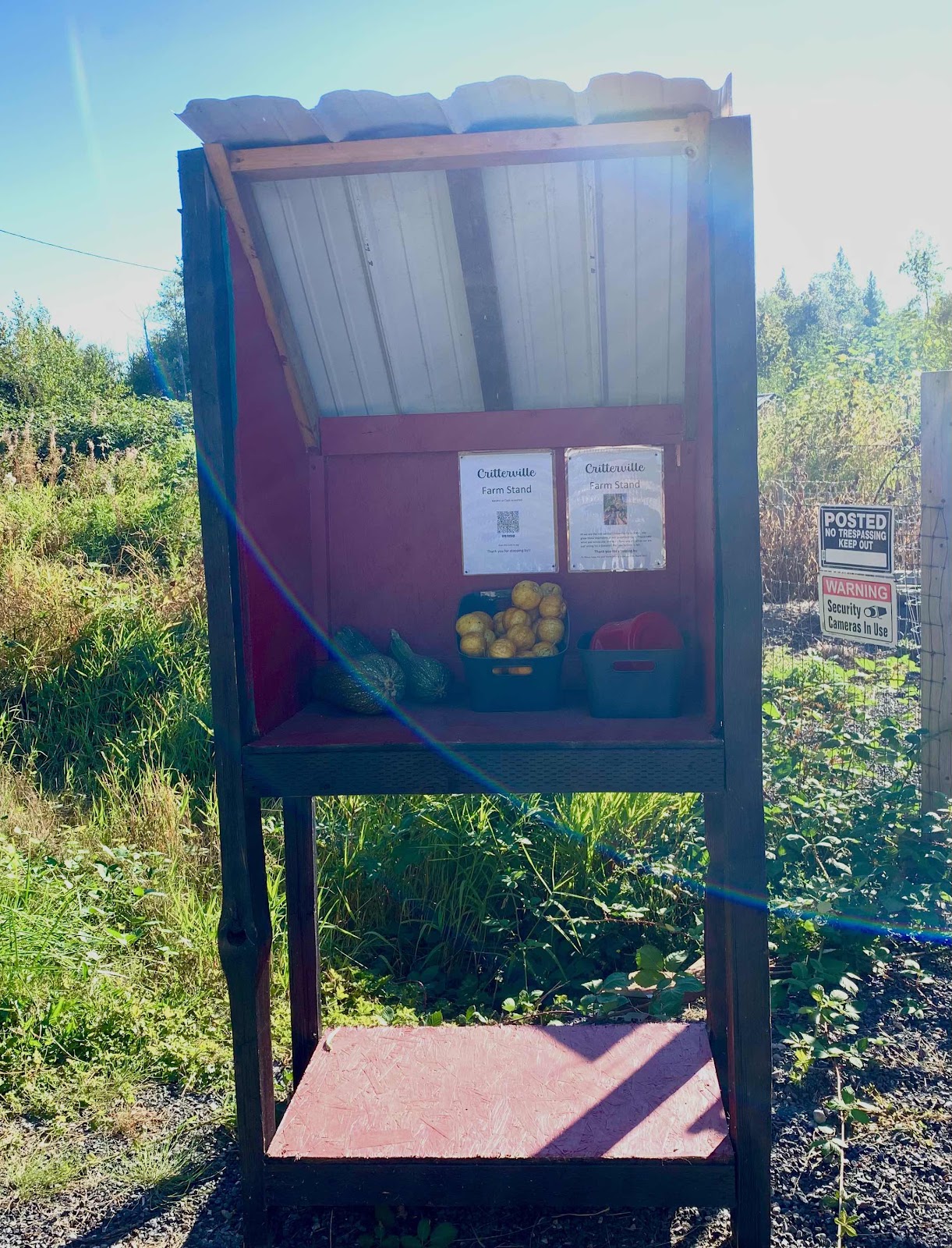
I thought it would be nice to post some photos of local farm stands and what I appreciate about each of them. They are so varied. 


Small, new farm stand on Blaine road north of Grandview (I think?). A small tow-headed boy came out to greet us, very excited to tell us about his lemon cucumbers. 


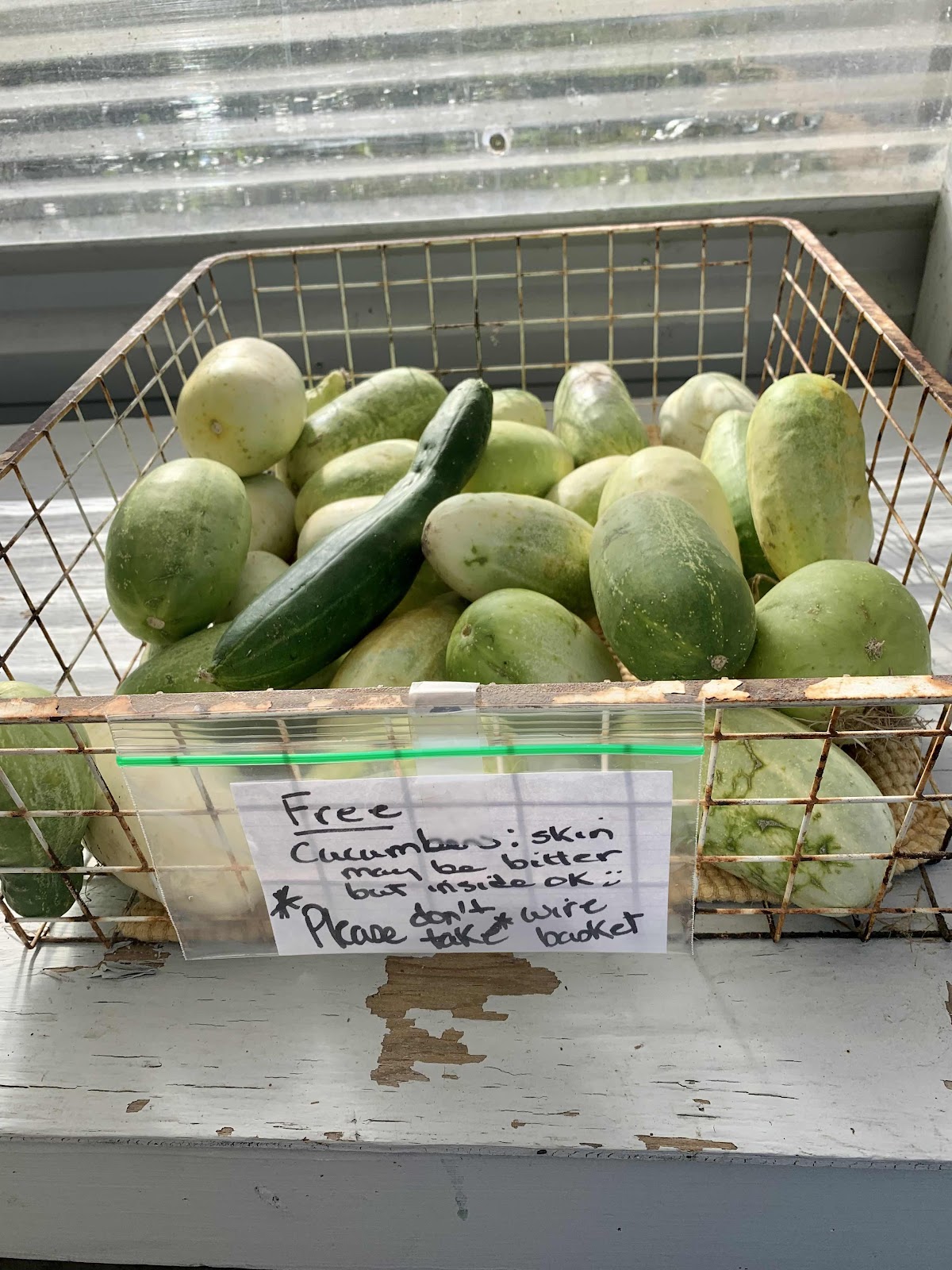
My favorite local stand. Kickerville road between Bay and Birch Bay-Lynden road. They run all season, with veggie starts and live plants in early spring, through to gourds in late fall. They sell seeds as well. There’s a small fridge where the greens stay nice and fresh. Prices are amazing - and in fact they often have free veggies as well. Also sell an assortment of books, baskets, and what-not. I’ve even bought chickens from them in the past. 


Free cucumbers in the Kickerville stand. 


The Kickerville stand from the outside. Looking fairly empty on this particular day. 


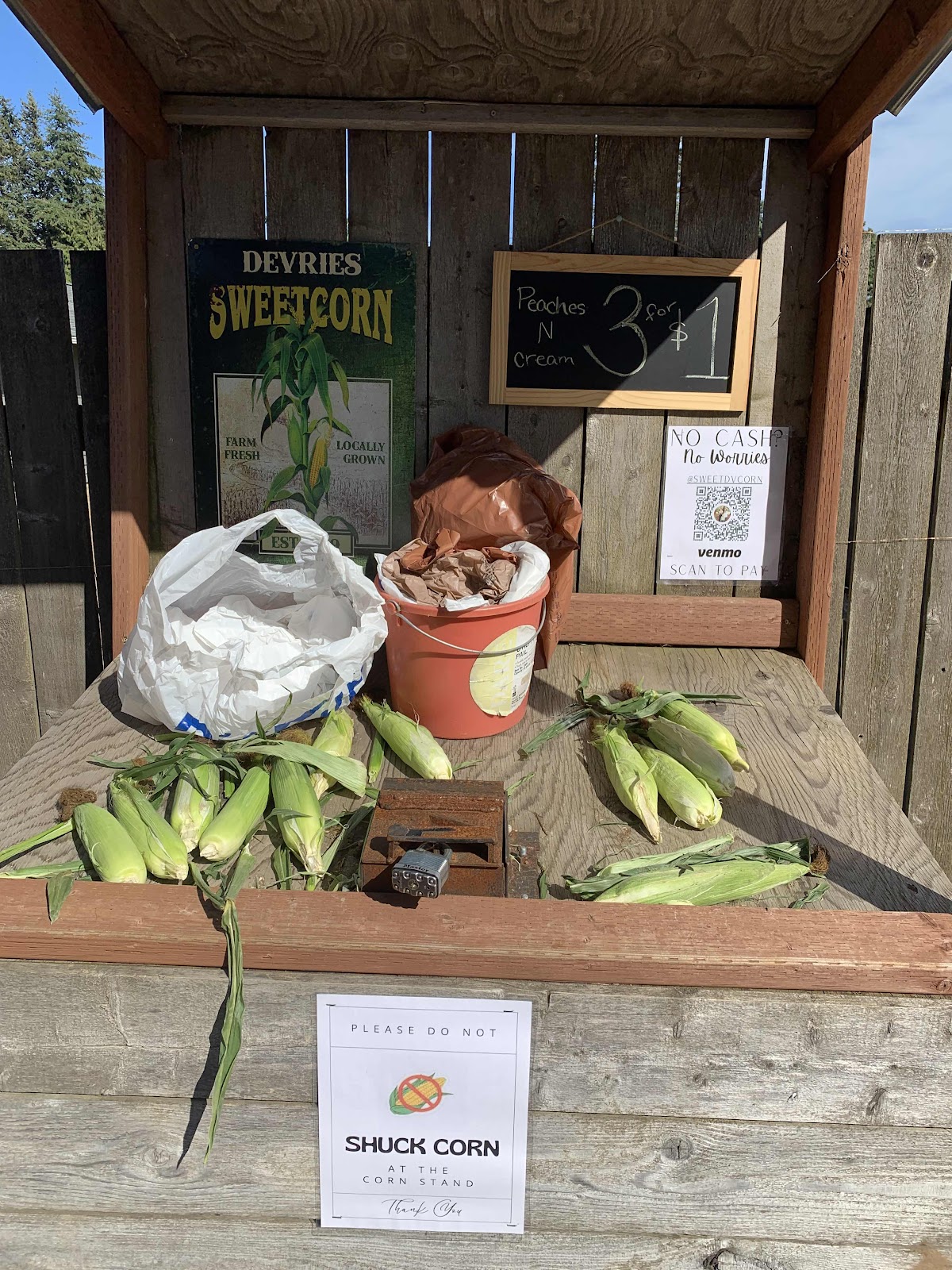
Sweet corn somewhere in the vast, confusing Bermuda Triangle between Enterprise road and the Guide, south of Birch Bay-Lynden road. Forgot to note the address. There are lots of sweet corn stands at the moment, of course, and they tend to be single-produce operations, appearing in mid-august and shuttered by early September. 


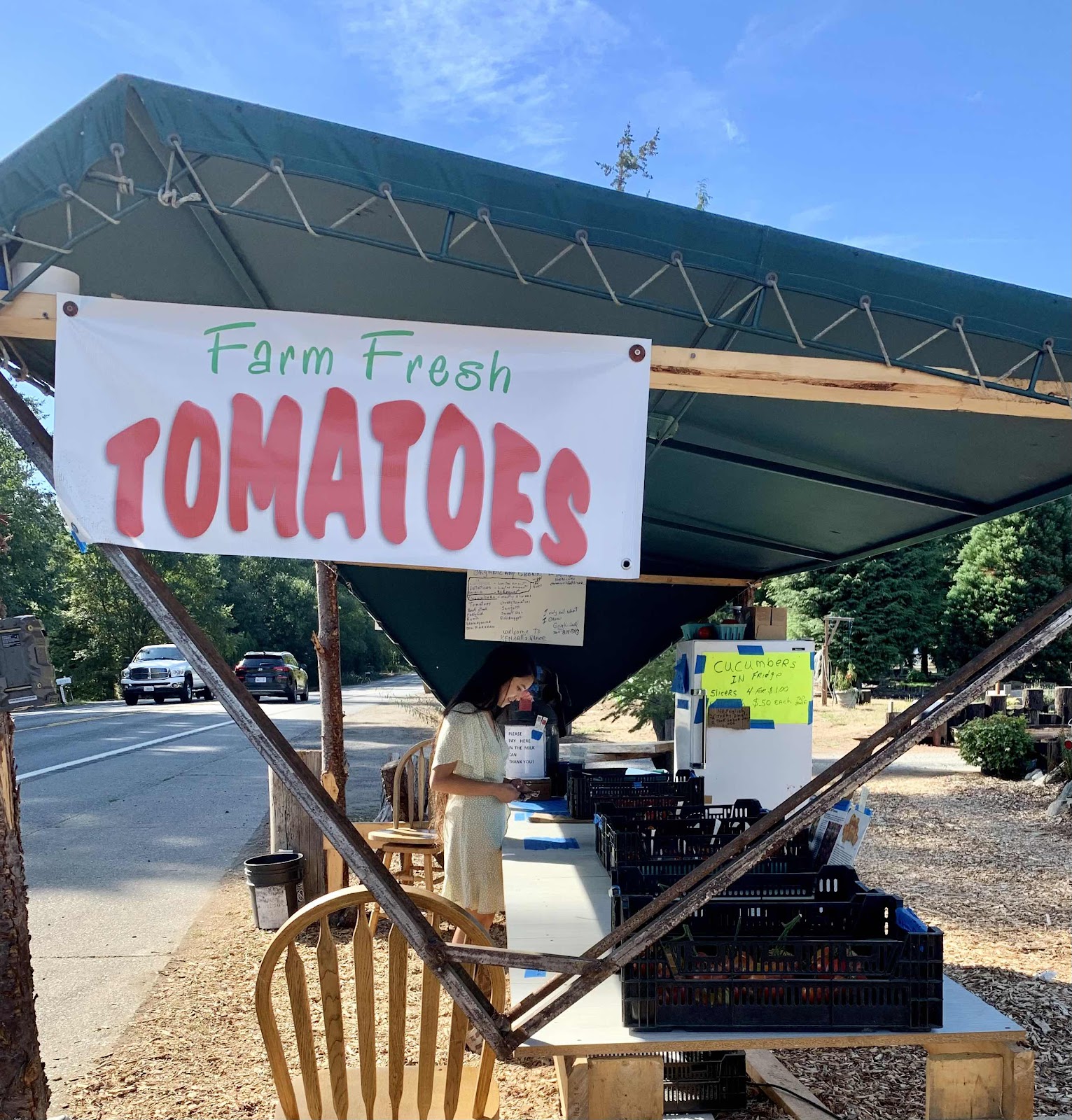
New stand (as of last year) on the Birch Bay -Lynden road just east of the freeway. This young lady grows TONS of tomatoes, many different varieties. Good prices and great tomatoes. 


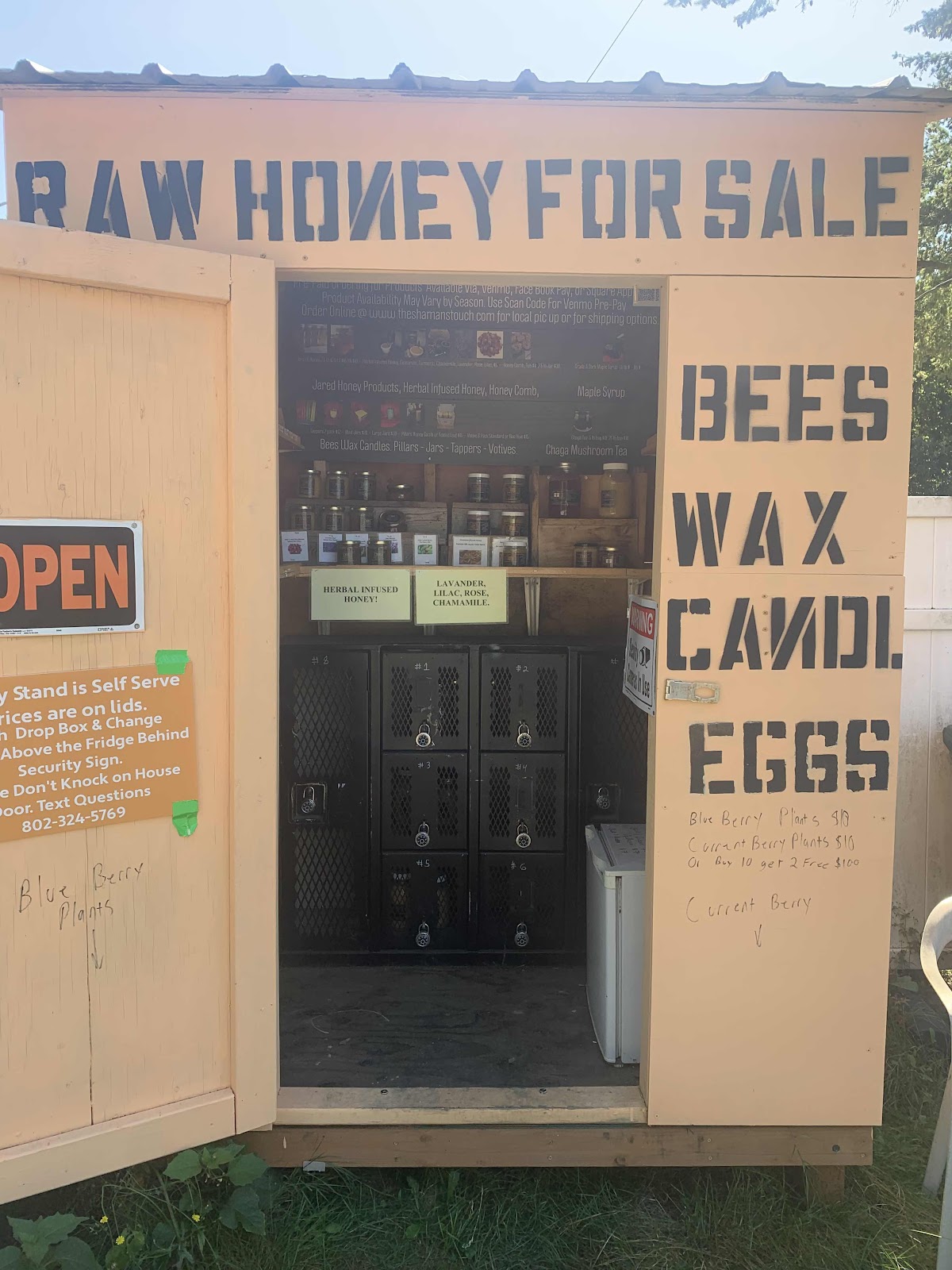
This stand is a real unique one. The owner is a beekeeper and he sells his honey, plain or compounded with herbs and spices and medicines. The lavender honey is especially nice. Overall the best, thickest honey I’ve found. He also sells gorgeous beeswax candles and copies of his self-published novels. 

There are many more farm stands that are worth a mention, but which I haven’t got any pictures of. Just across Kickerville from my favorite farm stand is Tiff’s Dahlias. 
A huge garden with all varieties of dahlias, sold for either $0.50 or $1 a stem, slightly older ones for $0.25. 

Smits family farm in Northwest has a huge and beautiful farm stand worthy of its own post. Mr. Smit has ten acres and grows hundreds of varieties of vegetables, including many not so common ones around here like asparagus. In fact if you are a regular, you can tell Mr. Smit what you would like and he will grow it for you. 

There’s a large stand with two big glass front refrigerators on E. Wiser lake road that sells Guernsey Milk, yogurt, and cream as well as fresh produce. There are also often homemade chocolate chips cookies. 

I never get tired of perusing farm stands, and it always makes me happy when I discover a new one, even if all they sell is zucchini.  

Wednesday, March 23, 2022

Forest Foraging (Spring Greens)


This afternoon the sun made an appearance, interrupting several days of chilly rain. I was so happy to see it that I was moved to actually get off the couch and take a walk outside with my husband. 

My favorite nearby walk is a trail through the forest that leads to a steep, rather slippery and rickety staircase down to the beach. It’s a quiet beach with no access other than this trail, so it’s often empty except for seagulls and crabs. The trip out and back is about a mile and three quarters, which is long enough to feel like exercise, especially when you consider the staircase. 

The forest is nothing special - it’s certainly not old growth - but it is interesting and varied. On some parts of the trail you are surrounded by cedars and enveloped in a ferny gloom; and in other areas alders and cottonwoods prevail. Right now the Indian plums are blooming and there are yellow skunk cabbage in the shady bogs. 

I’m sure a more expert forager than I am could tell you dozens of edibles and medicinals that can be gathered from an environment like this one, year round. I have personally harvested 

- red huckleberry 
- trailing native blackberry
- shaggy parasol mushrooms 
- nettles

I have seen, but not harvested, cottonwood buds (for making Balm of Gilead - https://learningherbs.com/remedies-recipes/balm-of-gilead/) and devil’s club. And I’m certain there are edible fiddlehead ferns and many other types of edible mushrooms and fungi in there as well. And this is just one small forest reserve that a biologist would doubtless describe as degraded. 

I do most of my yearly foraging in fields and hedgerows, not forests. I pick dandelion greens, lamb’s quarter, amaranth, field mushrooms like puffballs and agaricus campestri. Blackberries and sour cherries and plums from abandoned trees. Most of what I forage is not truly wild but rather escaped nonnative weeds. That’s okay. It’s all good food. 

A few days ago I went out and walked my fence lines looking for nettles. There were a few here and there, but they were all still very small. It will be another two weeks before I can get enough for a pot of soup. Today on the forest rail though, I saw hundreds of nettles, all at just about the perfect stage for picking. I guess I have my exercise for tomorrow planned out. 

Thursday, October 28, 2021

Monster Squash 2021 (Count on Cucurbits)

My mother used to say there were only two things for certain in this world - death and taxes. But I know there is another - that every year volunteer squash will grow out of the compost pile. 

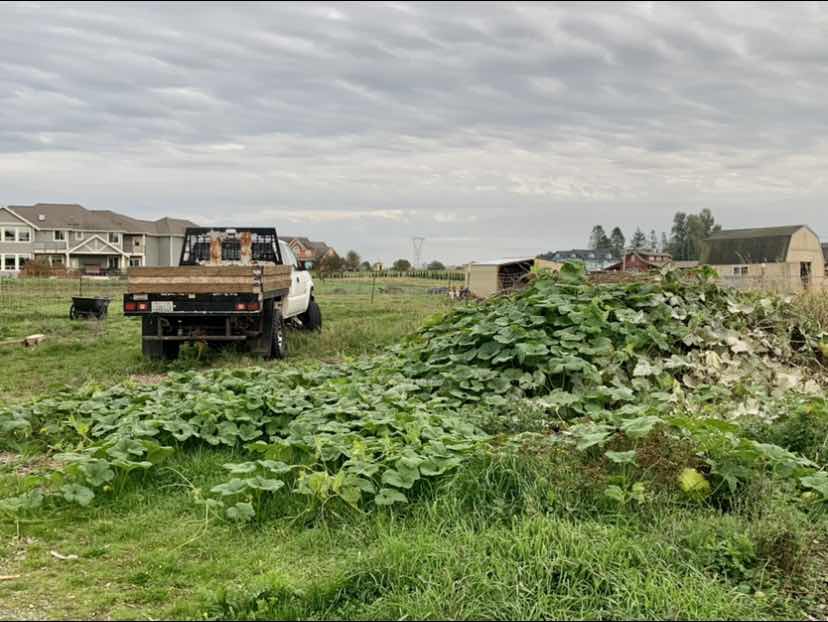
It’s so funny, I don’t usually have much luck trying to grow winter squash on purpose. The plants get powdery mildew, or they are poorly pollinated, or they get blossom end rot. But lo and behold the vigorous vines that sprouted this year from our discarded supermarket squash seeds:


There are actually three separate volunteer plants in that picture, and together they cover a good 500 square feet. All of them bore copious fruit, but unfortunately since supermarket squash are mostly hybrids, none of the three distinct varieties of fruit they bore was good to eat. 

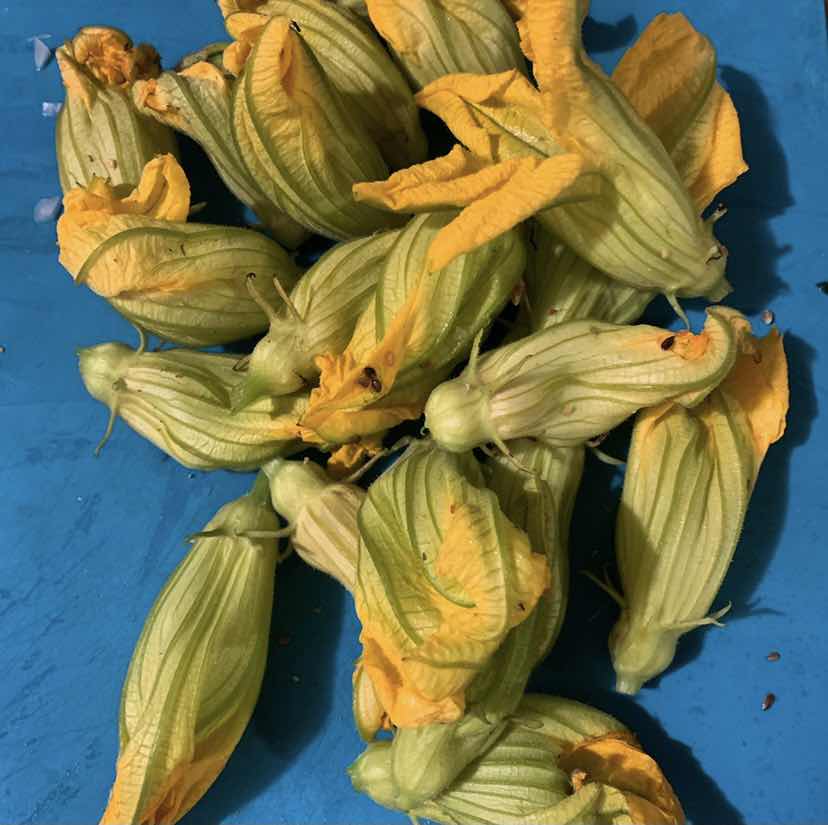
As varied as squash fruits are - that is to say, infinitely - squash blossoms are uniform. All squash plants, be they winter or summer or of unknown provenance, produce lovely yellow trumpet shaped flowers that are delicious. 

We like to tuck the fresh raw flowers into quesadillas, but they can be prepared in any number of different ways - one Italian preparation is stuffed with goat cheese, battered and fried. They can be added to soups or just sautéed in butter. 

Since we didn’t care about the inedible fruit of these particular plants, we picked both the male and female flowers, but if you are growing squash to eat just pick the male flowers. They are easy to tell apart because the male flowers grow in tall stems and the female flowers stay stuck close to the vine. Remove the pistils; they can be bitter. And always check for bugs! Our vines were still producing flowers last week, in chilly late October. 


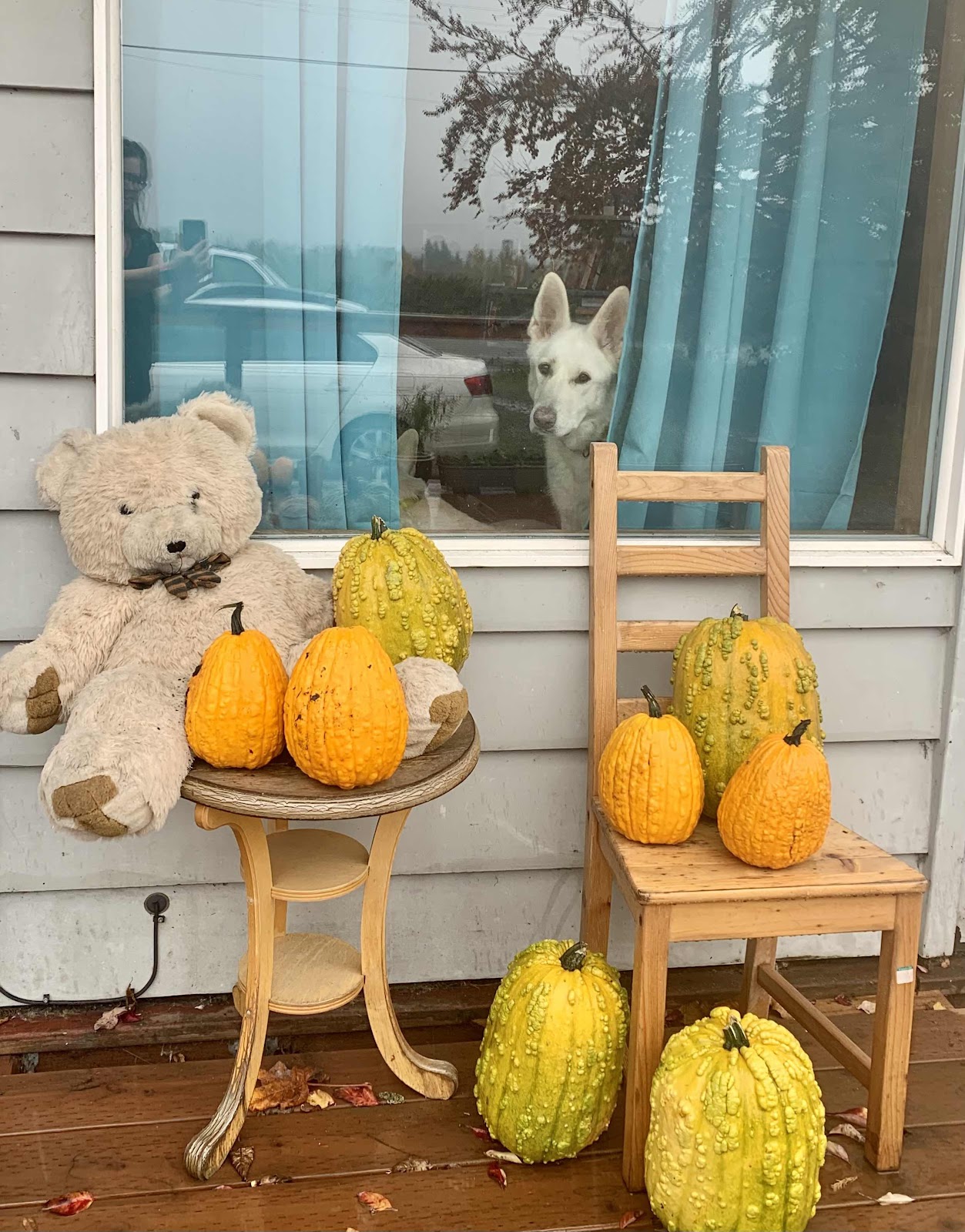
Although inedible, this year’s gourds do make a fine halloween porch display. There are many more that are not pictured here. One gargantuan vine produced more than a dozen of the huge warty gourds - probably well over 100 pounds of squash. 

I am not certain if the seeds of all these squashes are edible or not. I believe they are - I never heard of a poison pumpkin seed - but I should probably look it up to be safe before I decide to roast all the seeds after Halloween. 

Mercy is in the window. 


Monday, August 16, 2021

Meet the Greengage (Bears and Plums)


When we first moved here, in 2007, I knew the first thing I wanted to do was plant some fruit trees. The property had been a dairy farm before it was chopped into five acre parcels and sold off, and our parcel was the one with the original farmhouse on it, and where the dairy barn had stood before it was razed. There were few trees and a lot of bare earth. In my mind, an orchard is an indispensable part of any homestead, so I started doing some research.

Fruit trees are not as easy as people think - they are really rather finicky and delicate, for the most part, and need to be carefully chosen for the site. One needs to take into account not just the zone you are in 
(We are 8a - you can look up yours here) but also your microclimate and factors like drainage and soil composition. I have a very cold, windy microclimate and sandy, gravelly soil. Not really ideal. However I also have full sun all day long and  more than adequate rainfall.  While I was looking for information about varieties that might do well on my farm I found this amazing web site: Trees of Antiquity

Trees of Antiquity is devoted to propagating and preserving heirloom varieties of fruit and nut trees, and their experts will happily chat with you on the phone about your specific needs. They also have a terrific catalogue which arrives in the dead of winter and provides hours of entertainment in January, when I am likely to have exhausted all the interesting options on Netflix. 

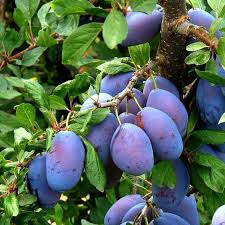
After extensive consultation, I chose several trees - three varieties of apple including one cider apple (a golden russet); three cherries (Bing, Rainier, and one named Sam), three pears (really too many pears, nobody needs three pear trees but I'm glad I got the Comice, they are the best pears EVER. I forget what the other two varieties are) and two plums. One is an Italian plum, which are purple on the outside and golden on the inside and delicious. That tree bears an alternating light/heavy harvest, but always as many plums as we can eat or possibly use. 

The second plum tree I chose is a greengage plum. Greengage plums are a very old variety, believed to have originated in Iran, and first introduced to Europe by the royal gardeners of 16th century France, who named it the Reine Claude. You MAY have seen greengage plums once or twice in a particularly well-sticked grocery store, but they are not generally available because the trees are not well suited to profit driven agriculture. They take a decade or so to begin bearing, and then they only bear good crops every two or three years, with very scant or absent crops on the off years. 

My tree has a perverse tendency to bear only in years when we are spending the summer in Mexico. I have only had three good harvests off this tree (which I planted in 2008. The first was in 2016, when we first discovered the unearthly deliciousness of these plums. Their reputation as the queen of plums is well deserved. We gorged ourselves and eagerly anticipated the next harvest. In 2017 there were no plums. In 2018 we could se it would be a goof year, but alas, we were spending the entire summer in Oaxaca. 

I told a friend of mine to please harvest the plums, and she did. She texted me to thank me and said "oh by the way, there has been a bear in your orchard. I saw bear scat." Normally, I would probably pooh-pooh a pronouncement by a friend of mine that they saw bear scat, but this particular friend grew up in the Yukon, and I trust she k owe bear scat when she sees it. "don't worry about it," she said, "your goats are safe. He was here for the plums." A year or so later, while we were beating about the bushes looking for a lost turkey, we found the place where the bear must have come in. A heavy-duty galvanized cattle panel was crumpled up from the ground, bent and twisted and lifted a good three and a half feet from the ground. We hadn't noticed because it was in an area of very thick brush. As far as we know, the bear hasn't been back. 

Maybe the bear hasn't been back because the tree hasn't fruited again until this year. In late spring, I could see the tree was absolutely loaded with small fruit, and that this would be the best year yet. And once again, we were planning to be in Mexico from mid July through mid August. I lamented the fact that we would probably one again miss out, and told my friend to come on back, and watch for bears. But luckily, when we returned a few days ago, the plums were just beginning to ripen and fall. 

They are just as good as I remember. So sweet - the sweetest fruit I can think of, sweeter than peaches. They are beautiful, too, green with glowing yellow and pink blushes. There is probably no better way to use them than to just eat them out of hand until you can eat no more. But because there are so many, I need to find some other things to so with them. 

Things to do with greengage plums, after eating yourself sick:

- dehydrate them (greengages are a freestone plum, so very easy to prep and dehydrate)

- make a shrub (cover a quart or so of chopped fruit with sugar and let macerate two days in the fridge. Add apple cider vinegar to make a concentrated, sweet-and-sour fruit flavored syrup. Pour over some ice cubes and add sparkling water, with or without a jigger of spirits)


- jam, as a last resort. Perusing some recipes suggests vanilla as a flavoring. However, we also got home in time for peak blackberry season, so my jam needs will be well-met. 

Small rant to end this post: The world has lost some vast and depressing percentage (I've heard everything from 30-75%) of its heirloom varieties of food plants. The wonderful diversity of food plants not only provides us with a spectrum of tastes and nutrition, but is also essential for food security. Different varieties of the same species have differing resistance to pests and diseases and different abilities to thrive in varied climates. This isn't academic - with climate change we need ALL the varieties of ALL the food plants in order to feed our hot, crowded planet. 

There are many seed houses and orchardists devoted to preserving these wonderful old heirloom varieties. 
It's worth seeking some of them out and supporting their mission. You'll eat better and sleep better :)


Sunday, September 13, 2020

Preserving Log (Late Summer 2020)


I’ve been on an absolute tear in the kitchen the last two weeks. Late August/early September is the middle harvest season (Mabon is coming right up), the prime harvest season around here. Here’s a list of what I’ve done lately - as far as I can remember. 


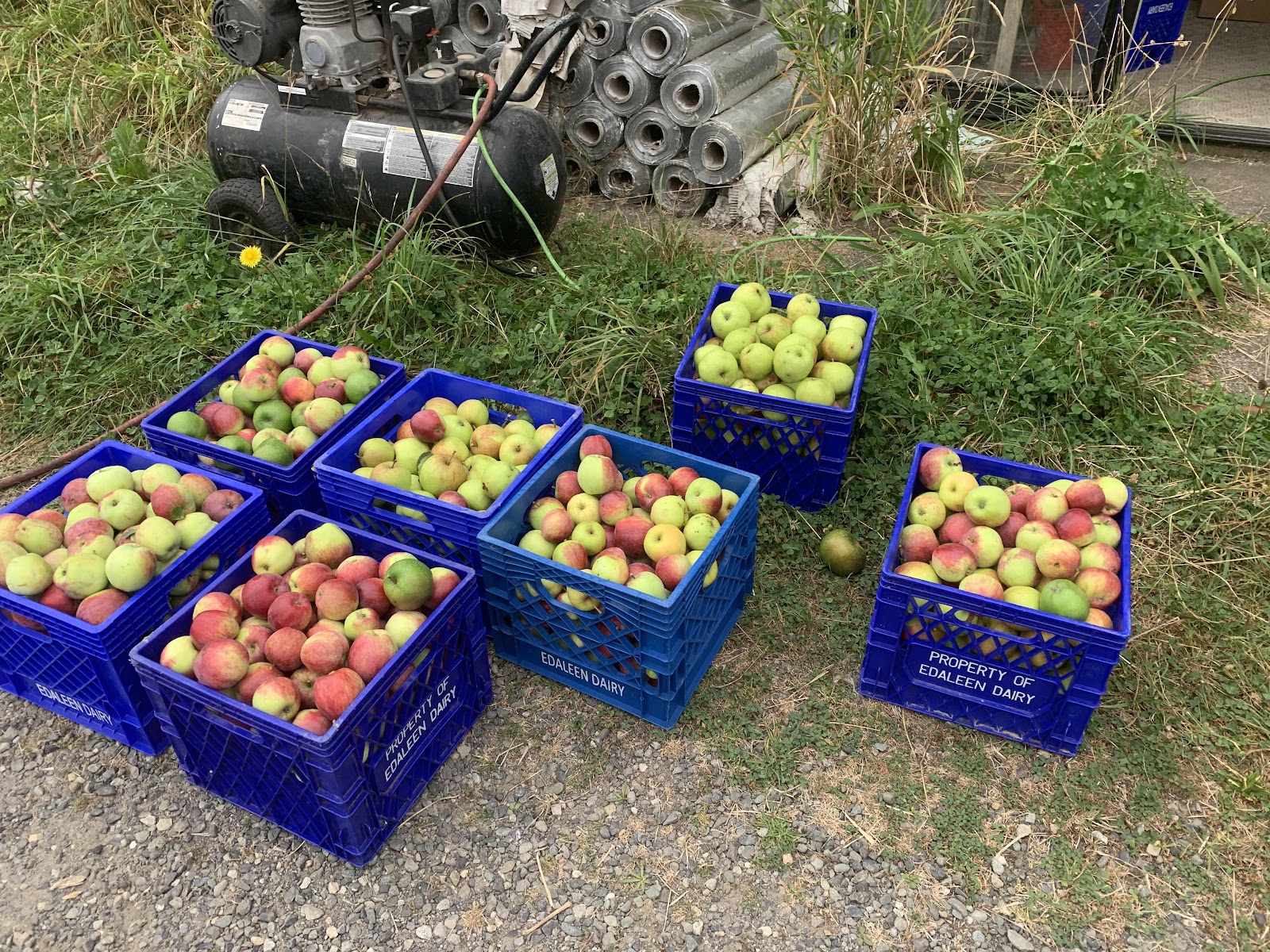
Today the girls and I pressed about ten gallons of cider, from the apples you see above. My friend H. down the way has a dozen apple trees and was only too happy to let us pick some. Tomorrow I will bring her some cider. 

Cidering is hard work. Picking the apples, carrying the crates, washing the apples, hauling the press out and cleaning it, bending down and standing up approximately 7000 times, pressing the buckets, pulling the tight-packed plate back out of the buckets, carrying the apple mast to the compost. It’s messy too, with little bits of apples flying everywhere and juice on everything. By the end I was so sweaty and sticky and tired! Working outdoors in this horrible smoke isn’t a lot of fun, either. But this was the first time we’ve pressed cider in a couple years and overall it’s a great experience. 

The smaller of my two carboys, three gallons, will be made into hard cider, and we’re keeping the rest sweet. I threw two gallons into the freezer, which leaves us about six gallons to get through before it turns into tepache. Not that there’s anything wrong with tepache. 


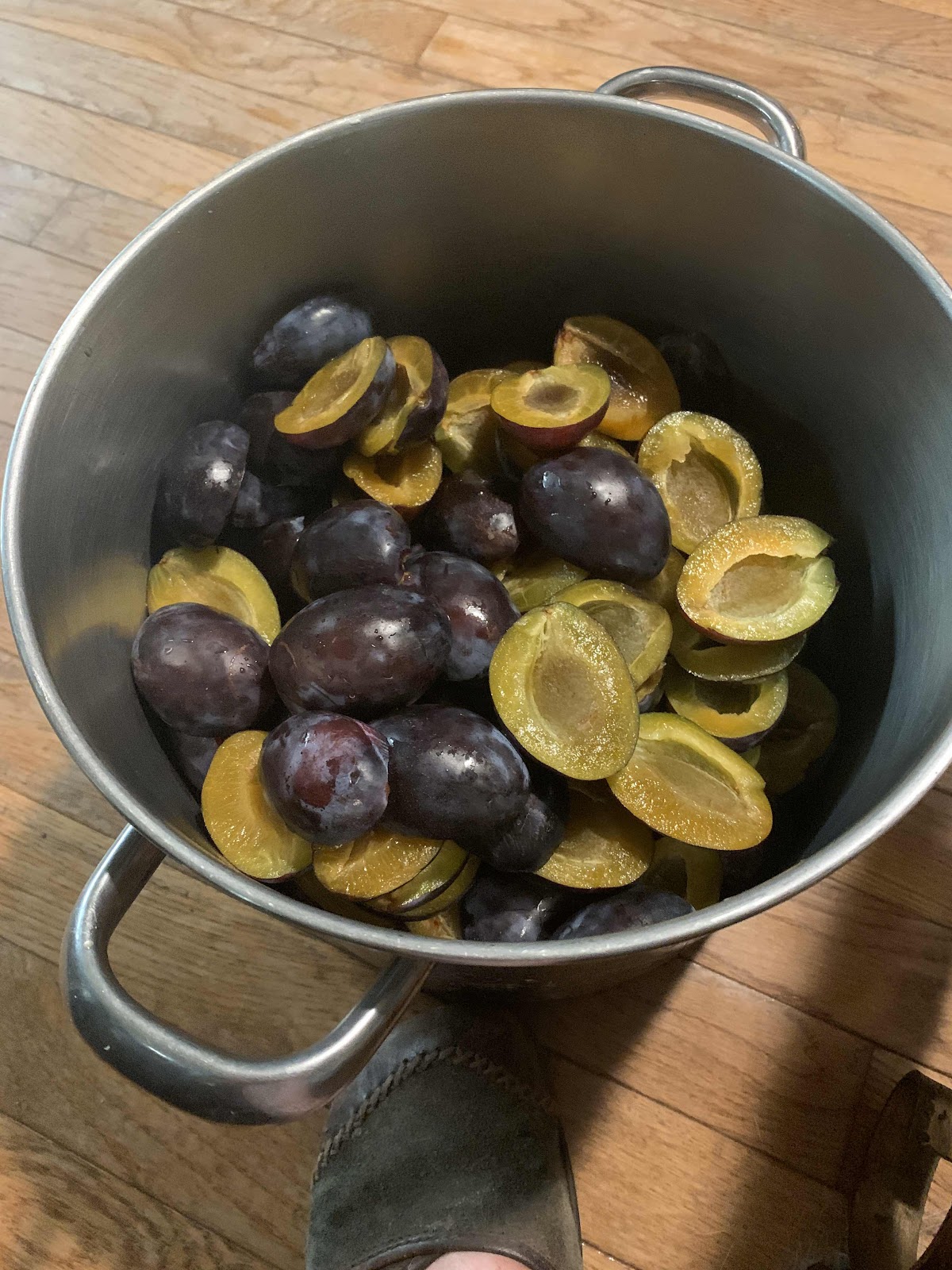
Plums. This in an on-year for the Italian plum tree, and there are hundreds and hundreds of plums. I’ve dehydrated enough to fill a gallon ziploc bag - more plums than you probably think - and the dehydrator is full of plums right now too. 

I’m taking another swing at plum wine. My past efforts have been drinkable, not fantastic.  Probably I won’t get any better unless I buy a little more equipment - like a hydrometer - and start taking recipes more seriously. But hey - there are so many plums. How far wrong can you go? Right now there’s about two gallons in a primary fermenting chamber and I’ll pitch the yeast tomorrow. I have to go buy another carboy because all of mine are currently full of apple cider. 


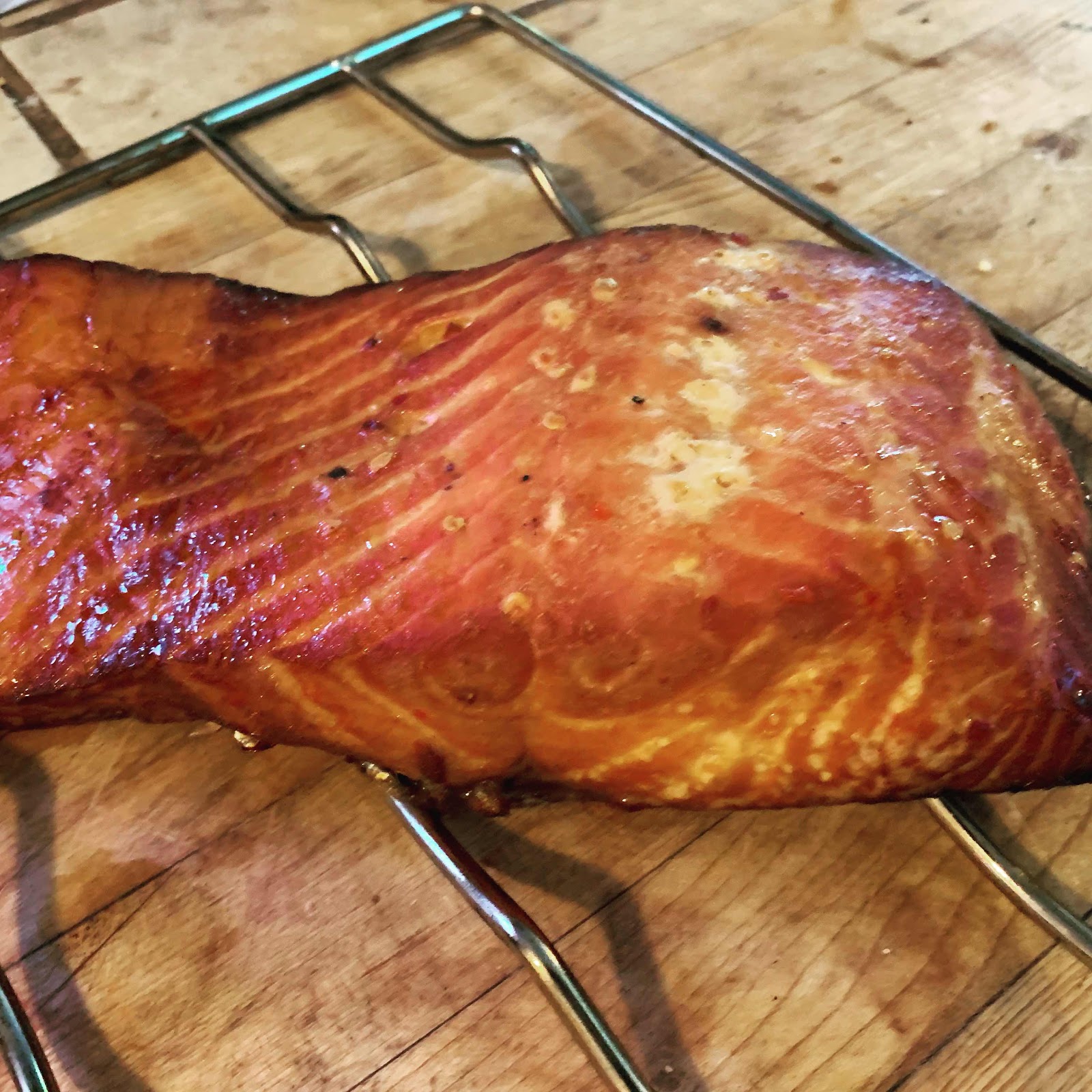
One of Homero’s clients brought him an enormous side of  salmon as a tip. I cut it into five approximately 1 1/2 lb pieces, and we ate one fresh and then I smoked the others. One of the smoked pieces is in the fridge to snack on and the others are vacuum sealed and will keep in the fridge for a few months. Probably not until Christmas though, sadly. Smoked salmon is my favorite thing to send friends and family as a Christmas gift. I could throw them in the freezer but I’m not sure how well the texture would hold up. 

Let’s see, what else? Oh, I canned six quarts of salsa ranchera  this week with tomatoes from gleaners. But I’m not doing a lot of canning for the simple reason that I can’t find canning lids anywhere! Apparently canning lids are the toilet paper of this phase of the pandemic. I have one package of small mouth lids left. 

A couple days ago I hit my favorite local farm stands just to see what was available. I brought home some sweet corn (which we ate), some cherry tomatoes (ditto), five pounds of green beans, and three smallish kohlrabi. I started kimchee with the kohlrabi. Earlier this summer I made a batch of kohlrabi kimchee and it was the BOMB. It’s only about a quart, but we will enjoy it. 

I’ll have to decide if I want to use the last of my canning lids to make canned dilly beans with the green beans, or if I will lacto-ferment them like kosher dill pickles. Both ways are good. 

I haven’t even started in the pears. Good lord, the pears! WHY did I plant FOUR pear trees? 


Wednesday, November 27, 2019

Thankful for the Truth (Warning graphic photos)


I love Thanksgiving, especially in the years, like this one, that I get to host. I enjoy the process of writing a menu, shopping for ingredients, and setting a beautiful table. There are few things that make me happier than seeing people I love really digging in to food I’ve prepared for them. I’m happy when my adult daughter comes over, and I’m happy to see my mom. But there is something about Thanksgiving that make me feel uneasy. There is a whiff of - if not hypocrisy, then maybe willful blindness - that hangs around the Thanksgiving table. 

Thanksgiving is a day of delicious excess, a national fantasy of happy peaceful families and endless sweetness, but the truth is often unpalatable. Enjoying an abundance of good things and being thankful for what we have is, of course, wonderful, and in no way a bad thing. Indeed, we’d all be happier and the world would probably be a better place if we came together more often to share our abundance and to give thanks out loud and in the presence others. 

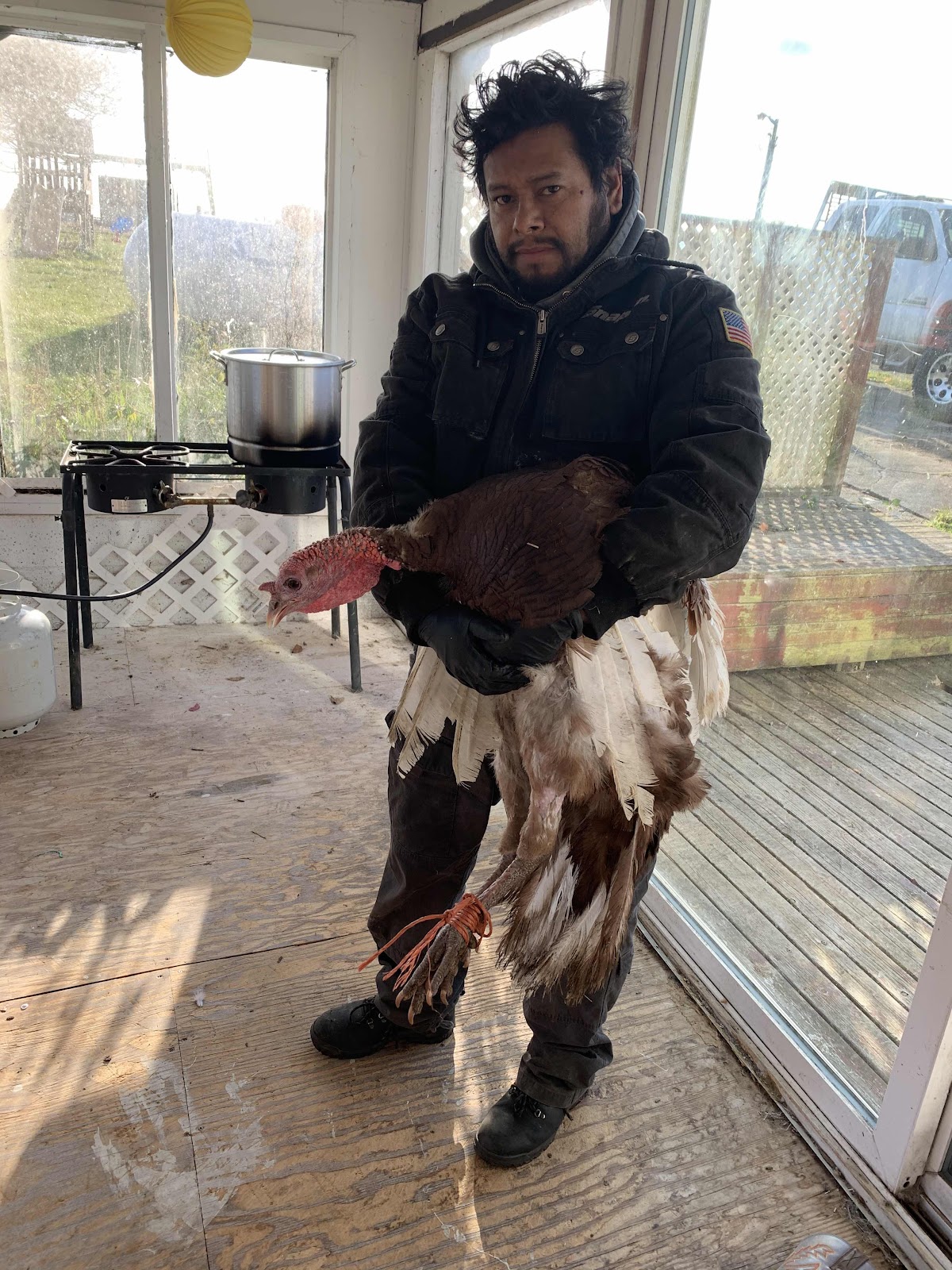
But it’s also important to acknowledge the realities that underlie the feast. These are manifold. Firstly, I acknowledge that to make this feast, a beautiful turkey had to die. 


I acknowledge the work that went into raising him - this bird was raised on pasture by a local farmer, so I thank my neighbor for her work and expense. But I also recognize the labor of the people - mostly immigrants - who toil in the vast and dangerous poultry processing industry; I acknowledge their worth and affirm their right to safe working conditions and just recompense. 

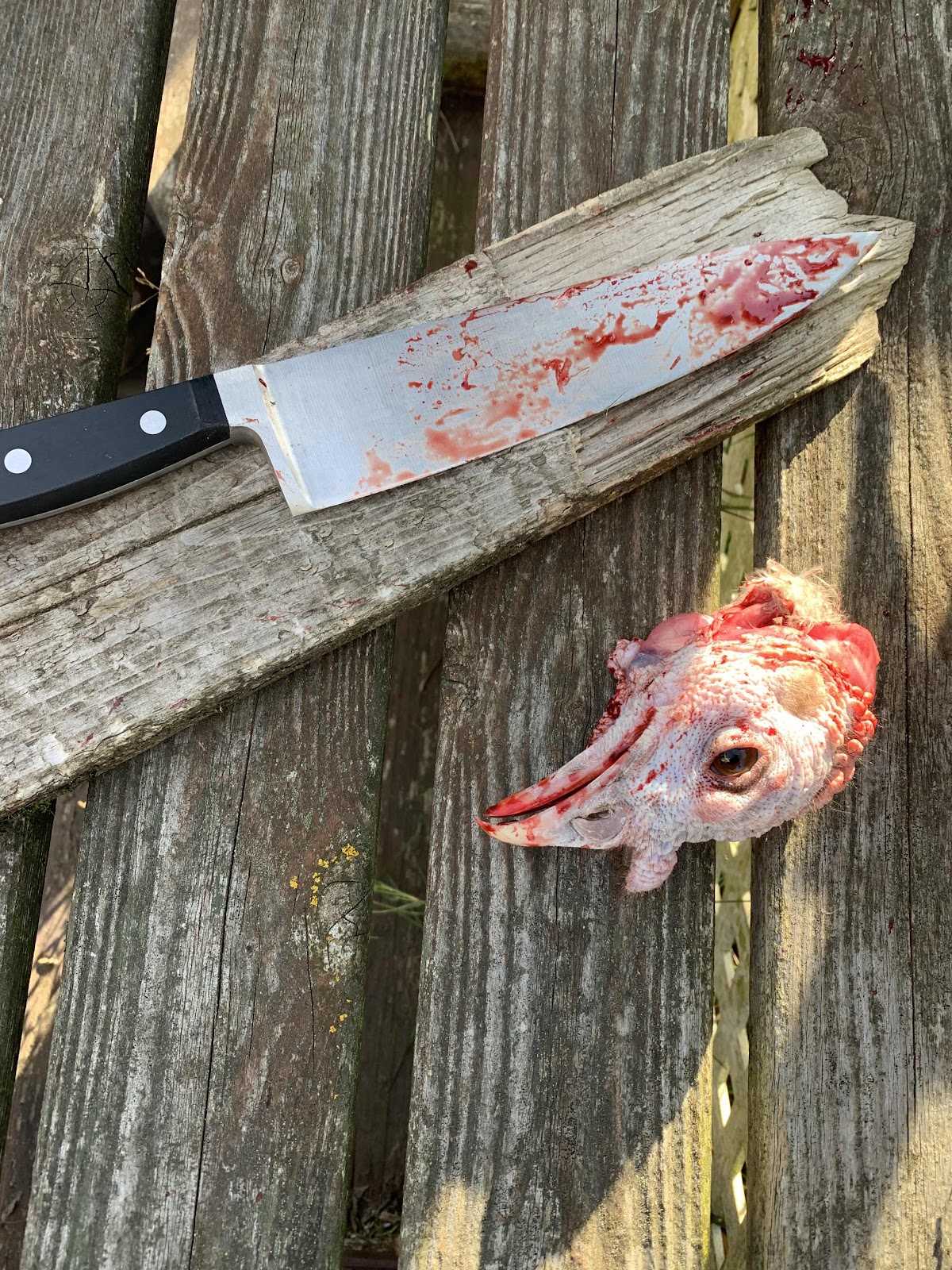
I thank my husband for the work he is doing right this minute - butchering the turkey out in the cold November wind. I acknowledge this is a disagreeable task and I thank him for being willing to develop the skill to do it well. 

The vegetables on the table - the potatoes, the Brussels sprouts, the salad greens - are produced by an unsustainable system that abuses workers and the earth in equal measure.  I am a witness, and I pledge to do what I can to avoid participating in those injustices and to mitigate the tremendous waste generated. 

And finally, I acknowledge that I live on unceded land of the Lummi and Nooksack tribes. All of us settlers live on land that either was never ceded by the tribes, or which was ceded under deeply unequal conditions, in which one side held all the power. I acknowledge that uncomfortable truth. If you want to know on whose land you reside, visit this link: 
https://native-land.ca/. I pledge to work toward correcting the grave inequalities that resulted by upholding the efforts of local tribes to sustain their culture and supporting their businesses and candidates for office. 

None of this is meant to be a huge bummer.

It is possible to be grateful for our wealth while recognizing the problem of poverty. We can celebrate being together with family while knowing that some are lonely. We can give thanks for warm homes, abundant food, and all the good things in our lives without trying to shut out the knowledge of the many who lack those things. It’s not a sin to be warm, to be fed, to be loved. These are wonderful gifts.

My hope and my prayer is that naming our gifts and sharing them with our loved ones will inspire us to share them more widely, as well. I remind myself, as I bask in warmth and light, of the existence of cold and darkness not out of guilt, but so that I may be moved by gratitude and grace to expand the circle of warmth and light to include others. I remind myself, as I nourish my body with roast turkey, of the death of the animal I am eating not as some sort of penance, but to honor the truth that this act embodies the cycles of life and death on this beautiful planet, cycles we are all of us bound by. 

May you be abundantly blessed this Thanksgiving. May you have much to give thanks for, as much as I. 


Thursday, October 10, 2019

Lobsters of the Forest (Mushroom Madness)


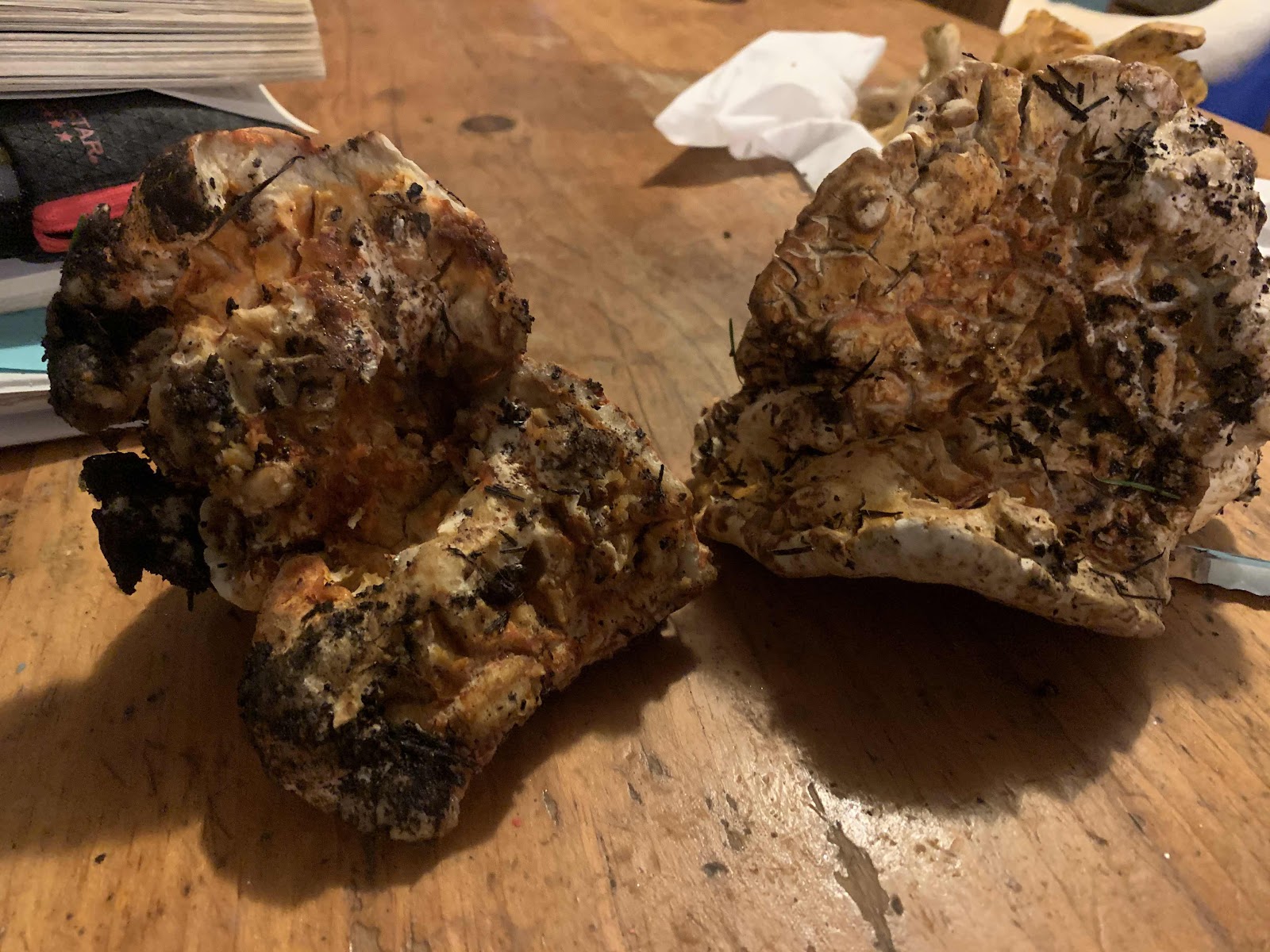
These ugly lumps are actually highly prized lobster mushrooms. 

It’s prime time for mushroom hunting in the Pacific Northwest. The rains came in mid September, right on schedule, and since then we’ve had alternating rain and sunshine, which is just perfect for making the mushrooms pop up. By all accounts it’s been a bumper year for chanterelles. 

I have long been fascinated by fungi, but I’ve not done the work of educating myself to pick them, beyond a very few varieties that are easy to identify. There’s a patch of shaggy manes out in the back pasture. I’m relatively sure I can recognize agaricus campestres (though there are toxic lookalikes). If I happened to trip over a chanterelle or a morel I would know what it was. 

Nobody just trips over forest mushrooms though. You have to go out and search for them, and you have to get off the trails and go bushwhacking through the deep woods. It’s hard physical exercise and it gets you wet, dirty, and scratched up. Also exhilarated and energized. 

A relatively new friend of mine is a confident forager. In the past I’ve traded her goat cheese for mushrooms, but this year I asked if I could pay her to just take me out with her foraging. Not to any of her secret spots! That would be a very rude thing to ask. Just out into the woods and help me improve my eye for good habitat and gain some confidence identifying a few more varieties. She was happy to do so. 

We found several edible mushrooms - coral mushrooms and oyster mushrooms, a couple of decent boletes, and a small patch of chanterelles- but the coolest find was a large number of lobster mushrooms. 


The ugly lumps after careful cleaning.

Lobster mushrooms are cool. They are actually a boring, bland mushroom that has been attacked by another fungus and improbably turned into something delicious. Lobsters start out as Russula Brevipes, which is a large white mushroom that pushes up through the forest duff in evergreen forests. They are edible but exceedingly bland. Wherever you find lots of Russulas, though, you will find a few that have been turned into lobsters. The fungus makes them bright orange and hard, and curls them into fantastic, tortuous shapes. Keep an eye out for glimpses of orange poking through the forest floor. 

Cleaning them is a chore. You don’t want to wash them with water if you can help it because they will soak it up like a sponge and ruin their texture and dilute their subtle flavor. Use a stiff brush instead. Most lobsters will have at least a few wormholes in them (these ones are exceptionally free from worms) but don’t worry about that. Just trim off any bits  that seem too wormy to eat. Ditto any parts that are stubbornly grubby - though as my mom says, you gotta eat a peck of dirt before you die and eating it along with wild mushrooms seems like as good a way as any. 


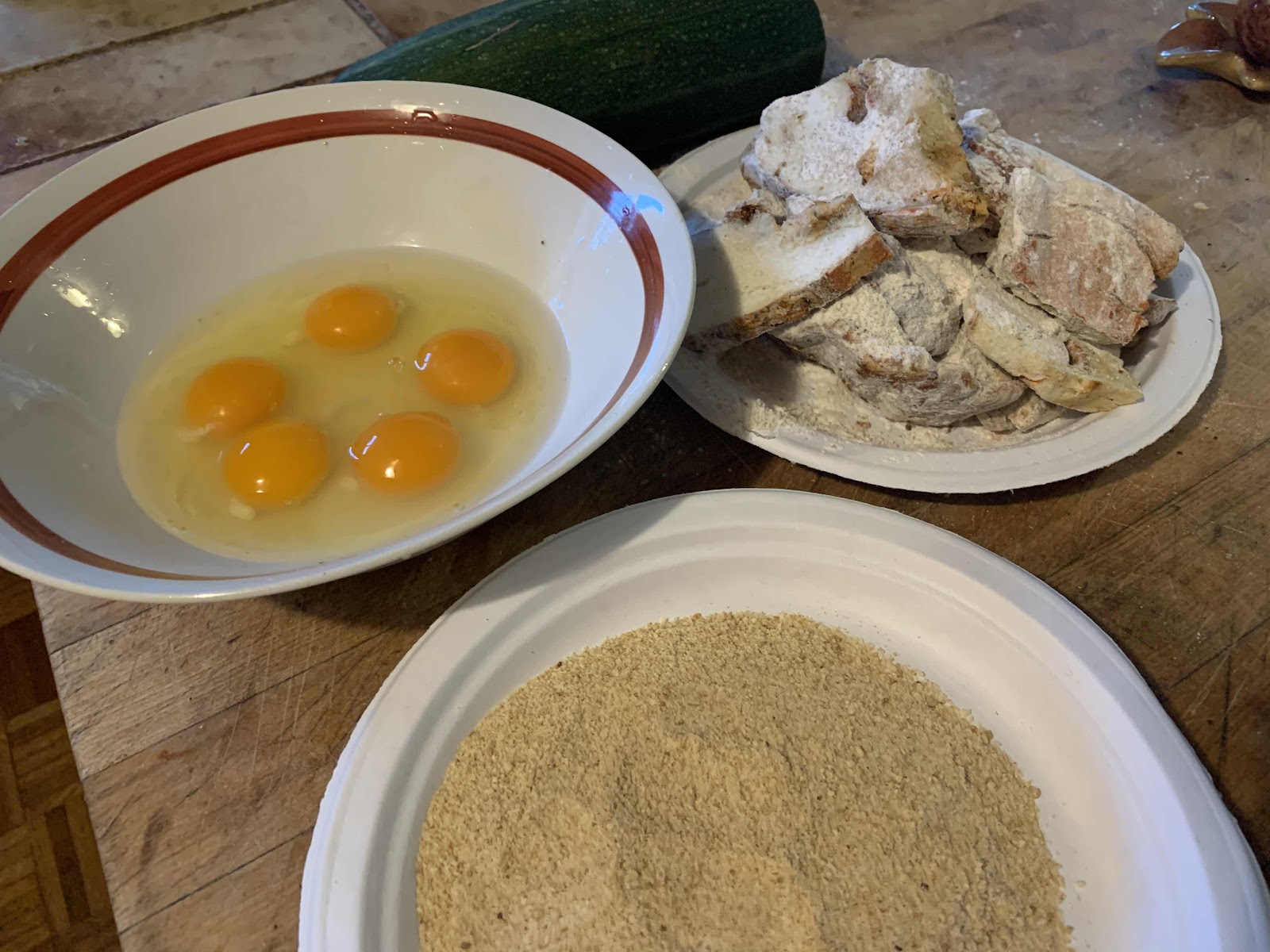
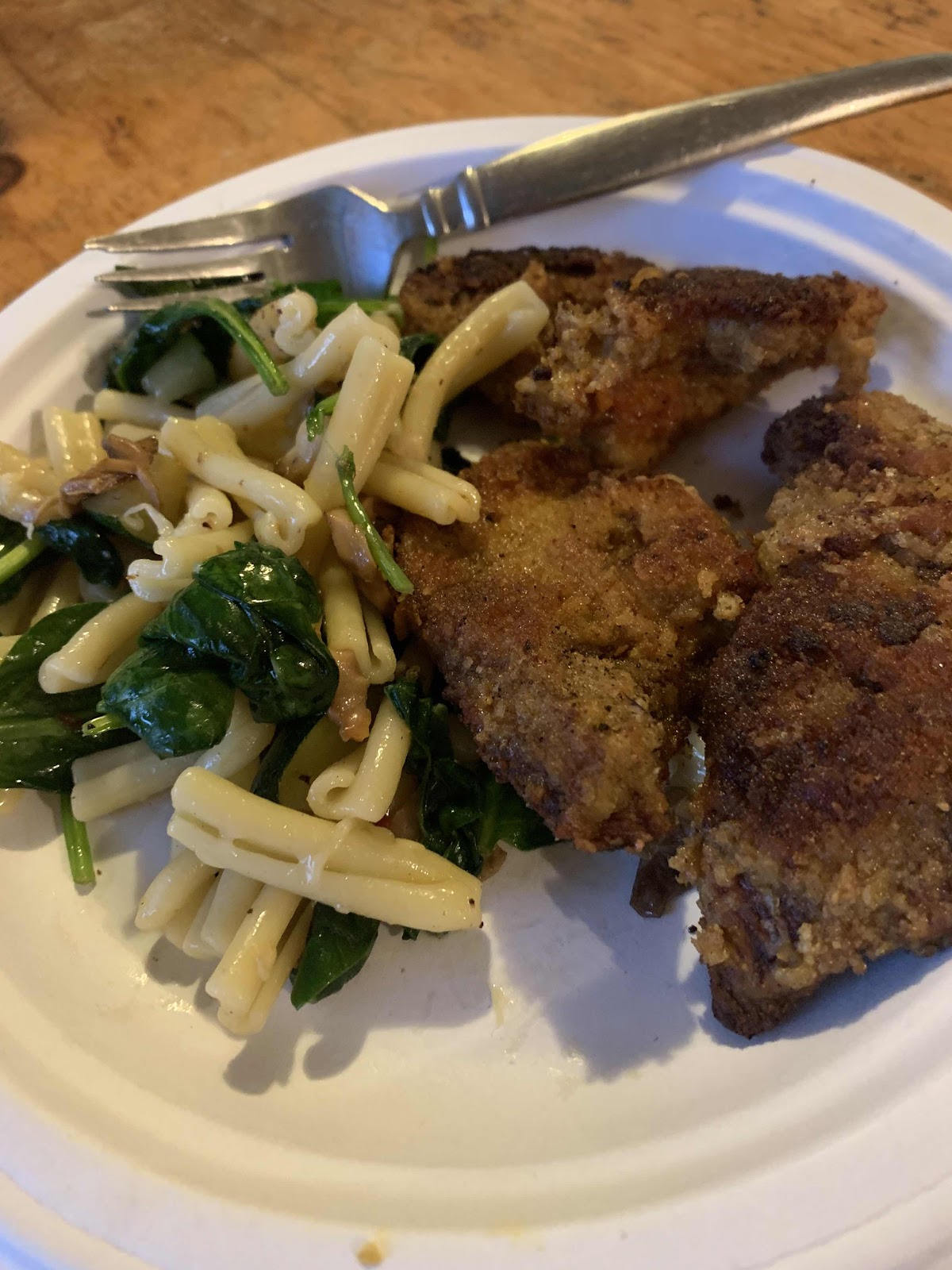
There are lots of ways to prepare lobsters, but they are one of the few wild mushrooms tough enough to stand up to being sliced and fried in egg wash and crumbs like chicken-fried-steak. I added Parmesan to my bread crumbs and pan fried the mushroom steaks y til deep golden brown on both sides. I found I liked them better the more cooked they were, so next time I might use a little lower heat and give them more time. 


The other mushrooms we found went into a pasta side dish with spinach. My husband and kids were a little leery of eating the lobsters at first, but they both enjoyed them after trying them. Homero, in fact, ate an entire lobster mushroom
all by himself. 

After three hours of hiking in the intermittent rain and then cleaning the haul and cooking dinner, Ipushed back from the table, told everyone to clean up please,  I was going to take  a long hot bath. I earned it. 

Tuesday, October 1, 2019

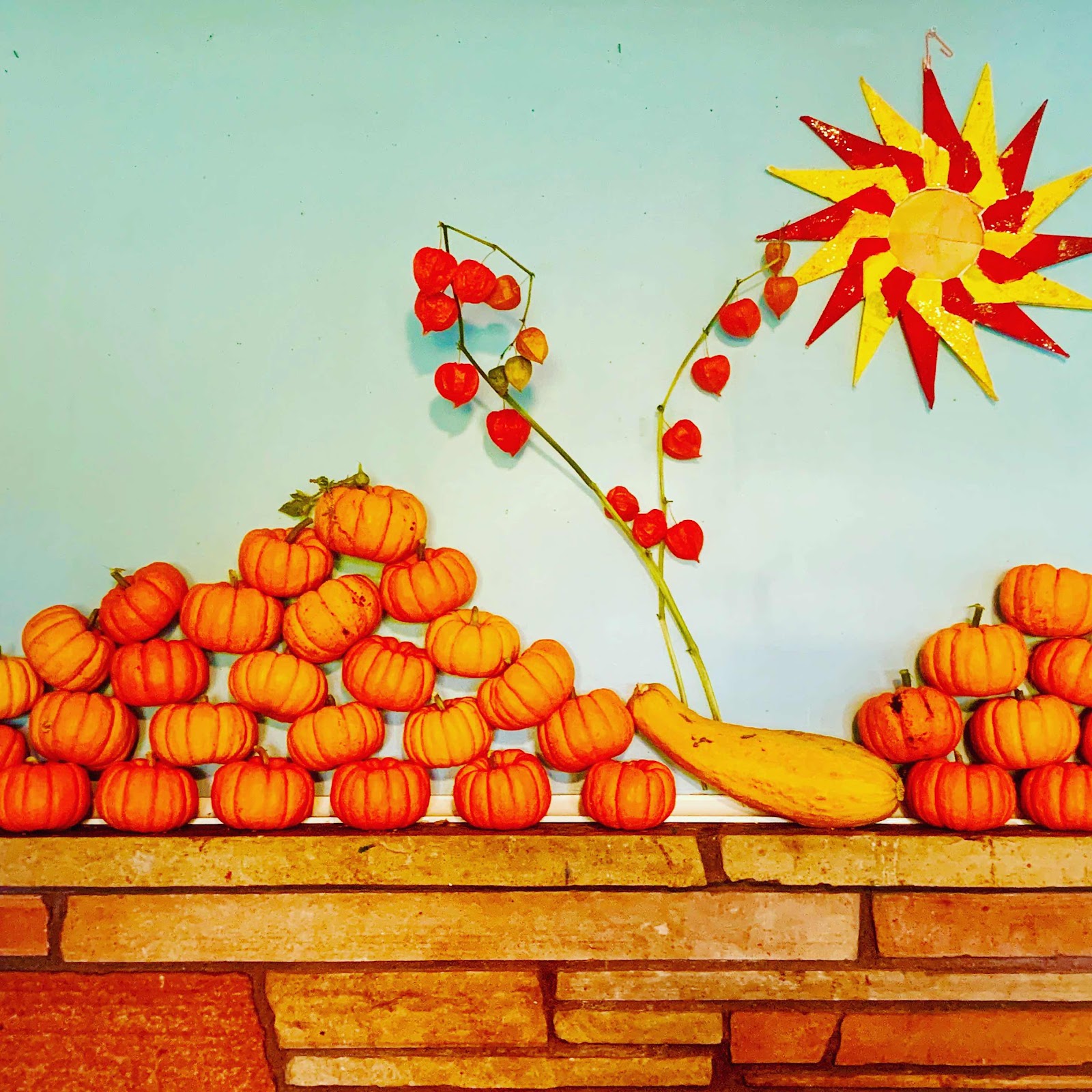
October Altar (Waste Not)


An enormous volunteer squash plant grew out of our compost pile this summer. This happens not infrequently, and because squash vines love rich compost, the plants tend to sprawl over vast areas and produce prodigious amounts of squash. However, most summer squash are hybrid varieties, so volunteer plants that sprout from discarded seeds are unlikely to bear fruit that is much good for eating. 

All squash blossoms are nice for eating, though. We picked many many blossoms for stuffing inside of quesadillas, or for stuffing with goat cheese. But no matter how many blossoms we picked, there were plenty left over for making squash. Past volunteer squash have produced warty gourds, yellow crooknecked squash but with hard shells and thin meat, or strange globular fruits. This one produced tiny rubbed hard shelled pumpkins, the kind you see 
decorated  with googly eyes and painted grins in bins at the grocery store in October. I’m sure they would be poor eating, but they make a nice autumn altar. 


After we picked all the little pumpkins, I let the goats go to town on the giant vine. They appreciated it. After we enjoy them on the altar for a while, I am donating these little guys to my sister, who is a pre-school teacher. No doubt they will all be festooned with googly-eyes and painted grins. 

Happy Fall to you and yours. 


Sunday, August 11, 2019

Sweet Corn and Sweet Memories


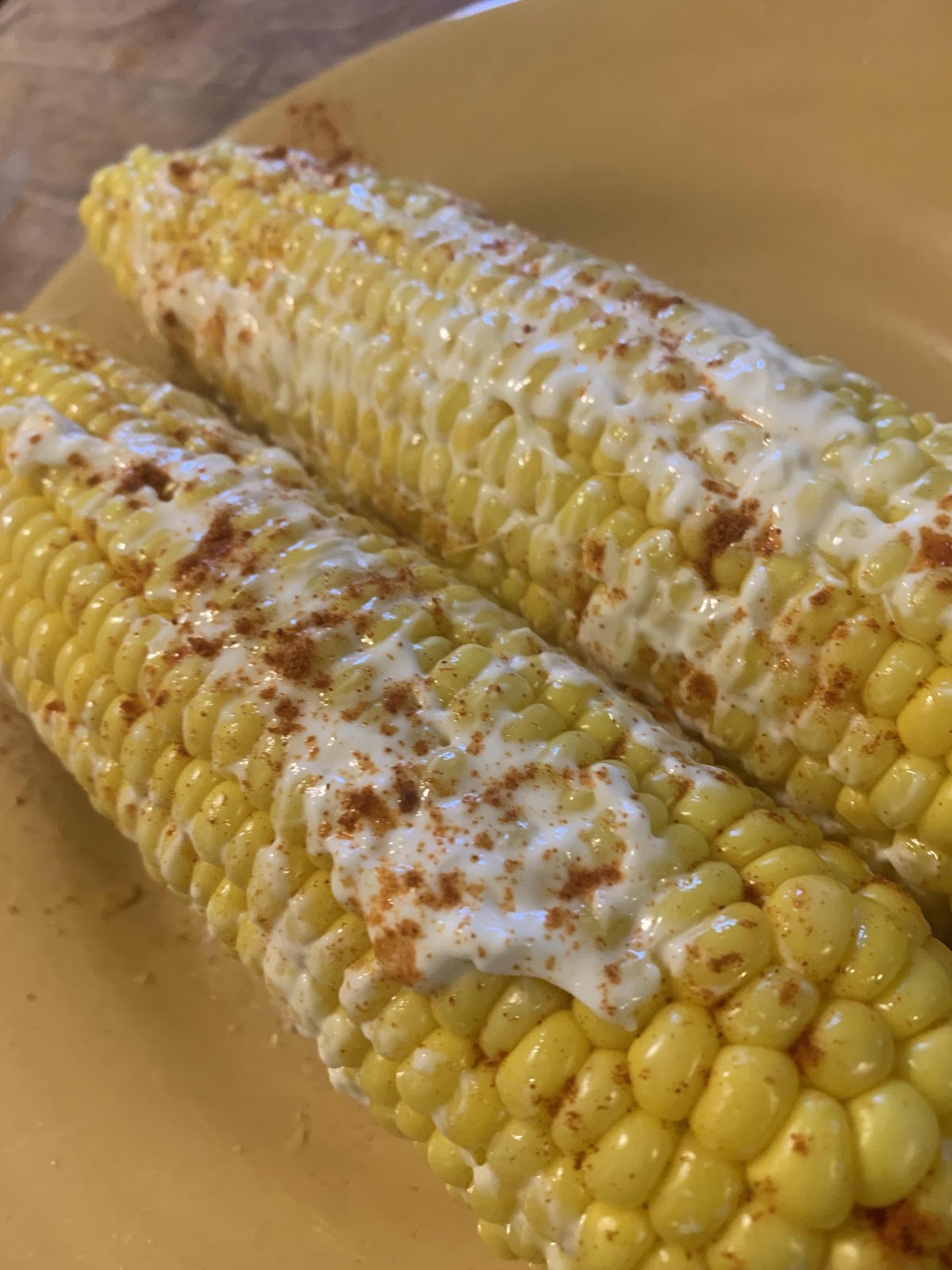
If you’ve never had sweet corn Mexican style, you really have to try it. When I was a child, we rolled our fresh boiled ears of sweet corn on top of a cold stick of butter, unwrapped and set on the table for that purpose. The hot corn melted a deep divot in the butter, making each subsequent ear easier to baptize. Then we sprinkled the ears with salt and went to town. 

There’s nothing wrong with that “recipe.”  I believe it was Garrison Kieller, in his wonderful memoir Lake Wobegon Days, who first asked the question “yeah, sex is great, but have you ever had fresh sweet corn straight from the field?” I will not go on record as to my preference, but I will affirm that fresh sweet corn bathed in butter and sprinkled with salt is one of life’s great pleasures. 

The kind of super-sweet hybrid corn we enjoy in the states  was more or less unknown in Mexico until very recently. Traditionally, all corn grown in Mexico for human consumption is what we know as “field corn” and generally used as animal feed. A little more scientifically, it’s known as “dent corn” for the little dents that develop in the center of each kernel as it dries. This is the corn that Mexican families grow, dry on the cob, twist the kernels off and store in buckets, and eventually turn into nixtamal and grind into masa to make the staple Mexican food, tortillas, all year round. There are literally hundreds of varieties - white, yellow, green, blue, red, black, and speckled. 

While most of the harvest is let to mature and will be used as described above, some of it is picked “tierno,” or “tender,” and eaten fresh. It is nowhere near as sweet as our hybrid corn, but it has a toothsome chew, and a satisfying heft that fills you up as sweet corn does not. It’s a complex carbohydrate, for sure. 

In Mexican Spanish, a fresh boiled ear of corn is called an Elote. It’s one of the most common street foods, served slathered with mayonnaise, squirted with fresh lime juice, sprinkled with chile powder, and rolled in grated cotija cheese. The same assemblage of flavors can be served in a cup, made up of the kernels of corn cut from the cob and then dressed with the same toppings. In this form it’s called Esquites, and it’s my absolute favorite Mexican street snack. 

One of my finest memories is sitting on a wrought iron bench in Oaxaca’s zocalo on a fine summer evening, eating esquites and watching dozens of well-dressed couples of a certain age dancing to the music of a marimba band. One of my greatest ambitions is to be one half of such a couple, on a fine summer evening a score of summers hence. And lord, I hope there will be esquites to revive me after I tire of dancing. 


Wednesday, August 7, 2019

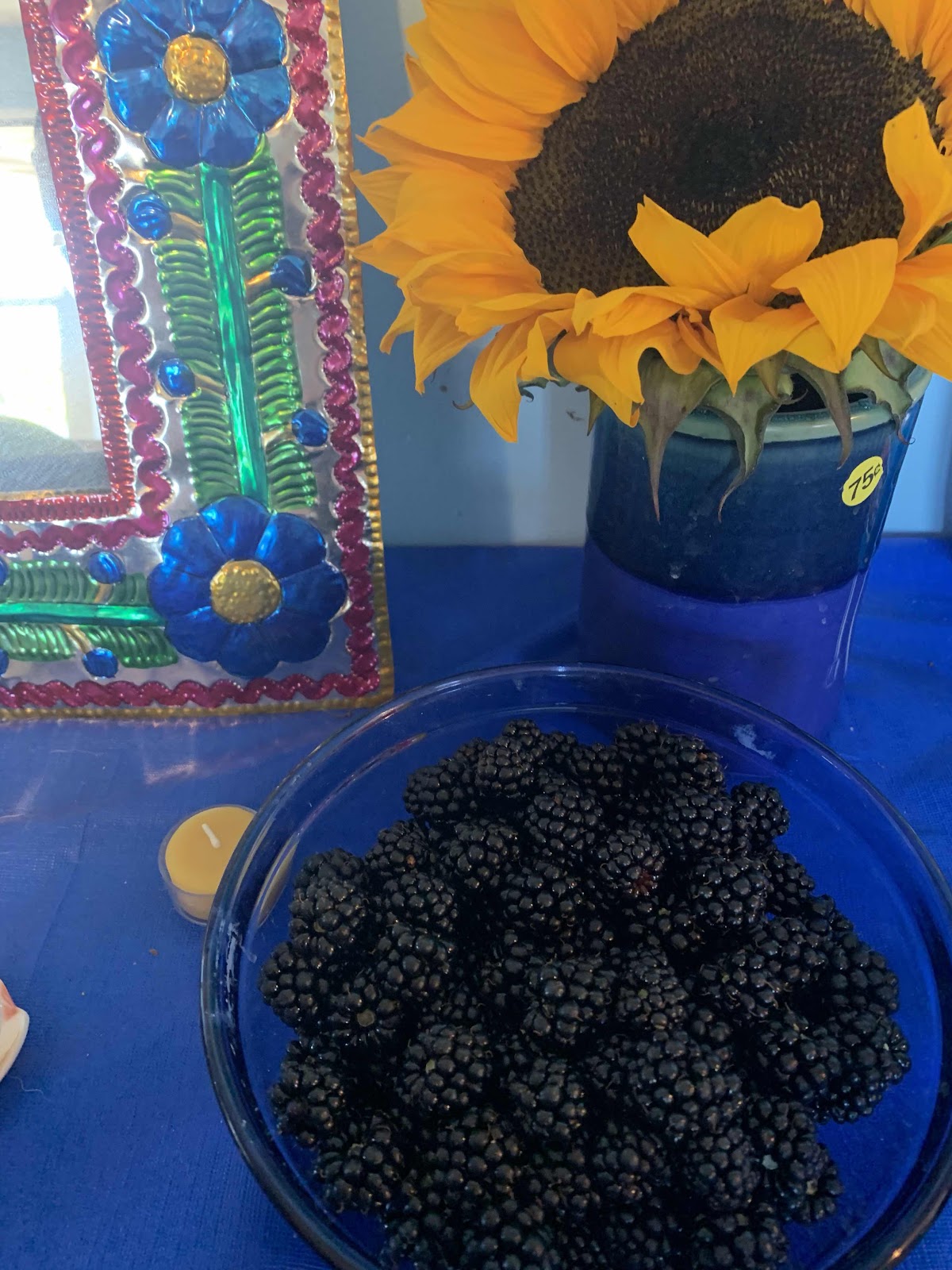
Blackberry Blessings


Tuesday, July 30, 2019

The Fermentation Files (Pickle-Palooza)


I’ve been doing a lot of fermentation lately. There was the rhubarb wine this spring, which I bottled a few weeks ago (and sampled while I did, of course). I made a really amazing batch of curtido, which is basically sauerkraut with Latin flavors. That’s a little simplistic, but not wrong exactly. 

Curtido is heavily salted shredded cabbage with shredded carrots, thinly sliced red onions, oregano, and jalapeños (if you like). Traditionally it is barely fermented - just about the level of fermentation you’d expect if you made it the day before and then left it out unrefrigerated in a hot central-American climate. I made curtido but then packed it into a half gallon jar and pounded it as you do for sauerkraut. Two weeks later it was sour and delicious, the cabbage wilted but still crunchy. I just finished that batch yesterday, piled on top of black bean burgers slathered with mayonnaise. Delicious. 

A friend gave me a ten pound sack of organic red onions. I didn’t know how to use those up, so I asked in my Facebook group dedicated to fermentation if anyone had fermented red onions before. The response was enthusiastic, so I went ahead and tried it. I added several sliced Serrano peppers, because my goal was something as spicy and yummy as the pickled red onions you find as a condiment  on every southern Mexican table. I was very pleased with the result - but I thought the spicy pink brine was even better than the onions themselves. 

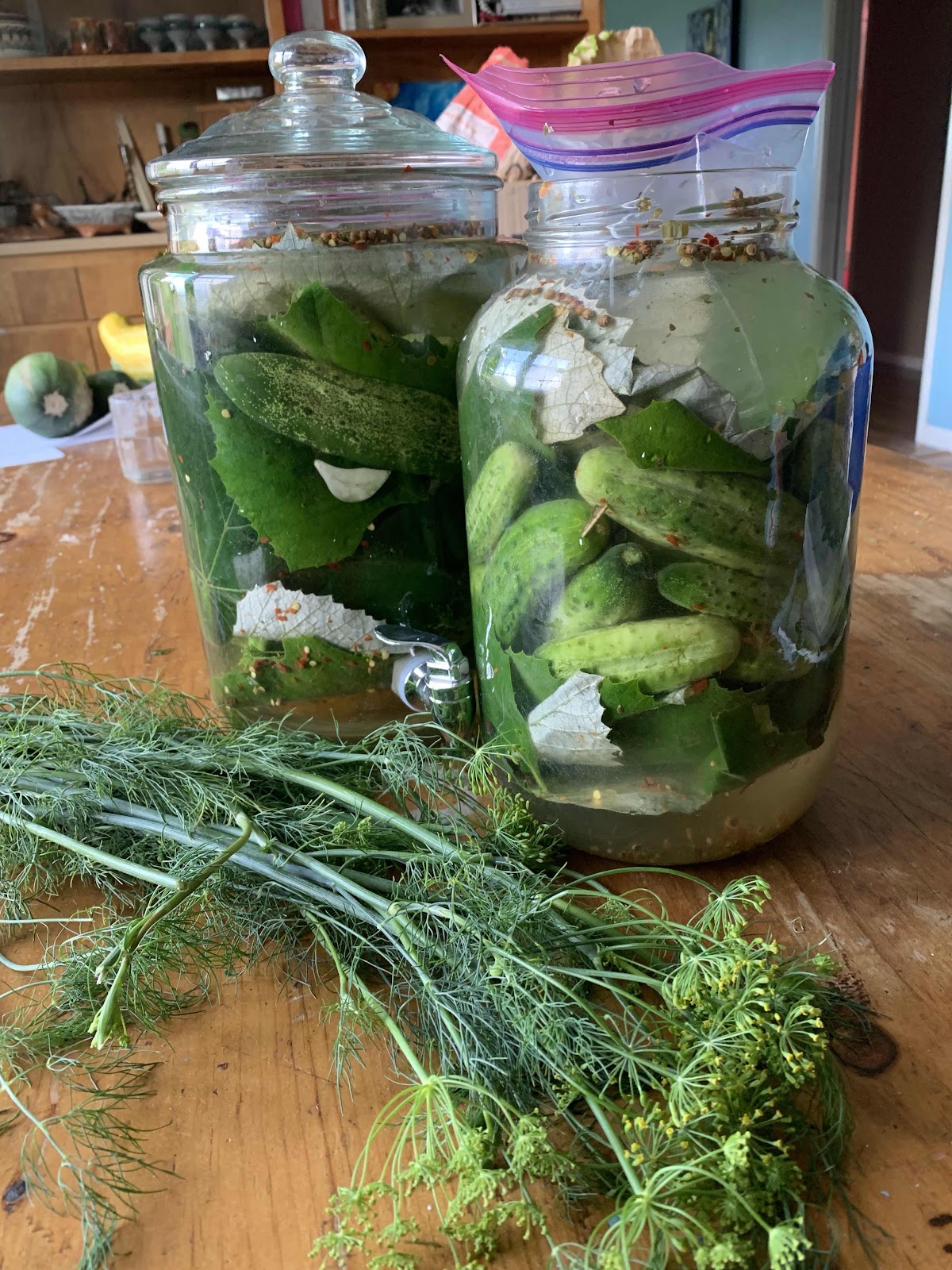
My favorite ferment will always be kosher dill pickles. Nothing is as satisfying as a salty, crunchy cucumber spear alongside a well made grilled cheese sandwich. We all love kosher dill pickles here, but even so I made too many last year. Too many being about five gallons. Eventually, they did all get consumed, but by November they were no longer as crisp and appetizing. Instead of eating them out of hand, I chopped them and put them into tuna salad or potato salad. 
This year I’m making two gallons. I imagine sometime in late September we will all be wishing I made more. 

And then of course there’s all the cheese I’ve been making... but that’s really another post. 

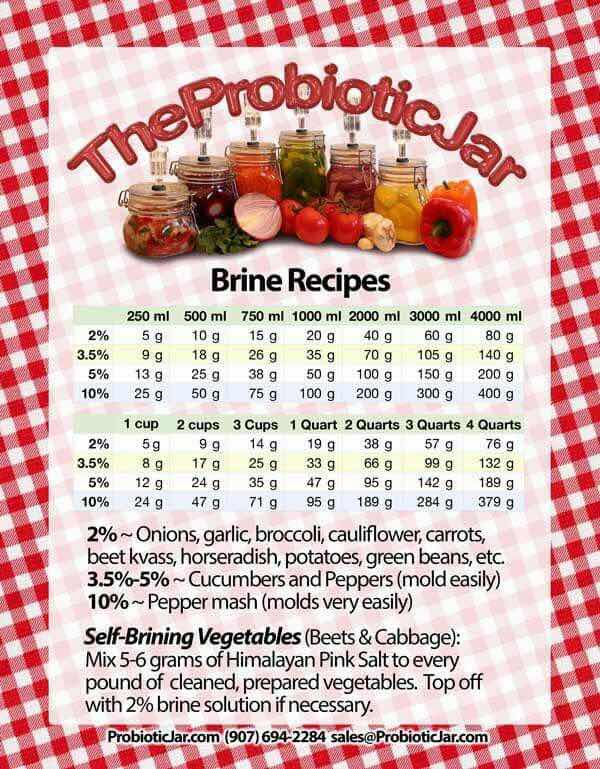
I encourage anyone who has ever been interested in lacto- fermenting to give it a go. It’s really entry-level food preservation. It’s low-risk and high reward. Here’s a neat chart I found in my Facebook group to help you get started. 


Wednesday, October 3, 2018

The Fermentation Files (Plum Edition)


Italian plum trees are known for having an alternating harvest: one very heavy year alternating with a very light year. As everyone who has an Italian plum tree knows, the heavy harvests are very heavy indeed. In 2016, the last heavy harvest year, there were so many plums on the tree that branches were breaking from the weight of all the green plums, and we had to strip off and throw away hundreds and hundreds of unripe plums.


Last year, true to form, the tree produced very few plums. I am actually glad that the Italian plum tree provides its owners with a rest every other year, because dealing with literally thousands of plums all ripening at once is a ton of work.

Of course, we cannot possibly make use of each and every plum. That's just a silly proposition. Even if we were to dedicate ourselves to preserving plums 24/7 in season, inevitably many, many plums would fall to the ground and become a feast for wasps before we could make use of them. And that's just fine. After all, wasps need to eat too.

My sense of duty, however, and overdeveloped guilt reflex, mandate that I make a valiant attempt every year to utilize as many plums as possible. There are lots of ways to use plums: eating fresh (we eat a lot); dehydrating - the dehydrator is going day and night in mid-september; cooking in pies and crumbles; giving away to friends and neighbors; and wine. For using up a whole lot of ripe plums at once, there is no preserving method superior to winemaking.

In 2016 I made my first attempt at plum wine, and it was fairly successful. By which I mean I produced a quaffable product that would reliably get you drunk, not that I produced a product worthy of bottling and bragging about. Surprisingly, the wine was a light, orangey rosé, not the sort of deep, velvety purple you would expect from blue plums. It was pleasant, quite dry, with a bit of a sour tang. It was good enough that when faced with a similarly overwhelming number of plums this year, I decided to repeat the experiment.

One of my many failings is that I am constitutionally incapable of taking notes, keeping records, and thus reliably repeating successes in the kitchen. I can't remember - and didn't write down - what type of yeast I bought in 2016, nor whether or not I used yeast nutrient (which is something you usually have to add to wines that aren't made from grapes), nor how long I left the wine in the primary fermenting chamber (AKA food-grade plastic bucket) before putting it into a carboy and air locking it.

So, basically I was starting from scratch. I followed a recipe from one of my books, more or less - I decided I would forgo the reccommended yeast nutrient because I was making the wine on a weekend and didn't want to wait until the home-brew store opened on Monday. And I made a few other tweaks - I added honey instead of sugar, I didn't have any Camden tablets - okay, I basically ignored the recipe entirely and winged it 100%. Fruit + sugar + water + yeast + time = alcohol. Right?

I do - always - sterilize equipment with boiling water. That's a non-negotiable. And I used a real wine yeast (Chablis, if I remember right), not baker's yeast. But I think this year's batch may have suffered somewhat from my lackadaisical attitude. After putting the wine into a carboy and air locking it, it bubbled vigorously for a few days, but then stopped entirely, rather than just slowing down as it should do. I left it in a cool place to keep doing its thing for two more weeks, but then I sat down and stared at the airlock for three minutes. No bubble. That is pretty definitive that the fermentation has stalled.

Stalled fermentation isn't the end of the world - not even the end of the wine. There are things you can do to try to get it going again. I decided to rack the wine off into another carboy, thereby aerating it. Tasting the wine as I transferred it, it was pretty thin and sour tasting, so I decided to add a bit more sugar. I replaced the airlock, and now there's nothing to do but wait three or four months and then taste it. It will either be drinkable or not, and either way it's experience. The tremendous abundance of plums makes it cheap and low risk to experiment with winemaking, just as the tremendous abundance of milk in early summer makes it cheap and low risk to experiment with cheesemaking. If, next spring, I have a few gallons of nice plum wine, I'll be happy. If I have to pour a few gallons of weird plum vinegar out onto the compost, well, so be it.

There is another, much lower risk, delicious way to ferment a few dozen plums, though, and I did that too this year. A plum shrub. A shrub is basically a sort of fruit concentrate - you put chopped ripe fruit to macerate in sugar for a few days, and then pour over apple cider vinegar to cover. The shrub will keep in the fridge indefinitely, and can be mixed with water - still or sparkling - to make an elegant and yummy non-alcoholic drink. Of course, you can also add a jigger of rum or vodka or gin to your cocktail. I made a half gallon of plum shrub flavored with rosemary, and it was delicious, with or without spirits.

Looking forward to a year off. 2020 will be soon enough to get elbow deep in plums.


Wednesday, September 12, 2018

Preserving Log 9/18


Arrived home from Oaxaca ten days ago. In that time we had a lot to do to get the kids ready for school- go shopping for supplies and clothes, adjust their schedules, etc. Paloma made a schedule and posted it on the fridge:


We did all that. Also I started a serious job - ten days of full time, 8 hour days interpreting for a student enrolled in he Washington state Caregiver’s training program. I have done this same course several times before. It’s very demanding; after eight hours of simultaneous interpretation my brain feels like a bowl of cold oatmeal. But it pays well and after our expensive summer abroad I couldn’t turn it down. 

Meanwhile, the pears and the plums and the early apples just kept on coming. Here’s what I’ve done in the way of preserving in the last ten days, more or less in order:

1) dehydrated two gallons of pears and two gallons of plums

2) canned six quarts salsa ranchera

3) canned four quarts pear/apple sauce

4) three gallons lacto-fermented pickles

5) made three gallons of plum wine - currently undergoing secondary fermentation in a carboy on the mantle. 

6) made three pounds chevre

7) canned eight pints blackberry jam

8) froze a gallon blueberries

Planning on picking up several pounds of peppers for canning later this week. That’s about it for now. I want to hit the farmers market and look for wild mushrooms - chanterelle season is in full swing, and I’d like to dry a few pounds. 

Happy Mabon to you all. 


Saturday, September 1, 2018

Making Up for Lost Time (Mabon Again)


We arrived home late the night before last. Or perhaps more accurate to say, early yesterday morning. We finally opened the door to our home at about 1:30 am Friday morning, to a couple of very happy dogs. 

After sleeping in quite late, we set about cleaning the house (my daughter Rowan did a wonderful job taking care of the farm and keeping the place operational, but she apparently didn’t sweep the floor or scrub the toilet once in seven weeks). I had cleaned out the fridge before we left, so there wasn’t much food in the house. 

A quick reconnaissance of the orchard revealed that there is still a heck of a lot of fruit to cope with. The greengage plums are done for this year - though a neighbor friend picked a bunch and dehydrated some for us - but the Italian plums are still a week or so away from ripe, and the tree is loaded. 

Pears are falling all over the property. I think I may have mentioned that I have FOUR pear trees, which is a ridiculous number. The Bartletts are ripe, and the Comice pears are not far behind. The Seckels and whatever the fourth one is (I forget) have a ways to go. Today I picked up a few dozen fallen Bartlett pears that were still firm and  fragnrant and tomorrow I will haul the dehydrator out of storage and scrub it. The girls love dehydrated pears in their school lunches. School starts Tuesday. 

The cider apple tree is covered with apples. Cider season will be soon.  The other Apple trees, still quite young, have a few dozen apples apiece. And the Asian pears trees, planted two years ago, and a half have a few pears on them. 


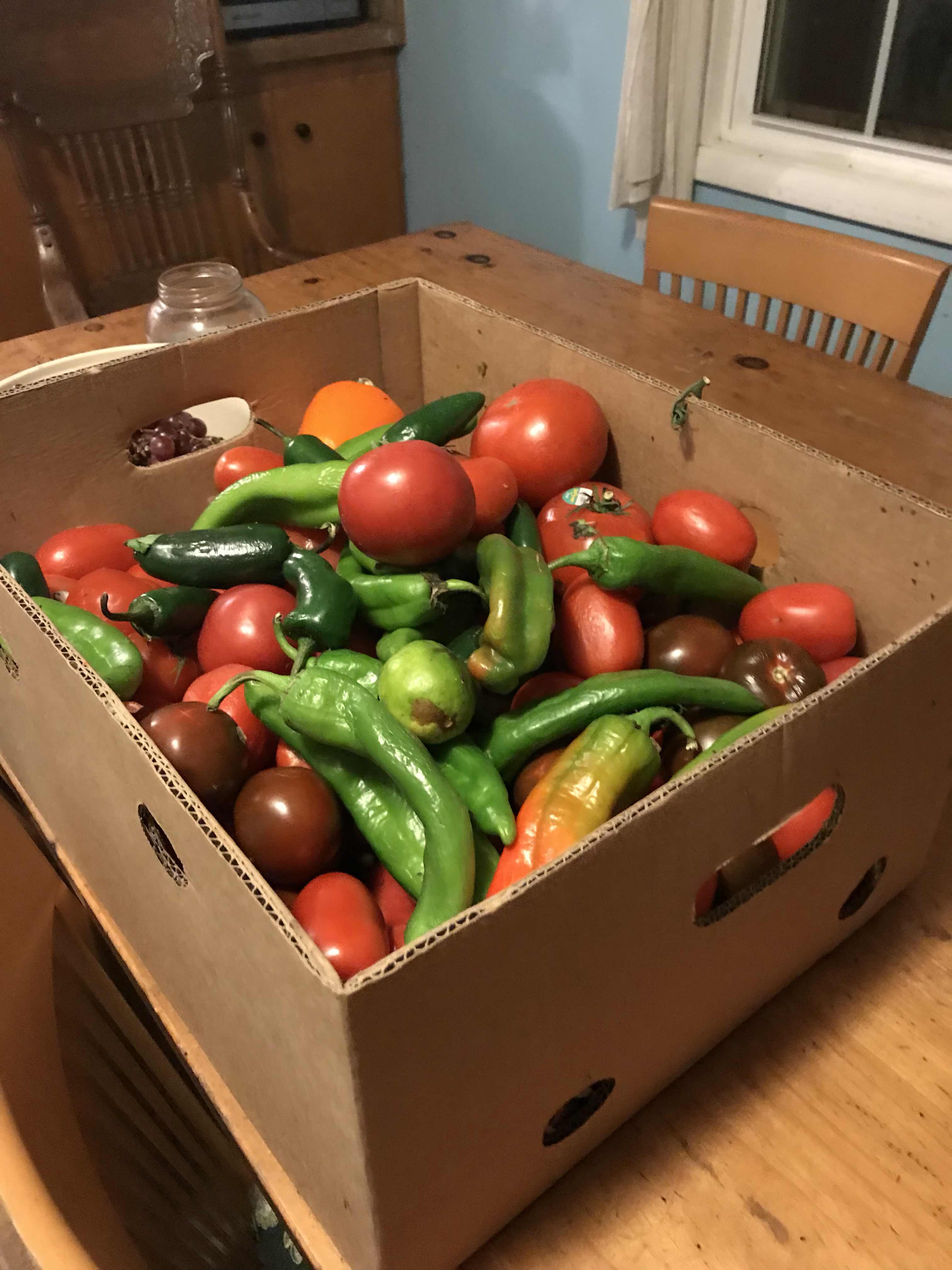
Today I went to Gleaners’s Pantry. Came home with the crate you see above - about twenty five pounds of tomatoes and peppers. Tomorrow I will can. I’m guessing there’s a good dozen quarts of salsa in that box. 

Tonight I spent a few hours making good use of other produce fromGleaner’s. Roasted hatch chiles, red onions, corn on the cob, and fresh tomatoes became this beautiful salsa: 


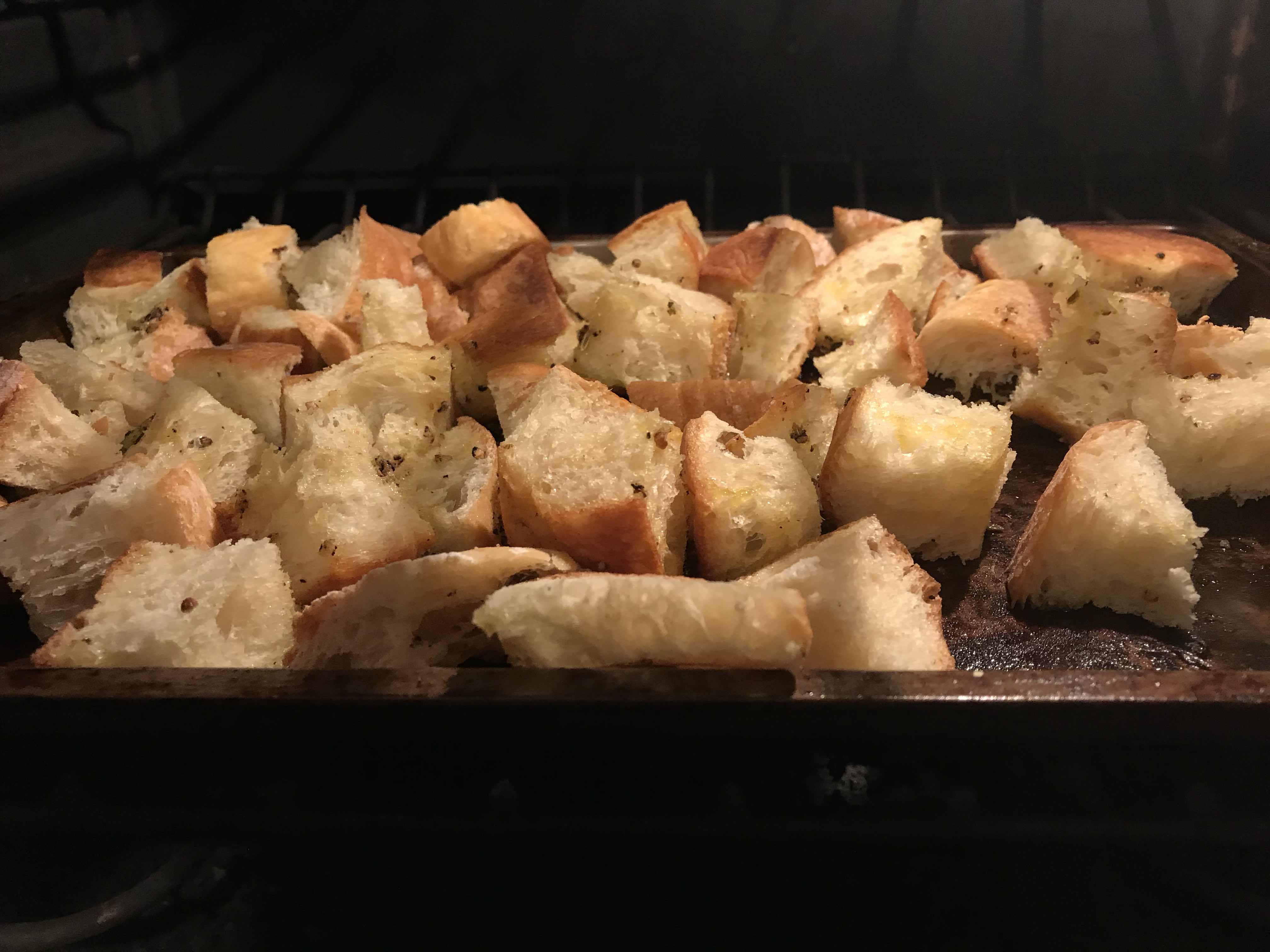
I also brought home a half dozen loaves of ciabatta bread. I like to cube it up and toss the cubes with a mix of olive oil, herbs, garlic, salt and pepper, and bake until they are crunchy croutons. Store in a ziplock bag in the fridge. 


 Not pictured here is a new experiment - plum shrub. A shrub is a fruit based concentrate, made of any fresh fruit macerated with sugar for a few days and then mixed with apple cider vinegar. That makes a storable concentrate that can be mixed with fresh water - still or sparkling - for a delightful refreshing non-alcoholic beverage. If you like, of course, you can also add a jigger of vodka or gin. My first attempt at a shrub is a half gallon of chopped Italian plums and a few springs of rosemary. I expect it will be delicious. 

I missed a lot of preserving season this year - for the very worthwhile reason that we were in Mexico with my husband’s family - but I am making up for list time. Mabon is upon us, almost, and I intend to embrace the motto of the season and be prepared. 

Besides, I love it. Putting up food is just about my favorite thing ever. 

Sunday, July 1, 2018

All the Fruit We Won’t Be Eating


The cherries are just getting ripe. Paloma and I went out and picked this basket of cherries in about four minutes flat, off of one of our three cherry trees. These cherries are perfectly ripe right now - but the Ranier and the other dark cherry (Lapin? Sam? Stella? I can’t remember) still have a few days to go. 

Homero is leaving for Mexico in the truck day after tomorrow; the girls and I are flying down a week later. We can gorge ourselves on cherries before we go, but there isn’t time for me to do any processing. It’s eat ‘em now or forever hold your peace. 

At least we get to enjoy the cherries before we go. This is shaping up to be a great year for the orchard, and we will miss out on some of my favorites. I’m especially mourning the loss of the greengage plums. That tree is finally starting to bear a respectable crop, after years of me wondering what was wrong with it. I guess it just needed time. Right now the branches are loaded with hard little green balls, which will ripen in August into luscious, sweet, golden orbs bursting with juice. And we will not get to enjoy any of them. 

Nor the raspberries. All of raspberry season will pass with us far away, and so we will not have raspberry smoothies this winter. I hope we will be home in time for the Italian prunes - that tree is absolutely jam-packed with little green plums. I adore Italian prunes, all ways - fresh, stewed, dried.  This year I was thinking to make wine again. It was delicious last time. But unless the weather is extraordinarily cooperative, we will miss Italian prune season as well. 

Blackberries are more hopeful. We will be home the first week in September. If the rains hold off, there will probably be blackberries still, although the best of the season will be ending. 

Apples and pears. Hooray! Apple cider season will take place as scheduled. The Comice pears will be perfect for eating out of hand, inshallah, and of course there will still be the farmers market and its late season bounty of tomatoes and squash.

And of course let’s not forget that I am traveling to the land of cheap and exquisite fruit. Mangoes. Tunas (cactus fruit, not fish). Watermelons. Avocados. Passion fruit. Papaya. 

Wednesday, August 17, 2016

Plum Conundrum and Pear Perplexity


In recent days, as I took Haku outside in the evenings to run around in the orchard,  I've noticed that a couple of trees in the orchard are so heavily laden with fruit that the branches are actually sitting on the ground.  Specifically, the Italian plum and one of the pear trees - the Comice - were so bowed down that I made a mental note to get out and pick some fruit as soon as possible.

Then a couple of days went by. This morning Homero told me that the plum tree had broken nearly in half.

I said "No, the big branch is just sitting on the ground, that's all."

He said "Go take a look."

The biggest branch was indeed broken. It must have happened just that day, because the leaves were still bright green and crisp. I ran for a bucket and with Homero's help, stripped off five gallons of plums from just that one broken branch in five minutes flat. We didn't even get all the plums from that branch - many of them fell on the ground and we didn't even bother to pick them up.

The plums are not quite ripe, but it doesn't matter, because I looked it up and plums ripen beautifully off the tree. In two or three days I will have a bushel (more or less) of ripe plums, not even counting those still on the tree. The still-on-the-tree plums account for at least four fifths of the total. I tried to think of something to do with five gallons of plums. Drying comes to mind, of course, but really - who likes prunes that much? And I am not much of a jam-master. If I'm going to attempt to make jam I will make blackberry jam, which we all like, rather than risking going to all the work of canning jam only to find out that nobody enjoys the end product.

That left wine.

I don't have much experience with making alcohol. Sure; a side effect of fresh cider is tepache (naturally fermented fresh juice) - and I have occasionally expanded upon wild fermentation and ventured into the alchemy of hard cider - with mixed results. But I have never set out deliberately to create "wine" which seems for some reason very serious and highbrow, even when made from an accidental glut of plums instead of fancy pedigreed grapes.

Today I went to our local home-brew store and told them what I was up to and ended up spending something over $50 in tubing, plastic airlocks, yeast, and specialized equipment. Chances are better than even that I will not produce anything drinkable by any but a late-stage alcoholic, but I'm going to try.


The pears are a whole 'nother story.

For one thing, they mostly will not ripen on the tree and demand careful and specific post-harvest handling in order to reach peak perfection. For another thing, the time period between "peak perfection" and "post-perfection" is about fifteen minutes.

Also - The pears arrive in tsunami-sized waves. So when I try to think of something to do with the pears, I am thinking about seventy-five or eighty pears at a time, not six or eight, which would be the perfect number to make into a pie.

With that in mind, I went and bought a dozen wide-mouth quart sized canning jars. I figure I can make a few gallons of pear-sauce; hopefully mixed with blackberry if I can coerce my children into picking a few pints.

I may also try Car-dehydrating. The weather has been unrelentingly hot. It's supposed to hit 90 degrees tomorrow and stay there through the weekend. I have read that in this kind of heat, you can lay our thin slices of fruit on foil-covered trays and put them in your car. The temperature inside will reach 150-175 quite quickly. Basically, if it would kill your dog, it will dehydrate your pears.

But by far the best option is to trade some of my fruit for something else that I want more. I put out the word today over social media and within minutes had received offers to trade plums for locally caught trout; for freshly harvested green beans;  and for assorted canning jars. That's neighborliness at its best.

Saturday, July 11, 2015

Harvest Ethics (Am I a Thief?)


Returning from Tucson at the beginning of the week, I found that the High Harvest has definitely begun, as signaled by the traditional anonymous box of squash left on the front porch. Last night's dinner was squash fritters topped with goat cheese. Now there are only six big zucchini left to deal with (until the next influx, anyway).  I will probably do what I did last year and bake a bunch of zucchini bread for the freezer. I defrosted the last of last year's zucchini loaves a few days ago, and it was in perfect condition. The trick is to wrap the loaf tightly in aluminum foil and then place in a ziploc bag. There are still a few cups of organic pecans in the cupboard leftover from a trade several weeks ago, and the zucchini bread plan will use those up as well.

Pickling cucumbers have appeared in the stores, and so I made a bunch of pickles. Four pints of bread and butter canned pickles, which are not my favorite but beloved by Paloma and my mom. I also started a big jar of lacto-fermented dills - but without any dill! I have yet to find any dill weed. I just used plenty of garlic, red pepper flakes, and a whole bunch of grape leaves to stop the pickles from getting soft. My children were aghast when I spotted an enormous grapevine growing up into the trees on the side of the road and pulled over to pick some leaves.

"Mom! You don't know who those belong to!"

"Nobody cares if I pick a handful of leaves off this vine, honey, it's gigantic. Besides, nobody can see me behind the trees."

"MOM!!! You're a THIEF!"

"Oh, relax, if anybody comes out I'll ask them nicely. It's not like I'm taking the grapes."

I also take apples and plums off of abandoned roadside trees. And the sour cherries off those branches of my neighbor's trees that hang over the fence onto my property. I'm unrepentant. Everybody knows that the fruit hanging in your airspace is fair game. As is the fruit off any tree growing in the ditch beside the road if there's no house in hailing/waving distance.

In Seattle, I had a beautiful young Bing cherry tree that I planted in the front yard, which was unfenced. I didn't mind if passersby took a small handful of cherries as they walked by - the temptation was strong - but I did draw the line when I saw people bringing bags and picking into the bag without asking. Once I actually caught a couple of young men UP IN THE BRANCHES, picking all the cherries they could and stuffing their shirtfronts. I yelled at those guys.

In apple season, I often cruise around looking for trees. I like to make apple cider and it takes a LOT of apples. As I said above, if the tree is not within sight of a house, I consider it free fruit. If it is in someone's yard or planted on the road near the driveway, I will knock and ask before taking any fruit. Oh - and obviously I only do that if I see that the apples are falling on the ground and not being picked up. If there are no apples on the ground I figure the owner is using the fruit. And if the owner says "yes, by all means, take all the fruit you like" I always offer back some cider or applesauce in return. I have some elderly neighbors who offered me all the apples I want in exchange for cleaning up the windfalls.

I truly believe I am acting well within the social norms of my region, but I'm very curious to hear what people from other parts of the country say. Am I a thief? Do you have to hike up a quarter mile driveway and knock before you take a handful of grape leaves? When is a tree abandoned? Is it open season on vacant lot trees? Can you strip them bare or is it good form to leave some fruit for the next person? Tell me in the comments.


Thursday, October 9, 2014

Lying Pears


Here is one of the pear trees, a few weeks ago. It looks the same today, but the foliage is yellower and not as thick. It is October, after all. Loaded with pears, seemingly. One other of the four pear trees still has a lot of fruit on it as well; the other two are earlier varieties and are long gone. We had a massive pear harvest this year from the antique Bartlett and the Comice, and so I wasn't in any kind of a hurry to harvest the last two trees. The only pressure I felt was that it would be nice to get the pears off the trees so that I could put the horses to graze in the orchard pasture before the first frost killed the grass. The horses would eat any pears they could find and founder. 

Yesterday evening while I was out with there goats, I saw and heard a flock of starlings knocking about in the pear trees. Figuring that the pears must be getting ripe if the birds were starting to peck at them, I decided to go out and get them down as soon as possible. Today I went out to gather a sackful of pears to trade to a friend for some pumpkins. I made a terrible discovery:


 The majority of the pears, seemingly intact and gorgeous, had in fact been eaten out by wasps. The trees were hung with hollow pears, thin-shelled and delicate like christmas tree ornaments,  and filled with yellow jackets. I think what happened is that the starlings peck at the pears, making a small wound, and then the wasps are drawn to the leaking juice and enter the pear through the hole and eat it from the inside out.

To make matters worse, the pears that hadn't yet been attacked were - although full sized - just as hard and green as they were a month ago. At that time, I picked a few pears and set them on the table to ripen, but they never did. They just sat there, stubbornly green. Homero, bizarrely, eats them like this, and so I didn't know if they would have eventually ripened or what, but I figured it couldn't hurt to just leave them until they started to fall on their own.


Above you see all the pears I could find which are solid - there are twenty-six of them. A few of them have bird strikes, but none have been invaded by insects yet.  But how to ripen them? I thought I remembered treading that some varieties of pears need to be chilled before they will ripen - and so a quick google search seems to confirm.  Supposedly, I should gold the pears at 32-35 degrees Farenehit for at least a week and up four months, and then bring them to room temperature for 7 - 10 days. How exactly I am supposed to do that I haven't the foggiest clue. I could refrigerate them, but I don't have room in my fridge for 26 pears. And my fridge isn't that cold, anyway. Nights this time of year average 55 degrees, so leaving them outside isn't likely to help.

That's probably the best I can do, though. As I said, we have already enjoyed a large and delicious crop of pears this year, so it isn't a tragedy if we don't make full use of this last harvest. Alternatively, my husband can eat them all green, the way he likes them.

Link: an extremely comprehensive guide to European Pear varieties, with photos and information about siting, disease tolerance, and uses. Great site. http://www.usapears.com/~/media/Files/Research%20Website%20Docs/Pear%20Encyclopedia/Pear%20Encyclopedia%2003-2011.ashx


Tuesday, July 22, 2014

Fruitocolypse (Or Pear-mageddon)


This spring, I was all aflutter over the lack of bees during flowering time (What's Wrong With These Pictures?) but the bees must have been there, because the orchard is going crazy. Above is one of my four pear trees, each of which is absolutely loaded with fruit. If I remember right (which I most likely don't) we have a Comice, a Red Bosc, an Anjou, and a Bartlett.

Three of the trees, including this one, are young trees we planted ourselves, but the fourth - the Bartlett - is a hoary old beast some sixty years old. It has on years and off years, and this is definitely an on year. It looks to have some five hundred pears on it. Some of those will drop off immature, of course, and others will be lost to scab or other infirmities, but that leaves plenty of pears for us. And the neighbors. There will be enough pears to feed the Russian Army, as my mother used to say.

Pears make good pie, and pears can be canned as sauce, especially mixed with apples, blueberries, and blackberries. Pears can be dehydrated (though I hate dehydrating stuff) and late ripening pears can be stored wrapped in paper in a cool shed.  Pears can also be fed to livestock (carefully; in moderation) and pears can be given away to friends and neighbors.

Alas, pears cannot be pressed for juice, at least not with the equipment I have. Pears turn to mush and gum up the works. I can throw a few pears in with a batch of apples, but I can't just press pears by themselves.

What else can you do with pears? Have pear fights? Ideas, anybody?