"United we bargain, divided we beg."
Showing posts with label politics. Show all posts

Wednesday, November 27, 2019

Thankful for the Truth (Warning graphic photos)


I love Thanksgiving, especially in the years, like this one, that I get to host. I enjoy the process of writing a menu, shopping for ingredients, and setting a beautiful table. There are few things that make me happier than seeing people I love really digging in to food I’ve prepared for them. I’m happy when my adult daughter comes over, and I’m happy to see my mom. But there is something about Thanksgiving that make me feel uneasy. There is a whiff of - if not hypocrisy, then maybe willful blindness - that hangs around the Thanksgiving table. 

Thanksgiving is a day of delicious excess, a national fantasy of happy peaceful families and endless sweetness, but the truth is often unpalatable. Enjoying an abundance of good things and being thankful for what we have is, of course, wonderful, and in no way a bad thing. Indeed, we’d all be happier and the world would probably be a better place if we came together more often to share our abundance and to give thanks out loud and in the presence others. 

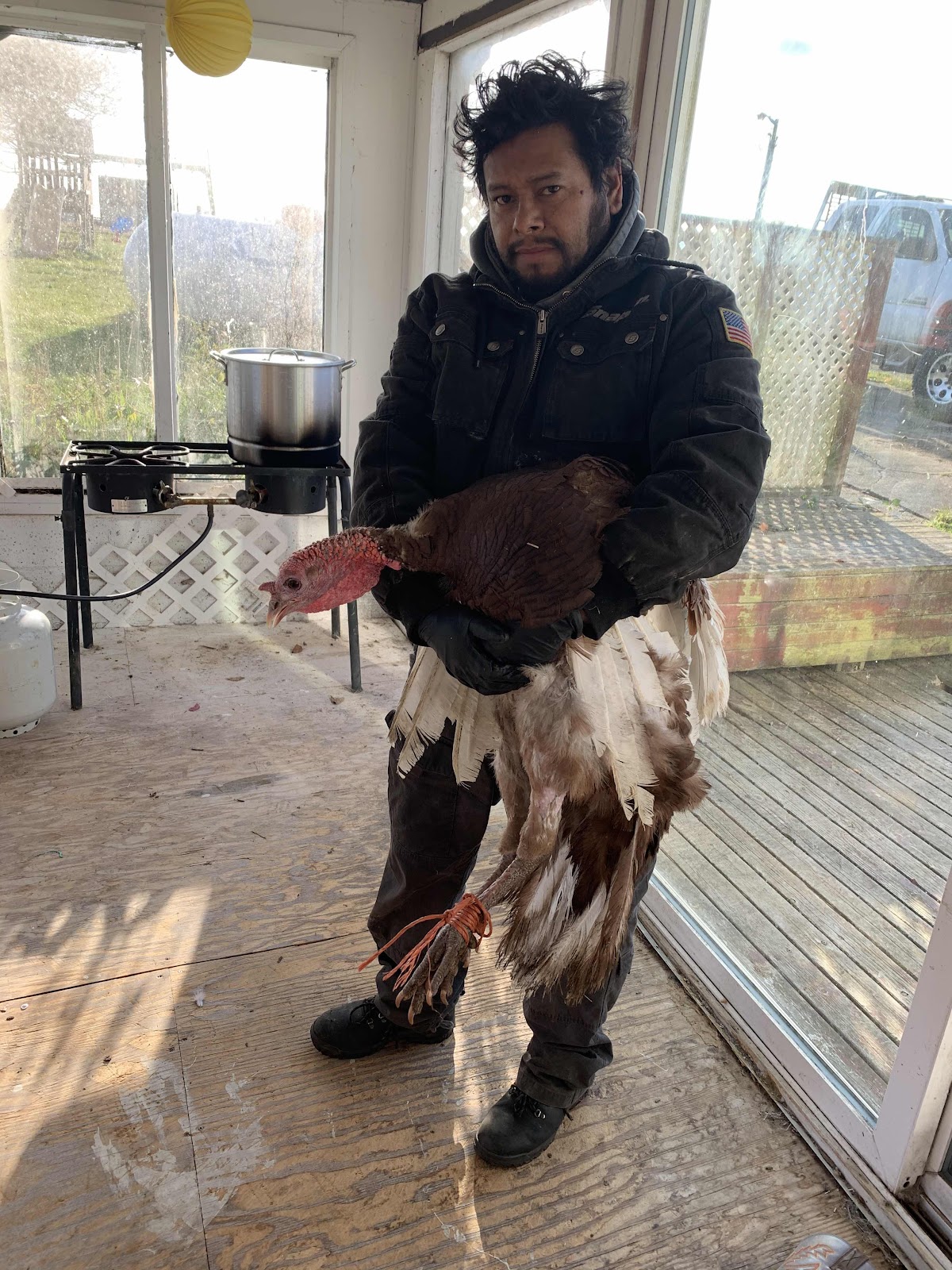
But it’s also important to acknowledge the realities that underlie the feast. These are manifold. Firstly, I acknowledge that to make this feast, a beautiful turkey had to die. 


I acknowledge the work that went into raising him - this bird was raised on pasture by a local farmer, so I thank my neighbor for her work and expense. But I also recognize the labor of the people - mostly immigrants - who toil in the vast and dangerous poultry processing industry; I acknowledge their worth and affirm their right to safe working conditions and just recompense. 

I thank my husband for the work he is doing right this minute - butchering the turkey out in the cold November wind. I acknowledge this is a disagreeable task and I thank him for being willing to develop the skill to do it well. 

The vegetables on the table - the potatoes, the Brussels sprouts, the salad greens - are produced by an unsustainable system that abuses workers and the earth in equal measure.  I am a witness, and I pledge to do what I can to avoid participating in those injustices and to mitigate the tremendous waste generated. 

And finally, I acknowledge that I live on unceded land of the Lummi and Nooksack tribes. All of us settlers live on land that either was never ceded by the tribes, or which was ceded under deeply unequal conditions, in which one side held all the power. I acknowledge that uncomfortable truth. If you want to know on whose land you reside, visit this link: 
https://native-land.ca/. I pledge to work toward correcting the grave inequalities that resulted by upholding the efforts of local tribes to sustain their culture and supporting their businesses and candidates for office. 

None of this is meant to be a huge bummer.

It is possible to be grateful for our wealth while recognizing the problem of poverty. We can celebrate being together with family while knowing that some are lonely. We can give thanks for warm homes, abundant food, and all the good things in our lives without trying to shut out the knowledge of the many who lack those things. It’s not a sin to be warm, to be fed, to be loved. These are wonderful gifts.

My hope and my prayer is that naming our gifts and sharing them with our loved ones will inspire us to share them more widely, as well. I remind myself, as I bask in warmth and light, of the existence of cold and darkness not out of guilt, but so that I may be moved by gratitude and grace to expand the circle of warmth and light to include others. I remind myself, as I nourish my body with roast turkey, of the death of the animal I am eating not as some sort of penance, but to honor the truth that this act embodies the cycles of life and death on this beautiful planet, cycles we are all of us bound by. 

May you be abundantly blessed this Thanksgiving. May you have much to give thanks for, as much as I. 


Monday, November 21, 2016

A Short Hiatus

Forgive me that I haven't written a new blog post in a couple of weeks. I've been too busy reeling around in horror and exploring the limits of my capacity for shock. 


The election results left me profoundly flabbergasted. I have to admit what now seems to me to be an extreme naïveté: never during the campaign season, not once, did I ever seriously contemplate the possibility that the citizens of this great country would elect a man so ignorant, so self-serving, so incompetent, and so boorish - not to mention bigoted, misogynistic, and disrespectful of the basic tenets of democracy. 

After spending a couple of days blubbering incoherently, I went into action mode. In the last ten days, I have organized an event for local folk who want to take concrete action to fight back against the alarming rise of hate speech and intimidation. I'm calling it the "Peaceful Progressive's Potluck," and I'm
hosting it at my house after thanksgiving. I'm promoting it through a new Facebook group a friend created called "whatcom rising." 

Here's what I'm hoping for: firstly, that a whole bunch of good hearted people who haven't met before can come together over good food and a few drinks and have a good time. It is so important not to give in to despair and pessimism. In times like these, just having fun can be a subversive act. 

Secondly, I hope that everyone who comes will bring an idea. I'm thinking of this event as a brainstorming session - please share your personal passions. Are you passionate about farmworker rights? Do you burn with zeal when it comes to protecting women's access to reproductive health care? What are you already involved in? So many of us are asking ourselves "what could I be doing right now?" Tell us about the great organizations and local opportunities that already exist. Let's make a list. Let's organize carpools to faraway events, let's have phone-your-representative brunches. 

But most importantly, I want to marshall the power of friendship. I'm thinking about studies that show how effective it is, in maintaining a fitness regimen (for example) to have friends who hold you accountable. I want to create a community of friends who hold each other accountable. I want us to pledge (maybe formally, in some sort of small ceremony) to keep encouraging each other, chivvying each other, even pressuring each other to keep fighting the good fight. 

I did something very scary this past Sunday. It shouldn't have been scary, but it was. I stood up in church and made a little speech about what I think it means to "love our neighbor as ourselves." I said I don't know what that phrase means, if it doesn't mean to shelter my neighbor, to protect him from those who revile him, to defend his children as though they were my own children. That doesn't seem like a controversial statement, but my congregation has enough Trump supporters who could decode the message that it felt risky to me. My voice trembled as I spoke. 

I envision a community of neighbors who will uphold each other and cheer each other on as they take on the kind of small but real risks that speaking out entails. Standing UP means standing OUT, and that's scary. So much scarier if we feel we are standing alone. So much easier if we know there is a community of friends who has got our back. 

Wherever you live, whatever your politics are - I'm talking to you rock-ribbed republicans here - please stand up and clearly state that you will not tolerate hate and discrimination. ESPECIALLY you republicans. Combat the general impression that being a conservative means you want to deprive women, immigrants, and people of color of their civil rights and their guarantee of due process and equality under the law. Make
it be known that espousing conservative values does not mean you want to cause suffering among vulnerable populations. 

Or does it? Convince me. Please. 


Sunday, November 22, 2015

Idea of the Year! Patent Pending!

A minute ago, I was reading a friend's blog ( The Well Run Dry ) and he was, as most of us do, lamenting the fact that the upcoming Christmas Season encourages blind commercialism and reduces the meaning of the holiday ("Holy Day") to something along the lines of an excel spreadsheet. I don't know a single person who doesn't hate this aspect of the season, yet we are all swept away on a tide of advertising and guilt, spending more than we intend or can afford, year after year on stuff that we don't need and that (in many cases) the recipients don't even want.

I composed a reply, saying that I tried to emphasize experiences over things, and in the middle of typing that sentence,  I had a flash of inspiration.

"I just had a total brain wave. Oh my gosh this is such a good idea! There are in my small town, as in most, I'm sure, a million christmas activities planned - tree lighting ceremonies, public caroling, concerts, card-making for kids at the library, stuff like that. I am going to make AN ADVENT CALENDAR OF EVENTS!!! Am I genius or what? I'll search the local papers and online event calendars, and I have no doubt I can find SOMETHING for almost every day between Dec 1st and Christmas day. Choirs visiting various churches. Craft Bazaars. Showings of Christmas movies at senior centers. I'll make an actual Advent calendar, with little paper doors that open, and behind each door will be that day's event! We won't have to go to all of them, but I bet the kids will LOVE opening the doors and seeing what we could go do."

If there are days for which I don't find any planned events, I can put one of our own traditions, like "make our own wrapping paper with potato stamps" or "cookie decorating party."

I'm so proud of myself right now I can't even tell you.


Wednesday, July 15, 2015

Tomato Slavery (Canning for my Soul)

Ever since I first moved to this farm, one of my main motivations for raising animals and putting in a garden has been to try and eat more ethically. I think this is a common concern - most of us care about the ethics of what we put in our mouths and most of us make some sort of effort to source our food with ethical concerns in mind.

For some of us, our paramount concern might be animal welfare, and our concern might lead us to vegetarianism, or to sourcing ethically raised meat. Some of us eat all organic, not just for our own health, but for the planet's health. Most of us try to avoid eating endangered species, and look for sustainably harvested seafood. Recently, many people have become concerned with the carbon footprint of their diet and look for locally produced food that isn't trucked or flown thousands of miles from the point of production.

These are ALL laudable goals, and what I am about to post is in no way meant to suggest that anybody ought to abandon their priorities for mine. We all do what we can to behave ethically - I hope - and I firmly believe it is impossible to refrain from all evil in all our actions.

That said - consider this quote:

"Since 1997, the Justice Department has prosecuted seven cases of slavery in the Florida agricultural industry — four involving tomato harvesters — freeing more than 1,000 men and women. The stories are a catalogue of horrors: abductions, pistol whippings, confinement at gunpoint, debt bondage and starvation wages." 
(for the rest of the article, see here)

Did you catch that? Here in these United States, in the past couple of decades, there have been cases of SLAVERY so egregious that they have been prosecuted as such by the Justice Department. Not "Wage Theft;" not "exploitation," but SLAVERY. For those of you who won't follow the link, the article details the commonplace practices of imprisonment, of people being forced to work at gunpoint, of hostage taking and threatening the families of those who try to escape. For the each of the seven cases that were prosecuted, there were (and are) literally thousands of cases that are never documented.

Following are two more links. I especially recommend the first. It was originally published in Gourmet Magazine in 2009, and it was the first time that the problem of widespread slavery in our agricultural system got serious mainstream press. It is the article that opened my eyes to the scale of the problem.

http://www.gourmet.com/magazine/2000s/2009/03/politics-of-the-plate-the-price-of-tomatoes.html

http://www.thenation.com/article/trouble-tomato-slave-labor/

More recently, there has been news coming out about conditions on tomato farms in Baja California in Mexico. Nearly all of our winter tomatoes in the US come from either Florida or Baja. The large plantations in Baja are not owned by US companies, but they are contracted to large US companies and those companies have moral responsibility for the conditions, which are, again, tantamount to slavery.

This past winter and spring, farmworkers on these plantations have begun to protest the practices and conditions - enforced confinement behind barbed wire and electric fencing; forcing workers to purchase all of their food and water from the company store, which charges exorbitant prices and puts the workers into debt-slavery; lack of running water or plumbing; and as retaliation for protesting, beatings and starvation.

The LA Times ran an expose on the situation, which you can read here:

http://www.latimes.com/world/mexico-americas/la-fg-baja-farmworkers-20150509-story.html

Aside from labor practices (what a tame and euphemistic phrase), our current system abuses farmworkers by poisoning their bodies with pesticides which they must apply to the fields, often with inadequate or nonexistent protection. The wells from which they must drink are tainted. Their children are subject to birth defects and chronic illnesses as a result of exposure to dangerous agricultural chemicals (see: http://afop.org/wp-content/uploads/2010/07/Annual_Publication_FINAL_English1.pdf)


In short, I have come to a decision. This decision is going to cost me a lot of time and effort. I have decided that I can no longer purchase tomatoes from Mexico or Florida. I realize that it is impossible for me to entirely wash my hands of my participation in our evil (yes, I said evil) agricultural system. Just as I cannot utterly refrain from the evils of the systems which produce my clothing, electronics, or transportation needs, I cannot keep 100% "clean" in my food choices either. It's simply not possible. But I can make a few choices that make me feel better, even if they do not do much to dismantle the systems themselves. This is one of those cases where the only effective action is collective action, yet I can only take individual action.

We eat a lot of tomatoes. After onions, I think tomatoes are probably the single most important vegetable ingredient in my pantry. They go into at least a third of the meals I cook at home. I will continue to buy tomatoes when I can verify that they were produced locally. And I will continue to accept tomatoes from the Gleaner's pantry, no matter where they come from. That is because - similarly to buying secondhand goods - my using those tomatoes does not materially benefit the producers. Exactly zero of my dollars are going to the growers if I collect the tomatoes after they have already been thrown away.

But if I want tomatoes in the months of November through March, I am going to have to preserve them myself. That means I am going to spend a large number of hot August afternoons washing, blanching, peeling, dicing, and canning tomatoes. If I can get my hands on small Roma tomatoes, I can freeze them whole, which is the easiest way of preserving tomatoes. But no matter what, my tomatoes are going to be more expensive from here on out - expensive in terms of time, certainly, and maybe money too, if if we factor in electricity and canning jars.

But what price, after all, a clean conscience? Moderately clean. at least. Moderately.


Friday, October 28, 2011

Protest as a Way of Life

I admire the folks who are out in the public squares protesting the ever greater inequality of wealth in this country; the ever greater power of the corporation in writing laws to enrich themselves; the ever lesser power of the people over the political process and over the means of production. I am following the Occupy movement closely and I hold out hope that this will transform over time into a lasting political movement.

However, I am too old and have too many place-based responsibilities to be out there myself. If I were bedding my old bones down on the concrete in Westlake center (ha!), who would be feeding the pigs, milking goats, preserving the harvest? Who would be controlling the means of production at MY house?

In other words, people, there is more than one way to protest. Civil disobedience is awesome and irreplaceable as a means of focusing attention. But the quiet protest of refusing to give your dollars to Monsanto, Cargill, Bayer, Halliburton, GE, and Texaco (among many others) by instead growing your own food, saving your own seed, producing your own electricity, brewing your own biodiesel, and sewing your own clothes is perhaps even more effective.

I'm not trying to say we do all of those things - far from it. But we do many of them. And I am learning how to do more of them. Even if we never reach the point of producing all our own energy, or growing all our own food, having the knowledge base in the community, keeping the traditional wisdom alive is so important. I am quantifiably less dependent on those corporations because I can meet a healthy percentage of my own needs. I have given them a heck of lot less of my money than most Americans (and spent less overall), because I have developed some skills to replace their services.

I may not be out there, visible, but I am a protester nonetheless. And I am as subversive as hell.

Aimee's recommended ways to be subversive in modern America:

1) Maximize your food independence. For some of us, that means growing a lot of food or raising animals. For others, it means learning how to cook from scratch. If you are buying raw materials from your local farmers at the farmer's market, you maximize support of your individual neighbors and minimize your support of the giant agribusiness companies. You also save money and eat better.

2) Buy secondhand. Everything you possibly can. In this way you avoid encouraging the extraction of raw materials and extend the useful life of products. The embedded energy cost in, say, a new car or a new set of dining room furniture - even a new winter coat! - can be stretched over a greater time period and made to serve a greater number of people. For me, buying secondhand clothing is an ethical decision to avoid supporting the sweatshop industry. A subclause to this recommendation is: repair things that can be repaired. Get your fridge fixed a few times before you get a new one. Learn to mend clothes. When was the last time you saw a kid wearing jeans with knee-patches on them, unless they were sold that way to begin with? Take good care of your car. Do all the scheduled maintenance. Learn to do it yourself! Or ask your neighbor.

3) Maximize your energy independence. There are so many ways to do this - we brew biodiesel for our cars. But you might do it with solar panels or windmills, depending on where you live. Or do it by not owning a car and biking instead. Or by living in a smaller house and super-insulating. The sky's the limit.

4) Know your neighbors. Make friends. Develop mutually beneficial networks. Support each other. Lend your tools. Pool your resources. Why should every small-farming family along the same stretch of road own its own haying equipment, for example? That's absurd. Or its own tractor, even? Why shouldn't three or four families get together to buy one tractor instead of four? Does every household really need a chainsaw? No, not if you are on good terms with Bob down the way. And not if you are willing to lend his wife your sewing machine.

5) Most important of all: take charge of your education! Be informed! Get your information from diverse sources. Use your brain. Teach your kids. Go to museums and libraries while they still exist! Buy books (secondhand, of course!). Do not default on your obligation to educate your children, or yourself. It's too important. You can't leave it to the public school system alone. Talk about important issues with your spouse, your neighbor, your kids, your in-laws, your city councilman, your state senator!

6) For the love of God, VOTE!

Milkweed Diaries: Occupy the Pantry. . .

Sunday, August 21, 2011

Canning Tomatoes (Staple Supply)


My tomatoes didn't do so well this year - a combination of early blight and some more recent malady that causes the vines to wither before the fruit is ripe has severely limited my tomato supply. Not that I would have had enough tomatoes to can in any case - I only planted about sixteen plants, of varying type. But I had hoped to have plenty of tomatoes for eating out of hand. Instead, we have only been able to pick a few here and there. There are lots of green tomatoes still, but I doubt they will ripen, at this point. Whatever I decide to do with the green tomatoes, it will not be what I did last year: Canning Wrap Up (Green Tomato Chutney) Green tomato chutney, while delicious in very small quantities, is not a solution for what to do with several pounds of unripe tomatoes.

However, I did very much want to can tomatoes. Canned tomatoes are a staple on my pantry shelves, as I suspect they are on most people's. Usually, I buy a case of diced tomatoes at Costco and go through the eight cans in a month. I have maybe twenty or thirty recipes in my weeknight dinner heavy rotation, and probably a third of them call for a can of diced tomatoes. Tomatoes are a highly seasonal crop - the only place in the United States that produces winter tomatoes is south Florida, and the conditions under which those tomatoes are produced (Warning, Politics Ahead) are such that I choose not to buy them. You can also get fresh tomatoes in winter from Mexico, but conditions there are almost as bad.

I don't go so far as to try and find out where the tomatoes in my favorite brand of canned tomatoes are sourced from. I might be able to do that, with a few hours on the phone, but I feel I have done my duty if I try my utmost to furnish the pantry with canned tomatoes made from fresh local summer tomatoes, canned by my own hands. Then, when I inevitably have to buy tomatoes in January or February, I can at least console myself with the memory of all the home canned tomatoes I used up first.

Therefore, I ordered a crate of organic romas from my local grower. For $30, I got enough romas to make 12 pints of sauce. More, actually, but twelve pints is as many as I can can in a day (I need a bigger kettle). Naturally, I chose the hottest day of the year to do my canning. Why is it that all canning takes place in August? There must be a reason...

My tomato sauce contains nothing but tomatoes, garlic, and salt, to make it more versatile. There are still about 15 pounds of tomatoes on the counter, which I have neither the time nor the jars to can. I think I will follow my sister's advice and simply freeze them whole. She tells me that washed tomatoes can be frozen whole and then, when you want to use them, you simply run warm water over them and skins loosen and can be easily slipped off.

It certainly would be less time consuming, not to mention less energy intensive. But then, would I really feel as industrious, as virtuous, pulling a ziploc out of the freezer as I do opening the cupboard to see a row of gleaming ruby jars?

Monday, February 14, 2011

Fears About Future Food

There has been an awful lot of noise in the news lately about global food prices. The price of most basic commodities such as wheat, sugar, corn, soybeans, and oilseeds are near or at historic highs. Global stockpiles are near or at historic lows. The recent events in the Middle East have been partially attributed to the swiftly rising price of food. In fact, food prices never really recovered after the 2008 spikes, though they did ease somewhat, and rice in particular (probably the most important grain, globally) seems to have stabilized for now, which is excellent news.

The factors that led to the 2008 spike are still with us, and in fact are intensifying. Most importantly, terrible weather events in many parts of the world over the last couple of years have drastically impacted regional staple crop production, from last year's drought in Russia and floods in Pakistan to this year's floods in Australia and unusual deep-freezes in the American south. Today, I bought some zucchinis to make a special Valentine's Day dinner, and paid over $7 for three smallish squash. They were $5.50 a pound. And no, they were not organic. I actually thought there was a mistake and asked the checker if that was the right price. She said it was and that the store had received a letter from their wholesalers letting them know that prices on many products would be higher through the season due to the freezes in the south.

Even if you think the weather events are a statistical aberration not likely to repeat in the coming years (which is a foolish opinion, but I'm granting it for the sake of argument), there are other, longer term forces at work which will continue to push food prices higher. There is the growing demand for biofuels - a sad story, which I am not going to go into in detail now. Suffice it to say that market forces have succeeded in turning a potentially brilliant, clean, carbon-sinking innovation into a global environmental disaster. As it currently exists, the global market in biofuels is destructive and helping to cause shortages. That doesn't mean I am against biofuels - I am decidedly for them! But the industry needs to evolve, and fast.

There is the price of oil, which is inexorably creeping upward and on which our agricultural system is utterly dependent, not just for transportation but for synthetic fertilizers. These fertilizers, in turn, mask another long term problem - the failing fertility of our soils. The loss of topsoil to drought and overtilling is only a small part of the soil's sickness. Loss of the biodiversity of microorganisms in the soil due to the long term use of insecticides and fungicides and herbicides has resulted in "dirt death."

Another huge problem - one of the biggest - is the water shortage. I was going to write "incipient water shortage" but in fact, the shortage is already here in many parts of the world. For the first time in recorded history, the Yellow river in China failed to reach the sea last year. All of it's water was siphoned off before it got there. That is routinely the case for the Colorado and the Rio Grande here in the states, as well as many other smaller waterways. I recently read (in a four page agricultural paper sold at my local feed store) that Eastern Washington's gigantic fossil water aquifer is down to about 15% of it's original capacity. The aquifer was not even tapped until the forties, and most of the drawdown has occurred in the last twenty years. They expect it will be totally exhausted within a decade. Then what? Well, my guess is that within another decade or two after that, the mighty Columbia may no longer reach the sea. California's imperial valley (source of a major slice of the nation's fresh produce) is losing productivity due to loss of water rights - water that is now being diverted to L.A. and San Diego. In Arizona, the water table has dropped from about 15 feet underground in the seventies to over 100 feet underground today.

The increasing wealth in large swaths of the developing world, including China and India, is obviously very good news in many respects. But not as regards global food supplies. As people get wealthier, they pretty much universally want to eat more meat. Meat, particularly beef, is the least efficient extraction of calories from the land, and the methodology of it's production - factory farming - is nearly indescribably destructive to the environment, further depleting the future productive potential of a great deal of land.

The largest underlying factor and the most difficult to address is, of course, population growth. By 2050 there will be somewhere in the neighborhood of 9 billion people on the planet, and they will all be hungry. Right now, population is not the problem in a direct, immediate sense - we still produce plenty of food for everybody, if it were evenly distributed. But if all production trends point downwards while all consumption trends point upwards... well, I'm not an economist, but.... I'm also not an idiot.

You may be thinking "what the heck are you talking about? My food prices haven't gone up that much. I've hardly noticed anything." The fact is that we here in the States are well-insulated from food price spikes, for a variety of reasons. Farm subsidies are one of them, but even more, it is because we tend to eat so much processed and packaged food that the cost of the actual ingredients represents only a small fraction of the total cost of the product. When you buy a box of cereal, the cost of the wheat or the rice is only about 10% of what you pay. The rest is packaging, processing, advertising, et cetera. If you go down the aisle and look at the cost of a sack of plain rice or a sack of plain lentils, you will notice that they have indeed gone up. Actually, so has the cereal. Cheerios for $5 a box? C'mon!

Personally, I have noticed big increases in the cost of bulk coffee, sugar, wheat flour, and some fresh produce such as citrus fruits and salad greens. I have also noticed that selection seems to be decreasing in many stores, and I wonder why this is? This is a longer term trend, I think. Ten years ago, I would have no problem at my local grocery finding pretty much any product I wanted, from fresh habanero peppers to, oh, say, savoy cabbage. There were always at least five varieties of potatoes. Lately, I have more and more often found myself looking for something I think of as a basic item and not been able to find it. A partial list - those that spring to mind - include:

-wild rice
-pearl onions
-dried garbanzo beans
-currants
-shitake mushrooms
-spinach that wasn't bagged baby spinach, but plain old fashioned adult spinach.

I'm curious to know, have you noticed similar trends? Are rising food prices an issue for you? What do you think will happen to global food prices in the next several years, and are you making any preparations? I will talk about my own preparations in a later post.


http://peakoil.com/consumption/food-crisis-2011-the-global-food-shortage-has-already-begun/


http://www.bloomberg.com/news/2011-01-05/global-food-prices-climb-to-record-on-cereal-sugar-costs-un-agency-says.html

Sunday, January 9, 2011

With Apologies: Politics Again

I'm not usually overtly political in this forum, but I feel unable to sit quiet regarding the events in Tucson: The attempted assassination of a sitting U.S. congresswoman, presumably for her political beliefs, and the "collateral damage" of six innocent people, including a nine year old girl. Following is the text of a letter I wrote to Joel Connelly, a longtime columnist to the Seattle Times, who wrote a creditable piece on the rise of violent rhetoric in American politics. Editorials | Reject poisonous political rhetoric | Seattle Times Newspaper

My letter:

The scuttling of the the hard right to take cover behind pious words would be funny to watch if it weren't so calculated and disingenuous. They know as well as you and I do that their words are not innocuous. Every genocide of modern times has been preceded by a long period of ramping up of violent rhetoric towards the eventual victims. In Rwanda particularly, radio personalities and talking heads spent many many hours exhorting the public to murder. Not that I think the U.S. is on the brink of a domestic holocaust or anything, but the American people need to be reminded that before atrocities can take place, a climate of hatred and justification of violence must first be created. And the Right is working overtime to create such a climate.

I especially fear the incredibly incendiary language used against undocumented immigrants and their children. Many on the Right have been consciously constructing a culture of dehumanization against them, comparing them to livestock or to dogs (when talking about electrified fences and microchips), and attempting to strip Latino babies of their natural-born citizenship. I hate to admit it, but I can easily see a massive roundup and deportation campaign reminiscent of the Japanese internment camps of WWII. Concentration camps on the American landscape may seem farfetched, but not when you meditate on Sherrif Arapaio's circus in the desert and his staged forced marches of Mexican prisoners through the streets of Phoenix, where they are subject to the revilement and abuse of ordinary Americans. That such things can take place in this country without provoking massive outrage makes me both frightened and sad.

Sincerely,
Aimee Day

Friends, I urge you not to remain silent about racism, political extremism, sexism, expressions of hatred or exhortations to violence. Most of us, like myself, have a very small pulpit, but whatever platform you have, be it as humble as the family dinner table, please use it to promote peace. No cause is so exalted as to justify assassination; no righteous ideology demands violence.

Peace be upon you,

Aimee


Monday, August 2, 2010

State of the Trade Network 2010 (What's Your Perspective?)

Most farmers I know engage in barter, whether they are professionals who just do a little trading on the side with friends or whether they are hobbyists or homesteaders, like I am. Nobody produces everything they need for themselves, and chances are your neighbor or friend down the way makes/can do something that you don't/can't. Since I discovered the wonders of Craigslist and began actively developing my trade network, we have traded our own


eggs
milk
cheese
goats
biodiesel
mechanic services
goat stud service
beef and pork

for

baked goods
vegetables and fruit
hay
plumbing services
electrician's services
honey
turkey
yardwork
mushrooms.

Aside from the obvious practicality of bartering, it is also just plain fun. I have yet to meet anyone who doesn't enjoy bartering. Why, there's even a famous annual Barter Fair in my state (think I missed it this year) which is known far and wide as a really good time. Everybody likes to offer (show off) their goods and services and to find out what his neighbor has to offer in exchange. Bartering is a great way to get to know people, build communities, meet your needs affordably, and find out what goods and services are available or unavailable locally. Bartering is a blast.

It's also illegal - unless you report it to the IRS and pay taxes on every transaction. Let me be totally upfront: I am a complete outlaw. I don't have the vaguest idea how to even go about reporting bartering transactions, and I am such a poor record-keeper that even if I tried really hard there's no way I could ever be in 100% compliance. I haven't any intention of trying to bring my bartering activity within the scope of the formal economy. So there. If I am soon contacted by the IRS, I will know somebody squealed. And I'm looking at you, bro.

Apparently for this reason, bartering is controversial. There was recently a long and vigorous debate on the subject at one of my favorite blogs, fast grow the weeds. Alas, I couldn't create a direct link to the right post, so you'll have to page back a couple of posts if you want to read it, but I assure you that the journey will be enjoyable. The author is a very serious gardener chock full o' knowledge and also a thoughtful and talented writer.

So, while I have no intention of stopping my illegal activities, the trade network has kind of broken down this year. Partly, this is because I've been out of town for some of the summer; partly it has to do with the lamentable departure of the Kale Fairy, the best trade partner I ever had. I've noticed that trade partnerships are seldom long-lasting. I especially miss the Baker/Biker. Man, he made some go-o-o-o-o-d fruitcake. People move away, they get their own chickens, they lose your phone number or e-mail.

I still have some good contacts: Kale Fairy II is meeting me later today to bring me carrots in exchange for a dozen eggs. Veggie/Oil Man continues to provide a great weekly trade at the farmer's market. Later on in the fall I will no doubt meet more apple people and brewers. Hopefully when mushroom season arrives I will be able to create some contacts with foragers.

So there you have it: I am an unrepentant barterer and a scofflaw. I just call it neighborliness. I mean really, where is the line between sharing some of your overabundant zucchini harvest with your next door neighbor and then a week later accepting a gift of a couple dozen eggs on the one hand and cheating the Government on the other? What is your take? Where do you stand on the issue?

Inquiring minds want to know.


Sunday, June 20, 2010

See, I'm Not Always Negative!


birdtown.JPG.jpg


Just to prove it's not all gloom and doom over here, I thought I'd post this wonderful e-mail letter I received. One of the organizations I have worked with in the past, Community to Community, has a focus on food justice, and one component of that is helping urban people organize to produce more of their own food and take more control over what they have available to them to eat.

The Urban Farm movement is growing by leaps and bounds all over the country, but nowhere is it growing faster or more vigorously than in Detroit. Detroit has been through a lot, and recently it has been ravaged by the housing crisis. Entire neighborhoods are practically abandoned, with only intermittent services, no schools or grocery stores left open, and blocks upon blocks of boarded up homes.

But some energetic people have seen opportunity in this situation, and have been banding together to create a vibrant new urban agricultural movement. This movement is not only providing food, but hope and optimism and beauty. Community to Community is sending a group to learn from some of the people in Detroit with the hopes of bringing back the spark of an independent Urban Food movement here.

This letter just made me so happy and so hopeful! Ordinary folks can do so much! Bless the strong, resilient people of Detroit, and may their industry and bravery be a model for other blighted areas around the country and the world.


To: Food Crisis Working Group (Coordination and Grassroots Mobilization
USSF subcommittee)


Re: Networking Trip in Detroit May 14-16, Fresh and Brief 1st Report


Our delegation of food justice activists, composed of Karen Washington
(beloved urban ag leader from the Bronx), Lorrie Clevenger (hard working WHY
staffer), Jessica Walker Beaumont (Brooklyn organizer), and Stephen Bartlett
(Agricultural Missions, and Sustainable Agriculture of Louisville), was
hosted by Greening of Detroit whirlwind leader Ashley Atkinson who bent over
backwards to make sure we could meet with everyone we could who are involved
in the ground breaking and flowering that is Urban Agriculture in Detroit.

As a first time visitor to Detroit, despite what I had read and pondered
about the collosal de-industrialization that is taking place in Detroit,
aggravated by the recent financial upheavals, I was nevertheless sobered to
see with my own eyes neighborhoods where upwards of 20%, 40%, 60%, 70% of
the homes lie vacant, many of them gutted and burned hulls! Was I in
Sarajevo or Burundi after a brutal war? one could almost ask oneself. Was I
in the 9th Ward of New Orleans?! The space of Detroit is immense, enough
space to fit NYC, Boston and DC within its city limits, we were told. But
most of it sprawls in all directions, bounded only by the river that divides
the US from Canada. Public services like public transit, working lights at
intersections (many have blinking lights now due to lack of heavy traffic),
are conspicuously absent. Empty lots are more common than full lots. There
are "No Mow" zones, where nature is reasserting itself. Infrastructure of
all kinds is in disrepair, from side walks to street lamps. Local artists
have done massive and symbolic works of colorful protest art on the shells
of abandoned houses, as in the Heidelburg (?) project area.

But in the midst of that scene, you have an amazing thing happening!
Amazing people working. Beautiful manifestations of the human spirit for
beauty and wholeness and solidarity. The Urban Gardeners and Farmers Are
Arising! Empty lots are acquired by permission, or squatted upon, sowed in
all manner of edible plants, empty houses are restored in clusters around
community gardens, greenhouses sprout up along with the mushrooms people are
cultivating in shaded log yards. Trees are being planted, by the tens of
thousands by Greening of Detroit (the city has given up on that job, and
leaves it to Greening, whose summer staff swells to the hundreds). Our
intrepid guide kept making mental notes to herself about trees she saw doing
well or poorly in neighborhoods far flung along our tour route around the
city, many of which she had planted herself. These people don't seem to
rest.

We learned how tree planting and community garden organizing had literally
brought neighborhoods back from the brink of scenes from a Mad Max movie,
kept schools from closing, creating desireable places for people to live and
thrive and enjoy nature's beauty, to keep the houses occupied by people.
How gardens and food production has become the center of the life of
neighborhood clusters all across Detroit. We saw how a food industry
district is being revitalized by strategic and visionary leadership aimed at
rebuilding the local food economy with a strong commitment to distributing
the benefits widely, as in the revitalized Eastern Market full of flower and
produce vendors (beautiful rhubarb and greens!) surrounded by food
processors, including Halal meat merchants and butchers, as well as the less
savory style of butchering.

We visited the Black Farmers Food Security Network D-Town Farm on an
expansive plot of land amidst a "tree farm" park, surrounded now by a deer
fence and hosting bee hives, mushroom log lots featuring two victorian style
stuffed chairs innoculated with mushroom spores, soon to be mushroom easy
chairs!, a greenhouse, garden plots and fields ready for planting. A
Saturday crew including inquisitive children was doing planting and bed
preparation and mulching. A guided tour through the grounds with handsome
signage teaches visitors about the agricultural heritage of Africans and
descendents of Africans. Beautiful work being done. A restored agrarian
consciousness being cultivated.

We visited Brightmore neighborhood, and Reet (sp?), cluster leader and
gardener/farmer extraordinaire, with her bee hives, chicken coop and rabbit
hutch, greenhouses and extensive vegetable production. A new garden
serviced by a homemade raincatchment system for drip irrigation. Hundreds
of sunflowers being propagated for planting on lots where houses were
foreclosed, stripped and burnt, as a symbolic action saying: we resist this
decay with signs of beauty! Her 20 youth volunteer crew were busy marching
in a neighborhood pride event, replete with marching band and the urban ag
youth movement in identical orange t-shirts.

We relished the leisurely walk around the track of a school for pregnant
teenage or recently given birth teenage girls, so they can finish their high
school education, with the football field now the pasture for a horse, the
track dug up and prepared in raised vegetable beds, beehives of every
historical description near the orchard trees, including one in the trunk of
a once enormous living tree! Ducks, goats, turkeys, chickens. Agriculture
integrated into the school curriculum. A beautiful tableau. My thought:
"Had any girl purposefully gotten pregnant simply to get into this school?"
I asked. The answer: "We have our suspicions. We now allow highly
motivated girls to come, even if they are not pregnant."

We visited a neighborhood stalwart with her yard full of pot bellied pigs,
chickens, and goats of all sizes and colors. Neighbors stop by with produce
to feed the goats through the fence. We did the same after chasing some
goats back in under a chain link fence, feeding mulberry leaves to the
ravenous goats. We could have been in a marginal neighborhood in Latin
America or Africa at first glance of that yard, chock full of edible
clucking and baahing life! Right in the city of Detroit!

A community garden with its own outdoor movie theater and bonfire pit, right
diagonally across from a recently developed community center in a once
abandoned local home. Vegetables galore sprouting up and loads of compost
heating up. "We had a big bonfire one Saturday evening. A cop rode by but
didn't say or do anything." People erecting chicken coops behind hedges,
as they are technically illegal in the city limits. Neighbors out walking
on the sidewalks clucking like hens or calling like roosters to let them
know "they know." Peoples front, side and back yards turned over to
agriculture. "Hippies" growing their own tobacco, no doubt for ceremonial
use as we in a community garden in Louisville do.

A once-a-month brunch at an urban farmstead. Volunteers cook quiche and
vegan fare for Sunday brunch in the homestead, for donations from $5 to $20,
enjoyed by crowds of people on about 10 picnic tables overlooking the
greenhouse and the "rock climbing Yellow Poplar tree." (The proceeds to go
towards a certified kitchen project.) The big attraction for the able
bodied? The giant tree. You get in a harness and with a spotter holding the
other end of the belay, you climb up and up and up up on boards bolted into
the tree with rock hand and footholds, into the crook of the giant tree and
on up, finally scrambling up the last limb to the very peak of this
magnificent tree. As one young women farmer climbs the tree, the farmer
tells us he keeps doubling his farm each year... following the healthy soil
(he was going west, he said, but the soil tests were high in lead), so he
veered northward, borrowed some machinery, a Bob Cat, and builds up wide
raised beds sowed in mikuna and mixed greens.

There is so much land abandoned and doing nothing but growing tall grass,
that the possibilities appear to be endless. Some entrepreneurial,
corporate types are looking at doing some deals whereby they can do
intensive, no doubt "chemical" agriculture on a large scale across the city,
ignoring what is already taking place, a boom of small scale family and
community groups doing low-input farming for local markets and home
consumption. Young men and women on bicycles with trailers selling produce
here and there. Dilapidated houses fixed up and made warm with the idealism
of youth and cooperativism, maintained by the work of growing food and doing
local carpentry.

It is really happening in Detroit, as in pockets of de-industrialized cities
like St. Louis, Cleveland, Pittsburgh... the entire Rust Belt actually, but
the scale in Detroit is reaching certain thresholds for the development of
local food processing and marketing and certified kitchen initiatives beyond
what is already happening. A lot of that synergy is coming out of the work
of the organizations we witnessed who are doing community education,
extensive community and family gardening and farming and animal husbandry,
doing marketing cooperatively, organizations who are well organized enough
to issue calendars in January that have all the major events already
scheduled! Organizations that do 25,000 telephone calls per year to their
community constituents (numbering 16,000!) to get them out to trainings,
community meetings, markets, plant distributions. It was really inspiring
to witness the level of organization!! We witnessed the fourth plant
seedling distribution done as part of the Garden Resource Program, and
helped distribute herbs and vegetable seedlings to hundreds and hundreds of
people, besides a large greenhouse run by Earthworks, a partner of Greening
I believe. Tens of thousands of plants were distributed over three hours to
both families and community gardeners.

Sunday morning we saw the giant field or fields where our Food Justice
Canopy will be erected for the US Social Forum (with 30 or more other large
canopies), toward the bridge to Canada about six long blocks from the COBO
convention center, on what appears to be a large "brown field" surrounded by
chain link fences, now shin high in scraggly grass, but with a beautiful
view of the river and Winsor, Canada and the local fishermen out there
catching their next meal. (We won't be growing veggies in that soil!) So
the canopy area will be about a 10-12 (brisk) minute walk from the COBO
center on the walkway bicycle trail that borders the river. A cluster of
tall hotels dubbed the Renaissance Center including the Marriott lie just a
short walk from the COBO center in the other direction, past Hart Plaza
where US Social Forum events will no doubt be scheduled.

Keep alert for our next Food Crisis Working Group Grassroots Mobilization
USSF subcommittee meeting (date and time TBA). Our "canopy" scheduling group
meets on Wednesday 2 p.m. by phone to advance on organization of the tent
space. Jessica Walker Beaumont is volunteering with the USSF staff in
Detroit today and should have more info for us by the Wed call. We made
excellent and sure-to-be-lasting friendships with our hosts and fellow urban
agrarians and tree climbers, not to mention the Louisville-NYC nexus now
solidified among us. We got some excitement going about USSF and some
desire for some Popular Education style activity in the Food Justice tent
and possibly elsewhere. I plan to bring the props and script for the
"Mother Earth Says" agrarian struggle socio drama. Please bring drums,
banners, baskets, incense, songs, produce, stories, skit ideas... where the
Social Forum becomes magical is where we can use our bodies and voices and
visions all together to share from the heart and continue to build our food
sovereignty movement!

Peace through Grassroots Agrarian Community Renewal in the wake of our
failed industrialism, corporate-led globalization and financial capital
predation, (a mouthful). Food sovereignty is our future! Our progressive
agrarian sisters and brothers in Detroit manifest an on-going example of
that spirit!

Friday, June 18, 2010

Political Aside (WARNING: Major Rant Ahead)

I seldom post on political topics, although lately it's been kind of hard to avoid. Those of you who know me know that I have been a longtime volunteer advocate for immigrants. I have been a volunteer interpreter and translator for, among other organizations, the Northwest Immigrant's Rights Project and Community to Community. I am a volunteer interpreter at my local Interfaith medical/dental clinic and for several area churches and neighborhood organizations who provide services to low-income, non English-speaking families. I have been involved in helping immigrants for over twelve years now. I am married to a Mexican immigrant (who is now a U.S. citizen but who was undocumented when we met), and my children are brown and bilingual.


There are few groups in this country more powerless and voiceless than undocumented immigrants and their children. Imagine, for a moment, if you can, being forced by poverty, war, or natural disaster to leave your home and family and move to a completely unknown country where you do not speak the language, know anyone, or understand the systems you must navigate. Imagine your journey is dangerous and uncertain, that you spend your life savings and arrive here destitute and alone. Imagine that every day you have to live with the anxiety and fear of being discovered. That's the way things were fifteen years ago - now, on top of those hardships we must add a new xenophobic attitude that in some parts of the country is truly vicious. Now you aren't just hunted, you are also hated.


I have listened with utter dismay to the rise of cruel rhetoric and the increase in racist, inhuman sentiments expressed in the popular press. I could provide examples, but it is just terribly dispiriting. There was Glenn Beck making "jokes" about rounding up "illegals," killing them, and processing their dead bodies into a fuel source to be called "Mexahol." More recently, the republican congressman (can't remember name right now) who wondered why we can't forcibly implant tracking devices into undocumented aliens. "I can microchip my dog," he said, "why can't I microchip an illegal?" There is the ongoing spectacle of sheriff Arapaio's circus in the desert, where he constructs open-air concentration camps and marches prisoners through the streets of Phoenix to be verbally abused and reviled.


There are the new laws that target undocumented immigrants, and apparently the fervor of anti-immigrant activists is such that they do not even care that the laws they frame will also target brown skinned Americans, legal immigrants, innocent children, and tourists. Arizona's 10-70 is almost a copy of the hated "passbook laws" of South Africa's apartheid era. It forces all people who might be suspected of being "illegal" for whatever reason to carry documentation at all times or risk being pulled off the street and jailed for an indeterminate length of time while their status is investigated. Having worked with organizations who help legal immigrants and citizens to whom this has actually happened, I can tell you that such length of time is not likely to be less than a week and might be very much longer. Have you heard about conditions in our nation's detention centers? No? Well they are a national shame and a nightmare. The Supreme Court has over and over again upheld the principle that American citizens do not have to carry or show identification, but this law says that if you don't, some really really bad things might happen to you.


What kind of country are we becoming? Now Massachusetts has outdone Arizona, and your state may be next. The people were not even given a chance to vote on this next abomination. I am especially alarmed by the 24-hour anonymous hotline to allow people to secretly denounce their neighbors as "illegals," no evidence necessary. It reminds me of the speaking tube I saw in Venice, the one that ran straight from the public street to the interior of the Doge's Palace, where citizens were encouraged to denounce their neighbors for sedition and other "crimes." Those thusly accused were rounded up and taken into the Doge's dungeons for "questioning." Some of them never saw the light of day again.


But wait, no, I am especially alarmed by the punitive measures taken against the citizen children of undocumented immigrants to deny them housing, medical care, and schooling. In fact, I am so outraged by the whole idea and so sad and so ashamed I can barely type. As soon as I trust my voice to speak steadily I'll be calling my representative to voice my objection to similar measures being passed here. I will do so in the strongest possible terms that do not include profanity. Please do the same.


Peace,

Aimee Day


Recently, the Massachusetts State Senate passed an amendment to the budget that targets immigrants and their families. Please call your State Representative and Senator to voice your opposition to the amendment, number 172.1. Ask them to tell the conference committee to remove the amendment from the bill.

Amendment 172.1 unfairly targets immigrants and their families and is costly to state and local agencies.

This amendment will be harmful for all residents, citizens and non-citizens alike.

  • It will install a 24-hour hotline for anonymous callers to report suspected undocumented immigrants. Callers will NOT have to provide a reason, and once your name is mentioned on the hot line the Attorney General's officewill investigate your status. This will be costly, result in racial profiling, and be used to harass lawful citizens.
  • The amendment will require redundant checks of immigration status for employment. Status is already checked through the federal I-9 form.
  • Anyone doing business with a state entity will have to verify the citizenship status for all employees using E-verify.
  • E-verify is prohibitively expensive for small businesses and individuals, costing up to $27,000 and has been found by theSocial Security Administration to have very high error rates which means citizens could lose wages, work time, and/or employment.
  • This amendment would deny public housing to citizen children whose parents may not have proper documentation. That increases homelessness.
  • Lastly, the proposed budget will prevent the children of undocumented immigrants from attending state colleges and universities, regardless of high achievement.

Call these representatives to sign Denis Provost's letter to the Speaker requesting amendment no. 172.1 be DROPPED.

Demand from the Ways & Means Chairs, Rep Charles Murphy and Sen. Steven Panagiotakos, to remove Senate Budget Amendment 172.1 during the conference committee.

The conference committee members are:

Rep. Charles Murphy (Co-Chair) 617-722-2990

Rep. Barbra L'Italien 617-722-2380

Rep. Robert Hargraves 617-722-2305

Sen. Stephen Panagiotakos (Co-Chair) 617-722-1630

Sen. Stephen Brewer 617-722-1540

Sen. Michael Knapik 617-722-1415

These Legislators voted No on this amendment. Thank Them for doing the right thing. Here is a list of those courageous Senators:

Sen. Sonia Chang-Diaz 617-722-1673

Sen. Cynthia Stone Creem 617-722-1639

Sen. Sal N. DiDomenico 617-722-1650

Sen. Kenneth J. Donnelly 617-722-1432

Sen. James B. Eldridge 617-722-1120

Sen. Patricia D. Jehlen 617-722-1578

Sen. Thomas M. McGee 617-722-1350

Sen. Stanley C. Rosenberg 617-722-1532

Sen. Steven A. Tolman 617-722-1280

Sen. Marian Walsh 617-722-1348

Friday, May 28, 2010

Bad News Blues (the Writing on the Wall)

The news has been pretty unrelenting lately. I don't have to tell you. I'm sure you've been listening.


A large part of the U.S. southern coastline is dying. A great sea may be dying. The country's second largest fishery is closed, for the foreseeable future, because all the fish are clogged with oil, dying, and fatal to consume. A not-inconsequential slice of the world's biodiversity is being lost, now - right now - choking on heavy crude, poisoned by toxic sludge. If I think too long about the suffering - about each individual uncomprehending animal becoming sick and then dying in pain, I start to cry.

An entire industry - a major industry - has been utterly destroyed. No-one will make a living fishing in Louisiana for a generation. If Prince William Sound is any guide, the coastline will not recover in thirty years. The effects of the massive loads of chemical dispersant used are totally unknown - but it is known that while oil is toxic at 11 ppm, the dispersant is toxic at 2 ppm. Russian scientists felt compelled to issue a report detailing the possibility - albeit remote - of the dispersant being taken up via evaporation and rained down on the entire east coast in toxic concentrations.

Where the hell are all the people who depend on the gulf going to go? Would you stay, if your home had been ruined - yes, ruined? Would you want to raise your children in a place where you had no livelihood and where it was very likely that the water they drink and the dirt they play in is poison? If there were no chance that they could enjoy the way of life you grew up with and loved?

I sure as hell wouldn't, not if I had anywhere else to go.

My husband just spent a few days in Oaxaca, Mexico, his hometown. Oaxaca is a medium sized city, about a half million people, and fifteen years ago was about as idyllic a place as you'd find anywhere in a developing nation. Sure, there was the usual grinding poverty and shocking living conditions; the corruption and the lack of law enforcement and social services that Mexicans everywhere endure, but even so, it was a beautiful city. American and European tourists flocked there to see the colonial architecture and the pre-Columbian cities, the world-class museums, and to enjoy the shady tree-lined avenues and visit the fantastic open air markets.

Homero hadn't been home in more than four years. He says he didn't recognize the place. There have of course been some changes specific to Oaxaca - political upheavals - but for the most part, the changes are those that are numbingly typical in nearly every sizable city in Mexico, our southern neighbor and ally.

Drought. Municipal water used to be delivered for an hour or two every day (imagine that, already, fellow Americans! Imagine you have to stay home and wait for the water to come on so you can be there to run the hose and fill up all your barrels. Imagine those are the good times), but now service is much more irregular. My mother-in-law hasn't received any tap-water for more than two weeks. Water in ten-gallon jars can be bought for drinking and cooking, but it's expensive and no-one can afford to use it for showering or washing clothes. The water situation is so bad that when my husband arrived, after five days driving, there was not enough water for him to take a shower. He and his mother walked to his grandmother's house to see if they had water there. She had some stored, but only very reluctantly parted with a bucket-full for Homero to bathe with.

Imagine, when water is so scarce that you can't offer your own son a bucket full to wash off the road-grime. In Mexico City - no-one knows how many people live there but estimates range from 11 to 20 million - water has been rationed for years. In the past, rationing was inconvenient. Now, it may be a matter of life and death for the very poor. When Homero was telling me about going to his brother-in-law's house, where the municipal water had recently been flowing, to fill a few barrels and return them to his mother's house in a pick-up truck, I asked him "what do the poor do?"

"God knows," he said.

Beg, I suppose. Beg for water.

Poor is relative, of course. You might guess from what I have described that my husband's family is poor. But they aren't - they are solidly middle class. In the immediate family are two physicians, an accountant, and an engineer. In Oaxaca, doctors can't afford water. In Mexico City, college professors can't afford water.

What would you do?

Yeah, me too.

I don't care how many troops Obama sends to the border - I don't care what kind of hideous, unjust laws we pass (I'm talking to you, Arizona), people are going to come here. From Mexico, from China, from the Gulf-freaking-Coast. If it were your children's life on the line, you'd come too, hell if you wouldn't. You'd break every law known to God and man to provide your children with clean water, not to mention a chance at a decent education, right? I would.

So get ready. If you live somewhere with abundant clean water, a mild climate (temperatures were over 100 degrees day and night in Oaxaca while my husband was there), and decent government services, people are going to come where you are.

What am I suggesting, razor wire and submachine guns?

No you twit, I'm not a fucking tea-party fascist. When I see people in desperate need headed my way, I don't think about how to head them off at the point of a gun, but instead about how I'm going to offer them succor. How am I going to prepare, how am I going to marshall my resources, how am I going to provide for my family while also providing hospitality?

If I, right now, rich as I am, were to show up at my mother-in-law's house - or most likely any other Oaxacan's house - she would do everything in her power to offer me a decent meal and a clean bed. The law of hospitality has been a cultural universal for thousands of years, and the harder the circumstances, the more uncompromising the commandment. Read the bible, if you are so inclined. Honor the stranger among you - that was written by a desert people who knew the value of a cup of clear water.

Alas, I don't have a lot of hope that we, as a society, are going to act ethically and charitably towards the hundreds of thousands of climate refugees who are headed our way over the next twenty or so years. I do not believe (and it pains me more than I can say to have to express this) that our government will extend the hand of welcome - or even the palm of tolerance - towards the needy families who will be asking for help. Current events and current opinion polls show me the very opposite: that freedom-loving American people are in favor of arresting and imprisoning people on suspicion alone.

That being the case - before I slide into bitterness and despair - what can I, or anyone else who wants to be part of a loving solution, do? Admitting that few people give except out of largesse, I suggest we start redefining largesse in a resource-poor world, and planning to produce it.

I'm not a saint - if it's a choice between feeding someone else's kids and feeding my own (or even my own mouth), I know what I'm choosing. So how do I avoid making that choice? Or other, harder choices that I do not want to have to live with? Do you think I am being overly-dramatic? Don't you remember the small-town policemen drawing their service guns on the Katrina refugees who were trying to cross that bridge? I remember. I was horrified - but I wasn't there. The news these days is forcing me to contemplate what I would do - specifically, honestly - if I find myself there.

What will being "rich" look like in the brave new world? I hope it looks a little brighter than simply having enough water to stay clean. I hope it means having enough to share. Enough water, enough food, enough space, enough love.

I plan to be among the rich.

I plan to have enough to share.

I plan to be able to help.

Wednesday, December 23, 2009

Today's Ethical Conundrum: Low Carbon Food Choices

I feel like I already do a pretty good job of minimizing my family's environmental impact when it comes to our food choices. Of the food we eat at home, 80-90% of the meat is home-grown and very very local. Milk, eggs and cheese are produced on the farm for well over half the year, and for the rest of the year we just don't eat a whole lot of those things. This year to date I have bought two dozen eggs from the supermarket, and perhaps five or six gallons of milk. Maybe five pounds of cheese. From May to October, a high percentage (70%?) of our vegetable and fruit consumption is also from producers local to within a few miles, due to the success of the trade network.

However, I have by no means banished high-impact foods from our lives. Most significantly, we go out to eat at least once a week. When I eat out, I pretty much throw away the rule book. Sure, I wouldn't knowingly eat a critically endangered species ("I'd like the pan-broiled panda, please - NO, the bluefin tuna sushi."), but I know that my meat is most likely conventionally raised in a CAFO, that my chicken was battery-farmed in cages too small to spread their wings, and that my milk products are chock-full of antibiotics and artificial hormones. I can't see myself as one of those people who spends fifteen minutes grilling the waiter about the liberal-progressive credentials of the food ("Is this tofu organic? Was it grown in Brazil? Were any indigenous people displaced as their rainforest homes were clear-cut for a giant international conglomerate to grow GMO soybeans?"), so that means we just need to eat out less often. Good for the pocketbook, too. We spend far too much on restaurants.

Even when it comes to regular old grocery store shopping, I could certainly do a better job. Today, for example, I went to Costco with my sister. You could argue that Costco is already a good choice, as buying in bulk cuts down on packaging. Well, only if you buy the twenty-pound sack full of plain rolled oats and not the giant carton of individually wrapped, highly processed, forty ingredient oat n' honey granola snacks. On this trip, the only processed "convenience" foods I bought were a big ol bag of fishsticks and a three pound package of chicken-apple sausage. Everything else was staples: rice, butter, oil, flour, fresh fruit. In between items include mega-jar of olives and full-case of canned diced tomatoes.

But let's examine that fresh fruit, shall we? I bought a flat of pomegranates from California. Pomegranates are in season. Also, California is not Mars. It's two states away from me; same coast. Could be worse. But could be better. Of course, if I'm ever going to eat pomegranates as long as I live, they will never be local. Until we retire to Mexico, that is. Pomegranates are my absolutely favorite fruit. One box of poms once or twice a year is not something to beat myself up over. However, there are other items which are not once-or-twice a year, but once or twice a month.

Coffee.

Bananas.

Chocolate.

Oranges, lemons, and limes.

Avocados.

Today I bought a pineapple flown in from Costa Rica. I read that pineapples are the single highest- carbon item of produce on the shelves. I only buy pineapples once or twice a year, but still - how much guilt do I want to ingest with my plate of fruit?

How good is good enough? How low is low enough? What level of virtue should I strive for? What level of personal responsibility for planetary destruction am I comfortable with? When does sane, sober responsibility morph into crazy, obsessive behavior? Is there even any such thing as too much virtue? Is there any acceptable level of harm? These are questions that apply much more widely than food choices, of course.

I've actually recently been having a discussion with my brother - a thoughtful, intellectually rigorous, highly educated man with loads of integrity who nonetheless disagrees with me most of the time (how is that possible?) about the limits of personal responsibility for communal suffering. He's a political conservative and seems to be comfortable with limits that leave me feeling desperately, squishily, quaveringly, liberally guilty. I guess each of us can only consult our own consciences with searching, fearless honesty and try as hard as we can to live by it's dictates.


For those of us who need a little guidance in this endeavor (me! me!) below is a wonderful, easy to follow guide published by Gourmet magazine on it's fabulous and highly recommended "food politics" page. Gourmet recently ceased publication after some sixty years and I feel it is a great loss. Not only was it a terrific resource for everyone interested in cooking, but under it's most recent editor Ruth Reichl it was a strong voice for justice and fairness in our agricultural system, and a voice that got results! The web site is still alive, though probably not for much longer. Please visit the food politics page Food Politics : gourmet.com while it is still around. Meanwhile, enjoy this easy to follow guide for making low-carbon food choices:

Ever since a 2006 report by the United Nations Food and Agriculture Organization found that the world’s livestock industry sends more greenhouse gases into the atmosphere than transportation, pressure has been building on food manufacturers to measure, and ultimately to reduce, their carbon footprints. In March of this year, the British government’s Environmental Audit Committee called for the establishment of a standardized system of labeling to show the impact of consumer goods and services on the earth’s atmosphere.

In general, consumers in England are more familiar with carbon issues than we are. The government-backed Carbon Trust has been pilot-testing a Carbon Reduction Label for a few years now. But American companies are now getting into the act: In January, PepsiCo certified the footprint of its half-gallon carton of Tropicana Premium orange juice with the help of the Carbon Trust, and it plans to release the footprints of Pepsi, Diet Pepsi, Gatorade, and Quaker Chewy Granola Bars in the future. (Tropicana has also partnered with Cool Earth in a “Rescue the Rainforest” campaign.)

Opinion varies as to what extent the footprint numbers will affect consumer behavior. Without a meaningful point of reference, the numbers are all but meaningless: The carbon footprint of that half-gallon of Tropicana orange juice, in case you’re wondering, is 3.75 pounds of carbon dioxide. Some have suggested that rather than listing the total pounds of carbon dioxide emitted, the labels should indicate how much carbon is embodied in every dollar spent, a system that would enable consumers to compare the impact of anything from a candy bar to an mp3 player.

Even if carbon labels don’t immediately change consumer behavior, they can help pinpoint the origins of our energy use and emissions and could likely spur reductions. In the meantime, here are some fast facts about the food system’s impact on climate change, as well as some tips on how to reduce your own footprint. The information is courtesy of the Cool Foods Campaign, a project for the Center for Food Safety and the CornerStone Campaign. To learn more, visit coolfoodscampaign.org.

THE FOOD SYSTEM

Agriculture emits greenhouse gases through the production, packaging, and transport of pesticides and fertilizers. These chemicals cause erosion and pollute water, two processes that also emit greenhouse gases. The machinery used on industrial farms—from tractors to irrigation systems—creates further greenhouse gases, as do livestock: Their waste is often stored in “manure lagoons” that emit methane. (Cattle, of course, also emit considerable amounts of methane in the digestive process). Finally, the grains that comprise the livestock diet have been refined by methods that are energy-intensive as well as polluting.

Once harvested, food is packaged and then transported an average of 1,500 miles, steps that further contribute to climate change.

PLAYING YOUR PART

The Cool Foods campaign’s “FoodPrint” reflects the total amount of greenhouse gases that have been created as a result of the growth, processing, packaging, and transportation of any given food. By making better choices, consumers can have significant impact. When seeking out the “coolest” foods, just ask yourself a few simple questions:

1. Is it organic?

Organic foods have been produced without synthetic pesticides and fertilizers, growth hormones, and antibiotics. In addition to the emissions from fertilizer mentioned above, nitrous oxide, another potent greenhouse gas, is emitted when these chemicals are applied to farmland. Conventional fertilizers also pollute water sources, kill sea life, emit still more methane, and contribute to erosion, a process that creates carbon dioxide.

What you can do:
Buy “certified organic” by looking for the USDA organic label at your local market.

2. Does this product come from an animal?

Conventional meat is the No. 1 cause of global warming in our food system. Animals in industrial systems are sprayed with over two million pounds—and their cages are treated with another 360,000 pounds—of pesticide every year. They also ingest a whopping 84 percent of all antimicrobials (including antibiotics) used in the United States and half of all the grains grown in the country.

What you can do:
Limit your consumption of meat, dairy, and farmed seafood. Buy organic, local, and grass-fed meat and dairy, as they are produced without synthetic pesticides and herbicides and may use less fossil fuel. Look for seafood that is wild and local and whose stocks are not endangered.

3. Has it been processed?

Unlike fruits and vegetables, processed foods require the use of energy-intensive canning, freezing, drying, and packaging. Processed foods are usually sold in packages and containers listing their ingredients and tend to be found in the center aisles of grocery stores.

What you can do:
Try to do most of your shopping in the outside aisles of the supermarket, where produce and other whole foods are displayed. If you must by processed products, opt for “certified organic” whenever possible.

4. How far has it traveled to get here?

The transportation of food accounts for over 30,000 tons of greenhouse gas per year.

What you can do:
Buy local (or relatively local) if you can. Look for country-of-origin labels on whole foods and try to avoid products that come from the other side of the globe.

5. What sort of package does it come in?

Plastic packages are manufactured using oil and, as such, are responsible for creating over 24,000 tons of greenhouse gas every year.

What can you do?
Avoid excessive packaging by choosing whole foods: loose fruits and vegetables, as well as bulk cereals, pastas, grains, seeds, and nuts. And remember to bring along a reusable grocery bag.