"United we bargain, divided we beg."
Showing posts with label milk. Show all posts

Friday, June 17, 2022

Cajeta (The Best Thing You Can Do With Goat’s Milk)


This time of year, I am usually drowning in milk. 2022 is a bit of an anomaly, because the only two goats in milk are the two young first fresheners, and they don’t give a ton of milk. Also, we let one of them dry off when Homero and I went on vacation last week. Now it’s just Sweetpea to milk, and she has a baby on her so there just won’t be much milk from now on this year. Unless Christmas gives birth - I am still uncertain if she’s even pregnant or not. 

Knowing that this milk season would likely be short, I made the most of the milk I had before we left and milked every day. Even two undersized first fresheners can collectively produce about three quarters of a gallon a day. By comparison, a single good milk goat in her second or third kidding season will produce a gallon all by herself. 

Three quarters of a gallon of milk a day is still a lot. We store the milk in half gallon sized mason jars, and by day three there are nine of these big jars in the fridge, hogging all the space. I absolutely have to do something with all the milk at least every third day. 

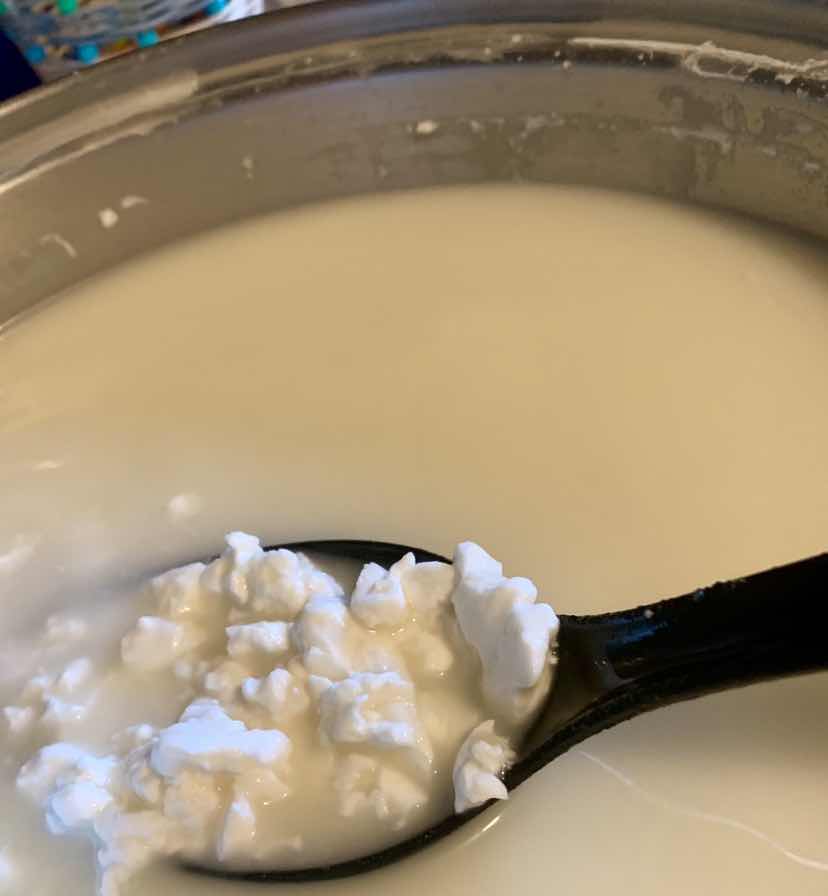
The simplest thing to do with milk is make chevre. That’s just involves adding culture to the still-warm milk and leaving it in a warm place for 24 hours, and then draining through a jelly-bag and salting. 

The next simplest thing to do is make what I call “easy Cheese.” That’s a paneer-type fresh cheese made by heating the milk to 180 degrees, adding vinegar, draining the curds and pressing. It takes about twenty minutes and makes a nice, fresh tasting cheese suitable for quesadillas. It’s a bit bland but it’s easy (hence the name). 

When I have more time I may make cheddar for long term storage, which is a multi-step process that requires active involvement and attention at various intervals over a several hour time frame. If I have lots of time but not the inclination for meticulous processes, I make cajeta. 

Cajeta, for the uninitiated, is Mexican caramel sauce made with goat’s milk. It’s unearthly delicious. Just crazy good. Try it on sliced bananas, or fresh peaches. My husband likes it on toast for breakfast. Everyone likes it on vanilla ice cream. Cajeta can be water-bath canned, and so I often give it as Christmas gifts. Nobody ever complains about getting a jar of cajeta. 

CAJETA 

1 gallon goats milk (must be very fresh) 
6 cups granulated sugar 
Teaspoon vanilla extract 
Half teaspoon baking soda 
Pinch salt 

In a very large stockpot, combine milk, sugar, and vanilla. Put over medium-high heat. When milk is hot but not yet boiling, add the baking soda. Careful, it may foam up quite a bit, but it will subside. Add salt. 

Bring milk to a  boil, then turn down to a fast simmer. Be careful - when the milk boils it will rapidly - instantly - I greatly increase in volume. That’s why the stockpot needs to be really big. But when it goes down to a simmer it will subside. Keep the simmer as fast as possible though, almost a true boil. 

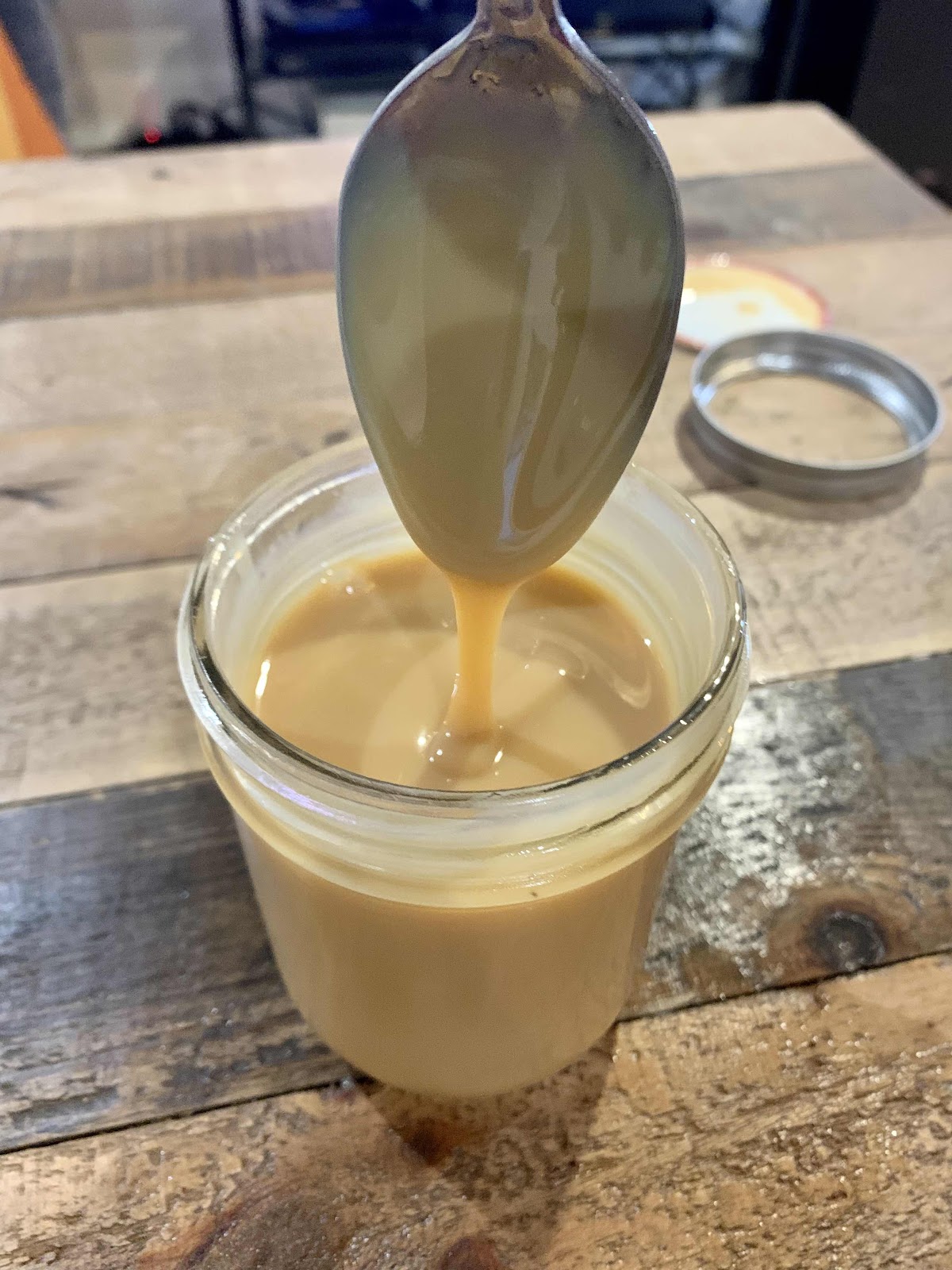
Leave it for about an hour. Every once in a while, check on it and scrape the sides with a rubber spatula. Keep it simmering until it thickens, and coats a spoon thickly.  It may take up to three hours, but it can be pretty much unsupervised except for the last bit. At the end, it will begin to boil quickly at the same heat. That’s okay, just stir it and don’t let it scorch. It should get medium-light brown (the cajeta in the picture above is a little bit pale), and be thick like caramel. It will thicken more as it cools. 

Put hot cajeta into sterilized jam jars and top with sterilized lids. Process in a water bath for fifteen minutes. If any jars don’t seal, don’t worry, they will keep in the fridge for a month, anyway. 
Friday, August 7, 2020

Miracle Milk (Goats are Great)


A neighbor of mine, S., recently had her first grandchild. Her daughter gave birth to a beautiful little boy. Although everything seemed fine at first, the baby wasn’t growing well. He had nearly constant colic, and wasn’t gaining weight the way the doctor wanted to see, even though he was nursing well. After trying several other things, the doctor suggested it might be something in mom’s diet, and suggested going off dairy entirely. 

Well, my neighbor owns a dairy. They are an old fashioned family-owned dairy, the likes of which have nearly disappeared. They own a hundred or so Holsteins, which are milked twice a day, and the dairy truck comes by daily to take away the milk. The family simply siphons off fresh unpasteurized milk from their refrigerated tank for their own use. “Going off dairy” was a serious proposition for someone raised on a dairy farm and used to fresh raw milk with every meal. Mom tried, but couldn’t give up milk for her coffee. The baby didn’t materially improve, and mom decided as a last ditch effort, she would seek out goat’s milk for her coffee and see if that made a difference. 

An aside - people who have trouble with milk and milk products might have any one of a number of different things going on. The most common is lactose intolerance. That is an inability to digest lactose (milk sugar) because of deficiency of the enzyme needed to break it apart. That enzyme is called lactase. All infant mammals produce it, but all non-human mammals, and many human mammals, cease to produce it after the age of weaning. If you don’t produce lactase, you will not be able to digest any milk, from whatever source. 

However, other people produce plenty of lactase but are intolerant to the protein in cow’s milk. They might be truly allergic to that protein, or they might just have an “intolerance,” meaning it causes them indigestion. If the milk PROTEIN is the problem, as opposed to the milk SUGAR, then one might very well be able to tolerate goat’s milk but not cow’s milk. The protein molecule of cow’s milk is about 100 times larger than that of human milk; the goat’s milk protein molecule much more closely resembles that of human milk. 

Back to the main story - my neighbor approached me and asked if I would be interested in trading goats milk for cows milk, just to see if it made a difference to her grandbaby. Of course I said yes. Two weeks later, my neighbor called me and said that the goat’s milk was a miracle, that she had been skeptical that anything in mom’s diet was the issue but she couldn’t argue with the results. Baby’s colic had nearly disappeared and he had gained significant weight. When I went to her house to trade more milk, she gave me a huge hug. 

In the course of my job (medical interpreter) I spend a lot of time just chatting with people while we sit in tiny exam rooms waiting for the doctor to arrive. One of the ways I pass the time is talking about my farm. Many of my clients grew up in very rural situations and this gives them a chance to reminisce and often we connect talking about caring for animals, kitchen wisdom and lore. 

No fewer than three people - all of them very elderly now - have told me that they were raised on goat’s milk from early infancy. One old gentleman told me how he was adopted when his mother died in childbirth and that he was fed goat milk from the first day of his life. When he told me the story he said “a nanny goat was my mother.” The other two were not quite so effusive, but they both told me that formula just wasn’t a thing that was available in the tiny ranchitos where they lived, and if there wasn’t a wet nurse available, then goat’s milk was considered the next best thing for newborns. 

In our area, there are a lot of immigrants from Russia and Ukraine. Some of them that are friends of ours have also expressed an almost magical belief in the power of raw goat’s milk to promote health and vigor. One Ukrainian friend of my mom’s drove up from Seattle - 100 miles - every week to get goat’s milk for his small daughter. 

Personally I have no strong feelings one way or the other about goat’s vs cow’s milk, not even about pasteurized vs raw milk (though I do think people ought to be allowed to buy and sell raw milk). I like goat’s milk. I LOVE goat cheese. If there is any magic in it, I tend to think it derives not from an inherent quality of the milk, but from the fact that it is a product of our own homestead. 

This place, this earth, grew the grass that nourished the goats. My hands cared for them and doctored them, birthed them and milked them. My eyes delighted in their grace and cavorting. My mind learned to use the milk to make cheese. My spirit birthed the longing to create this place and called all of it into being. Together my family made a home here that supports the goats, and they in turn support us. We have a beautiful circle going on here. 

The circle is the magic.


Saturday, May 18, 2019

The Fermentation Files, Spring 2019


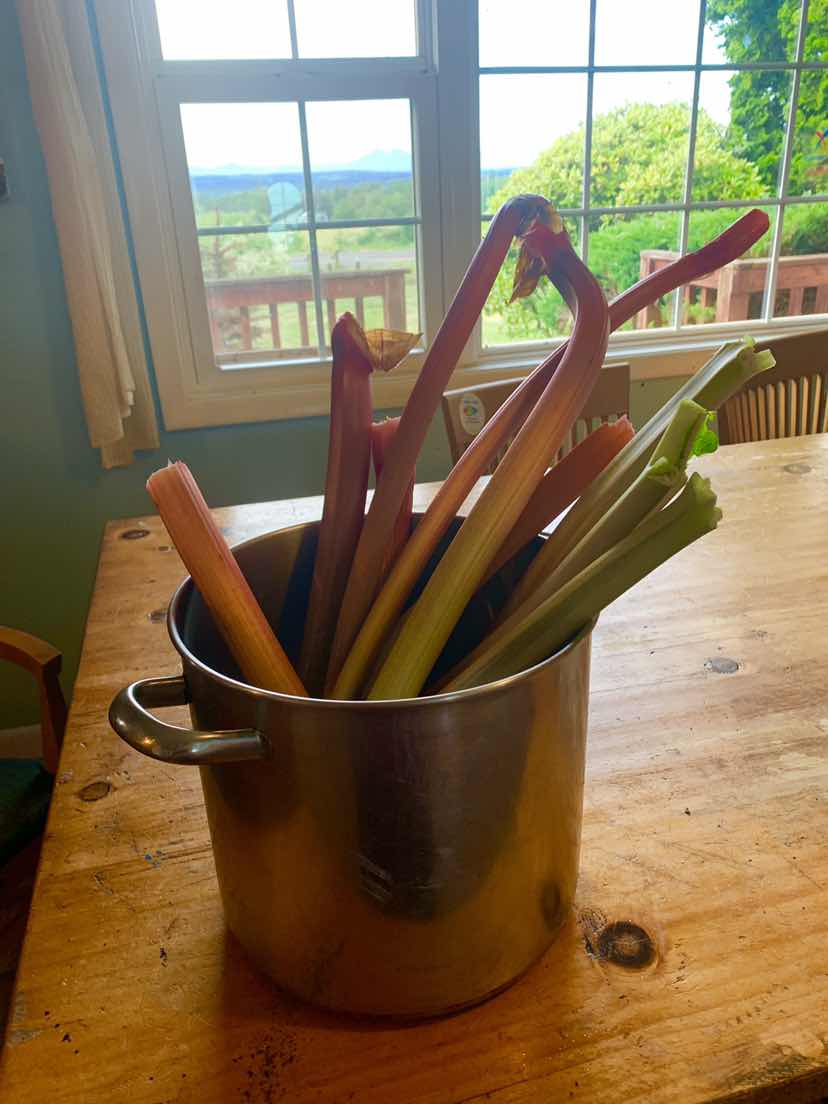
Spring finally sprang, and we’ve had a few weeks of beautiful weather. The grass grew all at once, the trees blossomed, and the rhubarb plant went wild. 


I love rhubarb, it’s exactly the kind of low maintenance perennial I want to fill my property with. But it is seriously prolific. By mother’s day I had already exhausted my family’s patience with rhubarb crisp, rhubarb pie, and rhubarb quickbread. So today I decided to start another batch of rhubarb wine. 

Last year’s rhubarb wine came out pretty good - dry, light pink, and quite quaffable. It’s nice to be able to start a wine in springtime, because most homemade fruit wines are only possible in the fall - blackberry, plum, hard apple cider. Rhubarb can be started now, in May, and be ready for drinking in September when the other wines are just getting started. 


It’s cheese season. The mama goats still have nursing babies on them, and will for the next few weeks. So I’m only getting about three quarters of a gallon daily, but that’s still plenty for making some cheese. 

This year I decided to switch up the cultures I usually buy.  In years past,  I have bought an all-purpose mesophilic starter that says it is suitable for chèvre, queso fresco, feta, and cheddar. And it is suitable for all those purposes.   But this year I decided to spend a little bit more for a fancier culture from France, and I’m so glad I did. My chèvre is leaps and bounds better than last year. It’s smooth, tangy, and delicious. It was a big hit at mother’s day brunch. 

Tonight I’m making cheddar with the same culture. I’ve made two batches of hard cheese before now, and they have been drying in the shelf during this nice dry weather. Today I broke out the vacuum sealer and sealed them up for long term storage in the fridge. That’s the best system I’ve yet found for keeping hard cheese at home without molding. It’s not ideal - the cheese doesn’t “breathe” if it’s vacuum sealed - but it does keep the cheese from molding for a good six months, which means we can enjoy cheese in December. 


Sunday, March 24, 2019

Four is Too Many


Christmas gave birth this morning, unaided, to quadruplets. They are all up and nursing, appear to be full term and healthy, and of course as cute as all get out. Three bucklings and one doeling. 

I’m not thrilled. Four is too many for a mama to raise alone. Having only two teats, even if she produces enough milk for all four (doubtful), the stronger kids will hog the teats and the weaker kids will starve. I’m going to have to pull a couple and bottle feed them, and I HATE bottle feeding. 

If there is anything in this world more frustrating than watching newborn kids try to stand up and nurse, it’s trying to get newborn kids to take a bottle. I’ve managed to avoid it most years, but I don’t think I’ll be able to this year. 

Christmas did NOT look big enough to have quads inside of her. I was expecting twins. She’s never had more than two before. 

Now I’m terrified for poor Flopsy! She’s twice the size of Christmas. She must have, like, nine in there. 

Sunday, June 10, 2018

Long Live Hippies (Trade Network ‘18) S


We are currently getting about three gallons of milk a day from my two best dairy goats, Polly and Christmas. I have been making cheese two or three times a week, but the milk piles up even so. This morning, there were seven half-gallon jars full of milk in the fridge, as well as a few pounds of chèvre and several vacuum sealed packages of hard cheese. There are also eight or so pints of canned cajeta in the pantry. 

As I have written before, we will be spending most of this summer in Oaxaca, so any and all cheesemaking activity needs to take place before we leave. Obviously, we want to maximize the benefit of this shortened milk season. To that end, Homero and I have both been seeking out possible trade partners. 

A few miles from here, between our farm and the shore of the Salish sea, there is a bona-fide commune. It’s a beautiful piece of property inhabited by five or six families of hippies who live in school-buses, RVs, and trailers of various sorts. Somehow, several years ago, Homero became the de-facto hippie commune schoolbus mechanic for the entire colony. He has been quietly and cheaply keeping their vehicles running for years now. This year, the relationship has paid off in a new trade partner. 

Today, a couple of nice young white people with dreadlocks appeared on our porch with a big bowl of strawberries, a bag of lovely lettuces, and a bunch of radishes. In exchange we handed over a gallon and a half of fresh milk and a pound or so of chèvre. After chatting for a few minutes about cheesemaking, I also loaned them a book of cheese recipes and a teaspoon of mesophilic starter. They were delighted, and promised future zucchini, basil, and raspberries in exchange for more cheese. We even talked about them possibly coming to milk while we are gone and thereby keep at least one of our does lactating. 

Forging relationships with my neighbors always makes me happy. I do love striving for self-sufficiency, which is one of my long-term goals,  but to me, that term does not and never has meant providing all our family’s needs alone. No man, and no homestead, is an island. True self-sufficiency has always meant cultivating mutually beneficial relationships and creating networks of mutual support with neighbors. Sharing resources, whether those resources be material goods like tools, canning jars, and pasture, or whether they be knowledge and experience, books and knowhow. True wealth lies not in hoarding stuff but in creating and maintaining friendships. 

Friends are the real wealth. 


Saturday, August 26, 2017

Vampire Goats


When we got home from our trip to Oregon to see the eclipse (WOW amazing sight and a great family vacation), I noticed that one of our mama goats, Polly, had become skeletally thin. She has always been a slender goat. Some
goats are naturally thin, some are naturally plump, just like
people. However, Polly's condition was in no way normal - her bones were sharp and visible from a distance. 

There are many factors that contribute to weight loss on goats. One of the main ones - insufficient feed- is not an issue at my place because I have three acres of fenced pasture for three does to feed in, more than enough. Probably the most important factor after availabalility of feed is parasite load. 

Goats are particularly prone to parasites. They are a problem in every area of the country. There are a plethora of parasites - stomach worms, lung worms, coccidia. For the most part, parasites will not kill an otherwise healthy goat, but they will seriously depress her ability to produce healthy kids, abundant milk, and keep her own health intact. https://www.famu.edu/cesta/main/assets/File/coop_extension/herds/Practical_Management_Internal_Parasites_in_Goats1_7-23-2007.pdf

I use ivermectin to control parasites, but over the years I think my herd has built up some resistance, because this year ivermectin is not showing much effectiveness. In particular, my best doe, Polly, has lost a tremendous amount of weight while raising her twins. 

The caloric cost of nursing twins is, of course, very high, but a healthy doe with unlimited forage ought to be able to do it without losing condition. Polly has been losing weight, and when we got back from our five day trip to see the eclipse (AWESOME!!) she had suddenly become emaciated. 

I worked her again, with Ivermectin as usual and also with Quess, a different wormer which has a different mode of action. Hopefully that will have an effect, but in the meantime I needed to get those kids off of her. They have been sucking her dry. 

We have three kids left - Polly's twins and a single doe from Christmas. They are all of an age to have been weaned a month ago, at least, but I am softhearted and didn't want to separate them from their  mamas. Well, Polly's condition forced my hand. Two nights ago, I put all the babies into the sacrifice area. Such wailing! Such gnashing of teeth! Anyone would think they were being peeled alive. But no- they are just being weaned.

All three babies are seriously overweight. Obese even. They have "milk glitters" on their throats- signs that they are being over fed. And meanwhile their poor mamas are staggering around at the end of their endurance. I should have separated them a month ago. 

Friday, April 15, 2016

Cheese Season Solutions (Practicality vs. Purism)


Cheese season will be short this year. We are leaving for Oaxaca June 24th, and at that point we will let the does dry off, since Rowan cannot milk and take care of the farm and go to school full time. Right now, Iris is at peak milk production, providing me with just about a gallon of milk a day. The other two does still have kids on them, and I am not usually bothering to separate the kids because Iris is providing me all the milk I can reasonably use.

Unless, that is, I find a solution for the difficult problem of aging hard cheese. I have tried for several years, with little success (okay, no success) to age my hard cheeses. I purchased a wine fridge. I bought cheese wax and waxed the cheeses and stored them in the wine fridge. I read about optimal humidity levels. I turned them over daily. No matter what I did, the wax cracked and the cheese molded within about a month to six weeks.

With larger wheels of cheese (large for me is about a four to five pound wheel) I was able to whittle off the mold and eat the interior of the cheese, but more than half of it was lost, and I could always detect a little moldiness even after trimming. Just seemed like a giant waste and a big disappointment.

So this year I have been making more chèvre, which I can use up in lots of ways (although I feel like an Iron Chef with chèvre as a secret ingredient - "you must use chèvre in EVERY dish") There's about three pounds of it in the fridge at the moment. I still make the hard cheese, my farmhouse cheddar, but we just have to eat it young. It's extremely frustrating, because the cheese continues to improve every day, right up until the day it starts to mold, which is at about one month. Very green hard cheese is not delicious - it's naturally quite sour and one-dimensional. Complex flavors don't begin to develop and the sourness doesn't subside until the cheese is about two weeks old, and then it becomes a challenge to try and eat it before it goes bad two weeks later. I have found that I can speed up the maturation process some by cutting the fresh cheese into 2" cubes and giving them a final salting. But what I really want is to be able to make hard cheese that I can eat six months later.

Recently, an exciting new cheese shop opened up in my town, Twin Sisters Creamery (http://www.twinsisterscreamery.com/#!cheese-shop/cjdh). Not only do they sell a wonderful assortment of cheeses both local and international, but they are cheesemakers as well, producing a terrific blue cheese called "Whatcom Blue," among others. When they first opened, I went in and had a long chat with one of the owners and she was delightful. We talked about cheese for a half hour or so, and she was interested in the fact that there are many home cheesemakers around. I told her I'd be back as soon as cheese season started, and if she wanted to sample some of my goat cheese, she'd be more than welcome. She said she'd love to.

It occurred to me today to go and ask her about solutions for my storage issues. I brought along a wheel of two-day old cheese, and two baggies of cheese cubes, one about two weeks old and one about four weeks old. I was hoping that she would want to taste my cheese and would be impressed with it (I'm a sucker for praise), but mostly I was just hoping she would have some suggestions for aging it successfully.

Turns out, she wasn't there. I spoke to her husband, instead, who was a very kind and friendly guy, but not the head honcho cheesemaker. He didn't want to taste the cheese ("I'm not really a goat cheese kind of guy") and I don't blame him - if I were a professional cheesemaker I certainly wouldn't want to taste random cheese from a local person I'd never met before. He did, however, have a very useful suggestion for me.

A Foodsaver. A vacuum-sealer.

It was kind of a "du-uh" moment.

Vacuum sealers are the kind of medium-large, medium-expensive appliance that I always categorized in my head as "unnecessary gadget." Along with microwave ovens and dehydrators. Less frivolous than ice cream makers or popcorn poppers, but to a culinary purist like myself kind of a cheat.

I always imagined myself - in my daydreams - as learning the real, old world, traditional crafts of aging and curing; hanging salami in natural casings, brining kosher dills in stoneware crocks, brewing and bottling hard cider, and carefully turning and aging my own cheese. It matters not that each of these processes is actually an entire professional category on its own, I cheerfully imagined that I would become an expert in them all. And look good doing it, too.

Time passes and illusions fade. Cheese molds, cider turns to vinegar, and salamis never even get made. Time to get real. Do I want to eat my homemade cheese in November, or not? Am I simply a dilettante, feeding goats year round for the sake eating fresh cheese three months of the year, or am I serious about this thing?

So I bought a Foodsaver. It won't be just for cheese - I can also use it in the fall, for storing home-smoked salmon. I still have some questions, and I still plan on going and asking the head honcho cheesemaking lady about them. First among them, won't the cheese stop maturing once it is sealed? Doesn't it need air to keep developing? Maybe not - after all traditional cheeses are either waxed or develop a rind that severely limits gas exchange. At what stage ought I to seal the cheese? As soon as it's pressed? After air drying for a few days? Just before it would begin to mold?

Assuming I can get some answers to those questions, and assuming I can figure out how to work the darn thing. I will start separating the babies from all three does and try to make cheese two or three times a week until we leave. Hopefully, with a little experimentation, I can start to make maximum use of the oceans of milk that flow in the springtime, and save it for the droughts of winter.


Tuesday, March 8, 2016

Well, That Was Fast


It only took me a day and a half to kill the kefir grains I was given. I have no idea what I did wrong - I only added a half cup of my own milk and then left them overnight at room temperature. The next day I opened the container and the liquid smelled great- tangy and fizzy. So I decided to strain some off and drink it. But when I poured the kefir through the strainer, nothing was left behind but a little bit of smooshy niblets, like cottage cheese. Less than a teaspoon. Even so I tried to save them by putting them back into fresh milk but no go. That evening they were totally dissolved. 

I don't get it. The only thing I can think of is that the milk I added was too cold. It was straight out of the fridge, but it was only about a quarter of the volume of the kefir in the jar, I didn't think it would make such a difference. 

That's the only idea I got. Sorry, unique kefir SCOBY!!  I didn't mean to kill you. 

Sunday, March 6, 2016

What's Growing in my Kitchen (the Fermentation Files)?

There's a new bookstore in town, and when I went in to check it out, I found this irresistible book:


Much more than a recipe book - in fact, I don't think there any actual "recipes" in it at all - this book is a wonderful compendium of stories, anecdotes, instructions, and musings on all types of fermentation. Parts of it are scholarly and full of references to the newest scientific research on gut biota, and parts of it are full of poetic or mystical ramblings. I am thoroughly enjoying it, and it has inspired me to start a whole bunch of new projects. 

I have been dabbling in fermentation for ages, of course. Longtime readers of this blog will remember some of my experiments with pickles, kim chee, hard cider, and sourdough. Even cheesemaking is one of the fermentation arts, although I had never thought of it that way before. 


I miss baking. We get so much free bread from the Gleaner's Pantry that there has been no actual need for me to bake. My wonderful sourdough starter died over the year we lived in Oaxaca. I parted it out to friends, but none of them kept it going. I have been without sourdough since. 

Inspired by the book, I put out a call over Facebook for sourdough and Kefir grains. Within hours, a couple of local farmer ladies had answered me. This sourdough was brought to my friend G. by her aunt in Alaska. The aunt claims that it is from a strain that has been kept alive since the 1890's. It seems that most people who have family starters all claim that they have been nurtured since pioneer days; who knows? It's possible. 

This particular sourdough did not seem very lively. It took me a week to nudge it back to life. For a little while I thought it was completely dead. I had fed it with wheat flour, warm water, and dribbles of honey without much result. A slow bubble here and there. Then I remembered that when you first start a sourdough you are supposed to use rye flour - so I ransacked the cupboard to see if I had any. I did! Three years old, but apparently still potent because after I added a half cup of it to the mason jar, it perked right up and started bubbling vigorously. Today I baked my first loaf of bread, and it is delicious! 


Kefir is a weird thing. Most people who buy it in liquid form at the store probably think it is some sort of yogurt, but it is not. You cannot use kefir to make more kefir, as you can with yogurt; you need
a Kefir SCOBY (symbiotic community of bacteria and yeast), and you need to keep the SCOBY alive by providing it with fresh milk every day or two. That milk will become kefir as the SCOBY digests it.

There are lots of SCOBYs, by the way - a vinegar "mother" is a SCOBY, as is kombucha. the Kefir SCOBY looks sort of like cauliflower. The photo above shows the one given to me by M., another nearby farmer lady. She tells me it came from a woman on Lummi Island, who says she brought it with her 30 years ago when she moved here from the east coast. And one of the really cool things about this Kefir SCOBY is that is adapted to goat's milk, having been grown only in goats milk for at least the last several years.

Although I like knowing the age and history of my ferments, it feels like a bit of added pressure to keep them alive. What if I kill the 1890 Skilly Dough? What if this ancient and unique kefir SCOBY dies an ignominious death in the back of my crowded refrigerator? Well, presumably there are lots of other kitchen witches like me keeping their own little SCOBYs alive. Long may they prosper!


Saturday, June 11, 2011

Massive Milk Overload (How to Make Paneer)!

I sent all my non-lactating goats to a friend's house to clean up her yard, and so for the next week or so I will be collecting nearly three gallons of milk a day. Probably that means it's time to can the year's supply of cajeta (goat's milk caramel sauce). I am actually all out of cheese making supplies - culture and rennet - so I'm going to order some more. It will take three days for the supplies to arrive in the mail, but in the meanwhile I can always make paneer - vinegar soured cheese.

Most of you are probably familiar with paneer from your local Indian restaurant - Saag Paneer is the famous pureed spiced spinach with cubed cheese dish. However, Paneer is used in any number of ways in Indian cooking, both sweet and savory. I tend to be lazy, which means I simply toss cubed panner into whatever type of curry I am currently simmering on the stovetop - peas and potatoes are popular, as are tomato based curries or chickpea or lentil stews. In my wonderful cookbook "660 Curries" by Raghavan Iyer, there are some thirty recipes for Paneer utilizing everything from cashews to cabbage. Most of them call for the paneer to be fried in shallow oil until golden beore being added to the curries, but you can skip this step if you want. Paneer is also great tucked into a hot folded tortilla or crumbled into a pan full of scrambled eggs. In fact, Paneer can be used pretty much any way you would use a fresh farmer's cheese or queso fresco. It works in quesadillas, for example. Indians use it in desserts, but I can't offer any recipes because I've never tried that.

What I love about it is that Paneer is "easy cheese." It requires almost nothing in the way of equipment or supplies. If you have a colander and some clean cloth, you can make paneer.

Paneer:

1 gallon milk (fresh raw milk will have the most flavor, but plain store bought cow's milk will work as well)
2-4 tablespoons distilled white vinegar
salt

Heat milk in a large pot to near boiling - about 180 degrees if you have a thermometer, or until it begins to rise up if you don't. Remove from heat. Drizzle in vinegar, stirring, until you see curds separate from whey - this will take about 1 minute.

Line a colander with a triple thickness of cheesecloth or with a section of plain cotton cloth cut from a pillowcase or sheet. Pour the contents of the pot into colander, slowly enough to let whey drain and curds be caught. Fold clean cloth over the top and let sit overnight.

In the morning, cut cheese into 1/2" cubes and salt heavily. Use in Indian or Mexican recipes or in grilled cheese sandwiches, or as you like.

Tuesday, February 22, 2011

Goat News, Good and Bad

Yesterday afternoon I took the sick little goatling to the vet to be put down. For a while it looked like she was going to recover from her hypothermia - she stood up, nursed from her mother with a little help, and was swallowing the milk I dribbled into her with a syringe. But then she began to have copious, watery diarrhea, her eyes took on a sunken appearance, she whimpered constantly as though in pain, and when I took her back out to her mother to have another go at nursing, she clearly didn't know what was going on. She just stood there feebly, and her mother kicked her.

There was nothing left to do, so we put her down and I buried her out back by the beehives. It was such a small grave, it only took me a few minutes to dig. Luckily, the other two babies are just fine. The weather has taken such a cold turn - and it is expected to be even colder over the next week - that I decided to keep Iris and her babies locked in the mama barn and run a heat lamp out there. A heat lamp in a barn full of hay makes me very nervous, but I can string it up so it hangs from the ceiling far from the hay.

The good news is that I have now sold all three goats that I had for sale. Funnily enough, they are both long distance sales, from people who were specifically looking for spotted Nubians. The man who bought the babies bought them for his elderly mother, who talks about the beautiful spotted goats she used to have when she was a girl in Greece. I thought that was so sweet! The babies will be going to Ellensberg as soon as they are 8 weeks old, and Storm Cloud, my buck, is going to Oregon. In fact, I will be transporting him there myself, because the lady who bought him offered to pay me to transport him, and I have a couple of good girlfriends I'd like to visit near his destination. It's like a free mini-vacation!

I'm kind of sorry Cloud will be going so far away. I won't find a better buck anytime soon, and I always had it in the back of my mind that whenever I acquired some new does, I'd use Cloud as my herdsire again. I am happy, however, that he is going to be lord of a new domain, herdsire to a whole harem of pretty Nubian does. He has a nice life ahead of him.

The death of the baby goat causes me a new problem. Now that I have sold Iris' other two babies, six weeks hence Iris will have no babies at all and I will once again be chained to the milking stand for months, a situation I wanted to avoid this year. Oh well, there are worse problems to have than too much goat milk.

Friday, February 18, 2011

Who Can Resist These Goats??


Last year was a very good year for selling baby goats. I sold seven out of eight babies, for a mean average of $160 apiece. That's a great price for goats around here. I made $1,100, which easily paid for hay and feed, and even vet bills, making all of our milk and meat essentially free - except for the labor involved, of course.

This year, I haven't got even one phone call regarding my adorable spotty Nubian babies, even though I dropped the price considerably from last year's. I have seen goats - purebred goats!- advertised at less than $50 on Craigslist. I won't sell mine that cheaply. They are worth more to me as meat. Although, to be honest, I have no desire to put six or eight goats in the freezer. We'd never eat them all! I like goat meat, in fact when well done it's superior to lamb, in my opinion, but I still don't like it as much as I like beef or pork.

Plus, if all my does are feeding triplets, if I can't sell off even a few of them, then I won't have very much milk, now will I? And milk, my friends, is the whole point of goats. I guess I'd rather sell a baby for $50 than kill a baby that doesn't even have 10 pounds of meat on her yet and is heart-wrenchingly adorable to boot. Well, it's early yet. Iris' babies have several weeks of enticing cuteness left in them. And Django and Flopsy have yet to give birth.

I am also not having any luck finding someone who wants to trade bucks with me. I can't use Cloud again next year; I need new blood. But so far, the two people who responded to my ad were unsuitable - one guy wanted a registered buck, and the other guy wanted to trade me a one month old crossbreed for Cloud, a proven purebred.

Why can't they invent a mammal that gives milk without needing to give birth first, the way chickens lay eggs without breeding?

Sunday, October 31, 2010

Gimpy Goat and No More Milk

This is Django. She is one of the original three goats we bought when we moved here, and now she is the only La Mancha I have (La Manchas are the earless goats. Nobody cut off her ears: it's just her breed.). Django has always been a good goat - good mother, good milker, about as easy-going as a goat gets. She did get terribly ill a couple of years ago after getting into the grain, but she recovered and has been pretty healthy ever since. She had triplets this past year.


Yesterday when I went out to do the chores, I saw something awful. Django appears to have a dislocated shoulder. One of her shoulder blades is depressed downwards and if I lay my palm on the place where it ought to be I can feel the bone socket. Her elbow is rather radically displaced - down and to the side. Nonetheless, she is getting around okay. I called the vet, of course, and as I was trying to explain exactly where the dislocation was, Django kept running away from me. As James Herriot said in his wonderful book All Creatures Great and Small, if you can't catch your patient you've probably got little to worry about. She was browsing normally and later on chewing her cud. She didn't cry when I manipulated the joint.

The vet said that he's seen this before, and never had any luck trying to manually replace the bone. He said an operation would be the only option. Well, I said, it's not an option for us... do you think she'll recover on her own? Is this a very painful condition? He said that it was unlikely the joint would "pop back in" on it's own, but that over the next few months she would develop a false joint and be more or less normal. She would look funny and probably never quite keep up with the herd, but once the joint stabilized she would get around fine. It's hard to tell how much pain a goat is in, they are very stoic animals, but it's a good sign that she's chewing her cud. He said it's a good thing it's the foreleg; hind leg displacements are more problematic and could interfere with kidding.

So we aren't going to do anything. This morning she jumped on and off the milking stand just like usual. She is interacting with the other goats and seems pretty normal, except for that weird elbow thing. I'll just keep an eye on her and watch for worsening mobility or signs of pain. If she does get worse, we'll have to make a decision then.

Also, all the goats are more or less dry. I got about a cup of milk from each one, and that's just not worth it. Most likely they are all pregnant and so I'll just stop milking until next spring.
Cheese season is over at last!

Thursday, June 17, 2010

The Quesillo Chronicles


My cheesemaking experience now stretches back almost three years. I have had some notable successes, and several notable failures. At last, I can now reliably produce chevre, queso fresco, and cheddar - which isn't bad considering the poverty of my equipment. One of my cheeses is even achieving some local fame - some of my friends ask for it by name. That would be my "Smokin' Goat Chilpotle Cheddar," a delicious, spicy, lightly aged cheese with chilpotle pepper flakes in it.

But to be honest, my cheesemaking is pretty much hit or miss. My recipe books say things like "hold the milk at 86 degrees for 18 hours." I don't know what kind of equipment they think I have, but I'm pretty sure they are imagining something more sophisticated than a stainless steel pot, a flexible cutting mat, and the oven-light. The rest of my equipment consists of a colander, some muslin, and a tall stack of heavy books. I do the best I can with what I've got and I'm willing to tolerate a fairly high degree of variability.

my cheesemaking equipment


This philosophy has so far resulted in a lot of delicious cheese, but it has not been very successful at producing specific, recognizable varieties of cheese beyond "soft" and "hard." Case in point: Quesillo.

Quesillo is a delicious, fresh, stretched-curd cheese (like mozzarella) indigenous to Oaxaca - in fact, if you are lucky enough to find it here in the states it will probably be labeled "queso oaxaqueno." It is most like string cheese in that it pulls apart into long shreds and melts beautifully. It is sold in long ropes wound into balls. My husband has been asking me to make it for him since the first time I made cheese.

Stretched-curd cheeses are difficult. There is a way to "cheat" with a microwave, but I don't own a microwave and anyway am far too much of a purist/snob to do it that way. Basically, stretched-curd cheeses are made the same way as other cheese up to the first draining, then they are plunged into very hot water or whey and massaged and kneaded until they become very smooth and elastic. Then they are pulled by hand into long ropes.

Sounds easy but it isn't. Since I have had a major milk-glut, I decided to begin experimenting. At any given time I have several gallons of milk and five or six pounds of cheese in the fridge - there's really no reason to be frugal. You gotta break a few eggs, right?

My first three attempts were total abject failures. Usually, any cheese can be salvaged, you just judge the texture and taste and then decide what to call it and how to use it. I tried for creamy and spreadable and got crumbly instead? That's okay, just call it "salad crumbles" and proudly say "I meant to do that." It's goat cheese; it all tastes good.

Well not this time. My attempts at quesillo were completely unsalvageable. Only the dog enjoyed the results. I was frustrated and confused. I thought I was following the recipe. Annoyed, I decided to let it go for a while and go back to something I knew and make some more cheddar. Oddly enough, it was this batch that turned into quesillo. I left the burner on low instead of turning it off and ended up with a very thick, tough curd. When I tried to cut it, it didn't cut cleanly, so I drained it on one solid piece.

Something about the way the drained curd looked made me decide to try one more time... so I heated up the whey to a temperature lower than boiling but hotter than "ouch" and plopped the curd back into it to poach.


I stirred the curd with a wooden spoon for fifteen or twenty minutes, and it began to get stretchy and droop off the spoon like Dali's clocks. Then I got out a clean bowl and placed the curd in it and scooped hot whey over it and began to knead it like dough. Yes, it was very very hot and my hands were poaching too. I got out another bowl and filled it with ice water so I could dip my hands in it when they started to feel like the skin was about to peel off. I kneaded for oh I'm going to say thirty minutes, frequently returning the curd to the hot whey for another bath.

After a while, I saw that when I picked up the curd out of the hot whey it began to stretch more and more. That's when I started to pull it like taffy, folding it over on itself and pulling, folding and pulling, and dipping it in the hot whey whenever it started to lose elasticity. I broke it up into smaller clumps and pulled each one into a long string and then laid it out on the cutting board to salt it. When it was salted, I rolled it up into balls, just like the balls sold in the 20 de Septiembre market in Oaxaca.


Well, almost like that. My skills are not refined enough to produce really thin strands or really round balls, but it WAS recognizably quesillo and it WAS good.

My next batch, however, was another throwaway. I'm trying again tonight. Consistency is the hard part - it always is. It was when I was playing pool and playing chess and it was when I was painting and it certainly is the hard part of parenting and it probably always will be the hard part of all my endeavors. On the other hand, as my favorite English teacher in high school, Mr. McAllister reminded us, "Consistency is the hobgoblin of little minds."

Sunday, May 30, 2010

Help, I'm Drowning!

.... In milk, that is. Ever since the baby goats left, I have been milking three goats morning and evening. Each goat gives me about a half gallon (averaged) at each milking, so that means I am collecting about three gallons of milk a day.


Which is a totally ridiculous amount of milk! I took a picture of the inside of my fridge, but my computer is having issues and so I can't post it right now. Basically, the entire fridge is a sea of half gallon jars full of milk. Well, there are also several quarts of cajeta, five pounds of various types of cheese, a half gallon of yogurt, and a gallon of lard. Plus eight or nine dozen eggs.

The lard and eggs have nothing to do with goat milk, but they are farm products in the fridge, so I mention them.

I need to make cheese and/or cajeta every day just to reduce the cubic volume somewhat. I brought my sister a gallon of milk when I went to her house today. "Take it!" I felt like shouting. "For God's sake, just take it away!" Then as I break down in sobs, I moan in a tiny little voice "it never stops... it just keeps coming...."

My hands are going through their annual transformation- getting all bulked up from the constant milking. So far, no troubles with carpal tunnel syndrome, but I'm sure the day is not far off.

I advertised Flopsy on Craigslist, but I was honest about her having had mastitis and nobody wants her. I really really would like to have one fewer goats to milk, but I can't just send her to the auction. It would be wrong. Homero wants to eat her but I absolutely forbade it. That's just disgusting. So, for my scruples, I have to keep milking her.

And oh my God, it's less than an hour until I have to go out and milk them all AGAIN.

Wednesday, May 26, 2010

One Giant Leap for Cheese


It's been only two days since the last two baby goats were picked up, and already I have run out of room in the refrigerator for milk and cheese. I am frankly stunned by the amount of milk three dairy goats produce daily. Yes yes, I have had three milking does for three years now, but this is the first year that I have bit the bullet and actually sold the kids while they were still babies. In years past, I have kept the kids until they grew up and weaned themselves. Then I sold them for meat.

Sure, theoretically, I knew that each doe would produce about a gallon a day, split between morning and evening milkings. But three theoretical gallons are very different from three actual gallons taking up all the very literal space in my refrigerator. I need to make cheese every day just to reduce the cubic volume somewhat - a gallon of milk makes a pound of cheese, which occupies much less space.

Today I made cheddar, and yesterday I made black pepper chevre. The day before that I made paneer. The trade network will be able to absorb some of this excess, but not all of it. As I am not a licensed dairy, it is illegal for me to sell cheese or even milk. I am not entirely sure of the legality of selling milk "for animal consumption only" but I advertised it that way on Craigslist nonetheless.

What I really need is a way to reliably age hard cheese. I can make cheddar, but without a "cheese cave" - a climate controlled area - I can only keep it for a month or so before it begins to mold. It's delicious young, but that's not the point. The point is, how can I store my summer excess for winter?

This is hardly scientific, I know, but my best idea so far came from the "Little House" books. Ma Ingalls used to paint her cheeses with wax and then set them to age in the root cellar, turning them every couple of weeks. I can buy paraffin cheaply at the craft store. It's worth a try. I don't exactly have a root cellar, but I have a crawl-space and a lockable cooler.

The other possibility is convincing my husband to have a go at converting an old half sized fridge we have sitting out in the garage into a cheese cave. What I need is a box that will maintain a temperature of between 45 and 55 degrees, and a set humidity which I'd have to look up. He likes to tinker, so getting him to give it a go isn't too far fetched. Getting him to maintain interest long enough to make it actually work, though...

The last possibility is training myself to look upon my astounding surplus of milk as a golden opportunity to experiment with tricky cheesemaking techniques and obscure products. I'm dying, for example, to learn how to make Oaxacan quesillo - a delicious kind of string cheese. My husband would absolutely swoon if I succeeded in making quesillo. I haven't attempted it before because it's difficult and I would certainly fail a few times before I succeeded.

I am rather a miser when it comes to milk (and eggs) and I find it very hard to launch an experiment which might very well result in the loss of a few gallons. Nobody knows what an investment of time, sweat, and tears those gallons represent but me. I am the same way, actually, with paint and canvass. Lord knows the masterpieces I might have created if I could just get over my fear of wasting materials.

Whaddaya say - shall I risk a little milk in pursuit of new and superior cheese? Some gourmand said (I read in a book of quotations) "Cheese is milk's leap toward immortality." If immortality isn't a goal worth risking a little raw material for, well, whatever is?

Tuesday, May 25, 2010

Aimee, All Alone (Top of the World, Ma!)

Day three of running the whole shebang by myself. I know that there are plenty of women who run larger operations than mine by themselves, day and day out, and who do it admirably. If any of those women are reading this blog, bully for you, babe, I salute you, but it's kicking my ass!


It's unfortunate that Homero's unscheduled vacation (he spontaneously decided to drive to Oaxaca) coincided with the beginning of milk-around-the-clock season. I am getting up a half hour early to milk and get everybody ready for school, and what with one thing and another, I pretty much don't sit down until bedtime.

Then I don't sit down, I fall down.

I never realized there was so much slack in my schedule before. I felt pretty busy a week ago, too, but it wasn't even in the same league. One thing's for sure - if I ever have to be a single mother (touch wood), I sure ain't milkin' no three dairy goats every damn day. Homero, if you ever entertained thoughts of leaving me, give it up! You ain't goin' nowhere!

This morning was particularly rough. When I went out the the barn to do chores, it was raining lightly. I realized I had left the brand new bags of chicken food and goat food out last night because I can't maneuver my way through the chained gate and operate the latch on the barn door while carrying a 50 pound feed sack and fending off four frantic goats without help. Well, I couldn't do that any better in the morning than I could at night, so I cast about for something to cover the bags with. I spied the 75-gallon rubbermaid water trough, which thankfully was empty. I lugged the tank over, then tried to pick up the sack of goat feed and put it on top of the sack of chicken feed. It seems, however, that the light rain had already weakened the paper and the sack split in the middle spilling all the grain on the ground. So, swearing, I ran around looking for a couple of five gallon buckets and some sort of scoop. At least the ground is dry and hard and so I didn't lose any grain to the mud.

Scooping up the last of the grain, I decided to sprinkle it over the hay in the new fence-line feeder that Homero built for me. The fence-line feeder is basically a big box into which you put a whole bale of hay on the OUTSIDE of the pasture. The goats can stick their heads into the box but they can't trample the hay. It was a massively heavy hinged wooden lid on top to protect the hay from rain. I lifted the lid and started to sprinkle grain. Then I noticed four eggs in the hay (the chickens can get in the feeder and love to lay in there). As I bent over to get the eggs, the lid fell on my head. I don't know why Homero made it so heavy, using both plywood AND
T1-11. He could have just used the siding.

Then I went in to milk. These days I carry two half-gallon glass jars to milk into - between the three does they both get full. While I was milking Flopsy, the last doe, into an almost-full half gallon jar, she kicked and made me spill it all over myself. "Oh you horrible goat!" I shouted. "I hate you!" And at that moment, I truly did. I hated the goat, my husband who left me here all alone, myself, and basically the whole world.


Saturday, April 24, 2010

The Fickleness of Memory (I got the Wormy Wormy Blues)

We had milk goats when I was a child. It was my job - along with my younger brother - to feed the goats and water them every morning before we went to school. I remember many a frosty morning lugging plastic milk jugs full of warm water before the sun came up. The hose didn't reach. One early morning (must have been the dead of winter - it was full dark) my brother and I saw a very strange thing in the sky. It looked like a satellite - just a star moving slowly in a straight line - but it had a trail of red flames bucking rapidly up and down. Remember that, bro?


I remember milking - though not as a regular chore. It was more of "when we felt like it" thing. I remember the cats lining up for squirts of milk whenever I milked. I remember the feeling of hot foamy milk squirted directly from the teat into my mouth. I was a generous (not to say wasteful) milker. One for the the bucket, one for the cats, one for me; one for the bucket, one for the cats, one for me.... I remember the one time Dad made cheese and being very upset that I didn't get to taste any before it was all gone.

I even remember when Lily the goat - our first ever - was attacked by wild dogs or coyotes and had a big muscle in the back of her rear leg torn out. She survived, but was never the same. I remember when Peanuts the buck was attacked by dogs while staked out in the blackberries. He was killed. After that my Dad (or Mom?) sat out with a shotgun for a few nights and peppered the dogs with birdshot. I remember when Daisy got out and ate so much rhododendron she was poisoned and how we found her lying on her side, horribly bloated.

I remember lots of frolicking in the springtime with baby goats, and how they leaped and twisted in the air. I remember there was one baby goat who could climb the ladder up into the hayloft of the barn. I do not remember how we got him down. I remember that all our goats had botanical names - Daisy, Fern, Clover, Dandelion, Bachelor's Button. I remember that I tried for years to see baby goats being born, and I never quite made it. I remember one year waking up in the pre-dawn light (my room was the closest to the barn) and hearing soft bleating sounds. I ran downstairs and out to the barn without my shoes on. Daisy ( a white Saanen) had given birth to triplets just moments before and they were just beginning to try and stand up. That was as close as I ever got.

Here's what I do not remember:

Anyone trimming any hooves.

Taking any goats to the vet, ever.

Problems with birthing.

Medicating the goats with anything at all.

Now, I was a child. I was only eleven when we moved off the farm. My mom put an ad in the paper for "free goats - first come, first serve" and we gave all the goats away in fifteen frantic minutes. It's entirely possible that a lot of things happened that I just don't have any memory of. But I think not. My mom does not remember having any problems with sick goats, either. Her memory isn't much more reliable than mine, but put our recollections together and they do begin to add up.

Most likely, we were utterly irresponsible goat owners. Mom was working seventy hour weeks after the divorce, and I'm sure the goats were the last thing on her list of priorities. For all I know, our goats were walking textbooks on parasites. But that's not what I remember. I remember vibrantly healthy goats, when they weren't being chewed on by dogs or poisoned by bad plants. I suspect that thirty years ago there were not the problems with CAE, CL, and parasites that exist today.

Today, it's a given that all goats have worms. The best you can hope for is that the worms are not resistant and can be controlled by relatively benign medications. My goats have worms. Lots of worms. I've had lungworms, stomach worms, and worms that don't even have names yet. My feeling has always been that a complete lack of parasites isn't possible: instead I should strive to have healthy, well-nourished goats who are capable of harboring a reasonable number of parasites without becoming symptomatic. My vet agrees with me.

Well, that road has closed. Despite my best efforts, despite using de-wormers strictly according to my veterinarian's directions, my goats have developed resistant worms. My does were wormed after kidding - as per instructions - with Ivermectin. At that point in time they were asymptomatic. A few weeks later I noticed that they all had diarrhea. Bad, green, liquid diarrhea. I took fecals to the vet. Stomach worms - a heavy load. Since they had been wormed recently with Ivermectin, I used Safeguard this time - again, on the advice of my vet. I wormed them all thoroughly - using a high dose and repeating it for four days.

Repeat fecals two weeks later revealed a virtually unchanged number of stomach worms. They were resistant. How did the resistance develop? I don't know. I did rent a buck from another farm last fall, but we coordinated worming schedules and both sides should have been worm free at the time of transfer. Other than that my herd has been closed for more than a year.

Oh shit that's not true. Just remembered, I also rented out Cloud for a month as a buck to a nearby farm. But Cloud is the only one who has remained asymptomatic this whole time! He is fat and glossy, pooping pellets and leaping around like a racehorse. The does, in contrast, are skinny as rail fences (poor Django is trying to feed triplets!). Petting them feels like petting a barbed wire fence. I feel like the world's worst goat owner. I can't let anyone see my goats right now or they would assume I am starving them to death. In actual fact, I am feeding them free-choice high quality local hay (orchard grass/alfalfa mix) plus eight cups of grain daily for the milkers, and nearly unlimited browse on grass and blackberries.

Today - again on the advice of my vet - I wormed them all - does, buck, and kids - with Quest. Quest is a whole different class of dewormer and my vet says she has had good luck using it with resistant worm populations. I hope it works. Quest has a month long meat withdrawal time, and an unknown milk withdrawal time, but probably at least two weeks. That's okay - my does will need at least two weeks to gain weight and get healthy before I start to milk them again anyway.

So no more milk products for now - no milk, yogurt, or cheese. Just wait. Just wish them luck.


Thursday, April 15, 2010

Easy-Cheesy (No Room at the Inn)

Last week, I started separating the baby goats at night. Now I am getting a crazy-large volume of milk, a volume that must be dealt with daily. If I don't do something with milk at least every other day, there will soon be no room at all in my fridge. The eggs are space-hogs. I have seven dozen eggs in there now, and the hens are outside popping out more even as we speak. I need to step up the trade network; but that's a topic for another day.


Yesterday I made a quart of cajeta (Cajeta is Love). Cajeta is easy to make, but you HAVE to watch it, because milk boils over whenever you take your eyes off of it for fifteen seconds. Ask me how I know. Because it has happened to me EVERY SINGLE TIME I make cajeta. Yesterday I pulled a chair right up to the stove so I could sit and read while I watched the pot. After an hour or so I was pretty sure that I had the right gentle simmer going, and the milk was nowhere near the top of the pot. So I went to the bathroom. Now I have a hamper full of sticky caramel covered washcloths and the floor is still pretty tacky on the bare feet. Will I never learn? But at least we also have a jar of cajeta in the fridge, and my husband was so happy to see it he gave me a big kiss and washed all the dishes.

I have made a half-gallon of yogurt, which is really too much. The guy I thought would want some is out of town so I can't offer him any. We'll just have to eat it. Luckily, there are still some blueberries in the chest freezer. We picked a LOT of blueberries last summer. Blueberry smoothies make a very good breakfast. Maybe I should put a raw egg in the blender too. Get rid of a few. No one will ever know.

When I started to make cheese the other day, I discovered that I'm out of rennet. I already had the milk heated to 100 degrees on the stove, so I thought fast and came up with the idea of making paneer. Paneer, for anyone who doesn't know, is soft fresh Indian cheese. It is made by souring milk with vinegar or lemon juice instead of coagulating with rennet. I like paneer just fine, but I've never made it before. I sort of can't think of it as "real cheese." But I'm glad I was forced to make it: it is so incredibly easy. The finished product tastes pretty much exactly like queso fresco, but it takes only an hour to make instead of a whole day.

Here's how you do it:

Heat a half gallon of milk to just below boiling - when the milk suddenly starts to expand in volume you're there. Remove from heat. Add about two tablespoons white vinegar, little by little, stirring as you go. In a minute, the milk will separate into tiny little curds and clear whey. If you want soft cheese, immediately scoop (with a fine mesh sieve) into a colander lined with a triple layer of cheesecloth. If you want your cheese firmer, put it back on the heat for a few minutes and stir, then scoop. Wrap the cheese up and either hang the cheesecloth bag from the faucet to drip, or leave it in the colander and put a heavy pot on top of it to press out the whey. In about an hour, you will have cheese. If it's firm, slice it into cubes and toss with a little salt (otherwise it's incredibly bland).

These are little cubes of pure protein, without much flavor. Indians put them into all kinds of curry. My husband crumbles them over eggs or beans. They can be used to make quesadillas. I have a feeling I will be making a lot of paneer. It's a perfectly adequate every-day kind of cheese, and it sure saves a lot of time. Of course I will still make regular cheese too: chevre and feta and cheddar. But maybe I don't have to make serious cheese every time.

Sometimes I can make easy-cheese.

Tuesday, April 6, 2010

"Goat-gurt."

step 1: heat milk to 150 degrees to pasteurize


That's goat yogurt, y'all, and a silly play on "go-gurt" a fake food product that purports to be actual yogurt in a tube and a fun way to get kids to eat yogurt, but which is actually, if you read the label, a mere concoction of sugar, thickeners, artificial flavorings, and some sort of milk-like product. My kids clamor for it, even though I haven't the faintest idea how they have even become aware of it's existence. Probably through other kid's lunches at school.

My "goat-gurt," on the other hand, is nothing but goat's milk and active cultures. I have been milking Flopsy, since she has only one baby left, and I have also been putting the other mama goats up on the stand and giving them their grain, and milking out just a few squirts each - just to get them used to the idea. All in all, I've harvested about a quart of milk a day for the last three days. That would be enough to make a nice batch of cheese - except that I don't have cheese-making supplies. I neglected to order new cultures and rennet before kidding season this year, so I can't make any cheese until I get some more.

My family, I regret to report, is rather squeamish and doesn't enjoy drinking goat milk straight. It tastes perfectly fine - in fact, I doubt anyone who wasn't forewarned would be able to distinguish it from whole cow's milk. It's a little richer and creamier, but there's virtually no "goaty" flavor. I think our reluctance is related to hygiene concerns: no matter how careful I am, there are always I few hairs and flecks in the milk when I bring it in. I strain the milk through a coffee filter, but I saw the hairs and flecks in it and it's hard to forget.

So what to do with the milk? If we aren't going to drink it, and I can't make cheese just yet, then what? I decided to make yogurt. Goat milk yogurt is hard to find, and if you can find it (Trader Joe's) it costs about $5/quart. We use a fair amount of yogurt ourselves, but I also know of at least two people who are interested in buying goat yogurt. I wouldn't charge them $5 a quart - but how about $3?

Whether we end up using it ourselves or selling it or trading it, here's my method for making goat's milk yogurt. Step one is above: pasteurize the milk (after straining) by heating to 150 degrees.
Put a tablespoon commercial yogurt (I like mountain high because it has the highest concentration active cultures) into a quart sized mason jar - or two.

Cool heated milk to between 100 and 120 degrees. I pour the milk into a container which is nestled into a bowl full of ice to cool it as fast as possible.

Add warm milk to jars with culture and stir vigorously for ten or fifteen seconds. Place lids on jars and place in the oven with pilot light lit. Let sit for twelve hours or more, without disturbing. You will have smooth, creamy, thick delicious yogurt.