"United we bargain, divided we beg."
Showing posts with label death. Show all posts

Monday, September 19, 2022

Meat Math, Bovine Edition (GRAPHIC)


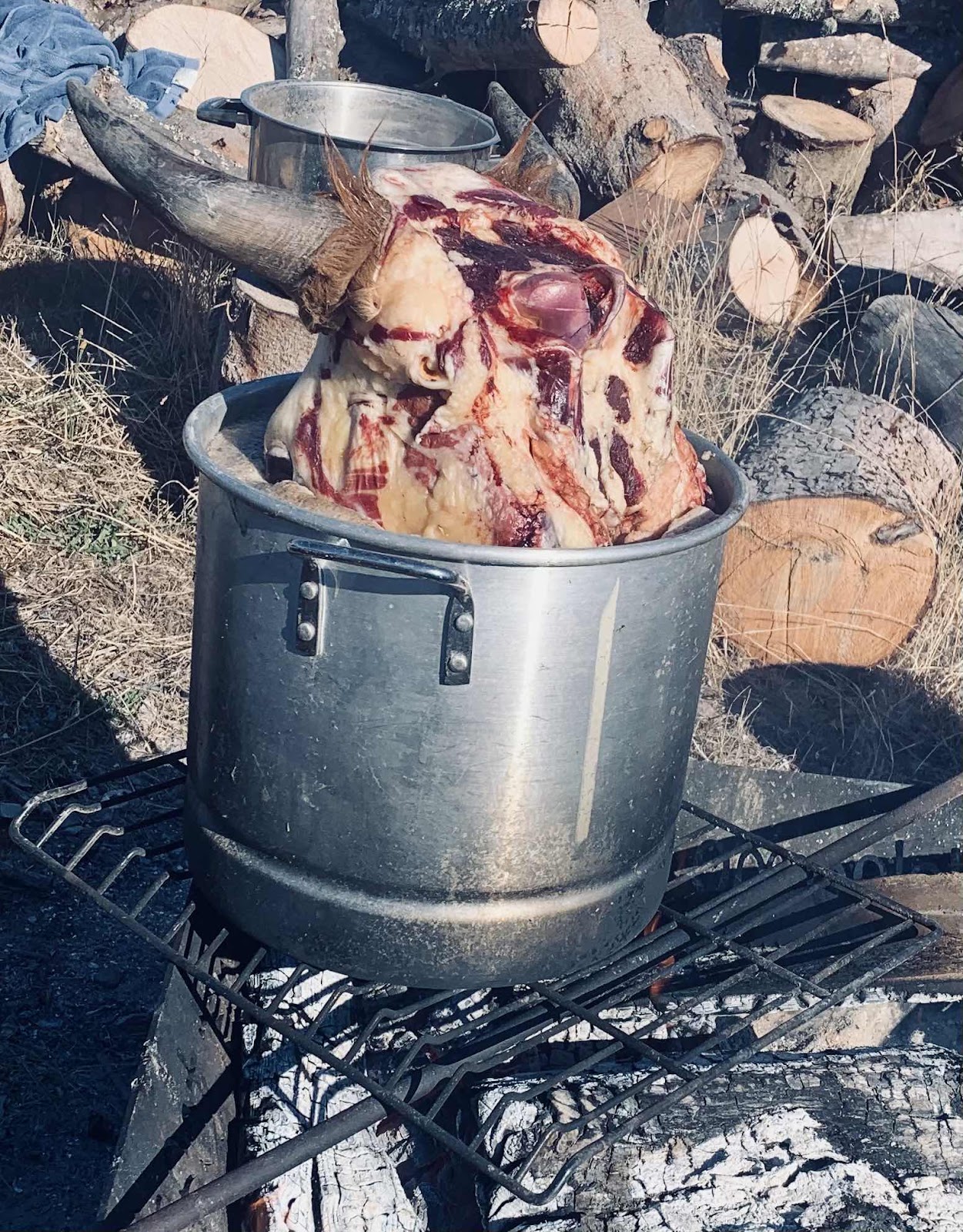
Not a very good picture, but that is a 40 quart stockpot, with  substantially less than half of a freshly butchered steer’s head submerged in it. 

This is what I came home to today. I knew, of course, that today was the day appointed for Pepe Toro, our Jersey steer, to meet his end. The men from Lynden meats were scheduled to arrive in their business-like panel van loaded with motorized equipment and on-board hot water, and do what butchers do. Half of Pepe Toro is already sold, and I have been making room in the freezer for the other half. The death of the cow, per se, was not a surprise. 

I did not know - though I should have suspected - that my husband was going to ask the men from Lynden meats to give him every scrap of the cow, from the horns to the hooves, that they would normally throw away or sell to a glue factory or something, and try to turn it into food. We’ve been through this before, and he ALWAYS does the same thing. 

We are just not prepared for cooking an entire cow’s head. In the past, even pig’s heads have proved to be difficult to manage. The head of a well-grown cow is a majorly large hunk of gristle and bone, and once the tongue has been removed, in my opinion it ought to be ignored. But Homero comes from a background that despises waste and finds a way to use EVERYTHING. This is, of course, admirable, but more so in the abstract than in real life. 


After I found the cow’s head sticking three-quarters of the way out of the pot, I convinced Homero to remove it, and to cut it into pieces with his sawzall, removing the horns and the disgusting patches of hair that clung to the skull around them. He has a plan for the horns - they are a gift to his friend Clacoyo, who wants to mount them on his motorcycle helmet. 

It took two sawzall blades, a cleaver, and a mallet to split the skull I to four pieces, but we got it done. Now the head is simmering over a wood fire - after two changes of water - along with a handful of allspice, cloves, star anise, fennel, and black pepper; three heads of garlic; several onions, and a bunch of guajillo chiles. It ought to be done sometime after moonrise. 

Now for the math. 

This animal was free. Homero has several clients who work on large dairy farms, and they are constantly giving away newborn males. I don’t know why they don’t just centrifuge the sperm they use - almost all cows are bred by AI - but either they don’t, or it has a high failure rate. This was the third free calf we’ve raised. 

The feed for a cow is almost all free too. We did have to bottle feed him for a short while but that was just one bag of milk replacer: about $30. Then of course there’s his winter hay, and a cow eats a lot of hay. I didn’t keep track of how much he ate versus the goats - that would be impossible - but we bought an extra 25 bales last winter and I’ll say that was all cow food. So that’s $100. Other than that, all he’s eaten is pasture grass and free veggies and bread from gleaners. Oh - and the same friend who provided him to us also have us the occasional pickup-load of free silage. 

We did take him to the vet to be castrated because we waited too long to band him. Won’t make that mistake again. I think that was about $100 as well. No medicine or other vet visits were needed over the course of his short lifetime. 

Total cost: approximately $230

Expected revenue: 

Last week I taped Pepe Toro to get an estimated live weight. He measured 78 inches around his heart-girth, which is very well grown. According to the internet charts, that means he has a live weight of approximately 1,112 pounds. The hanging weight of a cow is usually about 60% of live weight, so in our case approximately 668 lbs. 

I sold half of him for $3/lb, which would be $1,002. If I can find a buyer for another quarter I will sell that too, so that would be an extra $501 for a total of $1,503. Plus of course our own meat. 

That sounds like a hefty profit, but it isn’t as much as it sounds because Pepe Toro was wantonly destructive. He destroyed the calf hutch, which will cost $200 to replace, and he got I got he mama barn and put his feet right through the floor in a half dozen places. That will take a sheet of three quarter in inch plywood to fix, and now I have to go look up what that costs ($75) 

Total cost $505
Total expected revenue $1503
Total expected profit $998 

Not bad 


Thursday, July 14, 2022

They’re BAAAAAAACK (Prey Animal Strategy)


Right before bed, I decided to go out and check on the goats one more time, on the off-chance that mama Clio had found her babies. I was fairly certain coyotes had dragged them off, since two hours of me and Clio both searching for them this afternoon, Clio yelling her head off the whole time,  had yielded nothing. But there they were, like nothing ever happened. Just two sassy little baby goats without a care in the world. 


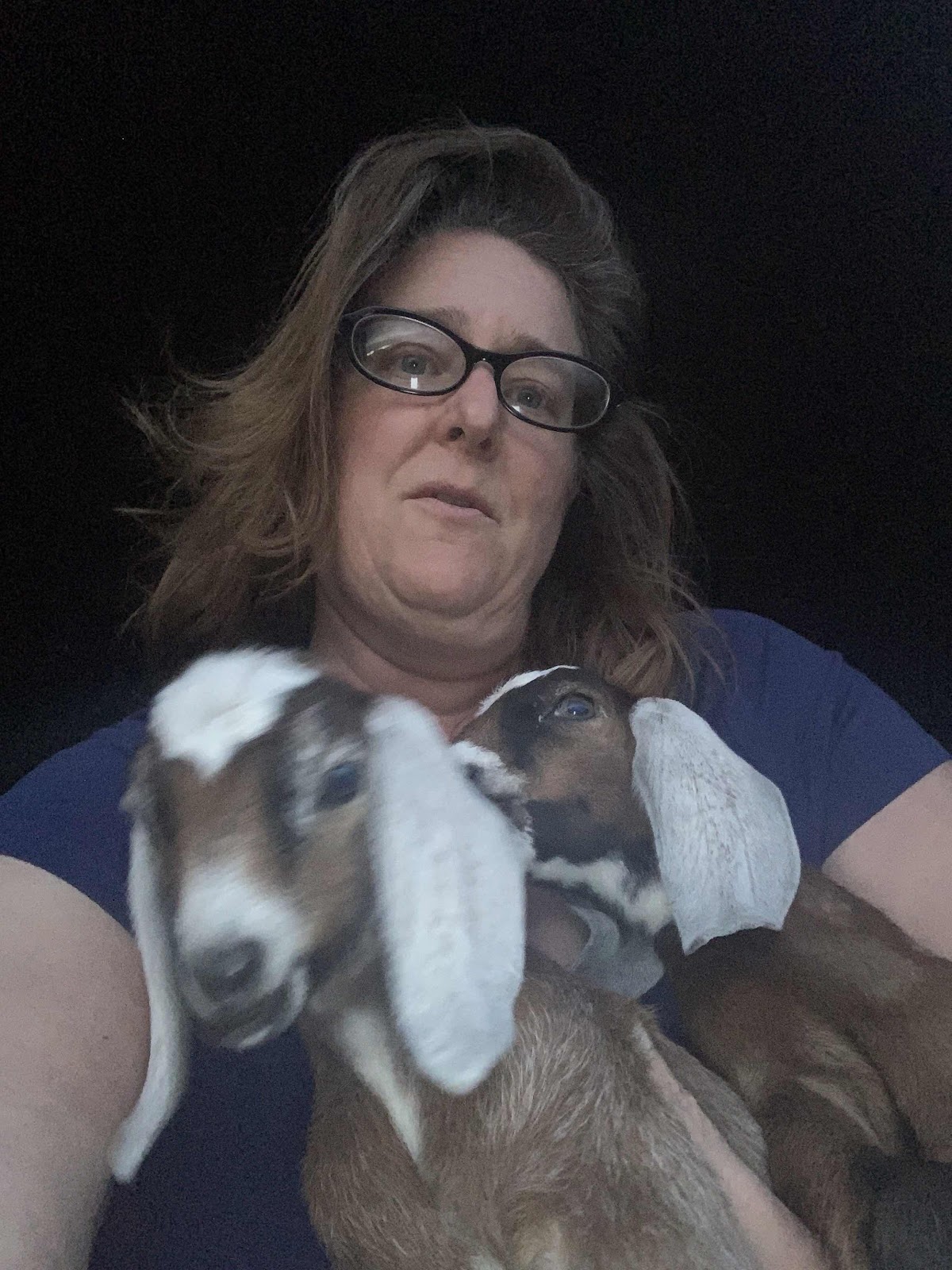
Im so relieved. I had been so sad, so angry at myself for putting them back in the big pasture, and so disappointed. I scooped them both up and took a selfie to send to Paloma, who was just as sad as I was about it. Then I dragged them all back into the backyard, where they will stay with the chickens until the babies are big enough to run fast. 

Baby goats hide while their mothers go off and eat. Just like baby deer do, and probably lots of other baby prey animals. And they are really, really good at hiding. It’s their only chance at survival - they have no other defense. Of course know that baby goats are good hiders, and for two hours today I assumed that’s what they were doing. But when their own mother was running around panicked, yelling and searching, I got worried. I thought they would answer her if they were there. But I guess as long as they don’t feel safe, they will stay quiet and immobile. And in four acres of chest high grass, there was no way we were going to find them if they didn’t make a noise. 

Phew. I’m wrung out. I’m gonna take a bath. 


The End, I Think

I’m done. Lost TWO more baby goats today, presumably to coyotes. I came home from work and Clio’s twins are gone. They were born just a week ago, and Clio, a first freshener,  was a great mama goat. She’s been yelling and yelling for them for the last hour, following me around as I walked the pasture. 


Coyotes have gotten four out of six babies born this year. This is the first year they’ve ever bothered the goats, been here fifteen years and never had an issue before. Must be a new pack with different hunting habits. But I’m just totally demoralized. I don’t want to have goats anymore.

Between worms, coccidia, and coyotes, I just can’t. My heart can’t take it anymore. 

Monday, May 16, 2022

Another One for the Coyotes (Attempts at Fence-Fixing)

Ever since the coyotes took Cosmos from the main barn during the night, we’ve been locking up the two remaining babies in the smaller, secure mama barn at night. We have to lock them up fairly late, unless we want to get up at the crack of dawn to milk the mamas. We go out after sundown but before full dark, which this time of year is about 8:30-8:45. 


Two nights ago When Paloma went out to get them, Gingersnap was missing. They coyotes got her while it was still light out. They are incredibly bold. I thought they babies would be safe during the daylight hours, but I guess I thought wrong. I really am just about out of ideas. Almost everybody I talk to agrees there is really no long term solution for coyotes - if you shoot them, they just have a bigger litter next year. Total eradication of a pack - if that’s even possible - will only create a temporary vacuum for a new pack to move  into. They are smart animals, tough and persistent. 

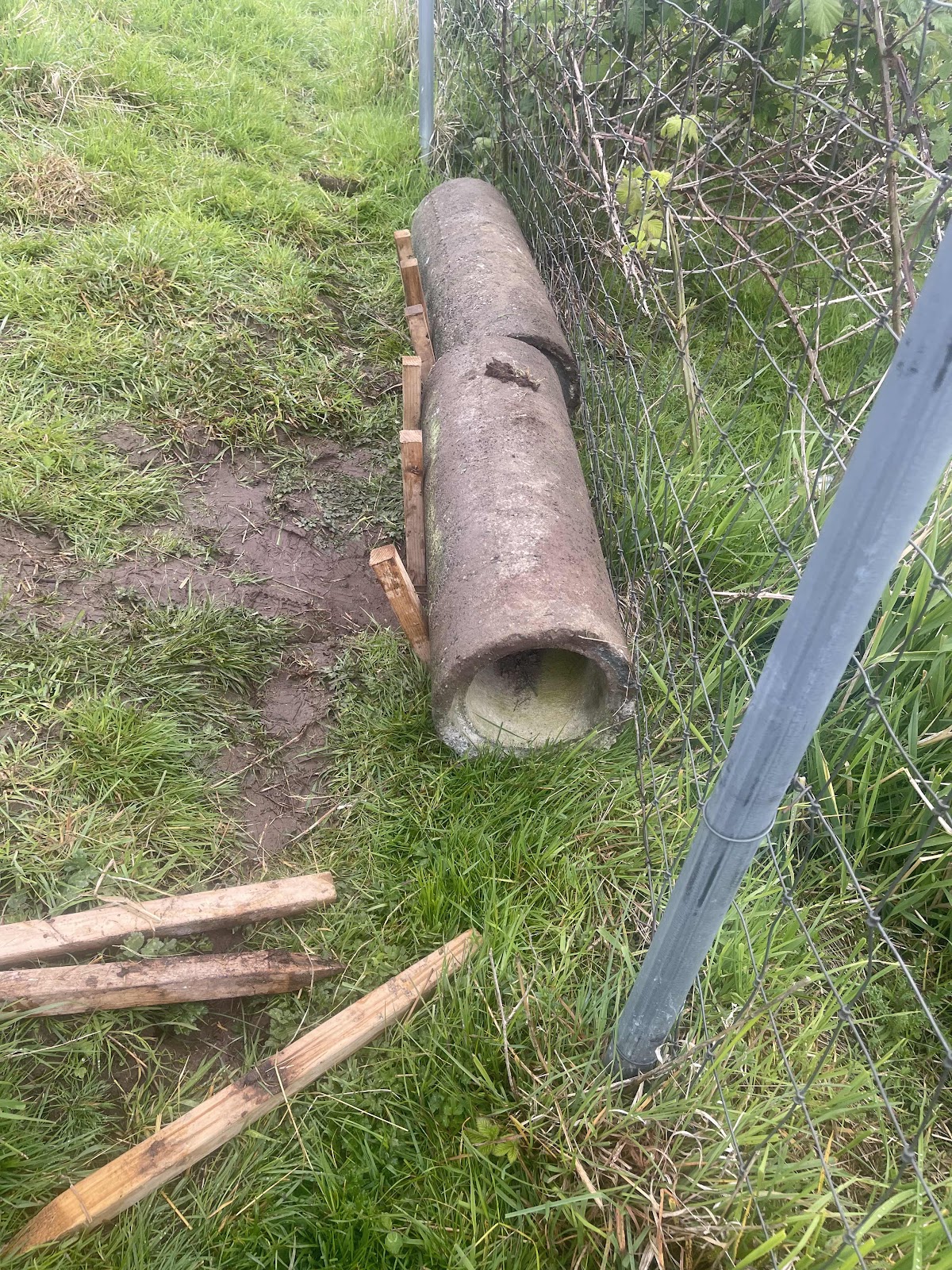
The hole under the fence has been patched, with an ad-hoc and frankly rather embarrassing mishmash of materials that Homero cobbled  together. We had a large number of wooden stakes, which he used to tack down the field fencing by stapling the lower wire to the stakes and then pounding them into the ground. The big hole was blocked with some concrete cylinders that have been lying along the back acre since we bought the place. It will do for now. 


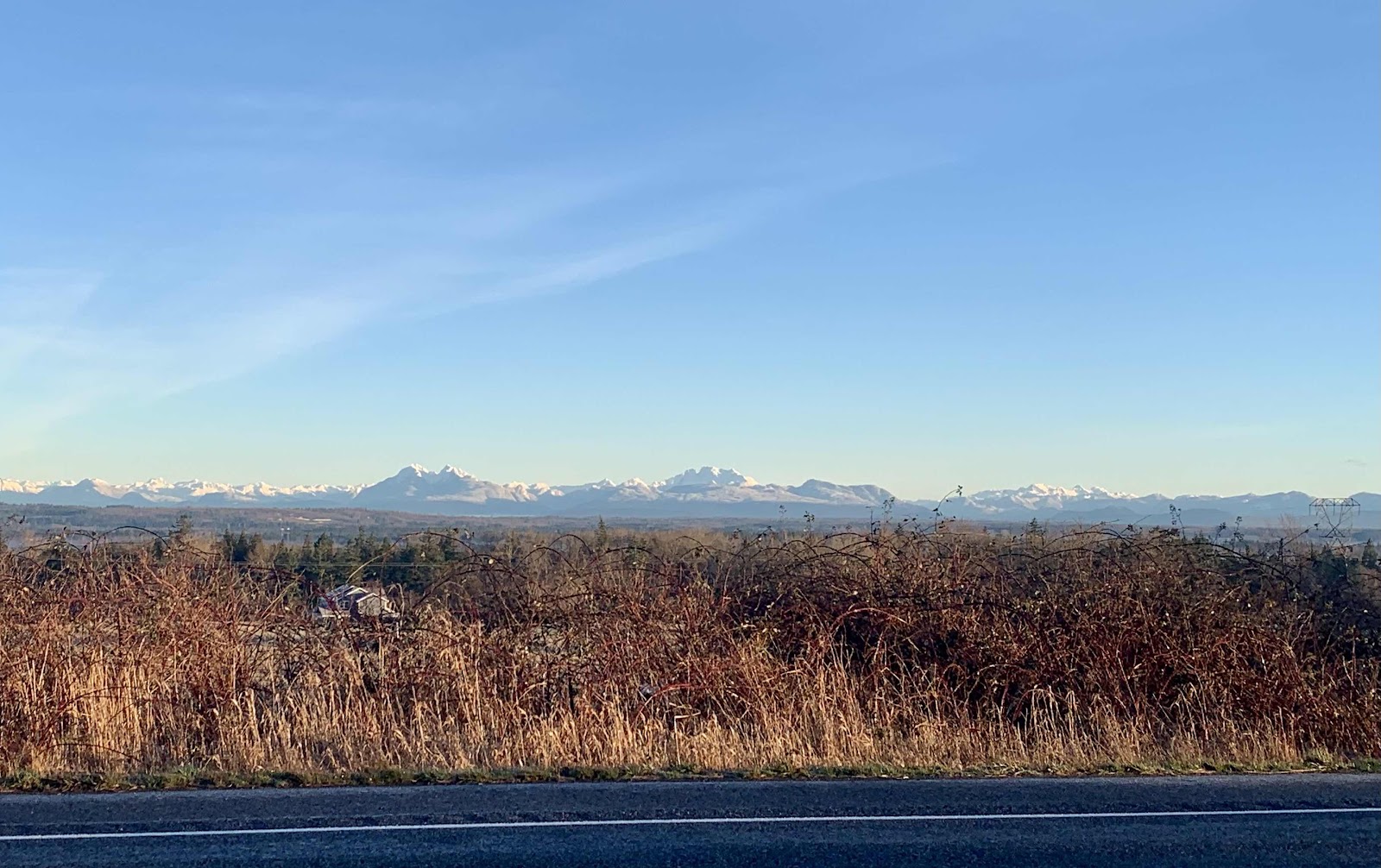
In this picture you can see how much acreage our neighbors to the west have. It’s about 300, give or take, and it has fields and forest and streams. It’s absolutely teeming with coyotes. When I complained about the problem on Facebook a few hunters contacted me and offered to help me out, so I may ask the neighbor’s  permission to let a couple hunters try and pick off the boldest ones. It may discourage them for a while. Especially if, as has been suggested, we leave a carcass hanging to rot on the fence where they normally come in. 


As I was walking the pasture that evening looking for signs of Gingersnap, I could hear the coyotes howling and  yippi-ki-yaying back in the woods. It sounded like a pretty fair number. “They’re fucking celebrating over my poor Gingersnap,”  I thought, filled with thirst for revenge. 

But the next day at church, we read psalm 148, which reads in part “praise the Lord from the earth, you sea monsters and all you deeps; fire and hail, snow and fog, tempestuous winds, doing God’s will; mountains and all hills, fruit trees and all cedars; wild beasts and all cattle….sing praise.” And I remembered the coyote song and thought to myself  “I may be upset, I may be sad, but the coyotes are praising the Lord.” 


Wednesday, May 4, 2022

Coyote Blues (Adios Cosmos)


I thought we were going to have a great year for baby goats. Last year was just terrible, we lost three out of four babies. But this year, so far, was shaping up to be great. Two out of three mamas have given birth, without issues, to a healthy single doeling and to a pair of healthy twins, a buck and a doe. 

The buckling is -was - this beautiful fellow here. As adorable as he was, for some reason his mama took a dislike to him and rejected him. But he took to a bottle with no trouble at all and was thriving. Like all bottle babies, he became very friendly and would run up to us as soon as we appeared. After a week or so, his mama (Bitsy) decided he wasn’t so bad after all and let him nurse again. He was just entering maximum cuteness phase, that’s probably why :) 

Because of his flashy coloring, there was a lot of interest in him and I actually managed to sell him for the very decent price of $200. A neighbor wanted him for her new herd sire. He would have made a very handsome buck, for sure. He was going to look just like his papa, Jupiter. We named him Cosmos. All our bucks have weather or atmospheric or space related names. 


But alas, it was not to be. Day before yesterday when we went out to do morning chores he was just missing. The other babies were there but Cosmos wasn’t. We searched the whole pasture but he was totally gone. We didn’t find any signs of him - not hide nor hair nor bloody patch of grass. What we did find were fresh tracks in the muddy area under the fence on the western side of the pasture where the coyotes come in. 

Damn coyotes. They have eaten well from our farm over the years. Never before have we lost a goat, though, only poultry. But we lose at least half our flock every damn winter. This winter we were down to a single chicken when we decided to just move the poor thing into a shelter inside  the fenced backyard; the coyotes wouldn’t dare come right up to the house like that. So we built a new coop and got a few more hens to be her companions and we haven’t lost a chicken since. 

If I had put any thought into it, it might have occurred to me that without any chickens to eat, the coyotes might not just shrug their metaphorical shoulders and move on. That they might, in fact, decide hey, we’re here anyway, might as well try out baby goat. 

For now, we are just locking up the babies at night. Hopefully before long they will be too big for the coyotes. I’m not sure what to do about it long term. We can patch one spot in the fence - though it would not be easy to get enough gravel or cement through the pasture to the site - but the coyotes could and would just dig a new hole. Considering that there’s 1000 linear feet of fence line it doesn’t seem likely that we are going to successfully fence them out. 

Opinions are mixed on the effectiveness of shooting them (we don’t have a rifle anyways). Most sources suggest that’s it’s a very temporary solution at best. There just doesn’t seem to be a great solution. Keeping the goats locked up at night is probably as good as we are going to get. And that’s problematic as well because it increases the chores exponentially. It decreases the time they can spend on pasture, thereby necessitating more hay,  and it drastically increases the amount of poop in the barn. 

Losing this baby hurt. He was gorgeous and sweet. I thought they were all going to live this year. It’s a gut punch. And, I’m not going to lie, it wasn’t any fun to give back that $200, either. 

Saturday, March 20, 2021

Notes from the Year of the Pandemic (Spring Equinox, 2021)


So far, spring this year is cold. There was a week of warm sun sometime in early March - there usually is - that tempted me to start shoveling some dirt into a wheelbarrow and laying down cardboard in the garden, but it was only a tease, and the frost returned as expected. I knew it would, of course, even as I stood on top of the compost pile in my shirtsleeves, shovel in hand. I'm slow but I do learn. 


The awareness that the warmth on my shoulders was the product of a small, false spring didn't matter. When the sun shines in March in the far Pacific Northwest, and you live on a farm, you get outside and you pick up a shovel with as much thought as worms have as they come to the surface when the ground thaws, as much as chickens who start to lay when the days lengthen, even though the eggs may freeze in the nest boxes overnight. After a Northwest winter, especially this last one which threatened to draw a final dark curtain across so many lives, you take your lumens while you may. Get out in that thin wind and squint, and take off your coat, and shiver, and give thanks.

It was a bad winter. In so many ways. Last spring, when the pandemic was just ramping up and we didn't know how long it would last, we made jokes about lockdown lasting a whole month, and we distracted ourselves with the rites and tasks of spring on the farm. I took up an old habit and carried a sketchbook around the property, drawing leaves and bugs and chickens. Like everyone else, I put in a big garden. I bought mountains of craft supplies for the girls and we all planned the ways we would enjoy ourselves and better ourselves and learn things and have fun together during this time of enforced togetherness. We were optimistic, if not about the course of the pandemic then about the possibility of our own growth and development during it. Like healthy people everywhere, undamaged people, people who know not what lies ahead, we embraced the imagined challenge of joy in adversity.


And I'm not saying none of it happened. We did stuff. The craft supplies were used to make crafts. I taught the kids to play cribbage and rummy. We took to going hiking on Sundays as a family and discovered beautiful places we'd never gone before. The garden did pretty well and many vegetables were fermented, and many loaves of sourdough were baked (yeast being in short supply). The farm produced, as it does every summer, a crop of beauty and fun in the form of baby goats and baby chicks and, this year, baby guinea hens. For months, the work of the day was sufficient thereunto, and we were more or less content. 


Then fall came, and school did not start. Life refused to return to anything approaching normal. Milestones passed uncelebrated. The new systems that were hastily constructed to replace the old, now-impossible ways of doing things were confusing and inadequate. We were all sick of the sight of each other. The stress of waiting to get sick was making us sick. The uncertainty -the total, global uncertainty - was wearing us all down. Would Hope be able to apply to colleges? Would school sports ever happen? Would we ever be able to have a birthday party? Would ANYTHING ever be NORMAL again? Time seemed more meaningless by the week, and I stopped updating the altar or looking forward to seasonal celebrations. 

It was especially hard to keep our spirits up after the string of disasters among the animals. The problem of multiple drug-resistant parasites with my goats has gotten worse and worse, and my veterinarian has basically thrown up his hands. First baby Stormy died, then Flopsy. Trying to medicate Lilac - out of desperation, as all the medications we have tried have utterly failed - the plunger slipped in my hand and I accidentally gave her a fatal overdose. This was especially awful, as Lilac was young and healthy and I expected her to be the star of the next generation of milkers. Polly and Christmas are looking thin and unthrifty and there's not a damn thing I can do about it. All I can do is keep them all contained in the sacrifice area, where there is nothing to eat, and feed them (presumably parasite free) hay. I am terrified I will simply have to watch them all die slowly, one after another. I can't sell any babies, should there be any, because I can't ethically export these awful worms to other farms. Paloma is not even looking forward to baby goats this year, after she fell in love with Stormy last year and lost him so soon.


An entire clutch of newly hatched chicks drowned in a waterer. 

Thirteen out of fourteen baby guinea hens failed to survive. They just disappeared one by one over a few days, and by the time we could catch the mother and remaining babies there was only one left. 

Gucci, Hope's beloved ferret, got tumors in the belly and had to be put down.

Turning our attention away from the farm to the outside world was little solace; the news was full of death, disaster, riot, war, idiocy, and fear. Fall was scary and long and dark and cold, and it often felt like the whole damn world was going straight down the shitter. The election was a bright spot of blessed relief, but the period between November 3 and January 20 was nerve-wracking.  Every day threatened rampage and disruption on a scale unimagined in my lifetime.

Now I've just been sitting here staring at the screen for five minutes. Then what? Then it was winter. We lived through it. It was not so awful for us, really, not compared to so many others. We had work. We didn't get Covid until January, and when we did it wasn't so bad, thank God. Homero's oxygen dipped down to 89 a few times and that was scary, but they put him on prednisone and gave him an inhaler and he was fine. I had awful chills and couldn't stay warm. I would shiver and my teeth would chatter while submerged in a hot bath. But it only lasted about ten days and we have almost totally recovered. I get winded quickly, that's all. Everyone should be so lucky.

There was a pretty good snowfall in February - 18 inches or so, enough to entirely transform the landscape and bring a welcome intermission from the tedium of rain and mud. My kids no longer play in the snow much, being in their high teenage years, but the dogs do. 


I don't know what I'm going to do next. Im staring down the barrel of empty-nest-hood. Hope did apply to colleges, and she will go away next fall, to one or another of them. Paloma is only two years behind her. Sports did start, and both girls have evening practice most nights. They have jobs on the weekends. They  drive. They kiss me and say "goodbye, mom!" and go see their friends.  I cook too much food, and nobody eats it. Well, the pigs do. 

Will nothing be normal ever again? No, it will not. Not for me. Normal is little girls blowing dandelion clocks on the lawn; normal is shiny baby goats bouncing across the field. Normal is reading bedtime stories. Normal is being able to make it all better with a kiss, and having answers to all their questions, or at least them believing I do. Normal is a memory now.


It is the equinox today. Winter is passing away and Spring is on the verge of emerging. The year of the pandemic - godwilling - is over, but I cannot see what is coming next. Like the planet, I am balanced on the knife edge of a new season. Be gentle with me, spring. I'm getting old and I'm slow, but I learn if you give me enough time. 


Friday, March 5, 2021

Goodbye to a Great Goat (The End of an Era)


    Iris gives the girls an early sex ed lesson, farm style


My first goat was Iris, a beautiful Nubian about a year and a half old, a first freshener. I bought a pregnant goat because I absolutely couldn’t wait another year for babies. 

Iris (short for ArcoĆ­ris, which means rainbow in Spanish) was a very fancy registered purebred from a farm with lots of grand champions to their credit. I really didn’t care about that, I just loved spotted Nubians. But breeding will out, and Iris turned out to be a truly outstanding goat in almost every way. 

The kids she threw were gorgeous, year after year. She almost never needed any assistance, and was a very good mom. She had a beautiful udder, easy to milk, and gave about a gallon of delicious sweet milk a day. She stood for milking, too, and jumped on the stand without fuss. Her hooves were good. She was seldom sick. But most of all, she was smart. 

Iris was one of the few goats that obviously knew her name. She could unlatch gates, be they barred or closed with a hook and eye. We had to use carabiners to keep her out of the feed shed. The undisputed herd queen, she led the herd for a good ten years, remembering which trees on the property fruited in which season and where to find the best new shoots and flowering twigs. She was affectionate and loving. Iris was a wonderful animal and a friend. 

Iris was fifteen this year, which is very very old for a dairy goat. As she got old, the worms which plague every dairy goat started getting the best of her, and she became very thin and frail. No matter how much grain and alfalfa we fed her, she kept losing weight. The other goats began to bully her, and knock her down. 

When we found her out in the field, knocked over and unable to stand up, we knew it was time. In fact if the truth be known I probably waited too long. She was suffering; I just didn’t want to say goodbye. After I brought out the girls to say goodbye, and after I stroked her and fed her some grain out of my palm, and after I shed a few tears, Homero went and got the gun and that was that. 

Iris, beautiful spirit, thank you for all the happiness you brought into my life. Thank you for for sharing your grace and your beauty with us. Thank you for the adorable kids you birthed. Thank you for your milk, which nourished our bodies and nourished my mind too, as I learned to make cheese and grew in my craft. Thank you for being a good goat. I loved you. 


                                   Herd Queen 


A girl and her goat in happier times. 

Saturday, August 29, 2020

Memorial Painting


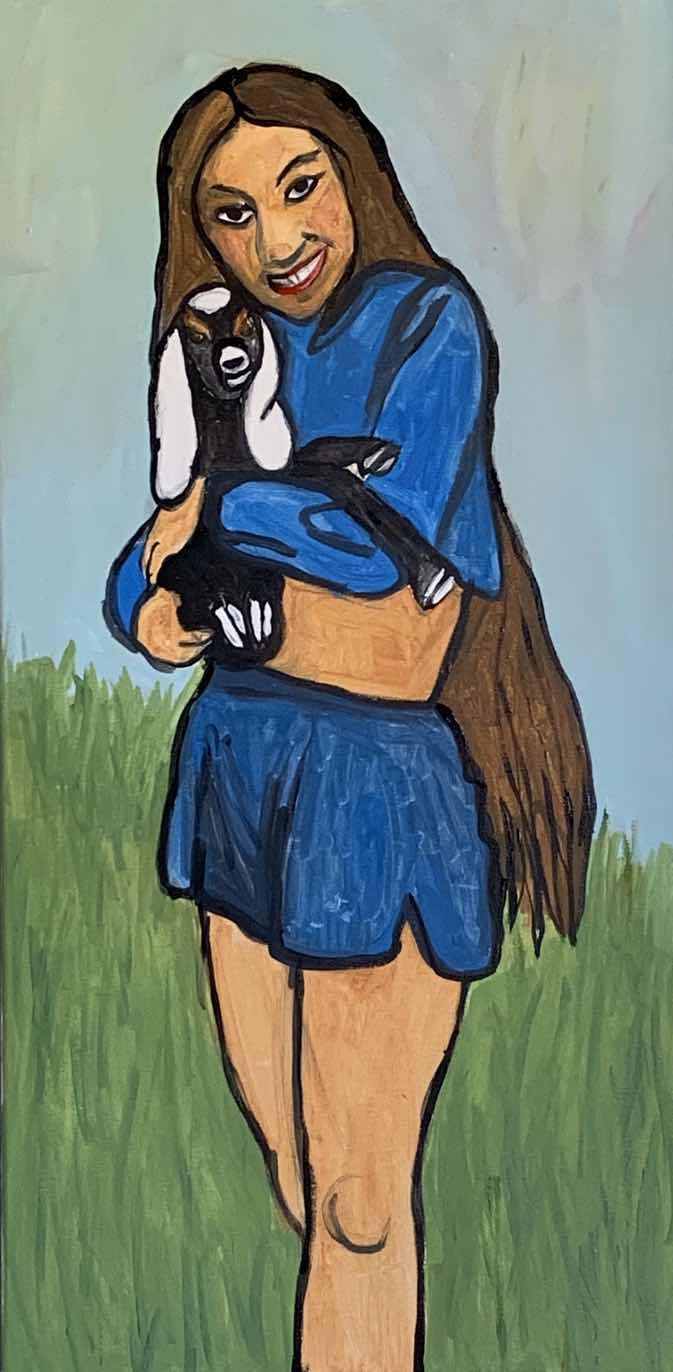
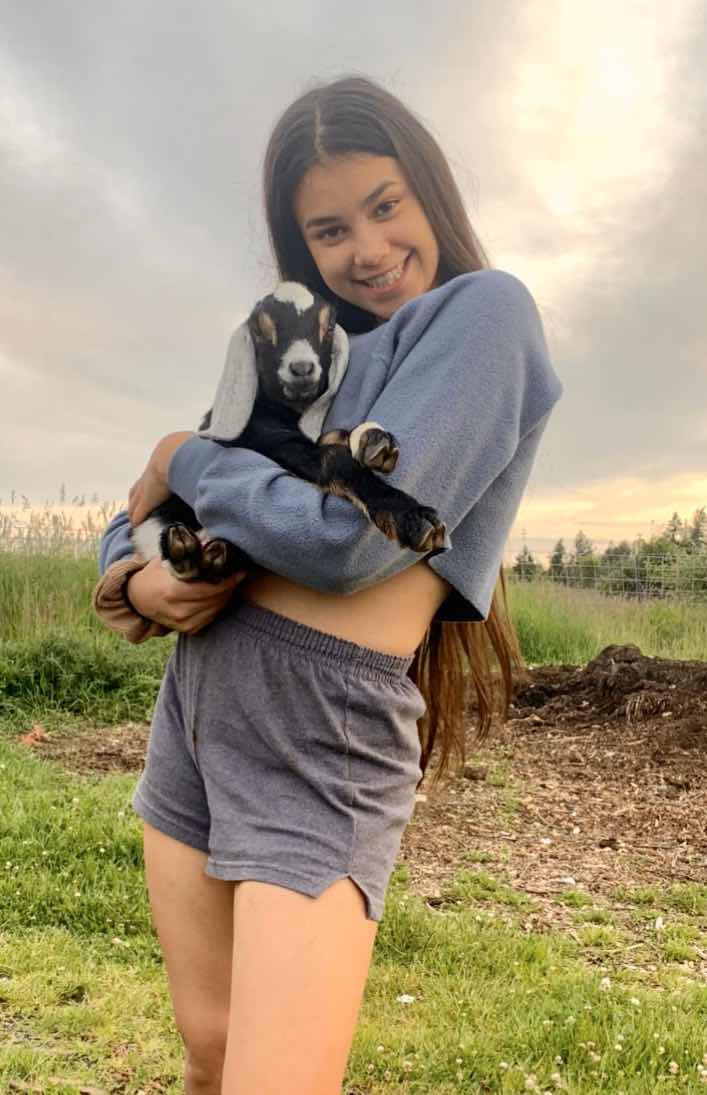
My memorial painting of Paloma with her sweet, deceased pet baby goat Stormy. I’m not a good painter by any means - in fact at some point during every attempt at painting I am convinced I am the worst painter in all of North America and I want to set my painting on fire and then set myself on fire as well. But my merit as a painter - or lack thereof - is distinctly secondary to any comfort I might be able to bring to my baby girl. 

I hope she likes this painting, and I hope she chooses to put it up in her room and I hope it brings her a little bit of relief from grief. But even if not, making it was good exercise for me. 


Saturday, August 15, 2020

Death and Disaster (Bad Farmer, Good Grief?)


A few days ago, Paloma told me something seemed to be wrong with Stormy, her extra-special pet baby goat, the surprise baby that Flopsy popped out at the end of May. 

He’s always been small, and not growing as well as the others, but I attributed that to the fact that his mama was extremely elderly and thin while she was pregnant with him. I expected he would stay small, but had no reason to think he wouldn’t be healthy. But there was clearly something wrong right now. The day before, he has been keeping up with  the herd, but now he laid down on the ground, and was grinding his teeth, which is how goats express pain. 

We took him to the vet - even though it was Sunday. The vet took some blood and a stool sample, and when those came back, told us he had a very heavy load of stomach worms and was severely anemic. He was so anemic, in fact, that the vet said he had only a 50/50 chance of making it through the next 24 hours. 

We were shocked. I knew the goats had worms - the goats ALWAYS have worms. Worms are pretty much impossible to eradicate, especially if they are resistant to medications, as mine are. But we had no idea the situation was this serious. several of my mama goats are quite thin, and they have intermittent diarrhea, and I knew it was time to worm them again, but nobody seemed on the point of death or anything like that. 

We went home with subcutaneous fluids for him, to be administered every four hours, and with three different medications, each with their own schedule. The vet told us to coop him up tight with his mamma so he wouldn’t expend any excess energy. We did that, but when we went and checked on him at 10 pm, he seemed cold, so we brought him in the house and wrapped him up. Paloma slept with him on the couch. 

Despite everything we did, he died at about 6 am. Paloma was devastated, inconsolable. Ever since she was a tiny child, every goat she picked out to be her special pet has died. Stormy was the third. The first died of a urinary calculus, a not uncommon problem in wethers. The second ate rhododendron and died of poisoning. And now this. 

I don’t blame Paloma if she’s angry at me. Controlling parasites is difficult, as I’ve said, but I haven’t been as diligent as I should have been. I didn’t want to spend that kind of money - individual fecal flotations on every goat three or four times a year adds up quickly to several hundred dollars - and the best practices are incredibly hard or imposible to implement. Several months ago when I had a vet out we went over worm control measures, and I just didn’t see how they were feasible. We would need to invest thousands of dollars into fencing to create five or six pastures for rotation, and mow all the pastures every two weeks over the summer so that the eggs would be exposed to the ultraviolet light of the sun. The pastures are full of embedded rocks and pieces of concrete and such that it makes them impossible to mow with standard equipment. 

I asked “what if I took all the goats off the pasture entirely, kept them in a sacrifice area and fed them hay? How long would it take for the eggs to die off and to have a clean slate again?” 

Five years. 

FIVE YEARS. 

In other words, you can’t. 

The only thing I can do is do more fecals, and treat the symptomatic goats on a schedule. And make sure they have the highest quality feed and minerals so they have the nutrition they need to fight off worms.  So that’s where we are. That’s what I’m committed to doing. 

We buried Stormy under the plum tree. Now just about every significant tree on the property has a beloved animal buried under it. Ivory is under the pink dogwood. Dorian and Vladimir are under the pear tree. Now Stormy is under the plum. Paloma is still pining, a week later. 

Then today, I went out to feed the animals and found that all six of the surprise new baby chicks has drowned in the water trough. All fucking six of them. All of them. All of them. 

I can’t bring myself to tell Paloma. 

I feel like such a negligent failure. I KNOW baby chicks drown in water troughs. I should have scooped up the mama
with her babies as soon as we found them and transported her to the rabbit hutch to raise them in a safe place. But I didn’t and now they’re all dead. 

Sometimes I don’t know why I’m doing this. Sometimes farming just feels like one heartbreak after another.  Sometimes it’s very hard to imagine the upside. 

I have to believe that the joy of living close to the land, immersed in the specific nature of our homestead is a concrete good for the soul. I have to believe that forming loving bonds with individual animals, caring for them, and delighting in their grace and beauty is good for us. I even believe that grief is good for us. I do. 

Joseph Campbell, talking about Greek tragedy, wrote “the world, as we know it, as we have seen it, yields but one ending: death, disintegration, dismemberment, and the crucifixion of our heart with the passing of the forms that we have loved.” which is undeniably true. Yet, he was not a pessimist or a melancholy man. On the contrary, he believed that we should strive to align our hearts and our perspectives with the eternal, divine animating principle that gives rise to the forms that we love. If we can do this, we will be peaceful, able to participate in the joy of infinite creation, which does not die with any one form but which goes on playfully creating more and more forever. 

This, however, is not an idea to be expressed to a grieving child at 6 am after a long, terrible, sleepless night. So I was incredibly grateful for my older daughter, Hope, who remembered this part of the FFA creed, which both she and Paloma memorized at school, and spoke it out loud as a kind of benediction: 

I believe that to live and work on a good farm, or to be engaged in other agricultural pursuits, is pleasant as well as challenging; for I know the joys and discomforts of agricultural life and hold an inborn fondness for those associations which, even in hours of discouragement, I cannot deny.


Sunday, August 2, 2020

The Horns of the Dilemma (to Disbud or Not to Disbud)


Seven A.M. on a Saturday. We are all peacefully asleep, dreaming the dreams of the innocent. There is no alarm clock set; we will wake when we wake, naturally and without intervention.

OR SO WE THINK. The phone rings, jangling us out of slumber. “Your goat is stuck in the fence again,” says our neighbor, acerbically. “She’s yelling.” 

For perhaps the ninth time this week, Homero truckles  out to the back pasture, wire cutters in one hand, wiping the sleep out of his eyes with the other. He spends a difficult ten minutes wrestling with Lilac, the goat who insists on sticking her head through the fence several times a day, even though the grass is EXACTLY as green on this side as that. 

We used to disbud our baby goats. Most goat farmers disbud, or at least in our area they did when we got into goats. Goats with horns are not allowed at the county fair, which means any kids who have goats as a 4-H project would have to disbud. For those of you who don’t know, disbudding a baby goat involves applying a red-hot iron to their little adorable heads for at least twenty seconds, while they struggle and scream and behave exactly as you would, if someone were applying a red hot iron to your head. 

Personally? I am a feelingless monster (Aquarius) and their pain and suffering didn’t really enter into the equation. However, I am a trained medical professional and I did notice that a high percentage of baby goats suffered serious consequences in the form of neurological symptoms for several days afterwards. And more importantly, no fewer than three baby goats died over the years, following the procedure, even though I took them to the vet and had it done under anesthesia.

Feelings aside, that’s an unacceptable economic proposal: let me give you more money than this goat is actually worth, to perform a procedure that has, in my experience, a 5% chance of killing my animal. That just doesn’t make sense. For a couple of seasons, we tried to do the procedure ourselves, but I found that I am not hard hearted enough (or strong stomached enough?) to apply the iron for the time needed to kill the horn buds and avoid the growth of misshapen scurs. It seems that there is very little margin for error in the disbudding operation - the space between too little and too much thermal damage is slim indeed. 

So, three or four years ago, we decided we won’t disbud baby goats anymore. For the most part, this decision has had very few negative consequences. Goats do use their horns to challenge each other, butting heads and so forth, but they cannot really do any real damage to each other with them - with the exception of bucks who can and do butt pregnant does and cause them to miscarry. There is still a good argument for  disbudding bucklings. We don’t do it, but I understand and support people who do. 

This decision means we have several does with horns, and one of them - Lilac - is so dumb as to get her head stuck in the fence multiple times a day. Another quick piece of relevant information - it is not feasible to remove horns form an adult goat. Horns are lavishly supplied with blood vessels, and removing them is tantamount to an amputation. 

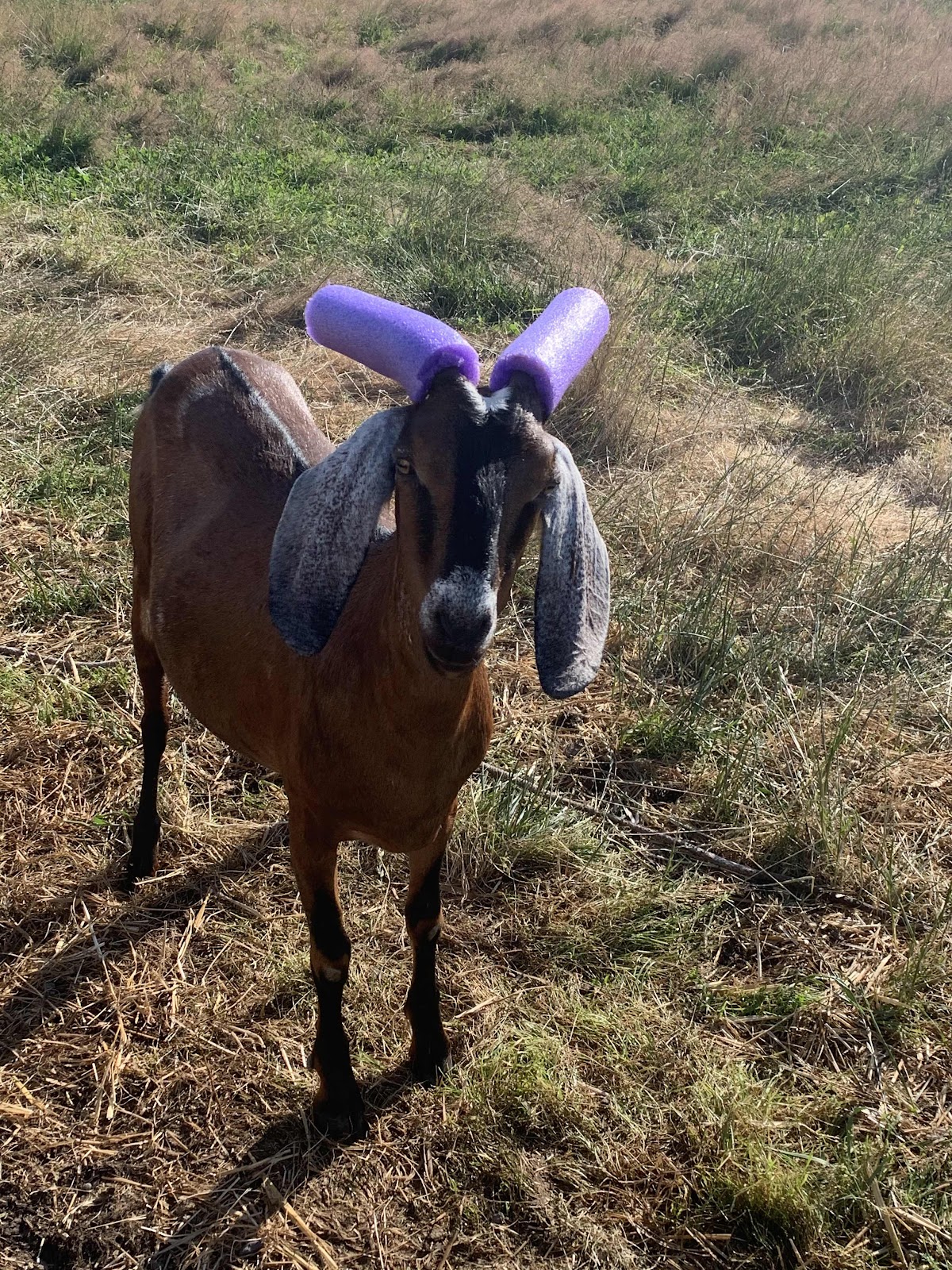
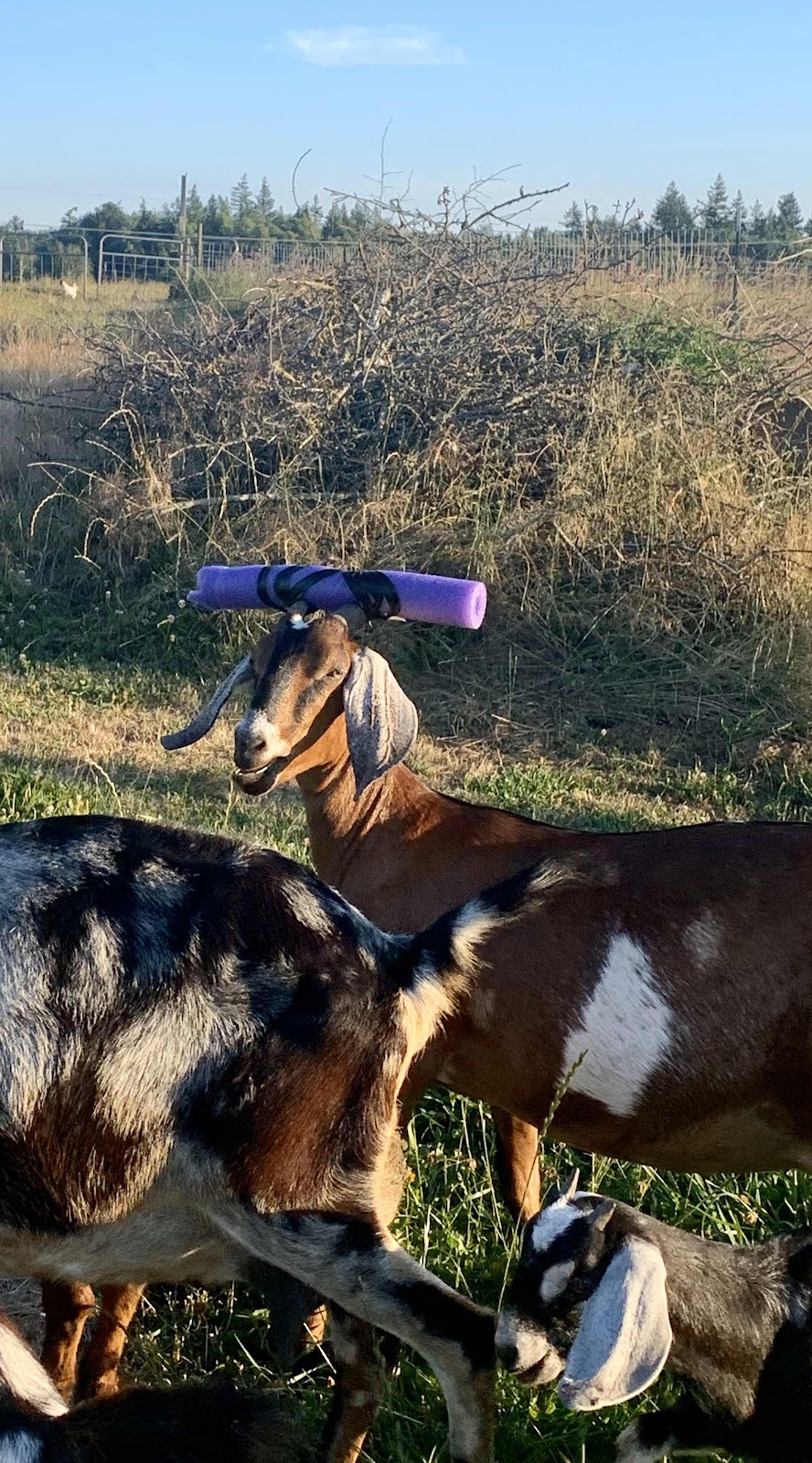
So we have been forced to try and rig up some sort of headdress that will prevent Lilac from putting her head through the fence, which has 4x4” openings. A little googling showed me solutions involving pool noodles. 
I went to the dollar store and bought a pool noodle, and we attempted to attach them to her head with zip ties:


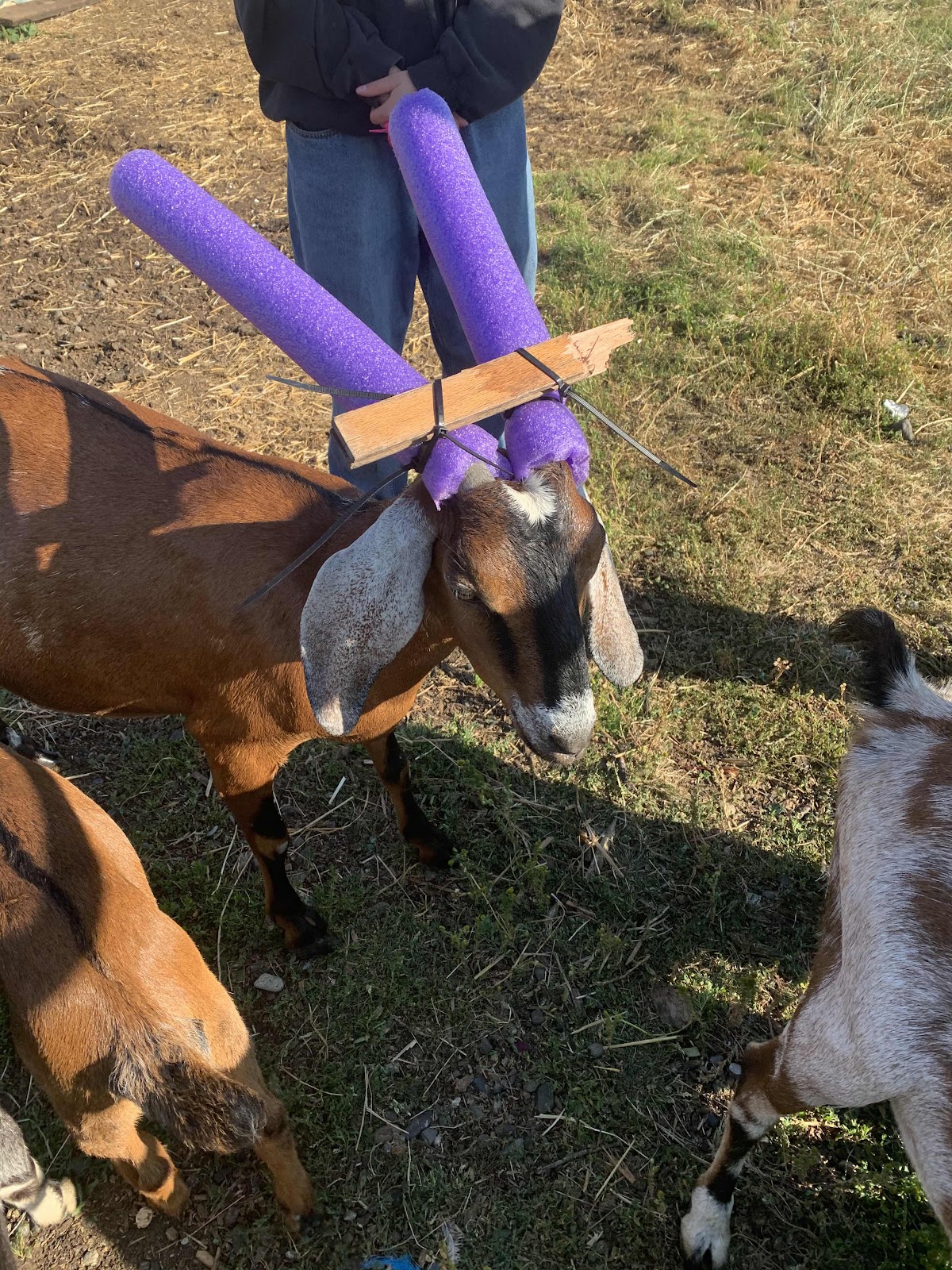
These fell off within minutes. We tried again, this time incorporating a cross-bar: 


This also lasted less than 60 minutes. Our next attempt was to put the entire pool noodle crosswise:


Also attached with zip ties, this arrangement lasted all of 30 minutes. The problem is that her horns, like most, are basically cylindrical. The headdress tends to slip up to the tips. 

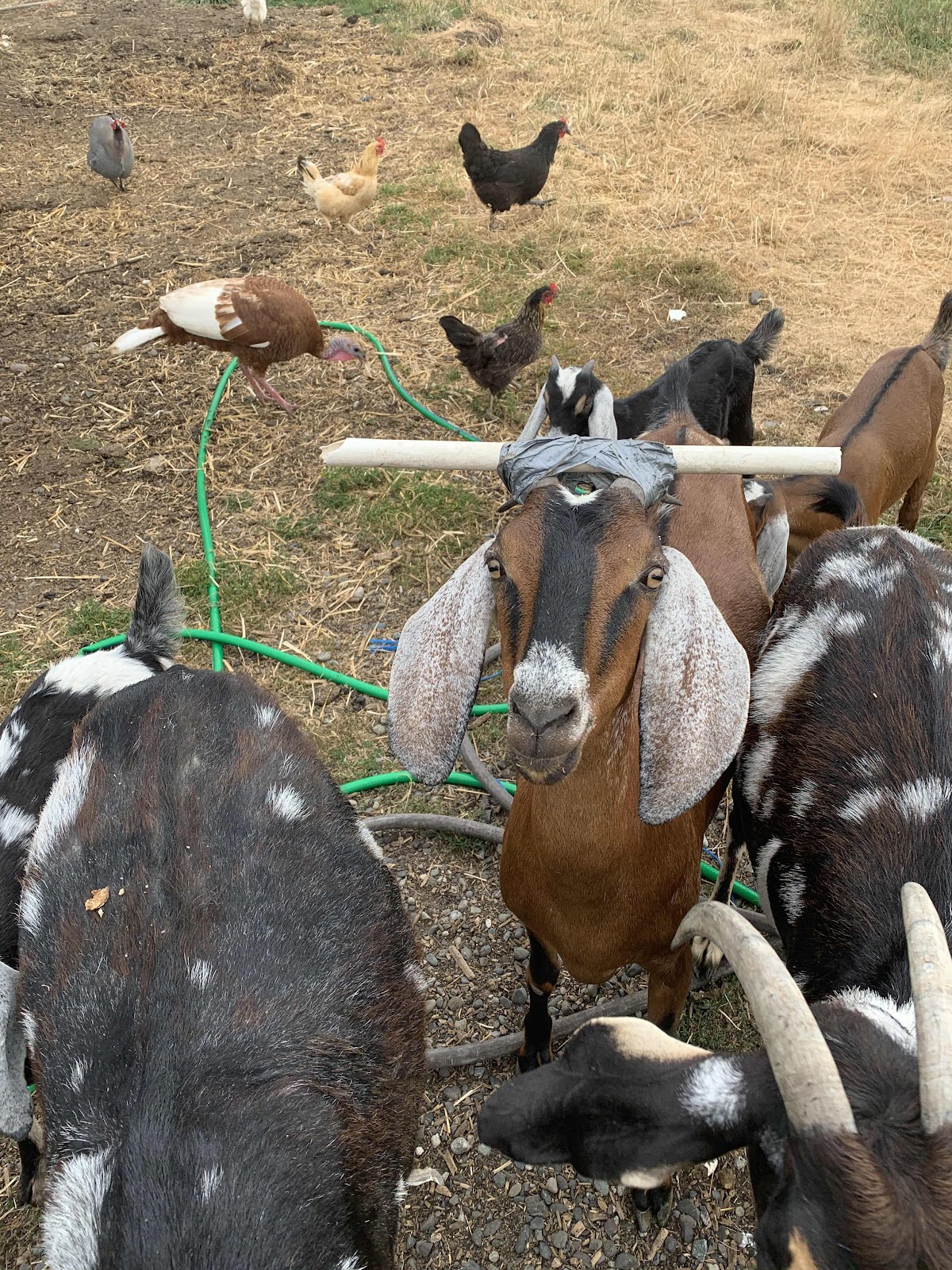
Finally, tired of fucking around and very extremely tired of being awakened at the crack of dawn by understandably irate neighbors, we bought a roll of wide, industrial strength duck tape and a short length of PVC piping. None too gently, I restrained the recalcitrant goat while Homero wound foot after foot of duck tape around her horns.


This iteration has lasted five days now. I hope
It will last until her horns grow wide enough to prevent the passage of her head through the holes in the fence. Wish us luck. We want to sleep. 

Wednesday, November 27, 2019

Thankful for the Truth (Warning graphic photos)


I love Thanksgiving, especially in the years, like this one, that I get to host. I enjoy the process of writing a menu, shopping for ingredients, and setting a beautiful table. There are few things that make me happier than seeing people I love really digging in to food I’ve prepared for them. I’m happy when my adult daughter comes over, and I’m happy to see my mom. But there is something about Thanksgiving that make me feel uneasy. There is a whiff of - if not hypocrisy, then maybe willful blindness - that hangs around the Thanksgiving table. 

Thanksgiving is a day of delicious excess, a national fantasy of happy peaceful families and endless sweetness, but the truth is often unpalatable. Enjoying an abundance of good things and being thankful for what we have is, of course, wonderful, and in no way a bad thing. Indeed, we’d all be happier and the world would probably be a better place if we came together more often to share our abundance and to give thanks out loud and in the presence others. 

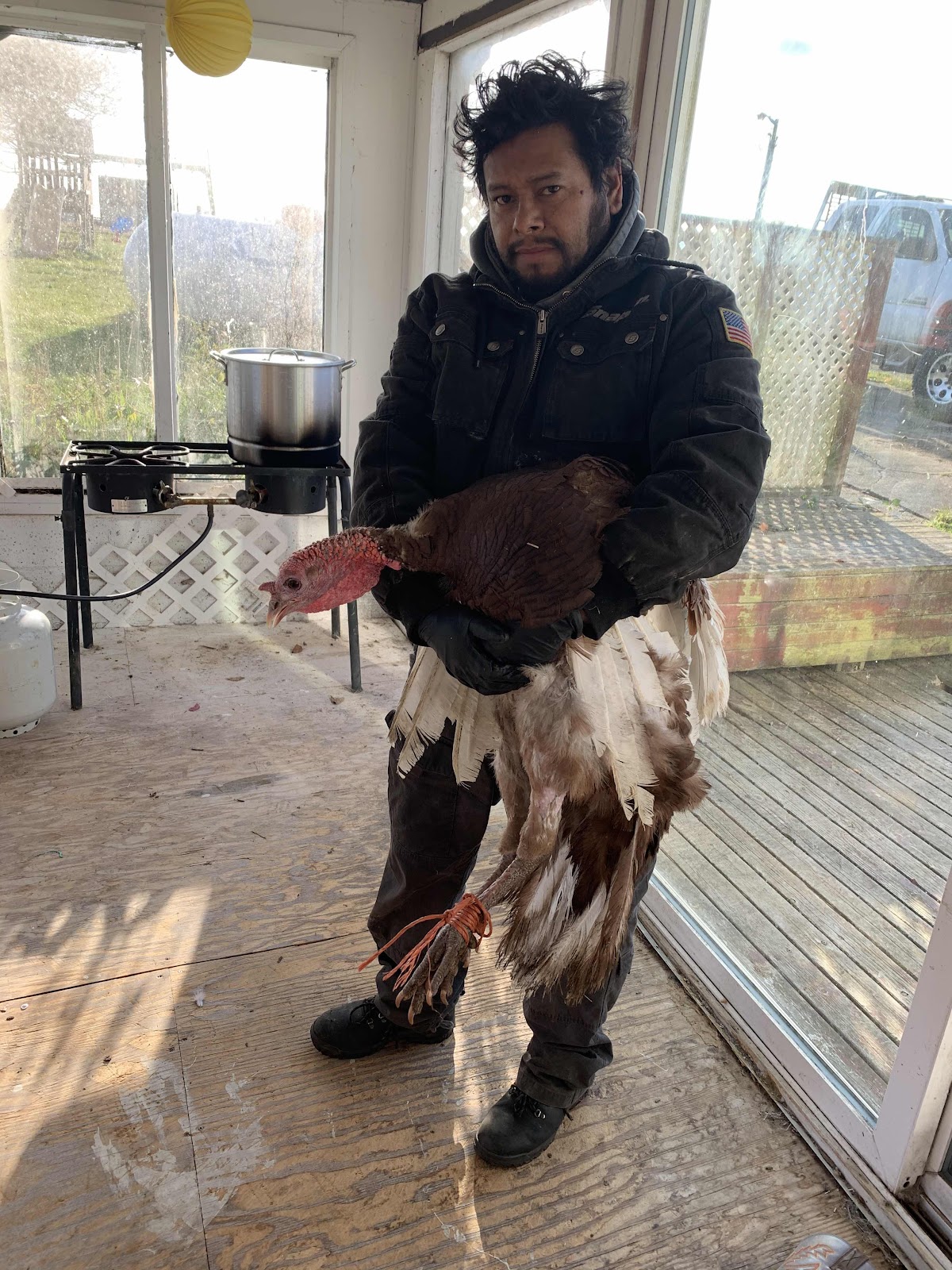
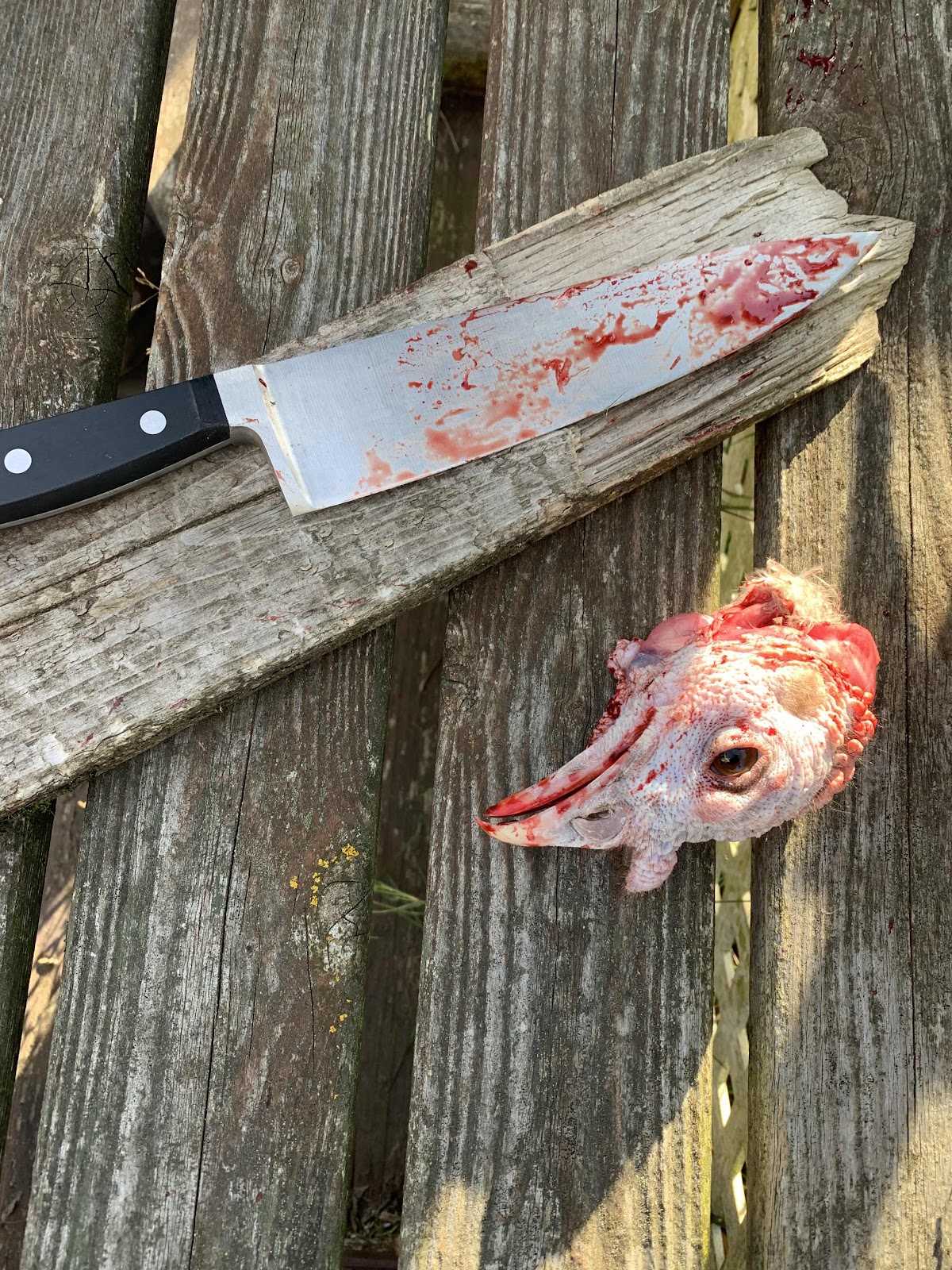
But it’s also important to acknowledge the realities that underlie the feast. These are manifold. Firstly, I acknowledge that to make this feast, a beautiful turkey had to die. 


I acknowledge the work that went into raising him - this bird was raised on pasture by a local farmer, so I thank my neighbor for her work and expense. But I also recognize the labor of the people - mostly immigrants - who toil in the vast and dangerous poultry processing industry; I acknowledge their worth and affirm their right to safe working conditions and just recompense. 

I thank my husband for the work he is doing right this minute - butchering the turkey out in the cold November wind. I acknowledge this is a disagreeable task and I thank him for being willing to develop the skill to do it well. 

The vegetables on the table - the potatoes, the Brussels sprouts, the salad greens - are produced by an unsustainable system that abuses workers and the earth in equal measure.  I am a witness, and I pledge to do what I can to avoid participating in those injustices and to mitigate the tremendous waste generated. 

And finally, I acknowledge that I live on unceded land of the Lummi and Nooksack tribes. All of us settlers live on land that either was never ceded by the tribes, or which was ceded under deeply unequal conditions, in which one side held all the power. I acknowledge that uncomfortable truth. If you want to know on whose land you reside, visit this link: 
https://native-land.ca/. I pledge to work toward correcting the grave inequalities that resulted by upholding the efforts of local tribes to sustain their culture and supporting their businesses and candidates for office. 

None of this is meant to be a huge bummer.

It is possible to be grateful for our wealth while recognizing the problem of poverty. We can celebrate being together with family while knowing that some are lonely. We can give thanks for warm homes, abundant food, and all the good things in our lives without trying to shut out the knowledge of the many who lack those things. It’s not a sin to be warm, to be fed, to be loved. These are wonderful gifts.

My hope and my prayer is that naming our gifts and sharing them with our loved ones will inspire us to share them more widely, as well. I remind myself, as I bask in warmth and light, of the existence of cold and darkness not out of guilt, but so that I may be moved by gratitude and grace to expand the circle of warmth and light to include others. I remind myself, as I nourish my body with roast turkey, of the death of the animal I am eating not as some sort of penance, but to honor the truth that this act embodies the cycles of life and death on this beautiful planet, cycles we are all of us bound by. 

May you be abundantly blessed this Thanksgiving. May you have much to give thanks for, as much as I. 


Monday, April 8, 2019

......Or Does He? (Warning: Graphic Photo)


First, please enjoy this photo of adorable, healthy baby goats frolicking in the springtime, all right with the world. This is the reality for 8/9 babies born this year, and that’s not such a bad outcome. 

But now - 


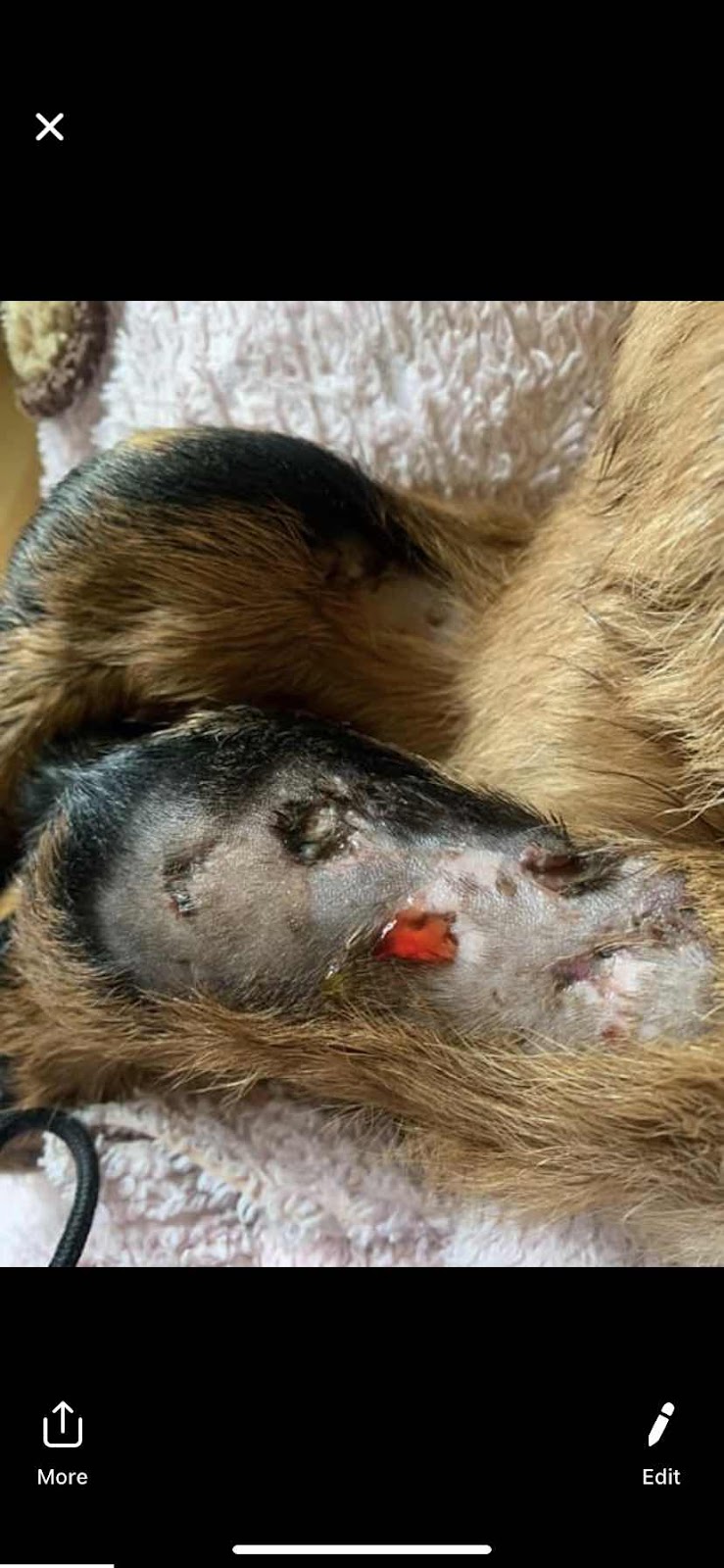
This photo of the bite inflicted on baby number nine by my very own dog. There’s a story here - hold on before you condemn the canine. 

The last mama goat to give birth was Polly, last Thursday evening around 5 o’clock. She had a lovely set of twins, who both stood up and nurses with no problems, a boy and a girl. I was thrilled. However, when Homero went out the next morning to do chores, he found another baby in the ground, still wet and gooey, who had apparently been born quite recently. 

For those of you who aren’t goat breeders, it’s not normal at ALL for there be such a long delay between kids. No matter how many kids are in there, a normal birth usually takes an hour, maybe an hour and a half, tops. So this little guy was off to a rough start. It seemed he had aspirated some amniotic fluid. His lungs rattled and he was very weak. He couldn’t stand up by himself, and his mama ignored him. 

That’s a bad sign. I always pay attention to the mamas, they seem to be able to tell better than I can when a baby is not very viable. However, he was alive, so we went to work to get some colostrum into him. Throughout that day we bottle fed him every hour or so, and although very weak and coughing, he was getting some down. 

But there was clearly something wrong with him. His head was swollen, whether from the hard birth or whether malformed in some way was hard to tell. He stayed standing if we stood him up, but he couldn’t get up on his own and he didn’t try to walk. 

We had plans to go away for the weekend. I asked my good friend K., goat rescuer extraordinaire, if she wanted to try to care for him over the weekend. I let her know he was poorly and might not make it. She did want to, and in her usual way she went to work on him. 

She noticed, however, that he seemed to have a small wound on his leg. When she washed it and shaved him, it turned out not to be a small wound after all but a pretty serious dog bite. Overall the weekend, it got infected despite her care. When we got home, she let me know she thought the baby was suffering. 

I picked him up and took him to the vet. My gut instinct told me that the little guy was in his way out and I thought he should be put down, but I wanted to give the vet a chance to weigh in. There’s always a possibility he or she might say “no, no, all he needs is a course of strong antibiotics.” 

But my instinct was right. The vet told me his leg was actually broken, and that he seemed to have some neurological damage as well, whether from the hard birth or for whatever reason. His lungs were crackly with pneumonia. He had several complex problems. It went far beyond a course of antibiotics. 

And truthfully, that’s about all I was willing to invest in this kid. Even if he lived, he was still marked as a meat animal. If he wasn’t going to enjoy his year or year and a half on earth as a happy, healthy member of the herd, then it’s better to put him out of his misery right away. Which is what we did. 

As for Haku.... well, I’m fairly sure he wasn’t trying to kill the baby. After all, if a 95 pound German Shepherd wants to kill a newborn baby goat, he generally can do it without much effort. And Haku is so very, very gentle with the babies. He only wants to lick them all over. My guess is that he was attempting to help. 

Baby goats hide. In the barn, they hide behind hay bales. That’s their instinct. When Homero found this little guy he was hidden behind hay bales. I think Haku was trying to drag him out of his hiding place. My sister has a livestock guardian dog and she told me that he once injured a baby goat doing exactly that. 

In any case, there is one less baby goat in the world now. Poor little guy. But it’s good news for his mama, who now only has to raise twins. 


Friday, March 30, 2018

The Long Goodbye


Today at around five o'clock in the evening I got the call from hospice that my dad had died

.


It was anything but an unexpected death, which I suppose is obvious from the fact that he was in hospice. That was my doing. As his legal guardian, it fell to me to make the decision to move him out of the ICU, where he had spent the past nine days, and into a hospice, where the pretense that he might possibly recover would end, along with all the futile, painful interventions that maintained that pretense.

I've been shuttling back and forth from Bellingham to Tucson frequently in the past year, along with my sister. Last spring, or early last summer, I forget which, my stepmom called us and said she couldn't care for him at home anymore. We were unsurprised.  Frankly we wondered how she had been managing for the past several years. Dad had a stroke in 2002 that left him hemi-paralyzed, and his health had described a slowly declining arc ever since.

The visit that followed my stepmom's pronouncement was pure hell, a hell that illuminated for me every single thing that is wrong with American health care and the American way of caring (or not) for the elderly and disabled. My sister and I had to make one awful, wrenching decision after another. Dad resisted with all of his strength facing the truth that he needed a level of care that could not be provided at home, and he used every tactic at his disposal. In the end we left him in the local veteran's hospital on a psych hold, and I started emergency proceedings to become his legal guardian.

There followed several months of bureaucratic nightmare waltz. Dad was transferred from one facility to another. I think he went through five placements in a fewer number of months. He was in and out of the hospital. I, formally instated by a judge as his legal guardian, received midnight calls from emergency room physicians asking me what I wanted them to do.

"If I do nothing, he's going to die," said the voice on the other end of the telephone.

This happened more than once.

Those awful episodes were interspersed with weeks of semi-recovery in various nursing homes. The nicest one had chickens and a nurse who helped him plant some seeds in pots in the small courtyard. Dad was always a gardener.  I don't think there has been a single year of his adult life he didn't have some sort of garden, even in these latter years. My brother-in-law built him raised beds in his yard in Tucson, beds he could plant and weed from his wheelchair.

That reminds me, of course, of all the time he and I spent dreaming about a little five-acre farm. During the years he lived with me and my daughter in the blue house in Seattle. It was a game we played, the "Self-Sufficiency" game.


The self-sufficiency game (love you, Dad)


This time, this last time, the call came that dad was in ICU again, and nobody was really sure what was happening. The first doctor I talked to said he thought it was a pulmonary embolism; the next one said septic shock. Shortly it became clear that whatever the precipitating event was, dad was extremely ill and not very likely to recover enough to make it back to the nursing home. Not that anyone was willing to come right out and say that - but that's a post for another day.

My sister and I both flew down. Dad was in and out of consciousness. We spent a week more or less at his bedside. It was clear, to me anyway, that he was declining, but oh so very, very slowly. It was only after we both had flown home that he became entirely unable to eat or drink, and it was when they started talking about a feeding tube that I said "No."

"Get me hospice," I said.

My mother and my brother have both named me as their medical power-of-attorney, as did dad a couple years ago. I'm not entirely sure why this duty has devolved on me, but I believe that in my mom's case at least, she sees me as the child "most likely to pull the plug." She has made it clear to all of her kids that she has zero desire to hang around in agony one minute longer than necessary, but I'm the one she has designated to make it so. She trusts me to kill her. I can't help but wonder - in dark moments like this one - if my family sees me as unfeeling.

Sometimes I wonder the same thing about myself.

This is the second spring in a row that I have had to fly to Tucson during kidding season. For two years in a row, I have left my husband and kids, who are not experts by any means, to cope with goats giving birth and getting the kids off to a good start. Last year there were complications, and this year I anticipated more complications. Flopsy was once again carrying a ridiculous number of babies, and I knew they would need active help. I did all I could, which was to ask knowledgeable neighbors if they could be on standby, and give their phone numbers to my husband.

Even as I sat at my dad's bedside in the hospital, even as I interrogated his cardiologist or his nurse, I was thinking about Flopsy and her quadruplets. I couldn't help it. Dad was manifestly in good hands - being cared for by people far more qualified than myself and obviously good at their jobs. The same could not be said for my goats. I wanted to care only about my dad, to be in one place completely, at his side and nowhere else, but that just wasn't possible. Not for me. Maybe it never is possible for anyone, and I'm being unreasonably hard on myself. How would I know? This is the first time I'm doing this. Thank all the gods I made it this far.

Luckily, the goats gave birth without major complications and the neighbors came through in spades. Mental note: I need to by a few Starbucks gift cards. In fact, I was sitting outside in the fragile evening sunshine enjoying the sight of seven little goatlets prancing about the lawn when the call came. Dad had passed away quietly, deep in a morphine dream, without pain or agitation, after two weeks of hospitalization.

My dad was a fighter. He did not Go Gently into that Good Night. He resisted every step of the way, with courage and stubbornness. There are certainly easier ways to live and to die than the ways he chose - or the ways that fell to him though fate and genetics - and for my part I hope I find those easier ways. But I admire him his fighting spirit. No one can say he didn't do his damndest to the very end.


Friday, March 10, 2017

Meat Math 2017


This year's horrible pigs (all pigs are horrible but this year's were worse than most) have been converted into meat, and the meat sold, except for what we wanted to keep for ourselves. It's time for this year's edition of MEAT MATH (Meat Math).

The pigs were pretty small. We killed them earlier than we maybe should have because they were so evil, and also because in the cold and wet, they weren't gaining weight very quickly. It's better to get piglets in the spring than in the fall, but of course everybody knows that, and so spring piglets are more expensive than fall piglets. The boy had a hanging weight of 132lbs, and the gilt 110lbs.

The larger pig we sold off in halves. One half went to our neighbor, the D. family, from whom we have actually bought pork in years past. But they decided (being quicker learners than we are, apparently) that they don't want to raise pigs anymore, so now they are buying from us. That half weighed 67lbs. The other half went to a Facebook friend, and weighed 65lbs.

We asked $3/lb, which is on the cheap side. I started out at $3.50/lb, which seems to be the going rate for pork without fancy qualifiers like Organic or Pastured, but it so happened that there was a lot of pork for sale at the same time I was trying to sell, at least according to Craigslist. I didn't get any response at $3.50/lb.

If I'd had an empty freezer, I might have held out. But I'd already made the date with the butcher, and our freezer was stuffed nigh to bursting with beef, salmon, and lamb. We have two eminently butcher-able animals (a sheep and a goat) that we have let live for the sole reason that we were saving room in the freezer for the pork. Faced with that severe space shortage, I lowered the price, and quickly sold off the bigger pig.

Okay, so 132 x $3 = $396. Rounding to $400.

The piglets themselves cost us $100 each. That leaves $200.

Feed was negligible, thanks to unlimited bread and produce from the Gleaner's Pantry ( What Wrong With this Avocado?). We did buy three or four bags of conventional pig feed - let's say that was $60. Now we have $140 left.

Unfortunately, I lost my receipt from the butcher, so I can't break it down into categories, but we paid them $178 for our 110lbs, which includes the kill fee, the cut and wrap, and the fee for smoking the hams, bacon, and hocks. Take 178 from 140 and we are 38 dollars in the hole. Divide 38 by 110 and you get homestead pork for $0.35/lb. Not, obviously, counting labor.

Even if I am forgetting a couple bags of feed, that's some pretty cheap, quality protein. The first meal I made was BBQ spareribs. Delicious.


Monday, February 15, 2016

A Rough Day for Iris (and Me)

I got up early this morning to go to a work appointment, only to find when I got there that the client had cancelled only minutes before. Barely awake, I executed a  U-turn and headed for the nearest coffee shop.

On the way home, as I was drinking my coffee, a crown popped off of one of my molars. Although it didn't hurt, it seriously freaked me out. Instead of a tooth, I suddenly had a small squishy gap where a tooth should be, with a small steel spike sticking up. I was so horrified, I almost swallowed the crown. Almost. Luckily, I was able to pop it back on - after I pulled over, of course, and after rotating it through a few revolutions and trying all the possible angles.

I drove straight to the dentist who had placed it, just last year (I broke that tooth cracking Dungeness crab with my teeth. Please don't ever do that. Crab-crackers were invented for a reason). I asked the receptionist at the dentist's office if there was a guarantee on the crown, seeing as I had had it for only a little over a year and further seeing as how I have no dental insurance. She told me that there was, and that if neither the crown nor the remnant of my tooth were damaged, then it could be replaced for free. However, she had no openings that day and the best they could do was tomorrow morning.

Sadly I drove home, trying not to test the strength of the crown by probing it with my tongue. When I got home, about ten thirty, Homero was waiting outside and flagged me down.

"Iris is giving birth, but I don't think it is going too well," he said. "Come and see."

Passing through the house to quickly wash my hands and get some soap and warm water and a towel, I raced out (through the driving rain) to the barn. We got Iris into the mama barn by main force, as she did not want to get up or walk.

Iris is my oldest goat, my first goat. She has had many babies and is now about nine years old. Last year she didn't get pregnant, and I had figured her mothering life might be over, but then she did catch this year. Once in the mama barn, she laid down on her side and started pushing hard, grunting and curling her lip. We tried to get her up on the stanchion, but no go, so I laid down in the straw behind her, soaped up my hand, and went exploring.

There was no sign of any residual "goo" which told me that her water had broken some time ago. She was dry and tight. There were two hooves right inside the vulva, both front hooves, and in normal right-side-up position. Further back, alongside and below the legs, was a head.

I needed to find out if the head and the legs belonged to the same kid. It didn't seem like it, because in a normal presentation the head should be above (dorsal to) the hooves. Feeling for the jaw, I found the mouth and inserted my fingers to feel for teeth. There were sharp little teeth on the upper (dorsal) side. Goats only have front teeth in their lower jaw, not in the upper. So feeling these teeth told me that the head was upside down.

What I needed to do was follow either the head and neck, or the front legs, down to a body and try to figure out where they all came together - or not. If there were two kids, I would need to push the head back into the uterus, and then find the head belonging to the legs and bring it around. Or, of course, the opposite - push the feet back and then find the other feet belonging to the head.

This might sound easy in theory, but in practice it is not. It's not easy even if you have an upright goat and are not laying on your side in the straw without very good light. I went in as far as I could, but I was unable to ascertain for certain whether there were two kids or one. The head did not budge when I pushed on it, nor did the feet come forward with gentle traction. Without having a clear picture of what was going on, I wasn't going to pull any harder than a 2 on a scale of ten.

I though we had twins - one with legs forward and head back, the other with head forward and legs back. Knowing there was nothing more I could do, I called the vet and told them I was coming in.
Getting Iris into the van was a challenge, but Homero and I did it, and then he stayed with the children while I drove as fast as I could (through the driving rain) to the vet. Not very fast at all, as I spent the entire twelve miles behind first a tractor and then behind one kind of semi-truck or another. I am not a patient driver at the best of times, and least off all with a beloved goat in the worst kind of distress in the back.

Once Iris was at the vet's and up on a stanchion (lifted by three people), the doctor gave her an epidural and went in to try to figure it out. It wasn't obvious to him either. It took a good ten minutes to first figure it out and then straighten it out. I was wrong; there were no twins. There was only a single baby, who had her neck wrapped around her own front legs like a corkscrew, so that her head was upside down underneath her own knees. It is an impossible presentation. The baby cannot come out that way, and pushing the head or pulling the legs is not going to help. The doctor had to twist the head and bring it around up over the legs, into a normal presentation, so the baby could be born. That was a pretty violent procedure requiring a lot of force, and Iris was in great pain - epidural or no.

She was dead, of course. It appeared she had been dead for some time, perhaps two or three hours. The vet said that with the poor presentation, Iris had probably been in low-grade labor for several hours. Without the head providing the correct pressure on the cervix, the labor didn't progress, and after the baby died (whenever that happened) the baby couldn't help by wriggling or changing position. If I hadn't taken her in, Iris would most likely have died eventually as well.

Poor Iris. She got a shot of painkillers, a shot of penicillin, and a ride home with a full udder and no baby. She is fairly torn up. I'll give her a full course of penicillin injections, and I have painkillers for three more days. She is also now officially retired - no more babies for Iris. I asked if any of this could be attributed too her age, and the vet said not definitively, but older dams do have a harder time kidding in general. Iris has earned her retirement at least twice over   (How Much is a Good Goat Worth?) - we will have this last season of milk from her, and then she can spend future breeding seasons with the ponies in the horse pasture.

The baby was a doe. A fine, big, brown doeling.

When I came home from the vet, covered in poop and blood and slime, aching for a bath, I found one of my kids already in there, and they had already used up all the hot water.

Also, there's no wine in the house.


Monday, June 2, 2014

Mystery Mortality (Milk Glut)

In the last two weeks we've gone from four baby goats to only two baby goats. One of them was served at our big party, so that was an expected death (and very delicious he was, too; I'm thinking in the future we may choose to butcher at 4 months instead of seven). However the second death, that of Flopsy's buckling Comet, was a complete mystery.

Comet was one of Flopsy's twins, born in March. The other buckling was sold intact for a very decent price and presumably is doing just fine. Comet was wethered and was marked as a meat animal, but that didn't stop him from being a favorite because he was so cute. Usually we don't name animals we plan on eating, but this little guy's white spots on a black background gave him the name Comet.


Comet was perfectly healthy and never ailed a day in his rather short life, until the last day. In the morning we heard him screaming and walked out to look for him in the tall grass. He was standing alone, sides heaving, with green frothy vomit all over his head and neck. Goats do not vomit. They just don't. In all my time raising goats, I have only ever seen them vomit from severe carbohydrate overload, and that obviously hadn't happened here because the barn where we keep the grain was closed and locked. 

As the day progressed, Comet kept screaming, almost continuously, and wouldn't eat, drink, or nurse. There was no more vomit, but he frothed at the mouth and dripped saliva. He was not pooping, though he would strain and heave. His symptoms seemed to be almost exclusively GI related - no neurological symptoms, no staggering or looking up at the sky like goats do when brain damaged. He got progressively dehydrated.

We spoke to the vet, of course. I thought of plant poisoning - we do have several poisonous plants on the property, but the goats generally leave them alone. I mentioned tansy, rhododendron, and hemlock, but the vet said none of those would cause vomiting, and would produce neurological signs. He suggested that a blockage was much more likely and said we should bring him in for exploratory surgery. He also said that vomiting was quite likely to cause inhalation pneumonia and that he would need antibiotic treatment quickly to avoid death from that cause. 

Well, that wasn't going to happen. Here I had an animal with a cash value of approximately $75 to $100, and treatment options began at several hundred dollars, with, of course, no guarantee of a good outcome. We decided to give Comet the day to start showing signs of recovery and to put him out of his misery if he continued the same or worse. Since he wouldn't drink, he was getting very dehydrated. He began to pant heavily and collapsed.

In the belief that a blockage was the most likely explanation, I decided to try and drench him with some neutral oil. I was terrified that I was going to pour a pint of oil into his lungs and kill him, but he was pretty close to dying already and I figured I couldn't very well make things worse. With Homero's help, we slid a tube down his throat and poured in some oil, and Comet thrashed weakly and fought us off the best he could. 

I don't know if his efforts exhausted his last reserves or if we did, in fact, kill him by our "treatment" but within a half hour he was obviously close to death, still crying weakly, so we went ahead and euthanized him with a .22. Poor little guy. 

We thought about having the vet do a post mortem, but Homero said he could do it himself, at least look for anything obvious. We skinned and prepared him for butchering as usual, but instead of throwing out the GI tract intact, Homero dissected it. I was expecting to find a fat, red gut, evidence of a torsion or a severe blockage, but everything looked completely normal. His intestines were slim, pearly grey, and just about empty. The liver and gallbladder were normal as well. Homero even opened up the rumen and checked carefully for any foreign objects, but there was just nothing to be found. 

The only odd thing we did find is that one of his lungs was swollen and covered in petechiae (small blood spots, showing that there had been a hemorrhage). The lung was abnormal enough that it might have explained his death, but of course I suspected I might have caused that myself by pouring a bunch of oil into it. It is also possible that he inhaled something and then damaged himself trying to cough it out. Severe coughing can cause vomiting in people, I don't know about goats. I thought eight hours would be too soon to show evidence of inhalation pneumonia, but maybe not. My farrier told me they once had a horse die in less than a day from that cause. 

I haven't the slightest idea what killed Comet. Well, I know what killed him - a bullet to the back of the head. But I have no idea what made him so sick. It could have been anything, from plant poisoning (a friend sent me a page from an old goat medicine book that detailed symptoms of rhododendron poisoning, and it was oddly accurate. It mentioned the screaming, the vomiting, and the labored breathing. I don't know why the vet said rhododendrons don't cause vomiting) to some kind of allergic reaction to a bite or sting. I am, however, pretty sure it wasn't a contagious illness because every other goat on the place is healthy as pie. 

It's been three days now, and no other goat has shown the slightest sign of any illness. On the contrary, they all are sleek and plump, and giving large quantities of milk. Now I have two in-milk does who have no kids on them, and so I am milking two goats twice a day. Once, long ago, I sold off all my kids young and then spent the next four months chained to the milking stand, and I swore I would never do that again. Goats must be milked every twelve hours, rain or shine, unless they have kids to nurse. I am bringing about two gallons of milk a day into the house, and it is a constant challenge to figure out what to do with it. 

A couple of days ago, we made cajeta (sweet delicious goat's milk caramel sauce - for a recipe visit  http://www.everything-goat-milk.com/cajeta.html), which used up a few gallons. I have several pounds of cheese in the fridge, and right now there is a whole pillowcase full of chĆØvre hung up to drain outside. It's a damn shame I can't sell any of this cheese. Good friends and neighbors are encouraged to drop by with containers. Feel free to bring any surplus garden vegetables you have. I'm particularly fond of snap peas. 

It's tough to lose an animal without knowing why. I'm sorry Comet suffered so much. I wish I knew what happened so I could try to prevent it from ever happening again. But at least I can be reasonably sure it wasn't due to any gross farming error on my part. The other healthy goats attest to that. 


Tuesday, May 27, 2014

The Littlest Huntress


Hope is ten, nearly eleven. She is a tall, graceful, athletic girl; just entering the stormy adolescent years. She is strong from gymnastics, an active and nimble thinker, and like many young girls her age, hotheaded and strong willed. For months she has been lobbying us to get her a BB gun. It seems her best friend has one, and she just has to have one too. She wants to hunt.

Sometime earlier this spring, we decided the time was right, and I bought her a mid-range air rifle - neither a toy nor a high powered weapon. It takes some real muscle to pump up the air pressure, and it is capable of firing BBs at 800 feet/second. We set up a target down in the bottom of the back pasture, and laid down the law about safety and seriousness. She would get exactly no second chances, we said - break the rules, and the gun goes bye bye for a long long time.

For about six weeks, we made her shoot only at that one target, and only when an adult was nearby. Hope grumbled and repeatedly asked when she would be allowed to actually hunt, but she followed the rules. She got pretty good, too: she could sometimes shoot a bottle cap from twenty feet away, and a tin can from twice as far. Yesterday, after chasing several rabbits out of the garden, Homero told her to go ahead and try to shoot one.

Rabbits are a plague around here. When Ivory was younger, they had a healthy respect for her and stayed away. Once in a while, she would catch one, but it takes a young, quick dog to catch a rabbit very often. As she got older, they got bolder, and now that she is twelve, she simply lays in the sun and pricks up her ears as they run past.

No rabbit, however, can run 800 feet per second, and it seems they are no match for Hope's eye, either. Within a half hour of being given permission, Hope came running back to the house yelling that she had killed a rabbit.

"Where is it?" we asked.

"Out here!" she answered, and she went galloping over the grass with Paloma bouncing behind her. I followed slowly, and saw the girls come to a stop, circling and looking down. They bent over, then sprang back up with sharp little cries of alarm, arms flying.

"Is it dead?" I yelled.

"Yes!"

"Then pick it up!"

After a few false starts, Hope picked the rabbit up by the back legs and trotted back towards the house. Homero and I bickered briefly over who was going to skin and dress it (I won; he did it) and we praised Hope lavishly.

I didn't really want to eat it (I've had wild rabbit before  - The Land Provides, part 1 - and I'm not too crazy about it) but we had talked to Hope before about eating what we kill and killing what we eat, and she would have been rightly appalled at our hypocrisy if we hadn't cooked her first kill. Moreover, she deserved us to make a big deal out of it. It IS a big deal.

I marinated the jointed rabbit (it probably weighed all of a pound, skinned and gutted) and braised it in beer with collards, onions, peppers, and corn kernels. The vegetables were delicious, but the rabbit itself was, as I expected, tough and bland. Maybe next time I will try a pressure cooker.

Oh yes, there will be a next time. Hope went back out and shot another rabbit ten  minutes after the first one. I convinced her the second rabbit was too small to eat (it was tiny) and that she shouldn't feel bad tossing it into the tall bushes; if it didn't become food for us, it would surely be food for something. The law of nature, I explained, is that "wherever there is something to eat, there will be something to eat it." If I remember, I got that out of Dune, from the planetary ecologist Kynes.

I really am proud of my middle child. She is beautiful, and growing up, and dangerous. She is at that frightening and lovely age when she is coming into her power, all unaware. She is stunning in her pride, and in her unconscious grace. She has already left her infancy behind, and in another year, or two or three, she will suddenly be a young woman. And in a few years after that, the cares and preoccupations of womanhood will take over, and the last traces of her childhood will be gone.

Artemis, most chaste and perilous Goddess, be with my young huntress. Help her learn to guide her arrows wisely, and lend her your fierceness and your unapologetic pride. Run with her through the trackless woods of adolescence. Protect her, and set your hounds on anyone who would try to cage her or make her doubt herself. Be her wild friend. Light her way with moonbeams, and let your silver laughter ring through her dreams.


Thursday, March 27, 2014

It Rained a Murder


The weather has all of us in a funk. It simply will not stop raining for more than an hour or two. Yesterday I saw the sun and ran and did a load of laundry on the short cycle so I could hang it to dry before it started to rain again. It wouldn't have dried, but the wind is so stiff that it dried in just an hour or two, and when the rain began again I took it all in.

The yard looks like hell, the animals are living in a swamp, and I've had to replant my peas twice and it looks like I may have to do it again. I have a few seedlings started in the greenhouse, but overall it looks like this will be a very late garden this year.

My husband can't stand it. He hates the rain and cold with a passion, because he works outside most of the time. A fair chunk of the day he spends on his back under a car, and if he has to lie in a puddle that's not going to put anybody in a very good mood. He has begun to make noises about trying to get away somewhere warm. I can't say as I blame him. I'd like to go somewhere dry, at least.

I know I bitch and moan about the rain and mud every spring (and every fall) but in fact, we are at more than double the average precipitation for March. In a normal year, we expect a generous 7" of rain in March - this year we have received over 16". Really, frayed tempers and muddy boots are the least of it. The rain can have deadly consequences, as it did for the small community of Darrington, just a few miles south of us.

Unofficial death toll climbs to 24 in Washington state mudslide

A square mile of mountain simply slid down into the Stillaguamish river, taking some thirty homes and a hundred or more  people with it. The rescue effort has by now become a recovery mission, but the truth is that probably many bodies will never be recovered. The mud is more than fifteen feet deep in some areas, and the river is backing up into a lake, drowning more land.

And still it rains, hampering the recovery efforts, making the debris field unstable and too dangerous to search. Will it never stop? Will we ever be dry again, will we ever be warm? Sitiing here in my chilly, damp house, I am reminded of Tom Robbins' passage, in his debut novel Another Roadside Attraction, on the subject of the local rains:

“And then the rains came. They came down from the hills and up from the sound. And it rained a sickness. And it rained a fear. And it rained an odor. And it rained a murder. And it rained dangers and pale eggs of the beast. Rain poured for days, unceasing. Flooding occurred. The wells filled with reptiles. The basements filled with fossils. Mossy-haired lunatics roamed the dripping peninsulas. Moisture gleamed on the beak of the raven. Ancient Shaman's rained from their homes in dead tree trunks, clacked their clamshell teeth in the drowned doorways of forests. Rain hissed on the freeway. It hissed at the prows of fishing boats. It ate the old warpaths, spilled the huckleberries, ran into the ditches. Soaking. Spreading. Penetrating. And it rained an omen. And it rained a poison. And it rained a pigment. And it rained a seizure.”


If you want to help the families and communities devastated by the slide, you can donate to the Red Cross here.

Thursday, February 27, 2014

Buck Up (Doe Down)


Yesterday morning, I sent Rowan out to feed the animals because my knee had slipped out of joint as I tried to put on my boots. There was still several inches of snow and ice on the ground and I didn't fancy my chances of getting to the barn and back without doing myself an injury. Soon, I'm going to write a whole post about the sorry state of my body and how I manage (or don't manage) to run the farm while being partially to mostly crippled. But not today. Today I'm telling the story of the new baby goats.

Rowan came running back to the house and said "I think you're going to want to come anyway, mom, Polly had a baby!"

The little girls ran out ahead of me, and as I was struggling through the snow, Paloma ran back towards me, shouting "There's two, but one's dead." Right behind her came Hope: "No, ALMOST dead!"

When I finally made it out to the barn, I saw Polly with a beautiful, strong baby buckling at her side, standing up and nursing. He had obviously been born quite some time ago, as he was dry and fluffy. On the ground nearby was a spotted doling, flat out on her side and, to all appearances, dead.

I cursed myself. The evening before, at second feeding, I had seen and remarked to Homero that Polly's udder had filled up and the babies had dropped. This means birth will be soon; but I checked her tail ligaments and I could still feel them easily. There were no telltale hollows on either side of her tailbone. I thought it would be at least 24 hours and probably more. We left her in the main barn, with the other animals. Then she gave birth sometime during the night, or more likely in the early morning hours. By the time I got out there, the little doeling had been lying on the cold, wet straw for at least two hours and probably more.

With the girls' help, I grabbed Polly and the buckling and put them into the mama barn. Then I picked up the doeling and brought her into the house. She was breathing very slowly and had her head curled back on her shoulders in what I call "the arc of death." I never like to see a kid with its head thrown back like that; it is a very bad sign. Most likely the little thing was already doomed, but I did what I could.

I heated up the oven to 200 degrees and then popped her in, first, of course, turning the heat off and leaving the door cracked. I went back outside and got some colostrum (the first milk) from Polly - making sure the buckling was nursing well, which he was - and drizzled it into the doeling's mouth with a tiny syringe. Over the next few hours, I repeatedly warmed up the oven, fed the baby, and rubbed her and talked to her.

I didn't have a car, or I could have gone to the feed store for lactated ringer's solution and given her fluids subcutaneously. Also I could have picked up a garage tube and tried to feed her nasogastrically. I've never done that before and the chances are good I would have killed her by pumping fluid into her lungs instead of her stomach, but at that point there was nothing to lose.

For a little while, things seemed to be looking up. She cried several times, and struggled to lift her head. Her mouth warmed up inside, somewhat. But then she just died. One time took her out of the oven she was alive, and five minutes later she was dead.

My other two does are due to kid anytime now. Homero helped me divide the main barn into two stalls with a cattle panel, so that we have another separated area for a mother to kid in. I have plenty of dry straw. Sometime today I should go to the farm store and pick up a gavage tube and some LR solution, along with a larger syringe. Just to be prepared.

Every year I struggle with timing breeding for the right kidding time. First of all, it isn't always easy to find a buck so sometimes I have to take him when he's available, even if it isn't ideal by the calendar. Secondly, who knows what the weather's going to be like in March? Sometimes we get snow here in April. Thirdly, I like to have babies earlier in the spring rather than later for a variety of reasons - 1) it gives me a longer milking season before the weather turns cruddy again in the fall; and 2) it gives the kids longer to grow to eating or market weight by autumn. If I had babies in mid-May, none of them would reach a decent eating size before November.

But it's a trade off. If I had babies in mid-May, I could worry a lot less about finding chilled, dead kids on the ground. Mostly, I'm terribly pissed off at myself for not locking up Polly in the warm, dry mama-barn that evening. I won't make that mistake again soon.

Friday, June 24, 2011

Very Sad Day (Goodbye, Django)


Django in happier days

This morning the results of my herd testing for CAE and CL came in. All my goats are negative for CL (so the hole in the goat was not a CL abscess), and all goats but one are negative for CAE. The positive result was, of course, Django. Django hasn't been a really healthy goat in a few years, and I attributed that to the aftereffects of her severe overeating illness - and I'm sure that played a part. But the other part is that she has a chronic debilitating disease.

In some ways, this actually makes me feel a little bit better. It may seem strange but now I know that her consistently below-par condition was not the result of below-par care on my part. It explains her thinness despite excellent forage, her slowness, her poor coat, all of it. It may even, indirectly, explain the abscess: goats with CAE spend a great deal of time lying down, which would naturally tend to cause a pressure ulcer in that location over time. Poor Django! She really has been a valiant goat - the energy it must have taken her to throw triplets year after year and produce for them, all while battling a nasty virus like CAE!

Well, she will soon be out of her pain. Homero is out digging a hole right now, and when it is deep enough, we will shoot her and put her in it. It's sad, actually sadder and more difficult than I thought it would be, but it's absolutely necessary. Transmission of CAE is almost exclusively vertical from dam to kid in the colostrum. Lateral transmission of CAE from adult to adult is very rare (which explains why my other does are negative after living with Django in close quarters for years) but it can happen. But even if I were assured it were impossible, I would still put her down. She is uncomfortable now, but soon she would be in pain every day. Also, of course, all of her kids would be CAE positive, and nobody would want to buy any kid from my farm - a position I totally agree with. I intend to maintain a clean herd, by any means necessary.

Damn it smarts, though. Even Homero, normally quite unemotional when it comes to life and death questions about animals, is feeling it. He calls Django "Cirquera," or Circus Goat, and liked to hold up food and have her stand up and follow him on two legs.


Django Today

Well. I can't think of much more to say. Django was a great goat and she gave us many dozens of gallons of milk over the years. I enjoyed watching her antics, and I loved watching her kids gallivanting around. Luckily, most of those kids were meat animals. I can only think of one doeling that we sold of hers that might still be alive. If I can find that person's number (doubtful) I will call her and warn her not to breed that baby.

It's all part of farming. That's what Homero says.