"United we bargain, divided we beg."
Showing posts with label breeding. Show all posts

Wednesday, September 20, 2023

New Buck (Breeding Season)


We sold Jupiter, our gorgeous Nubian buck, a few months ago. We have used him for three seasons now and it’s time for some new blood. 

 (see this post for my thoughts on swapping out bucks and for some semi-historical tidbits about ritual sacrificial kingship http://newtofarmlife.blogspot.com/2011/10/king-must-die-goat-breeding-and-divine.html?m=1)

I didn’t really want to buy a new buck because 1) they’re a pain in the tuchus and 2) I’m pretty sure each year of breeding is going to be my last. Finding a suitable buck to rent is often difficult. Luckily, my husband has a client just down that road who owns this handsome specimen. I forget his name, but he’s beautiful. He’s not quite as tall as Jupiter, but he is stocky and strong, and he has the same beautiful brown and white coloring. And check out those horns! 

Best of all, he was available for the old fashioned fee of a kid back. 

Friday, July 29, 2022

Balking a Buck (Apron Antics)


Breeding season is here.  It seems awfully early, being still high summer, but the days are getting shorter and that is the signal that sends the does ovaries into overdrive. It doesn’t seem to matter that they all gave birth fairly late this year and are all still nursing young kids. 

Since we have our own buck this year, I have to take precautions to prevent him from impregnating everyone right now. Not only would it be hard I the does to get pregnant again so soon, but if they get pregnant in July they’ll give birth in December or January and that is not good. 

We do have one goat named Christmas, who was obviously born Christmas Day, and she’s a fine healthy goat, but that is an anomaly. Some breeders like to have kids born in winter, presumable because they’ll be grown enough to breed come fall, but those farmers must have barns with electricity and heat. Probably heated electrified barns that are not situated a few hundred yards away from the house so they have to trudge through a howling blizzard to get to them. Or maybe they live in places that seldom experience cold weather, even i the depths of winter.  We have a primitive barn and a cold wet climate, and we like our babies born in May. 

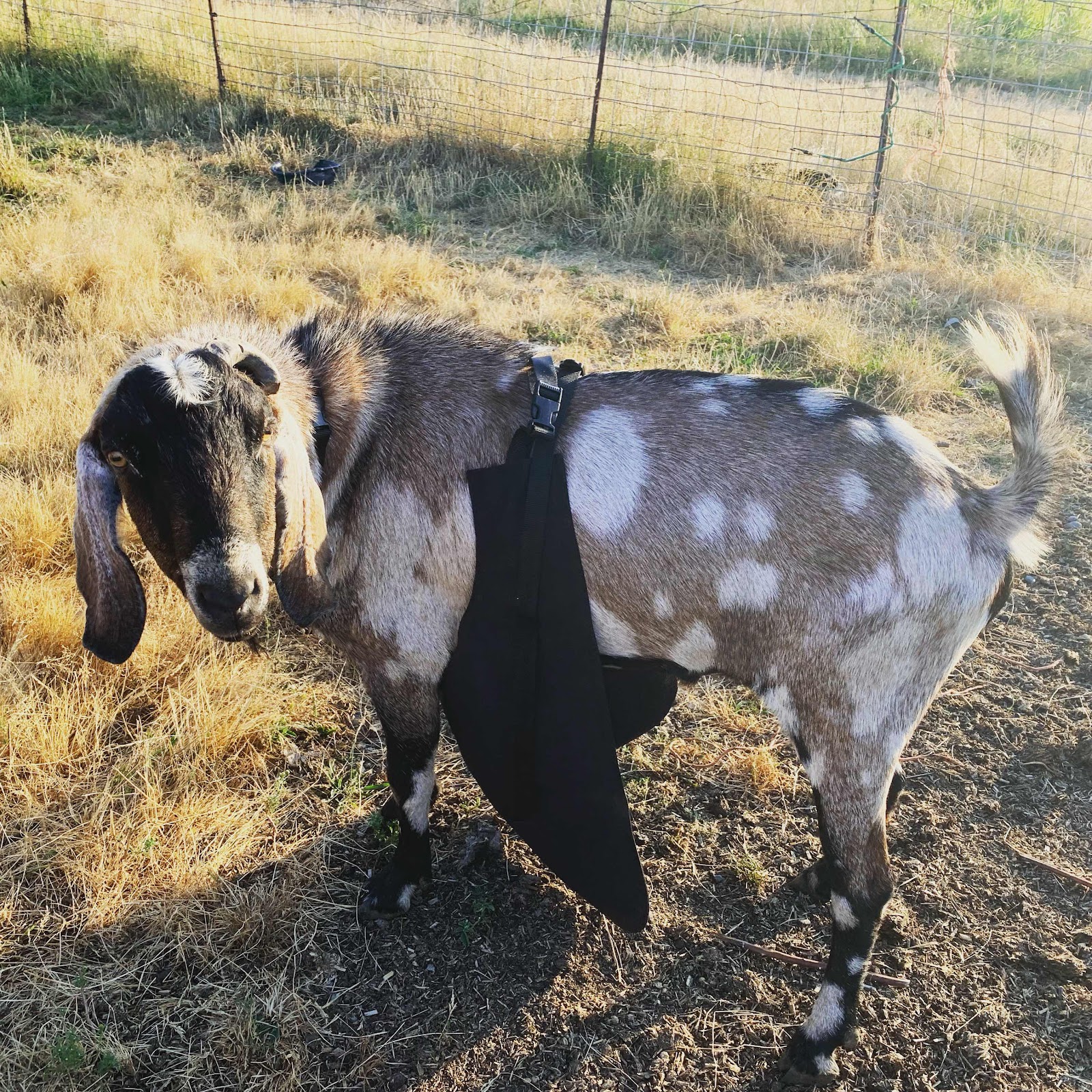
That means we have to control the buck. Not an easy thing to do. Until today he was separated from the herd in the sacrifice area along with the cow, but they ran out of grass. So I bought the  contraption you see in the photo: a buck apron. 

A buck apron is designed to provide a barrier between the buck’s business and any does. Reports of its effectiveness vary, and I’ve never tried one before. I guess we’ll find out. 
It wasn’t a ton of fun putting it on him - he stinks to high heaven - and it was expensive, so I hope it works. 


Sunday, March 24, 2019

Four is Too Many


Christmas gave birth this morning, unaided, to quadruplets. They are all up and nursing, appear to be full term and healthy, and of course as cute as all get out. Three bucklings and one doeling. 

I’m not thrilled. Four is too many for a mama to raise alone. Having only two teats, even if she produces enough milk for all four (doubtful), the stronger kids will hog the teats and the weaker kids will starve. I’m going to have to pull a couple and bottle feed them, and I HATE bottle feeding. 

If there is anything in this world more frustrating than watching newborn kids try to stand up and nurse, it’s trying to get newborn kids to take a bottle. I’ve managed to avoid it most years, but I don’t think I’ll be able to this year. 

Christmas did NOT look big enough to have quads inside of her. I was expecting twins. She’s never had more than two before. 

Now I’m terrified for poor Flopsy! She’s twice the size of Christmas. She must have, like, nine in there. 

Wednesday, October 11, 2017

Beautiful Buck


Fall is the season for making decisions about goat breeding. 
Most goats are seasonal breeders, meaning they only go into heat during certain times of the year. In our climate, the does begin to go into heat as soon as the days grow shorter and the nights become crisp, usually in September. Every doe is different - one of mine, Polly, is an early breeder and goes into heat in late July or early August. If we have a buck on the place, she will get pregnant early and give birth in the depths of winter, which is not good for the survival chances of her babies. 

For that and other reasons, I have not kept a buck in the farm for several years now. It's convienant to have your own buck, for sure. Finding a suitable buck is one of the more time comsuming and annoying tasks of the year. First you have to find a buck you like, of the correct breed, conformation, and vigor. Then you have to talk about testing for communicable diseases and coordinate worming schedules; negotiate a price for multiple does; and decide whether you will transport the does to the buck or the buck to the does, and who will take on that onerous task. Some buck owners want you to pay for feed or to provide specific hay; some charge boarding fees for your does. 

On the other hand, keeping a buck has its drawbacks. They are stinky, in season, and some of them are aggressive. They are generally speaking much harder on fences than does are, and more prone to escape and go marauding around the countryside damaging the neighbor's fruit trees. When breeding season comes around they must be kept separate from the does until such time as you want them bred, and that isn't easy. A healthy young buck will go to amazing lengths to breed an in-heat doe, including jumping a six foot fence. If you are still milking during breeding season, a buck's hormones will taint the milk and give it a rancid, billy-goat odor. 

On balance, I've decided that it's better to rent a buck than it is to keep one year round. For now, anyway. This year it was relatively easy to find a good buck. A friend of the family has a lovely, proven, black and white Nubian that he was willing to lend us for the three weeks it takes to complete a full breeding cycle. He isn't registered, but I don't care because neither are my does. Homero went and got him today. He transported him - crazily - in the backseat of our regular car, which means we will all have to sit on clean towels or smell like a billy goat for the next couple of weeks.  
But I'm happy - the does seem very happy, very welcoming. 

Here's a link to a post from a few years ago about the more historical and spiritual aspects of goat breeding:

Sunday, April 23, 2017

Haku and the Baby Goats ("Shepherd" Indeed)

No automatic alt text available.


Haku is in love with Bunny, the bottle baby. In this photo, he is clearly saying "mine." After several days of close supervision, we now trust him enough to leave him alone with the baby for, oh, up to five minutes at a time. He doesn't want to hurt her; he wants to lick her vigorously and unceasingly. That, however, is not pleasant for a baby goat. She quickly becomes wet and exhausted and needs to be rescued. 

As Bunny gets older and starts to jump and run more, Haku is becoming less trustworthy. I think his prey drive is engaged when the baby zips erratically around. So far, he has not tried to catch a baby with his teeth - only tried to pounce with his paws. But he has had to be scolded off often. I doubt very much if Haku will ever be entirely trustworthy with any livestock. 

Polly, the latest goat to give birth, certainly doesn't think so. Polly bucked the trend by giving birth easily and without drama to twin doelings. They were both large and energetic, standing up and nursing without help. I think my favorite is this pretty little brown and black girl. The girls have named her Ombre, after the way her colors fade into each other. 


Image may contain: outdoor


When I brought Haku into the mama barn to meet the new babies, he tried to lick them and kiss them the way he does with the house baby. Mama Polly was having none of it. She got between Haku and the babies, lowered her horns, and made menacing noises (well, what passes for menacing noises when made by a goat). When Haku persisted, Polly gave him her horns. Apparently deeply offended, Haku responded by growling and snapping at Polly - and I instantly hauled him away and scolded him. He needs to understand that the babies are to be safeguarded and that the mamas are absolutely sacrosanct. 

Maybe I am being a little bit unrealistic about Haku's vocabulary. I'd be happy if he just learned "gentle" and "no." 


Sunday, February 21, 2016

The Goat That Won't Kid


Yesterday was the first clear day we've had in ages. It's been raining so constantly that I had almost forgotten how to see colors - the world has been nothing but various shades of grey since last October. I read that this has in fact been the wettest winter in Washington State history - more than 28" since December first. 

I brought the goats out to graze during our short respite yesterday (today it is raining again). See the black goat on the left? The one who looks rather like a hot air balloon or like a giant beanbag chair? That's Flopsy, and she is pregnant. 

She is sooo pregnant. She is so pregnant it hurts to look at her. Her udder is tight, her ligaments are loose (see below - I can just about close my hand around her tailbone), but she just won't kid. 


She has been like this for about a week. Every day I am certain there will be kids on the ground in the morning and every day there are not. 

She just keeps getting bigger. I am a little worried - I think she is probably carrying triplets. She has thrown triplets at least twice before. Triples aren't usually a problem for a Nubian mama, but Flopsy has a problem. 

Several years ago she had mastitis, a serious infection. Even with the best treatment I could provide, she lost most of the function in one side of her udder. She's lopsided. Since then, she has successfully raised twins, but not triplets. 

I was hoping, after Iris lost her baby last week, that Flopsy would kid quickly, and in the event that she had triplets, I might be able to get one of them onto Iris. That is unlikely, now. Enough time has passed that autos would not accept a newborn kid. 

Lots of people love bottle babies, but I am not one of them. Call me lazy, but my days of 2 am feedings are OVER. If Flopsy has triplets I'll give one of them away to a friend who enjoys that sort of thing. 

Gotta go - it's just about time to go out I barn again and look for signs of incipient kids. 

Monday, February 15, 2016

A Rough Day for Iris (and Me)

I got up early this morning to go to a work appointment, only to find when I got there that the client had cancelled only minutes before. Barely awake, I executed a  U-turn and headed for the nearest coffee shop.

On the way home, as I was drinking my coffee, a crown popped off of one of my molars. Although it didn't hurt, it seriously freaked me out. Instead of a tooth, I suddenly had a small squishy gap where a tooth should be, with a small steel spike sticking up. I was so horrified, I almost swallowed the crown. Almost. Luckily, I was able to pop it back on - after I pulled over, of course, and after rotating it through a few revolutions and trying all the possible angles.

I drove straight to the dentist who had placed it, just last year (I broke that tooth cracking Dungeness crab with my teeth. Please don't ever do that. Crab-crackers were invented for a reason). I asked the receptionist at the dentist's office if there was a guarantee on the crown, seeing as I had had it for only a little over a year and further seeing as how I have no dental insurance. She told me that there was, and that if neither the crown nor the remnant of my tooth were damaged, then it could be replaced for free. However, she had no openings that day and the best they could do was tomorrow morning.

Sadly I drove home, trying not to test the strength of the crown by probing it with my tongue. When I got home, about ten thirty, Homero was waiting outside and flagged me down.

"Iris is giving birth, but I don't think it is going too well," he said. "Come and see."

Passing through the house to quickly wash my hands and get some soap and warm water and a towel, I raced out (through the driving rain) to the barn. We got Iris into the mama barn by main force, as she did not want to get up or walk.

Iris is my oldest goat, my first goat. She has had many babies and is now about nine years old. Last year she didn't get pregnant, and I had figured her mothering life might be over, but then she did catch this year. Once in the mama barn, she laid down on her side and started pushing hard, grunting and curling her lip. We tried to get her up on the stanchion, but no go, so I laid down in the straw behind her, soaped up my hand, and went exploring.

There was no sign of any residual "goo" which told me that her water had broken some time ago. She was dry and tight. There were two hooves right inside the vulva, both front hooves, and in normal right-side-up position. Further back, alongside and below the legs, was a head.

I needed to find out if the head and the legs belonged to the same kid. It didn't seem like it, because in a normal presentation the head should be above (dorsal to) the hooves. Feeling for the jaw, I found the mouth and inserted my fingers to feel for teeth. There were sharp little teeth on the upper (dorsal) side. Goats only have front teeth in their lower jaw, not in the upper. So feeling these teeth told me that the head was upside down.

What I needed to do was follow either the head and neck, or the front legs, down to a body and try to figure out where they all came together - or not. If there were two kids, I would need to push the head back into the uterus, and then find the head belonging to the legs and bring it around. Or, of course, the opposite - push the feet back and then find the other feet belonging to the head.

This might sound easy in theory, but in practice it is not. It's not easy even if you have an upright goat and are not laying on your side in the straw without very good light. I went in as far as I could, but I was unable to ascertain for certain whether there were two kids or one. The head did not budge when I pushed on it, nor did the feet come forward with gentle traction. Without having a clear picture of what was going on, I wasn't going to pull any harder than a 2 on a scale of ten.

I though we had twins - one with legs forward and head back, the other with head forward and legs back. Knowing there was nothing more I could do, I called the vet and told them I was coming in.
Getting Iris into the van was a challenge, but Homero and I did it, and then he stayed with the children while I drove as fast as I could (through the driving rain) to the vet. Not very fast at all, as I spent the entire twelve miles behind first a tractor and then behind one kind of semi-truck or another. I am not a patient driver at the best of times, and least off all with a beloved goat in the worst kind of distress in the back.

Once Iris was at the vet's and up on a stanchion (lifted by three people), the doctor gave her an epidural and went in to try to figure it out. It wasn't obvious to him either. It took a good ten minutes to first figure it out and then straighten it out. I was wrong; there were no twins. There was only a single baby, who had her neck wrapped around her own front legs like a corkscrew, so that her head was upside down underneath her own knees. It is an impossible presentation. The baby cannot come out that way, and pushing the head or pulling the legs is not going to help. The doctor had to twist the head and bring it around up over the legs, into a normal presentation, so the baby could be born. That was a pretty violent procedure requiring a lot of force, and Iris was in great pain - epidural or no.

She was dead, of course. It appeared she had been dead for some time, perhaps two or three hours. The vet said that with the poor presentation, Iris had probably been in low-grade labor for several hours. Without the head providing the correct pressure on the cervix, the labor didn't progress, and after the baby died (whenever that happened) the baby couldn't help by wriggling or changing position. If I hadn't taken her in, Iris would most likely have died eventually as well.

Poor Iris. She got a shot of painkillers, a shot of penicillin, and a ride home with a full udder and no baby. She is fairly torn up. I'll give her a full course of penicillin injections, and I have painkillers for three more days. She is also now officially retired - no more babies for Iris. I asked if any of this could be attributed too her age, and the vet said not definitively, but older dams do have a harder time kidding in general. Iris has earned her retirement at least twice over   (How Much is a Good Goat Worth?) - we will have this last season of milk from her, and then she can spend future breeding seasons with the ponies in the horse pasture.

The baby was a doe. A fine, big, brown doeling.

When I came home from the vet, covered in poop and blood and slime, aching for a bath, I found one of my kids already in there, and they had already used up all the hot water.

Also, there's no wine in the house.


Saturday, December 26, 2015

A Goat Named Christmas


On Christmas Eve morning, when Homero went out to feed the animals, he found a baby goat curled up, asleep in the hay. He wasn't sure which of the three does was the mama, so he picked up the baby and put her in the mama barn, chose the mama goat that most resembled the baby (Polly), and came back in to get me. 

When I entered the mama barn a few minutes later, the baby was nursing on Polly, so clearly Homero chose correctly. Polly must have given birth the evening before. The baby was dry and fluffy, nursing like a pro, and Polly looked great. 

I HAVE been checking the mama goat's udders when I go out, because I know that they were probably bred quite early, since we just let the buck run with them year round. Last year (or was it the year before?) we lost two babies because they were born in the middle of a deep freeze in the middle of the night. 

This time we (and the goats of course ) were luckier - it's been very wet but not cold. The barn has plenty of dry straw, and now that we put them in the mama barn, they ought to do just fine. Until I let them out, a few days from now, anyway. I can't imagine how that tiny baby can traverse the lake of deep mud between the door of the barn and the grass of the pasture. I need to get some chips down, pronto. 

A search for another baby - dead or alive - and any sign of placenta turned up negative. It seems this baby was a singleton. And it's a she. She's a doeling.  We named her Christmas. We're going to keep her. It's about time I added a new doe to the herd. It seems that Iris most likely did not get pregnant again this year. That makes two years in a row and I think it is unlikely she will produce again. Flopsy is also getting on, and she only has one teat. Polly is my best goat, and I think a doeling from her would make a good replacement for Iris or Flopsy. 

If, that is, we can raise her to maturity without being killed by Haku. I'm terrified about him killing baby goats. He doesn't bother the adult goats - only the sheep - but the adult goats don't prance and gambol and run around enticingly, which the baby goats most certainly will. Also the babies are perfectly prey sized for Haku. 

In an attempt to avoid that horrible fate, I brought the baby inside and let Haku lick her all over. I even brought Haku out to the mama barn and let him lick the baby all over right in front of her mama. Polly did not like that at all. She was very protective, keeping herself between Haku and the baby, and lowering her horns menacingly. But Haku behaved himself and was very gentle with the baby. 


I'd be perfectly happy if Christmas were the only baby we get this year. I don't need more goats and I don't need more milk than Polly can provide. It's always nice to have a couple of babies to sell, or to eat, so it wouldn't be awful if there were more babies, but they'd be surplus. The only thing I will need to do next year is find a different buck. Hopefully I can find someone in the same position as me who wants to trade bucks straight across. 


Monday, June 22, 2015

Tidbits and Fruit Update


Beautiful evening out with the goats. They are all (all four of them - the fewest number of goats I've had in years) looking fat and sassy. I'm trying to decide whether to keep the same buck for this coming year or not. Advantages - he's proven, impregnated two of my ladies last year with pretty, spotty babies, and he's healthy, and free. Disadvantages - Iris doesn't like him, didn't let him breed her last year. Also, if I don't separate him (or get rid of him) he will impregnate the does in late summer and I will have babies too early again. If I don't use him, I'll have to find another buck and pay for him.

The cherries are ripening. As usual, the birds are striking the cherries just before they are ripe enough for us. Long term, we have to figure that out. Short term, we are enjoying semi-ripe cherries and looking forward to ripe cherries with a few bird strike scars. Also the neighbors pie cherries are getting ripe, hanging over the fence, and I need to harvest those and make a quart or so of cherry-and-mint infused vodka. Just add club soda and you have what we have named a Cherry Mindy.

Earliest year on record for berries. I took the girls out to pick raspberries today. Unheard of. Strawberries are already done, everywhere. Zion holds its yearly Strawberry Social June 28th (I WILL win the quilt raffle this year, I WILL) but they will have to use frozen strawberries for the sundaes and shortcake. As I was driving around the county today I even saw blueberries ripe on the bushes. Blueberry season usually starts in August. The blackberries are still in blossom, barely. Mostly the bushes are covered with hard tiny green fruit.

Looks like it will be a decent year for pears, but for some reason the Italian Prune hasn't set a single plum. Not one. Last year was a good harvest, and it is one of those trees that usually alternates a heavy year with a light year, but NO fruit seems weird to me. Oh well, here's hoping some of my neighbors will have extra.

I'm headed out of town next week to care for my dad in Tucson. Tucson in July is a trial; it's been over 110 degrees for over a week now. At least he has a pool. By the time I get back, it will be full on harvest season, and I will be consumed with canning for a month or so. I've made a fateful decision, this year, that I can no longer buy tomatoes from Mexico (an upcoming post will detail why- for now, one word will suffice: SLAVERY) and so instead I will be seeking out a shit-ton of local tomatoes to can. I expect the Gleaner's Pantry to help me with that.

The solstice was yesterday. The longest, prettiest days of the year are here. These few short weeks are why I put up with months of mud and freezing rain. I am enjoying them to the fullest extant.


Saturday, January 31, 2015

The Worst Job on the Farm (Disbudding)


Meet the littlest baby goat. Flopsy gave birth just a week or so after Polly, who lost both babies
Sad Day (Breeding Gone Awry)) because we didn't know she had got pregnant so early and also because she can apparently hide twins in her belly and still look like a caprine supermodel. After that sad day, of course I kept a sharp eye on the other goats, and so we had plenty of time to lock up Flopsy in the warm, dry mama barn when she began to show signs of impending labor.

Surprisingly, she only gave birth to one baby, this fine spotted buckling you see above. Flopsy has thrown triplets more often than anything else, although her first baby was a single buckling as well, the inimitable Storm Cloud. It seems that whenever a goat throws a single, it is always a big buckling.  Iris once  had a single buckling, Clove, who was so big and vigorous he was trying to stand up before he was all the way out.

It may be that this little guy is our only baby goat this year. If Iris is pregnant it will be quite a while yet - she is thin and shows no udder development at all. At nine years old, her fertility may be declining, which is fine by me. Iris has given us many beautiful babies over the years and produced an awful lot of milk. She has earned her retirement. I don't mind if we don't get more babies - the market for goats has been poor for years now, and we often end up eating them instead of selling them. There's nothing wrong with that, of course, but it wouldn't bother me to take a year off from butchering.

I'm going to try to sell this little fellow as an intact buck. He has a fair chance, I think, because of his lovely spots. If I knew for certain he were destined to be a meat animal, I wouldn't bother with disbudding him, but there is absolutely zero chance anyone will buy a buck with horns. Nor should they; a full grown horned buck would a dangerous animal during rut season. So, today we disbudded him.


Disbudding baby goats is a terrifying procedure carried out with a red-hot iron (or actually, copper, as seen on the model above). I used to pay the veterinarian to do it under anesthesia, but that became prohibitively expensive as the price I could get for baby goats declined. Also, the vet killed one of my babies by accident ( This One Really Hurts (Bad Year for Baby Goats)) and I figured if anybody is going to kill one of my babies, it might as well be me.

Homero built me a kid-containment box out of an old bookshelf and I bought a disbudding iron off the internet. Last year I borrowed a friend's iron just to see if I could handle the procedure, and it turns out I can. It's horrible, but I can do it. Last year I disbudded three babies and they all turned out fine - no brain damage - and as far as I know they never grew any scurs, either. This year's baby buckling is now disbudded and back with his mama, seemingly none the worse for the experience. I'll watch him carefully and check him early in the morning for any signs of brain injury, but I think I have successfully added disbudding to my list of farm tasks that I can competently do, unpleasant as it is.


Tuesday, January 6, 2015

Sad Day (Breeding Gone Awry)


A likely looking buckling: Storm Cloud
To keep a buck or not to keep a buck is one of the major questions I struggle with. There are advantages and disadvantages to keeping your own buck  (see, for example,The King Must Die (Goat Breeding and Divine Kingship)) but the main advantage is not having to frantically search for a buck to rent every year, which can be a major hassle ( New To Farm Life: Unwelcome Drama in the Goat Breeding ...).  Accordingly, I have usually kept a buck around.

The next question is whether or not to let your buck run with the herd. Most goat folks will say not to do this, and after the story I am about to tell you, I have to agree. I have changed my mind. I always let my bucks run with the herd, truthfully because my fences have not been up to the task of keeping them separate. A buck who wants to get at does in heat is a very difficult animal to contain. Some people say a buck will harass the does until they are thin and sick; or that he will keep breeding a pregnant doe until she aborts. I haven't noticed that to be the case with my bucks. What any buck WILL do, however, is breed a doe at the earliest possible chance.

Nubians are generally seasonal breeders, meaning that they will not go into heat until the days begin to get shorter and the nights to get cooler, usually in early September around these parts. But if a doe goes in to heat early for some reason, no buck is going to stand around metaphorically twiddling his thumbs. He's going to blubber and pee on himself and strike ridiculous poses and breed that doe the second she'll stand still for it. And apparently, Polly went into heat in July this past summer.

The reason that you don't want your does pregnant in July - if you live in a place with wet, cold winters - is that you don't want baby goats born in January. They have a distressing tendency to die. Especially if the weather has been very wet and chilly. And most especially if you weren't expecting them, and therefore were not able to pen the mama goat up in the dry barn, and instead she gave birth in the middle of the night in the cold wet pasture. Then what will happen, 9 times out of 10, is that when you go outside to do the chores, you will find a couple of dead kids and a mama goat with a drum-tight udder.

Which is what happened here last friday. Homero found them. Twins; a buck and a doe, beautifully spotted and perfect, but cold, flat, and dead. I'm certain the poor little things were born live and just never stood up to nurse. If I had been there, they would almost certainly both be alive. I felt just awful - this is my fault for being lazy and slack about fencing, and not keeping good notes about when my does were bred, and not keeping close tabs on the mama goats regarding signs of pregnancy. Although to be fair to myself, it is often very difficult to tell when these large bodied Nubians are pregnant until the udders fill up a day before kidding.

It also so happened that when Homero came inside to tell me about the babies, I was just finishing up packing for a long-weekend vacation we were taking to Victoria. For the first time in years, we were all going together, all five of us. I had arranged for friends to take the dogs and we were simply going to leave the large animals with extra hay and water. There would be nobody at home at all to care for Polly.

Polly was fine - the birth didn't seem to be hard on her at all - but she would lose her milk if no-one milked her. Of course we didn't want her to lose her milk for OUR sake - that would make this breeding season a dead loss - but I was also worried about just leaving her to dry up on her own, without supervision. The vet said, when I called, that most times they will dry up just fine on their own, but they should always be watched for signs of mastitis. We were supposed to leave to go catch the boat in just a few hours, and the tickets were non-refundable (of course).

Desperate, I put the word out on the Facebook Farmer's group. I said I know it was an insane request, but I had to try - could anybody take my goat for a few days and keep her in milk for me? To my surprise and relief, no fewer than three other goat owners offered within minutes. My neighbor M., who was already caring for my elderly dog, was one of them. So we bundled the goat, the stanchion, and a bag of alfalfa pellets into the van and brought them all over, gave her a crash-course in milking, and thanked her profusely. Then we went to Victoria and had a perfectly lovely time.

I bitch a lot about technology but it really is wonderful to be part of this Facebook group of local farmers and neighbors. Ten years ago I would have been shit out of luck, and would have stayed home milking my goat while my husband and kids went to the Royal B.C. museum and the bug zoo without me. Being part of this community is a privilege and a responsibility - surely it is my turn next to help in any goat-related emergencies.


Saturday, April 5, 2014

The Goat Who Wouldn't Kid (When to Butt Out)


Iris, above, is the first goat I bought when I moved here. I was hurting for goats; I couldn't wait. Goats, as far as I was concerned, were the whole point of pulling up stakes and moving from the city to the countryside. It was late summer when we moved in, and late fall by the time I had bought a barn (Home Depot's largest model), put in fencing, and was ready to buy an animal. Not wanting to deal with breeding the first year, I looked for a pregnant goat.

Craigslist, as usual, was my vehicle. I put up an ad saying I wanted to buy a pregnant dairy goat - breed unimportant - and was soon answered by a local woman with a bred Nubian doe. She wanted an inordinate amount of money - $300! - but I was taken with goat fever and I simply decided to lie to my husband about how much I was spending. He has no idea what a good goat is worth, I rationalized. As it turns out, that woman actually runs a well-respected farm and her goats win prizes all over the tri-state area, but I had no way of knowing that at the time. Nor did the pedigree matter to me - she offered me Iris' papers for an extra $50 but I said no thanks, not thinking it would ever be important to prove her ancestry. I'm a homesteader, I said, not a goat breeder.

That was rather a dumb decision, I have since come to understand. For $50, I could have a herd of registered animals now, and each and every one of them would be regarded as quality breeding stock, allowed to be shown at agricultural fairs, and valued at some 25-50% higher than unregistered animals. Instead, I have a herd of beautiful, healthy animals, from good milking stock, and bred for hardiness, but only suitable for the smaller market of people who don't care about registries. It means I sell a lot of quality animals for meat instead of for show.

Nonetheless, Iris has earned her price many times over. That first year, she threw us twins, and one of them, Flopsy, I have to this day. Flopsy, in turn, has given us many kids over the years, including our prize buck. If I were to add up the value of all that Iris has provided in livestock, meat, and milk over the years - something I could theoretically do but not at this time of night - it would be a lot of money. Totally aside from her monetary worth, Iris is a great goat - smart, personable, and attractive.

She is getting on in years, however. A year and a half old when we bought her, she is now about eight. Goats live to something like thirteen, and they can theoretically keep producing until they keel over of old age. Iris is healthy, and she had a year off from kidding last year when we were in Mexico. When we brought in the buck, Paxton, last fall, he went for Iris first of all the does. He bred her within thirty seconds of entering the pasture, so it's clear she is still a fertile animal.

This spring, however, the other two does kidded first. Oh well, I thought, Iris must not have caught pregnant on the first go-round - I'll expect babies in a few weeks. I started to watch her. For a while, I was confused. I had been certain she was pregnant - like the other does, she got thick in the middle and developed a biscuity tail (that means that the skin of her tail got puffy and soft - a sign of early pregnancy). But after the other does kidded, Iris didn't seem to be developing at all - in fact, she was getting thinner. Her udder stayed stubbornly small and floppy. I couldn't figure it out at all and began to doubt she was even pregnant.

Finally, about a week ago, her udder began to fill out, which is unmistakable proof of advanced pregnancy. Usually, when the udder fills, you have only a few days until birth. But Iris' udder got bigger and bigger. Her belly got bigger and bigger. She was so poofy and huge she could barely walk. Her tail ligaments disappeared and her distal spine lifted up. Deep hollows appeared below her hipbones as the babies dropped lower and lower. I started to lock her in the mama barn at night, but every morning when I went out early to check, there was Iris, staring at me - no kids.

I had advertised her kids for sale on Craigslist, and a woman had already answered me with an offer to buy any doelings. She wrote me every day - are they here yet? No, I said, but I'm pretty sure today's the day. Night before last, I locked her in the barn as usual at evening feed, but I forgot to tip the milking stand on its side. I do that so that she won't be able to get up on the stand, stand on her hind legs, and reach the sack of grain stored on the tippy-top shelf, nine feet above the floor. So of course, that's what she did. When I went out first thing in the morning, expecting to see baby goats, instead I saw a lot of liquid excrement all over the place.

In case you don't know, when a goat overeats grain, she gets what's known as overeating disease (Enterotoxemia (Overeating Disease) of Sheep and Goats), or toxic rumen. To you and me, what that means is explosive diarrhea and massive amounts of gas. It's not a joke- goats can easily die of overeating disease - but Iris didn't get enough grain to be in serious trouble. Just enough to cause a lot of disgusting green liquid poo. Just what one wants when birth is imminent. I kept Iris locked inside the barn and bought a new bale of clean straw. I mucked out the poo-covered straw. I moaned and bitched and wailed and cursed the stupid goat. I wanted to beat her, but instead I brought out a pan of warm soapy water and a dozen rags and cleaned her rear end. Let nobody say I don't care about my goats.

All day I hung about, waiting. I brought a book out to the barn and sat down in the clean straw and read and waited. Iris was in serious distress, but I couldn't tell if it was labor or just intestinal distress from the diarrhea. Her udder continued to fill, and by four or five in the afternoon it was tight as a drum. That is an indication that the goat ought to kid within a few hours. I was waiting for the string of goo - which is, just as you probably guessed, a long string of mucus depending from the vagina. Once the string of goo appears, you want to see kids on the ground within an hour. No goo was forthcoming, but Iris was acting like a goat in active labor.

A goat in active labor will scratch at the ground, making a nest. She will often lay down and get up again, stretch, and yawn. Usually, she will stay standing until the final stages of labor, when she may lay down to push. She grunts and curls her lips in a very distinctive way. Normally, goats kid quickly, and the entire process ought not to take more than an hour or two from start to finish. I called the vet at 6 pm, because Iris had been getting up and laying down, stretching and rolling for about four hours. I was pretty certain that the kids were malpositioned.

The vet said it was time for me to go in and see what I could feel. Was the cervix open or shut? What was the presenting part? I put on some of my husband's thin black nitrile gloves, soaped up, and lay down on the wet straw behind Iris and inserted my hand.

I'm no expert. Over the years, I've had to pull kids several times, but until yesterday I'd never gone in before the water has broken. I would not have, but the vet said it was time. When it comes to birth - caprine or human - I am a big believer in standing back and letting nature take its course. I think we most often cause nothing but trouble when we interfere with a process honed by millions of years of evolution. In this case, I felt that her cervix was wide open and that I could feel the bag of waters easily, but that there was nothing firm inside it. I could feel no fetal part at all - not hooves, which would have been normal, nor a muzzle, nor even some blank wall of side or hip. Just an empty, squishy bag. Clearly, there was no kid in any position to be born.

I called the vet back and said "I think I better just leave her alone for a while. There's nothing I can do, those kids have to come around on their own."

Now, if any mothers are reading this, they may remember - as I do - that when somebody puts their hand inside you when you are already in labor, it provokes some serious contractions. My pelvic exam made poor Iris go into some hard core labor. Maybe that's what did it - I don't know. But in any case, Iris must have been busy while I was inside the house for a couple of hours. When I went back out at about 8 pm with a flashlight, there were two newborn babies on the ground. They had obviously been born mere minutes before. They hadn't yet stood up. I ran back to the house, yelling for Homero and the girls, and brought back clean towels and iodine.

The kids were both a little bit worse for wear, due to the long hard labor. The little girl, brown and white spotted just like her mama, had inhaled amniotic fluid and was snuffling and snorting. I didn't have a syringe to aspirate the fluid - not that I really knew how in any case. I briefly considered placing my mouth over her nose and aspirating old-school, but decided she'd probably live without any heroic measures. It seemed so, because she was the first one up, and managed to nurse without any help from me. Her brother, black with brown points and a white cap and ears, was the worse off between the two of them. He was shaky and weak and it took him a good half hour to stand up. A healthy baby ought to stand up within five minutes. I held him up and let him have at the teat; I knew that with a belly full of milk he'd be just fine for the night.

I don't like to see babies born late at night - the normal time seems to be early in the morning. I always wonder how they will figure out nursing without being able to see, but I realize that is a primate's prejudice. The little kids can smell and feel their way to the teat even in perfect darkness.

This morning, the babies were doing just fine. They had become all fluffy, as kids do when they are healthy, and both were standing and nursing without assistance. I think we are going to keep the little girl. I need a new doe - in another post I will detail my thinking on the health of the whole herd, but for the moment I'll just say I'm delighted to have a good looking spotted doling. The lady who wanted to buy a doling will just have to wait until next year.

Thursday, February 27, 2014

Buck Up (Doe Down)


Yesterday morning, I sent Rowan out to feed the animals because my knee had slipped out of joint as I tried to put on my boots. There was still several inches of snow and ice on the ground and I didn't fancy my chances of getting to the barn and back without doing myself an injury. Soon, I'm going to write a whole post about the sorry state of my body and how I manage (or don't manage) to run the farm while being partially to mostly crippled. But not today. Today I'm telling the story of the new baby goats.

Rowan came running back to the house and said "I think you're going to want to come anyway, mom, Polly had a baby!"

The little girls ran out ahead of me, and as I was struggling through the snow, Paloma ran back towards me, shouting "There's two, but one's dead." Right behind her came Hope: "No, ALMOST dead!"

When I finally made it out to the barn, I saw Polly with a beautiful, strong baby buckling at her side, standing up and nursing. He had obviously been born quite some time ago, as he was dry and fluffy. On the ground nearby was a spotted doling, flat out on her side and, to all appearances, dead.

I cursed myself. The evening before, at second feeding, I had seen and remarked to Homero that Polly's udder had filled up and the babies had dropped. This means birth will be soon; but I checked her tail ligaments and I could still feel them easily. There were no telltale hollows on either side of her tailbone. I thought it would be at least 24 hours and probably more. We left her in the main barn, with the other animals. Then she gave birth sometime during the night, or more likely in the early morning hours. By the time I got out there, the little doeling had been lying on the cold, wet straw for at least two hours and probably more.

With the girls' help, I grabbed Polly and the buckling and put them into the mama barn. Then I picked up the doeling and brought her into the house. She was breathing very slowly and had her head curled back on her shoulders in what I call "the arc of death." I never like to see a kid with its head thrown back like that; it is a very bad sign. Most likely the little thing was already doomed, but I did what I could.

I heated up the oven to 200 degrees and then popped her in, first, of course, turning the heat off and leaving the door cracked. I went back outside and got some colostrum (the first milk) from Polly - making sure the buckling was nursing well, which he was - and drizzled it into the doeling's mouth with a tiny syringe. Over the next few hours, I repeatedly warmed up the oven, fed the baby, and rubbed her and talked to her.

I didn't have a car, or I could have gone to the feed store for lactated ringer's solution and given her fluids subcutaneously. Also I could have picked up a garage tube and tried to feed her nasogastrically. I've never done that before and the chances are good I would have killed her by pumping fluid into her lungs instead of her stomach, but at that point there was nothing to lose.

For a little while, things seemed to be looking up. She cried several times, and struggled to lift her head. Her mouth warmed up inside, somewhat. But then she just died. One time took her out of the oven she was alive, and five minutes later she was dead.

My other two does are due to kid anytime now. Homero helped me divide the main barn into two stalls with a cattle panel, so that we have another separated area for a mother to kid in. I have plenty of dry straw. Sometime today I should go to the farm store and pick up a gavage tube and some LR solution, along with a larger syringe. Just to be prepared.

Every year I struggle with timing breeding for the right kidding time. First of all, it isn't always easy to find a buck so sometimes I have to take him when he's available, even if it isn't ideal by the calendar. Secondly, who knows what the weather's going to be like in March? Sometimes we get snow here in April. Thirdly, I like to have babies earlier in the spring rather than later for a variety of reasons - 1) it gives me a longer milking season before the weather turns cruddy again in the fall; and 2) it gives the kids longer to grow to eating or market weight by autumn. If I had babies in mid-May, none of them would reach a decent eating size before November.

But it's a trade off. If I had babies in mid-May, I could worry a lot less about finding chilled, dead kids on the ground. Mostly, I'm terribly pissed off at myself for not locking up Polly in the warm, dry mama-barn that evening. I won't make that mistake again soon.

Monday, September 30, 2013

Double Buck (the Craigslist Chronicles)


Sometimes it seems like I spend way too much time on Craigslist. I've toned it down since the early days, when I would spend hours scanning the farm and garden section looking for free chickens (you'd be surprised) or people who wanted to trade vegetable starts or raw alpaca fleece or something like that. I used craigslist to meet other local farmers, to set up useful bartering networks (New To Farm Life: Trade Network 2012 (Craigslist Chronicles)), and occasionally, to get rid of commodities I no longer wanted - this posting, in which I offer 25 pounds of free chicken livers, is a particular favorite of mine:

New To Farm Life: My Latest Craigslist Posting

One of my bad Craigslist habits is that I seldom remember to go back and delete a post after it has outlived it's usefulness. Usually this means nothing much beyond an annoyed e-mail once in a while, but this week, my laziness paid off. I forgot to delete the post looking for a buck to service my herd. We bought a buckling, (A Buckling Named Boob) so I wasn't in the market for a buck anymore. However, when a lady called me offering me a practically free purebred, papered, tested, and proven buck, well, I could hardly say no. Haboob, cute as he is, is still a tiny little baby and may not even be capable of mating this year. If he is, it won't be until January. I had resigned myself to not having any babies until early summer next year, and no cheese until sometime in July. When this handsome fellow popped up out of the blue, I jumped on him.

The lady, A., is simply getting out of Nubians. She is going to pure Nigerians (minis) and had no more use for Paxton. I guess she hadn't had much luck selling him at a decent price (the goat market fluctuates wildly; this is probably an off year) and decided finally she just wanted his stinky ass off the property before he went and impregnated the wrong does. She even offered to transport him, which is wonderful, because our van is broken down.

Paxton arrived on the farm at about six in the evening last friday, and fifteen seconds later, everybody was pregnant. The does must have been in heat - I can never tell - because Paxton took one look at them and did his Buckly duty before he even got all the way through the gate. So, doing the math, I ought to have a very busy week sometime in early March. Hooray!

We are keeping Haboob, of course. We will just wait and use him next year. For the rest of this breeding season, we can rent out Paxton, for cash or for trade in hay. Back to the barter section of Craigslist I go!

Wednesday, September 11, 2013

A Buckling Named Boob


It looks like breeding season will be delayed this year. This adorable little guy just won't be ready for a few months yet. Breeding season is always a major pain in the butt, or at least, it has been ever since I sold Storm Cloud, my beautiful herdsire. Last year, of course, we didn't breed any goats at all, being in Oaxaca. The year before that, we had a very difficult time finding a buck and ended up with a less-than-satisfactory arrangement (Unwelcome Drama in the Goat Breeding Business).

This year, I thought I had everything all sewn up ahead of time. A woman I know slightly has a black and white spotted buck and we made arrangements for her to bring him over for a few weeks and I would pay her $100. That sounds expensive, but it actually represents a bit of a discount, as I had three does to breed, and the going rate for a proven, purebred, tested buck is about $50 per doe. I wasn't thrilled about the timing, because she was in hurry to get him off of her property while she had houseguests (STINKY) and I wanted to wait until a little later in the season so that babies would not be born in January. However, a buck in the hand is worth two on the internet, so I said to bring him on over.

A week went by, and I hadn't heard from her. When I called her, she said "Oh, I sold him already. I tried to call you..." I was disappointed, but it wasn't really a surprise. It's never easy to find a buck to rent. Something always goes wrong. So I went back to Craigslist in search of another solution. I found bucklings for sale galore, but none to rent. As regular readers have surely gathered, I have a lot on my plate right now and wanted to get this goat thing taken care of as soon as possible, so I can get back to worrying about other stuff, like my high-need nieces. So after consulting with Homero, we decided to go look at a couple of low-priced bucklings.

Unfortunately, they were all quite young. The fellow we picked, this handsome tan and white moon-spotted buckling, is just over two months old. Bucks can usually breed at about four and a half months, so we are looking at... um.... babies at the beginning of May. Hopefully. Right now, he is rediculously tiny and the does are beating him up mercilessly. It seems unlikely he will dominate them anytime soon.

My kids don't like the name I gave him, Sandstorm. Our last herdsire was named Storm Cloud, and intact bucklings have taken on weather-related names. We had Cirrus and Nimbus, for example. The kids were ready to mutiny over Sandstorm, until I told them that in Arabic a sandstorm is called a Haboob. Now we have a goat named Boob, for short.  Courtesy of Hope, my nine year old.

For my general thoughts on goat breeding, see The King Must Die (Goat Breeding and Divine Kingship)

Sunday, December 4, 2011

Unwelcome Drama in the Goat Breeding Business

For the last two years, breeding my goats was very easy: I had my own buck. Storm Cloud was handsome and healthy, but alas, as with all bucks, his usefulness was only a couple of seasons long (The King Must Die (Goat Breeding and Divine Kingship)). This year I had to look for a buck.


I started out with high hopes - I advertised for a spotted purebred Nubian. Weeks and weeks went by, and no responses, except for one. I lowered my standards and simply looked for a Nubian. Same thing - no responses except for the same one. A problematic response. A response from a person I know, and would rather not work with.

D* is a local, small scale goat breeder. She is, in fact, the first goat breeder I met up here, and she was very helpful, giving me tips on general care such as hoof trimming and which worming medicines were most effective for local parasites. I was grateful. However, it didn't take me long to take a rather sharp dislike to her. I didn't like the way she spoke to her toddler child. I didn't like the way she vigorously badmouthed other local goat folks, people I didn't know. When I visited her home, to bring her a gift for her new baby, I was truly shocked by the conditions she was living in - not just squalid but actively dangerous for small children. And as time went on and I did meet other goat folks, I learned that everyone who has had dealings with her has had serious troubles.

I can't give too many specifics without identifying her, which I do not want to do, but various people told me of dealings with her that resulted in hard feelings, at best, and police involvement, at worst. I also heard that the Humane Society had removed some of her animals. You can see why I would prefer to have my does bred by somebody else's buck.

But I just wasn't finding one! A few people called me with bucks of other breeds on offer, but D*'s was the only Nubian available. Time went by, and I realized that if I wanted to breed my does to a Nubian buck this year, I would have to see D*.

There were immediate issues, but mostly minor annoyances. She insisted on current CAE and CL tests for all of my does (reasonable) but when asked for test results on her buck, she couldn't provide any. We talked about my boarding her buck for a few weeks to impregnate all the does at once (my preference), but I ended up transporting my does to her. She wanted to charge me a $3/day boarding fee for my does, plus a few bales of hay, but when we were talking about my boarding her buck there was no talk of her providing hay. In fact, she wanted to charge me a $10 transport fee, each way!

I ignored all this, because I really wanted my does bred, and the buck was actually quite handsome. Black and white spots, tall and big bodied, just what I was looking for. I brought over three of the four does (the fourth was waiting on test results - which cost me $48). All went well on the first go round, and I brought my does home after about a week. D* was paid the full stud fee for the three does, although of course we didn't know yet if they were actually pregnant.

Just a few days ago, I called D* to schedule bringing over my fourth doe, along with one of the original three, who was showing signs of heat, which would mean she wasn't pregnant. D* told me to bring them by anytime, but that the buck I had used before was no longer available and I would have to use her junior, unproven buck. Turns out, that first buck wasn't even hers, she was boarding him for someone else.

"Um, okay," I said. "That's not what I was expecting. How about a price break on the stud fee?"

"No," she said, "I'm already discounting the fee for multiple does. Take it or leave it. And bring some more hay."

I was pretty pissed off at this point. I felt that D* was trying to gouge me at every turn, and also that it was pretty duplicitous to collect stud fees on a buck that wasn't even yours... although of course I don't know what agreement she might have had with the buck's actual owner. However - it was now December, and goat breeding season is drawing to a close. I really wanted this particular doe bred, because she is a first freshener and already a little old for it. Also she is Storm Cloud's offspring, the only blood of his I have on the farm, and a spectacularly gorgeous animal. I don't want to wait another year and a half to see what she produces.

So I brought the goats. D* wasn't home, but she had told me where to leave them, and I did. I also brought a full bale of hay. The string on the hay broke as I was trying to unload it, and so I had to move it in several armloads, which I piled up on in the barn next to the rest of their hay. Then I went home.

A few hours later, I got an e-mail. It said "You have to either bring me more hay or pick up your goats tomorrow. This amount will not compensate me for my time and labor." Immediately following, there was a second e-mail: "disregard first message. Come get your goats now, we don't want them here."

Well. The woman clearly has issues. Anyone who so consistently creates chaos and strife in all their relationships is more to be pitied than hated. I say that now, after a few days cooling off time. In the heat of the moment, I was furious. I'm afraid I have to admit to firing back a long and ungracious e-mail, in which I told her some of the things I've heard about her in the past, and how I should have listened to those people and stayed far away. I am definitely not proud of sending that e-mail - I should have just shut up, collected my goats, and chalked it up to experience.

Also, as my sister told me, it wasn't very smart to send that e-mail while she still had physical possession of my goats. In any case, we got our goats back without difficulty. I told Homero I wanted him to come with me, just in case there were problems. There weren't: D* didn't come out of her trailer. The goats are back home, still unserviced, and I still have no leads on a Nubian buck.

But I have learned a lesson. I hate gossip with a passion, which is probably why I disregarded so many stories about D*. But when three or more people have similar stories to tell about an individual, maybe it isn't just gossip. Maybe it's worth a little caution. At least, in my case, there was no harm done and no police involvement! I'm counting my blessings.

Monday, October 24, 2011

The King Must Die (Goat Breeding and Divine Kingship)


I used to have my own buck. Storm Cloud, son of Flopsy, was (and presumably still is) an extremely handsome, healthy and virile tri-color purebred Nubian buck. He is black and white with brown points, tall, big-boned, from excellent milking lines, and also good natured, with healthy hooves, and never had a problem with parasites. Pretty much the ideal buck, in other words.

But even the ideal buck - even the divine Pan, were he to descend to Earth in the form of a buck - is only good for three years, maximum. After that, every doe on the place is either his sister, mother, or daughter. After three years, all bucks must be replaced. Now that I think about it, I am sure that is where the ancient tradition of the Summer King comes from.

For those of you who don't know, in ancient days, in Pre-Christian Europe, pretty much across the continent from Ireland to Asia Minor, there existed a tradition of divine kingship. The details varied from place to place, but basically, a king won his throne by supplanting the previous king, who was put to death.

Usually the reign was set for a specific period of time - a year, three years, seven years - after which there would be a solemn ceremony to replace the old king with a new, younger, stronger king. Sometimes the kings would fight to the death - a battle which was weighted against the old king - and sometimes the king submitted, after his appointed term had ended, to a ritual death of one kind or another.

The best documented of these rituals, perhaps, is that of the high festival of Dionysius, in certain parts of ancient Greece. On the appointed night, there would be an orgy, a great feast and dance, and the king would be celebrated, bedded by all the women he wanted, and gotten totally drunk. Then the Queen and her women - in a divine, drunken frenzy -would take on the personae of Maenads and literally tear him to pieces. His body would be plowed into the fields.

After that, the Queen would accept the new king into her bed and the country would be ritually fertilized for another year - or three, or five, or seven years. The Queen herself would only be replaced when she ceased to bear children.

However barbaric we might think such customs were, it seems to me they were expressing an inescapable biological reality. That is - you can't let one buck rule forever. That way lies genetic degeneration, illness, loss of hardiness, and general weakness in the herd. Inbreeding is bad.

Bucks must be replaced, alas. One might fairly ask, why bucks and not does? Well, think about it for a second: does provide kids and milk, year after year. One doe can feed a family of five with her offspring and her milk, each and every year for some ten years. A buck produces nothing but sperm, and his own meat. And each year, his sperm is less and less valuable. As is his meat, actually - meat from a mature, un-castrated billy goat is not, shall we say, a gourmet item.

Luckily, in a modern age, we can choose to trade bucks and shuttle them around rather than kill them when their local utility declines. I sold Storm Cloud to a lady in Portland, Oregon.
He went on to a delightful life servicing other does, and presumable, when he outlives his usefulness there, she will sell him on. Meanwhile - I need a new buck.

I have had a difficult time finding a buck this year. In my next post, I will detail my struggle - but for I will just say I think it is over. I think I have finally found a decent Nubian buck, albeit at a rather exorbitant price, and that I expect all my does to be pregnant within a month. It is late this year - I'd rather they were impregnated last month, but so be it.

Anyone looking for a great read - a truly wonderful novel, on my all-time top-ten list - which treats the subject of divine kingship in depth would be well-advised to read Mary Renault's The King Must Die. It is both a fabulous adventure story and a history lesson. Enjoy!

Tuesday, September 13, 2011

Beautiful New Goat (It's a Small Caprine World)


I went and did it again - yes, I bought a goat. A new doe. And not just any doe - a gorgeous tri-color spotty doeling. She looks just like the one that the vet accidentally killed this spring (Letter to the Vetrinarian), but a year older. It's no surprise they look alike - they are half sisters.

Yes, I bought one of Storm Cloud's offspring. One of my trade partners (I think I used to call her Turkey Girl, because our first trade with her was a thanksgiving turkey for Storm Cloud's buck service) is getting out of goats, and had three does for sale. One of them was Polly (short for Polychromatic), this lovely young thing right here:


Her sire was Storm Cloud, which means that two of my does, Flopsy and Iris, are her grandmother and great-grandmother respectively. I am especially glad to get Polly, because ever since I sold Storm Cloud, I had been lamenting the fact that I didn't keep any of his offspring. He was (presumably still is ) such a pretty buck - good conformation, good health, good feet, and good temperament. Here is a picture of Storm Cloud as a big kid, you can see he's pretty. In fact, these two bucklings are so pretty it looks like a Caprine version of an Abercrombie and Fitch ad.

I'm glad to have some of his blood back in the herd. However, I still don't have a buck for this year! Now I have FOUR lonely, spotted ladies to breed, and no Billy around to do the deed. I've advertised on Craigslist, but so far to no avail. I'm hoping to board a buck for a month or so and get the whole job done at once.

If you know of any stunningly handsome, big-boned, spotted fullbred Nubian buck around the NW washington area, give me a holler!

Sunday, July 10, 2011

It's a Fricken' Chicken' Miracle!


The hens have not had good luck this year raising chicks. Twice that I know of, a hen sat on a clutch of eggs for the full 21 days (or longer) and then abandoned them when nothing hatched. I don't know why nothing hatched - the roosters have surely been doing their job. A little too vigorously, I might add, with much squawking and flying of feathers. One or two of the hens are looking quite bare about the withers, a sure sign that we have too many roosters for too few hens.


After the two nest failures, I began shooing away any hens I saw sitting on eggs, and trying to collect all the eggs every day. A large percentage of my hens are broody breeds, and unless I break them up, I just don't have very many eggs during the summer months. I hate feeding twenty-some odd hens and collecting only three or four eggs a day. That's just silly.

There was one hen I didn't shoo, because I didn't know how long she had been sitting when I found her. She was up on a high shelf in the mama barn. On the day that we stuffed the mama barn with hay, I thought to myself, I'd better send the kids up there with a pillowcase and get her and those eggs into a better place - but we never did it. All I did was leave a window open so the hen could get in and out to eat and drink.

This morning, when I went out to feed the animals, I saw the mother hen outside with a bunch of babies - tiny little fluffy just hatched babies. A couple of quick counts left me fairly sure there were seven of them. I was extremely impressed - the journey from high shelf to outside cannot have been easy. Alas, I can't find the cord to my camera, so I can't show you exactly how difficult the journey was, but let me try to explain.

After the babies hatched, they had to follow their mama down off the high shelf and onto the tops of the stacked hay. Then they had to traverse the hay bales - a journey across several frightening crevasses that a chick, if it fell into, would be entirely incapable of climbing out of. Upon reaching the open window, the mama hen would have flown out and onto the ground; a paltry drop, for her, of about four and a half feet. But the chicks would have to have hurled themselves willy-nilly out into the unknown and tumbled unwittingly onto the hard-packed earth.

What courage! What valiance! I'm not being sarcastic here, I'm honestly moved by the determination it took for this mother hen to get her babies out into the world. By her endurance, sitting for weeks in that hot, dark barn. And by the beauty and strength of the directive implanted in those babies to follow their mother, come hell or high water. I know it's all instinct, but in my mind that makes it no less awe-inspiring.

The next thing I did, after counting babies, was to open up the mama barn and see if there were any babies left behind. Indeed, I heard a loud peeping emanating from floor level by the window. One chick must have fallen down between the hay bales. Oh no! What to do? On my own, I was totally incapable of moving the twenty or so bales that would have to be moved to rescue the chick. It wasn't even close - there's just no way. I would have to wait for Homero to get home and see what he said. In my mind, I decided to abide by whatever his decision was without complaint - he has been suffering a great deal with his back lately and I certainly wasn't going to insist he hurt himself to rescue one baby chick that would have a very high likelihood of being eaten by a hawk within a day or two in any case.

However, my husband being the man he is, he set about moving hay bales right away. "She worked so hard," he said, referring to the mama hen, "we can't just let her baby die down there." It took him about fifteen minutes to tear down the bales, rescue the baby, and replace the bales. I hope he doesn't suffer for it later tonight, but if he does, I will be there with ice-packs and massages. What a man I married.

Right now, the mama and all eight of her chicks are under the mama barn, where they will be safe from hawks and - I hope - other predators. In past years, we have lost a very high percentage of chicks, mostly, I think, to hawks. I would try to round them up and keep them in a safer place, but I don't really have one available, and that hasn't worked well in the past in any case. I have come to the conclusion that a good mother hen can raise babies at least as well as I can and most likely better.

I wish her luck.

That's not her in the above picture, by the way. As I said, I lost my camera cord, and so I pulled a generic picture off the web. My mama hen is black, and her babies are a delightful melange of colors from jet black to palest daffodil yellow.


Monday, April 25, 2011

Meet Edith (New Blood in the Herd)


Following the death of my little black and white doeling (http://newtofarmlife.blogspot.com/2011/04/this-one-really-hurts-bad-year-for-baby.html), I spent some time reflecting on my breeding program - or rather, my lack of a breeding program. Here's my program, in a nutshell: I like spots. It was very easy, I found, to breed for spots. I just pick my spottiest goats, let them go at it, and now, a few generations later, I got spots all over.

But I really do believe that Flopsy's triplets were weaker and less vigorous as a result of their close inbreeding. They were sired by their brother - or in other words, Flopsy was served by her own son. I knew it wasn't the best idea (even though both goats were utterly without defects as far as I could tell) but I just marked them down as meat kids in my mind. It was only when all three came out spectacularly spotty that I went against my better judgement and started thinking about keeping the girl. Last year I was able to sell a spotted wether for $250 (unHEARD of price for an unregistered wether), so I started thinking about trying to sell this boy, too. After all, if he were wethered, I wouldn't have to worry about him passing on his bad genetics....

However, when all three of Flopsy's triplets had problems of one kind or another, I had to face the fact that most likely they were simply not "good" goats, no matter how adorable and seemingly perfect. I am wholly against single-trait breeding - I don't even like purebred dogs! I think it is the height of irresponsibility to breed animals for a single trait, at the expense of their overall health or temperament. Yet, I did it myself. It really is frighteningly easy to get carried away by a showy, attractive trait like spots or, I would guess, a lucrative one like milk production and end up with defective or somehow inferior animals. Aside from the ethics of deliberately creating unhealthy animals, what a homesteader like me needs to be breeding for is hardiness.

Storm Cloud, the sire, is already sold. I sold him for a very handsome price after last year's breeding season, knowing I wouldn't be able to use him again. I thought about buying a new buck, but actually I have a different plan, now. I want to give Iris and Django a year off. They have both produced four years in a row and that's a lot. They are good, strong healthy goats and for all I know it won't do them a lick of hurt to keep on year after year, but as a woman and a mother, it feels cruel. Give the ladies a break! Flopsy, I will sell if I can. So I needed a replacement doe.

Enter Edith.


I found Edith on Craigslist, advertised as a two-year old, never bred purebred Nubian doe. I believe the rest of it, but I don't think she is a purebred. She looks like part Boer to me. She is thick-boned, with legs almost twice as thick as my other goats, and she is thick and heavily muscled. The last owners called her "Edith Behemoth" and I've already nicknamed her "the Bunker." It's a little bit hard to tell, because she is also pretty severely overweight, but I think she may have the signature "double-muscling" of the meat goat. If so, I would consider that an asset. After all, at least half of the kids born here end up on somebody's table. We have found that the Nubians and the crossbreeds give a nice carcass, if slaughtered in the fall after a summer on grass and browse, but I am sure adding some Boer into the mix would improve things. I'm not sure what kind of a milker she will be, but I have seen 1/2 and 1/2 Nubian/Boer mixes advertised as "dual purpose" goats, so I'm willing to give it a try.

Especially considering her spots! Edith has great color. And she is totally unrelated to all my other goats. So here's my new breeding plan: rent a spotted Nubian Buck this year and breed him to only Edith, giving the others a year off. If Edith throws a buckling, I can breed him to all my other ladies the following year, and send Edith out for breeding to a different buck. B y the end of that year I will know if Edith is a good milker or not. If she is, I'll keep her and sell the buck. If not, I'll keep the buck and sell Edith. Either way, I will have new blood in my herd and hopefully still have preserved the spotty genetics.

Edith is also a sweetheart. She loves people and follows me and the kids everywhere we go. She has been well taken care of and has good hooves, a shiny coat, and is pooping pellets. I hope she works out and adds a nice meaty strain to my stock.