"United we bargain, divided we beg."
Showing posts with label husband. Show all posts

Friday, April 14, 2023

King Kong Squash


This gorgeous, enormous Blue Hubbard squash was given to me by a neighbor. I don’t know for sure if she grew it herself but she’s quite a gardener so it’s entirely possible. Blue Hubbards are an heirloom variety winter squash with excellent keeping qualities, fine dry orange flesh, and which grow to impressive size. This one weighs 43 pounds. 


I’m staying home sick from work today, so I decided it was as good a day as any to deal with the giant squash. Their shells are so hard I had to have Homero cut it up with an axe. It occurs to me that this blog is full of pictures of Homero dealing with various large and unusual comestible items. Like the 25 pound Ling Cod. Cow heads. I should make a post of all those photos. 

My plan is to bake it, purée it, and make a bunch of pies, some soup, and….. I guess freeze the rest of the purée for later. It’s not recommended to home-can winter squash, even in a pressure canner. Something about the purée being too thick to heat evenly. But it freezes very well, and quart sized blocks of frozen purée can be used to make soup, pie and quick breads into the future. 

I’m also saving some seeds to plant later this spring. Blue Hubbards are an open pollinated heirloom variety, which means they will produce fruit similar to the parent plant, not like the more common hybrids that will produce fruit unlike, and usually inferior to, the parent plant. 

I love this photo of me and the squash. Look how happy I am! I can lift 43 pounds of food over my head!! 


Monday, September 19, 2022

Meat Math, Bovine Edition (GRAPHIC)


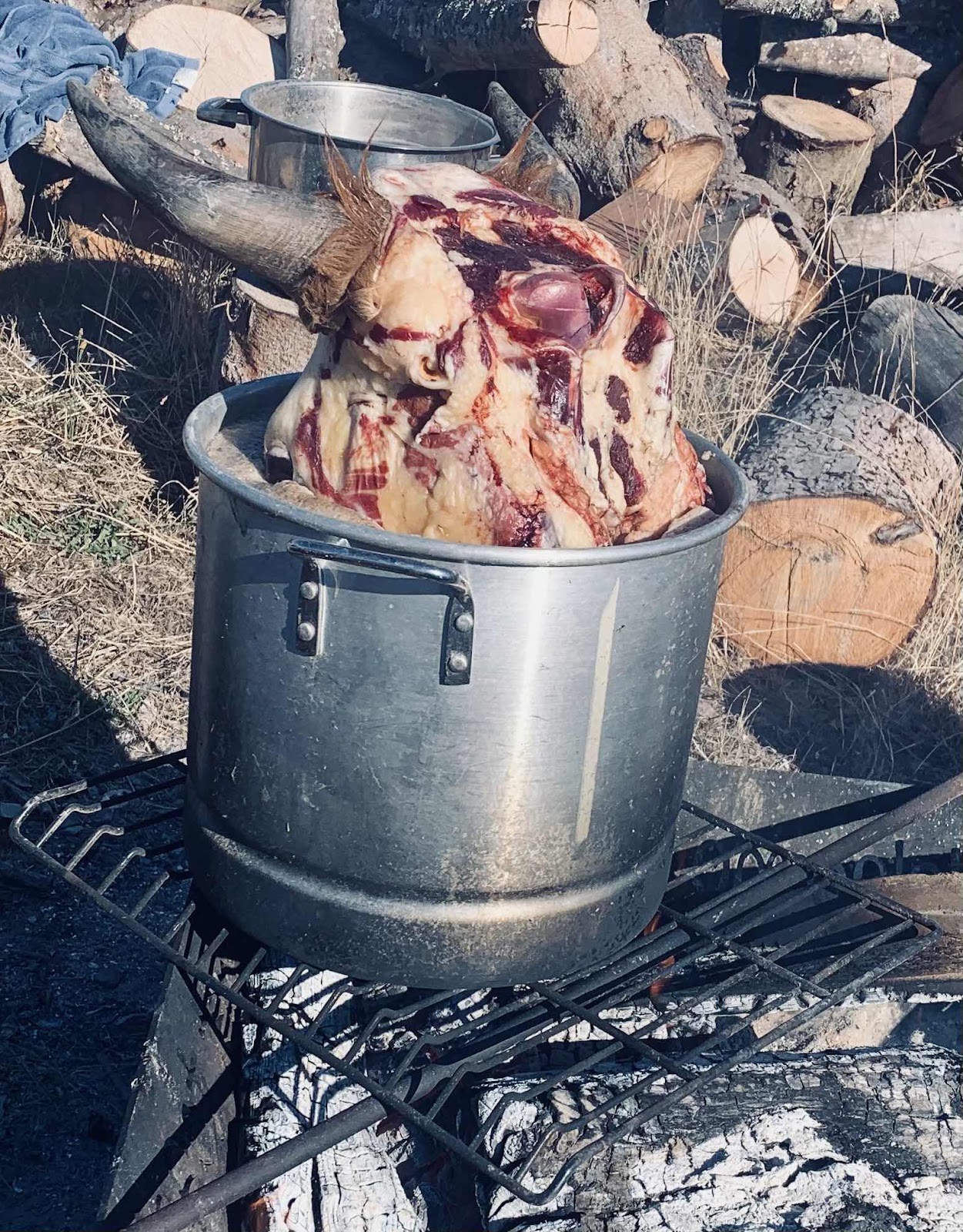
Not a very good picture, but that is a 40 quart stockpot, with  substantially less than half of a freshly butchered steer’s head submerged in it. 

This is what I came home to today. I knew, of course, that today was the day appointed for Pepe Toro, our Jersey steer, to meet his end. The men from Lynden meats were scheduled to arrive in their business-like panel van loaded with motorized equipment and on-board hot water, and do what butchers do. Half of Pepe Toro is already sold, and I have been making room in the freezer for the other half. The death of the cow, per se, was not a surprise. 

I did not know - though I should have suspected - that my husband was going to ask the men from Lynden meats to give him every scrap of the cow, from the horns to the hooves, that they would normally throw away or sell to a glue factory or something, and try to turn it into food. We’ve been through this before, and he ALWAYS does the same thing. 

We are just not prepared for cooking an entire cow’s head. In the past, even pig’s heads have proved to be difficult to manage. The head of a well-grown cow is a majorly large hunk of gristle and bone, and once the tongue has been removed, in my opinion it ought to be ignored. But Homero comes from a background that despises waste and finds a way to use EVERYTHING. This is, of course, admirable, but more so in the abstract than in real life. 


After I found the cow’s head sticking three-quarters of the way out of the pot, I convinced Homero to remove it, and to cut it into pieces with his sawzall, removing the horns and the disgusting patches of hair that clung to the skull around them. He has a plan for the horns - they are a gift to his friend Clacoyo, who wants to mount them on his motorcycle helmet. 

It took two sawzall blades, a cleaver, and a mallet to split the skull I to four pieces, but we got it done. Now the head is simmering over a wood fire - after two changes of water - along with a handful of allspice, cloves, star anise, fennel, and black pepper; three heads of garlic; several onions, and a bunch of guajillo chiles. It ought to be done sometime after moonrise. 

Now for the math. 

This animal was free. Homero has several clients who work on large dairy farms, and they are constantly giving away newborn males. I don’t know why they don’t just centrifuge the sperm they use - almost all cows are bred by AI - but either they don’t, or it has a high failure rate. This was the third free calf we’ve raised. 

The feed for a cow is almost all free too. We did have to bottle feed him for a short while but that was just one bag of milk replacer: about $30. Then of course there’s his winter hay, and a cow eats a lot of hay. I didn’t keep track of how much he ate versus the goats - that would be impossible - but we bought an extra 25 bales last winter and I’ll say that was all cow food. So that’s $100. Other than that, all he’s eaten is pasture grass and free veggies and bread from gleaners. Oh - and the same friend who provided him to us also have us the occasional pickup-load of free silage. 

We did take him to the vet to be castrated because we waited too long to band him. Won’t make that mistake again. I think that was about $100 as well. No medicine or other vet visits were needed over the course of his short lifetime. 

Total cost: approximately $230

Expected revenue: 

Last week I taped Pepe Toro to get an estimated live weight. He measured 78 inches around his heart-girth, which is very well grown. According to the internet charts, that means he has a live weight of approximately 1,112 pounds. The hanging weight of a cow is usually about 60% of live weight, so in our case approximately 668 lbs. 

I sold half of him for $3/lb, which would be $1,002. If I can find a buyer for another quarter I will sell that too, so that would be an extra $501 for a total of $1,503. Plus of course our own meat. 

That sounds like a hefty profit, but it isn’t as much as it sounds because Pepe Toro was wantonly destructive. He destroyed the calf hutch, which will cost $200 to replace, and he got I got he mama barn and put his feet right through the floor in a half dozen places. That will take a sheet of three quarter in inch plywood to fix, and now I have to go look up what that costs ($75) 

Total cost $505
Total expected revenue $1503
Total expected profit $998 

Not bad 


Thursday, February 10, 2022

Goat Totin’ Man Totin’ Goats

It recently came to my attention that there are still people out there reading my blog. Apparently, there’s a high school boy out there, a friend of Paloma’s, who thinks my blog is pretty cool and asked Paloma why I don’t write anymore. 


Because, Kyler B., I’m just lazy. Terribly, terribly lazy. It’s easier to post a  picture on Instagram or Facebook than it is to write a real post. Also, the news has been so sad on the farm lately - we went through a terrible time of many deaths. I felt like a complete failure as a farmer. And, after twelve or so years, I sometimes feel I’ve written all I have to write about the passing seasons on our little farm. 


But of course, I haven’t. There have been all sorts of recent developments. And I have had a cool idea for a new ongoing  series of posts about eating from the gleaner’s pantry as close to exclusively as possible. So, for those few of you out there in the real world who are still interested in life up here at Windy Hill Homestead, I will start writing again. 

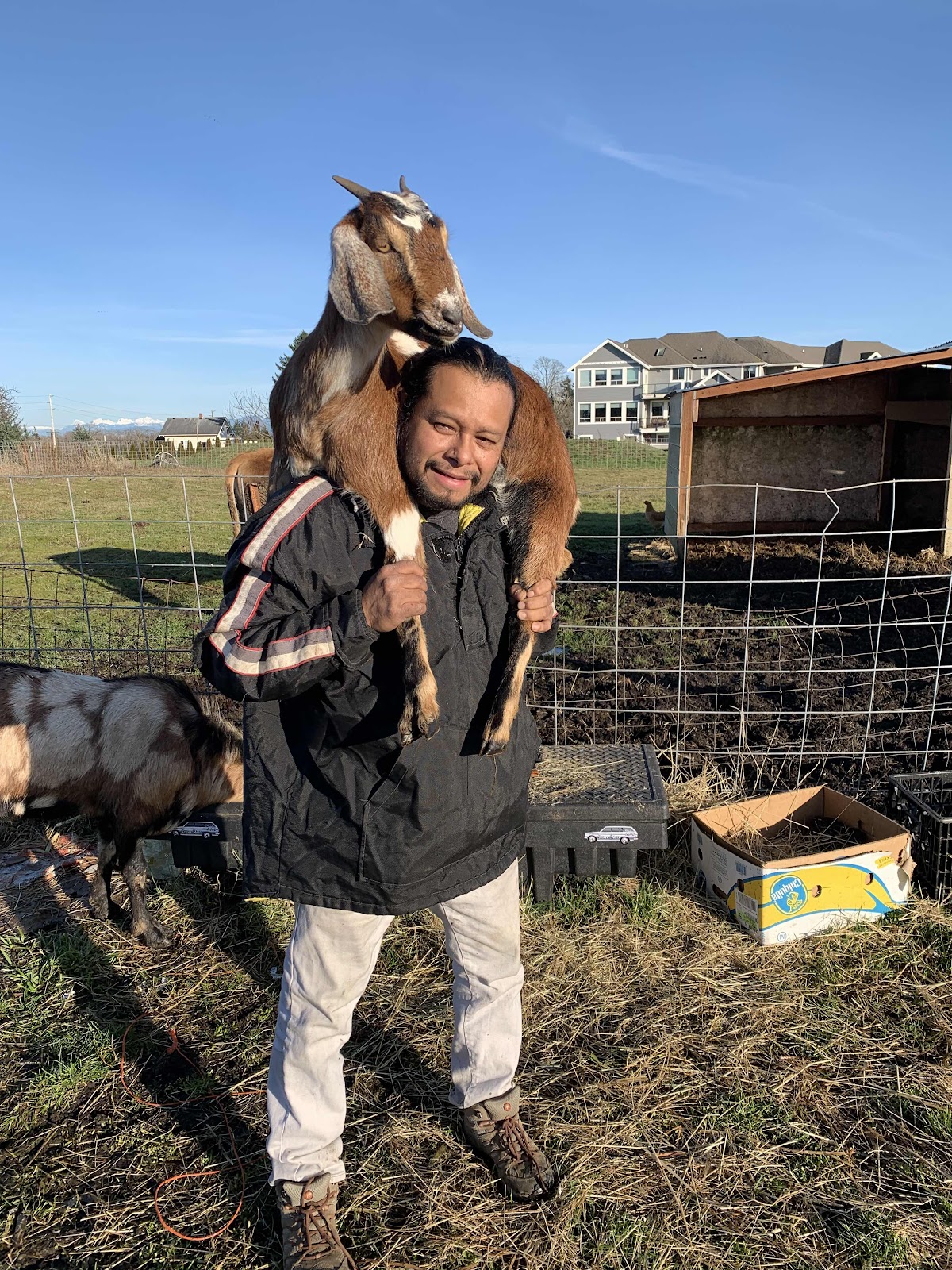
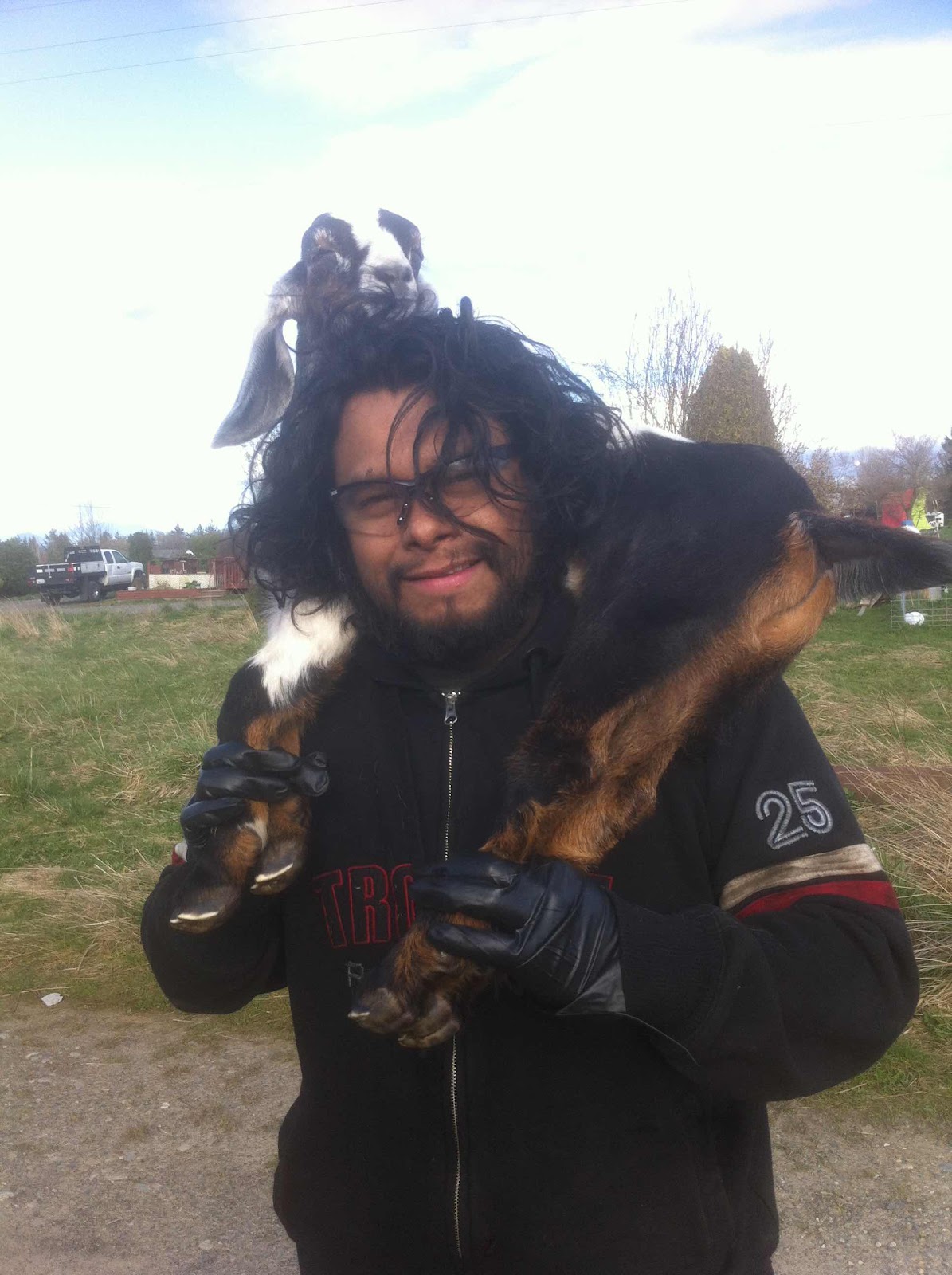
Meanwhile, here’s a few pictures of Homero toting goats. 


With Cleo, 2022


With Bitsy and Bootsy, 2020


 With a goat whose name I can’t remember, 2017 (?) 

Wednesday, November 27, 2019

Thankful for the Truth (Warning graphic photos)


I love Thanksgiving, especially in the years, like this one, that I get to host. I enjoy the process of writing a menu, shopping for ingredients, and setting a beautiful table. There are few things that make me happier than seeing people I love really digging in to food I’ve prepared for them. I’m happy when my adult daughter comes over, and I’m happy to see my mom. But there is something about Thanksgiving that make me feel uneasy. There is a whiff of - if not hypocrisy, then maybe willful blindness - that hangs around the Thanksgiving table. 

Thanksgiving is a day of delicious excess, a national fantasy of happy peaceful families and endless sweetness, but the truth is often unpalatable. Enjoying an abundance of good things and being thankful for what we have is, of course, wonderful, and in no way a bad thing. Indeed, we’d all be happier and the world would probably be a better place if we came together more often to share our abundance and to give thanks out loud and in the presence others. 

But it’s also important to acknowledge the realities that underlie the feast. These are manifold. Firstly, I acknowledge that to make this feast, a beautiful turkey had to die. 


I acknowledge the work that went into raising him - this bird was raised on pasture by a local farmer, so I thank my neighbor for her work and expense. But I also recognize the labor of the people - mostly immigrants - who toil in the vast and dangerous poultry processing industry; I acknowledge their worth and affirm their right to safe working conditions and just recompense. 

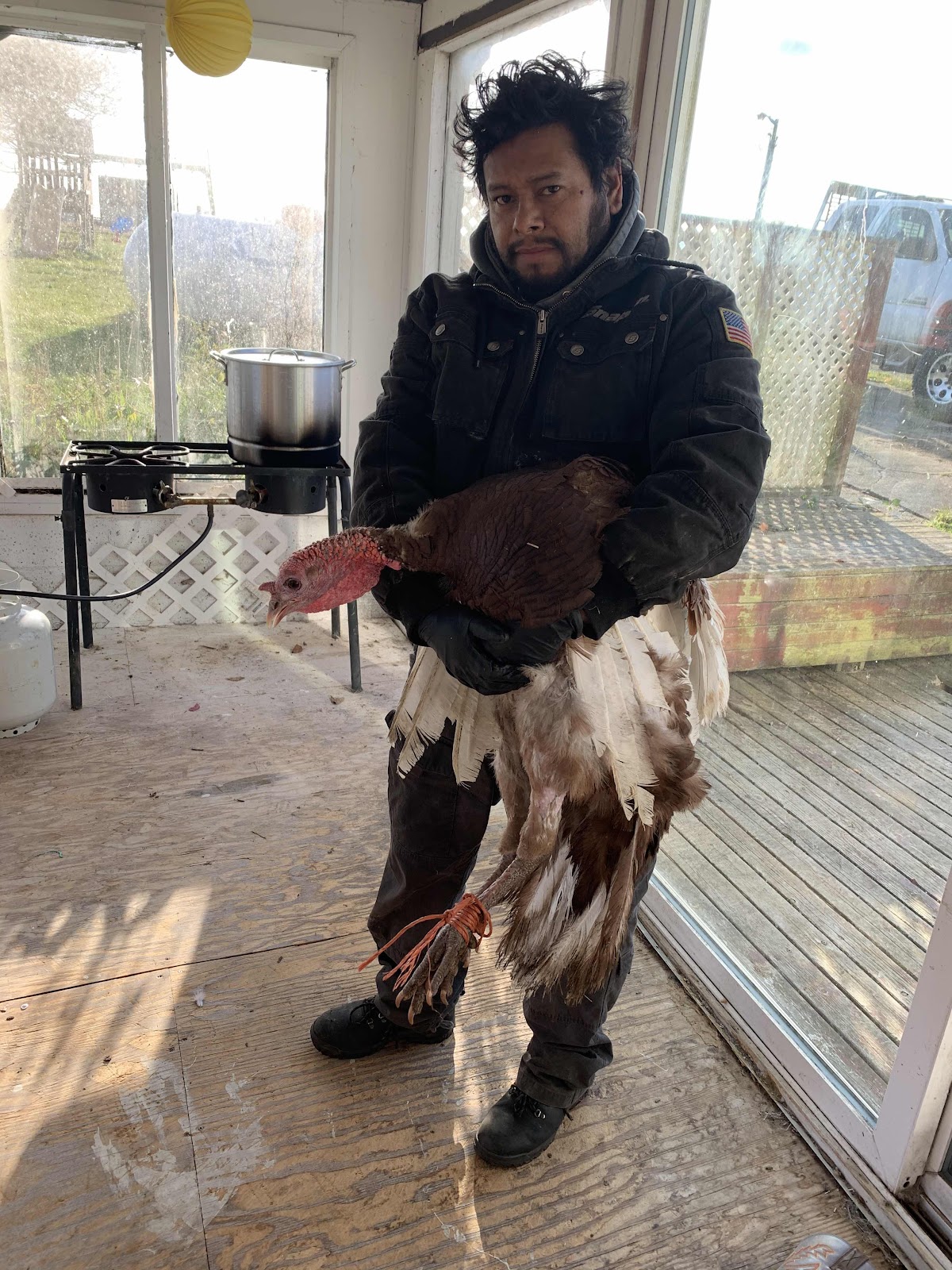
I thank my husband for the work he is doing right this minute - butchering the turkey out in the cold November wind. I acknowledge this is a disagreeable task and I thank him for being willing to develop the skill to do it well. 

The vegetables on the table - the potatoes, the Brussels sprouts, the salad greens - are produced by an unsustainable system that abuses workers and the earth in equal measure.  I am a witness, and I pledge to do what I can to avoid participating in those injustices and to mitigate the tremendous waste generated. 

And finally, I acknowledge that I live on unceded land of the Lummi and Nooksack tribes. All of us settlers live on land that either was never ceded by the tribes, or which was ceded under deeply unequal conditions, in which one side held all the power. I acknowledge that uncomfortable truth. If you want to know on whose land you reside, visit this link: 
https://native-land.ca/. I pledge to work toward correcting the grave inequalities that resulted by upholding the efforts of local tribes to sustain their culture and supporting their businesses and candidates for office. 

None of this is meant to be a huge bummer.

It is possible to be grateful for our wealth while recognizing the problem of poverty. We can celebrate being together with family while knowing that some are lonely. We can give thanks for warm homes, abundant food, and all the good things in our lives without trying to shut out the knowledge of the many who lack those things. It’s not a sin to be warm, to be fed, to be loved. These are wonderful gifts.

My hope and my prayer is that naming our gifts and sharing them with our loved ones will inspire us to share them more widely, as well. I remind myself, as I bask in warmth and light, of the existence of cold and darkness not out of guilt, but so that I may be moved by gratitude and grace to expand the circle of warmth and light to include others. I remind myself, as I nourish my body with roast turkey, of the death of the animal I am eating not as some sort of penance, but to honor the truth that this act embodies the cycles of life and death on this beautiful planet, cycles we are all of us bound by. 

May you be abundantly blessed this Thanksgiving. May you have much to give thanks for, as much as I. 


Thursday, June 20, 2019

Papa Fix-it-All

Tuesday a local, recommended appliance repair professional came out to our house and told us “you need a new fridge.” Homero told me he wanted to try to fix it. I rolled my eyes and said I’d give him two weeks, then I was buying whatever fancy fridge my heart desired. He ordered a $12 adaptor from Amazon that allowed him to refill the Freon. Today it came in the mail - two hours later and the fridge is cold again. 

He really lives up to his nickname “Papa fix-it-all.”

On an only slightly related note, I was absolutely certain that Freon was an element, one of the noble gases. I was so sure I told my family “I’d bet a hundred bucks right now. It’s on the right hand side of the periodic table of elements.... i think it goes Helium, Boron, Freon.....”


Homero: 1
Aimee:0 

Tuesday, August 28, 2018

Quince Años for Hope


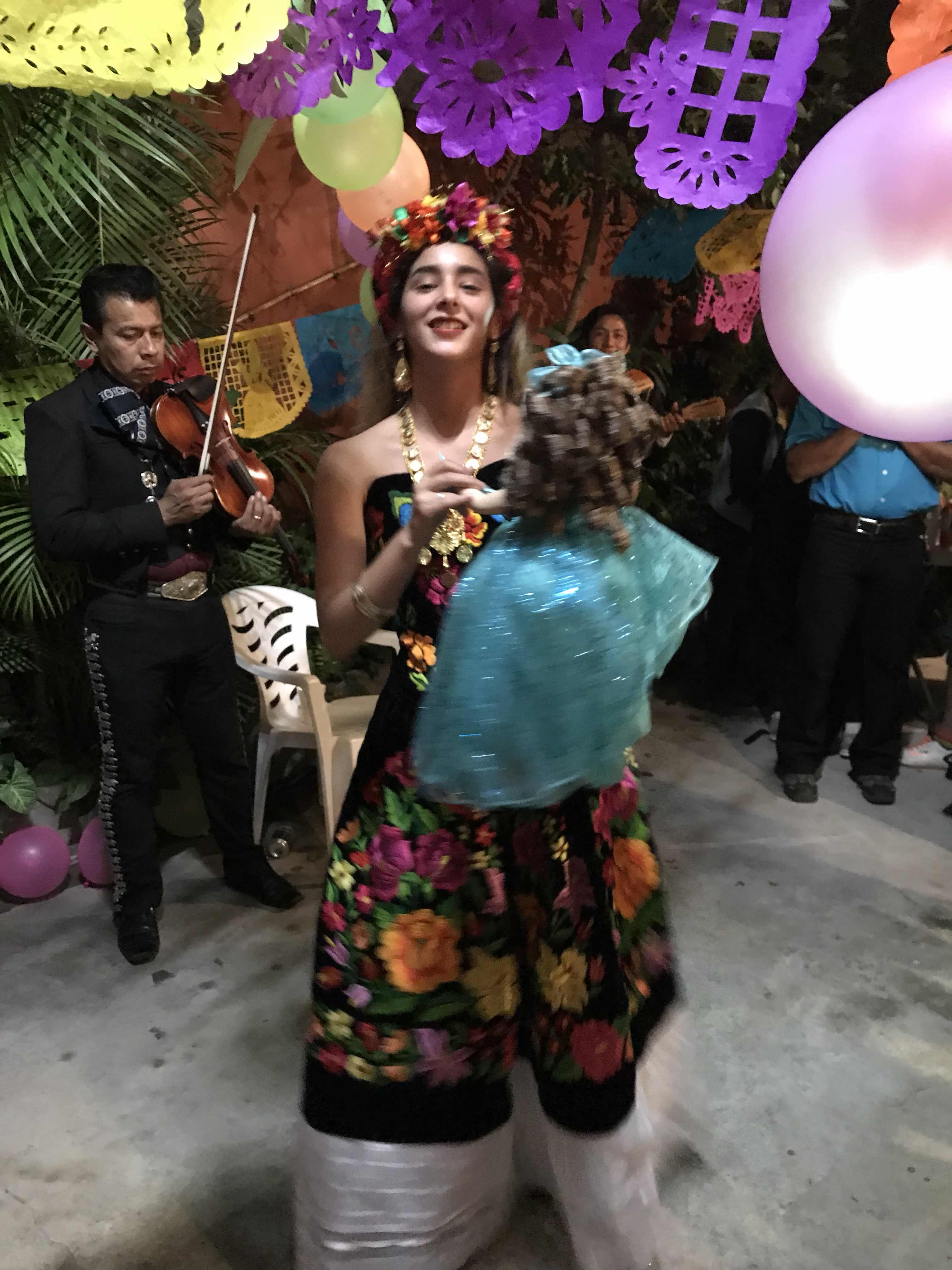
Hope will turn fifteen in October. Fifteen is a major, major birthday in Mexico - in the old days it was the traditional coming of age birthday, when a girl would be “presented to society” and declared eligible for courtship. And it was marked with an extravagant party for the entire community.  Rather like a debutante’s “coming out” ball. 

Hope will have her quince at home in October, but her abuelita wanted to throw her a party here as well. It was a lovely affair, just family and close friends, but that amounted to about thirty-five people. We cooked vats of posole (Hope’s requested meal) and Homero surprised her with mariachis. 


Opening the Waltz with Papa


Posing with the mariachis. Hope has become quite a good guitar player, and after the mariachis performed they sat down to eat - as is traditional - and Hope played a few songs. As they were leaving, the bandleader stopped Hope and told her that she has an enchanting voice, plays well, and should never stop. 


Last waltz with a doll.... this tradition symbolizes “putting away childish things” and becoming a grownup lady. 

There’s a lot to be said about Quinces, and I’d love to write a whole post about them. Maybe later, as right now I have to get downstairs and start helping with the tamales. 


Monday, May 28, 2018

Homero’s Great Big Birthday


My husband is a fortunate man in many respects. Not the least of which, obviously, is that he’s married to me. But the luck that I am thinking of is that of having his birthday on one of the most reliably beautiful dates of the year. 

May 22 is his actual birthday; we tend to celebrate it on the following weekend, which is Memorial Day weekend. His friends and their children have a rare three day weekend, and the weather is almost always amenable, to say the least, and outrageously gorgeous, if we’re lucky. 

This year, we were lucky. It has become something of a tradition to invite his best friends from Seattle up for a weekend carne asada. This year, we hosted three families - the best friend’s family, the best friend’s daughter’s family, and the best friend’s best friend’s family. Some of them brought their RV’s and stayed for two nights, and some of them stayed in the house for a night, and some of them just trekked up for a day trip. 

Our own children had both been invited, separately, by friend’s families to go camping or sailing, so it was just Homero and I acting as hosts. I made machaca (also known as ropa vieja, or basically shredded pot roast stewed on the stovetop with sliced onions and spices) for tacos and after dinner we decamped to the fire pit on the highest point of the property. 

 Saturday night was a bit breezy and chilly, but we built a roaring bonfire, wrapped up in wool blankets and serapes, and warmed ourselves with tequila and stories. Nightfall comes late at the end of May, but eventually the sky deepened and a three-quarters full moon rose, attended by Jupiter rising in the east and Venus setting in the west. 

Sunday brought hot sun and more people. We were awakened by the arrival of a new family and hurried to make coffee and set out sweetbread. Suddenly there was a swarm of little kids out on the lawn, running in circles and bouncing on the trampoline. After everyone had recuperated from the previous late night, one of the ladies, who is Salvadoreña,  decided to help me make pupusas and curtido for lunch. 

Pupusas are comida típica from El Salvador, fat little stuffed corn masa cakes. The can be, and are, stuffed with any number of delicious things, but we stuffed ours with mozzarella and served them with a tangy, slightly fermented cabbage slaw called curtido and a mild tomato salsa. They are delightfully crunchy, salty, and melty, topped with the vinegary slaw. 

After lunch, some people understandably wanted to lie around in a food coma, but others, when  I suggested going out to Birch Bay, took me up on that offer. Birch Bay is just a few miles from our house. There is a beautiful state park, but it costs money to park and the beach is rocky. Further along the shore, by the town, there is a mile-long sandy beach. The water is shallow and warm, with beds of eelgrass and lots of tiny crabs and little grey fish that dart away from your feet. This weekend, there also happened to be a kite festival, and the sky was decorated with dozens of colorful fish, dragons, ribbons, and geometric shapes. 

The children, barely more than toddlers, splashed and played in the lukewarm water. The adults rolled up their pantsleeves or tucked up their skirts and waded. We hit the ice cream shop. We hit the farmer’s market. We hit the liquor store. We went home just as the sun was beginning to dip and hunger pangs were beginning to assert themselves in our bellies. I felt the start of a serious sunburn on my forehead and shoulders. 

Arriving, we saw that the home contingent had started a fire again. I let the goats out to browse and followed them slowly  around the property, a beer in my hand, listening to the laughter of the adults around the fire and the shrieks of the children on the swingset. 

After the evening milking, I was ready for a break from the festivities and so I left everyone else to their convivial circle and headed inside to cook some dinner. I had bought a half-halibut a few days before because there was a great sale at my local store, and I had frozen some of it and planned to bake the rest for ourselves, but Homero told me that our guests had decided  to spend a second night and so I needed to make three pounds of fish stretch into dinner for sixteen. The only way to do that that I am aware of is fish soup, with lots of vegetables,  so that’s what I made, along with a big pot of rice. 

Having stayed up late the night before, I was tired and elected to turn in around eleven, long before anyone else. I assume the conversation around the fire went on into the wee hours, until the firewood, the beer, or both ran out, but I wasn’t there to be a part of it. I was dreaming peacefully face down in my down blanket. 

This morning I awoke before anyone else, and put on some water for coffee. I surveyed the wreck of the kitchen with a jaundiced eye, pulled a trash bag out from under the sunk, and began cleaning up, not caring too much if the clink and crash of beer bottles breaking as I threw them into the sack was disturbing anyone’s slumber. Eventually, my ragged-faced family and friends appeared in the kitchen, in search of coffee and food to assuage their hangovers. 

Originally, we had planned to do a carne asada - grilled meat - but it hadn’t happened, so we had a bunch of pre-marinated, thin-cut flank steak in the fridge. We cooked that on a hot cast iron comal (and disconnected the fire alarm, which didn’t like the resulting smoke and kept blasting out high pitched warnings), along with baby onions and fresh nopales. Add fresh hot corn tortillas, avocado slices, and copious amounts of stingingly hot salsa and you have a breakfast that will kick the shit out of your hangover. 

The rest of today, after everyone left, has been relegated to quiet activities - reading, maybe throwing a load of laundry in the machine, wiping down the table. I plan to watch an episode of Westworld in a little while here. That’s about it. 

There are leftover pupusas and fish soup for dinner. I’m looking forward to that. 


Monday, February 26, 2018

Porksicles (Deep Bedding)


After a prolonged, unseasonable warm spell in January, we experienced a brief, seasonable cold snap last week. Five or six days of temperatures in the high teens and low twenties, accompanied by small hard snow and high winds. 
Our pigs, which were very close to their butchering date, had only the three-sided field structure for shelter, and it was inadequate.

On a particularly cold night I asked Homero to go open a bale of hay for them to use as fresh bedding. He was outside a long time, and when he came back I asked what took him so long. 

“Amor, the pigs were freezing,” he said. “They didn’t even want to come out for food, and when they did come out they could hardly stand up they were trembling so hard.” 

“Oh no! Poor piggies! What did you do? Did you give them hay?” 

“Hay would not be enough, I moved them into the big barn with the goats.” 

The “big barn” is a 12x16’ barn from Home Depot which we have had since we first moved here. Every winter we use a deep bedding system; basically just throwing more and more dry straw down on top of the old, wet straw until it is a good eighteen inches thick. A couple weeks ago I dug down with my hand into the bedding and felt the heat from the natural composting. It was quite hot about six inches down - almost uncomfortably hot. The goats have been benefitting from this heat all winter long. 

Moving the pigs into the barn served a secondary purpose besides keeping them from freezing to death. As you might imagine (or might not, if you have no farm experience), removing a winter’s worth of deep litter is a back-breaking task. Even from a barn as small as ours is - the litter packs down tight and it takes a strong man (my husband) several hours to pitch it all out with a pitchfork, and then he needs a hot bath, a massage, and a shitload of Ibuprofen. Pigs, however, can plow through deep litter effortlessly with their snouts, like little biological diesel tractors. 

The pigs stayed in the barn for four days before the butchers came, and during that time they rooted through the compacted litter like badgers on steroids. The barn is now full of fluffy, relatively easy to shovel compost, which will greatly enhance our garden come spring. 

And the pigs themselves have now been removed to the deep freezers of Lynden Meats; soon to be dispersed to our customers, neighbors, family, and friends in the form of chops, ribs, bacon, and sausage, fuel for many a family feast. The pigs are dead, long live the pigs! 

Wednesday, December 21, 2016

O (Dead) Christmas Tree


Christmas, the 800 pound gorilla of holidays, is once again upon us. Every year, I envy my childless brother, who insouciantly flaunts on his own blog how free he is to blithely ignore Christmas. Oh, he enjoys the vacation time, which allows him to spend his disposable income gallivanting about the globe (most recently Taiwan) instead of spending it on a lot of plastic crap, designed to satisfy the outsized expectations of  a bunch of self-absorbed human pupae for exactly six-point-eight minutes.

What? Am I not exhibiting the correct cheerful demeanor?

I do, in fact, enjoy Christmas. I do, in fact, spend a lot of time planning activities that I think my kids would enjoy. I peruse my local paper and jot down the dates of Christmassy events - for the past two years I have made an advent calendar of events, complete with paper doors for them to open every evening and read the event planned for the next day. It might be a local concert or it might be hanging  christmas lights at home. My community is very civic minded and there are a goodly number of really cool holiday events - when those are lacking I plan home based activities such as baking gingerbread cookies or making christmas cards to mail out to relatives and friends.

One of the very biggest events in any Christmas season, obviously, is buying and decorating the tree. I'm not going to google at this time of night, but you and I both know that probably 99% of Christmas trees sold in this country are cut trees - read: dead trees. There is an argument to be had about the environmental impact of the christmas tree industry - some people maintain that the carbon sequestered by the growing of all those trees is greater than the carbon released by their harvest. I don't know about that - but I can say for certain that buying and planting a live tree is better than buying a cut tree.

That is what we did every year that I remember, growing up. Never in my memory did my mother buy a cut tree. We were lucky to always live in a private home on a suburban lot that allowed for the planting of at least one tree a year.  For many years after we moved away, my mom would take us driving back through old neighborhoods, and point out the trees we had planted years before. She would name the trees as she pointed them out: "Look, there's your brother's blue spruce. That one is your weeping pine."

During the years that I lived in a house on an urban lot on Seattle - from 1992 to 2006- we never had a Christmas tree. Since I didn't have space to plant a live tree, I chose to not have a tree at all. Instead, we made gingerbread houses, or I bought long sheets of green butcher paper and we cut out a simulated tree and taped it to the wall and decorated it with glitter glue and potato stamps. Moving to our current homestead, a windswept 5 acre property that could really use many more trees, was happy for many reasons, but not least for the chance to have a live Christmas tree every year and plant it the following spring.  I sited an area on the west side of the property that I planned to fill with Christmas trees, slowly. When my children were grown, if we kept cup the custom, we would have a Christmas tree grove for them to inhabit and imbue with meaning.

We have planted some five Christmas trees since we moved here. Many more fruit trees; but they don't come into this story. We re-used a few Christmas trees because they have become very expensive in recent years. And one of the trees we planted died, covered in blackberry vines and smothered by canary grass. But there are still five live trees, and there is still a lot of space to plant future trees. I have a vision of a lovely, full grown grove of evergreens on the western border of our land, home to native birds and mammals.

The day that the advent calendar said "buy a Christmas tree" was a day that I was working all day long. I asked Homero to please take the girls and get a tree. I told him in simple language to buy a LIVE tree. I didn't think it was terribly important thing to emphasize - after all, we had had live trees in each of the last five years. But knowing that Homero is - how shall i put this? CHEAP - I made it quite clear that I knew a live tree would be expensive, but that that was simply a fact of Christmas.

I'm not entirely certain  I have managed to describe how important it is to me not to have a cut tree. Do you, gentle reader, understand? If not, let me fill you in on a few details that my husband was already aware of. As well as attending a Christian church, I consider myself a pagan, a follower of the western and northern European pre-christian traditions. Trees are the very basis of the sacred calendar in this tradition. My oldest daughter, Rowan, was named for the sacred tree that presides over her birth month. She is a practicing witch. Trees - living trees - are the foundation of the knowledge of the Wiccan tradition. Having a dead, cut tree in our home would be, quite literally, sacrilege.

So my husband bought a cut tree. He took the kids, while I was at work, and drove around town, and decided that the live trees were too expensive. By the time he communicated to me what he had done, it was a fait accompli.  The dead tree was already installed in our living room.

Oh I was so upset. We were talking by text: I said "I am bringing home a live tree anyway! You just bought the goats lunch!"  Rowan and I both felt righteously indignant. We felt that our beliefs had been trampled and slighted. We felt that an atrocity (albeit a small one) had been committed in our name. We felt a burning need to remedy the situation. However, the prospect of dragging the dead tree out of the living room (a prospect I considered) seemed too drastic. That would only make me into a Savonarola, a crazy zealot, an extremist. Much better that I attempt to model flexibility and adaptability.

On my way home, I bought a small live tree. I was driving a volkswagen golf - I had to find something that would fit in the trunk. I ended up with a five foot tall arborvitae. I also bought a bag of large pinecones, and a sack of birdseed. At home, Rowan and I smeared the pinecones with peanut butter, and then rolled them in dishes of birdseed. We tucked the cones into the branches of the small live tree, which Homero set up right outside the kitchen window. That was his gesture of reconciliation, arranging a sturdy base for our live tree. This past week, we have enjoyed watching spotted towhees and black capped chickadees eating the seeds from the tree.

And in the living room, a lovely cut evergreen is decorated with lights and homemade ornaments. I am trying to look at it with appreciation and joy. It will feed the goats, after the twenty-fifth. I hope that those whose say that the tree sequestered more carbon dioxide in its life than it will give up in it's decomposition are right. I hope that during it's life it provided shelter and sustenance to many small creatures. I hope that the life of this tree amounted to something lasting. In the meantime, we will honor it's life by appreciating the beauty of its adorned branches.

Happy Solstice. Merry Christmas.


Monday, October 10, 2016

Fall Fermentation (Wine and Cider)


Plum wine in the autumn sun 

The satisfactions of living off of one's own land are many and varied. It is, for example, delightful to invite my extended family over for Thanksgiving and feed them on turkey we raised ourselves and apple pie made from the apples on the trees of our own orchard.  It makes me happy and proud to throw a big birthday bash for Homero and give his Mexican friends the pleasure of an old-fashioned goat barbacoa such as they remember from their younger days back home in Jalisco or Oaxaca; the slaughter, butchery, and the digging of the pit oven included. These pleasures still lie in the future this year - imagining them is one of the distinct joys of this short ephemeral season. 

This is my favorite time of year - after the heat of summer has dissipated and the leaves have turned and are falling, creating a crisp, fragrant carpet underfoot - but before the rains have turned everything into cold muck. The sky these past several days is a cool, cerulean blue, and the trees are ninety different shades of gold, orange, burgundy, and brown. I try to let the goats out every afternoon to forage on the dry leaves and blackberry vines, and on the fall-flushed grass before the first frost comes and kills the nutrition. 

Today I enjoyed the unique pleasure of sitting out in the late afternoon sun on a warm October afternoon and drinking a glass of beautiful, pink, home-brew plum wine. I'd have to page back in this blog to find out when, exactly, I started this batch of plum wine. I don't want to do that - bathed as I am in the rosy glow of the same. Let's just posit that the wine was ready, today, for bottling. I decided to do it today not because of any learned examination of the wine itself, but because I had finally collected a sufficient number of large brown bottles. Corona beer puts out a "family" size that measures 36 ounces. There were eight of them lined up today, and I decided that the time was ripe. 


I have never made wine before - though I have made apple cider a few times. In fact, I made apple cider earlier this year. That's a funny story, and a lesson. We pressed apples on three separate occasions this year, which is three times more often than we usually do. Faced with many gallons of fresh juice, I decided to try making hard cider. I'm not the kind of person who cautiously measures and precisely calibrates anything. I'm more of a "wing it" kind of cook. I'm a good cook, I won't ever say I'm not, but I am much better at soup (such a forgiving medium) than I am at baking cakes.  When it comes to brewing, that means I am not going to be exactly certain of the strength of my creations. 

A few weeks ago, I bottled this year's cider. I bottled it in these same 36 oz Corona bottles. My husband, seeing them lined up on the mantle, decided he was thirsty and didn't feel like going to the store. Accustomed as he was to downing one of these hefty bottles full of Corona, he did just that. But the bottle was full of home-brew cider. Hard cider that you buy in the store is usually more or less beer strength - 5 to 7%. I, however, used a champagne yeast, and my cider was at least twice as strong as beer. Maybe as much as three times. Had my husband consulted me, I would have told him to drink it like wine, not like beer. Alas, he did not. 

I have never seen Homero so drunk. He was accidentally drunk, so it doesn't reflect on his character at all - but it was pretty funny nonetheless. Poor man could hardly speak, and hardly stand up. I had to put him to bed. My main regret was that he had downed  too much of the limited supply of cider.

Most of the plum wine was bottled today in the same size jugs. I simply capped them with bottle caps instead of using wine bottles and corks. My local brewer's supply store rents out a corking machine, but we don't drink enough wine to have bottles to use. I asked about using beer bottles and capping them like this, and was told that if we drank the wine within the year it shouldn't matter at all. 

No problem there. I drank about one-tenth of it today. Such a beautiful afternoon and evening. I absolutely love days like this - crisp enough that other people complain of the cold, and I can feel superior and smug sitting out in my shirtsleeves. Especially on days like this, when I have completed all my housework and I can take a book outside with me to read without remorse or guilt. Well - only the delicious guilt of reading trashy fiction instead of anything "serious." 

A canvas slingback chair, a cheap novel, a jug of new plum wine, and the sunset......

Thursday, September 29, 2016

Swine Squared (Women's Work?)

KWe have acquired two new pigs. To get a pig or not to get a pig, in any given year, is one of the larger farm-related decisions we make. Pigs can be profitable, and of course they are delicious, but pigs are also expensive and destructive. 


The price of weaned pigs has risen precipitously in the last several years - from about $75 to about $140. And with pig food running at $15 per 50# sack, that means that pigs are only profitable if we can generously supplement thier diet with free food - AKA the Gleaner's Pantry. (http://newtofarmlife.blogspot.com/2013/10/scavenge-city-gleaners-pantry.html?m=1)

The problem is, that in order to seriously supplement the diet of not one, but two pigs, we would have to go to the gleaner's twice a week. And that's a hell of a lot of work. Frankly, more work than I am prepared to do. Accordingly, I told my husband that we could get pigs if and only if he would sometimes take my place at gleaner's.

He reacted with poorly concealed horror. He squirmed and he hemmed and hawed. He looked at the floor. 

"What's the problem?" I asked. "I've been doing it alone for three or four years now, and you know how much work it is. I'm tired." 

"Well," he said, practically digging a hole In the floor with his toe, "there's only women there." 

"What?" I was a little taken aback. "That's not true! There's always a guy
or two.... Usually..."

I'm surprised at myself that my first impulse was to deny the truth - yes, gleaner's is a women's organization and
fully 90% of the people there are of the female persuasion. Why was my instinctual response an attempt to soothe my husband's discomfort, rather than a challenge to the implicit assumption that he couldn't possibly be expected to be the only man in a room full of women, even for one hour? 

Could it possibly be because I've been conditioned to believe that a man's psychological comfort is more important than my time, my effort, or my feelings? That part of my job as a woman and especially as a wife is to protect him from the need to ever confront his unconscious sexism? 

Nah. Couldn't be.

So, without insisting on a discussion of the underlying gender dynamics, I simply said "well, I don't think I can commit to going to gleaner's that often. I guess we won't get any pigs. Even though - look!- these beautiful well-grown piglets are available at an extremely good price." 

As I suspected, Homero's anticipatory hunger won out over his conditioned reluctance to do what had been branded in his mind as "women's work." He said he'd help me get food from gleaner's to feed the pigs. And so we went and bought these incredibly adorable and healthy, larger-than-usual pigs. 


We've had the pigs for two weeks, however, which means six opportunities to go to gleaner's, and Homero has yet to go in my stead. So maybe the joke's on me. 

It was hilarious to watch Haku interacting with the pigs. He clearly had no idea what they were - maybe puppies? He tried to play with them like puppies. He made a play bow, and the pigs looked at him and snuffled. Next he tried pawing them, which they didn't like. 

Even a baby pig is fully capable of defending itself against your average dog. When Haku got too rough, the pigs charged him and bit. Haku snarled in retaliation, and then I stepped in to scold him.

"Gentle!" I said.

"Gentle" is probably the word Haku knows best, after "no." As soon as he heard me say "gentle," he stopped roughhousing and started quietly licking the pigs along the ribs.

The pigs, under this treatment, went into a trance and slowly toppled over on thier sides.  I love this about pigs. Scratch them gently, and they just roll over and lay there with silly smiles on their snouts, legs stiffly akimbo. 


Thursday, June 9, 2016

Cows and Compromise


One of Homero's clients just traded him a newborn Jersey heifer for a complete engine rebuild on his truck. She's healthy and adorable, and came to us on the day after she was born, after 24 hours on her mom for the colostrum. The first bottle feeding didn't go very well, but she learned quickly and is now able to suck down her twice-daily two liters in about three minutes flat. We are giving her a mixture of milk-replacer and fresh goat's milk - which is something we have too much of at the moment.


Haku is being gentle with the baby. He is very interested, but not frantically exited, the way he was with the baby goats a few months ago. I don't know if he is calming down in general around the livestock or if baby goats are simply more enticing than baby cows (I certainly think so). 


Homero says she weighs about sixty pounds. 


We set her up in the calf hutch, in the small pasture all by herself where she won't get bullied by the goats or the ponies. Just like any bottle baby, she is extremely friendly and runs up to us for attention whenever we come near. I have to admit she is endearing, even though I am not a fan of cows, in general. 

In fact Homero and I have had a few arguments about cows in the past, and I was not in favor of accepting a cow in trade for work. You can read all about my objection to cows and my (very reasonable and valid) arguments in favor of goats as a superior livestock option here: Imaginary Cows. For those who won't click the link, my argument can be boiled down to "we don't have enough land for a cow." 

However, Rowan and Homero are both over the moon about the baby. Rowan has adopted her as her own special pet and taken responsibility for feedings. Homero is already looking forward to milking her. Who am I to stand in the way of such happiness?

As much as I am loath to admit it, I have been pretty selfish about molding the farm in the image I have nurtured in my own mind and not ceding much, if anything, to the imaginings and dreams of others in the family. Homero and I have wrangled about the size of his shop; the amount of land he wanted to devote to a parking area; and how many non-running automobiles ought to be allowed to accumulate thereon. Rowan and I have wrangled about the garden space and the use of the greenhouse, and the species and placement of trees. 

Truly, I don't think of myself as a control-freak; but then again I am comparing myself in my head to my own mother, who is undeniably a control-freak of epic proportions. I suppose it is possible that others in my family might see me as just a tiny bit.... well, inflexible. 

Over the years, Homero has adopted the very effective tactic of, rather than debating with me beforehand,  simply presenting me with a fait accompli. This new cow is the latest example. She was just there one day when I got home from work. 

In my own defense, I will say that I think I have shown adaptability and if not grace, well, then at least resignation when these things happen. I am resigned to the new cow. Her name is Nettles. 


Friday, April 22, 2016

Bees and Heat


The last few days have been uncharacteristically hot, to say the least. Records were broken. In fact, records were obliterated - the previous daily high for one recent day was 77, back in the eighties; this 
time, we hit 88. And we had four or five days in a row over 80 degrees - totally unheard of for April. 

Also unheard of - the fields near me are being cut for hay. In April. I remember just a year ago or so seeing the same fields being cut in May and thinking, holy shit, that's early! If this trend continues, we will be cutting hay year round pretty soon, anytime the fields are dry enough to support a tractor. 

Another unsettling thing - despite the hot weather, I had seen nary a bee this year. A few bumblebees here and there, and as usual a ton of wasps, but no honeybees. A beekeeper friend of mine told me that her bees were so busy she was already putting honey supers on top of the hives, something she usually does in late June or early July. She thought it was probably from a lack of competition. I told her that other beekeeper friends of mine had lost most of their hives last winter - apparently the mites were just terrible last year. 

I wonder if our warm winters don't have something to do with the bee die-off. Perhaps if the temperatures are high enough, they don't really go into full hibernation and eat more of their stores? Perhaps the mites like the warm winters? Perhaps when fruit trees and other plants don't go into hard dormancy, they produce less or poorer quality nectar the following spring? In any case, I am worried about our fruit harvest this year, because there were seriously no bees around. 

Until the day before yesterday, that is. I was washing dishes at the kitchen sink, and looked out the window to see a vast cloud of big insects flying right outside. At first I thought they were flies and was grossed out; but I quickly realized they must be honeybees swarming. 

I ran outside to see where they were going. For a few minutes they kind of wandered back and forth across the front yard - a loose cumulous cloud of glittering bees, concentrated at the center and ragged around the edges. Then they veered toward the highway. 

"No! Don't cross the highway!" I thought. "Stay here!"

Finally, they settled into a blackberry bush, almost down on the grass, about two feet from the ditch along the edge of the highway. I didn't know how long they would stay there, but I know about five people who would be totally psyched if I called them to come collect the bees. There's and old saying: "a swarm of bees in May is worth a load of hay. A swarm of bees in June is worth a silver spoon." I don't know what a swarm of bees in April is worth, but I'm thinking it's worth at least a quart of honey this fall. I put the word out, and sat down in the shade to keep an eye on the swarm. 

A neighbor of our called me back, and said they would be over in a half hour with a box to get the bees. He told me not to worry, they wouldn't go anywhere for a while. The queen was resting from her maiden flight. He also told me not to worry about getting stung - without a hive to protect honeybees are very docile. 

"You could stick your hand right through that ball of bees and not get stung." 

I believed him, but could see no need to put it to the test. 


My neighbor put on a mask, but was working in shorts and without gloves, and it the bees gave him no hassles. The way to collect a swarm is to bring an appropriate vessel, place it under the swarm, and give a sharp tap to the branch they are hanging on. All the bees will fall right into the box. In this case, he couldn't put the box under the bees, because they were practically on the ground. He set the box to one side, and carefully clipped the blackberry bush until he could grasp the one cane that supported the swarm. Then he cut that cane, picked up the swarm, and tapped it against the edge of the box. About two thirds of the bees fell right into the box. 


Since the queen is inside the ball, it's most likely that she fell into the box, too, but we had to wait to be sure. My neighbor put the lid on there hive, leaving a crack, and then we waited. If the queen were outside the box, the bees on the inside would soon figure that out and start coming out. If the queen were on the inside, the bees that were still outside the box - a few thousand - would begin to settle on the box and go inside. 

After a few minutes, my neighbor pointed out a line of bees standing on the rim of the box, pointing their rear-ends up in the air and waggling them. 

"She's in there," he said. "Those bees are wafting out pheromone to tell everybody to come on in." 

By this time, it was close to sunset. My neighbor said he had to go pick up his kids from sports practice, but he'd be back later to get the bees. They needed plenty of time to get all of them inside and to decided definitively that this was their new home. 

And that's what happened. I hope this turns out to be a good strong queen and that they make a good strong hive. Homero wants to try having bees again as soon as possible - in fact he was annoyed with me for calling any body at all, and wanted to try to get them himself. But we don't have any equipment anymore. We can start getting some stuff together and when and if we see another swarm this year, we'll be ready. If we don't see one - as seems likely; this was the first swarm I've ever seen - we will at least be ready to start next year with a bought colony. 


Sunday, December 13, 2015

One Husband, Many Heads (Graphic Pictures)

the giant fish

I am not a squeamish eater. I like liver, and I put the giblets in my gravy. Tacos de lengua are alright with me. As compared to your average American, I think I have a high tolerance for and even appreciation of variety meats. Or "offal" or whatever name you favor for all the bits that aren't straight up muscle meat.

It's true, though, that I like my offal disguised in a creamy pate (I make the best chicken liver pate you ever tasted) or minced into invisibility in a gravy. Like most Americans I know, I don't want to see an identifiable organ on my plate. Ew.

Homero is not American. He's Mexican, and in Mexico, they really do use "everything but the squeal." As they do in most other places around the world. It's pretty much just us rich white folks who can afford to ignore a third of the edible parts on an animal. In fact, most of the world will insist that the parts we refer to as "offal" include the best meat. I'm sure every organ has it's partisans; Homero is partial to the head.

Eyeballs. Cheek meat. Tongue. Brains. Even ears and snouts. It's all yummy to him, and it pretty much doesn't matter what animal you're talking about. Before we were married, the first time we were in Oaxaca together, Homero's sister made sheep's head soup (which was delicious) and Homero made a big show of scooping out the eyeball and eating it.


pig head

When each of our pigs has been butchered, Homero has kept the head and made something with it - this last time it was head tacos. To me, it was a whole lot of gristly, greasy, cartilaginous bits, but to him it was ambrosia. 

Recently a friend gave us an enormous fish - I mean a really gigantic fish, a twenty-five pound denizen of the deep. I believe it was a yellow-eyed Rockfish. The filets, when a neighbor helped us get them off, weighed about six pounds each. They were lovely, snowy white and firm, and they looked like plenty of food to me, but Homero wanted to make soup out of the head, too. To be fair, the head was about one-third of the entire fish, and it did make a delicious broth. But it also made one hell of a mess.

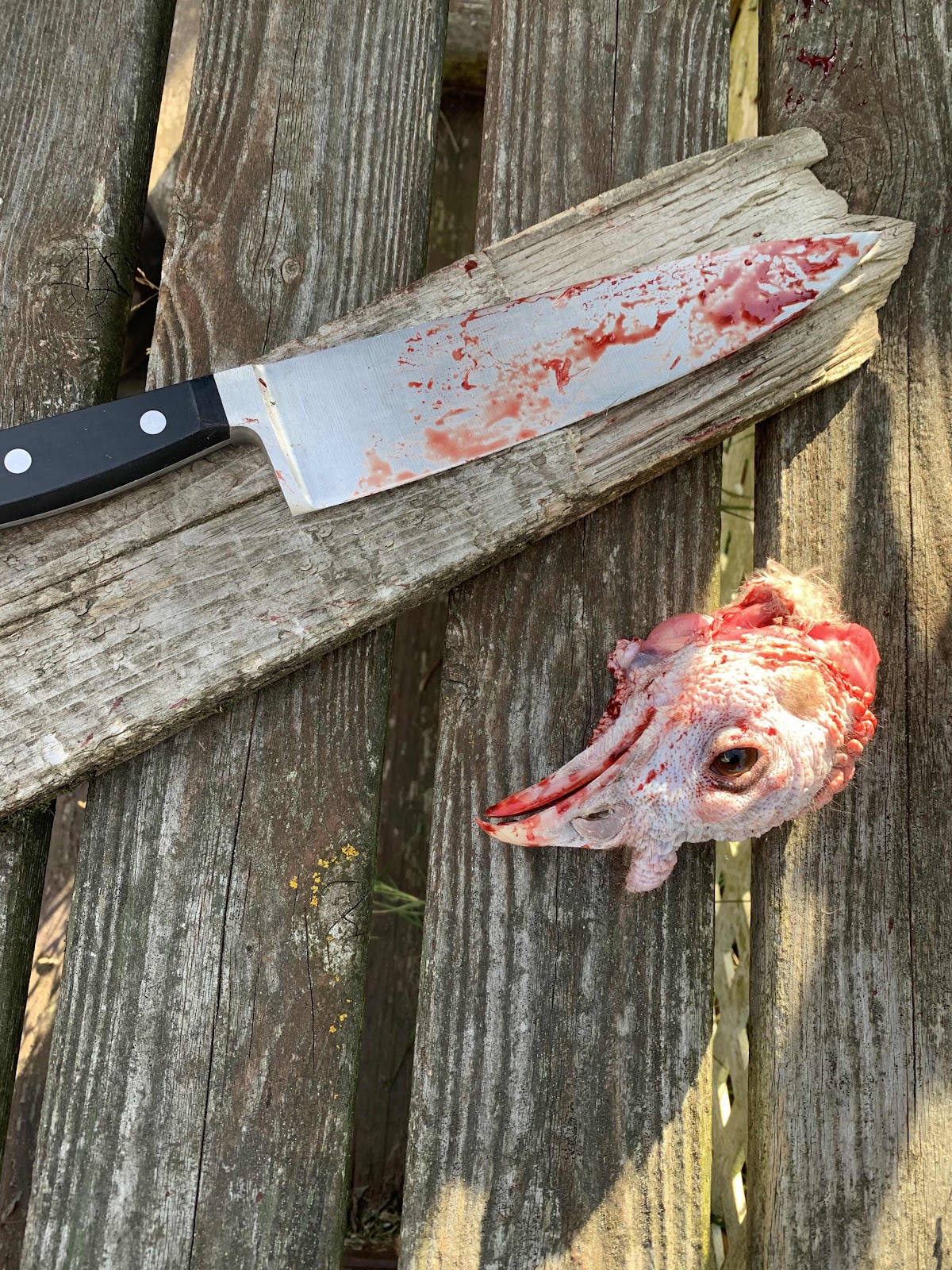
Right now, there is an entire cow's head in our freezer. It takes up a fair amount of the freezer all by itself. It's from our Jersey cow, who was butchered this past autumn. Homero insists that he is going to cook it - how, I haven't the faintest clue. We don't have a fire-proof receptacle capable of holding it - you'd need a medieval cauldron, even though she was a pretty small cow. Maybe he could barbecue it over an open fire outside.

Whatever he does with it, he better do it soon. I'm getting tired of wrestling with that frozen cow head every time I want to get into the freezer and get out some food. 


Friday, November 13, 2015

The Bog of Eternal Stench, The Dog from Hell, and Bad Knees

Once again it is November, number one on the list of months I wish I could fast-forward through, closely followed by February. Torrential rains have turned the barnyard - as always this time of year - into a sucking swamp. There is still a small pile of hog fuel we could spread, but so far we haven't been able to figure out how to do that without the pig charging out of the yard and into the backyard.

The pig has been able to get out of his pen for months now, and he has rooted up huge clumps of the pasture. He is now about 350 pounds, and that's no joke hurtling towards you at high speed and emitting high-pitched screams at the volume of a Van Halen concert, circa 1984.  The pig has a date with destiny, courtesy of our local mobile butcher, in a little over a week, so the problem will work itself out soon enough.

I did make a deal, way back last spring, with a tree service guy to trade cheese all summer in exchange for cedar chips come fall. He has called a couple of times, but we haven't been able to nail down a delivery, and now it is looking more and more doubtful that I will ever receive any chips.  That's the risk of trading for future goods. Meanwhile, the mud threatens to come up over my boot-tops.

Haku, our new German Shepherd puppy, has apparently made it his mission to tear my entire house into bite-sized chunks. I would post a picture of our playroom, if I could figure out how under the new operating system, but that would probably bring FEMA down on our heads. Seriously, it looks like - well, like a German Shepherd puppy has torn apart two queen-sized mattresses and one large sofa, not to mention gnawed an antique Victorian dollhouse to matchsticks and knocked over a shelf full of board games, torn up the boxes and ripped up all the cards, etc,  and evenly distributed all the chewed-up bits. I figure there's no point in cleaning it all up until he's finished - it might keep him occupied enough to leave a few of our furnishings alone. Why he isn't interested in the fifteen chew-toys I've bought for him I have no idea.

Homero has been suffering greatly this fall from a torn meniscus in his right knee. As a mechanic, he spends a lot of time getting up and down onto a concrete floor, sometimes squatting and sometimes kneeling. His knee will freeze up on him and leave him hobbling back to the house, unable to work for the rest of the day. He hates to take medicine of any kind; apparently he prefers to lay about looking pitiful and asking me to bring him stuff.

I know I sound unsympathetic - and maybe I am. He never reads this blog, so I feel free to say that his knee is nowhere near as bad as mine was - MY meniscus had two big "bucket handle" tears and various smaller tears.  My ACL was completely severed (the surgeon who read my MRI report used the word "trashed" to describe the state of my joint). Without health insurance, I had no choice but to live with it for four long years. I did my share of bitching and moaning - I'm not saying I didn't. I'm just saying I know how he feels, and then some. And then some more.

In my case, as soon as the ACA kicked in and we could finally afford health insurance, and the insurance companies couldn't exclude pre-existing conditions, I scheduled surgery and Hallelujah it has been almost a total cure. They had to remove almost all of the meniscus, and I was told that I'd need a total knee replacement sooner or later, but the pain has almost entirely disappeared, and the instability has been reduced by about 75%. The surgery - first surgery I ever had, unless you count wisdom teeth - was a piece of cake. From the time I woke up in the recovery room I was in less pain than I had been the day before. The next day I was walking on the beach.

Homero has been reluctant to schedule surgery. I'm not sure why. He's never had surgery before either - not even wisdom teeth - so maybe he's afraid. I was. But just as everyone told me, the only thing I was sorry about is that I hadn't done it sooner. I guess Homero just had to wait until it got bad enough. He's finally having surgery at the end of this month. I hope it will be as good for him as it was for me.

The first part of December looks to be a nice quiet time. Homero will be recuperating, and I will be taking a break from work. Right now I'm just finishing up a big job that, though it has left me exhausted, will pay enough to ensure a merry christmas and let me take time off to nurse my husband back to health.

Now if it we could just get a nice, hard freeze to lock up all the mud.

Wednesday, October 28, 2015

Computer Woes and Puppy Happiness

There are all sorts of things I'd like to write about, but I am stymied by my inability to learn the new operating system my husband downloaded last week. Whatever it's called - the Apple of Doom would be my nomination - it crashed our computer repeatedly and forced Homero to spend many hours on the phone to tech support.

Now the basic functions of the computer seem to be up and running - we can, for example, google stuff and use the word processor. The computer is communicating with the printer again which means I can actually go to work. But there are still many areas in which it seems the new operating system is basically incompatible, and one of these is Blogger.

Yes, I am in fact writing a post. I haven't hit "publish" yet so we will see if it works at all. But I can't see what I'm typing (I only know I've made a mistake when autocorrect pops up with a suggestion) and I can't upload photos anymore, because in the new operating system, iPhoto has switched to something just called "photos" and apparently Blogger can't communicate with "Photos."

Which is really a shame because I want to show you all photos of our adorable new dog. When Ivory passed away last spring after 14 wonderful years with us, we were too sad to even think about a new dog. But after some six months, we found ourselves pining for canine companionship. We began searching online for nearby adoptable dogs, but none of them struck our fancy until we saw one who looked so much like Ivory that we collectively gasped. 


We convinced the shelter to let us have him (more on that another time - it wasn't an easy process) and he's been with us for almost two weeks now. During which he has pretty much torn the entire house into bite sized pieces. 

We named him Haku, after the white dragon in Spirited Away. He is ten or eleven months old, seriously hyperactive, and completely innocent of manners. He needs immediate professional training. I have only ever had one dog -Ivory- and she never did become a well trained dog, although luckily after her puppy stage she had a wonderful temperament. 


Haku is going to be a challenging dog for a while. But I feel up to the challenge. I know what the long term payoff is - a wonderful companion and friend for years and years to come. No dog can ever replace Ivory in our hearts, but we can learn to love a new dog as well as we did her. 

And God willing, he won't eat the cat. 

Friday, August 28, 2015

Petrichor (Scent and Weakness)

They say it is finally going to rain this weekend. Actually, they said the rain would start last night - and a little bit of rain did fall; I'm not saying it didn't. The porch was wet this morning when I woke up, but there weren't any puddles.

There was just enough rain to make the earth send up a heavenly smell.  Petrichor, I hear that smell is called, the smell of rain after a prolonged dry spell, and there is no other smell like it. Once, when my children were small, we were driving across southeastern Washington to my cousin's wedding in Idaho. We were in amongst great green-gold hills covered in tall grass, with hardly a tree in sight. It was midsummer, and there had been no rain for weeks. But now, in the early evening, about an hour before sunset, a great circular blue-black cloud covered a full quadrant of the sky; whirling, dark and angry like a bruise. It was so amazing we stopped to take pictures of it. Then we got back in the car and tried to outrun it, for it looked fearsome.

We didn't outrun it: there was a short, fierce burst of hard warm rain, maybe fifteen minutes, and then it stopped and the sky cleared in time for sunset. The sunset was beautiful, pink and orange on the golden-green hills, and so we stopped at an overlook to get out of the car and watch the sun go down. When we opened the car door, we stepped out into a world of scent such as I have never even imagined. We were in the middle of thousands of acres of grasslands, which had just been drenched with the first rain in ages. It was as if the whole earth opened her lungs and exhaled sweet, blessed relief in our faces. I almost swooned with the beauty of that smell. If, on the day I die, I am granted a foretaste of paradise, it will be that smell that wafts me to the afterworld.

Today, my own fields gave up a similar, much fainter scent, just enough to make me smile with the memory.

If the forecast is right, it will rain much harder tonight, and probably continue through the weekend. I hope so - we certainly need the rain. All the leaves are turning early. We need it here, but much more they need rain in Eastern Washington, where the forest fires rage on unabated. This year has been unlike any other to date, with fires larger and more intense than we have seen in living memory. My  mom lost her cabin in Tonasket, and as of today I hear that some 500 primary residences have been burned, and of course three brave firefighters have lost their lives. We are all praying for rain.

Here on the farm, however, impending rain means work. A few days ago, Homero went to pick up a load of hay given to us my some good neighbors. They had baled the standing hay on their new property, only to discover that it wasn't of a quality that their horses could eat. Knowing we had goats, they offered it to us free for the collecting. We thanked them, I brought over some gratitude-cheese, and Homero collected the hay. There were two pick-up loads, each about twenty-five or twenty-eight bales. The first fit into our small barn, but the second had nowhere to go, so it stayed on the back of the truck until today, when the imminent rain made it important to get it under cover of one kind or another.

I suggested putting the hay in the field shelter. It sits in the sacrifice area and normally the ponies use it as shelter, but right now the ponies are in the main field with the goats. If we use that hay first, I reasoned, we might use it up before we have to move the ponies into the sacrifice area in November. Besides, there's nowhere else to put it.

One problem is that the field shelter is fairly rudimentary and has a dirt floor, with a small gap running around the perimeter. The bottom layer of hay would get wet if we put it on the ground. If we had four or five pallets, we could make a platform to keep the hay off the ground, but we don't. What we did have, it occurred to me, it a big old pile of hog-fuel, left by my brother-in-law recently. He has a tree-service company and once in a while, if he happens to have a job nearby that leaves him with a load of chips, he will come by and dump it, much to our benefit. I told Homero I thought that if we spread a four-inch layer of hog fuel down first, the hay would probably stay pretty dry.

So Homero started up his new Case loader  (Homero's New Toy (the Craigslist Chronicles)) and I ran for the wheelbarrow. He shoveled hog fuel over the fence into the wheelbarrow, and I trundled it over into the field shelter and dumped it. We repeated this four or five times, and then I kicked it all around a bit and called it good. Homero drove the truck over to the fence line with the hay on it. I thought climbing up onto the back of the truck and tossing bales over the fence would probably be easier than dragging those bales into the field shelter and stacking them, so I told Homero that I'd throw and he'd drag.

"I don't want you to slip," he said. "I'll toss them."

"I'm not going to slip," I said. "What are you talking about?"

"Okay," he said. "Go ahead."

I know I've alluded, several times in the past, to the fact that I am a gimp. Specifically, I have an inherited connective tissue disorder (Ehler's-Danlose syndrome) that leaves me prone to sprains, dislocations, and minor injuries of all sorts. For most of my life, I wasn't aware of this, and simply assumed I was accident-prone and/or ridiculously clumsy. Many people with EDS have it much worse than I do - my specific sitiuation is quite minor compared to what it could be, and I'm grateful for that. However, it is not negligible. Many of my joints are loose and cannot handle the kind of use that I feel they ought to be able to handle.

In this particular case, I wanted to stand on top of a fairly wobbly pile of hay bales, pick them up one by one (they weigh approximately forty to fifty pounds each) and heave them horizontally over a five foot fence. The first time I tried to do this, the bale of hay fell short of the fence, down into the gap between the truck and the fence. I swore. Homero looked at me with a kind of exasperated patience. The next three or four bales went over the fence and Homero picked them up and moved them into the field shelter. Bales five and six fell into the gap again. I swore again.

"Amor," he said, "why don't you let me get this?"

"I want to help," I said angrily, and tried to throw another bale. It fell short.

"Get down from there," he said, "I'm afraid you're going to fall."

"Okay, we can switch," I said. On that last throw, I had felt my knee slip out of position with an ominous pop. It slipped right back in, but on other occasions it has come completely dislocated and if that happened and Homero had to take me to the emergency room, not only would he be proved right but the hay would get wet, too.

We switched places and Homero started tossing bales easily and gracefully over the fence. One by one, I slipped my girly little soft marshmallow hands under the orange twine and lugged them into the field shelter. This part wasn't easy, either. The bales were heavy and spiky, and the twine dug into my palms. It must have looked terribly awkward. I must have looked pathetic, because Homero shortly called out to me.

"Amor, please let me do this by myself."

"I want to help!" I yelled again, sweaty and angry and frustrated with my stupid, fat, weak, defective body.

"Amor, please." he said. "You are wonderful in the kitchen, you are a great cook. This, I can do."

"A good COOK?" I was aghast.

"Yes amor, and you make cheese. I can't make cheese."

"Seriously?"

"Si, amor. Why don't you go in the house and bring me a beer. Please?"

So this is what it has come to. The little Mujercita is sent into the house to fetch beer while her husband does the real work. I came back with two beers and leaned on the fence and watched Homero carry the bales - one handed! - into the field shelter and stack them. I tried to look on the bright side.

"That was a good idea I had, to spread the hog fuel in the shelter, huh?" I said.

"Yes," Homero answered, "it was."

Earlier in the day, Homero had trimmed the goat's hooves. His hands are so much stronger than mine, he can close the shears through the horniest, toughest hoof wall, which I can't do. But, I reflected, I was the one who taught him how to trim; that the plantar surface has to be even and flat; that you have to trim the bulb of the heel, that you can cut right down until there's no gap, even if you have to cut way up the sides and it looks scary.

Homero is a good milker, but he wouldn't know if one of the does were in the early stages of mastitis. I doubt he would feel the slight warmth, that he would notice the hesitant flow, or feel the tiny flakes in the milk and tiny bumps in the udder. He doesn't know what they need in terms of nutrition, what minerals to buy or how much grain to give. He doesn't know what to do - or might not notice - if they develop diarrhea. He doesn't know the signs of parasites or how to treat them.

I'm the one who can walk the pastures and evaluate the health of them - I know the names of all the weeds and what each one signifies about the health of the earth beneath. I know what each one is good for; I know that Tansy is a vermifuge in moderation but poison in excess. I know the goats eat thistles, but only when they are in bud, as they were two weeks ago. I know that blackberry will increase their milk supply, and that cherry and plum leaves are nutritious in all seasons but this one - the dangerous season of wilt, when the leaves wither but before they are completely dry. Only now are they poisonous.

And Homero is right; I do know how to make cheese. Also I know how to make lacto-fermented pickles and sauerkraut and kim chee.  I can make applesauce and jam and dilly-beans. I AM a good cook and I not only that but I have a good working knowledge of nutrition and what my children need to grow and be healthy. I can dry herbs, and I can make them into teas for various ailments. I know how to treat stomach aches and tooth aches and even heart aches. I may not remember everything from my nursing days but I know when a child needs to go to the emergency room and when it can wait until the clinic opens on monday.

I can read stories out loud and do all the voices. I know dozens of lullabies. I am a first-class kisser of boo-boos, even if my kids are too old now for boo-boos. I know how to lay down a fretful child and give her a good dream to go to sleep on, a dream of riding ponies across the wild hills or a dream of swimming with blue dolphins in warm Caribbean waters. When my daughters come to me with womanly problems I will have womanly answers for them, or at least I can have womanly conversations, if there are no answers. I have over the decades tended a small circle of woman-friends who will be aunties and confidants to them; teachers and secret-keepers and surrogate mothers, as I will be to their daughters.

So my muscles aren't what they should be. My body isn't what it should be. My heart is what it should be, mostly. My family is what it should be, mostly. My soul is what it should be, mostly. This place and this time; here, now; all is as it should be. Praise be.


Tuesday, June 23, 2015

Pig and Cow (Major Meat)


Long summer evenings and good weather have us out in the yard until late in the day. I haven't mowed the back yard in a few weeks; partly for the benefit of the bees and partly to have a nice carpet of clover available for fattening up the cow, who will be meeting her destiny as a meat animal as soon as this summer is over. Today when I let the goats out to graze, the cow came barreling out as well - nearly knocking me over - and so I grabbed a rope and tied her up smack in the middle of the clover-carpet. 

The rope was maybe too long, and the cow was overexcited at being out of the back pasture for the first time in her woefully short and dim memory. She capered about, knocking over the burn barrel to eat the salty ashes, upending the ferret's play-cage, and generally wreaking havoc. She trampled the new lawn game I bought last week (ladder ball) and now we will have to repair it with many yards of duct-tape. As annoying as all that was, it was also hilarious and delightful to watch her happily kicking up her heels. Homero was moved to try and ride her, with the results you see above. 


We have a new pig. It's been years since we had a pig - I'd have to look back over the blog to see exactly how long it's been and exactly why I swore off pigs forever. I remember doing that, but not precisely why. Since I have belonged to the Gleaner's Pantry, it almost seems a sin not to have a pig, when I have access to a literally unlimited amount of fresh clean bread and produce. Also, it being high milk season, a nearly unlimited amount of whey from cheese making. The waste-stream to which I have access is abundant enough to support a half-dozen pigs - I have been partaking only minimally, but now I will have to up my participation.

There is a local farmer, a neighbor of mine, an older gentleman who has lived around here since Hector was a pup and who in his retirement still raises pigs and chickens and who imparts wisdom to all and sundry via the medium of the local Facebook Farmer's group. I'll call him the Livestock Guru, or the L.G. for short.  This week, he was advertising barbecue pigs (100-150 lbs) for the fourth of July, dressed out and ready for the spit for $350. At the end of the ad he added "or you could raise them out for meat." I asked, "same price live or dressed?" and he answered that I could have a live one for only $200.

Considering that a 40-50 lb piglet goes for $125 to $140, and they usually sell out in minutes, that seemed like an extraordinarily good deal. I consulted with Homero and he agreed. He spent today fixing up the old pigpen - putting new hinges on the old broken gate and hauling the calf-hutch over from the pony's pasture.  Around 6 pm, L.G. brought over a beautiful, healthy pink pig who immediately went to town on the pile of compost in his pen.

If all goes well, he ought to be ready for slaughter at about the same time as the cow - late September, when the grass is dried up. I have heard that I ought to get on the waiting list at local slaughterhouses, as it isn't always easy to get a slaughter date in those prime weeks at the end of summer.