"United we bargain, divided we beg."
Showing posts with label celebrations. Show all posts

Monday, October 12, 2020

Samhain Season Altar


I’ve neglected my altar for many moons. Not for any particular reason - life just rushes in and gets in the way. Like everyone else’s, our family has been preoccupied by dealing with life in the Covid era. The new school year has been difficult so far. Distance learning is not going well, and it’s been exceedingly frustrating. We aren’t in lockdown, but there are still strict rules about how many people outside your own household you can see per week and how restaurants can operate and so on and so forth. It’s all exhausting. 

Last week I finally cleaned and purified the altar - and used way too much copal. The whole house filled up with resinous, fragrant smoke. I just used my turkey feather wafter to waft it all around, smudging the house basically, and then opened all the windows and doors wide and let the cool breeze finish the job. 


(Altar tools: the turkey feather fan is for wafting smoke, smudging an area. The pampas grass wand is for doing a limpia of a person - brushing their aura, for lack of a better term)


Except for lining up some squash, however, I left the altar empty. I just wasn’t inspired to decorate it. It wasn’t quite Samhain season, not quite time for the day of the dead altar, and too late to dress it for Mabon. So it stayed empty and clean for a week. 

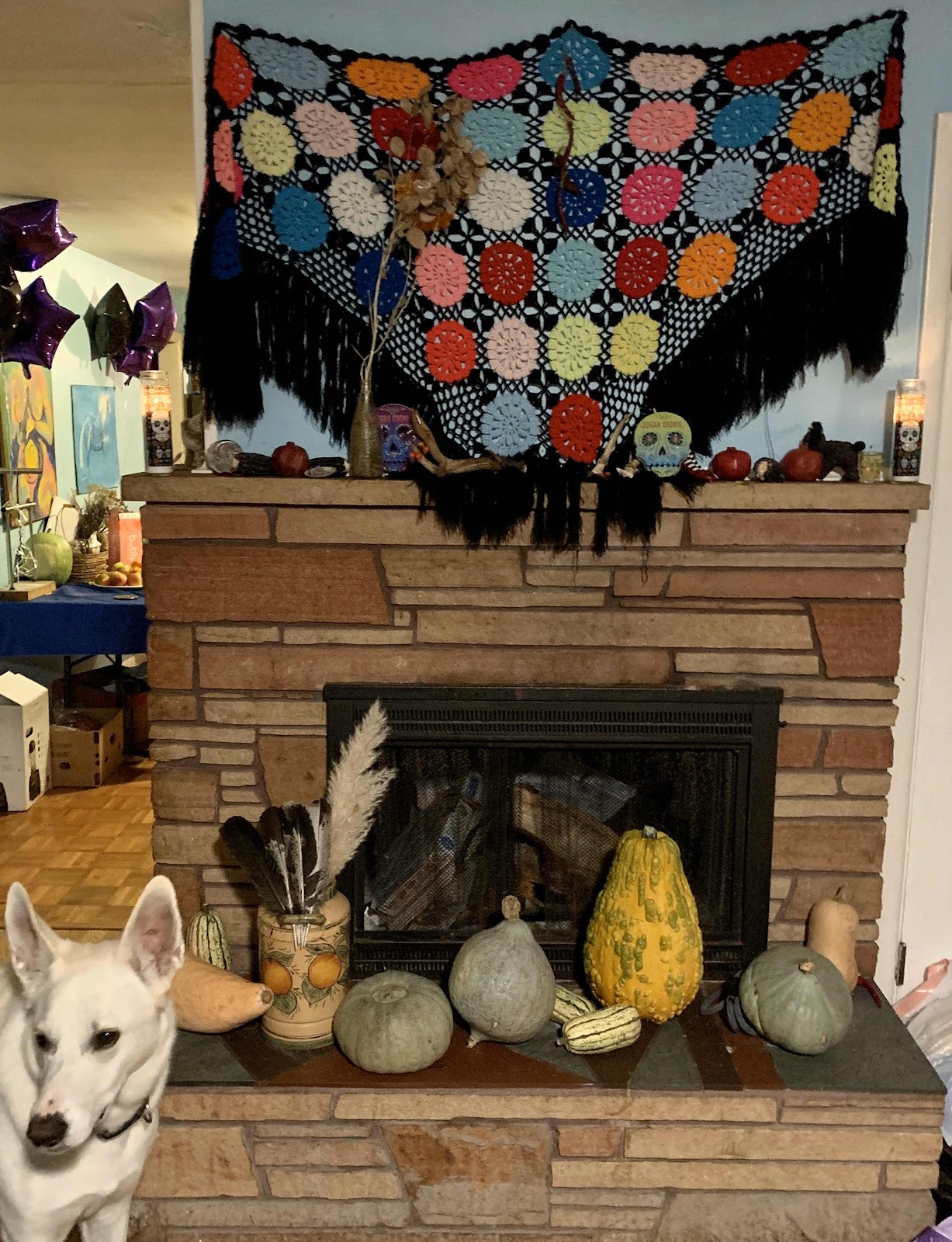
Today my oldest daughter Rowan was visiting, and Hope asked if we could all dress the altar together. She found an altar cloth (a crocheted shawl I had just given her for her birthday) and we all chose seasonal items to place, either from the yard or from my collection of altar pieces I keep on a shelf in the kitchen. It only took about fifteen minutes and was a really nice group activity. 
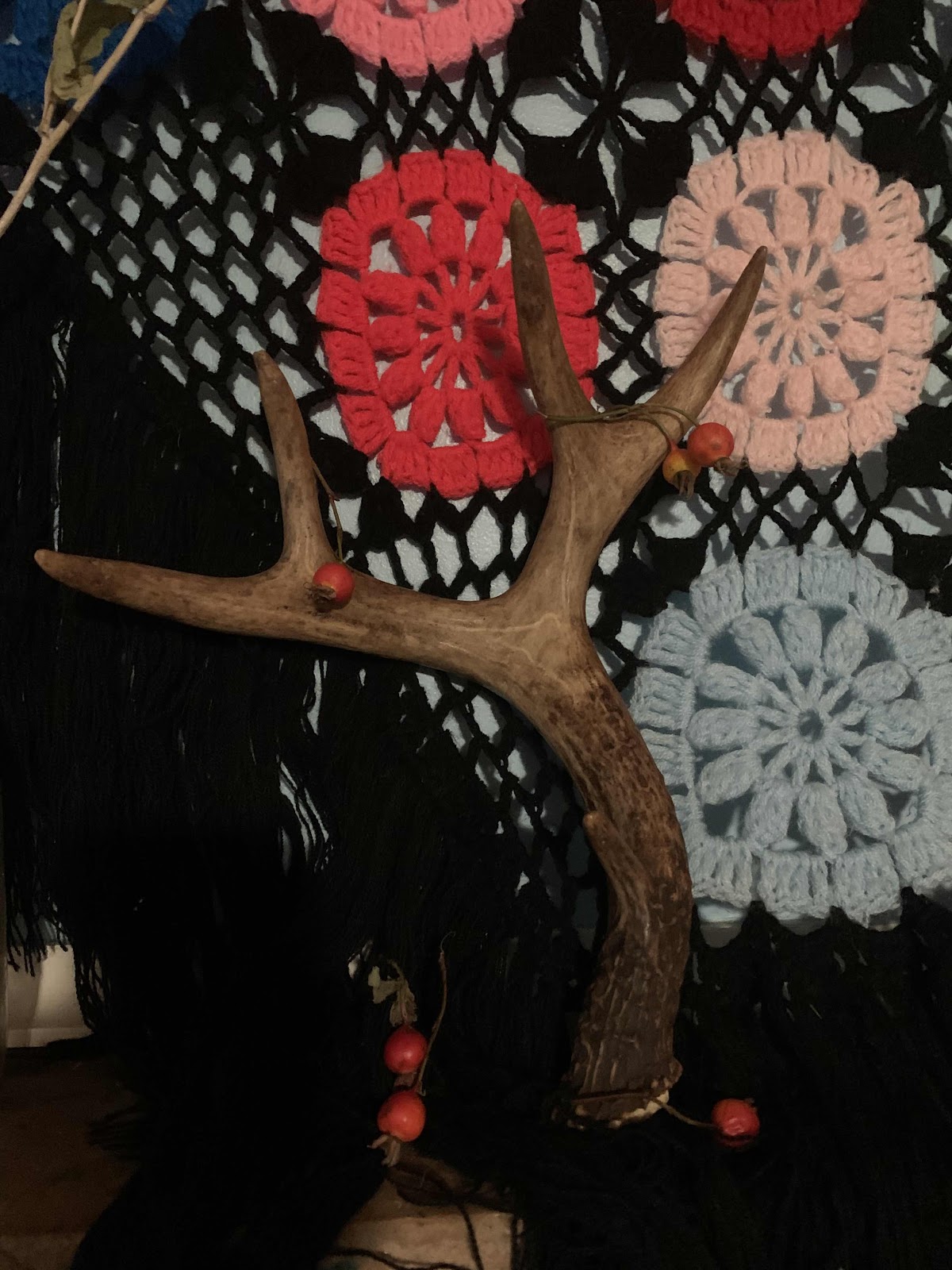


The picture of the whole altar doesn’t show details, so here are a few of our seasonal items. Shed antlers, decorated with rose hips. Reminds me of a seasonal crown on Cernunnos, although he isn’t really a deity I have dealings with. 
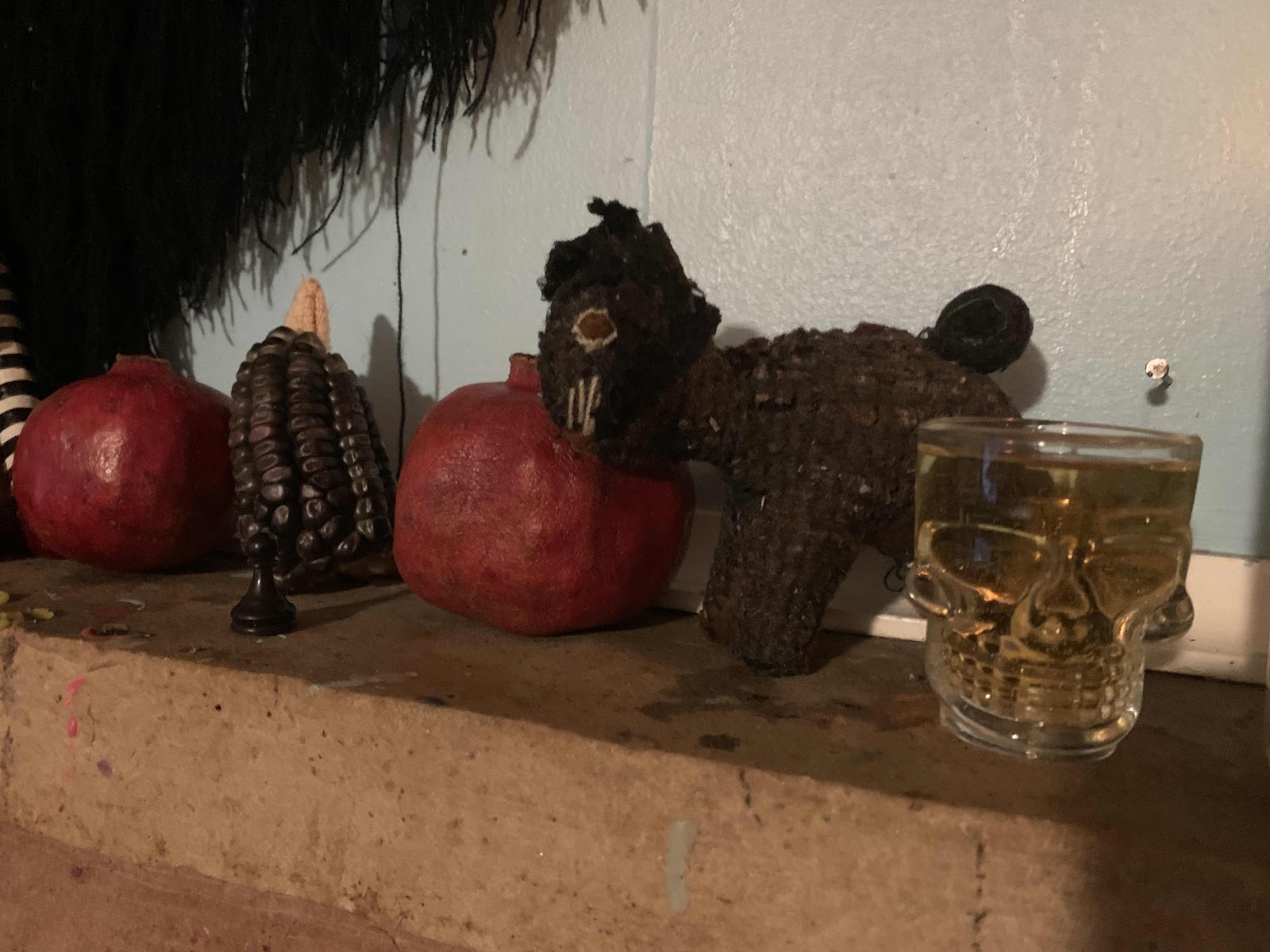


Pomegranates, of course, are a beautiful and appropriate decoration for an autumn altar. Persephone is sinking into Hades right now, to meet her husband and take on her aspect as queen of the dead. The black corn I brought back from Oaxaca, and is there simply for its beauty. The skull shot glass has apple cider in it, for visitors. And that tattered crocheted animal is a representation of the Black Rabbit of InlĂ© (What? You haven’t read Watership Down? Go start it right now). 

This altar will probably stay up through the day of the dead, and we will add to it as the day approaches. We will out up photos of our dearly departed, and add flowers and fruits and sweet breads. On the day itself, we will make a big batch of hot cocoa, light a fire, and sit around the altar eating and drinking and telling stories of our ancestors and beloved dead. 

The house feels so much more homey with an altar laid. 
Wednesday, November 27, 2019

Thankful for the Truth (Warning graphic photos)


I love Thanksgiving, especially in the years, like this one, that I get to host. I enjoy the process of writing a menu, shopping for ingredients, and setting a beautiful table. There are few things that make me happier than seeing people I love really digging in to food I’ve prepared for them. I’m happy when my adult daughter comes over, and I’m happy to see my mom. But there is something about Thanksgiving that make me feel uneasy. There is a whiff of - if not hypocrisy, then maybe willful blindness - that hangs around the Thanksgiving table. 

Thanksgiving is a day of delicious excess, a national fantasy of happy peaceful families and endless sweetness, but the truth is often unpalatable. Enjoying an abundance of good things and being thankful for what we have is, of course, wonderful, and in no way a bad thing. Indeed, we’d all be happier and the world would probably be a better place if we came together more often to share our abundance and to give thanks out loud and in the presence others. 

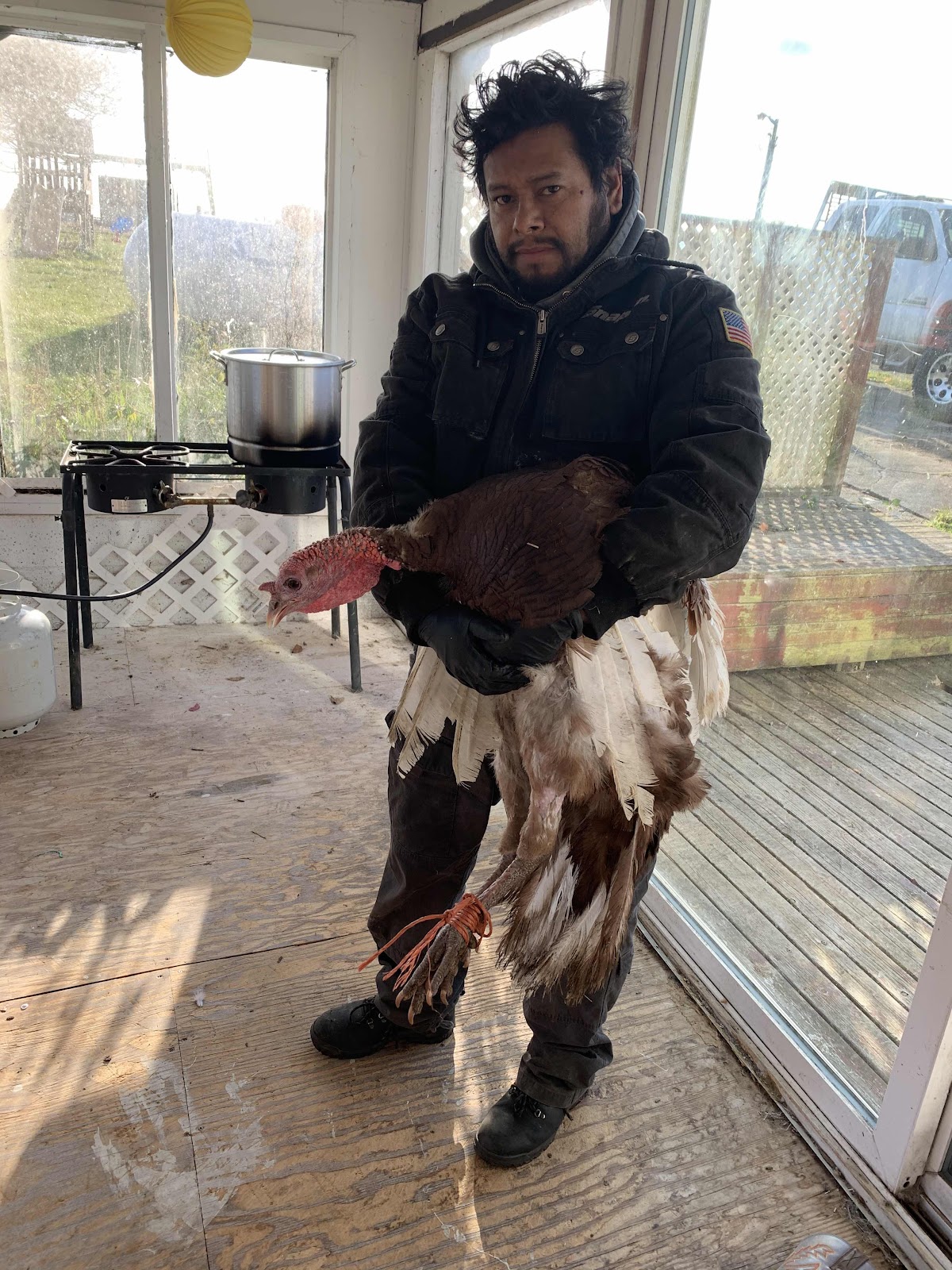
But it’s also important to acknowledge the realities that underlie the feast. These are manifold. Firstly, I acknowledge that to make this feast, a beautiful turkey had to die. 


I acknowledge the work that went into raising him - this bird was raised on pasture by a local farmer, so I thank my neighbor for her work and expense. But I also recognize the labor of the people - mostly immigrants - who toil in the vast and dangerous poultry processing industry; I acknowledge their worth and affirm their right to safe working conditions and just recompense. 

I thank my husband for the work he is doing right this minute - butchering the turkey out in the cold November wind. I acknowledge this is a disagreeable task and I thank him for being willing to develop the skill to do it well. 

The vegetables on the table - the potatoes, the Brussels sprouts, the salad greens - are produced by an unsustainable system that abuses workers and the earth in equal measure.  I am a witness, and I pledge to do what I can to avoid participating in those injustices and to mitigate the tremendous waste generated. 

And finally, I acknowledge that I live on unceded land of the Lummi and Nooksack tribes. All of us settlers live on land that either was never ceded by the tribes, or which was ceded under deeply unequal conditions, in which one side held all the power. I acknowledge that uncomfortable truth. If you want to know on whose land you reside, visit this link: 
https://native-land.ca/. I pledge to work toward correcting the grave inequalities that resulted by upholding the efforts of local tribes to sustain their culture and supporting their businesses and candidates for office. 

None of this is meant to be a huge bummer.

It is possible to be grateful for our wealth while recognizing the problem of poverty. We can celebrate being together with family while knowing that some are lonely. We can give thanks for warm homes, abundant food, and all the good things in our lives without trying to shut out the knowledge of the many who lack those things. It’s not a sin to be warm, to be fed, to be loved. These are wonderful gifts.

My hope and my prayer is that naming our gifts and sharing them with our loved ones will inspire us to share them more widely, as well. I remind myself, as I bask in warmth and light, of the existence of cold and darkness not out of guilt, but so that I may be moved by gratitude and grace to expand the circle of warmth and light to include others. I remind myself, as I nourish my body with roast turkey, of the death of the animal I am eating not as some sort of penance, but to honor the truth that this act embodies the cycles of life and death on this beautiful planet, cycles we are all of us bound by. 

May you be abundantly blessed this Thanksgiving. May you have much to give thanks for, as much as I. 


Wednesday, December 5, 2018

Little Altars Everywhere


Beltane altar

My religious background is very complicated. I was born Jewish, because my mother and her mother and her mother were Jews, albeit secular ones. My mother used to say they were just Jewish enough for Hitler to want them dead. I don’t identify as a Jew though, because I don’t practice Judaism, and I do practice some other religions. In fact I believe that according to orthodox Jewish law, I stopped being a Jew at the age of eight, when my father had me baptized into the Mormon church. 

While my parents were married, which they weren’t anymore very shortly after said baptism, we used to go to Mormon services fairly often. After the divorce Dad would still take us once in a while during our weekend visits, while we were still small. I remember long boring services and lots of cookies.  But he fell away from the church, and he fell away from his kids, and stopped taking us to church, or anywhere else. Mom never set foot in a Mormon church again, as far as I know. I myself haven’t been to a Mormon church - except for my cousin’s wedding - in thirty five years. 

In fact I didn’t set foot in a church of any kind for over twenty years, unless it was as a tourist in Italy or Mexico. But I nonetheless had a spiritual life. It was centered, as most of my life has always been centered, around books and learning. In community college when I was sixteen I took a class called the Power of Myth, that used Joseph Campbell’s work as a textbook, and I’m here to tell you it blew my mind. 


Litha Altar 


The year I was twenty-one I was pregnant with my first child. I spent months that year reading the White Goddess by Robert Graves. Among the many things I learned in that book was the sacred tree-calendar of the Druids, and I named my daughter Rowan, after the tree that ruled her birth-month of February. Since then, I’ve more or less considered myself a solitary witch.

It’s true that I attend my local church, a tiny ELCA congregation called Zion. After many solitary years I felt the need to worship with others, and I wanted a deeper connection with my neighbors. I was attracted by the aesthetics of Zion, I admit: a small, whitewashed building with a steeple and a real bell, and a real graveyard, sitting alone in a green valley near my house.  It took me years to screw up my courage and attend a service. 

It so happened that at that first service, the young woman who was pastor (a good sign!) gave a sermon in which she said “a church is not a place where a bunch of people sit together all believing the same thing” which was auspicious. At coffee hour afterwards I introduced myself. I wanted to come back but I was very conscious of the fact that I wasn’t actually a Christian. I wanted to ask if I could come as an interfaith visitor - but of course I didn’t know those words and what came out of my mouth was “is it okay if I come here as a Pagan?” 

But although I go to church two or three times a month, and I find it nourishing, I’m still a witch. The main way that I practice my path is through observing the sacred calendar of the earth - the solstices and the equinoxes, and the cross-quarter day’s in between them. The names that I attatch to these holy days are Celtic or Neo-Pagan, but it really doesn’t matter to me what they are called. If I knew the names in Ancient Greek or Mayan, I might use those names. 


Samhain Altar 


Observing the holy days means laying an altar for them. Over the years in this blog, I’ve shared pictures of my seasonal altars many times, and I’ve shared observations of various holy days such as Mabon and Imbolc. But I haven’t talked about the practice of keeping an altar. 

Some people are very formal about their altars. They have set places for them, with well-demarcated boundaries and lots of rules for which items belong on the altar at which seasons. You can probably guess I’m not one of those people. I do have certain icons that I like to use for certain holidays - usually my own paintings that evoke the season or a particular deity. One of my very long term goals is to eventually paint enough icons to have an entire set for all seasons. But for the most part, I play loose and fast with the idea of an altar. 

The shelf above our hearth is my main altar, and I have a smaller space in the kitchen for a kitchen altar. But an altar has no fixed position. As Black Elk said, “the sacred mountain is everywhere.” And so, wherever you lay your altar, you are really laying it on your heart. And if it isn’t laid in your heart, then it isn’t laid anywhere and you are just playing with leaves and stones. Not that there’s anything wrong with playing with leaves and stones. 

Altars even spring into being all by themselves, and I think these may be my favorite and most sacred type of altar - the ones that emerge organically from the life of the household. When I notice that my ordinary life, the simple repetitive rythyms of my days, creates little altars everywhere, then I feel especially blessed and feel that I must be doing something right. Then I feel that Hera, Goddess of hearth and home, at once the royal Queen of heaven and humble housewife, has come to visit me and is incaranate in the work of my hands. 


Spontaneous altar that emerged on a side table