"United we bargain, divided we beg."
Showing posts with label family. Show all posts

Tuesday, September 12, 2023

Change of (Beverage) Seasons


It’s been a few years since we last broke out the old cider press. This is the same machine my family used to press apples when I was a little kid growing up on a three acre hobby farm in Woodinville (years before the Microsoft campus transformed it from a sleepy, far-out Seattle suburb into software-mogul wonderland). My mom gave it to me when we first moved up here and started planting apple trees. 

Our apple trees have met various terrible fates. Some were eaten by goats, other run over with riding mowers when they were but tiny saplings. We do have one beautiful, well grown apple tree that I planted specifically for the purpose of making hard cider. It’s an antique variety called a golden russet. But it’s a late apple, best after the first frost, and also I don’t drink alcohol anymore, so it’s of minimal use on a warm September day when we feel like making cider. 

Therefore I invited my good neighbor Hilde and her family to make cider with us. They have a large old orchard with several different kinds of apples. We all traipsed out to pick apples, and her sharp-eyed daughter saved us from a fate worse than death by spotting this horrendously huge hornet’s nest hidden in one of the trees.


Carefully avoiding the tree of mayhem, we gathered several large totes full of apples. Hope kept asking “do you think we have enough apples?” and didn’t believe me when I told her we manifestly had more than enough apples. Like I said, it’s been a few years, but I can still do 5 gallon bucket-to-gallon jug conversions in my head. 

It was a lot of work, as cidering always is,,but we all had a great time. Hilde’s kids had never made cider before and they were excited to turn the crank and pass the apples hand to hand and pour the juice through sieves and funnels. 

And we made SO. MUCH. CIDER. As usual, the weak link in the cider-making chain is finding enough jars. We filled up all my half-gallon mason jars, which means it is truly the end of milk season (the goat is almost dry anyway). Luckily Homero rooted around in the recesses of his shop and came up with this 3 gallon skull-shaped beverage dispenser. It doesn’t have a lid, but we just put a plate on top of it and will dispense cider at will for the next few days. 


Monday, October 12, 2020

Samhain Season Altar


I’ve neglected my altar for many moons. Not for any particular reason - life just rushes in and gets in the way. Like everyone else’s, our family has been preoccupied by dealing with life in the Covid era. The new school year has been difficult so far. Distance learning is not going well, and it’s been exceedingly frustrating. We aren’t in lockdown, but there are still strict rules about how many people outside your own household you can see per week and how restaurants can operate and so on and so forth. It’s all exhausting. 

Last week I finally cleaned and purified the altar - and used way too much copal. The whole house filled up with resinous, fragrant smoke. I just used my turkey feather wafter to waft it all around, smudging the house basically, and then opened all the windows and doors wide and let the cool breeze finish the job. 


(Altar tools: the turkey feather fan is for wafting smoke, smudging an area. The pampas grass wand is for doing a limpia of a person - brushing their aura, for lack of a better term)


Except for lining up some squash, however, I left the altar empty. I just wasn’t inspired to decorate it. It wasn’t quite Samhain season, not quite time for the day of the dead altar, and too late to dress it for Mabon. So it stayed empty and clean for a week. 

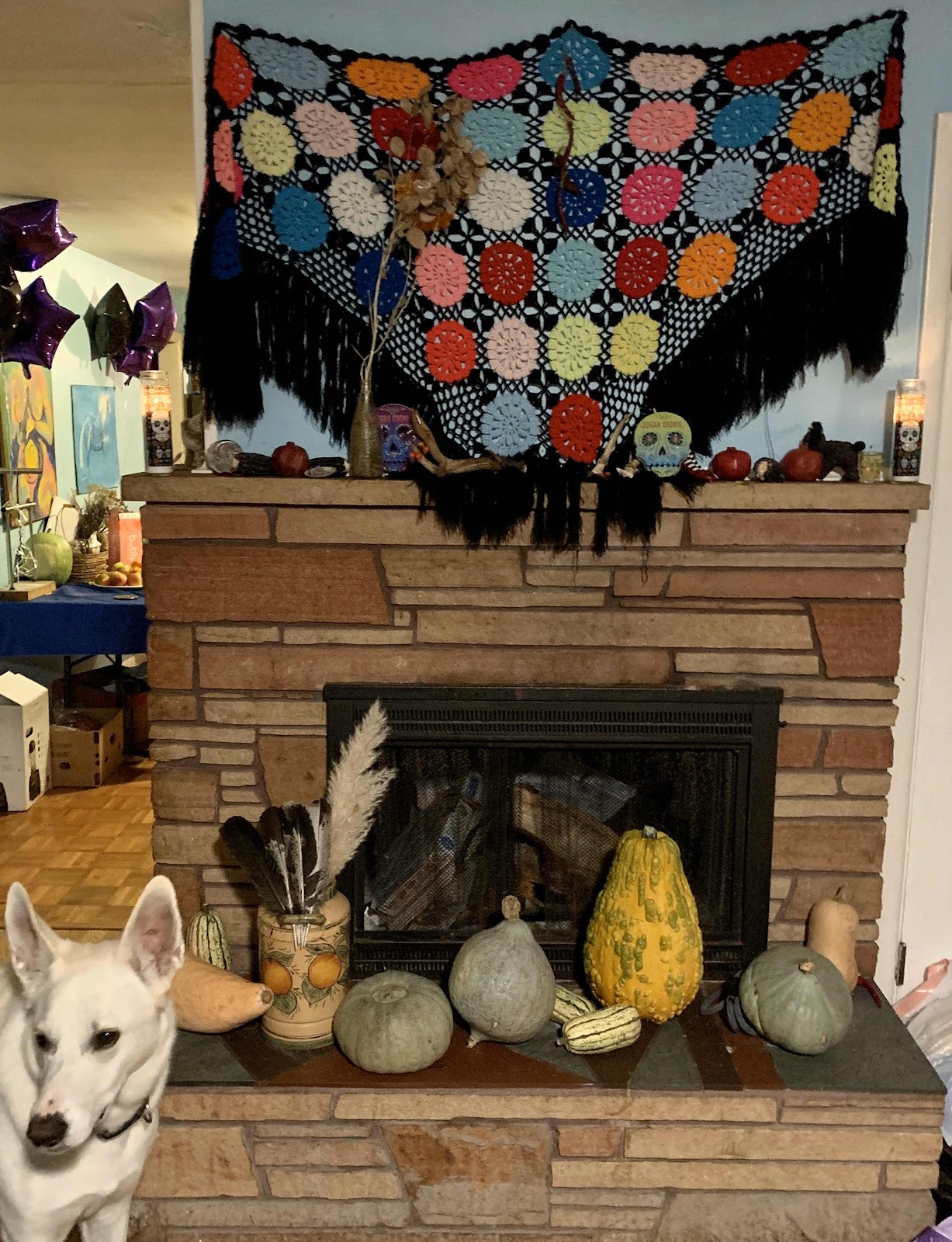
Today my oldest daughter Rowan was visiting, and Hope asked if we could all dress the altar together. She found an altar cloth (a crocheted shawl I had just given her for her birthday) and we all chose seasonal items to place, either from the yard or from my collection of altar pieces I keep on a shelf in the kitchen. It only took about fifteen minutes and was a really nice group activity. 


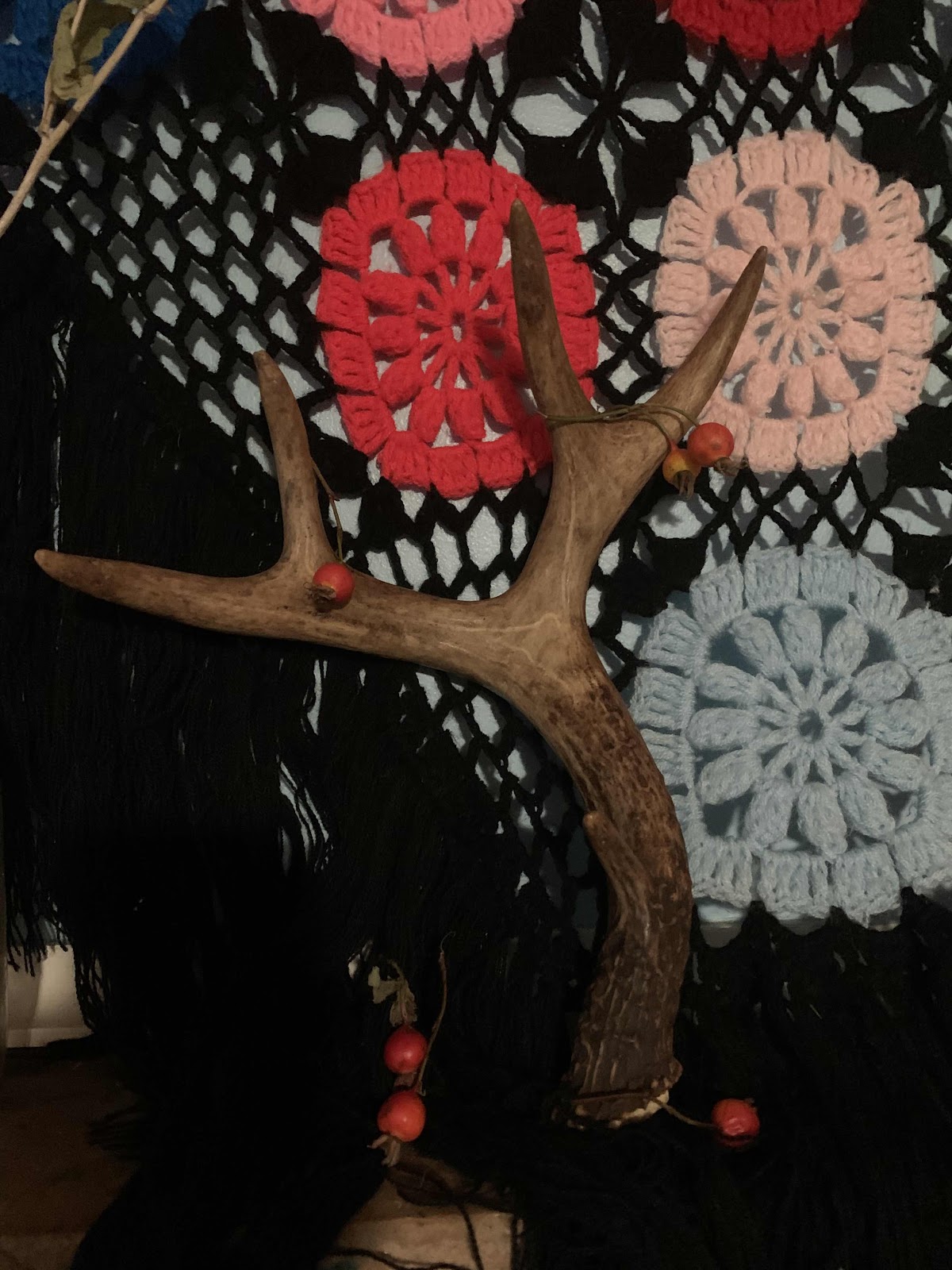
The picture of the whole altar doesn’t show details, so here are a few of our seasonal items. Shed antlers, decorated with rose hips. Reminds me of a seasonal crown on Cernunnos, although he isn’t really a deity I have dealings with. 


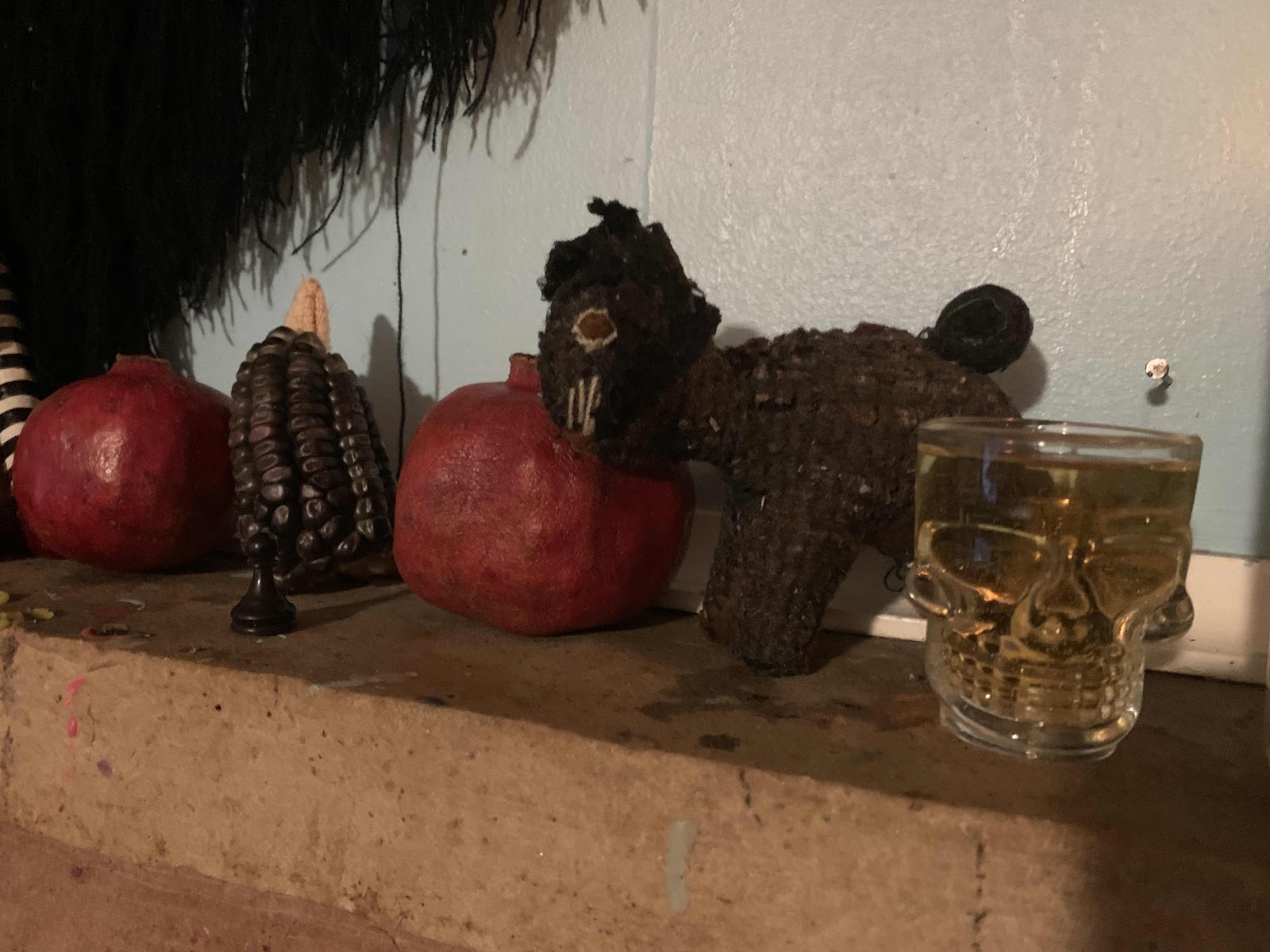
Pomegranates, of course, are a beautiful and appropriate decoration for an autumn altar. Persephone is sinking into Hades right now, to meet her husband and take on her aspect as queen of the dead. The black corn I brought back from Oaxaca, and is there simply for its beauty. The skull shot glass has apple cider in it, for visitors. And that tattered crocheted animal is a representation of the Black Rabbit of Inlé (What? You haven’t read Watership Down? Go start it right now). 

This altar will probably stay up through the day of the dead, and we will add to it as the day approaches. We will out up photos of our dearly departed, and add flowers and fruits and sweet breads. On the day itself, we will make a big batch of hot cocoa, light a fire, and sit around the altar eating and drinking and telling stories of our ancestors and beloved dead. 

The house feels so much more homey with an altar laid. 

Saturday, August 29, 2020

Memorial Painting


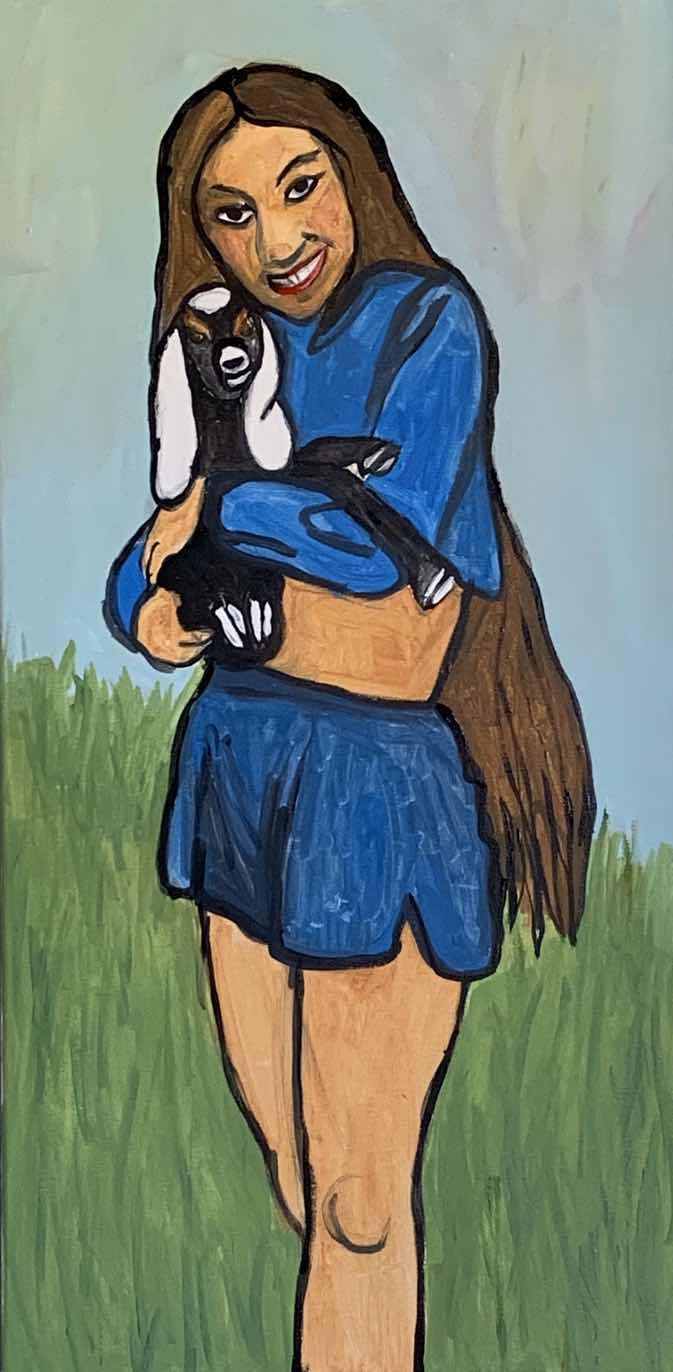
My memorial painting of Paloma with her sweet, deceased pet baby goat Stormy. I’m not a good painter by any means - in fact at some point during every attempt at painting I am convinced I am the worst painter in all of North America and I want to set my painting on fire and then set myself on fire as well. But my merit as a painter - or lack thereof - is distinctly secondary to any comfort I might be able to bring to my baby girl. 

I hope she likes this painting, and I hope she chooses to put it up in her room and I hope it brings her a little bit of relief from grief. But even if not, making it was good exercise for me. 


Friday, June 5, 2020

Just Cute Goat Pictures


Paloma and Flopsy’s baby boy. I can’t decide who is cuter. 


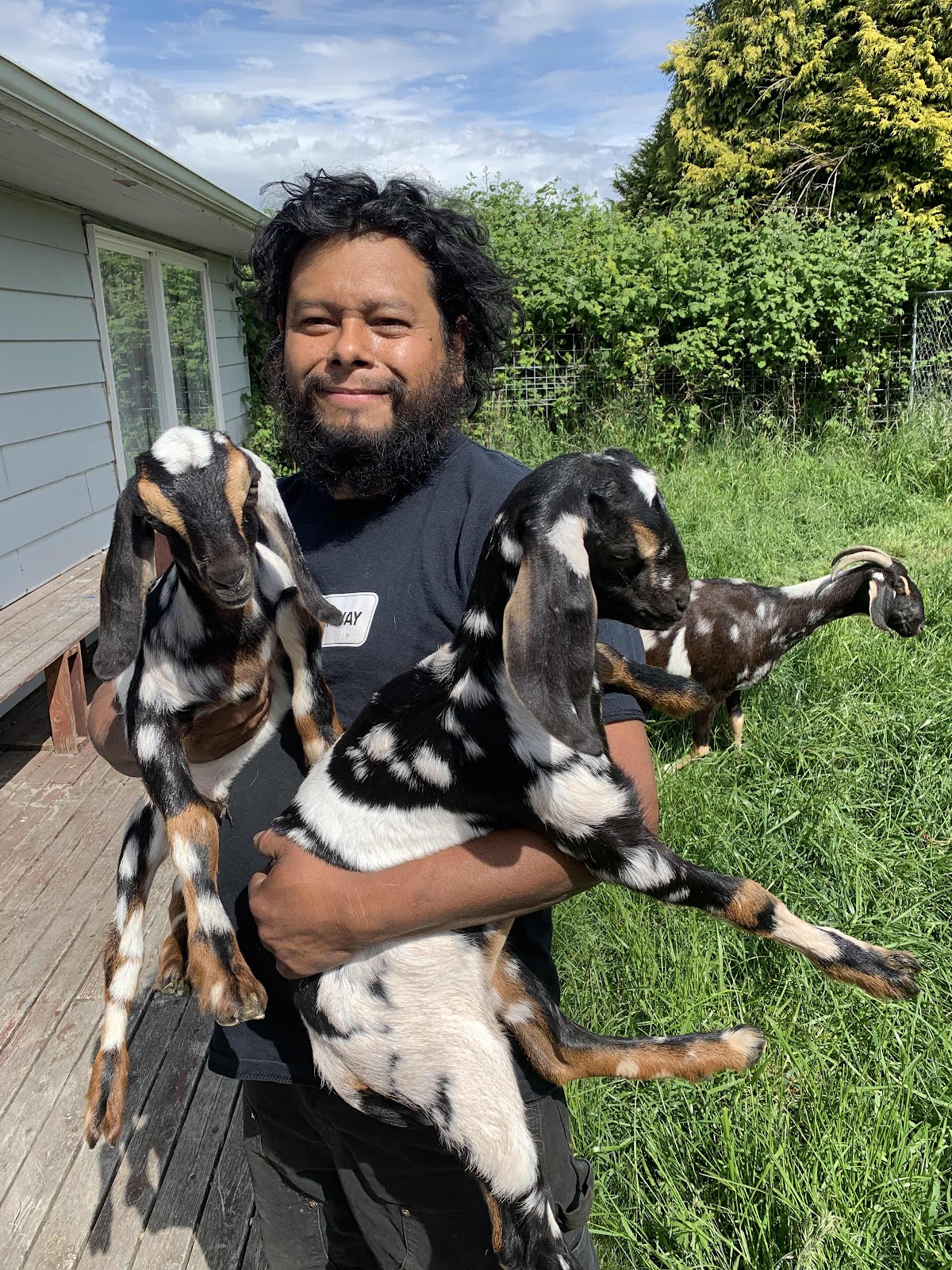
My goat-totin’ man, totin’ Bitsy and Bootsy, Christmas’ two doelings. 


Hope being tickled by goat kisses from Sweet Pea, Polly’s doeling. 


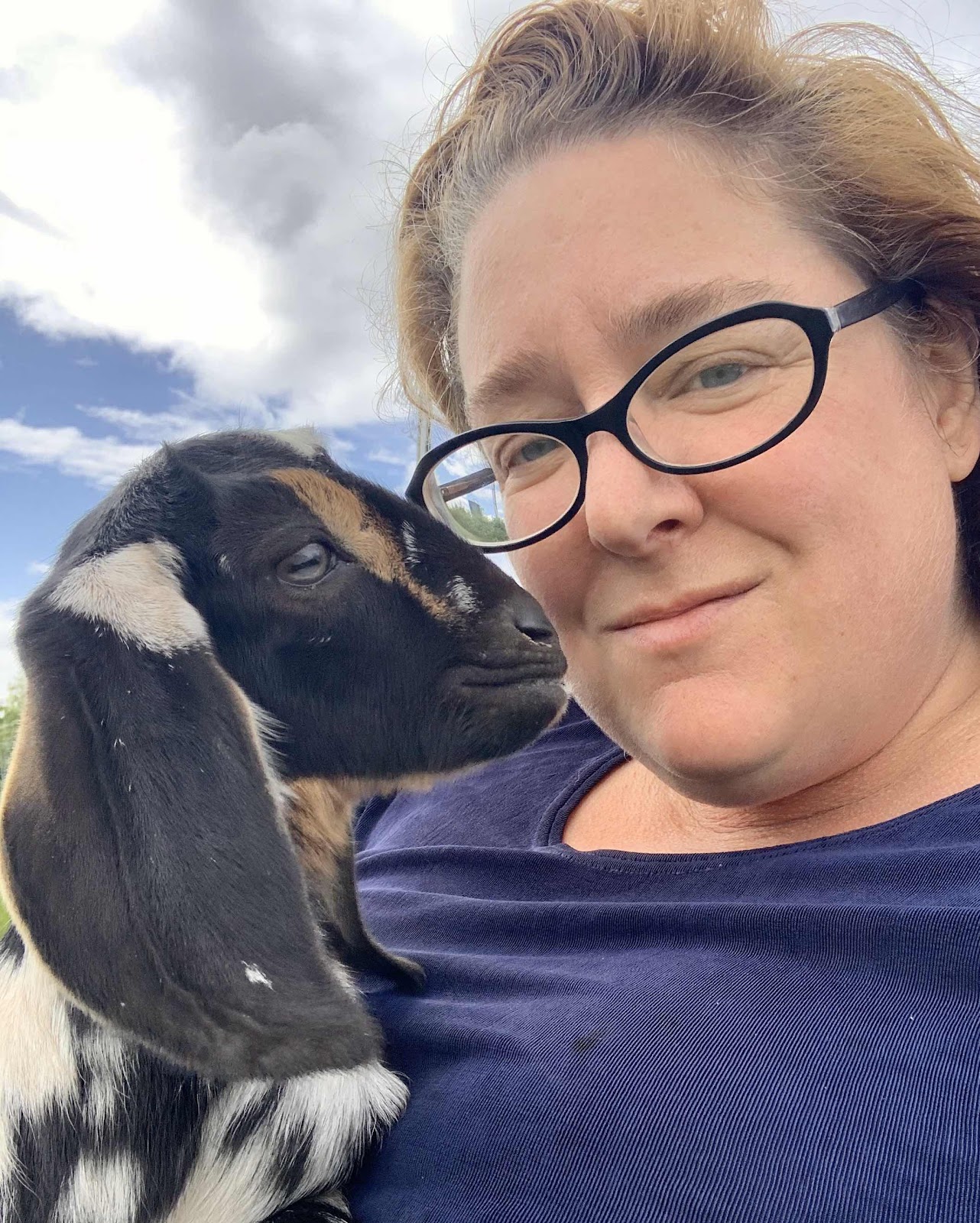
Me and Bitsy. I think I’m gonna keep this one. 

Wednesday, March 18, 2020

State of the Farm: Pandemic Edition


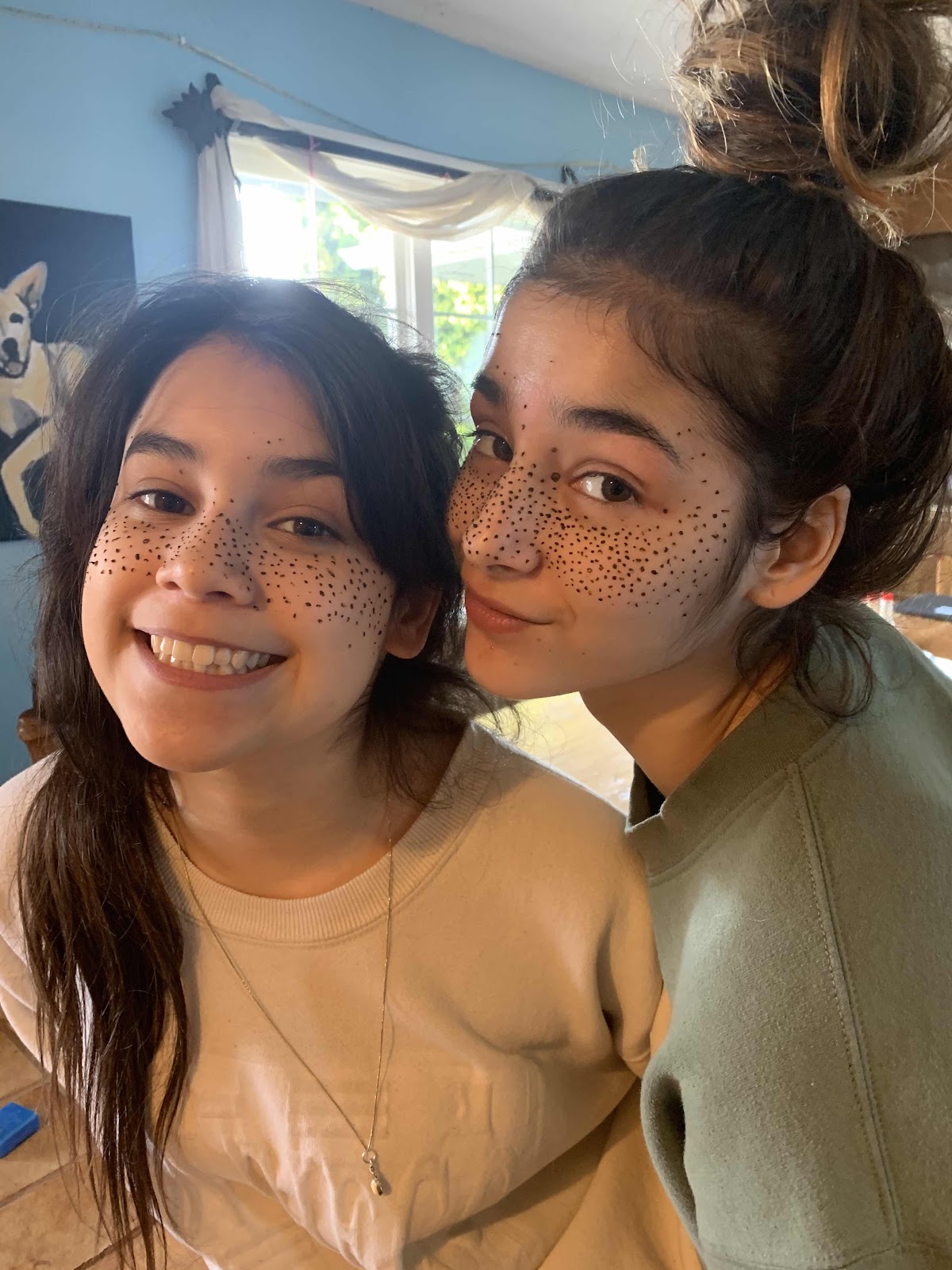
The girls amuse themselves at home with Henna freckles 


DQ2 - day two of “quarantine.” We aren’t officially quarantined, of course, and not even prohibited from going out and visiting. The official prohibitions in Washington are (as of right now) no gatherings of over 50 people (or has it been changed to 10?) and smaller gatherings must abide by strict “social distancing” rules that keep people 6 feet apart. 

Schools are closed at least through 4/27. I started the DQ count from the first day that schools were closed, which was yesterday, hence today is DQ2. Restaurants are closed, though takeout and delivery is allowed. Bars are closed, as are any place where people habitually gather, such as bowling alleys, churches, movie theaters, museums, libraries, barber shops, etc. Grocery stores and pharmacies are open. 

Everyone who can work from home is being told to work from home. I am still working, working more than usual in fact. As a medical interpreter, I spend my days going from one doctor’s office to another, which I suppose makes me high risk for infection. Today, for the first time, there were nurses with thermometers stationed at the entrances of the clinics, taking everyone’s temperature before they were allowed in. I don’t have a fever. 

Homero is still working as well, but he works from home all the time anyway. People still need their cars fixed, even if they are being told to stay home, I guess. I worry a bit about him because he has a few different underlying health conditions (as do I) that could make him a higher risk for complications. At least he wears gloves all the time. 

The girls were initially thrilled about the prospect of a six week spring break, until it was made clear to them that they would not being spending much time hanging out with friends, or indeed outside the house at all. I have let them see a couple friends, one or two at a time, and I’m thinking of getting in touch with the parents of a few of their “best friends” and asking about creating a closed circle of friends so they can all hang out with each other without becoming vectors of disease. 

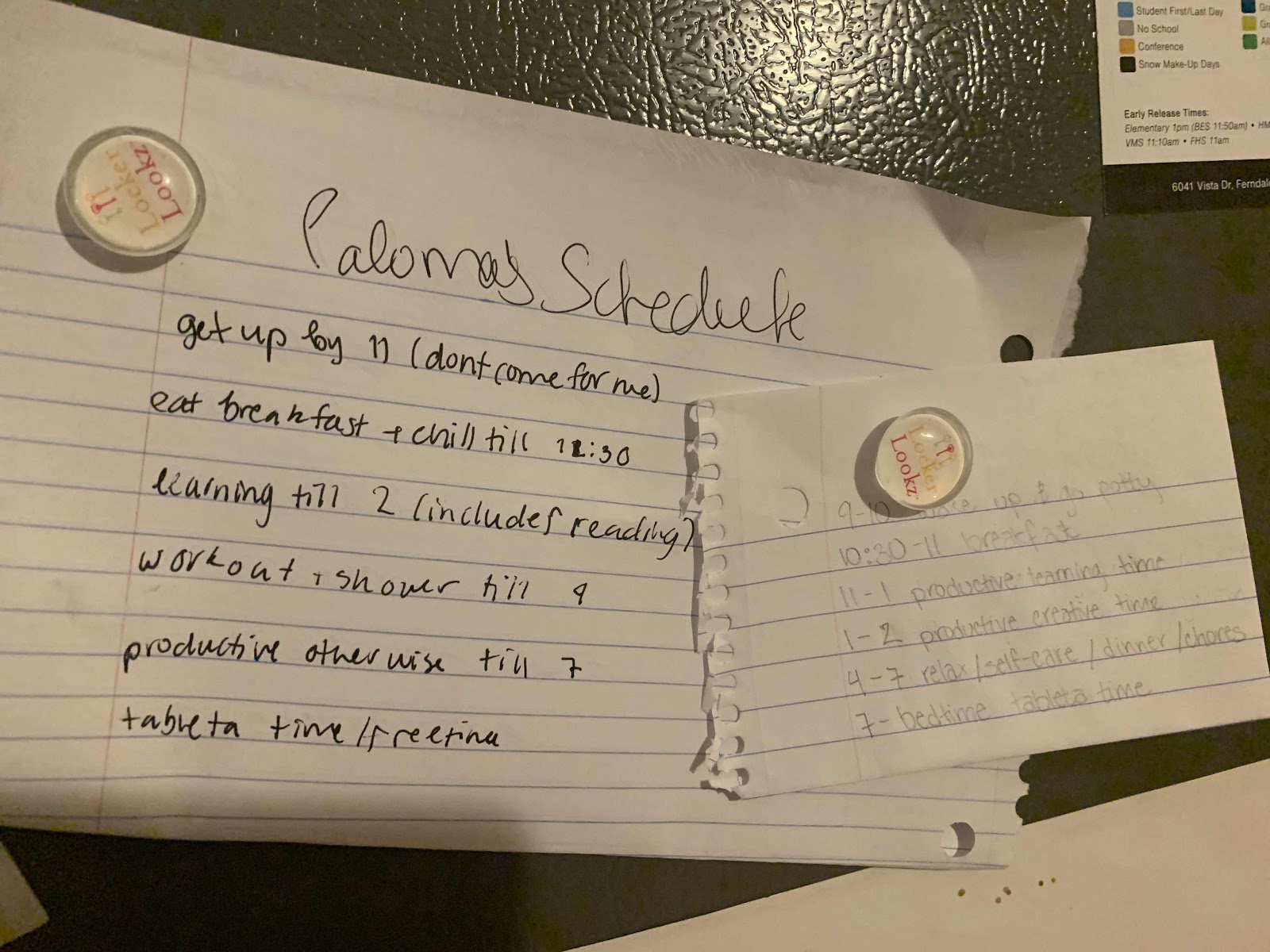
Nobody knows yet when school will resume. Teachers have been told not to send homework for the time being, since not every child has internet access at home and it wouldn’t be equitable. The district is working on a solution, at least for high schoolers, and I expect sometime in the next week or two that they will probably send home some fat packets. In the meantime, I told the girls this isn’t a vacation, and that they needed to write up a schedule for themselves. It doesn’t have to be a strict schedule, or overly specific, but it has to exist. Here’s what they came up with:


I especially like Paloma’s first line item: “get up by eleven (don’t come for me).” 

Each schedule has to include a two hour block of time for school related work (their teachers can’t assign work that will be collected and graded, but they can post “suggestions” online) and a two hour block of “productive other” time. This second category can be anything from playing piano to drawing to exercising to working in the garden to reading a book. Other than those two categories, and one chore assigned by me or their papa each day, their time is their own. 

Some examples of the chores I intend to make them do, in no particular order:

- walk the pastures and pick up all the pieces of broken plastic, plastic baling twine, or plastic bags and assorted trash they can find. No matter how careful one is, small plastic detritus accumulates over the winter. 

- turn over some of the compost pile

- clean out a drawer or a cabinet 

- harvest nettles

- organize the canning jars (full ones by contents; empty ones by size)

- use the sewing machine to make patches for mending the quilts with holes in them (our dogs have a tendency to get overexcited and tug on the bedclothes)

- clean up the greenhouse 

Like everyone else, I am imagining all the great stuff we will all get done during this enforced down-time, and like everyone else I am probably fooling myself. It’s unlikely I will take up a musical instrument or learn a third language. A more realistic hope is that I will have time and energy to put in a small garden - something I haven’t done for a few years - and read a few extra books. Perhaps do some drawing. Within a month the goats will kid, and soon thereafter it will be cheese season again. 

A good chore for me would be to find, clean, and organize 
my cheese making equipment, and order new cultures and supplies. 

Another good chore for me would be to commit to keeping a blog diary of our lives during this time.  Nobody knows how this is going to play out. Things could stay bad for a long time. Many of my neighbors are elderly and frail and are really not supposed to go out at all. Tomorrow I will talk about local efforts to pull together and provide help and services for folks who are ACTUALLY quarantined, and for folks who have lost their jobs, and those negatively affected in all sorts of ways by this unprecedented situation. 

Stay healthy! 

Monday, December 24, 2018

Christmas’s Eve 2018 (with recipes)

Another Christmas. Another year almost gone. As my children get older, each year seems more and more precious. As in years past, I made an advent calendar of events, a posterboard hung with 24 gift tags, each one of which had an activity or community event written on the back. Although they are both teenagers now, Hope and Paloma were still excited to turn over a tag each night before bed. 


A few highlights: 


Pioneer Park Old Fashioned Christmas. Our favorite event of the season. Santa looks a little skeptical of my big girls. 


We crossed the border to visit Vancouver’s Van Dusen botanical garden light show. It was raining cats and dogs and we got soaked, but the lights were spectacular.


Decorating cookies. The girls invited friends and made a party out of it. We went overboard and there were hundreds of cookies. Hope had the bright idea of distributing cookies at Ferndale’s assisted living facility. She’s a sweet, thoughtful child. 


All three kids in front of this year’s tree. It’s another live tree and will be added to our small but growing Christmas grove. 

The menu tonight is simple but yummy. It’s just the five of us, for the first time in memory. We usually go to my Mom’s house for a formal Christmas Eve dinner with the good china, but this year my stepdad broke his leg and had to have surgery the day before yesterday and isn’t feeling up to visits. We will get together for new year’s instead. 

Small Feast: 

Cream of mushroom soup 

Roast lemon- garlic-herb chicken 

Fingerling potatoes roasted in drippings

Romaine lettuce and crudités with “Cesar” dip. 


I recently invented this mock-Cesar dressing/dip and I love it. I make the base in a mortar and pestle, remove half of it to be a rub for he roast chicken, and then finish the dressing. 

Mock-Cesar dip:

In a mortar and pestle, combine 

1 large clove garlic
1 tsp whole Black peppercorns
1/2 tsp salt
2 anchovy filets 

Mash with pestle until a coarse paste forms. Add

1 Tbspn olive oil and mix with a spoon. 

Remove half the paste and use it to season your whole chicken, making sure to get some inside the cavity as well. I stuffed the cavity with a half onion and a half lemon, and set the chicken on a bed of rosemary and thyme. 

To the remaining paste in the mortar, add

1 tsp whole grain mustard
Juice of one large lemon
Heaping spoonful mayonnaise

Mix gently until well incorporated and smooth. 
Add lemon juice if needed for acidity, taste for salt. 

Make a crudités platter with celery sticks, hearts of romaine separated into leaves, cucumber rounds, etc. Serve the dio right there in the mortar. It’s very strong flavored but super yummy. 

Merry Christmas! 

Wednesday, December 5, 2018

Little Altars Everywhere


Beltane altar

My religious background is very complicated. I was born Jewish, because my mother and her mother and her mother were Jews, albeit secular ones. My mother used to say they were just Jewish enough for Hitler to want them dead. I don’t identify as a Jew though, because I don’t practice Judaism, and I do practice some other religions. In fact I believe that according to orthodox Jewish law, I stopped being a Jew at the age of eight, when my father had me baptized into the Mormon church. 

While my parents were married, which they weren’t anymore very shortly after said baptism, we used to go to Mormon services fairly often. After the divorce Dad would still take us once in a while during our weekend visits, while we were still small. I remember long boring services and lots of cookies.  But he fell away from the church, and he fell away from his kids, and stopped taking us to church, or anywhere else. Mom never set foot in a Mormon church again, as far as I know. I myself haven’t been to a Mormon church - except for my cousin’s wedding - in thirty five years. 

In fact I didn’t set foot in a church of any kind for over twenty years, unless it was as a tourist in Italy or Mexico. But I nonetheless had a spiritual life. It was centered, as most of my life has always been centered, around books and learning. In community college when I was sixteen I took a class called the Power of Myth, that used Joseph Campbell’s work as a textbook, and I’m here to tell you it blew my mind. 


Litha Altar 


The year I was twenty-one I was pregnant with my first child. I spent months that year reading the White Goddess by Robert Graves. Among the many things I learned in that book was the sacred tree-calendar of the Druids, and I named my daughter Rowan, after the tree that ruled her birth-month of February. Since then, I’ve more or less considered myself a solitary witch.

It’s true that I attend my local church, a tiny ELCA congregation called Zion. After many solitary years I felt the need to worship with others, and I wanted a deeper connection with my neighbors. I was attracted by the aesthetics of Zion, I admit: a small, whitewashed building with a steeple and a real bell, and a real graveyard, sitting alone in a green valley near my house.  It took me years to screw up my courage and attend a service. 

It so happened that at that first service, the young woman who was pastor (a good sign!) gave a sermon in which she said “a church is not a place where a bunch of people sit together all believing the same thing” which was auspicious. At coffee hour afterwards I introduced myself. I wanted to come back but I was very conscious of the fact that I wasn’t actually a Christian. I wanted to ask if I could come as an interfaith visitor - but of course I didn’t know those words and what came out of my mouth was “is it okay if I come here as a Pagan?” 

But although I go to church two or three times a month, and I find it nourishing, I’m still a witch. The main way that I practice my path is through observing the sacred calendar of the earth - the solstices and the equinoxes, and the cross-quarter day’s in between them. The names that I attatch to these holy days are Celtic or Neo-Pagan, but it really doesn’t matter to me what they are called. If I knew the names in Ancient Greek or Mayan, I might use those names. 


Samhain Altar 


Observing the holy days means laying an altar for them. Over the years in this blog, I’ve shared pictures of my seasonal altars many times, and I’ve shared observations of various holy days such as Mabon and Imbolc. But I haven’t talked about the practice of keeping an altar. 

Some people are very formal about their altars. They have set places for them, with well-demarcated boundaries and lots of rules for which items belong on the altar at which seasons. You can probably guess I’m not one of those people. I do have certain icons that I like to use for certain holidays - usually my own paintings that evoke the season or a particular deity. One of my very long term goals is to eventually paint enough icons to have an entire set for all seasons. But for the most part, I play loose and fast with the idea of an altar. 

The shelf above our hearth is my main altar, and I have a smaller space in the kitchen for a kitchen altar. But an altar has no fixed position. As Black Elk said, “the sacred mountain is everywhere.” And so, wherever you lay your altar, you are really laying it on your heart. And if it isn’t laid in your heart, then it isn’t laid anywhere and you are just playing with leaves and stones. Not that there’s anything wrong with playing with leaves and stones. 

Altars even spring into being all by themselves, and I think these may be my favorite and most sacred type of altar - the ones that emerge organically from the life of the household. When I notice that my ordinary life, the simple repetitive rythyms of my days, creates little altars everywhere, then I feel especially blessed and feel that I must be doing something right. Then I feel that Hera, Goddess of hearth and home, at once the royal Queen of heaven and humble housewife, has come to visit me and is incaranate in the work of my hands. 


Spontaneous altar that emerged on a side table 


Monday, November 19, 2018

Practicing Thankfulness (a look back)


A repost from a few years ago follows.  Although we have no turkeys this year, and many other things are different as well, it’s always, always, always good to give thanks. And sometimes, if I have a hard time coming up with things I am presently thankful for, it’s good to be able to look back on this blog and find what I was thankful for in another time. 

So right now, I’m thankful that I have diligently recorded my seasons on this piece of land. I’m thankful for my own past hours spent on that endeavor. I’m thankful for the technology that lets me easily and quickly find the bits of my writing that I am looking for, or to peruse those I have forgotten I ever wrote. I’m thankful for the technology that lets me record and share the beauty of this place I live in. I’m grateful for my artist’s eye that lets me see beauty in my mundane surroundings, like the frosted leaves above, and for the ability to share that frozen moment with all of you. 

Here’s what I was grateful for in November of 2013. 


1) The turkeys. We will be eating our own bird thursday, a beautiful creature who dressed out at 19 pounds. I sold two other turkeys, for $4/lb, a very decent price. Well, one of them I accepted half cash and half groceries, and some of those groceries will be on the thanksgiving table as well. In particular, I'm thankful for

2) the quart of dried morels I accepted as partial payment. I love wild mushroom gravy. The last turkey I decided to donate rather than stash it in the freezer for Christmas or something. Calling around, I found out that

3) the Lighthouse Mission in Bellingham will be serving a Thanksgiving meal on friday for those who missed out on the big day. I'm thankful they are doing this, and also that they can legally accept my turkey. Anybody looking for an easy way to help out the homeless and hungry this year could do worse than to donate to this hardworking organization.

4) I'm thankful that my mom is coming up from Seattle and we will have a crowd of family around the table. I'm sorry my sister won't be here, but I am thankful that

5) I don't have to make a gluten free, dairy free Thanksgiving meal.

6) I'm thankful that the buck is sold and the boarded does are gone home and that all my goats are probably pregnant and that goat breeding season is over for another year!

7) I'm grateful that the cold snap is over and I no longer have to water the animals with a five gallon bucket but can go back to using the hose like a normal person.

8) I'm grateful for my nieces, who are sweet, cheerful, hardworking, and funny. They are doing so well in school and making friends. I am grateful they are enjoying their time here and I'm so grateful for the trust that their parents put in me and Homero. It's a blessing.

9) I'm thankful for the beauty of my part of the world. I'm so grateful to be able to look out my window and see the mountains and the trees and the sky. I'm constantly amazed at the natural beauty with which I am surrounded.

10) I'm thankful for this house, drafty and creaky as it is, it's still shelter, and it's home.

Tuesday, August 28, 2018

Quince Años for Hope


Hope will turn fifteen in October. Fifteen is a major, major birthday in Mexico - in the old days it was the traditional coming of age birthday, when a girl would be “presented to society” and declared eligible for courtship. And it was marked with an extravagant party for the entire community.  Rather like a debutante’s “coming out” ball. 

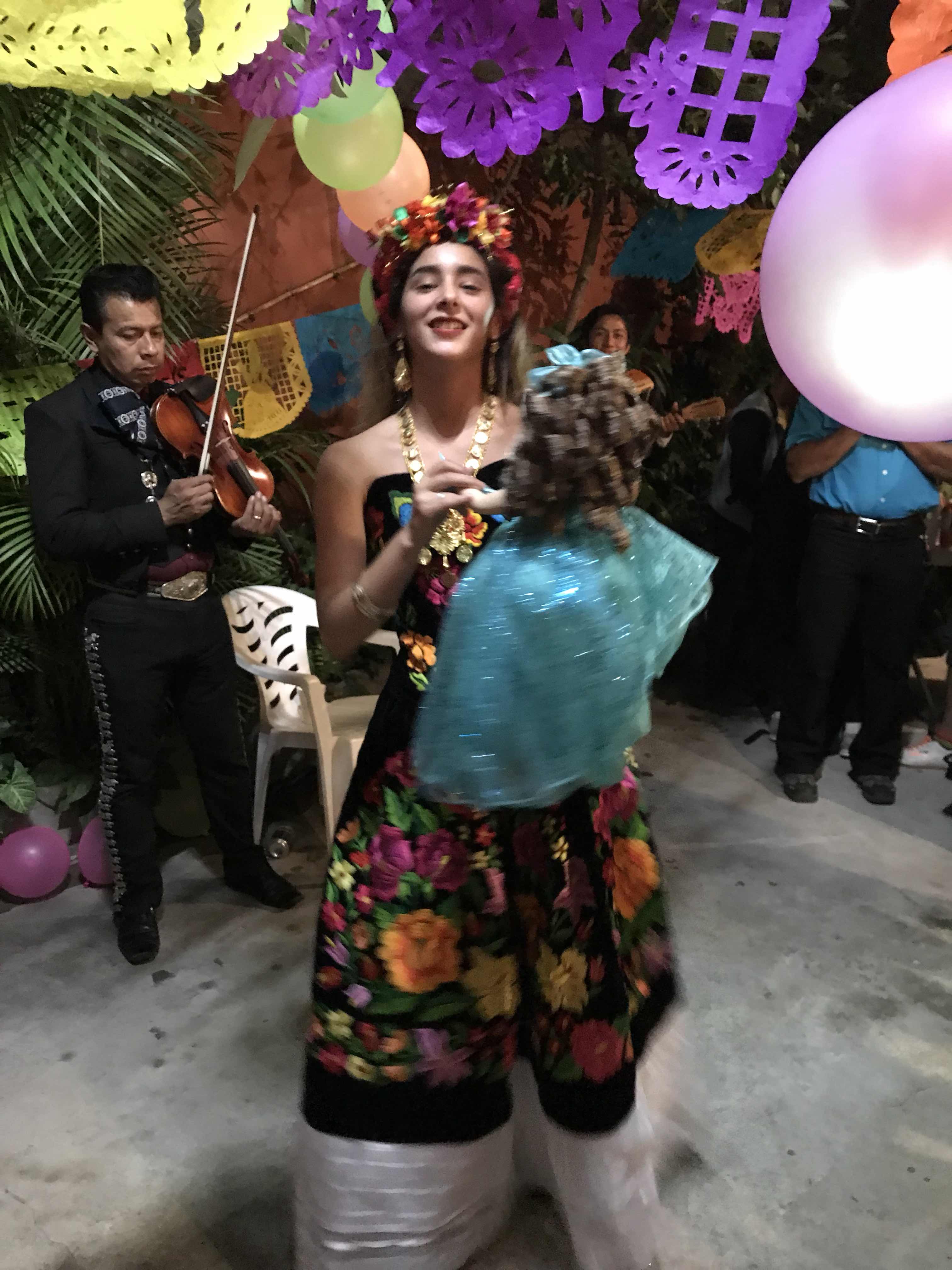
Hope will have her quince at home in October, but her abuelita wanted to throw her a party here as well. It was a lovely affair, just family and close friends, but that amounted to about thirty-five people. We cooked vats of posole (Hope’s requested meal) and Homero surprised her with mariachis. 


Opening the Waltz with Papa


Posing with the mariachis. Hope has become quite a good guitar player, and after the mariachis performed they sat down to eat - as is traditional - and Hope played a few songs. As they were leaving, the bandleader stopped Hope and told her that she has an enchanting voice, plays well, and should never stop. 


Last waltz with a doll.... this tradition symbolizes “putting away childish things” and becoming a grownup lady. 

There’s a lot to be said about Quinces, and I’d love to write a whole post about them. Maybe later, as right now I have to get downstairs and start helping with the tamales. 


Sunday, July 1, 2018

All the Fruit We Won’t Be Eating


The cherries are just getting ripe. Paloma and I went out and picked this basket of cherries in about four minutes flat, off of one of our three cherry trees. These cherries are perfectly ripe right now - but the Ranier and the other dark cherry (Lapin? Sam? Stella? I can’t remember) still have a few days to go. 

Homero is leaving for Mexico in the truck day after tomorrow; the girls and I are flying down a week later. We can gorge ourselves on cherries before we go, but there isn’t time for me to do any processing. It’s eat ‘em now or forever hold your peace. 

At least we get to enjoy the cherries before we go. This is shaping up to be a great year for the orchard, and we will miss out on some of my favorites. I’m especially mourning the loss of the greengage plums. That tree is finally starting to bear a respectable crop, after years of me wondering what was wrong with it. I guess it just needed time. Right now the branches are loaded with hard little green balls, which will ripen in August into luscious, sweet, golden orbs bursting with juice. And we will not get to enjoy any of them. 

Nor the raspberries. All of raspberry season will pass with us far away, and so we will not have raspberry smoothies this winter. I hope we will be home in time for the Italian prunes - that tree is absolutely jam-packed with little green plums. I adore Italian prunes, all ways - fresh, stewed, dried.  This year I was thinking to make wine again. It was delicious last time. But unless the weather is extraordinarily cooperative, we will miss Italian prune season as well. 

Blackberries are more hopeful. We will be home the first week in September. If the rains hold off, there will probably be blackberries still, although the best of the season will be ending. 

Apples and pears. Hooray! Apple cider season will take place as scheduled. The Comice pears will be perfect for eating out of hand, inshallah, and of course there will still be the farmers market and its late season bounty of tomatoes and squash.

And of course let’s not forget that I am traveling to the land of cheap and exquisite fruit. Mangoes. Tunas (cactus fruit, not fish). Watermelons. Avocados. Passion fruit. Papaya. 

Friday, March 30, 2018

The Long Goodbye


Today at around five o'clock in the evening I got the call from hospice that my dad had died

.


It was anything but an unexpected death, which I suppose is obvious from the fact that he was in hospice. That was my doing. As his legal guardian, it fell to me to make the decision to move him out of the ICU, where he had spent the past nine days, and into a hospice, where the pretense that he might possibly recover would end, along with all the futile, painful interventions that maintained that pretense.

I've been shuttling back and forth from Bellingham to Tucson frequently in the past year, along with my sister. Last spring, or early last summer, I forget which, my stepmom called us and said she couldn't care for him at home anymore. We were unsurprised.  Frankly we wondered how she had been managing for the past several years. Dad had a stroke in 2002 that left him hemi-paralyzed, and his health had described a slowly declining arc ever since.

The visit that followed my stepmom's pronouncement was pure hell, a hell that illuminated for me every single thing that is wrong with American health care and the American way of caring (or not) for the elderly and disabled. My sister and I had to make one awful, wrenching decision after another. Dad resisted with all of his strength facing the truth that he needed a level of care that could not be provided at home, and he used every tactic at his disposal. In the end we left him in the local veteran's hospital on a psych hold, and I started emergency proceedings to become his legal guardian.

There followed several months of bureaucratic nightmare waltz. Dad was transferred from one facility to another. I think he went through five placements in a fewer number of months. He was in and out of the hospital. I, formally instated by a judge as his legal guardian, received midnight calls from emergency room physicians asking me what I wanted them to do.

"If I do nothing, he's going to die," said the voice on the other end of the telephone.

This happened more than once.

Those awful episodes were interspersed with weeks of semi-recovery in various nursing homes. The nicest one had chickens and a nurse who helped him plant some seeds in pots in the small courtyard. Dad was always a gardener.  I don't think there has been a single year of his adult life he didn't have some sort of garden, even in these latter years. My brother-in-law built him raised beds in his yard in Tucson, beds he could plant and weed from his wheelchair.

That reminds me, of course, of all the time he and I spent dreaming about a little five-acre farm. During the years he lived with me and my daughter in the blue house in Seattle. It was a game we played, the "Self-Sufficiency" game.


The self-sufficiency game (love you, Dad)


This time, this last time, the call came that dad was in ICU again, and nobody was really sure what was happening. The first doctor I talked to said he thought it was a pulmonary embolism; the next one said septic shock. Shortly it became clear that whatever the precipitating event was, dad was extremely ill and not very likely to recover enough to make it back to the nursing home. Not that anyone was willing to come right out and say that - but that's a post for another day.

My sister and I both flew down. Dad was in and out of consciousness. We spent a week more or less at his bedside. It was clear, to me anyway, that he was declining, but oh so very, very slowly. It was only after we both had flown home that he became entirely unable to eat or drink, and it was when they started talking about a feeding tube that I said "No."

"Get me hospice," I said.

My mother and my brother have both named me as their medical power-of-attorney, as did dad a couple years ago. I'm not entirely sure why this duty has devolved on me, but I believe that in my mom's case at least, she sees me as the child "most likely to pull the plug." She has made it clear to all of her kids that she has zero desire to hang around in agony one minute longer than necessary, but I'm the one she has designated to make it so. She trusts me to kill her. I can't help but wonder - in dark moments like this one - if my family sees me as unfeeling.

Sometimes I wonder the same thing about myself.

This is the second spring in a row that I have had to fly to Tucson during kidding season. For two years in a row, I have left my husband and kids, who are not experts by any means, to cope with goats giving birth and getting the kids off to a good start. Last year there were complications, and this year I anticipated more complications. Flopsy was once again carrying a ridiculous number of babies, and I knew they would need active help. I did all I could, which was to ask knowledgeable neighbors if they could be on standby, and give their phone numbers to my husband.

Even as I sat at my dad's bedside in the hospital, even as I interrogated his cardiologist or his nurse, I was thinking about Flopsy and her quadruplets. I couldn't help it. Dad was manifestly in good hands - being cared for by people far more qualified than myself and obviously good at their jobs. The same could not be said for my goats. I wanted to care only about my dad, to be in one place completely, at his side and nowhere else, but that just wasn't possible. Not for me. Maybe it never is possible for anyone, and I'm being unreasonably hard on myself. How would I know? This is the first time I'm doing this. Thank all the gods I made it this far.

Luckily, the goats gave birth without major complications and the neighbors came through in spades. Mental note: I need to by a few Starbucks gift cards. In fact, I was sitting outside in the fragile evening sunshine enjoying the sight of seven little goatlets prancing about the lawn when the call came. Dad had passed away quietly, deep in a morphine dream, without pain or agitation, after two weeks of hospitalization.

My dad was a fighter. He did not Go Gently into that Good Night. He resisted every step of the way, with courage and stubbornness. There are certainly easier ways to live and to die than the ways he chose - or the ways that fell to him though fate and genetics - and for my part I hope I find those easier ways. But I admire him his fighting spirit. No one can say he didn't do his damndest to the very end.


Thursday, August 10, 2017

Decisions, Decisions


My youngest child, Paloma, says she doesn't like blackberries. Sadly, i see no option but to disown her. 

Friday, June 30, 2017

Coming of Age Custard Pie


I am forty-five years old. Incredibly, there has not been a death in my immediate family since my last living grandparent - Grandma Eva - died when I was about twenty, some twenty-five years ago. My other grandparents were either dead before I was born, or died when I was still very much a child.

As an adult, only a very few people I know have died, principally the mother of my stepfather. Grandma Joann was a lovely woman, who we saw on every holiday and who always remembered my children with presents or cards. The mother of my best friend died of ovarian cancer years ago, and I went to her memorial service.  That represents the sum total of my experience with human death, pretty much.

Never have I, until now, been an adult member of a community celebrating the death of one of its own. The church I belong to, Zion Lutheran, is a small rural church with a long history. I've written about Zion before. I joined in order to meet a deep, incohate need to be part of a congregation - to experience worship as more than a solitary activity - and in order to become more fully a part of the community I had moved into. That relationship has been everything I could have hoped, and more than I could have imagined when I first joined. It has been a deep pleasure, and a rather strange experience for a lifelong loner like me, to slowly become a fully instated, respectable member of a circle of peers. I am, believe it or not (few who knew me as a teenager would) a member of the church council. I sing in the (occasional) choir.

Zion's congregation is old, and small. There are perhaps thirty families who belong, and maybe thirty or forty individuals who show up for services every Sunday. Most of these folk are elderly. If I had to guess at a median age for people seated in the pews on an average Sunday, I'd say about seventy. Many of them were married at Zion a half-century hence, and christened there even longer ago. The grassy, sloping churchyard hosts a couple score of gravestones, many of which bear the names of the parents and grandparents of current members. In the basement, where we gather for coffee hour after service, there is a wall filled with photos going back to the year Zion was built, 1903. In those days, mass was spoken in Norwegian. There is a very real continuity, a living history, embodied in this tiny, local institution.

Last week, the oldest living member of Zion's congregation, H. R., died. She was in her nineties, and had been a member of Zion all her life. Her photo is one of the older ones on there basement wall. My children and I knew her as a neat, friendly, well-dressed, and tiny lady who still drove herself to church. We pressed her small hands when we passed the peace. She had beautiful snow-white hair and a sweet smile. She had deep, deep ties in our area. She will be missed. Her memorial is Saturday.

Yesterday, I got a phone call from another of the OG's of Zion, M. She is above - or behind - or superior to me on Zion's official phone tree, and she was calling me to ask me to bring a dessert to H.'s memorial service.

Of course I was planning to attend the service. But it would not have occurred to me to bring anything if I had not been called. I suppose I would have thought, if I thought anything at all, that H's family would be bringing "refreshments." At the very few memorial services I have attended, the food was just there, as if my magic, and I was a consumer; not a provider. Even when my step-grandma died just a few years ago, I had nothing to do with putting on the service - I just showed up, signed the book, and ate the cheese and crackers. It was only when I answered the phone that I realized I had become, willy-nilly, a person to be called upon. To be counted on. A sister. A matron of the church.

"Yes, of course I'll bring a dessert," I said. "What time is the service?"

"Noon," M. answered me. "Just bring it by anytime before." And then she surprised me by asking what I was going to make.

"I'm not sure," I said, "probably something with rhubarb because I have an awful lot of it."

"Oh good," said M., "rhubarb is my favorite."


Coming of Age Rhubarb Custard Pie

eight cups (or so) chopped fresh rhubarb, from 10 to 12 stems

four store-bought rolled pie crusts, or a double recipe home made

3 cups sugar

1 1/2 cups flour

8 eggs

1/2 cup milk (or more)

tsp salt

Grease a 9 x 13" baking pan. Preheat oven to 375. 

Unroll pastry, or prepare homemade crust and roll out thin. Lay pastry in baking dish, leaving plenty of overlap on the edges. If using store-bought pastry, cut to fit. 

In a large mixing bowl  measure out sugar, four, salt. In a second bowl, beat all 8 eggs together with milk.add wet ingredients to dry, and mix with a fork. If very thick, add a bit more milk until you have a very thick but pourable mixture. Pour over chopped rhubarb and turn to mix, gently. Scrape into the baking dish, spreading to edges. Crimp dough around filling. 

Bake at 375 for approximately 45 minutes until crust is golden and filling is well set. Let cool and top with whipped cream or drizzle with sweetened sour cream. Cut into squares to serve. 


Thursday, March 24, 2016

State of the Farm (Spring Equinox)


grey spring


I know, I'm a few days late on the equinox. That's okay, I feel like I'm a few days late on everything these days. I have been working a lot more than usual at my non-farm job (medical interpreter). Today, I was out of the house by 5:45 and didn't get home until just now, about a quarter to five in the afternoon. That's not typical - on an average day I'll spend four or five hours outside the house, but even that much really cuts into my farm-and-house work time.

I suppose, to be honest, what it really cuts into is my free time. Reading, cruising the internet, blogging, leisurely baths.... all those things are luxuries, of course, to a mom with a job and a farm. Before I worked outside the home, I used to do my housework at a nice slow pace. I might sit down with a cookbook, read for awhile until something piqued my interest, then go shopping for ingredients and spend the afternoon cooking. Now I boil up some noodles or fry a bunch of eggs at short-order speed, trying to fit dinner in between after-school activities, homework help, evening chores, and bedtime.

Homero has been picking top an awful lot of slack, lately. He does the morning chores almost every day, including milking. We are giving an awful lot of milk to Haku simply because I don't have time to make cheese. He's getting fat, though it doesn't seem to slow him down any, more's the pity. We finally had to strip the playroom of carpet entirely, because he had pulled it all up and ripped it to shreds. It's down to the bare plywood now, and I am just waiting to see how he manages to destroy that.

I don't think I'm going to get a garden in at all this year. We did plant a couple of hazelnut trees and I'm going to plant a couple more apple trees, but as far as a vegetable garden, I just don't think it's going to happen. Partly this is because of another giant time-suck - the Gleaner's Pantry. I adore the Gleaner's, it brings in hundreds of dollars worth of organic produce a month, but in exchange it demands about 20 hours of work a month, broken up into three or four several-hour-long chunks. That isn't counting all the work I do at home to prepare for such an influx - cleaning out the fridge before I go - nor what I do to preserve it afterwards, whether it be canning, freezing, juicing, our whatnot. And I know I just said how much work Gleaner's is, but truth be told its a hell of a lot less work than actually gardening. When I have unlimited, varied, organic produce spilling out of my refrigerator, it's difficult to work up the motivation to pick up a shovel.

Another reason not to put in a garden this year is that we will be spending a big part of the summer in Oaxaca. This will be our first trip to Mexico since we came back from our year with Abuelita, in 2013. (New to Mexican Life) The children are super excited to see their cousins again. There's not much point planting vegetables in April and May when you'll be out of town for all of July.

It's still far too wet to start planting, in any case. This has been the wettest year to date in Washington state history  (As rain falls, so does Seattle's record for wettest wet season ...) and that's really saying something. We have used some twenty-five yards of mulch and chips this year, just to keep the poor animal's heads above the mud. The grass is growing pretty well, due to warm temperatures, but the ground is still too saturated to let the horses out on pasture. The pasture got pretty torn up last fall when our pig learned to get out of his pen, and I want to give it a good long rest. I've reseeded the areas the pig plowed up, and I need to give the seed time to germinate and get a good head start before I loose the ravenous beasts. That means we are still feeding hay, though less of it, as the goats have some browse and the ponies can be staked out in the orchard on days when it isn't raining.

Poor Rosie pony's horrible eye problem is back, and it's worse than ever. Her eye is so swollen and ugly that I'm ashamed to post a picture of it. I've been washing it with warm salt water and putting antibiotic ointment in it for the past several days, but I don't see much difference. She is clearly suffering, and besides her eye, she is looking thin and rundown. Maybe she needs a different wormer than the one I've been using - pretty haphazardly, I must admit. But as the single most superfluous  animal on the farm, I don't get much of a vet budget for Rosie. She is getting on in years, and soon I will have to start thinking about when it might be time to send her on to the great green pasture in the sky. Not yet, but soon.

We had a chicken attrition situation over the winter, as is often the case. In fact, the chickens and turkeys were disappearing at such a clip late last fall that I invited a couple of local boys to lay out in the field with .22 rifles and wait for the coyotes to show up. The coyotes never did show up, but when the boys were scoping out the perimeter, they said we had both canine and feline tracks in the mud along the fence line and suggested we probably had a bobcat as well as coyotes preying on our poultry.

The chickens are locked in the coop, now, though I hate to do that to them. This time of year it is always wet in the coop, and the chickens really ought to be out scratching for spring bugs and eating the worms who are lying about all over the place, trying not to drown. There are five hens left, but only three of them are laying. Two of the three eggs that I gather each day are distinctive - the tiny egg is laid by the one banty hen; the white egg is laid by the lone leghorn - but the third egg could be anybody's, so I don't know which hens are the slackers.

Five chicks are in a big wooden box in the shed, under a heat lamp. I brought them home last week. They are leghorns. I had never raised that breed before (most commercial layers are leghorns) because I thought I wanted a dual purpose hen, one that was heavy enough to eat when she ran out of eggs. But time and experience taught me that actually, I am not interested in a free-range old layer hen as a culinary item. It's nasty. And then I acquired a couple of leghorns - I disremember how - and was very impressed with them. They are small, streamlined birds. They are bright white (we named them Pearl and Shell) and are good flyers, which keeps them a bit safer from predators. They will never go broody, which means they lay more eggs per year. They are regular egg machines - each hen laying one large white egg a day, with only the very occasional day off. I liked them so much I decided to buy all leghorn chicks this year. Five isn't very many, but assuming that at least three of them live to laying age (you never know with chicks) they will provide more than enough eggs for us.

Let's see, what else. Oh. Out of Flopsy's four babies (The (Finally) Four) we only have one left. On the day they kidded, I gave two bucklings away to a neighbor farmer lady who enjoys bottle babies. I do not enjoy bottle babies. We kept two babies on Flopsy - a beautiful buckling and a fabulously gorgeous spotted doeling. But there was soon a problem. Both babies only wanted to nurse off one side. Flops had mastitis and now has lopsided teats - one normal teat and one small one that gives about half as much milk. Oddly, they both wanted only the small one. I guess the big one was difficult to latch onto. Since the buckling was bigger and stronger, he drained all the milk from the small teat and the little girl didn't get any. I couldn't seem to teach her to use the big teat. After a few days, I went out in the morning and found the little girl flat out and cold. That happens if they don't get enough milk - they just lie down and give up the ghost.

I tried to revive her in a warm water bath and get her to take a bottle, but after a frustrating 24 hours I knew I wasn't up for it. I called the same neighbor and told her she could keep there baby girl if she wanted to try and save her. My saintly neighbor told me to bring her on over. She worked patiently over the next day and succeeded in getting her to take a bottle. Then - this is so cute, I wish I had a picture - my neighbor's pigmy doe kidded with a single kid. And our little baby Nubian girl went straight for the teat. She hadn't forgotten hoe to nurse. So now, this valiant pigmy Nigerian is nursing her own kid, plus a Nubian kid, who has to practically lay down in the dirt to get to the teat.

My neighbor insists on giving us the doeling back when she is old enough to be weaned. She says that keeping the two bucklings is payment enough for the trouble of caring for the doe. I told her not to make up her mind just yet. Assuming that little Ziggy (as her children named her) lives and thrives, she ought to be worth a fair amount of money. I said she should feel free to sell her, but so far, she continues to say she will give her back to us. If so, then we will have two new does from this season, Ziggy and Christmas. That will make up for the two I plan on retiring - Iris and Flopsy.

The farm goes on. 2016 is a new year, our eighth here on this windy wet hill, I think. I'm not quite so "new to farm life" as once I was. We are settling into a good groove. I know now, more or less, how many animals the land will support, and what sort of animals are most useful and profitable to us. I continue to learn about husbandry, both of the land and the animals - and, I suppose, of my children and of my marriage and of my very own soul. I really do love to feel the slow deepening of knowledge and experience that comes from knowing a single place - or a single person - intimately, and living with a single place - or a single person - intimately, in all of its seasons, in all of its moods, in all of its slow splendor. This land, this place, this time, these people, these animals, this carefully tended ecosystem - here we all are, surviving. Hopefully thriving. Caring for each other as best we can.







Monday, September 21, 2015

Welcome Sheep


The little brown blob in the lower left foreground of this picture is a young Jacob's sheep. She is about four or five months old, and wads given to me by my sister in exchange for babysitting her children for a weekend so she could go away with her husband. For the record: I would have babysat in any case, but once offered, I wasn't going to turn down a free sheep.

Jacob's sheep are those funny four (or even six) horned breed. They are an ancient "unimproved" breed, meaning they have not been highly selected for any given trait or developed for commercial purposes. Until recently, they were usually only found in the U.S. among Native American herds in the southwest. Sometimes they are called "churro" sheep.


As such, they vary widely from herd to herd, but in general they are small (a ewe reaches approximately 80-100 pounds) and have good quality wool and lean meat. You can see how small the little ewe looks next to my Nubian goats.

I was afraid my goats would bully her terribly, but it seems not. I brought the lamb home last night and shut her up in the Mama Barn for the night. This morning I went to the Gleaner's Pantry and so I wasn't around when Homero let her out to mingle with the goats. It seems to have gone well, though. This afternoon - a beautiful sunny warm September afternoon - when I let the goats out, I tried to keep the sheep in the pasture because I didn't know how herd able she was. At my sister's house she lived in a small enclosure and nobody ever tried to herd her in an open space.

After twenty minutes or so of enjoyably perusing my magazine while the goats grazed, I heard the sheep bleating plaintively from a direction incompatible with her being inside the pasture fence. The little thing was apparently able to squeezed through the gap between the gate panels and get out onto the front lawn. She simply followed the goats around, any stayed close to them even though the does occasionally butted her in the side.

Our plan is to keep her over the winter - hopefully she will grow well - and then shear her in the spring. Rowan is interested in her wool. Then we will let her fatten a bit on the spring grass before we turn her into lamburgers. Lamb is actually my favorite meat. I never buy it at the store; it has become so terribly expensive lately. I'm looking forward to having some put away for our personal use.


Friday, August 28, 2015

Petrichor (Scent and Weakness)

They say it is finally going to rain this weekend. Actually, they said the rain would start last night - and a little bit of rain did fall; I'm not saying it didn't. The porch was wet this morning when I woke up, but there weren't any puddles.

There was just enough rain to make the earth send up a heavenly smell.  Petrichor, I hear that smell is called, the smell of rain after a prolonged dry spell, and there is no other smell like it. Once, when my children were small, we were driving across southeastern Washington to my cousin's wedding in Idaho. We were in amongst great green-gold hills covered in tall grass, with hardly a tree in sight. It was midsummer, and there had been no rain for weeks. But now, in the early evening, about an hour before sunset, a great circular blue-black cloud covered a full quadrant of the sky; whirling, dark and angry like a bruise. It was so amazing we stopped to take pictures of it. Then we got back in the car and tried to outrun it, for it looked fearsome.

We didn't outrun it: there was a short, fierce burst of hard warm rain, maybe fifteen minutes, and then it stopped and the sky cleared in time for sunset. The sunset was beautiful, pink and orange on the golden-green hills, and so we stopped at an overlook to get out of the car and watch the sun go down. When we opened the car door, we stepped out into a world of scent such as I have never even imagined. We were in the middle of thousands of acres of grasslands, which had just been drenched with the first rain in ages. It was as if the whole earth opened her lungs and exhaled sweet, blessed relief in our faces. I almost swooned with the beauty of that smell. If, on the day I die, I am granted a foretaste of paradise, it will be that smell that wafts me to the afterworld.

Today, my own fields gave up a similar, much fainter scent, just enough to make me smile with the memory.

If the forecast is right, it will rain much harder tonight, and probably continue through the weekend. I hope so - we certainly need the rain. All the leaves are turning early. We need it here, but much more they need rain in Eastern Washington, where the forest fires rage on unabated. This year has been unlike any other to date, with fires larger and more intense than we have seen in living memory. My  mom lost her cabin in Tonasket, and as of today I hear that some 500 primary residences have been burned, and of course three brave firefighters have lost their lives. We are all praying for rain.

Here on the farm, however, impending rain means work. A few days ago, Homero went to pick up a load of hay given to us my some good neighbors. They had baled the standing hay on their new property, only to discover that it wasn't of a quality that their horses could eat. Knowing we had goats, they offered it to us free for the collecting. We thanked them, I brought over some gratitude-cheese, and Homero collected the hay. There were two pick-up loads, each about twenty-five or twenty-eight bales. The first fit into our small barn, but the second had nowhere to go, so it stayed on the back of the truck until today, when the imminent rain made it important to get it under cover of one kind or another.

I suggested putting the hay in the field shelter. It sits in the sacrifice area and normally the ponies use it as shelter, but right now the ponies are in the main field with the goats. If we use that hay first, I reasoned, we might use it up before we have to move the ponies into the sacrifice area in November. Besides, there's nowhere else to put it.

One problem is that the field shelter is fairly rudimentary and has a dirt floor, with a small gap running around the perimeter. The bottom layer of hay would get wet if we put it on the ground. If we had four or five pallets, we could make a platform to keep the hay off the ground, but we don't. What we did have, it occurred to me, it a big old pile of hog-fuel, left by my brother-in-law recently. He has a tree-service company and once in a while, if he happens to have a job nearby that leaves him with a load of chips, he will come by and dump it, much to our benefit. I told Homero I thought that if we spread a four-inch layer of hog fuel down first, the hay would probably stay pretty dry.

So Homero started up his new Case loader  (Homero's New Toy (the Craigslist Chronicles)) and I ran for the wheelbarrow. He shoveled hog fuel over the fence into the wheelbarrow, and I trundled it over into the field shelter and dumped it. We repeated this four or five times, and then I kicked it all around a bit and called it good. Homero drove the truck over to the fence line with the hay on it. I thought climbing up onto the back of the truck and tossing bales over the fence would probably be easier than dragging those bales into the field shelter and stacking them, so I told Homero that I'd throw and he'd drag.

"I don't want you to slip," he said. "I'll toss them."

"I'm not going to slip," I said. "What are you talking about?"

"Okay," he said. "Go ahead."

I know I've alluded, several times in the past, to the fact that I am a gimp. Specifically, I have an inherited connective tissue disorder (Ehler's-Danlose syndrome) that leaves me prone to sprains, dislocations, and minor injuries of all sorts. For most of my life, I wasn't aware of this, and simply assumed I was accident-prone and/or ridiculously clumsy. Many people with EDS have it much worse than I do - my specific sitiuation is quite minor compared to what it could be, and I'm grateful for that. However, it is not negligible. Many of my joints are loose and cannot handle the kind of use that I feel they ought to be able to handle.

In this particular case, I wanted to stand on top of a fairly wobbly pile of hay bales, pick them up one by one (they weigh approximately forty to fifty pounds each) and heave them horizontally over a five foot fence. The first time I tried to do this, the bale of hay fell short of the fence, down into the gap between the truck and the fence. I swore. Homero looked at me with a kind of exasperated patience. The next three or four bales went over the fence and Homero picked them up and moved them into the field shelter. Bales five and six fell into the gap again. I swore again.

"Amor," he said, "why don't you let me get this?"

"I want to help," I said angrily, and tried to throw another bale. It fell short.

"Get down from there," he said, "I'm afraid you're going to fall."

"Okay, we can switch," I said. On that last throw, I had felt my knee slip out of position with an ominous pop. It slipped right back in, but on other occasions it has come completely dislocated and if that happened and Homero had to take me to the emergency room, not only would he be proved right but the hay would get wet, too.

We switched places and Homero started tossing bales easily and gracefully over the fence. One by one, I slipped my girly little soft marshmallow hands under the orange twine and lugged them into the field shelter. This part wasn't easy, either. The bales were heavy and spiky, and the twine dug into my palms. It must have looked terribly awkward. I must have looked pathetic, because Homero shortly called out to me.

"Amor, please let me do this by myself."

"I want to help!" I yelled again, sweaty and angry and frustrated with my stupid, fat, weak, defective body.

"Amor, please." he said. "You are wonderful in the kitchen, you are a great cook. This, I can do."

"A good COOK?" I was aghast.

"Yes amor, and you make cheese. I can't make cheese."

"Seriously?"

"Si, amor. Why don't you go in the house and bring me a beer. Please?"

So this is what it has come to. The little Mujercita is sent into the house to fetch beer while her husband does the real work. I came back with two beers and leaned on the fence and watched Homero carry the bales - one handed! - into the field shelter and stack them. I tried to look on the bright side.

"That was a good idea I had, to spread the hog fuel in the shelter, huh?" I said.

"Yes," Homero answered, "it was."

Earlier in the day, Homero had trimmed the goat's hooves. His hands are so much stronger than mine, he can close the shears through the horniest, toughest hoof wall, which I can't do. But, I reflected, I was the one who taught him how to trim; that the plantar surface has to be even and flat; that you have to trim the bulb of the heel, that you can cut right down until there's no gap, even if you have to cut way up the sides and it looks scary.

Homero is a good milker, but he wouldn't know if one of the does were in the early stages of mastitis. I doubt he would feel the slight warmth, that he would notice the hesitant flow, or feel the tiny flakes in the milk and tiny bumps in the udder. He doesn't know what they need in terms of nutrition, what minerals to buy or how much grain to give. He doesn't know what to do - or might not notice - if they develop diarrhea. He doesn't know the signs of parasites or how to treat them.

I'm the one who can walk the pastures and evaluate the health of them - I know the names of all the weeds and what each one signifies about the health of the earth beneath. I know what each one is good for; I know that Tansy is a vermifuge in moderation but poison in excess. I know the goats eat thistles, but only when they are in bud, as they were two weeks ago. I know that blackberry will increase their milk supply, and that cherry and plum leaves are nutritious in all seasons but this one - the dangerous season of wilt, when the leaves wither but before they are completely dry. Only now are they poisonous.

And Homero is right; I do know how to make cheese. Also I know how to make lacto-fermented pickles and sauerkraut and kim chee.  I can make applesauce and jam and dilly-beans. I AM a good cook and I not only that but I have a good working knowledge of nutrition and what my children need to grow and be healthy. I can dry herbs, and I can make them into teas for various ailments. I know how to treat stomach aches and tooth aches and even heart aches. I may not remember everything from my nursing days but I know when a child needs to go to the emergency room and when it can wait until the clinic opens on monday.

I can read stories out loud and do all the voices. I know dozens of lullabies. I am a first-class kisser of boo-boos, even if my kids are too old now for boo-boos. I know how to lay down a fretful child and give her a good dream to go to sleep on, a dream of riding ponies across the wild hills or a dream of swimming with blue dolphins in warm Caribbean waters. When my daughters come to me with womanly problems I will have womanly answers for them, or at least I can have womanly conversations, if there are no answers. I have over the decades tended a small circle of woman-friends who will be aunties and confidants to them; teachers and secret-keepers and surrogate mothers, as I will be to their daughters.

So my muscles aren't what they should be. My body isn't what it should be. My heart is what it should be, mostly. My family is what it should be, mostly. My soul is what it should be, mostly. This place and this time; here, now; all is as it should be. Praise be.


Monday, June 23, 2014

High Summer Plans (Adios, Muchachas)

On thursday, my nieces, who have been living with us for the past year, are going home to Oaxaca. It's been a good year, and we have enjoyed having them here. The girls have been sweet and helpful, and have worked hard in school and in their English classes. Hopefully, they are going home with a pretty decent command of the language and with some understanding of life in another culture than their own, and also with stronger bonds with their cousins, our daughters.

As much as I liked having them here, and as privileged as I felt to have been entrusted with their care,  I would be lying if I said I wasn't looking forward to them going home. This is nothing to do with the girls themselves, but simply with the fact that it has now been over two years since it's been just us - the nuclear family - in our own house.

The year before last, we were in Oaxaca living with my mother-in-law (see sister blog www.newtomexicanlife.blogspot.com). When we came home, we were in limbo for three months, renters still in our house, living here and there. And once we moved back into our home, it was only a few weeks before the nieces arrived for the most recent school year. During the year that they were here, we also hosted their father for some five weeks, their mother for three, and their grandmother for another three. Somewhere in there, my brother-in-law also came to stay for a few weeks. The number of people living in my house over the past year probably averaged out to about 9.5.

That many people puts a strain on the facilities - the washing machine, the septic system, the hot water heater, the refrigerator - and on the nerves, no matter how delightful they may be as individuals. Doubling the number of children in the house more than doubles the mess, the noise, the dishes, the laundry, and the gasoline spent driving them all hither and yon to double the number of activities. Even for an American, I require rather a lot of privacy and quiet time, and hosting several gregarious Mexican relatives at the same time and over the course of a year took a lot out of me. I wouldn't have it any other way - I married into this crowd and I'm damn glad I did - but I'm also ready for a rest.

Homero feels the same way. This spring, his fortieth birthday coincided with his niece's fifteenth - a major milestone year in Mexico - and I threw a very large party. I hadn't thrown a party like this since Rowan's fifteenth birthday, six years ago. We butchered a goat and I hired Mariachis. The house was scrubbed every day for a week beforehand and three women cooked up a storm for 48 hours straight ahead of time. My friends and relatives came from as far away as Philadelphia and Oaxaca. There were about seventy people, give or take. The party began at four in the afternoon with flowers and white tablecloths and wound down around two in the morning with Corona and kareoke around the ashes of a big bonfire. It was a huge success, but when it was over, Homero said "Amor, don't make any more plans for this summer, okay?"

Both of us would love to have a nice, low-key summer vacation, just hanging out at home with the kids. I hope we can, but already, less than two weeks since school ended, the obligations and plans are piling up. Hope and Paloma have been taking gymnastics at a local gym, and last week they tried out for the competitive team. Both of them made the cut - which means twice weekly practice and monthly meets in Seattle. Additionally, I recently earned my state interpreter's license and have started taking actual jobs and earning actual money - something I would like to do a bit more of in the summer when my farmwife/homemaker duties are on the lighter side. And although I just said that farm duties are lighter right now, this is, of course, cheese season - twice daily milking and cheese making twice or three times a week. Also, there is no forgetting that summer is preserving season - if we are to have berries, tomato sauce, pickles, cajeta, jam, and salmon next winter, I have to make it this July and August.

In addition to all these regular chores, here are some things I'd like to do this summer -

- Training Poppy. This is a whole 'nother post, but Poppy has had some training/breaking recently, and can now be considered "green broke." I have bought the minimum of tack needed - a bridle and a bareback pad - and want to get the kids to ride her around the paddock at least three or four times a week. Training the horse and teaching the kids to ride simultaneously is a complicated and expensive endeavor which deserves elaboration in it's own post, but suffice it to say that this is the summer I decide if it is worth the time and expense to keep a horse.

- Go to Victoria. I love Victoria, and I have never taken the younger girls. Homero and I took Rowan many years ago, but the littler ones don't know it. It's a great weekend trip, a perfect two-nighter. The  Royal Museum ( http://royalbcmuseum.bc.ca ) is one of the coolest museums for kids on the entire North American continent, and that's only one of many wonderful things to do in Victoria (another will be to visit our good friend Andrew).

- Go to the ocean. It's been years since the family went out to the coast - the little girls have never been, I don't think. I myself haven't been in at least three years, and that's just an unacceptable amount of time. We have the use, this summer, of my mom's very nice and comfortable, mechanically sound class A recreational vehicle, and I can think of no higher purpose to put it to than introducing my daughters to the mighty North Pacific.

- Put in a French drain and fix the far bedroom. The list just wouldn't be complete without a major construction project. While my brother-in-law (a contractor) was here, I asked him about the stubborn and recurring patch of mold in the far bedroom and asked if he could find the leak in the roof.

"There's no leak in the roof," he said. "That's water from the backyard. See the slope?"

Our backyard is higher than the house, and given the ridiculous amount of rain we get, there are several metric tons of eater sitting right up against the house foundations for most of the year. We need to take advantage of the dry season (July and August) to put in a French drain and reroute the water around the east side of the house to the ditch. And also to replace the moldy wallboard in the far bedroom, and hope like hell that the beams that sit on top of the foundation are not rotted.

That seems like a summer's worth of stuff, at least. I notice that I've put all the fun stuff first. That is, in fact, how I intend to do it. If I have to spend thousands of dollars and a couple of weeks freaking out about mold and rot, I can at least do it with a nice tan, after I've taken my kids to the beach.


Tuesday, May 27, 2014

The Littlest Huntress


Hope is ten, nearly eleven. She is a tall, graceful, athletic girl; just entering the stormy adolescent years. She is strong from gymnastics, an active and nimble thinker, and like many young girls her age, hotheaded and strong willed. For months she has been lobbying us to get her a BB gun. It seems her best friend has one, and she just has to have one too. She wants to hunt.

Sometime earlier this spring, we decided the time was right, and I bought her a mid-range air rifle - neither a toy nor a high powered weapon. It takes some real muscle to pump up the air pressure, and it is capable of firing BBs at 800 feet/second. We set up a target down in the bottom of the back pasture, and laid down the law about safety and seriousness. She would get exactly no second chances, we said - break the rules, and the gun goes bye bye for a long long time.

For about six weeks, we made her shoot only at that one target, and only when an adult was nearby. Hope grumbled and repeatedly asked when she would be allowed to actually hunt, but she followed the rules. She got pretty good, too: she could sometimes shoot a bottle cap from twenty feet away, and a tin can from twice as far. Yesterday, after chasing several rabbits out of the garden, Homero told her to go ahead and try to shoot one.

Rabbits are a plague around here. When Ivory was younger, they had a healthy respect for her and stayed away. Once in a while, she would catch one, but it takes a young, quick dog to catch a rabbit very often. As she got older, they got bolder, and now that she is twelve, she simply lays in the sun and pricks up her ears as they run past.

No rabbit, however, can run 800 feet per second, and it seems they are no match for Hope's eye, either. Within a half hour of being given permission, Hope came running back to the house yelling that she had killed a rabbit.

"Where is it?" we asked.

"Out here!" she answered, and she went galloping over the grass with Paloma bouncing behind her. I followed slowly, and saw the girls come to a stop, circling and looking down. They bent over, then sprang back up with sharp little cries of alarm, arms flying.

"Is it dead?" I yelled.

"Yes!"

"Then pick it up!"

After a few false starts, Hope picked the rabbit up by the back legs and trotted back towards the house. Homero and I bickered briefly over who was going to skin and dress it (I won; he did it) and we praised Hope lavishly.

I didn't really want to eat it (I've had wild rabbit before  - The Land Provides, part 1 - and I'm not too crazy about it) but we had talked to Hope before about eating what we kill and killing what we eat, and she would have been rightly appalled at our hypocrisy if we hadn't cooked her first kill. Moreover, she deserved us to make a big deal out of it. It IS a big deal.

I marinated the jointed rabbit (it probably weighed all of a pound, skinned and gutted) and braised it in beer with collards, onions, peppers, and corn kernels. The vegetables were delicious, but the rabbit itself was, as I expected, tough and bland. Maybe next time I will try a pressure cooker.

Oh yes, there will be a next time. Hope went back out and shot another rabbit ten  minutes after the first one. I convinced her the second rabbit was too small to eat (it was tiny) and that she shouldn't feel bad tossing it into the tall bushes; if it didn't become food for us, it would surely be food for something. The law of nature, I explained, is that "wherever there is something to eat, there will be something to eat it." If I remember, I got that out of Dune, from the planetary ecologist Kynes.

I really am proud of my middle child. She is beautiful, and growing up, and dangerous. She is at that frightening and lovely age when she is coming into her power, all unaware. She is stunning in her pride, and in her unconscious grace. She has already left her infancy behind, and in another year, or two or three, she will suddenly be a young woman. And in a few years after that, the cares and preoccupations of womanhood will take over, and the last traces of her childhood will be gone.

Artemis, most chaste and perilous Goddess, be with my young huntress. Help her learn to guide her arrows wisely, and lend her your fierceness and your unapologetic pride. Run with her through the trackless woods of adolescence. Protect her, and set your hounds on anyone who would try to cage her or make her doubt herself. Be her wild friend. Light her way with moonbeams, and let your silver laughter ring through her dreams.


Monday, December 2, 2013

Potato Day, 2013 (Indoor Games)

With the weather taking a sharp turn towards the shitty, and without a car capable of transporting all of us at once, we have recently found ourselves stuck in the house with a lot of time on our hands, and cabin fever was starting to set in.

I try to limit the amount of time the kids spend on their various electronic devices (subject for another post), and whenever they aren't absorbed in some beeping game or watching a show about shoes or something equally inane, they expect me to entertain them. I've mentioned that this is what books were invented for - long winter afternoons - but I get a lot of whining coming back at me. SO.... saturday I unilaterally declared Potato Day, 2013.

Potato Day is a venerable holiday in our house, going back to 1997 or thereabouts. I invented it one day when Rowan was a three year old bored with all her toys and not yet old enough to either shove outside or sit in the corner with a book. On potato day, we do all things potato-related we can think of....


Potato stamps, for example. I drag out the cookie cutters and we make Christmas wrapping paper with potatoes and paint. And glitter, of course, can't forget the glitter. While the kids are stamping, I make them potato snacks.....


Homemade french fries.....


and cheesy scalloped potatoes....


..and my favorite craft of the year: potato puppets. This is one of the three kings. Balthazar, maybe? 
Potato Day only comes once a year, so I'll have to think of something else for next week.... it's supposed to stay cold and wet for the foreseeable future. 

What do you all do on those interminable winter evenings?