"United we bargain, divided we beg."

Sunday, January 22, 2012

The Big Reveal (What We Want)


I've been sitting on a major news item. My husband and I made a decision a few months ago, which we only revealed to our families recently. Making this decision and dealing with the ramifications has been sucking up an awful lot of my brainspace, which helps explain why I haven't been writing very much.


We are moving to Mexico. Not permanently: for about a year. Ever since we had children, we knew we would do this at some point. We want our children to know their family and their heritage more fully than they possibly could if annual two-week vacations are all we can give them. We want them to be truly bilingual, not just fluent in a a second language as I am and as their father is. We also want them to be bicultural.

That's a weird word, bicultural. Just as neither Homero nor I is truly bilingual, neither are we truly bicultural. Being bilingual means more than simply being able to converse fluently. It means understanding slang, and jokes. It means being able to speak to a toddler as well as a grandmother. It means hearing accents, and being able to infer something from them. It means being able to read poetry. Few people can do those things in a language that they learned as an adult.

Similarly, being bicultural means more than just being able to get along in another country without committing a bunch of ignorant mistakes all the time. Understanding gestures - just gestures! - is complicated. After ten years married to a Mexican and many trips to Mexico I still misinterpreted a simple "reverencia" on our last trip. Manners. Manners are tricky even in one's own culture, of course, and are a subject wide ranging and variable enough to spawn several books on the topic in any given year. Learning the right things to say and do in various contexts in another culture is a process that takes decades.

And - here's where it gets complicated - learning the assumptions and the realities on which those manners are based.... ah! Now we're getting somewhere. As with language - a person might be fluent enough to read the Spanish translation of the Mayan book the Popol Vuh, but still totally unable to comprehend it, because one has no grasp of the symbols, the references, and the feelings that suffuse it.

I remember visiting the Mexican Museum of Anthropology in Mexico City for the first time. Surrounded by art and artifacts that were wholly unfamiliar to me, I felt dumbfounded. I realized I could not appreciate this art - not because it wasn't beautiful - but because I was totally illiterate in the language of symbols it used. I realized that in just about every other museum I had ever visited, the art was based on a symbology - and even deeper, a cosmology - that is part of my heritage as a European. Even when looking at Indian art, or Middle Eastern Art, I can find the marks of Greek, Jewish, and Christian thought. Our shared history makes a path that is easily to follow. I recognize the pantheon of Gods, even if I don't know their names in Sanskrit or Aramaic. I know what the moon means, more or less, all across Europe and Asia Minor.

In Mexico, I knew nothing. Where art and cosmology is concerned, I was as an infant. The symbols slid right off my brain. Americans think of Mexico as a neighbor, and have no idea whatsoever how very different it really is. Even five hundred years of European rule have only left a familiar suit of clothes on the great brown body of Indigenous Mexico.

Octavio Paz calls Mexico a "non-Cartesian culture" and that is true, and also a very hard thing for a westerner to accept. We tend to see all non-Cartesian thinking as simply uneducated, rather than as part of a different tradition of knowledge. Mexico is a communal culture rather than an individualistic one, and that is a very hard thing for an American to accept. Americans who have spent time in other communal cultures such as Japan or the Arab countries will know what I mean when I say we see them as smothering and constricting, and they see us as cold and uncaring.

Necessarily, I am taking a bit of a leap of faith here. I am not Mexican, I am not bicultural, and it is too late for me to become so. I have found a great deal to admire in Mexican culture as I know it, and I love the Mexican land and I adore my Mexican relatives. I want my children to have real, deep relationships with their family, and I want them to be real Mexicans as well as real Americans. I want them to develop the typical thick, tangled web of kinship relationships. I want them to grow up with many comadres and compadres. I want them to grow up knowing deep in their bones that their family will do anything for them, anything... and to feel the equally deep obligations to help out to the best of their ability. I want them to laugh at dirty jokes and speak street slang in Spanish. I want them to be have that beautiful sparkle, that lovely Mexican ability to laugh at fate even as you accept its yoke, to bend in the wind and pop up dancing.

On one of my trips to Mexico, years ago, I had a dream. I dreamed that I was on a boat in a river, and that the a gaudy, gorgeous, colorful Mexican countryside was rolling by on the shore. There were people on land calling to me, inviting me to join them, but I couldn't get off the boat. I could only slide by and enjoy the view.

I want my children to be on the shore.

Wednesday, January 18, 2012

Winter Haiku

Hot tea in my mug
winter outside the window
study in contrast

A beautiful sight

winter pulls her cold white cloak
over the mountain

Farm chores in the snow
horse's breath makes warm white clouds
pigs snug in straw beds

On the third day stuck at home, snowed in, tired of playing Scrabble with six year olds and having rifled through the stack of DVD's more than once without piquing my interest, I turn to an older pursuit: poetry. Haikus are lovely - so beautifully easy to write, and so soothing in their single-minded simplicity. I wish I had someone ere who liked them as much as I do so we could sit across from each other at the kitchen table, hot cocoa in hand, and play the game of speaking in haiku for as long as we can.

Three days is too long
to watch TV with the kids
I long for power outage

Monday, January 16, 2012

Snow at Last (On Being Unprepared)

The "puff-room."

There are about eight inches of snow on the ground right now, and it's still coming down. I don't mind snow - I actually like snow. We've all been waiting for snow this year, and we are pretty happy that it's finally here. The little girls spent most of the day outside yesterday, apparently oblivious to the cold. Whenever they would come inside, I'd ply them with hot chocolate, put their wet clothes in the dryer, and send them into the "puff-room." The puff-room is a tent made by throwing a down quilt over the heater grate. The girls crawl under there with their teddy bears and curl up together, getting warm. As my sister pointed out, it looks like Epcott center, but it really works!

View of the front pasture

For the past two days, it's looked pretty much the picture above: grey skies, with snow falling five minutes on, five minutes off. Homero has been working out in the shop, poor man. We don't have any paying work right now, so he's been making biodiesel and working on the diesel bug, which lately tops out at thirty miles an hour. After several hours out in the shop I'm sure he wishes he could visit the puff-room.

The Dogwood Tree.

I should really make more of an effort to read the weather reports. I can't say the snow caught me entirely off guard, but I had the idea it would be no more than a dusting, not a snowstorm that would have us stuck at home for at least two days. When I find myself stranded at home for even a day or two, I realize how woefully unprepared I am.

Firstly; we are stuck not because the roads are truly impassible, but simply because all the tires on all of our vehicles are smooth as cue balls. We are incredibly lazy (and Homero is incredibly cheap) about replacing tires on time. If the truck had decent tires we could get around. At least down to the feed store, which is pretty important because -

Secondly; there is no chicken food or pig food in the barn. Ran out yesterday. Those damn pigs! They eat like... well, like pigs, but they never seem to grow! We are so tired of having them around (Pig Farming is Not Sexy) and really really want them to be ready for slaughter. To that end, we have been feeding them even more than usual... but it just doesn't seem to make much difference. I don't know if the cold is making them use more energy than they would if it were summer, but it seems logical. Anyway, we go through a fifty pound bag in three days, and that's with all the kitchen scraps on top of it.

Since I seldom have a hundred bucks to drop at the feed store at any given time, I can't really stock up. We're out again. This morning I cleaned out the cupboards and the fridge and found enough stale bread, old cereal, wrinkly apples, limp carrots, and pieces of hard old cheese to tide them over for the morning feeding, but I'm going to have to try to get out to the feed store before nightfall.
Pigs in the Snow.

Thirdly, there's no milk in the house. Or cheese. Or fruit. Or cereal. Or beer, damn it. I really must learn to pay attention to details like groceries and the weather!

Tuesday, January 10, 2012

Sunshine (Makes Me Feel Like Working)

It's been an oddly warm winter so far. The forecast, back in the fall, was for colder and wetter conditions than usual due to La Nina conditions (the opposite, not surprisingly, of El Nino conditions, which are warmer and dryer than usual). As it turns out, we haven't had a single flake of snow yet, and not very many days of hard frost, either.


It HAS been extremely wet, however, Rain, rain, and more rain. I get tired of bitching about the mud (New To Farm Life: Mud Patrol (I Heart Hog Fuel)) so I won't go into a tirade. I'll just mention, briefly, that the other day when I had to go into the pigpen the mud came up over the top of my gumboot. It was an unpleasant experience.

Today was the first day since we returned from mexico that the sun was out for more than a few minutes at a time. For most of the day the sky was bright blue and the temperature was somewhere in the high forties. T-shirt weather. The kind of day that makes you want to get out and work.

Here's what I did today:

Let all the animals out. The goats and the horses got to go out on the front lawn and eat to their hearts content. I don't suppose that January grass has a whole lot of nutrition in it, but it's green, and they all seemed absolutely rapturous.

I also let the pigs out of their small enclosure. They were so happy to be out, they started charging around the back pasture like wild animals, snorting and kicking and acting up. After a few minutes, they settled down and began grazing. Really: grazing, just like horses. They were chomping down on the green grass as if it were candy. In addition to their bagged pig food, which is mainly corn and soy, we feed the pigs all the scraps from our kitchen. Those are mainly things like banana peels, eggshells, old greens and limp carrots, rinds of cheese, et cetera. I liked to think that those items added needed nutrients and variety to the pig's diet, but seeing them out on the pasture today, devouring grass like it was crack cocaine, I realized they are probably missing fresh food.

It was pleasing to see how happy the pigs were. Unlike goats and horses, it is totally obvious when a pig is happy. Like a dog. You just can't mistake it. The pigs ran around in circles and then would trot up to me, grunting and looking up at my face as if to say "hey! Thanks, friend!" I walked the perimeter of the property, just generally checking things out, and the pigs trotted along at my heels like puppies. It will be hard to lock them back in.

I tried to turn the compost pile, but it is too much for me. I did put on gloves and pull out about forty hay-bale strings. It's amazing how many hay bale strings pile up on a small property. When I start to count, I realize that we go through some hundred bales of hay a year, and each bale has two strings... it isn't amazing how many strings there ARE, but that every single one of them ends up in the compost pile. You'd think we would gather at least some of the up and throw them away. I consoled myself by imagining that pulling out the deeply buried strings must do SOMETHING towards aerating the compost and providing tunnels for worms.


Then Homero and I planted two Christmas trees. Neither one was from this year: this year we were in Mexico and we only had trees made out of paper ( Speed Christmas (I've Doubled my Trouble)). No; these two trees were from Christmases long past. We had simply been too lazy to plant them and so they had hung about in pots for two years while we scratched our butts. For some reason, I decided that today was the day they would get planted. Then I gave my husband a shovel and told him where to dig. No - I actually dug, too, but I have to admit he did the heavy work. I mostly shoveled the loose dirt in around the trunks after they were planted and stomped it down firm.

That's about as much work as these short January days can inspire me to do - on top, of course, of the regular rounds of shopping, cooking, and tidying up. I am so looking forward to March, when I can get started on seeds and gardening. The seed catalogues are due to arrive in the mail anytime now.


Saturday, January 7, 2012

Sign of the Season (Trumpeter Swans)

The day before yesterday, I saw the first trumpeter swans of the season. Twice a year - in the early fall and then again in the late winter - trumpeter swans pass by as they migrate. I assume, though I really am not sure, that this time of year they are migrating North to their spring breeding grounds.

We are in the middle of the Pacific flyway here and there are many other waterfowl who pass by twice annually - Canada geese, tundra swans, snow geese, and others. The trumpeters are the most spectacular, however. They are really huge, for one thing. When I saw them the other day, they were feeding among the rubble of a corn field along with some Canada geese. Most of you will be familiar with Canada geese - the large, brown and white geese ubiquitous in city parks all over the united states. Canada geese can be scary. They are large enough, and aggressive enough, to intimidate a six year old, for example. Well, trumpeter swans are nearly twice as big.

The field that I pass by is on a quiet country road, and so I stopped to observe the swans for a while. There were about fifty of them, perhaps as many as seventy. Most of them were adults, but there was a smattering of grayish juveniles as well. Many of them were doing a strange kind of dance, dipping their necks and stretching them out, over and over again. I don't know if this was a mating ritual or perhaps just part of their normal feeding behavior.

About thirty miles south of me lies the Skagit Valley, a beautiful, productive, wide flat river valley created by the Skagit river. The Skagit is threatened by runaway development, but still supports some of the greatest abundance and variety of bird life in the entire country. It is, for example, possibly the best area in the lower 48 for observing bald eagles. The estuary supports tens thousands of waterfowl of many different species. In the right season, a person simply cruising along the freeway can observe thousands of trumpeter swans on their annual migrations.

Below, please find a few links to societies which are actively working to protect the Skagit river and its wildlife. Few rivers in the country have as much potential to support wild birds as the Skagit does. Thanks for your support!

The Trumpeter Swan Society

Tuesday, January 3, 2012

State of the Farm: Midwinter

Here's a long overdue update on the state of farm, after a long and delightful diversion into the wonders of Mexico, which I hope y'all enjoyed as much as I did. Well, you know, without actually being there.


The house: Not too bad. Everything is about the same as we left it, which is to say, in medium-poor repair and not as clean as I would like, but habitable. I did notice, upon entering the house for the first time in 3 weeks, the smell of mildew. I'm pretty sure the house always smells slightly of mildew during the winter months - and I've already ceased to notice it - but it was unpleasant that the first thing I noticed about getting home was that it smelled funky.

As I believe I may have mentioned (The Demon of Bad Smell (the Plumber as Hero)) we live in a sixty year old, owner built farmhouse in the wettest, windiest part of a wet, windy state. The house has issues - and will, unless and until it is razed to the ground. Faint unpleasant smells are par for the course in an old farmhouse on a working farm. Some people wouldn't live in an old farmhouse, and some people don't mind. I am the latter kind of people.

The Livestock: Once again, not too bad. The ponies are fine, shaggy in their winter coats and muddy about the ankles, but well fed and healthy. They were clearly happy to see me, running up the fence and putting their heads over to be scratched. The field shelter is in serious need of mucking out, but that's to be expected. The hard part is that there is so much mud right now that I can't get a wheelbarrow out there. I'll have to pitch poop into a pile to be picked up later.

The goats are also well- presumably all pregnant. There was a bit of drama in getting them bred this year (New To Farm Life: Unwelcome Drama in the Goat Breeding Business), and one of the girls was at my sister's house while we were gone getting bred to her Angora buck. My girl - Polly - is a Nubian, but there wasn't a Nubian buck available when I needed one, and I wanted her bred before I left. The kids will be designated as meat - unless someone wants them as pets, they are sure to be adorable - and I will still get to see what kind of mother Polly will be. I brought Polly home last night.

Edith, my Nubian/Boer cross, is limping a bit and I think she has hoof rot. Just as with mildew in the house, the climate around here ensures that all the goats will suffer a spot of hoof rot here and there in the wet season, no matter how carefully one trims. But usually it doesn't proceed as far as limping. I need to get her on the stand in the next couple of days and take a look.

Pigs. Ah, pigs. How I loathe pigs. I think we will be done with pigs after this pair, at least until we totally revamp the pig-corral situation. The two pigs seem to be exactly the same size as when we left. These girls have been slow growing, and I don't know why. Maybe it's the breed, I haven't raised these pigs before. They are a cross between a Large Black Hog and a Tamworth Sow. My book says these breeds are known for hardiness and foraging ability, but it doesn't say anything about weight gain. We have fenced them into a fairly large corral for the winter to keep them off the pasture. They have a space in the barn as well as an area approximately 30 x 20 to exercise in. That outside area is a knee-deep stew of cold mud. It's horrible. I am having a terrible time figuring out a way to keep their food and water out of the mud. Any container I put in there they flip over and drag away from the fence, even when I have securely tied it in three places. Even if they can't flip it, they put their feet in and fill up any container with mud. It is so gross I am in a constant state of deep disgust whenever I am out there. Ugh.

Chickens. The chickens are laying well, as far as I can tell. There were two nests up in the hayloft when we got back, each with some twenty eggs in it. Let's see... I have a dozen laying hens and we were gone for 18 days... that's approximately two eggs a day from a dozen hens, or 14 eggs a week, or 2 eggs per week per hen. Not bad for the absolute shortest days of the year. I don't, obviously, have a lamp out there. There is one hen who seems to have hurt her leg, but she is still getting around well enough that I can't catch her, so...

The Orchard: Late in the fall, I planted two hazelnut bushes that a friend gave me. They are both dead, apparently eaten by deer. Everything else looks fine. I want to plant two more apple trees in the spring. We lost three out of the four apples I planted two years ago - two to goats and one to the mower. This time I will buy the largest, well-grown trees I can find instead of mail-order two-foot high sticks.

All in all, I am pleased with the state of the place. As always, there is a gigantic heap of work to do. I love my children, but sometimes I think I would love them more if they were all strapping teenage boys with an excess of muscles and energy.

Sunday, January 1, 2012

Mexico Photos (Part Three)

Agave hearts ready to be roasted (on the left) and after roasting in a pit oven on a small-scale mescal producer's farm (right). Agaves take seven to ten years to reach maturity; then it takes some thirty to forty of the hearts to create a single batch of mescal - we were told that a ton of fermented agave hearts results in twenty to thirty liters of mescal. We bought a liter for thirty pesos - or two and a half bucks. I am sipping some of that right now as I write this post.


Evening in Chiapa de Corzo. Homero bought us a carriage ride around the main square. In an old colonial town like Chiapa de Corzo, there are three or four churches within a two block radius of the main square, each decorated for Christmas. This photo was taken out the back of the carriage, which was driven by an old man in his seventies, who gleefully pointed out all the old points of interest. "That was the movie theatre," he said, and "right there was old mercado, before they moved it." His was the only horse drawn carriage in the area, and patronizing him felt like supporting a time gone by.

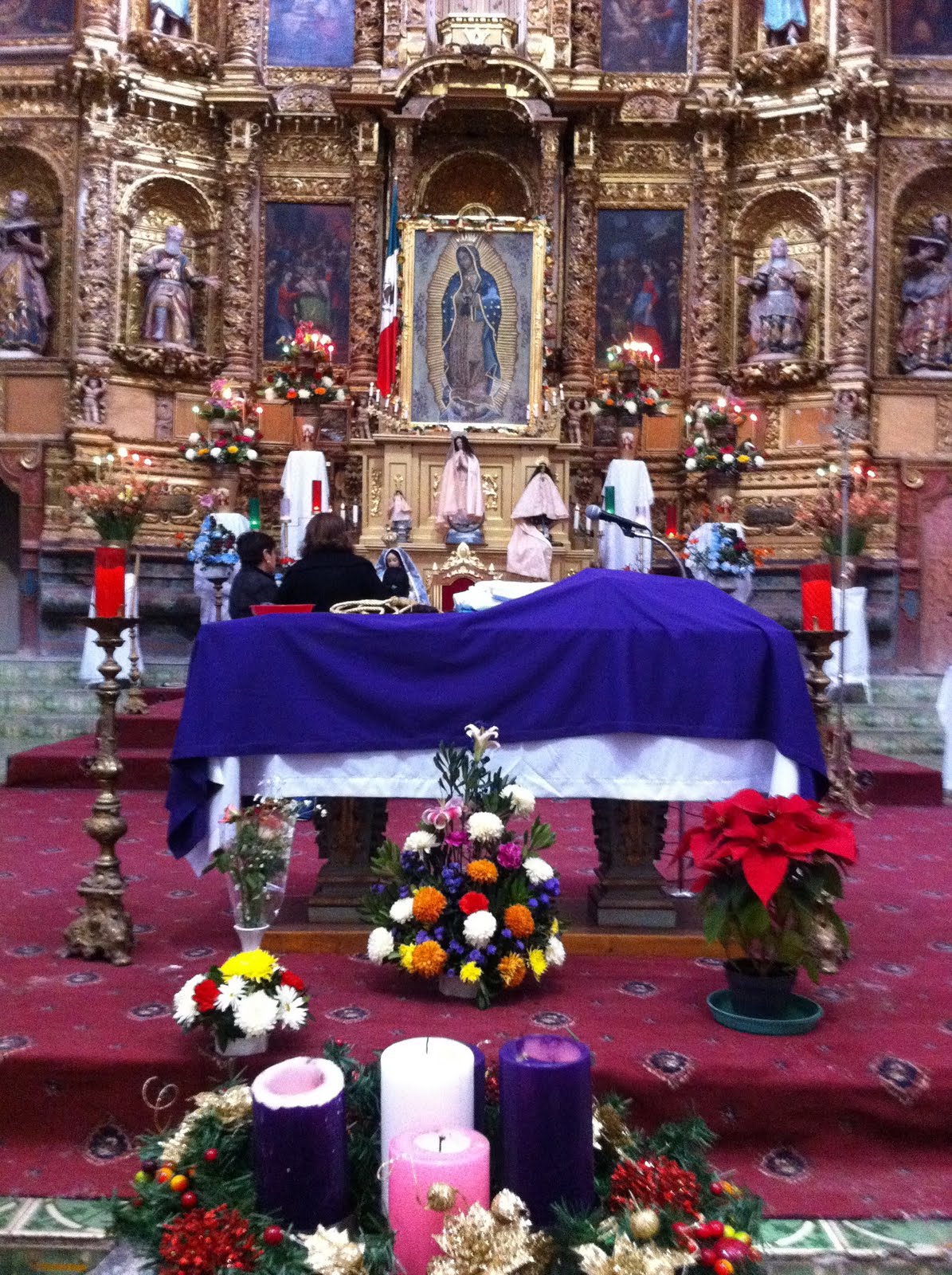
Nearly every business in Mexico has an altar. Perhaps in the Christmas season the altars are more prominent and elaborate than usual, but I have been visiting Mexico for some ten years now and I have always noticed the altars set up in every establishment, no matter how humble. The altar above was set up in a gas station: an ordinary Pemex station along the highway.

This picture is from our visit to the limestone caves above the city of San Cristobal de las Casas. As far as I can tell, the caves have no name besides "las grutas" which simply means "the caves." The entrance is located within a beautiful park about ten miles outside of town. It costs ten pesos to enter the park and another ten to visit the caves - about two dollars total for an incredible experience.

El Palacio Municipal (city center) lit up for Christmas with lovely magenta light. This building lines one side of the zocalo in San Cristobal de las Casas, providing one fourth of the gaudy, gorgeous pageantry surrounding the main square. Three bands were playing; couples were dancing; old movies were projected on rolled down screens; and of course dozens of artisans strolled hither and yon hawking their wares.

Tule: the largest tree of it's species in the world. The species is Taxodium mucronatum , a kind of cypress. It's trunk is the stoutest in the world. The tree towers over the church built in front of it. It is a lovely and impressive tree. The town is also lovely and impressive - about fifteen miles outside of Oaxaca, a goof place to visit, to eat at the mercado and but artesanias.

Hope and Paloma enjoying a few moments climbing all over the back side of Santo Domingo Church.


Beautiful and strange art installation in the corredor turistica in Oaxaca. Somone, or several someones, placed hundreds of hand built, unique clay people in the courtyard of Santo Domingo, the grandest and most ancient church in Oaxaca. It looked like a pilgrimage of Morlocks.
I absolutely cannot remember which of a hundred beautiful churches this is.

Chapulines. Grasshoppers, in other words. In pre-hispanic times, insects provided a significant portion of the people's protein. Even today, many species of insects are highly prized as food and command high prices. Chapulines are only one of many. Agave worms, Chinches, and Escamoles are only a few of the bugs one might find in a well-stocked mercado. Chapulines are the most available: the common wisdom holds that if one eats chapulines one will always return to Oaxaca.

It has always worked for me so far.

Saturday, December 31, 2011

How to Make the Most Beautiful Pinata (Mexican Photos Part Two)


The pinata is the universal celebratory item, is it not? I don't know if the pinata is a purely Mexican invention that has spread around the world, or if the idea of the pinata is a kind of cultural universal (I suspect the latter) but in either case, a pinata is a lot of fun and a must-have item for all festive occasions.

My children broke seven pinatas on this trip. That's by their own count. I kind of lost track. Pinata making is a cottage industry in Mexico, and many is the family that makes its living with newspaper and paste. The sad little cardboard factory made things that pass for pinatas here in the states are pathetic by comparison, and I hate buying them. Pinatas in Mexico are truly works of art, even if most of them are based on Disney characters and one might question the tastefulness of beating the little mermaid to death with a stick.

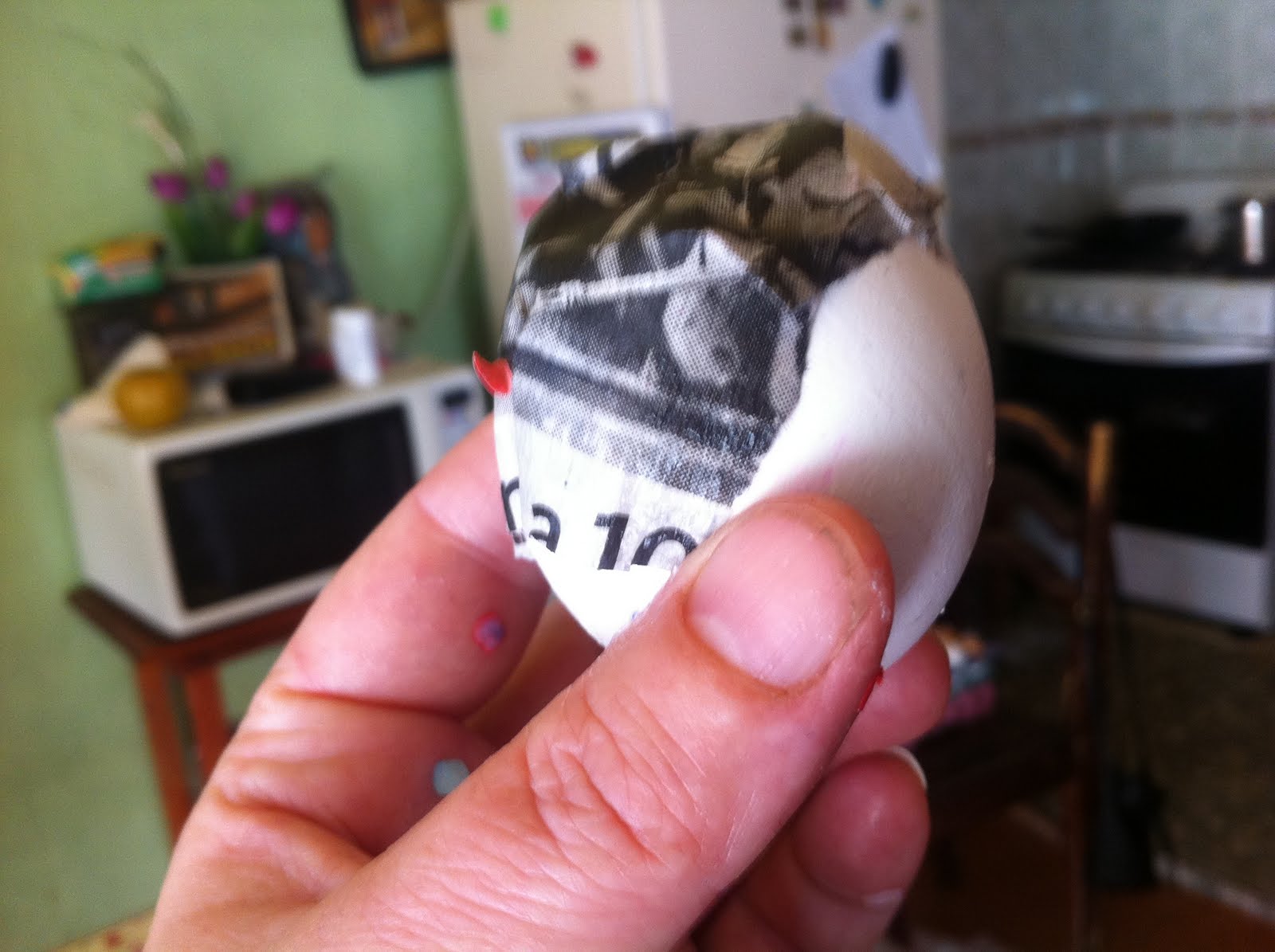
My sister-in-law Temy and her children made the most beautiful pinata I have ever seen - with small help from us. It is in the form of a branch of grapes, and is molded on a clay pot and covered with blown, confetti stuffed eggs. If you count the time it takes to save up so many eggshells, this pinata must have taken months to make. I hope to make one myself someday, so I documented the process. This pinata is truly for those with the Martha Stewart gene, so be warned. But if you want to make the mothers of the friends of your five year old swoon with envy, make this for her birthday party. Just start four months ahead of time.

The girls covering the clay pot with strips of newspaper glued on with a paste made from water and cornstarch. Since you are unlikely to come across an unfired round clay pot here in the states (and may also wish to avoid the risk of concussion), mold your pinata base on a balloon.

For several months ahead of time, anytime you use an egg, be careful to crack it only at the top, preserving as much as possible the shell. Set the shells aside to dry. When you have about 150 of them, buy a bag full of confetti and fill the eggshells with a spoon.

Use small strips of newspaper and paste to cover the openings of the filled eggs. Set the covered eggs out in the sun to dry - this will take a few hours to a day, depending on solar availability in your area.
Turn the pot upside down - or, if using a balloon, cut off a small opening on the top for filling with candy. Then turn upside down. Roll a piece of thin cardboard into a cone and attach to the bottom of the pinata (the top, turned upside down - get it?) with newspaper and paste. Let dry completely. Poke four holes in the rim of the opening and run twine through in a cross pattern. This is to hang the pinata later. When eggs and pinata are dry, use a hot glue gun to attach the eggs, covered side in, to the pinata. Start at the tip of the cone and work your way down on a spiral, trying to cover the pinata as closely as possible. When all are attached and dry, carefully turn pinata right side up and hang with the twine outside somewhere.

Use spray paint to paint the pinata grape-colored. This pinata has leaves made of cardboard covered with green crepe-paper, which is a nice touch. The hardest part is transporting the pinata after it is filled, so if possible make and fill the pinata on the same site where it is to be broken. Once it is turned right side up and filled, a strong person has to hold it at arm's length so the eggs don't break until it can be strung up.


It feels like a damn shame to destroy such a beautiful, painstakingly constructed object. You will not want to. I didn't. But the children have so much fun, they are so delighted with the crash and the shower of confetti and the candy. And there is something both terrible and elating about the violent destruction of beauty, especially of a beautiful object that embodies so much time and effort.

Breaking this pinata is like a tiny lesson in mortality. In all endeavors, natural and artificial, complexity occurs slowly and with effort, but can and will inevitably be reduced in a relative instant. Breaking the pinata is ritually laughing in the face of death, a beautiful celebration of ending. To break the pinata is to bow to the inevitable, but to do so with grace and spirit and joy.

How very Mexican.


Friday, December 30, 2011

Mexico Photos Part One (Shout Out to Rowan)

The trip home was almost interminable - we were up at 5 am two days in a row - but is it finally over. We arrived back at the farm around two o'clock this afternoon, to some very excited dogs and other animals. Everybody is fine and healthy.

Rowan did an amazing job taking care of the place and deserves some public props. For almost three solid weeks she was fully and solely responsible for feeding the horses, goats, chickens, dogs, rabbits, and cat twice a day. For the first week we were gone, the hose was frozen solid and she had to haul warm water in buckets, a nasty job. She kept the house clean (or at least cleaned it before we got home) and even threw a Christmas party for a bunch of teenage friends without wrecking the place. She dropped us off at the airport (125 miles away) when we left and picked us up when we arrived home. She did a bang-up job, and I'm extremely proud of her. Thanks, sweetie.

According to my iPhone just now, I took 488 pictures while I was gone. This is what happens in the digital age, I guess. I am old enough to remember buying three or four rolls of film before a trip and being choosy about what I photographed. Nowadays everyone - including me - just walks around with a camera raised to their face pretty much all the time. This actually drives me batty, in much the same way that people breaking off a conversation in mid-sentence to answer their cell phones irks me, but I am nearly as guilty as everyone else, so I am ashamed to complain.

However, the compensation for seeing Mexico on a three by three inch screen is that I do, in fact, have a lot of very nice pictures. In the old days, I used to come home and eagerly develop my precious 36 frames, usually to discover that 22 of them were complete crap. I specialized in pictures of my own feet. Now, even though the crap:pleasant ratio is about the same, I have a lot more to sift through and can come up with a few pictures worth sharing.

Here are some of them, in no particular order:

Homero sitting on a wild horse. Not kidding. This was during our trip to Crecencio's village to deliver some gifts to his family (A Visit to La Mixteca Baja, Mixteca Trip Part Two, Take Three, Damnit!). The young man holding the horse's head actually went out into the hills and captured that horse, brought it home, and broke it and trained it himself. He is seventeen. The boy, not the horse.

On the way out to Crecencio's village, we stopped to visit the ex-covent of Yanhuitlan. Passing by, Temy, my sister-in-law, noticed it was open. She yelled "Stop!" Apparently, it is almost never open. It was well worth the delay. This enormous and beautiful temple-complex (I don't know what else to call it) was built in the mid sixteenth century by the Dominicans. Well, actually, as the caretaker told us, by six hundred native Mexicans working every day for twenty five years. I have my doubts about whether a single Dominican priest ever lifted a single stone. But breezing right by that (shall we) it is a place of extreme beauty. To be honest, now that I look at the above picture, I think it is probably not of Yanhuitlan at all, b ut instead of one of the apses in Santo Domingo in Oaxaca City. Hmm. So many beautiful churches in Oaxaca, they blend together after a while. But Yanhuitlan's beauty is austere, and Santo Domingo's is baroque. Well. Either way.

Ahem. Moving on. Below is a very ordinary, typical street scene in central Oaxaca. The streets are cobblestone; the buildings are stone or stuccoed adobe, still habitable and functional after five hundred years. The native stone that much of the city is made of is called cantera, and is usually a beautiful light green, though sometimes rosy pink as well. The building on the left is made of cantera. The small fountain in front is operational, and is a favorite place for young lovers to pass a few minutes "tortorleando." Literally: acting like lovebirds.

Below: street corner on the edge of the Mercado 20 de Noviembre, which is the main central market. Plenty of people still shop there for their daily goods, but it has largely become a tourist attraction. That is not to say, however, that you should pass it by if you happen to be in Oaxaca. By no means! Go! The market is a real experience. It may give you a migraine from the press of people, the competing music blaring from adjacent stalls, the mixed up smells of raw meat, rotting flowers, fresh herbs, copal, and sweat, but if you go to Oaxaca and miss the central market, you may as well not have gone.

Besides, the other option is the Mercado de Abastos, where the majority of city residents go when they want to shop (those that don't go to Wal-Mart, that is) and that place is scary as hell. The Mercado de Abastos is for professional adventurer tourists only. There you can hire a brujo to take a curse off of you, or get a pirated version of a movie that isn't even out in theaters yet, or buy anything from a live chicken to a pair of fake monolo blahniks, but you can also get lost irrevocably in the vast labyrinth of tarp-backed puestos, and I am here to tell you that that is not a fun experience. Once was enough for me: now I stick to the Mercado 20 de Noviembre, touristy though it be. It's plenty colorful enough for me. Look below and you'll see.

Senora Maura's garden. Although her patio is very small - perhaps only 10 by 30 feet or so - she has managed to create a very serene and beautiful haven. The concrete walls are dusty pink, and dozens of terra cotta pots are planted with flowers and edibles. The two trees in the photo are a papaya (left) and a pomegranate (right). She also has a chayote vine (that's mirliton to you southerners) and a chile de arbol. A bird of paradise plant blooms along the other wall, and night blooming jasmine scents the evenings. It was a beautiful place to spend a few hours on a warm December night, chatting and drinking mezcal.

In my experience, if I may generalize, Mexicans have a gift for creating beauty in small, intimate spaces. As tourists, many Americans never have the opportunity to get behind the two-story wall of concrete that lines every Mexican street. From the perspective of a tourist, Mexican towns can seem loud, dirty, and claustrophobic. Those damn unbroken walls of cement! There are no sight-lines - all views are blocked by walls. The noise of unmuffled trucks and loudspeakers announcing God-knows-what at high decibels bounces back and forth against the concrete walls. The walls are decorated with spray paint, much of it artless graffiti or poorly drawn representations of Disney characters.

What the unlucky tourist may never know is that just on the other side of each of these walls is a shady, serene courtyard. Every home, no matter how humble, encloses a central space open to the sky. In the city center, the most gorgeous, expansive colonial homes may have three or more courtyards, gardens, fountains, balconies, trees - but none of that will be evident from the outside.

Mexico, somebody talking about sex once said, is not a prudish culture, but it is intensely private. I think that is true of its houses, as well. Homes which are closed up tight as an oyster yield lush, sensual hospitality once you are granted entrance. There are no people on earth as generous, as fun loving, and as welcoming as Mexicans - but you might not guess that from the impassive faces you see in the street. Mexico has a great poker face. But get it to crack a grin - and it's the most beautiful smile you've ever seen.


Tuesday, December 27, 2011

Almost Over (Recreation)

This may have been the shortest three weeks ever. Oour time in Mexico just sped by, we were busy just about every day. Anyone who has moved far from home, but whose relatives mostly stayed put knows that a visit home isn't really a vacation. There are so many people to visit, and the holidays superimpose their own hectic schedule.


Christmas was nice. Homero's grandmother hosted. Abuelita Adelina doesn't know how old she is, having been born in a time and a place without birth certificates, but her oldest child is well into his seventies. Adelina has slowed down, of course, but she is still capable of getting up at six am and making enough tamales to feed a crowd. Dinner was tamales, roast chicken, a delicious and interesting potato/apple salad, and ponche. Ponche is basically a whole lor of fruit - mostly things we don't have at home and that I didn't even recognize, such as tecojote and ciruela and guayaba - thrown into a kettle with cinnamon sticks and boiled for a while. It was very good, especially with a little "piquete."

I used the children as an excuse to go home and go to bed around midnight, but of course the party went on. As it did in the streets all around us. Mexicans love fireworks, the bigger the bang the better they like them. It sounded like Christmas in Afghanistan until about three a.m. Oddly, I've become accustomed and can sleep through most of the fireworks, the packs of howling dogs, and the rediculously loud music. At home, I sleep with blackout curtains and ask everyone to please use headphones after eleven. I am only a few steps away from Michael Jackson, sleeping in a sensory deprivation tank. Truth is, I'd LOVE a sensory deprivation tank. Here, I guess I've acepted the fact that there is absolutely nothing to be done about the noise. I can make my own dog stop barking at home, but a chorus of raggedy ass Mexican street curs? Not likely. Pull the covers over your head and shut it out.


The weather has been pretty much delightful the entire time. The first couple of days was very hot - maybe 90? - and I wasn't careful. I took a long walk and didn't hydrate enough and ended up with the most massive migraine ever. I thought I was going to die, but luckily our resident physicians (my brother and sister in law) went to the pharmacy and brought back something that killed the migraine in fifteen minutes flat. I know the Spanish name but not the English name. I plan to bring some home, if I can. After the first few days, the weather has been terrific. Still hot enough to be aware you are in Mexico, but not can't-move hot.


Yesterday, Mama and I took all four little girls out to a water park some twenty miles out of town. It would be a small water park by US standards - it isn't a third the size of the birch bay waterslides, for example - but it was heaven for us. Three tall waterslides (even though one of them gave some pretty hefty electrical shocks when you first step in) and three pools for swimming. The air was hot and the water was cold and they sold beer and snacks and I had sunblock with me and it was great.


After the waterpark, we went to see some nearby ruins that Mama had never seen before. There are so many prehispanic ruins around here that only the largest, such as Monte Alban, ahve any kind of national or international name. The entire state is covered with medium and small ruins that were once towns or noble houses. This was a heavily populated area before Europeans arrived. The ruin we went to see is called Yagul, and was probably once a pretty good sized town. It has a very well preserved ball court and the remains of a rambling palace that they call the labyrinth. For good reason! We ran around the inside, up and down narow corridors, finding small courtyards and shouting to each other over the shoulder-high walls. we could see each other's heads, but we couldn't reach each other in the twisty passages. The children adored it.


Today we are having a quiet day, relaxing at home and sorting through our luggage preparatory to packing up. Later on this afternoon, we will take the children downtown and take a tour through the city botanical gardens, something I have meant to do on every visit but haven't yet. Tomorrow is our last full day here. We leave at 6 am thursday, first taking a six hour bus ride to Mexico City and then two flights home, with a two hour drive home from the airport on the other side.


I am ready to go home. I miss Rowan, my oldest, who stayed home to watch the farm. I miss the farm. I miss my dog and my goats. And my sister. Not necesarily in that order.


Thursday, December 22, 2011

Honeymoon in Chiapas

Everyone should wait and have their honeymoon after they've been married several years. That's when you will need it. Think about it - before you get married, before you have kids, it's all honeymoon, all the time. A decade after the wedding, when you have two or three kids, a mortgage, jobs... when you have to squeeze making love in between putting the kids to bed and washing the dishes. In our case, we took our honeymoon for our tenth anniversary. It was supposed to be Hawaii, but well, here we are in Mexico again.

I don't miss Hawaii one bit. Someday I'll get there. For now, we had Chiapas. Alas, we only had three days. We could have easily spent a week. Ten years ago, Homero and I and then-seven-year-old Rowan took a week long car trip around parts of southern Mexico, including some of Chiapas. We went to Palenque, one of the largest and best excavated Mayan cities in Mexico. An amazing sight. On this trip, I had hoped to be able to visit another Mayan site, either Bonampak or Tonina. There just wasn't time. Even though new superhighways have sprung up all over Mexico, linking once remote places, the distances are just too great.

As a matter of fact, we spent most of our three day honeymoon driving. It took us eleven hours to get from Oaxaca to Chapa de Corzo, the small town on the banks of the river that runs through el canyon de sumidero. But we weren't hurrying. We stopped here and there to look at this and that, to eat, to take pictures. And we like driving, even on these incredibly mountainous, curvy roads, where every quarter mile there is a litle cross set up to show you where somebody plunged 500 feet to a grisly death. The views are awesome. Once again, I apologize for not having pictures up, but I still can't figure it out. When I get back home I'll put up all the photos at once.

One of the towns we passed, Matatlan, is famous as the world capitol of mescal. If you don't know what mescal is, the easiest way to describe it is as Tequila's countrified cousin. Both are distilled from fermented agave, but the name tequila is restricted to that produced from one species of agave and produced within a certain area, mostly, I think, the state of Jalisco. Oaxaca is where the greatest quantity and variety of mescal is made, and much of it is still made in small family run operations that produce mescal in small quantities, the old fashioned way. We stopped at one such operation, and watched the pit roasted agave hearts being crushed by a stone wheel driven by a donkey. The fermentation and the distillation all takes place on site. We bought a liter of mescal fresh from the still for 30 pesos, or about $2.50. Of course, the good stuff is aged in oak for three years or more, and we also bought a liter of that, for the rather more exorbitant price of 110 pesos, or about 9 bucks.

We packed a lot into our one full day of no driving. In the morning we took a tour through the canyon, which is narrow and very deep. At the deepest point, the walls tower 300 meters above the river. The walls are sheer, just about perfectly vertical, but nonetheless cactuses, aloes, orchids, and even trees grow out of the rock face. We saw four alligators. One of them was about three meters long.

After the tour, we jumped into the car and drove to San Cristobal de las Casas. This beautiful, colonial town has become too famous for it's own good. Fifteen years ago, it leapt onto the world stage as the home of the zapatistas, and ever since it has been inundated with tourists of every description, from well-meaning journalists and anthropologists to culture-vulture hippies and "extreme" adventure tourists. The houses, streets and churches are all as gorgeous as ever, but now you walk shoulder to shoulder with crowds of sightseers.

Nonetheless, we enjoyed it. The zolcalo was lit up for the holidays, and a marimba band was playing. We danced in the street alomg with several other couples. Homero bought us a ride in horse and carriage through the old streets, and the guide pointed out sights of interest. We ate pizza and bought a ridiculous number of tchatkes from tiny children in traditional clothing. It's hard to say no to a five year old selling painted clay animals for five pesos apiece, especially when said five year old has eyes the size of dessert plates.

Some ten miles outside of town there is a park, located in a pine forest (that tells you how high San Cristobal is, to have a pine forest in the tropics). In this park is the entrance to a limestone cave. It is a living cave, and there is a half mile long walkway built inside, with some few and far between lights strung up. They are nothing like the Oregon caves, for example, but still ´pretty impressive. I try never to miss a cave, wherever I am. I love caves. The entire lower half of Mexico is riddled with caves, and I'm sure this one goes on and on beyond the place where the walkway ends.

The next morning we drove back, again ambling along stopping here and there along the way. The children didn't miss us at all, says Mama. They had a wonderful time playing with their cousins and eating as much candy as they could stuff in their faces.They went to three posadas and broke three pinatas and stayed up till all hours. They are probably sad we are back.

Time flies. Less than a week left. Christmas is the day after tomorrow (they celebrate Christmas eve, not Christmas day). Then just a couple more days to pack, buy last minute gifts, and we,re off back home. I know Rowan has been taking excellent care of the place, but I´m still anxious. I want to see Rowan. I want to check out the animals. I want to cook in my own kitchen again. I'd even like some cold air - it's been above eighty every day here, and at night it cools down to about sixty.

More later.

Sunday, December 18, 2011

Take Three, Damnit!

RRRRGH if i acidentally move the cursor I can't get it back it goes to the beginning of the post and I can't move it. Okay here we go I was takking about wild horses.


..... they are not truly wild but they know the touch of man on only two occasions - when they are caught and branded, and when (if) they are caught and brought to the village to be tamed. I was told, though I find it hard to believe, that a man will rope a horse and run it down and grab it by the ears and bring it to the ground. It's true they aren't very big - this one was about twelve hands, and small framed - and also that the men are ncredibly tough, but even so. I can't picture a man wrestling a horse the way they wrestle steer in the rodeo.

This teenager, however, was the absolute picture of an old fashioned Mexican charro. It was a real pleasure to watch him ride. He had a saddle - a gorgeous hand tooled leather saddle, and a bridle, but the bridle had no bit. It was pure neck reining. I have a photo but I can't upload it until I get home.

I also enjoyed seeing the harvest of corn laid out on the houses sroops to dry. The whole year's harvest was piled up in mounds to dry, and soon the people will seoarate the seed coen from the food corn and will twist the seed off the cob. It is very easy to do - I tried it, and also put a handful of seed in my purse. Next year I intend to see if criollo oaxacan corn will grow in northwest washington.


There is so much more to write, and I'm so frustrated with the limitations of this stupid keyboard. Tomorrow morning early Homero and I are off on our honeymoon trip. Three days in Chiapas. We are driving from here to Chiapas de Corzo, and then el canyon de sumidero. If we have time, I,d love to see Bonampak, but that deoends on how the children take to being left alone with abuelita and their aunt Temy.

More to follow!

Mixteca Trip Part Two

sorry about that folks, im trying to type this on a tablet and i haven't got the bugs worked out yet. I can't seem to go back and edit, so any mistakes i make will just have to stay.


ok, we arrived in San Pedro Nopala at about noon, and were greeted like kings and queens, with tamales and cold beers and wide, delighted smiles. The village itself is not one of the most pictaresque, but it is typical of the region, and the setting is gorgeous. It is nestled into a narrow valley among high, eroded hills, covered in scrub and scattered trees. The earth in that region is very strange, almost white. San Pedro Nopala has a small, stone church with a handsome courtyard planted with roses, and the streets climb the hills at alarming angles.

Up one of these steep hills we were welcomed into a traditional kitchen, separate from the rest of the house, with an open fireplace for cooking, on which a giant pot of tamales was bubbling away. About fifteen people were there to greet us, not counting the half dozen young children tumbling about. After distributing our gifts, we passed the time chatting and drinking beer while the children played outside. A teenage boy, younger brother of one kf our friends, arrived with his horse and gave the children turns sitting on it.

No ordinary horse, this was one of the wild horses that runs in the hills surrounding the village. I asked how many horses there were, and got a vague answer, maybe somewhere around a hundred. They are not exactly wild - there are no true wild horses in North America - but they are a free-running, free-breeding herd that knows the touch of man only on two

A Visit to La Mixteca Baja

Oh how annoying it is not to be able to upload photos! Bro, if you read this, please tell me again how to do it on my iphone. Doesn't blogger have an iphone app?


Yesterday we went on a daytrip to a tiny village in the mixteca baja region called San Pedro Nopala. Our good friend Crecencio is from there, as is his wife and cousins. When they heard we were going to Oaxaca this christmas, they asked us to bring gifts for their family. This always hapens, by the way. If you know any Mexicans and you are going anywhere in Mexico, expect to be regaled with backpacks and cellphones, jewelry and cameras and such to deliver to your friend's loved ones.

In our case, we were convinced to bring a backpack full of gifts and an electronic piano, which must have weighed a hundred pounds, in a hard case. The relatives would have sent someone to Oaxaca city to pick up the gifts, but Crecencio was excited for us to see his village and meet his parents. "If you think I can barbecue a g
oat, "he said, "wait until you try my father,s barbecue. No, hombre!"

About an hour north of Oaxaca, we turned off the autopista at Noxchtitlan. We stopped at an incredible ex convent that happened to be ooen at a place I can't remember, but it was pretty incredible. The caretaker there told us it was started in the year 1550 and that 600 men worked for 25 years to complete it. Six hundred poor indians, I thought, but did not say. And though I feel terrible for even thinking such a thing, it occurred to me that through force and torture had emerged a thing of eternal beauty and power. Though surely the means does not justify the end, I couldn,t help but marvel at the finished product.

We only got lost once on the way to the village, which lies some twelve kilometers off the paved road. We stopped and asked an old man resting next to his burro in the fields and he set us straight. As an aside, this particular trip was an eleven donkey trip. Whenever we go on a roadtrip in Mexico we count the donkeys we see by the side of the road. There are fewer now than there were a decade ago. When i first came to Oaxaca, this would surely have been a twenty donkey journey.
e a goat," he said, "Wait untik you have my father's barbecue. No, hombre, no hay nada asi."

Thursday, December 15, 2011

Arrival

The trip took 22 hours, but we made it. Well, if you count from the time we left our house, it was more like thirty six hours. We picked up the girls from school on monday and drove down to my moms house, where she had prepared a beautiful Christmas dinner and gave us our present. A very nice present, this Zoom that I'm writing on. Its a little more limited than a laptop, and i haven't yet figured out how to put photos on the blog, so those will have to wait.


After our Christmas with mom, we drove to the airport and found the closest, cheapest hotel we could find, drew the curtains, and set the alarm for 4 am. Our flight left on time, at 6:00, and we had no trouble with security or anything else. However, we had a plane change in Dallas, and it was a very tight connection. In fact, the boarding time listed on our pass was five minutes after the landing time of the first flight! And I had never been in the Dallas airport before, but it is by far the biggest airport I've seen. Of course, the gates were as far apart as they could possibly be. There's a train, but even on the train it took a full ten miutes to get there. We arrived at the second gate sweaty and panting, but in time.

Landing in Mexico City, we were supposed to meet my brother and sister in law, who had driven up from Oaxaca to pick us up. That's a six hour drive. As my sister said, when I told her, "That's like driving from Bellingham to Eugene Oregon to pick someone up at the airport!" Yep. That's what Mexican families do.

However, we couldn't find them. We spent a very nervous half hour sitting on our luggage in the main terminal and fending off offers of "aid'" while trying to decide what to do if they didn't show. Find a hotel and stay overnight? Rent a car? Try and get a bus? We couldn't make our cell phones work and no-one was answering the house phone. Homero was more worried than I was, I figured they were waiting at a different door somewhere. As it turned out, they were circling the airport to avoid having to park and stopping in to check each time they came around to the loading zone. And they found us before actual panic set in.

By the time we got outside of the city, it was sunset, and we had a gorgeous view of the two mountains, Popocateptl and the other one that looks like a sleeping lady, pink and glowing in the hazy late afternoon sky. The drive was long, but enlived by lots of happy talk and gossip, and the batteries on the Zoom held out so the kids were okay, and we arrived at Abuelita's house about half past midnight.

Of course Abuelita had food and cold beers waiting for us, and after we carried the children to bed we stayed up talking and eating and drinking until about two in the morning. Then we fell inro bed and slept like the dead unril noon the next day.


I hope I can figure out how to add pictures from here. If not, I will add them when I get home. We have so many great things planned. Homero and I are going on a short honeymoon for our tenth anniversary to el Canyon de Sumidero (google it, it's gorgeous). Our goat butchering friend Crecencio is from a small village not far from here, and we are going there to bring his family some gifts he sent with us and to attend - what else - a goat barbecue feast in our welcome. That is sure to be interesting.

It being Christmas, there are all sorts of things gojng on in the centro - parties, concerts, shows and displays, church processions, posadas, and of course the night of the radishes. Three weeks seems like a long time but it really isn't. Not when there is so much to do! More later, it isn't very east typing on this zoom thingy.