"United we bargain, divided we beg."

Wednesday, May 26, 2010

One Giant Leap for Cheese


It's been only two days since the last two baby goats were picked up, and already I have run out of room in the refrigerator for milk and cheese. I am frankly stunned by the amount of milk three dairy goats produce daily. Yes yes, I have had three milking does for three years now, but this is the first year that I have bit the bullet and actually sold the kids while they were still babies. In years past, I have kept the kids until they grew up and weaned themselves. Then I sold them for meat.

Sure, theoretically, I knew that each doe would produce about a gallon a day, split between morning and evening milkings. But three theoretical gallons are very different from three actual gallons taking up all the very literal space in my refrigerator. I need to make cheese every day just to reduce the cubic volume somewhat - a gallon of milk makes a pound of cheese, which occupies much less space.

Today I made cheddar, and yesterday I made black pepper chevre. The day before that I made paneer. The trade network will be able to absorb some of this excess, but not all of it. As I am not a licensed dairy, it is illegal for me to sell cheese or even milk. I am not entirely sure of the legality of selling milk "for animal consumption only" but I advertised it that way on Craigslist nonetheless.

What I really need is a way to reliably age hard cheese. I can make cheddar, but without a "cheese cave" - a climate controlled area - I can only keep it for a month or so before it begins to mold. It's delicious young, but that's not the point. The point is, how can I store my summer excess for winter?

This is hardly scientific, I know, but my best idea so far came from the "Little House" books. Ma Ingalls used to paint her cheeses with wax and then set them to age in the root cellar, turning them every couple of weeks. I can buy paraffin cheaply at the craft store. It's worth a try. I don't exactly have a root cellar, but I have a crawl-space and a lockable cooler.

The other possibility is convincing my husband to have a go at converting an old half sized fridge we have sitting out in the garage into a cheese cave. What I need is a box that will maintain a temperature of between 45 and 55 degrees, and a set humidity which I'd have to look up. He likes to tinker, so getting him to give it a go isn't too far fetched. Getting him to maintain interest long enough to make it actually work, though...

The last possibility is training myself to look upon my astounding surplus of milk as a golden opportunity to experiment with tricky cheesemaking techniques and obscure products. I'm dying, for example, to learn how to make Oaxacan quesillo - a delicious kind of string cheese. My husband would absolutely swoon if I succeeded in making quesillo. I haven't attempted it before because it's difficult and I would certainly fail a few times before I succeeded.

I am rather a miser when it comes to milk (and eggs) and I find it very hard to launch an experiment which might very well result in the loss of a few gallons. Nobody knows what an investment of time, sweat, and tears those gallons represent but me. I am the same way, actually, with paint and canvass. Lord knows the masterpieces I might have created if I could just get over my fear of wasting materials.

Whaddaya say - shall I risk a little milk in pursuit of new and superior cheese? Some gourmand said (I read in a book of quotations) "Cheese is milk's leap toward immortality." If immortality isn't a goal worth risking a little raw material for, well, whatever is?

Tuesday, May 25, 2010

Aimee, All Alone (Top of the World, Ma!)

Day three of running the whole shebang by myself. I know that there are plenty of women who run larger operations than mine by themselves, day and day out, and who do it admirably. If any of those women are reading this blog, bully for you, babe, I salute you, but it's kicking my ass!


It's unfortunate that Homero's unscheduled vacation (he spontaneously decided to drive to Oaxaca) coincided with the beginning of milk-around-the-clock season. I am getting up a half hour early to milk and get everybody ready for school, and what with one thing and another, I pretty much don't sit down until bedtime.

Then I don't sit down, I fall down.

I never realized there was so much slack in my schedule before. I felt pretty busy a week ago, too, but it wasn't even in the same league. One thing's for sure - if I ever have to be a single mother (touch wood), I sure ain't milkin' no three dairy goats every damn day. Homero, if you ever entertained thoughts of leaving me, give it up! You ain't goin' nowhere!

This morning was particularly rough. When I went out the the barn to do chores, it was raining lightly. I realized I had left the brand new bags of chicken food and goat food out last night because I can't maneuver my way through the chained gate and operate the latch on the barn door while carrying a 50 pound feed sack and fending off four frantic goats without help. Well, I couldn't do that any better in the morning than I could at night, so I cast about for something to cover the bags with. I spied the 75-gallon rubbermaid water trough, which thankfully was empty. I lugged the tank over, then tried to pick up the sack of goat feed and put it on top of the sack of chicken feed. It seems, however, that the light rain had already weakened the paper and the sack split in the middle spilling all the grain on the ground. So, swearing, I ran around looking for a couple of five gallon buckets and some sort of scoop. At least the ground is dry and hard and so I didn't lose any grain to the mud.

Scooping up the last of the grain, I decided to sprinkle it over the hay in the new fence-line feeder that Homero built for me. The fence-line feeder is basically a big box into which you put a whole bale of hay on the OUTSIDE of the pasture. The goats can stick their heads into the box but they can't trample the hay. It was a massively heavy hinged wooden lid on top to protect the hay from rain. I lifted the lid and started to sprinkle grain. Then I noticed four eggs in the hay (the chickens can get in the feeder and love to lay in there). As I bent over to get the eggs, the lid fell on my head. I don't know why Homero made it so heavy, using both plywood AND
T1-11. He could have just used the siding.

Then I went in to milk. These days I carry two half-gallon glass jars to milk into - between the three does they both get full. While I was milking Flopsy, the last doe, into an almost-full half gallon jar, she kicked and made me spill it all over myself. "Oh you horrible goat!" I shouted. "I hate you!" And at that moment, I truly did. I hated the goat, my husband who left me here all alone, myself, and basically the whole world.


Sunday, May 23, 2010

Daily Grind: Stuff That Got Done

- Goats got milked at 8 am. That's pushing it, and I can only do it because each doe still has one baby on her. Starting tomorrow, it's 7 am at the latest. Got about 3/4 gallon all told. Together with yesterday's take, I had enough for


- Cheese to get made. Just paneer, but I like it more and more. It's soft, mild, easy to make, and the kids love it.

- Potatoes got hilled. Since I planted my potatoes so early - back in mid february - it's already time for them to be hilled up. I hilled up the 40 foot row while watching the

- goats and ponies get grazed. On nice days when I have a little time, it's important to let the goats and ponies out to eat outside the main pasture. It spares the pasture for the rest of the season.

- Brownies got baked for a party that it turned out we missed entirely. Somehow we thought it was an evening function, when in fact it was a luncheon. During the baking of the brownies,

- garden got munched. The G*&%$!@ goats took advantage of the five minutes I went inside to pop the brownies in the oven to eat most of my snap peas and half of my runner beans.

- Poppy pony got a little bit of training. While tied out to graze, I brought out a blanket and waved it around and threw it over her back and leaned on her for a while. God I love that pony. What a doll.

- goats got milked again at 6 pm.

- dishes got washed and dinner got made. Everybody got fed tuna melts and brownies.

- Blog got updated. This is it. Now we are caught up to reality.

I just learned that I will be holding down the fort alone for much longer than I thought. Homero is gone to Mexico and has decided to stay with his family for a few days before heading home, so it's just me here for probably a whole week. I'm not thrilled about it, but I think I can handle it. I'll keep you all updated on how it goes.

Saturday, May 22, 2010

"Chatelaine" - New Recurring Feature

In trying to keep better track of the products of the homestead, I've decided I should invent a new category here on the blog. It will include all aspects of food production - garden, meat and eggs and milk, honey, and orchard products. It will also detail what I am doing with said products - processing for home consumption, trading, selling, et cetera.


In the past, all this sort of thing has been chopped up into the categories of self-sufficiency, preserving, finances, gardening, and the like. I will still use those tags so that people can search by them, but I think I will add a new tag called "Chatelaine" (Thank you Sharon Astyk- The Chatelaine's Keys). I love the concept of the chatelaine - the word is so much more romantic than "housewife" though the duties are actually much the same.

A chatelaine oversees the stores. She supervises the garden, the orchard, the apiary, the coop, the stables, the dairy, and the kitchen and pantry. She keeps the books describing what supplies are on hand and what are needed. Such supplies would include, for example, not only human food but animal fodder. They would include preserving supplies such as salt, jars, sugar, pectin, and cheesecloth. Also fertilizer, garden tools, wire and rope and all the various necessities of farm life. The chatelaine knows the state of health of every animal on the spread, when it is time to turn the compost pile, how many bean seeds to order, and how the chickens are laying.

She maintains the trade network. She knows the neighbors, and what each of them needs, wants, and has to offer in trade. She walks the pastures and knows the state of them. She inspects the barn and knows what repairs need to be made. She maintains contact with the veterinarian, the farrier, the orchardist, the guy with the big tractor, the mechanic, and the butcher. She oversees the state of the kitchen equipment, maintaining and replacing as necessary pots and pans, sieves and colanders, brooms and mops and soap and dishes and silverware. She shops for the staples of dry goods (pulses, grains, canned goods, and spices). Whatever is needed, she knows if you have it, how much, and if not why not and how to get it.

I believe I may have already combined the office of chatelaine with that of overseer or foreman, but even so, I have not yet begun to describe the duties of the housewife (which is to say, my duties). The housewife, in addition to being responsible for procuring the supplies necessary to the baker, the cheesemaker, the cook, the maid, the gardener, and the governess, does in fact actually perform all of those duties herself - myself.

I am the chatelaine, the accountant, the goatherd, the flock-keeper, the beekeeper, the cook, the gardener, the baker, the housekeeper, and not to even mention, the freakin' mother of the children and the wife. I am responsible for everything I have described above, plus the education and well-being of my children, the satisfaction of my husband, and possibly the survival of civilization as we know it.

I feel I have strayed into sarcasm, which was not my intention. I actually do admire and aspire to the office of chatelaine. It is a pretty good word to describe a large part of my job. I'm going to claim it and use it. I'm actually going to to try and fulfill the office - well, I have already been trying to do so, and let me tell you, it's not an easy job. Especially when you your other job is "housewife."

Baby Goats Go Bye Bye Bye


Yesterday some folks came and picked up their baby goats. Tomorrow two more are scheduled to be collected. I will be down to one baby goat, from an original eight. The only unsold baby goat is Django's doeling, who is kind of runty and not really very cute. For a baby goat. I think she will probably end up as meat. That's her in Paloma's arms, on the left. Shhh.


Django and Iris each have one kid left, and they were used to feeding triplets. So they need to be milked twice daily. This morning was the first milking, and they each gave me about a quart. After the last babies are gone, that will go up. Time to start making some cheese!

Flopsy, on the other hand... sigh. She still has one baby on her too, and apparently that's all she can feed, because she never has more than a cup or so for me. I am leaning more and more strongly towards selling her as an in-milk doe as soon as her babies are gone. I am torn - she's one of my healthiest goats, she doesn't have the parasite problems that Iris and Django do, and she throws the most incredibly beautiful kids! However, she is Storm Cloud's mother and so he shouldn't breed her and I am committed to using him as my buck for at least one year. Also, Flopsy had mastitis as a first freshener, and although she made a full recovery and has had no reoccurrence so far this year, it does tend to recur in the same animals over and over.

Maybe I'll advertise her - disclosing the history of mastitis of course - and see is anyone bites.

Meanwhile, we have a whole year to go before more baby goats!!


Wednesday, May 19, 2010

Appliance Recycling

We have terrible luck with appliances. Really just very very bad.


Last December, the furnace died in the middle of the one and only cold snap of the year (Freezing My Tuchus Off). The toilet in the second bathroom (a toilet counts as an appliance, right?) is apparently possessed by evil demons and finds it amusing to erupt for no particular reason two or three times a month. Two different plumbers - plus my husband - have failed to fix the toilet. My refrigerator died for the third and final time on Thanksgiving Day last year ( A Fine Day).

And then there's the washing machine. When I moved here, I was all exited about the chance to buy a fancy-schmancy new energy and water efficient machine. I spent a ridiculous sum on a brand new washer/dryer set - the first time in my life I had ever bought brand new appliances. Turns out, that might not be such a great idea.

I am thirty-eight years old. I moved here three years ago, when I was thirty-five. Thanks to a generous Grandfather, I bought my first house when I was twenty-one. Twenty-one to thirty-five is fourteen years. For every last one of those years I enjoyed the services of a single washing machine, a single dryer, a single stove/oven, and a single fridge. The washer and dryer were in fact inherited with the house and I don't even know how old they were. They were avocado green, so that says pretty old to me.

Back when appliances were built to last in other words. My new washing machine - a front loading, energy star rated Kenmore - lasted all of a year and a half before it began to break down. Homero fixed it three separate times, each time (so he claims) for a different problem. Finally we became to frustrated with the evil machine that we beat the hell out of it and threw it off the front porch.

Then I went to the used appliance store and bought the very same model that had served me so well for so long back in my old house. For one sixth the price of the new one.

Homero is using the old one to make a centrifuge to clean waste veggie oil for biodiesel processing. His biodiesel processor consists of an old recycled water heater and now an old recycled washing machine. Plus the old dead furnace is in his shop waiting to be converted into something that can run on biodiesel.

Here's hoping that the embedded energy in the broken appliances can be reaped in one way or another into the future.


Monday, May 17, 2010

State of the Season, 49th parallel, 2010

This was such a strange year, what with the warm winter and the bizarrely early spring, that I decided to begin keeping track of the timing of the change of the seasons here on the farm. (It's Called "Phenology!") It seemed to me that a years-long record of the dates of the first and last frost, the timing of fruit tree blooms, and the leafing out of the trees is the sort of thing that might be useful to future farmers of this little plot of land (my kids and grandkids, if I am lucky.)

My sister, when she bought her house, inherited from the former owners - who were avid gardeners - a detailed garden journal spanning some fifteen years. Besides it obvious practical value, it also happens to be a beautiful work of art. Well, I'm not going to create anything like that. I'm not much of a gardener, truth to tell, but I am a fairly keen observer of the small slice of the natural world here on my doorstep.

Even in such a short span of time, it has become rather clear that I am not such a great recorder of all the little details, but I hope to compensate with a nice photographic record. With commentary.
The pink dogwood tree in maximum bloom. This was taken yesterday. Such a pretty tree. What more is there to say? Oh yes - if you want to plant one and have goats, be aware that dogwood is like crack cocaine for goats. They will jump fences, crawl under fences, and sell their hairy little souls to eat dogwood.

On a walk today I saw these California poppies in bloom. I usually associate these with mid-summer. Other flowers which are blooming now but which in my head are associated with July are Oxeye daisies, lupine, and Scotch broom.

Looks like we might get some cherries this year! These are Rainiers, and the tree was planted three years ago. This will be (knock wood) the first crop.


The very very first red clover bloom on the property, as far as I can tell. I am eagerly anticipating the clovers because it means I can stop feeding the bees. Right now, even though the weather is gorgeous, there just isn't a lot ion bloom for the bees. The trees are done and the dandelions are done, but clover and blackberries haven't started yet.

It's funny, on a side note, to see which pollinators like which kinds of flowers. One thing which is blooming now, strongly, is my rhododendrons and azaleas. I don't actually like rhodies and azaleas much, and I have considered tearing them out for garden space, but I can't do that when I see how they are always thickly covered with native mason bees. The mason bees just adore the rhodies! The whole bush just hums the whole time it is in bloom. Yellow jackets like them too, and apparently even paper wasps like them - but not honeybees. I've spent quite some time watching, and I've never seen a honeybee on a rhododendron.

Weird.


Sunday, May 16, 2010

Opening Day


Canning season has officially begun.


Saturday, I traded four dozen eggs for eight pounds of asparagus at the farmer's market. After we ate our fill of fresh steamed asparagus with lemon mayonnaise (recipe to follow), there were still about four pounds left over. Yes, we can eat a LOT of fresh steamed asparagus.

I've never make pickled asparagus before, but I sure like it. It's the kind of thing I never ever buy because it is just too ridiculously expensive and not really what you might call a staple. I mean really, when are you going to use pickled asparagus? On an antipasto plate, sure. In a bloody mary. Okay, so if I'm planning an Italian themed brunch hour cocktail party, I can see how I'd want some.

And now I have some. Two quarts and a pint - all I could find of wide mouth jars at the moment, and wide mouth lids were the only kind I had new. The reason I don't have any wide mouth canning jars is that my husband keeps stealing them for making test batches of biodiesel. There are about twenty completely ruined jars out in the shed, full of various grades of biodiesel.

Also, I couldn't find my tongs for removing hot lids and jars from boiling water. I had to use a long handled spoon and a carving fork. Clearly, I am not prepared for canning season, but so what? It's still May. I have plenty of time.

Hahahhahaha who am I kidding? I am going to be inundated before I know it.

Fresh steamed asparagus with lemon mayonnaise

Whenever you come into a lot of nice looking asparagus, this is the first thing you'll want to do with it. Wash and trim (by bending the asparagus until it snaps on its own) at least a half pound per person. Place in a large pot of cold, lightly salted water and bring to a boil. As soon as the water begins to truly boil - not just simmer - remove from heat. Let stand two or three minutes and then drain and rinse with cold water. This depends a little on the asparagus - if pencil thin and tender you will want to drain and shock immediately. If thick and older, let stand a little longer before draining. Asparagus should be bright, vigorous green.

In a regular bowl, mix a bog glop prepared mayonnaise (big glop = three or four tablespoons) with the juice of three lemons. Beat with a fork until smooth and creamy. Should be fairly thin, pourable. Season with plenty of fresh ground black pepper and a strong dash of cayenne.

You could serve this with anything, or even alone as an appetizer. Accompaniments that spring to mind are pasta with butter and pepper, tabouli salad, fresh baked bread, a big bowl of steamer clams, or any kind of fish for that matter. Oh heck, I really can't think of anything that doesn't go with fresh steamed asparagus and lemon mayonnaise. Steak? Sure! Roast chicken? You betcha!

Just be aware that anything you serve with this will be relegated to second place.

Saturday, May 15, 2010

The Bee-Man Speaks

My beekeeping mentor called me after my frantic e-mail asking what I should do about the missing queen and the developing queen cells in my hive #1. It wasn't what I thought. He said I should wait - if they are making queen cells, then yes, my queen is dead or gone. Soon, though, one of the queen cells will hatch and that queen will go around and kill all the other developing queens. Then she will take her "maiden flight."


Before an old queen dies, or departs to start another hive, she lays an egg in a large queen cell. The nurse bees feed the larva a diet of only royal jelley, or bee's milk, made from a gland on their heads. In only 16 days a new queen emerges. She seeks out and destroys any rival queens, because there can be only one queen per colony.
Queen bee


When
10 days old, a new queen takes a high maiden flight, pursued by drones from nearby hives. In about 13 minutes, she mates with 7 or more of them, storing their sperm for the rest of her life of 2 years.

She produces chemical scents which regulate hive activity.


If my new queen successfully mates and returns to the hive, then there shouldn't be a problem and my hive will go on as before. But apparently, many queens don't make it back from their maiden flight. If that should happen, then I will need to either a) buy a new queen for $20, or b) combine my hives. Hives are combined by laying a couple layers of dampened newspaper on the top of one hive and then putting the second hive on top. By the time they chew through the newspaper they will have gotten used to each other's smell and chemically become one hive.

I hope I don't have to do that, though. I hope my new queen lives!

Friday, May 14, 2010

Opening the Hives Again (Long Live the Queen).


We've had a short stretch of beautiful weather these last few days. Today it is actually rather uncomfortably hot - well, uncomfortably hot if you are turning the compost pile and moving wheelbarrows full of dirt around, as I have been doing all day. But the last few days have been the absolute definition of gorgeous, as far as I'm concerned - sunny, light breeze, temperature somewhere around 68 degrees Fahrenheit.

Perfect weather for opening up the beehives. I've been putting it off. Truth to tell, I was a bit nervous since I got stung (A Bee Bit my Butt). But there's no getting around it - it was time to open them and see how the hives are doing. I needed in particular to know if I still have queens. So Rowan and I suited up and went out to the hives about three o'clock yesterday. Homero, saying he is "muy macho," asserted that he needed no gloves or hat or anything else. When I questioned his judgement, he simply unbuttoned his shirt and said he would go out barechested. I decided to shut up before he took off his pants.

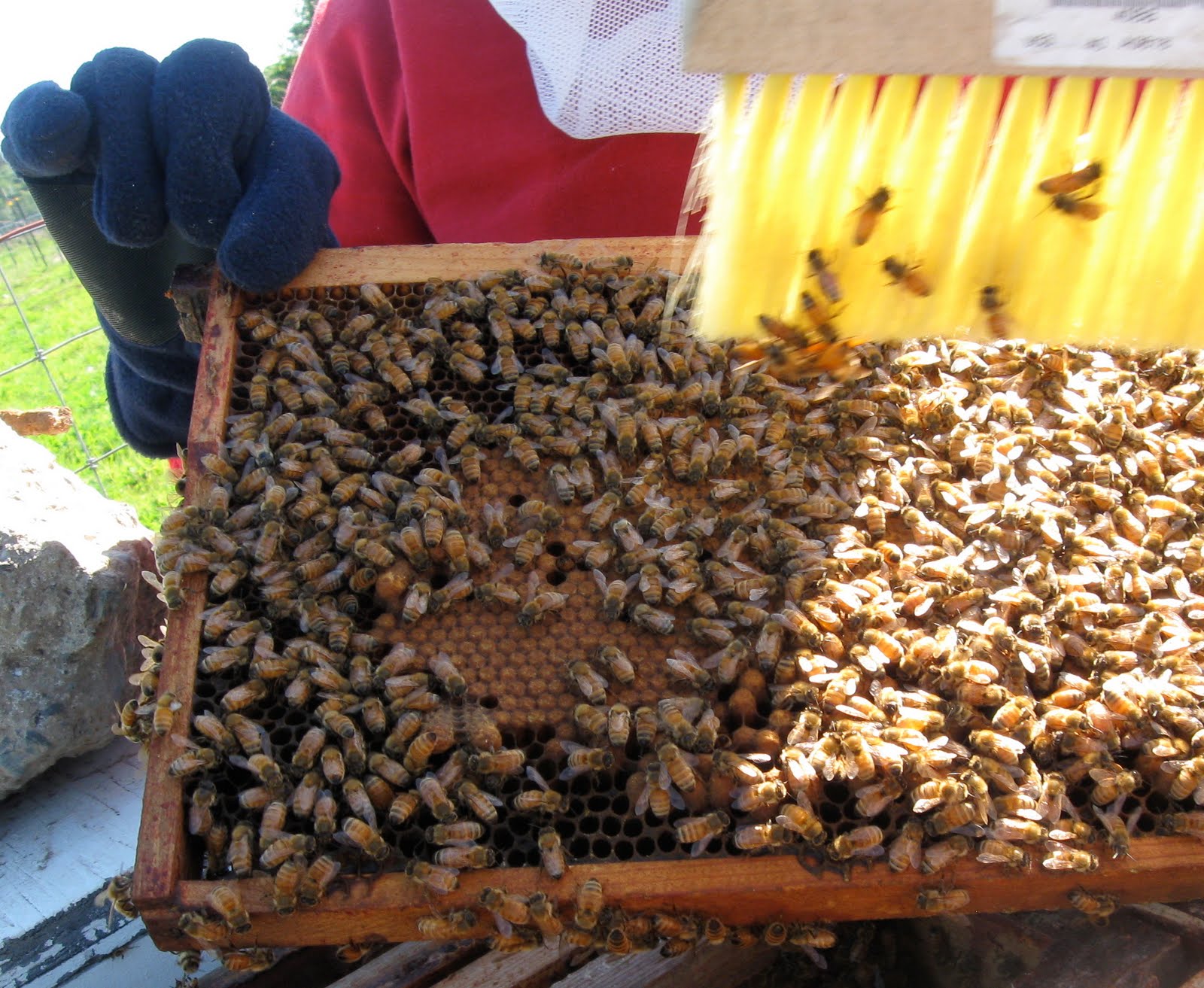
With Homero manning both the smoker and the camera, we opened up one hive. As you can see in the picture above, there is quite a bit of capped comb, but I don't know what is inside. When we observed my neighbor open his hives, he pointed out the capped brood and you could see the eggs or larva inside. Here, I couldn't. In this first hive, we didn't see any eggs or larva anywhere, and we DID see several "supercells." Supercells are those peanut shaped protuberances at lower left in the picture below. These are queen cells - it most likely means that the queen of this hive has died or flown away. I think I am supposed to cut away these supercells before the queen emerges to avoid a swarm, and buy a new queen. I'm going to call my bee-mentor and ask him what I should do.

The second hive looked much better. We saw both large larva ready to emerge and fresh new eggs. I don't have much doubt that the second hive has a healthy egg-laying queen. However, I was a little bit disappointed at the lack of new comb.

Each of my hives has nine frames in it, and four or five of those were nice, drawn out comb before I ever put any bees in. I was hoping to find that the boxes now had seven or eight frames full of comb and I could put on a second box. That's not what I found. It actually appears that the bees have been busy laying eggs, collecting nectar and pollen and capping the comb already in there, but not doing anything much about drawing out new comb.

That's probably my fault. At the monthly meeting of the Mt Baker Beekeeper's association last week, I learned that this time of year there is actually a dearth of nectar flow. The maple trees and the dandelions are about over, but the clover and the blackberries haven't bloomed yet. I thought I could quit feeding my bees sugar syrup once the weather warmed up, but not so. They need syrup until the blackberries come into bloom early next month. Apparently, you have to add a second box and let the colony really build up its numbers before you can add a honey super. And the first honey super is for the bees to survive the winter. The second honey super is for you - and most colonies don't get there the first year.

So, even though it's kind of expensive to keep feeding the colonies a quart of sugar syrup each
every other day or so, I just need to keep in mind that a quart of sugar syrup costs about $0.25, and a quart of honey is worth about $10.00.


Tuesday, May 11, 2010

Aimee vs. the Weeds, round 118


The Bellingham Herald reports there have been four cases of human poisonings from the above plant this year. One fatality. The Herald reports that people mistake Hemlock for carrot or anise, and provides a detailed description to help people avoid making the mistake:


Poison hemlock (Conium maculatum) was introduced to the U.S. from Europe as an ornamental plant. It has adapted to a wide range of climates and grows along roadsides and waterways, in pastures and playgrounds, in vacant lots and cracks in the pavement.

"This plant is very adaptable," Baldwin said.

Its stem is hollow, and the erect biennial is usually 4 to 6 feet tall.

The numerous flowers are white. Its leaves are lush, and look like a cross between Italian parsley and a fern. All parts of the plant are poisonous and affect the nervous system.

Initial symptoms could include a burning sensation in the mouth, nausea, confusion, and muscle paralysis.

Baldwin said the smooth and hairless stem with purple spots near the base are sure-fire indicators of poison hemlock.

It spreads by seed. When crushed, the plant has an unpleasant odor that has been describe as musky or smelling like mouse urine.


This smell is what makes me wonder how anyone could mistake it for carrot. Carrots smell good: Hemlock stinks like hell. Those of you with long memories will remember my years-long battle with this evil weed (Philosopher's Bane) . It's a battle I've been slowly losing, I'm afraid. Over the years, the Hemlock has been stealthily expanding it's range, while I have only been getting older and stiffer, which makes it much harder to stoop over and pull it's devilishly long taproot. Here's what I had to say about Hemlock back in 2008:


I really dislike this stuff. It's seriously poisonous, poisonous enough to pose a real hazard to animals and small children; it spreads like wildfire; it's hard, backaching work to try to pull it out by the roots, it stinks horribly and gives me hives, and if all that weren't enough, it grows in inaccessible places, like in the middle of thistle patches and along the fence line amidst the concrete rubble from the old barn. Every time I go wage a battle against the poison hemlock, I come back scratched, red, bumpy, itchy, and limping. I may eventually need to call in the cavalry: Roundup.


Well, I realize I have tied one hand behind my back here, but I have NOT called in the chemical cavalry, nor do I intend too. As far as I'm concerned, Monsanto is a far greater evil being than Hemlock is. Neither do I have the equipment (or the money to rent same) needed to disk the whole field, till, and plant new grass the way professionals do. No, it's just me, my aching back, and the pathetic old Murray lawnmower, which really deserves it's own label in this screed, considering the length and complexity of its ongoing saga.


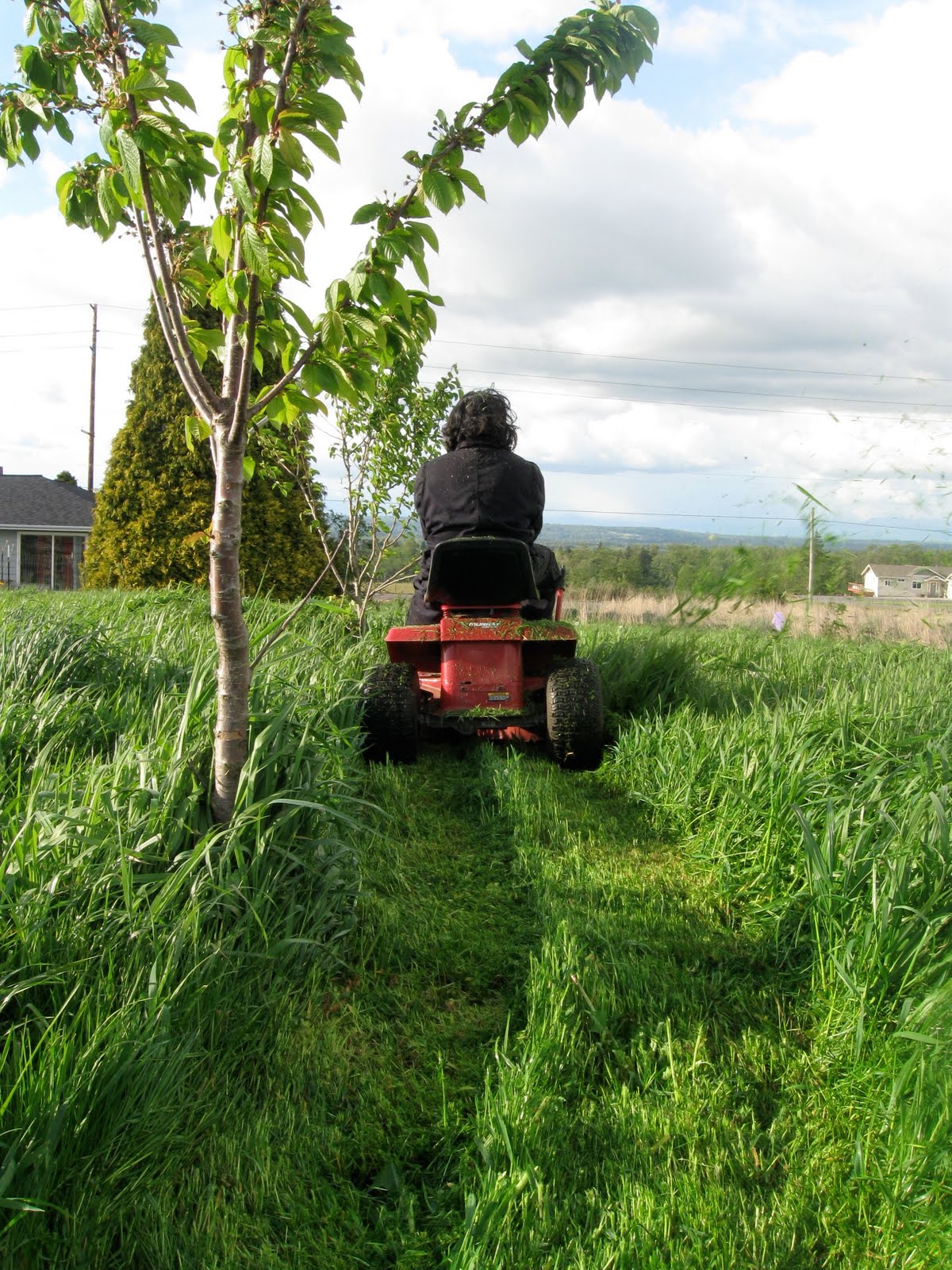
In the last installment of the lawnmower saga, Homero fixed the machine for the umpteenth time and bought a new battery for it. That means it actually starts without having to drag a car battery and jumper cables out to wherever it was when it died last time. It means that I am actually capable of starting it myself and cutting the grass without asking my husband for his manly assistance.


Today I decided I would take the irascible machine out to the back pasture and try to mow as much Hemlock as I could. I would have to be extremely careful as there are still - despite several hours of really hard work with a crowbar - many large rocks imbedded in the ground and any one of them would kill the mower if I ran over it, not seeing it amongst the tall poisonous plants. Oh the many perils that exist in one small field! The idea, which is not exactly supported by experience, is that repeated mowing of the plants before they flower and go to seed will prevent them from spreading, at least.


Well, I managed to mow for a good thirty minutes, and I did mow down a large expanse of young hemlock plants. I felt pretty good. I felt pretty successful. I got ambitious and decided to go out to the other large patch of hemlock out by the fence. Now, this was dangerous because there is a steep drop-off right along the fenceline. The hemlock - along with stinging nettle and blackberry - grows down into this small ravine right up to the fence. Obviously, I was going to stay up on the plain and just get as much as I reasonably could get with the riding mower. The stuff down in the valley would have to be got with a weedeater.


Do you see where we are going here?


No no, not quite. I didn't drive right over the edge. But I did try to get too close and the mower started to slide sideways. I put on the brake, threw it in reverse, and tried to back up but I only backed up a half a foot or so before something stopped me. I thought that might be enough, so I put in the lowest forward gear and leaned my weight hard to the right and tried to go forward. No soap; the wheels spun and the machine started to tip sideways again.


After a couple more equally ineffective tries, I couldn't think of anything to do but kill the motor and hop off - right into a patch of stinging nettle, I might add - before the whole operation quite literally went south. Slightly scratched, with stinging ankles, and rather annoyed with myself, I stomped off to the shop to tell my husband I was going to need his manly assistance after all.


Monday, May 10, 2010

No Naked Ladies!


Saturday night, I went and did something I haven't done in years.

Those of you who know my (distant) past might well be alarmed by that comment. However, I did NOT smoke anything, put anything up my nose, or go to bed with any strangers. No, no, most of my old habits remain firmly where they belong, on the compost pile of my personal history. All I did was search all the cupboards for mostly empty tubes of paint, wash up some very crusty old brushes, and spend a few hours painting.

I used to do a fair amount of painting. For several years - say, from the age of seventeen to twenty-seven or so - I painted with pretty fair regularity. I've never been more than an enthusiastic amateur, and I've never really been much good. I can paint naked ladies pretty well, and that's about that. I have stacks of naked lady paintings in the closet.

Once, in my old house, when I had all the art up, I threw a pretty big cinco de Mayo party with a pinata full of airplane bottles of tequila and lots of Mexican food and a big bonfire. That was a great party. So I was told, by a fairly drunk guy who said "This is a great party! Good food, plenty of booze, and boobies everywhere you look!"

When I moved to the new house, I put up a lot of the same paintings but truth to tell, I'm tired of most of them. They're all pretty good, but great art they aren't, and I think great art is the only kind you want to look at every single day of your life. Right? Since I am far too cheap and also too narcissistic to buy art, that means if I want new art up, I gotta paint it.

So I tried. Shit, what's the worst that can happen? An ugly painting? I can live through that. I couldn't even worry about wasting a lot of perfectly good paint, because I didn't have any. All I could come up with, after some serious searching, was a couple little bottles of craft acrylic - black, orange, red, yellow, and white - some light blue house paint, and some metallic gold spray paint (which I didn't use.).

Then I put on my headphones, cranked the tunes, and painted like I just didn't care. The only rule was NO NAKED LADIES. Here's what I ended up with:


This is the first painting of the night - Mount Baker as seen from the back of my property. Well, before the Holiday Inn went in, that is. This took me about an hour and a half and while it was fun to do and I'm not exactly ashamed of it, I'm not in love with it, either. It's about two feet square.


This was inspired by the copper beech out in front of the house. It doesn't actually look a whole lot like that tree, but I love it nonetheless. This picture took me half an hour tops, and I DO love it. It's up in my kitchen already.

I don't know when I'll paint again. I'd like to fix up my "studio" which is really just the shed. I hang up the canvasses on a nail on the wall and use the top of the chest freezer as a table. Last night I was driven inside by a skunk who came very very close to the shed and was then apparently startled by something. Maybe by me belting out "Me and Bobby McGee."

Even if it's a long time before I paint again. It felt good, in any case. It sure did feel good.

Saturday, May 8, 2010

Farmsitters (Just Whose Expectations Are Too High Here?)

Summer is on the horizon, and that means yet another attempt to take a vacation from the farm and visit family in Mexico.


Due to a string of circumstances beyond our control - well, not exactly beyond our control - well okay, let's just start over. Due to a string of circumstances totally brought on by our own laziness, lack of foresight, and disorganization, we have not visited Mexico in well over three years. We have bought tickets, we have packed our bags, we have even arrived at the airport. But we have not gone (see Adios, Snow!, and I Spoke Too Soon.).

Hope and Paloma have basically no memory at all of Oaxaca or Abuelita's house, or of any of their cousins. Their Spanish is spotty and pretty much all receptive. They know diddley-squat about the land their father comes from and the way people live there. Typical American kids, in other words. That's not our vision for them. We want them to grow up not only bilingual, but bicultural. A couple of weeks every other year is not the way to accomplish that goal, but it's the best we can do for now. At least they need to know their relatives better.

So, planning for leaving the farm is underway. I put an ad on Craigslist looking for a farm sitter which I thought was pretty straightforward and laid it all out pretty neatly. Here it is:

Hello all:

My family will be traveling for two weeks this summer and we are in need of a responsible, conscientious individual or family to stay in our home and take care of our diverse crew of critters. Staying in the home is essential - we have three milk goats who will need to be milked twice a day. If not milked every twelve hours they will be in great pain and might even get mastitis and die. So, if you are not willing to stay here, please don't bother to write.

Please DO write if you:

- know how to milk goats
- like dogs (2, a collie and a whippet mix)
- would enjoy a "staycation" in a large, comfortable house with a spectacular view, high speed internet, satellite TV, and really cool play equipment for kids
- have references
- want to make some money this summer

Responsible teenagers with good references will be considered. In the interest of full disclosure, here is a list of our animals:

-four goats, three of whom will need to be milked twice daily
-two ponies, out on pasture, no need to feed
-bunch of chickens - somewhere around fifteen or twenty - not much work
-two friendly but rather large dogs
- one cat who you might not even see
- two hives full of bees. No beekeeping required. Just leave them alone and they'll leave you alone.

Realistically, I expect that you could expect to spend about an hour to an hour and half a day tending to everything that needs trending. Pay to be negotiated when we speak. Oh but hey - perks include twelve to fifteen eggs a day and a gallon or two of milk!

Thanks for looking!

That's clear, isn't it? The response has been overwhelming, I've received somewhere in the vicinity of a hundred calls. Of these, only three people say they have milked a goat a before. Everyone else says they can learn fast! Many people have asked if they REALLY need to stay in the house (yes you REALLY do). Several people call and the first thing out of their mouths is "what does it pay?" before they even let me ask them if they've ever milked a goat.

I have interviewed two of the three responders who say they have milked goats before. The first response came from a young gay couple who owned a share in a milk goat through a cooperative. So they have milked goats, but never cared for them. Odd. The farm part of the interview went well. I ran them through the routine, showed them where everything is kept, met all the animals, etc, etc. They seemed capable enough, if a bit nervous, perhaps. But when we went into the house, I could see it wasn't going to work.

I'm not sure what they were expecting, but it clearly wasn't my old farmhouse, which is nice but not - let's be real - going to grace the cover of house beautiful anytime soon. Or ever. Neither will I be receiving the housekeeper of the year award from Martha Stewart's own hand, ever.

Perhaps my ad was misleading. We do indeed have a spectacular view (you can see it on the sidebar - see?)
high speed internet, and satellite TV. There is indeed some awesome play equipment for kids. The house is large and comfortable. But comfortable like a worn shoe, not like a five star hotel.

Perhaps I should amend the ad, and add something along the lines of "This is not a bed and breakfast, it is a working farmhouse. It is not the kind of place you would ordinarily pay $150/night to stay in. It is the kind of place I will pay YOU $20 or $30/night to stay in: that's the point of this ad. The carpet is shot and a couple of the closets smell faintly of cat pee. If this is news to you, you probably don't have much real farm experience and should look on the next ad. If you are busting a gut laughing right now, you should call me for sure."


Wednesday, May 5, 2010

Farm Photos (Natural Equine Massage)

In lieu of actually writing anything about what's going on around here (too depressing, and I haven't got time to wipe my nose lately, much less sit down and write for an hour) I thought I'd post some of my favorite photos from the past week or so.

The potatoes are up. There are about twenty shoots sticking up in the forty foot trench I planted. Time to plant some more.

Natural equine massage.

Field mushrooms. Pretty sure they are edible but haven't tried them.


A rainstorm across the valley. This was such a cool day - it was bright and sunny at our place, though cold, but in three out of four directions I could see rain just pouring down from big old cumulus clouds. The storms passed within a half mile or so but nary a raindrop fell on me.

Homero making a dent in the grass. He worked on the mower for an hour to get it started, cut grass for approximately ten minutes, and then the mower broke again. This happens OVER and OVER again. This mower has never worked for more than thirty or forty minutes straight, but Homero refuses to buy something more reliable (and expensive.)

Evening sun through the dandelion puffs.

Evening sun through my favorite tree, the copper beech.


Friday, April 30, 2010

Vet Visit (Separating the Sheep From the Goats)

My ongoing struggle with worms has not been going very well. Just to recap:


After the does kidded in late March, they were wormed with Ivermectin just because it's protocol; they weren't symptomatic, although Iris did have a lot of trouble keeping the weight on during her pregnancy. Within a week or two, the does developed icky diarrhea, which I brought in for testing. The testing showed a high load of stomach worms. Since they had already been wormed with Ivermectin, I used Panacur this time. Subsequent fecals showed a virtually unchanged worm load. So on the advice of the vet, I moved to Quest, a different category of drug.

Ten days later, the diarrhea was pretty much unchanged, although I have to say I did notice the goats seemed a little more perky and less zombie-like. But they had not yet begun to put on weight, and two of the does were so skinny they would put Kate Moss to shame. I had stopped milking them, because 1) Quest has a long withdrawal time, and 2) milking a goat that looks like a wire coat rack just seems wrong.

I decided it was time to ask the vet to come out for a farm visit. She had only seen fecal reports, not the animal themselves. I thought she should see them, and also cast a skeptical eye over my entire operations and maybe suggest improvements. I have been working with this vet for a couple of years now and I like her very much. She's young, but she comes from a vet family and she actually knows and cares about goats (rare in a vet.)

Promptly at 9 am she showed up and we went out to the barn together. She looked over the does, running her hand over their poor, sharp spinous processes, and flipped their eyelids inside out to check for anemia; took their temperatures and looked at their coats and hooves. She listened to their hearts, lungs, and rumens.

"You know," she said, "these goats don't look too bad."

"What are you talking about?" I exclaimed. "They look like they were just liberated from Dachau."

"Well, yeah, they are pretty skinny," she said. "But their color is good, they are strong, they have great appetites, and I think they are going to recover just fine."

"I'm ashamed to have you look at them," I said. "I'm afraid you'll think I'm starving them to death."

"Please," she answered, "You get an A+ as an animal owner. You keep a close eye on your animals and always bring problems to our attention promptly. I know you care about your goats and it's obvious how well you care for them. Don't worry about that."

That made me feel good.

Then we went over my nutritional regimen, which is free-choice local hay plus a flake or two of alfalfa daily; a pound and a half of grain on the milking stand each morning (even though I'm not milking I keep up the routine of making them jump on the stand to get the grain), and free choice baking soda and loose minerals.

"The minerals are formulated for sheep," I said. "I couldn't find any formulated for goats."

"OHHHHH," she replied, "well, I think that's your problem right there."

Turns out, that although sheep and goats are very similar in many respects, there is at least one in which they are very different. Sheep are highly intolerant of copper; it is toxic to them. Therefore sheep minerals are formulated without copper. Goats, however, need a fair amount of copper. Recent research has specifically linked parasite resistance to adequate copper levels. My goats were probably copper deficient.

She also had a few suggestions for rearranging things on the farm and in my daily routine:

1) Get some loose minerals for goats and put it out in small amounts. They will only eat it fresh and dry.

2) Make a fenceline feeder so that the goats are not stepping on, urinating on, and pooping on their hay. It will also save a lot in wasted hay. Obviously, I don't feed my goats on the ground: they have a hayrack inside the barn. But they hayrack allows them to pull a lot of hay through the slats and trample it. In general, they just shouldn't have their food in their bedding area at all. Below is an example of a fenceline feeder, though I don't know why it doesn't have a lid on it to protect the hay from rain. Mine will.

2693505807_921cf65cd8.jpg


3) Feed grain in two separate feeding rather than one lump feeding in the morning. Goat rumens are so sensitive that a large amount of grain will actually create an environment so acidic, within a few hours, as to kill off many of the bacteria that digest cellulose, and the goats will not be able to fully digest their browse, which will lead to bloating and diarrhea. The answer is to break up the grain feeding into small amounts.

4) Start feeding some grain to the babies, using a creep feeder (I'm using a chicken tractor for this prupose) so that the adults can't get it. This will help them lay off the moms a little bit and not suck them dry like little caprine vampires.

5) Get a Sweetlix protein block. When they are lactating heavily, they need extra protein.

She took some fecal samples and later, she called me with the results and told me that the stomach worms are down to 2. That's from 69 last time. She said the diarrhea is most likely residual and will simply take a week or so to clear up. In the meantime, the measures she suggested should help keep them from getting reinfested, or from becoming so sick if they do.

Let's hope.