"United we bargain, divided we beg."

Monday, April 8, 2019

......Or Does He? (Warning: Graphic Photo)


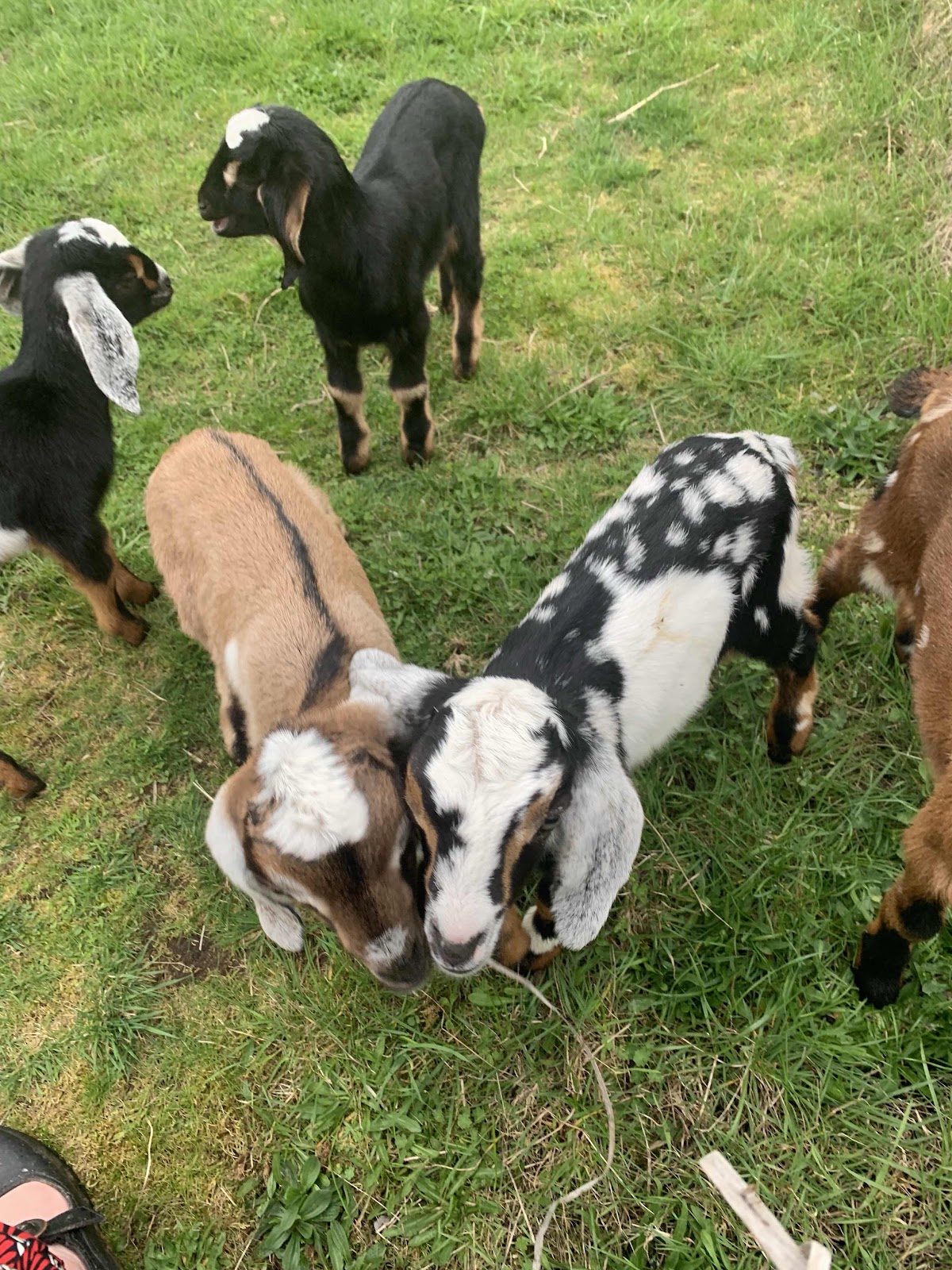
First, please enjoy this photo of adorable, healthy baby goats frolicking in the springtime, all right with the world. This is the reality for 8/9 babies born this year, and that’s not such a bad outcome. 

But now - 
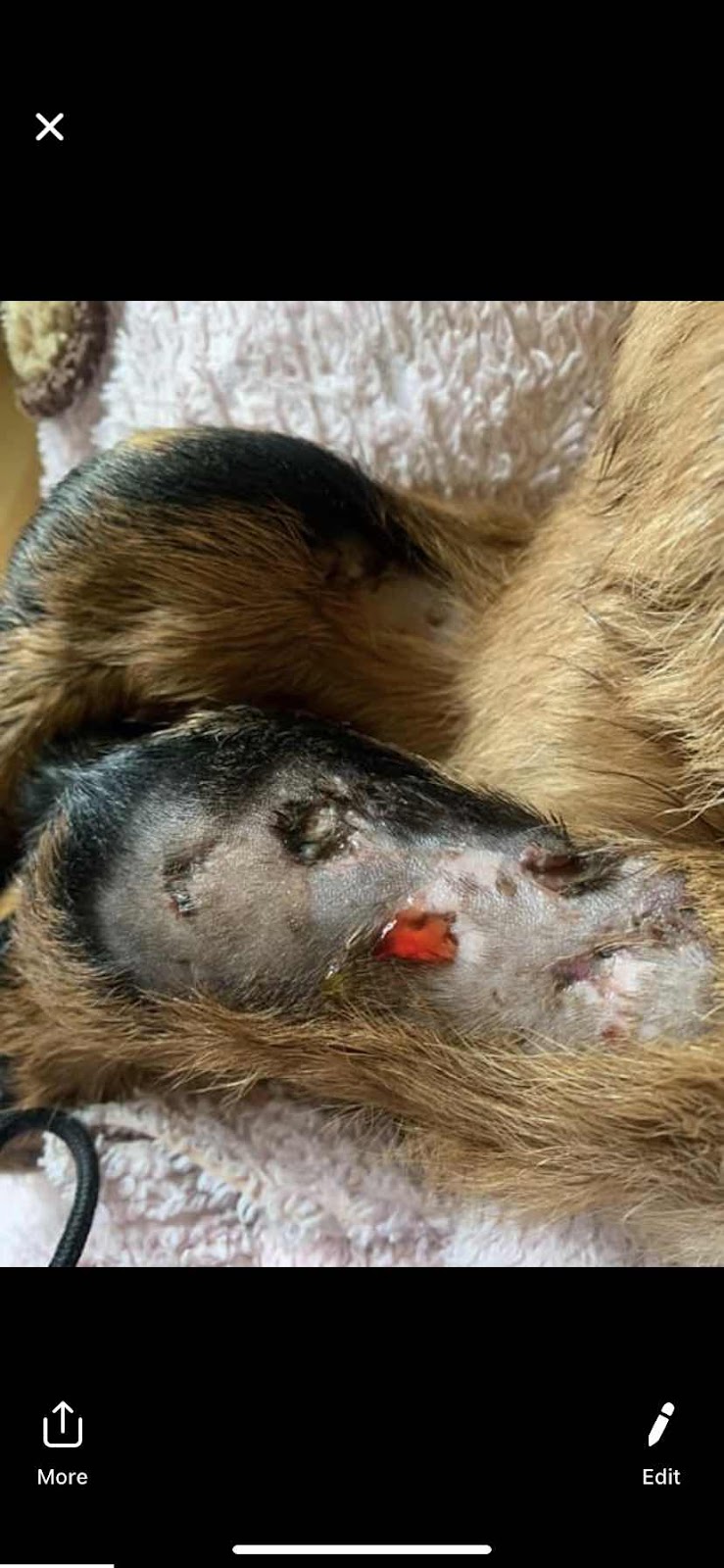


This photo of the bite inflicted on baby number nine by my very own dog. There’s a story here - hold on before you condemn the canine. 

The last mama goat to give birth was Polly, last Thursday evening around 5 o’clock. She had a lovely set of twins, who both stood up and nurses with no problems, a boy and a girl. I was thrilled. However, when Homero went out the next morning to do chores, he found another baby in the ground, still wet and gooey, who had apparently been born quite recently. 

For those of you who aren’t goat breeders, it’s not normal at ALL for there be such a long delay between kids. No matter how many kids are in there, a normal birth usually takes an hour, maybe an hour and a half, tops. So this little guy was off to a rough start. It seemed he had aspirated some amniotic fluid. His lungs rattled and he was very weak. He couldn’t stand up by himself, and his mama ignored him. 

That’s a bad sign. I always pay attention to the mamas, they seem to be able to tell better than I can when a baby is not very viable. However, he was alive, so we went to work to get some colostrum into him. Throughout that day we bottle fed him every hour or so, and although very weak and coughing, he was getting some down. 

But there was clearly something wrong with him. His head was swollen, whether from the hard birth or whether malformed in some way was hard to tell. He stayed standing if we stood him up, but he couldn’t get up on his own and he didn’t try to walk. 

We had plans to go away for the weekend. I asked my good friend K., goat rescuer extraordinaire, if she wanted to try to care for him over the weekend. I let her know he was poorly and might not make it. She did want to, and in her usual way she went to work on him. 

She noticed, however, that he seemed to have a small wound on his leg. When she washed it and shaved him, it turned out not to be a small wound after all but a pretty serious dog bite. Overall the weekend, it got infected despite her care. When we got home, she let me know she thought the baby was suffering. 

I picked him up and took him to the vet. My gut instinct told me that the little guy was in his way out and I thought he should be put down, but I wanted to give the vet a chance to weigh in. There’s always a possibility he or she might say “no, no, all he needs is a course of strong antibiotics.” 

But my instinct was right. The vet told me his leg was actually broken, and that he seemed to have some neurological damage as well, whether from the hard birth or for whatever reason. His lungs were crackly with pneumonia. He had several complex problems. It went far beyond a course of antibiotics. 

And truthfully, that’s about all I was willing to invest in this kid. Even if he lived, he was still marked as a meat animal. If he wasn’t going to enjoy his year or year and a half on earth as a happy, healthy member of the herd, then it’s better to put him out of his misery right away. Which is what we did. 

As for Haku.... well, I’m fairly sure he wasn’t trying to kill the baby. After all, if a 95 pound German Shepherd wants to kill a newborn baby goat, he generally can do it without much effort. And Haku is so very, very gentle with the babies. He only wants to lick them all over. My guess is that he was attempting to help. 

Baby goats hide. In the barn, they hide behind hay bales. That’s their instinct. When Homero found this little guy he was hidden behind hay bales. I think Haku was trying to drag him out of his hiding place. My sister has a livestock guardian dog and she told me that he once injured a baby goat doing exactly that. 

In any case, there is one less baby goat in the world now. Poor little guy. But it’s good news for his mama, who now only has to raise twins. 


Tuesday, March 26, 2019

Haku Loves Baby Goats


....... or maybe he’s just checking to see if this baby is as tasty as he looks. 

Sunday, March 24, 2019

Four is Too Many


Christmas gave birth this morning, unaided, to quadruplets. They are all up and nursing, appear to be full term and healthy, and of course as cute as all get out. Three bucklings and one doeling. 

I’m not thrilled. Four is too many for a mama to raise alone. Having only two teats, even if she produces enough milk for all four (doubtful), the stronger kids will hog the teats and the weaker kids will starve. I’m going to have to pull a couple and bottle feed them, and I HATE bottle feeding. 

If there is anything in this world more frustrating than watching newborn kids try to stand up and nurse, it’s trying to get newborn kids to take a bottle. I’ve managed to avoid it most years, but I don’t think I’ll be able to this year. 

Christmas did NOT look big enough to have quads inside of her. I was expecting twins. She’s never had more than two before. 

Now I’m terrified for poor Flopsy! She’s twice the size of Christmas. She must have, like, nine in there. 

Saturday, March 23, 2019

Scary Birds, Scary Eggs


The turkeys have finally started laying. I guess it took them a long time to settle down, after their repeated escapes and the traumatic process of catching them - traumatic for both the birds and for us. These mixed-breed birds are large, strong, excellent flyers, and very wild. I sustained several nasty scratches trying to catch them, including a six inch one across my cheek and jaw that I thought was going to scar. 


Which explains why, when I saw the eggs, I went back to the house for reinforcements in the form of Paloma and a kitchen broom. I made her stand at the entrance to coop and distract the turkeys with jabbing motions and loud gobbles, while I collected the eggs. It involved a certain amount of kicking, but we made it back to the house with the eggs intact and without letting the turkeys escape again. 

Hopefully, the turkeys will hatch it chicks this year, but so far I haven’t seen the Tom turkey do anything resembling an attempt to mate. When I open these eggs, I ought to be able to tell if they are fertilized or not. If so, I’ll leave future nests alone until I can tell if a hen is brooding them. If they aren’t fertilized, we’ll eat them. 

Paloma isn’t thrilled about that. I told her turkey eggs taste just like chicken eggs and once they are scrambled she won’t be able to tell the difference, but I don’t really know if that’s true. 

Guess we’ll find out! 


Thursday, February 28, 2019

Turkey Tale and Maybe Bears


These are our new turkeys. A neighbor was selling off her entire menagerie, and we got these pretty mixed breed ladies. She said they were layers, and went broody, but they haven’t laid any eggs here yet. They spent the first couple weeks locked up in the coop, and then we let them out into the barnyard. I always prefer to let my poultry free range if possible. 


It isn’t possible, however, with Haku around. The very first morning they were out, he chased them and scared them, and they flew away over to the neighbor’s property. I really don’t know what I’m going to do about that dog. We’ve had turkeys and chickens for years, and he’d gotten quite good about not chasing them, but we haven’t had any poultry in about six months, and I guess he “forgot.” I’m very worried about the future baby goats. That, however, is a worry for another day - a day about six weeks off. 

The turkeys spent two nights roosting in a horse chestnut tree on the fence line between the neighbor’s yard and Homero’s shop. We put out food for them, but when we approached, they retreated. They are good fliers. There wasn’t much we could do except wait and hope that they’d come back on their own. I wasn’t sure if they’d been here long enough to think of this place as home, but apparently so, because this morning they were back in the barnyard. 

We still haven’t been able to catch them and get them back into the coop, though. We’ll wait for dusk and hope they roost in the barn, then we can sneak up on them. I found a Tom turkey for sale nearby, and I’m going to get him tomorrow. If their former owner was telling me true, maybe they will hatch chicks this summer. That would be cool. 

While we were beating about the bushes along the fence line, Homero found something odd in an inaccessible corner. A sturdy cattle panel - heavy gauge! - has been severely bent, wrenched up off the ground more than two feet, making a big gap. It looks like it got hit by a car, but there’s no access for any vehicle - it’s deep in the brush.   


Last summer, while we were in Mexico, a friend of mine was coming by three times a week to make sure everyone had water and to enjoy the cherries and plums that we were missing out on. She told me she saw bear-scat a couple of separate times. Normally I’d be skeptical, but this particular friend grew up in the Yukon, and she knows bear scat. Also, there were multiple sighting of a young black bear within a couple of miles of our place. Maybe this is how the bear got through the fence. I really don’t know what else might have done it. I would have guessed a bear would go over a fence, not under it, but what do I know about bears? Not much. 

Haku, meanwhile, is on house arrest. 


Tuesday, February 12, 2019

Snow for Days (Sno-Crastination)


It’s a repeat of 2017 - snow up to the roof. This picture actually taken yesterday; it snowed more overnight. It’s been snowing on and off for a week. It’s still snowing right now. Or at least I think it is - the wind is high, so maybe it’s just blowing the same snow around. It’s hard to tell.


The drift outside Paloma’s sliding glass door is taller than the dog. 

It’s hard to guess how much snow actually fell, because of the incessant wind. There are bare patches, and there are shoulder-height drifts. That same wind makes it RAWTHER unpleasant to go outside. So, we aren’t playing in the snow or making forts or having snowball fights, we are huddled inside around our eletronic devices. 

Other snow-day activities: Downton Abbey marathon; bread baking, making valentine’s day cards with scissors and glitter glue; teaching the kids to play gin rummy. 

Snow-day activities I ought to do but most likely won’t:
Clean the fridge; fold laundry; sort the snack drawer and cabinets; take pantry inventory. And the biggie - taxes. 

I will have to go outside of course. The animals need liquid water and more hay. Our new turkeys are shut up inside the mama barn and they need food and water. The goats need more hay. I’m not looking forward to chores this morning. 

Update: My wonderful husband did the chores


I must be old. I’d much rather watch the snow through the window than go out and be in it. 

Tuesday, February 5, 2019

Jelly Fail and Jelly Lessons


Pepper jelly


I am not an expert canner. I do a lot of water bath canning - at least, “a lot” statistically speaking. Most people don’t can at all anymore, so I’m on the upper part of the curve by default. In my circle, there are still a fair number of women who “put up” a significant portion of their family’s food every year. These women count their canning jars by the gross - I count mine by the dozen. My best estimate for my current supply is eight dozen - two thirds filled, one third empty. 

Nonetheless. Canning is a regular part of my kitchen activity. I can at least once a month year round, thanks to the Gleaners’s Pantry, and in the high season I might can once a week. This week, the Gleaners’s Pantry offered up beautiful peppers, and so I decided to make pepper jelly. 

Pepper jelly is an under appreciated condiment - it’s delicious and beautiful both. It makes an excellent Christmas present. At the end of the day, though, it’s jelly. And I’m not good at jelly. Judging by the number of websites devoted to helping people master jelly and/or fix jelly gone wrong, I’m not the only bad-at-jelly canner our there. 

Jelly, it seems, is rather finicky. Jelly requires a level of kitchen precision more often associated with wedding cakes or soufflés. By which I mean, I guess, the willingness and ability to closely follow a recipe, including actually measure all the ingredients and being in possession of a thermometer.

I have a thermometer - I’m both a nurse and a cheesemaker - but I cannot, for love or money, closely follow a step-by -step recipe. Therefore it follows that my jelly often refuses to gel. Today’s pepper jelly seems to have done just that.

While I was searching the internet for reasons my jelly might have failed to gel and for ways to repair a failed jelly, I learned a whole bunch of things I did not know about jelly. Most of those things only served to reinforce my suspicion that I may be congenitally incapable of the precision and consistency required, but in the firm belief that the information may be useful to others, I offer some of the tips I learned here:

- when removing the jars from the water bath, try to keep them vertical. Set them down gently. Any jarring motion or departure from the vertical can interfere with gel formation.

- leave the jars alone for two full days. It can take that long for the gel to firm up. Really!

- try putting a jar in the fridge. Cooler temps can help. 

If none of this works, you can open the jars and re-do the entire process. But holy mother of god, the instructions for determining what went wrong in the first place and how to correct it read like a third-year chemistry exam. Apparently, gel formation relies on a complex interplay of the variables Acidity, Pectin, and Temperature. Hence the whole following recipes thing. 

Here’s a list of sites that provide detailed instructions, but to be honest, my favorite advice is “call it syrup and move on with your life.” 


Tuesday, January 22, 2019

Birthday Dinner

It’s my birthday so I can cook whatever I want and nobody can complain. And what I want is Lima beans with ham hocks and homemade upside down cornbread. What’s upside down cornbread? Glad you asked. It’s my own invention. 

You take a cast iron skillet and sauté chiffonade collard greens and onions in plenty of the fat of your choice (lard from our own pig). Make your cornbread batter. Pour batter right into the sizzling hot skillet, right over the greens. Top with grated cheese. Bake at 350 for twenty five minutes.
 
You can change up the flavors any way you want. Try onions and poblano peppers, garlic and cumin as the sauté, and top with grated pepper jack. Or - I havent tried this - what about a sweet cornbread batter, and use something like sliced peaches or plums as the sauté? Top with cinnamon sugar?


Friday, January 11, 2019

Bounty from the Sea (Gleaner’s Dinner)


This week, Gleaner’s Pantry got a donation of frozen seafood. There were a few different types of fish, but the nicest was frozen filets of flounder. Everyone took home some twelve or fifteen filets. 

Flounder is a delicate white fleshed fish that needs gentle treatment. Here’s what I did with some of it tonight. The vegetables came from Gleaner’s as well. 

Preheat oven to 325

In a lidded casserole dish, lay down a bed of chiffonaded kale or other hearty greens. Add a layer of thinly sliced red onion. Lay down the flounder filets, and shellfish if you’ve got some. Mussels would work as well as clams. Add two cloves of minced garlic. Pour over 1/2 cup of orange juice and 1/2 cup of white wine. Dot with a few tablespoons butter. Salt and fresh ground pepper to taste. Also add a tablespoon fennel seed. Cover and bake until all
Shellfish are open or until fish flakes easily. 

Serve with baguette or plain rice. 

Thursday, December 27, 2018

A Peck of Disappointing Peppers


The Gleaner’s Pantry usually has an abundance of food after any major holiday - and this year was no exception. The day after Christmas there was a special glean, and along with a plethora of cookies, cakes, pannetone, and various and sundry candies, there was also a vast amount of fresh vegetables and fruits. 


I took home three or four sacks of oranges, a half a dozen pomegranates, and a goodly number of specialty pears wrapped in crinkly foil paper, lovingly packed into wooden crates, and labeled with a well-known national
brand. But the real haul was a near-bushel of shiny, green, taut-skinned jalapeños. I couldn’t see a damn thing wrong with these peppers, nor imagine why they had been thrown away. I took all of them that nobody else wanted - at least two full shopping bags full. 

This morning I spent three hours with a pair of latex gloves on, prepping the peppers for canning. I searched the cabinets and discovered a dozen wide mouth pint jars; I unearthed the lids and rings and set them to boil. I sat down with a paring knife and put on a CD and filleted some fifty or sixty peppers and cut them into rajas. I made a brine of one third white vinegar and two thirds water, a half cup of sugar and a quarter cup of salt, pickling spices and several cloves peeled garlic. 


Ten pints of sealed pickled peppers later it occurs to me to actually taste the peppers - there were a lot left over. And damn! I finally figured out why such a huge quantity of perfect peppers was at Gleaner’s in the first place. These supposed jalapeños had ZERO heat. They were basically small, pointy green bell peppers. 

You have probably noticed - if you are over thirty years old and like to cook -  that jalapeño peppers have changed in the past decade or so. A new hybrid came out ten or fifteen years ago: a bigger, blunter, WAY less spicy jalapeño. I think it’s a cross between a jalapeño and a green bell pepper. Recently, it seems that this is the only “jalapeño” you can find. The older, smaller, hotter jalapeños have pretty much disappeared from the markets. These days if I want a hot pepper, I have to buy serranos. But I have never yet run into a hybrid jalapeño that had NO heat whatsoever.

My guess is that somebody bought a bunch of this batch and then complained to the grocery manager - I know I would. And then the manager taste-tested them and came to the same conclusion I did - these jalapeños are shit. 

Oh well - now I have twelve pints of pickled anemic peppers. We usually go through a pint of pickled jalapeños every two weeks or so. They are standard garnish for three out of every four meals we eat here - scrambled eggs, taco toppings, sandwich fillings, components in tuna or chicken salad. But peppers without any bite at all? I just don’t know how we will use them up. 


Monday, December 24, 2018

Christmas’s Eve 2018 (with recipes)

Another Christmas. Another year almost gone. As my children get older, each year seems more and more precious. As in years past, I made an advent calendar of events, a posterboard hung with 24 gift tags, each one of which had an activity or community event written on the back. Although they are both teenagers now, Hope and Paloma were still excited to turn over a tag each night before bed. 


A few highlights: 


Pioneer Park Old Fashioned Christmas. Our favorite event of the season. Santa looks a little skeptical of my big girls. 


We crossed the border to visit Vancouver’s Van Dusen botanical garden light show. It was raining cats and dogs and we got soaked, but the lights were spectacular.


Decorating cookies. The girls invited friends and made a party out of it. We went overboard and there were hundreds of cookies. Hope had the bright idea of distributing cookies at Ferndale’s assisted living facility. She’s a sweet, thoughtful child. 


All three kids in front of this year’s tree. It’s another live tree and will be added to our small but growing Christmas grove. 

The menu tonight is simple but yummy. It’s just the five of us, for the first time in memory. We usually go to my Mom’s house for a formal Christmas Eve dinner with the good china, but this year my stepdad broke his leg and had to have surgery the day before yesterday and isn’t feeling up to visits. We will get together for new year’s instead. 

Small Feast: 

Cream of mushroom soup 

Roast lemon- garlic-herb chicken 

Fingerling potatoes roasted in drippings

Romaine lettuce and crudités with “Cesar” dip. 


I recently invented this mock-Cesar dressing/dip and I love it. I make the base in a mortar and pestle, remove half of it to be a rub for he roast chicken, and then finish the dressing. 

Mock-Cesar dip:

In a mortar and pestle, combine 

1 large clove garlic
1 tsp whole Black peppercorns
1/2 tsp salt
2 anchovy filets 

Mash with pestle until a coarse paste forms. Add

1 Tbspn olive oil and mix with a spoon. 

Remove half the paste and use it to season your whole chicken, making sure to get some inside the cavity as well. I stuffed the cavity with a half onion and a half lemon, and set the chicken on a bed of rosemary and thyme. 

To the remaining paste in the mortar, add

1 tsp whole grain mustard
Juice of one large lemon
Heaping spoonful mayonnaise

Mix gently until well incorporated and smooth. 
Add lemon juice if needed for acidity, taste for salt. 

Make a crudités platter with celery sticks, hearts of romaine separated into leaves, cucumber rounds, etc. Serve the dio right there in the mortar. It’s very strong flavored but super yummy. 

Merry Christmas! 

Wednesday, December 5, 2018

Little Altars Everywhere


Beltane altar

My religious background is very complicated. I was born Jewish, because my mother and her mother and her mother were Jews, albeit secular ones. My mother used to say they were just Jewish enough for Hitler to want them dead. I don’t identify as a Jew though, because I don’t practice Judaism, and I do practice some other religions. In fact I believe that according to orthodox Jewish law, I stopped being a Jew at the age of eight, when my father had me baptized into the Mormon church. 

While my parents were married, which they weren’t anymore very shortly after said baptism, we used to go to Mormon services fairly often. After the divorce Dad would still take us once in a while during our weekend visits, while we were still small. I remember long boring services and lots of cookies.  But he fell away from the church, and he fell away from his kids, and stopped taking us to church, or anywhere else. Mom never set foot in a Mormon church again, as far as I know. I myself haven’t been to a Mormon church - except for my cousin’s wedding - in thirty five years. 

In fact I didn’t set foot in a church of any kind for over twenty years, unless it was as a tourist in Italy or Mexico. But I nonetheless had a spiritual life. It was centered, as most of my life has always been centered, around books and learning. In community college when I was sixteen I took a class called the Power of Myth, that used Joseph Campbell’s work as a textbook, and I’m here to tell you it blew my mind. 


Litha Altar 


The year I was twenty-one I was pregnant with my first child. I spent months that year reading the White Goddess by Robert Graves. Among the many things I learned in that book was the sacred tree-calendar of the Druids, and I named my daughter Rowan, after the tree that ruled her birth-month of February. Since then, I’ve more or less considered myself a solitary witch.

It’s true that I attend my local church, a tiny ELCA congregation called Zion. After many solitary years I felt the need to worship with others, and I wanted a deeper connection with my neighbors. I was attracted by the aesthetics of Zion, I admit: a small, whitewashed building with a steeple and a real bell, and a real graveyard, sitting alone in a green valley near my house.  It took me years to screw up my courage and attend a service. 

It so happened that at that first service, the young woman who was pastor (a good sign!) gave a sermon in which she said “a church is not a place where a bunch of people sit together all believing the same thing” which was auspicious. At coffee hour afterwards I introduced myself. I wanted to come back but I was very conscious of the fact that I wasn’t actually a Christian. I wanted to ask if I could come as an interfaith visitor - but of course I didn’t know those words and what came out of my mouth was “is it okay if I come here as a Pagan?” 

But although I go to church two or three times a month, and I find it nourishing, I’m still a witch. The main way that I practice my path is through observing the sacred calendar of the earth - the solstices and the equinoxes, and the cross-quarter day’s in between them. The names that I attatch to these holy days are Celtic or Neo-Pagan, but it really doesn’t matter to me what they are called. If I knew the names in Ancient Greek or Mayan, I might use those names. 


Samhain Altar 


Observing the holy days means laying an altar for them. Over the years in this blog, I’ve shared pictures of my seasonal altars many times, and I’ve shared observations of various holy days such as Mabon and Imbolc. But I haven’t talked about the practice of keeping an altar. 

Some people are very formal about their altars. They have set places for them, with well-demarcated boundaries and lots of rules for which items belong on the altar at which seasons. You can probably guess I’m not one of those people. I do have certain icons that I like to use for certain holidays - usually my own paintings that evoke the season or a particular deity. One of my very long term goals is to eventually paint enough icons to have an entire set for all seasons. But for the most part, I play loose and fast with the idea of an altar. 

The shelf above our hearth is my main altar, and I have a smaller space in the kitchen for a kitchen altar. But an altar has no fixed position. As Black Elk said, “the sacred mountain is everywhere.” And so, wherever you lay your altar, you are really laying it on your heart. And if it isn’t laid in your heart, then it isn’t laid anywhere and you are just playing with leaves and stones. Not that there’s anything wrong with playing with leaves and stones. 

Altars even spring into being all by themselves, and I think these may be my favorite and most sacred type of altar - the ones that emerge organically from the life of the household. When I notice that my ordinary life, the simple repetitive rythyms of my days, creates little altars everywhere, then I feel especially blessed and feel that I must be doing something right. Then I feel that Hera, Goddess of hearth and home, at once the royal Queen of heaven and humble housewife, has come to visit me and is incaranate in the work of my hands. 


Spontaneous altar that emerged on a side table 


Monday, November 19, 2018

Practicing Thankfulness (a look back)


A repost from a few years ago follows.  Although we have no turkeys this year, and many other things are different as well, it’s always, always, always good to give thanks. And sometimes, if I have a hard time coming up with things I am presently thankful for, it’s good to be able to look back on this blog and find what I was thankful for in another time. 

So right now, I’m thankful that I have diligently recorded my seasons on this piece of land. I’m thankful for my own past hours spent on that endeavor. I’m thankful for the technology that lets me easily and quickly find the bits of my writing that I am looking for, or to peruse those I have forgotten I ever wrote. I’m thankful for the technology that lets me record and share the beauty of this place I live in. I’m grateful for my artist’s eye that lets me see beauty in my mundane surroundings, like the frosted leaves above, and for the ability to share that frozen moment with all of you. 

Here’s what I was grateful for in November of 2013. 


1) The turkeys. We will be eating our own bird thursday, a beautiful creature who dressed out at 19 pounds. I sold two other turkeys, for $4/lb, a very decent price. Well, one of them I accepted half cash and half groceries, and some of those groceries will be on the thanksgiving table as well. In particular, I'm thankful for

2) the quart of dried morels I accepted as partial payment. I love wild mushroom gravy. The last turkey I decided to donate rather than stash it in the freezer for Christmas or something. Calling around, I found out that

3) the Lighthouse Mission in Bellingham will be serving a Thanksgiving meal on friday for those who missed out on the big day. I'm thankful they are doing this, and also that they can legally accept my turkey. Anybody looking for an easy way to help out the homeless and hungry this year could do worse than to donate to this hardworking organization.

4) I'm thankful that my mom is coming up from Seattle and we will have a crowd of family around the table. I'm sorry my sister won't be here, but I am thankful that

5) I don't have to make a gluten free, dairy free Thanksgiving meal.

6) I'm thankful that the buck is sold and the boarded does are gone home and that all my goats are probably pregnant and that goat breeding season is over for another year!

7) I'm grateful that the cold snap is over and I no longer have to water the animals with a five gallon bucket but can go back to using the hose like a normal person.

8) I'm grateful for my nieces, who are sweet, cheerful, hardworking, and funny. They are doing so well in school and making friends. I am grateful they are enjoying their time here and I'm so grateful for the trust that their parents put in me and Homero. It's a blessing.

9) I'm thankful for the beauty of my part of the world. I'm so grateful to be able to look out my window and see the mountains and the trees and the sky. I'm constantly amazed at the natural beauty with which I am surrounded.

10) I'm thankful for this house, drafty and creaky as it is, it's still shelter, and it's home.

Sunday, November 11, 2018

Salvaging the Impalatable (Fermented Seal Guts)


April and May is goat cheese season, year after year. This past spring, however, I spent even more time than I usually do making cheese. That was because I knew that we would be spending the two months of high summer far from home, in Oaxaca. Whereas I would usually use most of the milk making fresh, easy to make and easy to use simple cheeses like queso fresco and chevre, this year I made more hard cheeses, intended for storing. 

My hope was that I could make enough hard cheese, and store it effectively enough, to have cheese in the late summer and fall when we came home. I made mostly cheddar, with and without flavorings such as chives and red pepper flakes, and I used my vacuum sealer to seal it up and store it in the fridge over the summer. In past years, I haven’t had great luck with this method - the cheese inevitably molded even inside the vacuum sealed pouches. This time I took more care to cure (air dry) the cheeses well before sealing. Then I packed them into the coldest part of the fridge, crossed my fingers, said a prayer, and flew away. 

Upon our return I was delighted to find that none of the packages showed any signs of mold. The seals were tight; thee was no evidence of air inside the bubble, and when I opened a package, the cheese smelled fresh and good. 

However. 

However. 

I still wasn’t happy with the “final product.” In my mind, an aged cheddar should have a distinct taste and texture  - “sharp,” piquant, and maybe a bit crystally, ever so slightly crunchy under the teeth. It ought to melt well. It ought to smell wonderful, and to be appetizing even to those who aren’t the biggest fans of aged cheese. At the very least, it ought not to be offensive to the taste (except to those weak-stomached fools who hate any strong flavored cheese). 

The cheeses I have opened so far have been a bit hit or miss, according to these criteria. Mostly, they do melt well and have a very good texture. The problem is their extremely strong, rather goaty flavor. The “goaty” flavor in aged goat cheeses is due to certain compounds known as Caprine flavor compounds. Apparently, they tend to concentrate over time. What went into the fridge in May as a nice, smooth, mild-mannered green cheddar came out in September as a rugged, aggressive, stinky, crumbly goat cheese. It is simply not something that most people - more to the point “we” - would choose to eat as a stand alone product. 

That’s disappointing of course. I’ve made myself eat a few slices on crackers, with grapes or apples and the soothing influence of fig jam or plum preserves, but it just isn’t a truly pleasant experience, if I am honest. So I am left with the question of what to do with several pounds of extra-strong stinky goat cheese that represents a silly number of hours of labor that I am simply not willing to chalk up to experience and toss in the trash.

Today I solved that problem by making calzone. I had some herbed pizza dough courtesy of the gleaner’s pantry, and our own pantry provided various strong flavored ingredients such as kalamata olives and marinated artichoke hearts, with which I intended to mask the Caprine compounds. 

Paloma helped me roll out the dough and I took the opportunity to educate her a little (read, bore her to tears) about the historical necessity of making do with whatever ingredients were available, regardless of their objective edibility. For most of human existence, nobody had the luxury of turning their nose up at “stinky” food. Willingness to eat what was available was quite literally the difference between life and death, or at least between health and malnutrition. 

“Some people in Greenland had to eat fermented seal guts,” I told her, “and eventually, it became a delicacy. Necessity is the mother of invention.” 

Her expression showed me she wasn’t convinced. 

“It’s always been a woman’s job to take whatever was at hand and turn it into something, if not delicious, at least something that her family would eat,” I continued. “And that’s the origin of haute cuisine. Seriously - all culinary creativity is based on using the dregs, the ugly bits, the stinky bits, and making it beautiful and desirable.” 

This, as I grate the too-stinky-to-eat goat cheese onto the rolled out calzone dough, and cover it with chopped olives, artichoke hearts, parsley and marinara sauce. I tell Paloma, and I cross my fingers that I’m not lying, that the cheese’s too-strong flavor will, in the company of all these other flavors, enhance the calzone and actually be an asset to the finished product. 

I’m sure that dozens of generations of women have made this same argument to their skeptical families regarding dozens of equally dubious ingredients. I mean, seriously. Natto? “Thousand year eggs?” Shrimp paste? The first Gorgonzola? We ladies have simply had to brazen it out, and time and history have largely vindicated us. Except for the fermented seal guts. 

The verdict on the calzones was that they were delicious. The goaty flavor of the cheese melded well with the salty, briny olives, and all the calzones disappeared with alacrity. 

One cheese down, several cheeses to go.