"United we bargain, divided we beg."
Showing posts with label butchery. Show all posts

Thursday, November 14, 2013

Freezer Puzzle (Turkeys for Sale)

Our four turkeys have a date with destiny on Saturday morning. I found a guy who will process them professionally (i.e., he has a defeathering machine) for $10 apiece. That is apparently a cheap enough price that Homero will allow me to pay somebody to do it rather than doing it himself. We do not have a defeathering machine. Nor has Homero ever butchered a turkey before. It's probably more difficult than a goat. You can shoot a goat.

I put the turkeys on Craigslist - I'd like to sell two of them. We don't need four turkeys, nor, indeed do we have room in the freezer for four turkeys. We already have a quarter of beef and most of a goat in the freezer, as well as many gallons of berries and about a dozen frozen zucchini breads that I baked earlier in the year when somebody left  a crate of squash on the porch. Oh, and a few gallon bags of broccoli.

Damndest thing. Homero was in Mt. Vernon in August, buying school clothes for the girls at the Goodwill there. A Mexican gentleman approached him with three enormous grocery bags of fresh broccoli and asked if he wanted them. Not if he wanted to buy them; just if he wanted them. Like, take some of this fresh broccoli off my hands, willya, friend? Nobody is surprised when their friends try to give them free zucchini, but a stranger proffering free broccoli is something I've never seen before. Of course, Homero took all the broccoli. Not knowing what to do with it, I blanched it and froze it in gallon ziploc bags. Turns out, frozen broccoli kind of sucks. It works for soups or quiches, but not for eating by itself.

Anyway, nobody has called me about the turkeys. I suppose it's kind of awkward to try and sell fresh turkeys ten days before Thanksgiving. But many people say that poultry is improved by a few days freezing, especially lean pastured birds like these turkeys. I hold out hope - I'm selling them at  the very reasonable price of $4/lb, and I expect them to be the perfect Thanksgiving size of about twelve to fifteen pounds each. In the meantime, however, we need to prepare for the possibility of having to fit four turkeys into the freezer by sunday.

I can consolidate a little bit, and probably bring a few more gallons of berries into the house-freezer, but we need to start eating out of the freezer NOW. I'm making a blackberry pie today, and I can do something with another gallon of broccoli - soufflé, maybe? What's really taking up space is the goat. Since I butchered and wrapped that myself, and I don't have a saw, it's in pretty large and awkwardly shaped packages. Maybe I should haul out the ribs and make barbecued goat ribs with broccoli on the side and blackberry pie for dessert.

Tuesday, September 24, 2013

Butchering Season (the Breakdown)


Fall is butchering season. The grass is dying back and losing nutrition, and the meat animals are as fat as they are going to get. We've been keeping two goats alive, Polly's last kids, for quite a bit longer than we ever intended to. They are a year and a few months old, older than meat kids usually ever get.

The last time we bred the goats, I had such a hard time finding a buck that we eventually had to borrow my sister's buck. Blueberry is a beautiful animal, a terrific buck... but he's an Angora. That's a fiber goat. I have Nubians, dairy goats. So Polly's kids, all three of them, were half Angora, half Nubian. That's not a useful cross. They end up being no good for either fiber or milk, and not even really good meat goats, because they grow slowly and are small, like an Angora. They do have excellent flavor, but they take twice as long to grow a carcass only about two thirds as meaty. I only resorted to using Blueberry because I really needed the mama goat bred, so she would produce milk. I simply decided ahead of time that her offspring from that year would be meat animals.

Polly threw triplets, as a first freshener. That's good, she's a good goat. She's going to be an excellent milker, as well. She raised those triplet without losing any noticeable condition. Before we left for Oaxaca, we gave away the single buckling to a friend of ours who was similarly in need of a buck. We explained that any resulting kids would not be prime quality, but he simply wanted his does freshened, so it didn't matter to him. That buck is now living the life of Riley down in the skagit valley, lucky fellow. The two doelings stayed on the farm while we were gone. One of them was given to our neighbor, I forget exactly why. The other was traded to another neighbor for four turkeys, after we got back.

Then, neither neighbor wanted to come get their goats. Time passed, summer passed. It started to rain. We called the turkey trade neighbor several times, and he always said the same thing: "Yeah, I'll be up there this week." Our other neighbor said he'd take the goat as soon as he got a pen built. Meanwhile, they are eating the grass and mashing down fences. The rest of our goats are older nannies; they don't jump anymore. But these little doelings were jumpers. One morning they jumped the fence and ate up half of the neighbor's fruit tree. I began badgering my husband to do something, either to the fences or to the goats.

One day my neighbor's wife was out working in the garden and we had a conversation across the fence. I told her that we'd bring over the goat anytime, or we'd be happy to do the butchering ourselves and give her the meat, but that we needed the goat gone. She told me to nevermind about the meat, her husband shouldn't have fatty goat meat anyway, he had a triple bypass just a few months ago, and that she would take the blame. So we went ahead and butchered the goats.

Or, I should say, Homero did. He is still a pretty fledgling butcher, having only once done the job entirely by himself before. It took him far too long to skin the first animal - nearly an hour. By the time he was ready to start on the second goat, the other neighbor had answered our phone calls and shown up to help. He knew what he was doing, and so the second goat went much quicker than the first. We have learned the fastest way to dispatch the goats is with a .22 bullet to the back of the head (never the front - a goat has a thick shelf of bone over the forehead and a bullet between the eyes would ricochet and be dangerous) and then immediately cut the throat. The little guys hit the ground and are dead before they know it. Then we hang them by the tendons in their hocks from the swingset and gut them into a kiddie pool that we keep around for that purpose. The kids are far too big for kiddie pools anymore.

When the goats were broken down into about eight pieces - shoulder and foreleg, haunch and back leg, ribs and belly, neck and back - the men brought them inside and I did the rest of the butchering on the kitchen table. I'm getting better. It's easy to separate the shanks from the haunch, but much harder on the front end. I need to read up on that. I had to use a heavy cleaver to cut through the bone, and it made sharp splinters that had to be carefully washed out of the meat. I cut away the loin from the spine and cut it up for stew meat. I cut the belly meat (the flank) from the ribs and packaged it separately. That will probably be marinated, pounded, and grilled as steaks. The ribs are not very meaty on these goats and probably it would take all of them to make a meal for the family, big as our family is these days. The biggest, meatiest part is of course the haunch, or the upper part of the hind leg. Each of those will make a big, fat roast.

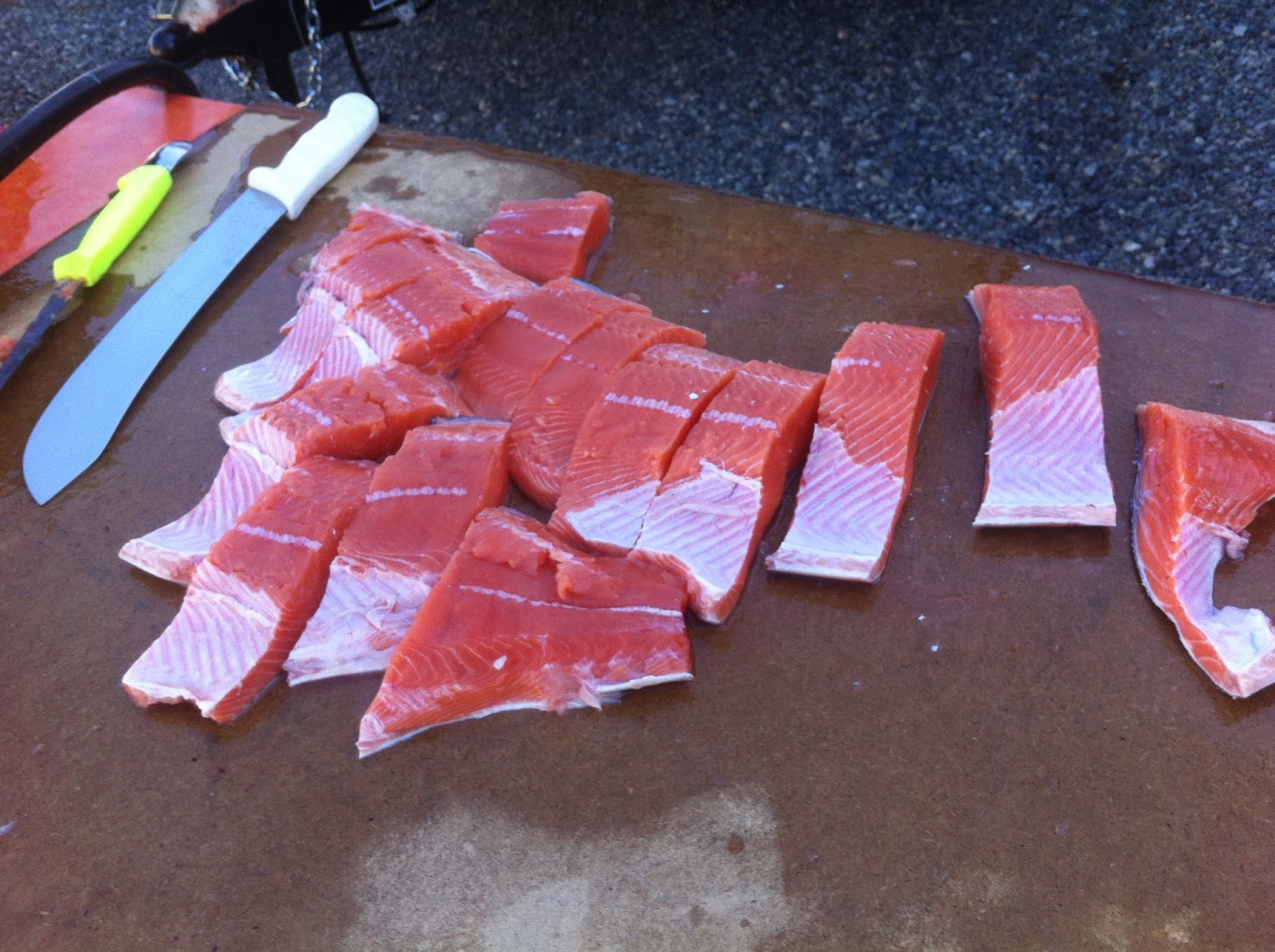
The chart at the top of this page shows the cuts as they would be made by a professional butcher. Bully for the professional butcher - I really ought to study and practice a lot more. I wish I could make neat sections like that. But it's virtually impossible to learn how to do that from a book. You need - or at least, I need - someone to actually show me, someone to put my hand in the right place at the right angle and say "feel that?" In the absence of such hands-on mentoring, I do the best I can. I did okay, probably about as well as I did on the King salmons a few weeks ago (Fish Tale (Canning Salmon)).
Could somebody else do better? Sure. Did I do okay? Yup. I have a freezer full of neat packages wrapped in white paper and tucked into ziploc bags. As my mom always says, "good enough for government work."

I used all four shanks of our goat for the butchering day dinner. I seared them in a hot skillet and then braised them in a mixture of orange juice, chilpotle peppers, tomato, garlic, and cumin. They were very good, but they need to braise all day to reach that falling-off-the-bone consistency. I find that is the best way to cook goat. Again, according to the chart, there are fine chops and filets on a goat, but personally I haven't had much luck with cooking goat as though it were beef, fast and rare. Lamb works well that way, but not goat. Luckily, the falling-apart melt in your mouth meat was delicious, wrapped in fresh hot tortillas and dipped in the spicy sauce.

I am going to bring a package of the meat over to my neighbor, the one whose wife told me not to. Again, according to the chart, goat is actually very lean and has an excellent lipid profile.


Wednesday, August 21, 2013

Fish Tale (Canning Salmon)


One of the many blessings of living where I live is the seasonal availability of the world's greatest fish, the noble King Salmon. Salmon of one kind or another, often farmed, are available year round, but I wait for the local wild runs. To my mind, no other fish can come close to the deliciousness of a fresh caught wild salmon. 

Salmon has become very expensive in recent years, as has most quality seafood. The damage we have done and continue to do to our oceans through overfishing, pollution and acidification is catching up with us fast. The price of good clean fish is really the least of it, but I don't want to get sidetracked into a rant. Point being, I can only afford a few fish a year, and I want them to be salmon. 

A small scale local fisherman shoots me an e-mail when the fish come in, so I was ready. These fish came off the boat yesterday morning about 6 a.m., and I was there with a hundred dollar bill at nine. That bought me these two lovely twelve pound fish. I know that sounds like an awful lot of money, but I did some math, and by using up every last gram of meat on these fish, I can make each fish feed my family four times, maybe even five. That is, I can get somewhere between fifteen and twenty servings from each fish, and that brings the price right down in a very reasonable range. 

fresh kings

One of the fish was for eating fresh, and the other was for canning. I know that sounds like sacrilege, but ever since a friend of mine who lives in Alaska sent me some canned King salmon several years ago, I've wanted to try it. A King salmon is a big fish, it's hard to eat a whole one, and I like canned salmon better than frozen salmon. In fact, canned salmon is delicious.

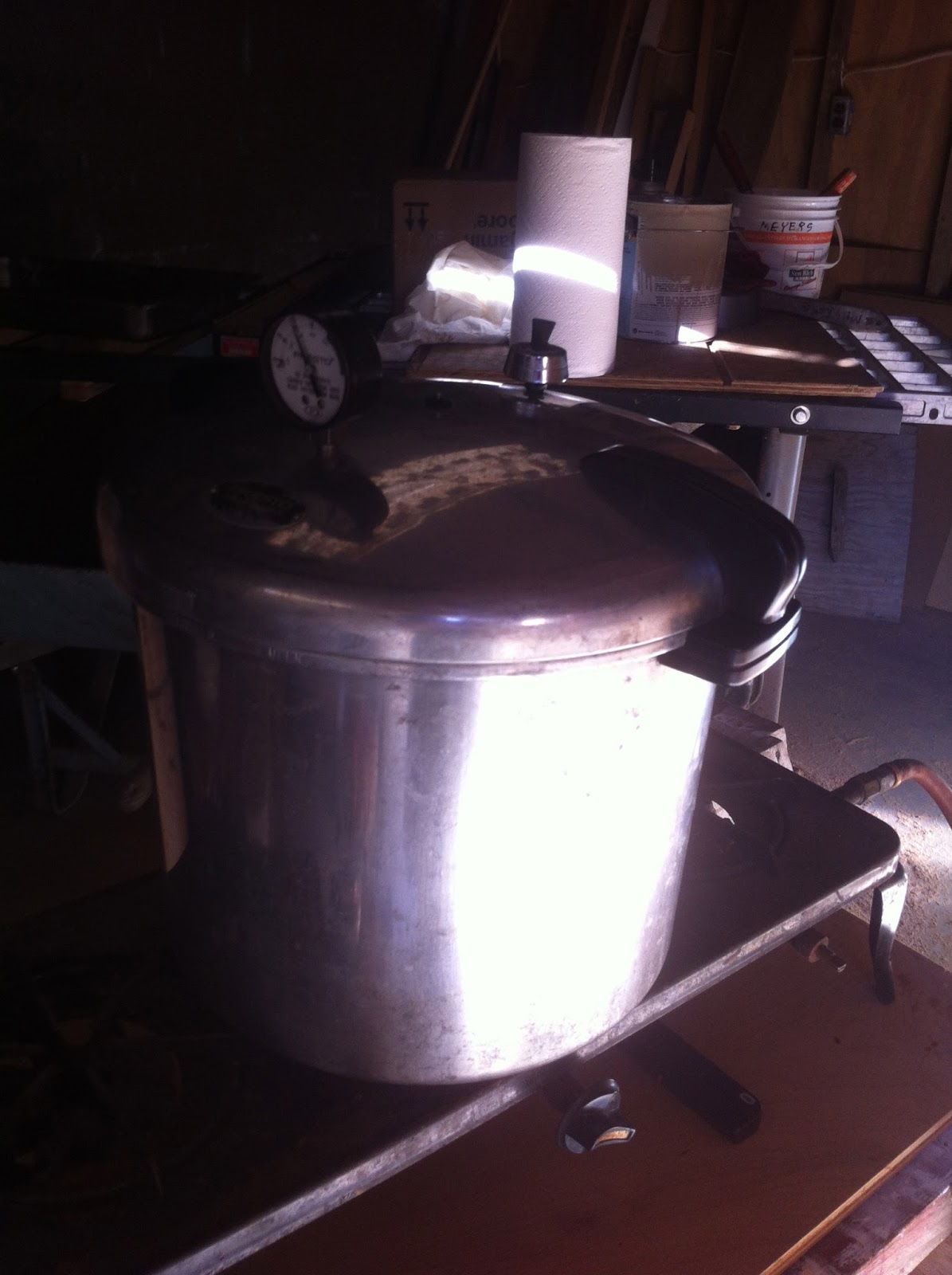
I've never canned fish before - in fact I've never used a pressure canner and don't own one.  Luckily, a wonderful couple I know from church offered to help me. The gentlemen half of this couple is none other than Duckman , an avid hunter and fisherman who has been very generous with us. The lady half is R., one of the most welcoming women at Zion and an old hand at canning the fish her husband brings home. I was very grateful to have their help. First, however, I had to deal with the fish I planned to cook for dinner last night.

Never having filleted a whole fish before (I know, I know, how does a woman who considers herself a serious cook and who loves salmon as much as I just said I do get to the age of 40 without ever filleting a fish? Buy small ones and bake them whole, or pay the fisherman) I was terrified I was going to massacre it. Because it was so fresh, only hours out of the water, the fish was covered with a thick layer of slime, and it was so slippery I could barely hold on to it.

Thank God for Youtube. It took ten seconds to find a short, no nonsense video of a chef with a thick European accent cutting up a whole salmon. Of course, he made it look easy, which it wasn't. Maybe his fish wasn't as slimy as mine. Certainly, his knives were sharper. Mine need professional help. However, I don't think I did too badly for my first ever attempt.


Here is the fish after I removed the filets, with the bellies alongside. I know I left a lot of usable meat on the bones, but don't worry. I chopped the fish into pieces, removed the gills, and put the whole carcass into gently simmering salted water with a little lemon juice. It only needs about five minutes poaching, then all the meat easily slips right off the bones (ok, you have to dig around a little in the head). I salvaged close to a pound of meat from that carcass, and froze it in a ziploc bag. Sometime in the future, it is plenty to make a salmon cake dinner.  Also, I took the collars and bellies and marinated them for a few minutes in a mixture of sugar, soy cause, rice vinegar, and sriracha, and then broiled them skin side up under the broiler for 10 minutes or so. These bits we just gobbled up like candy, but it was plenty of meat that I could have made a separate meal out of it if I wanted to.


Here are the filets. They aren't super pretty, but I think I did okay. One of them was dinner last night (with enough leftovers to make some salmon salad sandwich spread) and the other is in the fridge, marinating in a dry rub. I'm going to break out my "Little Chief" smoker - which I've never used - and attempt to make some real smoked salmon. 

The second fish went out to Duckman's house with me in the afternoon. Let me tell you, watching him with a knife and a fish was a thing of beauty. In about a minute flat he had that big old King filleted, and the filets cut into pieces. He did a neat little trick where he sliced the skin off (not good for canning) without losing a millimeter of meat. Once again, I took the trim (a lot less of it, this time) for poaching and picking. 


We packed the raw salmon into wide mouth pint jars, and added nothing at all except a quarter teaspoon of salt to each jar. You leave plenty of headroom. No water, oil, or anything else. 


 Top the jars with sterilized lids and rings, and into the canner they went. R. and Duckman have a propane cooker set up in their shed; they don't like to can fish in the house because of the smell. I personally find the smell divine, but maybe it lingers.

I'm still a little sacred of the canner, to tell the truth. I just don't quite get exactly how it works. I mean, I can follow instructions, and I can tell when it's working correctly and when something is wrong, but I can't exactly visualize what the parts are all for, and what is happening inside. Anyway. We put the eight pints in the canner and added 2 quarts of water. We ran hot water over the inside of the lid and checked that the gasket fitted into the groove tightly all the way around. We closed it up and put the cooker on low. If you heat it up too fast, you run the risk of breaking all your jars.

When you can see steam venting continuously from the vent, you carefully place the regulator on. The little vent in the middle ought to pop up. If it doesn't, you just wait until it does. Then the pressure will start to rise, and you watch the gauge carefully. Salmon is canned at 10 pounds pressure for 100 minutes. Don't start the timer until the pressure rises to 10.

Then, settle down in your chair and read a book. We had to adjust the flame several times to keep the pressure right; it wanted to creep up. It's fine to let it go a little higher than ten, but you don't want it to go above 15. Once it's at pressure, it only takes the barest whisper of flame to keep it up.


While we were waiting, R. made hamburgers and corn on the cob from her garden. I had brought over a blackberry cobbler as a thank you, and so we had a fine meal. The girls ran and played on the lawn in the late afternoon sunshine and we grownups sat back and chatted about local goings-on. There's a new pastor at Zion. The grandchildren are coming to stay. A fishing trip planned for October. 

When the timer went off, we just turned off the propane. You have to let the pressure dissipate completely before you open the lid - in fact, you have to let it cool down. That takes quite a while, and it was getting late. The sun was setting and a big full moon was rising over the mountain. We decided to just let the canner cool down overnight and I'd come back for my fish in the morning. 

Which I just did. It's beautiful. I brought over a quart of my dill pickles as a thank you for Duckman, but he wasn't home. He's out on the Skagit river, fishing for humpies. 


Wednesday, January 5, 2011

Farm Folks Are Friendly (Home-style Goat Tacos)

Like most other bloggers, I suspect, I have an online community made up of people who read my blog and leave comments and of those whose blogs I read and comment on. As you can see by the blogroll on my sidebar (oh wow, I'm afraid the internet has not, generally speaking, given rise to poetic turns of phrase), my community is mostly made up of other farmer/homesteader types, both nearby and far away. One of the cooler blogs run by a neighbor of mine is the Schoonover Farm blog. D. and her husband run a great little operation in the Skagit valley focused mostly on fiber. Here is a photo of a few of her animals, healthy and sassy in the dead of winter. I especially like the white guy in the right background caught in the middle of a caprine leap.

D. Schoonover contacted me not so long ago, via the blog, and asked me if I'd be interested in a goat of hers as food. She had a particular wether (castrated male) who was very aggressive and they had decided to put him down. They themselves are not fans of goat meat, but she knew that my family is, and did we want to pick him up and make use of him?

Well, hell, we sure did! She may have been inspired to make this generous offer by my incessant whining about how much food it takes to feed eleven people a day when you are accustomed to feeding only five (my in-laws were in town for an extended visit). I think that my duck-hunting neighbor may also have been moved to donate his kill to us after reading my post on how much money I was spending at Costco (Quack Quack Christmas (Shout Out to Zion)). This same neighbor came by New Year's Eve morning with a gigantic turkey - storebought, not hunted - and said that as he and his wife were going out of town on an extended trip, we'd be doing them a favor by accepting the bird. Doubtful though I was about this claim, I nonetheless took the turkey with alacrity and gratitude. It was delicious.

As was D.'s wether. Early New Year's Day, I sent my husband and his brother and sister down to pick up the goat (who had been swiftly and mercifully dispatched by D.). We called on our trusty goat-butchering-buddy, Crecencio, to come and help us and of course to bring his family and feast with us. Homero did not wait for Crecencio to arrive, but began right away to skin and gut the goat. He said he's witnessed at least four slaughters and ought to be able to do it himself by now.
Once again, as with the roadkill deer (New To Farm Life: The Redneck Rubicon (WARNING - GRAPHIC)), we found that a sturdy swingset makes a mighty fine gallows, and a plastic kiddie pool a very serviceable receptacle for guts and such. I made myself scarce, so I can't say much about how the actual butchering went. By eleven o'clock in the morning, the goat was dismembered and firmly ensconced in a truly enormous kettle, along with various Mexican seasonings, and spent the next four hours steaming gently over a wood fire.

Meanwhile, in the kitchen, I, Mama, Temy, and Crecencio's wife Maricela went to work cooking the accompaniments. Basically we were making tacos, which means that the only truly necessary sides are a couple of different salsas, finely chopped onion and cilantro, and quartered limes. I have been a guest in Maricela's kitchen a few times now, and her salsas are absolutely divine, so I stood aside and let her go to town in my kitchen. However, I watched extremely closely and can now offer a couple of recipes:

Salsa Verde Cruda - Raw Green Sauce

several tomatillos - about eight - husked and rinsed
1 bunch cilantro, stemmed and rinsed
3-5 serranos (if you like it hot) or jalapenos (if you like it hot but a little less so)
1/2 medium yellow onion, skinned and chopped
juice of one fat lime
salt

combine all ingredients in blender and blend until nearly but not quite smooth.

Salsa Roja Cocida - Cooked Red Sauce

1 oz chile de arbol - small dried red chiles (1 package) or more to taste.
1 lb tomatillos, husked and rinsed
2 cloves garlic
pinch cumin seed
salt

In a shallow pot, simmer whole chiles for 15-20 minutes. Then add tomatillos and continue to simmer another 20-30 minutes. Transfer to blender along with other ingredients. Blend until as smooth as it's going to get. Salt to taste. This salsa is extremely hot - watch out!

I also cooked a pot of black beans as a side dish. Add a tall stack of fresh hot corn tortillas and you are good to go! Some people might like sour cream or avocado slices, or some finely grated cotija cheese, but we are purists. Do not, however, neglect a case of icy cold Corona or Pacifico beer.

Happy New Year to all, and a great shout of thanks to the Schoonover Farm Family, who, I can testify, really know how to raise a goat!


Friday, August 13, 2010

Question for People Who Kill Their Own Meat

I've posted before about butchering our animals. We butchered quite recently. I've posted about my feelings on meat eating in general, and also about eating our own animals (Too Many Roos, and Musings on Meat (WARNING - GRAPHIC PICS)). The question has come up (to put it mildly) as to how we should treat this issue as regards the kids?


My husband is from Mexico, and his family raised chickens, ducks, and pigs for meat. Homero cannot remember a time when he wasn't aware that the family animals were killed and eaten. But he does remember a specific occasion, when he was about eight years old, that his mother was preparing for a fairly large party, a party that required the demise of more than a few chickens. Up until that point, his job had been to catch chickens and bring them to his mother, who would stretch their necks. This time, when he brought her a chicken, she already had one in her own hands and said "Andale, hijo! Matalo!" Which means, "buck up, kiddo, and kill it already!" That was his introduction to killing chickens with his own hands. He doesn't remember this incident as traumatic, but the fact that he does remember it clearly shows it made a serious impression.

Homero also told me the story of his younger brother's "pet" duck. Now, Mexicans don't have farm animals as pets. In fact, they barely have pets at all. Seriously. I know there are a few here and there, but I feel totally confident in saying that in general, dogs are guard animals; cats are rat-catchers; burros are pack animals; and everything else is food. Little brother's duck was never ever going to live out it's life as a pet. Little brother was aware of that. But on the awful day that the duck appeared on the table, little brother said he wasn't going to eat any and went and sat in his room. Now understand, in my husband's family when they were children, meat was a treat eaten once a week or less. Little brother sat up in his room fuming for several minutes before his stomach won over his conscience, and then came down and ate the duck with tears streaming down his face.

When this story was told to me, everyone laughed uproariously, including little brother (now thirty-some years old.). I don't doubt for a second that little brother had strong negative emotions at the time. But in that world, the death of animals for food, including those who had been known by name, was simply a given fact of life, not something in the least open to debate. All children had to confront the facts of life; it was understood to be unpleasant, but not traumatic in any lasting way. Children, like little brother, who had trouble were teased and cajoled until they got used to it.

In my own family, there is a famous incident that all three of us kids remember vividly - the day Dad killed the rooster. We normally didn't eat any of our animals for food. I think mom put the kibosh on that idea. But we had a rooster who was vicious and attacked us kids, so Dad decided to kill it. He further decided that all three of us children had to line up and watch as he laid it on the chopping block and chopped off its head.

I remember the bright blood fountaining out of the stump. I remember the headless body flopping about. I remember being terribly excited and also kind of scared. I don't remember much after the body stopped flopping. Did he cook it? Did we eat it? Can't remember. As an adult, I don't think Dad made the right decision, but I understand why he did what he did. I do not feel traumatized, though I was the oldest child (maybe seven?) and it's possible my younger siblings received a more severe and lasting shock than I did.

Among the people I know who raise their own animals for food, there is a wide range of opinion on when and how to introduce children to the reality. Should they be totally shielded even from the knowledge that meat comes from dead animals? Should they know the generalities but be shielded from the process of killing and butchering? Should they be fully included in the whole process, from raising the animal to eating it? And what ages are appropriate for different levels of involvement?

I think our position is probably clear to anyone who reads this blog - we hide nothing from our children, but neither do we force their participation. Our children are currently five and a half, almost seven, and sixteen. The sixteen year old is a vegetarian. She has tried many different ways of eating ethically, including killing a chicken herself with her own hands. After much thought and serious consideration, she has decided not to eat meat. That's absolutely fine with me and I respect her immensely for doing the necessary work to arrive at her decision. Our smaller children know that we eat our own animals, and they were peripherally present when we butchered - that is, they were running around doing their own thing and not paying a whole lot of attention but if they had wanted to stop and watch they would have been allowed to. C., our friend who did most of the work, has a seven year old son who physically assisted him with the actual killing of the animal. Homero was impressed and proud of the boy, and said something to the effect that someday his children would be helping him.

So far, our smaller children don't have the mental or moral maturity to evaluate killing and eating the way they will one day have to. When that day comes, we will try to help them through it compassionately and factually, and explain why we eat the way we do, according to their ability to understand. Until that day, we want their default position to be that raising, killing, and eating animals in a natural, healthy way is absolutely normal, and that there is nothing frightening or repugnant about it.

Obviously, there are many ways to approach these issues. I'm curious as to how your family does it. If you raise and butcher your own meat, would you please take a moment and let me know how you do/did handle introducing your children to it?

Wednesday, August 11, 2010

Goat Feast

Yesterday we butchered a couple of goats. There's a sentence that, five years ago, I never thought I would say.


My sister and her husband keep Angora goats, which are fiber goats like the one above (that's not her goat, that's an internet image.). They had one particular goat who they were ready to convert into a nice rug, but they didn't want to eat him. My sister is a vegetarian. Her husband eats meat, but they just weren't ready to deal with eating one of their own animals and explain it to the kids and everything. Also, they don't have the skill to skin it perfectly so that the hide is usable. They offered the goat to us to butcher and keep all the meat; just return the hide intact.

Well we don't have that kind of skill either (it's harder than you think) but we know someone who does. Our friend C. bought and butchered three goats last year for a party he was throwing ( Goat Butchering Party) and told us he'd help us out whenever we needed him. So we gave C. a call and offered him half the meat to come up and do the job - with Homero's help of course. He drove right up with his cousin and his three children (7, 4, and 8 months old, all as cute as buttons).

Then, since the men were here anyway, we decided we might as well butcher our one kid as well. While the men slowly worked their way through the goats and through a case of beer, I got to work in the kitchen and watched the children.

I made frijoles de olla (pinto beans), Mexican red rice, sauteed zucchini, and two kinds of pie - sweet potato and blackberry. As soon as it was ready, Homero brought me in a leg of goat and I seared it in olive oil, rubbed it with garlic and rosemary, squeezed a couple of lemons over it, and popped it in the oven at 325 to braise. The leg was rather stringy and tough looking, especially the shank, so I was worried it might not get tender in the time we had, so I asked the guys to bring me a loin. That I sliced into thin steaks and pan fried with onions and chiles.

As you might imagine, all that cooking took some time - about the same amount of time as it took to break down two goats. Somewhere in the vicinity of five hours. The men arrived at 2:00 and we sat down to eat around nine. The meat was very flavorful, but I don't doubt it would have benefitted from a couple of three days hanging in a cooler. Alas, we don't have access to a cooler. So we gnawed on the bones and chewed the meat like bubble gum. Tasted great, and a little exercise never hurt anyone's jaw muscles, right?

After they left, at about 11:00, I still had to trim and wrap all the meat for the freezer. Even though C. took more than half a goat, there was still a lot of wrapping. I had never tried to wrap meat before, and it isn't easy. Try taking a whole slab of ribs or a whole hind leg and producing a neat, flat package. Huh-uh. Homero and I spent an hour or so trimming and wrapping and taping and twining, and by the time we were done the table looked like it belonged to one of the more notorious serial killers, somebody who might be called "the butcher."

But now, this morning, there is about thirty or forty pounds of wrapped meat in the freezer. I'm glad butchering only happens once a year. I am worn out.

Thursday, March 11, 2010

Big Pig, and Big Decision


See the pig. The pig is big. See the big pig.


The pig is big enough to kill. The pig is big enough to eat.

Homero would like to let the pig grow a little more. I don't know how much the pig weighs - he's about as big as the other two pigs were when we killed them - but I know how much the pig eats. The pig eats a lot. A bag of pig food costs about fifteen bucks and lasts two weeks, supplemented with household scraps. In two weeks, how much weight does a young pig gain?

That's the kind of thing I could probably look up.

And then, if I were further mathematically inclined, I could actually figure out the cost of each pound gained by the pig, and come to a perfect break-even point, a scientifically derived death-date for the pig.

That's not really my thing. I'm more of an estimator. Storey's guide to pigs says butcher weight is between 200 and 250 pounds. I think our pig is just about that weight. Time to kill the pig, stop spending money feeding the pig and let the pig start feeding us.

Oh did I mention, we ate the last scrap of pork from the chest freezer about a month ago? NO, of course that doesn't figure into my calculations. What do you think I am, a monster?

So the question is, not whether or when to kill the pig, but how. We have, for the first time, the opportunity to hire a local expert who will work for a share of meat (Hi Crecencio!). He butchered the goats last fall and did a damn fine job.

Upside: saving $250 we don't actually have at the moment.

Downside: losing a quarter or so of the meat (random guess - anyone out there know what percentage we should offer him? This is all new to us). Losing good quality ham and bacon, replaced by whatever I, with nil experience, can cure and smoke myself. Probably that means bacon, no ham. Everyone I've talked to who has tried it says that our climate here just flat out isn't conducive to ham unless you have a climate controlled room. I don't. But I do have a small smoker capable of smoking bacon.

What to do, what to do? While I mull it over, please enjoy this picture of the pig with his head stuck in a bucket.


Monday, January 4, 2010

Too Many Roos, and Musings on Meat (WARNING - GRAPHIC PICS)


Although last year's chicks had a very poor survival rate (like maybe 25%) we still ended up with too many roosters. Now we have five, which is far too many for a flock of sixteen or eighteen hens. There are the original two, now about two and a half years old. I hear that older roosters are better at protecting the hens, so maybe we should keep these and get rid of the others. Plus, of course, these old roos wouldn't be very good to eat.

But there is one who hatched out quite early last spring and has become a real handsome guy; he's large, glossy, and gorgeous. Homero likes him and wants to keep him. The other two are just old enough to be recognizable as bona-fide roosters, and they are both scruffy and ugly, scrawny little crossbreeds - nothing much to look at. They are definitely going in the fry-pan, even though they are barely bigger than pigeons. That's the problem with raising one's own chickens. When it comes time to eat them, there's a lot of (very icky) work for very little return.

I have to admit, I have not yet been able to completely overcome the yuck factor when it comes to eating animals that I process myself. I have no idea why this should be: after all, meat from the grocery store is just as dead. A whole chicken from the store doesn't gross me out, but if I pluck it and gut it myself first, then it does. I don't like duck anyway, but I couldn't get over the yuck factor of the wild duck breasts that I carved out myself from the still-warm duck. The rabbit that Homero skinned and processed. Even the goats - although I wasn't around for the actual slaughter, I did see the big kettle full of body parts and watch the men doing the last bit of disjointing and skinning.


That part of it doesn't bother me - I didn't feel nauseated while the butchering was going on - in fact I found it interesting and wanted to see all the different organs. Only the next day, when I tried to eat some of the meat - which at that point looked, smelled and tasted great! - did I feel faintly sick.

This bothers me, and I really hope I get over it. I know intellectually that the meat I buy from the store is actually much more disgusting. If I saw the processes that led to it being there - not just the dangerous slaughterhouse, but the factory farm, the CAFO and the battery cages, I would be horrified. Presumably I wouldn't want to eat it.

The meat I raise here on the farm is, objectively speaking, much better. I know my animals are healthy. I know exactly what kind of lives they have led and what they have eaten, and my conscience is clear on all accounts. I treat my animals well and this place is adequate to their needs. So why do I still have this visceral reaction?

Is it just a natural reaction to death, blood and guts? Maybe I shouldn't be eating meat at all. I remember way back when I first was contemplating eating my own animals I said (very bravely, and very prematurely) that if couldn't enjoy meat from my own animals, meat that I was wholly responsible for, well then, I just shouldn't eat meat at all. I still feel that way - no, more accurate to say, I still THINK that way.

But I FEEL a little sick when I kill a chicken, and I only feel hungry when I order chicken at a restaurant. I'm going to have to try harder. I'm going to have to just try and get through it and get over it. I'm going to have to kill a bunch of roosters.

Sigh.

Saturday, December 19, 2009

Goat Butchering Party

Who knew, butchering can be fun?


Well, I wasn't actually around for most of it. I had just left the house yesterday afternoon about 5:00 with a full schedule of things to do that would keep me and the kids busy until about 7, when Homero called to tell me the boys were there to do the baby goats. He also told me they had brought a bottle of mezcal, and he tried to convince me this was traditional. Maybe it is.

Luckily, one of the men, Crecencio, is a very expert butcher. Homero assures me that each goat kid was dispatched very quickly and humanely, by a sharp knife to the jugular. They bled out in under a minute. Then each kid was hung from the rafters of Homero's shop (no playset this time!) and skinned, gutted, and jointed in about twenty minutes.

Homero is always irritated by the amount of "waste" when the professionals from Keizer meats come to kill the pigs. To me, it doesn't look they are throwing away anything I'd want to eat - ears, hooves, various unrecognizable organs, stuff like that. But now that I have seen a Mexican butcher at work, I totally get it. These guys left nothing behind. Pretty much literally nothing. The only things I saw go in the trash bag were the skins and the full rumen.

They had two giant steel stockpots - much bigger than anything I own, and into one them went all the muscle meat and the bones. ALL of it. The heads. The legs, skinned right down to the feet. The hooves were skinned off and the tender inner part of the foot went in the pot. There was just nothing left of those goats. In the other pot went all the organs, and I do mean all of them, with the single exception of the rumen. The hearts, the lungs, the livers, the kidneys, all the fat. The big sheet of some kind of tripe that hangs off the rumen. Most of the intestine. They kept everything.

It was all quite clean. No mess, no smell. Crecencio was obviously very competent. All the men helped with this or that, but mostly everyone was free to stand around the little fire they built and talk and drink. They had brought some enormous maguey leaves (where do they get fresh maguey in washington state? Who knows?) and were slowly roasting them over the small fire.

By the time I arrived, everyone was pleasantly lubricated. The talk was mostly about food: all the great, remembered home cooking of their mamas and grandmas; which ingredients can or can't be got here; reminiscing about all the weird things that can't be got here, like grasshoppers, chinches, real queso fresco, a bunch of plants I don't know. By the time the butchering party wound all the way down, about ten o'clock, we were invited to the big party tomorrow (well, today, now) and many heartfelt sentiments about friendship and solidarity were expressed. The men all made a point of telling me I wasn't too bad for a gabacha and that they looked forward to introducing me to their wives.

I had a great time, and I can't wait to find out what all those unseen Mexican ladies are going to do with my goats. I bet it's going to be delicious.

I actually haven't seen Homero so happy in a long time.

Thursday, December 10, 2009

Hello, Goodbye

Goodbye, Sandy and Tutu (and Clove, not pictured). I sold all three goat kids to a Mexican guy who is throwing a birthday party and wants to put on a big ole barbecue. I don't how many people he's expecting, but apparently three goats' worth. I sold the three of them for $200.


I have mixed feelings about this. One - I intended to eat one myself. We were invited to the party, so I guess we'll get a taste, but that's not the same as putting a whole goat in the freezer. It's not that we need the meat more than we need the money - we don't - but rather that it means putting off for another year taking the large psychological step of killing and eating a kid ourselves. I want that task over and done with.

On the plus side, the Mexican gentlemen are going to do the butchering here, and Homero will be watching and learning. I'd like to watch and learn myself, but I think I had better take the kids and get the hell out of dodge for the duration. I made the mistake of letting the girls hear about the upcoming slaughter, and then I had such a situation to deal with! Such weeping and yelling! Such wailing and gnashing of teeth!

It's understandable. It's normal. I am sad myself, to tell the truth. It wouldn't stop me from enjoying a nice roast leg, but I'm not looking forward to seeing my sweet little kidlings killed and skinned. If the girls give me a legitimate excuse to be absent.... I'm cool with that.

Hello to the newest animals on the farm.... bees! This is just a photo I pulled off the web, since my camera cord is missing. But we have approximately the same setup - four hives plus all the ancillary equipment. Yes, you guessed it - Craigslist. Yes, I agree, it's maybe time for me to find a CL anonymous meeting - but in the meantime, I have a new hobby.

Or Homero does. His father used to keep bees and Homero has often expressed an interest in learning. I like the idea of bees for several reasons - honey, obviously. Better pollination of the orchard and the garden. The possibility of income. But mostly, it's the ultimate fulfillment of the self-sufficiency game The self-sufficiency game (love you, Dad).

Saturday, November 7, 2009

Armed And Kind of Sort of Ready

I bought a handgun today. The husband of a good friend of mine, who is an expert, has been guiding me through the process, from choosing the type of gun I wanted to finding the exact one. Alas, he lives too far away to actually come show me how to use it.


So I signed up for a safety and training course next saturday. After that, it's adios, cabritos!

Wednesday, November 4, 2009

Quiet Days on the Homefront

I'd be writing more, but there's just not that much to write about. This is the quiet time of year. We still have the rent-a-buck here, and we are still living in a faint miasma of funky goat ball pheromones and watching the goats butt heads and tails together, but other than that, there's not much going on.


A black hen is still on her eggs up in the hayloft. I think today I will clean out the rabbit hutch and get it ready to transfer her and her eggs into. And I'm going to keep them there as long as possible.

Food preservation season is over. Maybe, maybe someone will still want to press a few apples, but there aren't that many apples around any more. I did have fun making tepache - basically, wild fermented apple-beer. Leave it out on a warm countertop for three or four days, until it gets a not-unpleasant tang, then freeze it. Remove ice. The liquid left over is pretty strongly alcoholic. I'm guessing here, but maybe 12-15%? From a gallon of cider, I got a quart of tepache. I poured that into a quart jar and screwed the cap on loosely and left it in the fridge for another two days. When I opened the jar, it was fizzy and quite delicious. And rather heady. I would
try making more, but I'm all out of fresh cider. I am also out of cheese and running out of eggs.

But the freezer is still full of beef and berries. And seven or eight gallons of frozen cider.

The last food preservation job of the year is butchering the goats. I am not looking forward to it, but it is almost time. When we are feeding the goats exclusively hay, then it's time. When the weather is cold enough to hang them for a day or so, it's time. When they are fat (and they are) it's time.

I better go get a gun, I guess.

Friday, October 23, 2009

Armed Aimee?

Goat butchering season is right around the corner.


I had been dithering, thinking that perhaps it would be worth it after all to have the professionals come do it... sure, it's $70/goat, but that only works out to about $3.50 a pound, same as the pig....

But that was before the deer incident. Although we didn't eat any of it, we did skin it and butcher it. It was an icky job and the results were far from professional, but I am rather more convinced that we can cut up a goat now. I think we can and should do it at home. It's all part of self-sufficiency.

However, I want to ensure that they are humanely and above all quickly killed. Homero says he can cut their throats, and I know that would work and is in fact how it is done in most traditions, but I want to shoot them in the back of the head.

Instant. No pain, no fear. Except, that is, for the fear I felt upon entering a gun store for the first time in my life and asking about 22 pistols. My hands would not stop trembling. It's absurd, and I know some of you more experienced folks are laughing at me right now.

That's okay. For me, buying a gun, especially a handgun (I thought about a 22 rifle but on the advice of a good friend have decided on a pistol) is a big deal. I haven't held a gun in my hand since I was 14 and my Dad won a tiny little pearl handled revolver in a game of poker and showed me how to shoot it in the basement of the Pioneer Square Hotel. I think I shot it twice.

I need to get a gun soon, because I want to have time to take a handgun safety and training course before I have to shoot the goats. Right now, I just about know which end of a gun to keep pointed away from me and that's it.

Any advice from knowledgeable gun owners would be welcome.


Tuesday, October 20, 2009

The Redneck Rubicon (WARNING - GRAPHIC)

There's no point in denying it any longer. How can I maintain any semblance of sophistication, how can I pretend that I still have any city polish, when I spent the last three hours butchering a roadkill deer? When I think that my mother was a debutante in Scarsdale, with her picture on the society page... well, let's just not go down that path any further.

To be fair to myself, it was not my idea to bring home the freshly killed doe, nor did I have any say in the matter whatsoever. It was simply there when I got home (I would pay quite a bit to have been a fly on the wall as Homero was lifting this 175 pound animal onto his car. It's a busy road. Many people must have passed by. Nobody offered to help, that's all I know.). If I had been consulted, I would have argued against it.

However.

In less than a month, we will be butchering the goats. We've never killed anything bigger than a chicken before. It seemed like too good of an opportunity to pass up. If it was good to eat, we'd eat it. If not, well, it was practice.

Homero hoists the doe up and ties her to the top of the kid's playset - the only suitable place we could find. Now the playset is forever associated in their little minds with blood and guts.
Homero uses his closed fist to separate the hide. He cut a little too deeply at first and some intestine bulged out - but was not perforated.

I attempt to skin the foreleg.

The skinned and gutted carcass with the damaged meat removed. The doe was hit in the right side, and pretty much that whole side was destroyed. We decided we would not use any meat from the right side of the animal, not even the foreleg.

I am looking rather absurdly proud of myself for having removed the left tenderloin without too much destruction or waste. I ran this into the house and submerged it in red wine and garlic.

We then attempted to remove the left hindquarter. We did eventually succeed, but let's just say that no pretty roast was going to be had from that quarter. It was pretty well massacred. I decided to try and dissect what was left, and I did in fact separate it into it's component muscle groups, but I haven't the foggiest idea how to use them. I thought I'd cut it all up for stew meat, maybe.

While I was wrestling with a ribcage, a hind leg, and a foreleg in the kitchen sink, Homero had disposed of the rest of the deer by dragging it out to the farthest section of the property and leaving it for the coyotes (whatever is left tomorrow we will bury). Then he sat down at the computer and did a little research. Which convinced him we shouldn't eat any part of the deer.

I wonder how many women, in this day and age, when presented with a freshly killed large animal would gird up their loins, get out the knife sharpener and the kiddie pool, and get to work. How many would go look up on the internet how to cut around the anus and then actually do it - how many would throw a whole bleeding haunch over their shoulder and throw it down on their kitchen counter? Figure out how to cut it up? Wrap it in plastic wrap and tinfoil and put it in the freezer? Marinate the choicest cut and seriously intend to cook it up and eat it?

I'd wager it's not a really big percentage. I'll be frank, it took some time - and some fortitude - to psyche myself up to tackle that animal. It wasn't a whole lot of fun, but I did it. I was fairly pissed off when Homero suddenly decided we weren't going to eat any of it. Not even the dogs, he decided, could eat any of it.

Well, what the hell did you bring it home for??

It was good practice, I'll give him that. It was good practice.


Look What the Cat Dragged In


When I spoke to my husband today, he said "wait till you get home. I have a surprise for you. I think you're going to like it."


My husband has some weird ideas about what I might like. Flowers, now I like flowers. A surprise date, dinner and dancing? Lovely. He's done the dishes or the laundry for me? Hooray!

Dead deer on my car?

Not so much.

He found it on the road early this morning. It was still steaming. I'm sure it would have been fine if he had hung it up and bled it right away. But he just slung it on the hood of the car and went to work. Now, it's nearly twelve hours later and I'm not at all sure it will still be good.

It's still warm enough to have a tick on it, I saw that. They haven't left yet. It's mostly stiff, but the legs have some play at the joints. I don't know if it's going into rigor mortis or relaxing out of it. No puffiness yet. And there's barely a mark on it, just blood from the mouth.

It - she - is gigantic. Probably weighs at least 150, maybe more. What the hell, it will be good practice to cut it up, since we do have to butcher the goats pretty soon. If the meat doesn't look good to me, we can always feed it to the dogs.

Homero will be home any minute; I told him under no circumstances can he wait until tomorrow. He got himself into this; now he's got to deal with it RIGHT NOW.

And that includes digging the hole for the carcass.

Tuesday, February 17, 2009

Adios, Porker, We Hardly Knew Thee

WARNING GRAPHIC DESCRIPTIONS

The men from Keizer meats were here bright and early in their businesslike panel van. They were here before I got back from dropping the kids off at school, actually. They were sitting in their truck waiting for me to get here, because, they said, they didn't know "which one" to kill. 
"There's only one pig," I said. "he's right there."
"Oh it's a pig? the paper we got says 'lamb'." 
"Glad you didn't kill one of my goats!"

I asked if I could watch, since we were trying to decide if this was something we could do at home next time. They didn't mind, so I observed the whole process closely. The pig was killed with a 22 pistol, right in the head as he ate some grain I fed him. It was obvious that he was dead instantly, nerve reaction notwithstanding. He keeled right over and went stiff as a plank, twitched and flopped and pedaled with his feet for about two minutes, the movements getting smaller and smaller. I'm completely certain he didn't suffer. 

A large knife to the throat, under the jaw, and he bled out very quickly, probably within two minutes or so. The men used a chain and a motorized winch to haul him over to the truck and get him set up on a metal sawhorse, face up. They washed him all over with hot water from a hose in the truck.  Then they took their knives and skinned him carefully until the hide was only attached at the back, underneath. They cut around the hocks and ankles and broke off the feet, still attached to the rest of the hide. They cut off his ears and nose as they skinned the face. This is the part that took the longest, probably twelve or fifteen minutes. It became quite clear that these guys were seriously practiced and that we would not be as neat, clean or quick by a longshot. One of the guys said to me, at this point, "this isn't as easy as we're making it look." That's for sure!

When the skin was almost all off, they used a large saw to open the chest cavity and put hooks through the back legs, under the strong tendons there, and hauled the pig up so it was hanging clear off the ground. This would be hard to duplicate ourselves, without a motorized winch or anything tall and strong enough to hang a pig from! They pulled the rest of the hide off and threw it on the ground. I was surprised how thin it was. For some reason I expected it to be thick and tough looking, but it was like a sheet. You could see light through it.  I asked the guy about the whole cutting around the anus and tying it off thing, but he said "you don't have to do that with a pig, you just grab it and pull out as you cut the guts out." And that's what he did. He held onto the anus-end of the guts and cut carefully the thin membranes that held the intestines and stomach against the back wall of the body. I guess this might be the omentum? The whole pile fell out forward as far as the liver, and then he had to cut some more to get the upper organs - heart, lungs - out. It all fell out together in a big slimy pile, but there was no blood at all. It was white and clean-looking.

I thought about asking for the liver. If I'd thought ahead and had a clean bowl handy I might have. I asked if they did anything with the hides, if they sold them or what, but they said, "no, it's garbage." 

All in all, I was very impressed with how quick and clean it was. There's a small puddle of blood where they cut his throat, and that's it. This pig, too, looked very lean, just like the last one.  I could see the pink meat through a layer of white fat, and in most places the fat was very thin. I don't think we'll be getting any lard back this time, either. I wish Homero had stayed home long enough to watch. He's the one who wants to kill the next one, after all, not me.


Friday, January 9, 2009

Be Afraid, Be Very Afraid.


Homero wants to butcher the pig himself. 


The economic argument is rather compelling. At least half the cost of the final product is in the killing and what comes after. The "kill fee," or the cost of getting the butcher to come to the farm and kill it, is $70. Then they charge 55 cents cut and wrap fee per pound hanging weight, which is different than the weight of the meat you actually get back. The last pig, a little on the small side, was 138 pounds hanging weight and 90 pounds of meat. Assuming this pig is a little bigger - say, 180 hanging weight -it will cost us $169 to have him processed. As a little piglet, he cost $75, and we've probably spent $50-75 in feed for him. That adds up: at least $300, or something like $3/pound. 

I guess it's the same price as supermarket pork, more or less, for a much better product, and the peace of mind of knowing that our animal was humanely raised and healthy. But home butchering would bring that price down to a little over $1.25 a pound. That's some cheap, quality protein.

Now for the downside. Oh, where to begin? Okay, let's begin with MY knowledge deficit. I don't have the foggiest idea how to cure bacon and ham, and I'm not really psyched to learn. So we'd either have to have all uncured pork (no way) or pay somebody to cure it. Then there's my husband's knowledge deficit. Homero has, in fact, helped butcher a pig before. He was twelve years old and he assisted his father in Mexico. How material was his assistance, I don't know. I haven't asked. Homero has many wonderful qualities, and one of them is his - how do I put this? - unflagging self-assurance. He hasn't any doubt whatsoever that his prior experience and enthusiasm is equal to the task. It's left to me to play Cassandra.

So I bought a book, which is what I do when I have any sort of doubts about anything, or indeed, any money in my pocket at all. Storey's big book of butchery. I simply told Homero he was welcome to kill the pig as soon as he had carefully read the section on pigs and assembled all of the tools it says are necessary. Since the first such tool is a 22 rifle, the next is a sturdy, 4 1/2 x 6 foot wooden platform, and the third is a 95 gallon stock tank settled over a cement fire pit, I think the pig is safe for a while. 

Seriously. Home butchery is part of self-sufficiency, and it should be a goal of mine to become capable at it or more realistically to encourage my husband to become capable. It's a fact that the animals have to die in order for us to eat, I'm aware of that, and I've been pushing myself by little baby steps toward becoming more, um, tolerant of the process. No matter how quick, humane and painless the animal's death might be, butchery is messy, bloody, smelly, and wearisome. I should be grateful that Homero is willing to take it on.

But I still want good meat, ham, and bacon. I don't want to lost all this meat to his first try. Therefore I put an ad on Craigslist for a mobile butcher, professional or very experienced amateur, willing to help, teach, and get paid partly in meat or mechanic work. We'll see how that pans out.