"United we bargain, divided we beg."
Showing posts with label veterinarian. Show all posts

Sunday, August 2, 2020

The Horns of the Dilemma (to Disbud or Not to Disbud)


Seven A.M. on a Saturday. We are all peacefully asleep, dreaming the dreams of the innocent. There is no alarm clock set; we will wake when we wake, naturally and without intervention.

OR SO WE THINK. The phone rings, jangling us out of slumber. “Your goat is stuck in the fence again,” says our neighbor, acerbically. “She’s yelling.” 

For perhaps the ninth time this week, Homero truckles  out to the back pasture, wire cutters in one hand, wiping the sleep out of his eyes with the other. He spends a difficult ten minutes wrestling with Lilac, the goat who insists on sticking her head through the fence several times a day, even though the grass is EXACTLY as green on this side as that. 

We used to disbud our baby goats. Most goat farmers disbud, or at least in our area they did when we got into goats. Goats with horns are not allowed at the county fair, which means any kids who have goats as a 4-H project would have to disbud. For those of you who don’t know, disbudding a baby goat involves applying a red-hot iron to their little adorable heads for at least twenty seconds, while they struggle and scream and behave exactly as you would, if someone were applying a red hot iron to your head. 

Personally? I am a feelingless monster (Aquarius) and their pain and suffering didn’t really enter into the equation. However, I am a trained medical professional and I did notice that a high percentage of baby goats suffered serious consequences in the form of neurological symptoms for several days afterwards. And more importantly, no fewer than three baby goats died over the years, following the procedure, even though I took them to the vet and had it done under anesthesia.

Feelings aside, that’s an unacceptable economic proposal: let me give you more money than this goat is actually worth, to perform a procedure that has, in my experience, a 5% chance of killing my animal. That just doesn’t make sense. For a couple of seasons, we tried to do the procedure ourselves, but I found that I am not hard hearted enough (or strong stomached enough?) to apply the iron for the time needed to kill the horn buds and avoid the growth of misshapen scurs. It seems that there is very little margin for error in the disbudding operation - the space between too little and too much thermal damage is slim indeed. 

So, three or four years ago, we decided we won’t disbud baby goats anymore. For the most part, this decision has had very few negative consequences. Goats do use their horns to challenge each other, butting heads and so forth, but they cannot really do any real damage to each other with them - with the exception of bucks who can and do butt pregnant does and cause them to miscarry. There is still a good argument for  disbudding bucklings. We don’t do it, but I understand and support people who do. 

This decision means we have several does with horns, and one of them - Lilac - is so dumb as to get her head stuck in the fence multiple times a day. Another quick piece of relevant information - it is not feasible to remove horns form an adult goat. Horns are lavishly supplied with blood vessels, and removing them is tantamount to an amputation. 

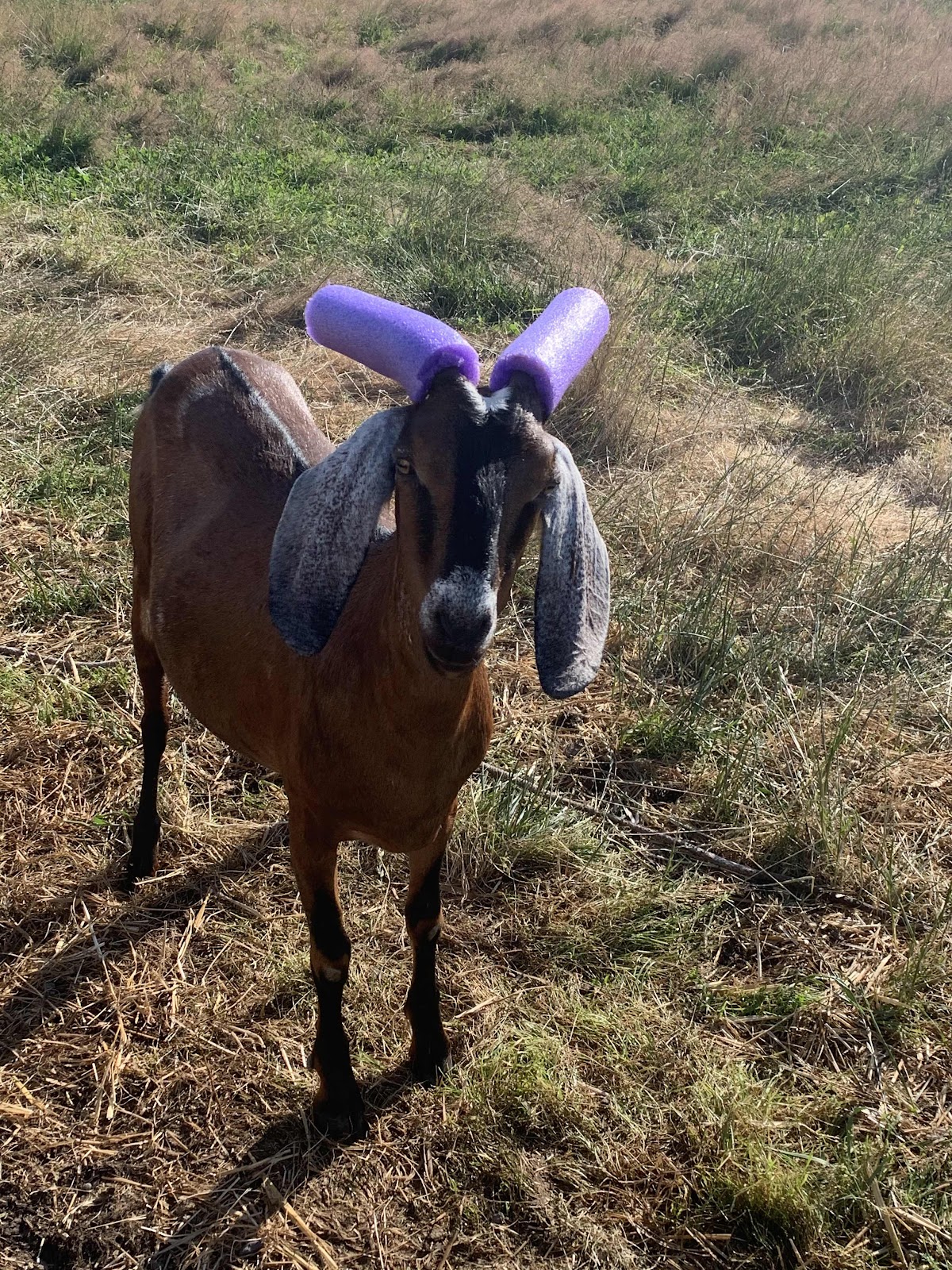
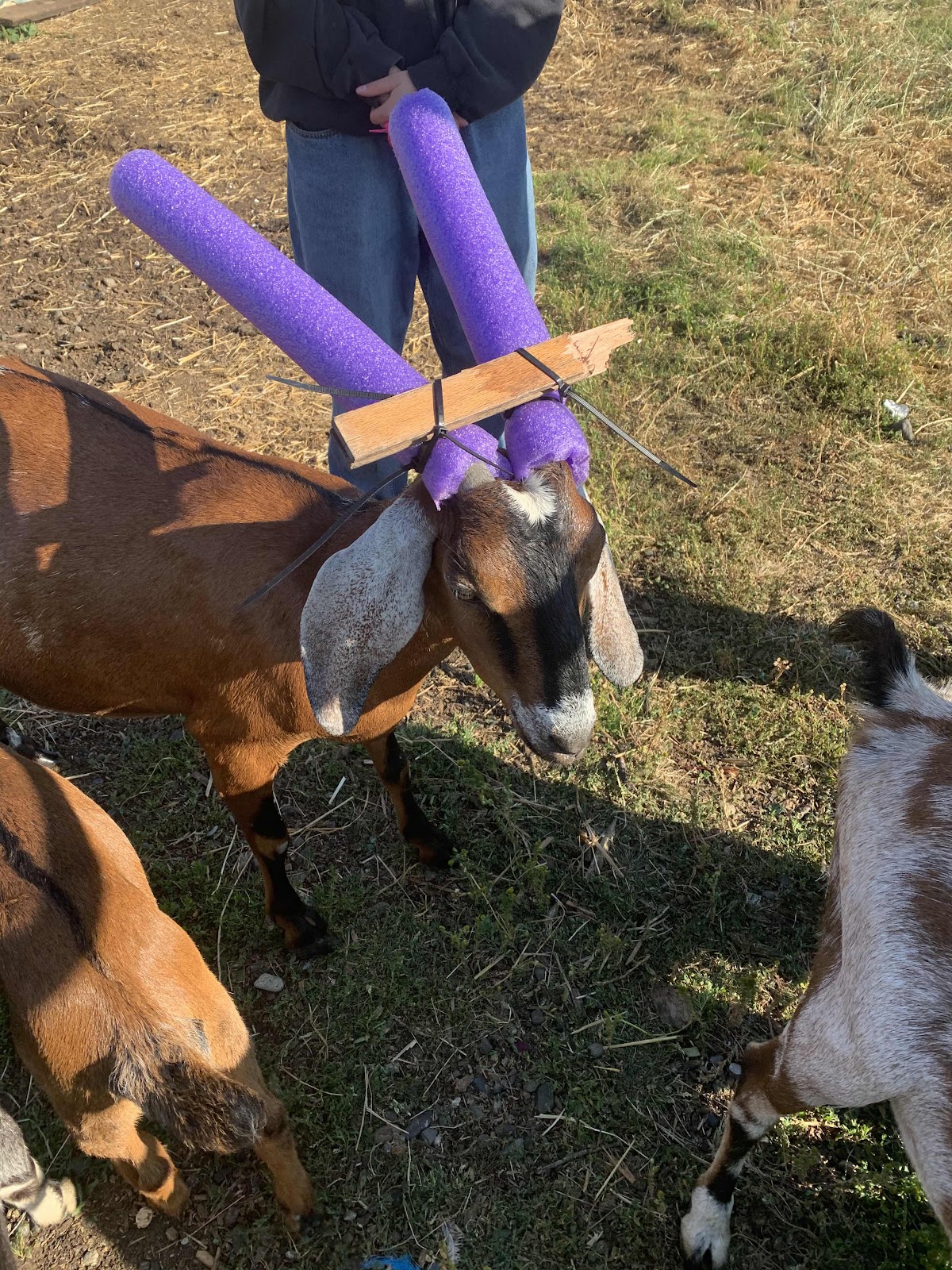
So we have been forced to try and rig up some sort of headdress that will prevent Lilac from putting her head through the fence, which has 4x4” openings. A little googling showed me solutions involving pool noodles. 
I went to the dollar store and bought a pool noodle, and we attempted to attach them to her head with zip ties:


These fell off within minutes. We tried again, this time incorporating a cross-bar: 


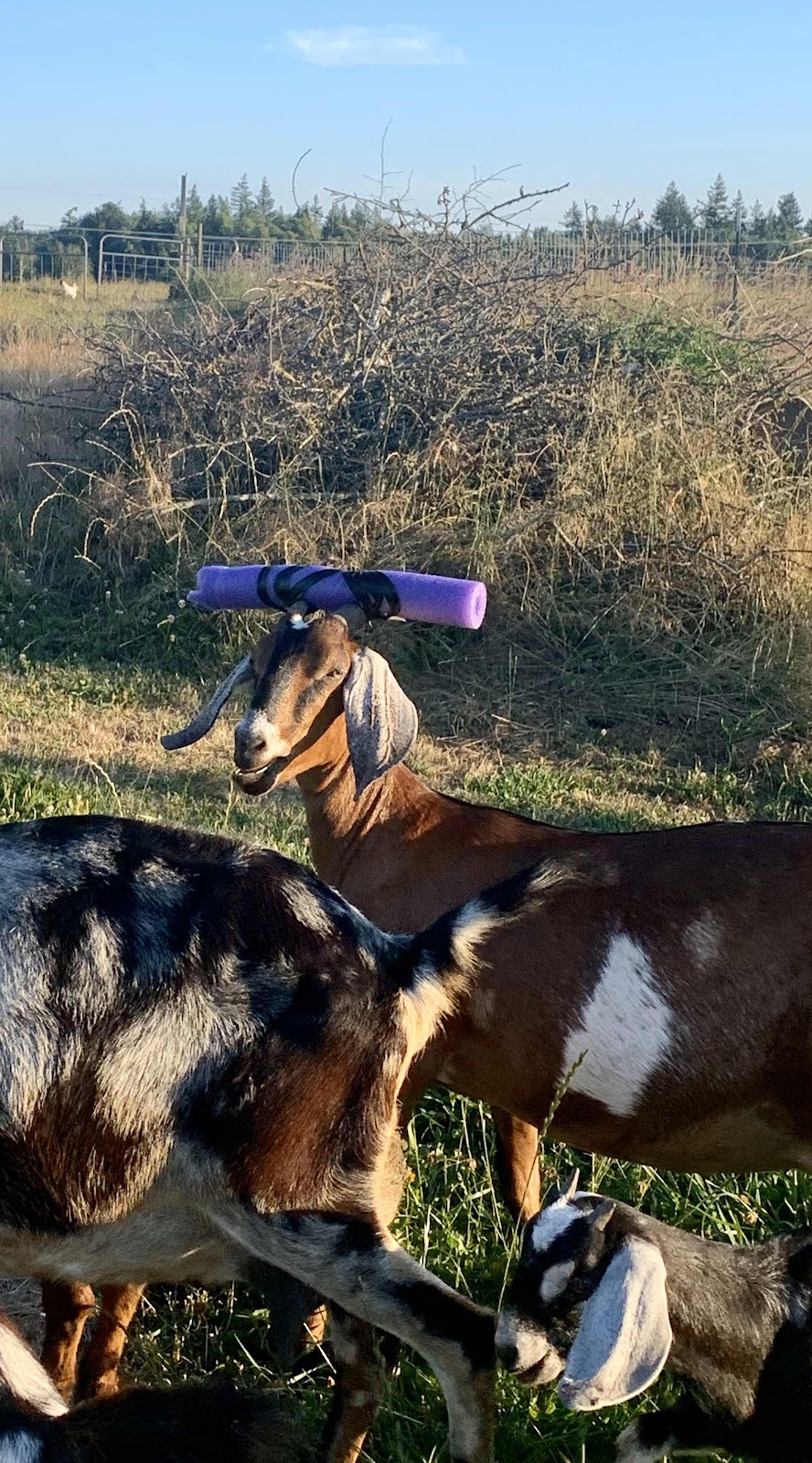
This also lasted less than 60 minutes. Our next attempt was to put the entire pool noodle crosswise:


Also attached with zip ties, this arrangement lasted all of 30 minutes. The problem is that her horns, like most, are basically cylindrical. The headdress tends to slip up to the tips. 

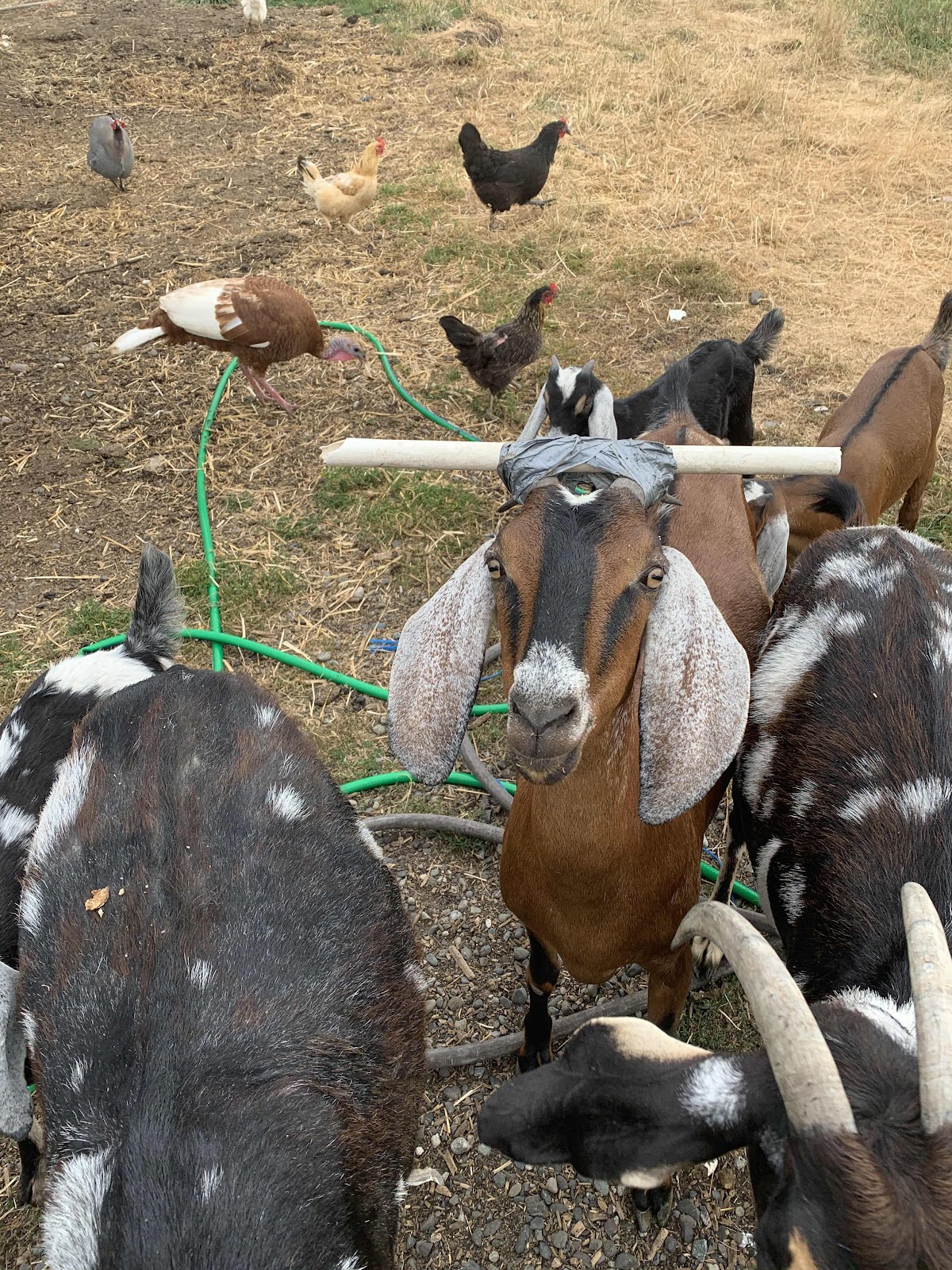
Finally, tired of fucking around and very extremely tired of being awakened at the crack of dawn by understandably irate neighbors, we bought a roll of wide, industrial strength duck tape and a short length of PVC piping. None too gently, I restrained the recalcitrant goat while Homero wound foot after foot of duck tape around her horns.


This iteration has lasted five days now. I hope
It will last until her horns grow wide enough to prevent the passage of her head through the holes in the fence. Wish us luck. We want to sleep. 

Monday, April 8, 2019

......Or Does He? (Warning: Graphic Photo)


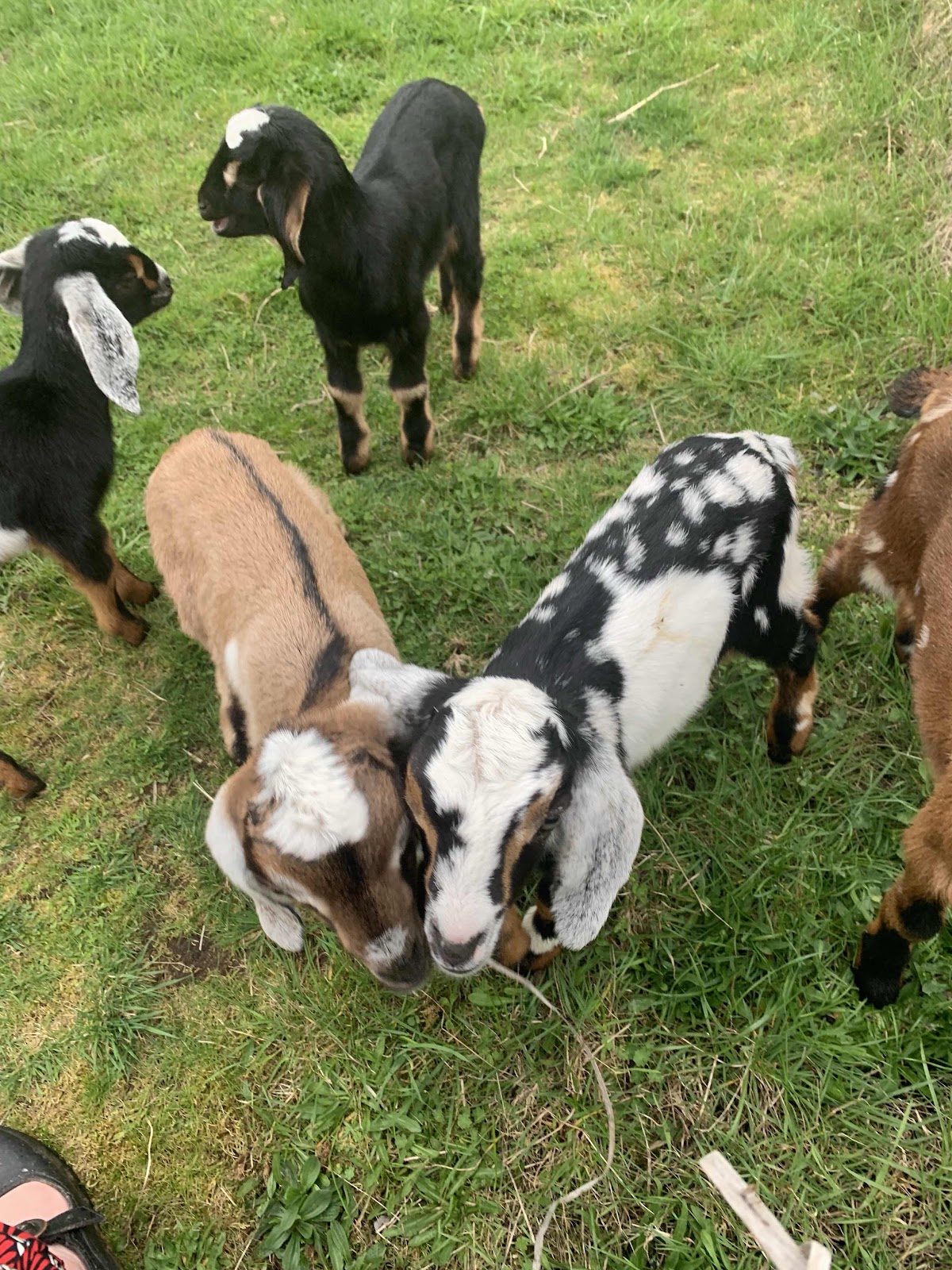
First, please enjoy this photo of adorable, healthy baby goats frolicking in the springtime, all right with the world. This is the reality for 8/9 babies born this year, and that’s not such a bad outcome. 

But now - 


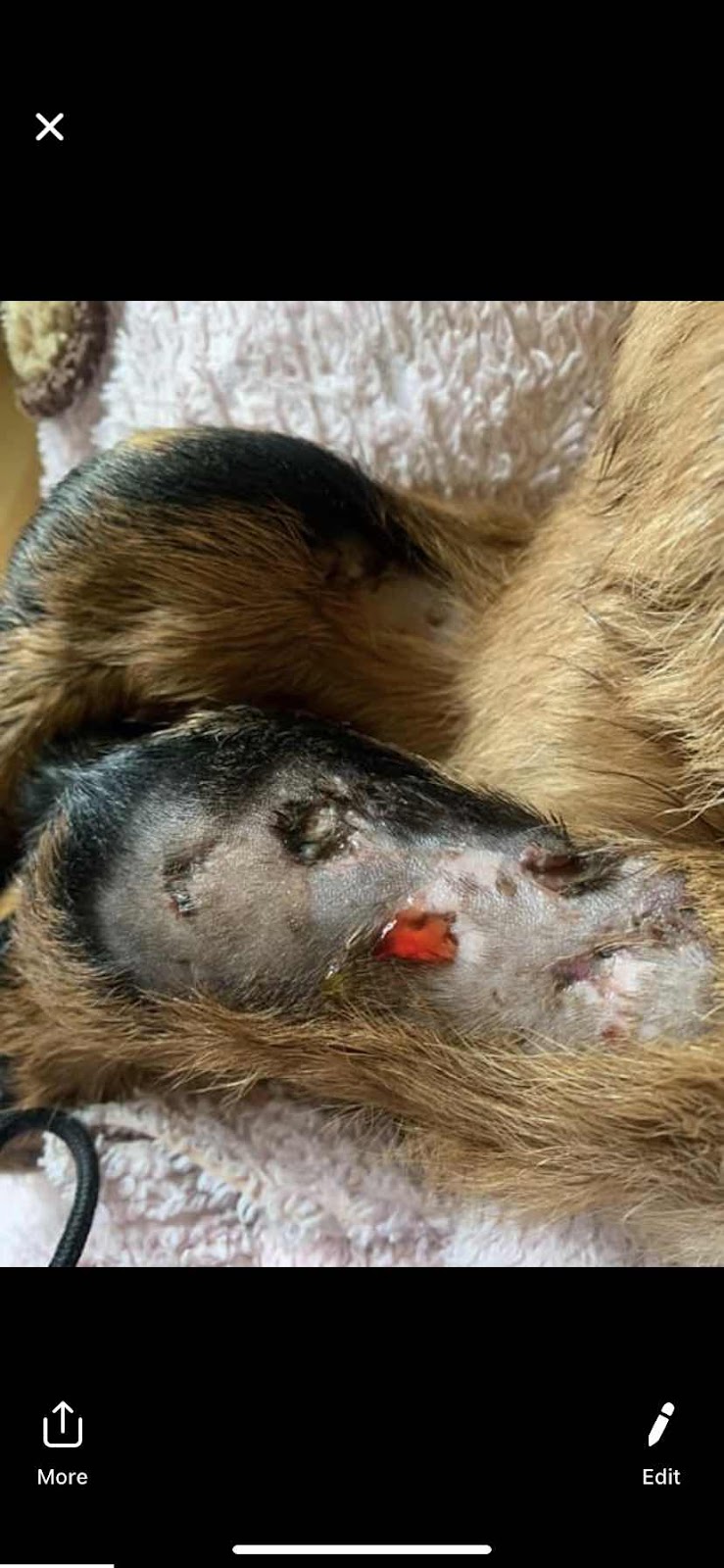
This photo of the bite inflicted on baby number nine by my very own dog. There’s a story here - hold on before you condemn the canine. 

The last mama goat to give birth was Polly, last Thursday evening around 5 o’clock. She had a lovely set of twins, who both stood up and nurses with no problems, a boy and a girl. I was thrilled. However, when Homero went out the next morning to do chores, he found another baby in the ground, still wet and gooey, who had apparently been born quite recently. 

For those of you who aren’t goat breeders, it’s not normal at ALL for there be such a long delay between kids. No matter how many kids are in there, a normal birth usually takes an hour, maybe an hour and a half, tops. So this little guy was off to a rough start. It seemed he had aspirated some amniotic fluid. His lungs rattled and he was very weak. He couldn’t stand up by himself, and his mama ignored him. 

That’s a bad sign. I always pay attention to the mamas, they seem to be able to tell better than I can when a baby is not very viable. However, he was alive, so we went to work to get some colostrum into him. Throughout that day we bottle fed him every hour or so, and although very weak and coughing, he was getting some down. 

But there was clearly something wrong with him. His head was swollen, whether from the hard birth or whether malformed in some way was hard to tell. He stayed standing if we stood him up, but he couldn’t get up on his own and he didn’t try to walk. 

We had plans to go away for the weekend. I asked my good friend K., goat rescuer extraordinaire, if she wanted to try to care for him over the weekend. I let her know he was poorly and might not make it. She did want to, and in her usual way she went to work on him. 

She noticed, however, that he seemed to have a small wound on his leg. When she washed it and shaved him, it turned out not to be a small wound after all but a pretty serious dog bite. Overall the weekend, it got infected despite her care. When we got home, she let me know she thought the baby was suffering. 

I picked him up and took him to the vet. My gut instinct told me that the little guy was in his way out and I thought he should be put down, but I wanted to give the vet a chance to weigh in. There’s always a possibility he or she might say “no, no, all he needs is a course of strong antibiotics.” 

But my instinct was right. The vet told me his leg was actually broken, and that he seemed to have some neurological damage as well, whether from the hard birth or for whatever reason. His lungs were crackly with pneumonia. He had several complex problems. It went far beyond a course of antibiotics. 

And truthfully, that’s about all I was willing to invest in this kid. Even if he lived, he was still marked as a meat animal. If he wasn’t going to enjoy his year or year and a half on earth as a happy, healthy member of the herd, then it’s better to put him out of his misery right away. Which is what we did. 

As for Haku.... well, I’m fairly sure he wasn’t trying to kill the baby. After all, if a 95 pound German Shepherd wants to kill a newborn baby goat, he generally can do it without much effort. And Haku is so very, very gentle with the babies. He only wants to lick them all over. My guess is that he was attempting to help. 

Baby goats hide. In the barn, they hide behind hay bales. That’s their instinct. When Homero found this little guy he was hidden behind hay bales. I think Haku was trying to drag him out of his hiding place. My sister has a livestock guardian dog and she told me that he once injured a baby goat doing exactly that. 

In any case, there is one less baby goat in the world now. Poor little guy. But it’s good news for his mama, who now only has to raise twins. 


Friday, June 8, 2018

Bloodsuckers (Parasite Problems)


Dairy goats are plagued by parasites. It's just a fact. Some areas of the country are worse than others, and in some areas resistance has become a problem; in other areas its less serious. But anyone who raises dairy goats will have to develop a parasite protocol and be on the lookout for signs of infestation.

I've had my troubles with parasites before - our wet weather and lack of hard freezes some winters contributes to the issue. We've had lungworms and stomach worms and coccidia. For the most part, these have been passing problems, and with vigilant treatment otherwise healthy goats shake off the effects and continue to thrive. I do know by now, however, what a wormy goat looks like.

-Diarrhea. Primary symptom. May be intermittent or constant.

- Skinny. Weight loss is the main symptom (after diarrhea) and it happens not just because the parasites leech energy from the host, but because if the host is losing enough blood they will become anemic and then the rumen doesn't get properly perfused, doesn't work correctly, and you get malabsorption syndrome. Then it doesn't matter how much quality food you are feeding, the goats can't benefit from it.

- anemia symptoms: lethargy, pale gums and conjunctiva

- lowered milk production, if they are in milk

- rough, coarse coat. I don't know why this happens.

In the middle of winter, when it's cold, and all the forage is gone and the goats are subsisting on just hay, and they are pregnant, it's fairly normal for them to lose a little weight. But they shouldn't get really thin. This past winter my goats kept losing weight no matter what I fed them. In fact, they were skinny as rail fences, and generally looked run down and wormy. They started pooping green glop, instead of nice clean pellets. I figured I had worms and dosed everyone with the standard medicine, Ivermectin.

When they didn't improve after some time, I repeated the ivermectin, and when they still didn't improve I thought I might have some resistant worms on my hands and switched to a different wormer that works by a totally different action.

Well they just kept losing weight. Spring came, they gave birth (Flopsy to quadruplets again) and the babies were all healthy, but the moms went downhill, trying to feed all those insatiable little monsters. I brought fecal samples to the vet and, maddeningly, they came out clean. Negative for everything. Repeat fecals came out clean as well.

I discussed the issue with my vet, on the phone, but all he suggested was increasing their ration of grain and buying some alfalfa hay. He seemed to think it was a feed issue, and indeed it certainly looked as though my poor goats were starving to death. He said "Parasites are not your problem," but I knew he was wrong. I know an anemic goat when I see one.

I don't know when the light dawned. Maybe it was when spring was far enough advanced that I started letting the goats out to graze in the front, and began spending a lot more time in close proximity with them than I did in the winter, when I would just go out for a few minutes twice a day for chores. I noticed that their coats weren't just rough, but that they actually had bald patches and that they were rubbing themselves along the fences. BINGO! A lightbulb went off in my head.

Not all parasites are internal. There are external parasites as well. Lice. Probably brought here by the buck I used to serve them last fall.

As the parent of three children who went to public school, I have had my fair share of experience with human head lice. As obnoxious and disgusting as they are, in people, lice are not dangerous. They do not carry and dangerous diseases, and being confined to a small percentage of our total surface area, they can't really suck enough blood to do us great harm. In goats, however, the case is different.

A serious lice infestation can act exactly as a serious internal parasite infestation - the insects can suck enough blood to cause serious anemia, and then all the sequelae are the same as that of a worm-induced anemia - malabsorption syndrome, weight loss, even death by starvation. My poor goats were being sucked dry by thousands of tiny vampires.

Luckily, the treatment is easy and cheap. It's actually the exact same medicine used in people - Permethrin - but at a higher concentration. You can buy it at the feed store under the name "Ultraboss," You dose the animals at 3mL/100lbs at a 5% concentration, laying down a line along their spines, just like applying flea medicine to dogs. As in people, it requires a minimum of two doses given two weeks apart, because Permethrin kills live lice but not eggs. Now my goats have received three treatments, and I may still have to give them a fourth. This was a very heavy infestation.

Almost immediately they began to improve. Their energy level went up quickly, and they began to gambol about and bounce like healthy goats do, instead of hobbling around arthritically. Milk production skyrocketed (another post will follow - I am drowning in milk). Their coats began to fill out and regain their gloss. Only the diarrhea is still hanging around. I think that probably the severe anemia actually did some damage to their rumens and it will simply take some time for them to heal and perform optimally again. That's just a supposition. If the diarrhea persists for another couple of weeks, I will have to bite the bullet and actually have the vet out to look at them.

But for now, I feel pretty proud of myself. Yes, it took me a while, but I diagnosed the problem despite poor veterinary advice, and was able to treat my ladies and help them get better. It makes me trust my eye and my instinct better than before. Little belittle, I am becoming a real farmer.

for more information about lice in goats:

http://www.ansc.purdue.edu/SP/MG/Documents/SLIDES/External%20Parasites.pdf


Monday, February 15, 2016

A Rough Day for Iris (and Me)

I got up early this morning to go to a work appointment, only to find when I got there that the client had cancelled only minutes before. Barely awake, I executed a  U-turn and headed for the nearest coffee shop.

On the way home, as I was drinking my coffee, a crown popped off of one of my molars. Although it didn't hurt, it seriously freaked me out. Instead of a tooth, I suddenly had a small squishy gap where a tooth should be, with a small steel spike sticking up. I was so horrified, I almost swallowed the crown. Almost. Luckily, I was able to pop it back on - after I pulled over, of course, and after rotating it through a few revolutions and trying all the possible angles.

I drove straight to the dentist who had placed it, just last year (I broke that tooth cracking Dungeness crab with my teeth. Please don't ever do that. Crab-crackers were invented for a reason). I asked the receptionist at the dentist's office if there was a guarantee on the crown, seeing as I had had it for only a little over a year and further seeing as how I have no dental insurance. She told me that there was, and that if neither the crown nor the remnant of my tooth were damaged, then it could be replaced for free. However, she had no openings that day and the best they could do was tomorrow morning.

Sadly I drove home, trying not to test the strength of the crown by probing it with my tongue. When I got home, about ten thirty, Homero was waiting outside and flagged me down.

"Iris is giving birth, but I don't think it is going too well," he said. "Come and see."

Passing through the house to quickly wash my hands and get some soap and warm water and a towel, I raced out (through the driving rain) to the barn. We got Iris into the mama barn by main force, as she did not want to get up or walk.

Iris is my oldest goat, my first goat. She has had many babies and is now about nine years old. Last year she didn't get pregnant, and I had figured her mothering life might be over, but then she did catch this year. Once in the mama barn, she laid down on her side and started pushing hard, grunting and curling her lip. We tried to get her up on the stanchion, but no go, so I laid down in the straw behind her, soaped up my hand, and went exploring.

There was no sign of any residual "goo" which told me that her water had broken some time ago. She was dry and tight. There were two hooves right inside the vulva, both front hooves, and in normal right-side-up position. Further back, alongside and below the legs, was a head.

I needed to find out if the head and the legs belonged to the same kid. It didn't seem like it, because in a normal presentation the head should be above (dorsal to) the hooves. Feeling for the jaw, I found the mouth and inserted my fingers to feel for teeth. There were sharp little teeth on the upper (dorsal) side. Goats only have front teeth in their lower jaw, not in the upper. So feeling these teeth told me that the head was upside down.

What I needed to do was follow either the head and neck, or the front legs, down to a body and try to figure out where they all came together - or not. If there were two kids, I would need to push the head back into the uterus, and then find the head belonging to the legs and bring it around. Or, of course, the opposite - push the feet back and then find the other feet belonging to the head.

This might sound easy in theory, but in practice it is not. It's not easy even if you have an upright goat and are not laying on your side in the straw without very good light. I went in as far as I could, but I was unable to ascertain for certain whether there were two kids or one. The head did not budge when I pushed on it, nor did the feet come forward with gentle traction. Without having a clear picture of what was going on, I wasn't going to pull any harder than a 2 on a scale of ten.

I though we had twins - one with legs forward and head back, the other with head forward and legs back. Knowing there was nothing more I could do, I called the vet and told them I was coming in.
Getting Iris into the van was a challenge, but Homero and I did it, and then he stayed with the children while I drove as fast as I could (through the driving rain) to the vet. Not very fast at all, as I spent the entire twelve miles behind first a tractor and then behind one kind of semi-truck or another. I am not a patient driver at the best of times, and least off all with a beloved goat in the worst kind of distress in the back.

Once Iris was at the vet's and up on a stanchion (lifted by three people), the doctor gave her an epidural and went in to try to figure it out. It wasn't obvious to him either. It took a good ten minutes to first figure it out and then straighten it out. I was wrong; there were no twins. There was only a single baby, who had her neck wrapped around her own front legs like a corkscrew, so that her head was upside down underneath her own knees. It is an impossible presentation. The baby cannot come out that way, and pushing the head or pulling the legs is not going to help. The doctor had to twist the head and bring it around up over the legs, into a normal presentation, so the baby could be born. That was a pretty violent procedure requiring a lot of force, and Iris was in great pain - epidural or no.

She was dead, of course. It appeared she had been dead for some time, perhaps two or three hours. The vet said that with the poor presentation, Iris had probably been in low-grade labor for several hours. Without the head providing the correct pressure on the cervix, the labor didn't progress, and after the baby died (whenever that happened) the baby couldn't help by wriggling or changing position. If I hadn't taken her in, Iris would most likely have died eventually as well.

Poor Iris. She got a shot of painkillers, a shot of penicillin, and a ride home with a full udder and no baby. She is fairly torn up. I'll give her a full course of penicillin injections, and I have painkillers for three more days. She is also now officially retired - no more babies for Iris. I asked if any of this could be attributed too her age, and the vet said not definitively, but older dams do have a harder time kidding in general. Iris has earned her retirement at least twice over   (How Much is a Good Goat Worth?) - we will have this last season of milk from her, and then she can spend future breeding seasons with the ponies in the horse pasture.

The baby was a doe. A fine, big, brown doeling.

When I came home from the vet, covered in poop and blood and slime, aching for a bath, I found one of my kids already in there, and they had already used up all the hot water.

Also, there's no wine in the house.


Sunday, September 14, 2014

It Never Rains But it Pours (When is Enough Enough?)


We've had a streak of bad luck lately. An expensive streak. In the past two weeks:

- I broke a tooth. A particularly exciting trade had come my way - it's crab season in these parts and apparently it's been a very good year. A friend of mine traded me a couple pounds of goat cheese for three or four big fat dungeoness crabs, already cleaned and cooked. Since in my estimation, dungeoness crab gives king salmon a run for its money as the most delectable native seafood of the Salish Sea, I was understandably excited about this trade. I sat down at the kitchen table with a pair of crackers to extract the meat and have a few nibbles along the way. I spent a very happy hour or so cracking crab legs, partly with the pincers and partly with my teeth, sweet sea-flavored juice dribbling down my shirt front. But when all the crab was gone and I came out of my yummy-food-induced trance, I poked around in my mouth with my tongue and found that one of my molars was missing a big ass chunk.

The good part was that it didn't hurt. The bad part was that my brain instantly began to freak out and insist that my tongue check out the hole every 0.6 seconds for the next eighteen hours. I don't have dental insurance - I have health insurance thanks to the ACA, but not dental - and so I had to wait until the local Interfaith dental clinic opened up on monday morning and wait my turn with all the other poor snaggletooth schlubs. The dentist there told me they could fill it, but that that was only a temporary solution and I really needed a crown. Crowns, I was told by every local dentist I called, run about fifteen hundred dollars.

My husband said, when I told him, that if we didn't spend money on our teeth, what the hell were we saving it for? So I made the appointment and went in, on wednesday I think. A crown is a two appointment procedure, and this first one was the hard one. For two and a half hours I suffered in silence, and then I paid them $750 dollars and drove home with a numb, swollen jaw. When I got there I found that

- Poppy Pony had had an accident. Homero had tried to text me and tell me, but I was head down in a dentist's chair with my mouth full of cotton gauze and pain. It seems he had staked her out to eat the green grass in the front yard. The pasture is pretty brown and bald at the end of this long, dry summer. Poppy had tried to reach some greener grass nearby and had pulled the stake, a T-post, right out of the ground. It hit her in the hocks; she panicked and went charging around the property at top speed with a six foot steel bar thumping and whacking along behind her. Trying to get back into her own enclosure, she went over the top of a cattle panel and crashed into the side of the barn, actually knocking a big hole in it.

"We hath to caw the wet," I said.

When he got there, the vet gave her a sedative, a shot of antibiotics, and an injection of pain medicine. He cleaned up the numerous cuts on all four of her legs. No stitches were needed, but he had to trim off a couple of flaps of skin with scissors. She was limping, but he thought that was just bruising. He gave me anti inflammatory gel to administer for the next ten days and said no riding for three weeks. He also showed me a hideous photo on his cell phone of a horse who had gone over a barbed wire fence that same day. A big sheet of skin and muscle was hanging down off the animal's neck. He said Poppy was very lucky; she could easily have broken a leg or suffered a trauma like the one in the picture. Then he charged me three hundred dollars and drove away.

Later in the week, a man came out to inspect the crawlspace. A couple of years ago, while we were in Mexico, the sump-pump failed and the crawlspace flooded (Bad News from Home). We have only just had the money to address the issue. OR SO I THOUGHT. The man who came out, owner of a very highly regarded company that specializes in crawlspaces and nothing but, went under the house in a haz-mat suit and took about two hundred pictures. When he came back up he said "the sump pump is the least of your problems." Then he showed us the pictures.

I really don't have the heart to go into it. For the first time, I am seriously questioning whether we made the right decision in buying this house. I love this property with all my heart and I firmly believe that by moving here, we have given our children the great gift of a childhood that includes wildness and the possibility of losing themselves in nature. Over the years, I have come to love this house as well - this very 1940's owner-built ranch house, with all its eccentricities and quirks. The many issues we have addressed - the roof, the plumbing, the rot - have been expensive, but I thought we were finally getting on top of it, and even felt pride in slowly restoring an aging but unique farmhouse.

We were not getting on top of it. Underneath it all, there is a hideous story of rot, sinking cement footings, and poorly shimmed pillars. There is unstable earth. There are rats. There is a sixty year legacy of poor workmanship, deception and fraud, and amateurism. Underneath it all, at the very bottom, there is a poorly drained slope to the northeast undermining the foundation.

All of these issues can be addressed, mitigated, though not fully corrected. Even were money no object - which is certainly is - the very best that can be done cannot completely heal the house. To the contractor, after his presentation of misery, I said "for fifty years people have been slapping one cheap fix on top of another to this house. I want that to stop here, with me. I want to leave this house to my children." He nodded, but he didn't say that was a realistic plan.

The truth is, he might be the best contractor in the world, but he can't stop time. I might spend all the money at my disposal, but I can't stop the rain from beating down or the beetles from boring. I had a dream the other night, before all this. A nightmare. I dreamed I was walking with a group of people I didn't know through an office building, a skyscraper. We were all going downstairs at a deliberate pace. Each time we reached a new floor, I lost some power of movement. Suddenly I couldn't move my arms anymore. On the next floor down, I couldn't turn my head. Then I found that I couldn't stop walking, either. I wasn't unduly alarmed; it seemed pretty normal.

I am trying not to be unduly alarmed. We can only do what we can do; we cannot be immortal, nor can we safeguard our homes and properties for eternity. We will do what we can - I plan to hire the contractor and ask him to do everything within my budget to stabilize the house unto the third generation. My hope is that someday in the far future, Homero and I will be able to retire to sunny Oaxaca in good conscience, that I will leave my children a real home, not a pile of rotting wood. I will not stint, and I hope that they will not have cause to reproach me for negligence, penny-pinching, or sloth.

But maybe they will reproach me for wasting their inheritance propping up a lost cause.


Monday, June 2, 2014

Mystery Mortality (Milk Glut)

In the last two weeks we've gone from four baby goats to only two baby goats. One of them was served at our big party, so that was an expected death (and very delicious he was, too; I'm thinking in the future we may choose to butcher at 4 months instead of seven). However the second death, that of Flopsy's buckling Comet, was a complete mystery.

Comet was one of Flopsy's twins, born in March. The other buckling was sold intact for a very decent price and presumably is doing just fine. Comet was wethered and was marked as a meat animal, but that didn't stop him from being a favorite because he was so cute. Usually we don't name animals we plan on eating, but this little guy's white spots on a black background gave him the name Comet.


Comet was perfectly healthy and never ailed a day in his rather short life, until the last day. In the morning we heard him screaming and walked out to look for him in the tall grass. He was standing alone, sides heaving, with green frothy vomit all over his head and neck. Goats do not vomit. They just don't. In all my time raising goats, I have only ever seen them vomit from severe carbohydrate overload, and that obviously hadn't happened here because the barn where we keep the grain was closed and locked. 

As the day progressed, Comet kept screaming, almost continuously, and wouldn't eat, drink, or nurse. There was no more vomit, but he frothed at the mouth and dripped saliva. He was not pooping, though he would strain and heave. His symptoms seemed to be almost exclusively GI related - no neurological symptoms, no staggering or looking up at the sky like goats do when brain damaged. He got progressively dehydrated.

We spoke to the vet, of course. I thought of plant poisoning - we do have several poisonous plants on the property, but the goats generally leave them alone. I mentioned tansy, rhododendron, and hemlock, but the vet said none of those would cause vomiting, and would produce neurological signs. He suggested that a blockage was much more likely and said we should bring him in for exploratory surgery. He also said that vomiting was quite likely to cause inhalation pneumonia and that he would need antibiotic treatment quickly to avoid death from that cause. 

Well, that wasn't going to happen. Here I had an animal with a cash value of approximately $75 to $100, and treatment options began at several hundred dollars, with, of course, no guarantee of a good outcome. We decided to give Comet the day to start showing signs of recovery and to put him out of his misery if he continued the same or worse. Since he wouldn't drink, he was getting very dehydrated. He began to pant heavily and collapsed.

In the belief that a blockage was the most likely explanation, I decided to try and drench him with some neutral oil. I was terrified that I was going to pour a pint of oil into his lungs and kill him, but he was pretty close to dying already and I figured I couldn't very well make things worse. With Homero's help, we slid a tube down his throat and poured in some oil, and Comet thrashed weakly and fought us off the best he could. 

I don't know if his efforts exhausted his last reserves or if we did, in fact, kill him by our "treatment" but within a half hour he was obviously close to death, still crying weakly, so we went ahead and euthanized him with a .22. Poor little guy. 

We thought about having the vet do a post mortem, but Homero said he could do it himself, at least look for anything obvious. We skinned and prepared him for butchering as usual, but instead of throwing out the GI tract intact, Homero dissected it. I was expecting to find a fat, red gut, evidence of a torsion or a severe blockage, but everything looked completely normal. His intestines were slim, pearly grey, and just about empty. The liver and gallbladder were normal as well. Homero even opened up the rumen and checked carefully for any foreign objects, but there was just nothing to be found. 

The only odd thing we did find is that one of his lungs was swollen and covered in petechiae (small blood spots, showing that there had been a hemorrhage). The lung was abnormal enough that it might have explained his death, but of course I suspected I might have caused that myself by pouring a bunch of oil into it. It is also possible that he inhaled something and then damaged himself trying to cough it out. Severe coughing can cause vomiting in people, I don't know about goats. I thought eight hours would be too soon to show evidence of inhalation pneumonia, but maybe not. My farrier told me they once had a horse die in less than a day from that cause. 

I haven't the slightest idea what killed Comet. Well, I know what killed him - a bullet to the back of the head. But I have no idea what made him so sick. It could have been anything, from plant poisoning (a friend sent me a page from an old goat medicine book that detailed symptoms of rhododendron poisoning, and it was oddly accurate. It mentioned the screaming, the vomiting, and the labored breathing. I don't know why the vet said rhododendrons don't cause vomiting) to some kind of allergic reaction to a bite or sting. I am, however, pretty sure it wasn't a contagious illness because every other goat on the place is healthy as pie. 

It's been three days now, and no other goat has shown the slightest sign of any illness. On the contrary, they all are sleek and plump, and giving large quantities of milk. Now I have two in-milk does who have no kids on them, and so I am milking two goats twice a day. Once, long ago, I sold off all my kids young and then spent the next four months chained to the milking stand, and I swore I would never do that again. Goats must be milked every twelve hours, rain or shine, unless they have kids to nurse. I am bringing about two gallons of milk a day into the house, and it is a constant challenge to figure out what to do with it. 

A couple of days ago, we made cajeta (sweet delicious goat's milk caramel sauce - for a recipe visit  http://www.everything-goat-milk.com/cajeta.html), which used up a few gallons. I have several pounds of cheese in the fridge, and right now there is a whole pillowcase full of chèvre hung up to drain outside. It's a damn shame I can't sell any of this cheese. Good friends and neighbors are encouraged to drop by with containers. Feel free to bring any surplus garden vegetables you have. I'm particularly fond of snap peas. 

It's tough to lose an animal without knowing why. I'm sorry Comet suffered so much. I wish I knew what happened so I could try to prevent it from ever happening again. But at least I can be reasonably sure it wasn't due to any gross farming error on my part. The other healthy goats attest to that. 


Tuesday, May 20, 2014

Self-Administered Supplements (Separating the Sheep from the Goats)


Goats need regular mineral supplementation, just like cows and horses do. For cows and horses, you basically just buy a salt-lick. These are cheap, available everywhere, and formulated for cows and horses, the most common and highly valued livestock around. You can get medicated and unmedicated salt-blocks, you can get them in white, red, blue, green and grey, and in every size from five pounds on up to fifty. 

Most farm stores also carry sheep minerals. Usually these are in the form of a fifty pound bag of loose minerals, rather than a solid block, and are meant to be poured out into a trough and left for the animals to nibble on as they choose. For the first several years I was here, I thought these were adequate supplements for goats, as well. Sheep, goats, what's the difference, really? In every livestock book out there for the smallholder, goats and sheep are lumped together as "small ruminants." Even the vet does the same thing, for example advertising a "small ruminant" workshop every spring. Usually, these things are geared more toward a sheep than they are toward goats. 

Goats are... well, the "goats" of the farm world. They are the low animal on the totem pole. Few veterinarians are trained specifically in goat care (if you don't believe me, take a sample of opinions from any ten goat owners). Farm stores seldom carry items targeted for goats, be they hoof-trimmers, disbudding machines, or feed and minerals. The prevailing attitude towards goats seems to be that they are tough, independent animals that don't really need active care; just throw them some hay and whatever you have and they'll be all right. 

It is true that goats are often shockingly neglected. I think it stems from many people not even knowing what a healthy goat in the prime of life actually looks like. Dairy goat breeds are supposed to have short, sleek, shiny coats - not shaggy coarse hair. They ought to be pleasingly plump, with visible hipbones, but no sharp projections anywhere. Their hooves ought to be dainty and short, not long and certainly not curled or chipped. At all times, goats should be active and sprightly, never lethargic or weak. 

In order to maintain this good health, one of the things they need, it turns out, is a mineral supplement formulated specifically for GOATS, not for sheep. Goats need a higher level of copper in their diets than do sheep (http://www.extension.org/pages/19383/goat-nutrition-copper#.U3wKeF6BlQY) and if fed sheep supplements over a long period of time, they will become copper deficient and susceptible to parasites. Parasites are a complex problem in goats, with many more factors in play, but copper levels are an important one. I learned this the hard way. 

For a long time, after I initially requested it, my local feed store carried Purina Goat Minerals, and my goats loved it and ate it up with relish. But for some reason, since we returned from Mexico, Purina Goat Minerals are no longer available locally. My store didn't carry any goat minerals at all and tried to sell me sheep minerals again, but I insisted that they get me some goat stuff. What they came up with (I misremember the name and do not choose, at this time, to walk out to the barn and take a look) is presumably perfectly adequate from a nutritional standpoint, but the goats don't like it. In order to get them to eat it, I have to mix it with grain and molasses. 

The goats seem, however, to have found another source of needed minerals. I often let the goats out to browse outside of their pasture on sunny afternoons, and whenever I do, the first place they go is the fire pit. While I can't make much of an educated guess about the chemical composition, much less the copper content, I can say that the goats eat up the wood ashes with alacrity. Yesterday we burned a bunch of scrap wood and cardboard that was lying about the place, and the ashes left behind must have been delicious, because the does were fighting each other for the best spot. 

I'm not worried that they might poison themselves, because we don't burn treated wood, plastic, or other trash. I'm only a little bit concerned that I am not providing them with enough loose minerals, or else they wouldn't be so crazy about the fire pit. 


Saturday, April 5, 2014

The Goat Who Wouldn't Kid (When to Butt Out)


Iris, above, is the first goat I bought when I moved here. I was hurting for goats; I couldn't wait. Goats, as far as I was concerned, were the whole point of pulling up stakes and moving from the city to the countryside. It was late summer when we moved in, and late fall by the time I had bought a barn (Home Depot's largest model), put in fencing, and was ready to buy an animal. Not wanting to deal with breeding the first year, I looked for a pregnant goat.

Craigslist, as usual, was my vehicle. I put up an ad saying I wanted to buy a pregnant dairy goat - breed unimportant - and was soon answered by a local woman with a bred Nubian doe. She wanted an inordinate amount of money - $300! - but I was taken with goat fever and I simply decided to lie to my husband about how much I was spending. He has no idea what a good goat is worth, I rationalized. As it turns out, that woman actually runs a well-respected farm and her goats win prizes all over the tri-state area, but I had no way of knowing that at the time. Nor did the pedigree matter to me - she offered me Iris' papers for an extra $50 but I said no thanks, not thinking it would ever be important to prove her ancestry. I'm a homesteader, I said, not a goat breeder.

That was rather a dumb decision, I have since come to understand. For $50, I could have a herd of registered animals now, and each and every one of them would be regarded as quality breeding stock, allowed to be shown at agricultural fairs, and valued at some 25-50% higher than unregistered animals. Instead, I have a herd of beautiful, healthy animals, from good milking stock, and bred for hardiness, but only suitable for the smaller market of people who don't care about registries. It means I sell a lot of quality animals for meat instead of for show.

Nonetheless, Iris has earned her price many times over. That first year, she threw us twins, and one of them, Flopsy, I have to this day. Flopsy, in turn, has given us many kids over the years, including our prize buck. If I were to add up the value of all that Iris has provided in livestock, meat, and milk over the years - something I could theoretically do but not at this time of night - it would be a lot of money. Totally aside from her monetary worth, Iris is a great goat - smart, personable, and attractive.

She is getting on in years, however. A year and a half old when we bought her, she is now about eight. Goats live to something like thirteen, and they can theoretically keep producing until they keel over of old age. Iris is healthy, and she had a year off from kidding last year when we were in Mexico. When we brought in the buck, Paxton, last fall, he went for Iris first of all the does. He bred her within thirty seconds of entering the pasture, so it's clear she is still a fertile animal.

This spring, however, the other two does kidded first. Oh well, I thought, Iris must not have caught pregnant on the first go-round - I'll expect babies in a few weeks. I started to watch her. For a while, I was confused. I had been certain she was pregnant - like the other does, she got thick in the middle and developed a biscuity tail (that means that the skin of her tail got puffy and soft - a sign of early pregnancy). But after the other does kidded, Iris didn't seem to be developing at all - in fact, she was getting thinner. Her udder stayed stubbornly small and floppy. I couldn't figure it out at all and began to doubt she was even pregnant.

Finally, about a week ago, her udder began to fill out, which is unmistakable proof of advanced pregnancy. Usually, when the udder fills, you have only a few days until birth. But Iris' udder got bigger and bigger. Her belly got bigger and bigger. She was so poofy and huge she could barely walk. Her tail ligaments disappeared and her distal spine lifted up. Deep hollows appeared below her hipbones as the babies dropped lower and lower. I started to lock her in the mama barn at night, but every morning when I went out early to check, there was Iris, staring at me - no kids.

I had advertised her kids for sale on Craigslist, and a woman had already answered me with an offer to buy any doelings. She wrote me every day - are they here yet? No, I said, but I'm pretty sure today's the day. Night before last, I locked her in the barn as usual at evening feed, but I forgot to tip the milking stand on its side. I do that so that she won't be able to get up on the stand, stand on her hind legs, and reach the sack of grain stored on the tippy-top shelf, nine feet above the floor. So of course, that's what she did. When I went out first thing in the morning, expecting to see baby goats, instead I saw a lot of liquid excrement all over the place.

In case you don't know, when a goat overeats grain, she gets what's known as overeating disease (Enterotoxemia (Overeating Disease) of Sheep and Goats), or toxic rumen. To you and me, what that means is explosive diarrhea and massive amounts of gas. It's not a joke- goats can easily die of overeating disease - but Iris didn't get enough grain to be in serious trouble. Just enough to cause a lot of disgusting green liquid poo. Just what one wants when birth is imminent. I kept Iris locked inside the barn and bought a new bale of clean straw. I mucked out the poo-covered straw. I moaned and bitched and wailed and cursed the stupid goat. I wanted to beat her, but instead I brought out a pan of warm soapy water and a dozen rags and cleaned her rear end. Let nobody say I don't care about my goats.

All day I hung about, waiting. I brought a book out to the barn and sat down in the clean straw and read and waited. Iris was in serious distress, but I couldn't tell if it was labor or just intestinal distress from the diarrhea. Her udder continued to fill, and by four or five in the afternoon it was tight as a drum. That is an indication that the goat ought to kid within a few hours. I was waiting for the string of goo - which is, just as you probably guessed, a long string of mucus depending from the vagina. Once the string of goo appears, you want to see kids on the ground within an hour. No goo was forthcoming, but Iris was acting like a goat in active labor.

A goat in active labor will scratch at the ground, making a nest. She will often lay down and get up again, stretch, and yawn. Usually, she will stay standing until the final stages of labor, when she may lay down to push. She grunts and curls her lips in a very distinctive way. Normally, goats kid quickly, and the entire process ought not to take more than an hour or two from start to finish. I called the vet at 6 pm, because Iris had been getting up and laying down, stretching and rolling for about four hours. I was pretty certain that the kids were malpositioned.

The vet said it was time for me to go in and see what I could feel. Was the cervix open or shut? What was the presenting part? I put on some of my husband's thin black nitrile gloves, soaped up, and lay down on the wet straw behind Iris and inserted my hand.

I'm no expert. Over the years, I've had to pull kids several times, but until yesterday I'd never gone in before the water has broken. I would not have, but the vet said it was time. When it comes to birth - caprine or human - I am a big believer in standing back and letting nature take its course. I think we most often cause nothing but trouble when we interfere with a process honed by millions of years of evolution. In this case, I felt that her cervix was wide open and that I could feel the bag of waters easily, but that there was nothing firm inside it. I could feel no fetal part at all - not hooves, which would have been normal, nor a muzzle, nor even some blank wall of side or hip. Just an empty, squishy bag. Clearly, there was no kid in any position to be born.

I called the vet back and said "I think I better just leave her alone for a while. There's nothing I can do, those kids have to come around on their own."

Now, if any mothers are reading this, they may remember - as I do - that when somebody puts their hand inside you when you are already in labor, it provokes some serious contractions. My pelvic exam made poor Iris go into some hard core labor. Maybe that's what did it - I don't know. But in any case, Iris must have been busy while I was inside the house for a couple of hours. When I went back out at about 8 pm with a flashlight, there were two newborn babies on the ground. They had obviously been born mere minutes before. They hadn't yet stood up. I ran back to the house, yelling for Homero and the girls, and brought back clean towels and iodine.

The kids were both a little bit worse for wear, due to the long hard labor. The little girl, brown and white spotted just like her mama, had inhaled amniotic fluid and was snuffling and snorting. I didn't have a syringe to aspirate the fluid - not that I really knew how in any case. I briefly considered placing my mouth over her nose and aspirating old-school, but decided she'd probably live without any heroic measures. It seemed so, because she was the first one up, and managed to nurse without any help from me. Her brother, black with brown points and a white cap and ears, was the worse off between the two of them. He was shaky and weak and it took him a good half hour to stand up. A healthy baby ought to stand up within five minutes. I held him up and let him have at the teat; I knew that with a belly full of milk he'd be just fine for the night.

I don't like to see babies born late at night - the normal time seems to be early in the morning. I always wonder how they will figure out nursing without being able to see, but I realize that is a primate's prejudice. The little kids can smell and feel their way to the teat even in perfect darkness.

This morning, the babies were doing just fine. They had become all fluffy, as kids do when they are healthy, and both were standing and nursing without assistance. I think we are going to keep the little girl. I need a new doe - in another post I will detail my thinking on the health of the whole herd, but for the moment I'll just say I'm delighted to have a good looking spotted doling. The lady who wanted to buy a doling will just have to wait until next year.
Sunday, March 9, 2014

New Frontier in Goat Care (Disbudding)


Polly's buckling, the survivor of the twins, is growing incredibly fast because he is getting all of Polly's milk. I didn't think one baby goat would even be capable of draining Polly, who is a prodigious producer, but this little guy is doing a pretty good job. Although only ten days old, it was already time to disbud him. 

Disbudding goats means burning the little horn buds off with a red-hot iron, an electric machine that looks like a giant version of the cigarette lighter in your car. Usually, this is done at about two weeks of age. It's a delicate procedure - albeit that's a strange word to use in conjunction with the phrase "red hot iron." It's quite easy to make mistakes. One can either be too gentle and hesitant, in which case the buds aren't completely destroyed and the goat ends up with weird, misshapen "scurs" instead of horns; or one can be too aggressive and damage the baby's brain. 

Even the veterinarian can make mistakes - a few years ago I lost a baby that I brought to be disbudded at the vet ( This One Really Hurts (Bad Year for Baby Goats)). The risk of killing a goat, along with the inherent barbarity of the procedure and the cost of buying a disbudding iron, combined to prevent me from attempting to do my own disbudding. Until now. 


Blizzard in a disbudding box

So far this year, I have three bucklings and no does (Flopsy kidded yesterday with adorable twin bucklings - photos to follow). Bucklings, especially unregistered bucklings, are not very valuable, being worth only about half as much as doelings. I listed my bucklings for $75 on craigslist. Disbudding costs $50 at the vet. You can see that it just isn't financially viable to take bucklings to the vet for disbudding. Doelings, maybe; I can usually get $150 for a pretty, spotted doe. 

In past years, I have taken my babies to a farmer to be disbudded, and so I have seen what it looks like without anesthesia. It's about like you'd imagine. But I decided I have to get over myself and give it a try. I was a nurse once - blood and guts and screaming in pain isn't supposed to bother me. 

In case you are wondering why we don't just leave the buds on and let them grow horns, there are a few reasons. With does that I plan on keeping, I do let them grow horns. Polly has horns and it isn't a problem. In fact they make convenient handles. Bucks are different, however. A horned buck can be a dangerous animal, especially during rut. My goats come from a line of large, heavy animals and a full grown buck probably weighs about 200 pounds. I don't want a horned buck on the property. He could hurt not just me or the kids, but the does. I have heard about pregnant does miscarrying because they were butted by bucks. Also, it's difficult to to sell a horned animal. And occasionally, a horned goat will stick his or her head through a fence and get stuck. That's not a fun situation to deal with. 

 For all of these reasons, I decided that this was the year I was going to disbud my own baby goats. I asked around among my friends, and a neighbor of mine, K., was willing to lend us their iron and their baby box. Homero and I showed up with Blizzard and a fresh hot loaf of zucchini bread. K. and her husband had the iron heated up already, and it was just a few minutes work to pop the baby in the box and clip the fur on his head.

Before burning the buds, you are supposed to use hoof trimmers (or something like that) to cut off the tips of the horn buds. For some reason, that part made me feel much more queasy than the cauterizing did. I made Homero do that part, but then I did the burning. I sat down on the box behind the baby goat, and while Homero grabbed his head, I applied the iron firmly to the bud, twisting back and forth and counting to six. Most people say ten, but I wasn't taking any chances on burning his brains. I could always re-apply.

However it wasn't necessary. You can tell when you are done by the "copper ring" around the horn bud - that's a shiny, copper colored ring which I believe is actually burnt bone. It shows up pretty well in the photo below. Then you use the side of the iron to burn the middles a little bit more - just a second or two - and then the little fried cap of skin comes off, and you're done. On that side, anyway.

the copper ring

A robust baby goat ought to stay conscious and actively struggling throughout the procedure. You don't want to render them unconscious; that's probably going to cause brain damage. After you are done, promptly return the baby goat to its mother - they should run right up and nurse for comfort. The thing to remember is that even if the baby looks like he or she has come through with no ill effects, keep a close eye on them for 48 hours. If there is going to be trouble, it will be the result of inflammation and swelling of the brain. Inflammation peaks about 48 hours after injury and then begins to decline. If you have Banamine, an injectable anti-inflammatory, that's a good idea. Ask your vet for dosage information.

I'll be watching young Blizzard for any signs of trouble, but I expect he will be just fine. And I feel fine, too. It wasn't anywhere near as hard as I'd thought it was going to be. I actually had serious doubts about whether or not I would be able to do it, when push came to shove. But I guess once a nurse, always a nurse - the screaming  didn't bother me much at all.


Thursday, October 24, 2013

The Lamest Farm Ever (Ethical Questions)

This place is pathetic. Seems like everywhere I look, I see an injured animal.


The new Jersey calf with her droopy broken ear, limping around on her dislocated hip, or whatever it is. She is actually getting around much better than she was at first, even frolicking a bit, but she will probably never be entirely normal. Homero holds out hope she can be bred and used as a family milk cow, but I rather doubt it, myself. He wonders if she can give birth normally; I wonder if one of her hindquarters will be unfit to eat. 

Flopsy the goat has something wrong with her left foreleg. She is a little slower than the other goats, bobs her head when she walks, and often holds her foot up off the ground. I thought it was hoof rot, because her hooves were horrible when we got from Mexico. All the goat's hooves were, actually; I think the renters hadn't trimmed in many moons. But this particular foot of Flopsy's was the worst: grossly deformed and swollen. However, after diligent trimming for three months, it's pretty much back to normal. I can't see that there's anything in the hoof that would explain her limp. Now I'm thinking she has a strain somewhere higher up in the leg. I'm a bit worried because she is certainly bred now, and the extra weight of pregnancy isn't going to do her any favors. Flopsy is a gigantic obese goat in any case, which is probably why the leg hasn't healed on it's own. I don't know why she's so fat - she just eats grass like all the rest of them. 

The white turkey got stepped on by a horse about six weeks ago. He was pretty bad off for a while. He spent most of his time laying down and his breast feathers all fell out. Now the feathers have grown in again, which greatly improves his appearance, but he still limps. He somehow flies up to the top of the chicken coop to roost every night, but I have no idea how. When he comes down in the mornings he flops heavily to the ground and it looks like a small airplane crash landing. I always try to run up and grab him to let him down gently, but he always evades me. 

Rosie Pony's intermittent eye infection is back, and her long lashes are gummed together. Twice a day I try to catch her, and if I can, I swab her eyes with warm salt water and cider vinegar. What she needs is to have her tear ducts irrigated, but she'd need to be sedated for that and last time, three years ago, it cost $400. (see What Do You Do With a Drunken Pony?)


The day before yesterday I saw Dorian, our elderly cat, sitting in the sun on the front porch. He was hunched up oddly, and when I went closer I saw he had one foreleg folded under him. I tried to get him to stand up and he fell over, crying. We brought him into the house and examined him, discovering a large, squishy lump over his shoulder. I couldn't find the shoulder blade, and that, combined with the way the leg was dangling, made me think he had a fracture or dislocation. 

A friend of ours, A., is a vet who makes house calls, and she came out yesterday to see Dorian, prepared to put him down if he turned out to have a fracture for real. Dorian is almost seventeen years old and in poor health; we weren't going to try any heroic measures. However, A. said that the big squishy lump was an abscess. We didn't find a bite mark, but A. said she saw a scar. She thought he had been bitten by something - maybe a rat- some time ago, and the skin healed over the infection. She said cat skin seals up quickly. I held Dorian while A. tried to aspirate the wound - without much luck - and then made a small incision to let the wound drain. 

I've been putting hot compresses on the wound three or four times a day, and giving him heavy doses of antibiotics. The poor cat is flat out, he hasn't eaten anything, not even the tuna I opened for him. I'm not sure yet if he's going to make it or not. The little girls are frantic, Dorian has been around since long before they were born. He's our oldest pet. 

The questions surrounding how much should be done to save a pet are complicated. The questions surrounding how much should be done for livestock are complicated as well. One of the reasons I didn't want a cow is that I know we can't afford the veterinary care she would need if she were to get sick or injured - further injured, I mean. I don't think we should have animals around if we are unable or unwilling to provide a certain minimum level of care for them. We shouldn't let animals suffer pain or debility, that seems like a simple statement. Until you begin to break it down into economic terms. 

Dorian's case is relatively easy. He's elderly and has other, chronic conditions. If he doesn't heal in a reasonable time frame, we will ask our friend to euthanize him and bury him beneath a fruit tree. He's a pet, with a name, so he gets a funeral and a headstone. Flopsy is in a grey area - she is livestock, not a pet. But she has a name and we all have feelings for her. If she had to be put down because of an injury, for example, we would never eat her. Homero might try to convince me to sell her as meat, but we would gang up on him and refuse. She would be buried in the goat graveyard, no funeral, no headstone. Flopsy is an animal with economic value - she provides us with meat and milk, year after year, and often with cash income from the sale of her adorable babies. Beyond the ethical requirement to provide her with some level of veterinary care that applies to all the animals, she justifies the vet's fee economically as well. Up to a point, anyway. 

Poultry does not get veterinary care. If a chicken gets injured, they get a cold appraisal and my best guess as to whether they will recover on their own or not. If I don't think they will, they get their necks wrung quickly and mercifully by Homero, and will be eaten or not eaten according to their age and health status. Chickens simply do not have either the economic or the sentimental value to justify spending money on the vet. I would only do that if, say, there seemed to be some sort of epidemic. 

These all seem like pretty middle-of-the-road positions to me, extreme in neither direction. But I know people have a wide range of opinions on these topics. How do the farmers among you make these kinds of decisions? How have you decided when it is time to authorize a pet? How much does money figure into it? Any comments would be greatly appreciated. 

Friday, June 24, 2011

Very Sad Day (Goodbye, Django)


Django in happier days

This morning the results of my herd testing for CAE and CL came in. All my goats are negative for CL (so the hole in the goat was not a CL abscess), and all goats but one are negative for CAE. The positive result was, of course, Django. Django hasn't been a really healthy goat in a few years, and I attributed that to the aftereffects of her severe overeating illness - and I'm sure that played a part. But the other part is that she has a chronic debilitating disease.

In some ways, this actually makes me feel a little bit better. It may seem strange but now I know that her consistently below-par condition was not the result of below-par care on my part. It explains her thinness despite excellent forage, her slowness, her poor coat, all of it. It may even, indirectly, explain the abscess: goats with CAE spend a great deal of time lying down, which would naturally tend to cause a pressure ulcer in that location over time. Poor Django! She really has been a valiant goat - the energy it must have taken her to throw triplets year after year and produce for them, all while battling a nasty virus like CAE!

Well, she will soon be out of her pain. Homero is out digging a hole right now, and when it is deep enough, we will shoot her and put her in it. It's sad, actually sadder and more difficult than I thought it would be, but it's absolutely necessary. Transmission of CAE is almost exclusively vertical from dam to kid in the colostrum. Lateral transmission of CAE from adult to adult is very rare (which explains why my other does are negative after living with Django in close quarters for years) but it can happen. But even if I were assured it were impossible, I would still put her down. She is uncomfortable now, but soon she would be in pain every day. Also, of course, all of her kids would be CAE positive, and nobody would want to buy any kid from my farm - a position I totally agree with. I intend to maintain a clean herd, by any means necessary.

Damn it smarts, though. Even Homero, normally quite unemotional when it comes to life and death questions about animals, is feeling it. He calls Django "Cirquera," or Circus Goat, and liked to hold up food and have her stand up and follow him on two legs.


Django Today

Well. I can't think of much more to say. Django was a great goat and she gave us many dozens of gallons of milk over the years. I enjoyed watching her antics, and I loved watching her kids gallivanting around. Luckily, most of those kids were meat animals. I can only think of one doeling that we sold of hers that might still be alive. If I can find that person's number (doubtful) I will call her and warn her not to breed that baby.

It's all part of farming. That's what Homero says.

Wednesday, June 15, 2011

Hole in the Goat Update (When to Cull?)

The vet finally called me back. He said that while it was hard to tell from just a photo, the wound did not look like CL. Just as some of my readers commented, the lack of pus and the location both argued against it. He suggested, just as some of you did, that it was most likely a splinter of some sort that became infected and formed an abscess. He told me that that particular spot, at the end of the breastbone, is where the goat puts the most pressure when she lays down. He said that older goats or thin goats often wear down that spot and get pressure wounds. Most likely, my middle aged, thin goat laid on something sharp.

Nonetheless, I've decided I should have my entire herd tested for CAE and CL. Although I bought goats from tested herds, I have not done any testing myself and it's been over four years now. I can't advertise anything about the CAE or CL status of my goats truthfully at this point, and I do want to be able to say I have a clean herd. So, it's time to test. The vet is coming on thursday to take blood samples and at that time he will look at Django's chest as well. In the meantime, I am washing it out twice a day with a dilute iodine solution. It's pretty gross. We are also not using any of her milk at least until we know what we are dealing with.

Assuming that Django (and the rest) come back negative for CAE and CL, I still have a decision to make. Django is not a robust goat. She was perfectly healthy until, three years ago, she got into the grain and ate herself so sick that she almost died. Goats can quite easily die from overeating carbohydrate rich food - grains of any kind but most especially chicken food. Django was at death's door, and only recovered very slowly. For a whole year, she was very ill. She had a severely damaged rumen and was almost blind from the vitamin B deficiency that resulted. She became prone to infections and more vulnerable to worms. She hobbled slowly about, not keeping up with the herd and barely keeping herself alive.

I should have culled her.

I should have culled her then. I felt so guilty for leaving the grain unsecured, for not taking good care of her, for letting her get sick. The least I could do was give her a decent chance to recover... right? And she did recover, not wholly, and not quickly, but she came back. Her vision returned, with daily vitamin B shots. She keeps up with the herd now. And she has thrown triplets and successfully raised them two years in a row, which is not something a very weak goat can do. But she is not and never will be the glossy, plump, energetic animal she was before she got sick.

And now she has this ugly wound, which has clearly been around for a long time without healing. Again - she's not actually sick - no fever, no infection - but she isn't healthy, either. She could probably limp along for the natural lifespan of a goat, some six to eight more years, and have a middling quality of life. She would even continue to provide me with the benefit of more kids and more milk. But should she?

Or should she be culled? My herd would be healthier without her. Removing her would relieve some stress on the pasture. It's one less animal to buy hay, grain and medicine for. And there's another, unpleasant reason. She's embarrassing. Her gimpy, straggly presence in my herd is embarrassing. She makes it look like I don't have healthy animals, like I don't care well for them. This is an ego thing, I guess, but when people visit my far, (especially if they are coming to look at an animal I have for sale) I don't want them to see an old, skinny, scraggly goat. I want them to see a lot of fat, sassy, shiny animals leaping about.

When is it the right time to cull an animal? Is there ever a right time if the animal in question is not suffering? Should animals only be put down to put them out of misery, or does the goal of improving the herd justify the culling of any substandard animal?

What do you think?

Tuesday, June 14, 2011

What The @$&! is That? (WARNING-graphic picture)

My doe Django has something horribly, horribly wrong with her. You are all going to judge me for letting something so terrible go on for so long, but I swear I knew nothing about it until yesterday. In my defense, it is in a very difficult place to see - on her chest, low down between her front legs. This spot is not visible with a goat in any normal goat-postures. I even trimmed her hooves last week without seeing this awful thing. Homero is the one that finally noticed it.

Here ya go - if anyone has the faintest inkling what the heck is wrong with my goat, please let me know!


I e-mailed this photo to my vet, along with the information that Django is eating and behaving normally, nursing 12 week old twins, afebrile, apparently not in any pain, and five years old. The wound itself has clearly been there for a while - it has thick, indurated edges and is non-tender. Django didn't move a muscle even when I stuck a q-tip a full inch inside her chest and wiggled it around to get a sample of exudate for the vet. There pretty much isn't any exudate - neither blood nor pus. Nor is there any smell.

It's just a great bloody baffling hole right in the middle of the goat.

So far no word from the vet. I think I'll call.

Tuesday, May 24, 2011

Banding Baby Bucklings (What's Outside Your Comfort Zone?)

There are many animal procedures that happen on a farm that fall along a spectrum of skill. From the things that almost all farmers so for themselves - such as hoof trimming - to the things that almost everyone has the vet do - like putting down a terminally ill beast - we all have our "no big deal" procedures and our "no way I'm not going there" procedures.

For me, banding bucklings is as easy as pie. You buy a twelve dollar tool at the farm store, and off you go. A bander is a small handheld tool with squeeze handles on one end and four prongs on the other. You slip a heavy duty rubber band over the prongs, and squeeze the handles to separate the prongs and force open the band. Then you slip the scrotum through and let go. That's not quite all there is to it - you do need to be careful and know a couple of things. Yesterday I banded my sister's bucklings (because for her, banding is one of those "uh-uh" jobs) and I took a picture to try to illustrate those couple of things. It's a terrible picture, but I'll try to use it:

alt=""id="BLOGGER_PHOTO_ID_5610355584572377394" />
Okay, the big round thing is the scrotum. At the top, you can see a bit of the dark green band. Above the band and to one side, you can see a dark pointy-down thing. That's one of his nipples. Yes, boy baby goats have nipples, too. And the nipples are right one front of the scrotum, quite close to where the band goes. Before you let go of the handles, you need to be quite sure that neither nipple is under the band. That would be bad.

My vet told me that the other main way to fail at castrating is to get only one ball under the band. See, the testicles are actually quite free-floating inside the scrotum. And they are slippery little buggers, too. After pushing the scrotum through the band, and before you let go, palpate to make sure there are TWO testicles inside. You will be surprised at how easy it is, while palpating, to accidentally send on or both of them squipping up through the loose skin of the scrotum and into the body cavity. I'm sure many a farmer has only half castrated a billy and been unpleasantly surprised come breeding season.

It's also surprising - men will be shocked - that the baby goats hardly seem to notice. Sometimes one will yelp a little bit just as I let go the band, but most of the time, if they are eating a little grain, they don't do anything at all. One or two will walk a little funny or shake their hind legs for an hour or so, and then they just utterly forget about it. Clearly, being castrated is not nearly as traumatic as having your horn buds burned off.


Now, that is a procedure that is seriously painful. This is something I have not been able to bring myself to do. My husband says I should, that it is part of farming, and taking them all to the vet just isn't practical. It isn't - he's right. It costs a minimum of $40 to have the vet do it, and this is for an animal that most years, sells for $75 if I'm very lucky. The vet gives them a nerve block and puts them to sleep with gas. One year I took them to a farmer who does it herself, and I must say, with no anesthesia at all, I was impressed with how quickly the little animals bounced back. They were imprisoned in a box with just their heads sticking out and they struggled and screamed most horribly as they were burned, but when they were let out, they ran back to their mothers, nursed, and then pretty much went back to jumping and playing as usual. But I just don't have the stomach for it. Plus I think it extremely likely I would burn myself.

And of course, disbudding can be dangerous. I lost a baby to brain injury from disbudding this year (See "this one really hurts"). And the vet did that disbudding! If I had done it myself I'd never have forgiven myself. I'd rather somebody else kill my goat than kill it myself.

What about you all? Do you castrate, disbud, slaughter? Do you hire it out, call in a neighbor, or what?

Wednesday, April 13, 2011

Letter to the Vetrinarian

I got the results of the necropsy on Sunshine. Here is the letter I wrote to my vet's office:


To whom it may concern:

On Monday April 11th, I brought in two goat kids to be disbudded. Dr. A* performed the operation. The kids did not respond well, and the following day - yesterday - I called and spoke to Dr. J* regarding my concerns. I followed her advice, but alas, this morning, I found the doeling dead and the buckling quite depressed. I called in, and when Dr. A* was informed she told me to bring in both kids at any time and the boy would be treated and the girl examined. Dr. J* saw my buckling, and treated him with banamine, antibiotics, and subcutaneous fluids. I am happy to report he is doing much better as of this evening.

Dr. A* called me with the results of the necropsy and told me quite frankly that the baby appeared to have died of a brain hemorrhage and it appeared that thermal damage was the cause. She apologized and let me know that my disbudding fee would be refunded and that there would be no fee for the buckling's treatment.

I am writing to let you know that my confidence in Dr. A* is totally unshaken, and that I in no way, shape, or form blame her for my doeling's death. I was present during the operation - as I have been at many others previously - and her technique was faultless. Both kids appeared to recover from anaesthesia quickly and unremarkably. I do not believe that anything Dr. A* did was responsible for my doeling's death - on the contrary, I am sure it was due to some small idiosyncrasy of her anatomy. These things happen occasionally and they are nobody's fault, but simply the result of chance.

I will continue to request Dr. A* as the primary doctor for my goats, and I will continue to recommend her to my friends and neighbors.

Thank you for your time.

Sincerely,

Aimee Day

This One Really Hurts (Bad Year for Baby Goats)

Sunshine is dead. She was the doeling from Flopsy's triplets. The prettiest goat, the one we had decided to keep, the spotty doeling I've been waiting for for years.

I took her and her brother in to be disbudded the day before yesterday. Sunshine's buds were still quite small, but her brother's were getting so big I was afraid to wait longer. The vet checked sunshine and decided she wasn't too small and we could disbud her too. All seemed to go well; they woke up from the anaesthesia in good time, were given banamine for the pain, and were walking around and nursed when I got them home.

But the next day, yesterday, they didn't look good at all, especially Sunshine. They were lethargic, trembling, and not nursing well. It looked they were suffering from brain swelling - this happened once before and I recognized the signs. That time, though, the baby had been disbudded by a farmer, not a vet. That is the main reason I brought them to the vet this time, despite the expense. I called the vet back and was given instructions to give her aspirin at 100 mg/kg, or about 500 mg. I crushed up two aspirin (650 mg), dissolved it in a few ounces of milk, and gave her three quarters of the milk, approximately. I very much doubt she received more than 400 mg. I closed her and her brother up with Flopsy in the mama barn, waited until I had seen her nursing, and went to bed.

This morning she was stiff and cold. She must have died in the middle of the night. Her brother doesn't look great, either. I called the vet back, of course, and we decided I will bring them both in and the boy can be examined and treated, and the girl autopsied so the vet can decide if she killed her accidentally or what.

I feel just terrible. The kids are going to be devastated. This one was going to be a pet.

Saturday, February 19, 2011

Beautiful, Difficult Day (Beating Myself Up)


This morning dawned bright and clear, with that crystalline sharpness that follows a hard frost. On my way out to the animals, I could see my breath puffing out thick and cottony white. The water buckets were frozen over, and I knew I'd have to fill them with warm water from the house, because the hose would be frozen solid. The mountains were putting on a show, magnified, knife-edged, and blindingly white in the early morning sun.

The triplets had an appointment to get their horn-buds burned off, so I grabbed a big cardboard box and stuffed it full of clean hay. When I walked into the barn, Iris and two of her babies jumped and up and followed me, but the third baby lay limp and still on the straw. It was my favorite one; the littlest doeling with the big white patch on top of her head. I thought she was dead when I picked her up; her head lolled obscenely and her legs were stiff and cold. Then she bleated and began to make feeble paddling motions. Her head was bent back sharply over her spine and her eyes were upward-turned and glazed. To me, it looked like she'd had some sort of major neurological event. It also looked like she was dying.

As I already had an appointment 30 minutes hence, I simply bundled her into the box along with her siblings and set out for the vet. The box full of goats was on the passenger seat next to me; I could see that the healthy babies were trampling their sick little sister. That made me feel ill, so I pulled over and picked up the baby and cuddled her against my belly as I drove. It was shocking how cold she was. She did not have the warmth of life in her at all. If she hadn't occasionally bleated, I would have thought she had expired.

Arriving at the vet's, I explained the situation and sat down to wait while they took her in the back. It was hypothermia. To make a long story short, my little goat had frozen in the cold snap - while her siblings had not- because she was the runt. As the smallest, weakest animal since birth, she couldn't fight her way to the teat as often as the others. She wasn't getting enough calories to maintain her body temperature when the mercury dropped thirty points. The vet fully expected her to be dead in a very short time - he told me her heart was only beating once every twenty seconds. Nonetheless, he bundled her up under heat lamps with hot water bottles on either side of her thin little rib cage, and she kept breathing - twice every minute or so. She just kept breathing. After an hour (during which we burned the horn buds off of the other two babies), he told me she was sitting up on her chest and her temperature had risen to 98 degrees. Twenty minutes earlier her temperature had been too low for the thermometer to register. It goes down to 90 degrees Fahrenheit. She has demonstrated a suck reflex and taken an ounce of milk through a syringe. The vet suggested I name her "Lazarus."

He asked me if her mother was thin - and I had to admit that yes, Iris is quite thin. I have noticed that this year her bag never did really fill out the way I would like. A heavy blanket of guilt settled over my shoulders as I realized that this was all my fault. I haven't been supplementing the pregnant does with as much grain as they need, because it is such a damn hassle - all four goats crowd me and push and shove with such strength that they have actually knocked me over more than once - and I am not a lightweight. What I do is shovel up about two pounds of "Super Goat" grain and set the dish out on the ground and let them shove each other around until it's gone. I don't know who is getting how much, but clearly, Iris hasn't been getting enough because she isn't producing enough milk for three babies. Last year she easily did. The new protocol is to lock Iris and the remaining babies in the Mama Barn for at least another week, where they will stay warmer and not waste a lot of energy keeping their temperatures up. I bought a few bales of high quality alfalfa and Iris has access to as much as she likes for the next few days.

Meanwhile, Lazarus (Lizzie for short) is in a box next to a space heater in our bedroom. I put an ad on Craigslist looking for goat's milk and heard from a kind gentlemen right away who gave me some free of charge. Lizzie is taking the warmed milk 5 cc's at a time through a syringe. I have some nipples and tomorrow I will try her on a bottle.

Here's the thing. Any warm-blooded animal whose heart beat only once every twenty seconds for a couple of hours straight is likely to have sustained quite a bit of brain damage. Indeed, Lizzie is "acting neurological -", pointing her head upwards and staring, yawning, and falling over. The vet was honest with me; he said that he could keep her overnight, pump her full of fluids, do his damndest... but... truth to tell, he didn't think it was worth it. Her chances of making a full recovery were very slight. "However," he said, "I thought she'd be dead six hours ago, so you never know. Sometimes they surprise you."

"I appreciate your candor," I said, "but to be honest... oh this sounds so bad... I'm not in the business of keeping invalid goats alive."

"I totally get it." he said. "Why don't you call me on Monday and if she hasn't made major improvements, I'll put her down for you."

And there we are. I fucked up. I didn't feed my pregnant doe right; I didn't pay close enough attention to how the babies were doing; I didn't read the weather report, and now I have a brain-dead goat to show for it. A perfectly lovely little doeling who was as healthy as a horse yesterday afternoon. Now she will either live or die but never be the same, and her suffering is due to my laziness and stupidity. If she has to be killed on Monday, I will have killed her. If she lives a diminished life, I will have diminished it.

Meanwhile, I am sitting here resenting the fact that I have to get up every three hours during the night to feed her. I am incorrigible.