Wednesday, October 19, 2022
Smoke and Drought
Posted by Aimee at 9:11 AM 0 comments
Thursday, July 14, 2022
The End, I Think
I’m done. Lost TWO more baby goats today, presumably to coyotes. I came home from work and Clio’s twins are gone. They were born just a week ago, and Clio, a first freshener, was a great mama goat. She’s been yelling and yelling for them for the last hour, following me around as I walked the pasture.
Posted by Aimee at 7:07 PM 0 comments
Friday, May 7, 2021
Animals Behaving Badly (Escapes and Attacks)
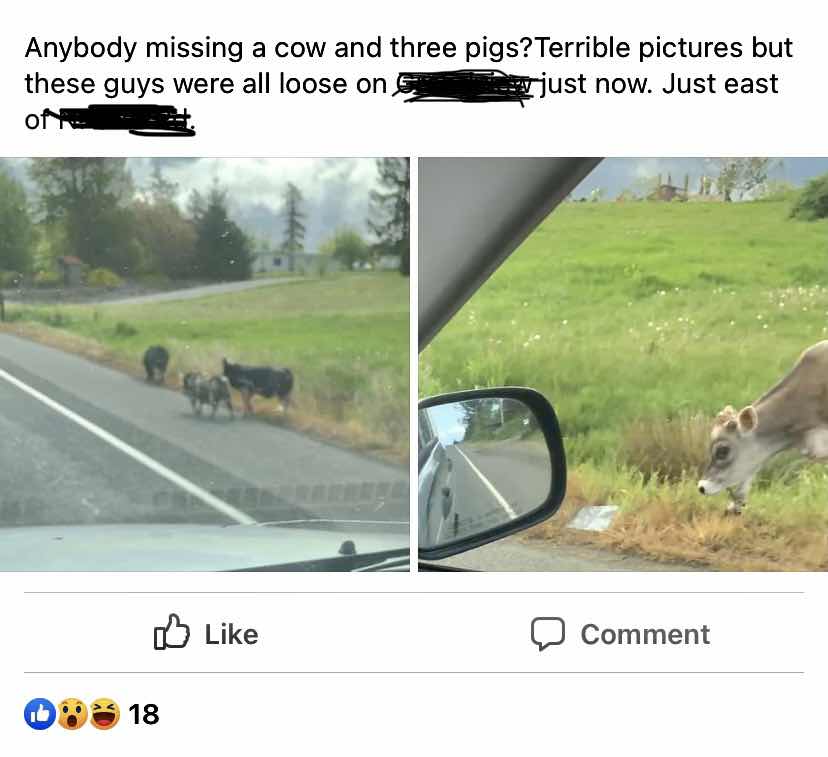
Shame!! Shame and embarrassment! Animal escapes are always entertaining unless they are your animals. It's bad enough that people know my animals were out, but the fact that they were actually wandering along the state highway was worse. Tanker trucks blast by at 60 MPH and we live on top of a hill with a very short sight distance. Only blind luck prevented a terrifying accident. Oh well - all's well that ends well, and at least somebody driving along got a giggle out of it. As it turns out, there was no breach in the fenceline (although we do need to do some maintenance). The chain holding the main gate shut had broken. Probably secondary to a couple of big pigs pushing on it.
Posted by Aimee at 8:21 PM 0 comments
Saturday, March 20, 2021
Notes from the Year of the Pandemic (Spring Equinox, 2021)
So far, spring this year is cold. There was a week of warm sun sometime in early March - there usually is - that tempted me to start shoveling some dirt into a wheelbarrow and laying down cardboard in the garden, but it was only a tease, and the frost returned as expected. I knew it would, of course, even as I stood on top of the compost pile in my shirtsleeves, shovel in hand. I'm slow but I do learn.
The awareness that the warmth on my shoulders was the product of a small, false spring didn't matter. When the sun shines in March in the far Pacific Northwest, and you live on a farm, you get outside and you pick up a shovel with as much thought as worms have as they come to the surface when the ground thaws, as much as chickens who start to lay when the days lengthen, even though the eggs may freeze in the nest boxes overnight. After a Northwest winter, especially this last one which threatened to draw a final dark curtain across so many lives, you take your lumens while you may. Get out in that thin wind and squint, and take off your coat, and shiver, and give thanks.
It was a bad winter. In so many ways. Last spring, when the pandemic was just ramping up and we didn't know how long it would last, we made jokes about lockdown lasting a whole month, and we distracted ourselves with the rites and tasks of spring on the farm. I took up an old habit and carried a sketchbook around the property, drawing leaves and bugs and chickens. Like everyone else, I put in a big garden. I bought mountains of craft supplies for the girls and we all planned the ways we would enjoy ourselves and better ourselves and learn things and have fun together during this time of enforced togetherness. We were optimistic, if not about the course of the pandemic then about the possibility of our own growth and development during it. Like healthy people everywhere, undamaged people, people who know not what lies ahead, we embraced the imagined challenge of joy in adversity.
And I'm not saying none of it happened. We did stuff. The craft supplies were used to make crafts. I taught the kids to play cribbage and rummy. We took to going hiking on Sundays as a family and discovered beautiful places we'd never gone before. The garden did pretty well and many vegetables were fermented, and many loaves of sourdough were baked (yeast being in short supply). The farm produced, as it does every summer, a crop of beauty and fun in the form of baby goats and baby chicks and, this year, baby guinea hens. For months, the work of the day was sufficient thereunto, and we were more or less content.
Then fall came, and school did not start. Life refused to return to anything approaching normal. Milestones passed uncelebrated. The new systems that were hastily constructed to replace the old, now-impossible ways of doing things were confusing and inadequate. We were all sick of the sight of each other. The stress of waiting to get sick was making us sick. The uncertainty -the total, global uncertainty - was wearing us all down. Would Hope be able to apply to colleges? Would school sports ever happen? Would we ever be able to have a birthday party? Would ANYTHING ever be NORMAL again? Time seemed more meaningless by the week, and I stopped updating the altar or looking forward to seasonal celebrations.
It was especially hard to keep our spirits up after the string of disasters among the animals. The problem of multiple drug-resistant parasites with my goats has gotten worse and worse, and my veterinarian has basically thrown up his hands. First baby Stormy died, then Flopsy. Trying to medicate Lilac - out of desperation, as all the medications we have tried have utterly failed - the plunger slipped in my hand and I accidentally gave her a fatal overdose. This was especially awful, as Lilac was young and healthy and I expected her to be the star of the next generation of milkers. Polly and Christmas are looking thin and unthrifty and there's not a damn thing I can do about it. All I can do is keep them all contained in the sacrifice area, where there is nothing to eat, and feed them (presumably parasite free) hay. I am terrified I will simply have to watch them all die slowly, one after another. I can't sell any babies, should there be any, because I can't ethically export these awful worms to other farms. Paloma is not even looking forward to baby goats this year, after she fell in love with Stormy last year and lost him so soon.
An entire clutch of newly hatched chicks drowned in a waterer.
Thirteen out of fourteen baby guinea hens failed to survive. They just disappeared one by one over a few days, and by the time we could catch the mother and remaining babies there was only one left.
Gucci, Hope's beloved ferret, got tumors in the belly and had to be put down.
Turning our attention away from the farm to the outside world was little solace; the news was full of death, disaster, riot, war, idiocy, and fear. Fall was scary and long and dark and cold, and it often felt like the whole damn world was going straight down the shitter. The election was a bright spot of blessed relief, but the period between November 3 and January 20 was nerve-wracking. Every day threatened rampage and disruption on a scale unimagined in my lifetime.
Now I've just been sitting here staring at the screen for five minutes. Then what? Then it was winter. We lived through it. It was not so awful for us, really, not compared to so many others. We had work. We didn't get Covid until January, and when we did it wasn't so bad, thank God. Homero's oxygen dipped down to 89 a few times and that was scary, but they put him on prednisone and gave him an inhaler and he was fine. I had awful chills and couldn't stay warm. I would shiver and my teeth would chatter while submerged in a hot bath. But it only lasted about ten days and we have almost totally recovered. I get winded quickly, that's all. Everyone should be so lucky.
There was a pretty good snowfall in February - 18 inches or so, enough to entirely transform the landscape and bring a welcome intermission from the tedium of rain and mud. My kids no longer play in the snow much, being in their high teenage years, but the dogs do.
I don't know what I'm going to do next. Im staring down the barrel of empty-nest-hood. Hope did apply to colleges, and she will go away next fall, to one or another of them. Paloma is only two years behind her. Sports did start, and both girls have evening practice most nights. They have jobs on the weekends. They drive. They kiss me and say "goodbye, mom!" and go see their friends. I cook too much food, and nobody eats it. Well, the pigs do.
Will nothing be normal ever again? No, it will not. Not for me. Normal is little girls blowing dandelion clocks on the lawn; normal is shiny baby goats bouncing across the field. Normal is reading bedtime stories. Normal is being able to make it all better with a kiss, and having answers to all their questions, or at least them believing I do. Normal is a memory now.
It is the equinox today. Winter is passing away and Spring is on the verge of emerging. The year of the pandemic - godwilling - is over, but I cannot see what is coming next. Like the planet, I am balanced on the knife edge of a new season. Be gentle with me, spring. I'm getting old and I'm slow, but I learn if you give me enough time.
Saturday, August 15, 2020
Death and Disaster (Bad Farmer, Good Grief?)
Posted by Aimee at 4:50 PM 3 comments
Tuesday, March 24, 2020
DQ8 - Alone With the Chores
Since my last post, the governor has increased restrictions, banning all gatherings, public and private, including even weddings and funerals. He has told all non-essential businesses to close and all non-essential workers to stay home.
Posted by Aimee at 8:17 PM 0 comments
Labels: disaster, quarantine, work
Sunday, March 22, 2020
DQ6 - Visit From Rowan
Posted by Aimee at 4:14 PM 0 comments
Labels: disaster, garden, self sufficiency, spring, work
Wednesday, March 18, 2020
State of the Farm: Pandemic Edition
Posted by Aimee at 8:24 PM 1 comments
Labels: canning, cooking, disaster, family, farm, fermentation, food, frugality, gardening, self sufficiency, spring, vacation
Tuesday, June 21, 2016
Oaxaca Trip (Bad Timing)
| Fires set by protesters to block the road |
| a truck carrying chickens set ablaze and used to blockade the highway |
And this:
| civil unrest in Nochixtlan |
The perennial dispute between the branch of the teacher's union known as section 22 and the federal government has once again flared into violence, as it has been doing every couple of years since at least 2006. This particular exacerbation is probably the worst since that time. Eight protestors have been killed by police, and there are fires and marches and blockades and rocks being thrown and molotov cocktails being tossed and batons swinging all over town.
Blockades are nothing new, and for the most part have been traditionally seen as nothing more than annoyances - inconvenient, yes, but a legitimate tactic nonetheless, like a strike. In fact I would venture to say that most Oaxacans view blockades and strikes with a kind of grudging admiration: "these people have guts" sort of thing. If it weren't for these people putting themselves on the line we'd all be ground under the heel of the imperialist oppressor. At worst, a blockade is met with a resigned shrug.
That changed, however, at least among the people I knew, a few years ago when the teacher's strike dragged on so long that schoolchildren missed almost a half a year of school. Those who could afford to sent their children to private schools. Those who couldn't do that had to miss work to care for kids or else leave them at home alone. Blockaders were so inflexible that a woman died in an ambulance that was not allowed to cross the blockade to the hospital. Tourism shrank away to nothing and many jobs were lost.
This time looks to be pretty bad. But it's so hard to judge without being there. A friend of mine who lives in the city center says that the blockades are so bad that grocery stores are running out of food. He said all he could buy at the local market was potatoes, yams, and cucumbers. Mama, on the other hand, just returned from a trip to Tuxtepec and said her bus had no trouble with blockades and that the stores in her neighborhood are perfectly well-stocked. She and my siblings-in-law are pooh-poohing the situation and say that we ought to come down as planned. In three days.
Here is a case where differing cultural expectations can be glaring. When I expressed concern to Homero that there might be a blockade on the road leading from the airport to the city, so that we might be stuck at the airport with no way to get to mama's house, he waved off my fears.
"The blockades are only stopping vehicles," he said. "you can walk around. It's only a few miles."
Somehow, the idea of attempting to traverse "a few miles" of terrain like that in these photos - a terrain littered with tire-fires, riot police, dead chickens, and rock-throwing youth does not inspire confidence. Especially when I imagine having to do it in 90 degree heat, with young children in tow, dragging all our luggage. I know those Oaxaca highways and even at the best of times they are not suited to those little plastic suitcase wheels.
Thus far we have not been able to contact the airline. My brother suggested that given the situation, the airline would probably waive the change-date fees. Maybe - IF we could get ahold of a human. But really, what good would that do? Who knows when the situation will be any better? Homero spent an hour attempting to contact the customer service department of AreoMexico and only succeeded in soliciting the information (from a computerized voice) that the change-date fee is $250/ticket.
I think we will go. Nothing is ever as bad as it looks on the news.
But I'm bringing a carton of Cliff bars in my carryon.
Posted by Aimee at 6:40 PM 1 comments
Tuesday, January 6, 2015
Sad Day (Breeding Gone Awry)
| A likely looking buckling: Storm Cloud |
The next question is whether or not to let your buck run with the herd. Most goat folks will say not to do this, and after the story I am about to tell you, I have to agree. I have changed my mind. I always let my bucks run with the herd, truthfully because my fences have not been up to the task of keeping them separate. A buck who wants to get at does in heat is a very difficult animal to contain. Some people say a buck will harass the does until they are thin and sick; or that he will keep breeding a pregnant doe until she aborts. I haven't noticed that to be the case with my bucks. What any buck WILL do, however, is breed a doe at the earliest possible chance.
Nubians are generally seasonal breeders, meaning that they will not go into heat until the days begin to get shorter and the nights to get cooler, usually in early September around these parts. But if a doe goes in to heat early for some reason, no buck is going to stand around metaphorically twiddling his thumbs. He's going to blubber and pee on himself and strike ridiculous poses and breed that doe the second she'll stand still for it. And apparently, Polly went into heat in July this past summer.
The reason that you don't want your does pregnant in July - if you live in a place with wet, cold winters - is that you don't want baby goats born in January. They have a distressing tendency to die. Especially if the weather has been very wet and chilly. And most especially if you weren't expecting them, and therefore were not able to pen the mama goat up in the dry barn, and instead she gave birth in the middle of the night in the cold wet pasture. Then what will happen, 9 times out of 10, is that when you go outside to do the chores, you will find a couple of dead kids and a mama goat with a drum-tight udder.
Which is what happened here last friday. Homero found them. Twins; a buck and a doe, beautifully spotted and perfect, but cold, flat, and dead. I'm certain the poor little things were born live and just never stood up to nurse. If I had been there, they would almost certainly both be alive. I felt just awful - this is my fault for being lazy and slack about fencing, and not keeping good notes about when my does were bred, and not keeping close tabs on the mama goats regarding signs of pregnancy. Although to be fair to myself, it is often very difficult to tell when these large bodied Nubians are pregnant until the udders fill up a day before kidding.
It also so happened that when Homero came inside to tell me about the babies, I was just finishing up packing for a long-weekend vacation we were taking to Victoria. For the first time in years, we were all going together, all five of us. I had arranged for friends to take the dogs and we were simply going to leave the large animals with extra hay and water. There would be nobody at home at all to care for Polly.
Polly was fine - the birth didn't seem to be hard on her at all - but she would lose her milk if no-one milked her. Of course we didn't want her to lose her milk for OUR sake - that would make this breeding season a dead loss - but I was also worried about just leaving her to dry up on her own, without supervision. The vet said, when I called, that most times they will dry up just fine on their own, but they should always be watched for signs of mastitis. We were supposed to leave to go catch the boat in just a few hours, and the tickets were non-refundable (of course).
Desperate, I put the word out on the Facebook Farmer's group. I said I know it was an insane request, but I had to try - could anybody take my goat for a few days and keep her in milk for me? To my surprise and relief, no fewer than three other goat owners offered within minutes. My neighbor M., who was already caring for my elderly dog, was one of them. So we bundled the goat, the stanchion, and a bag of alfalfa pellets into the van and brought them all over, gave her a crash-course in milking, and thanked her profusely. Then we went to Victoria and had a perfectly lovely time.
I bitch a lot about technology but it really is wonderful to be part of this Facebook group of local farmers and neighbors. Ten years ago I would have been shit out of luck, and would have stayed home milking my goat while my husband and kids went to the Royal B.C. museum and the bug zoo without me. Being part of this community is a privilege and a responsibility - surely it is my turn next to help in any goat-related emergencies.
Posted by Aimee at 4:12 PM 1 comments
Sunday, September 14, 2014
It Never Rains But it Pours (When is Enough Enough?)
We've had a streak of bad luck lately. An expensive streak. In the past two weeks:
- I broke a tooth. A particularly exciting trade had come my way - it's crab season in these parts and apparently it's been a very good year. A friend of mine traded me a couple pounds of goat cheese for three or four big fat dungeoness crabs, already cleaned and cooked. Since in my estimation, dungeoness crab gives king salmon a run for its money as the most delectable native seafood of the Salish Sea, I was understandably excited about this trade. I sat down at the kitchen table with a pair of crackers to extract the meat and have a few nibbles along the way. I spent a very happy hour or so cracking crab legs, partly with the pincers and partly with my teeth, sweet sea-flavored juice dribbling down my shirt front. But when all the crab was gone and I came out of my yummy-food-induced trance, I poked around in my mouth with my tongue and found that one of my molars was missing a big ass chunk.
The good part was that it didn't hurt. The bad part was that my brain instantly began to freak out and insist that my tongue check out the hole every 0.6 seconds for the next eighteen hours. I don't have dental insurance - I have health insurance thanks to the ACA, but not dental - and so I had to wait until the local Interfaith dental clinic opened up on monday morning and wait my turn with all the other poor snaggletooth schlubs. The dentist there told me they could fill it, but that that was only a temporary solution and I really needed a crown. Crowns, I was told by every local dentist I called, run about fifteen hundred dollars.
My husband said, when I told him, that if we didn't spend money on our teeth, what the hell were we saving it for? So I made the appointment and went in, on wednesday I think. A crown is a two appointment procedure, and this first one was the hard one. For two and a half hours I suffered in silence, and then I paid them $750 dollars and drove home with a numb, swollen jaw. When I got there I found that
- Poppy Pony had had an accident. Homero had tried to text me and tell me, but I was head down in a dentist's chair with my mouth full of cotton gauze and pain. It seems he had staked her out to eat the green grass in the front yard. The pasture is pretty brown and bald at the end of this long, dry summer. Poppy had tried to reach some greener grass nearby and had pulled the stake, a T-post, right out of the ground. It hit her in the hocks; she panicked and went charging around the property at top speed with a six foot steel bar thumping and whacking along behind her. Trying to get back into her own enclosure, she went over the top of a cattle panel and crashed into the side of the barn, actually knocking a big hole in it.
"We hath to caw the wet," I said.
When he got there, the vet gave her a sedative, a shot of antibiotics, and an injection of pain medicine. He cleaned up the numerous cuts on all four of her legs. No stitches were needed, but he had to trim off a couple of flaps of skin with scissors. She was limping, but he thought that was just bruising. He gave me anti inflammatory gel to administer for the next ten days and said no riding for three weeks. He also showed me a hideous photo on his cell phone of a horse who had gone over a barbed wire fence that same day. A big sheet of skin and muscle was hanging down off the animal's neck. He said Poppy was very lucky; she could easily have broken a leg or suffered a trauma like the one in the picture. Then he charged me three hundred dollars and drove away.
Later in the week, a man came out to inspect the crawlspace. A couple of years ago, while we were in Mexico, the sump-pump failed and the crawlspace flooded (Bad News from Home). We have only just had the money to address the issue. OR SO I THOUGHT. The man who came out, owner of a very highly regarded company that specializes in crawlspaces and nothing but, went under the house in a haz-mat suit and took about two hundred pictures. When he came back up he said "the sump pump is the least of your problems." Then he showed us the pictures.
I really don't have the heart to go into it. For the first time, I am seriously questioning whether we made the right decision in buying this house. I love this property with all my heart and I firmly believe that by moving here, we have given our children the great gift of a childhood that includes wildness and the possibility of losing themselves in nature. Over the years, I have come to love this house as well - this very 1940's owner-built ranch house, with all its eccentricities and quirks. The many issues we have addressed - the roof, the plumbing, the rot - have been expensive, but I thought we were finally getting on top of it, and even felt pride in slowly restoring an aging but unique farmhouse.
We were not getting on top of it. Underneath it all, there is a hideous story of rot, sinking cement footings, and poorly shimmed pillars. There is unstable earth. There are rats. There is a sixty year legacy of poor workmanship, deception and fraud, and amateurism. Underneath it all, at the very bottom, there is a poorly drained slope to the northeast undermining the foundation.
All of these issues can be addressed, mitigated, though not fully corrected. Even were money no object - which is certainly is - the very best that can be done cannot completely heal the house. To the contractor, after his presentation of misery, I said "for fifty years people have been slapping one cheap fix on top of another to this house. I want that to stop here, with me. I want to leave this house to my children." He nodded, but he didn't say that was a realistic plan.
The truth is, he might be the best contractor in the world, but he can't stop time. I might spend all the money at my disposal, but I can't stop the rain from beating down or the beetles from boring. I had a dream the other night, before all this. A nightmare. I dreamed I was walking with a group of people I didn't know through an office building, a skyscraper. We were all going downstairs at a deliberate pace. Each time we reached a new floor, I lost some power of movement. Suddenly I couldn't move my arms anymore. On the next floor down, I couldn't turn my head. Then I found that I couldn't stop walking, either. I wasn't unduly alarmed; it seemed pretty normal.
I am trying not to be unduly alarmed. We can only do what we can do; we cannot be immortal, nor can we safeguard our homes and properties for eternity. We will do what we can - I plan to hire the contractor and ask him to do everything within my budget to stabilize the house unto the third generation. My hope is that someday in the far future, Homero and I will be able to retire to sunny Oaxaca in good conscience, that I will leave my children a real home, not a pile of rotting wood. I will not stint, and I hope that they will not have cause to reproach me for negligence, penny-pinching, or sloth.
But maybe they will reproach me for wasting their inheritance propping up a lost cause.
Posted by Aimee at 9:42 PM 2 comments
Labels: disaster, husband, pony, veterinarian, work