"United we bargain, divided we beg."
Showing posts with label neighbors. Show all posts

Tuesday, September 12, 2023

Change of (Beverage) Seasons


It’s been a few years since we last broke out the old cider press. This is the same machine my family used to press apples when I was a little kid growing up on a three acre hobby farm in Woodinville (years before the Microsoft campus transformed it from a sleepy, far-out Seattle suburb into software-mogul wonderland). My mom gave it to me when we first moved up here and started planting apple trees. 

Our apple trees have met various terrible fates. Some were eaten by goats, other run over with riding mowers when they were but tiny saplings. We do have one beautiful, well grown apple tree that I planted specifically for the purpose of making hard cider. It’s an antique variety called a golden russet. But it’s a late apple, best after the first frost, and also I don’t drink alcohol anymore, so it’s of minimal use on a warm September day when we feel like making cider. 

Therefore I invited my good neighbor Hilde and her family to make cider with us. They have a large old orchard with several different kinds of apples. We all traipsed out to pick apples, and her sharp-eyed daughter saved us from a fate worse than death by spotting this horrendously huge hornet’s nest hidden in one of the trees.


Carefully avoiding the tree of mayhem, we gathered several large totes full of apples. Hope kept asking “do you think we have enough apples?” and didn’t believe me when I told her we manifestly had more than enough apples. Like I said, it’s been a few years, but I can still do 5 gallon bucket-to-gallon jug conversions in my head. 

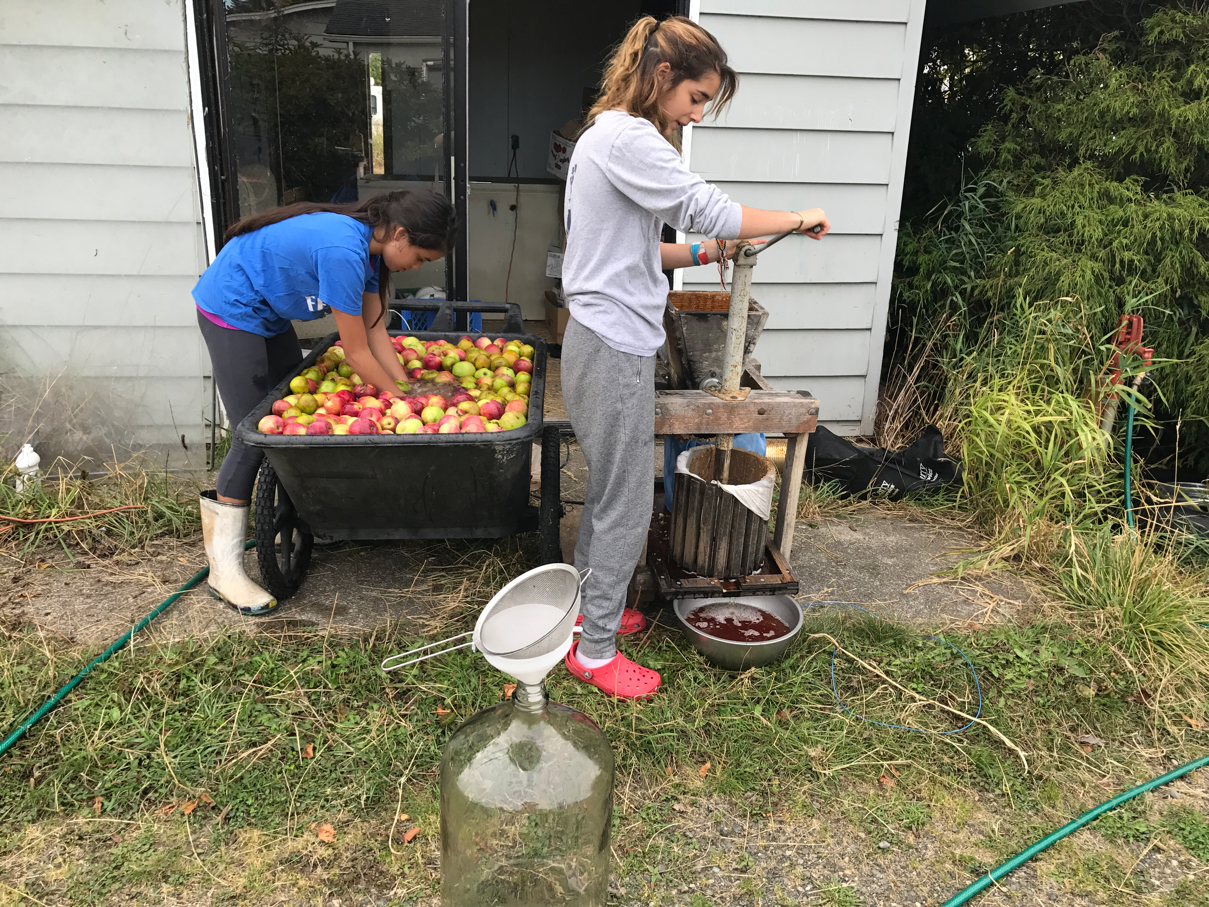
It was a lot of work, as cidering always is,,but we all had a great time. Hilde’s kids had never made cider before and they were excited to turn the crank and pass the apples hand to hand and pour the juice through sieves and funnels. 

And we made SO. MUCH. CIDER. As usual, the weak link in the cider-making chain is finding enough jars. We filled up all my half-gallon mason jars, which means it is truly the end of milk season (the goat is almost dry anyway). Luckily Homero rooted around in the recesses of his shop and came up with this 3 gallon skull-shaped beverage dispenser. It doesn’t have a lid, but we just put a plate on top of it and will dispense cider at will for the next few days. 


Friday, April 14, 2023

King Kong Squash


This gorgeous, enormous Blue Hubbard squash was given to me by a neighbor. I don’t know for sure if she grew it herself but she’s quite a gardener so it’s entirely possible. Blue Hubbards are an heirloom variety winter squash with excellent keeping qualities, fine dry orange flesh, and which grow to impressive size. This one weighs 43 pounds. 


I’m staying home sick from work today, so I decided it was as good a day as any to deal with the giant squash. Their shells are so hard I had to have Homero cut it up with an axe. It occurs to me that this blog is full of pictures of Homero dealing with various large and unusual comestible items. Like the 25 pound Ling Cod. Cow heads. I should make a post of all those photos. 

My plan is to bake it, purée it, and make a bunch of pies, some soup, and….. I guess freeze the rest of the purée for later. It’s not recommended to home-can winter squash, even in a pressure canner. Something about the purée being too thick to heat evenly. But it freezes very well, and quart sized blocks of frozen purée can be used to make soup, pie and quick breads into the future. 

I’m also saving some seeds to plant later this spring. Blue Hubbards are an open pollinated heirloom variety, which means they will produce fruit similar to the parent plant, not like the more common hybrids that will produce fruit unlike, and usually inferior to, the parent plant. 

I love this photo of me and the squash. Look how happy I am! I can lift 43 pounds of food over my head!! 


Wednesday, September 14, 2022

Farm Stand Photos


I thought it would be nice to post some photos of local farm stands and what I appreciate about each of them. They are so varied. 


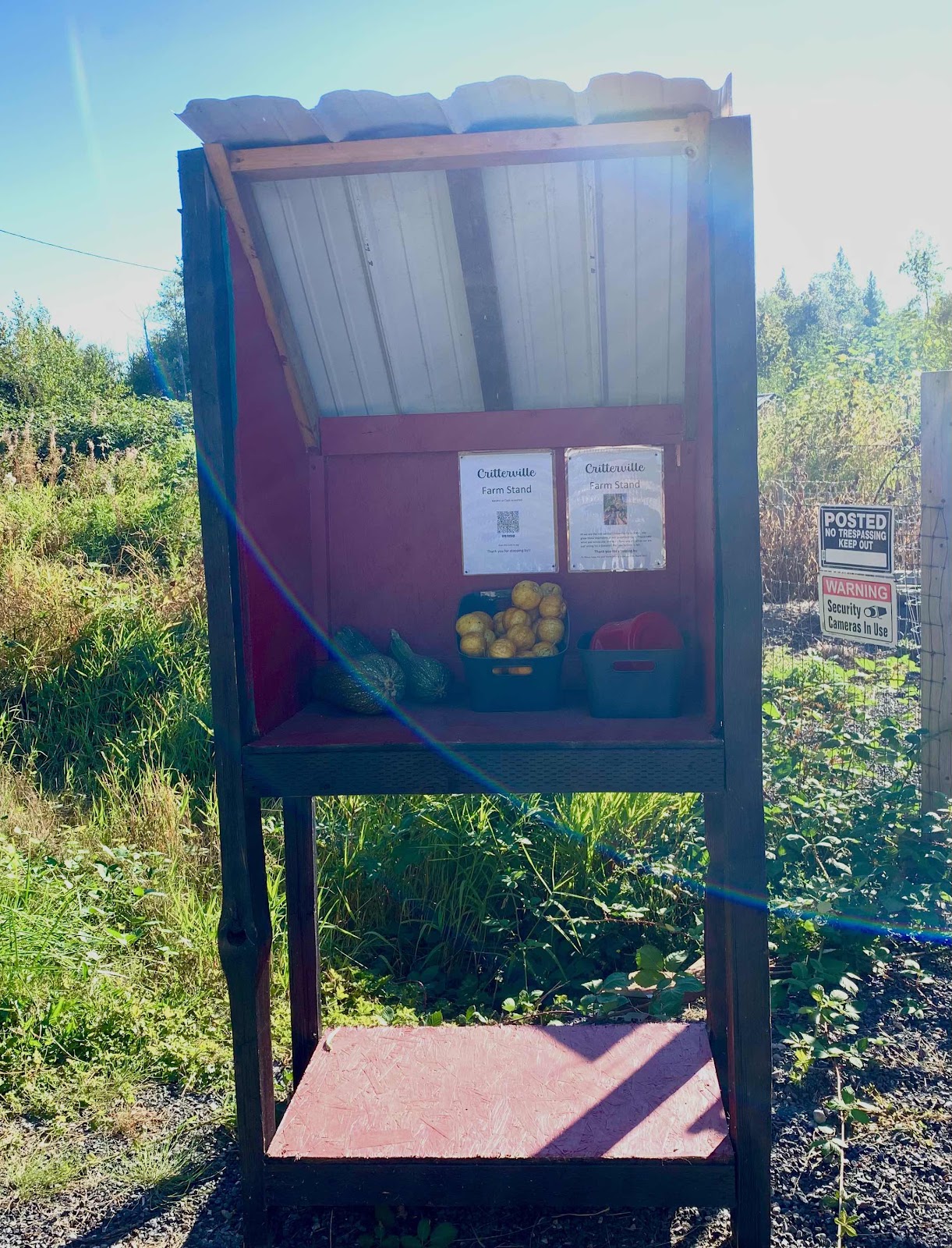
Small, new farm stand on Blaine road north of Grandview (I think?). A small tow-headed boy came out to greet us, very excited to tell us about his lemon cucumbers. 


My favorite local stand. Kickerville road between Bay and Birch Bay-Lynden road. They run all season, with veggie starts and live plants in early spring, through to gourds in late fall. They sell seeds as well. There’s a small fridge where the greens stay nice and fresh. Prices are amazing - and in fact they often have free veggies as well. Also sell an assortment of books, baskets, and what-not. I’ve even bought chickens from them in the past. 


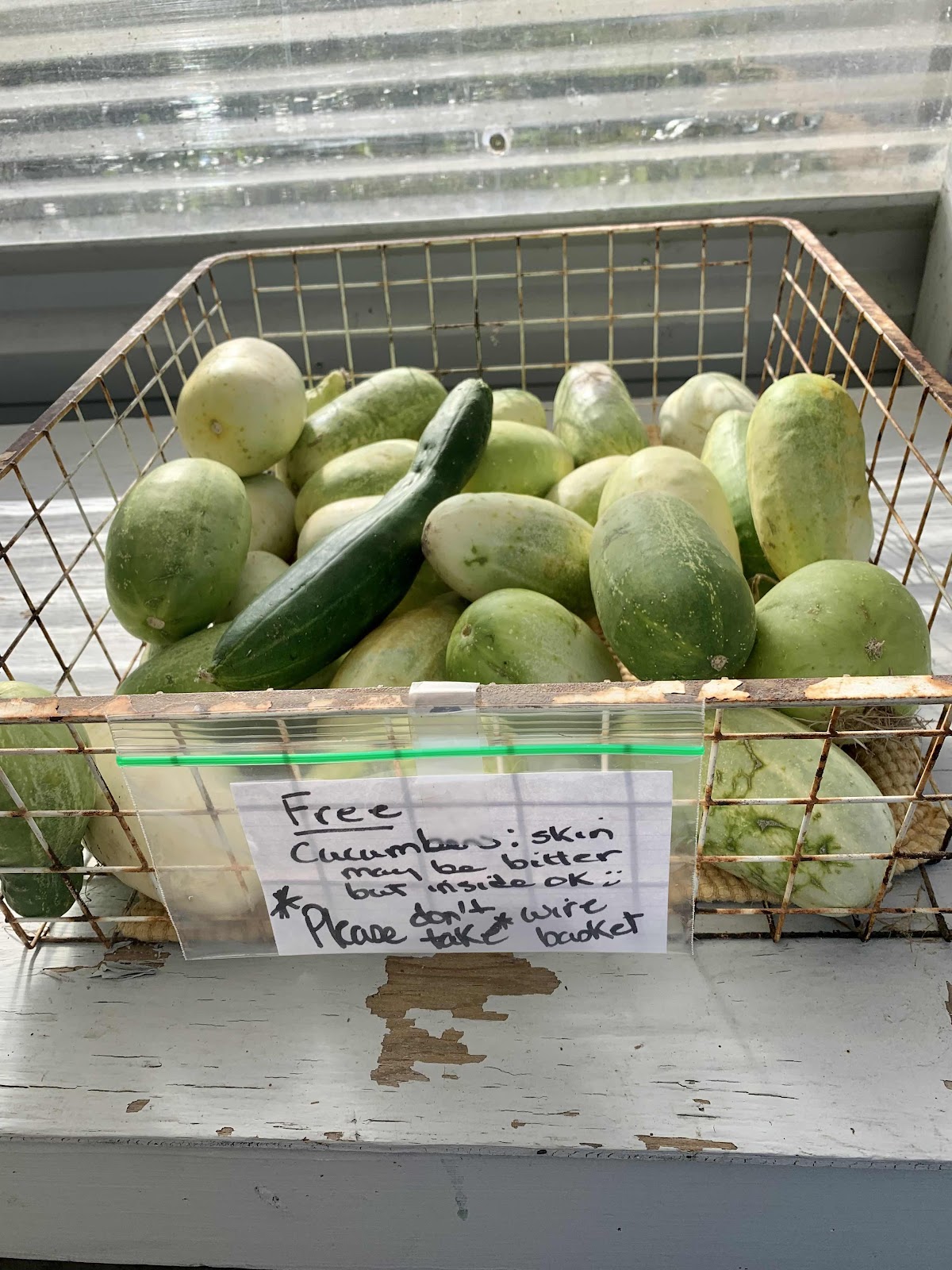
Free cucumbers in the Kickerville stand. 


The Kickerville stand from the outside. Looking fairly empty on this particular day. 


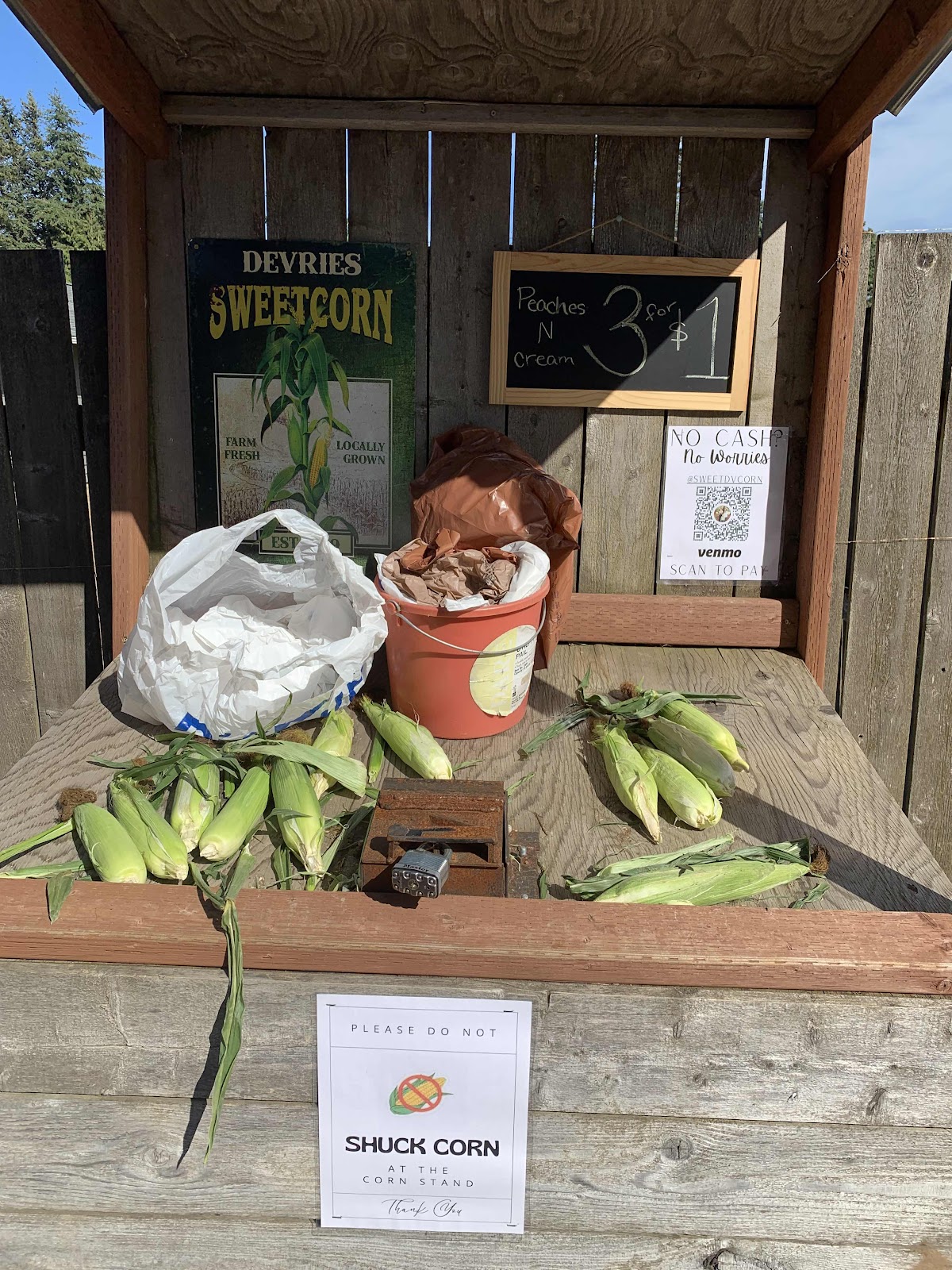
Sweet corn somewhere in the vast, confusing Bermuda Triangle between Enterprise road and the Guide, south of Birch Bay-Lynden road. Forgot to note the address. There are lots of sweet corn stands at the moment, of course, and they tend to be single-produce operations, appearing in mid-august and shuttered by early September. 


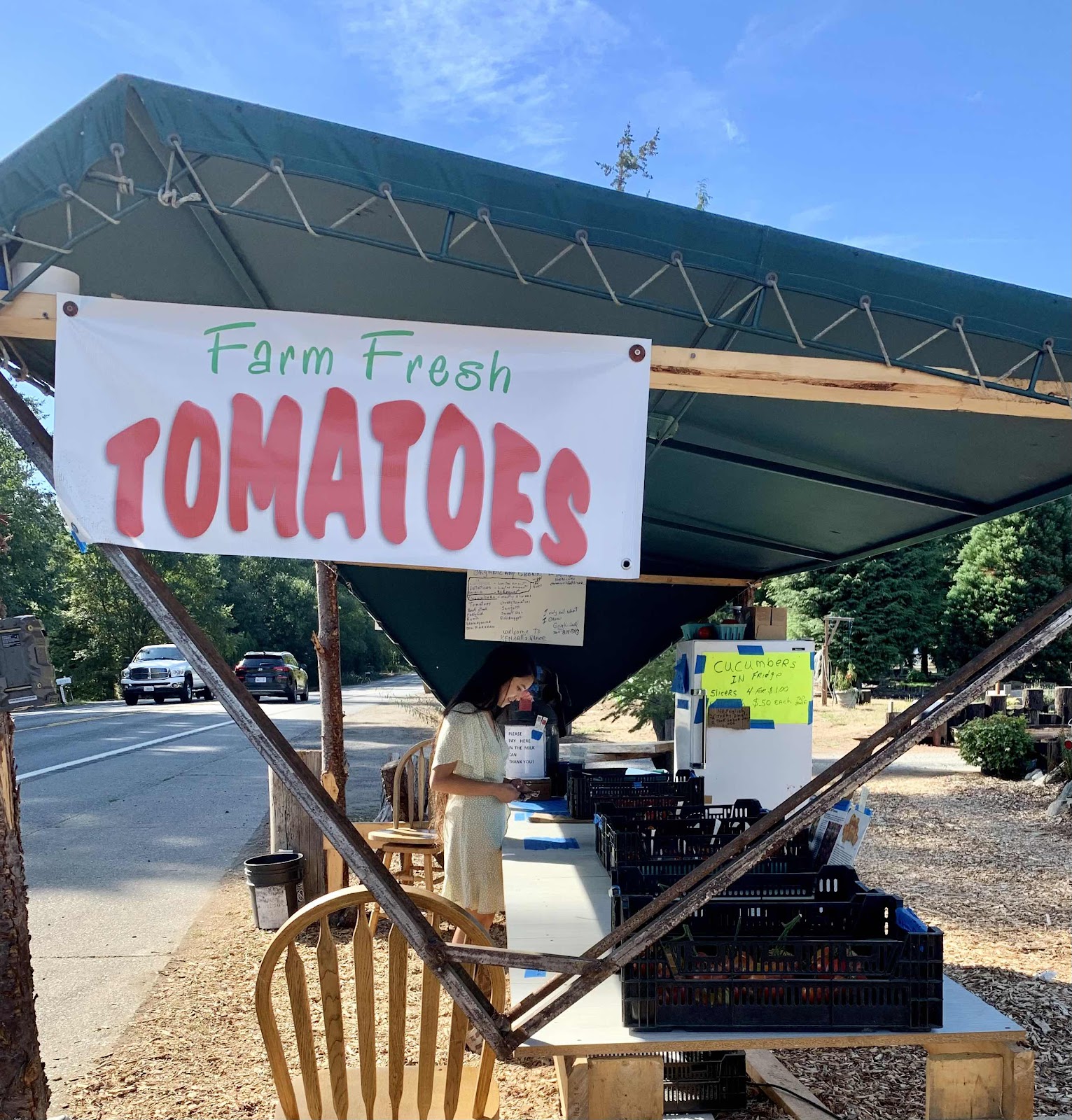
New stand (as of last year) on the Birch Bay -Lynden road just east of the freeway. This young lady grows TONS of tomatoes, many different varieties. Good prices and great tomatoes. 


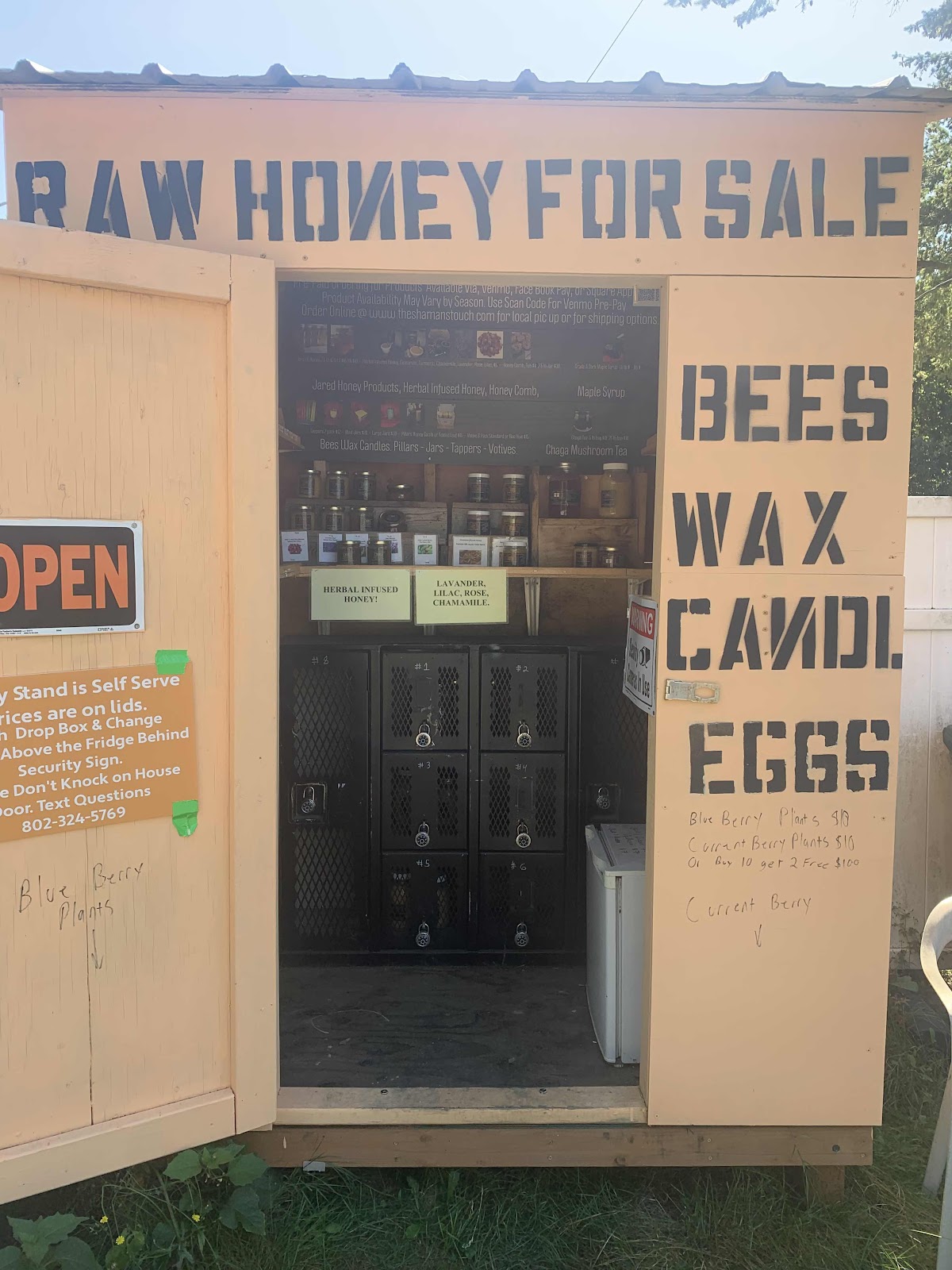
This stand is a real unique one. The owner is a beekeeper and he sells his honey, plain or compounded with herbs and spices and medicines. The lavender honey is especially nice. Overall the best, thickest honey I’ve found. He also sells gorgeous beeswax candles and copies of his self-published novels. 

There are many more farm stands that are worth a mention, but which I haven’t got any pictures of. Just across Kickerville from my favorite farm stand is Tiff’s Dahlias. 
A huge garden with all varieties of dahlias, sold for either $0.50 or $1 a stem, slightly older ones for $0.25. 

Smits family farm in Northwest has a huge and beautiful farm stand worthy of its own post. Mr. Smit has ten acres and grows hundreds of varieties of vegetables, including many not so common ones around here like asparagus. In fact if you are a regular, you can tell Mr. Smit what you would like and he will grow it for you. 

There’s a large stand with two big glass front refrigerators on E. Wiser lake road that sells Guernsey Milk, yogurt, and cream as well as fresh produce. There are also often homemade chocolate chips cookies. 

I never get tired of perusing farm stands, and it always makes me happy when I discover a new one, even if all they sell is zucchini.  

Friday, August 19, 2022

Farm Stand Fun


One of the things I love about where I live is that, recent development notwithstanding, it is still rural enough that there are dozens of small, seasonal farm stands close to me. 

Many of my neighbors put out farm produce of one sort or another, or of various kinds, throughout the agricultural year.  It begins with eggs in the earliest spring (we have sold eggs ourselves) and progresses through vegetable starts, spring flower bouquets, early greens, right up to August, where we are now, with an absolute abundance of garden produce of all sorts. This particular moment is sweet corn, tomatoes, peppers, cucumbers, and of course, zucchini. Further along there will be apples and pears, pumpkins and gourds and dahlias. 

Some stands are no more than a hand lettered sign and a cooler. Most are some sort of cabinet or old wardrobe, with the goods portioned out into Tupperware or ziplocs, and a cash box of varying degrees of impregnability ranging from a child’s piggy bank to miniature bank vaults. These days, many farm stands accept Venmo or PayPal. The more professional stands will have a refrigerator and possibly an entire greenhouse. In addition to edible goods, some stands sell locally made soaps and lotions, or bric-a-brac, or second hand books. I have a bias towards the small, the ramshackle, the eccentric, and the obviously run by children. 

There’s a circuit I do when I want to see what’s up in my local farm stands. A couple of circuits, really - a small one that is a square about two miles on a side and includes five farm stands, and a longer route I do if I have more time or want to hit up some of the bigger stands. A little bit further will take me to a special stand I like that has dairy products - Jersey milk, yogurt, and cheese. It’s a really relaxing and enjoyable way to spend an hour or two - driving down my well-known country roads with the windows open and the smell of curing hay blowing in the window, discovering what my neighbors have been planting, what did well this year and what failed, maybe having a chat with a farmer if you happen to catch one replenishing the ziplocs. 

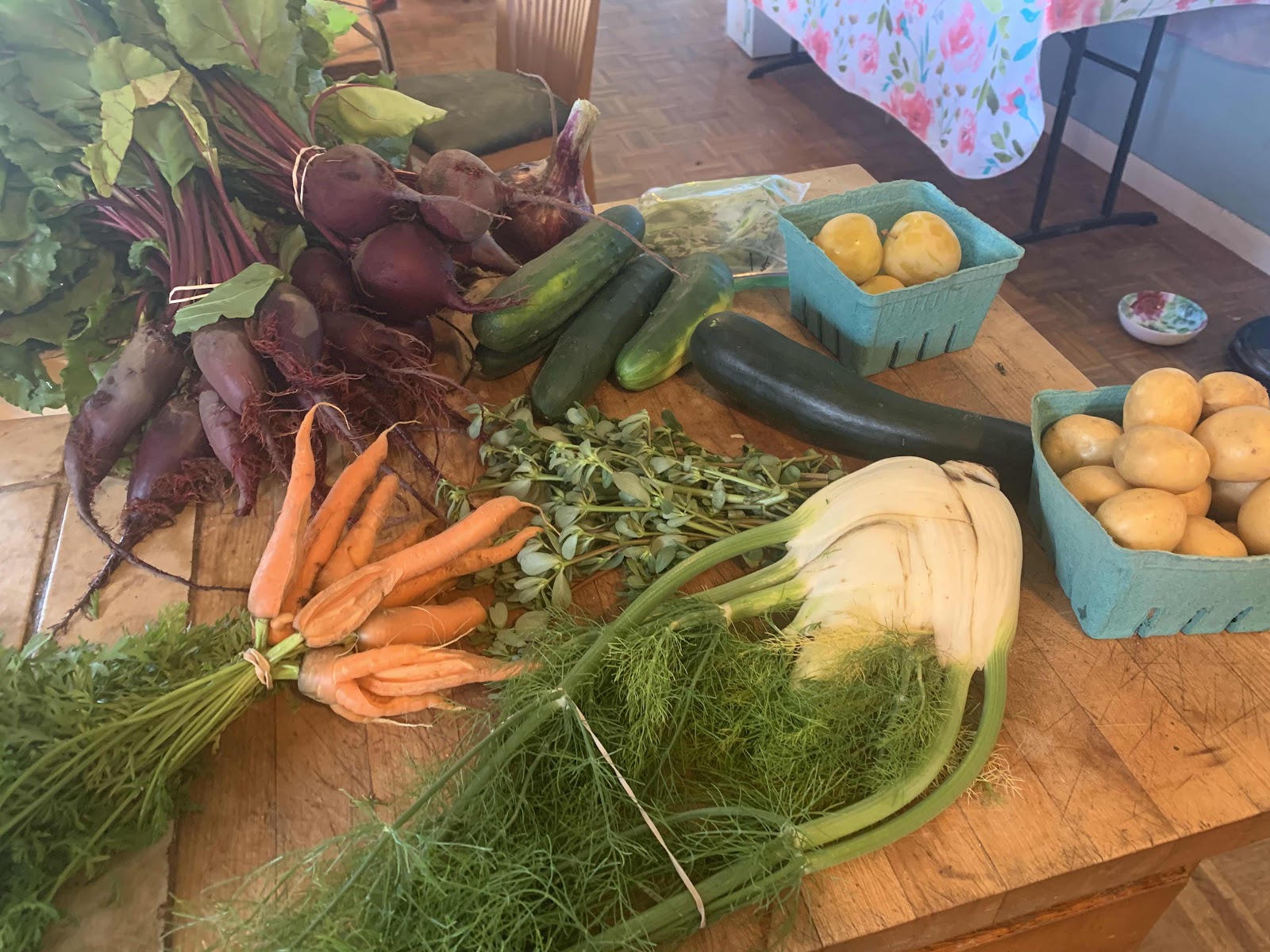
Yesterday’s haul was all from my small local circuit. Twenty dollars total got me everything you see above - new potatoes, Italian frying peppers, carrots, beets, fennel, cucumbers, plums, onions and purslane. Those three bunches of beets made six pints of pickled beets with enough left over for a beautiful roasted beet and goat cheese salad for dinner. 

There are only three of us at home these days, and it often happens that my eyes are bigger than all of our stomachs. 


Thursday, October 7, 2021

Farmer’s Swap Meet (Fall Harvest)


A neighbor of ours, a friend who started out as one of Homero’s clients, started a farm a few years ago. She raises medicinal plants of all sorts and makes them into tinctures, salves, ointments, and decoctions. She started just two or three years ago with a weedy patch of ground and now has a lovely three acre medicinal plant garden. 


Last month, she decided to throw a swap meet for all her local friends - mostly farmers but also bakers, artists, musicians, and people with skills of various sorts. I was super excited to be invited - a decade ago I did the same thing, hoping to make it an annual event, but alas there was only one September Swap Meet and Jamboree on our farm. 


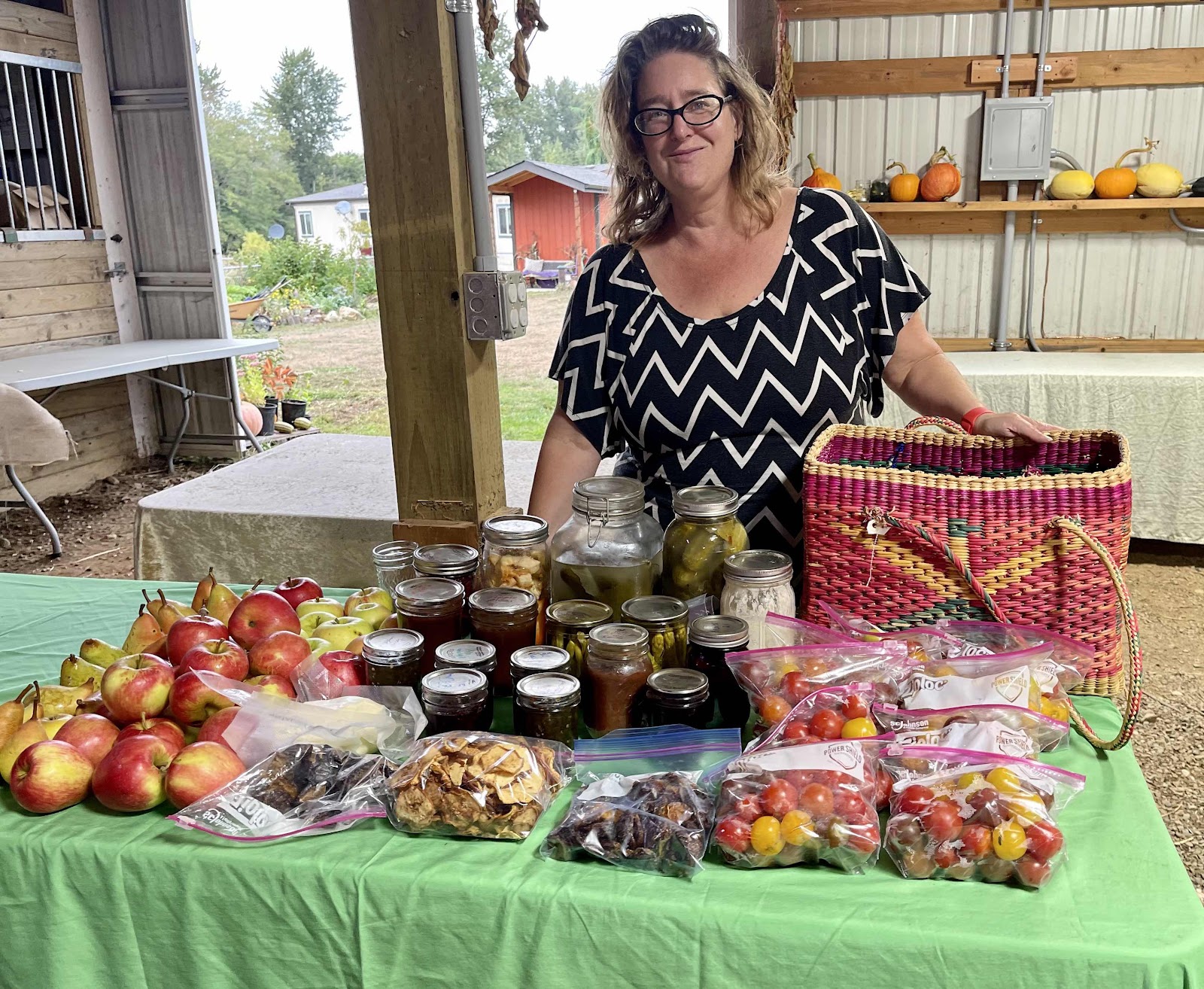
Deciding what to bring was half the fun. I didn’t know what might be available to trade for, so I didn’t worry about that and just brought a little of everything, hoping to hold my own and put on a pretty spread on front of my farming peers. 

We had lots of fruit from our trees - Italian plums, pears, and apples - both fresh and dehydrated. And just the day before Gleaner’s pantry hosted a farm glean for organic cherry tomatoes, so I had a ridiculous number of gorgeous cherry tomatoes in various colors. I also brought a selection of ferments - some caraway kraut, some kohlrabi kimchi, and some sourdough starter. 

I rounded out my section with a bunch of canned goods from the pantry. Admittedly, some of it was weird stuff from years last that didn’t get eaten, like my “spicy mixed stone fruit chutney” and some apple-plum butter. But I also brought a whole bunch of freshly made blackberry jam and pickled asparagus and dilly beans. Oh, and a two pound wheel of cheese. 

There was also a potluck, which was delicious. I brought lentil soup with bacon from our pig, and a big sourdough bread made with the same starter I had brought to swap with. 

We came home with a lot of stuff. Two or three different salves and some lip balms; tomatillos; raspberries; eggs; a carved wooden kitchen spoon, a fancy bottle shaped like a skull (which I think started out filled with tequila); a load of firewood; and a dehydrator. 

It was a great day. I got to meet lots of my neighbors and fellow farmers. Most of them were considerably younger than me, but it’s nice to be slowly morphing into a kind of elder in the community. I got to show off a little bit - my table was definitely one of the more diverse and well-frequented. And Homero and I got to wander through the beautiful garden eating raspberries and holding hands. 


Friday, May 7, 2021

Animals Behaving Badly (Escapes and Attacks)


We had an exciting morning around here. It started off nicely enough; I was sitting at the kitchen table around nine am having coffee with my husband, and we were enjoying the fact that our children are now in high school and get themselves off to school without even waking us up. The sun was out and it looked like it was going to be a nice day. 

Then our neighbor called. 

"Your cow and the pigs, they are over here on my side of the fence," he said. So we jumped up from the table, ran around looking for ropes (to lead the cow) and stale bread (to entice the pigs) and headed outside. The animals were indeed just on the other side of the fence, on the east side, near the orchard. Luckily, there is a cattle panel on that side that is just attached with carabiners, which we had done in order to let our neighbor come through on his tractor and pick up compost for his garden. So it was fairly easy to open the fence and chase the animals back in through the gap. Except for the Kune Kune pig, who had apparently decided he wanted to run away and join the circus. 

I assumed we had a breach in the fenceline somewhere along the eastern side of the property. Pigs will test fences and push cattle panels up off the ground and go under,  or detach them from the t-posts if, as is there case at our house, they are but loosely affixed with baling twine. So once the animals were all back in the main pasture, Homero grabbed some zip ties and got on the ATV to inspect the fences, and I went back inside to finish my coffee and peruse Facebook. 

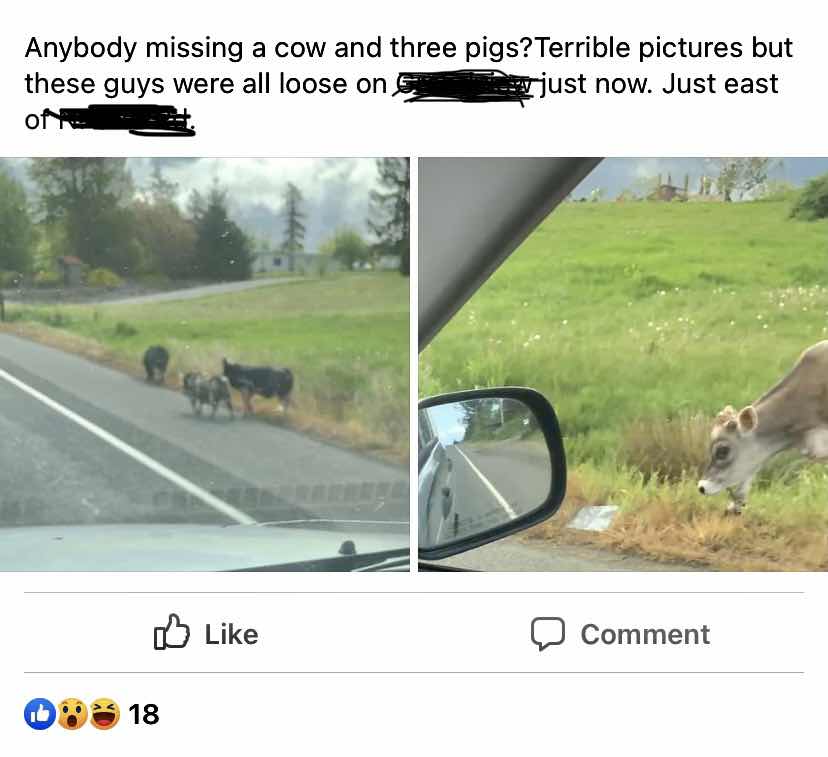
Where I saw this:


Shame!! Shame and embarrassment! Animal escapes are always entertaining unless they are your animals. It's bad enough that people know my animals were out, but the fact that they were actually wandering along the state highway was worse. Tanker trucks blast by at 60 MPH and we live on top of a hill with a very short sight distance. Only blind luck prevented a terrifying accident. Oh well - all's well that ends well, and at least somebody driving along got a giggle out of it. As it turns out, there was no breach in the fenceline (although we do need to do some maintenance). The chain holding the main gate shut had broken. Probably secondary to a couple of big pigs pushing on it. 

Then, when I went back out to feed everyone, the black rooster attacked me noiselessly from behind and gouged two good sized holes into my thigh, right through my skirt. I never saw him coming. It was like being hit by a very small meteor. He's always been a vicious bird. I think I'll have Homero wring his neck and make a fan out of his very beautiful, glossy black evil feathers. 


Friday, August 7, 2020

Miracle Milk (Goats are Great)


A neighbor of mine, S., recently had her first grandchild. Her daughter gave birth to a beautiful little boy. Although everything seemed fine at first, the baby wasn’t growing well. He had nearly constant colic, and wasn’t gaining weight the way the doctor wanted to see, even though he was nursing well. After trying several other things, the doctor suggested it might be something in mom’s diet, and suggested going off dairy entirely. 

Well, my neighbor owns a dairy. They are an old fashioned family-owned dairy, the likes of which have nearly disappeared. They own a hundred or so Holsteins, which are milked twice a day, and the dairy truck comes by daily to take away the milk. The family simply siphons off fresh unpasteurized milk from their refrigerated tank for their own use. “Going off dairy” was a serious proposition for someone raised on a dairy farm and used to fresh raw milk with every meal. Mom tried, but couldn’t give up milk for her coffee. The baby didn’t materially improve, and mom decided as a last ditch effort, she would seek out goat’s milk for her coffee and see if that made a difference. 

An aside - people who have trouble with milk and milk products might have any one of a number of different things going on. The most common is lactose intolerance. That is an inability to digest lactose (milk sugar) because of deficiency of the enzyme needed to break it apart. That enzyme is called lactase. All infant mammals produce it, but all non-human mammals, and many human mammals, cease to produce it after the age of weaning. If you don’t produce lactase, you will not be able to digest any milk, from whatever source. 

However, other people produce plenty of lactase but are intolerant to the protein in cow’s milk. They might be truly allergic to that protein, or they might just have an “intolerance,” meaning it causes them indigestion. If the milk PROTEIN is the problem, as opposed to the milk SUGAR, then one might very well be able to tolerate goat’s milk but not cow’s milk. The protein molecule of cow’s milk is about 100 times larger than that of human milk; the goat’s milk protein molecule much more closely resembles that of human milk. 

Back to the main story - my neighbor approached me and asked if I would be interested in trading goats milk for cows milk, just to see if it made a difference to her grandbaby. Of course I said yes. Two weeks later, my neighbor called me and said that the goat’s milk was a miracle, that she had been skeptical that anything in mom’s diet was the issue but she couldn’t argue with the results. Baby’s colic had nearly disappeared and he had gained significant weight. When I went to her house to trade more milk, she gave me a huge hug. 

In the course of my job (medical interpreter) I spend a lot of time just chatting with people while we sit in tiny exam rooms waiting for the doctor to arrive. One of the ways I pass the time is talking about my farm. Many of my clients grew up in very rural situations and this gives them a chance to reminisce and often we connect talking about caring for animals, kitchen wisdom and lore. 

No fewer than three people - all of them very elderly now - have told me that they were raised on goat’s milk from early infancy. One old gentleman told me how he was adopted when his mother died in childbirth and that he was fed goat milk from the first day of his life. When he told me the story he said “a nanny goat was my mother.” The other two were not quite so effusive, but they both told me that formula just wasn’t a thing that was available in the tiny ranchitos where they lived, and if there wasn’t a wet nurse available, then goat’s milk was considered the next best thing for newborns. 

In our area, there are a lot of immigrants from Russia and Ukraine. Some of them that are friends of ours have also expressed an almost magical belief in the power of raw goat’s milk to promote health and vigor. One Ukrainian friend of my mom’s drove up from Seattle - 100 miles - every week to get goat’s milk for his small daughter. 

Personally I have no strong feelings one way or the other about goat’s vs cow’s milk, not even about pasteurized vs raw milk (though I do think people ought to be allowed to buy and sell raw milk). I like goat’s milk. I LOVE goat cheese. If there is any magic in it, I tend to think it derives not from an inherent quality of the milk, but from the fact that it is a product of our own homestead. 

This place, this earth, grew the grass that nourished the goats. My hands cared for them and doctored them, birthed them and milked them. My eyes delighted in their grace and cavorting. My mind learned to use the milk to make cheese. My spirit birthed the longing to create this place and called all of it into being. Together my family made a home here that supports the goats, and they in turn support us. We have a beautiful circle going on here. 

The circle is the magic.


Friday, January 31, 2020

Welcome Mercy (On Taking a Chance)


                             Haku and Merced 


I am a sucker for beautiful dogs. I never even had a dog of my own until I was a grown up married lady. My first dog was the incomparable Ivory (http://newtofarmlife.blogspot.com/2011/05/ivory-dog-omy-heart.html?m=1) - a gorgeous white shepherd/whippet mix who was graceful, intelligent, affectionate, protective, and silly - everything a dog ought to be. Ivory became the mold and model that all subsequent dogs would have to live up to. 


                                   Ivory 


When Ivory died, at age 14, we were heartbroken and were not ready for a new dog for nearly six months.... a long time to be dogless, for dog lovers. We eventually found Haku - a white shepherd mixed with something  (maybe golden lab?) who had been given up twice before he was a year old for being too destructive and unmanageable. We had no particular reason to think we would be able to handle him better than anyone else - we are not dog trainers or experts of any sort - we just thought he was incredibly beautiful and we couldn’t live without him another day of our lives.

Haku tested us severely by destroying the playroom utterly, jumping every fence we could erect, and killing an entire sheep, but over the course of two years he finally settled down and became what you could call a good dog, if you aren’t too picky about dictionary definitions. Now we can’t imagine life without him. He makes us all feel very safe by scaring the living daylights out of anyone who ventures onto the front porch. 

Paloma has been pestering us for a second dog for many moons now. I have been the main holdout - everyone else in the family is persuadable (Homero doesn’t need persuading - he’d have a dozen dogs if I’d let him) but I have been the lone voice of reason. Who’s going to take care of two dogs when we go to Mexico? Who’s going to pick up twice as much dog poo? Sweep up twice as much dog hair? Buy twice as much dog food and pay twice the vet bills? Huh? Huh? 

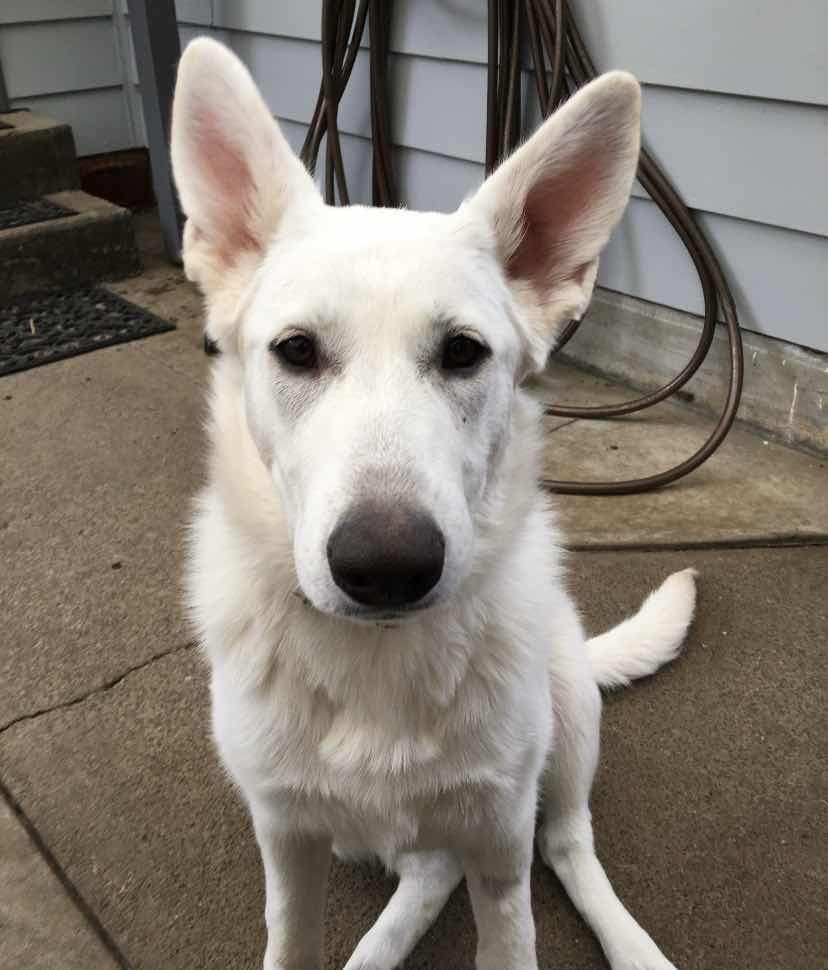
Well call me a hypocrite, because a couple days ago a desperate plea floated through my internet space. A lovely young shepherd, named Merced, was being given up by her family because she had attacked a new puppy brought into the house, and when mom got in between them, she got bitten, badly enough to need to go to urgent care. The family has very reluctantly decided that Merced could not stay with them. The humane society declined to accept her. They didn’t know what to do, and issued a general plea for someone to foster her before she would have to be destroyed. 


Well I must have been a little tipsy, or hypnotized, because I forwarded her photo to my husband, knowing full well he would fall lock stock and barrel in love. 

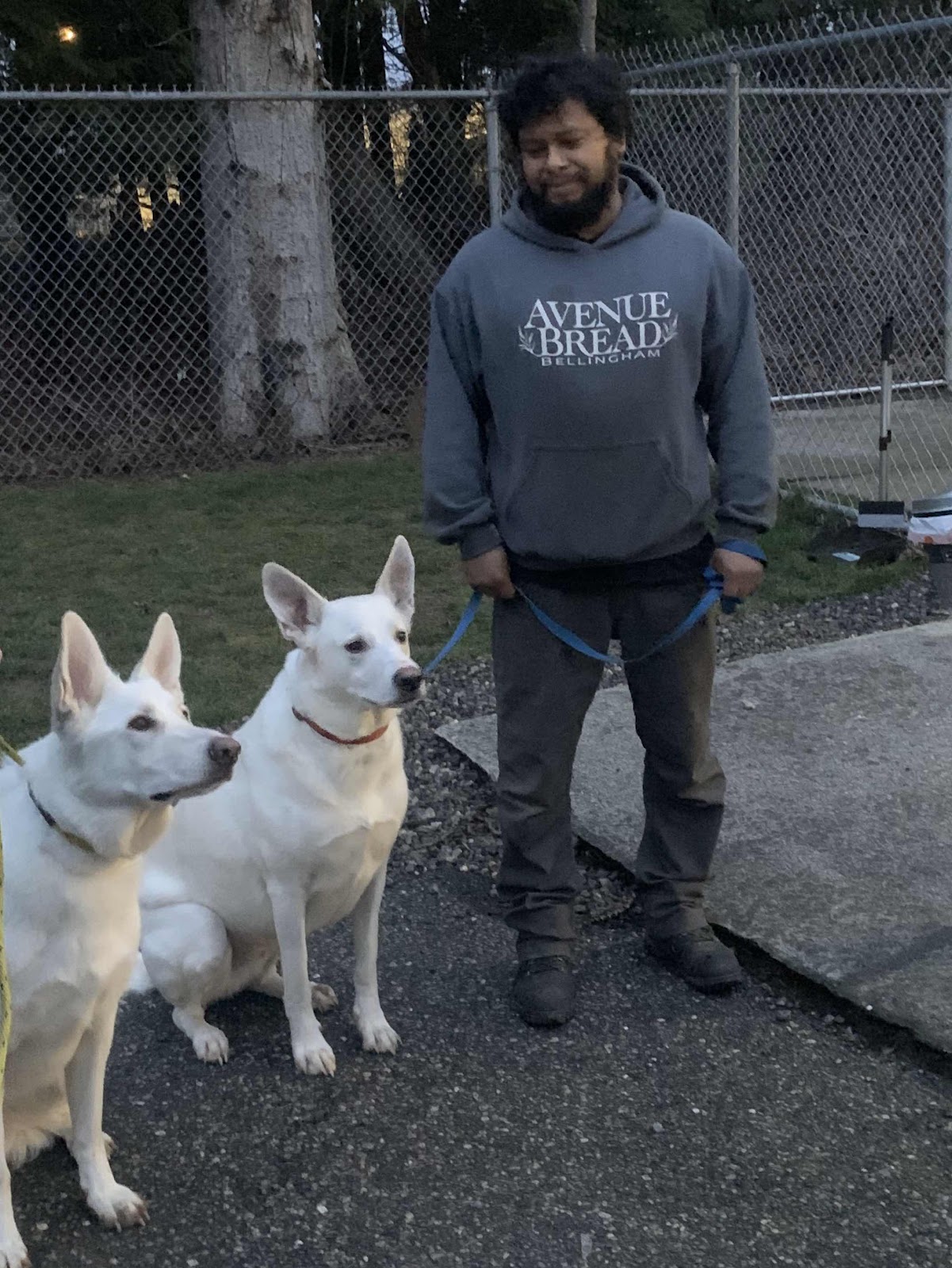
Fast forward two days. We spoke to the owners; we spoke to their trainer; we spoke to the handler at the kennel where she was being boarded. We visited her and she was every bit as charming as we imagined she would be. We were warned from all quarters that she was a challenging dog who would need careful monitoring and ongoing training, but also that she was intelligent, obedient, loving, healthy, and eager to please. We said we’d take her, pending a successful introduction to Haku. 

The handler at the kennel, a big bear of a man named Adam, helped us with the meet and greet. He spent a good two hours of uncompensated time with us and the two dogs, doing everything he could to ensure they had a peaceful introduction. It went very very well indeed, and we took Merced home the same day - yesterday. 

Today, all has gone well so far, except for one short squabble that ensued when Haku got jealous that Merced was leaning on me and tried to push past her and get closer to me. She snarled, and he snapped. He got an ear in his teeth and made her YIKE, but there was no blood and it was over in less than five seconds. Since then, they’ve spent hours together with no further trouble. 

I have high hopes that within a month, Merced and Haku will be fast friends. My main worry is that they might bond  as a pack and go after my goats. Twice the German shepherds is like, six times the prey-drive. It’s a the-whole-is-more-than-the-sum-of-it’s-parts situation. The two of them could make a very efficient killing machine working in tandem. 

But we’ll cross that bridge if we come to it. In the meantime, I am very much enjoying making my daily rounds attended by two majestic white hounds. It makes me feel like Princess Mononoke. 


Friday, August 23, 2019

The Gift of the Crab


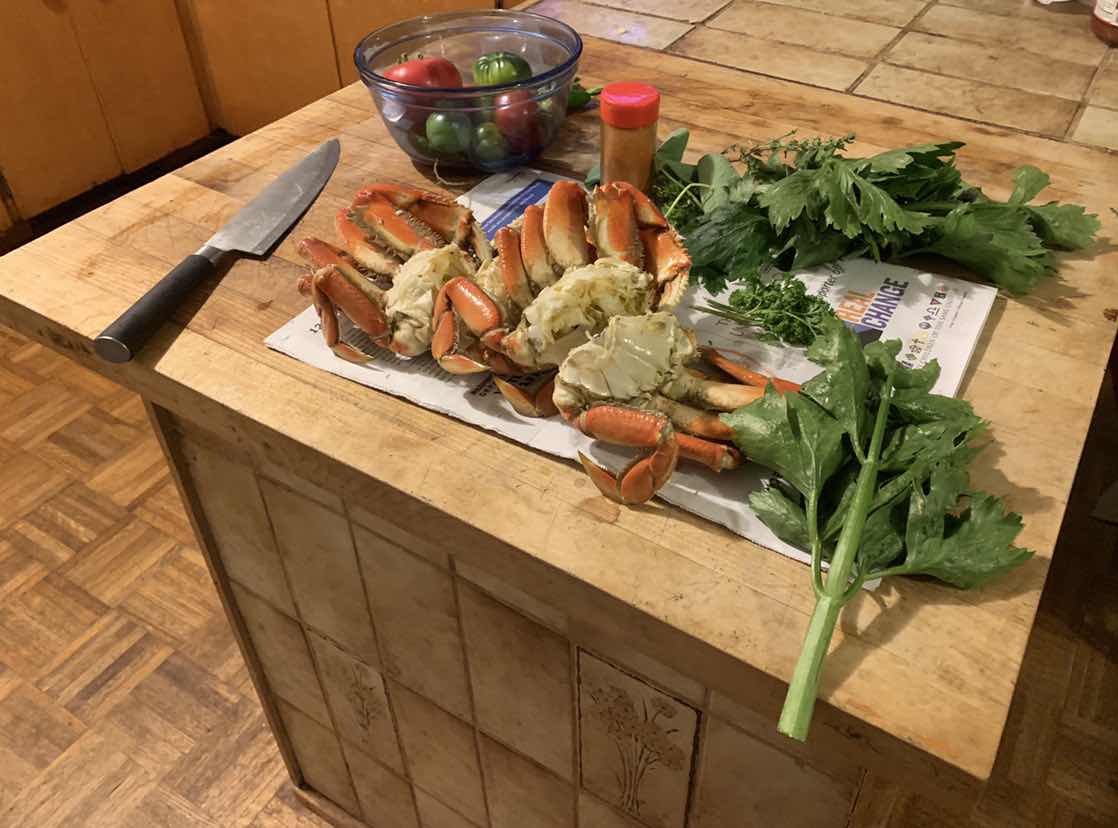
Hope’s best friend’s dad took the girls out to check his crab pots today. Of course I instantly told her to offer the Dad goat cheese for a couple of crabs. She rolled her eyes a little and said she would. 

Then she started texting me photos. Photos of a giant cauldron of crabs boiling in seawater. 

“Mom we got SO many crabs! And we’re going back out!”

“Don’t forget!” I wrote. “Goat cheese! Or ham! Or maybe some grass fed beef?”

More photos. More crabs. Big crabs! Hope learned to clean a crab. Hope sent pictures of herself eating big handfuls of snowy white crab, but no word on whether or not she was bringing any home.

“My right arm? My firstborn child?” I texted. And then “you’re killing me, smalls!” 

When she finally came home, she shook her head. 

“Sorry mom, they didn’t want to part with any crabs.”

“Really?!” I was surprised, but not THAT surprised. I mean, no matter how many dungeoness crabs I had, I’d still find it difficult to give them away. Maybe they were for a big event. Lots of people have crab parties on the beach this time of year. 

“Bummer!” I said. “I was really hoping....” 

“Sorry mom, But I could only ask him once, you know” she said, a little witheringly. 

“I know, I know. It’s fine,” I answered, but not really feeling fine. Dungeoness crab is the absolutely best seafood on earth. Fight me. 

Then the door opened and her best friend came galloping in holding an ice chest and both girls dissolved into giggles. 

“Gotcha, mom!” Hope teased me. “How could he NOT give you crabs? I showed him our text thread. You were THIRSTY for crabs.” 

Four big crabs, already cooked and cleaned. I didn’t even have a chance to give him anything in return. Hope’s friend is spending the night, so I can send her home with something. 

Not my right arm, though. I need that to hold the nutcracker. 


Sunday, June 10, 2018

Long Live Hippies (Trade Network ‘18) S


We are currently getting about three gallons of milk a day from my two best dairy goats, Polly and Christmas. I have been making cheese two or three times a week, but the milk piles up even so. This morning, there were seven half-gallon jars full of milk in the fridge, as well as a few pounds of chèvre and several vacuum sealed packages of hard cheese. There are also eight or so pints of canned cajeta in the pantry. 

As I have written before, we will be spending most of this summer in Oaxaca, so any and all cheesemaking activity needs to take place before we leave. Obviously, we want to maximize the benefit of this shortened milk season. To that end, Homero and I have both been seeking out possible trade partners. 

A few miles from here, between our farm and the shore of the Salish sea, there is a bona-fide commune. It’s a beautiful piece of property inhabited by five or six families of hippies who live in school-buses, RVs, and trailers of various sorts. Somehow, several years ago, Homero became the de-facto hippie commune schoolbus mechanic for the entire colony. He has been quietly and cheaply keeping their vehicles running for years now. This year, the relationship has paid off in a new trade partner. 

Today, a couple of nice young white people with dreadlocks appeared on our porch with a big bowl of strawberries, a bag of lovely lettuces, and a bunch of radishes. In exchange we handed over a gallon and a half of fresh milk and a pound or so of chèvre. After chatting for a few minutes about cheesemaking, I also loaned them a book of cheese recipes and a teaspoon of mesophilic starter. They were delighted, and promised future zucchini, basil, and raspberries in exchange for more cheese. We even talked about them possibly coming to milk while we are gone and thereby keep at least one of our does lactating. 

Forging relationships with my neighbors always makes me happy. I do love striving for self-sufficiency, which is one of my long-term goals,  but to me, that term does not and never has meant providing all our family’s needs alone. No man, and no homestead, is an island. True self-sufficiency has always meant cultivating mutually beneficial relationships and creating networks of mutual support with neighbors. Sharing resources, whether those resources be material goods like tools, canning jars, and pasture, or whether they be knowledge and experience, books and knowhow. True wealth lies not in hoarding stuff but in creating and maintaining friendships. 

Friends are the real wealth. 


Wednesday, October 11, 2017

Beautiful Buck


Fall is the season for making decisions about goat breeding. 
Most goats are seasonal breeders, meaning they only go into heat during certain times of the year. In our climate, the does begin to go into heat as soon as the days grow shorter and the nights become crisp, usually in September. Every doe is different - one of mine, Polly, is an early breeder and goes into heat in late July or early August. If we have a buck on the place, she will get pregnant early and give birth in the depths of winter, which is not good for the survival chances of her babies. 

For that and other reasons, I have not kept a buck in the farm for several years now. It's convienant to have your own buck, for sure. Finding a suitable buck is one of the more time comsuming and annoying tasks of the year. First you have to find a buck you like, of the correct breed, conformation, and vigor. Then you have to talk about testing for communicable diseases and coordinate worming schedules; negotiate a price for multiple does; and decide whether you will transport the does to the buck or the buck to the does, and who will take on that onerous task. Some buck owners want you to pay for feed or to provide specific hay; some charge boarding fees for your does. 

On the other hand, keeping a buck has its drawbacks. They are stinky, in season, and some of them are aggressive. They are generally speaking much harder on fences than does are, and more prone to escape and go marauding around the countryside damaging the neighbor's fruit trees. When breeding season comes around they must be kept separate from the does until such time as you want them bred, and that isn't easy. A healthy young buck will go to amazing lengths to breed an in-heat doe, including jumping a six foot fence. If you are still milking during breeding season, a buck's hormones will taint the milk and give it a rancid, billy-goat odor. 

On balance, I've decided that it's better to rent a buck than it is to keep one year round. For now, anyway. This year it was relatively easy to find a good buck. A friend of the family has a lovely, proven, black and white Nubian that he was willing to lend us for the three weeks it takes to complete a full breeding cycle. He isn't registered, but I don't care because neither are my does. Homero went and got him today. He transported him - crazily - in the backseat of our regular car, which means we will all have to sit on clean towels or smell like a billy goat for the next couple of weeks.  
But I'm happy - the does seem very happy, very welcoming. 

Here's a link to a post from a few years ago about the more historical and spiritual aspects of goat breeding:

Saturday, September 23, 2017

Happy Apple Cider Day (Neighbors to the Rescue)


A close up of the gear mechanism of the apple press. The girls and I had pressed about three gallons of cider today, and were only about a third of the way through the wheelbarrow full of apples, when the press broke.  It always breaks in the same way - the little rod that goes through the horizontal gear and attaches it to the presser-rod breaks. Last time this happened, after I let some over enthusiastic college boys use the press, Homero fixed it by using a nail to replace the little rod. Today, that nail broke in half. 


The girls and I could not figure out how to fix it. It's simple
enough to see how it works but the presser-rod had slipped down inside the tube and we couldn't get it to come up high enough to thread a new nail through the hole. Nor could we figure out how to remove the vertical gear which we would have to do. Nor could we find any tool hanging around capable of cutting off the excess nail so it wouldn't halt the turning of the horizontal gear halfway through a revolution. I learned that you cannot cut a nail with long-armed garden loppers, and it's dangerous, so don't try. 

Homero is in Seattle, and he wasn't answering his phone. I was about to give up, and frustrated because I had hoped to do all my pressing in one fell swoop his year. The apples which we gathered from a friend's orchard had already been resting for about a week and I didn't think they would last a whole lot longer. And I didn't want to clean up the press and the mess and then just wait for Homero to fix it. 

Then I remembered Mr B. The B's are close neighbors and friends from church. They are an elderly couple, from whom  we buy a side of beef every year that they have one to spare. One year, the B's borrowed the press, and when he returned it, Mr B had cleaned and serviced it, oiled it and sharpened the blades. I knew he could make short work of this simple
mechanical problem, and he might even enjoy himself while he was at it. 

Five minutes after I called, both B's arrived. It took Mr B a few minutes to figure out how to get the presser-rod to come up through the tube (it screws, but the mechanism is hidden), and after that it was smooth sailing. We brought over a collection of nails and he chose one, threaded it through the hole, marked where it needed to be cut, and then took it back to his workshop and cut it with his sawzall. There was some fiddling around with pliers and the cotter-pin on the vertical gear, and then presto! It worked! 

We all cheered. I convinced them to take home a little thank you basket, with a half gallon of cider, a few ham steaks from the freezer, and a jar of blackberry jam. They didn't want to take it but I insisted. 

Then we had to really rock and roll to get the apples pressed before dark. Pressing cider is hard work, even with a motorized press, and there were a whole lot of apples.  But we got it done. Hooray for good neighbors, who are handy and willing to lend a handy hand. 


Friday, September 1, 2017

Beef Abundance (Simple is Good)


Summer is drawing to a close - not that you'd know it by the weather. Today, September first, it was 85 degrees and sunny. This is something like our fiftieth day without measurable rain. The forecast continues dry and hot as far as the weather-people can see into the future.

But the calendar is implacable. School starts this Tuesday, no matter the forecast. It's time and past time to get the kids new school shoes and jackets; to mow the last scraggly weeds; to shake off summer's languor and impose something like a schedule again. 

It's also time, more pleasantly, to eat up the meat in the freezer. Last week Mr. B., my neighbor, asked us if we'd be wanting to buy a side of beef this year again, and I said we sure would. Last fall, due to a silly series of miscommunications, we ended up buying a ridiculous quantity of beef - three quarters of a big fat steer, much more than we needed. Quite a bit of it is still in the freezer and needs to be devoured ASAP to make room. 

Today I thawed a package of rib steaks. A favorite cut of mine, they are heavily marbled and carry a thick rim of fat around the edges. If you aren't used to grass fed beef, you might be thinking "yuck, fat." I assure you that the succulent, yellow, flavorful fat of a grass fed and grass finished beeve is nothing like the pale rubbery fat on a factory farmed animal. 

These steaks don't need much. After thawing, I liberally sprinkled them with salt, pepper, and garlic powder, and laid them on a big cast iron griddle slicked with quality olive oil and got out of the way. Flip after six or seven minutes and give the other side a sear. My husband likes his steaks medium well and I like mine medium rare, so I take mine off a few minutes early and let it rest while his continues to cook. 

As an accompaniment I boiled a half dozen yellow potatoes, and smashed them with a couple tablespoons of butter, a teaspoon of whole grain mustard, a spoonful of mayonnaise, salt, pepper, and a generous amount of minced parsley. A cold beer after a hot day's work rounds out the meal. 


Sunday, August 13, 2017

Preserving Log Update


Surely one of the very best smells in the world is that of a bubbling vat of apples, enriched with cloves, cinnamon, allspice, and sugar. Doesn't hurt to throw in a quart or so of freshly picked blackberries, either. 

Yesterday I went to a neighbor's house - a person who is becoming a very good friend - and took home two shopping bags full of transparent apples. If you, like my daughter, thinks a transparent apple is an apple you can see through, read and learn. Transparents are yellow apples that ripen early. They are specifically sauce apples, being good for not much else. They are too mushy to eat fresh, and too mushy to juice. But they make wonderful sauce. 

I had invited myself over to pick apples after noticing, as I was driving by, a transparent tree that was dropping it's apples already. I asked if I could come collect some and she said "Please!" Once there, i realized that she actually has a serious apple orchard - about twenty trees of many varieties, and most of them are positively loaded with (as yet unripe) apples. I suggested that I ought to lug over my apple press later in the season and we should devote a day to cidering. That idea was met with enthusiasm. 

Today was given over to making applesauce. Good thing I was recently gifted so many canning jars, or would have had to go buy a dozen quarts. A dozen quarts is what I ended up with - though I actually canned only nine of them, because that's as many as fits in my largest kettle. The other three are in the refrigerator. One will go back to my neighbor as thanks, and the other two we will eat quickly. 

I've made some jam recently too. So the preserving log update is as follows:

9 quarts apple-blackberry sauce
6 pints blackberry jam
1 gallon dried apricots


Friday, June 30, 2017

Coming of Age Custard Pie


I am forty-five years old. Incredibly, there has not been a death in my immediate family since my last living grandparent - Grandma Eva - died when I was about twenty, some twenty-five years ago. My other grandparents were either dead before I was born, or died when I was still very much a child.

As an adult, only a very few people I know have died, principally the mother of my stepfather. Grandma Joann was a lovely woman, who we saw on every holiday and who always remembered my children with presents or cards. The mother of my best friend died of ovarian cancer years ago, and I went to her memorial service.  That represents the sum total of my experience with human death, pretty much.

Never have I, until now, been an adult member of a community celebrating the death of one of its own. The church I belong to, Zion Lutheran, is a small rural church with a long history. I've written about Zion before. I joined in order to meet a deep, incohate need to be part of a congregation - to experience worship as more than a solitary activity - and in order to become more fully a part of the community I had moved into. That relationship has been everything I could have hoped, and more than I could have imagined when I first joined. It has been a deep pleasure, and a rather strange experience for a lifelong loner like me, to slowly become a fully instated, respectable member of a circle of peers. I am, believe it or not (few who knew me as a teenager would) a member of the church council. I sing in the (occasional) choir.

Zion's congregation is old, and small. There are perhaps thirty families who belong, and maybe thirty or forty individuals who show up for services every Sunday. Most of these folk are elderly. If I had to guess at a median age for people seated in the pews on an average Sunday, I'd say about seventy. Many of them were married at Zion a half-century hence, and christened there even longer ago. The grassy, sloping churchyard hosts a couple score of gravestones, many of which bear the names of the parents and grandparents of current members. In the basement, where we gather for coffee hour after service, there is a wall filled with photos going back to the year Zion was built, 1903. In those days, mass was spoken in Norwegian. There is a very real continuity, a living history, embodied in this tiny, local institution.

Last week, the oldest living member of Zion's congregation, H. R., died. She was in her nineties, and had been a member of Zion all her life. Her photo is one of the older ones on there basement wall. My children and I knew her as a neat, friendly, well-dressed, and tiny lady who still drove herself to church. We pressed her small hands when we passed the peace. She had beautiful snow-white hair and a sweet smile. She had deep, deep ties in our area. She will be missed. Her memorial is Saturday.

Yesterday, I got a phone call from another of the OG's of Zion, M. She is above - or behind - or superior to me on Zion's official phone tree, and she was calling me to ask me to bring a dessert to H.'s memorial service.

Of course I was planning to attend the service. But it would not have occurred to me to bring anything if I had not been called. I suppose I would have thought, if I thought anything at all, that H's family would be bringing "refreshments." At the very few memorial services I have attended, the food was just there, as if my magic, and I was a consumer; not a provider. Even when my step-grandma died just a few years ago, I had nothing to do with putting on the service - I just showed up, signed the book, and ate the cheese and crackers. It was only when I answered the phone that I realized I had become, willy-nilly, a person to be called upon. To be counted on. A sister. A matron of the church.

"Yes, of course I'll bring a dessert," I said. "What time is the service?"

"Noon," M. answered me. "Just bring it by anytime before." And then she surprised me by asking what I was going to make.

"I'm not sure," I said, "probably something with rhubarb because I have an awful lot of it."

"Oh good," said M., "rhubarb is my favorite."


Coming of Age Rhubarb Custard Pie

eight cups (or so) chopped fresh rhubarb, from 10 to 12 stems

four store-bought rolled pie crusts, or a double recipe home made

3 cups sugar

1 1/2 cups flour

8 eggs

1/2 cup milk (or more)

tsp salt

Grease a 9 x 13" baking pan. Preheat oven to 375. 

Unroll pastry, or prepare homemade crust and roll out thin. Lay pastry in baking dish, leaving plenty of overlap on the edges. If using store-bought pastry, cut to fit. 

In a large mixing bowl  measure out sugar, four, salt. In a second bowl, beat all 8 eggs together with milk.add wet ingredients to dry, and mix with a fork. If very thick, add a bit more milk until you have a very thick but pourable mixture. Pour over chopped rhubarb and turn to mix, gently. Scrape into the baking dish, spreading to edges. Crimp dough around filling. 

Bake at 375 for approximately 45 minutes until crust is golden and filling is well set. Let cool and top with whipped cream or drizzle with sweetened sour cream. Cut into squares to serve. 


Friday, March 10, 2017

Meat Math 2017


This year's horrible pigs (all pigs are horrible but this year's were worse than most) have been converted into meat, and the meat sold, except for what we wanted to keep for ourselves. It's time for this year's edition of MEAT MATH (Meat Math).

The pigs were pretty small. We killed them earlier than we maybe should have because they were so evil, and also because in the cold and wet, they weren't gaining weight very quickly. It's better to get piglets in the spring than in the fall, but of course everybody knows that, and so spring piglets are more expensive than fall piglets. The boy had a hanging weight of 132lbs, and the gilt 110lbs.

The larger pig we sold off in halves. One half went to our neighbor, the D. family, from whom we have actually bought pork in years past. But they decided (being quicker learners than we are, apparently) that they don't want to raise pigs anymore, so now they are buying from us. That half weighed 67lbs. The other half went to a Facebook friend, and weighed 65lbs.

We asked $3/lb, which is on the cheap side. I started out at $3.50/lb, which seems to be the going rate for pork without fancy qualifiers like Organic or Pastured, but it so happened that there was a lot of pork for sale at the same time I was trying to sell, at least according to Craigslist. I didn't get any response at $3.50/lb.

If I'd had an empty freezer, I might have held out. But I'd already made the date with the butcher, and our freezer was stuffed nigh to bursting with beef, salmon, and lamb. We have two eminently butcher-able animals (a sheep and a goat) that we have let live for the sole reason that we were saving room in the freezer for the pork. Faced with that severe space shortage, I lowered the price, and quickly sold off the bigger pig.

Okay, so 132 x $3 = $396. Rounding to $400.

The piglets themselves cost us $100 each. That leaves $200.

Feed was negligible, thanks to unlimited bread and produce from the Gleaner's Pantry ( What Wrong With this Avocado?). We did buy three or four bags of conventional pig feed - let's say that was $60. Now we have $140 left.

Unfortunately, I lost my receipt from the butcher, so I can't break it down into categories, but we paid them $178 for our 110lbs, which includes the kill fee, the cut and wrap, and the fee for smoking the hams, bacon, and hocks. Take 178 from 140 and we are 38 dollars in the hole. Divide 38 by 110 and you get homestead pork for $0.35/lb. Not, obviously, counting labor.

Even if I am forgetting a couple bags of feed, that's some pretty cheap, quality protein. The first meal I made was BBQ spareribs. Delicious.


Wednesday, October 19, 2016

Meat Madness (Weighing Options)


I have a neighbor who raises beef cattle, Mr. B., and we have bought beef from him several times in the past. It's wonderful stuff, he has gorgeous pastures, but we haven't bought any the last few years. Not last year, because we had our own cow butchered (she was a cull from a dairy that couldn't be bred, but she made a decent meat animal), and not the year before because we waited too long to ask him, and he'd already sold it all. He doesn't butcher very many steers in any given year - maybe 12 or 15 - and he told me that usually he sells all of it to extended family. I took that as a hint that I should look for beef elsewhere.

This year, we have Homero's nieces living with us again, which means dinner is for seven every night. We all like beef, and eat it pretty often. The freezer was almost empty. We were down to the last few packages of hamburger from last year's cow, and so I went on the hunt for grass fed beef on Craigslist.

Wow, the price of beef has really gone up in the last several years. I can't remember for sure what the price per pound was the first year I bought beef (2008) but I know it was under $2/lb. I think it was $1.80. This year I couldn't find anything under $3.50/lb hanging weight, which means by the time you pay the cut and wrap and figure in the 20% discard, you are paying around $5/lb for the actual beef you are going to eat.

Not that that is a high price, speaking in absolute terms. Around here, if you can even find local grass fed beef in the grocery store, it starts at $6.00 for the hamburger and goes up from there. The really nice steaks are probably over $20/lb - not that I would know! So don't think I'm complaining! However, it does mean you have to come up with a big chunk of change all at once.

I finally resigned myself to paying the going rate, and spoke with a lady in Lynden. She had a half a Hereford to sell, and she said I could buy the half or just a quarter if I preferred. The meat was already at the butcher's and would be ready in a week or so. She said he was a good sized animal, so I bought a quarter. We'd wait until the butcher called me with the final weight before I paid her.

Then, that Sunday, I went to church and saw my neighbor. Over coffee after the service, he asked me if Homero and I would like some beef this year. He wasn't certain, but he thought he'd probably have a little extra.

"If it turns out I do, would you want it?"

"Yes," I said, instantly deciding it would be a good idea to get back on his list of customers.

"Well, I'll let you know."

Now I had a conundrum. Should I cancel on the lady with the expensive beef? Mr. B.'s price was considerably lower. But what if it turned out Mr. B. didn't have any beef after all? Or what if he only had an eighth? Homero and I talked it over and he said to go ahead and buy the quarter anyway, to be on the safe side. We'd certainly eat it.

When the butcher called me a few days later, however, I was in for a surprise. The final hanging weight was 250 pounds! For those of you who have never bought your beef by the side, let me assure that is a LOT of meat. The steer must have been one gigantic animal. At $3.50/lb, plus the cut and wrap, I would be spending something like $1000 to put it in my fridge. But there was no option - the meat was mine.

Mr. B. spoke to me again at church the next week. He said there was a half for me. I smiled and said "that's wonderful, thank you so much!"

There's no way we could get through THREE QUARTERS OF A COW by ourselves, especially when one of the quarters is nearly as big as an average half. Luckily, my sister said her family would split the half with me. We simply called the butcher and told him we wanted to split it, and each of us gave our cut and wrap orders.

Now the freezer - 18.5 cubic feet; a big freezer! - is packed to the brim with meat. There is so much beef in there that we can't butcher the baby goat because there's simply no place to put him. We had to remove a few gallons of cider and drink it up to make room. There are worse problems to have than a surfeit of high quality beef. So we'll have to eat beef more often this winter than I would have guessed. Oh, Rats!


Wednesday, August 17, 2016

Plum Conundrum and Pear Perplexity


In recent days, as I took Haku outside in the evenings to run around in the orchard,  I've noticed that a couple of trees in the orchard are so heavily laden with fruit that the branches are actually sitting on the ground.  Specifically, the Italian plum and one of the pear trees - the Comice - were so bowed down that I made a mental note to get out and pick some fruit as soon as possible.

Then a couple of days went by. This morning Homero told me that the plum tree had broken nearly in half.

I said "No, the big branch is just sitting on the ground, that's all."

He said "Go take a look."

The biggest branch was indeed broken. It must have happened just that day, because the leaves were still bright green and crisp. I ran for a bucket and with Homero's help, stripped off five gallons of plums from just that one broken branch in five minutes flat. We didn't even get all the plums from that branch - many of them fell on the ground and we didn't even bother to pick them up.

The plums are not quite ripe, but it doesn't matter, because I looked it up and plums ripen beautifully off the tree. In two or three days I will have a bushel (more or less) of ripe plums, not even counting those still on the tree. The still-on-the-tree plums account for at least four fifths of the total. I tried to think of something to do with five gallons of plums. Drying comes to mind, of course, but really - who likes prunes that much? And I am not much of a jam-master. If I'm going to attempt to make jam I will make blackberry jam, which we all like, rather than risking going to all the work of canning jam only to find out that nobody enjoys the end product.

That left wine.

I don't have much experience with making alcohol. Sure; a side effect of fresh cider is tepache (naturally fermented fresh juice) - and I have occasionally expanded upon wild fermentation and ventured into the alchemy of hard cider - with mixed results. But I have never set out deliberately to create "wine" which seems for some reason very serious and highbrow, even when made from an accidental glut of plums instead of fancy pedigreed grapes.

Today I went to our local home-brew store and told them what I was up to and ended up spending something over $50 in tubing, plastic airlocks, yeast, and specialized equipment. Chances are better than even that I will not produce anything drinkable by any but a late-stage alcoholic, but I'm going to try.


The pears are a whole 'nother story.

For one thing, they mostly will not ripen on the tree and demand careful and specific post-harvest handling in order to reach peak perfection. For another thing, the time period between "peak perfection" and "post-perfection" is about fifteen minutes.

Also - The pears arrive in tsunami-sized waves. So when I try to think of something to do with the pears, I am thinking about seventy-five or eighty pears at a time, not six or eight, which would be the perfect number to make into a pie.

With that in mind, I went and bought a dozen wide-mouth quart sized canning jars. I figure I can make a few gallons of pear-sauce; hopefully mixed with blackberry if I can coerce my children into picking a few pints.

I may also try Car-dehydrating. The weather has been unrelentingly hot. It's supposed to hit 90 degrees tomorrow and stay there through the weekend. I have read that in this kind of heat, you can lay our thin slices of fruit on foil-covered trays and put them in your car. The temperature inside will reach 150-175 quite quickly. Basically, if it would kill your dog, it will dehydrate your pears.

But by far the best option is to trade some of my fruit for something else that I want more. I put out the word today over social media and within minutes had received offers to trade plums for locally caught trout; for freshly harvested green beans;  and for assorted canning jars. That's neighborliness at its best.

Monday, May 30, 2016

Friends and Hymenoptera


Memorial Day weekend. Old friends came in from out of town. I've been down to see them - Portland, Oregon - fairly recently, but they had not visited the farm since our housewarming party nine years ago, when it still existed mostly as potential.  

They arrived Saturday afternoon, in the middle of a cold rainstorm. We hugged, and ate tacos, and commiserated about the weather. They had been planning to camp, but decided to take advantage of our commodious and dry RV instead. Having made preparations for a barbecue the following day that including buying three dozen local oysters, I hoped and prayed that the weather would change.

It did. Yesterday, Sunday, was an absolutely perfect Pacific Northwest day. There has not been such a perfect Pacific Northwest day yet this year, or perhaps ever. The sky was mostly a clear cerulean blue, but decorated with impressive and towering cumulonimbus clouds that bore watching and incited speculation. The temperature was high enough to be hot on the shoulders and brow, unless you deliberately sought the breeze, which was cool and sea-scented and right there waiting to be found. 

After a breakfast of sourdough pancakes and our own ham, I took their 9 year old daughter with me to do chores and she learned how to milk a goat. She and Paloma, my 11 year old, hit it off quite well and spent the next little while looking for eggs in the hayloft and jumping on the trampoline. 

Later I took them to Lynden. Lynden has lately been undergoing a sort of renaissance and has some very nice new shops and bookstores to explore. In the beautiful Lynden city park, our children played while we sat by the stream and watched ravens bathing in the cool, quick moving water. A pileated woodpecker landed a scant ten feet from us and began hammering for his breakfast, until the ravens chased him off. 

On the way home, we stopped at a U-pick strawberry farm. The five of us spent about twenty minutes picking berries and brought home twenty pounds of fragrant, beautiful fruit. Then my girlfriend and I spent a leisurely afternoon drinking beer and preparing side dishes. The menfolk drowsed in the shade and the children took turns falling on their backs, arms spread wide, into the head-high grass. 

Around five o'clock, we roused ourselves and wandered slowly about gathering chairs and folding tables and tablecloths and firewood, setting up for the feast. Homero did his usual fire-starting trick involving a blowtorch and a little bit of home-brew biodiesel. My sister and her family arrived bearing tofu-dogs and corn on the cob. 

A long afternoon slowly faded into evening as we shucked oysters and gnawed on corn and drank local microbrews. The adults talked about everything and nothing: politics; philosophy; the pressing minutiae of our lives.  The children ran about and hollered. The fire leaped high and orange as the sun set and the stars came out. I saw an amazingly bright meteor in the southeastern sky that nobody else saw. My sister and her family drifted off. The ice in the cooler melted and the shells and the empties piled up. The beers became lukewarm and unattractive. Eventually we turned a hose on the fire, and staggered off in various directions to sleep. 

This morning dawned fine and hot. Not a cloud overhead. My friends wanted to get an early start home, so I only brewed coffee and used the leftover steak from last night and some canned ranchera salsa to make a quick breakfast, folded into hot corn tortillas with a smear of goat cheese. Farewell. Happy Trails. Drive Safe. 

Back to bed. A while later, leftovers and more coffee. Netflix. Too beautiful to stay inside. Out with the goats and the last beer. It's hot, really hot. All the blackberry blossoms are open, and the smell of the vines is strong after the rain. As I sit in a folding canvas chair, book opened and turned upside down over my knee, I close my eyes and I can hear the thrum and the buzz of hundreds of bees. It seems to me that I remember this sound from a dozen occasions of my childhood. 

The apple tree in full blossom, and the blue sky seen through the young leaves as I lay on my back underneath.  A lone hawthorne in a neighbor's field, alive with bees in the snowy blossom. Red clover; bull thistle with its fine purple hairs; the climbing roses behind the garage, a bee in every pale pink rose's heart. Such a hopeful sound, a hundred bees, somehow both soporific and energizing. 

I think this will be a weekend long remembered.


Friday, April 22, 2016

Bees and Heat


The last few days have been uncharacteristically hot, to say the least. Records were broken. In fact, records were obliterated - the previous daily high for one recent day was 77, back in the eighties; this 
time, we hit 88. And we had four or five days in a row over 80 degrees - totally unheard of for April. 

Also unheard of - the fields near me are being cut for hay. In April. I remember just a year ago or so seeing the same fields being cut in May and thinking, holy shit, that's early! If this trend continues, we will be cutting hay year round pretty soon, anytime the fields are dry enough to support a tractor. 

Another unsettling thing - despite the hot weather, I had seen nary a bee this year. A few bumblebees here and there, and as usual a ton of wasps, but no honeybees. A beekeeper friend of mine told me that her bees were so busy she was already putting honey supers on top of the hives, something she usually does in late June or early July. She thought it was probably from a lack of competition. I told her that other beekeeper friends of mine had lost most of their hives last winter - apparently the mites were just terrible last year. 

I wonder if our warm winters don't have something to do with the bee die-off. Perhaps if the temperatures are high enough, they don't really go into full hibernation and eat more of their stores? Perhaps the mites like the warm winters? Perhaps when fruit trees and other plants don't go into hard dormancy, they produce less or poorer quality nectar the following spring? In any case, I am worried about our fruit harvest this year, because there were seriously no bees around. 

Until the day before yesterday, that is. I was washing dishes at the kitchen sink, and looked out the window to see a vast cloud of big insects flying right outside. At first I thought they were flies and was grossed out; but I quickly realized they must be honeybees swarming. 

I ran outside to see where they were going. For a few minutes they kind of wandered back and forth across the front yard - a loose cumulous cloud of glittering bees, concentrated at the center and ragged around the edges. Then they veered toward the highway. 

"No! Don't cross the highway!" I thought. "Stay here!"

Finally, they settled into a blackberry bush, almost down on the grass, about two feet from the ditch along the edge of the highway. I didn't know how long they would stay there, but I know about five people who would be totally psyched if I called them to come collect the bees. There's and old saying: "a swarm of bees in May is worth a load of hay. A swarm of bees in June is worth a silver spoon." I don't know what a swarm of bees in April is worth, but I'm thinking it's worth at least a quart of honey this fall. I put the word out, and sat down in the shade to keep an eye on the swarm. 

A neighbor of our called me back, and said they would be over in a half hour with a box to get the bees. He told me not to worry, they wouldn't go anywhere for a while. The queen was resting from her maiden flight. He also told me not to worry about getting stung - without a hive to protect honeybees are very docile. 

"You could stick your hand right through that ball of bees and not get stung." 

I believed him, but could see no need to put it to the test. 


My neighbor put on a mask, but was working in shorts and without gloves, and it the bees gave him no hassles. The way to collect a swarm is to bring an appropriate vessel, place it under the swarm, and give a sharp tap to the branch they are hanging on. All the bees will fall right into the box. In this case, he couldn't put the box under the bees, because they were practically on the ground. He set the box to one side, and carefully clipped the blackberry bush until he could grasp the one cane that supported the swarm. Then he cut that cane, picked up the swarm, and tapped it against the edge of the box. About two thirds of the bees fell right into the box. 


Since the queen is inside the ball, it's most likely that she fell into the box, too, but we had to wait to be sure. My neighbor put the lid on there hive, leaving a crack, and then we waited. If the queen were outside the box, the bees on the inside would soon figure that out and start coming out. If the queen were on the inside, the bees that were still outside the box - a few thousand - would begin to settle on the box and go inside. 

After a few minutes, my neighbor pointed out a line of bees standing on the rim of the box, pointing their rear-ends up in the air and waggling them. 

"She's in there," he said. "Those bees are wafting out pheromone to tell everybody to come on in." 

By this time, it was close to sunset. My neighbor said he had to go pick up his kids from sports practice, but he'd be back later to get the bees. They needed plenty of time to get all of them inside and to decided definitively that this was their new home. 

And that's what happened. I hope this turns out to be a good strong queen and that they make a good strong hive. Homero wants to try having bees again as soon as possible - in fact he was annoyed with me for calling any body at all, and wanted to try to get them himself. But we don't have any equipment anymore. We can start getting some stuff together and when and if we see another swarm this year, we'll be ready. If we don't see one - as seems likely; this was the first swarm I've ever seen - we will at least be ready to start next year with a bought colony.