"United we bargain, divided we beg."
Showing posts with label mexican food. Show all posts

Friday, January 6, 2023

Rosca de Reyes (King Cake)


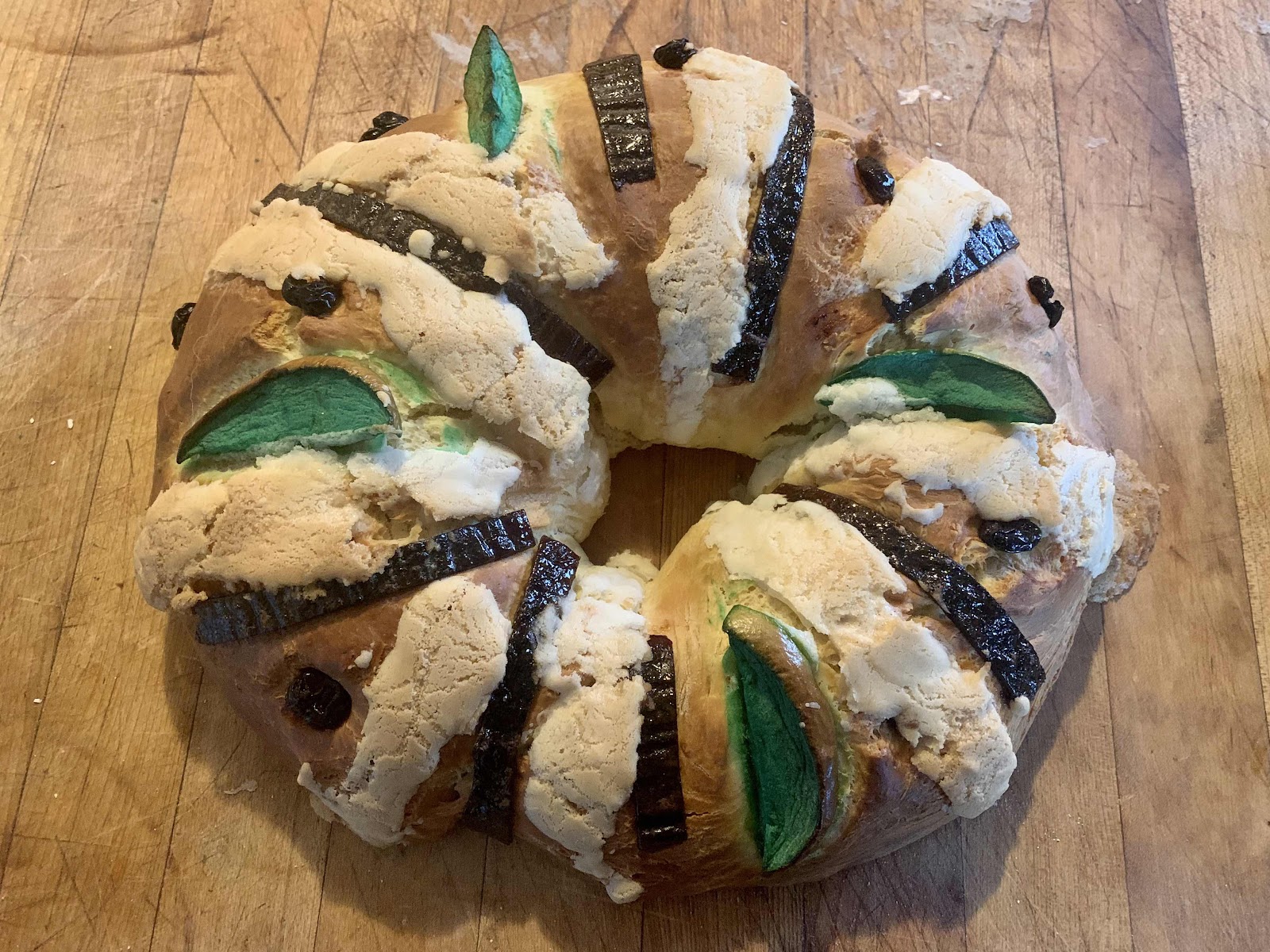
I made this lovely Rosca de Reyes cake today, which is January 6th - also known as Epiphany and the Three Kings day. 

Mexicans celebrate three kings day with a Rosca de Reyes, or a King Cake. It’s a sweet egg-and-butter enriched bread studded with dried fruit, nuts, and sugar paste. Sometimes it’s stuffed with marzipan. And somewhere inside it, there’s a little statue of the baby Jesus. Or a baby anyway. The tradition goes that whoever gets the baby Jesus in his or her slice of King Cake has to make tamales for the next feast on the calendar, which is Candelmas - February second. 

(For a post about Candelmas/Imbolc, click here http://newtofarmlife.blogspot.com/2014/02/imbolc-repost.html?m=1

Like many other catholic feast days, Epiphany has some Pagan antecedents. The tradition of a King Cake goes way back in pre-Christian Europe. Instead of a baby Jesus, a dried broad bean would be baked into the cake and the person who found it was crowned King for a day. 

This is an example of a topsy-turvy festival, when a peasant can be a king and vice versa. The Bean King would be the focus of the celebration and the center of attention. He could behave however he wanted for the night - get super drunk, grope the girls - without repercussions. Such festivals upset the social order and let people blow off steam, flouting the norms which they have to live by the rest of the year. 

But in the REALLY way back days, in some bronze-age planting societies across Eurasia, the bean-king was no laughing matter. Instead of being king for a night, he was made the sacred king for a year, during which he was given the best of everything and revered by everyone. But when the next year’s planting time came around, he would be killed and his blood poured on the fields to ritually fertilize them. 

There is no bean in my cake, nor is there a tiny baby Jesus statue. Oddly enough, I don’t actually own such a thing. For the decorations, I used strips of my homemade fruit leather, and thin slices of dehydrated pears colored with green food coloring. Tonight we will enjoy it with hot chocolate and nobody will be King. 


Friday, June 17, 2022

Cajeta (The Best Thing You Can Do With Goat’s Milk)


This time of year, I am usually drowning in milk. 2022 is a bit of an anomaly, because the only two goats in milk are the two young first fresheners, and they don’t give a ton of milk. Also, we let one of them dry off when Homero and I went on vacation last week. Now it’s just Sweetpea to milk, and she has a baby on her so there just won’t be much milk from now on this year. Unless Christmas gives birth - I am still uncertain if she’s even pregnant or not. 

Knowing that this milk season would likely be short, I made the most of the milk I had before we left and milked every day. Even two undersized first fresheners can collectively produce about three quarters of a gallon a day. By comparison, a single good milk goat in her second or third kidding season will produce a gallon all by herself. 

Three quarters of a gallon of milk a day is still a lot. We store the milk in half gallon sized mason jars, and by day three there are nine of these big jars in the fridge, hogging all the space. I absolutely have to do something with all the milk at least every third day. 

The simplest thing to do with milk is make chevre. That’s just involves adding culture to the still-warm milk and leaving it in a warm place for 24 hours, and then draining through a jelly-bag and salting. 

The next simplest thing to do is make what I call “easy Cheese.” That’s a paneer-type fresh cheese made by heating the milk to 180 degrees, adding vinegar, draining the curds and pressing. It takes about twenty minutes and makes a nice, fresh tasting cheese suitable for quesadillas. It’s a bit bland but it’s easy (hence the name). 

When I have more time I may make cheddar for long term storage, which is a multi-step process that requires active involvement and attention at various intervals over a several hour time frame. If I have lots of time but not the inclination for meticulous processes, I make cajeta. 

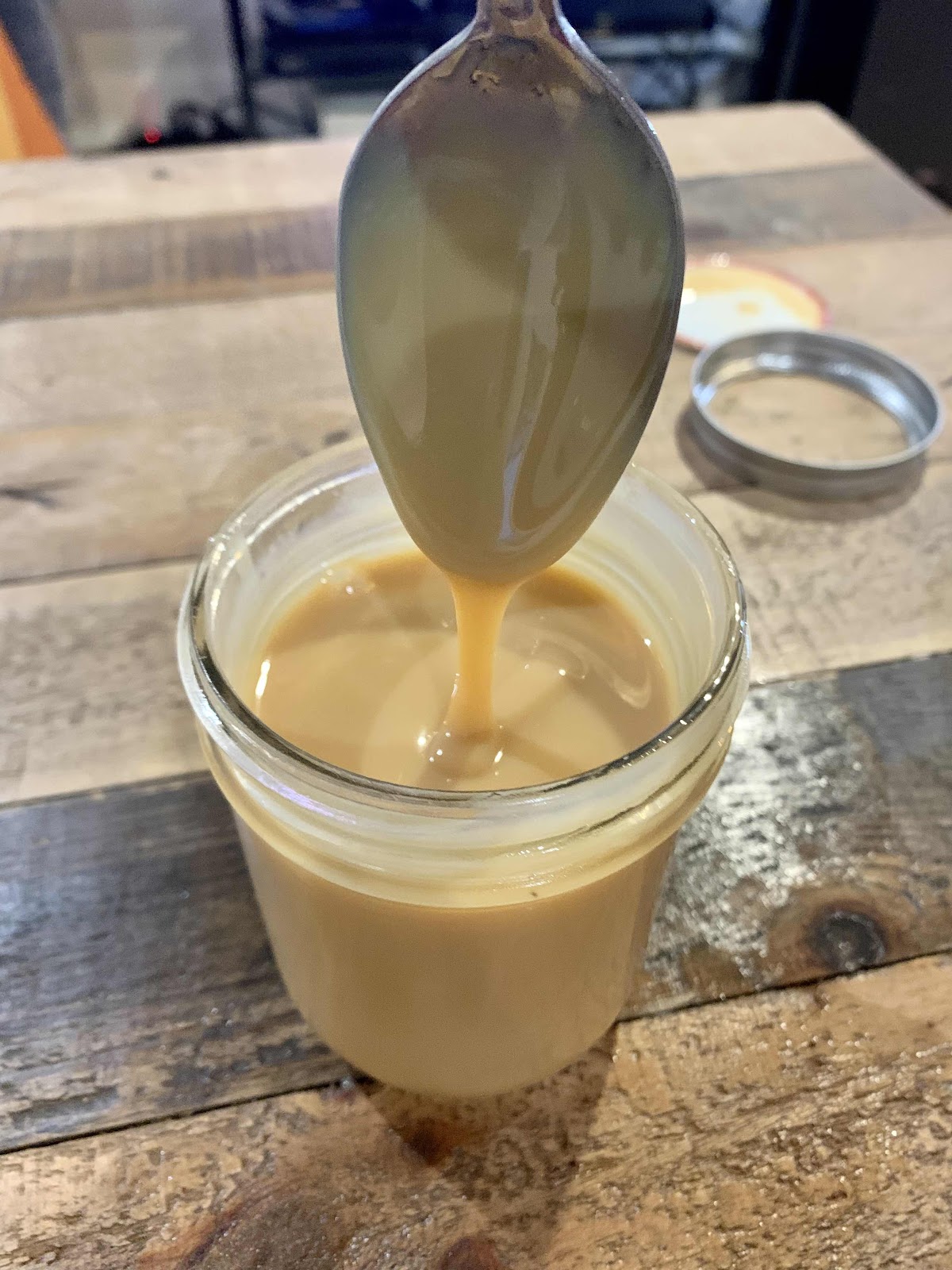
Cajeta, for the uninitiated, is Mexican caramel sauce made with goat’s milk. It’s unearthly delicious. Just crazy good. Try it on sliced bananas, or fresh peaches. My husband likes it on toast for breakfast. Everyone likes it on vanilla ice cream. Cajeta can be water-bath canned, and so I often give it as Christmas gifts. Nobody ever complains about getting a jar of cajeta. 

CAJETA 

1 gallon goats milk (must be very fresh) 
6 cups granulated sugar 
Teaspoon vanilla extract 
Half teaspoon baking soda 
Pinch salt 

In a very large stockpot, combine milk, sugar, and vanilla. Put over medium-high heat. When milk is hot but not yet boiling, add the baking soda. Careful, it may foam up quite a bit, but it will subside. Add salt. 

Bring milk to a  boil, then turn down to a fast simmer. Be careful - when the milk boils it will rapidly - instantly - I greatly increase in volume. That’s why the stockpot needs to be really big. But when it goes down to a simmer it will subside. Keep the simmer as fast as possible though, almost a true boil. 

Leave it for about an hour. Every once in a while, check on it and scrape the sides with a rubber spatula. Keep it simmering until it thickens, and coats a spoon thickly.  It may take up to three hours, but it can be pretty much unsupervised except for the last bit. At the end, it will begin to boil quickly at the same heat. That’s okay, just stir it and don’t let it scorch. It should get medium-light brown (the cajeta in the picture above is a little bit pale), and be thick like caramel. It will thicken more as it cools. 

Put hot cajeta into sterilized jam jars and top with sterilized lids. Process in a water bath for fifteen minutes. If any jars don’t seal, don’t worry, they will keep in the fridge for a month, anyway. 

Sunday, April 11, 2021

First Fire (Carne Asada)


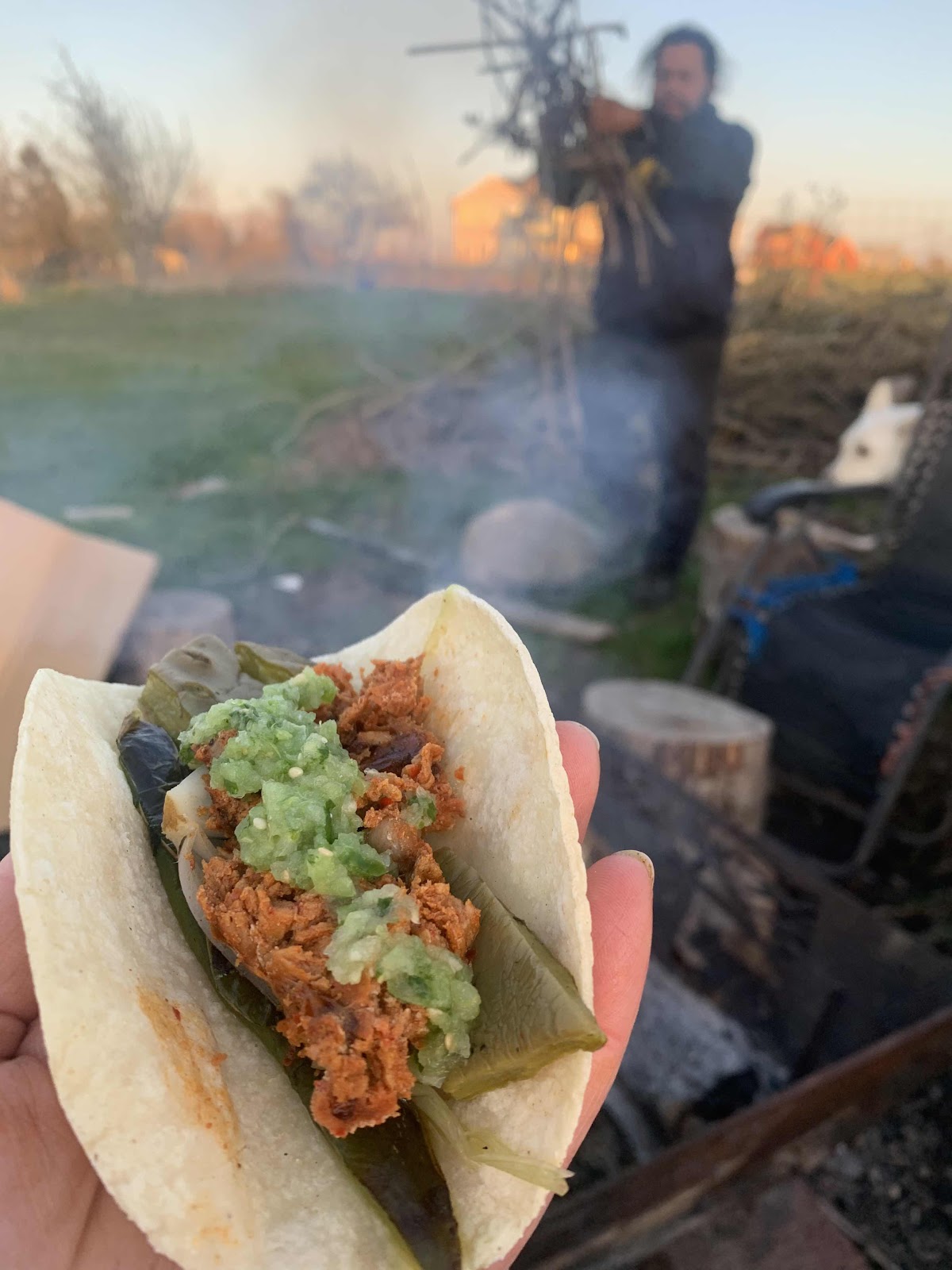
Built a fire this afternoon and had a carne asada, just for us. It’s still cold, but the sun was bright and tempting. I just took the oven rack out to the fire pit and laid it over the coals. Nopales and spring onions, tasajo, and a bit of fresh chorizo. I whizzed up a quick raw tomatillo salsa in the blender, heated up tortillas, and brought out the quesillo I made last week. 


Sunday, August 11, 2019

Sweet Corn and Sweet Memories


If you’ve never had sweet corn Mexican style, you really have to try it. When I was a child, we rolled our fresh boiled ears of sweet corn on top of a cold stick of butter, unwrapped and set on the table for that purpose. The hot corn melted a deep divot in the butter, making each subsequent ear easier to baptize. Then we sprinkled the ears with salt and went to town. 

There’s nothing wrong with that “recipe.”  I believe it was Garrison Kieller, in his wonderful memoir Lake Wobegon Days, who first asked the question “yeah, sex is great, but have you ever had fresh sweet corn straight from the field?” I will not go on record as to my preference, but I will affirm that fresh sweet corn bathed in butter and sprinkled with salt is one of life’s great pleasures. 

The kind of super-sweet hybrid corn we enjoy in the states  was more or less unknown in Mexico until very recently. Traditionally, all corn grown in Mexico for human consumption is what we know as “field corn” and generally used as animal feed. A little more scientifically, it’s known as “dent corn” for the little dents that develop in the center of each kernel as it dries. This is the corn that Mexican families grow, dry on the cob, twist the kernels off and store in buckets, and eventually turn into nixtamal and grind into masa to make the staple Mexican food, tortillas, all year round. There are literally hundreds of varieties - white, yellow, green, blue, red, black, and speckled. 

While most of the harvest is let to mature and will be used as described above, some of it is picked “tierno,” or “tender,” and eaten fresh. It is nowhere near as sweet as our hybrid corn, but it has a toothsome chew, and a satisfying heft that fills you up as sweet corn does not. It’s a complex carbohydrate, for sure. 

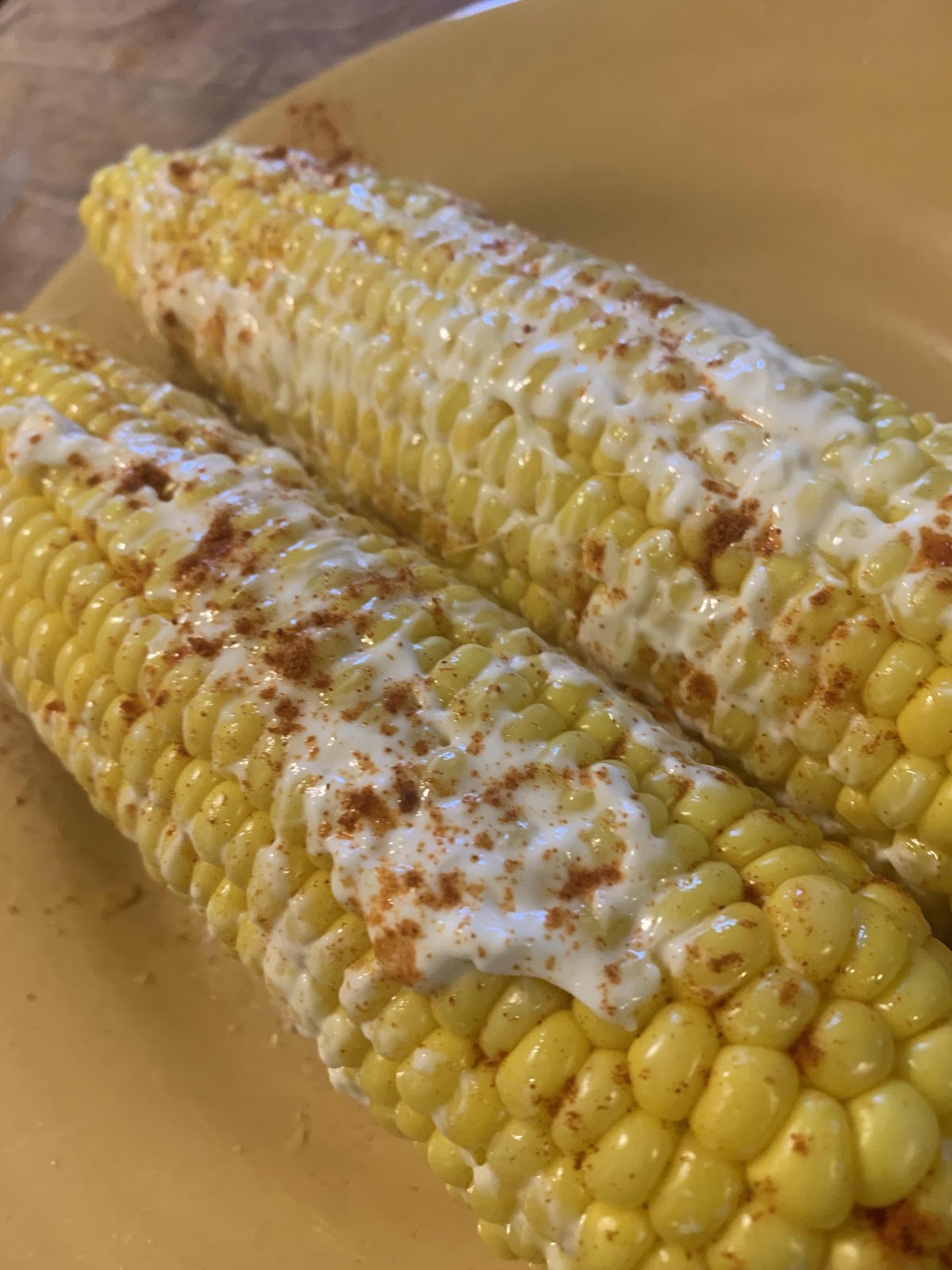
In Mexican Spanish, a fresh boiled ear of corn is called an Elote. It’s one of the most common street foods, served slathered with mayonnaise, squirted with fresh lime juice, sprinkled with chile powder, and rolled in grated cotija cheese. The same assemblage of flavors can be served in a cup, made up of the kernels of corn cut from the cob and then dressed with the same toppings. In this form it’s called Esquites, and it’s my absolute favorite Mexican street snack. 

One of my finest memories is sitting on a wrought iron bench in Oaxaca’s zocalo on a fine summer evening, eating esquites and watching dozens of well-dressed couples of a certain age dancing to the music of a marimba band. One of my greatest ambitions is to be one half of such a couple, on a fine summer evening a score of summers hence. And lord, I hope there will be esquites to revive me after I tire of dancing. 


Tuesday, December 12, 2017

What is Guacamole, Anyway?


Let's get one thing out of the way: there's no such thing as one "right" way to make guacamole. There are not even one hundred "right" ways to make guacamole. There are as many "right" ways to make guacamole as there are abuelitas in Mexico. 

I'd like to be a fly on the wall listening to a hundred Mexican abuelitas argue about how to make guacamole. There will no doubt be virulent partisans: for or against the inclusion of tomatoes; the chunky tribe versus the smooth; those who advocate garlic and those to whom garlic is a barbarian adulterant. 

If we turn to etymology, as I always do in times of doubt, we find that "guacamole" is a compound word made up of the Nahuatl words for "avocado" and "sauce." (Well, okay if you want to get technical the Nahuatl word "ahuahacatl" actually means "testicle" but that's only an interesting aside. Avocados grow in pairs. Picture it.) Therefore, guacamole is simply a sauce made with avocados. Quite likely, for the prehispanic residents of Mexico, guacamole may have consisted of no more than mashed avocados and salt, perhaps with chiles. 

I don't know enough about regional Mexican cuisine to pinpoint a cook's origin by her guacamole recipe, but I know how they do it in Oaxaca - or, okay, at least how my husband's family does it. In Oaxaca, guacamole contains tomatillos. When Homero and I were getting married, my mom hired some great caterers and told her we wanted a Mexican buffet. They worked up a sample menu and invited us to taste it. It was fantastic - the food is what everyone remembers about my wedding - but Homero had a problem with the guacamole. They had made a chunky style guacamole with tomatoes - like a pico de gallo suspended in a mousse of whipped avocado. Homero barely recognized it as guacamole - he wanted something looser, soupier, more liquid. In Oaxaca this is achieved by blending the avocados with soft simmered tomatillos, fresh raw chiles, onion, and cilantro. Oaxacan guacamole is smooth, of variable spiciness, and most often used as one of several garnishes on tacos, chilaquiles, enchiladas, or what have you. It isn't a "dip," per se. 

Over the years, I've developed what I consider to be my own ur-guacamole recipe, meaning the list of ingredients without which I cannot make guacamole, but in practice, I seldom make guacamole the same way twice. That list is:

- avocados (of course)
- chile (much preferred fresh but I'll use cayenne powder if I have to)
-cilantro
-lime

Onion is nearly as essential but I don't include it because  if I didn't have an onion (the horror!) I wouldn't let it stop me from making guacamole if I had all the other ingredients. 

In Mexico, avocados are cheap. Even in the states, in some areas, avocados used to be ubiquitous and inexpensive. In fact, they used to be called "poor man's butter" in Florida. Alas, no longer. Even in season, avocados these days are pretty dear. So I'm often looking for avocado-extenders. 
If I happen to have them, I'll use tomatillos. I like to use them raw, however, instead of simmered. For one thing, who is going to make guacamole if it involves actual cooking? For another, I like the fresh, slightly citrusy acidity of raw tomatillos and am not a fan of the soft, almost slimy texture of cooked tomatillos. 

Other extenders I've come up with are decidedly less traditional. I have used sour cream, yogurt, and even 

(Dum Dum DUM....) 

Mayonnaise.

I started one time throwing in plain, tangy yogurt not as an extender, but because I was looking for a way to make the guacamole less calorically dense. I decided I liked it. The acidity of good yogurt is a nice balance to the creaminess of avocado. 

Personally, I like the texture that the addition of dairy products brings to guacamole. Avocado is so creamy and rich, and it seems to me that extending it with other creamy and rich products like sour cream or mayonnaise preserves that quality.  That creaminess always needs to be balanced by the acidity of lime. I might extend that to include lemon, but in my mind citrus is the only possible source of acidity. I have occasionally heard of people using vinegar and while I would never do such a thing, I'm not going to tell anybody else what to do. 

Which brings me to my main point. Any given dish made by any given cook has a story, a history. That history interacts with the tastes and the resources of the cook to produce a new dish - the actual dish that the cook is putting on his or her table on any given evening. "Authenticity" is a moving target, not a static Platonic ideal enshrined in any particular place or time. I am a good cook - I'm both respectful of tradition and inventive and innovative. I use everything I have at my disposal - the knowledge imparted to me by my mother and mother-in-law; the skills I have developed through trial and error; the ingredients unique to this farmstead, this time and place; and the feedback from my husband and children, my "customers." 

The food that I place on my family's table night after night is the unique and personal expression of the covergence  of multiple factors. That makes it "authentic." My guacamole is authentic. Is it authentic Oaxacan? No. Is it authentic Oaxacan-American? Yes.

Is it delicious? Hell to the yeah. 

Wednesday, April 19, 2017

Beat Up by a Sheep (For the LAST time)


Sometime this past winter, my sister gave us a sheep. A ram, actually. She and her husband raise Jacob's sheep, a heritage breed that is believed to be one of the oldest breeds around. They typically have four horns, and some even have six. They are not large, for sheep. They are a dual purpose breed, bred for meat and wool. They didn't want this particular sheep, my sister explained, "because he is an asshole."
Image result for jacob's sheep
Not ones to look a gift horse (or sheep) in the mouth, we said "thank you," and took him home.
Soon enough, we found out why they didn't want him around. Every time we went into the pasture, he would charge us like a deranged... well.... ram. Although he only weighed about fifty pounds, it still hurt like hell when he bashed into the side of my knee. And he didn't back off when I fought back, either. I took to carrying a stick, and once I hit him hard enough the nose to make him bleed (yes, I felt bad afterwards) but it made no difference to the sheep. He charged regardless.

The obvious solution would have been to kill him immediately, of course, but there were a variety of reasons we didn't do that. Firstly, we thought we could fatten him up. Secondly, the freezer was already full of beef, pork, and salmon. And lastly, Homero just didn't have time, and he is too cheap to let me schedule a professional to do any job he is capable of doing himself.

So we simply lived with the crazy aggressive sheep. I lost track of the number of times he knocked me down, but one instance stands out in my mind. It was mid-winter, and the ground was frozen solid. Over the past few days, it had repeatedly snowed, thawed, and frozen, and so there were a couple inches of ice in the barnyard, with hummocks of frozen dirt and gravel sticking up, and holes here and there as well. Treacherous ground, on which anybody might turn an ankle, irrespective of the need to fight off mentally impaired ovines.

The hose was frozen, so I was filling five gallon buckets directly from the spigot, precariously standing bent over on the ice-slick that surrounded the water pump. The sheep hit me from behind; I never saw him coming. I fell down, of course, and floundered around on the ice, unable to get up. The sheep backed up and charged again. He hit me in the hip, and I sprawled on my belly. I rolled over on my back and wildly flailed my legs trying to fend off his next charge. This ridiculous and humiliating scene went on for some time, until I managed to grab him by the horns and immobilize him. I still couldn't get up, however. My boots slid helplessly on the ice, and I didn't dare let go of the sheep to grab the fence for support. There were a few minutes of detente, the sheep and I frozen in an absurd tableau, catching our breath.

After a while, I managed to stand up, using the sheep himself as support. I lugged him into the barn and somehow closed the door between us. Then I limped back to the house, determined that the sheep had beat me up for the last time. Not so, alas, not so. Over the next few months, the sheep kept me well supplied with bruises. The children could not be sent out to do chores. We more or less lived in fear of this stupid, obstinate animal, himself apparently the victim of an overdeveloped instinct to attack everything that moved.

Recently, the grass finally being grown enough to provide forage, we moved the sheep by himself into the orchard, where he wouldn't interfere with daily chores. This worked fine until yesterday. Yesterday, I took the goats out to browse, and the sight of them moved the sheep to heroic efforts. He escaped, and as soon as he was free, he charged me. This time I saw him coming, and I grabbed him by the horns before he could hurt me. Holding on, I yelled for my husband. While I was waiting for him to run over from the shop, I noticed that one of the ram's four horns was curled back and growing straight into his own skull. As far as I could tell,  it hadn't yet penetrated the flesh, but it was surely uncomfortable, and soon would be downright painful, if it wasn't already. When Homero arrived, I showed him the situation, and said "we have to kill this sheep today."

Luckily, it was a fairly nice afternoon, and so Homero quickly dispatched the ram via a bullet to the back of the head (never the front; the bullet will ricochet off the shelf of thick bone). Within a couple of hours, the evil ram had been reduced to his constituent parts and was fulfilling his ultimate purpose of providing us with tasty protein. According to our personal system of division of labor, Homero deals with the slaughter and the icky parts of skinning, cleaning, and gutting, and delivers the meat to me inside in the form of large hunks - what I believe are called in the trade "primal" cuts - whole legs, shoulder, ribs and belly, back. I take it from there and trim and cut the chunks into reasonable portions as best I can, which isn't all that great since my only education in butchery is a thin book I bought called "home butchery of livestock and game."

The ribs (both sides) went into the oven, slathered with barbecue rub, and cooked on a moderate 325 degrees, covered in tinfoil, for about five hours until they were falling apart tender. That was dinner last night. I broke down the back legs into butt and haunch (I know those aren't the right terms) and packaged four nice roasts for the freezer. Then I took all the rest - shoulder, neck, back - and packed them into my giant tamalero (basically a gigantic spaghetti pot; a steamer) to make broth.

Today I strained the broth, ladled it into gallon ziplock bags for the freezer, and shredded the meat off the bones to be packaged in quart sized ziplock bags in the freezer. Except, of course, for the meat we are using tonight to make tacos de barbacoa de borrego.

Tacos de Borrego:

Make the broth

In a large steamer pot, pack all the mutton pieces (shoulder, neck, ribs, butt, whatever)
add:
1 large onion
1 head garlic, separated
10 chiles guajillo, torn into pieces and seeds shaken out
1 tbsp whole allspice
1/4 cup salt
1 tbsp whole black peppercorns

1 gallon water

cover, seal with foil, and steam 4-6 hours, until meat is falling off the bone

Strain broth and save for another purpose. 
Shred meat off bones and serve on a platter with:

Fresh hot corn tortillas
minced white onion
minced jalapeno peppers
quartered limes
minced cilantro

Raw Green and Cooked red salsa

Green salsa:
10 raw tomatillos, peeled and rinsed
3 serrano chiles
1/2 white onion
cilantro
lime
salt
blend in blender until fairly smooth

Cooked Red salsa:
10 chiles guajillo, toasted, soaked for 1 hour in boiling water
1/4 cup neutral oil, heated until shimmering
1 tsp whole cumin seed
1 clove garlic
1 tbsp apple cider vinegar
salt

Blend soaked chiles, garlic, and vinegar in blender until quite smooth
heat oil in saucepan, add cumin 
pour blended chiles into pan; be careful, it will spit. 
Stir, add salt too taste

To serve:

lay out a platter of steamed shredded mutton, minced vegetables and herbs, quartered limes, hot tortillas, and cubed avocado. Have simple boiled rice on the side. 


Thursday, May 5, 2016

The Fat of the Land


What's in these jars? Honey? Apple cider?

No! Lard!

I finally took the big package of pork fat out of the freezer and rendered it all. It was a slow day. I don't know how many pounds of fat these six quarts represents - probably about fifteen or sixteen. The sliced fat filled my largest cauldron.

It's not all from our last pig - when I went to the butcher's to pick him up, there was no fat, which I had specifically asked for. The lady behind the counter said  - "oh, let me go look."

A suspiciously long time passed. When she reappeared she apologized and said that the order to save the fat hadn't gotten written down. She gave us a big bag of pork fat that was clearly from a much fatter pig than our had been. I hope nobody else is missing their fat! Not likely - most people don't even want it.

Which is kind of hard to understand. Lard is a wonderful thing, assuming you like pork. Home rendered lard will not be odorless and tasteless like the lard at the store; it will have an unctuous, rich, porky taste. And contrary to popular belief, lard is not a terrible fat, health wise. In fact, it is probably better for you than butter or coconut fat, which is so trendy these days.

To render lard from pork fat, keep the heat on medium to medium-low. Even if all the pieces look like pure fat, there will always be skin and connective tissue, and you don't want to scorch it. As the fat starts to melt, add a cup or two of water. This will help you regulate the temperature (water is simmering = good) and also help avoid scorching. The water will boil off as the fat melts completely.

Occasionally stir and turn the fat to make sure all parts come in contact with the hot bottom of the kettle. The connective tissue and skin and little bits of meat here and there will start to fry, eventually becoming dark, crispy cracklings. These are not the same as chicharrones, which are made from pieces of actual skin. These cracklings will probably be too fatty or greasy to be good, except for the occasional piece of deep fried meat. They do make good dog treats, though in small quantities!

When everything is melted, the water has boiled off, and the cracklings are dark brown, you are ready to store the lard. I am storing mine in quart jars in the chest freezer, plus one jar open in the fridge, for everyday use. There's no need to actually can the fat - it will keep virtually forever in the fridge or freezer.

Simply wait an hour our so with the kettle on the lowest possible heat, for all the solid bits to settle at the bottom. Then you can ladle the clear lard off the top. The last little bit can be poured through a coffee filter. The lard in the photos above is still hot - when it cools it will turn almost pure white.

Lard has a myriad of uses in the kitchen. I probably wouldn't use this lard for pie crust, unless I were making a savory pie like a quiche. Might taste a little funny in a sweet pie. But you can use it as a regular sautéing fat; it's especially good for frying eggs or making fried rice. A spoonful of lard is the best medium for making refried beans. However my favorite use for lard is in tamales. There is nothing like the lard from a real pastured pig to make tamales taste fantastic. One of these days when we are all home and have nothing to do, we will get together and make a whole bunch of tamales together as a family. Here's how my mother-in-law taught me do it. 

I don't think we will get a pig this year. We are going to be gone most of the summer and lately I've been feeling that we have quite enough animals already, thank you. Plus the pasture is still recuperating from the last pig. We have eaten most of that pig already - there's just some unflavored sausage and a ham left. But with all this lard I can have some pig flavor whenever I want, for the foreseeable future.


Tuesday, January 19, 2016

Salsa Ranchera a la Gleaner's Pantry

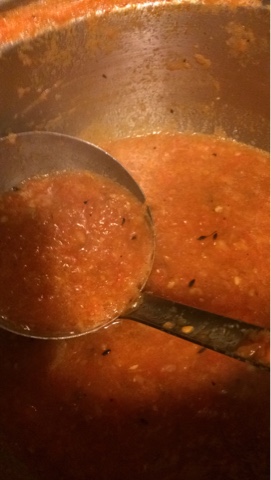
Canning in January! This is salsa ranchera. Recipe as follows: put 6 or 8 pint jars and lids to sterilize in boiling water. On a cast iron griddle or in a cast iron pan (dry), put three to four pounds of tomatoes (whole), two onions, quartered, six cloves of peeled garlic, and as many hot chiles of whatever type you like (split and seeded). You will have to work in batches. Turn vegetables as they blacken slightly in spots. Chiles will release fumes as they toast - remove them as soon as they get little toasty spots and open a window! Onions should be well blackened in spots. Remove all vegetables to blender (again with the batches). 
Heat a tablespoon or so neutral oil in a big sauce pan, and sauté a teaspoon of cumin seed, a few cloves and a few allspice berries. Purée vegetables in batches and add to saucepan (it will spatter at first). Add salt to taste. As soon as sauce simmers, add juice of two or three limes. Then place in sterilized jars and process in boiling water until sealed approximately 10-15 minutes. Use sauce later to simmer eggs, or chicken pieces.

Thursday, May 21, 2015

Making Mole (Happy Birthday)


Tomorrow is Homero's birthday, and we are having a party. Nothing as huge as last year's - no Mariachis, no rented canopies - just a few families coming over to eat some goat barbacoa and drink beers around a fire. Homero will butcher Bambi, our smallest goat, tomorrow and give it to our friend Carlos' wife to cook.

I was surprised and a little hurt when he told me he was having somebody else cook the goat.  I had been poring over my cookbooks looking for some good recipes. However, I consoled myself that I would have plenty of cooking to do with beans, rice, three different salsas, aguas frescas, etc. I guess can I can get over the disappointment of not having to watch a giant stewpot full of goat meat all day long.

Then Homero began to fret that there wouldn't be enough food. I seriously doubt that - Bambi weighs about 85 pounds on the hoof and ought to provide a good twenty to twenty five pounds of muscle meat. Shred that up and it will make a lot of tacos. Homero, though, lives in terror that the food will run out, or that even if it doesn't, it might look like it could possibly run out and he will be nervous. He, like my mom, prefers that when a party is ended there is approximately 80% as much food on the table as there was at the beginning. So I suggested that I could cook a turkey (there's one in the freezer) and make mole.

Homero raised his eyebrow at me. He said "You want to make mole? You've never made mole before."

"I know that," I said, "but I think I can do it."

"Okay," he said skeptically, "but when my mom and sister make mole it takes two days."

"So I'll start today. If it doesn't work out, there will be plenty of time to go buy some."

Just in case anybody doesn't know what mole is, I'll do my best to explain. Mole means "sauce" and so it is.... there are many, many moles, and they vary wildly, but all of them have in common that they are a thick, smooth sauce made from a mixture of chiles, nuts, spices, and fruits. Probably there closest analog of mole in the American culinary lexicon is barbecue sauce - it's complex, savory and highly flavored, and everybody has their own secret recipe. Mole can be yellow, red, black, or even green. But what most people think of when they think of mole is Mole Poblano, the famous dark brown glossy version that contains chocolate.

I looked through my cookbooks. I looked up recipes online. I must have read through a half dozen recipes for mole poblano, and no two of them alike. Some contained tomatoes, others not. Some called for plantain; some for prunes, some for apple or raisins. All called for some kind of nut but in some cases it was peanuts, in others pecans. Other constants were sesame and chocolate, but in differing amounts. I decided I could simply use what I had and add one more variation to the theme.


Here is my recipe - although I will probably never make it exactly the same way twice!

15 guajillo chiles, 10 ancho chiles, and 2 chilpotle chiles. Break open and shake out seeds, reserving seeds. 

Toast chiles on a dry cast iron skillet about 3 minutes, turning. Do not let scorch! Put in a blender and cover with boiling chicken stock. Let soak 1 hour. 

Meanwhile: on same skillet, toast 4 roma tomatoes, one yellow onion (quartered) and 4 cloves garlic until blackened in spots. Get some good char on them. Set aside. Also toast 10 allspice berries, 10 cloves, and a teaspoon cumin seed and set aside. Toast the reserved chile seeds separately, until quite dark, and add to the other spices. 

In another skillet, heat 1/2 c. of lard. Okay, you CAN use vegetable oil, but I don't recommend it. Fry 1/2 c. of raisins, a cut up apple, and a quarter cup apiece of peanuts and pecans. Add three torn-up corn tortillas and a slice of bread. Yes, that's what I said. In the last minute, after everything else is fragrant and fried, add 2 tablespoons sesame seeds and fry another minute. Remove from heat.

When chiles are soft, blend well and then dump the blender into a really big bowl, and add ALL the other ingredients. Also add 3 oz chopped Mexican chocolate (or semi-sweet baking chocolate if you can't find Mexican chocolate) and 1 tsp. cinnamon, 2 tsp salt and 1 tsp black pepper. Mix well. What a mess. 

Working in batches, puree this big mess in the blender. This will work best if you have a heavy duty blender like a vitamin, but if not just keep blending. I blend each batch for a full minute on "ice-crush" and then dump it back in the same big bowl, stir, and scoop up the next batch. That way each batch keeps blending and re-blending some of the same stuff and it gets smoother. 

You will probably have to add a little liquid - use chicken stock. The final texture will be thicker than ketchup but not as thick as peanut butter. 

Now you can store the mole in a jar in the fridge for practically ever. When you want to use some, heat a little oil in a saucepan, add a cup of mole, and thin with hot stock to the consistency of heavy cream. Serve as a sauce for chicken or turkey, or cheese taquitos. VERY rich.

We had enmolados for dinner last night - just heat some corn tortillas and when they are soft, grab with tongs and dip in the mole. Fold onto a plate, and top with crumbled queso fresco. Makes a very satisfying vegetarian (almost) dinner. 

Tuesday, December 23, 2014

Christmas 2014 (Musings and Menus)


Preparations for Christmas this year are just about done. The presents are all bought and wrapped, the tree is lit, the house is decorated and plans are firmly in place for who we are visiting when. I've enjoyed the run-up to Christmas this year. The girls helped me decorate and seemed to enjoy it - I wonder how many years I have left of making snowflakes and decorating cookies with them? We staged a small Christmas piano recital for family and friends, and we went to Vancouver to go see the lights in Stanley Park. 

2014 Christmas Altar

Because we finally sold the property we have been trying for many years to sell, we have a little extra money this year. Which is a good thing, because my husband LOVES to shop for and buy Christmas presents, and often we have some friction around much we ought to spend vs. how much we (ahem: he) actually end up spending. This year I was able to mostly relax around it and let him go to town. 

I can't help, however, contrasting Christmas in the U.S. with Christmas in Oaxaca. Sure, people here go to parties during Christmas season, and many of us go to church, but if we are honest we have to admit that Christmas, for Americans, mostly revolves around buying gifts and exchanging them. That is not the case in Oaxaca, where we have spent more than a couple of Christmases, most recently in 2012.
Christmas 2012 in Abuelita's house


Christmas in Oaxaca begins on December 16th. For the nine days leading up to Christmas, there are Posadas, a celebration, a reenactment of the journey of Mary and Joseph before Christ's birth that moves from house to house and involves pinatas, singing, and food. Although parish-based, Posadas truly are open to everyone, including random tourists who are brave enough to accept a waved invitation. 

Aside from the posadas, there is a nearly endless string of parties and visits. Everyone wants to entertain at Christmastime, and pretty much everyone does. On Christmas eve, the neighborhood Posada finishes its nine-day journey at the local church; there is a big street festival and mass is spoken, and then everyone heads home for a big, late dinner. And then that's it; that's Christmas. Christmas morning is for nursing hangovers and - eventually - cleaning up. Gifts are reserved for Epiphany, on January 6th, and are pretty much just tokens.

In many ways, Christmas in Oaxaca is a lot less stressful, not to mention expensive. The holiday is much more about events - parties, mass, going downtown to look at the decorations, visiting family - and much less about spending money and gifts. Of course, it is still expensive and stressful to entertain visiting family. The average American family might be totally aghast at the thought of hosting three or four different families, sequentially or simultaneously, and feeding them all and being gracious for weeks on end. Or at the thought of throwing six to eight parties during the Christmas season instead of one. Personally I'm thankful to not be hosting any parties at all.

I am, though, doing Christmas eve dinner. Just here at home, and the only invited guest is P., Rowan's ex-boyfriend, who is leaving Christmas day on a greyhound to go back to the mid-west from whence he came. We love P. and will miss him, and are glad to have him with us. So I'm only cooking for six, which is fewer than the number of people  cooked for every single day last year, when P. and the cousins Alehida and Shidezi were living with us. But of course it has to be special.

I asked Homero what he wanted for Christmas eve dinner, and he said "Roast chicken, but not like you make it. I want it like my grandma makes it. And also the noodles she makes. And the potato salad."

If there's one thing I think all us wives can agree we don't like to hear about our cooking, it's that "it's not like Grandma used to make." Especially if Grandma happens to come from an entirely different country with different, unavailable ingredients. At least I have the advantage of having eaten Grandma's Christmas eve roast chicken. It is, indeed, delicious. I think I can come up with a pretty good approximation. Also it is true that Grandma herself showed me how to make her guajillo salsa, which is, as Homero says, "good enough to make you eat the tablecloth where it spilled."


Abuelita's Guajillo Salsa

20 or so guajillo chiles (dried California or New Mexico chiles are good substitutes)
3 cloves garlic
large pinch whole cumin seed
tsp. white vinegar
salt

Heat a large cast iron skillet or griddle. Also heat a kettle of water to boiling. Wipe with an oiled napkin, but do not let any oil remain. Tear open chiles and shake out seeds. Toast, turning often, until they become highly fragrant and begin to emit fumes - about 1 minute. 
Put toasted chiles into a blender canister and cover with boiling water. In the same hot skillet, put the peeled garlic and turn until blackened in spots. Also roast the cumin seed until toasty-scented - about 30 seconds. Add to blender canister, along with vinegar. Allow to sit and soften 1 hour. Blend on high for a few FULL MINUTES, until as smoothly pureed as it will ever be. 
Pour into a small saucepan and simmer to reduce. When finished, the salsa ought to coat the back of a spoon. Serve with roasted chicken and potato salad. 


Sunday, November 17, 2013

Mexican Turkey Broth (What is a Gizzard Anyway?)


At 6:30 this morning Homero and I squelched out through the cold mud and light rain to the chicken coop, to catch sleeping turkeys before they woke up. The processor had asked me to be at his place by 7 am. Homero would grab a turkey right off its perch and take it into the mama barn, tie its feet together with hay twine, and hand it to me. I'd wrap my arms around it to keep the wings from flapping and lay it down on its side on a tarp in the back of the van. Then I'd throw a blanket over the turkey and it would lie there quietly, seemingly resigned to its fate.

As soon as I had four strangely quiscent lumps under the blanket, I drove as quickly as I could out to the processor's facility. We unloaded the turkeys and the man asked me "do you mind if I kill them in front of you? I'm in a hurry."

"Not at all," I said, "do what you gotta do."

He had a neat contraption; a round stand with three metal, upside-down cones attached. The bottom of the cone is open. You dump a turkey in headfirst, so its head sticks out the bottom, and then when you cut its throat, it can't flap around. A twenty five or thirty pound bird can really beat you up with its wings. Even a healthy chicken can be difficult to manage. When I got home, I told Homero to look out for a discarded orange traffic cone; I bet we can use it for chickens here on the farm.

I asked the man to save me the livers and the necks. He said "don't you want the hearts and gizzards?" Actually I did not, but I knew Homero would, so I said, "yeah, save me all of it."

"Come back in an hour."

I spent a very pleasant hour at a local coffee shop with the sunday paper. It might not have been so pleasant for the people around me, however. I didn't have time to change my shoes before I left the house. I was in my barnyard gumboots. I did look for a good deep puddle and waded through it before I went into the coffee shop. Heck, its a rural area. I'm sure I'm not the only fragrant farmer who passes through.

The turkeys were just about exactly the sizes I had estimated - the smallest was fourteen pounds and the largest was twenty. They were beautiful, wrapped up in big clear plastic bags looking just like supermarket turkeys. Then the man's son, a husky twelve or thirteen year old boy who was helping, handed me a gallon sized ziploc bag full of innards. The gizzards were the most disgusting things I've ever seen; big, round, veiny softball-sized lumps of gore. I figured Homero would take one look at them and decide to throw them away.

I was wrong. He took one look and started rooting through the kitchen drawer for our sharpest knife. While I put a big pot of water on for the necks and started chopping vegetables, he carefully cleaned the gizzards, while we had this discussion:

"So what is a gizzard, anyway?" I asked.

"I hate to tell you this, amor, but it's the butt."

"The WHAT?"

"The butt."

"That's not a chicken butt," I said. "I think it's the crop."

"The what?" he asked.

"The crop. Or is it the craw?"

"What's that?"

"You know, the neck pouch where they eat little rocks to chew up their food."

"No," he said, "I've cut it out of too many chickens. It doesn't come from the neck. That's the buche, this is the butt."

In the olden days, we might have had to agree to disagree, but today there's google. According to Wikipedia, arbiter of 9/10th of all marital disagreements, the gizzard is neither the butt nor the crop. It's a secondary stomach, a grinding chamber additional to the crop (or, colloquially, craw). Although it is located in the last third or so of the digestive tract, it is definitively not the butt.

Gizzards are apparently pretty hard to deal with, though. It took Homero a good twenty minutes to split open, wash, and peel the four gizzards. There's a tough membrane that has to be removed. After serious washing, he tossed them into the pot with the necks and vegetables. That broth turned out to be the best broth I've tasted in AGES. We were all swooning over the soup, although only Homero elected to actually eat the gizzards. I don't know if the gizzards added materially to the flavor, or if it would have been just as good with only the necks, but it seems likely they added something.

Here's my recipe for Mexican turkey broth. This stuff will cure you of colds you haven't even caught yet, it's that good. Probably, however, it only has that magic if you have access to pastured turkey.

MEXICAN TURKEY BROTH
and Mexican Rice - makes a whole meal

for a big pot:

4 turkey necks
4 well-cleaned gizzards (optional but recommended)
1 yellow onion, rough chopped
3 cloves garlic
2 carrots, chopped
1 fresh jalapeño chile, chopped
teaspoon whole allspice
10 or so whole cloves
teaspoon whole black peppercorns
tablespoon salt

Put all ingredients into a large stockpot with a gallon of water. Bring to a boil and then turn down to a fast simmer. Skim any scum. Let simmer two hours.

Meanwhile, make Mexican rice - heat a tablespoon canola oil in a large non stick skillet, and put in a cup and a half of long grain wite rice, a diced onion, diced red pepper, two cloves of minced garlic, and a large pinch of cumin. Stir with a wooden spoon until rice is lightly toasted and just beginning to  color. Add 1 can of diced tomatoes and several ladles of the simmering turkey stock. Turn heat down to low and cover tightly. Let steam twenty minutes or so until rice is tender and fluffy.

Set out a plate with the following condiments: quartered limes, diced avocado, minced green onion, cilantro, and more jalapeños. Also set out a bowl of good quality corn chips.

In every bowl, put a scoop of rice, then ladle over the broth. Everybody seasons their soup as they like best. I like mine with everything, including crumbled corn chips. Delicious and warming.

Sunday, January 1, 2012

Mexico Photos (Part Three)

Agave hearts ready to be roasted (on the left) and after roasting in a pit oven on a small-scale mescal producer's farm (right). Agaves take seven to ten years to reach maturity; then it takes some thirty to forty of the hearts to create a single batch of mescal - we were told that a ton of fermented agave hearts results in twenty to thirty liters of mescal. We bought a liter for thirty pesos - or two and a half bucks. I am sipping some of that right now as I write this post.


Evening in Chiapa de Corzo. Homero bought us a carriage ride around the main square. In an old colonial town like Chiapa de Corzo, there are three or four churches within a two block radius of the main square, each decorated for Christmas. This photo was taken out the back of the carriage, which was driven by an old man in his seventies, who gleefully pointed out all the old points of interest. "That was the movie theatre," he said, and "right there was old mercado, before they moved it." His was the only horse drawn carriage in the area, and patronizing him felt like supporting a time gone by.

Nearly every business in Mexico has an altar. Perhaps in the Christmas season the altars are more prominent and elaborate than usual, but I have been visiting Mexico for some ten years now and I have always noticed the altars set up in every establishment, no matter how humble. The altar above was set up in a gas station: an ordinary Pemex station along the highway.

This picture is from our visit to the limestone caves above the city of San Cristobal de las Casas. As far as I can tell, the caves have no name besides "las grutas" which simply means "the caves." The entrance is located within a beautiful park about ten miles outside of town. It costs ten pesos to enter the park and another ten to visit the caves - about two dollars total for an incredible experience.

El Palacio Municipal (city center) lit up for Christmas with lovely magenta light. This building lines one side of the zocalo in San Cristobal de las Casas, providing one fourth of the gaudy, gorgeous pageantry surrounding the main square. Three bands were playing; couples were dancing; old movies were projected on rolled down screens; and of course dozens of artisans strolled hither and yon hawking their wares.

Tule: the largest tree of it's species in the world. The species is Taxodium mucronatum , a kind of cypress. It's trunk is the stoutest in the world. The tree towers over the church built in front of it. It is a lovely and impressive tree. The town is also lovely and impressive - about fifteen miles outside of Oaxaca, a goof place to visit, to eat at the mercado and but artesanias.

Hope and Paloma enjoying a few moments climbing all over the back side of Santo Domingo Church.


Beautiful and strange art installation in the corredor turistica in Oaxaca. Somone, or several someones, placed hundreds of hand built, unique clay people in the courtyard of Santo Domingo, the grandest and most ancient church in Oaxaca. It looked like a pilgrimage of Morlocks.
I absolutely cannot remember which of a hundred beautiful churches this is.

Chapulines. Grasshoppers, in other words. In pre-hispanic times, insects provided a significant portion of the people's protein. Even today, many species of insects are highly prized as food and command high prices. Chapulines are only one of many. Agave worms, Chinches, and Escamoles are only a few of the bugs one might find in a well-stocked mercado. Chapulines are the most available: the common wisdom holds that if one eats chapulines one will always return to Oaxaca.

It has always worked for me so far.

Sunday, December 18, 2011

A Visit to La Mixteca Baja

Oh how annoying it is not to be able to upload photos! Bro, if you read this, please tell me again how to do it on my iphone. Doesn't blogger have an iphone app?


Yesterday we went on a daytrip to a tiny village in the mixteca baja region called San Pedro Nopala. Our good friend Crecencio is from there, as is his wife and cousins. When they heard we were going to Oaxaca this christmas, they asked us to bring gifts for their family. This always hapens, by the way. If you know any Mexicans and you are going anywhere in Mexico, expect to be regaled with backpacks and cellphones, jewelry and cameras and such to deliver to your friend's loved ones.

In our case, we were convinced to bring a backpack full of gifts and an electronic piano, which must have weighed a hundred pounds, in a hard case. The relatives would have sent someone to Oaxaca city to pick up the gifts, but Crecencio was excited for us to see his village and meet his parents. "If you think I can barbecue a g
oat, "he said, "wait until you try my father,s barbecue. No, hombre!"

About an hour north of Oaxaca, we turned off the autopista at Noxchtitlan. We stopped at an incredible ex convent that happened to be ooen at a place I can't remember, but it was pretty incredible. The caretaker there told us it was started in the year 1550 and that 600 men worked for 25 years to complete it. Six hundred poor indians, I thought, but did not say. And though I feel terrible for even thinking such a thing, it occurred to me that through force and torture had emerged a thing of eternal beauty and power. Though surely the means does not justify the end, I couldn,t help but marvel at the finished product.

We only got lost once on the way to the village, which lies some twelve kilometers off the paved road. We stopped and asked an old man resting next to his burro in the fields and he set us straight. As an aside, this particular trip was an eleven donkey trip. Whenever we go on a roadtrip in Mexico we count the donkeys we see by the side of the road. There are fewer now than there were a decade ago. When i first came to Oaxaca, this would surely have been a twenty donkey journey.
e a goat," he said, "Wait untik you have my father's barbecue. No, hombre, no hay nada asi."

Thursday, August 18, 2011

Pajaretas (Goat Milk Cocktail)

Yesterday's goat slaughtering turned into quite a party. It was a gorgeous day but hot, and the men doing the butchering worked up a thirst early on. By the time the two goats were finished (we had originally thought we would process all four but that was just too much work) and one was tucked neatly into a giant kettle steaming away on top of a propane ring, the guys had worked their way through most of a case of Corona.


For myself, I made a pitcher of mojitos - I have a truly splendid patch of mint - and sipped on that while I made red salsa and green salsa, a pasta salad, and the various other accoutrements. My sister and her family showed up for the meal and she helped me out a little with the mojitos. Then our next door neighbors showed up and brought a bottle of whiskey with them.

It sounds like quite the bacchanal, but nobody got too lubricated. There was so much food. We decided to eat outside, and Homero dragged the milking stand over to the fire pit to serve as the sideboard. We simply laid out all the dishes, along with a tall stack of tortillas and some paper plates, lifted the lid off of the kettle, and let everyone make up their own tacos to their specifications. The meat was delicious and tender, falling off the bone. I think I ate six tacos.

Then we laid back in our canvas camping chairs and talked and laughed and drank while the children ran around playing. The hours drifted by. My sister and her family waved goodbye, and sometime later our neighbors walked across the field home. We picked at the food and told stories and threw bones to the dogs. The sun lowered in the west and the mosquitos came out, but nobody cared by that point.

Our friend C. suggested, after we ran out of beer, that rather than drink straight whiskey we try a rustic Mexican cocktail that a friend of his had introduced him to back home in Oaxaca. I have no idea who invented the "pajareta" nor where nor when, but that anonymous Mexican goatherd was a genius. Now I'm warning you, this is going to sound hideous. But trust me, it's actually delicious.

Well, you will just have to trust me, because unless you have an in-milk nanny-goat, you aren't going to be able to try it yourself anyway. C. told me to go get a jar and put a few spoonfuls of chocolate milk mix in it (in Mexico they use "chocomil" or Nestle's quick). I, of course, don't have any chocolate milk mix, but I did have some plain unsweetened powdered cocoa. I used a heaping teaspoon of cocoa and three heaping teaspoons of sugar and brought the jar back. C. added a healthy three shots of whiskey to the jar and swirled it around. Then we brought out the goat and - after clearing the milking stand of the detritus of the meal - milked her straight into the jar. I'd say we aded about a pint of fresh hot goat's milk to the chocolate and whiskey.

Then we divided it up and drank it. It was utterly fantastic ("udderly," ha ha), and no I'm not kidding. Sweet, creamy, frothy, chocolatey, and smooth, with a kick. I know this sounds bizarre, and maybe it is. But it was also the perfect capper for our goat party.

Trust me.

Pajaretas

for three people:

1 heaping teaspoon hershey's unsweetened cocoa powder
3 heaping teaspoons sugar
3 healthy jiggers whiskey
mix in the bottom of a quart jar.
add:
1 pint goat's milk straight from the teat.

pour into three cups and share, preferably around a fire outdoors.

Wednesday, August 17, 2011

Redneck Shopping List

This is how much of a redneck I've become: my shopping list for today? A case of beer, propane, and bullets.


It's goat slaughtering day. Our friend C. is here with his family, and all four baby goats are meeting their end today. One will be cooked up for the taco feast later on, one will go home with C. as his pay, and the other two will go in the freezer.

At this point, we've done this enough times that I no longer feel the need to take a bunch of pictures and post about the process. I've listed some related posts which do have photos and musings if anyone cares to get the details.


Friday, June 17, 2011

Broiler Report (Caldo de Pollo and Liver Pate)

Back in late March, my sister and I decided to go in on a dozen broiler chicks. Homero and I had been trying - unsuccessfully - to eat one of our layers once in a while, and had found them to be inedibly tough, no matter how they were cooked. Long boiling? nope. Marinated in wine, like coq au vin? Huh-uh. Pressure cooker? Not even that. Layer hens are simply not food for humans - the best I could do was freeze the broth and throw the carcasses to the dogs. And even the dogs tended to ignore the rubbery lumps.

We love chicken around here - who doesn't? Chicken is the backbone of the American diet! Mexicans eat chicken like it's going out of style. I am accustomed to roasting a chicken about once a week for dinner, and then using the leftover scraps for either soup or - if there's enough meat leftover - enchiladas, chicken salad, or a casserole of some kind. Chicken is not something we can eliminate from our diet. Yet, I really don't want to eat commercially raised poultry. I won't go into a rant here - I'm sure everyone here already knows about the conditions in factory farming. Just one image ought to suffice:


People who want to know more about the consequences of factory farming on the animal, human, and planetary health are advised to watch Food, inc., or to read The Future of Food, The Omnivore's Dilemma, or any of a number of excellent books on the subject. While I make no pretense that I will entirely avoid commercial chicken (I may order it in a restaurant, for example) I decided that at least I should make provisions for my home cooked birds. With that in mind, my sis and I decided to raise some of our own. The meat chicks available at the local feed store were Cornish Crosses.


This is the same breed as commercially raised meat birds. That is rather troublesome in itself - these birds are bred to grow so quickly that their body weight often outstrips their legs ability to support it, and they break their legs. They are also prone to heart attacks. They must be slaughtered by ten weeks of age to avoid these and other issues. I had my doubts about supporting the breeding of animal so unnatural that it can't survive for anything like a natural lifespan, but I decided that raising my own Cornish Crosses was the lesser evil. My sister and I bought a dozen, with the understanding that I would care for them and she would provide a greater share of the feed (organic.). Then at slaughter time, we'd split them, six for her, six for us.

Slaughter time has come and gone. Sister's six were sent to a slaughterhouse, because she wanted them to be professionally processed. Homero killed and cleaned our six. I can't see any difference, myself. The first application of the chickens was Chicken Liver Pate - as Homero handed the freshly cleaned and plucked chickens in through the kitchen window, I washed them, wrapped them in plastic bags, and threw the livers into a pan of foaming butter. The second application was Mexican Caldo de Pollo. Recipes for both follow.

The report on the quality of the chicken is mixed: Homero is delighted with them. They do indeed yield a rich, golden, chickeny broth with tons of flavor. However, they are still tough compared to supermarket birds. This may be because we slaughtered them a little late - about 11 weeks instead of 8 to 10 - but I think the sad fact is that supermarket chicken is so tender because it spends it's life in a 12 by 12 inch box. Like the tender, succulent, pale meat of veal calves - cruel, unjustifiable, and oh so delicious. However, compared to layer hens, these chickens (which dressed out at about five and a half pounds each) are perfect. They are an excellent compromise between quality and conscience.

Aimee's Liver Pate

6 large chicken livers
1/2 stick butter
1 large sweet yellow onion, such as Walla Walla
one sage leaf
1 pinch rosemary leaves
1 jigger bourbon, or if unavailable sherry, or even white wine.
1/2 bunch parsley
salt and pepper

Melt butter in a skillet. Add chopped onion, raise heat to medium, and stir until onion is wilted, translucent. Add livers and herbs. When livers are firm but still pink inside, add bourbon and raise heat to simmer. When liquid is reduced (5 minutes) pour all contents into a blender canister, add parsley and salt and pepper, and blend until quite smooth. Scrape into a bowl, top off with melted butter and refrigerate. Serve with water crackers and crudites. Unbelievably delicious!

Mexican Caldo de Pollo:

Soup ingredients:
One chicken, cut into serving pieces
1 small onion, chopped
2 jalapenos, chopped
4-6 allspice berries
2-4 cloves
2 carrots, chopped
pinch cumin seed
1 chayote squash, peeled and chopped (optional)

garnishes:
cilantro, minced
jalapeno, minced
avocado, cubed
limes, quartered

hot tortillas

Combine soup ingredients in a kettle and bring to a fast simmer. Cover. Cook one hour or more, until chicken very tender. Salt to taste. Ladle into serving bowls, adding one good piece of chicken to each bowl. Set out garnishes on table in attractive bowls. Serve with plenty of hot corn tortillas. And plain boiled rice.

Wednesday, April 27, 2011

Cheesy Success!


It;s just about suppertime, so I have no time at the moment for a detailed explanation, but I have FINALLY created a reasonable facsimile of Quesillo, also known as Queso Oaxaqueno, a fresh mild string cheese which is wound into balls and used in quesadillas and as a topping for just about anything. Also it is my husband's favorite unavailable food from home, and I have been trying to make it for years now without notable success.

Consistency is the demon that torments all cheesemakers, of course, and one batch of decent quesillo does not guarantee success in future attempts. But nonetheless, I'm thrilled that I've done it once.

Wednesday, January 5, 2011

Farm Folks Are Friendly (Home-style Goat Tacos)

Like most other bloggers, I suspect, I have an online community made up of people who read my blog and leave comments and of those whose blogs I read and comment on. As you can see by the blogroll on my sidebar (oh wow, I'm afraid the internet has not, generally speaking, given rise to poetic turns of phrase), my community is mostly made up of other farmer/homesteader types, both nearby and far away. One of the cooler blogs run by a neighbor of mine is the Schoonover Farm blog. D. and her husband run a great little operation in the Skagit valley focused mostly on fiber. Here is a photo of a few of her animals, healthy and sassy in the dead of winter. I especially like the white guy in the right background caught in the middle of a caprine leap.

D. Schoonover contacted me not so long ago, via the blog, and asked me if I'd be interested in a goat of hers as food. She had a particular wether (castrated male) who was very aggressive and they had decided to put him down. They themselves are not fans of goat meat, but she knew that my family is, and did we want to pick him up and make use of him?

Well, hell, we sure did! She may have been inspired to make this generous offer by my incessant whining about how much food it takes to feed eleven people a day when you are accustomed to feeding only five (my in-laws were in town for an extended visit). I think that my duck-hunting neighbor may also have been moved to donate his kill to us after reading my post on how much money I was spending at Costco (Quack Quack Christmas (Shout Out to Zion)). This same neighbor came by New Year's Eve morning with a gigantic turkey - storebought, not hunted - and said that as he and his wife were going out of town on an extended trip, we'd be doing them a favor by accepting the bird. Doubtful though I was about this claim, I nonetheless took the turkey with alacrity and gratitude. It was delicious.

As was D.'s wether. Early New Year's Day, I sent my husband and his brother and sister down to pick up the goat (who had been swiftly and mercifully dispatched by D.). We called on our trusty goat-butchering-buddy, Crecencio, to come and help us and of course to bring his family and feast with us. Homero did not wait for Crecencio to arrive, but began right away to skin and gut the goat. He said he's witnessed at least four slaughters and ought to be able to do it himself by now.
Once again, as with the roadkill deer (New To Farm Life: The Redneck Rubicon (WARNING - GRAPHIC)), we found that a sturdy swingset makes a mighty fine gallows, and a plastic kiddie pool a very serviceable receptacle for guts and such. I made myself scarce, so I can't say much about how the actual butchering went. By eleven o'clock in the morning, the goat was dismembered and firmly ensconced in a truly enormous kettle, along with various Mexican seasonings, and spent the next four hours steaming gently over a wood fire.

Meanwhile, in the kitchen, I, Mama, Temy, and Crecencio's wife Maricela went to work cooking the accompaniments. Basically we were making tacos, which means that the only truly necessary sides are a couple of different salsas, finely chopped onion and cilantro, and quartered limes. I have been a guest in Maricela's kitchen a few times now, and her salsas are absolutely divine, so I stood aside and let her go to town in my kitchen. However, I watched extremely closely and can now offer a couple of recipes:

Salsa Verde Cruda - Raw Green Sauce

several tomatillos - about eight - husked and rinsed
1 bunch cilantro, stemmed and rinsed
3-5 serranos (if you like it hot) or jalapenos (if you like it hot but a little less so)
1/2 medium yellow onion, skinned and chopped
juice of one fat lime
salt

combine all ingredients in blender and blend until nearly but not quite smooth.

Salsa Roja Cocida - Cooked Red Sauce

1 oz chile de arbol - small dried red chiles (1 package) or more to taste.
1 lb tomatillos, husked and rinsed
2 cloves garlic
pinch cumin seed
salt

In a shallow pot, simmer whole chiles for 15-20 minutes. Then add tomatillos and continue to simmer another 20-30 minutes. Transfer to blender along with other ingredients. Blend until as smooth as it's going to get. Salt to taste. This salsa is extremely hot - watch out!

I also cooked a pot of black beans as a side dish. Add a tall stack of fresh hot corn tortillas and you are good to go! Some people might like sour cream or avocado slices, or some finely grated cotija cheese, but we are purists. Do not, however, neglect a case of icy cold Corona or Pacifico beer.

Happy New Year to all, and a great shout of thanks to the Schoonover Farm Family, who, I can testify, really know how to raise a goat!


Thursday, November 25, 2010

How to Make Real Tamales


Part of yesterday and all of today (so far) was given over to making tamales. From actual scratch. It's something I've always wanted to learn to do, and now my mother-in-law has taught me. Here is how we did it, step by step, start to finish. This pictorial recipe is as detailed as I can make it - I do believe that if you want to make tamales from scratch, this post will show you how. It's not easy, but it is fun if you have lots of help and the tamales are incredibly delicious. This is for real!

I can break the recipe up into three parts: the masa, the filling, and the process. Here we go.

1) The Masa

Buy three kilos of dried Mexican corn - available at Mexican groceries. Hopefully. We had to use "posole" corn, which Senora Maura said wasn't right, but which worked in the absence of the right corn. Also buy at least 1 cup of "cal." Cal is lime, and is a white powder. It looks like baking soda. Be careful with it, as it is actually a mild form of sodium hydroxide and will burn you if you aren't careful. Mix the cal with a quart or so of water. Use a spoon to blend and make a slurry. Set aside. Put 2 gallons of water to boil in a large kettle. When water is hot, add corn. Now take the bowl of cal-slurry and start pouring it slowly into the kettle of corn. Most of the cal will have settled to the bottom - this is good. Pour only the water off the top, do not add the semi-solid slurry from the bottom. That is too strong.

Now comes the first part that calls for judgment - judgment that you will not have if, like me, you have never done this before. Nevermind - resolve to go boldly where you have not been before. Taste the water from the kettle. It should "bite." That means, to my mind, that it is bitter and you can taste the cal, but it should NOT burn. Bring the kettle to a boil and simmer for about one hour. The hulls of the corn will turn yellow and they will rub off with your finger.

Let the kettle sit overnight. In the morning, test the corn. It should be soft enough to pierce with a fingernail, but still very much "al dente." The outside should be butter yellow and the inside chalky white. Rinse some and taste it - now you should barely be able to taste the cal - if it tastes strong, rinse the corn and let sit in fresh water for a while. Rinse and rub off the corn skins. They are very delicate and sometimes barely visible. Don't worry about getting every little bit.

Run the corn through your grinder. I used a meat grinder with the finest disk.
After the first grinding, the masa was still too textured for mama, so we added the other ingredients and ran it through again.


The other ingredients are a) a liter more or less of melted lard - in this case from our own pig. I'm afraid that if you don't have access to lard from a pasture raised pig, your tamales will suffer. The lard you can buy in the store is snow white and almost entirely flavorless. Good lard is golden yellow to light brown and has a rich, porky, unctuous flavor. Add your lard to the ground corn in a large kettle. Also add a biggish pint or so of strong pork broth (this comes from boiling the pork for the filling - see next section), and about 2 tablespoons of salt. Use your clean hands to mix and mash everything together. Run through the grinder again. More judgment is called for here - the masa should be thick and should easily hold it's shape when squeezed. It should not be dry or crumbly. It should be spreadable, like peanut butter. It will feel slightly gritty but not chunky. If you have a very fine disk or a different kind of grinder, you may be able to skip the second grinding.

While the corn is boiling, or whenever it makes sense, make the filling (2) thusly:

put 5-7 pounds pork roast (shoulder, butt, whatever you have that isn't too fatty or boney) into a large pot. Cover with water. Add an onion, roughly chopped, a pinch of cumin, and a few cloves of garlic. Boil at a fast simmer until very tender, about two and a half to three hours. Remove meat from broth. Broth will be used in making the masa. Meat, when cooled, should be shredded more or less finely. Set aside.

Make salsas. We made green and red salsa. Green salsa is made by:
simmering together 1 kilo husked, rinsed tomatillos, 5-10 whole serrano chiles, 2 cloves garlic, and a pinch salt. When tomatillos are quite soft, strain and put everything into a blender. Blend until smooth. Remove to refrigerator until ready to use.

Red salsa: Heat a few quarts water in a large pot. When hot, add 25-40 guajillo chiles and a small handful chiles de arbol (these are dried red chiles, available in most groceries and in Mexican stores. If you don't want it too spicy, omit the chile de arbol). Add two cloves garlic and a pinch salt. Keep hot but not boiling until chiles are soft - about one hour. Remove chiles to blender and blend on high until as smooth as possible. Pour result into a fine mesh sieve over a bowl and use a spoon to force as much paste as possible through the sieve.


Bring red sauce to a simmer and heat until somewhat reduced. It should coat a spoon. Meanwhile, put a few packages of dried corn husks to soften in warm water. When soft, and when all the components are ready (masa, salsas, and meat), bring everything to the table and call all your friends to help out forming the tamales.

The process (3):

You should have laid out in front of you a big crock of masa, a bowl of each kind of salsa, and a plate of shredded pork. You really ought to have, at a minimum, two people. The first person takes one of the corn husks and turns it smooth side up (it will curl upwards like a boat). Use a spoon to put a blob of masa on the husk - the size of the blob depends on the size of the husk. Use the edge of the spoon to spread the masa out in a thin layer, leaving a space at the thin end.

Now put a blob of salsa on the husk, and a little bit of shredded meat. Fold the husk in thirds - each side over the middle and the tip folded up. Place the folded tamal in a kettle fitted with a steamer basket. Put it in standing up with the folded side down and facing out toward the edge of the kettle (this is so that as you go along you don't accidentally start putting tamales inside of each other and opening up the husks.). When all the tamales are in the basket, remove the basket and put three or four quarts of water in the kettle. Bring to a boil. Then replace the steamer basket and cover tightly. Steam tamales for about two hours.


After a couple of hours, open up a tamale and check it (well, okay, a couple of times during the steaming you should make sure you aren't running out of water and add a little if needed.). The masa should be firm and kind of "sproingy" to the touch. It should not stick to your fingers.
Call everyone to the table and open a whole bunch of cold beers. Eat until you feel just the tiniest bit sick and wholly satisfied. Turn on a movie and relax on the couch with another beer.

My notes

The table after assembling the tamales. I put down a sheet to protect everything from salsa and hot lard. Good plan.