"United we bargain, divided we beg."
Showing posts with label bees. Show all posts

Friday, April 22, 2016

Bees and Heat


The last few days have been uncharacteristically hot, to say the least. Records were broken. In fact, records were obliterated - the previous daily high for one recent day was 77, back in the eighties; this 
time, we hit 88. And we had four or five days in a row over 80 degrees - totally unheard of for April. 

Also unheard of - the fields near me are being cut for hay. In April. I remember just a year ago or so seeing the same fields being cut in May and thinking, holy shit, that's early! If this trend continues, we will be cutting hay year round pretty soon, anytime the fields are dry enough to support a tractor. 

Another unsettling thing - despite the hot weather, I had seen nary a bee this year. A few bumblebees here and there, and as usual a ton of wasps, but no honeybees. A beekeeper friend of mine told me that her bees were so busy she was already putting honey supers on top of the hives, something she usually does in late June or early July. She thought it was probably from a lack of competition. I told her that other beekeeper friends of mine had lost most of their hives last winter - apparently the mites were just terrible last year. 

I wonder if our warm winters don't have something to do with the bee die-off. Perhaps if the temperatures are high enough, they don't really go into full hibernation and eat more of their stores? Perhaps the mites like the warm winters? Perhaps when fruit trees and other plants don't go into hard dormancy, they produce less or poorer quality nectar the following spring? In any case, I am worried about our fruit harvest this year, because there were seriously no bees around. 

Until the day before yesterday, that is. I was washing dishes at the kitchen sink, and looked out the window to see a vast cloud of big insects flying right outside. At first I thought they were flies and was grossed out; but I quickly realized they must be honeybees swarming. 

I ran outside to see where they were going. For a few minutes they kind of wandered back and forth across the front yard - a loose cumulous cloud of glittering bees, concentrated at the center and ragged around the edges. Then they veered toward the highway. 

"No! Don't cross the highway!" I thought. "Stay here!"

Finally, they settled into a blackberry bush, almost down on the grass, about two feet from the ditch along the edge of the highway. I didn't know how long they would stay there, but I know about five people who would be totally psyched if I called them to come collect the bees. There's and old saying: "a swarm of bees in May is worth a load of hay. A swarm of bees in June is worth a silver spoon." I don't know what a swarm of bees in April is worth, but I'm thinking it's worth at least a quart of honey this fall. I put the word out, and sat down in the shade to keep an eye on the swarm. 

A neighbor of our called me back, and said they would be over in a half hour with a box to get the bees. He told me not to worry, they wouldn't go anywhere for a while. The queen was resting from her maiden flight. He also told me not to worry about getting stung - without a hive to protect honeybees are very docile. 

"You could stick your hand right through that ball of bees and not get stung." 

I believed him, but could see no need to put it to the test. 


My neighbor put on a mask, but was working in shorts and without gloves, and it the bees gave him no hassles. The way to collect a swarm is to bring an appropriate vessel, place it under the swarm, and give a sharp tap to the branch they are hanging on. All the bees will fall right into the box. In this case, he couldn't put the box under the bees, because they were practically on the ground. He set the box to one side, and carefully clipped the blackberry bush until he could grasp the one cane that supported the swarm. Then he cut that cane, picked up the swarm, and tapped it against the edge of the box. About two thirds of the bees fell right into the box. 


Since the queen is inside the ball, it's most likely that she fell into the box, too, but we had to wait to be sure. My neighbor put the lid on there hive, leaving a crack, and then we waited. If the queen were outside the box, the bees on the inside would soon figure that out and start coming out. If the queen were on the inside, the bees that were still outside the box - a few thousand - would begin to settle on the box and go inside. 

After a few minutes, my neighbor pointed out a line of bees standing on the rim of the box, pointing their rear-ends up in the air and waggling them. 

"She's in there," he said. "Those bees are wafting out pheromone to tell everybody to come on in." 

By this time, it was close to sunset. My neighbor said he had to go pick up his kids from sports practice, but he'd be back later to get the bees. They needed plenty of time to get all of them inside and to decided definitively that this was their new home. 

And that's what happened. I hope this turns out to be a good strong queen and that they make a good strong hive. Homero wants to try having bees again as soon as possible - in fact he was annoyed with me for calling any body at all, and wanted to try to get them himself. But we don't have any equipment anymore. We can start getting some stuff together and when and if we see another swarm this year, we'll be ready. If we don't see one - as seems likely; this was the first swarm I've ever seen - we will at least be ready to start next year with a bought colony. 


Monday, April 21, 2014

What's Wrong With These Pictures?


The pear tree is in full bloom. The sun is out and the temperature is near sixty degrees. This tree ought to be crawling with bees, but I haven't seen a single one. I haven't spotted one - not one! - honeybee yet this year. I've seen yellow jackets, and one lonely bumblebee, but not a single honeybee. 


No bees on the dandelions. 


No bees in the rhododendrons. Usually, these flowers are favorites of bumblebees, with a fair number of honeybees as well. Nothing so far. Nothing. 

It's scary. Colony Collapse Syndrome  has been around since at least 2005, and despite intense research, there is of yet no consensus on a cause. Most likely, it is due to a combination of factors including pesticides (especially nicotinoids, which has been banned in Europe for this reason), parasites, viruses, and possibly GMO pollen. 

This year, we also had an unusually harsh winter and a very late, cold spring. It's possible that many local hives simply didn't make it through. My friends who keep bees say their hives are active, so I know that most bees ought to have "woken up" by now. I wonder what the orchard fruit crop will be like this year with no pollinators out during maximum bloom time. I wonder about the garden. 

We used to keep bees, but when they died in a winter storm (Bad Bee News; Baby Broilers) we didn't replace them. The equipment and medicine is expensive, there is a fair amount of regular maintenance and work to be done which nobody was really excited about, and as it turns out I have a pretty intense allergy to stings. One sting will make an entire limb swell up and itch horrifically for three or four days. 

We may try again with bees, someday. We may have to. There may come a day when if we don't keep bees we just don't get fruit and vegetables. I hope not. I hate to think about a world without feral bees, but it may be just around the corner. Already, in case you didn't know, the nation's berry, orchard fruit, and nut crops, as well as many other crops (full list here) are dependent on managed commercial hives, trucked all over the country by a shrinking number of professional beekeepers. 
Without those beekeepers - who are routinely sustaining losses of half their hives every year, year after year - we will be a poorer and hungrier nation. 


Monday, March 21, 2011

Bad Bee News; Baby Broilers


About a month ago, we had a windstorm. That's not news; we have windstorms every couple of weeks from October on every winter. We live on a high, exposed ridge and seventy mile an hour winds are nothing exceptional in the fall, winter and early spring - usually accompanied by stinging rain or hail. Sometimes I wish I had paid more attention to the man who inspected our house before purchase. He grew up just down the road and told us "you get a lot of weather up on this ridge." I guess he thought he was warning us, but the man had a gift for understatement.

Apparently it's the kind of thing you just can't understand without experiencing it. I remember thinking "Sure, sure, a lot of weather. Whatever THAT means." I didn't really try to puzzle it out. After all, I grew up around here myself, and I'm no stranger to rain. Turns out, I was blissfully ignorant of what a local boy means by "a lot of weather." It means having to literally propel yourself against the wind by main force, unable to hear a thing except for the shrieking and howling of the moving air. It means cold rain driving itself into your actual eardrums at fifty miles an hour, giving you earaches. It means that you can't carry a bucket of water ten feet without getting soaked. By the time you reach your destination, the wind will have removed the top half of the water from the bucket, and it will have landed on you, anywhere from the chest down. If this happens in the dead of winter, your pants will be frozen solid against your legs by the time you reach the house. It means laying awake at night listening to the banshee wail of the wind around the corners of the house and wondering when the power will go out; or if you are losing roof shingles; or how the animals are coping.

This year, it meant losing a baby goat to hypothermia. Not this year but two years ago, we had such a prolonged stretch of extreme weather that I had to sit the children down and talk to them about what to do if they had to come outside and find us while we were attending to the animals. Do NOT leave the house, I said, without putting on your coat, your boots, your hat, and your mittens. Come STRAIGHT out to the barn and go inside right away. If you ever get stuck outside and you can't get in the house, go STRAIGHT to the barn and close the door. Once, coming back from chores, I found Paloma, then three years old, stumbling around outside in the driving snow trying to come find me. She was crying and very cold. That episode terrified me. I realized that you don't need to live above the arctic circle for your children to die of exposure. Really, any old freezing weather will do, especially when combined with precipitation. A three year old might suffer severe hypothermia in as little as half an hour.

All of this is by way of preamble: our bees dies over the winter. Both hives. In the windstorm that I mentioned, one of the many, the tops blew off of both hives. In spite of the "bee glue" - propolis - that the bees use to seal the hive. In spite of the cement blocks that we placed on top of the hive lids. The storm blew the lids off, and I went out to find that the interior of the hive was exposed to the cold rain. At the time, I knew the bees were still alive because I could hear them humming, trying desperately to dry out the interior of their home by fanning their wings. I replaced the lids, not knowing what else to do. The bees died. I didn't know for sure they were dead until this past week, when I cooked up a strong sugar syrup for the feeders. After three days, the syrup was untouched. There is only one explanation for that, and it's a hive full of dead bees.

Of course I haven't opened the hives; I won't do that until we get a really warm day. That looks like it might be mid-June, at this rate. But I fully expect, when I do open them, to find a lot of dead, decomposed, wet bee-bodies. I am not going to try again with bees. My husband and my teenage daughter both expressed enthusiasm for beekeeping, and then they both did exactly nothing to help. Personally, I am not excited by beekeeping and never was - I like honey, but I'm scared of bees. I got the equipment because I felt like bees are part of a self-sufficient homestead and I thought I had family members willing to take on the duties. Oh well. Maybe we can salvage some honey and then sell the equipment.

Meanwhile, we have decided to try meat chickens. Homero has always felt that chickens are meant to be eaten, and we have been sadly disappointed by our attempts to turn our birds into something worth eating. Look at the sidebar for links to chickens, meat eating for a log of our past attempts. I told him, finally, that we just didn't have the right kind of birds - our skinny little chickens were great at pumping out eggs but really not worth the twenty minutes it takes to dress them out when it comes to meat. So, this year, we decided to give meat birds a try.

IN GENERAL, I am philosophically opposed to the whole idea of breeding an animal that can't even live to maturity because it gets so heavy that it's legs will break trying to hold it up. However, I have to face the fact that if I am to eat chicken at all, I will either have to eat our skinny, hard-as-nails birds (something we have already decided is damn-near impossible); eat supermarket chickens, which are the same meat birds raised in factory-farm conditions, or eat meat birds that we raise ourselves in humane conditions. From a purely philosophical point of view, raising our own meat birds looks like the lesser evil. It may or may not turn pout to be practical - we'll see.

Thursday, July 29, 2010

Hopeful About Honey (When to Invest?)


The other day, Rowan and I put the honey-supers on the hives. Honey supers are just like regular beehive boxes, but shorter, so that when they are full of honey they will only weigh about forty pounds instead of eighty or a hundred pounds.

I didn't have enough of the smaller frames to go in the supers, so I put an ad on Craigslist and quickly found someone willing to lend me some in exchange for half my harvest from those frames. If any, of course - harvesting honey is just a dream at the moment, I don't know whether or not there will actually be any.

I intended to open the hives all up and check for queens, but I didn't. We just pried the tops off, took a quick look at tens of thousands of buzzing bees, and quickly slapped on the queen excluders (grills that keep the queens from entering the honey supers but do allow in the worker bees) and then the honey boxes and replaced the lids. I had added the second brood boxes right before we left for Mexico, so three weeks ago they were pretty much empty. Now it is clear that they are stuffed full of bees.

That means I MUST have queens, and they MUST have been laying their little butts off. I know that sooner or later I will have to take the hives apart and check all the frames and find the queens and look for signs of mites and illness... etc etc etc. But I'm not over-eager. For now, it's good enough for me to peek in and go "holy crap, what a lot of bees!"

I am looking forward to honey. There are issues; there always are. Beekeeping, like many other aspects of farming, can be made much easier if you have the right equipment. Extracting honey is pretty easy if you have a honey extractor, and a big fat pain in the butt if you don't. The thing is, a honey extractor (even a small, "hobby" model) is quite expensive - too expensive to be worth it if you only have a couple of hives, like me.

I have noticed the same thing over and over again in many aspects of farming - sure would be nice to have a drum carder, for example, to deal with the alpaca fleece, but a drum carder costs $400. The fleece is only worth about $150.
I'd like a cheese press and molds, too, but the same ratio applies.

I think it makes sense to wait a few years at least, to see if a given hobby lasts before investing in the equipment. The alpacas, for example, are long gone. If I had bought a drum carder it would be sitting in a closet. The cheese press, on the other hand, I think would be a good investment still.

Then there's the DIY option: I've seen plans on the internet for a passive-solar powered honey extractor. It involves heavy cardboard, black paint, and fine metal screens. I'll probably try that. My DIY cheese press is a tall stack of my biggest books, and it works pretty well, although it does occasionally fall over in the middle of the night and wake me up.

Tuesday, June 8, 2010

NOT Better the Second Day

Okay, so apparently I have a delayed reaction to bee-stings. It doesn't hurt but my wrist is swollen up like an inner tube and ITCHES constantly, and badly enough to drive me right out of my tiny little mind.


Thank God for Benadryl. G'night.

Monday, June 7, 2010

Bee Man to the Rescue!

a marked queen bee

Today my bee mentor came over to help me figure out what was going on with my hives. I inspected them a few days ago and thought that I had lost both queens. I didn't see any eggs in either hive, nor could I find the queen.

Turns out, eggs and queens are just really hard to see. Both of my hives have queens - hive number two is still going strong with the queen I originally purchased, while hive number one has managed to produce a replacement queen who survived her maiden flight and is now producing eggs. That is actually quite a feat considering the weather - today is nice, but for weeks it has been unseasonably cold and wet. Bee Man told me he has lost all the queens he managed to breed this year (he is trying to breed them for sale).

What a relief! I was terribly worried. If I had not had any queens, I would have had difficulty finding new ones. No-one has them for sale locally and those available by mail are not only very expensive but this year have been remarkably unreliable. I might have simply lost my hives and the investment they represent (kind of a lot).

Bee Man caught and marked the new queen for me. That isn't her in the picture - that's a picture off the web. But mine looks just the same, except her spot is green. Hopefully I will be able to find her myself next time. Also next time I will know how to look for eggs - they are very very tiny, much smaller than a grain of rice, and sit on the bottom of the cells. They are completely invisible unless you tilt the frame back and forth until the bright sunlight hits them just right. Then they glow a beautiful pearly white.

The bees have not drawn out a lot of new comb, though, which isn't surprising considering the weather. However, now that the clover and the blackberry blossoms have arrived, they will go into high gear. Bee Man suggests I have second boxes ready within a week or two. Then, in late July after we get back from Mexico, I can add honey supers!!! I may actually harvest a little bit of honey this year!!

Oh I'm so excited. I love bees. I don't even care that I got stung again. It was through my shirt, so I barely felt it.

Friday, June 4, 2010

Good News, Bad News


Whaddaya want first?

Whenever I am asked that question, I always ask for the bad news first. But I can't make that option make narrative sense, so here comes the good news first:

Yesterday was an absolutely glorious day. The sun finally decided to shine, and it shone brightly and warmly. I think the mercury hit 67 or 68. I could not spend a single minute indoors, my skin was so hungry for sunlight. I stripped to a T-shirt and worked just about all day long in the garden. There was a brisk wind, and large, threatening clouds marched across the bright blue sky. When they occasionally blocked out the sun, the temperature would drop immediately, but as long as I kept working I felt warm enough.

The first thing I did was clear out the greens from several planters. The lettuce was beginning to get bitter and the spinach was starting to go to seed. I picked a giant colander full of salad greens to eat, and gained fresh space to plant. In the sun room, I had a few tomato plants and a few winter squash starts (a variety called "sweet buttercup" that I am not familiar with but am hoping is something like hubbard. These were transplanted into the recently vacated tires.


A couple of weeks ago, on the last sunny day we enjoyed, I dragged one of the garden boxes out beyond the fence that protects the orchard from goats and used my fancy mother's day wheelbarrow to fill it with used straw from the barn. The idea was to let it compost a little and then cover it with topsoil and viola! A new garden bed. I simply laid the square down on the lawn and covered the inside space with empty feed-sacks (they ARE good for something!) before carting several loads of crappy wet straw over. Ooh, my back hurt that night!

When my husband cleaned out the parthenon (Nasty Weather and Unfinished Business), he found a jar of scarlet runner bean seeds. A big jar. I have no idea where it came from. Instead of bringing it into the house, as a normal person might do, he decided to simply empty the jar onto my new garden bed, right on top of the straw. Then, it rained for two weeks.

Well, you can guess, right? Now we have a veritable carpet of bean sprouts all over my garden bed. I'm going to make him build a trellis. I had been going to plant corn in that bed - now I don't know where I might plant corn. It's getting late - if I am going to plant any corn, it should be done this week.

Let's see - more good news.... We got a lot of grass cut. But that leads me into the bad news because I ran over one of the new apple trees. Earlier this spring I planted six trees from Trees of Antiquity, four apples, a greengage plum, and a cherry. All six were doing just fine. Until yesterday, when I misjudged the distance between my blades and the Ashmead's Kernel and severed it completely from its stem. I felt like a murderer. It was perhaps the healthiest and most vigorous of all six trees, and I simply ran right over it like a full-blown idiot. Ah well, what are you gonna do? I never claimed to be a good driver.

The other bad news is about the bees. Two weeks ago or so, I opened the hives and discovered that one of them had apparently lost its queen. They were making queen cells. Consultation with my beekeeping mentor (The Bee-Man Speaks) yielded the plan to check the hives again in two weeks to make sure that one of the new queens had survived her maiden flight and begun laying eggs.

Well, I opened the hives yesterday. I am still a fairly hesitant beekeeper and I am not confident in my ability to correctly observe what is happening inside a hive, but I can be fairly sure that there is still no queen in that hive. I did not see any brood at all. There is plenty of nectar, and some capped cells, but no eggs or larvae.

That's not even the worst. The SECOND hive, the one that looked perfectly healthy last time, also appears to have lost it's queen. I did see some capped brood and some well-developed larvae, but no eggs or tiny larvae. I couldn't find the queen nor could I find any sign that she had recently been active. Nor did I see any queen cells.

This SUCKS! My plan had been, if there were no queen in hive one, to combine the hives by laying a a few layers of wet newspaper on top of hive two and then putting hive one on top. By the time the bees chew through the newspaper, they will have chemically melded and won't try to kill each other. But that plan only works if one of the hives still has a viable queen. With two hives but no queen, I haven't a clue what to do.

Well, I do have one idea. Call my bee-mentor and beg and plead for him to help me. I am not even sure of what I saw - I don't want to make things worse by buying and installing a new queen if there is in fact still a queen there. But on the other hand, I don't know how long a hive can survive without a queen. Maybe they will all die or fly away unless I get on the ball. In short, I need a second opinion, and I need one quick. Maybe I can bribe the man with goat cheese.

God knows, I have plenty of that.

Monday, May 17, 2010

State of the Season, 49th parallel, 2010

This was such a strange year, what with the warm winter and the bizarrely early spring, that I decided to begin keeping track of the timing of the change of the seasons here on the farm. (It's Called "Phenology!") It seemed to me that a years-long record of the dates of the first and last frost, the timing of fruit tree blooms, and the leafing out of the trees is the sort of thing that might be useful to future farmers of this little plot of land (my kids and grandkids, if I am lucky.)

My sister, when she bought her house, inherited from the former owners - who were avid gardeners - a detailed garden journal spanning some fifteen years. Besides it obvious practical value, it also happens to be a beautiful work of art. Well, I'm not going to create anything like that. I'm not much of a gardener, truth to tell, but I am a fairly keen observer of the small slice of the natural world here on my doorstep.

Even in such a short span of time, it has become rather clear that I am not such a great recorder of all the little details, but I hope to compensate with a nice photographic record. With commentary.
The pink dogwood tree in maximum bloom. This was taken yesterday. Such a pretty tree. What more is there to say? Oh yes - if you want to plant one and have goats, be aware that dogwood is like crack cocaine for goats. They will jump fences, crawl under fences, and sell their hairy little souls to eat dogwood.

On a walk today I saw these California poppies in bloom. I usually associate these with mid-summer. Other flowers which are blooming now but which in my head are associated with July are Oxeye daisies, lupine, and Scotch broom.

Looks like we might get some cherries this year! These are Rainiers, and the tree was planted three years ago. This will be (knock wood) the first crop.


The very very first red clover bloom on the property, as far as I can tell. I am eagerly anticipating the clovers because it means I can stop feeding the bees. Right now, even though the weather is gorgeous, there just isn't a lot ion bloom for the bees. The trees are done and the dandelions are done, but clover and blackberries haven't started yet.

It's funny, on a side note, to see which pollinators like which kinds of flowers. One thing which is blooming now, strongly, is my rhododendrons and azaleas. I don't actually like rhodies and azaleas much, and I have considered tearing them out for garden space, but I can't do that when I see how they are always thickly covered with native mason bees. The mason bees just adore the rhodies! The whole bush just hums the whole time it is in bloom. Yellow jackets like them too, and apparently even paper wasps like them - but not honeybees. I've spent quite some time watching, and I've never seen a honeybee on a rhododendron.

Weird.


Saturday, May 15, 2010

The Bee-Man Speaks

My beekeeping mentor called me after my frantic e-mail asking what I should do about the missing queen and the developing queen cells in my hive #1. It wasn't what I thought. He said I should wait - if they are making queen cells, then yes, my queen is dead or gone. Soon, though, one of the queen cells will hatch and that queen will go around and kill all the other developing queens. Then she will take her "maiden flight."


Before an old queen dies, or departs to start another hive, she lays an egg in a large queen cell. The nurse bees feed the larva a diet of only royal jelley, or bee's milk, made from a gland on their heads. In only 16 days a new queen emerges. She seeks out and destroys any rival queens, because there can be only one queen per colony.
Queen bee


When
10 days old, a new queen takes a high maiden flight, pursued by drones from nearby hives. In about 13 minutes, she mates with 7 or more of them, storing their sperm for the rest of her life of 2 years.

She produces chemical scents which regulate hive activity.


If my new queen successfully mates and returns to the hive, then there shouldn't be a problem and my hive will go on as before. But apparently, many queens don't make it back from their maiden flight. If that should happen, then I will need to either a) buy a new queen for $20, or b) combine my hives. Hives are combined by laying a couple layers of dampened newspaper on the top of one hive and then putting the second hive on top. By the time they chew through the newspaper they will have gotten used to each other's smell and chemically become one hive.

I hope I don't have to do that, though. I hope my new queen lives!

Friday, May 14, 2010

Opening the Hives Again (Long Live the Queen).


We've had a short stretch of beautiful weather these last few days. Today it is actually rather uncomfortably hot - well, uncomfortably hot if you are turning the compost pile and moving wheelbarrows full of dirt around, as I have been doing all day. But the last few days have been the absolute definition of gorgeous, as far as I'm concerned - sunny, light breeze, temperature somewhere around 68 degrees Fahrenheit.

Perfect weather for opening up the beehives. I've been putting it off. Truth to tell, I was a bit nervous since I got stung (A Bee Bit my Butt). But there's no getting around it - it was time to open them and see how the hives are doing. I needed in particular to know if I still have queens. So Rowan and I suited up and went out to the hives about three o'clock yesterday. Homero, saying he is "muy macho," asserted that he needed no gloves or hat or anything else. When I questioned his judgement, he simply unbuttoned his shirt and said he would go out barechested. I decided to shut up before he took off his pants.

With Homero manning both the smoker and the camera, we opened up one hive. As you can see in the picture above, there is quite a bit of capped comb, but I don't know what is inside. When we observed my neighbor open his hives, he pointed out the capped brood and you could see the eggs or larva inside. Here, I couldn't. In this first hive, we didn't see any eggs or larva anywhere, and we DID see several "supercells." Supercells are those peanut shaped protuberances at lower left in the picture below. These are queen cells - it most likely means that the queen of this hive has died or flown away. I think I am supposed to cut away these supercells before the queen emerges to avoid a swarm, and buy a new queen. I'm going to call my bee-mentor and ask him what I should do.

The second hive looked much better. We saw both large larva ready to emerge and fresh new eggs. I don't have much doubt that the second hive has a healthy egg-laying queen. However, I was a little bit disappointed at the lack of new comb.

Each of my hives has nine frames in it, and four or five of those were nice, drawn out comb before I ever put any bees in. I was hoping to find that the boxes now had seven or eight frames full of comb and I could put on a second box. That's not what I found. It actually appears that the bees have been busy laying eggs, collecting nectar and pollen and capping the comb already in there, but not doing anything much about drawing out new comb.

That's probably my fault. At the monthly meeting of the Mt Baker Beekeeper's association last week, I learned that this time of year there is actually a dearth of nectar flow. The maple trees and the dandelions are about over, but the clover and the blackberries haven't bloomed yet. I thought I could quit feeding my bees sugar syrup once the weather warmed up, but not so. They need syrup until the blackberries come into bloom early next month. Apparently, you have to add a second box and let the colony really build up its numbers before you can add a honey super. And the first honey super is for the bees to survive the winter. The second honey super is for you - and most colonies don't get there the first year.

So, even though it's kind of expensive to keep feeding the colonies a quart of sugar syrup each
every other day or so, I just need to keep in mind that a quart of sugar syrup costs about $0.25, and a quart of honey is worth about $10.00.


Wednesday, April 28, 2010

Opening the Hives

Sooner or later, I knew I would have to open the hives again. The last time I opened them, a few days ago, it was to remove the bee-boxes and replace the frames. I did it, despite my abject fear, but not without injury (A Bee Bit my Butt). I was rather reluctant to hurry up and open the hives again. However, I needed to know if the queens had managed to escape from their boxes, plugged as they were not with marshmallows (as recommended) but with bread dipped in simple syrup. If the queens had died in their boxes, well, not only would that be horrible and make me feel really, really guilty, but also my hive would die without a queen to lay eggs.


So, it being an absolutely glorious day, I girded up my loins (and put on some pants this time) and went out to the hives. Once again, I decided not to smoke them but just to spray them with sugar syrup. Above, you can see me in full beekeeper regalia, wielding my spray bottle as I peek under the lid of hive number two.

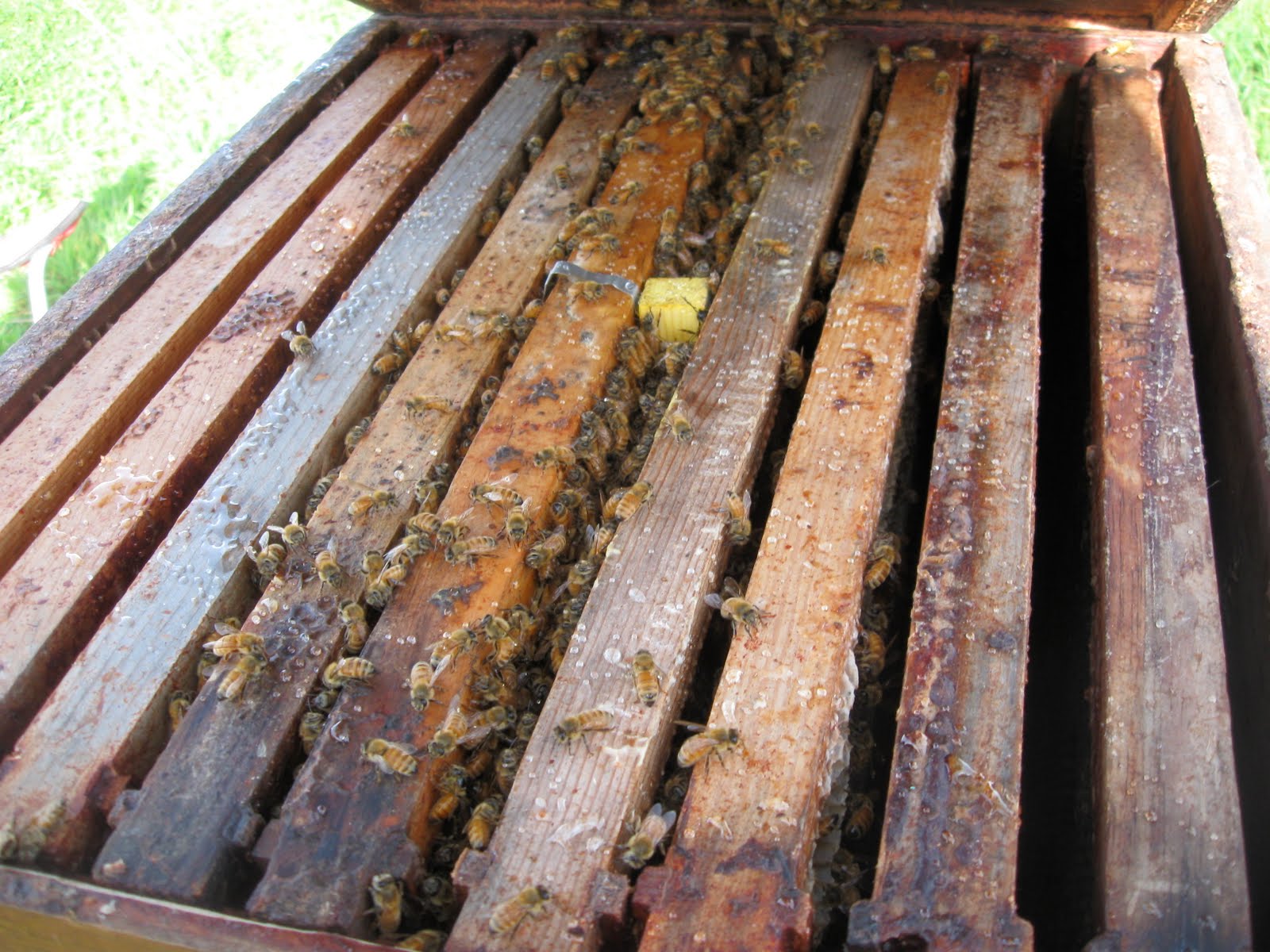
Here is what it looks like under the lid of a beehive. As you can see, most of the bees are clustered in the middle around that bright yellow square - the queen cage. If you look closely you can see a silver strip to the left of the cage - that's an aluminum tag to grab it by. In my big fuzzy gloves, I couldn't grab it, so I had to take off my gloves and reach in barehanded. Very slowly, I pulled the cage out, being careful not to hurt any bees.

About thirty or forty bees adhered to the cage, as did a long strip of burr comb. Burr comb is comb that is not neatly laid out in straight sheets in the frames, but rather is built up willy-nilly wherever there is a vacancy. Beekeepers don't like burr comb. I'm not totally sure why, except that it makes it hard to see what's going on.

Again, if you look carefully at the picture of the inside of the hive, you will see that the frames are not put in totally straight. They are a little crooked. That's because I was starting to freak out last time I opened the hives and put them in, as the bees got angrier and angrier and began to dive-bomb me and crawl up my skirt. I kind of just shoved the frames in and fled. Today, I saw that my cowardice and haste has allowed the bees to start building up a lot of burr-comb. That's bad, though once again I have to go read the book to remember exactly why.

The queen cages were both empty. That's good; the queens were able to eat their way through the sugar-soaked bread and escape. Now I was worried that I might have pulled the queen out of the hive as one of the bees attached to the cages. I carefully examined all the bees, looking for one that was a bit larger, longer, and with a spot on her back (marked by the beekeeper, not by nature). I couldn't find the queen.

Theoretically, I should have pulled out the frames one by one and examined them for brood (eggs in the newly formed comb) and searched thoroughly for the queen. In fact, I once again chickened out when the bees began to get aggressive. They will only stand for so much tampering before they decide they are under attack and begin defensive maneuvers (stinging).

For now, I'm going to assume that my queens are alive. Maybe within the next couple of weeks I can get my beekeeping mentor out here to help me do a real inspection.


Friday, April 23, 2010

A Bee Bit my Butt

Bees don't bite, of course, they sting. I just couldn't resist the alliteration.


My beekeeping mentor gave me some advice today about my hiving problems. He doesn't think the bread plugs will be a problem, but I should check in 5 or 6 days and make sure the queen cages are empty, and release the queens if not. However, he said putting the boxes inside the hives was a mistake, and I should remove them right away before they start building burr-comb all over them. Don't smoke the bees, he said, just spray them with sugar syrup.

So I put on my gloves and my bee-hat and went outside armed with a spray bottle full of syrup. On the way out to the hives Homero saw me and said "Aren't you going to put on some pants?"

No, I wasn't stark naked beneath my bee hat. I had a floor-length skirt on. "No," I said, "I'll be fine." The bees have been very docile and calm. I figured I'd just spray everybody down good and then work quick.

It almost worked. I lifted the lids of the hives and sprayed the bees down, then lowered the lids and let them eat for a few minutes. Then I lifted the lids again and slowly, carefully grasped the boxes and lifted them out. The boxes were totally covered in bees. My guess is that about one third of each colony was on or inside of the boxes rather than in the frames of the hives.

Hmmm. If I had done it right the first time, I would have removed the syrup can, turned the box upside down, and sharply rapped it on the top of the empty hive and most of the bees would have fallen out of the box and into the hive. Replace lid, and bingo, you're done. The few stragglers still attached to the box would find their own way into the hive.

But now, rapping the box sharply on the open hive would be a recipe for disaster. Picture: Cloud of angry bees erupting like Mount Vesuvius into my face and then swarming away into the trees. How to get the bees into the hive?

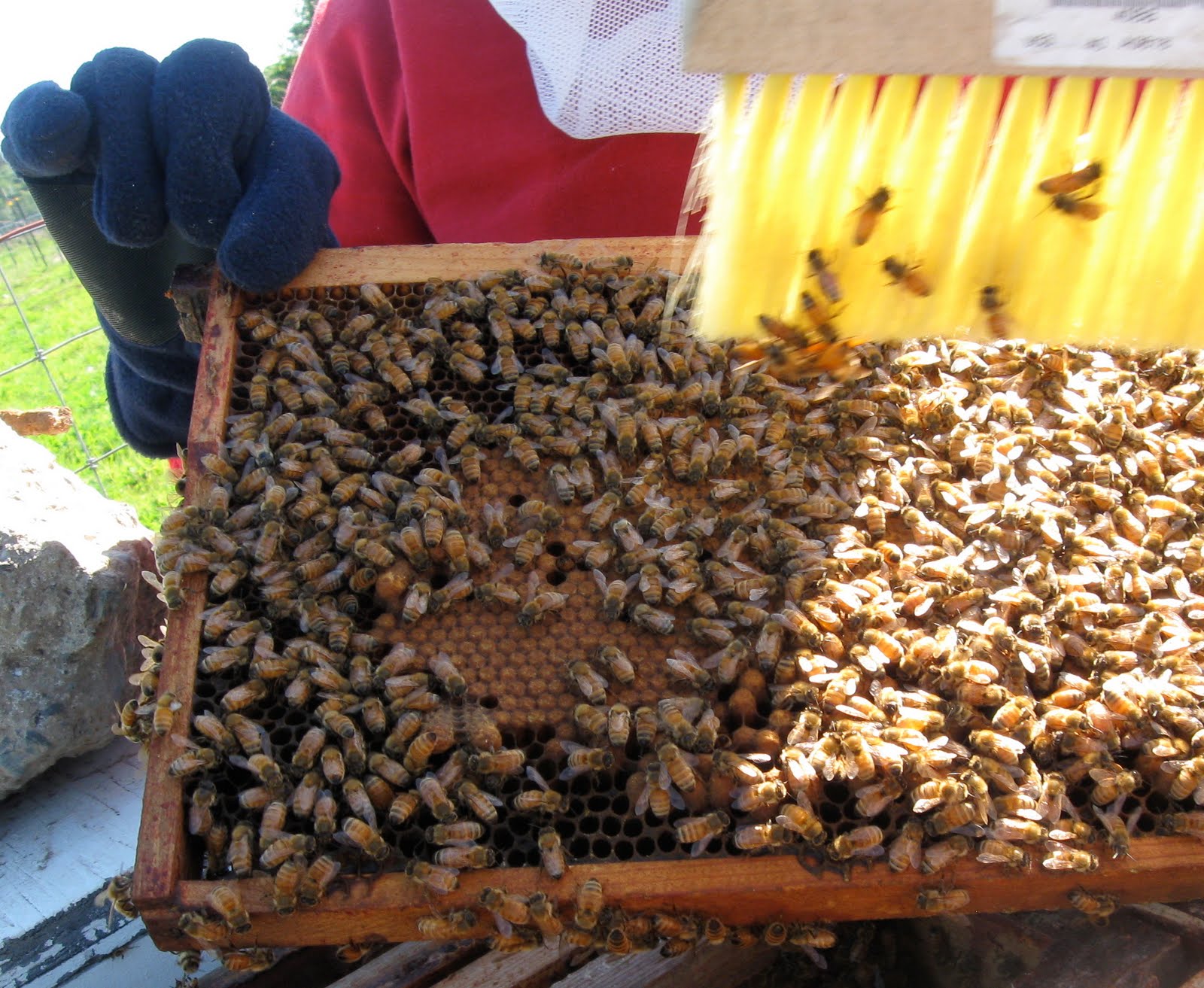
I have a big, very soft bristled brush that is used to brush bees around. I tried to brush the bees off the box and into the hive. They brushed off the box okay, but they didn't go into the hive. I was just brushing them into the air. The bees were getting more and more upset. The buzzing was getting louder and louder. They were starting to dive-bomb me. They couldn't get to me beneath me bee hat, but I could feel the force with which they were hitting the mesh over my face.

Then I felt a bee on my leg under my skirt. Okay, time to go. I replaced the lids of the hives, set the boxes (covered in bees) right next to the hive entrances, and liberally sprayed the entrances with sugar syrup, hoping that would attract all the bees back to the hives. Then I mentally shrugged my shoulders and went inside.

I could still feel the bee under my skirt. It was on my lower back now. If my husband were home, he could have helped me carefully remove it, but I was alone, so I had to try and take my skirt off without disturbing the bee enough to make it sting me.

I failed. It stung me. Not so bad, really. Nowhere near as bad as being stung by a yellow-jacket. I'm really almost glad: now I know I'm not terribly allergic (which I was worried about) and that it only hurts for a few minutes. I won't be so nervous about stings anymore.

Hope the bees make it back into the hive. I'll check later on in the afternoon.

Thursday, April 22, 2010

Buzz Buzz Buzz


The bees arrived! Hooray!

Now I can add "Beekeeper" to my impressive list of titles (Goatherd and Cheesewright). Assuming that the bees actually decide to stay, and stay alive. Well, also, to tell the truth, Homero and Rowan are more the beekeepers than I am. Homero picked the bees up, and Rowan read the instructions for hiving them, and all three of us worked together to overcome our collective willies and get them into the hives.

It was kind of silly. We couldn't find the queen cages at first. See the box with thousands of bees in it? And the round metal thing at the top? That's a syrup can, but where are the queens? They ought to be in their own little cages somewhere.... A phone call to Belleville Honey answered the question for us: the cages are hanging inside the box full of thousands of bees. You have to sharply rap the whole box on a flat surface to make all the bees fall to the bottom, remove the syrup can, reach inside and remove the queen cage.

Well, reaching my bare hand into a box full of 10,000 angry, disoriented bees goes against every natural instinct I have. So I made Rowan do it. Hey, before you report me to child protective services, SHE wants to be a beekeeper! She got the queen cages out just fine, but now we had another problem. The queen cages have a hole in them which is plugged with a cork. We have to remove that cork and replace it with something she will be able to chew through in a few days. This is to protect her: if she escapes her cage before the rest of the bees are used to her smell, they'll kill her. Beekeepers suggest using a mini-marshmallow to plug the hole.

Well I didn't have any marshmallows and I did have two open boxes of bees that I wanted to get into the hives ASAP. I know, I know - think these things through beforehand. Yes, would have been smart. I feel the same way when I am in the middle of making a cake, say, and discover I have no eggs. Read the recipe all the way through and gather your ingredients first. Too late for the cake, and too late for the marshmallows.

I had made sugar syrup for the feeders, though (see the feeder?) and I had an idea. I ran to the house and got a slice of bread. I ripped little pieces of the bread off the slice and dunked them in the sugar syrup. Then I wadded them up into balls about the size of a mini marshmallow and used them to plug the holes.

We hung the queen cages inside the hive and then, since it was after 7:00 and almost sunset, we decided to just put the opened boxes straight into the hive rather than trying to dump the bees in. The Bee Man said it was okay.

IMG_1289.JPG.jpg


This morning the air around the hives is thick with bees, but they don't seem to be going anywhere or doing anything purposeful right now. They are just buzzing around, kind of agitated-like. Also I noticed that the syrup feeders are still just as full as they were last night, which is odd. I was told that they would last only a day. Maybe the holes are plugged up because I made the syrup too thick?

And I'm worried about the bread-balls. I don't know whether the queens will be able to chew their way out. Maybe I should remove them. But I'm not supposed to open the hives for at least a week.

I can see that the bees are going to offer me plenty of opportunity for self-doubt and second guessing.

Friday, March 5, 2010

Beehive Ho!


Homero and I worked together all morning to put together two beehives.


First we went over all the frames and boxes (again) and finished cleaning them up and picking the best frames to fill four boxes. Unfortunately, we found another mouse-nest and this time it was full of pink, squirmy little babies. Homero gagged and blanched, but he scooped them all into an old feed bag and threw it in the back of the truck with all the other trash destined for the dump. The mama mouse retreated deep into one of the hive boxes, so we took the whole thing outside and pulled the frames out one by one until the mouse made a break for it. Ivory was standing by, and the mouse didn't get far.

Then I took all the lids, bases, screens, and feeders and washed them with the high pressure nozzle on the hose and lined them up along the fence to dry in the sun (it's about 63 degrees and sunny - we were hot in the mama barn. Some of the frames have honey in them and it is melting and getting all over everything.) I had to take a stiff brush to some of them, but they mostly look pretty good now.

We needed some kind of table or base to set the hives on that would keep them up off the damp, cold ground and more or less keep weeds away from the entrances. We don't actually have any extra tables right now - as a matter of fact we don't even have a coffee table for the living room. But we do have an old desk that has been sitting in the backyard for the the last three years. Homero sawed the top off of it to make a level base and then reinforced it with 2x4's (two hives, when full, might collectively weigh more than four hundred pounds).

Next we had to decide on a site. According to my book (Beekeeping for Dummies), the ideal site has both sun and shade available, faces south or southeast, has water available nearby, is sheltered from livestock and other animals, and has protection from the wind. That's a tall order for us, but we found a site that faces southeast, is level and dry, and has water nearby. Maybe we can rig up some sort of wind protection - we'll probably have to, considering the strength of the wind around here.

I can't wait for my bees! I'm so excited!

Thursday, February 25, 2010

Mama Barn Mice, and an Ode to my Husband

My husband is a brave man. He possesses an enviable equanimity. He is not one to dwell on frightening possibilities - in fact, he's rather fatalistic in a very Mexican way. He is as unmoved by the thought of death as anyone I've ever met. He certainly isn't afraid of pain or hardship.

In his life, he has confronted danger and privation such as very few of us comfortable Americans have known. He has experienced thirst, hunger, and terrible uncertainty. He has been within a hairsbreadth of death by exposure, and lived many years as a hunted man, and yet maintained his sense of humor, his trust in God, and his joie de vivre. Offhand, I can't think of a single person I admire as much, nor anyone I'd rather have at my side should things ever go horribly, horribly wrong.

Yet, my husband is afraid of a couple of things. One of them is snakes. To be fair, he does come from a part of the world which abounds in poisonous snakes. However, I have not yet been able to convince him that garter snakes are harmless and that the the little girls should be allowed to play with them.

Also, he is afraid of mice.

Today, we were in the mama barn cleaning beehive frames (something it feels like we've been doing forever), when suddenly a couple of field mice crawled up out of one of the boxes. Homero startled, backed up, and dropped his hive tool. "Get it!" he said. "Get it out of here!"

The first one I easily grabbed by the tail and threw out of the barn, but the second and third were too fast for me and escaped into the stack of hive boxes. I spent a few minutes trying to catch them; moving box by box and scrambling around in the hay, but I couldn't get either of them. Homero, pale and a little shaky, said "I'm going to get the cat," and hightailed it for the house.

I kept working for a few more minutes, then decided to go see what was going on. My dear husband was in the kitchen washing dishes. "I couldn't find the cat," he said. "When you see him, lock him in the barn for a few days, okay?"

Sunday, February 21, 2010

Things I Don't Understand

1) Why the chickens are not laying eggs. A few weeks ago, we decided to put the chickens into a coop because we weren't getting very many eggs. Since then, we've been getting no eggs at all. Before you suggest it, yes, I let the chickens back out and still got almost no eggs at all. Put them back in so at least we would know whether they were not laying or laying but hiding eggs in the blackberries. They aren't laying. I'm feeding twenty chickens and getting two eggs a day. Why?


2) Why I can't figure out how to cook a farm chicken and make it edible. In light of the rediculous feed:egg ratio, we decided to kill a few roosters today (note to self: later, post pics and praise Rowan highly for doing her part). This time, we picked the very youngest roosters, neither more than four months old. Same result: tough, inedible, rubbery flesh in a grimy broth. Happy dogs, unhappy people.

3) Why I even have chickens at all.

4) How to clean up beehive frames and put together a beehive. It seems simple when you read about it in a book. There are only four or five parts to a beehive, none of them moving parts (until you put the bees in, anyway.) Why can't I figure it out? Today I scraped down about thirty frames and tried to sort my big jumble of equipment into recognizable bits: bases, boxes, lids, queen excluders, feeders..... I just got hot and confused.

5) Why the beeswax won't melt. When I scraped the frames, I scraped them into a big cardboard box. Beeswax is really nice stuff, and expensive, too. Of course, the crap I was scraping off the frames wasn't nice clean wax, but rather blackened, hardened lumps full of dead bees. However, I figured it was at least worth a shot to try to save it, beeswax being so valuable and all. I dumped it all into the top of a double boiler and it's been simmering away on the stove (along with the hideous chicken soup) for hours. No melting yet. I planned to sieve the melted wax through a triple layer of cheesecloth, but I can't do that if it WON'T MELT.

6) Why in God's name there's no beer in the house.

Thursday, February 18, 2010

The First Day of Spring

Forsythia in full bloom in Bellingham


I'm going to go ahead and call it: Today was the first day of spring in Bellingham, WA. The mercury got up to 58 degrees and the sky was bright blue without a hint of cloud. When I got into my car in the afternoon, it was actually hot. I saw no fewer than three girls in short-shorts (although this IS a university town).

My snap peas are coming up. They are at the "bow" stage - a loop of stem is visible above the dirt but no leaves are up. Radishes have also germinated. The goats are looking very extremely pregnant. The roosters are leaping on the hens with mad abandon. Ornamental fruit trees are in bloom - very nearly full bloom.

My own fruit trees are not near blooming yet - I'd say two weeks, even with continued warm weather. That's fine by me - I don't want a late frost to kill the blossoms and destroy the harvest. Ha Ha - I say "late frost" in mid February. That's not really very funny, but I've decided I'm going to laugh instead of lay awake freaking out.

I opened up my (secondhand) beehives and have started to clean out the dead bees and scrape down the frames. The bees I ordered are arriving in April, so I want everything ready ahead of time. I'm not sure what I need to do with the hives - some of the frames are moldy. If I were to follow my instinct I'd scrape those down to the wood and treat them with boiling water or a propane torch. But I just don't know.

Right now the hives are in the Mama Barn, and I need to get them out of there before the goats are due to deliver, because they take up most of the space. I'm not even sure when the goats are due - if the buck I rented is the papa, then they aren't due until mid April. However, Iris at least looks ready to pop way before then. Her udder is pretty big, her belly is gigantic, and her spine is looking pretty prominent around the tailbone. Oh well - Iris is an experienced mama and has given birth without trouble twice before now. If she gives birth out in the field I don't doubt she will do fine and take care of her kids.

I'm glad it's spring, even if it's frighteningly early. I really enjoyed being out today, digging in the dirt, herding the goats and the ponies around, and generally enjoying myself in the sun. If my brother can call the first day of spring as the day his baseball team reports for spring training, then surely I can report the first day of spring as the day my daffodils opened.

Saturday, February 6, 2010

I am NOT afraid of bees

My new mantra. I am NOT afraid of bees, I am NOT afraid of bees, I am NOT afraid of bees....

Actually, I really am not terribly afraid of bees. Wasps, yes. Yellow jackets, paper wasps, hornets... I am totally and abjectly terrified of those things. But honeybees and bumblebees are nothing to be afraid of. They aren't aggressive, they are beautiful, and everything they do is beneficial to us. In fact, we likely couldn't survive without them.

Which, as I'm sure y'all already know, is a big big problem, because they are disappearing fast. Some ideas are beginning to emerge regarding Colony Collapse Disorder (ARS : Questions and Answers: Colony Collapse Disorder) and the research tends to implicate certain pesticides as well as mites and other diseases. But definitive answers are still far away, and certainly a cure is nowhere on the immediate horizon.

CCD has not been a major problem where I live, so far. I hope that it will not affect ..... my NEW BEEHIVES!!!!!! Yes, it's true. I decided not to wait another year but to bite the bullet, gird up my loins, put on my big-girl panties (pick your silly metaphor) and order some bees. I asked on Craigslist for a mentor, and found a nice guy who lives just down the road and is happy to help me get started. I have to clean out my old hives (which I bought off Craigslist a few months ago) and get them in shape to accept my bees, which should arrive in late March or early April.

Today is my trial by fire - the neighbor is going to open up his own hives and check things out and he invited me to come watch. I have a hat with a veil and long gloves, but I need a set of zip-up coveralls. I'll be very very proud of myself if I get through today without a galloping case of willies. Or at least if I can keep the willies under wraps. Like, not scream like a little girl and run away. I think I can hold myself to that standard.

Unless a bee gets inside my face veil.

Thursday, December 10, 2009

Hello, Goodbye

Goodbye, Sandy and Tutu (and Clove, not pictured). I sold all three goat kids to a Mexican guy who is throwing a birthday party and wants to put on a big ole barbecue. I don't how many people he's expecting, but apparently three goats' worth. I sold the three of them for $200.


I have mixed feelings about this. One - I intended to eat one myself. We were invited to the party, so I guess we'll get a taste, but that's not the same as putting a whole goat in the freezer. It's not that we need the meat more than we need the money - we don't - but rather that it means putting off for another year taking the large psychological step of killing and eating a kid ourselves. I want that task over and done with.

On the plus side, the Mexican gentlemen are going to do the butchering here, and Homero will be watching and learning. I'd like to watch and learn myself, but I think I had better take the kids and get the hell out of dodge for the duration. I made the mistake of letting the girls hear about the upcoming slaughter, and then I had such a situation to deal with! Such weeping and yelling! Such wailing and gnashing of teeth!

It's understandable. It's normal. I am sad myself, to tell the truth. It wouldn't stop me from enjoying a nice roast leg, but I'm not looking forward to seeing my sweet little kidlings killed and skinned. If the girls give me a legitimate excuse to be absent.... I'm cool with that.

Hello to the newest animals on the farm.... bees! This is just a photo I pulled off the web, since my camera cord is missing. But we have approximately the same setup - four hives plus all the ancillary equipment. Yes, you guessed it - Craigslist. Yes, I agree, it's maybe time for me to find a CL anonymous meeting - but in the meantime, I have a new hobby.

Or Homero does. His father used to keep bees and Homero has often expressed an interest in learning. I like the idea of bees for several reasons - honey, obviously. Better pollination of the orchard and the garden. The possibility of income. But mostly, it's the ultimate fulfillment of the self-sufficiency game The self-sufficiency game (love you, Dad).