"United we bargain, divided we beg."
Showing posts with label Meat. Show all posts

Friday, September 30, 2022

Everybody Gets a Share (Doggy Delight)


Mercy 


Haku 

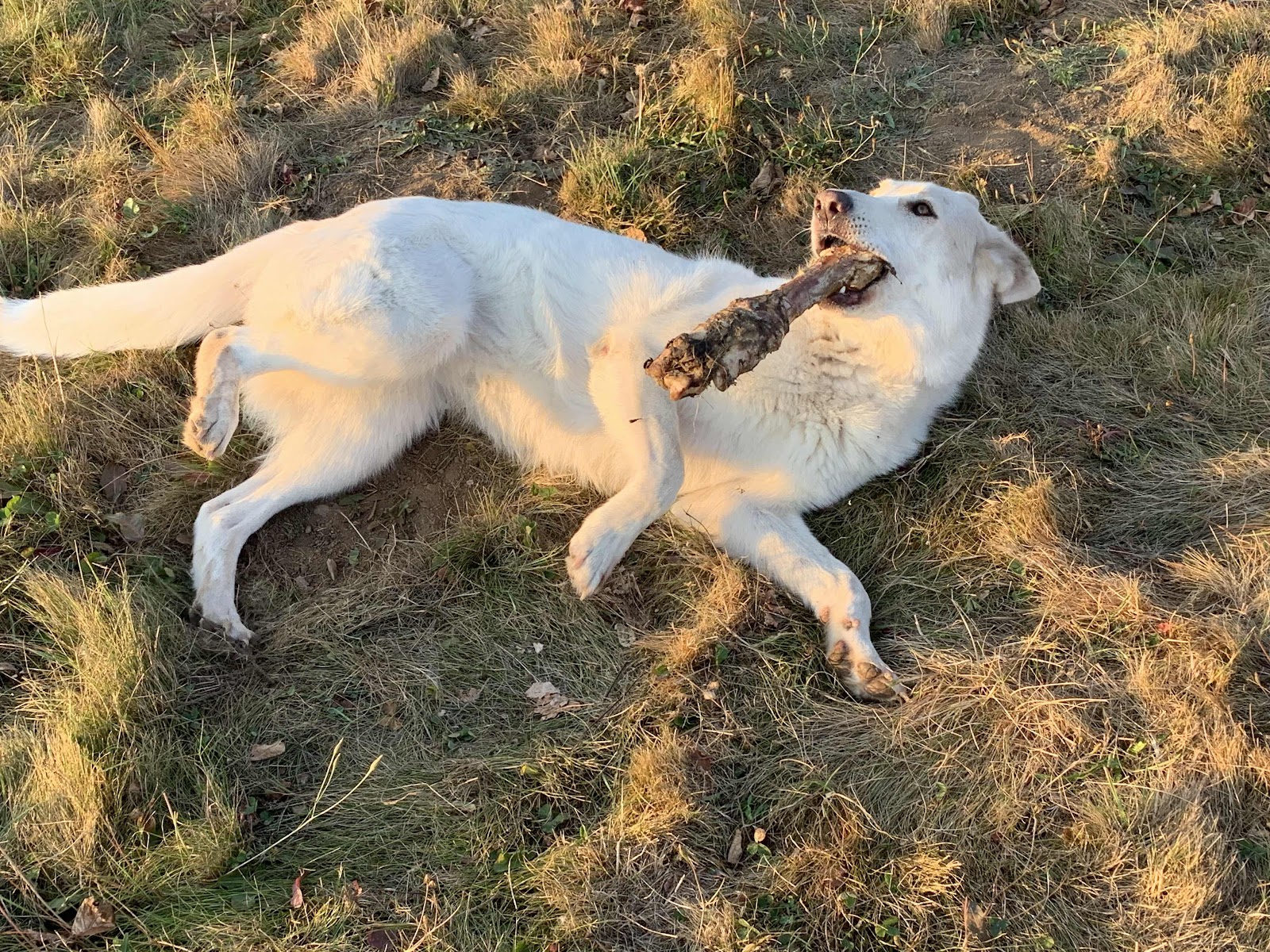
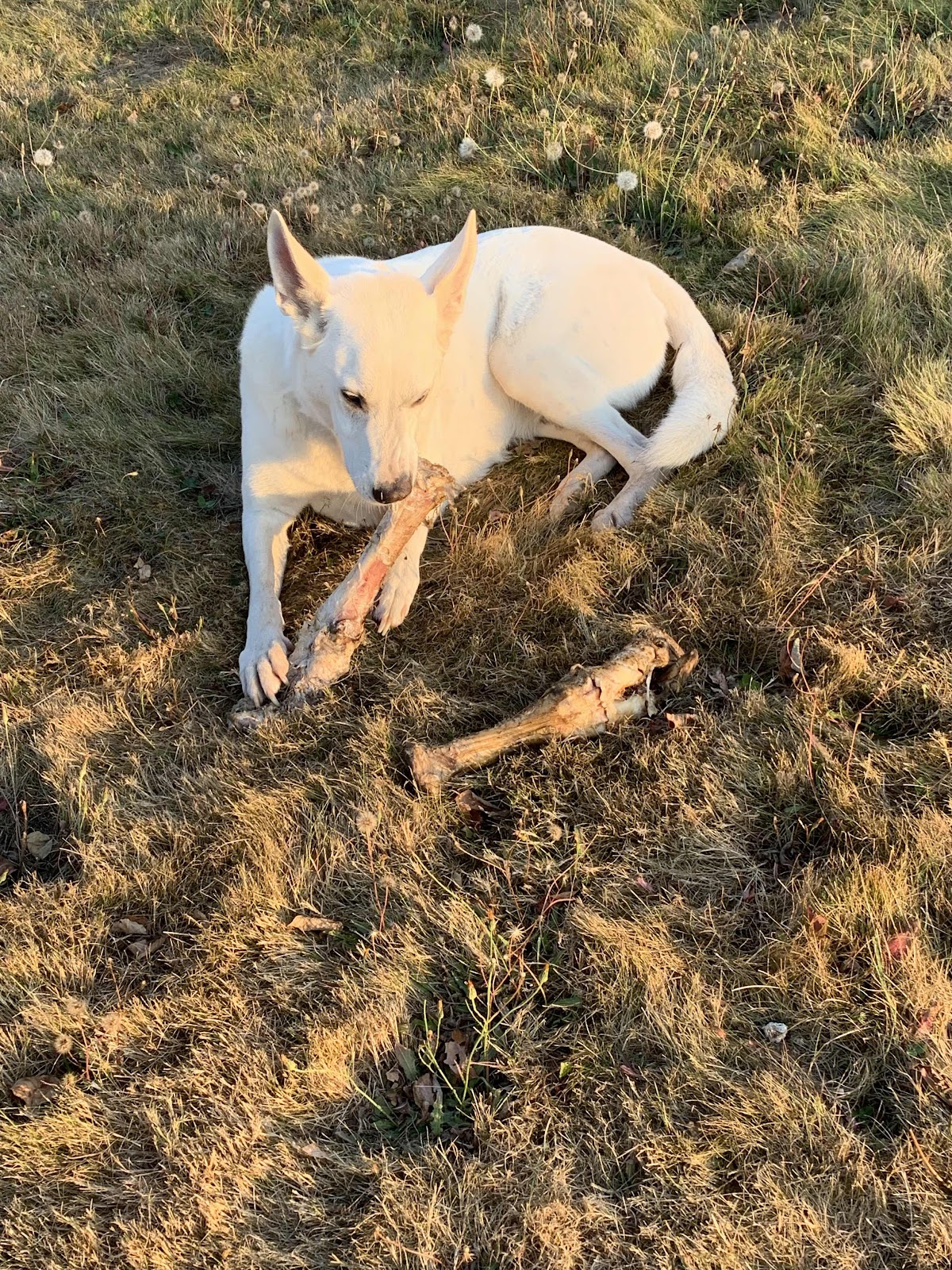
My husband’s insistence on keeping the gristly bits of the cow sure paid off for the dogs. They’ve been chewing on these shinbones for a full week now. 

Monday, September 19, 2022

Meat Math, Bovine Edition (GRAPHIC)


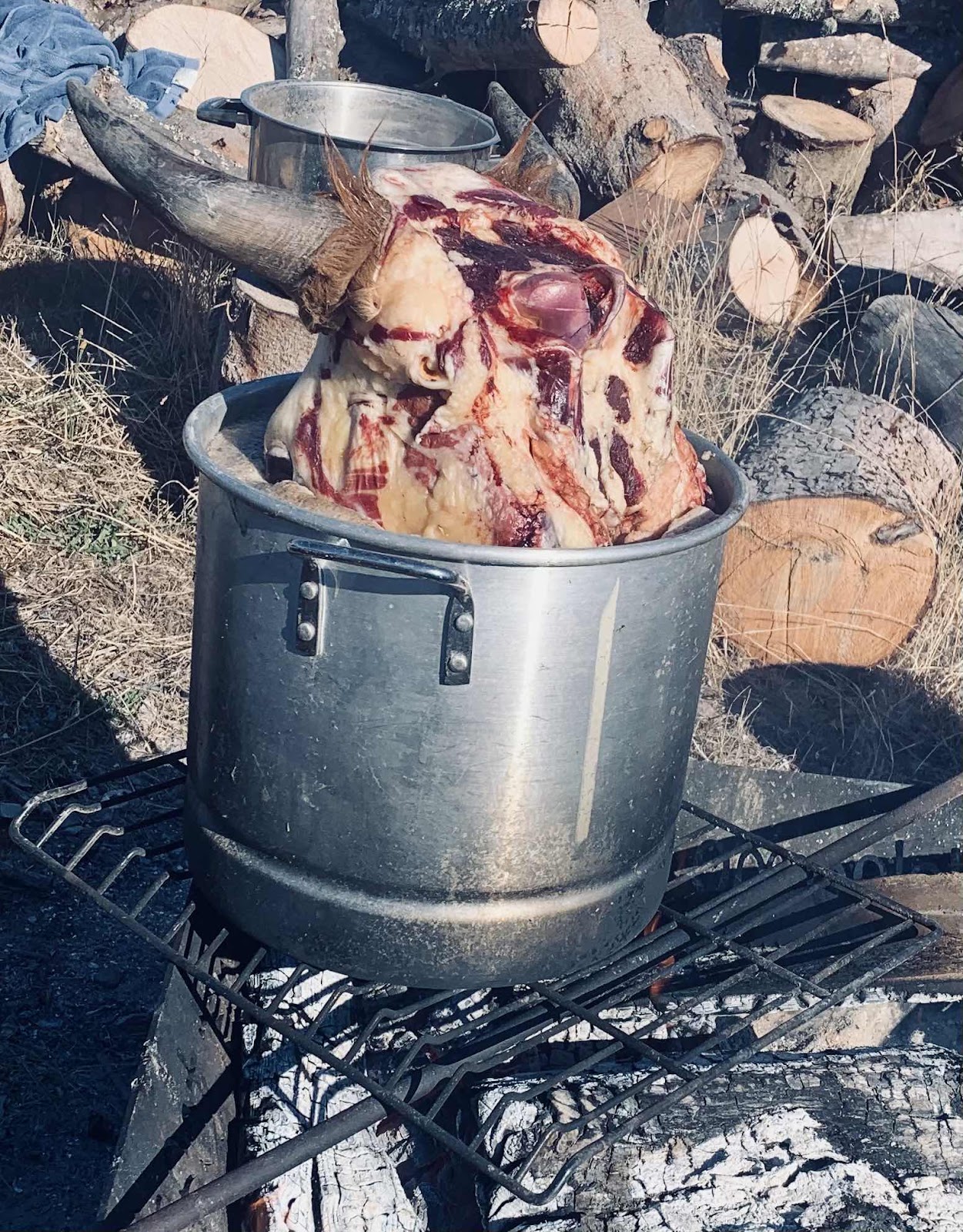
Not a very good picture, but that is a 40 quart stockpot, with  substantially less than half of a freshly butchered steer’s head submerged in it. 

This is what I came home to today. I knew, of course, that today was the day appointed for Pepe Toro, our Jersey steer, to meet his end. The men from Lynden meats were scheduled to arrive in their business-like panel van loaded with motorized equipment and on-board hot water, and do what butchers do. Half of Pepe Toro is already sold, and I have been making room in the freezer for the other half. The death of the cow, per se, was not a surprise. 

I did not know - though I should have suspected - that my husband was going to ask the men from Lynden meats to give him every scrap of the cow, from the horns to the hooves, that they would normally throw away or sell to a glue factory or something, and try to turn it into food. We’ve been through this before, and he ALWAYS does the same thing. 

We are just not prepared for cooking an entire cow’s head. In the past, even pig’s heads have proved to be difficult to manage. The head of a well-grown cow is a majorly large hunk of gristle and bone, and once the tongue has been removed, in my opinion it ought to be ignored. But Homero comes from a background that despises waste and finds a way to use EVERYTHING. This is, of course, admirable, but more so in the abstract than in real life. 


After I found the cow’s head sticking three-quarters of the way out of the pot, I convinced Homero to remove it, and to cut it into pieces with his sawzall, removing the horns and the disgusting patches of hair that clung to the skull around them. He has a plan for the horns - they are a gift to his friend Clacoyo, who wants to mount them on his motorcycle helmet. 

It took two sawzall blades, a cleaver, and a mallet to split the skull I to four pieces, but we got it done. Now the head is simmering over a wood fire - after two changes of water - along with a handful of allspice, cloves, star anise, fennel, and black pepper; three heads of garlic; several onions, and a bunch of guajillo chiles. It ought to be done sometime after moonrise. 

Now for the math. 

This animal was free. Homero has several clients who work on large dairy farms, and they are constantly giving away newborn males. I don’t know why they don’t just centrifuge the sperm they use - almost all cows are bred by AI - but either they don’t, or it has a high failure rate. This was the third free calf we’ve raised. 

The feed for a cow is almost all free too. We did have to bottle feed him for a short while but that was just one bag of milk replacer: about $30. Then of course there’s his winter hay, and a cow eats a lot of hay. I didn’t keep track of how much he ate versus the goats - that would be impossible - but we bought an extra 25 bales last winter and I’ll say that was all cow food. So that’s $100. Other than that, all he’s eaten is pasture grass and free veggies and bread from gleaners. Oh - and the same friend who provided him to us also have us the occasional pickup-load of free silage. 

We did take him to the vet to be castrated because we waited too long to band him. Won’t make that mistake again. I think that was about $100 as well. No medicine or other vet visits were needed over the course of his short lifetime. 

Total cost: approximately $230

Expected revenue: 

Last week I taped Pepe Toro to get an estimated live weight. He measured 78 inches around his heart-girth, which is very well grown. According to the internet charts, that means he has a live weight of approximately 1,112 pounds. The hanging weight of a cow is usually about 60% of live weight, so in our case approximately 668 lbs. 

I sold half of him for $3/lb, which would be $1,002. If I can find a buyer for another quarter I will sell that too, so that would be an extra $501 for a total of $1,503. Plus of course our own meat. 

That sounds like a hefty profit, but it isn’t as much as it sounds because Pepe Toro was wantonly destructive. He destroyed the calf hutch, which will cost $200 to replace, and he got I got he mama barn and put his feet right through the floor in a half dozen places. That will take a sheet of three quarter in inch plywood to fix, and now I have to go look up what that costs ($75) 

Total cost $505
Total expected revenue $1503
Total expected profit $998 

Not bad 


Wednesday, April 29, 2020

DQ43 (???) Meat Math 2020


One day blends into another. I can’t believe it’s been over 40 days of quarantine. Insanity. Anyhoo. 

Tomorrow is Paloma’s birthday. She’s turning 15 and it was supposed to be her big fancy quinceaƱera party but of course that isn’t happening. She is having ONE friend over and we are eating cheeseburgers and carrot cake (her request) out on the lawn where we can socially distance. 

The pigs are meeting their maker tomorrow at 9 am. Since these pigs started out as Paloma’s FFA project, she gets a share of the profit. The catch is, she has to actually figure out the profit (if any) from the following facts:

- two piglets cost $100 each
- we bought 10 bags of pig food at $15 each (give or take)
- we are selling the bigger pig, in halves, and keeping the smaller pig for ourselves. The sale price is $3.50/lb hanging weight. We won’t actually know the exact hanging weight for a few days, but I guess the big pig will weigh in at about 200 lbs. 
- for one of the halves of the big pig, we are accepting in trade a butchered lamb worth $200. The value of the side over and above $200 will be paid in cash. 
- the other half of the big pig will be paid in cash. 
- we are not attempting to place a value on our labor (that’s a fool’s game). 

A little quick estimating tells me two things: a) this particular pork venture was more financially successful than past ventures have been. I feel that we came out ahead this time, very handsomely ahead. And b) Paloma is going to be disappointed in her share. 

I haven’t decided what value to let her put on the pig we are keeping - should it be the same $3.50/lb, even though we are not actually getting any money for it? Or should it be the cost of the same amount of pork if we bought it at the grocery store, even though we never actually would buy that much pork? Or should it be zero, because it just counts as free meat for us? What would an actual bookkeeper say? Any actual bookkeepers out there? 

Paloma wants to know. 

Monday, February 26, 2018

Porksicles (Deep Bedding)


After a prolonged, unseasonable warm spell in January, we experienced a brief, seasonable cold snap last week. Five or six days of temperatures in the high teens and low twenties, accompanied by small hard snow and high winds. 
Our pigs, which were very close to their butchering date, had only the three-sided field structure for shelter, and it was inadequate.

On a particularly cold night I asked Homero to go open a bale of hay for them to use as fresh bedding. He was outside a long time, and when he came back I asked what took him so long. 

“Amor, the pigs were freezing,” he said. “They didn’t even want to come out for food, and when they did come out they could hardly stand up they were trembling so hard.” 

“Oh no! Poor piggies! What did you do? Did you give them hay?” 

“Hay would not be enough, I moved them into the big barn with the goats.” 

The “big barn” is a 12x16’ barn from Home Depot which we have had since we first moved here. Every winter we use a deep bedding system; basically just throwing more and more dry straw down on top of the old, wet straw until it is a good eighteen inches thick. A couple weeks ago I dug down with my hand into the bedding and felt the heat from the natural composting. It was quite hot about six inches down - almost uncomfortably hot. The goats have been benefitting from this heat all winter long. 

Moving the pigs into the barn served a secondary purpose besides keeping them from freezing to death. As you might imagine (or might not, if you have no farm experience), removing a winter’s worth of deep litter is a back-breaking task. Even from a barn as small as ours is - the litter packs down tight and it takes a strong man (my husband) several hours to pitch it all out with a pitchfork, and then he needs a hot bath, a massage, and a shitload of Ibuprofen. Pigs, however, can plow through deep litter effortlessly with their snouts, like little biological diesel tractors. 

The pigs stayed in the barn for four days before the butchers came, and during that time they rooted through the compacted litter like badgers on steroids. The barn is now full of fluffy, relatively easy to shovel compost, which will greatly enhance our garden come spring. 

And the pigs themselves have now been removed to the deep freezers of Lynden Meats; soon to be dispersed to our customers, neighbors, family, and friends in the form of chops, ribs, bacon, and sausage, fuel for many a family feast. The pigs are dead, long live the pigs! 

Wednesday, October 4, 2017

Piggy Piggy (More Pork)


 Paloma and the Pig 


Two new pigs have arrived on the farm. We weren't looking for pigs; we still have plenty of pork left in the freezer from the last pigs. Those pigs were so vicious and unpleasant that I was looking forward to not having any pigs again for
some time to come. 

However. I belong to a local farmer's Facebook group, and that means I just HAVE to see all the animals for sale at any given time. I can't even help it - it just appears on my feed. In the "old days" three years ago, I had to at least go to Craigslist and seek out animals to buy. Boy, that was like, the Jurassic era. 

So, a neighbor farmer friend of ours, from whom we have bought pigs before (but not last year's evil pigs) was advertising well-grown piglets for $125 each. A friend of his had to leave town quickly unexpectedly for a new job and asked our friend to sell off his herd of nine piglets. From the photos he posted, I could see that they were considerably older than  the usual weaners which sell for the same price. After consulting with Homero, I asked our friend to keep two for us. 

When he delivered them, I was surprised and gratified to see how big they are. They were almost the size of barbecue hogs which sell for $250 or so. I asked what breed they were and I got "Berkshire cross." That's good enough for me. 

These pigs are quite shy, and scared of people. I don't mind; I've found that if the pigs aren't scared of me, then I am likely to be scared of them. They spent the first few days in the big barn, but we have since transferred them to the sacrifice area. There, they can be comfortable in the field shelter, and have plenty of space for exercising. If they root up the ground, they will be doing me a favor, since that earth is compacted and gravelly. 

If all goes well, the pigs ought to be harvest sized by Christmas. In the meantime, we have to eat up the pork we still have in the freezer. To that end, I made a delicious pork roast yesterday. I just liberally salted and peppered it, put it in a casserole with a few cloves of garlic, and then poured over two cups of home pressed apple cider that was a week old and fairly well converted into tepache. I covered the casserole with tinfoil and crimped it well, and baked it at 300 for several hours. Absolutely delicious with smashed Prato salad. 

Friday, September 1, 2017

Beef Abundance (Simple is Good)


Summer is drawing to a close - not that you'd know it by the weather. Today, September first, it was 85 degrees and sunny. This is something like our fiftieth day without measurable rain. The forecast continues dry and hot as far as the weather-people can see into the future.

But the calendar is implacable. School starts this Tuesday, no matter the forecast. It's time and past time to get the kids new school shoes and jackets; to mow the last scraggly weeds; to shake off summer's languor and impose something like a schedule again. 

It's also time, more pleasantly, to eat up the meat in the freezer. Last week Mr. B., my neighbor, asked us if we'd be wanting to buy a side of beef this year again, and I said we sure would. Last fall, due to a silly series of miscommunications, we ended up buying a ridiculous quantity of beef - three quarters of a big fat steer, much more than we needed. Quite a bit of it is still in the freezer and needs to be devoured ASAP to make room. 

Today I thawed a package of rib steaks. A favorite cut of mine, they are heavily marbled and carry a thick rim of fat around the edges. If you aren't used to grass fed beef, you might be thinking "yuck, fat." I assure you that the succulent, yellow, flavorful fat of a grass fed and grass finished beeve is nothing like the pale rubbery fat on a factory farmed animal. 

These steaks don't need much. After thawing, I liberally sprinkled them with salt, pepper, and garlic powder, and laid them on a big cast iron griddle slicked with quality olive oil and got out of the way. Flip after six or seven minutes and give the other side a sear. My husband likes his steaks medium well and I like mine medium rare, so I take mine off a few minutes early and let it rest while his continues to cook. 

As an accompaniment I boiled a half dozen yellow potatoes, and smashed them with a couple tablespoons of butter, a teaspoon of whole grain mustard, a spoonful of mayonnaise, salt, pepper, and a generous amount of minced parsley. A cold beer after a hot day's work rounds out the meal. 


Friday, March 10, 2017

Meat Math 2017


This year's horrible pigs (all pigs are horrible but this year's were worse than most) have been converted into meat, and the meat sold, except for what we wanted to keep for ourselves. It's time for this year's edition of MEAT MATH (Meat Math).

The pigs were pretty small. We killed them earlier than we maybe should have because they were so evil, and also because in the cold and wet, they weren't gaining weight very quickly. It's better to get piglets in the spring than in the fall, but of course everybody knows that, and so spring piglets are more expensive than fall piglets. The boy had a hanging weight of 132lbs, and the gilt 110lbs.

The larger pig we sold off in halves. One half went to our neighbor, the D. family, from whom we have actually bought pork in years past. But they decided (being quicker learners than we are, apparently) that they don't want to raise pigs anymore, so now they are buying from us. That half weighed 67lbs. The other half went to a Facebook friend, and weighed 65lbs.

We asked $3/lb, which is on the cheap side. I started out at $3.50/lb, which seems to be the going rate for pork without fancy qualifiers like Organic or Pastured, but it so happened that there was a lot of pork for sale at the same time I was trying to sell, at least according to Craigslist. I didn't get any response at $3.50/lb.

If I'd had an empty freezer, I might have held out. But I'd already made the date with the butcher, and our freezer was stuffed nigh to bursting with beef, salmon, and lamb. We have two eminently butcher-able animals (a sheep and a goat) that we have let live for the sole reason that we were saving room in the freezer for the pork. Faced with that severe space shortage, I lowered the price, and quickly sold off the bigger pig.

Okay, so 132 x $3 = $396. Rounding to $400.

The piglets themselves cost us $100 each. That leaves $200.

Feed was negligible, thanks to unlimited bread and produce from the Gleaner's Pantry ( What Wrong With this Avocado?). We did buy three or four bags of conventional pig feed - let's say that was $60. Now we have $140 left.

Unfortunately, I lost my receipt from the butcher, so I can't break it down into categories, but we paid them $178 for our 110lbs, which includes the kill fee, the cut and wrap, and the fee for smoking the hams, bacon, and hocks. Take 178 from 140 and we are 38 dollars in the hole. Divide 38 by 110 and you get homestead pork for $0.35/lb. Not, obviously, counting labor.

Even if I am forgetting a couple bags of feed, that's some pretty cheap, quality protein. The first meal I made was BBQ spareribs. Delicious.


Wednesday, October 19, 2016

Meat Madness (Weighing Options)


I have a neighbor who raises beef cattle, Mr. B., and we have bought beef from him several times in the past. It's wonderful stuff, he has gorgeous pastures, but we haven't bought any the last few years. Not last year, because we had our own cow butchered (she was a cull from a dairy that couldn't be bred, but she made a decent meat animal), and not the year before because we waited too long to ask him, and he'd already sold it all. He doesn't butcher very many steers in any given year - maybe 12 or 15 - and he told me that usually he sells all of it to extended family. I took that as a hint that I should look for beef elsewhere.

This year, we have Homero's nieces living with us again, which means dinner is for seven every night. We all like beef, and eat it pretty often. The freezer was almost empty. We were down to the last few packages of hamburger from last year's cow, and so I went on the hunt for grass fed beef on Craigslist.

Wow, the price of beef has really gone up in the last several years. I can't remember for sure what the price per pound was the first year I bought beef (2008) but I know it was under $2/lb. I think it was $1.80. This year I couldn't find anything under $3.50/lb hanging weight, which means by the time you pay the cut and wrap and figure in the 20% discard, you are paying around $5/lb for the actual beef you are going to eat.

Not that that is a high price, speaking in absolute terms. Around here, if you can even find local grass fed beef in the grocery store, it starts at $6.00 for the hamburger and goes up from there. The really nice steaks are probably over $20/lb - not that I would know! So don't think I'm complaining! However, it does mean you have to come up with a big chunk of change all at once.

I finally resigned myself to paying the going rate, and spoke with a lady in Lynden. She had a half a Hereford to sell, and she said I could buy the half or just a quarter if I preferred. The meat was already at the butcher's and would be ready in a week or so. She said he was a good sized animal, so I bought a quarter. We'd wait until the butcher called me with the final weight before I paid her.

Then, that Sunday, I went to church and saw my neighbor. Over coffee after the service, he asked me if Homero and I would like some beef this year. He wasn't certain, but he thought he'd probably have a little extra.

"If it turns out I do, would you want it?"

"Yes," I said, instantly deciding it would be a good idea to get back on his list of customers.

"Well, I'll let you know."

Now I had a conundrum. Should I cancel on the lady with the expensive beef? Mr. B.'s price was considerably lower. But what if it turned out Mr. B. didn't have any beef after all? Or what if he only had an eighth? Homero and I talked it over and he said to go ahead and buy the quarter anyway, to be on the safe side. We'd certainly eat it.

When the butcher called me a few days later, however, I was in for a surprise. The final hanging weight was 250 pounds! For those of you who have never bought your beef by the side, let me assure that is a LOT of meat. The steer must have been one gigantic animal. At $3.50/lb, plus the cut and wrap, I would be spending something like $1000 to put it in my fridge. But there was no option - the meat was mine.

Mr. B. spoke to me again at church the next week. He said there was a half for me. I smiled and said "that's wonderful, thank you so much!"

There's no way we could get through THREE QUARTERS OF A COW by ourselves, especially when one of the quarters is nearly as big as an average half. Luckily, my sister said her family would split the half with me. We simply called the butcher and told him we wanted to split it, and each of us gave our cut and wrap orders.

Now the freezer - 18.5 cubic feet; a big freezer! - is packed to the brim with meat. There is so much beef in there that we can't butcher the baby goat because there's simply no place to put him. We had to remove a few gallons of cider and drink it up to make room. There are worse problems to have than a surfeit of high quality beef. So we'll have to eat beef more often this winter than I would have guessed. Oh, Rats!


Saturday, November 21, 2015

Slaughter Season (More Meat Math)


This week we made a lot of room on the farm. Most notably, the pig (seen here a couple of months ago) met his fate, at the capable hands of our local mobile butcher, later to appear in his final form as chops and bacon on our table. 

Half of him was sold, on Craigslist, for $3.00/lb. that's on the low end, but most of the pork that is advertised at a higher price has labels like "organic feed only" or "no GMO feed" attached to it, and ours doesn't. 

The hanging weight was 163 lbs, and half that is 81.5, times $3.00/lb and I collected $244.00. Considering that the pig himself cost us $200 originally, and that he was fed almost entirely from the gleaners' pantry (plus a couple bags of conventional feed), I think we did very well. Without figuring it to the penny, our own pork is basically free, not counting labor of course. 

Today I took the turkeys to a neighbor to be processed. I thought Homero would do it, but he asked me to see if I could find someone to do it at a reasonable
price, and I did. I paid $10 per bird, half in cash and half in grass fed beef. 

I'll be picking up two of them tomorrow morning - I needed one tonight for a person who is going out of town early on the morning. That turkey weighed a full 20 pounds, which is $80 at $4/lb. bigger than I expected - and frankly, bigger than the lady wanted. But what can you do? I didn't weigh them live. Suppose I might have. 

If the other two turkeys are the same weight, then I'll make a total of $160 on the turkeys (the third one is for our own table). So many turkeys died this year that I think we are not even breaking even. The chicks cost about $65. We started them on expensive game bird feed - another $20. After that they were also largely fed from the gleaners' pantry, but I know we bought at least four bags of feed, costing altogether about $65. Add that up, it's $150. So, let's say it worked out about the same as the pig - our own meat is free. 

If I could figure out how to keep turkey chicks alive to maturity, they would be very lucrative. We began with 8 this year, and ended up with three. In past years, the survival rate has been better (over 50%) but it's never been really satisfactory. People tell me that turkeys are fussy, hard to raise. I guess so. 

They sure are delicious, though. Thanksgiving is at my house this year. I'm looking forward to hostessing. No matter how costly, it is a real pleasure to offer my family a big traditional centerpiece that we raised ourselves. This will be the third year in a row that we have eaten our own pastured turkey for thanksgiving. It's always wonderful.