
"United we bargain, divided we beg."
Showing posts with label gardening. Show all posts

Wednesday, March 18, 2020

State of the Farm: Pandemic Edition


The girls amuse themselves at home with Henna freckles 


DQ2 - day two of “quarantine.” We aren’t officially quarantined, of course, and not even prohibited from going out and visiting. The official prohibitions in Washington are (as of right now) no gatherings of over 50 people (or has it been changed to 10?) and smaller gatherings must abide by strict “social distancing” rules that keep people 6 feet apart. 

Schools are closed at least through 4/27. I started the DQ count from the first day that schools were closed, which was yesterday, hence today is DQ2. Restaurants are closed, though takeout and delivery is allowed. Bars are closed, as are any place where people habitually gather, such as bowling alleys, churches, movie theaters, museums, libraries, barber shops, etc. Grocery stores and pharmacies are open. 

Everyone who can work from home is being told to work from home. I am still working, working more than usual in fact. As a medical interpreter, I spend my days going from one doctor’s office to another, which I suppose makes me high risk for infection. Today, for the first time, there were nurses with thermometers stationed at the entrances of the clinics, taking everyone’s temperature before they were allowed in. I don’t have a fever. 

Homero is still working as well, but he works from home all the time anyway. People still need their cars fixed, even if they are being told to stay home, I guess. I worry a bit about him because he has a few different underlying health conditions (as do I) that could make him a higher risk for complications. At least he wears gloves all the time. 

The girls were initially thrilled about the prospect of a six week spring break, until it was made clear to them that they would not being spending much time hanging out with friends, or indeed outside the house at all. I have let them see a couple friends, one or two at a time, and I’m thinking of getting in touch with the parents of a few of their “best friends” and asking about creating a closed circle of friends so they can all hang out with each other without becoming vectors of disease. 

Nobody knows yet when school will resume. Teachers have been told not to send homework for the time being, since not every child has internet access at home and it wouldn’t be equitable. The district is working on a solution, at least for high schoolers, and I expect sometime in the next week or two that they will probably send home some fat packets. In the meantime, I told the girls this isn’t a vacation, and that they needed to write up a schedule for themselves. It doesn’t have to be a strict schedule, or overly specific, but it has to exist. Here’s what they came up with:
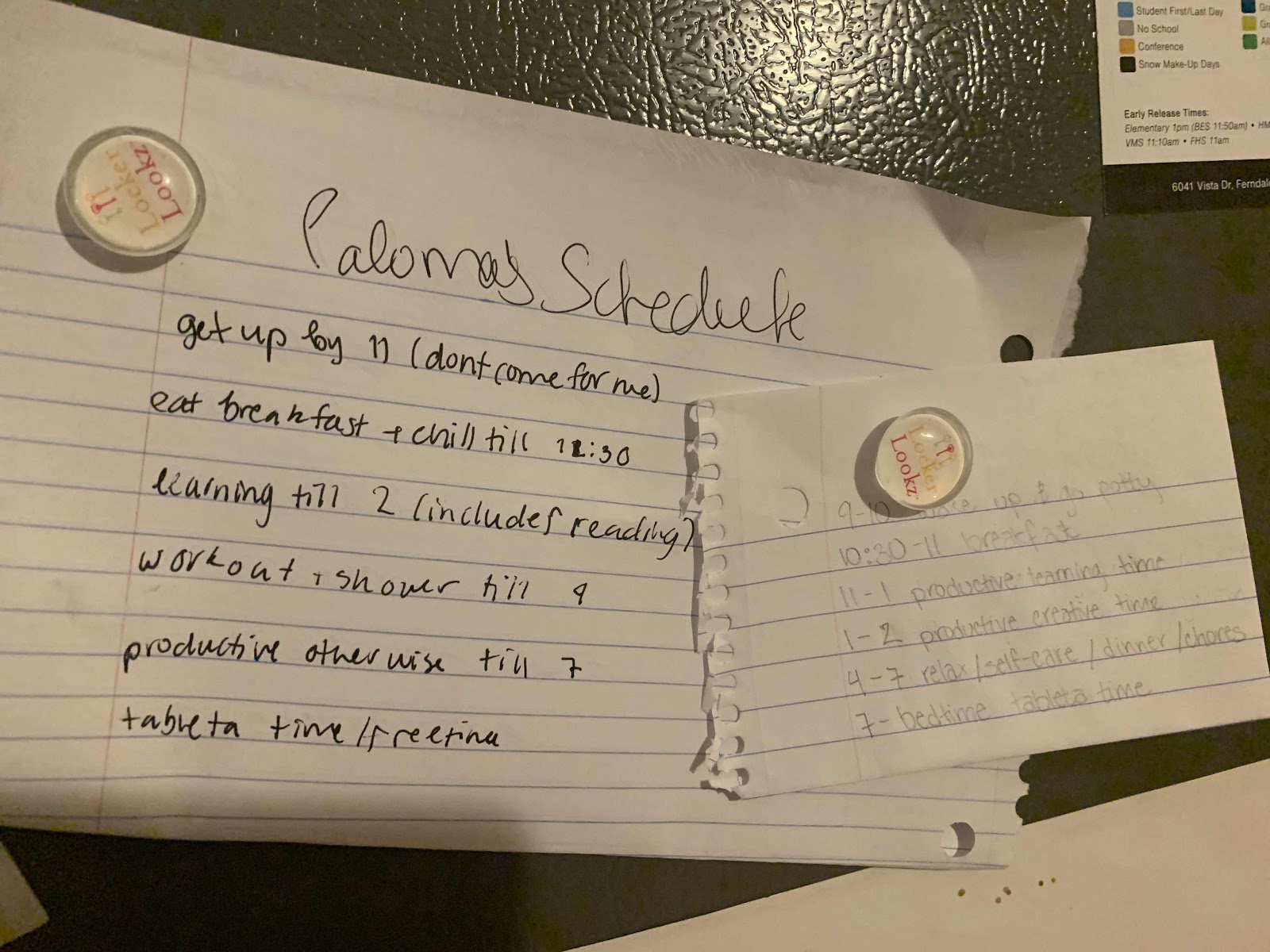


I especially like Paloma’s first line item: “get up by eleven (don’t come for me).” 

Each schedule has to include a two hour block of time for school related work (their teachers can’t assign work that will be collected and graded, but they can post “suggestions” online) and a two hour block of “productive other” time. This second category can be anything from playing piano to drawing to exercising to working in the garden to reading a book. Other than those two categories, and one chore assigned by me or their papa each day, their time is their own. 

Some examples of the chores I intend to make them do, in no particular order:

- walk the pastures and pick up all the pieces of broken plastic, plastic baling twine, or plastic bags and assorted trash they can find. No matter how careful one is, small plastic detritus accumulates over the winter. 

- turn over some of the compost pile

- clean out a drawer or a cabinet 

- harvest nettles

- organize the canning jars (full ones by contents; empty ones by size)

- use the sewing machine to make patches for mending the quilts with holes in them (our dogs have a tendency to get overexcited and tug on the bedclothes)

- clean up the greenhouse 

Like everyone else, I am imagining all the great stuff we will all get done during this enforced down-time, and like everyone else I am probably fooling myself. It’s unlikely I will take up a musical instrument or learn a third language. A more realistic hope is that I will have time and energy to put in a small garden - something I haven’t done for a few years - and read a few extra books. Perhaps do some drawing. Within a month the goats will kid, and soon thereafter it will be cheese season again. 

A good chore for me would be to find, clean, and organize 
my cheese making equipment, and order new cultures and supplies. 

Another good chore for me would be to commit to keeping a blog diary of our lives during this time.  Nobody knows how this is going to play out. Things could stay bad for a long time. Many of my neighbors are elderly and frail and are really not supposed to go out at all. Tomorrow I will talk about local efforts to pull together and provide help and services for folks who are ACTUALLY quarantined, and for folks who have lost their jobs, and those negatively affected in all sorts of ways by this unprecedented situation. 

Stay healthy! 
Tuesday, October 1, 2019

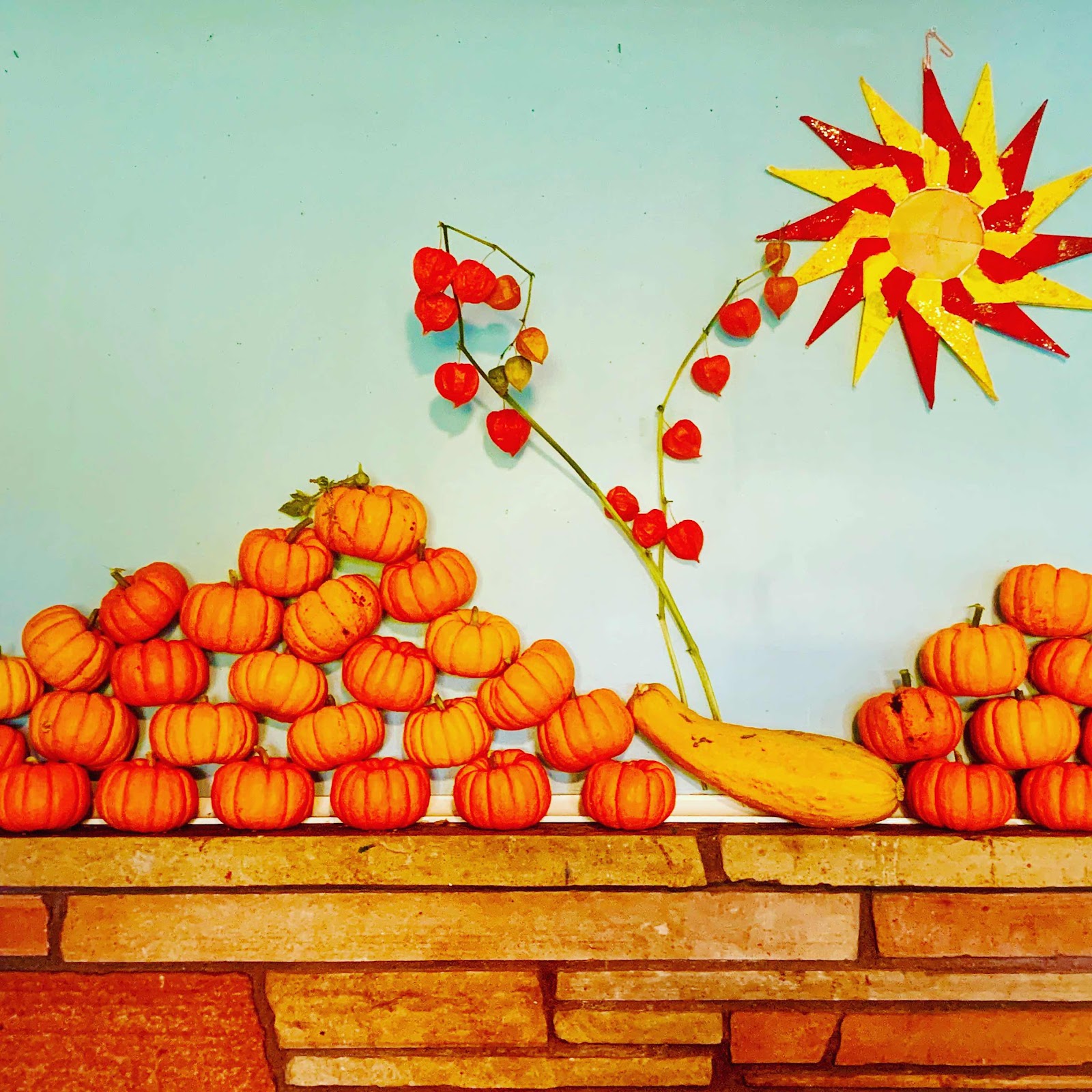
October Altar (Waste Not)


An enormous volunteer squash plant grew out of our compost pile this summer. This happens not infrequently, and because squash vines love rich compost, the plants tend to sprawl over vast areas and produce prodigious amounts of squash. However, most summer squash are hybrid varieties, so volunteer plants that sprout from discarded seeds are unlikely to bear fruit that is much good for eating. 

All squash blossoms are nice for eating, though. We picked many many blossoms for stuffing inside of quesadillas, or for stuffing with goat cheese. But no matter how many blossoms we picked, there were plenty left over for making squash. Past volunteer squash have produced warty gourds, yellow crooknecked squash but with hard shells and thin meat, or strange globular fruits. This one produced tiny rubbed hard shelled pumpkins, the kind you see 
decorated  with googly eyes and painted grins in bins at the grocery store in October. I’m sure they would be poor eating, but they make a nice autumn altar. 


After we picked all the little pumpkins, I let the goats go to town on the giant vine. They appreciated it. After we enjoy them on the altar for a while, I am donating these little guys to my sister, who is a pre-school teacher. No doubt they will all be festooned with googly-eyes and painted grins. 

Happy Fall to you and yours. 


Thursday, March 24, 2016

State of the Farm (Spring Equinox)


grey spring


I know, I'm a few days late on the equinox. That's okay, I feel like I'm a few days late on everything these days. I have been working a lot more than usual at my non-farm job (medical interpreter). Today, I was out of the house by 5:45 and didn't get home until just now, about a quarter to five in the afternoon. That's not typical - on an average day I'll spend four or five hours outside the house, but even that much really cuts into my farm-and-house work time.

I suppose, to be honest, what it really cuts into is my free time. Reading, cruising the internet, blogging, leisurely baths.... all those things are luxuries, of course, to a mom with a job and a farm. Before I worked outside the home, I used to do my housework at a nice slow pace. I might sit down with a cookbook, read for awhile until something piqued my interest, then go shopping for ingredients and spend the afternoon cooking. Now I boil up some noodles or fry a bunch of eggs at short-order speed, trying to fit dinner in between after-school activities, homework help, evening chores, and bedtime.

Homero has been picking top an awful lot of slack, lately. He does the morning chores almost every day, including milking. We are giving an awful lot of milk to Haku simply because I don't have time to make cheese. He's getting fat, though it doesn't seem to slow him down any, more's the pity. We finally had to strip the playroom of carpet entirely, because he had pulled it all up and ripped it to shreds. It's down to the bare plywood now, and I am just waiting to see how he manages to destroy that.

I don't think I'm going to get a garden in at all this year. We did plant a couple of hazelnut trees and I'm going to plant a couple more apple trees, but as far as a vegetable garden, I just don't think it's going to happen. Partly this is because of another giant time-suck - the Gleaner's Pantry. I adore the Gleaner's, it brings in hundreds of dollars worth of organic produce a month, but in exchange it demands about 20 hours of work a month, broken up into three or four several-hour-long chunks. That isn't counting all the work I do at home to prepare for such an influx - cleaning out the fridge before I go - nor what I do to preserve it afterwards, whether it be canning, freezing, juicing, our whatnot. And I know I just said how much work Gleaner's is, but truth be told its a hell of a lot less work than actually gardening. When I have unlimited, varied, organic produce spilling out of my refrigerator, it's difficult to work up the motivation to pick up a shovel.

Another reason not to put in a garden this year is that we will be spending a big part of the summer in Oaxaca. This will be our first trip to Mexico since we came back from our year with Abuelita, in 2013. (New to Mexican Life) The children are super excited to see their cousins again. There's not much point planting vegetables in April and May when you'll be out of town for all of July.

It's still far too wet to start planting, in any case. This has been the wettest year to date in Washington state history  (As rain falls, so does Seattle's record for wettest wet season ...) and that's really saying something. We have used some twenty-five yards of mulch and chips this year, just to keep the poor animal's heads above the mud. The grass is growing pretty well, due to warm temperatures, but the ground is still too saturated to let the horses out on pasture. The pasture got pretty torn up last fall when our pig learned to get out of his pen, and I want to give it a good long rest. I've reseeded the areas the pig plowed up, and I need to give the seed time to germinate and get a good head start before I loose the ravenous beasts. That means we are still feeding hay, though less of it, as the goats have some browse and the ponies can be staked out in the orchard on days when it isn't raining.

Poor Rosie pony's horrible eye problem is back, and it's worse than ever. Her eye is so swollen and ugly that I'm ashamed to post a picture of it. I've been washing it with warm salt water and putting antibiotic ointment in it for the past several days, but I don't see much difference. She is clearly suffering, and besides her eye, she is looking thin and rundown. Maybe she needs a different wormer than the one I've been using - pretty haphazardly, I must admit. But as the single most superfluous  animal on the farm, I don't get much of a vet budget for Rosie. She is getting on in years, and soon I will have to start thinking about when it might be time to send her on to the great green pasture in the sky. Not yet, but soon.

We had a chicken attrition situation over the winter, as is often the case. In fact, the chickens and turkeys were disappearing at such a clip late last fall that I invited a couple of local boys to lay out in the field with .22 rifles and wait for the coyotes to show up. The coyotes never did show up, but when the boys were scoping out the perimeter, they said we had both canine and feline tracks in the mud along the fence line and suggested we probably had a bobcat as well as coyotes preying on our poultry.

The chickens are locked in the coop, now, though I hate to do that to them. This time of year it is always wet in the coop, and the chickens really ought to be out scratching for spring bugs and eating the worms who are lying about all over the place, trying not to drown. There are five hens left, but only three of them are laying. Two of the three eggs that I gather each day are distinctive - the tiny egg is laid by the one banty hen; the white egg is laid by the lone leghorn - but the third egg could be anybody's, so I don't know which hens are the slackers.

Five chicks are in a big wooden box in the shed, under a heat lamp. I brought them home last week. They are leghorns. I had never raised that breed before (most commercial layers are leghorns) because I thought I wanted a dual purpose hen, one that was heavy enough to eat when she ran out of eggs. But time and experience taught me that actually, I am not interested in a free-range old layer hen as a culinary item. It's nasty. And then I acquired a couple of leghorns - I disremember how - and was very impressed with them. They are small, streamlined birds. They are bright white (we named them Pearl and Shell) and are good flyers, which keeps them a bit safer from predators. They will never go broody, which means they lay more eggs per year. They are regular egg machines - each hen laying one large white egg a day, with only the very occasional day off. I liked them so much I decided to buy all leghorn chicks this year. Five isn't very many, but assuming that at least three of them live to laying age (you never know with chicks) they will provide more than enough eggs for us.

Let's see, what else. Oh. Out of Flopsy's four babies (The (Finally) Four) we only have one left. On the day they kidded, I gave two bucklings away to a neighbor farmer lady who enjoys bottle babies. I do not enjoy bottle babies. We kept two babies on Flopsy - a beautiful buckling and a fabulously gorgeous spotted doeling. But there was soon a problem. Both babies only wanted to nurse off one side. Flops had mastitis and now has lopsided teats - one normal teat and one small one that gives about half as much milk. Oddly, they both wanted only the small one. I guess the big one was difficult to latch onto. Since the buckling was bigger and stronger, he drained all the milk from the small teat and the little girl didn't get any. I couldn't seem to teach her to use the big teat. After a few days, I went out in the morning and found the little girl flat out and cold. That happens if they don't get enough milk - they just lie down and give up the ghost.

I tried to revive her in a warm water bath and get her to take a bottle, but after a frustrating 24 hours I knew I wasn't up for it. I called the same neighbor and told her she could keep there baby girl if she wanted to try and save her. My saintly neighbor told me to bring her on over. She worked patiently over the next day and succeeded in getting her to take a bottle. Then - this is so cute, I wish I had a picture - my neighbor's pigmy doe kidded with a single kid. And our little baby Nubian girl went straight for the teat. She hadn't forgotten hoe to nurse. So now, this valiant pigmy Nigerian is nursing her own kid, plus a Nubian kid, who has to practically lay down in the dirt to get to the teat.

My neighbor insists on giving us the doeling back when she is old enough to be weaned. She says that keeping the two bucklings is payment enough for the trouble of caring for the doe. I told her not to make up her mind just yet. Assuming that little Ziggy (as her children named her) lives and thrives, she ought to be worth a fair amount of money. I said she should feel free to sell her, but so far, she continues to say she will give her back to us. If so, then we will have two new does from this season, Ziggy and Christmas. That will make up for the two I plan on retiring - Iris and Flopsy.

The farm goes on. 2016 is a new year, our eighth here on this windy wet hill, I think. I'm not quite so "new to farm life" as once I was. We are settling into a good groove. I know now, more or less, how many animals the land will support, and what sort of animals are most useful and profitable to us. I continue to learn about husbandry, both of the land and the animals - and, I suppose, of my children and of my marriage and of my very own soul. I really do love to feel the slow deepening of knowledge and experience that comes from knowing a single place - or a single person - intimately, and living with a single place - or a single person - intimately, in all of its seasons, in all of its moods, in all of its slow splendor. This land, this place, this time, these people, these animals, this carefully tended ecosystem - here we all are, surviving. Hopefully thriving. Caring for each other as best we can.


Monday, April 27, 2015

Homero's New Toy (the Craigslist Chronicles)


A few weeks ago, Homero made a spectacular find on Craigslist - a Case loader for under a thousand dollars, more or less in running condition. He has wanted a tractor for ages - he has major tractor envy of our neighbor, who has a small, spanking new Kubota with a loader and a backhoe. But the truth is that five acres does not a tractor justify, not unless you have some sort of intensive revenue-positive business on your five acres that requires a tractor. An occasional need to move barn-litter or patch potholes in the gravel driveway does not count.

Our neighbor, by the way, also has five acres. When he bought his Kubota, complete with field mower and rototiller attachments, he spent week after week going over his land, converting it fairly quickly into dust, which blew away in the wind or ran down into the ditches with the rain. We shook our heads, but what can a neighbor do? What is a friendly warning about erosion, compared to the seductive smell of diesel exhaust? 

Homero sensibly sold me on the idea of buying the Case by explaining how he would make a few minor repairs and then sell it for triple the purchase price. Maybe that will happen. Who am I to say? What do I know about the value of small farm machinery? Not a whole lot.  Meanwhile, Homero has been enjoying playing with the loader.

My brother in law brought a load of chips recently, which had stayed in a pile in front of the barn for lack of a way to spread them. Done - a neat, four inch thick carpet is laid over the muddy area. The barn litter, which I had simply forked out through the window into the old pig yard has now been moved over to the compost area. And best of all - the old compost pile has been turned and turned and turned again. 


Some of the compost goes back five years. I guess it can fairly be called topsoil now. Grass had grown thick over the top of the oldest mound. I certainly wasn't going to try to turn it by hand, with my creaky shoulders and my obstreperous lumbar region. There it sat, a four foot high mound, fifteen feet across, inviolate, until today. 

Homero spent the last hour of daylight this afternoon practicing with the loader, going over and over the compost, turning it and turning it again. When he was done there was a pile of beautiful loose dirt - black as a devil's food cake; moist, crumbly, squeezable, and absolutely heady with the smell of freshly turned earth. I cannot doubt that it will work magic in the garden. Somebody's garden, anyway - I plan to offer it for sale on Craigslist. Turnabout's fair play. 


Sunday, March 1, 2015

State of the Farm, Early Spring 2015

This has been, nearly, a year without a winter. We had a hard freeze and a few inches of snow way back in November, and several frosts over the months, but generally speaking it has been one of the warmest winters in recent memory. The local snowpack is at historic lows: about 30% of normal in the north cascades and less than 12% of normal in the Olympics and Vancouver Island. Everyone is expecting a protracted drought this summer and water restrictions.

Once again I have failed to make use of my several 275 gallon totes, which were originally purchased to store the spring rains for the dry season, for use in the garden. I still have not (after five years) set up a system to collect rainwater from the roof. Here's what I do have: a gigantic plastic cone, purchased from the vet for my long-gone standard collie. I'm thinking I can still set it into the opening on top of a tote and use it as a kind of enormous funnel. At the moment, the totes (those that have not been appropriated by my husband for his biodiesel manufacturing or for waste-oil storage) are sitting uselessly about, cluttering up the landscape.


Lancelot


This is just about the earliest spring anyone can remember. A wasp was blundering about inside the greenhouse shortly after New Years. I saw a honeybee in the first half of February. The first Killdeer's piercing cry was heard on January 31st (I made a note of it), and the choir frogs, known locally as Peepers, began to sing weeks ago.


Walking  around downtown some ten days ago, I saw crocuses and daffodils. One house, for an unknown reason advanced in springtime beyond its neighbors, even had a rhododendron in full bloom. 


Rhodedendrons are strange plants - I have a whole hedge of them, some fifteen completely mature bushes, and they are individually glorious, but I've never understood why their bloom times are so widely staggered. The first two, with delicate deep purple flowers, are blooming now, albeit mostly still in bud. The others - scarlet, white, mauve, and coral - bloom at odd intervals anytime between now and early June. It's nice to have an unending procession of flowers, but quite mystifying as well. Personally I would never have planted Rhodies - they are very poisonous to livestock - but I'm certainly not going to tear out a whole bunch of forty-year old, spectacular bushes. 

I was almost too late to prune the fruit trees. The buds were already swollen. You can actually prune at any time, it's only a courtesy to the trees to do it while they are dormant. Since I only lop off a few little suckers here and there (I am a very timid pruner) I figured I might as well wait until the juicy buds would provide a snack for the goats. After a long winter on a pure hay diet they appreciate the woody browse.  The buds on my orchard have not yet opened, but the ornamental cherries in town are a snowy mass of blossom. 

It is time to exert myself in there garden, if I plan to have a garden this year, which is something I have not yet decided. On the one hand, I have had some sort of garden every year since I was seventeen and I would hardly know who I was if I didn't poke a few seeds into the ground. On the other hand, I barely have time to wipe my nose after I sneeze these days, what with my new job (medical interpreter) and my volunteer duties. The Gleaner's Pantry  provides us with as much fresh produce as we can possibly eat. If it isn't as fresh as it would be from my own garden, well, neither does it require as much backbreaking work with a shovel. Right now on my stove there simmers a stew made with chickpeas from my pantry and kale, tomatoes, onions, garlic, and bell peppers from the Gleaner's. It is hard to justify the work and time to put in vegetables when I can have as many as I want for basically free. 

Actually, I have already started a tiny little garden. Two weeks ago, during the warm spell, Paloma had a friend over and she brought her little sisters. I amused the girls by bringing a half a dozen egg cartons out to the greenhouse and letting them fill them with sifted compost and plant a packet of sugar snap peas. They are just emerging now. In another week or so I will tear the carton into its component compartments and plant them directly into the dirt. I also filled up a couple of wooden planters and sowed them with arugula, which is already knuckle-high. Who am I kidding? There will be a garden here as usual. 

Let's see, other spring news.... I walked the pasture perimeter yesterday and saw that if I want to harvest nettles this year now's the time. Nettles are delicious - they make the most wonderful soup ((Stinging Nettle Soup (Wild Spring)) and I've heard they also make great pesto and tea, though I couldn't testify to that. 

With only one doe milking, I am not making a lot of cheese, but what there is is good. On the porch outside the kitchen I have a few planters full of herbs, and the clump of chives is up and green. To me there are few tastes as evocative of spring as green, oniony chives. I snipped a handful and chopped them fine and added them to some freshly made chèvre, and then I sat down and ate an unholy quantity spread on plain crackers, with red grapes. 

I love Springtime. 


Saturday, January 10, 2015

Seed Catalogue Season (Plant Porn)


My daughter Rowan started a garden a few years ago; a big garden, with the idea that she would have a booth at the local farmer's market. She got a business license and called it "The Enchanted Broccoli Forest." Yes, I know that name is already taken. I told her that - I have the cookbook - but she didn't care. And it doesn't matter, because her business has never actually advanced as far as selling anything. Pretty much all the success has been on the supply side, so far, not so much on the demand side.

One of the consequences of having an actual gardening business, even if it has yet to make a penny, is that you get dozens of seed catalogues in the mail. January is prime seed catalogue season; so far I think we have received somewhere in the neighborhood of fifteen or twenty. Rowan and I both love seed catalogues - really, what gardener does not? Such a wealth of possibility, so much fun imagining the ultimate garden that this year - this year! - will be a reality. I'm sure some people get the same satisfaction leafing through Architectural Digest imagining their dream home, or Vogue, imagining their impossible wardrobe. I could care less about clothes or decor - give me plant porn.

While we were in Mexico, Rowan used my garden space and greenhouse, and when we came back she moved her garden to a friend's house. This year, we've decided to both use the garden space and greenhouse here at the house. Lord knows, I don't make full use of it. I'm sure there's enough room for both of us. We have a 10 x 12 greenhouse with shelves and a fenced garden area of about 800 square feet, or enough room for ten or twelve long beds. Last year I used four of the beds. Maybe together we can put the whole space to use.

Rowan and I have differing ideals, as well as differing abilities, when it comes to gardening. I have the time and the money; she has the muscle and the energy. She wants to grow a wide variety of interesting and beautiful, unusual edibles, such as purple pole beans and cheddar-cheese cauliflower. She looks for weird and rare varieties of garden staples, such as the beautiful Peacock Broccoli or the wonderfully named Frizzy Headed Drunken Woman Lettuce. Her main priorities in choosing a plant are beauty, oddness, and "wow factor." I have different ideas.

Seattle recently launched a very cool and innovative vision - the Food Forest . If you haven't heard of it, the idea is to grow a whole bunch of trees and shrubs, bushes and other hardy perennials that can provide food for local gatherers and foragers free of cost. I think this idea may have been a natural one in an area that so amply provides the wonderful hardy (if invasive) perennial the Himalayan Blackberry. Most Seattleites are accustomed to harvesting berries from roadsides and parking lots every August, and some of them (like me when I lived there) are not averse to seeking out neglected apple or plum trees and helping ourselves. I love the idea of the Food Forest and I hope it flourishes.

On my own five acres, I'd like to eventually have something similar. I want to create a habitat for as many edible perennials as I possibly can. Mainly because once established, a perennial garden is WAY less work than an annual garden. So far, I have a pretty good orchard, two healthy rhubarb plants, a nice little strawberry patch, and a thriving if small raspberry patch. And of course there are the wild perennials - blackberries, mushrooms, dandelion, nettle, dock, thistle, and clover. All harvestable edibles which we take advantage of to one degree or another. Here are a few perennials I'm still missing which I'd like to establish:

- an asparagus bed. In one of those catalogues above there is a special deal - 15 asparagus crowns for only $7.00. I have not planted asparagus yet because I don't want to wait three years to start harvesting it - but by that logic I never will. So this is the year. I will give over one of the garden beds to asparagus permanently.

- grapes. I've tried grapes here twice before and they have died each time, but that's because a certain male person who shall remain unnamed repeatedly mowed the vines down with the weedeater. I'm going to try one more time - I'll use a locally adapted variant of the Concord called the Lyn-Blue. It's an eating and juice grape, but I don't much care about the eating quality because my main interest is in the leaves.

- hazelnuts. I have one thriving and beautiful hazelnut bush which flowers abundantly every year but which never produces any nuts. Obviously it needs a pollinator, but that is hard to come by as I don't know what variety my bush is. I'll have to buy two or three separate varieties of hazel and plant them all; that will assure that one of them at least will fertilize my well-grown bush. I hope.

- plums. Similar issue with a lovely Greengage Plum I planted years ago and which flowers every year but which has never set a single plum. I need top look up what the pollinator is and plant one.

I also have a yen for a few non-edibles this year. Looking through the catalogues, there are some great deals on trees - trees which do not produce food but which are still beautiful. We have a severe lack of trees on the property and personally I think it is the civic duty of everyone who has room to plant a few trees for posterity. I'm gong to try a couple of big old fashioned weeping willows and a couple of paper-white birches. And, of course, this year's Christmas Tree.


Tuesday, September 30, 2014

We're Having Authenticity For Dinner (Tepache)

tepache in the garage


We are having a pretty simple supper tonight: pan fried trout, baked potatoes, and braised red cabbage. It smells wonderful in my kitchen right now (even though I haven't fried the trout yet) and I thought I'd put up the recipe for the red cabbage. But when I started to compose it in my mind, I realized that this recipe - and those for the other components of dinner -is actually very involved, and interesting, if I describe it correctly.

It's apple season. I love apples, and I love apple season, but we still, after seven years here, do not have our own apples. I have a beautiful old cider press and every year I go in search of apples to feed it. Two weeks ago, a lovely older couple from church told me they would be happy - nay, grateful - if I would go to their house and pick apples from their six trees. Every year the apples fall all over the yard and they are getting rather elderly and stiff to be picking them all up. My sister and I went together and picked something like three bushels of apples, and spent a few minutes picking up windfalls as a thank-you.

Then I pressed cider with a neighbor, who also brought a few bushels of apples. Fresh cider is wonderful, and we drank as much as we could as fast as we could, but even so, there was a three gallon carboy leftover that fermented gently in the garage. A week after the pressing, the cider in the carboy was fizzy and delicious, lightly alcoholic (probably one-and-a-half percent, so weak that I let the children drink it), and beautiful over ice on a warm September afternoon. Now, two weeks after that, it is edging into apple cider vinegar territory.

It isn't quite vinegar yet. But neither is it cider anymore; what I have now is a couple gallons of tepache. Unless you are Mexican, and a rural Mexican at that, you probably don't know what tepache is. Tepache, along with pulque, is a quintessential rural Mexican beverage served at festivals and rodeos and birthday parties back in the hill country, and out of clay jugs on market days in small towns. It can be made from apples, or peaches, or plums, or various Mexican fruits that don't grow around here, such as ciruelas and tunas. Basically, it is a weak fruit beer. It's impossible to get drunk on tepache, but if you quaff enough of it on a hot Mexican day while watching a parade, you can get a small but pleasant buzz. The tepache in my garage is fairly far over onto the vinegar side of the spectrum. It's still tasty, but I wouldn't want to drink a pint of it. There is still a gallon and half of it, however, and I have to do something with it, fairly quickly.

Today was a gorgeous day, sunny and warm. The garden has been neglected lately, and it was past time to get out there and pick what was left to pick, dig the potatoes (which was a chore, since the plants died back ages ago and the weeds grew over), and do general cleanup. There's not a whole lot left, but I picked a quart of cherry tomatoes and dug a few pounds of potatoes. There are six red cabbage and I picked two, leaving the other four in the ground for later. I ate the last of the overbearing golden raspberries as I worked. The hubbard squashes, which did not do well, have died back already and I brought in the two small blue squash. My chiles dried on the plants ion the greenhouse and I picked them all as well. I am by no means done putting the garden to bed, but at least I made some progress.

Carrying in my potatoes and cabbage, the outlines of dinner came to me. Several weeks ago, my daughter Hope's best friend came over to spend the night, bearing a dozen beautiful little trout she had caught with her grandfather, already cleaned and frozen. I took the trout out to defrost and sliced the potatoes to roast in a shallow pan with olive oil and salt.  I wanted to give the cabbage a German/Eastern European treatment, braised with bacon and spices. I looked up a few recipes, and all of them called for apple cider vinegar. Well, of course I have some apple cider vinegar in the house, but I thought tepache would serve beautifully.

Except for the spices, everything we are eating tonight came from either our own garden or a neighbor. Everything is local to within a few miles. Everything was procured with our own labor and knowledge, or our friend's labor and knowledge, and grown in our own dirt.

Once, years ago, when I wrote a post about the importance of being able to produce my own food, my brother told me he didn't see the difference between producing your own food with your own labor, or using your labor to make money and buy your food. It was kind of an "if you have to ask, you'll never know" moment, but I just thought of an analogy he might get. What's the difference between writing a piano concerto yourself and playing it on a piano yourself, or paying somebody to write and preform a concerto for you?

Braised Red Cabbage

1 medium or two small heads red cabbage, from your garden. 
1 large red onion, ditto
1/2 pound bacon, preferably from your own pig
1 pint homemade tepache
1 tsp caraway seeds
1 tsp black mustard seeds
6 allspice berries
1 tsp black peppercorns, crushed
1/2 tsp salt

In a medium saucepan, fry chopped bacon over medium heat to render fat. Saute sliced onion and sliced red cabbage. When vegetables are beginning to soften, add spices and fry for a few minutes more. Add tepache and bring to a fast simmer. Cover and cook until cabbage is very tender, about 30 minutes. Salt and pepper to taste. 


Thursday, August 21, 2014

Harvest Time (Buckets Of Spuds)


Yesterday I harvested all the rest of the chiles off my cayenne plants. There were a few green ones hanging on, but most of them were fully dried on the plants. It was the best year for chiles I've ever had - I don't know if that's because I only planted cayennes and cayennes do well, or if there is some other mysterious reason, but in either case I think I am well fixed for heat. 


This picture of a bucket of spuds came off the internet, because I don't have my camera handy, but the bucket of spuds just outside my door looks pretty much the same. I have white potatoes and russets as well as redskins. It's funny - I planted a lot of potatoes this year, but then I totally ignored them and didn't weed at all. The potato patch looks like a jungle of thistles, amaranth, dock, and chicory. The potato plants themselves died back some time ago, and I sadly figured there would be no potatoes under there. 

Today, however, a friend asked me to bring her some lamb's quarter to plant in her garden for her rabbits. I told her to reconsider, I said it was a plague on my land and she'd olive to regret it, but she wants some anyway. So I went out to the potato patch and shoveled up a plant. Along with the lamb's quarter came three or four big, healthy potatoes. 

In the next five minutes, I uncovered a three gallon bucket full of potatoes. I decided I ad better stop. I don't want my lovely, unexpected potato crop to go all wrinkly and flabby in a drawer; we can leave them in the ground and dig them up as needed until the frost. I dug less than a tenth of the whole patch; I think we will be eating a lot of potatoes this fall. 

Other success stories this year (with pictures to follow someday):

- Tomatoes. I bought a whole flat of unmarked tomatoes in May and planted out some twenty plants before I got tired. They all did well, and I am now picking tomatoes every day. Mostly cherries, some Romas. 

- Pickling cucumbers. I've never had luck with cucumbers of any kind before but this year they did pretty well. Four plants provided me with enough cukes to keep my kitchen-table fermenting crock full. I also like to throw in the crock any extra... 

- Green beans. You can never have too many green beans, in my opinion. I planted blue lake (I think?) pole beans and yellow wax bush beans. They both did great and in addition to eating them fresh I canned six pints of hot dilly beans. 

- Red cabbage. I have six big cabbages out there that I probably ought to harvest before the slugs get them. 

Things that didn't do so well this year were the early spring crops - I got barely any peas, radishes, or spinach. Too wet, I think.  had to replant peas twice because they just rotted. Also I planted cantaloupes in the greenhouse and although the vines grew well, they only set two melons which are now about the size of softballs. I don't think anything is going to happen with those.  And my winter squash aren't too good, either. I have a grand total of two butternut squashes et, and two hub bards. If the hub bards get to a good size that will be enough, but who knows if that will happen. 

There is one other amazing plant this year, but it isn't in the garden. It's a volunteer yellow crookneck summer squash that grew out of the compost pile. I have never seen such an amazingly huge squab plant. this one plant has covered an area of about 200 square feet, sprawling all over the compost and out into the field in all directions. It has at least twenty-five squashes on it, and many many dozens of flowers. We have been eating the squash blossoms in quesadillas and soup, but I haven't tried one of the squashes themselves yet.

Overall I would call this one of my more successful gardens. I'm definitely happy with the tomatoes and chiles, and the discovery of such spudly abundance today was a welcome surprise. How about y'all? How is your garden doing?


Friday, May 16, 2014

Spring Pictures (Voyeurism)

It may be the middle of May, but spring is finally in full swing here in the upper northwest. We have enjoyed nearly an entire week of very warm, sunny days. Yesterday I took a walk around a beautiful residential neighborhood in Bellingham, cruising the alleys and checking out the backyard gardens.

Although I am only a few miles north of Bellingham, my homestead has a very cold microclimate (as I think I may have mentioned once or a thousand times) and it is always surprising to me to see just how much further ahead the season is downtown as compared to here.


Irises are my favorite flower. I have gorgeous giant blue irises in my yard (a few years ago I traded eggs for bulbs) but they haven't bloomed yet, they are still stately green spires. These irises were lovely in the afternoon sunshine.


forget-me-nots


Bleeding hearts


Columbine

I don't grow flowers - except for that one clump of irises and the rhododendron bushes that line the front path I am content with wildflowers on my property. But it was lovely to see the flower gardens surrounding the beautiful old homes on my walk yesterday. I am a bit too practical for flowers - unless it's edible I'm not really interested in growing it. But these flowers almost make me change my mind. Almost. 

There are plenty of edible-oriented garden in the downtown areas, as well. That's one of the reasons I like to walk the alleys - most people plant their flowers out front and their vegetable gardens in the backyard. I would say nearly every home has something edible planted - a fruit tree or other perennial - and about a third have an actual garden of some sort.  Favorites in our area include:


Rhubarb


Raspberries; so many homes have a line of raspberry canes running along the back of a shed or the alley. These are in bloom. The flowers are not impressive, but there were plenty of bees. Grapevines are also a popular item, and now are just putting out their fresh green leaves and tendrils. 

I have definite voyeuristic tendencies when it comes to other people's yards. I like to look and see how they have things organized and think how I would use the same space for food production. All those little flower bushes could be blueberries, for example, and that weedy space on the side of the porch looks just right for a chicken coop.... I'd train a grapevine over that carport, I think, or use that sunny lawn space for raised beds...

I can't be the only one who does this. Mentally rearranging other people's space is a fun exercise, but the truth is I have plenty of actual rearranging to do here at home. Last week I went to a giant plant sale and got a lot of plants, cheap. I have to get them into the ground soon. I bought a flat of roma tomatoes (which can finally be set outside) and several containers of strawberries. I'm running out of garden space... but that's another post. 


Monday, April 21, 2014

What's Wrong With These Pictures?


The pear tree is in full bloom. The sun is out and the temperature is near sixty degrees. This tree ought to be crawling with bees, but I haven't seen a single one. I haven't spotted one - not one! - honeybee yet this year. I've seen yellow jackets, and one lonely bumblebee, but not a single honeybee. 


No bees on the dandelions. 


No bees in the rhododendrons. Usually, these flowers are favorites of bumblebees, with a fair number of honeybees as well. Nothing so far. Nothing. 

It's scary. Colony Collapse Syndrome  has been around since at least 2005, and despite intense research, there is of yet no consensus on a cause. Most likely, it is due to a combination of factors including pesticides (especially nicotinoids, which has been banned in Europe for this reason), parasites, viruses, and possibly GMO pollen. 

This year, we also had an unusually harsh winter and a very late, cold spring. It's possible that many local hives simply didn't make it through. My friends who keep bees say their hives are active, so I know that most bees ought to have "woken up" by now. I wonder what the orchard fruit crop will be like this year with no pollinators out during maximum bloom time. I wonder about the garden. 

We used to keep bees, but when they died in a winter storm (Bad Bee News; Baby Broilers) we didn't replace them. The equipment and medicine is expensive, there is a fair amount of regular maintenance and work to be done which nobody was really excited about, and as it turns out I have a pretty intense allergy to stings. One sting will make an entire limb swell up and itch horrifically for three or four days. 

We may try again with bees, someday. We may have to. There may come a day when if we don't keep bees we just don't get fruit and vegetables. I hope not. I hate to think about a world without feral bees, but it may be just around the corner. Already, in case you didn't know, the nation's berry, orchard fruit, and nut crops, as well as many other crops (full list here) are dependent on managed commercial hives, trucked all over the country by a shrinking number of professional beekeepers. 
Without those beekeepers - who are routinely sustaining losses of half their hives every year, year after year - we will be a poorer and hungrier nation. 


Wednesday, March 19, 2014

State of the Farm (Spring Equinox)


When two feet of snow melts, it leaves a lot of water. For more than a week, there was a tiny running stream going out the driveway and into the ditch. As it warmed up, we passed from winter to spring, as marked by the beginning of mud season. The mud is knee deep out in the barnyard, viscous and hungry. Pulling my boot out of the mud takes real effort, and once in a while my knee joint slips out of place as I pull, being weaker than the mud. 

The thaw was followed by a few fair days, and even though I knew better, the warm sun tempted me to plant a packet of snow peas. I do this every year; I can't seem to resist the temptation to plant too early. Mr. B., my 80 year old neighbor who has had a farm stand for some sixty years, shook his head at me dolefully when I told him, over coffee in the church basement, that I had planted peas. 

"Them peas'll rot in the ground," he told me. And I know he's right. It rained like murder the last three days. But what the hell - the exercise was good for me, it won't hurt me to repeat it in another week. 


The arugula in the redneck cold frame is doing better. The soil was so warm I had to take the glass off; then I had to put it back on to save the sprouts from drowning. The other bathtub is full of mixed mustards; they are further along than the arugula. The first vegetable and herb starts are available at the farm store, and I bought some italian parsley. They pack about a hundred seeds into a three by three pot; separating them is a laborious task. I did the best I could and planted a 12"x24" container with them. Hopefully that will keep me in parsley for the summer. I also have radish and carrot seeds on hand, ready plant whenever the next stretch of dry weather comes along. 


Rowan's boyfriend, P. (I must come up with a blog nickname for him) pays me rent in work. I charge him and Rowan each eight hours of work a month in rent. I think it's a fair deal - that's $100 a month at $12/hour, roughly. This month, he's been doing general yard clean up and last week it was dry enough to actually make a burn pile. We got rid of all the scrap wood - broken chairs, rotted lumber, fruit tree prunings - and paper-based trash about the place. It makes a big difference. I am planning a big party for May and I don't want the homestead to look like Arkansas circa 1936. 


Lucky for us, the annual breakdown of the dryer coincided with the start of spring. Homero made one attempt at fixing it that took him most of a day, but it still makes a hideous clonking and squealing whenever we turn it on, so I asked him to string some clothesline instead. Even if the dryer doesn't breakdown, I try to switch to air-drying during the warmer months. Why pay for electricity when the sun and the constant stiff breeze up here will do the job for free? 


More cleanup: there were three winter squash that didn't get eaten over the winter, and with the warm weather they finally began to get soft and icky. For a while I kidded myself that I could still save the seeds, but finally the mold took over and I threw them out on the compost for the chickens. This is what I call "spring cleaning" at my house.


Finally, spring of course means kidding season. Two of my three does have kidded already - both throwing twins. The last one is Iris. I'm thoroughly puzzled by her behavior. All winter I would have sworn she was pregnant. I saw the buck service her many times, and she failed to return to heat after his visit. Her tail skin got thick and doughy (a sign of early pregnancy) and as the season progressed, she got just as big as the other two. But they both kidded weeks ago. And Iris has gotten slimmer instead of bigger, and her udder remains stubbornly flaccid. Today she managed to slip out of the field through the loosely chained gate - something she hasn't been able to do for months. I can't figure it out. Maybe she lost the kid sometime over the past month and I missed the signs? But I haven't noticed any bleeding or discharge. I'm at a loss. She is still quite a bit bigger than the does who DID kid, so I'm not giving up hope. I'll just have to wait and see. 


Monday, February 17, 2014

Signs of Spring


This picture was taken last week, at my local park by the river. Chunks of ice were floating merrily along downstream, but this bush - whatever it is - is in full bloom. The only thing I know of that usually blooms this early is forsythia, but that's yellow. Anybody have any ideas on this?

The alder catkins have been out for some two weeks now. Even if I couldn't see them for myself, I'd know they had bloomed by the number of people sneezing and wiping their eyes. Luckily, I am not allergic to alder or any other plant, as far as I know. I feel for those who suffer seasonal allergies; it must be like having a head cold all the time - something which I can especially sympathize with at the moment, as I have one.

Then, today as I was doing the evening feeding, I heard at least two separate frogs. The first frogs of the season! Without seeing them, of course I don't know exactly what kind of frogs they were, but a quick glance at the Washington state department of fish and wildlife page on frogs suggests they were almost certainly Pacific Tree Frogs. These tiny and adorable bright green frogs are also called Peepers and their song is one of the earliest signs of spring.

Another sign of spring - itchy garden hands. Two weeks ago, during a short stretch of sunny days that heated the greenhouse right up, I placed a sheet of pane glass over a claw foot bathtub full of dirt to make the annual Redneck Cold Frame. Then I waited for the dirt to warm up. Three days ago I went to check and it seemed pretty warm to me. I did not, however, apply the traditional English method of checking the soil temperature that I heard described by an English lady on the radio the other day. "Just take your knickers down and sit your bum down. If it feels nice and cozy, you're ready to plant!"

I used my elbow, and although it might be just a wee bit hardier than my nether region, nonetheless I decided to go for it. I planted arugula, which is what I usually plant first thing. The Idiot Gardener says I shouldn't plant arugula this time of year (he calls it "Rocket") but I don't have to listen to him, as he is an idiot. Just to cover my bets, I will plant mixed mustards in the other bathtub next week.

How about you? Any signs of spring yet where you are?

Monday, January 27, 2014

Spud 'Speriment (Potato Poetry)

Today I was cleaning out the kitchen drawers. There's a big drawer on the bottom, lined with brown paper bags, that I use for potatoes and onions. This drawer tends to get a little, um, icky after a while, filling up with onion skins and soft, sprouty potatoes. This tendency has intensified somewhat since I started going to the Gleaner's Pantry (Scavenge City (Gleaner's Pantry)). Turns out that I sometimes bring home more potatoes than we can actually eat before they grow long, pale whiskers.

Of course, as long as the potato itself is still firm, not flabby, it is perfectly permissible to rub the whiskers off and cook the potato as usual. Often I do that. But this morning, as I was excavating the drawer, I came across a pound bag of lovely little fingerling potatoes that had sprouted. Previously, we had eaten several bags of these fingerlings, and so I know they are wonderful potatoes: nutty, dense, creamy, and delicious. I remember thinking "I ought to try to get ahold of some of these for planting this year." So, of course, when I found them all sprouted and ready for planting, I had to think about what to do with them.

It is still January. January is a ridiculous time to plant potatoes. Not only will we certainly have a few more hard frosts, but even if we didn't, the wet ground will rot any potatoes that I plant too early - meaning, before the end of March. Ask me how I know this. Yes, because I have repeated that elemental error several times in my pre-spring gardening ardor.

Other things I know about growing potatoes, in no particular order:

- people say they are the easiest of crops to grow, but I haven't found that to be the case. In only two of my six years here have I had a really good potato crop.

- people are also always saying that you can grow potatoes in containers easily, but I have not had luck with that, either. My two good crops both came out of the ground, and out of containers I have harvested only small, rather disappointing crops.

- it is strongly suggested in gardening books on my shelf that one buy seed potatoes for planting and that one does not use grocery store potatoes for planting. This is because seed potatoes are guaranteed free of various diseases and viruses, whereas grocery store potatoes are not. Nonetheless, anyone as cheap as I am (or, if you like, as frugal) will not like to waste grocery store potatoes that have become inedible, but will try to salvage them for seed. That's what my dad always did.

- "chitting" is the process of pre-sprouting your potatoes, i.e., what naturally happens to any potato left in a dark drawer for too long. I was somehow completely mistaken about the meaning of this word, and thought it meant just the opposite: rubbing the sprouts OFF of your potatoes sometime in january so that they would not go all soft and flabby and would still be viable for planting come spring. (http://www.motherearthnews.com/organic-gardening/greensprouting-potatoes-zb0z1203zlon.aspx) I got this idea from reading some memoir, the title of which I cannot now remember, by a woman who grew up in Iowa during the depression and described "chitting the potatoes" as her least favorite job as a child. Going down to the cellar and handling the pale, soft, spidery potatoes gave her the heebie-jeebies, she wrote, but if the sprouts were not rubbed off, there would be no seed potatoes for the spring planting.

So here I had all these adorable little chitted potatoes, all ready to plant, and it is still january. Seeing as how it was either plant them or throw them away (I have a serious potato surplus at the moment; and none of my farm animals relishes sprouty potatoes), I decided to perform an experiment.

The south side of my house has an enclosed porch with floor to ceiling windows. It isn't quite a sunroom, because there isn't ever quite enough sun up here to justify that title. But it is a large space with lots of light, protected from freezing temperatures. I thought, why not fill a couple of big black plastic pots (of which I have several dozen) halfway up with dirt and straw and throw those potatoes in? I could place them by the south windows and just let them be. What's the worst that could happen? So now I have a couple of twenty gallon pots in the "sunroom" planted with fingerling potatoes, which are officially the first planting of 2014. We'll see how it goes.

On a related note - I have only ever received material recompense for my poetry on one occasion. That was when I entered a poem into the WashingtonState Potato Commision's annual Potato Poetry contest, back in 1999 or thereabouts. I won. I won an apron, several potato cookbooks, and various sundries which I misremember now. Here is the 1998 (or thereabouts) prizewinning potato poem:

My dad planted potatoes
in old tires
all along the long side of the yard
and us kids grubbed them up
all summer
some as small as marbles
with thin, papery skin
some bigger than our child sized fists
The clean, cottony inside
of a baked potato
is such a surprise
or at least it was to us
who had prized them just that morning
asleep from the mud


Saturday, August 10, 2013

Tree Trouble (What the Hell is Wrong With These Plums?)


Sometimes I despair of the orchard. I really do. There are so many factors conspiring against trees here; some of them natural, others decidedly of my own making. We didn't site the orchard very well, to begin with. It's right up on the highest part of the property, where the prevailing winds hit the trees full on. The trees in the southernmost row are all hunched over, curled around their own trunks, almost in the fetal position.

The soil up there is poor and rocky; further down, it gets spongy and has poorish drainage. The highest trees struggle in the compact gravel while the lower ones have wet feet most of the year. Of the five trees we planted the first year, only one remains, the italian plum. The rest succumbed to a variety of maladies, known and unknown.

The orchard has been repeatedly attacked by goats. A herd of six or seven goats can really blow through a young orchard if you give them fifteen minutes unmolested. Then there are the times - yes, more than one - that I rode right over a first-year tree on the riding lawnmower. Sometimes I used to have a few beers before I decided the grass was getting a little long.

It's amazing, the sheer variety of of pests that have plagued my orchard. I didn't know there even WERE so many fruit tree pests. There are the ones that look like tiny little slugs sticking all over the cherry tree leaves, and that, as far as I can tell by googling, are called "bird-poop worms." There's fire blight on the pears. Caterpillars chew on the leaves and voles gnaw on the roots. Something makes certain leaves turn white; something else makes other leaves curl up. Yet something else shreds them like a hail of tiny meteors. There's white fly and mildew and scab, oh my.

It's really too bad, because I believe that the orchard is rightly the cornerstone of a successful homestead. Nothing gives such return on investment as does an apple tree. Twelve or fifteen healthy, highly productive fruit trees would supply a family with much of their family's needs - for fresh fruit, certainly, but also for winter preserves, for animal forage, for shade and beauty, even, perhaps, for some extra cash from a farm stand. A good milk goat is a valuable creature, but she doesn't begin to touch the worth of a good tree.

Much of my orchard's problems are due to simple neglect. I have taught myself a little about pruning, but I'm timid and afraid of doing damage. I hate to use sprays, and I haven't even used fertilizer. The orchard is far from the hose, and to water it in the long dry stretches of August, I have to carry a whole lot of five gallon buckets around, and I haven't done that as consistently as I should. Considering the potential worth of these trees, and the money already invested, it's probably worth it to get a real tree person out here to prune and give me suggestions. Certainly, the current state of affairs is intolerable.

Today I went out to check out the plums on the plum tree. I had been delighted to see that we actually had a decent number of plums this year, but then I began to get annoyed by the plums' mystifying refusal to ripen. Here it is, practically mid August, and the plums are still green as grass and hard as rocks. Hunting diligently through the ratty, tattered foliage, I managed to find two plums that were respectably purple, and even sort of soft. So I bit into one.

I haven't got the foggiest clue what is wrong with those plums, but they taste like satan's compost pile. They are filled with a brown, mushy gunk that seems to be fermented and rotten. Checking carefully all over the skins, I didn't see any holes, nor did I find any insects in the stinking brown mush. Maybe it's a fungus of some sort. Maybe it's a virus. Maybe it's monkeys, I don't know! But it makes me VERY UNHAPPY.


Saturday, March 31, 2012

Garden Log for March (Out Like a Lion)


Although the weather has turned cold and nasty again after a few glorious days of sunshine last week, I have still been out gardening in the rain. Time passes quickly, it's the end of March, and if I'm going to have a garden at all this year, I have to get things in the ground.

As we will be leaving for our year in Mexico in September (The Big Reveal (What We Want)), I won't have a late season garden. I am only planting early to mid season crops this year. Today I planted raspberries (had to replace the canes my sister gave me last year. The goats destroyed them.), arugula, and potted up some lemon balm in the greenhouse.

Wait, let's do this all organized-like:

2012 annuals (so far):

radishes
snow peas
arugula
swiss chard
potatoes
mesclun
garlic

still to go:

summer squash
pole beans
tomatillos
chiles
tomatoes
cucumbers

I never know exactly what I'm going to plant ahead of time, but these are things I plant every year. Well, the tomatillos were new last year but they were so easy and prolific that I will plant them every year henceforth. If I come across something else interesting and/or on sale, I may plant more.

2012 perennials added so far:

lemon balm
lavender
raspberries
pussy willow tree
2 apple trees

still to go:

rosemary. I'd like a big hedge of rosemary, for me and for the bees.
grapevine, to replace the one killed by goats

established perennials:

well, including the orchard, it makes a fairly impressive list.

Three apple, three pear, two cherry and two plum trees.
rhubarb
raspberries
mint
sage
thyme
oregano
blackberries (I didn't plant them, but they count)
hazelnuts
blueberries

Not a bad list! I think perennials are the way to go, for a lazy gardener like me. I wish there were such a thing as a perennial tomato! Then I'd be happy.


Saturday, March 24, 2012

Spring Cleaning (At Last)

The last two days have been extremely gorgeous. After my months of complaining about the chilly, soggy weather, it amazes me how quickly my body and psyche respond to a few hours of warmth and light. I don't know exactly how warm it's gotten, but it feels like the high fifties. With a clear blue sky and an absence of wind, that is paradise.


It just makes so much difference - suddenly I want to get out and get dirty. My shoulders itch to heave some soil. An hour of shoveling seems like a pleasant way to move some of my stagnant Chi around, instead of a thankless muddy task. I want to clean up, throw open the windows, do some laundry, and generally get things together. The long winter is over, and it's time to get rid of its accumulated shit.

Other people must be feeling the same way: everywhere I go there are thin columns of smoke from burn piles. My neighbor is burning trash - she is eighty years old and doesn't bother separating out the plastic, so it's rather unpleasant, but oh well - it's a sign of life. In fact I am also going to do some burning this afternoon. I bought - for ten bucks - the inside canister of an old washing machine, and it makes an excellent burn barrel. All the paper feed bags from winter are going up in smoke tonight, along with a waist-high stack of flattened cardboard.

Today I was inspired to do several things: first, and probably most importantly, I took my children out to Birch Bay to walk on the beach. We took Ivory with us (New To Farm Life: Ivory (Dog O'My Heart)) and we all had a great time looking for crabs and pretty shells. It was low tide, and there were several families out clamming or oystering. I'm not sure I would trust Birch Bay's shellfish (too close to the refinery) but it looked like they were having fun. Certainly my children were, and my dog.

When we came home, I let the ponies out into the big pasture to graze, and the goats out into the front yard. I spent a pleasant couple of hours reading my new book (the world in 2050 - kind of a downer) and watching the animals. When I put the goats away, I decided it would be a good day to trim hooves.

I've gotten out of the habit of using this blog to record farm chores: that's a shame and I should start up again. I may begin a new label - chores - to help me remember when I have trimmed hooves, when goats were bred or kidded, when the farrier came, et cetera. I am sorry to admit that my goat's hooves looked terrible. Apparently, it's been quite some time since I last trimmed. I do hate to trim hooves in winter - the liquid mud makes it so unpleasant - but there is only so much hoof maintenance you can defer before your goats begin to suffer. If I kept better track of the last time I trimmed, I would know when it was time to just gird up my loins and get out there.

So I trimmed today. The hooves looked awful. I don't know the last time I trimmed, but obviously its was far too long. As I have mentioned in previous posts (Hoof Rot - see photos) there is no escaping a certain amount of rot in our climate, but it should never advance as far as mine did this winter. Four does equals sixteen feet, and I'd say half of those feet were fine, another quarter were pretty ugly, and the last quarter showed serious damage. Now - I'm not a vet, and in the past when I've had the vet out here I have said "Oh my God, their hooves are awful" only two have the vet say, "no really, they aren't that bad." So maybe I am overestimating the seriousness of the situation.

All I know for sure is that I had to remove a whole lot of hoof. I did it by myself today, and it's a pretty strenuous task. The does kick like hell and I have to work pretty hard to hold their feet in my left hand and trim with my right. Despite my best efforts I cut myself on the left forefinger pretty badly. I should probably wait until I have a man to hold their legs for me, but inspiration arrived today and I had to strike while the iron was hot. At least I didn't cut any of the does deeply enough to bleed. After all, I can disinfect my finger and put a band-aid on it, but the goats have to walk around out in the barnyard.

After I trimmed, I did a little gardening and planted a few rows of swiss chard. Now I have chard, radishes, snow peas, and arugula planted. Oh and some potatoes. It's past time to plant potatoes but the ground has been very wet so I only planted a few in the bathtub out back. I hope if the weather holds to till a nice patch and plant some serious spuds this week.

How about y'all? Especially those of you here in the coastal Pacific Northwest? What have you been doing this week?