"United we bargain, divided we beg."
Showing posts with label self sufficiency. Show all posts

Monday, June 20, 2022

Project Pantry (Meatballs and Morels)


Today’s dinner - kinda sorta Swedish meatballs but not really. I had a pound of ground venison from the gleaner’s  pantry that I wanted to use, but I’ve never cooked with it before. As I was perusing google on the subject of ground venison, Swedish meatball recipes kept popping up and they looked great. I’ve never made Swedish meatballs before either, but I have eaten them. I belong to a Lutheran church full of elderly people of Scandinavian heritage. 

After I decided to make Swedish meatballs, I realized that I was short several ingredients, but the benefit of having a deep pantry is that one can always adapt. I don’t have any beef broth, but I have dried morels, so I made more mushroom stock. I consider that an upgrade. I do wish I had fresh dill or parsley, all I have is chives and celery leaves. But who cares, I tasted the sauce and it’s fabulously delicious. 

I can’t remember what Swedish meatballs are traditionally serviced with (which starch, I mean. I know they are served with lingonberry jam but we will make do with blackberry). I’m thinking wild rice would be a good choice to go with the mushroom sauce. 

“Swedish” venison meatballs 

This is how I made them today, substitutions and all. Not how they are “supposed” to be. 

1 pound ground venison 
1/2 pound ground pork 
1 egg
1/2 cup breadcrumbs 
1 teaspoon sugar 
Garlic powder to taste 
Dash cinnamon (go very easy on this, a pinch is plenty) 
Fresh ground black pepper 

Mix all ingredients with hands and shape into meatballs. Place on a sheet pan lined with parchment paper or tinfoil and bake at 375 for 20 minutes. 

While meatballs are baking, get out a cast iron skillet and make sauce 

2 tablespoons butter 
Two yellow onions, sliced fairly thin ribbons 
Two tablespoons flour
1 teaspoon maggi chicken bouillon 
1 cup give or take dried morels, some broken into small pieces 
1 teaspoon Dijon mustard
2 cups goats milk
Black pepper 
Minced fresh herbs 

Melt butter and sauté onions over medium-low  heat until softened, about ten minutes. Increase heat to medium. Sprinkle over flour and mix with a wooden spoon until well incorporated and onions are coated. Sprinkle maggi and keep stirring. Add mustard and about 1/2 to 3/5 cup water. Add the morels. Stir until sauce smooths out and begins to thicken. Add more water if needed. Then add goat’s milk and stir until smooth. Bring to a simmer but not a boil. Add meatballs. Turn meatballs in sauce and let simmer until sauce is slightly reduced. Just before serving shower with herbs and fresh ground pepper. 

Breakdown: 

From the gleaners pantry: 

Venison 
Pork
Bread (for crumbs)
Maggi chicken bouillon 
Flour 

From the farm or trade network:

Egg 
Herbs 
Goat’s milk 
Morels 

From the grocery store:

Butter
Onions 
Mustard
Pepper 


Monday, June 6, 2022

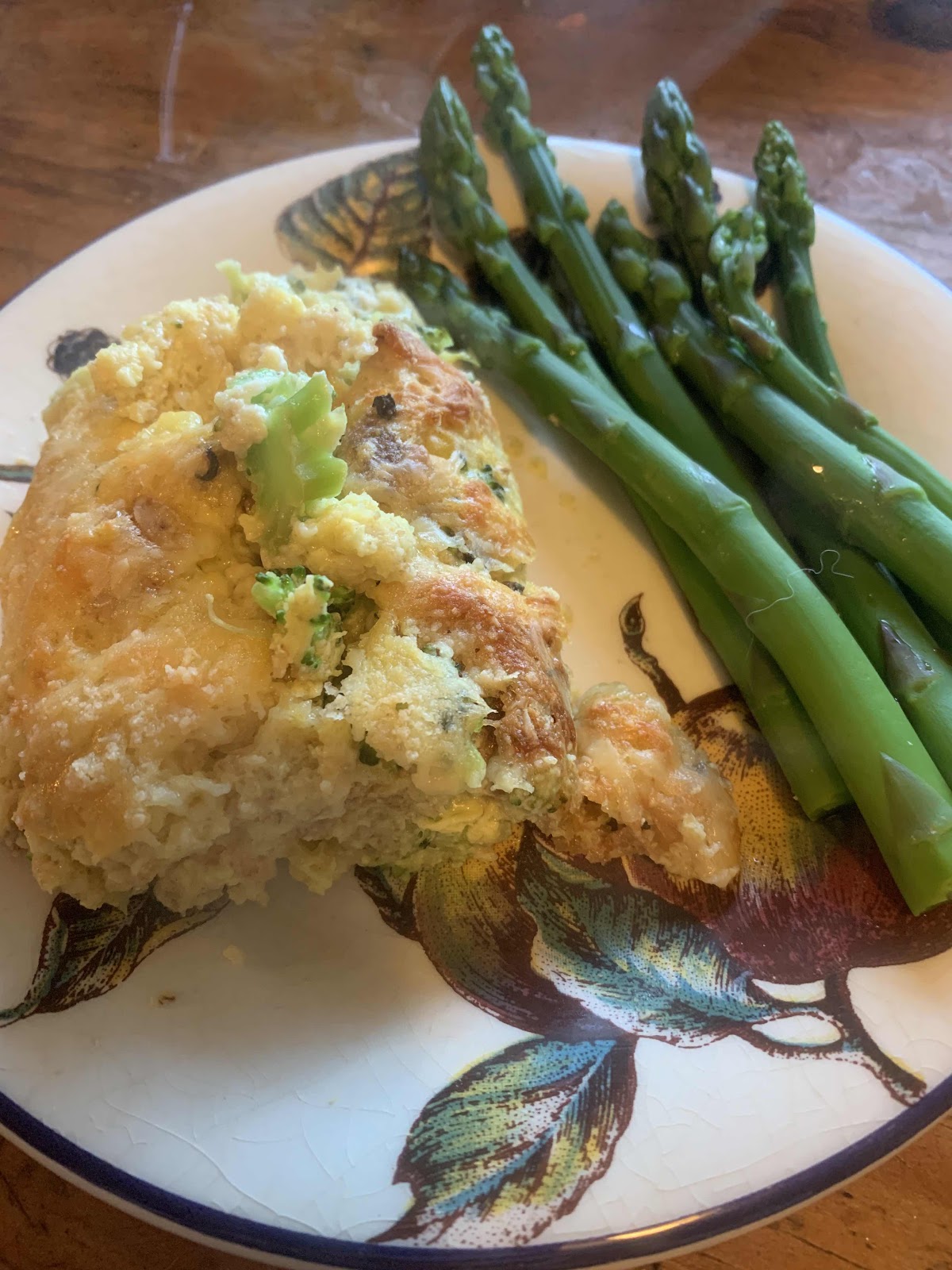
Project Pantry (Poor Man’s Soufflé)


Episode two of Project Pantry, my occasional feature where I describe a recent home cooked meal and detail which ingredients came from where. Tonight’s dinner was a broccoli strata, and it was delicious. 

Strata, as far as I can tell, is a relatively new term made up to seem fancier than “savory bread pudding.” It sounds vaguely Italian, which this dish probably isn’t. This dish, in fact, screams “Ladies Home Journal Brunch Contest 1996.” 
That’s not an insult - as a veteran of a few recipe contests myself, I appreciate the ingenuity, ease, and frugality evident in a dish like this. But I like to call it a Poor Man’s Soufflé, because it really is almost as puffy and delicate. 

Ingredients: 

2-3 cups cooked broccoli, chopped into small pieces 

4 large eggs 

1 1/2 cups milk (I used goat milk since that’s what I got) 

5 pieces sandwich bread. You can use whole wheat but it has to be soft, squishy bread. Nothing too crusty. 

3 oz chevre or other semi-soft, crumbly cheese 

1 cup extra sharp grated cheddar 

Fresh ground pepper

Preheat oven to 350
Tear up the bread and scatter in a casserole dish. Beat eggs with milk and pour over bread. Add chopped broccoli and chevre. Several grinds of pepper. Turn with a large spoon several times to coat. Leave bread to soak for at least fifteen minutes. Then add cheddar on top, and bake for 30 minutes, until puffed up and barely jiggly in the middle. Broil for one minute to brown cheese topping. 

Serve with a green salad, or as I did, with fresh asparagus from a local farm stand. 

Ingredient breakdown: 

From the store: cheddar cheese, broccoli, pepper

From the gleaner’s pantry: bread 

From our farm: eggs, milk, and chevre

From a local neighbor’s farm: asparagus 


Monday, May 30, 2022

Herb Harvest 2022


Mint is one of my favorite herbs, not only for its zingy flavor and medicinal qualities, but because it’s a hardy perennial that’s damn near impossible to kill, even for a notorious plant murderer like me. 

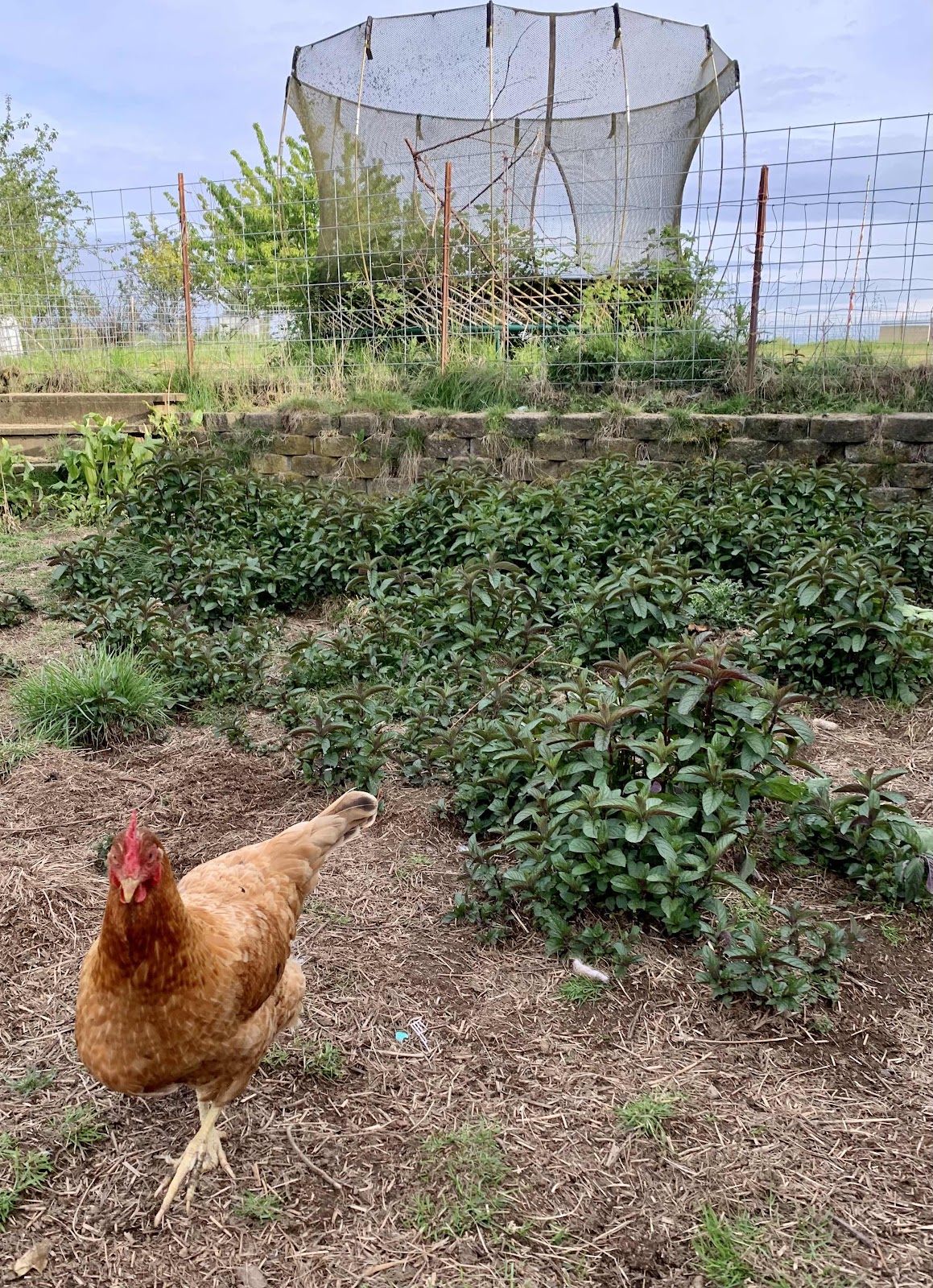
I have spearmint in the front yard and peppermint in the back yard. The spearmint is buried in amongst a hedge of tall weeds and I have to forage for it. This used to be the case for the backyard peppermint as well, but ever since we moved the chickens, the mint is the only green thing left. The rest of the yard has been scratched bare. 


Spearmint is a lovely herbal addition to lots of dishes and we eat a fair amount of it fresh. I add it by the handful to tabouli, for example, and to fresh fruit salads, especially melons. I added some to the melange of herbs I chopped finely and added to my chevre. It even goes well into a pot of Mexican chicken soup, if you can believe that.

Peppermint is a different proposition altogether. It’s much too strong for use as a vegetable or salad green. Mine is so strong that if you chew on a fresh leaf it actually burns your mouth. It’s pretty strictly for tea. A few years ago I made some peppermint vodka, but that’s out of my realm these days. 

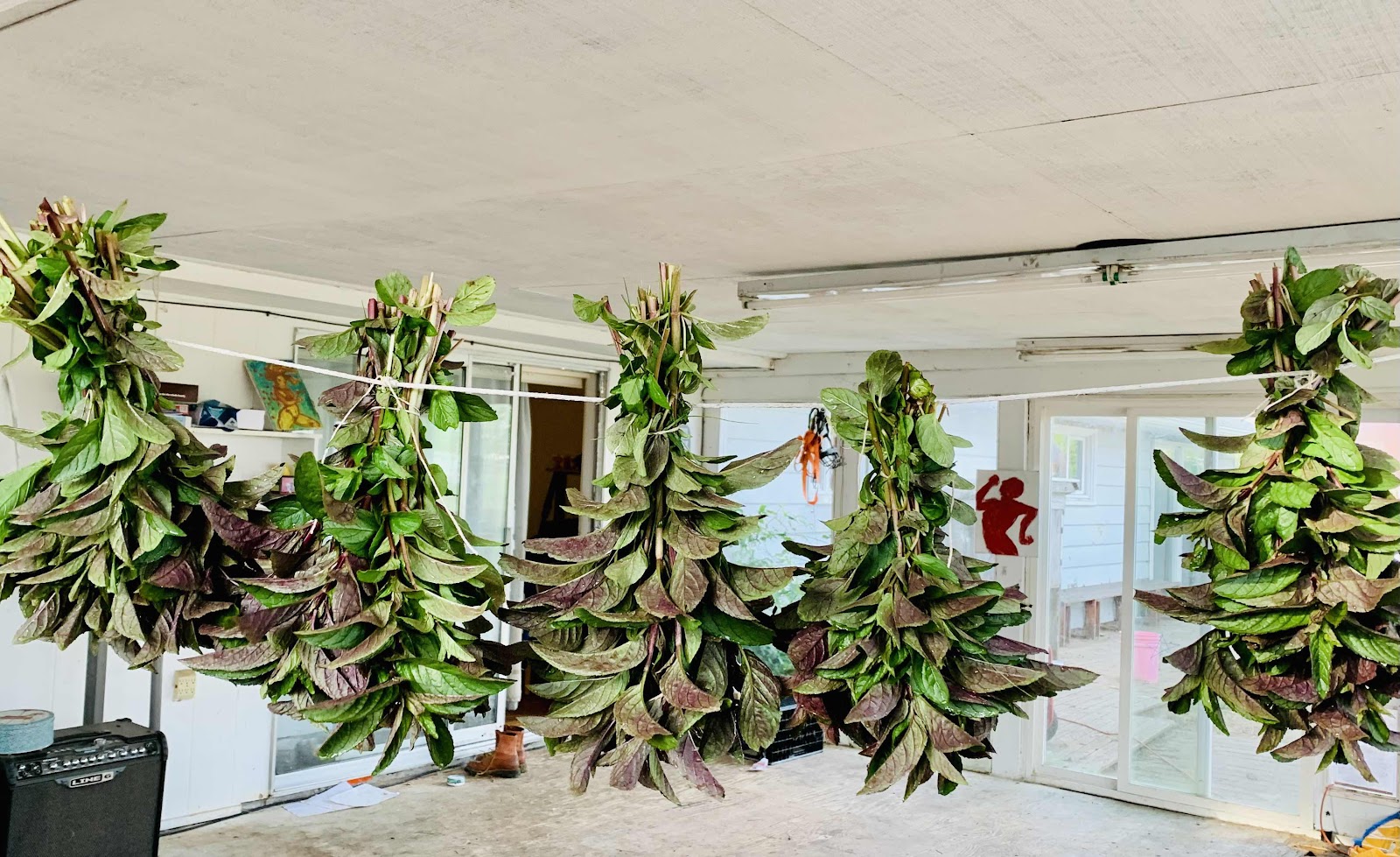
Last year I cut a couple bunches and hung them up to dry in the playroom. Then I forgot about them for an entire year. You don’t generally want to leave your herbs to dry for a whole year - most books will tell you dried herbs last a few months, maximum. However, today when I took the bunches down and rubbed the leaves off them, the scent of peppermint that wafted up was still vibrant. So I crushed them in my hands - they were crispy dry and crumbled nicely into bits - and put them into an airtight storage jar. Later on tonight I’ll make some tea and see how it tastes. 


Then I went and cut five more big bunches of peppermint and hung them up to dry. Since they are in the chicken yard, 
I gave them a good rinse first. This time I will try to remember to strip the leaves and jar them up before another year goes by. I should probably order some desiccant packs from the restaurant supply store, too. That will eliminate any chance of mold. And I’ll want them in a few months when it’s mushroom drying season. 


Now, I should probably get to work and harvest the lemon balm! Lemon balm makes delicious lemony tea and it’s very calming and good for nerves and insomnia. And I have an absolutely ridiculous amount of it. It’s in the mint family as well, and it gets out of control fairly quickly. 

Friday, April 22, 2022

Pasture Puzzle (All Flesh is Grass)


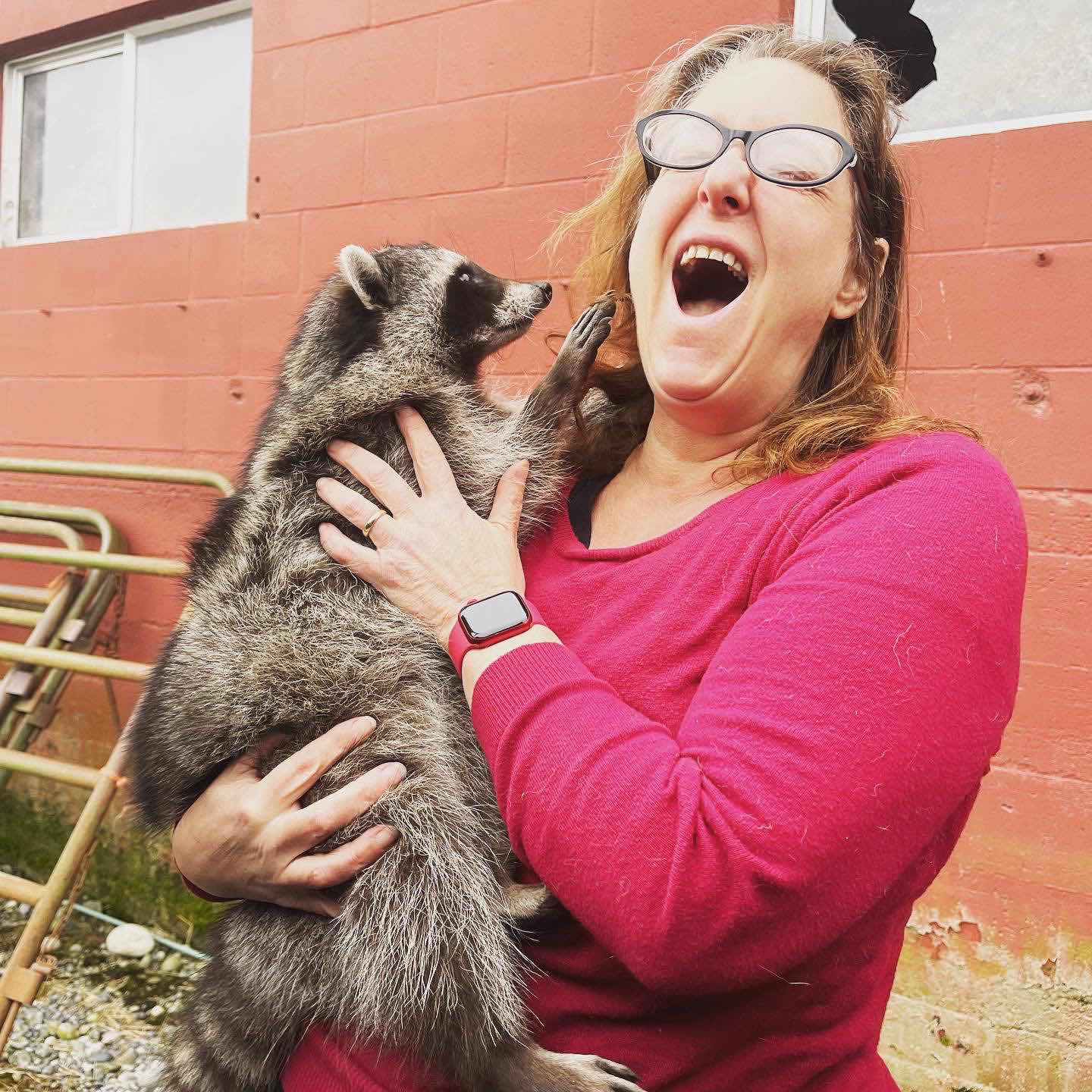
This year the grass has been slow to start growing. It’s been a very cold, wet spring. But finally, nearing the end of April, after months of mud, there is finally a decent amount of grass. Good thing too, because we’ve flat run out of hay. Actually we’ve run out of hay twice and gone for more, but as of yesterday we are out again. At one of the places we bought hay there was a tame raccoon and I got to hold her. Just putting that in there so I don’t forget THE BEST DAY OF MY LIFE. 


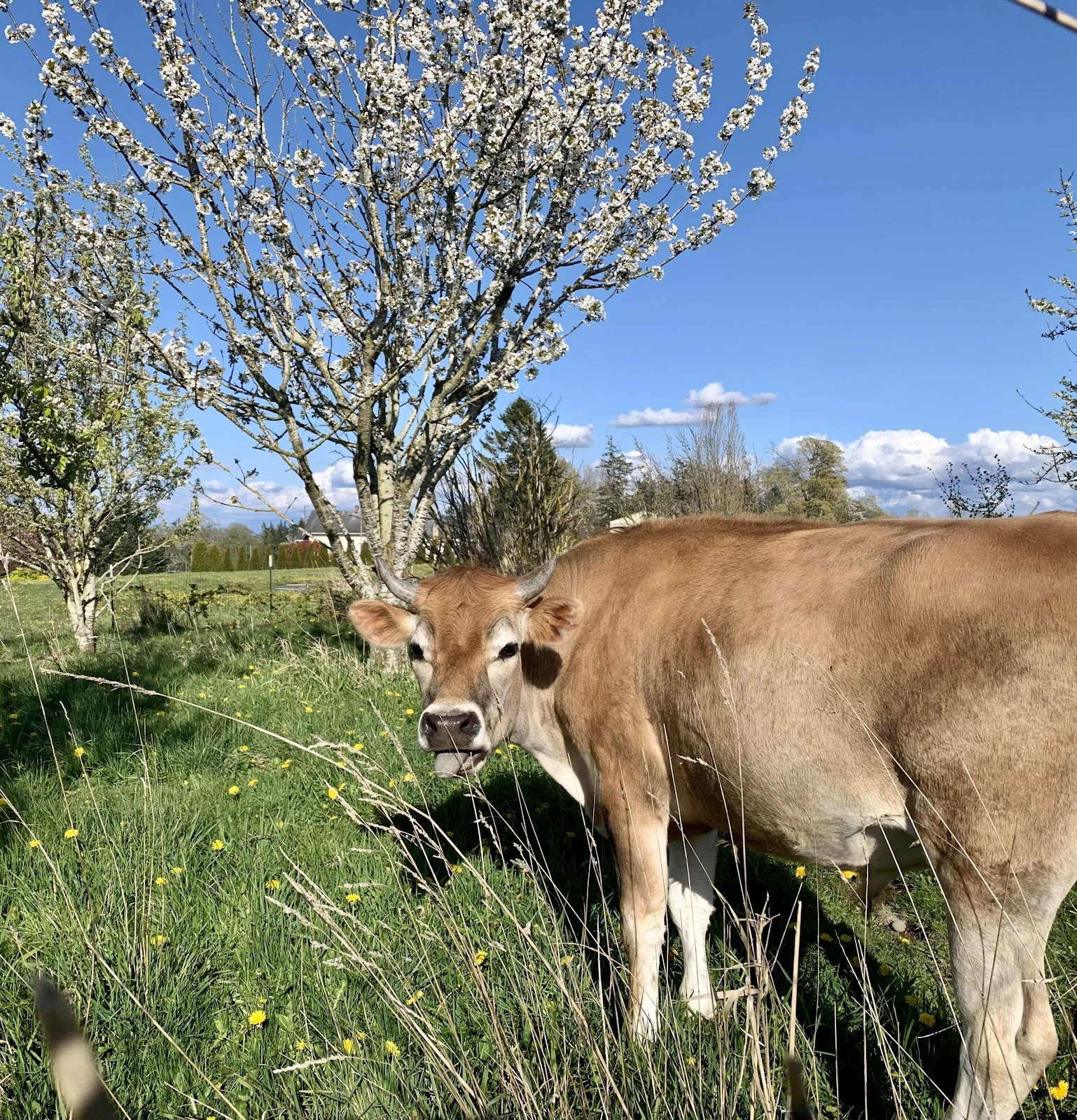
The goats are in the main pasture now, but the cow has been in the sacrifice area, because he is rambunctious and I worry he will injure the pregnant goats or the newborn babies. That’s why we had to get rid of Rowan’s cow, Nettles. Also I want to preserve grass for the goats. One dairy cow eats as much grass as six or seven goats, easily. 

We have three fenced pasture areas, but only the largest - which is about 60% of the total area -  has any real grass in it. The second largest one is about 100x100 and is our sacrifice area. The smallest simply isn’t large enough to have much grass, and moreover the grass doesn’t grow great in there because it is very wet. It’s more of a holding pen for keeping animals separate from each other when necessary. 

There is one other fenced area, and it has a ton of grass. That’s the orchard. Unfortunately we can’t put the goats in the orchard, because they are fully capable of killing the smaller trees in a day or two. I long for the day that the trees are big enough to withstand the caprice onslaught, but that day is still several years away. The cow may nibble on the trees, but cows aren’t browsers like goats are, so I’m hoping he will munch on the grass instead. 

Getting the cow INTO the orchard, however, was a problem. The cow has not been trained in any way, shape, or form, and when he gets out of the corral he goes mad with freedom and starts running about wildly and kicking up his heels. He’s very dangerous. Instead of attempting to lead the cow across the yard with a grain bucket, which might end up with a cow running around on the state highway, I decided to get some wire cutters and open up a gap between the sacrifice area and the orchard. 

Currently I am sitting on the lawn with a book, watching to make sure the cow doesn’t start trying to push over the trees or anything like that. The gap in the fence is closed with a bungi cord. I have a loaf of sliced bread next to me. If the trees are endangered, I can just undo the bingo cord and throw bread through the gap. The cow will chase the bread into the sacrifice area, and I can bingo the fence shut behind him. 

I hope this works, because we really have needed an extra area of grass for a long time now. A five acre farm is really quite small - all those silly books about homesteading on an acre? Yeah, chuck those books out the window. We have about three and a half acres of pasture and that is a bare minimum, even for dairy goats and it really isn’t sufficient for a cow PLUS dairy goats. 

It’s been frustrating to have a big fenced area of green grass we couldn’t use, and it’s very gratifying today to sit here listening to the cow tear up and chew all that green embodied sunlight. Come fall, it will all be meat. For, as the Bible tells us, “all flesh is grass.” 

I may have a slightly different understanding of those words than Isaiah intended. 

Wednesday, March 23, 2022

Forest Foraging (Spring Greens)


This afternoon the sun made an appearance, interrupting several days of chilly rain. I was so happy to see it that I was moved to actually get off the couch and take a walk outside with my husband. 

My favorite nearby walk is a trail through the forest that leads to a steep, rather slippery and rickety staircase down to the beach. It’s a quiet beach with no access other than this trail, so it’s often empty except for seagulls and crabs. The trip out and back is about a mile and three quarters, which is long enough to feel like exercise, especially when you consider the staircase. 

The forest is nothing special - it’s certainly not old growth - but it is interesting and varied. On some parts of the trail you are surrounded by cedars and enveloped in a ferny gloom; and in other areas alders and cottonwoods prevail. Right now the Indian plums are blooming and there are yellow skunk cabbage in the shady bogs. 

I’m sure a more expert forager than I am could tell you dozens of edibles and medicinals that can be gathered from an environment like this one, year round. I have personally harvested 

- red huckleberry 
- trailing native blackberry
- shaggy parasol mushrooms 
- nettles

I have seen, but not harvested, cottonwood buds (for making Balm of Gilead - https://learningherbs.com/remedies-recipes/balm-of-gilead/) and devil’s club. And I’m certain there are edible fiddlehead ferns and many other types of edible mushrooms and fungi in there as well. And this is just one small forest reserve that a biologist would doubtless describe as degraded. 

I do most of my yearly foraging in fields and hedgerows, not forests. I pick dandelion greens, lamb’s quarter, amaranth, field mushrooms like puffballs and agaricus campestri. Blackberries and sour cherries and plums from abandoned trees. Most of what I forage is not truly wild but rather escaped nonnative weeds. That’s okay. It’s all good food. 

A few days ago I went out and walked my fence lines looking for nettles. There were a few here and there, but they were all still very small. It will be another two weeks before I can get enough for a pot of soup. Today on the forest rail though, I saw hundreds of nettles, all at just about the perfect stage for picking. I guess I have my exercise for tomorrow planned out. 

Thursday, October 28, 2021

Monster Squash 2021 (Count on Cucurbits)

My mother used to say there were only two things for certain in this world - death and taxes. But I know there is another - that every year volunteer squash will grow out of the compost pile. 

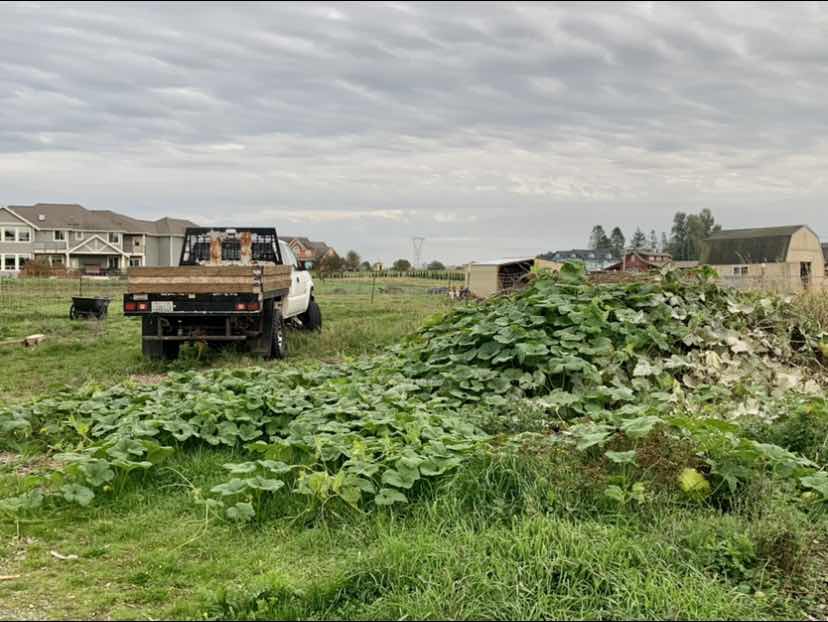
It’s so funny, I don’t usually have much luck trying to grow winter squash on purpose. The plants get powdery mildew, or they are poorly pollinated, or they get blossom end rot. But lo and behold the vigorous vines that sprouted this year from our discarded supermarket squash seeds:


There are actually three separate volunteer plants in that picture, and together they cover a good 500 square feet. All of them bore copious fruit, but unfortunately since supermarket squash are mostly hybrids, none of the three distinct varieties of fruit they bore was good to eat. 

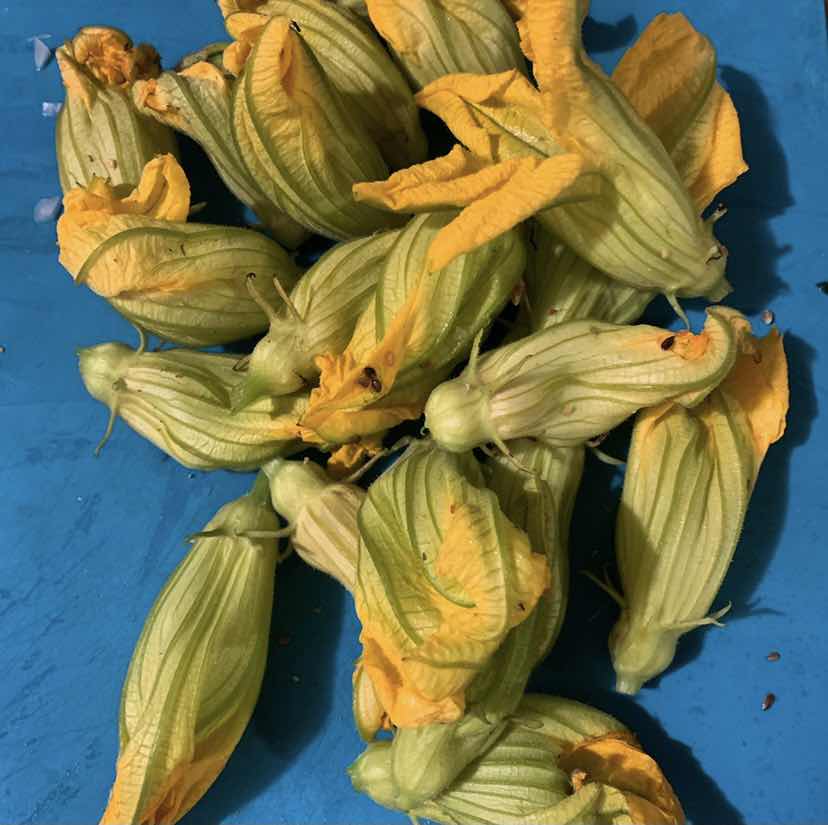
As varied as squash fruits are - that is to say, infinitely - squash blossoms are uniform. All squash plants, be they winter or summer or of unknown provenance, produce lovely yellow trumpet shaped flowers that are delicious. 

We like to tuck the fresh raw flowers into quesadillas, but they can be prepared in any number of different ways - one Italian preparation is stuffed with goat cheese, battered and fried. They can be added to soups or just sautéed in butter. 

Since we didn’t care about the inedible fruit of these particular plants, we picked both the male and female flowers, but if you are growing squash to eat just pick the male flowers. They are easy to tell apart because the male flowers grow in tall stems and the female flowers stay stuck close to the vine. Remove the pistils; they can be bitter. And always check for bugs! Our vines were still producing flowers last week, in chilly late October. 


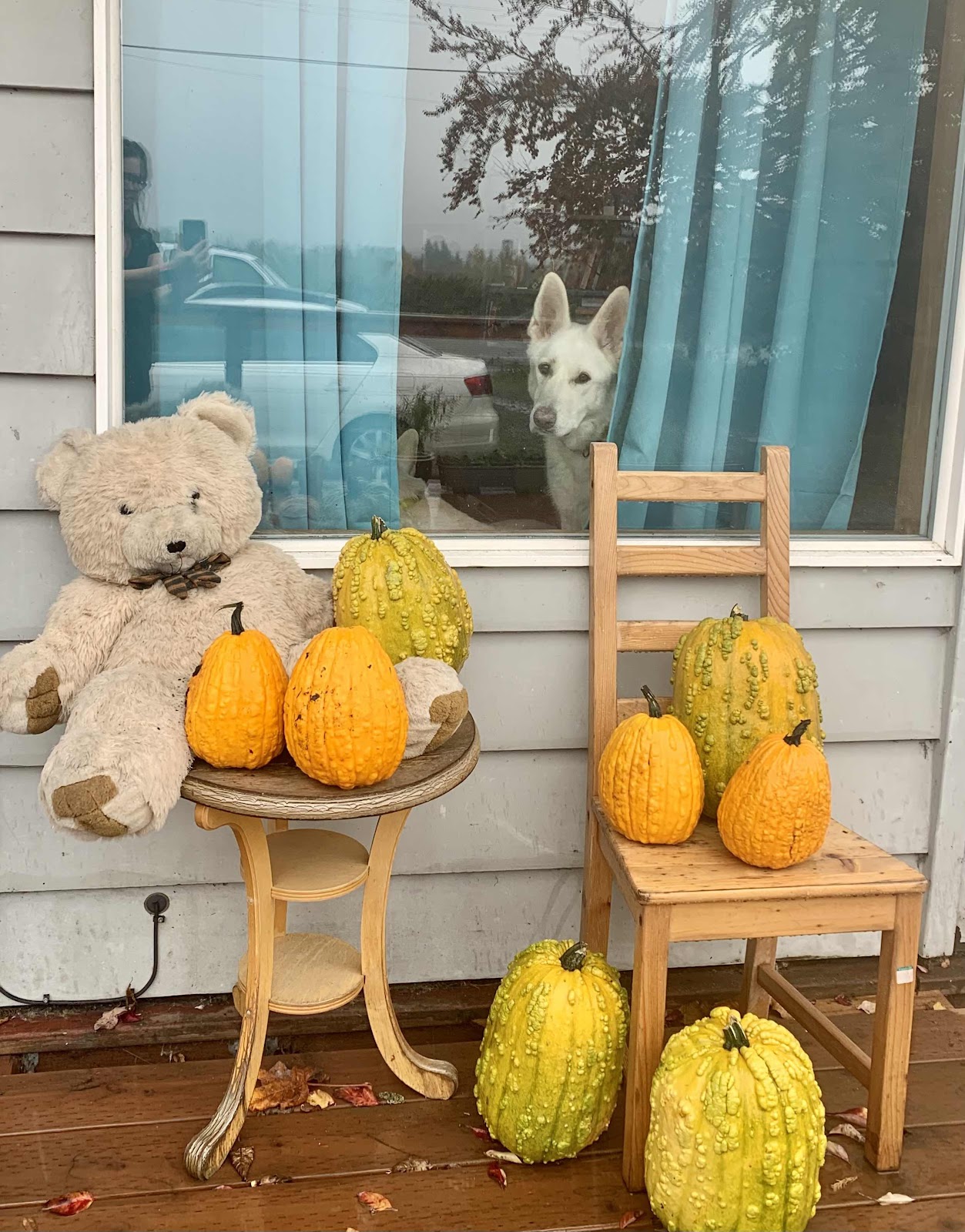
Although inedible, this year’s gourds do make a fine halloween porch display. There are many more that are not pictured here. One gargantuan vine produced more than a dozen of the huge warty gourds - probably well over 100 pounds of squash. 

I am not certain if the seeds of all these squashes are edible or not. I believe they are - I never heard of a poison pumpkin seed - but I should probably look it up to be safe before I decide to roast all the seeds after Halloween. 

Mercy is in the window. 


Wednesday, July 8, 2020

Preserving Log (Early Summer Edition)


I’ve fallen behind on my blogging, I’m afraid. Since the stay-at-home order was lifted early last month, I’ve been busier than a one-armed paper-hanger (as my mother used to say). 

Mostly, I’ve been working a lot. All the procedures and routine checkup and vaccination appointments and dentist appointments that were canceled during the lockdown have been rescheduled, and all the doctor’s and dentist’s offices are full. My agency is down by at least three interpreters. Two of them are elderly and not in great health and so are not taking appointments at the moment, and o e of them got stuck in Spain way back in March and hasn’t been able to come home yet. This means there is a ton of work for me, more than I want, really, but if I turn appointments down they often go unfilled.

In my free times, this is what I’ve been doing as far as preserving goes: 

 - several small batches (3-4 quarts at a time) salsa ranchera, as the gleaners pantry gives me the ingredients

- a gallon of kosher fills that is almost gone now. Yesterday I bought more pickling cucumbers and later on today I will gather grape leaves start a new batch

- a gallon ziploc of dried cherry tomatoes. Haven’t done this before and it’s really good. I season them with a little salt and garlic powder and then dry them till they are very leathery or even crisp. Nice for snacking and they add great flavor to a stew or soup.

- froze about a dozen quarts of strawberries. Went to the u-pick with friends when they were up visiting. 

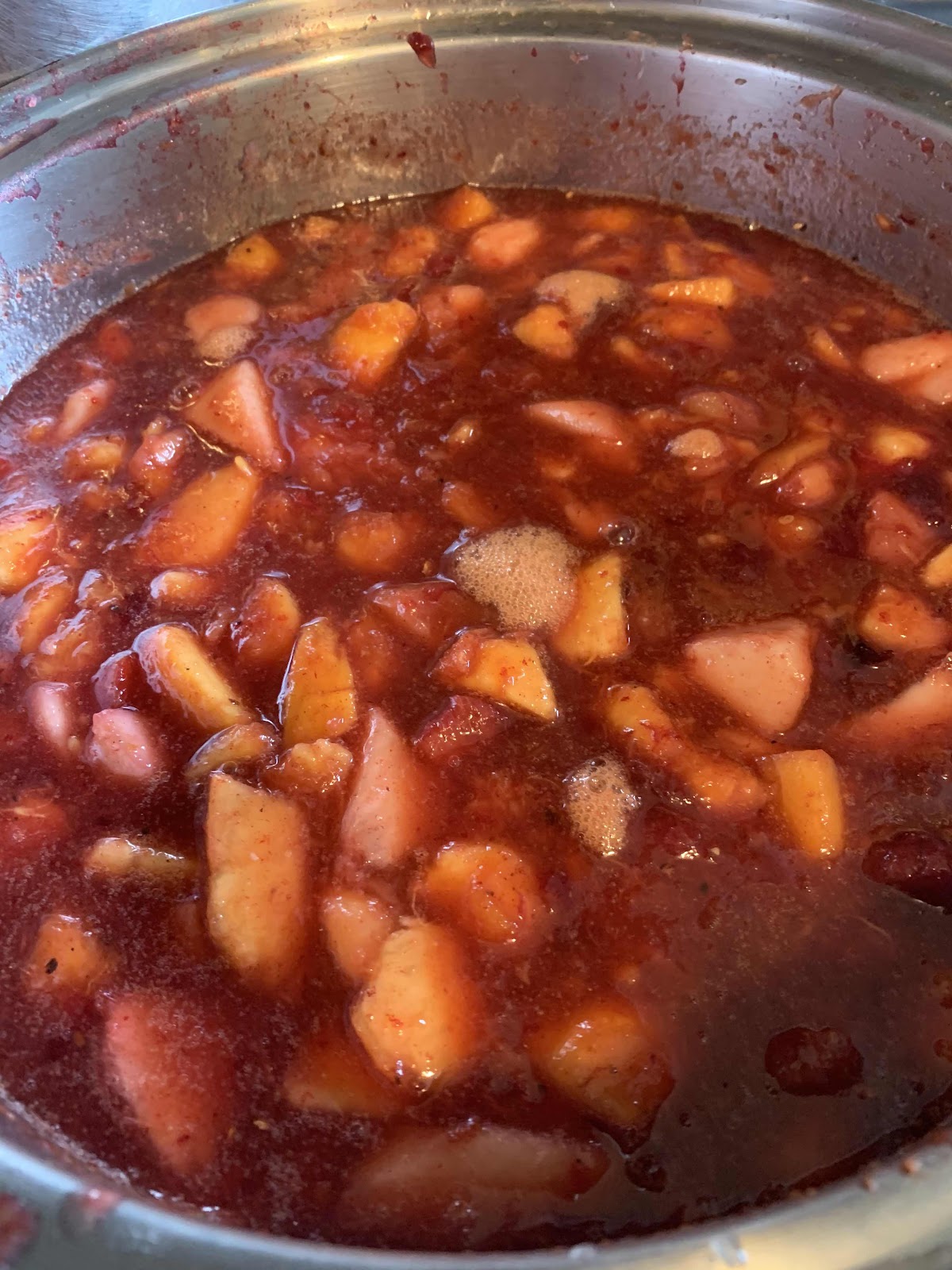
And today I am breaking out the big stockpot to deal with this:


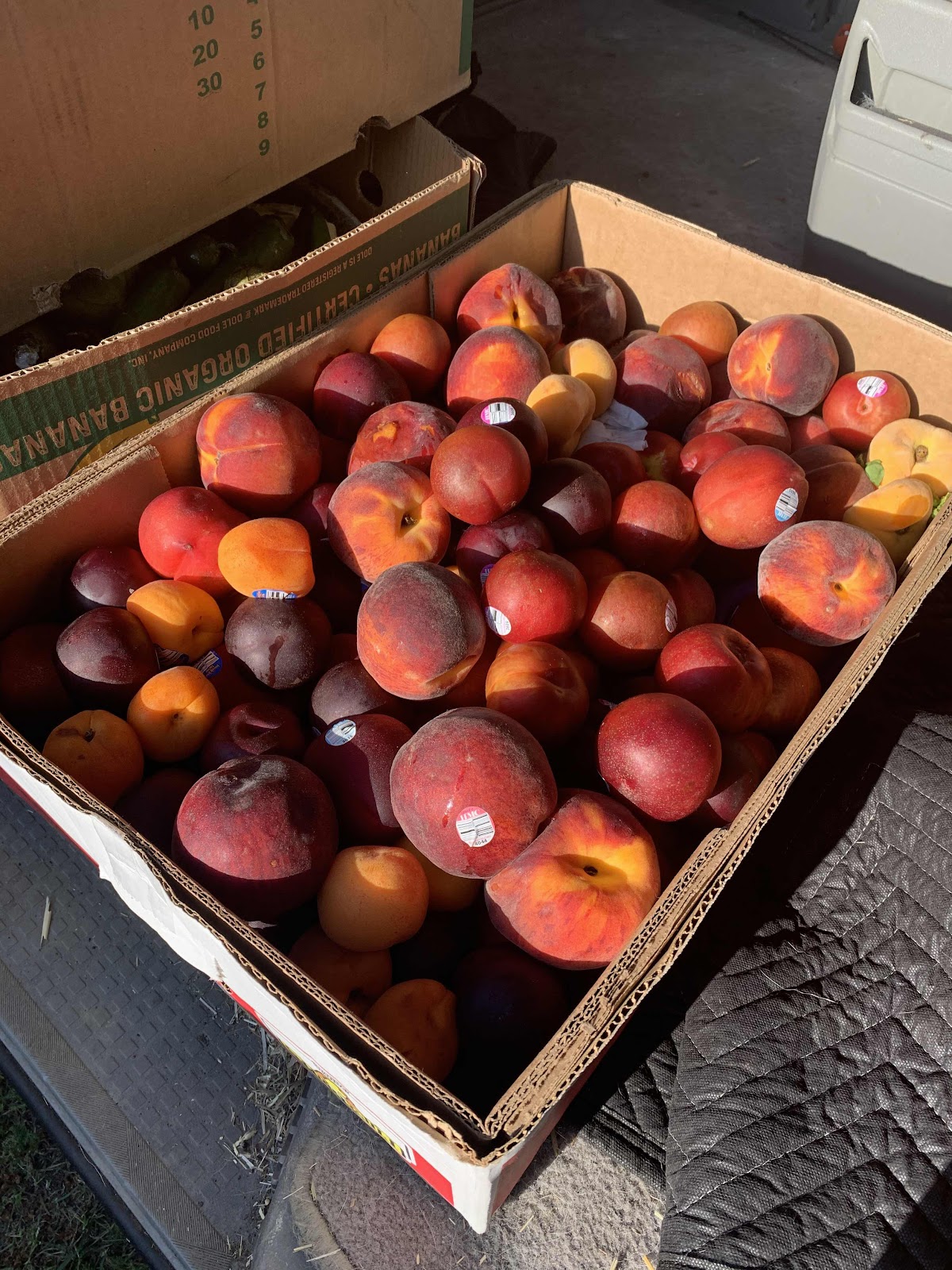
That’s about 25 pounds of mixed stone fruit from gleaner’s. After I separated the fruit that was too far gone and picked out the fruit that was still perfect for eating fresh, I was left with about ten to twelve pounds of slightly overripe fruit. The last hour or so has been devoted to bleaching, peeling, and chopping and my kitchen looked like a couple of murders had taken place (red plums!) but now I have this simmering on the stove:


Spicy stone fruit chutney. It has cinnamon, cloves, black pepper, red pepper flakes, a TINY hint of garlic, brown sugar and apple cider vinegar. It smells like heaven and it ought to be delicious with pork chops, chicken breasts, or maybe a hearty fish like halibut. It’s super pretty, too. 

But man there’s gonna be a lot of it. I think this may be my Christmas present to a few people this year. 

Still sitting out on the front porch: a crate of corn on the cob to be shucked, shaved, and frozen; and about ten pounds of jalapeños to be turned into rajas en escabeche. I might get the peppers done today, but he corn is gonna have to wait. 


Sunday, March 22, 2020

DQ6 - Visit From Rowan


Our oldest daughter Rowan came by today. She’s been in isolation for ten days already, because she had a cough and a sore throat. No fever though. Chances are it’s her regular seasonal allergies and post-nasal drip, but nobody’s taking any chances these days. 

She and her roommates are also putting in a bigger garden this year, and she called to ask if we had any fencing lying around she could use to keep the dogs out of the garden beds. As does any good farmstead, we have a few rolls of chicken wire kicking around, and I said she was welcome to come get some. 

When she arrived, Hope and I were in the garden laying down cardboard and anchoring it with rocks that Hope and Papa gathered in the pig pasture. That’s where all the rocks are, but we were afraid of the pigs and thought they would bite us if we went in there to gather the rocks. Papa said “I’ll go” and it turned out the pigs weren’t interested in trying to bite anybody. Ten minutes yielded enough rocks to hold down all the cardboard I had brought home from gleaners. Gleaners is a basically unlimited source of cardboard, and I ought to bring home a lot more. 

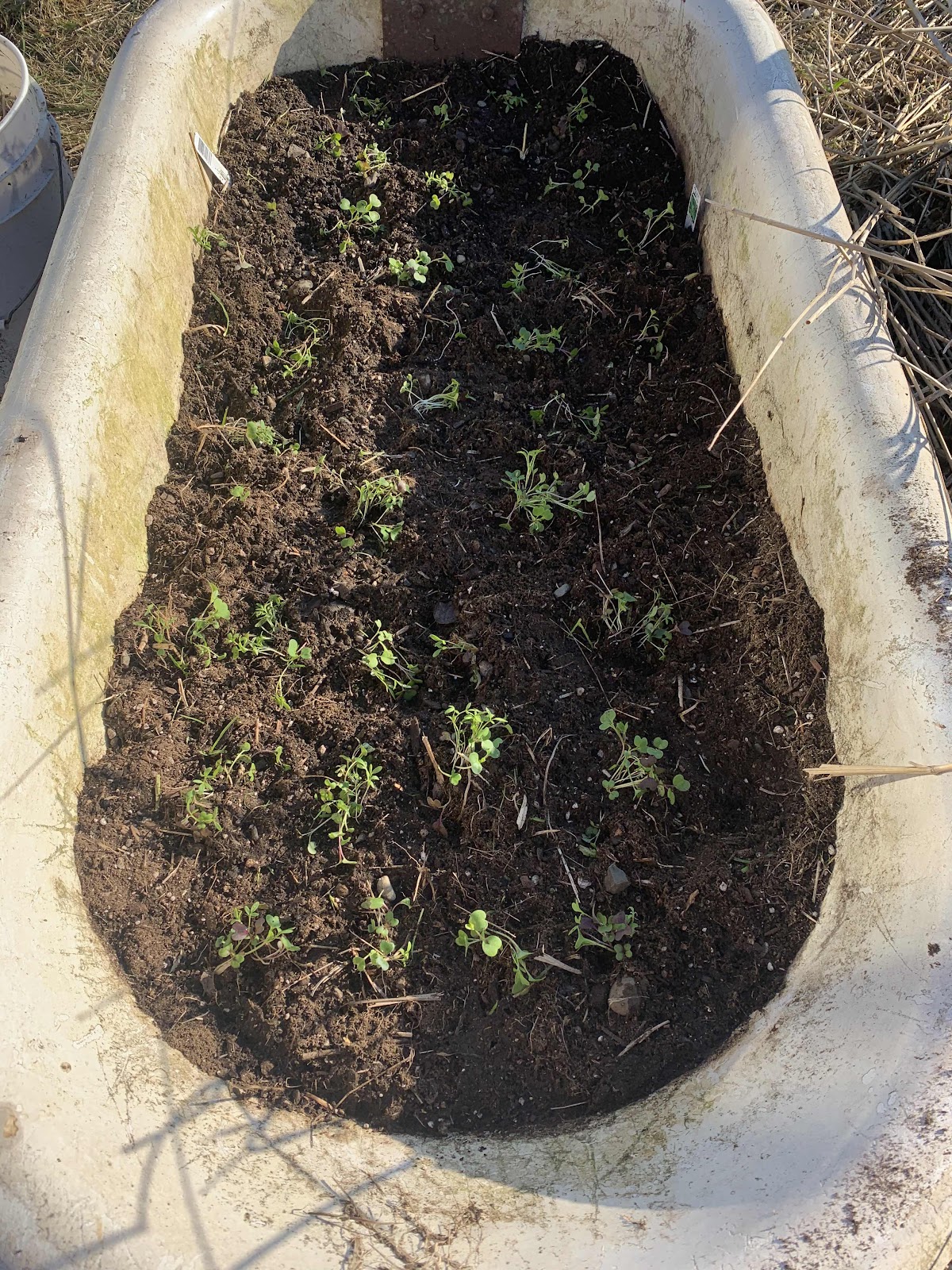
Rowan looked at the old strawberry bed, which is pretty much just lawn at this point, and suggested we dig up any strawberries we could find and transplant them into the second of the old claw foot bathtubs. We have two, and the first one was planted with spicy salad mix yesterday by Paloma and me. 


Eight clumps of strawberries were rescued and transplanted. There is room in the bathtub for another four or so; I may pick some up at the farm store tomorrow. We also cleaned up another raised bed and prepared it for transplanting our snap peas in a few days. The snap peas are currently germinating on the kitchen table in five egg cartons. As soon as we can prepare enough space, I have radish seeds and beet seeds ready to go. 

Today I also sent out a message over Facebook that if anyone was in need of eggs - I hear they are scarce in the grocery stores - I have five dozen I am happy to donate to families in need. We have thirteen laying hens and this time of year we are drowning in eggs. Three people messaged me and we made arrangement to meet up. 

It’s very odd to go to the grocery store and see empty shelves. That’s never happened in my lifetime. I’m so used to abundance and variety that it seems almost to be a natural American right. Shortages? Long lines? That only happens 
in other places - poor places, “socialist” places - not here. 
Not in AMERICA.  I was at Fred Meyer yesterday. The produce section looked unchanged, thank God, but there were long stretches of bare shelving in the toilet paper aisle, the cleaning products aisle, the pet food aisle, and the liquor aisle. American priorities, amiright? 


Friday, March 20, 2020

DQ4 - Garden Notes


I haven’t bothered with a garden in years - beyond my perennials; rhubarb, raspberries, fruit trees - because I can get unlimited free produce from the gleaner’s pantry. This year, however, things are so very uncertain that it seems like it can’t be a bad idea to try to plant a few things. So far, gleaner’s is carrying on, but if the governor issues a shelter in place order, as so many others have, then I assume it will have to come to a halt. 

Our old garden space is a mess. The beds are entirely gone - just grass. Homero took a weed eater to the canary grass and Paloma clipped the blackberries. I hauled a few buckets full of compost and topped up one of the bathtubs. Then we planted a couple packs of spicy salad mix. 

A few days ago Paloma and I planted five egg cartons worth of snap peas, and they are germinating in the kitchen table. I’ll have to prepare a bed for them soon. Also sorted through some drawers and found seed packets of years past - most of the seeds will still sprout. I have cylindrical beets, radishes, and green beans. Also nasturtiums. No place to plant those though, until we do a lot more work. 

We have the time. Nothing but time. 

Wednesday, March 18, 2020

State of the Farm: Pandemic Edition


The girls amuse themselves at home with Henna freckles 


DQ2 - day two of “quarantine.” We aren’t officially quarantined, of course, and not even prohibited from going out and visiting. The official prohibitions in Washington are (as of right now) no gatherings of over 50 people (or has it been changed to 10?) and smaller gatherings must abide by strict “social distancing” rules that keep people 6 feet apart. 

Schools are closed at least through 4/27. I started the DQ count from the first day that schools were closed, which was yesterday, hence today is DQ2. Restaurants are closed, though takeout and delivery is allowed. Bars are closed, as are any place where people habitually gather, such as bowling alleys, churches, movie theaters, museums, libraries, barber shops, etc. Grocery stores and pharmacies are open. 

Everyone who can work from home is being told to work from home. I am still working, working more than usual in fact. As a medical interpreter, I spend my days going from one doctor’s office to another, which I suppose makes me high risk for infection. Today, for the first time, there were nurses with thermometers stationed at the entrances of the clinics, taking everyone’s temperature before they were allowed in. I don’t have a fever. 

Homero is still working as well, but he works from home all the time anyway. People still need their cars fixed, even if they are being told to stay home, I guess. I worry a bit about him because he has a few different underlying health conditions (as do I) that could make him a higher risk for complications. At least he wears gloves all the time. 

The girls were initially thrilled about the prospect of a six week spring break, until it was made clear to them that they would not being spending much time hanging out with friends, or indeed outside the house at all. I have let them see a couple friends, one or two at a time, and I’m thinking of getting in touch with the parents of a few of their “best friends” and asking about creating a closed circle of friends so they can all hang out with each other without becoming vectors of disease. 

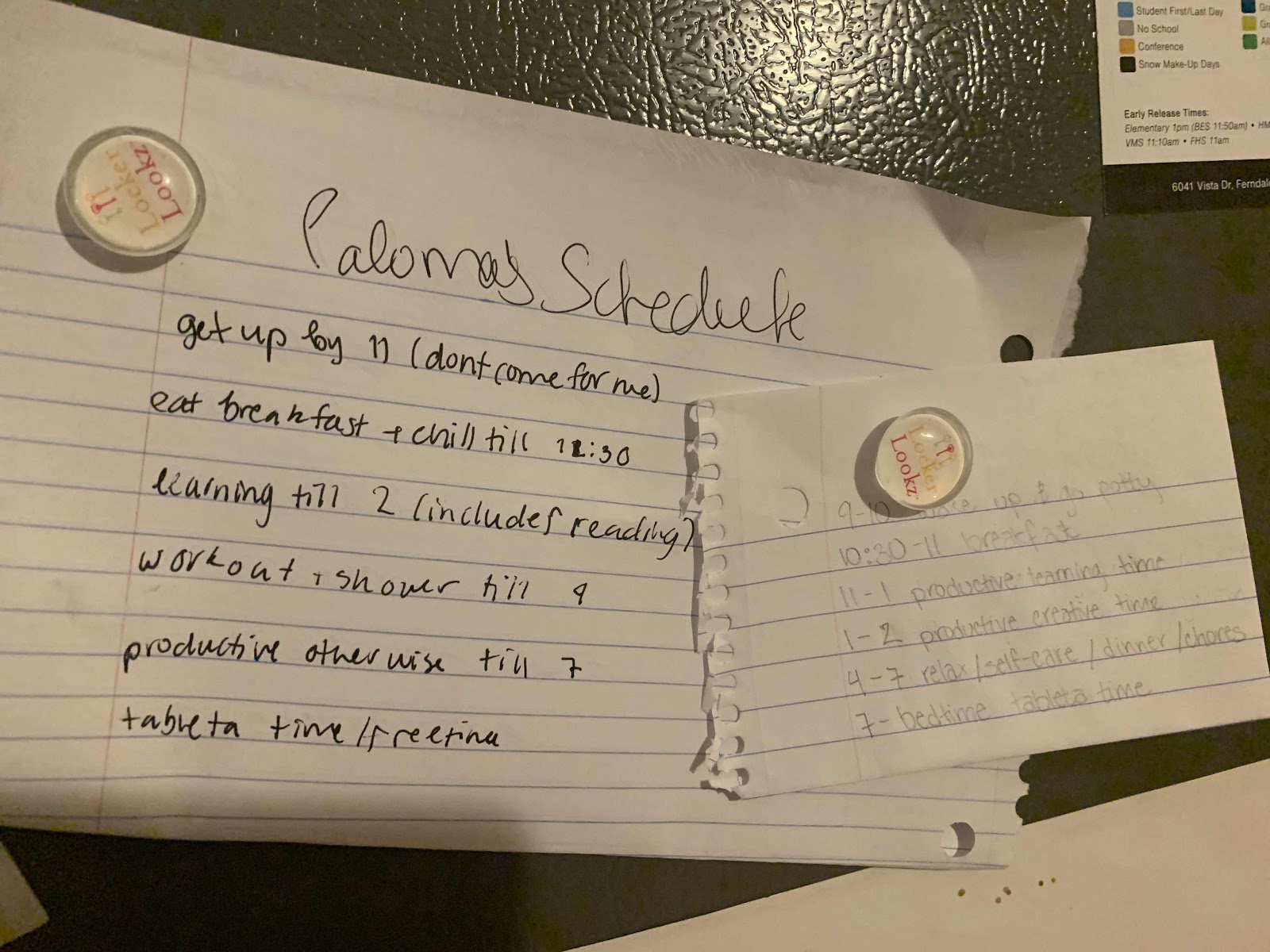
Nobody knows yet when school will resume. Teachers have been told not to send homework for the time being, since not every child has internet access at home and it wouldn’t be equitable. The district is working on a solution, at least for high schoolers, and I expect sometime in the next week or two that they will probably send home some fat packets. In the meantime, I told the girls this isn’t a vacation, and that they needed to write up a schedule for themselves. It doesn’t have to be a strict schedule, or overly specific, but it has to exist. Here’s what they came up with:


I especially like Paloma’s first line item: “get up by eleven (don’t come for me).” 

Each schedule has to include a two hour block of time for school related work (their teachers can’t assign work that will be collected and graded, but they can post “suggestions” online) and a two hour block of “productive other” time. This second category can be anything from playing piano to drawing to exercising to working in the garden to reading a book. Other than those two categories, and one chore assigned by me or their papa each day, their time is their own. 

Some examples of the chores I intend to make them do, in no particular order:

- walk the pastures and pick up all the pieces of broken plastic, plastic baling twine, or plastic bags and assorted trash they can find. No matter how careful one is, small plastic detritus accumulates over the winter. 

- turn over some of the compost pile

- clean out a drawer or a cabinet 

- harvest nettles

- organize the canning jars (full ones by contents; empty ones by size)

- use the sewing machine to make patches for mending the quilts with holes in them (our dogs have a tendency to get overexcited and tug on the bedclothes)

- clean up the greenhouse 

Like everyone else, I am imagining all the great stuff we will all get done during this enforced down-time, and like everyone else I am probably fooling myself. It’s unlikely I will take up a musical instrument or learn a third language. A more realistic hope is that I will have time and energy to put in a small garden - something I haven’t done for a few years - and read a few extra books. Perhaps do some drawing. Within a month the goats will kid, and soon thereafter it will be cheese season again. 

A good chore for me would be to find, clean, and organize 
my cheese making equipment, and order new cultures and supplies. 

Another good chore for me would be to commit to keeping a blog diary of our lives during this time.  Nobody knows how this is going to play out. Things could stay bad for a long time. Many of my neighbors are elderly and frail and are really not supposed to go out at all. Tomorrow I will talk about local efforts to pull together and provide help and services for folks who are ACTUALLY quarantined, and for folks who have lost their jobs, and those negatively affected in all sorts of ways by this unprecedented situation. 

Stay healthy! 

Wednesday, November 27, 2019

Thankful for the Truth (Warning graphic photos)


I love Thanksgiving, especially in the years, like this one, that I get to host. I enjoy the process of writing a menu, shopping for ingredients, and setting a beautiful table. There are few things that make me happier than seeing people I love really digging in to food I’ve prepared for them. I’m happy when my adult daughter comes over, and I’m happy to see my mom. But there is something about Thanksgiving that make me feel uneasy. There is a whiff of - if not hypocrisy, then maybe willful blindness - that hangs around the Thanksgiving table. 

Thanksgiving is a day of delicious excess, a national fantasy of happy peaceful families and endless sweetness, but the truth is often unpalatable. Enjoying an abundance of good things and being thankful for what we have is, of course, wonderful, and in no way a bad thing. Indeed, we’d all be happier and the world would probably be a better place if we came together more often to share our abundance and to give thanks out loud and in the presence others. 

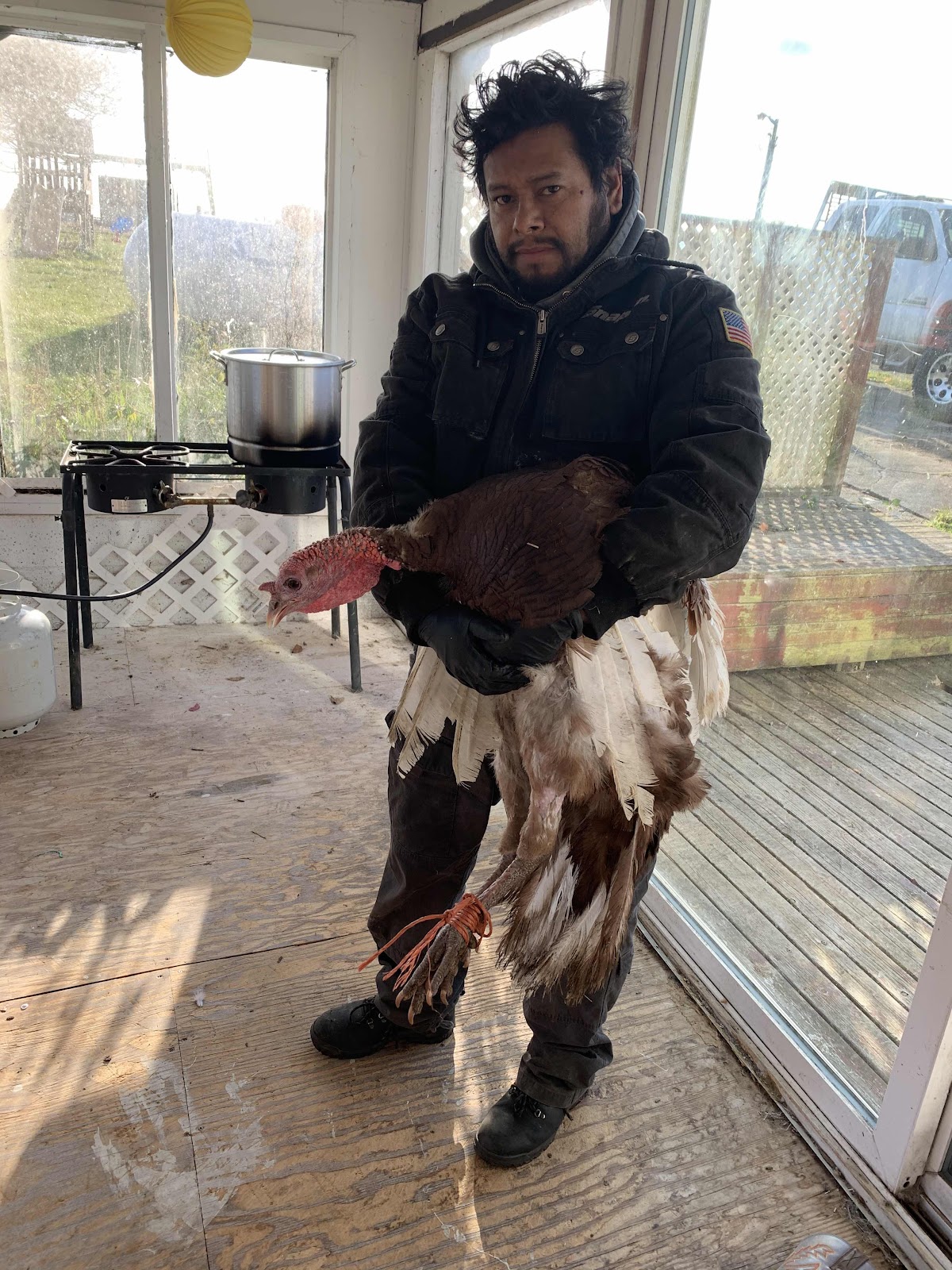
But it’s also important to acknowledge the realities that underlie the feast. These are manifold. Firstly, I acknowledge that to make this feast, a beautiful turkey had to die. 


I acknowledge the work that went into raising him - this bird was raised on pasture by a local farmer, so I thank my neighbor for her work and expense. But I also recognize the labor of the people - mostly immigrants - who toil in the vast and dangerous poultry processing industry; I acknowledge their worth and affirm their right to safe working conditions and just recompense. 

I thank my husband for the work he is doing right this minute - butchering the turkey out in the cold November wind. I acknowledge this is a disagreeable task and I thank him for being willing to develop the skill to do it well. 

The vegetables on the table - the potatoes, the Brussels sprouts, the salad greens - are produced by an unsustainable system that abuses workers and the earth in equal measure.  I am a witness, and I pledge to do what I can to avoid participating in those injustices and to mitigate the tremendous waste generated. 

And finally, I acknowledge that I live on unceded land of the Lummi and Nooksack tribes. All of us settlers live on land that either was never ceded by the tribes, or which was ceded under deeply unequal conditions, in which one side held all the power. I acknowledge that uncomfortable truth. If you want to know on whose land you reside, visit this link: 
https://native-land.ca/. I pledge to work toward correcting the grave inequalities that resulted by upholding the efforts of local tribes to sustain their culture and supporting their businesses and candidates for office. 

None of this is meant to be a huge bummer.

It is possible to be grateful for our wealth while recognizing the problem of poverty. We can celebrate being together with family while knowing that some are lonely. We can give thanks for warm homes, abundant food, and all the good things in our lives without trying to shut out the knowledge of the many who lack those things. It’s not a sin to be warm, to be fed, to be loved. These are wonderful gifts.

My hope and my prayer is that naming our gifts and sharing them with our loved ones will inspire us to share them more widely, as well. I remind myself, as I bask in warmth and light, of the existence of cold and darkness not out of guilt, but so that I may be moved by gratitude and grace to expand the circle of warmth and light to include others. I remind myself, as I nourish my body with roast turkey, of the death of the animal I am eating not as some sort of penance, but to honor the truth that this act embodies the cycles of life and death on this beautiful planet, cycles we are all of us bound by. 

May you be abundantly blessed this Thanksgiving. May you have much to give thanks for, as much as I. 


Thursday, October 10, 2019

Lobsters of the Forest (Mushroom Madness)


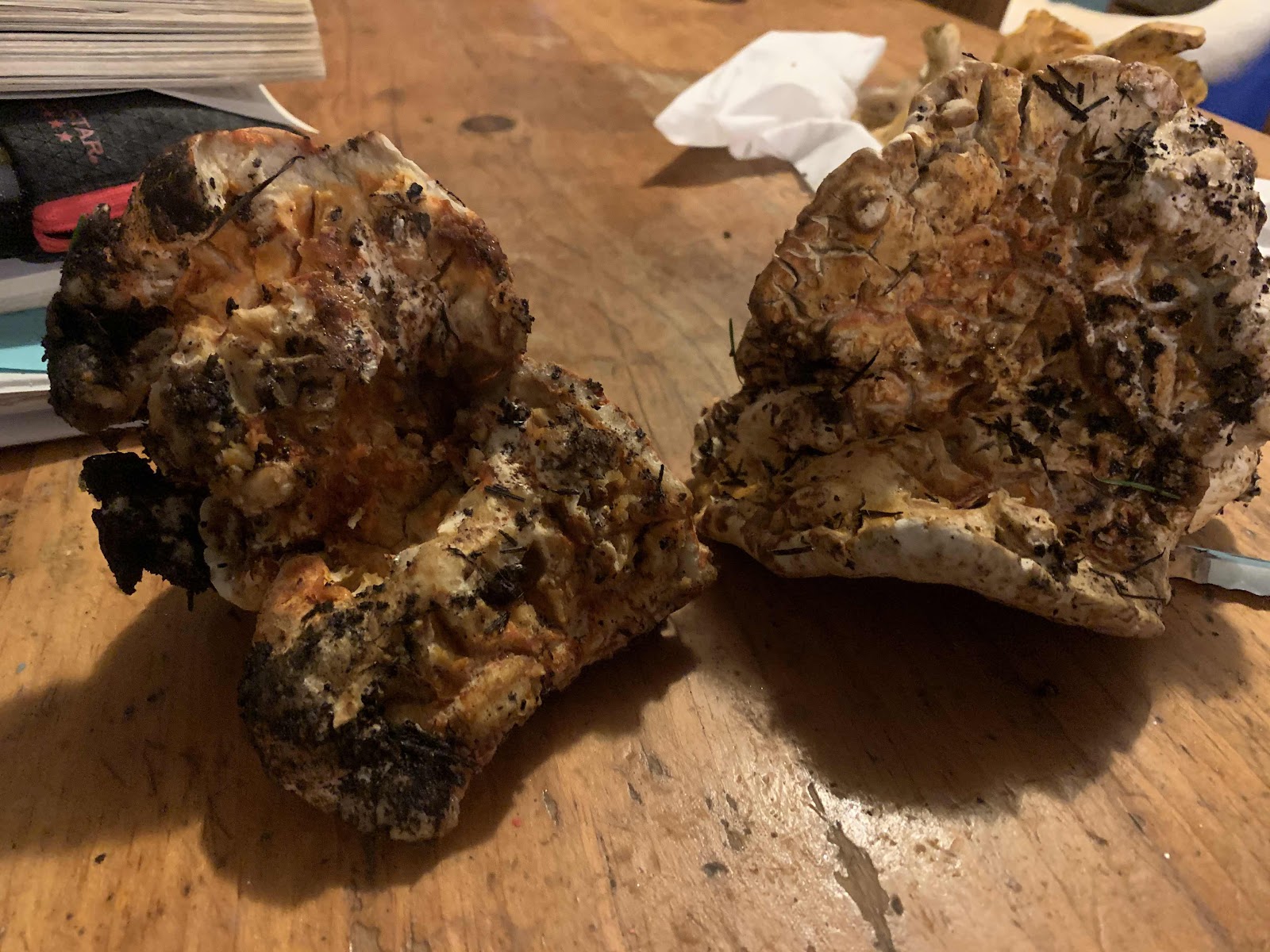
These ugly lumps are actually highly prized lobster mushrooms. 

It’s prime time for mushroom hunting in the Pacific Northwest. The rains came in mid September, right on schedule, and since then we’ve had alternating rain and sunshine, which is just perfect for making the mushrooms pop up. By all accounts it’s been a bumper year for chanterelles. 

I have long been fascinated by fungi, but I’ve not done the work of educating myself to pick them, beyond a very few varieties that are easy to identify. There’s a patch of shaggy manes out in the back pasture. I’m relatively sure I can recognize agaricus campestres (though there are toxic lookalikes). If I happened to trip over a chanterelle or a morel I would know what it was. 

Nobody just trips over forest mushrooms though. You have to go out and search for them, and you have to get off the trails and go bushwhacking through the deep woods. It’s hard physical exercise and it gets you wet, dirty, and scratched up. Also exhilarated and energized. 

A relatively new friend of mine is a confident forager. In the past I’ve traded her goat cheese for mushrooms, but this year I asked if I could pay her to just take me out with her foraging. Not to any of her secret spots! That would be a very rude thing to ask. Just out into the woods and help me improve my eye for good habitat and gain some confidence identifying a few more varieties. She was happy to do so. 

We found several edible mushrooms - coral mushrooms and oyster mushrooms, a couple of decent boletes, and a small patch of chanterelles- but the coolest find was a large number of lobster mushrooms. 


The ugly lumps after careful cleaning.

Lobster mushrooms are cool. They are actually a boring, bland mushroom that has been attacked by another fungus and improbably turned into something delicious. Lobsters start out as Russula Brevipes, which is a large white mushroom that pushes up through the forest duff in evergreen forests. They are edible but exceedingly bland. Wherever you find lots of Russulas, though, you will find a few that have been turned into lobsters. The fungus makes them bright orange and hard, and curls them into fantastic, tortuous shapes. Keep an eye out for glimpses of orange poking through the forest floor. 

Cleaning them is a chore. You don’t want to wash them with water if you can help it because they will soak it up like a sponge and ruin their texture and dilute their subtle flavor. Use a stiff brush instead. Most lobsters will have at least a few wormholes in them (these ones are exceptionally free from worms) but don’t worry about that. Just trim off any bits  that seem too wormy to eat. Ditto any parts that are stubbornly grubby - though as my mom says, you gotta eat a peck of dirt before you die and eating it along with wild mushrooms seems like as good a way as any. 


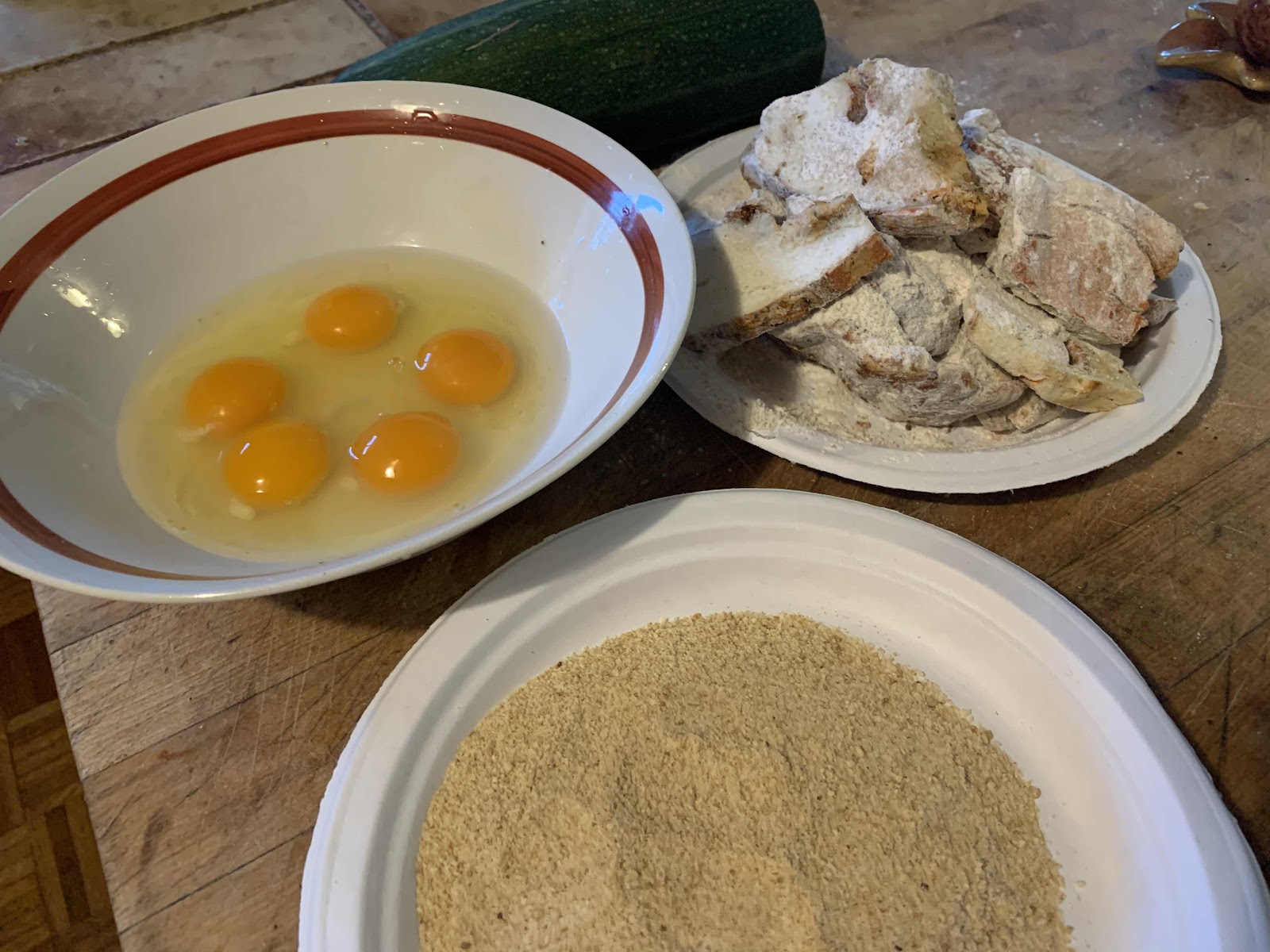
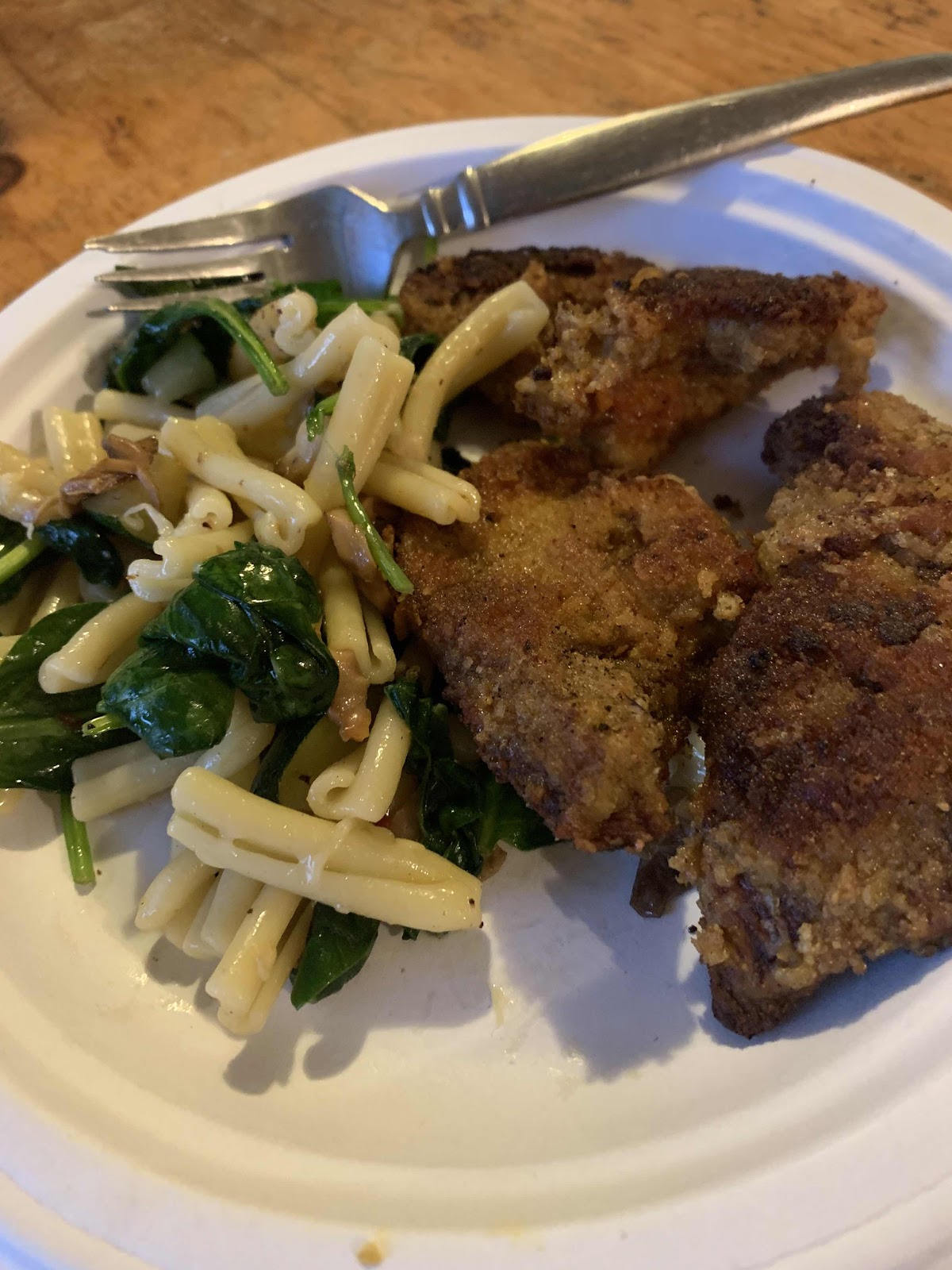
There are lots of ways to prepare lobsters, but they are one of the few wild mushrooms tough enough to stand up to being sliced and fried in egg wash and crumbs like chicken-fried-steak. I added Parmesan to my bread crumbs and pan fried the mushroom steaks y til deep golden brown on both sides. I found I liked them better the more cooked they were, so next time I might use a little lower heat and give them more time. 


The other mushrooms we found went into a pasta side dish with spinach. My husband and kids were a little leery of eating the lobsters at first, but they both enjoyed them after trying them. Homero, in fact, ate an entire lobster mushroom
all by himself. 

After three hours of hiking in the intermittent rain and then cleaning the haul and cooking dinner, Ipushed back from the table, told everyone to clean up please,  I was going to take  a long hot bath. I earned it. 

Saturday, May 18, 2019

The Fermentation Files, Spring 2019


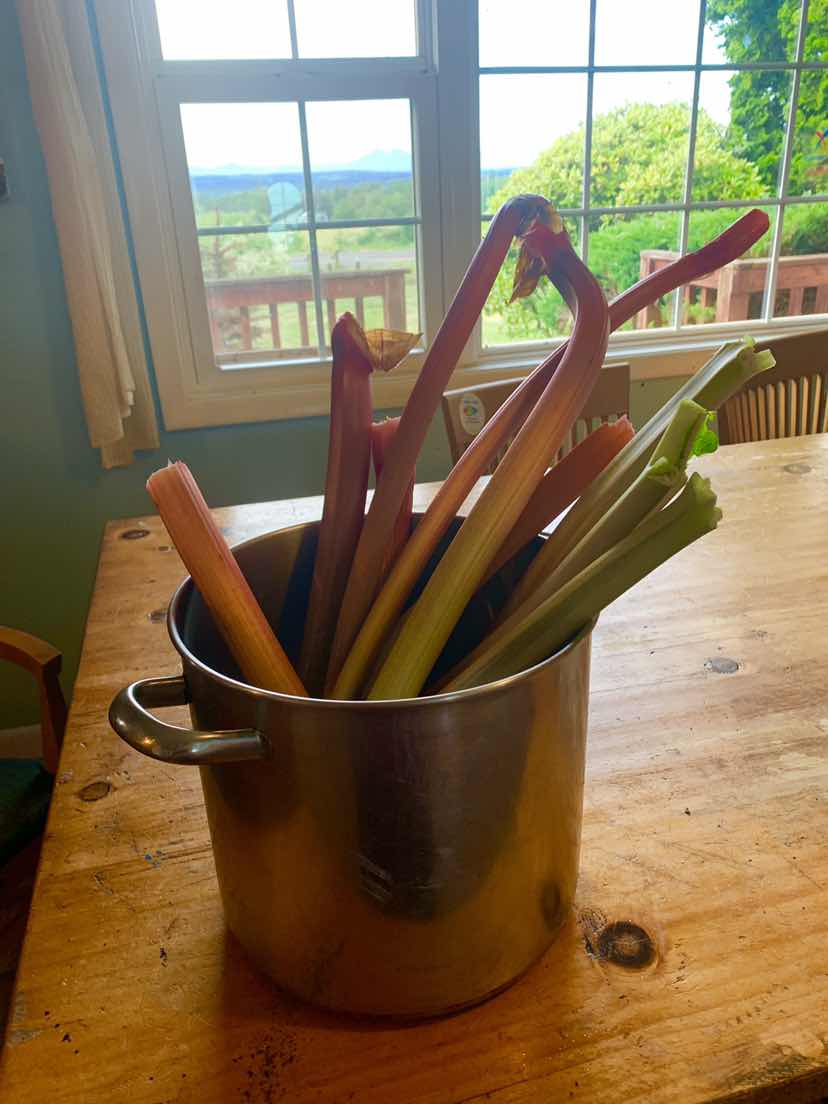
Spring finally sprang, and we’ve had a few weeks of beautiful weather. The grass grew all at once, the trees blossomed, and the rhubarb plant went wild. 


I love rhubarb, it’s exactly the kind of low maintenance perennial I want to fill my property with. But it is seriously prolific. By mother’s day I had already exhausted my family’s patience with rhubarb crisp, rhubarb pie, and rhubarb quickbread. So today I decided to start another batch of rhubarb wine. 

Last year’s rhubarb wine came out pretty good - dry, light pink, and quite quaffable. It’s nice to be able to start a wine in springtime, because most homemade fruit wines are only possible in the fall - blackberry, plum, hard apple cider. Rhubarb can be started now, in May, and be ready for drinking in September when the other wines are just getting started. 


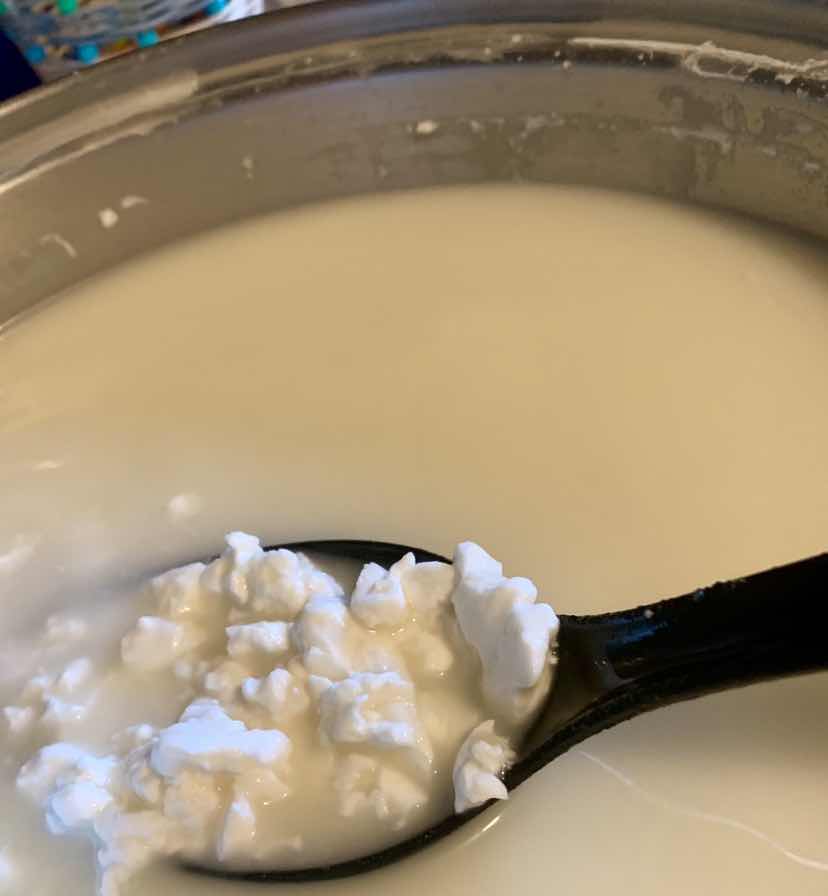
It’s cheese season. The mama goats still have nursing babies on them, and will for the next few weeks. So I’m only getting about three quarters of a gallon daily, but that’s still plenty for making some cheese. 

This year I decided to switch up the cultures I usually buy.  In years past,  I have bought an all-purpose mesophilic starter that says it is suitable for chèvre, queso fresco, feta, and cheddar. And it is suitable for all those purposes.   But this year I decided to spend a little bit more for a fancier culture from France, and I’m so glad I did. My chèvre is leaps and bounds better than last year. It’s smooth, tangy, and delicious. It was a big hit at mother’s day brunch. 

Tonight I’m making cheddar with the same culture. I’ve made two batches of hard cheese before now, and they have been drying in the shelf during this nice dry weather. Today I broke out the vacuum sealer and sealed them up for long term storage in the fridge. That’s the best system I’ve yet found for keeping hard cheese at home without molding. It’s not ideal - the cheese doesn’t “breathe” if it’s vacuum sealed - but it does keep the cheese from molding for a good six months, which means we can enjoy cheese in December. 


Thursday, December 27, 2018

A Peck of Disappointing Peppers


The Gleaner’s Pantry usually has an abundance of food after any major holiday - and this year was no exception. The day after Christmas there was a special glean, and along with a plethora of cookies, cakes, pannetone, and various and sundry candies, there was also a vast amount of fresh vegetables and fruits. 


I took home three or four sacks of oranges, a half a dozen pomegranates, and a goodly number of specialty pears wrapped in crinkly foil paper, lovingly packed into wooden crates, and labeled with a well-known national
brand. But the real haul was a near-bushel of shiny, green, taut-skinned jalapeños. I couldn’t see a damn thing wrong with these peppers, nor imagine why they had been thrown away. I took all of them that nobody else wanted - at least two full shopping bags full. 

This morning I spent three hours with a pair of latex gloves on, prepping the peppers for canning. I searched the cabinets and discovered a dozen wide mouth pint jars; I unearthed the lids and rings and set them to boil. I sat down with a paring knife and put on a CD and filleted some fifty or sixty peppers and cut them into rajas. I made a brine of one third white vinegar and two thirds water, a half cup of sugar and a quarter cup of salt, pickling spices and several cloves peeled garlic. 


Ten pints of sealed pickled peppers later it occurs to me to actually taste the peppers - there were a lot left over. And damn! I finally figured out why such a huge quantity of perfect peppers was at Gleaner’s in the first place. These supposed jalapeños had ZERO heat. They were basically small, pointy green bell peppers. 

You have probably noticed - if you are over thirty years old and like to cook -  that jalapeño peppers have changed in the past decade or so. A new hybrid came out ten or fifteen years ago: a bigger, blunter, WAY less spicy jalapeño. I think it’s a cross between a jalapeño and a green bell pepper. Recently, it seems that this is the only “jalapeño” you can find. The older, smaller, hotter jalapeños have pretty much disappeared from the markets. These days if I want a hot pepper, I have to buy serranos. But I have never yet run into a hybrid jalapeño that had NO heat whatsoever.

My guess is that somebody bought a bunch of this batch and then complained to the grocery manager - I know I would. And then the manager taste-tested them and came to the same conclusion I did - these jalapeños are shit. 

Oh well - now I have twelve pints of pickled anemic peppers. We usually go through a pint of pickled jalapeños every two weeks or so. They are standard garnish for three out of every four meals we eat here - scrambled eggs, taco toppings, sandwich fillings, components in tuna or chicken salad. But peppers without any bite at all? I just don’t know how we will use them up. 


Saturday, September 1, 2018

Making Up for Lost Time (Mabon Again)


We arrived home late the night before last. Or perhaps more accurate to say, early yesterday morning. We finally opened the door to our home at about 1:30 am Friday morning, to a couple of very happy dogs. 

After sleeping in quite late, we set about cleaning the house (my daughter Rowan did a wonderful job taking care of the farm and keeping the place operational, but she apparently didn’t sweep the floor or scrub the toilet once in seven weeks). I had cleaned out the fridge before we left, so there wasn’t much food in the house. 

A quick reconnaissance of the orchard revealed that there is still a heck of a lot of fruit to cope with. The greengage plums are done for this year - though a neighbor friend picked a bunch and dehydrated some for us - but the Italian plums are still a week or so away from ripe, and the tree is loaded. 

Pears are falling all over the property. I think I may have mentioned that I have FOUR pear trees, which is a ridiculous number. The Bartletts are ripe, and the Comice pears are not far behind. The Seckels and whatever the fourth one is (I forget) have a ways to go. Today I picked up a few dozen fallen Bartlett pears that were still firm and  fragnrant and tomorrow I will haul the dehydrator out of storage and scrub it. The girls love dehydrated pears in their school lunches. School starts Tuesday. 

The cider apple tree is covered with apples. Cider season will be soon.  The other Apple trees, still quite young, have a few dozen apples apiece. And the Asian pears trees, planted two years ago, and a half have a few pears on them. 


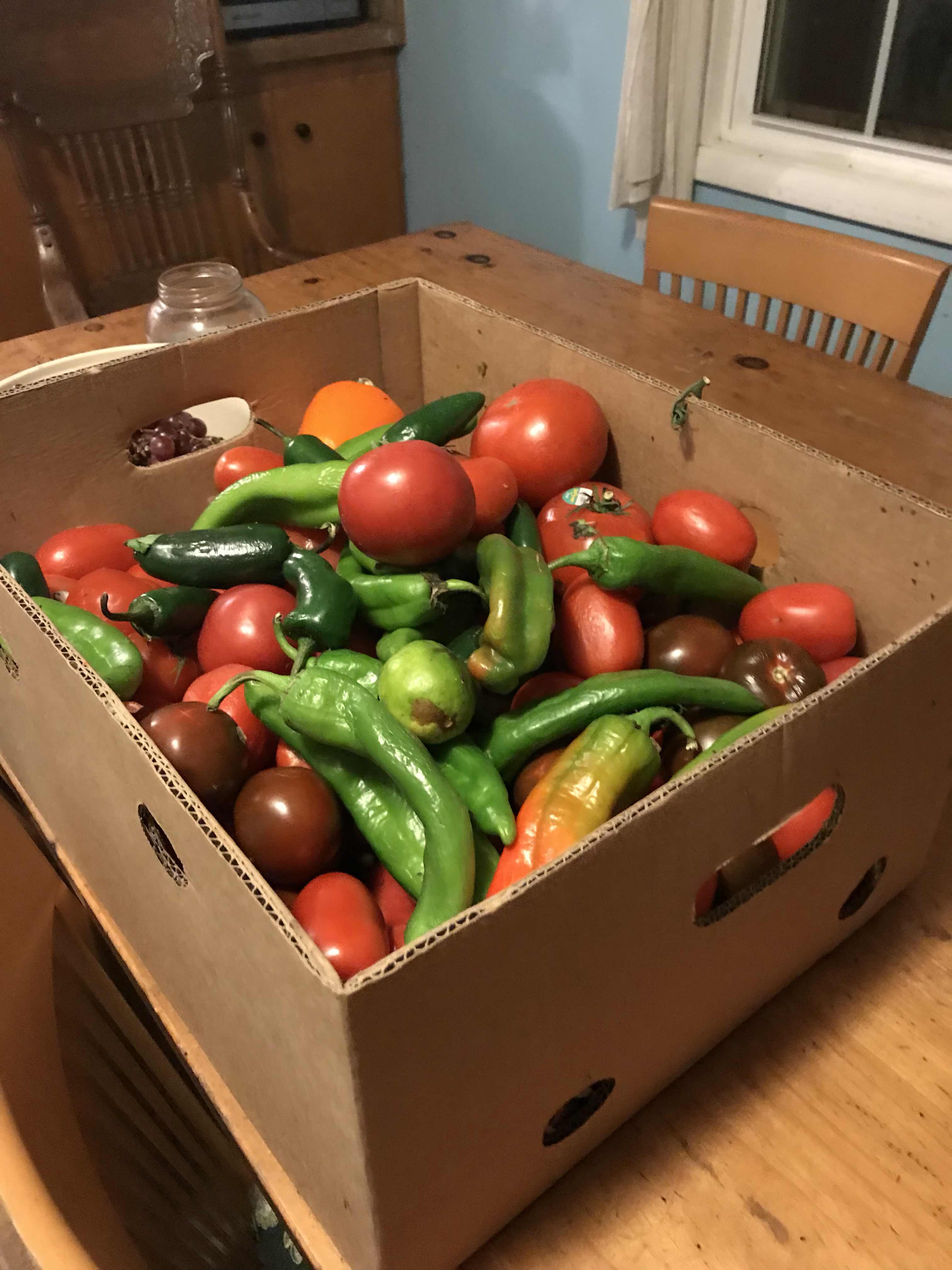
Today I went to Gleaners’s Pantry. Came home with the crate you see above - about twenty five pounds of tomatoes and peppers. Tomorrow I will can. I’m guessing there’s a good dozen quarts of salsa in that box. 

Tonight I spent a few hours making good use of other produce fromGleaner’s. Roasted hatch chiles, red onions, corn on the cob, and fresh tomatoes became this beautiful salsa: 


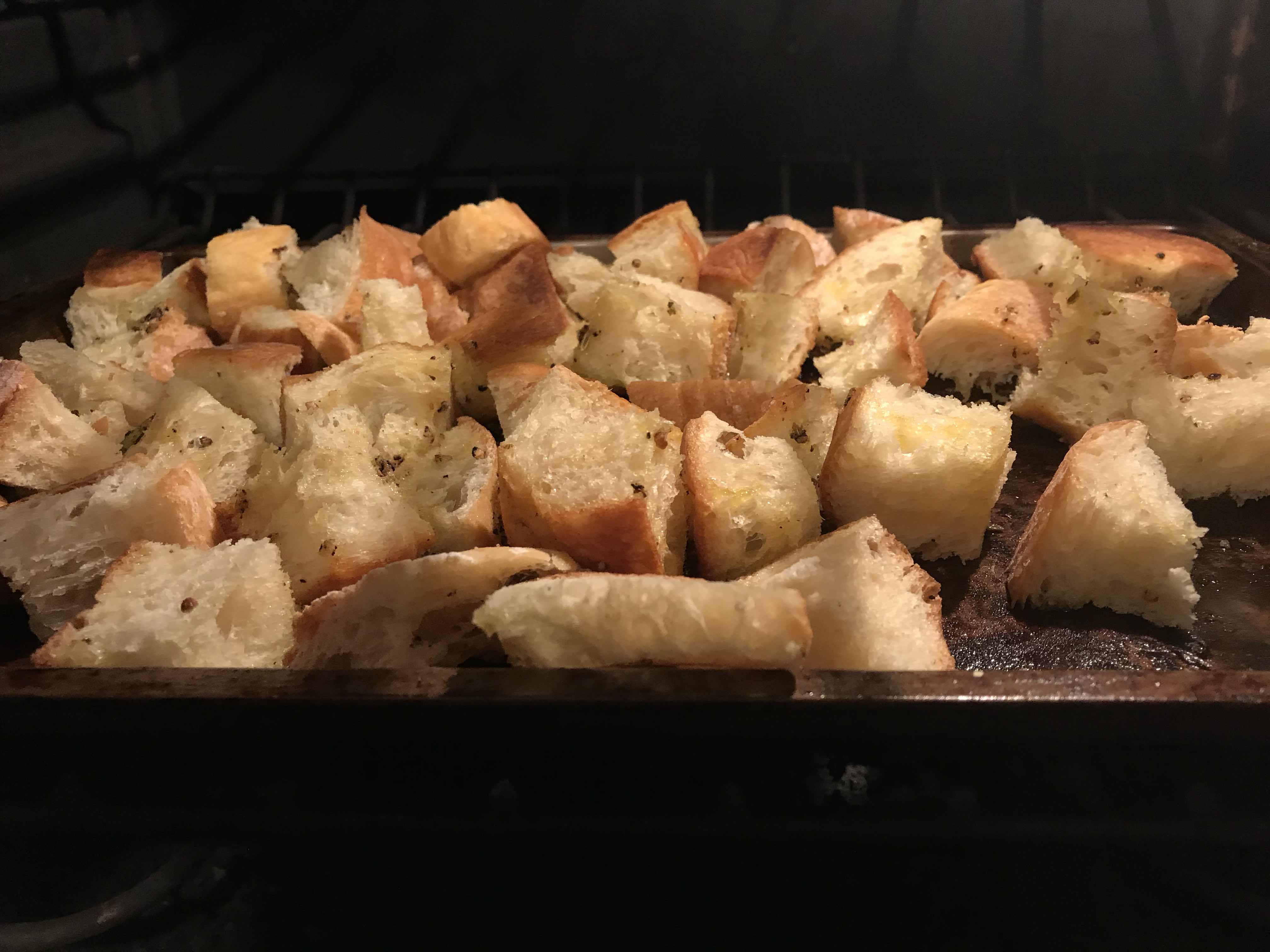
I also brought home a half dozen loaves of ciabatta bread. I like to cube it up and toss the cubes with a mix of olive oil, herbs, garlic, salt and pepper, and bake until they are crunchy croutons. Store in a ziplock bag in the fridge. 


 Not pictured here is a new experiment - plum shrub. A shrub is a fruit based concentrate, made of any fresh fruit macerated with sugar for a few days and then mixed with apple cider vinegar. That makes a storable concentrate that can be mixed with fresh water - still or sparkling - for a delightful refreshing non-alcoholic beverage. If you like, of course, you can also add a jigger of vodka or gin. My first attempt at a shrub is a half gallon of chopped Italian plums and a few springs of rosemary. I expect it will be delicious. 

I missed a lot of preserving season this year - for the very worthwhile reason that we were in Mexico with my husband’s family - but I am making up for list time. Mabon is upon us, almost, and I intend to embrace the motto of the season and be prepared. 

Besides, I love it. Putting up food is just about my favorite thing ever. 

Friday, June 8, 2018

Bloodsuckers (Parasite Problems)


Dairy goats are plagued by parasites. It's just a fact. Some areas of the country are worse than others, and in some areas resistance has become a problem; in other areas its less serious. But anyone who raises dairy goats will have to develop a parasite protocol and be on the lookout for signs of infestation.

I've had my troubles with parasites before - our wet weather and lack of hard freezes some winters contributes to the issue. We've had lungworms and stomach worms and coccidia. For the most part, these have been passing problems, and with vigilant treatment otherwise healthy goats shake off the effects and continue to thrive. I do know by now, however, what a wormy goat looks like.

-Diarrhea. Primary symptom. May be intermittent or constant.

- Skinny. Weight loss is the main symptom (after diarrhea) and it happens not just because the parasites leech energy from the host, but because if the host is losing enough blood they will become anemic and then the rumen doesn't get properly perfused, doesn't work correctly, and you get malabsorption syndrome. Then it doesn't matter how much quality food you are feeding, the goats can't benefit from it.

- anemia symptoms: lethargy, pale gums and conjunctiva

- lowered milk production, if they are in milk

- rough, coarse coat. I don't know why this happens.

In the middle of winter, when it's cold, and all the forage is gone and the goats are subsisting on just hay, and they are pregnant, it's fairly normal for them to lose a little weight. But they shouldn't get really thin. This past winter my goats kept losing weight no matter what I fed them. In fact, they were skinny as rail fences, and generally looked run down and wormy. They started pooping green glop, instead of nice clean pellets. I figured I had worms and dosed everyone with the standard medicine, Ivermectin.

When they didn't improve after some time, I repeated the ivermectin, and when they still didn't improve I thought I might have some resistant worms on my hands and switched to a different wormer that works by a totally different action.

Well they just kept losing weight. Spring came, they gave birth (Flopsy to quadruplets again) and the babies were all healthy, but the moms went downhill, trying to feed all those insatiable little monsters. I brought fecal samples to the vet and, maddeningly, they came out clean. Negative for everything. Repeat fecals came out clean as well.

I discussed the issue with my vet, on the phone, but all he suggested was increasing their ration of grain and buying some alfalfa hay. He seemed to think it was a feed issue, and indeed it certainly looked as though my poor goats were starving to death. He said "Parasites are not your problem," but I knew he was wrong. I know an anemic goat when I see one.

I don't know when the light dawned. Maybe it was when spring was far enough advanced that I started letting the goats out to graze in the front, and began spending a lot more time in close proximity with them than I did in the winter, when I would just go out for a few minutes twice a day for chores. I noticed that their coats weren't just rough, but that they actually had bald patches and that they were rubbing themselves along the fences. BINGO! A lightbulb went off in my head.

Not all parasites are internal. There are external parasites as well. Lice. Probably brought here by the buck I used to serve them last fall.

As the parent of three children who went to public school, I have had my fair share of experience with human head lice. As obnoxious and disgusting as they are, in people, lice are not dangerous. They do not carry and dangerous diseases, and being confined to a small percentage of our total surface area, they can't really suck enough blood to do us great harm. In goats, however, the case is different.

A serious lice infestation can act exactly as a serious internal parasite infestation - the insects can suck enough blood to cause serious anemia, and then all the sequelae are the same as that of a worm-induced anemia - malabsorption syndrome, weight loss, even death by starvation. My poor goats were being sucked dry by thousands of tiny vampires.

Luckily, the treatment is easy and cheap. It's actually the exact same medicine used in people - Permethrin - but at a higher concentration. You can buy it at the feed store under the name "Ultraboss," You dose the animals at 3mL/100lbs at a 5% concentration, laying down a line along their spines, just like applying flea medicine to dogs. As in people, it requires a minimum of two doses given two weeks apart, because Permethrin kills live lice but not eggs. Now my goats have received three treatments, and I may still have to give them a fourth. This was a very heavy infestation.

Almost immediately they began to improve. Their energy level went up quickly, and they began to gambol about and bounce like healthy goats do, instead of hobbling around arthritically. Milk production skyrocketed (another post will follow - I am drowning in milk). Their coats began to fill out and regain their gloss. Only the diarrhea is still hanging around. I think that probably the severe anemia actually did some damage to their rumens and it will simply take some time for them to heal and perform optimally again. That's just a supposition. If the diarrhea persists for another couple of weeks, I will have to bite the bullet and actually have the vet out to look at them.

But for now, I feel pretty proud of myself. Yes, it took me a while, but I diagnosed the problem despite poor veterinary advice, and was able to treat my ladies and help them get better. It makes me trust my eye and my instinct better than before. Little belittle, I am becoming a real farmer.

for more information about lice in goats:

http://www.ansc.purdue.edu/SP/MG/Documents/SLIDES/External%20Parasites.pdf


Wednesday, October 4, 2017

Piggy Piggy (More Pork)


 Paloma and the Pig 


Two new pigs have arrived on the farm. We weren't looking for pigs; we still have plenty of pork left in the freezer from the last pigs. Those pigs were so vicious and unpleasant that I was looking forward to not having any pigs again for
some time to come. 

However. I belong to a local farmer's Facebook group, and that means I just HAVE to see all the animals for sale at any given time. I can't even help it - it just appears on my feed. In the "old days" three years ago, I had to at least go to Craigslist and seek out animals to buy. Boy, that was like, the Jurassic era. 

So, a neighbor farmer friend of ours, from whom we have bought pigs before (but not last year's evil pigs) was advertising well-grown piglets for $125 each. A friend of his had to leave town quickly unexpectedly for a new job and asked our friend to sell off his herd of nine piglets. From the photos he posted, I could see that they were considerably older than  the usual weaners which sell for the same price. After consulting with Homero, I asked our friend to keep two for us. 

When he delivered them, I was surprised and gratified to see how big they are. They were almost the size of barbecue hogs which sell for $250 or so. I asked what breed they were and I got "Berkshire cross." That's good enough for me. 

These pigs are quite shy, and scared of people. I don't mind; I've found that if the pigs aren't scared of me, then I am likely to be scared of them. They spent the first few days in the big barn, but we have since transferred them to the sacrifice area. There, they can be comfortable in the field shelter, and have plenty of space for exercising. If they root up the ground, they will be doing me a favor, since that earth is compacted and gravelly. 

If all goes well, the pigs ought to be harvest sized by Christmas. In the meantime, we have to eat up the pork we still have in the freezer. To that end, I made a delicious pork roast yesterday. I just liberally salted and peppered it, put it in a casserole with a few cloves of garlic, and then poured over two cups of home pressed apple cider that was a week old and fairly well converted into tepache. I covered the casserole with tinfoil and crimped it well, and baked it at 300 for several hours. Absolutely delicious with smashed Prato salad. 

Friday, September 1, 2017

Beef Abundance (Simple is Good)


Summer is drawing to a close - not that you'd know it by the weather. Today, September first, it was 85 degrees and sunny. This is something like our fiftieth day without measurable rain. The forecast continues dry and hot as far as the weather-people can see into the future.

But the calendar is implacable. School starts this Tuesday, no matter the forecast. It's time and past time to get the kids new school shoes and jackets; to mow the last scraggly weeds; to shake off summer's languor and impose something like a schedule again. 

It's also time, more pleasantly, to eat up the meat in the freezer. Last week Mr. B., my neighbor, asked us if we'd be wanting to buy a side of beef this year again, and I said we sure would. Last fall, due to a silly series of miscommunications, we ended up buying a ridiculous quantity of beef - three quarters of a big fat steer, much more than we needed. Quite a bit of it is still in the freezer and needs to be devoured ASAP to make room. 

Today I thawed a package of rib steaks. A favorite cut of mine, they are heavily marbled and carry a thick rim of fat around the edges. If you aren't used to grass fed beef, you might be thinking "yuck, fat." I assure you that the succulent, yellow, flavorful fat of a grass fed and grass finished beeve is nothing like the pale rubbery fat on a factory farmed animal. 

These steaks don't need much. After thawing, I liberally sprinkled them with salt, pepper, and garlic powder, and laid them on a big cast iron griddle slicked with quality olive oil and got out of the way. Flip after six or seven minutes and give the other side a sear. My husband likes his steaks medium well and I like mine medium rare, so I take mine off a few minutes early and let it rest while his continues to cook. 

As an accompaniment I boiled a half dozen yellow potatoes, and smashed them with a couple tablespoons of butter, a teaspoon of whole grain mustard, a spoonful of mayonnaise, salt, pepper, and a generous amount of minced parsley. A cold beer after a hot day's work rounds out the meal.