"United we bargain, divided we beg."
Showing posts with label cheese. Show all posts

Sunday, September 13, 2020

Preserving Log (Late Summer 2020)


I’ve been on an absolute tear in the kitchen the last two weeks. Late August/early September is the middle harvest season (Mabon is coming right up), the prime harvest season around here. Here’s a list of what I’ve done lately - as far as I can remember. 
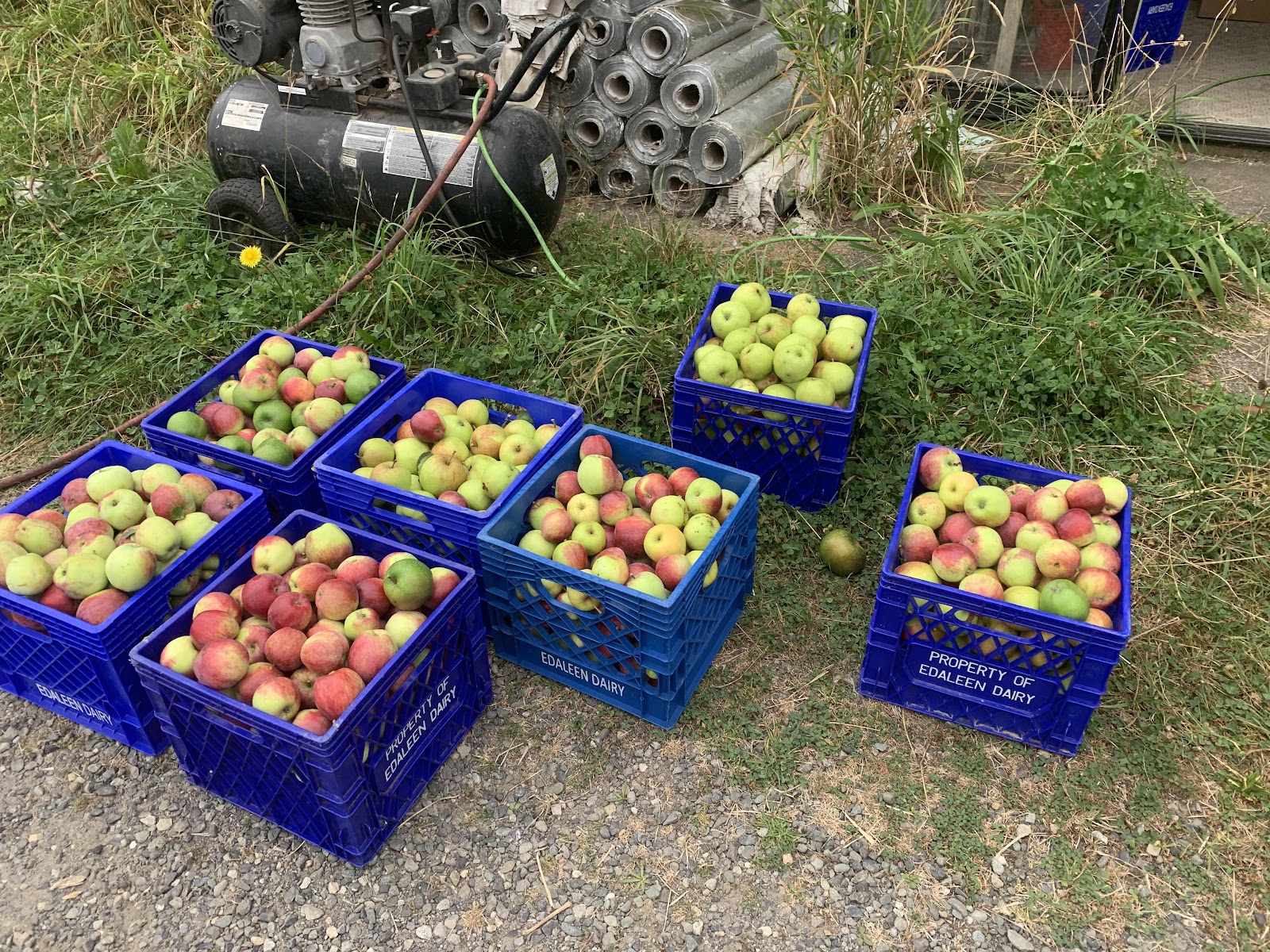

Today the girls and I pressed about ten gallons of cider, from the apples you see above. My friend H. down the way has a dozen apple trees and was only too happy to let us pick some. Tomorrow I will bring her some cider. 

Cidering is hard work. Picking the apples, carrying the crates, washing the apples, hauling the press out and cleaning it, bending down and standing up approximately 7000 times, pressing the buckets, pulling the tight-packed plate back out of the buckets, carrying the apple mast to the compost. It’s messy too, with little bits of apples flying everywhere and juice on everything. By the end I was so sweaty and sticky and tired! Working outdoors in this horrible smoke isn’t a lot of fun, either. But this was the first time we’ve pressed cider in a couple years and overall it’s a great experience. 

The smaller of my two carboys, three gallons, will be made into hard cider, and we’re keeping the rest sweet. I threw two gallons into the freezer, which leaves us about six gallons to get through before it turns into tepache. Not that there’s anything wrong with tepache. 
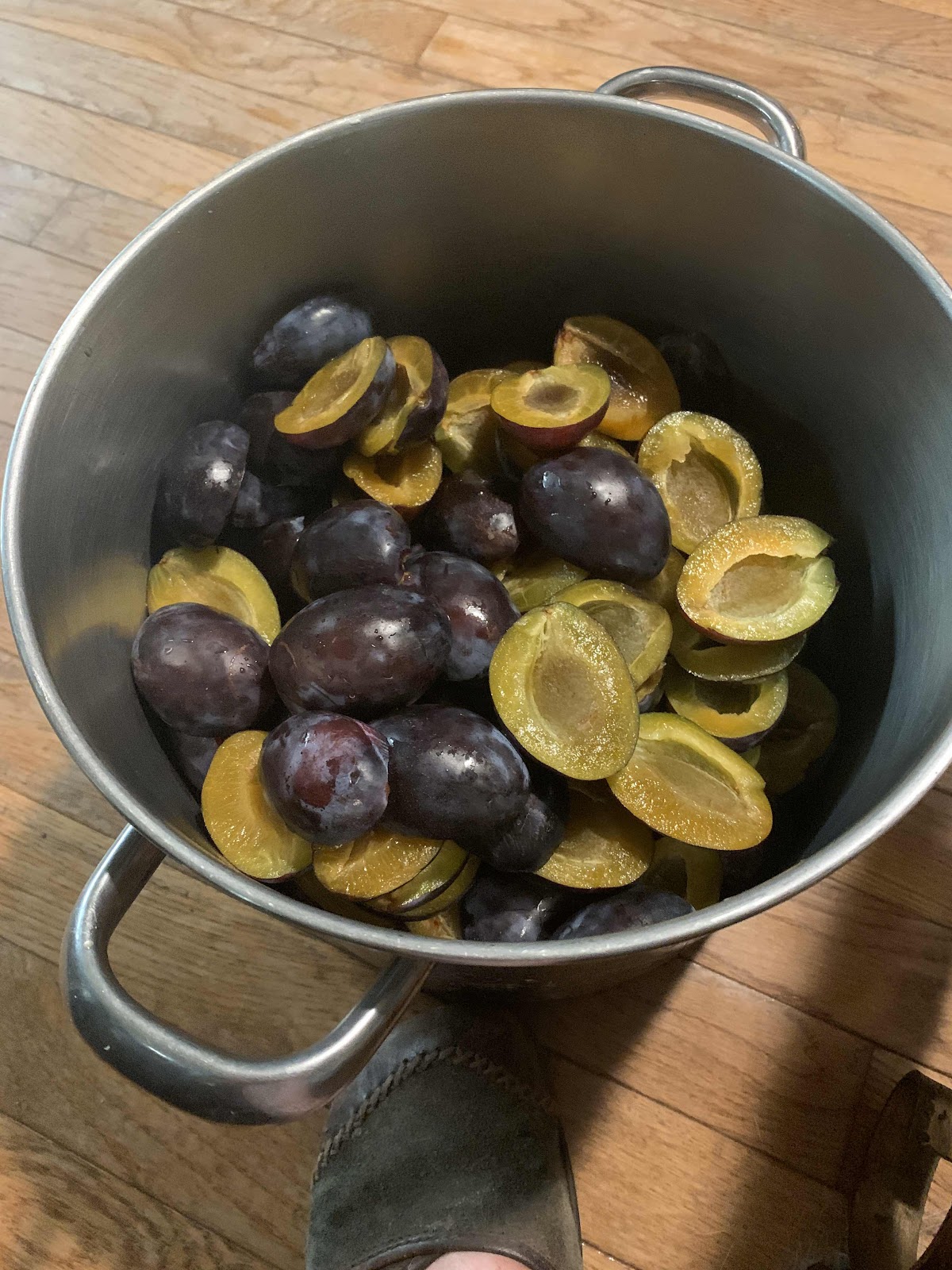


Plums. This in an on-year for the Italian plum tree, and there are hundreds and hundreds of plums. I’ve dehydrated enough to fill a gallon ziploc bag - more plums than you probably think - and the dehydrator is full of plums right now too. 

I’m taking another swing at plum wine. My past efforts have been drinkable, not fantastic.  Probably I won’t get any better unless I buy a little more equipment - like a hydrometer - and start taking recipes more seriously. But hey - there are so many plums. How far wrong can you go? Right now there’s about two gallons in a primary fermenting chamber and I’ll pitch the yeast tomorrow. I have to go buy another carboy because all of mine are currently full of apple cider. 
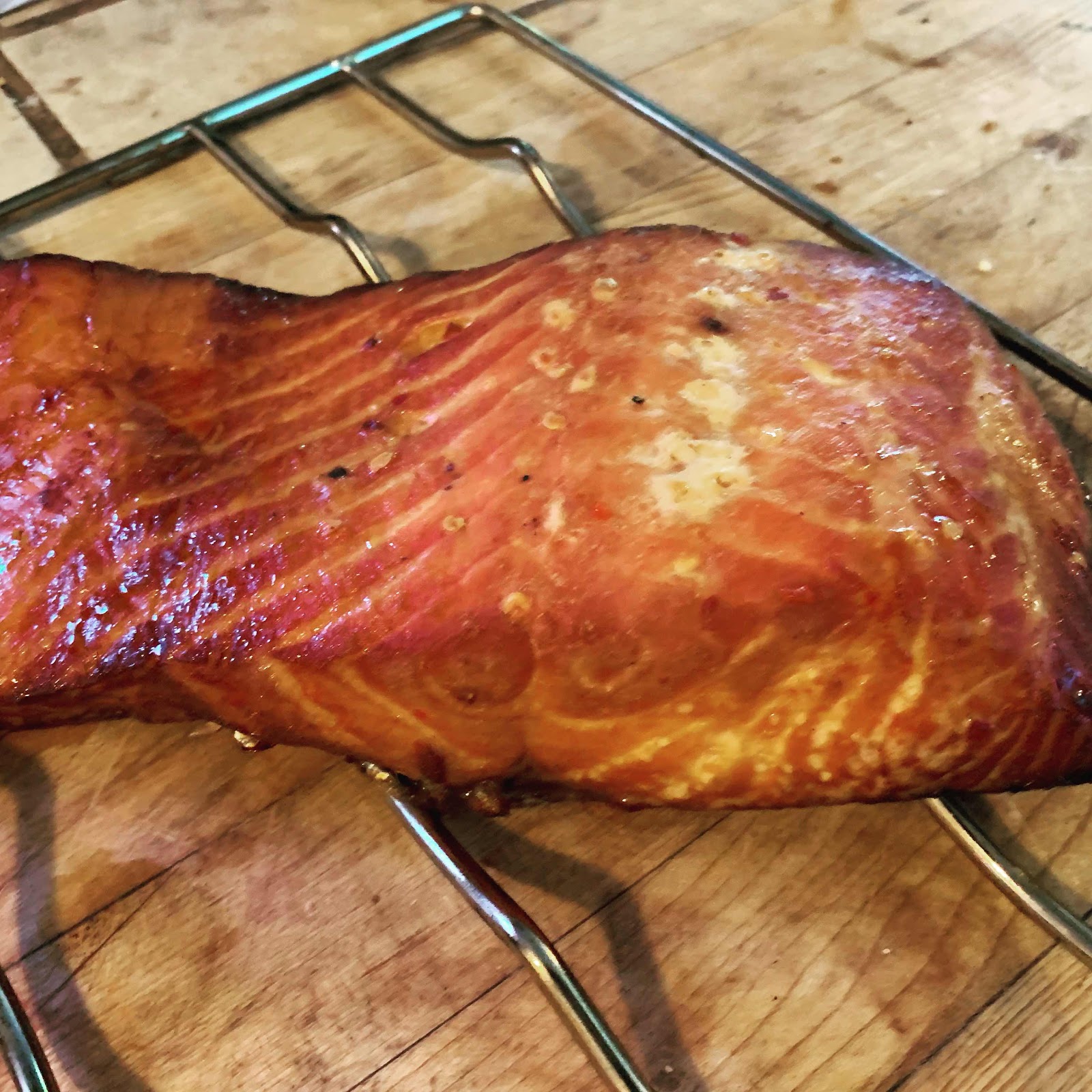


One of Homero’s clients brought him an enormous side of  salmon as a tip. I cut it into five approximately 1 1/2 lb pieces, and we ate one fresh and then I smoked the others. One of the smoked pieces is in the fridge to snack on and the others are vacuum sealed and will keep in the fridge for a few months. Probably not until Christmas though, sadly. Smoked salmon is my favorite thing to send friends and family as a Christmas gift. I could throw them in the freezer but I’m not sure how well the texture would hold up. 

Let’s see, what else? Oh, I canned six quarts of salsa ranchera  this week with tomatoes from gleaners. But I’m not doing a lot of canning for the simple reason that I can’t find canning lids anywhere! Apparently canning lids are the toilet paper of this phase of the pandemic. I have one package of small mouth lids left. 

A couple days ago I hit my favorite local farm stands just to see what was available. I brought home some sweet corn (which we ate), some cherry tomatoes (ditto), five pounds of green beans, and three smallish kohlrabi. I started kimchee with the kohlrabi. Earlier this summer I made a batch of kohlrabi kimchee and it was the BOMB. It’s only about a quart, but we will enjoy it. 

I’ll have to decide if I want to use the last of my canning lids to make canned dilly beans with the green beans, or if I will lacto-ferment them like kosher dill pickles. Both ways are good. 

I haven’t even started in the pears. Good lord, the pears! WHY did I plant FOUR pear trees? 


Sunday, July 19, 2020

High Cheese Season 2020 (Making Do)


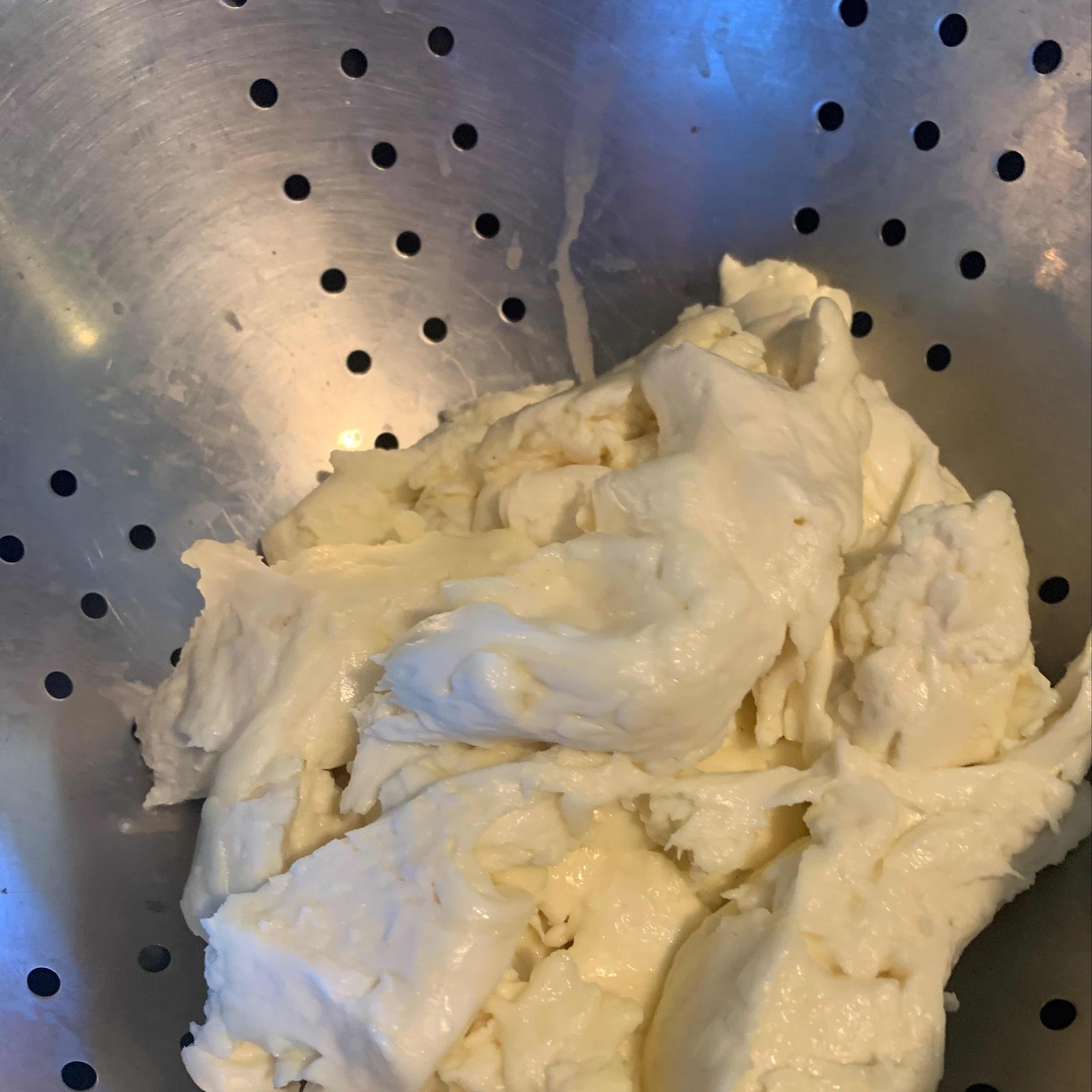
            A middle stage in the making of cheddar 


In last week’s post on preserving, I forgot to include cheese. Cheese is kind of the whole point of this farm - a desire to milk goats and learn how to make cheese was one of the driving forces in moving up here in the first place. After ten or so years, I have developed three or four cheese recipes that serve me well. As in many endeavors, it is pretty easy to achieve a basic level of competence, and then quite difficult to move on to a level of expertise that allows for consistent, high quality results every time. 

Being who I am, I have more or less decided that I’m happy with my level. I very seldom have an abject failure - all the cheese I make tastes good and is usable for one application or another. But I often have to decide what that application is AFTER I see how the cheese turns out. 

Today I am making chevre and cheddar. Chevre is easy - you just culture the fresh milk and wait 24 hours, then drain it through a clean pillowcase and salt it to taste. Once in a while, especially in very warm weather, the chevre will develop some off, goaty flavors that nobody is fond of. When that happens, I incorporate the cheese into a highly flavored recipe where the goaty flavors will be outcompeted,  like spicy eggplant Parmesan. 

Cheddar is more difficult. It requires several steps, and my recipes include instructions that are patently impossible to follow in a home kitchen, such as “hold the milk at exactly 99 degrees for four hours.” Much of the “cheddar” I’ve made is actually just “plain semi-hard cheese.” The most common defect is that it stays crumbly instead of melding into a single, smooth textured mass. But hey, goat cheese crumbles are a delicious addition to many dishes. Luckily, my Mexican husband is totally used to a dish of cheese crumbles on the table as a condiment, with a spoon, for sprinkling onto everything from refried beans to scrambled eggs to green salad. 

Making do with what you have is a philosophy, one that I’m fond of. I’m not going to waste any time lamenting over a “failure” to produce perfect cheddar when what I’ve actually produced is a pretty delicious piece of cheese. Instead, I’m going to incorporate that cheese into the larger, creative task of taking stock of what I have on hand and weaving disparate ingredients into something new and satisfying. 

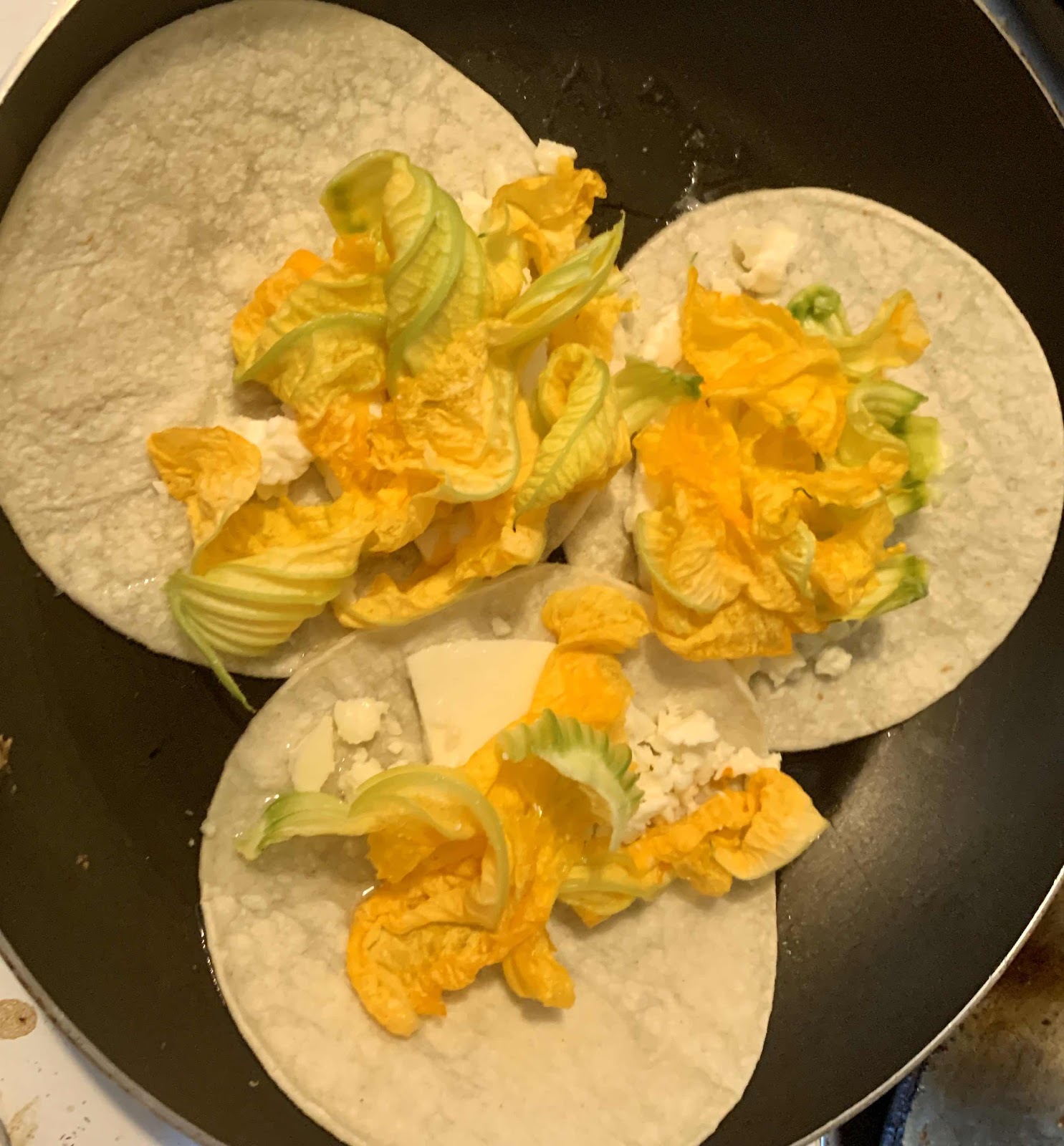
This morning, I opened a vacuum sealed package of cheese from early this spring, expecting to find a nice, mild, melting cheddar. Instead it was a sharp flavored crumbly cheese. But it still worked well to make squash blossom goat cheese quesadillas for breakfast. I got no complaints. 


Wednesday, February 12, 2020

Dedicated Cheese


Today I opened up a cheese from last spring, that had been resting, vacuum sealed, in the dedicated fridge in the store room. The “dedicated fridge” is a half-sized refrigerator that I bought last year to store cheese, smoked salmon, and various fermented products such as sauerkraut, kim chee, and so forth.

As of today, there were only three packages of cheese in the dedicated fridge, totaling  perhaps  four pounds. Most of the cheese had been either eaten or traded away months ago. It’s always a gamble opening up a sealed cheese. 

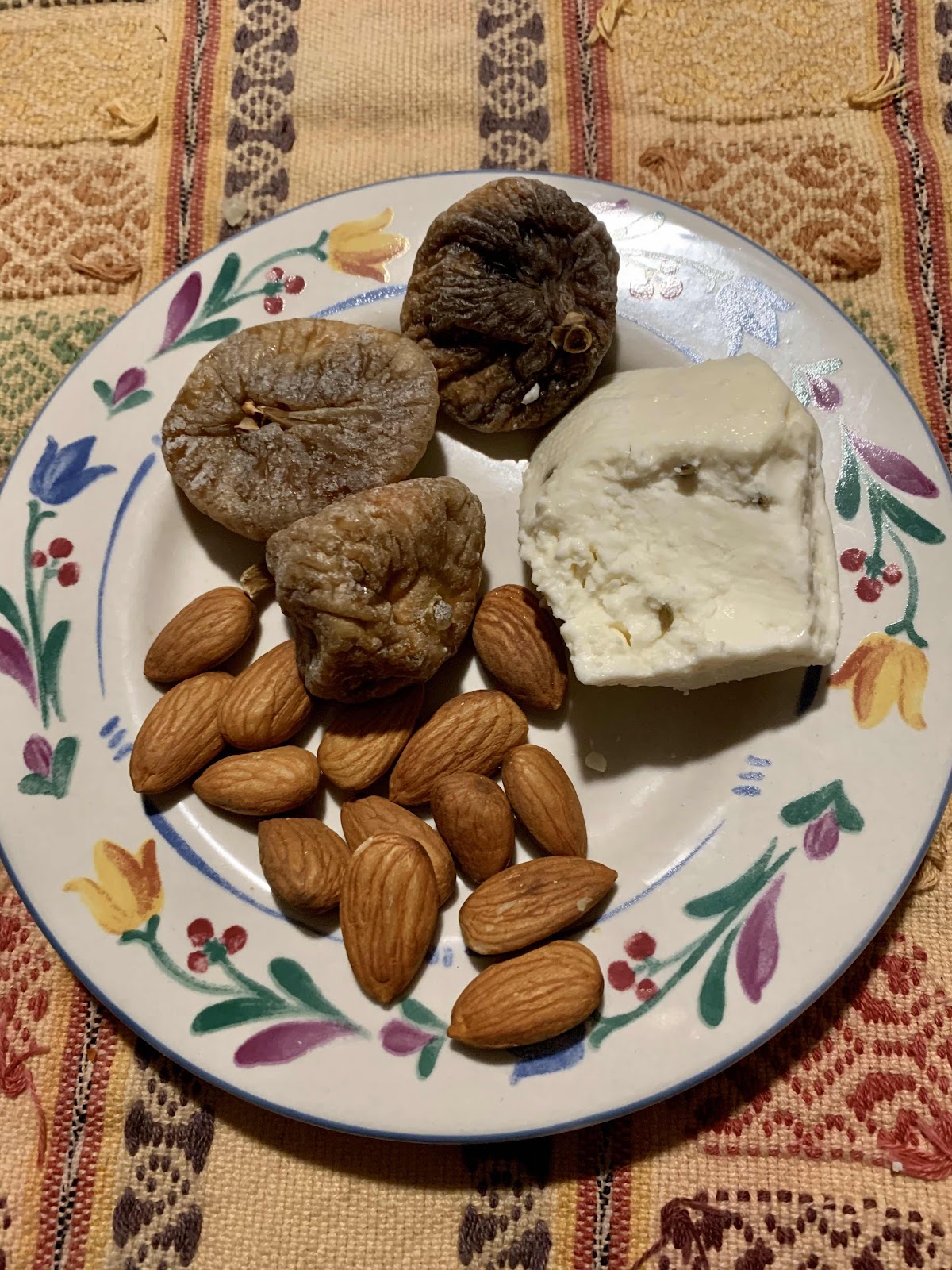
This gamble paid off. The cheese is strong but delightfully rather than offensively so; goaty but pleasantly so; herbal with the scent of caraway seed, but not overpoweringly. A handful of almonds and a few dried figs made a beautiful accompaniment.

Other likely partners include fresh apple slices, sourdough bread, olives, maybe roasted red peppers and artichoke hearts... basically it would be an enhancement to any mezze plate or antipasto plate. 

I’m inordinately proud. I mean seriously. How many people are there, in this day and age, who make their own cheese? And cheese made from the milk of goats who they raised and milked themselves, at that? the cheese I enjoyed tonight is a true artisan farmstead product that few people have the chance to taste.

More’s the pity. if you ever make it out here, there’s cheese in the dedicated fridge. Dedicated for you. 

Sunday, November 11, 2018

Salvaging the Impalatable (Fermented Seal Guts)


April and May is goat cheese season, year after year. This past spring, however, I spent even more time than I usually do making cheese. That was because I knew that we would be spending the two months of high summer far from home, in Oaxaca. Whereas I would usually use most of the milk making fresh, easy to make and easy to use simple cheeses like queso fresco and chevre, this year I made more hard cheeses, intended for storing. 

My hope was that I could make enough hard cheese, and store it effectively enough, to have cheese in the late summer and fall when we came home. I made mostly cheddar, with and without flavorings such as chives and red pepper flakes, and I used my vacuum sealer to seal it up and store it in the fridge over the summer. In past years, I haven’t had great luck with this method - the cheese inevitably molded even inside the vacuum sealed pouches. This time I took more care to cure (air dry) the cheeses well before sealing. Then I packed them into the coldest part of the fridge, crossed my fingers, said a prayer, and flew away. 

Upon our return I was delighted to find that none of the packages showed any signs of mold. The seals were tight; thee was no evidence of air inside the bubble, and when I opened a package, the cheese smelled fresh and good. 

However. 

However. 

I still wasn’t happy with the “final product.” In my mind, an aged cheddar should have a distinct taste and texture  - “sharp,” piquant, and maybe a bit crystally, ever so slightly crunchy under the teeth. It ought to melt well. It ought to smell wonderful, and to be appetizing even to those who aren’t the biggest fans of aged cheese. At the very least, it ought not to be offensive to the taste (except to those weak-stomached fools who hate any strong flavored cheese). 

The cheeses I have opened so far have been a bit hit or miss, according to these criteria. Mostly, they do melt well and have a very good texture. The problem is their extremely strong, rather goaty flavor. The “goaty” flavor in aged goat cheeses is due to certain compounds known as Caprine flavor compounds. Apparently, they tend to concentrate over time. What went into the fridge in May as a nice, smooth, mild-mannered green cheddar came out in September as a rugged, aggressive, stinky, crumbly goat cheese. It is simply not something that most people - more to the point “we” - would choose to eat as a stand alone product. 

That’s disappointing of course. I’ve made myself eat a few slices on crackers, with grapes or apples and the soothing influence of fig jam or plum preserves, but it just isn’t a truly pleasant experience, if I am honest. So I am left with the question of what to do with several pounds of extra-strong stinky goat cheese that represents a silly number of hours of labor that I am simply not willing to chalk up to experience and toss in the trash.

Today I solved that problem by making calzone. I had some herbed pizza dough courtesy of the gleaner’s pantry, and our own pantry provided various strong flavored ingredients such as kalamata olives and marinated artichoke hearts, with which I intended to mask the Caprine compounds. 

Paloma helped me roll out the dough and I took the opportunity to educate her a little (read, bore her to tears) about the historical necessity of making do with whatever ingredients were available, regardless of their objective edibility. For most of human existence, nobody had the luxury of turning their nose up at “stinky” food. Willingness to eat what was available was quite literally the difference between life and death, or at least between health and malnutrition. 

“Some people in Greenland had to eat fermented seal guts,” I told her, “and eventually, it became a delicacy. Necessity is the mother of invention.” 

Her expression showed me she wasn’t convinced. 

“It’s always been a woman’s job to take whatever was at hand and turn it into something, if not delicious, at least something that her family would eat,” I continued. “And that’s the origin of haute cuisine. Seriously - all culinary creativity is based on using the dregs, the ugly bits, the stinky bits, and making it beautiful and desirable.” 

This, as I grate the too-stinky-to-eat goat cheese onto the rolled out calzone dough, and cover it with chopped olives, artichoke hearts, parsley and marinara sauce. I tell Paloma, and I cross my fingers that I’m not lying, that the cheese’s too-strong flavor will, in the company of all these other flavors, enhance the calzone and actually be an asset to the finished product. 

I’m sure that dozens of generations of women have made this same argument to their skeptical families regarding dozens of equally dubious ingredients. I mean, seriously. Natto? “Thousand year eggs?” Shrimp paste? The first Gorgonzola? We ladies have simply had to brazen it out, and time and history have largely vindicated us. Except for the fermented seal guts. 

The verdict on the calzones was that they were delicious. The goaty flavor of the cheese melded well with the salty, briny olives, and all the calzones disappeared with alacrity. 

One cheese down, several cheeses to go. 


Tuesday, May 15, 2018

Summer in Oaxaca (Abbreviated Cheese)


This cheese season will be a short one: we are going to Mexico for most of the summer. Over the past three years we have been slowly, by fits and starts, building a house in Oaxaca. The house is finally getting close to “done,” by which I mean the part for which we are paying professionals is nearly done, and we are approaching the parts that we plan to do ourselves. 

The professionals (and it should be mentioned here that it pained my husband in the extreme to cede any part of the construction to professionals at all) have completed what in Mexico is called the “obra negra.” That means, more or less, that the floors, walls, ceilings, and roof are in, and the plumbing and wiring is basically finished. But there are no fixtures, no appliances, no lights or sinks or paint or flooring. Choosing and installing all of that, and choosing the furniture, is the “fun part.” We will be doing much of that work this July and August. 

It’s been two years since we were in Oaxaca, and I can’t wait to get back. The children are excited too. However, it is beginning to become clear to me that when we elected to raise our children bilingual, binational, and bicultural, it was not an unmixed blessing we were bestowing upon them. I only thought of the benefits of having two homelands; it never occurred to me that being at home and comfortable in two worlds came with the drawback of always being homesick for somewhere. 

When we are here, they miss Oaxaca, and their cousins, and the peculiar camaraderie and joie de vivre that life in Mexico affords. When they are in Oaxaca they miss their home, their rooms, their friends, and the American brand of privacy that does not exist in Mexico. I never thought about the fact that being a citizen of two countries means you are always pining for one or the other. 

Meanwhile, here on the farm, cheese season has begun. I was lucky to sell all the goats I intended to sell this year - not just this year’s babies but also those from last year that I deemed unsuitable as breeding stock - which was all of them. I think this is the best year I have ever had for selling goats. I sold ten, altogether - seven babies and three adults - for a combined total of fifteen hundred dollars. That is, coincidentally, the exact amount I need as farm income, once every third year at least, to keep my favorable tax status as a working farm. 

All of this year’s babies have now been collected, which means that I have three mammas to milk every day. And that means about three gallons of milk a day - a little less. And THAT means I need to be making cheese at least three times a weeks so far, I have made three batches of delicious chèvre, two cheddars, and a couple of queso frescos. My brother in law hooked me up with a woman who owns a fishing boat and sells Alaskan salmon - I am planning to meet with her and trade cheese for salmon sometime this week. 

And now I have to go, because it is time to milk, yet again. 


Friday, April 15, 2016

Cheese Season Solutions (Practicality vs. Purism)


Cheese season will be short this year. We are leaving for Oaxaca June 24th, and at that point we will let the does dry off, since Rowan cannot milk and take care of the farm and go to school full time. Right now, Iris is at peak milk production, providing me with just about a gallon of milk a day. The other two does still have kids on them, and I am not usually bothering to separate the kids because Iris is providing me all the milk I can reasonably use.

Unless, that is, I find a solution for the difficult problem of aging hard cheese. I have tried for several years, with little success (okay, no success) to age my hard cheeses. I purchased a wine fridge. I bought cheese wax and waxed the cheeses and stored them in the wine fridge. I read about optimal humidity levels. I turned them over daily. No matter what I did, the wax cracked and the cheese molded within about a month to six weeks.

With larger wheels of cheese (large for me is about a four to five pound wheel) I was able to whittle off the mold and eat the interior of the cheese, but more than half of it was lost, and I could always detect a little moldiness even after trimming. Just seemed like a giant waste and a big disappointment.

So this year I have been making more chèvre, which I can use up in lots of ways (although I feel like an Iron Chef with chèvre as a secret ingredient - "you must use chèvre in EVERY dish") There's about three pounds of it in the fridge at the moment. I still make the hard cheese, my farmhouse cheddar, but we just have to eat it young. It's extremely frustrating, because the cheese continues to improve every day, right up until the day it starts to mold, which is at about one month. Very green hard cheese is not delicious - it's naturally quite sour and one-dimensional. Complex flavors don't begin to develop and the sourness doesn't subside until the cheese is about two weeks old, and then it becomes a challenge to try and eat it before it goes bad two weeks later. I have found that I can speed up the maturation process some by cutting the fresh cheese into 2" cubes and giving them a final salting. But what I really want is to be able to make hard cheese that I can eat six months later.

Recently, an exciting new cheese shop opened up in my town, Twin Sisters Creamery (http://www.twinsisterscreamery.com/#!cheese-shop/cjdh). Not only do they sell a wonderful assortment of cheeses both local and international, but they are cheesemakers as well, producing a terrific blue cheese called "Whatcom Blue," among others. When they first opened, I went in and had a long chat with one of the owners and she was delightful. We talked about cheese for a half hour or so, and she was interested in the fact that there are many home cheesemakers around. I told her I'd be back as soon as cheese season started, and if she wanted to sample some of my goat cheese, she'd be more than welcome. She said she'd love to.

It occurred to me today to go and ask her about solutions for my storage issues. I brought along a wheel of two-day old cheese, and two baggies of cheese cubes, one about two weeks old and one about four weeks old. I was hoping that she would want to taste my cheese and would be impressed with it (I'm a sucker for praise), but mostly I was just hoping she would have some suggestions for aging it successfully.

Turns out, she wasn't there. I spoke to her husband, instead, who was a very kind and friendly guy, but not the head honcho cheesemaker. He didn't want to taste the cheese ("I'm not really a goat cheese kind of guy") and I don't blame him - if I were a professional cheesemaker I certainly wouldn't want to taste random cheese from a local person I'd never met before. He did, however, have a very useful suggestion for me.

A Foodsaver. A vacuum-sealer.

It was kind of a "du-uh" moment.

Vacuum sealers are the kind of medium-large, medium-expensive appliance that I always categorized in my head as "unnecessary gadget." Along with microwave ovens and dehydrators. Less frivolous than ice cream makers or popcorn poppers, but to a culinary purist like myself kind of a cheat.

I always imagined myself - in my daydreams - as learning the real, old world, traditional crafts of aging and curing; hanging salami in natural casings, brining kosher dills in stoneware crocks, brewing and bottling hard cider, and carefully turning and aging my own cheese. It matters not that each of these processes is actually an entire professional category on its own, I cheerfully imagined that I would become an expert in them all. And look good doing it, too.

Time passes and illusions fade. Cheese molds, cider turns to vinegar, and salamis never even get made. Time to get real. Do I want to eat my homemade cheese in November, or not? Am I simply a dilettante, feeding goats year round for the sake eating fresh cheese three months of the year, or am I serious about this thing?

So I bought a Foodsaver. It won't be just for cheese - I can also use it in the fall, for storing home-smoked salmon. I still have some questions, and I still plan on going and asking the head honcho cheesemaking lady about them. First among them, won't the cheese stop maturing once it is sealed? Doesn't it need air to keep developing? Maybe not - after all traditional cheeses are either waxed or develop a rind that severely limits gas exchange. At what stage ought I to seal the cheese? As soon as it's pressed? After air drying for a few days? Just before it would begin to mold?

Assuming I can get some answers to those questions, and assuming I can figure out how to work the darn thing. I will start separating the babies from all three does and try to make cheese two or three times a week until we leave. Hopefully, with a little experimentation, I can start to make maximum use of the oceans of milk that flow in the springtime, and save it for the droughts of winter.


Tuesday, May 5, 2015

Spring Swaps

Spring is a good season for trading. I have eggs, milk, and cheese, and am on the prowl for anything to make gardening easier, as I get stiffer and lazier every year. Here are a few recent trades that made me happy:


- A pound and a half of assorted cheese for a dozen big, vigorous raspberry canes. I am slowly turning my garden patch into a raspberry patch. 

- A couple pounds of assorted cheese for credit towards future pruning for my fruit trees. The orchard is growing - that part of it not mutilated by tent caterpillars, anyway - and will need to be pruned this coming fall/winter. This fellow is happy rot accept cheese all season long and keep track of what he owes. It's a bit of a gamble, since I haven't ever traded with him before and don't know for certain he won't just stop returning my calls as soon as I run out of cheese. However, I have so much cheese I can't possibly eat it all and so what am I really losing, here? I know I'm making somebody really happy, so that's a gamble I'm willing to take. 

- Disbudding baby goats for various sundries. Since I acquired my own iron and started disbudding my own baby goats, other nearby goat-folks have been asking me to help them. I can't charge for the service - that would be "impersonating a veterinarian" - but I am not averse to accepting a small gift in exchange for my time. First, of course, I give a long spiel about how I am NOT a vet; that disbudding is an inherently dangerous job; that there is always some risk, of infection or brain damage; and by the way, did I say I am NOT a vet?

After I am convinced that the owner is aware of and willing to assume the risks, I am happy to help. It only takes a minute and so far, I haven't injured or killed any goats. And as far as I know, none of them have grown scurs, either; I tell everybody that if they do, I will repeat the procedure, but nobody has complained yet of an incomplete disbudding. 

One lady traded me a few cuts of grass fed beef and two jars of home-canned venison for the job. Another, my friend M., traded me several pounds of shelled, organic pecans from her uncle's farm in Texas. I made curry with the venison and pecan pie with some of the pecans.

I have a long list of people waiting for cheese. I have suggested, in trade, such things as canning jars, vegetable starts, jams and jellies, or meat. People have offered me other things - some interesting, some not so much. I have no use, for example, for evergreen tree starts. But sewing lessons? Yes, I think I might just enjoy that. 

I love trading with my neighbors. 

Saturday, April 18, 2015

Three Easy Cheeses (From One and a Half Goats)

Polly and Iris

This year I have one-and-a-half does in milk. Sounds weird, but it's about right. Polly (black and white, above) had twin babies born early during a snowstorm that didn't make it. She is a good milker and is now giving me about 3/4 gallon of milk a day. This isn't as much as last year - she ought to be at peak production about now and I expected closer to a gallon a day based on last year. However, with the addition of the cow, the pasture is not as abundant as it once was; maybe I am not making up the difference with quality supplemental hay. It doesn't matter much to me - she has good body condition and I don't need to squeeze every last drop of milk from her.

Flopsy had a single buckling a month later, a spectacular spotted boy. It's nice that Flopsy had a single this year, because she is more usually given to throwing triplets, and as a "half a doe" she can't raise triplets. Years and years ago, Flopsy had a serious case of mastitis and lost most of the production on one side of her udder. If this were a commercial operation, we would have had to cull her. Luckily, this is a homestead and I can make decisions that aren't ruthlessly practical. I decided that since Flopsy is fertile, healthy, a good mother and a good kidder, and still capable of raising twins on one teat, she's worth keeping. Indeed, Flopsy brought in the only cash income of the year, with the sale of her flashy buckling. Flopsy adds about three pints a day to the milk total.

Iris didn't get pregnant at all last year - a first. She is the best milker I have and also usually throws triplets. I don't know if it's her age - nine - or the fact that she clearly didn't like last year's buck. She ran away from him and wouldn't let him mount, even though she was in full, raging heat. It's okay though -together, the in-milk does are providing me a little over a gallon of milk a day, which is a lot.

I have to make cheese about three times a week to keep up. This year I have been pretty busy with a new job and so I have settled into a routine of making easy cheese that I am already very familiar with rather than trying to experiment with tricky recipes. Here are my three go-to cheeses, in ascending order of difficulty:

1) queso fresco. Just heat a gallon of milk to 180 degrees fahrenheit, add 1/4 cup of distilled white vinegar, and when the curds separate, strain through a clean cotton cloth. When drained, you can place cheese in a bowl, cut or crumble into small pieces, salt, and then wrap and press (in a press or under a stack of books) for several hours until firm. If you like, add chopped herbs or red pepper flakes when you add the salt. Good for quesadillas.

2) chèvre. Heat a gallon of milk just to blood temperature, no higher. Add mesophilic starter, 1/8 teaspoon and gently stir. Cover and let sit several hours. I like to add two to three drops rennet for a slightly firmer cheese, but if you like it very soft and spreadable, omit this step. Continue to let sit undisturbed for a full 24 hours at room temperature. Then drain through a clean cotton pillowcase. I like to hang my pillowcase up on the clothesline to drip. It will take several hours or overnight to drain sufficiently. Remove cheese and salt, mixing well. Takes about 1 level tablespoon salt per gallon of milk, less if you have drained the cheese until it is very thick and dry.

3) "cheddar." This is probably not really cheddar; it's my simplified recipe that I have developed over the years. For a gallon or up to two gallons of milk. Heat to blood temperature and add 1/8 tsp mesophilic starter. Cover and let sit undisturbed about 2 hours. Add five drops rennet and gently stir. Wait until curds separate into a cake with whey floating on top - about two more hours. Check for a clean cut with a thin-bladed knife. Make three or four cuts and then wiggle the pan - the cheese should separate cleanly with sharp lines. If not, wait longer, up to 8 hours if room is cool.

When you have a clean cut, use your knife to cut curd into small cubes - about 1/2". Heat gently to about 105 - warm bath temperature but not hot. Stir. Curds will firm up and whey will get clearer. Stir continually for as long as you have available - up to 45 minutes. Curds will become rounded, shiny, and firmer. Drain through a clean cotton cloth. Salt well, using hands to turn and knead for a few minutes. Then wrap in the cloth and press under firm pressure - about 50 pounds. You will need a press for this - a 50 pound stack of books is very wobbly.

Press overnight. Turn cheese and press under even firmer pressure - 75?- for another 10 to 12 hours. Remove cheese from press and let air dry (under cheesecloth to protect from flies) for about 2 days, turning once. Then cheese may be waxed and stored at cellar temperature. My oldest "cheddar" is now about 10 weeks old, but I haven't broached it yet so I can't tell you how it turned out.

It goes without saying that all of your equipment ought to be not just clean but sterile - use only stainless steel or tempered glass, something that can withstand being washed with boiling water. I keep a small pot of water simmering on the stove for my spoons, thermometers, etc. Only the cotton cloth cannot actually be sterile - but after each time I unwrap cheese, I wash it and wring it out in very hot water and then hang it up to dry outside in the breeze. I wash it again in hot water just before use.

Two of the above recipes use unpasteurized milk - that is up to your discretion. The recipes will work equally well with pasteurized milk. Just heat milk to 160 degrees. Boom, it's pasteurized. If anyone who might eat the cheese is pregnant or has an immune deficiency disease the milk MUST be pasteurized. Not to do so is to court Listeria, Salmonella, E. Coli, and other dangerous diseases. Even healthy, well-cared-for animals harbor these bacteria in their gut. I wash my hands!


Sunday, March 1, 2015

State of the Farm, Early Spring 2015

This has been, nearly, a year without a winter. We had a hard freeze and a few inches of snow way back in November, and several frosts over the months, but generally speaking it has been one of the warmest winters in recent memory. The local snowpack is at historic lows: about 30% of normal in the north cascades and less than 12% of normal in the Olympics and Vancouver Island. Everyone is expecting a protracted drought this summer and water restrictions.

Once again I have failed to make use of my several 275 gallon totes, which were originally purchased to store the spring rains for the dry season, for use in the garden. I still have not (after five years) set up a system to collect rainwater from the roof. Here's what I do have: a gigantic plastic cone, purchased from the vet for my long-gone standard collie. I'm thinking I can still set it into the opening on top of a tote and use it as a kind of enormous funnel. At the moment, the totes (those that have not been appropriated by my husband for his biodiesel manufacturing or for waste-oil storage) are sitting uselessly about, cluttering up the landscape.


Lancelot


This is just about the earliest spring anyone can remember. A wasp was blundering about inside the greenhouse shortly after New Years. I saw a honeybee in the first half of February. The first Killdeer's piercing cry was heard on January 31st (I made a note of it), and the choir frogs, known locally as Peepers, began to sing weeks ago.


Walking  around downtown some ten days ago, I saw crocuses and daffodils. One house, for an unknown reason advanced in springtime beyond its neighbors, even had a rhododendron in full bloom. 


Rhodedendrons are strange plants - I have a whole hedge of them, some fifteen completely mature bushes, and they are individually glorious, but I've never understood why their bloom times are so widely staggered. The first two, with delicate deep purple flowers, are blooming now, albeit mostly still in bud. The others - scarlet, white, mauve, and coral - bloom at odd intervals anytime between now and early June. It's nice to have an unending procession of flowers, but quite mystifying as well. Personally I would never have planted Rhodies - they are very poisonous to livestock - but I'm certainly not going to tear out a whole bunch of forty-year old, spectacular bushes. 

I was almost too late to prune the fruit trees. The buds were already swollen. You can actually prune at any time, it's only a courtesy to the trees to do it while they are dormant. Since I only lop off a few little suckers here and there (I am a very timid pruner) I figured I might as well wait until the juicy buds would provide a snack for the goats. After a long winter on a pure hay diet they appreciate the woody browse.  The buds on my orchard have not yet opened, but the ornamental cherries in town are a snowy mass of blossom. 

It is time to exert myself in there garden, if I plan to have a garden this year, which is something I have not yet decided. On the one hand, I have had some sort of garden every year since I was seventeen and I would hardly know who I was if I didn't poke a few seeds into the ground. On the other hand, I barely have time to wipe my nose after I sneeze these days, what with my new job (medical interpreter) and my volunteer duties. The Gleaner's Pantry  provides us with as much fresh produce as we can possibly eat. If it isn't as fresh as it would be from my own garden, well, neither does it require as much backbreaking work with a shovel. Right now on my stove there simmers a stew made with chickpeas from my pantry and kale, tomatoes, onions, garlic, and bell peppers from the Gleaner's. It is hard to justify the work and time to put in vegetables when I can have as many as I want for basically free. 

Actually, I have already started a tiny little garden. Two weeks ago, during the warm spell, Paloma had a friend over and she brought her little sisters. I amused the girls by bringing a half a dozen egg cartons out to the greenhouse and letting them fill them with sifted compost and plant a packet of sugar snap peas. They are just emerging now. In another week or so I will tear the carton into its component compartments and plant them directly into the dirt. I also filled up a couple of wooden planters and sowed them with arugula, which is already knuckle-high. Who am I kidding? There will be a garden here as usual. 

Let's see, other spring news.... I walked the pasture perimeter yesterday and saw that if I want to harvest nettles this year now's the time. Nettles are delicious - they make the most wonderful soup ((Stinging Nettle Soup (Wild Spring)) and I've heard they also make great pesto and tea, though I couldn't testify to that. 

With only one doe milking, I am not making a lot of cheese, but what there is is good. On the porch outside the kitchen I have a few planters full of herbs, and the clump of chives is up and green. To me there are few tastes as evocative of spring as green, oniony chives. I snipped a handful and chopped them fine and added them to some freshly made chèvre, and then I sat down and ate an unholy quantity spread on plain crackers, with red grapes. 

I love Springtime. 


Thursday, September 4, 2014

Demon Cheese (Homero the Hero)

Our house is old. Most of the essential features - the roof, the septic system - have been upgraded over the years (this sweeping statement covers a whole host of terrifying and - in retrospect - amusing stories, some of which can be found in these posts Mold Monster UpdateA Handy Man is Good to Find...?The Demon of Bad Smell (the Plumber as Hero)) but others have not. One such system is the plumbing, which was, like the rest of the house, originally owner installed and has some - shall we say - quirks.

Some of the issues with the plumbing, however, are entirely my own fault. Over the last several months, the kitchen sink has been chronically slow to drain, and when I do laundry the washing machine water backs up into the utility sink in the laundry room. Such is life with old pipes, we thought, and simply used the heavy-duty plunger to unclog things temporarily. A couple days ago, however, the sink was completely stopped up and plunging did no good. Homero took apart the U bend underneath and it was clear, so the problem was further along, somewhere under the house. Our thirty foot snake couldn't clear the problem, either.

At this point, I was all for calling the roto-rooter man. That's what he's for, right? Unclogging pipes. Homero, on the other hand, will not call in a professional unless he has previously tried and failed at least six times to fix the problem, and sometimes not even then. I'm relatively certain he would rather live with, say, a non-working refrigerator forever than pay somebody else to fix it. As you might imagine, this has been a source of considerable stress for me, but a few years ago I decided I would rather live with a non-working refrigerator than with Homero's injured pride. These days, I make one gentle suggestion that it might be time to call in the pros, and after that I go take a hot bath. Assuming it isn't the hot water heater that is broken, of course.

So Homero went under the house. We have a very tight crawlspace. Two years ago the sump-pump bit the dust and the crawlspace flooded. We have yet to make repairs, so the insulation hangs down in damp curtain-like swaths, and the vapor barrier doesn't adhere tightly to the floor or walls. It's a dank, musty, scary, claustrophobic place. Oh, and the wiring went kablooey so the only light is a flashlight. I wouldn't go down there for all the tea in China. In truth, I probably wouldn't fit.

Homero asked me to stay by the trapdoor in case he needed anything. I lay on the concrete floor of the garage and peered into the dark, listening to Homero grunting softly as he wormed his way over to the space underneath the kitchen sink. He began banging softly on the pipes with a wrench to find the clog. A little later, I heard the sound of his power saw. He was cutting open the pipe. He yelled something back to me that sounds like "cheese."

"What?"

"They're full of cheese!"

"What?"

"CHEESE!"

Homero came crawling back with a three foot section of pipe. Sure enough, it was clogged solid with a substance that bore some hellish resemblance to cheese. White, soft, crumbly, and squishy, and unbelievably revolting.

"How did that happen?" I gagged.

"It's from all the whey you pour down the drain," he said. "And the whole pipe is full of it all the way to the sewer line. I'm going to have to replace it all. Help me out of here, I'm going to Home Depot."

For the last four or five years, as long as I've been making cheese, I've been letting the cheese drain in the sink. The whey that drains off varies, but is usually clear or nearly clear, and I didn't think there was any harm in letting it go down the drain. I know that whey is actually useful for all sorts of things and if I were thriftier and less lazy, I would have caught it and used it to water my plants, or polish the silverware, or cure warts or something. Whenever we had a pig during cheese season, the pig would get the whey, but most years we didn't. I felt awful, and not just from the smell.

"I'm so sorry," I said. "I didn't know. What can I do?"

He didn't even dignify that with an answer. He just washed his face and drove away.

Later that afternoon,  Homero returned with a lot of black PVC piping and some clamps and other stuff that I didn't look at too closely and couldn't identify if I did. He asked Hope to come under the house with him and hold the flashlight for him. I was a little alarmed at that - Hope is ten - but I didn't say anything. Hope was totally game. She's a brave girl. I hovered by the hole, trying to see and occasionally yelling "everything okay down there?"

About an hour later Homero sent Hope up.

"He said he doesn't need me anymore," she said.

Homero kept working for another hour or so, and finally came back up through the trapdoor, looking grim and dirty.

"All done?"

"All done," he said. "I'm taking a shower."

"Wouldn't it be nice if somebody paid you $900 to do that?" I asked with a smile, attempting levity.

He shook his head. "I wouldn't do it."

Later, after dinner and after the kids were in bed, Homero told me that he had sent Hope up because he had come upon a nest of pink baby rats. He has a horror of rats, a real phobia - of course, anyone would be afraid of rats in that situation, under the house in the dark, where you can't see them and you can't escape! But he didn't lose his cool, he just told Hope "Okay, that's all, thanks, you've been a big help," and then he squished the baby rats with the handle of his power saw and kept working.

I just can't come up with a response to that kind of bravery and determination. Nothing I could do or say feels like enough. I told him I was so proud of him, and I thanked him over and over again, and I told him he can have whatever he wants for a whole week, no holds barred. I promised to never ever make cheese in the sink again. But really, I'm just speechless. A small part of me would rather he had called a plumber and let somebody else freak out under the house, but most of me is incredibly grateful and admiring. Homero is really something else, he really is. He's macho in the very best sense of the word. No, there's a better word, from my Eastern European Yiddish speaking ancestors: he's a mensch. My husband is 100% mensch.


Saturday, June 7, 2014

New Trade Route


The trade network has been pretty much dormant since I got back from Mexico. We made that one great trade last summer - a baby goat for four turkeys ( Turkey Trade )- but nothing the robust networks I had going on a few years ago ( On Trading and CanningMaking Trade Goods (Gratuitous Canning Advice)Recent Trades and a Good Idea).

Then a new trading avenue opened up; I was invited to join a Facebook group of local farmers looking to trade goods and services. So far, it has only resulted in two actual trades - my pork chops for fresh cow's milk, and then my empty canning jars and some fresh cheese for these lovely canned plums, above. Since I have more cheese than I know what to do with, I asked people on the list who might be interested in some of it - as a free gift, from one neighbor to another, NOT for sale, which would be illegal. It's not illegal, however, for you to give me some of your extra snap peas. Not in exchange, you see, but just because you have too many of them. Just as I have too much cheese. Ahem.

Seriously, the legality of trading is so nebulous and cobwebby I don't even want to look into it. I'm sure it's illegal, just like EVERYTHING ELSE I want to do. Especially trading milk products. That probably would get me five to ten in the state pen. Please don't tell.

Please. I'll give you cheese.

I've already written a post about the legality of trading and admitting myself to be a scofflaw and an unrepentant participant in the informal economy (State of the Trade Network 2010 (What's Your Perspective?), so I won't go into it again here. But I am still interested - what do you all think about trading? Do you do it? Do you report it to the IRS? Do you think it ought to be regulated?

Saturday, October 16, 2010

Organic Disaster (Late Season Trades)


My longest running trade partner, Veggie/Oil Man ( see This Is What You Call Having Your Work Cut Out For You), had a rough year. His farm is certified organic, and so he uses natural fertilizers like steer manure. Early this summer, he - along with a dozen other organic farm in Whatcom County - bought steer manure tainted with some kind of broad-leaf herbicide. The herbicide came from the hay fed to the cows, and the cows apparently passed it right through unchanged, because when he applied this fertilizers to his crops, all the broadleaf crops died.

This was a disaster, of course - not only did he lose the majority of his yearly production, but this stuff may be quite persistent in the soil and affect his crops for years to come. There's also the question of what will happen to his organic certification. Some people have wondered why it is that manure from non-organic cattle can be used on organic farms. Personally I think there's only so far back up the chain you can go - you have to draw the line somewhere. If all the manure had to come from only cows fed hay from certified organic land - well, there just wouldn't be enough.

There is some hope - he told me that late in the summer, they noticed that broadleaf weeds were coming back, so they tried a late season planting of quick growing greens like arugula. They had a greens crop by mid-september. Also, he had some fields that were not fertilized with the tainted poop.

One of those fields was his pumpkin patch. At the last farmer's market of the season last week, he was giving away pumpkins. Due to the cool, short summer, many of them didn't quite orange up the way they should. He can't sell greenish jack-o-lanterns to his regular outlets, and he has a few thousand not-quite-ripe pumpkins sitting in his fields. So I went and got some.

They are orange enough for me. Of course I brought some cheese with me - a half pound each of the Smokin' Goat and the Seedy Dill and Caraway. While I was there, I noticed that there were still many blossoms on the vines and asked if I could grab some. He said go ahead, so I filled up a little lunchbag. These are just as good as any other kind of squash blossom. There are a lot of things to do with squash blossoms, but my husband like them simply tucked into quesadillas.

A sharp eye is important when looking for trades. I saw that he had a grapevine along one side of a shed and asked if I could take some leaves, which still looked nice. "Heck," he said, "take some grapes." I said I'd have to bring him back some more cheese and he said that would be fine. So the next day I went back and picked a few pounds of lovely delicious concord grapes. I'll put them in the kids' lunches.

I still have a big cheese surplus. I made tons of cheese (okay, tens of pounds of cheese) in advance of the September Swap Meet, which then was a dismal flop. I know there are still trades to be had out there - apples, for example - but I can't advertise the cheese as a trade item. Cheese must be a word-of-mouth item, traded to friends only.

So hey - if you are one of my friends... or a friend of a friend.... and you have an apple tree or maybe some late season greens like kale or collards... parsnips... you know who to call!

Wednesday, September 29, 2010

Great, Now I'm Terrified

On a total whim, I entered one of my cheeses (the seedy dill and caraway) into the national Good Food Awards contest (Good Food Awards). This is a "first annual" event - just like my swap meet, ha ha ha - meant to honor producers of local, artisanal food in several categories, which include cheese, beer, pickles, preserves, and charcuterie.


Obviously, most if not all of the entrants are businesses. I knew that - after all, the big prize is not money or an all-expenses-paid vacation but the "Good Food Seal of Approval" to slap on your product. I was totally honest in my application: I said I am NOT a business, NOT a licensed dairy, and NOT allowed to sell my product at all. I said I make something under 100 pounds of cheese a year for home consumption. I said that my cheese was made from raw goat's milk, aged considerably less than 60 days, and most likely I would be breaking several state laws just by mailing it in. I said they taste at their own (legal) risk.

Frankly, I was totally shocked and surprised to hear that I was chosen as one of 400 entrants to submit their product for a blind taste test. I am to mail my cheese to California, sufficiently wrapped and packaged, to arrive by October 7th at the latest. This is a very very big deal - the event has been written up in the New York Times, the Village Voice, the San Fransisco Chronicle, etc etc. Among the tasters are Alice Waters and Ruth Reichl (who just happens to be my food hero, being the person who brought a soul and a social conscience to Gourmet Magazine.).

Here's the problem - they want five pounds of cheese. Since I never expected to actually send in any cheese, we ate most of the seedy cheese (damn, it's really really good). There's barely any left. I am making more tonight, but it will be

1) extremely green, and

2) only about 2 pounds.

The fresh cheese is good - some people prefer it quite fresh, but it isn't really representative of the product, which I think is best at about two months old (well, ok, yes - that's as old as it's ever gotten, because we eat it that fast. So I guess in fact, my judgement is that it gets better and better as it ages.). Fresh, the cheese is slightly sour and has a bouncy, squeaky feeling between the teeth. It's good, but it's not what I decided to submit.

The other problem is more difficult. I can send in immature cheese but I can't send in five pounds of it if I only have two. I'm thinking that I am simply going to make up the difference in other cheeses (like Smokin' Goat Chilpotle Cheddar) and include a note explaining why.

Here's a first draft:

Hi!

I am most incredibly flattered and excited to have been asked to send y'all some of my cheese. As you know, this is not a commercial product, but a sample of the cheese I make for myself and my family. That being the case, I regretfully inform you that I do not have a full five pounds of Seedy Cheese. Please accept this "Smokin' Goat Chilpotle" in lieu of half the Seedy Cheese. I hope you will enjoy it equally.

This year, I have only three does, and every bit of cheese I made (as well as yogurt and cajeta) is made from their milk. Iris, Django, and Flopsy together provide us with about 350 gallons of milk a year (while still feeding their own kids), from which I make somewhere between 50 and 100 pounds of cheese.

My goats browse freely on my five acres, eating whatever they like. They like blackberries, thistles, fruit trees, and dandelions! In the winter, they eat local hay. I take care of them entirely: I breed them, I deliver the kids, I trim their hooves and give them medicine when they are sick. I milk them myself, and I even trained my dog to help me herd them around the property. It has been my lifelong dream to have goats and learn to make cheese, and now it is the opportunity of a lifetime to offer some of it to you.

I offer you this not because I think it is the best cheese around - it isn't. My cheese is delicious, if I say so myself, but I have a lot to learn and a long way to go before I reach the level of the professional cheesemaker. I offer you this cheese because it is something lamentably rare, something that ought to be more common - a true farmstead product; the product of a single place, a single season, and a single person. This cheese is an example of what can be achieved by an ordinary city girl who has followed her dream for only a few years. This cheese is the product of one woman determined to feed her family on the best food she can produce. I am pretty damn proud of it, even though it will most likely fall short of the very high standard you have solicited. Please enjoy with my compliments, and I hope you like it as much as I do.

Aimee

p.s. please please don't eat it if you are pregnant.


Thursday, June 17, 2010

The Quesillo Chronicles


My cheesemaking experience now stretches back almost three years. I have had some notable successes, and several notable failures. At last, I can now reliably produce chevre, queso fresco, and cheddar - which isn't bad considering the poverty of my equipment. One of my cheeses is even achieving some local fame - some of my friends ask for it by name. That would be my "Smokin' Goat Chilpotle Cheddar," a delicious, spicy, lightly aged cheese with chilpotle pepper flakes in it.

But to be honest, my cheesemaking is pretty much hit or miss. My recipe books say things like "hold the milk at 86 degrees for 18 hours." I don't know what kind of equipment they think I have, but I'm pretty sure they are imagining something more sophisticated than a stainless steel pot, a flexible cutting mat, and the oven-light. The rest of my equipment consists of a colander, some muslin, and a tall stack of heavy books. I do the best I can with what I've got and I'm willing to tolerate a fairly high degree of variability.

my cheesemaking equipment


This philosophy has so far resulted in a lot of delicious cheese, but it has not been very successful at producing specific, recognizable varieties of cheese beyond "soft" and "hard." Case in point: Quesillo.

Quesillo is a delicious, fresh, stretched-curd cheese (like mozzarella) indigenous to Oaxaca - in fact, if you are lucky enough to find it here in the states it will probably be labeled "queso oaxaqueno." It is most like string cheese in that it pulls apart into long shreds and melts beautifully. It is sold in long ropes wound into balls. My husband has been asking me to make it for him since the first time I made cheese.

Stretched-curd cheeses are difficult. There is a way to "cheat" with a microwave, but I don't own a microwave and anyway am far too much of a purist/snob to do it that way. Basically, stretched-curd cheeses are made the same way as other cheese up to the first draining, then they are plunged into very hot water or whey and massaged and kneaded until they become very smooth and elastic. Then they are pulled by hand into long ropes.

Sounds easy but it isn't. Since I have had a major milk-glut, I decided to begin experimenting. At any given time I have several gallons of milk and five or six pounds of cheese in the fridge - there's really no reason to be frugal. You gotta break a few eggs, right?

My first three attempts were total abject failures. Usually, any cheese can be salvaged, you just judge the texture and taste and then decide what to call it and how to use it. I tried for creamy and spreadable and got crumbly instead? That's okay, just call it "salad crumbles" and proudly say "I meant to do that." It's goat cheese; it all tastes good.

Well not this time. My attempts at quesillo were completely unsalvageable. Only the dog enjoyed the results. I was frustrated and confused. I thought I was following the recipe. Annoyed, I decided to let it go for a while and go back to something I knew and make some more cheddar. Oddly enough, it was this batch that turned into quesillo. I left the burner on low instead of turning it off and ended up with a very thick, tough curd. When I tried to cut it, it didn't cut cleanly, so I drained it on one solid piece.

Something about the way the drained curd looked made me decide to try one more time... so I heated up the whey to a temperature lower than boiling but hotter than "ouch" and plopped the curd back into it to poach.


I stirred the curd with a wooden spoon for fifteen or twenty minutes, and it began to get stretchy and droop off the spoon like Dali's clocks. Then I got out a clean bowl and placed the curd in it and scooped hot whey over it and began to knead it like dough. Yes, it was very very hot and my hands were poaching too. I got out another bowl and filled it with ice water so I could dip my hands in it when they started to feel like the skin was about to peel off. I kneaded for oh I'm going to say thirty minutes, frequently returning the curd to the hot whey for another bath.

After a while, I saw that when I picked up the curd out of the hot whey it began to stretch more and more. That's when I started to pull it like taffy, folding it over on itself and pulling, folding and pulling, and dipping it in the hot whey whenever it started to lose elasticity. I broke it up into smaller clumps and pulled each one into a long string and then laid it out on the cutting board to salt it. When it was salted, I rolled it up into balls, just like the balls sold in the 20 de Septiembre market in Oaxaca.


Well, almost like that. My skills are not refined enough to produce really thin strands or really round balls, but it WAS recognizably quesillo and it WAS good.

My next batch, however, was another throwaway. I'm trying again tonight. Consistency is the hard part - it always is. It was when I was playing pool and playing chess and it was when I was painting and it certainly is the hard part of parenting and it probably always will be the hard part of all my endeavors. On the other hand, as my favorite English teacher in high school, Mr. McAllister reminded us, "Consistency is the hobgoblin of little minds."

Tuesday, August 19, 2008

Bounty

This is a small fraction of the week's bounty. The blueberries and cherry tomatoes were picked today; blueberries from a farm up the road, tomatoes from my tiny excuse for a garden. The squash and the beets came from my eggs-for-veggies trade network, and the grape leaves were harvested from a neighbor's property. In addition, this week I've gathered, directly or via trade, two bunches of black kale, two bunches of swiss chard, a bunch of collards, a couple pounds of green beans, three red onions, a mess of snap peas, and a pie's worth of blackberries.


Then of course, there's the four dozen eggs (three traded, one kept) and the two pounds of goat cheese I made this week. Another batch of cheese is in the oven, jelling. 

Rowan has a friend staying with us for the week, and I've put her to work milking the goats and feeding chickens, picking berries and helping me make cheese. Her mom asked me to show her "the icky side" of animal husbandry, but I haven't made her muck out the barn. I want her to enjoy her stay, and get some work out of her at the same time.

gotta go, children calling

Sunday, June 22, 2008

Chevre Chevere (to the tune of chim-chimeree from Mary Poppins)


My attempts at cheesemaking have been hit or miss, a little. I was constrained by several factors, the main one being that my only lactating goat, Iris, was feeding twins and had only a pint a day or so left over for me. It takes a gallon of milk to make 12 ounces or so of cheese, so I seldom had enough milk to even try. I used half and half goat milk and supermarket cow's milk. Also, my recipes would say things like "hold the milk at 72 degrees Fahrenheit for 18 hours" without any suggestions about how to do that. A yogurt-maker sprang to mind, but finding one in my town proved impossible. I resorted to bain-maries and the oven light, but I'm sure that the resulting temperature fluctuations had adverse effects on the cheese. As you can see from the picture, my equipment is pretty rudimentary. Joann, my step-grandmother (?) gave me an old fashioned food mill, which I found works perfectly well for draining fresh curds, especially when lined with a cut-up clean cotton pillowcase.  Some of the cheese was okay. Some of it was pretty darn good, but even when it turned out well, I couldn't duplicate the result. 


Some of these problems have been solved. Django gave birth a few weeks ago to one undersized baby girl, Valentine, and has so much milk that I have to milk her twice a day or she gets uncomfortable, this on top of nursing her kid. Between the two does, I'm now netting about a half gallon of milk daily, which is plenty to make cheese once a week and also to make yogurt and to drink. The temperature problem isn't solved, but now that daytime temperatures are in the range that I want anyway, I can simply use room temperature, if I start early in the morning. I'm beginning to get much more consistent results, at least as far as chevre is concerned.

For those of you who might not be familiar with it, chevre is the white, smooth, spreadable goat cheese that usually comes in the form of a log. If a menu just says "goat cheese," it's almost always chevre. I love it. I could eat it by the barrel. The last batch I made was the first batch that was 100% goat milk, all hand milked by me from my very own goats. And it was by far my best batch yet, snowy white, creamy, tangy and delicious. It was a big hit at my friend Sarah's solstice party yesterday. I know pride's a sin, but I was proud enough to burst watching people bite into my cheese and smile.