This gorgeous, enormous Blue Hubbard squash was given to me by a neighbor. I don’t know for sure if she grew it herself but she’s quite a gardener so it’s entirely possible. Blue Hubbards are an heirloom variety winter squash with excellent keeping qualities, fine dry orange flesh, and which grow to impressive size. This one weighs 43 pounds.
Friday, April 14, 2023
King Kong Squash
Posted by Aimee at 11:09 AM 0 comments
Labels: farm, food, frugality, homesteading, husband, neighbors, seasons
Wednesday, May 4, 2022
Coyote Blues (Adios Cosmos)
Posted by Aimee at 5:12 PM 1 comments
Labels: death, farm, goats, homesteading, predator
Friday, May 7, 2021
Animals Behaving Badly (Escapes and Attacks)
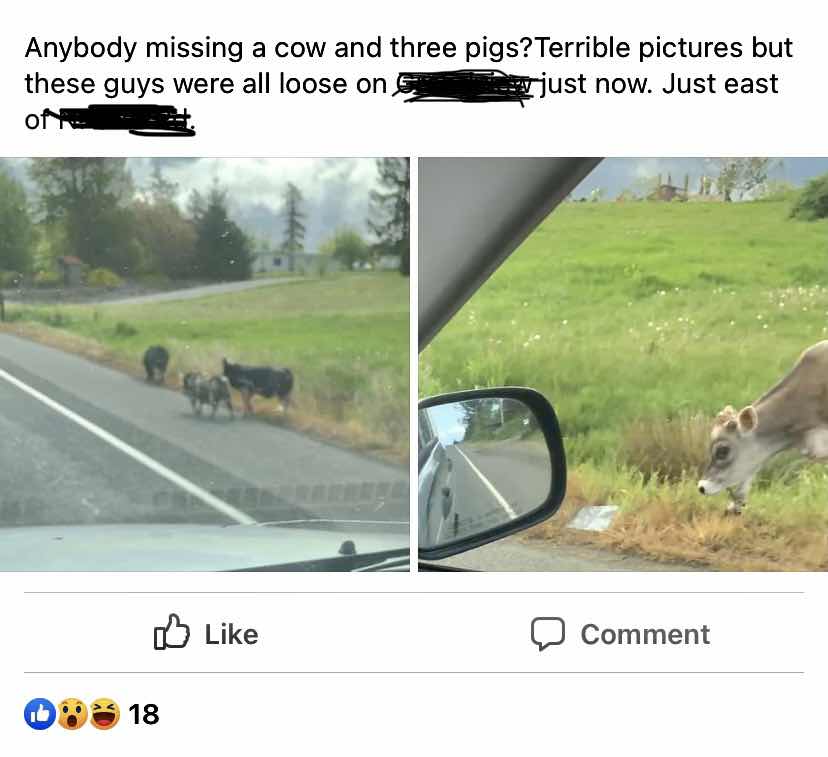
Shame!! Shame and embarrassment! Animal escapes are always entertaining unless they are your animals. It's bad enough that people know my animals were out, but the fact that they were actually wandering along the state highway was worse. Tanker trucks blast by at 60 MPH and we live on top of a hill with a very short sight distance. Only blind luck prevented a terrifying accident. Oh well - all's well that ends well, and at least somebody driving along got a giggle out of it. As it turns out, there was no breach in the fenceline (although we do need to do some maintenance). The chain holding the main gate shut had broken. Probably secondary to a couple of big pigs pushing on it.
Posted by Aimee at 8:21 PM 0 comments
Sunday, July 19, 2020
High Cheese Season 2020 (Making Do)
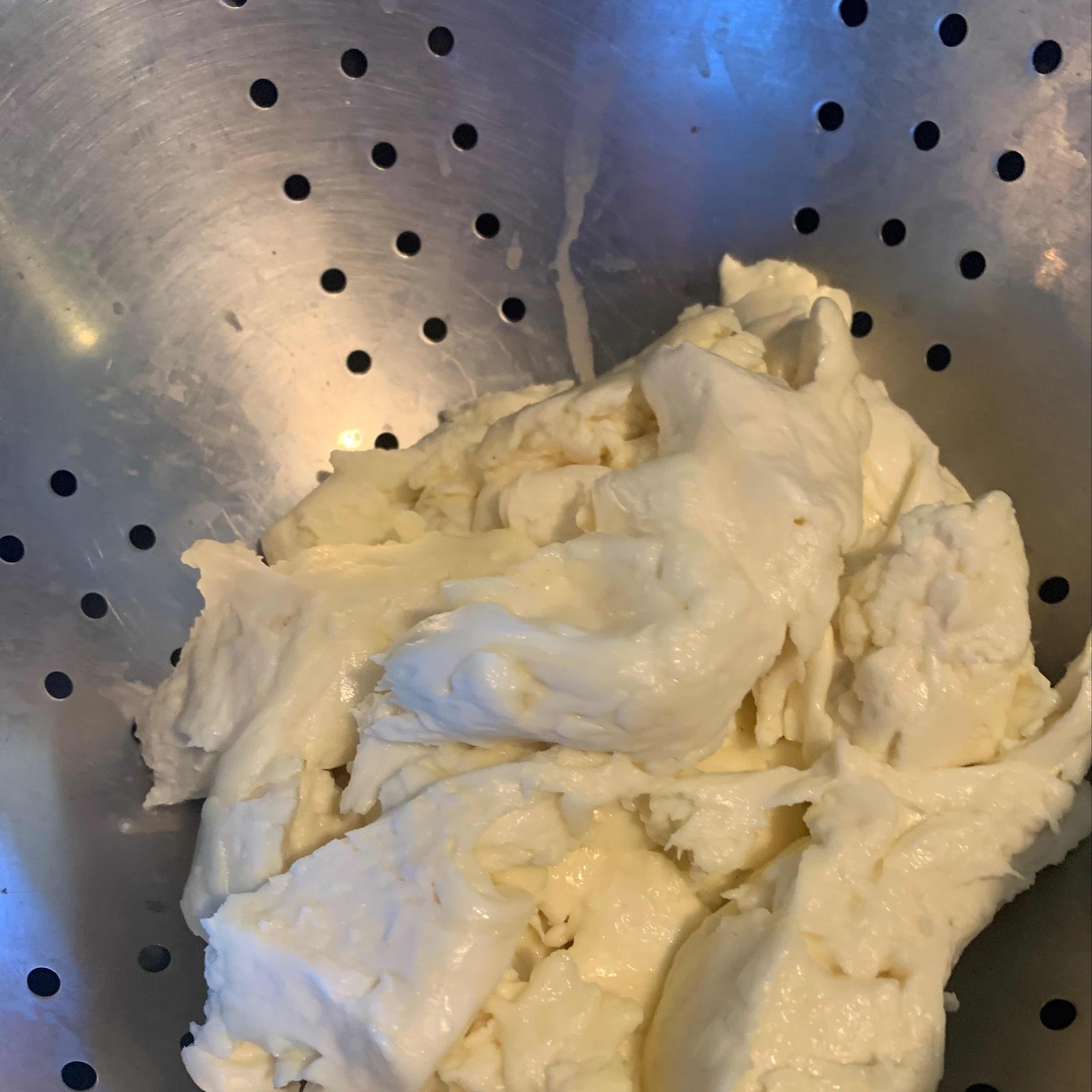
A middle stage in the making of cheddar
Posted by Aimee at 5:09 PM 0 comments
Labels: cheese, cheesemaking, fermentation, goats, grass, homesteading, pasture, preserving
Wednesday, July 8, 2020
Preserving Log (Early Summer Edition)
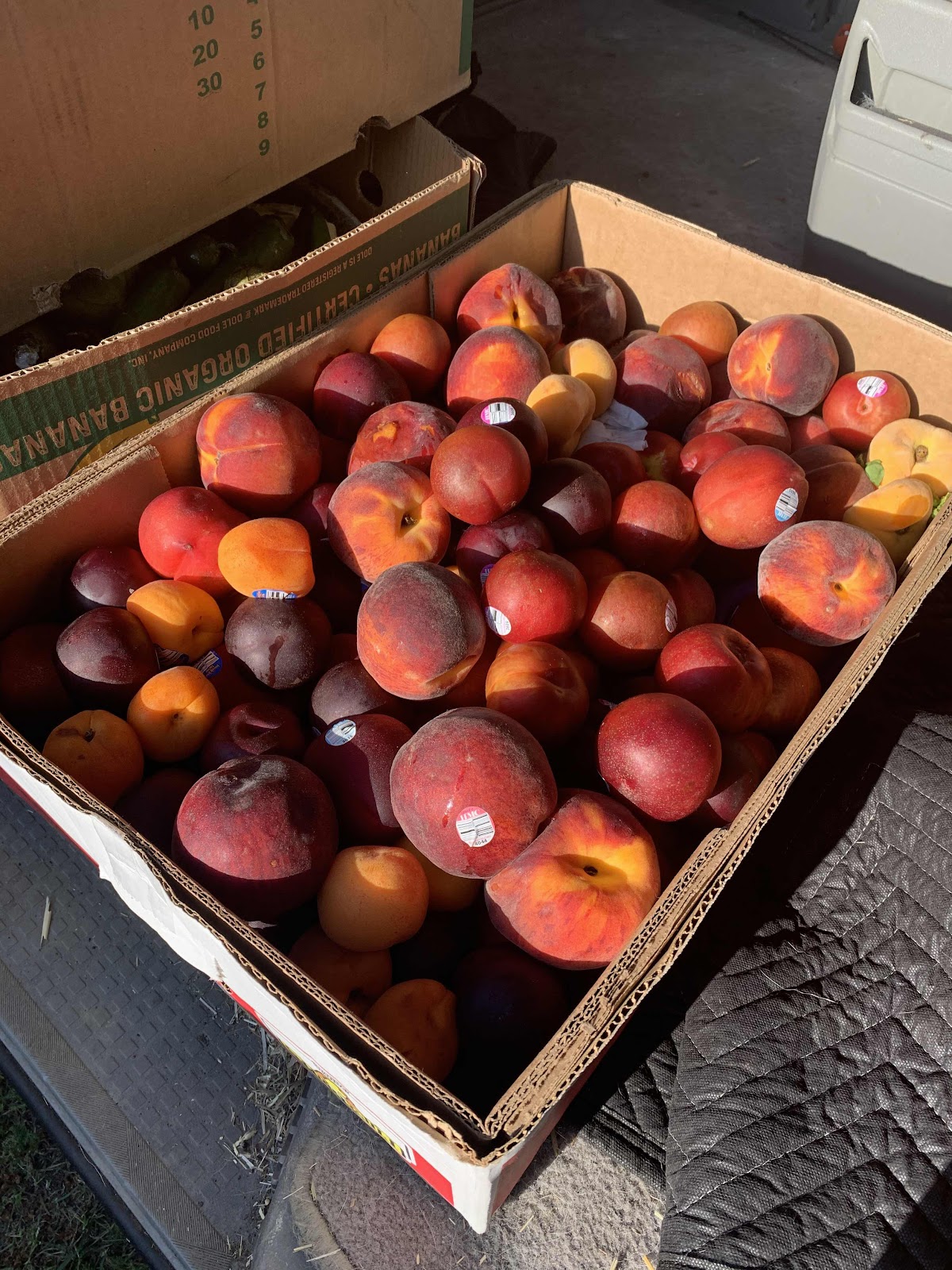
That’s about 25 pounds of mixed stone fruit from gleaner’s. After I separated the fruit that was too far gone and picked out the fruit that was still perfect for eating fresh, I was left with about ten to twelve pounds of slightly overripe fruit. The last hour or so has been devoted to bleaching, peeling, and chopping and my kitchen looked like a couple of murders had taken place (red plums!) but now I have this simmering on the stove:
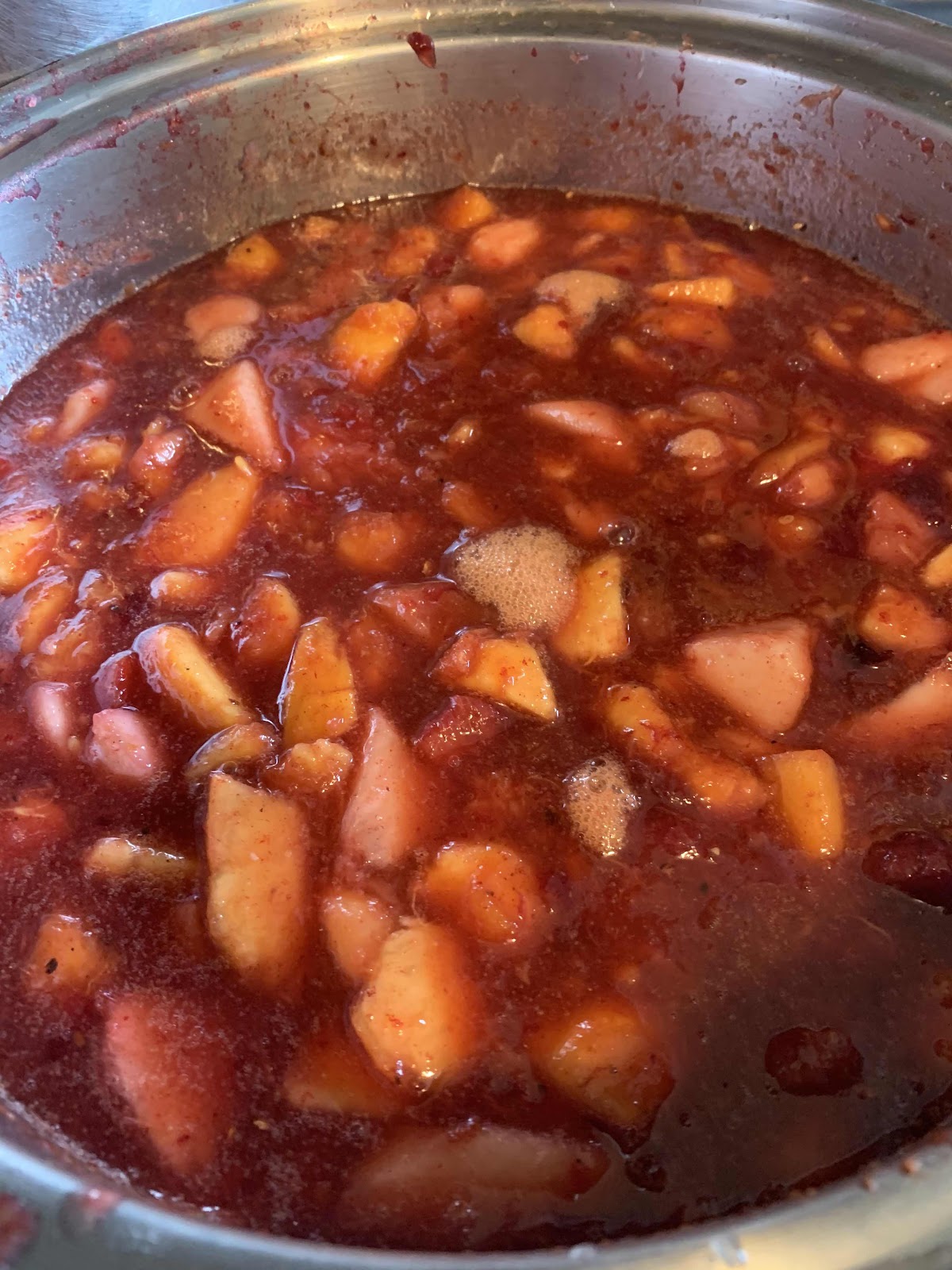
Spicy stone fruit chutney. It has cinnamon, cloves, black pepper, red pepper flakes, a TINY hint of garlic, brown sugar and apple cider vinegar. It smells like heaven and it ought to be delicious with pork chops, chicken breasts, or maybe a hearty fish like halibut. It’s super pretty, too.
Posted by Aimee at 1:13 PM 0 comments
Labels: food, frugality, homesteading, preserving, recipes, self sufficiency
Saturday, March 23, 2019
Scary Birds, Scary Eggs
The turkeys have finally started laying. I guess it took them a long time to settle down, after their repeated escapes and the traumatic process of catching them - traumatic for both the birds and for us. These mixed-breed birds are large, strong, excellent flyers, and very wild. I sustained several nasty scratches trying to catch them, including a six inch one across my cheek and jaw that I thought was going to scar.
Posted by Aimee at 12:05 PM 2 comments
Labels: food, homesteading, seasons, spring, turkeys
Wednesday, September 12, 2018
Preserving Log 9/18
Posted by Aimee at 8:42 PM 0 comments
Labels: apples, berries, canning, fall, farm, fermentation, food, frugality, fruit, harvest, homesteading, preserving, seasons
Saturday, September 1, 2018
Making Up for Lost Time (Mabon Again)
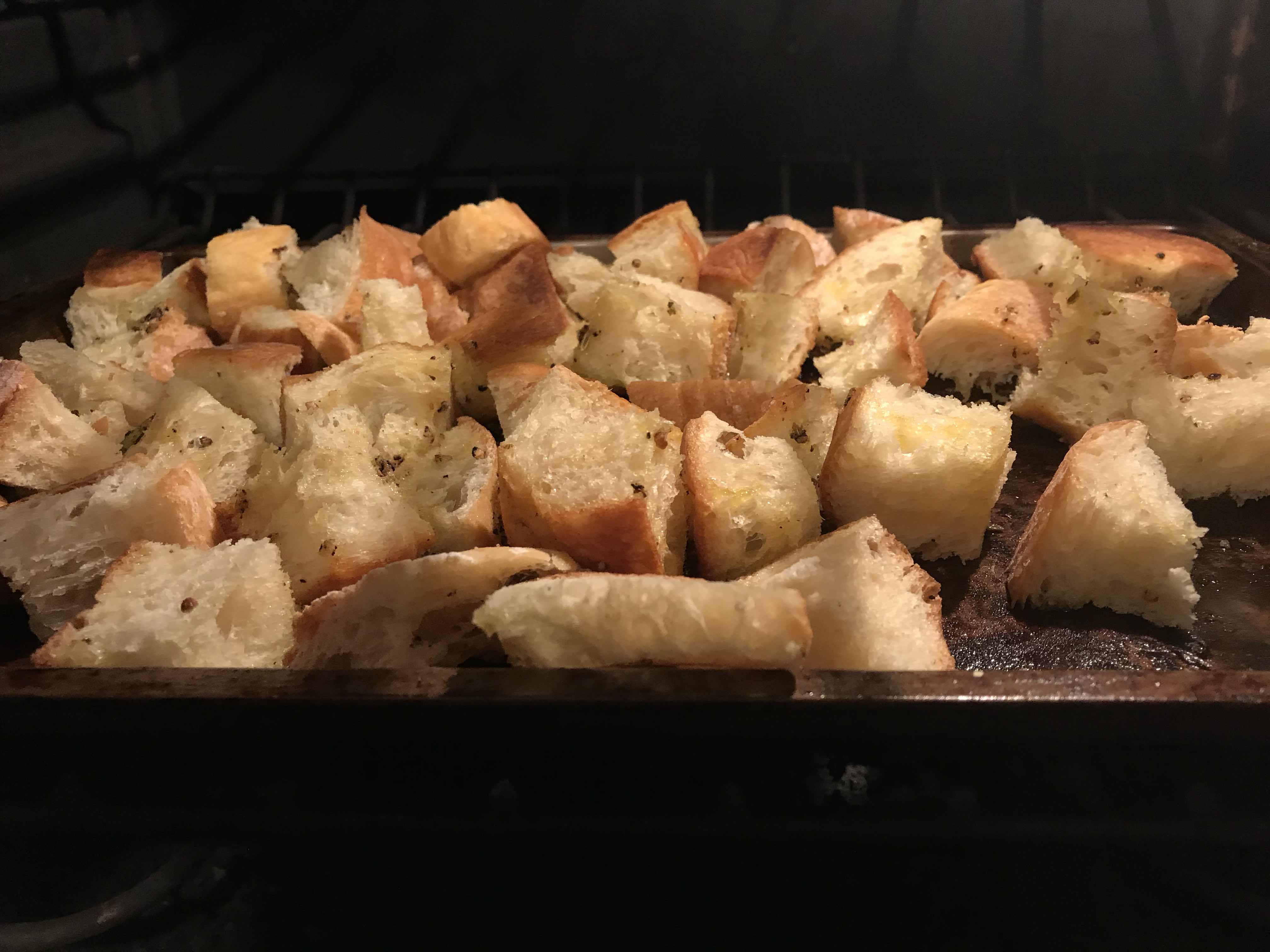
I also brought home a half dozen loaves of ciabatta bread. I like to cube it up and toss the cubes with a mix of olive oil, herbs, garlic, salt and pepper, and bake until they are crunchy croutons. Store in a ziplock bag in the fridge.
Posted by Aimee at 9:56 PM 3 comments
Labels: berries, canning, fall, food, frugality, harvest, homesteading, preserving, self sufficiency, summer
Friday, April 15, 2016
Cheese Season Solutions (Practicality vs. Purism)
Cheese season will be short this year. We are leaving for Oaxaca June 24th, and at that point we will let the does dry off, since Rowan cannot milk and take care of the farm and go to school full time. Right now, Iris is at peak milk production, providing me with just about a gallon of milk a day. The other two does still have kids on them, and I am not usually bothering to separate the kids because Iris is providing me all the milk I can reasonably use.
Unless, that is, I find a solution for the difficult problem of aging hard cheese. I have tried for several years, with little success (okay, no success) to age my hard cheeses. I purchased a wine fridge. I bought cheese wax and waxed the cheeses and stored them in the wine fridge. I read about optimal humidity levels. I turned them over daily. No matter what I did, the wax cracked and the cheese molded within about a month to six weeks.
With larger wheels of cheese (large for me is about a four to five pound wheel) I was able to whittle off the mold and eat the interior of the cheese, but more than half of it was lost, and I could always detect a little moldiness even after trimming. Just seemed like a giant waste and a big disappointment.
So this year I have been making more chèvre, which I can use up in lots of ways (although I feel like an Iron Chef with chèvre as a secret ingredient - "you must use chèvre in EVERY dish") There's about three pounds of it in the fridge at the moment. I still make the hard cheese, my farmhouse cheddar, but we just have to eat it young. It's extremely frustrating, because the cheese continues to improve every day, right up until the day it starts to mold, which is at about one month. Very green hard cheese is not delicious - it's naturally quite sour and one-dimensional. Complex flavors don't begin to develop and the sourness doesn't subside until the cheese is about two weeks old, and then it becomes a challenge to try and eat it before it goes bad two weeks later. I have found that I can speed up the maturation process some by cutting the fresh cheese into 2" cubes and giving them a final salting. But what I really want is to be able to make hard cheese that I can eat six months later.
Recently, an exciting new cheese shop opened up in my town, Twin Sisters Creamery (http://www.twinsisterscreamery.com/#!cheese-shop/cjdh). Not only do they sell a wonderful assortment of cheeses both local and international, but they are cheesemakers as well, producing a terrific blue cheese called "Whatcom Blue," among others. When they first opened, I went in and had a long chat with one of the owners and she was delightful. We talked about cheese for a half hour or so, and she was interested in the fact that there are many home cheesemakers around. I told her I'd be back as soon as cheese season started, and if she wanted to sample some of my goat cheese, she'd be more than welcome. She said she'd love to.
It occurred to me today to go and ask her about solutions for my storage issues. I brought along a wheel of two-day old cheese, and two baggies of cheese cubes, one about two weeks old and one about four weeks old. I was hoping that she would want to taste my cheese and would be impressed with it (I'm a sucker for praise), but mostly I was just hoping she would have some suggestions for aging it successfully.
Turns out, she wasn't there. I spoke to her husband, instead, who was a very kind and friendly guy, but not the head honcho cheesemaker. He didn't want to taste the cheese ("I'm not really a goat cheese kind of guy") and I don't blame him - if I were a professional cheesemaker I certainly wouldn't want to taste random cheese from a local person I'd never met before. He did, however, have a very useful suggestion for me.
A Foodsaver. A vacuum-sealer.
It was kind of a "du-uh" moment.
Vacuum sealers are the kind of medium-large, medium-expensive appliance that I always categorized in my head as "unnecessary gadget." Along with microwave ovens and dehydrators. Less frivolous than ice cream makers or popcorn poppers, but to a culinary purist like myself kind of a cheat.
I always imagined myself - in my daydreams - as learning the real, old world, traditional crafts of aging and curing; hanging salami in natural casings, brining kosher dills in stoneware crocks, brewing and bottling hard cider, and carefully turning and aging my own cheese. It matters not that each of these processes is actually an entire professional category on its own, I cheerfully imagined that I would become an expert in them all. And look good doing it, too.
Time passes and illusions fade. Cheese molds, cider turns to vinegar, and salamis never even get made. Time to get real. Do I want to eat my homemade cheese in November, or not? Am I simply a dilettante, feeding goats year round for the sake eating fresh cheese three months of the year, or am I serious about this thing?
So I bought a Foodsaver. It won't be just for cheese - I can also use it in the fall, for storing home-smoked salmon. I still have some questions, and I still plan on going and asking the head honcho cheesemaking lady about them. First among them, won't the cheese stop maturing once it is sealed? Doesn't it need air to keep developing? Maybe not - after all traditional cheeses are either waxed or develop a rind that severely limits gas exchange. At what stage ought I to seal the cheese? As soon as it's pressed? After air drying for a few days? Just before it would begin to mold?
Assuming I can get some answers to those questions, and assuming I can figure out how to work the darn thing. I will start separating the babies from all three does and try to make cheese two or three times a week until we leave. Hopefully, with a little experimentation, I can start to make maximum use of the oceans of milk that flow in the springtime, and save it for the droughts of winter.
Posted by Aimee at 2:26 PM 0 comments
Labels: cheese, cheesemaking, homesteading, milk, neighbors, preserving
Thursday, March 24, 2016
State of the Farm (Spring Equinox)
| grey spring |
I suppose, to be honest, what it really cuts into is my free time. Reading, cruising the internet, blogging, leisurely baths.... all those things are luxuries, of course, to a mom with a job and a farm. Before I worked outside the home, I used to do my housework at a nice slow pace. I might sit down with a cookbook, read for awhile until something piqued my interest, then go shopping for ingredients and spend the afternoon cooking. Now I boil up some noodles or fry a bunch of eggs at short-order speed, trying to fit dinner in between after-school activities, homework help, evening chores, and bedtime.
Homero has been picking top an awful lot of slack, lately. He does the morning chores almost every day, including milking. We are giving an awful lot of milk to Haku simply because I don't have time to make cheese. He's getting fat, though it doesn't seem to slow him down any, more's the pity. We finally had to strip the playroom of carpet entirely, because he had pulled it all up and ripped it to shreds. It's down to the bare plywood now, and I am just waiting to see how he manages to destroy that.
I don't think I'm going to get a garden in at all this year. We did plant a couple of hazelnut trees and I'm going to plant a couple more apple trees, but as far as a vegetable garden, I just don't think it's going to happen. Partly this is because of another giant time-suck - the Gleaner's Pantry. I adore the Gleaner's, it brings in hundreds of dollars worth of organic produce a month, but in exchange it demands about 20 hours of work a month, broken up into three or four several-hour-long chunks. That isn't counting all the work I do at home to prepare for such an influx - cleaning out the fridge before I go - nor what I do to preserve it afterwards, whether it be canning, freezing, juicing, our whatnot. And I know I just said how much work Gleaner's is, but truth be told its a hell of a lot less work than actually gardening. When I have unlimited, varied, organic produce spilling out of my refrigerator, it's difficult to work up the motivation to pick up a shovel.
Another reason not to put in a garden this year is that we will be spending a big part of the summer in Oaxaca. This will be our first trip to Mexico since we came back from our year with Abuelita, in 2013. (New to Mexican Life) The children are super excited to see their cousins again. There's not much point planting vegetables in April and May when you'll be out of town for all of July.
It's still far too wet to start planting, in any case. This has been the wettest year to date in Washington state history (As rain falls, so does Seattle's record for wettest wet season ...) and that's really saying something. We have used some twenty-five yards of mulch and chips this year, just to keep the poor animal's heads above the mud. The grass is growing pretty well, due to warm temperatures, but the ground is still too saturated to let the horses out on pasture. The pasture got pretty torn up last fall when our pig learned to get out of his pen, and I want to give it a good long rest. I've reseeded the areas the pig plowed up, and I need to give the seed time to germinate and get a good head start before I loose the ravenous beasts. That means we are still feeding hay, though less of it, as the goats have some browse and the ponies can be staked out in the orchard on days when it isn't raining.
Poor Rosie pony's horrible eye problem is back, and it's worse than ever. Her eye is so swollen and ugly that I'm ashamed to post a picture of it. I've been washing it with warm salt water and putting antibiotic ointment in it for the past several days, but I don't see much difference. She is clearly suffering, and besides her eye, she is looking thin and rundown. Maybe she needs a different wormer than the one I've been using - pretty haphazardly, I must admit. But as the single most superfluous animal on the farm, I don't get much of a vet budget for Rosie. She is getting on in years, and soon I will have to start thinking about when it might be time to send her on to the great green pasture in the sky. Not yet, but soon.
We had a chicken attrition situation over the winter, as is often the case. In fact, the chickens and turkeys were disappearing at such a clip late last fall that I invited a couple of local boys to lay out in the field with .22 rifles and wait for the coyotes to show up. The coyotes never did show up, but when the boys were scoping out the perimeter, they said we had both canine and feline tracks in the mud along the fence line and suggested we probably had a bobcat as well as coyotes preying on our poultry.
The chickens are locked in the coop, now, though I hate to do that to them. This time of year it is always wet in the coop, and the chickens really ought to be out scratching for spring bugs and eating the worms who are lying about all over the place, trying not to drown. There are five hens left, but only three of them are laying. Two of the three eggs that I gather each day are distinctive - the tiny egg is laid by the one banty hen; the white egg is laid by the lone leghorn - but the third egg could be anybody's, so I don't know which hens are the slackers.
Five chicks are in a big wooden box in the shed, under a heat lamp. I brought them home last week. They are leghorns. I had never raised that breed before (most commercial layers are leghorns) because I thought I wanted a dual purpose hen, one that was heavy enough to eat when she ran out of eggs. But time and experience taught me that actually, I am not interested in a free-range old layer hen as a culinary item. It's nasty. And then I acquired a couple of leghorns - I disremember how - and was very impressed with them. They are small, streamlined birds. They are bright white (we named them Pearl and Shell) and are good flyers, which keeps them a bit safer from predators. They will never go broody, which means they lay more eggs per year. They are regular egg machines - each hen laying one large white egg a day, with only the very occasional day off. I liked them so much I decided to buy all leghorn chicks this year. Five isn't very many, but assuming that at least three of them live to laying age (you never know with chicks) they will provide more than enough eggs for us.
Let's see, what else. Oh. Out of Flopsy's four babies (The (Finally) Four) we only have one left. On the day they kidded, I gave two bucklings away to a neighbor farmer lady who enjoys bottle babies. I do not enjoy bottle babies. We kept two babies on Flopsy - a beautiful buckling and a fabulously gorgeous spotted doeling. But there was soon a problem. Both babies only wanted to nurse off one side. Flops had mastitis and now has lopsided teats - one normal teat and one small one that gives about half as much milk. Oddly, they both wanted only the small one. I guess the big one was difficult to latch onto. Since the buckling was bigger and stronger, he drained all the milk from the small teat and the little girl didn't get any. I couldn't seem to teach her to use the big teat. After a few days, I went out in the morning and found the little girl flat out and cold. That happens if they don't get enough milk - they just lie down and give up the ghost.
I tried to revive her in a warm water bath and get her to take a bottle, but after a frustrating 24 hours I knew I wasn't up for it. I called the same neighbor and told her she could keep there baby girl if she wanted to try and save her. My saintly neighbor told me to bring her on over. She worked patiently over the next day and succeeded in getting her to take a bottle. Then - this is so cute, I wish I had a picture - my neighbor's pigmy doe kidded with a single kid. And our little baby Nubian girl went straight for the teat. She hadn't forgotten hoe to nurse. So now, this valiant pigmy Nigerian is nursing her own kid, plus a Nubian kid, who has to practically lay down in the dirt to get to the teat.
My neighbor insists on giving us the doeling back when she is old enough to be weaned. She says that keeping the two bucklings is payment enough for the trouble of caring for the doe. I told her not to make up her mind just yet. Assuming that little Ziggy (as her children named her) lives and thrives, she ought to be worth a fair amount of money. I said she should feel free to sell her, but so far, she continues to say she will give her back to us. If so, then we will have two new does from this season, Ziggy and Christmas. That will make up for the two I plan on retiring - Iris and Flopsy.
The farm goes on. 2016 is a new year, our eighth here on this windy wet hill, I think. I'm not quite so "new to farm life" as once I was. We are settling into a good groove. I know now, more or less, how many animals the land will support, and what sort of animals are most useful and profitable to us. I continue to learn about husbandry, both of the land and the animals - and, I suppose, of my children and of my marriage and of my very own soul. I really do love to feel the slow deepening of knowledge and experience that comes from knowing a single place - or a single person - intimately, and living with a single place - or a single person - intimately, in all of its seasons, in all of its moods, in all of its slow splendor. This land, this place, this time, these people, these animals, this carefully tended ecosystem - here we all are, surviving. Hopefully thriving. Caring for each other as best we can.
Posted by Aimee at 6:06 PM 0 comments
Labels: family, farm, gardening, goats, homesteading
Monday, September 21, 2015
Welcome Sheep
The little brown blob in the lower left foreground of this picture is a young Jacob's sheep. She is about four or five months old, and wads given to me by my sister in exchange for babysitting her children for a weekend so she could go away with her husband. For the record: I would have babysat in any case, but once offered, I wasn't going to turn down a free sheep.
Jacob's sheep are those funny four (or even six) horned breed. They are an ancient "unimproved" breed, meaning they have not been highly selected for any given trait or developed for commercial purposes. Until recently, they were usually only found in the U.S. among Native American herds in the southwest. Sometimes they are called "churro" sheep.
As such, they vary widely from herd to herd, but in general they are small (a ewe reaches approximately 80-100 pounds) and have good quality wool and lean meat. You can see how small the little ewe looks next to my Nubian goats.
I was afraid my goats would bully her terribly, but it seems not. I brought the lamb home last night and shut her up in the Mama Barn for the night. This morning I went to the Gleaner's Pantry and so I wasn't around when Homero let her out to mingle with the goats. It seems to have gone well, though. This afternoon - a beautiful sunny warm September afternoon - when I let the goats out, I tried to keep the sheep in the pasture because I didn't know how herd able she was. At my sister's house she lived in a small enclosure and nobody ever tried to herd her in an open space.
After twenty minutes or so of enjoyably perusing my magazine while the goats grazed, I heard the sheep bleating plaintively from a direction incompatible with her being inside the pasture fence. The little thing was apparently able to squeezed through the gap between the gate panels and get out onto the front lawn. She simply followed the goats around, any stayed close to them even though the does occasionally butted her in the side.
Our plan is to keep her over the winter - hopefully she will grow well - and then shear her in the spring. Rowan is interested in her wool. Then we will let her fatten a bit on the spring grass before we turn her into lamburgers. Lamb is actually my favorite meat. I never buy it at the store; it has become so terribly expensive lately. I'm looking forward to having some put away for our personal use.
Posted by Aimee at 6:00 PM 4 comments
Labels: family, homesteading, meat eating
Saturday, April 5, 2014
The Goat Who Wouldn't Kid (When to Butt Out)
Iris, above, is the first goat I bought when I moved here. I was hurting for goats; I couldn't wait. Goats, as far as I was concerned, were the whole point of pulling up stakes and moving from the city to the countryside. It was late summer when we moved in, and late fall by the time I had bought a barn (Home Depot's largest model), put in fencing, and was ready to buy an animal. Not wanting to deal with breeding the first year, I looked for a pregnant goat.
Craigslist, as usual, was my vehicle. I put up an ad saying I wanted to buy a pregnant dairy goat - breed unimportant - and was soon answered by a local woman with a bred Nubian doe. She wanted an inordinate amount of money - $300! - but I was taken with goat fever and I simply decided to lie to my husband about how much I was spending. He has no idea what a good goat is worth, I rationalized. As it turns out, that woman actually runs a well-respected farm and her goats win prizes all over the tri-state area, but I had no way of knowing that at the time. Nor did the pedigree matter to me - she offered me Iris' papers for an extra $50 but I said no thanks, not thinking it would ever be important to prove her ancestry. I'm a homesteader, I said, not a goat breeder.
That was rather a dumb decision, I have since come to understand. For $50, I could have a herd of registered animals now, and each and every one of them would be regarded as quality breeding stock, allowed to be shown at agricultural fairs, and valued at some 25-50% higher than unregistered animals. Instead, I have a herd of beautiful, healthy animals, from good milking stock, and bred for hardiness, but only suitable for the smaller market of people who don't care about registries. It means I sell a lot of quality animals for meat instead of for show.
Nonetheless, Iris has earned her price many times over. That first year, she threw us twins, and one of them, Flopsy, I have to this day. Flopsy, in turn, has given us many kids over the years, including our prize buck. If I were to add up the value of all that Iris has provided in livestock, meat, and milk over the years - something I could theoretically do but not at this time of night - it would be a lot of money. Totally aside from her monetary worth, Iris is a great goat - smart, personable, and attractive.
She is getting on in years, however. A year and a half old when we bought her, she is now about eight. Goats live to something like thirteen, and they can theoretically keep producing until they keel over of old age. Iris is healthy, and she had a year off from kidding last year when we were in Mexico. When we brought in the buck, Paxton, last fall, he went for Iris first of all the does. He bred her within thirty seconds of entering the pasture, so it's clear she is still a fertile animal.
This spring, however, the other two does kidded first. Oh well, I thought, Iris must not have caught pregnant on the first go-round - I'll expect babies in a few weeks. I started to watch her. For a while, I was confused. I had been certain she was pregnant - like the other does, she got thick in the middle and developed a biscuity tail (that means that the skin of her tail got puffy and soft - a sign of early pregnancy). But after the other does kidded, Iris didn't seem to be developing at all - in fact, she was getting thinner. Her udder stayed stubbornly small and floppy. I couldn't figure it out at all and began to doubt she was even pregnant.
Finally, about a week ago, her udder began to fill out, which is unmistakable proof of advanced pregnancy. Usually, when the udder fills, you have only a few days until birth. But Iris' udder got bigger and bigger. Her belly got bigger and bigger. She was so poofy and huge she could barely walk. Her tail ligaments disappeared and her distal spine lifted up. Deep hollows appeared below her hipbones as the babies dropped lower and lower. I started to lock her in the mama barn at night, but every morning when I went out early to check, there was Iris, staring at me - no kids.
I had advertised her kids for sale on Craigslist, and a woman had already answered me with an offer to buy any doelings. She wrote me every day - are they here yet? No, I said, but I'm pretty sure today's the day. Night before last, I locked her in the barn as usual at evening feed, but I forgot to tip the milking stand on its side. I do that so that she won't be able to get up on the stand, stand on her hind legs, and reach the sack of grain stored on the tippy-top shelf, nine feet above the floor. So of course, that's what she did. When I went out first thing in the morning, expecting to see baby goats, instead I saw a lot of liquid excrement all over the place.
In case you don't know, when a goat overeats grain, she gets what's known as overeating disease (Enterotoxemia (Overeating Disease) of Sheep and Goats), or toxic rumen. To you and me, what that means is explosive diarrhea and massive amounts of gas. It's not a joke- goats can easily die of overeating disease - but Iris didn't get enough grain to be in serious trouble. Just enough to cause a lot of disgusting green liquid poo. Just what one wants when birth is imminent. I kept Iris locked inside the barn and bought a new bale of clean straw. I mucked out the poo-covered straw. I moaned and bitched and wailed and cursed the stupid goat. I wanted to beat her, but instead I brought out a pan of warm soapy water and a dozen rags and cleaned her rear end. Let nobody say I don't care about my goats.
All day I hung about, waiting. I brought a book out to the barn and sat down in the clean straw and read and waited. Iris was in serious distress, but I couldn't tell if it was labor or just intestinal distress from the diarrhea. Her udder continued to fill, and by four or five in the afternoon it was tight as a drum. That is an indication that the goat ought to kid within a few hours. I was waiting for the string of goo - which is, just as you probably guessed, a long string of mucus depending from the vagina. Once the string of goo appears, you want to see kids on the ground within an hour. No goo was forthcoming, but Iris was acting like a goat in active labor.
A goat in active labor will scratch at the ground, making a nest. She will often lay down and get up again, stretch, and yawn. Usually, she will stay standing until the final stages of labor, when she may lay down to push. She grunts and curls her lips in a very distinctive way. Normally, goats kid quickly, and the entire process ought not to take more than an hour or two from start to finish. I called the vet at 6 pm, because Iris had been getting up and laying down, stretching and rolling for about four hours. I was pretty certain that the kids were malpositioned.
The vet said it was time for me to go in and see what I could feel. Was the cervix open or shut? What was the presenting part? I put on some of my husband's thin black nitrile gloves, soaped up, and lay down on the wet straw behind Iris and inserted my hand.
I'm no expert. Over the years, I've had to pull kids several times, but until yesterday I'd never gone in before the water has broken. I would not have, but the vet said it was time. When it comes to birth - caprine or human - I am a big believer in standing back and letting nature take its course. I think we most often cause nothing but trouble when we interfere with a process honed by millions of years of evolution. In this case, I felt that her cervix was wide open and that I could feel the bag of waters easily, but that there was nothing firm inside it. I could feel no fetal part at all - not hooves, which would have been normal, nor a muzzle, nor even some blank wall of side or hip. Just an empty, squishy bag. Clearly, there was no kid in any position to be born.
I called the vet back and said "I think I better just leave her alone for a while. There's nothing I can do, those kids have to come around on their own."
Now, if any mothers are reading this, they may remember - as I do - that when somebody puts their hand inside you when you are already in labor, it provokes some serious contractions. My pelvic exam made poor Iris go into some hard core labor. Maybe that's what did it - I don't know. But in any case, Iris must have been busy while I was inside the house for a couple of hours. When I went back out at about 8 pm with a flashlight, there were two newborn babies on the ground. They had obviously been born mere minutes before. They hadn't yet stood up. I ran back to the house, yelling for Homero and the girls, and brought back clean towels and iodine.
The kids were both a little bit worse for wear, due to the long hard labor. The little girl, brown and white spotted just like her mama, had inhaled amniotic fluid and was snuffling and snorting. I didn't have a syringe to aspirate the fluid - not that I really knew how in any case. I briefly considered placing my mouth over her nose and aspirating old-school, but decided she'd probably live without any heroic measures. It seemed so, because she was the first one up, and managed to nurse without any help from me. Her brother, black with brown points and a white cap and ears, was the worse off between the two of them. He was shaky and weak and it took him a good half hour to stand up. A healthy baby ought to stand up within five minutes. I held him up and let him have at the teat; I knew that with a belly full of milk he'd be just fine for the night.
I don't like to see babies born late at night - the normal time seems to be early in the morning. I always wonder how they will figure out nursing without being able to see, but I realize that is a primate's prejudice. The little kids can smell and feel their way to the teat even in perfect darkness.
This morning, the babies were doing just fine. They had become all fluffy, as kids do when they are healthy, and both were standing and nursing without assistance. I think we are going to keep the little girl. I need a new doe - in another post I will detail my thinking on the health of the whole herd, but for the moment I'll just say I'm delighted to have a good looking spotted doling. The lady who wanted to buy a doling will just have to wait until next year.
Posted by Aimee at 11:22 PM 0 comments
Labels: breeding, finance, goats, homesteading, veterinarian
Tuesday, March 4, 2014
No More Hay
We are out of hay. We still have a need for hay - it will be another month before it dries out enough that I can put the animals out on the pasture. At least. This year I tried to keep the heavy hooves off the pasture all winter long - the horses went into the sacrifice area in late October or early November and they haven't been out since (except for a few sunny winter days that I brought them out onto the front lawn). Since we were in Mexico last year and the horses were boarded out, the pasture got a nice little rest. There were only three goats on 2.5 acres - well within the carrying capacity of the land. I wanted to extend that rest and generally start treating my pasture better.
My husband kind of messed up my pasture plans by insisting on a cow against my better judgement (Imaginary Cows). A calf is not as heavy as a horse, but a good deal heavier than a goat, and plenty heavy enough to damage wet pasture. Even so, keeping the two horses off the pasture all winter ought to go a long way towards resting the land.
But it also means we use more hay. Even in the dead of winter, around here there is always green grass to be found, except for a few weeks when the ground is actually frozen hard. Animals out on the pasture will graze. In the sacrifice area, we have to feed 100% hay all winter long, and it adds up.
The best time to buy hay, of course, is during haying time. If you are willing and able to jump in your truck and go pick up bales right behind the baler, you can often get first cut local hay for as low as $3 a bale. Better quality for $4. But this year we had no truck during haying season. An elderly farmer friend of ours saved some twenty five bales for me at cutting time prices until I could find a vehicle, but he is no longer able to help toss hay, being something over 77 years old. My husband was gone (for some reason, I can't remember why now) and I had to do it myself. Now, a healthy 40 year old woman ought to be able to toss 25 bales of hay and then stack them in her own barn without too much trouble. Each bale weighed between forty and fifty pounds. It's hard work, but it ought to be doable.
I, however, am a gimp. At that time, I had very recently blown my anterior cruciate ligament (collateral ligament?) and was barely able to walk. Rowan was pressed into service and between the two of us we managed to collect, transport, and stack the hay but it was one big bitch to do it. I took a lot of ibuprofen that night. That twenty-five bales had to feed two horses and four goats - three of them pregnant. It lasted until early January, if I remember right. About three months.
When we were nearly out of hay, I searched Craigslist and found a source of local, well-priced hay. Sadly, a small local dairy is going out of business and selling off the barn full of hay - having already sold off the calves. Homero and I went out and brought back another twenty bales. We figured that if twenty-five bales had lasted us three months, another twenty ought to last the rest of the way until spring.
But no. As it turned out this year, we had terrible, bone-chilling cold snaps and heavy snow and ice that lasted for weeks. I just read that this february is either the coldest on record in Bellingham or the fourth coldest, depending on how you measure (average daily lows or average daily highs). Also, the hay we bought - while green and good smelling - was for some reason very light. Each bale only weighed in the neighborhood of thirty pounds. I guess it was quite a bit dryer than the hay we bought earlier in the season. The animals went through it at an amazing speed - and today, we are out.
Forty-five bales in nearly five months isn't really so bad. It's only a little over two bales a week. And a total of $250. That does not, of course, amount to what it costs to feed the animals over the winter. Oh no! We also have to buy grain for the pregnant goats, chicken food for the chickens, and alfalfa pellets for the poor half-paralyzed calf that can't eat regular hay very well (for an explanation, see Rosie Pony Update (And Notes on the Cow)). If I figure the same rate of feed - two bales a week - we only need another dozen bales to get us through to the time I can put the animals on pasture.
However, I am once again without a vehicle. Sigh. We have one working vehicle and Homero took it to work. Tomorrow I can get some hay. Today I'm tiding them over with greens from the Gleaner's Pantry and stale bread. For one day, it won't kill anybody.
Posted by Aimee at 10:39 AM 0 comments
Labels: frugality, hay, homesteading, husband, preparedness
Thursday, February 27, 2014
Buck Up (Doe Down)
Yesterday morning, I sent Rowan out to feed the animals because my knee had slipped out of joint as I tried to put on my boots. There was still several inches of snow and ice on the ground and I didn't fancy my chances of getting to the barn and back without doing myself an injury. Soon, I'm going to write a whole post about the sorry state of my body and how I manage (or don't manage) to run the farm while being partially to mostly crippled. But not today. Today I'm telling the story of the new baby goats.
Rowan came running back to the house and said "I think you're going to want to come anyway, mom, Polly had a baby!"
The little girls ran out ahead of me, and as I was struggling through the snow, Paloma ran back towards me, shouting "There's two, but one's dead." Right behind her came Hope: "No, ALMOST dead!"
When I finally made it out to the barn, I saw Polly with a beautiful, strong baby buckling at her side, standing up and nursing. He had obviously been born quite some time ago, as he was dry and fluffy. On the ground nearby was a spotted doling, flat out on her side and, to all appearances, dead.
I cursed myself. The evening before, at second feeding, I had seen and remarked to Homero that Polly's udder had filled up and the babies had dropped. This means birth will be soon; but I checked her tail ligaments and I could still feel them easily. There were no telltale hollows on either side of her tailbone. I thought it would be at least 24 hours and probably more. We left her in the main barn, with the other animals. Then she gave birth sometime during the night, or more likely in the early morning hours. By the time I got out there, the little doeling had been lying on the cold, wet straw for at least two hours and probably more.
With the girls' help, I grabbed Polly and the buckling and put them into the mama barn. Then I picked up the doeling and brought her into the house. She was breathing very slowly and had her head curled back on her shoulders in what I call "the arc of death." I never like to see a kid with its head thrown back like that; it is a very bad sign. Most likely the little thing was already doomed, but I did what I could.
I heated up the oven to 200 degrees and then popped her in, first, of course, turning the heat off and leaving the door cracked. I went back outside and got some colostrum (the first milk) from Polly - making sure the buckling was nursing well, which he was - and drizzled it into the doeling's mouth with a tiny syringe. Over the next few hours, I repeatedly warmed up the oven, fed the baby, and rubbed her and talked to her.
I didn't have a car, or I could have gone to the feed store for lactated ringer's solution and given her fluids subcutaneously. Also I could have picked up a garage tube and tried to feed her nasogastrically. I've never done that before and the chances are good I would have killed her by pumping fluid into her lungs instead of her stomach, but at that point there was nothing to lose.
For a little while, things seemed to be looking up. She cried several times, and struggled to lift her head. Her mouth warmed up inside, somewhat. But then she just died. One time took her out of the oven she was alive, and five minutes later she was dead.
My other two does are due to kid anytime now. Homero helped me divide the main barn into two stalls with a cattle panel, so that we have another separated area for a mother to kid in. I have plenty of dry straw. Sometime today I should go to the farm store and pick up a gavage tube and some LR solution, along with a larger syringe. Just to be prepared.
Every year I struggle with timing breeding for the right kidding time. First of all, it isn't always easy to find a buck so sometimes I have to take him when he's available, even if it isn't ideal by the calendar. Secondly, who knows what the weather's going to be like in March? Sometimes we get snow here in April. Thirdly, I like to have babies earlier in the spring rather than later for a variety of reasons - 1) it gives me a longer milking season before the weather turns cruddy again in the fall; and 2) it gives the kids longer to grow to eating or market weight by autumn. If I had babies in mid-May, none of them would reach a decent eating size before November.
But it's a trade off. If I had babies in mid-May, I could worry a lot less about finding chilled, dead kids on the ground. Mostly, I'm terribly pissed off at myself for not locking up Polly in the warm, dry mama-barn that evening. I won't make that mistake again soon.
Posted by Aimee at 12:52 PM 0 comments
Labels: breeding, death, goats, homesteading
Monday, January 27, 2014
Spud 'Speriment (Potato Poetry)
Today I was cleaning out the kitchen drawers. There's a big drawer on the bottom, lined with brown paper bags, that I use for potatoes and onions. This drawer tends to get a little, um, icky after a while, filling up with onion skins and soft, sprouty potatoes. This tendency has intensified somewhat since I started going to the Gleaner's Pantry (Scavenge City (Gleaner's Pantry)). Turns out that I sometimes bring home more potatoes than we can actually eat before they grow long, pale whiskers.
Of course, as long as the potato itself is still firm, not flabby, it is perfectly permissible to rub the whiskers off and cook the potato as usual. Often I do that. But this morning, as I was excavating the drawer, I came across a pound bag of lovely little fingerling potatoes that had sprouted. Previously, we had eaten several bags of these fingerlings, and so I know they are wonderful potatoes: nutty, dense, creamy, and delicious. I remember thinking "I ought to try to get ahold of some of these for planting this year." So, of course, when I found them all sprouted and ready for planting, I had to think about what to do with them.
It is still January. January is a ridiculous time to plant potatoes. Not only will we certainly have a few more hard frosts, but even if we didn't, the wet ground will rot any potatoes that I plant too early - meaning, before the end of March. Ask me how I know this. Yes, because I have repeated that elemental error several times in my pre-spring gardening ardor.
Other things I know about growing potatoes, in no particular order:
- people say they are the easiest of crops to grow, but I haven't found that to be the case. In only two of my six years here have I had a really good potato crop.
- people are also always saying that you can grow potatoes in containers easily, but I have not had luck with that, either. My two good crops both came out of the ground, and out of containers I have harvested only small, rather disappointing crops.
- it is strongly suggested in gardening books on my shelf that one buy seed potatoes for planting and that one does not use grocery store potatoes for planting. This is because seed potatoes are guaranteed free of various diseases and viruses, whereas grocery store potatoes are not. Nonetheless, anyone as cheap as I am (or, if you like, as frugal) will not like to waste grocery store potatoes that have become inedible, but will try to salvage them for seed. That's what my dad always did.
- "chitting" is the process of pre-sprouting your potatoes, i.e., what naturally happens to any potato left in a dark drawer for too long. I was somehow completely mistaken about the meaning of this word, and thought it meant just the opposite: rubbing the sprouts OFF of your potatoes sometime in january so that they would not go all soft and flabby and would still be viable for planting come spring. (http://www.motherearthnews.com/organic-gardening/greensprouting-potatoes-zb0z1203zlon.aspx) I got this idea from reading some memoir, the title of which I cannot now remember, by a woman who grew up in Iowa during the depression and described "chitting the potatoes" as her least favorite job as a child. Going down to the cellar and handling the pale, soft, spidery potatoes gave her the heebie-jeebies, she wrote, but if the sprouts were not rubbed off, there would be no seed potatoes for the spring planting.
So here I had all these adorable little chitted potatoes, all ready to plant, and it is still january. Seeing as how it was either plant them or throw them away (I have a serious potato surplus at the moment; and none of my farm animals relishes sprouty potatoes), I decided to perform an experiment.
The south side of my house has an enclosed porch with floor to ceiling windows. It isn't quite a sunroom, because there isn't ever quite enough sun up here to justify that title. But it is a large space with lots of light, protected from freezing temperatures. I thought, why not fill a couple of big black plastic pots (of which I have several dozen) halfway up with dirt and straw and throw those potatoes in? I could place them by the south windows and just let them be. What's the worst that could happen? So now I have a couple of twenty gallon pots in the "sunroom" planted with fingerling potatoes, which are officially the first planting of 2014. We'll see how it goes.
On a related note - I have only ever received material recompense for my poetry on one occasion. That was when I entered a poem into the WashingtonState Potato Commision's annual Potato Poetry contest, back in 1999 or thereabouts. I won. I won an apron, several potato cookbooks, and various sundries which I misremember now. Here is the 1998 (or thereabouts) prizewinning potato poem:
My dad planted potatoes
in old tires
all along the long side of the yard
and us kids grubbed them up
all summer
some as small as marbles
with thin, papery skin
some bigger than our child sized fists
The clean, cottony inside
of a baked potato
is such a surprise
or at least it was to us
who had prized them just that morning
asleep from the mud
Posted by Aimee at 3:46 PM 1 comments
Labels: gardening, homesteading, seasons
Saturday, August 31, 2013
Berry Abundant Berries (Child Labor Pays)
Someday, I hope to can something without injury. Today, I canned ten half-pint quilted jelly jars of blueberry jam, and as usual, burned myself by dipping a finger into the boiling water. This time I also managed to cut myself rummaging around in the drawer for that can-lifter I bought after the LAST time I burned myself by dipping my finger in boiling water. That was when I was canning bread and butter pickles a few weeks ago. Of course, I didn't remember that I'd bought a jar-lifter until AFTER I burned myself again. Ten pints is a lot of jam, but we had a lot of blueberries.
Tonight, I am making an enormous blackberry crumble to bring to a family barbecue. I'm using my largest lasagna pan, a hulking old 10x18" Pyrex monster. Probably takes about two gallons of blackberries to fill it, but that doesn't matter, because we are SWIMMING in blackberries.
Just about every morning, I start the kids off with a strawberry, raspberry, or blackberry smoothie. Yogurt and fruit, seems like a breakfast of champions to me. And it uses up a lot of berries. The freezer is jam-packed (you should excuse the pun) with berries. Last count was four gallons of strawberries, two gallons of raspberries (my favorite, so they go fast), four gallons of blueberries, and TEN gallons of blackberries.
Why so much fruit this year? Well, I have twice the labor force. Homero's nieces, collectively known as the Tamagochis, are staying with us for the coming school year. Their parents - Homero's sister and her husband - were impressed with our decision to spend a year with our kids in Oaxaca, and saw how quickly the girls became fluent in Spanish. They decided it would be good for their girls to have the same experience in reverse. Taking a year off from their jobs as physicians, however, was not feasible, so they asked us if we would be willing to host the girls for a year.
They arrived last week, just in time for the tail end of blackberry season. Although my children would be quick to call me a slave-driving berry Nazi, based on their experience picking strawberries and raspberries with me earlier this season, I was not the one who put the Tamagochis to work in the blackberry fields. Their father, who is staying until school starts, must have been eager to show us how much help the girls will be to us. He made them each a berry-picking bucket by cutting up a plastic milk jug and tying on a rope so it can slip over their heads (very clever!) and those two girls are some berry-picking machines, let me tell you.
Everyone around here is actually a little sick of berries, if you can believe that. That's fine with me. We won't be sick of them in January, and we may actually still have some then!
Posted by Aimee at 6:49 PM 0 comments
Labels: family, homesteading, jam, work
Wednesday, August 21, 2013
Fish Tale (Canning Salmon)
| fresh kings |
One of the fish was for eating fresh, and the other was for canning. I know that sounds like sacrilege, but ever since a friend of mine who lives in Alaska sent me some canned King salmon several years ago, I've wanted to try it. A King salmon is a big fish, it's hard to eat a whole one, and I like canned salmon better than frozen salmon. In fact, canned salmon is delicious.
I've never canned fish before - in fact I've never used a pressure canner and don't own one. Luckily, a wonderful couple I know from church offered to help me. The gentlemen half of this couple is none other than Duckman , an avid hunter and fisherman who has been very generous with us. The lady half is R., one of the most welcoming women at Zion and an old hand at canning the fish her husband brings home. I was very grateful to have their help. First, however, I had to deal with the fish I planned to cook for dinner last night.
Never having filleted a whole fish before (I know, I know, how does a woman who considers herself a serious cook and who loves salmon as much as I just said I do get to the age of 40 without ever filleting a fish? Buy small ones and bake them whole, or pay the fisherman) I was terrified I was going to massacre it. Because it was so fresh, only hours out of the water, the fish was covered with a thick layer of slime, and it was so slippery I could barely hold on to it.
Thank God for Youtube. It took ten seconds to find a short, no nonsense video of a chef with a thick European accent cutting up a whole salmon. Of course, he made it look easy, which it wasn't. Maybe his fish wasn't as slimy as mine. Certainly, his knives were sharper. Mine need professional help. However, I don't think I did too badly for my first ever attempt.
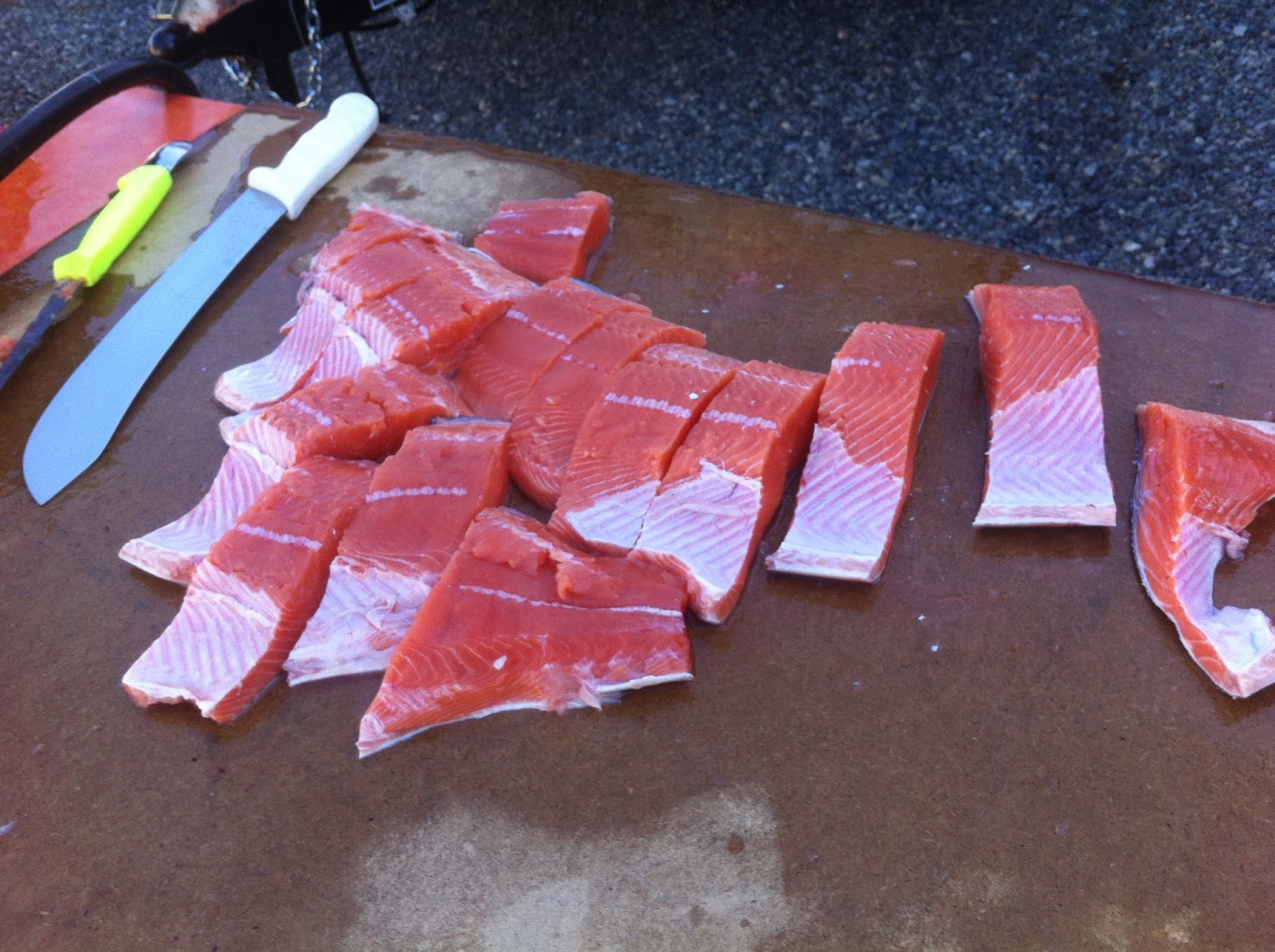
Here is the fish after I removed the filets, with the bellies alongside. I know I left a lot of usable meat on the bones, but don't worry. I chopped the fish into pieces, removed the gills, and put the whole carcass into gently simmering salted water with a little lemon juice. It only needs about five minutes poaching, then all the meat easily slips right off the bones (ok, you have to dig around a little in the head). I salvaged close to a pound of meat from that carcass, and froze it in a ziploc bag. Sometime in the future, it is plenty to make a salmon cake dinner. Also, I took the collars and bellies and marinated them for a few minutes in a mixture of sugar, soy cause, rice vinegar, and sriracha, and then broiled them skin side up under the broiler for 10 minutes or so. These bits we just gobbled up like candy, but it was plenty of meat that I could have made a separate meal out of it if I wanted to.
Top the jars with sterilized lids and rings, and into the canner they went. R. and Duckman have a propane cooker set up in their shed; they don't like to can fish in the house because of the smell. I personally find the smell divine, but maybe it lingers.
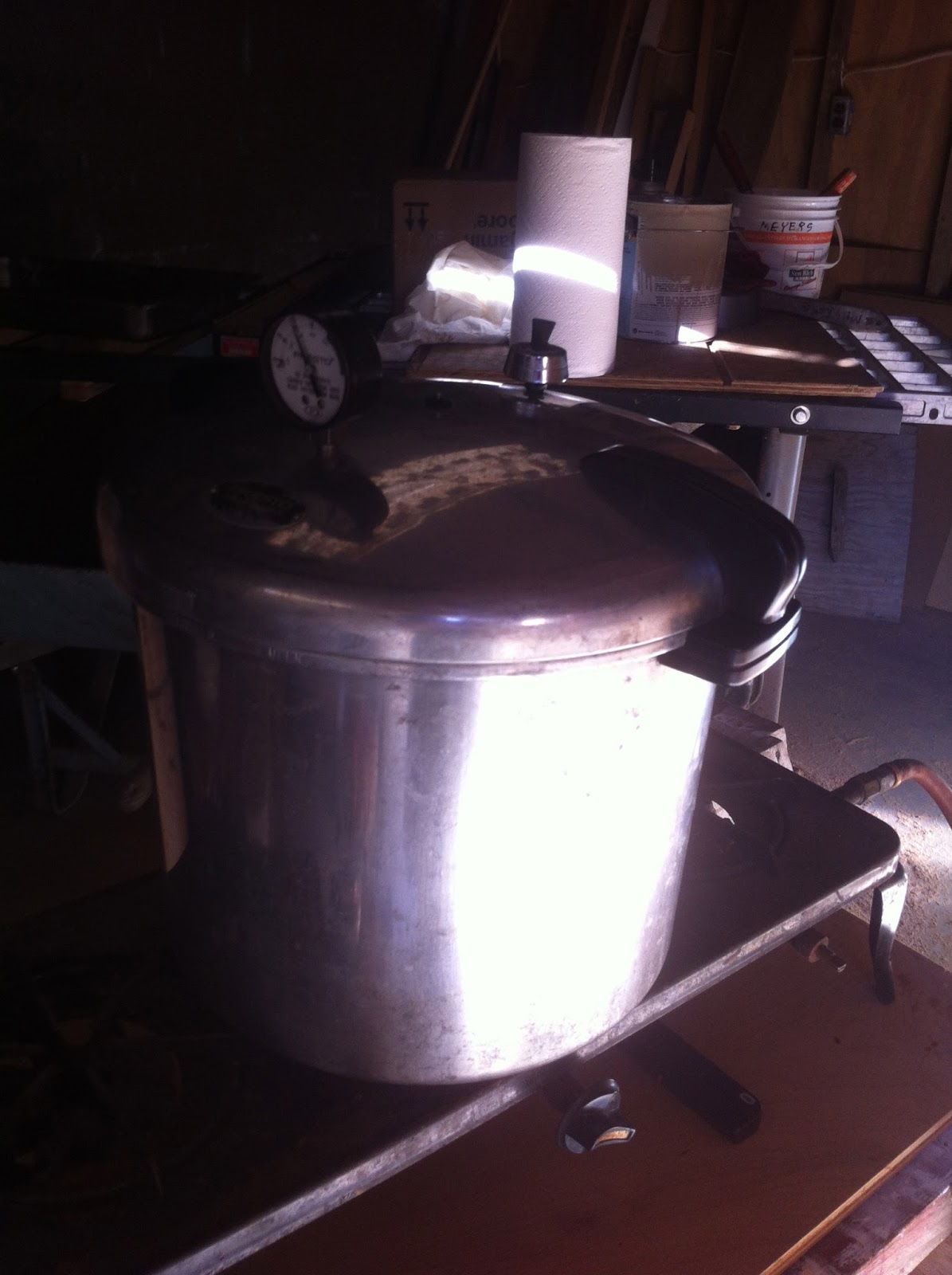
I'm still a little sacred of the canner, to tell the truth. I just don't quite get exactly how it works. I mean, I can follow instructions, and I can tell when it's working correctly and when something is wrong, but I can't exactly visualize what the parts are all for, and what is happening inside. Anyway. We put the eight pints in the canner and added 2 quarts of water. We ran hot water over the inside of the lid and checked that the gasket fitted into the groove tightly all the way around. We closed it up and put the cooker on low. If you heat it up too fast, you run the risk of breaking all your jars.
When you can see steam venting continuously from the vent, you carefully place the regulator on. The little vent in the middle ought to pop up. If it doesn't, you just wait until it does. Then the pressure will start to rise, and you watch the gauge carefully. Salmon is canned at 10 pounds pressure for 100 minutes. Don't start the timer until the pressure rises to 10.
Then, settle down in your chair and read a book. We had to adjust the flame several times to keep the pressure right; it wanted to creep up. It's fine to let it go a little higher than ten, but you don't want it to go above 15. Once it's at pressure, it only takes the barest whisper of flame to keep it up.
Posted by Aimee at 12:10 PM 2 comments
Labels: butchery, canning, homesteading, neighbors, preserving, summer, work
Thursday, August 15, 2013
Turkey Trade
Over the years, we've benefitted greatly from trading goods and services with our neighbors (and also with the random people who read the barter section of Craigslist). The trade network has had its up times and down times, but in general, I feel confident in asserting that trade is a big boon to us. Probably as much food has come our way via the trade network as we actually produce ourselves here on the farm.
For the most part, I trade my animal products (cheese, eggs, meat) for other people's vegetable products, since I am a pretty poor gardener. I also offer up my husband's services as a mechanic (sometimes without his prior knowledge; I gotta quit doing that) in exchange for other professional services. That's how we got our roof fixed last year. I've been lucky enough to find and maintain a few long term trading partners - Veggie/Oil man and the Kale Fairy come to mind - but I lost those contacts over the year we were in Mexico.
Luckily, the trade network shows signs of revival. We're off to a good start I think. Talking to a friend at church, I mentioned that I needed to find some chickens, as I had given all mine away when we left last year. This led to a conversation and ultimately to a trade with her son-in-law. He got a bunch of old beekeeping equipment that we were certainly not going to use again, and we got nine healthy laying hens.
Some neighbors of ours wanted a goat for butchering. We have two young, plump goats that are just about ready to eat, and I offered to sell them one for $75 and let them do the work here at our place, since they don't have a suitable space for butchering. They countered with an offer of four turkeys for one goat. I've never raised turkeys before, but that seemed like a heck of a deal, so now we have turkeys. And nasty, obnoxious creatures they are, too. They look like dinosaurs, and charge at me whenever I go out to feed them. It's a bit frightening, having a twelve pound bird hurtle toward you at the speed of a velociraptor. Thanksgiving will be at our house this year.
Just today I set up a new trade, albeit a short-term one. I was buying pickling cucumbers at a vegetable stand downtown. I bought a lot of them because I'm selling them at $5 a quart and there seem to be a fair number of people who want to buy them. The proprietor and I got to talking, and he said if I brought down a few jars of pickles, he'd trade me fresh produce for them. I see tomatoes in my future.
Do you trade ? What do you like to trade? Does trade have a significant impact on your household budget? Below, find several links to stories about some of the more interesting trades I've made over the past few years.
Trade Network 2012 (Craigslist Chronicles)
On Trading and Canning
Mushroom Mistake (Win Some, Lose Some)
State of the Trade Network 2010 (What's Your Perspective?)
Posted by Aimee at 4:02 PM 4 comments
Labels: homesteading, neighbors, trade
Saturday, August 10, 2013
Tree Trouble (What the Hell is Wrong With These Plums?)
Sometimes I despair of the orchard. I really do. There are so many factors conspiring against trees here; some of them natural, others decidedly of my own making. We didn't site the orchard very well, to begin with. It's right up on the highest part of the property, where the prevailing winds hit the trees full on. The trees in the southernmost row are all hunched over, curled around their own trunks, almost in the fetal position.
The soil up there is poor and rocky; further down, it gets spongy and has poorish drainage. The highest trees struggle in the compact gravel while the lower ones have wet feet most of the year. Of the five trees we planted the first year, only one remains, the italian plum. The rest succumbed to a variety of maladies, known and unknown.
The orchard has been repeatedly attacked by goats. A herd of six or seven goats can really blow through a young orchard if you give them fifteen minutes unmolested. Then there are the times - yes, more than one - that I rode right over a first-year tree on the riding lawnmower. Sometimes I used to have a few beers before I decided the grass was getting a little long.
It's amazing, the sheer variety of of pests that have plagued my orchard. I didn't know there even WERE so many fruit tree pests. There are the ones that look like tiny little slugs sticking all over the cherry tree leaves, and that, as far as I can tell by googling, are called "bird-poop worms." There's fire blight on the pears. Caterpillars chew on the leaves and voles gnaw on the roots. Something makes certain leaves turn white; something else makes other leaves curl up. Yet something else shreds them like a hail of tiny meteors. There's white fly and mildew and scab, oh my.
It's really too bad, because I believe that the orchard is rightly the cornerstone of a successful homestead. Nothing gives such return on investment as does an apple tree. Twelve or fifteen healthy, highly productive fruit trees would supply a family with much of their family's needs - for fresh fruit, certainly, but also for winter preserves, for animal forage, for shade and beauty, even, perhaps, for some extra cash from a farm stand. A good milk goat is a valuable creature, but she doesn't begin to touch the worth of a good tree.
Much of my orchard's problems are due to simple neglect. I have taught myself a little about pruning, but I'm timid and afraid of doing damage. I hate to use sprays, and I haven't even used fertilizer. The orchard is far from the hose, and to water it in the long dry stretches of August, I have to carry a whole lot of five gallon buckets around, and I haven't done that as consistently as I should. Considering the potential worth of these trees, and the money already invested, it's probably worth it to get a real tree person out here to prune and give me suggestions. Certainly, the current state of affairs is intolerable.
Today I went out to check out the plums on the plum tree. I had been delighted to see that we actually had a decent number of plums this year, but then I began to get annoyed by the plums' mystifying refusal to ripen. Here it is, practically mid August, and the plums are still green as grass and hard as rocks. Hunting diligently through the ratty, tattered foliage, I managed to find two plums that were respectably purple, and even sort of soft. So I bit into one.
I haven't got the foggiest clue what is wrong with those plums, but they taste like satan's compost pile. They are filled with a brown, mushy gunk that seems to be fermented and rotten. Checking carefully all over the skins, I didn't see any holes, nor did I find any insects in the stinking brown mush. Maybe it's a fungus of some sort. Maybe it's a virus. Maybe it's monkeys, I don't know! But it makes me VERY UNHAPPY.
Posted by Aimee at 8:24 PM 2 comments
Labels: disease, farm, gardening, homesteading, summer, trees