"United we bargain, divided we beg."
Showing posts with label goats. Show all posts

Wednesday, September 20, 2023

New Buck (Breeding Season)


We sold Jupiter, our gorgeous Nubian buck, a few months ago. We have used him for three seasons now and it’s time for some new blood. 

 (see this post for my thoughts on swapping out bucks and for some semi-historical tidbits about ritual sacrificial kingship http://newtofarmlife.blogspot.com/2011/10/king-must-die-goat-breeding-and-divine.html?m=1)

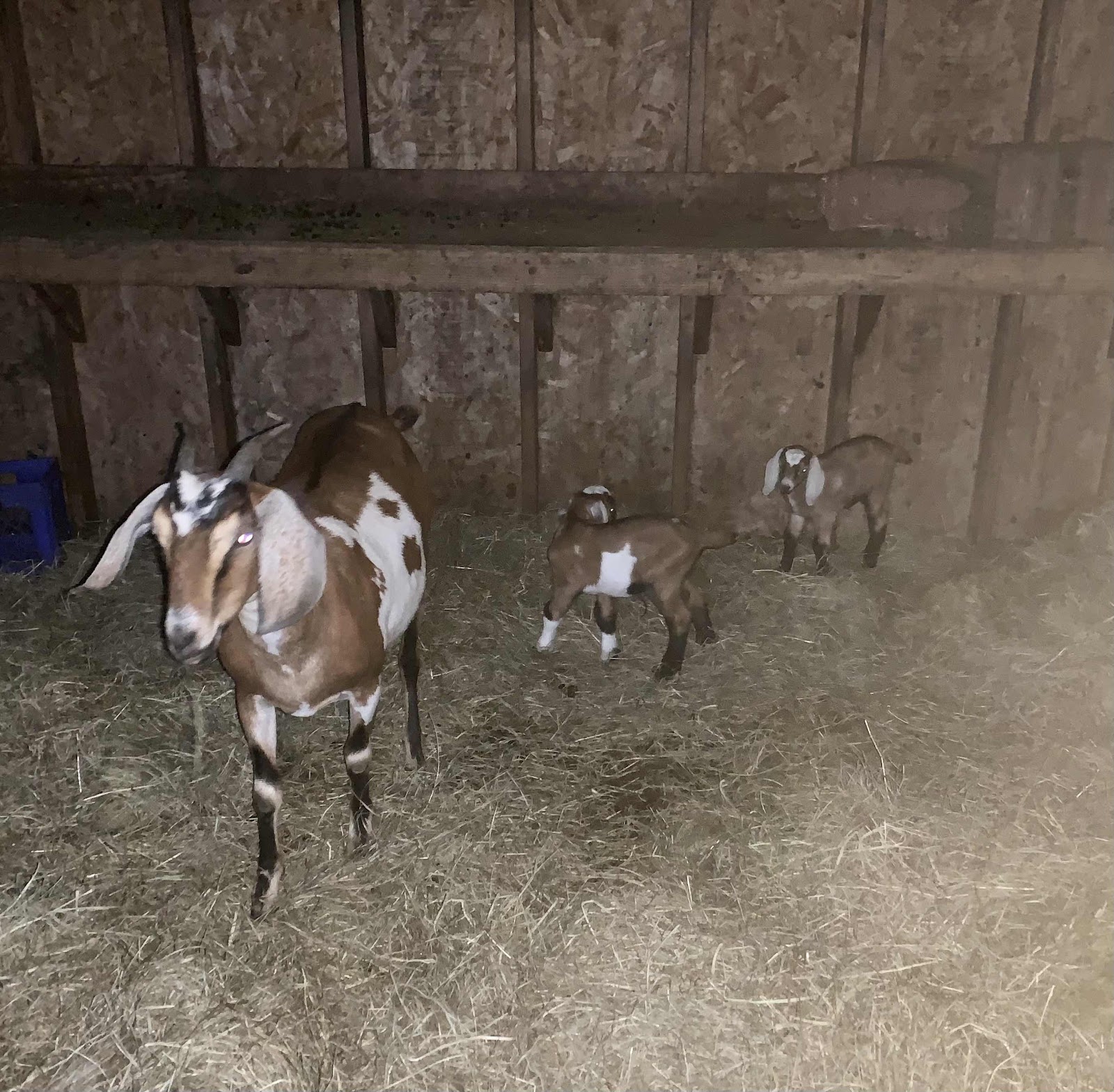
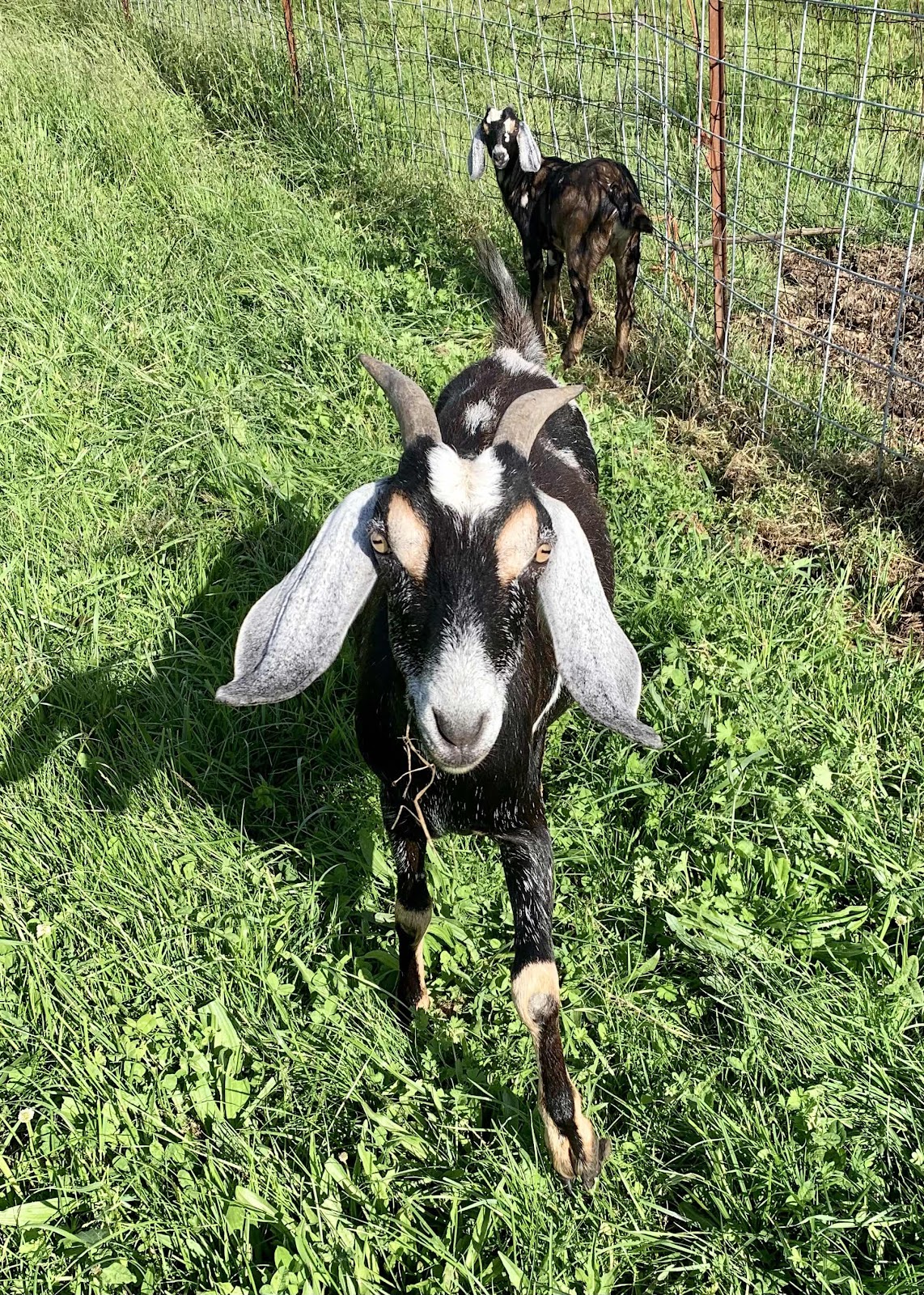
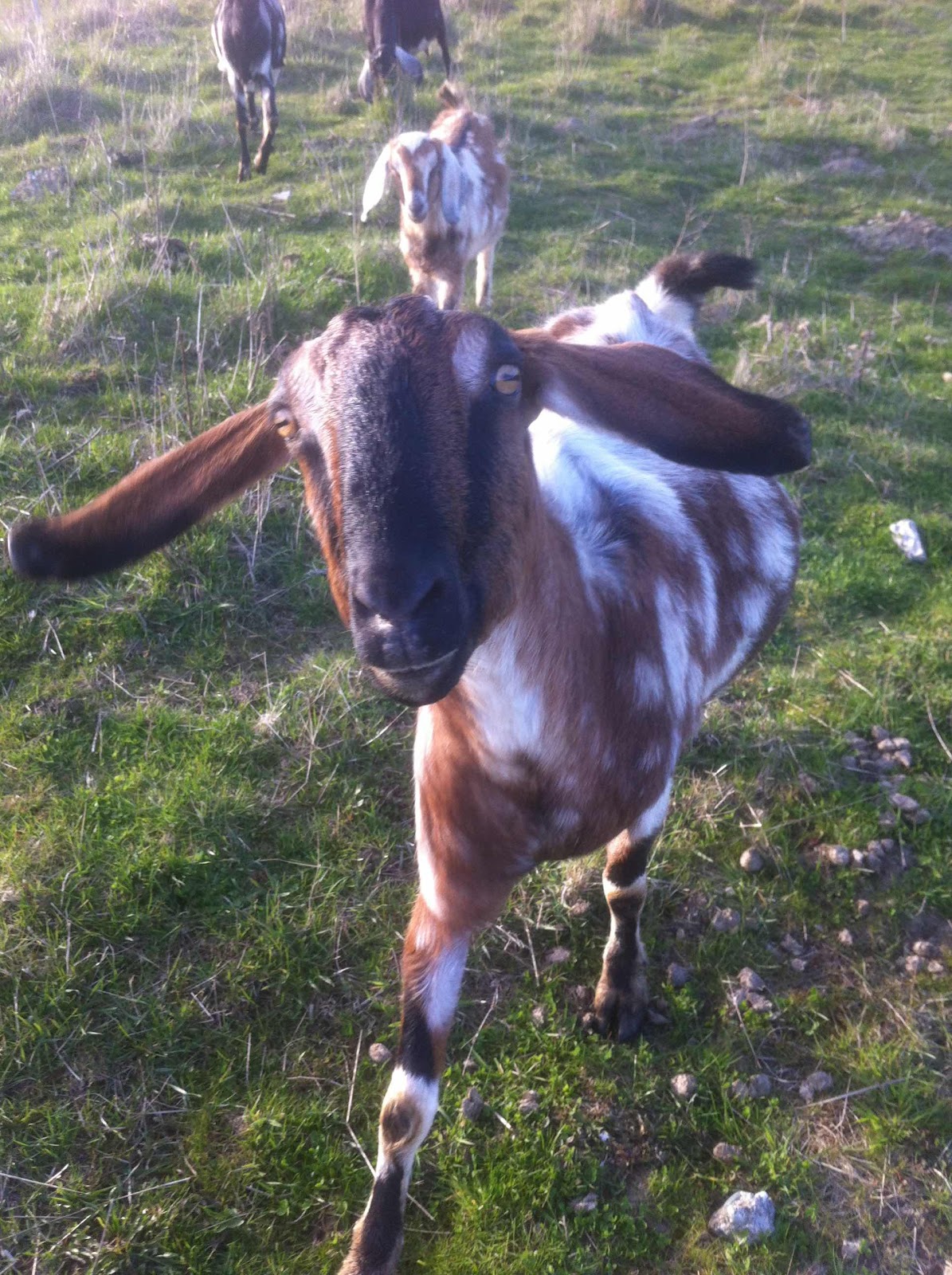
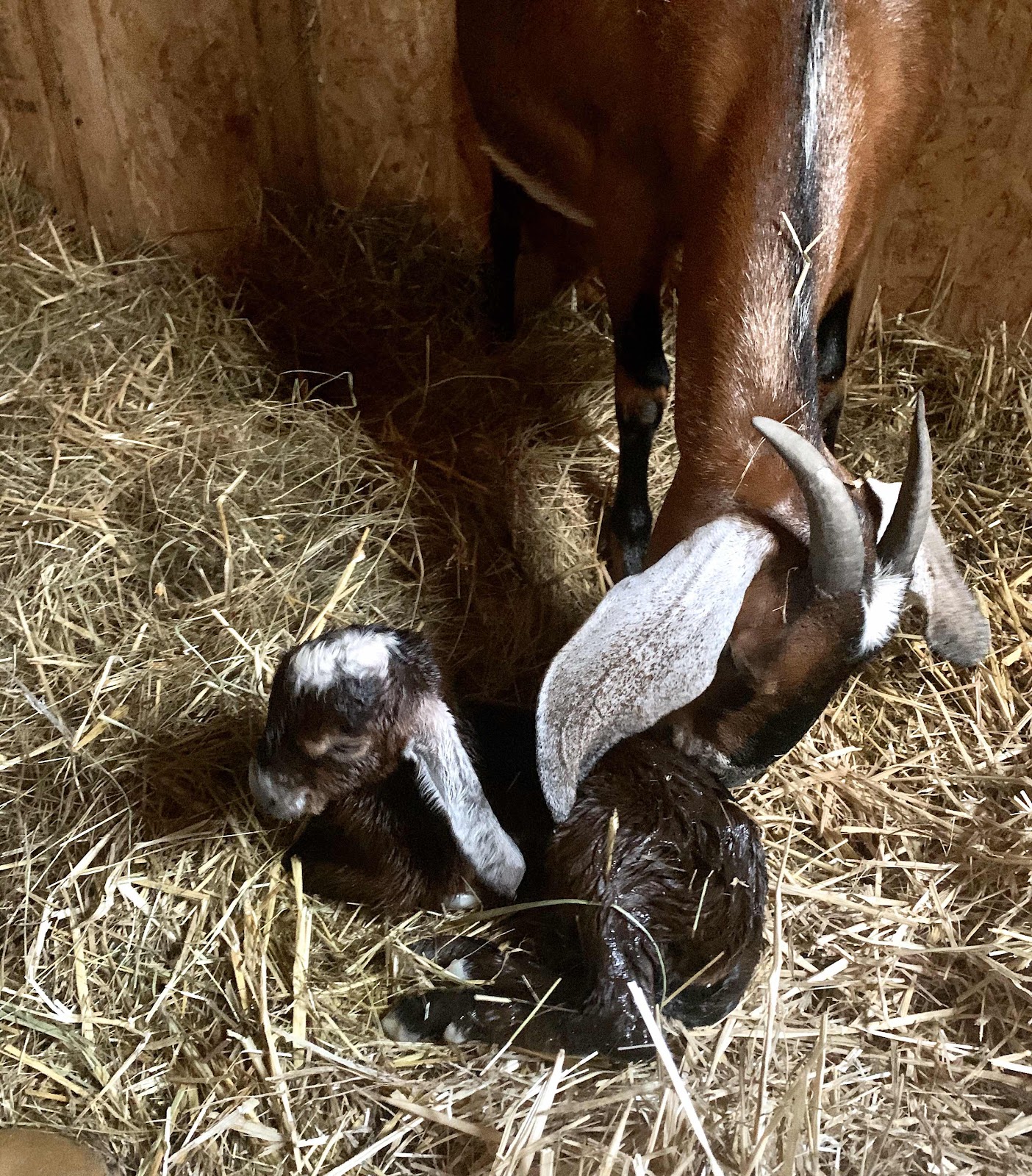
I didn’t really want to buy a new buck because 1) they’re a pain in the tuchus and 2) I’m pretty sure each year of breeding is going to be my last. Finding a suitable buck to rent is often difficult. Luckily, my husband has a client just down that road who owns this handsome specimen. I forget his name, but he’s beautiful. He’s not quite as tall as Jupiter, but he is stocky and strong, and he has the same beautiful brown and white coloring. And check out those horns! 

Best of all, he was available for the old fashioned fee of a kid back. 

Friday, July 29, 2022

Balking a Buck (Apron Antics)


Breeding season is here.  It seems awfully early, being still high summer, but the days are getting shorter and that is the signal that sends the does ovaries into overdrive. It doesn’t seem to matter that they all gave birth fairly late this year and are all still nursing young kids. 

Since we have our own buck this year, I have to take precautions to prevent him from impregnating everyone right now. Not only would it be hard I the does to get pregnant again so soon, but if they get pregnant in July they’ll give birth in December or January and that is not good. 

We do have one goat named Christmas, who was obviously born Christmas Day, and she’s a fine healthy goat, but that is an anomaly. Some breeders like to have kids born in winter, presumable because they’ll be grown enough to breed come fall, but those farmers must have barns with electricity and heat. Probably heated electrified barns that are not situated a few hundred yards away from the house so they have to trudge through a howling blizzard to get to them. Or maybe they live in places that seldom experience cold weather, even i the depths of winter.  We have a primitive barn and a cold wet climate, and we like our babies born in May. 

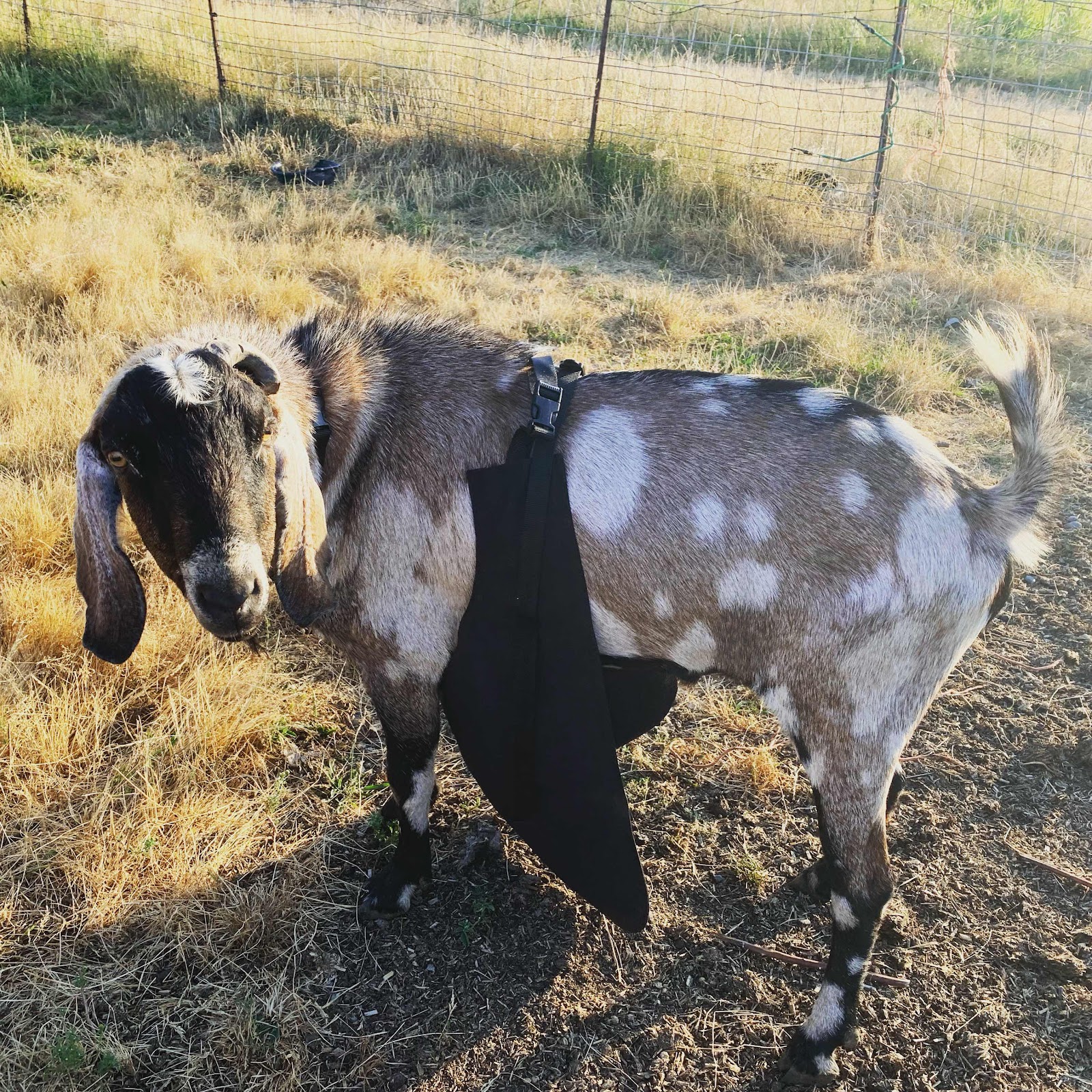
That means we have to control the buck. Not an easy thing to do. Until today he was separated from the herd in the sacrifice area along with the cow, but they ran out of grass. So I bought the  contraption you see in the photo: a buck apron. 

A buck apron is designed to provide a barrier between the buck’s business and any does. Reports of its effectiveness vary, and I’ve never tried one before. I guess we’ll find out. 
It wasn’t a ton of fun putting it on him - he stinks to high heaven - and it was expensive, so I hope it works. 


Thursday, July 14, 2022

They’re BAAAAAAACK (Prey Animal Strategy)


Right before bed, I decided to go out and check on the goats one more time, on the off-chance that mama Clio had found her babies. I was fairly certain coyotes had dragged them off, since two hours of me and Clio both searching for them this afternoon, Clio yelling her head off the whole time,  had yielded nothing. But there they were, like nothing ever happened. Just two sassy little baby goats without a care in the world. 


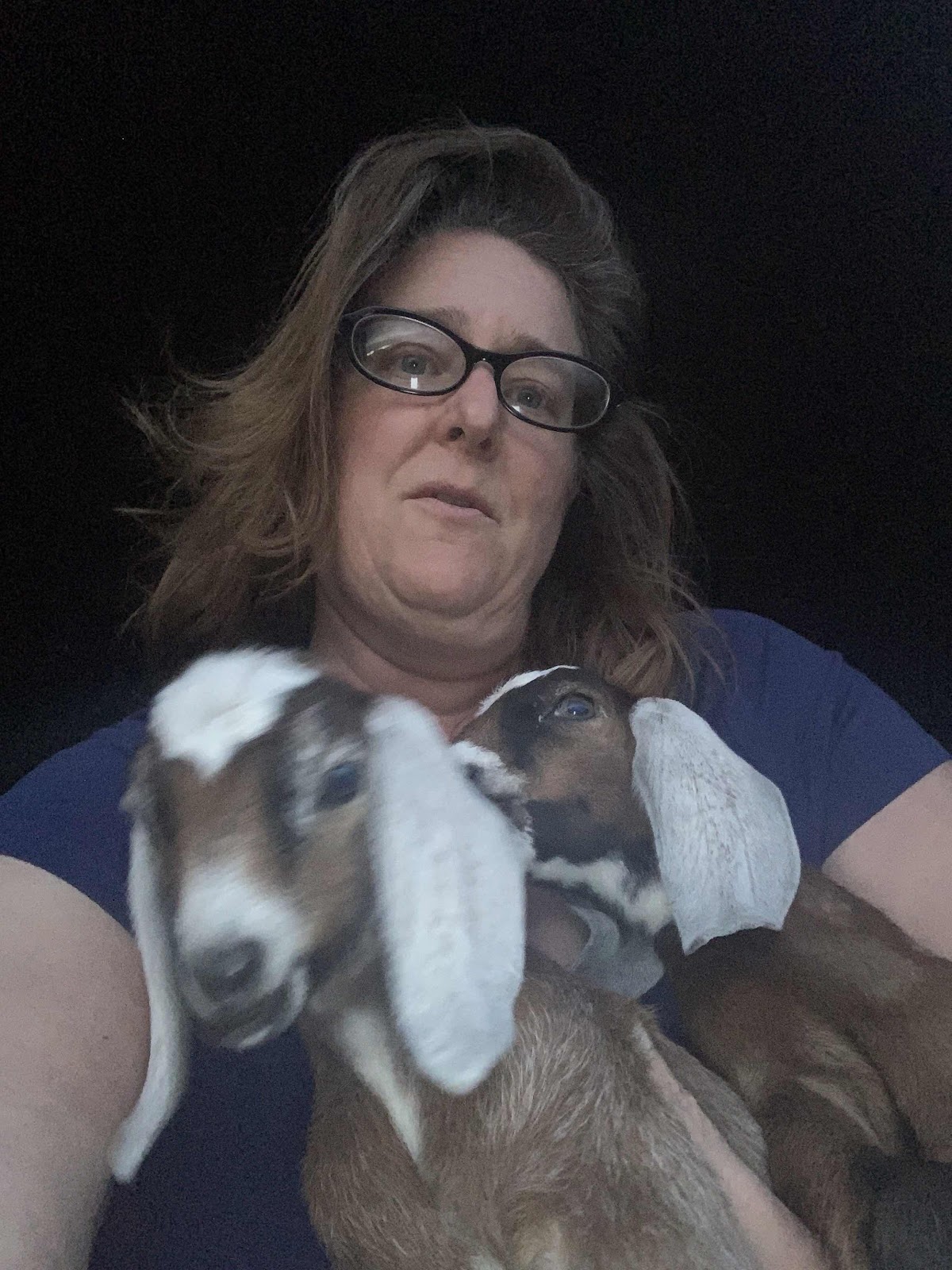
Im so relieved. I had been so sad, so angry at myself for putting them back in the big pasture, and so disappointed. I scooped them both up and took a selfie to send to Paloma, who was just as sad as I was about it. Then I dragged them all back into the backyard, where they will stay with the chickens until the babies are big enough to run fast. 

Baby goats hide while their mothers go off and eat. Just like baby deer do, and probably lots of other baby prey animals. And they are really, really good at hiding. It’s their only chance at survival - they have no other defense. Of course know that baby goats are good hiders, and for two hours today I assumed that’s what they were doing. But when their own mother was running around panicked, yelling and searching, I got worried. I thought they would answer her if they were there. But I guess as long as they don’t feel safe, they will stay quiet and immobile. And in four acres of chest high grass, there was no way we were going to find them if they didn’t make a noise. 

Phew. I’m wrung out. I’m gonna take a bath. 


Sunday, June 19, 2022

Meet the Herd


Clio (pregnant first freshener) with her mom Bitsy. 


Buck of many names. In keeping with our tradition of using weather or atmospheric or space related names for our bucks, we named him Jupiter. But the the girls started calling him Juniper instead. And then, just recently, I talked to one of his former owners and they said his name was Hunter. Homero likes that name and so now we all call him something different. He cares not a whit. 


Christmas (pregnant) is my oldest goat at about 7 or 8. She’s also my biggest goat except for the buck and a great milker. 
Behind her is this years only surviving baby (coyotes got the others), Luna. 


Sweetpea, Luna’s mom. Great little goat and very friendly because she was a bottle baby. 


Closeup of Luna. I love her unusual coloring, but experienced goat people tell me the brown will fade to white or cream. 


Wednesday, May 4, 2022

Coyote Blues (Adios Cosmos)


I thought we were going to have a great year for baby goats. Last year was just terrible, we lost three out of four babies. But this year, so far, was shaping up to be great. Two out of three mamas have given birth, without issues, to a healthy single doeling and to a pair of healthy twins, a buck and a doe. 

The buckling is -was - this beautiful fellow here. As adorable as he was, for some reason his mama took a dislike to him and rejected him. But he took to a bottle with no trouble at all and was thriving. Like all bottle babies, he became very friendly and would run up to us as soon as we appeared. After a week or so, his mama (Bitsy) decided he wasn’t so bad after all and let him nurse again. He was just entering maximum cuteness phase, that’s probably why :) 

Because of his flashy coloring, there was a lot of interest in him and I actually managed to sell him for the very decent price of $200. A neighbor wanted him for her new herd sire. He would have made a very handsome buck, for sure. He was going to look just like his papa, Jupiter. We named him Cosmos. All our bucks have weather or atmospheric or space related names. 


But alas, it was not to be. Day before yesterday when we went out to do morning chores he was just missing. The other babies were there but Cosmos wasn’t. We searched the whole pasture but he was totally gone. We didn’t find any signs of him - not hide nor hair nor bloody patch of grass. What we did find were fresh tracks in the muddy area under the fence on the western side of the pasture where the coyotes come in. 

Damn coyotes. They have eaten well from our farm over the years. Never before have we lost a goat, though, only poultry. But we lose at least half our flock every damn winter. This winter we were down to a single chicken when we decided to just move the poor thing into a shelter inside  the fenced backyard; the coyotes wouldn’t dare come right up to the house like that. So we built a new coop and got a few more hens to be her companions and we haven’t lost a chicken since. 

If I had put any thought into it, it might have occurred to me that without any chickens to eat, the coyotes might not just shrug their metaphorical shoulders and move on. That they might, in fact, decide hey, we’re here anyway, might as well try out baby goat. 

For now, we are just locking up the babies at night. Hopefully before long they will be too big for the coyotes. I’m not sure what to do about it long term. We can patch one spot in the fence - though it would not be easy to get enough gravel or cement through the pasture to the site - but the coyotes could and would just dig a new hole. Considering that there’s 1000 linear feet of fence line it doesn’t seem likely that we are going to successfully fence them out. 

Opinions are mixed on the effectiveness of shooting them (we don’t have a rifle anyways). Most sources suggest that’s it’s a very temporary solution at best. There just doesn’t seem to be a great solution. Keeping the goats locked up at night is probably as good as we are going to get. And that’s problematic as well because it increases the chores exponentially. It decreases the time they can spend on pasture, thereby necessitating more hay,  and it drastically increases the amount of poop in the barn. 

Losing this baby hurt. He was gorgeous and sweet. I thought they were all going to live this year. It’s a gut punch. And, I’m not going to lie, it wasn’t any fun to give back that $200, either. 

Wednesday, April 13, 2022

First Babies of 2022 (Bitsy Babies)


Bitsy surprised us today by quietly popping out twins with no fanfare this evening. We had just finished trimming all the hooves - a horrible, grubby job that we put off for too long, as always. Over the winter it is hard to force ourselves to trim as often as we should, what with the ankle deep mud and the shit and the freezing cold. The hooves were all fairly badly overgrown, with the soft rotten spots that they get from standing in the wet all the time. Those spots all need to be trimmed out or they will go lame. 

All the goats are rather flighty and shy after a long winter with little handling, especially the young does. They had to be caught and bodily lifted onto the stanchion, and then it took both of us to grip the legs and hold them still enough to trail with the extremely sharp hoof trimmers. The buck, Jupiter, is extremely strong and does NOT like having his hooves trimmed. Bitsy is small and easier to handle, but she didn’t like it either and struggled a lot. 

After we finished, I opened the gate and let them all out to graze on the front pasture for a while, but Bitsy didn’t follow the herd. She just hung back, bleating plaintively. I was worried the stress of being manhandled might have caused her a shock, or that we might have accidentally hurt one of her legs holding it in position for trimming. I didn’t think she was near kidding yet - she had an udder but it wasn’t tight and shiny the way it gets right before kidding. 

However when I went back out to check in her after dinner, she was in the back of the big barn and two babies were struggling to stand up next to her. I ran for the house yelling for help and towels. Homero and Paloma came out and we all trooped back and put her and the babies into the mama barn, where it is warm and dry. Over the next fifteen minutes we watched as they stood up and successfully nursed. Bitsy was wonderful - she chuckled at them and licked them clean and stood still to let them figure out where the milk is. She’s a great little mama. 

However, she is quite thin. We wormed her yesterday and repeated the worming today - I’m using ivermectin and fenbendazole together, two doses twelve hours apart, repeated in ten days. But as I’ve written ad nauseum, the worms on my farm are very resistant and the poor mamas always get thin and pale this time of year. All I can do is worm her, give her lots of good food, and hope for the best. 

Theres a buck and a doe. As seems to be usual, the buckling is the pretty flashy one, and the doe is just regular brown. But they are both healthy and vigorous, and that’s the most important thing. I’m tremendously relieved after last year’s awful losses that we are off to a good start to kidding season. 


Thursday, February 10, 2022

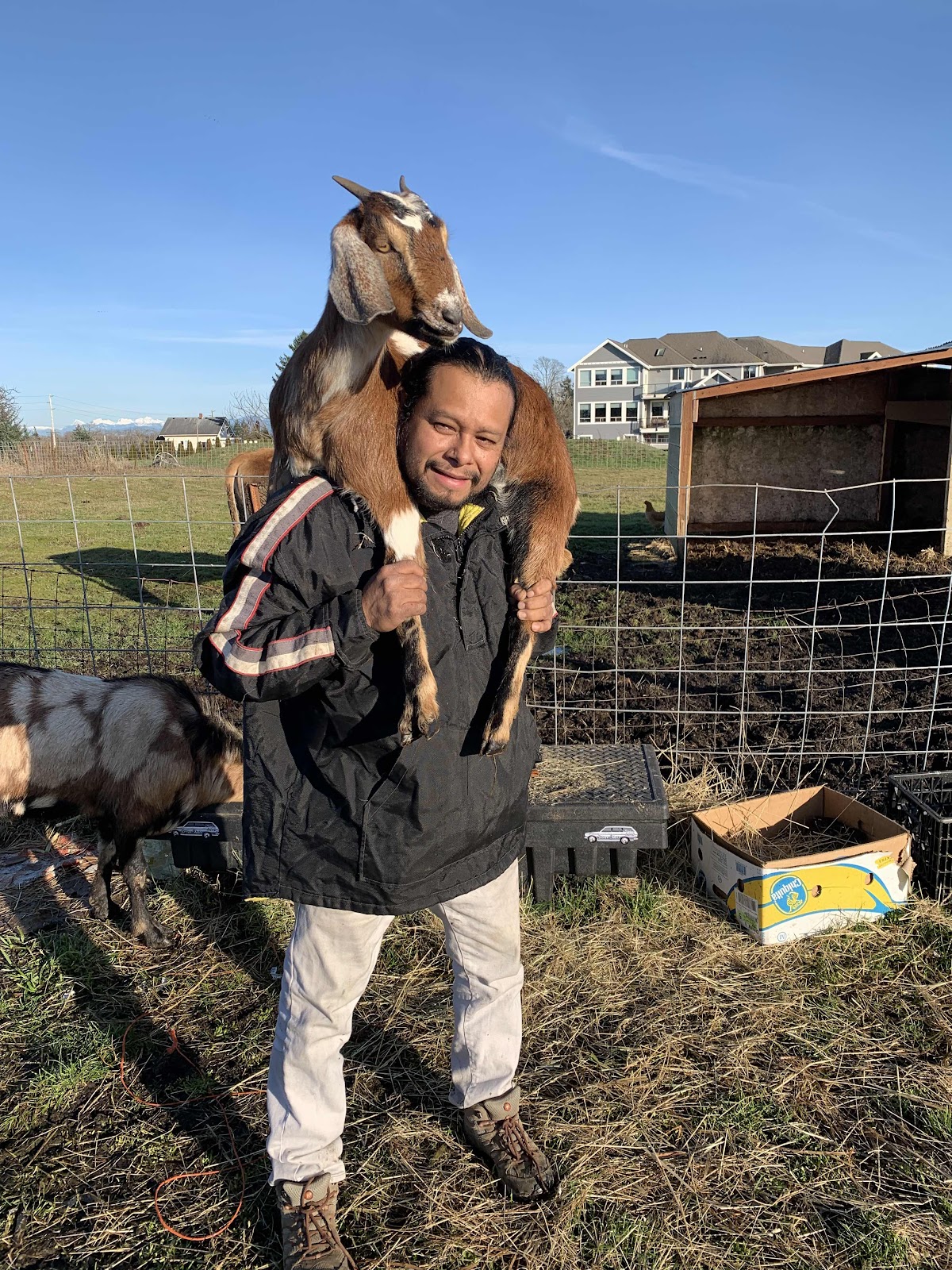
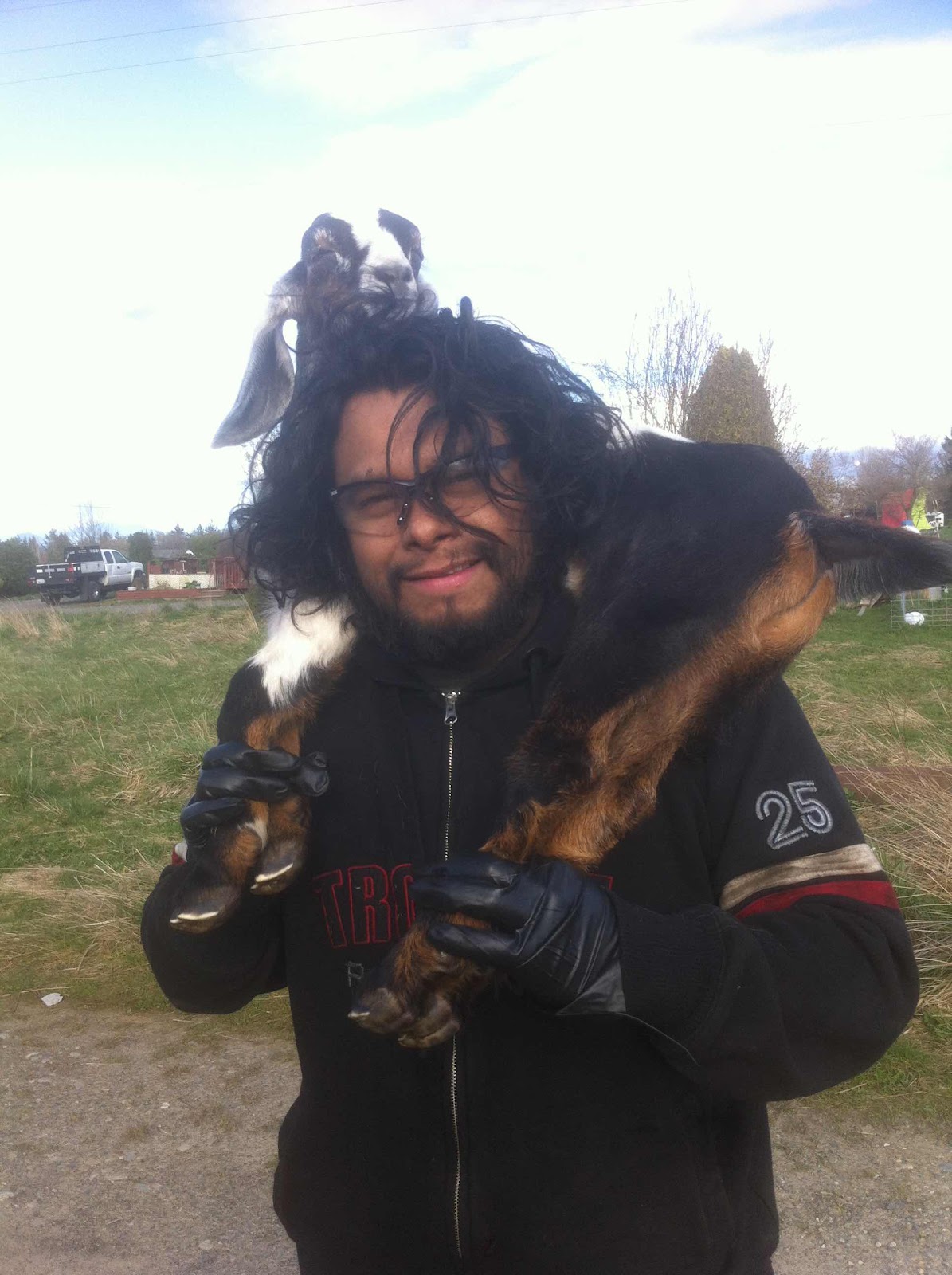
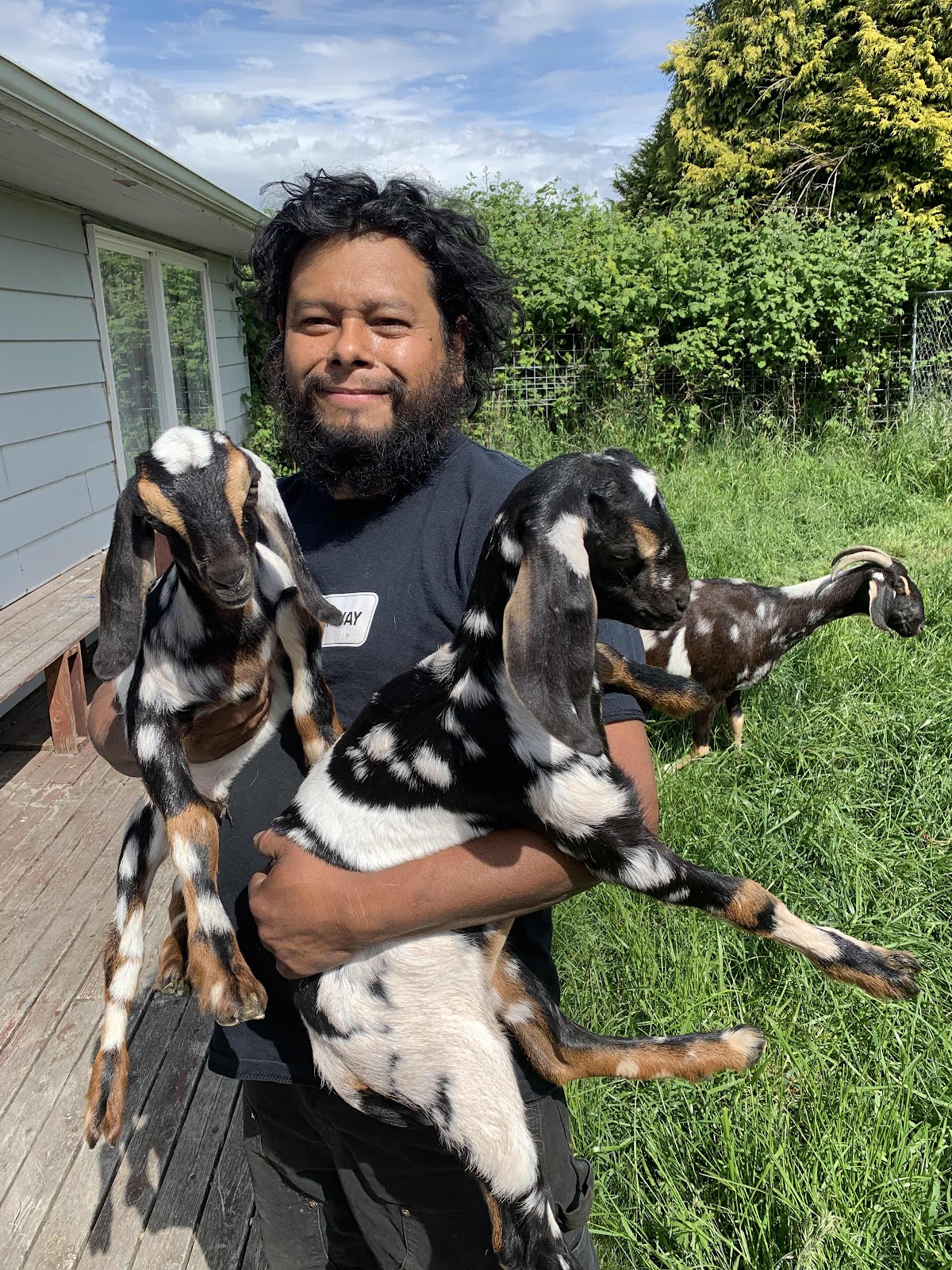
Goat Totin’ Man Totin’ Goats

It recently came to my attention that there are still people out there reading my blog. Apparently, there’s a high school boy out there, a friend of Paloma’s, who thinks my blog is pretty cool and asked Paloma why I don’t write anymore. 


Because, Kyler B., I’m just lazy. Terribly, terribly lazy. It’s easier to post a  picture on Instagram or Facebook than it is to write a real post. Also, the news has been so sad on the farm lately - we went through a terrible time of many deaths. I felt like a complete failure as a farmer. And, after twelve or so years, I sometimes feel I’ve written all I have to write about the passing seasons on our little farm. 


But of course, I haven’t. There have been all sorts of recent developments. And I have had a cool idea for a new ongoing  series of posts about eating from the gleaner’s pantry as close to exclusively as possible. So, for those few of you out there in the real world who are still interested in life up here at Windy Hill Homestead, I will start writing again. 

Meanwhile, here’s a few pictures of Homero toting goats. 


With Cleo, 2022


With Bitsy and Bootsy, 2020


 With a goat whose name I can’t remember, 2017 (?) 

Friday, March 5, 2021

Goodbye to a Great Goat (The End of an Era)


    Iris gives the girls an early sex ed lesson, farm style


My first goat was Iris, a beautiful Nubian about a year and a half old, a first freshener. I bought a pregnant goat because I absolutely couldn’t wait another year for babies. 

Iris (short for ArcoĆ­ris, which means rainbow in Spanish) was a very fancy registered purebred from a farm with lots of grand champions to their credit. I really didn’t care about that, I just loved spotted Nubians. But breeding will out, and Iris turned out to be a truly outstanding goat in almost every way. 

The kids she threw were gorgeous, year after year. She almost never needed any assistance, and was a very good mom. She had a beautiful udder, easy to milk, and gave about a gallon of delicious sweet milk a day. She stood for milking, too, and jumped on the stand without fuss. Her hooves were good. She was seldom sick. But most of all, she was smart. 

Iris was one of the few goats that obviously knew her name. She could unlatch gates, be they barred or closed with a hook and eye. We had to use carabiners to keep her out of the feed shed. The undisputed herd queen, she led the herd for a good ten years, remembering which trees on the property fruited in which season and where to find the best new shoots and flowering twigs. She was affectionate and loving. Iris was a wonderful animal and a friend. 

Iris was fifteen this year, which is very very old for a dairy goat. As she got old, the worms which plague every dairy goat started getting the best of her, and she became very thin and frail. No matter how much grain and alfalfa we fed her, she kept losing weight. The other goats began to bully her, and knock her down. 

When we found her out in the field, knocked over and unable to stand up, we knew it was time. In fact if the truth be known I probably waited too long. She was suffering; I just didn’t want to say goodbye. After I brought out the girls to say goodbye, and after I stroked her and fed her some grain out of my palm, and after I shed a few tears, Homero went and got the gun and that was that. 

Iris, beautiful spirit, thank you for all the happiness you brought into my life. Thank you for for sharing your grace and your beauty with us. Thank you for the adorable kids you birthed. Thank you for your milk, which nourished our bodies and nourished my mind too, as I learned to make cheese and grew in my craft. Thank you for being a good goat. I loved you. 


                                   Herd Queen 


A girl and her goat in happier times. 

Sunday, August 2, 2020

The Horns of the Dilemma (to Disbud or Not to Disbud)


Seven A.M. on a Saturday. We are all peacefully asleep, dreaming the dreams of the innocent. There is no alarm clock set; we will wake when we wake, naturally and without intervention.

OR SO WE THINK. The phone rings, jangling us out of slumber. “Your goat is stuck in the fence again,” says our neighbor, acerbically. “She’s yelling.” 

For perhaps the ninth time this week, Homero truckles  out to the back pasture, wire cutters in one hand, wiping the sleep out of his eyes with the other. He spends a difficult ten minutes wrestling with Lilac, the goat who insists on sticking her head through the fence several times a day, even though the grass is EXACTLY as green on this side as that. 

We used to disbud our baby goats. Most goat farmers disbud, or at least in our area they did when we got into goats. Goats with horns are not allowed at the county fair, which means any kids who have goats as a 4-H project would have to disbud. For those of you who don’t know, disbudding a baby goat involves applying a red-hot iron to their little adorable heads for at least twenty seconds, while they struggle and scream and behave exactly as you would, if someone were applying a red hot iron to your head. 

Personally? I am a feelingless monster (Aquarius) and their pain and suffering didn’t really enter into the equation. However, I am a trained medical professional and I did notice that a high percentage of baby goats suffered serious consequences in the form of neurological symptoms for several days afterwards. And more importantly, no fewer than three baby goats died over the years, following the procedure, even though I took them to the vet and had it done under anesthesia.

Feelings aside, that’s an unacceptable economic proposal: let me give you more money than this goat is actually worth, to perform a procedure that has, in my experience, a 5% chance of killing my animal. That just doesn’t make sense. For a couple of seasons, we tried to do the procedure ourselves, but I found that I am not hard hearted enough (or strong stomached enough?) to apply the iron for the time needed to kill the horn buds and avoid the growth of misshapen scurs. It seems that there is very little margin for error in the disbudding operation - the space between too little and too much thermal damage is slim indeed. 

So, three or four years ago, we decided we won’t disbud baby goats anymore. For the most part, this decision has had very few negative consequences. Goats do use their horns to challenge each other, butting heads and so forth, but they cannot really do any real damage to each other with them - with the exception of bucks who can and do butt pregnant does and cause them to miscarry. There is still a good argument for  disbudding bucklings. We don’t do it, but I understand and support people who do. 

This decision means we have several does with horns, and one of them - Lilac - is so dumb as to get her head stuck in the fence multiple times a day. Another quick piece of relevant information - it is not feasible to remove horns form an adult goat. Horns are lavishly supplied with blood vessels, and removing them is tantamount to an amputation. 

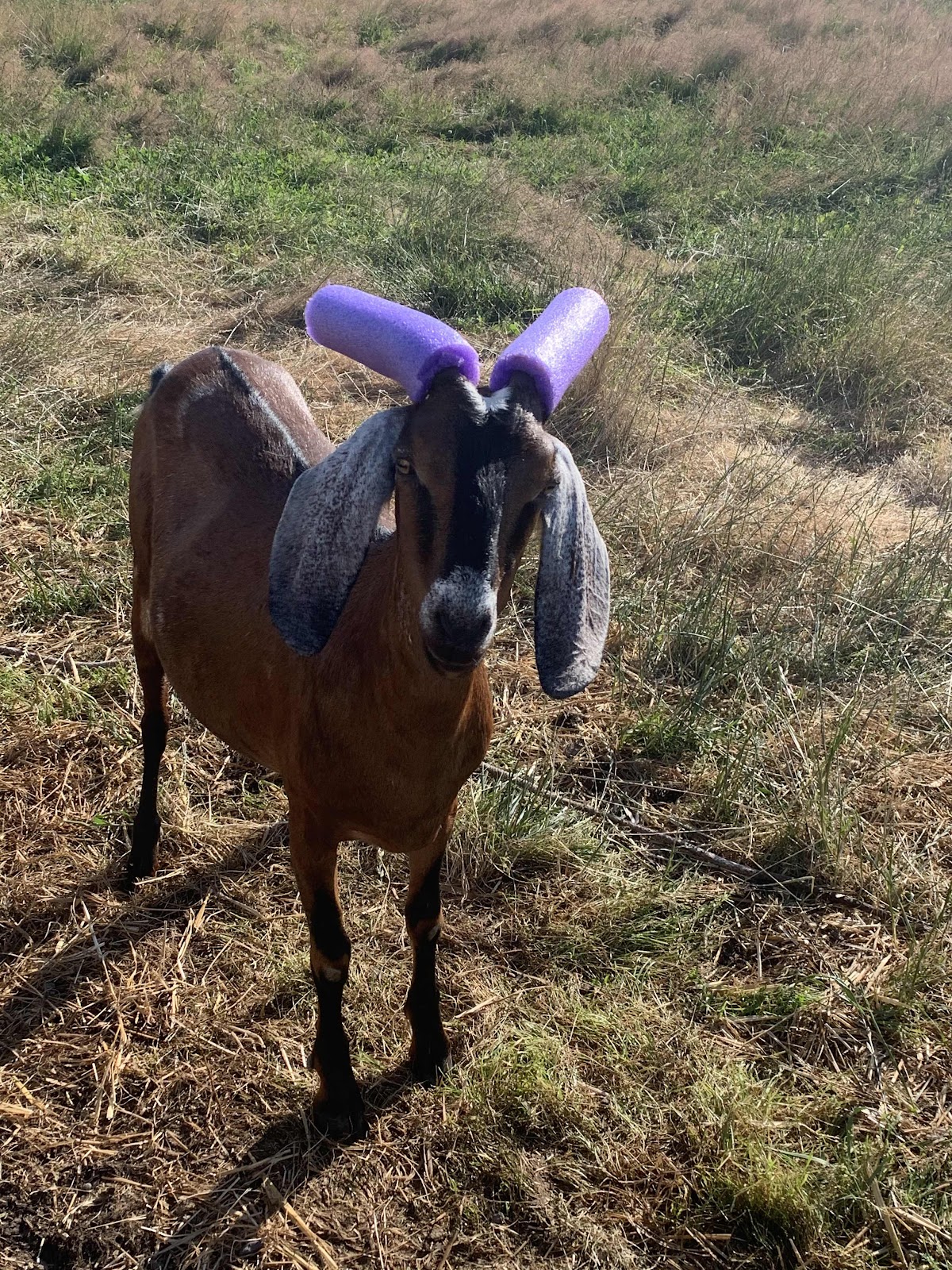
So we have been forced to try and rig up some sort of headdress that will prevent Lilac from putting her head through the fence, which has 4x4” openings. A little googling showed me solutions involving pool noodles. 
I went to the dollar store and bought a pool noodle, and we attempted to attach them to her head with zip ties:


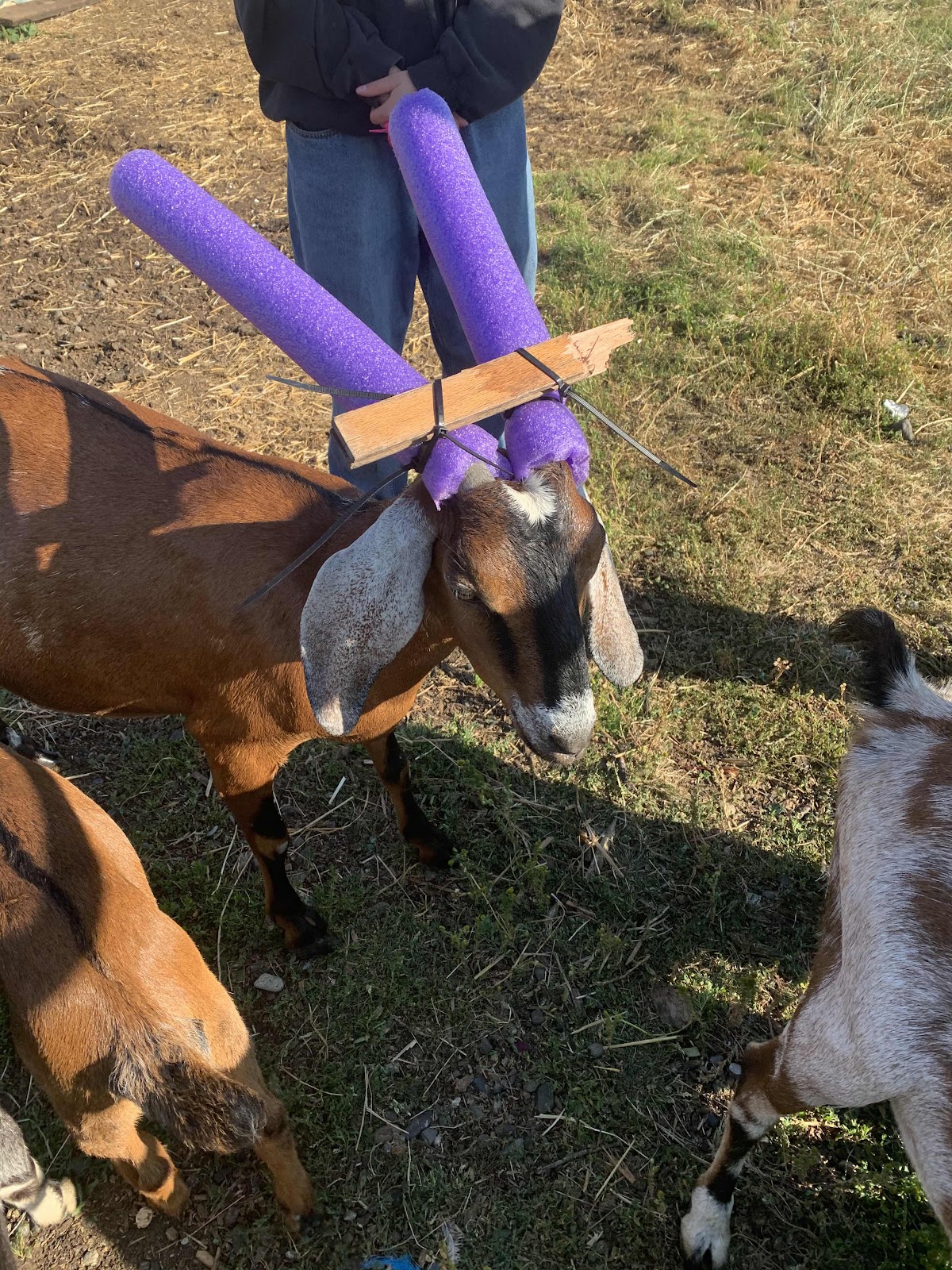
These fell off within minutes. We tried again, this time incorporating a cross-bar: 


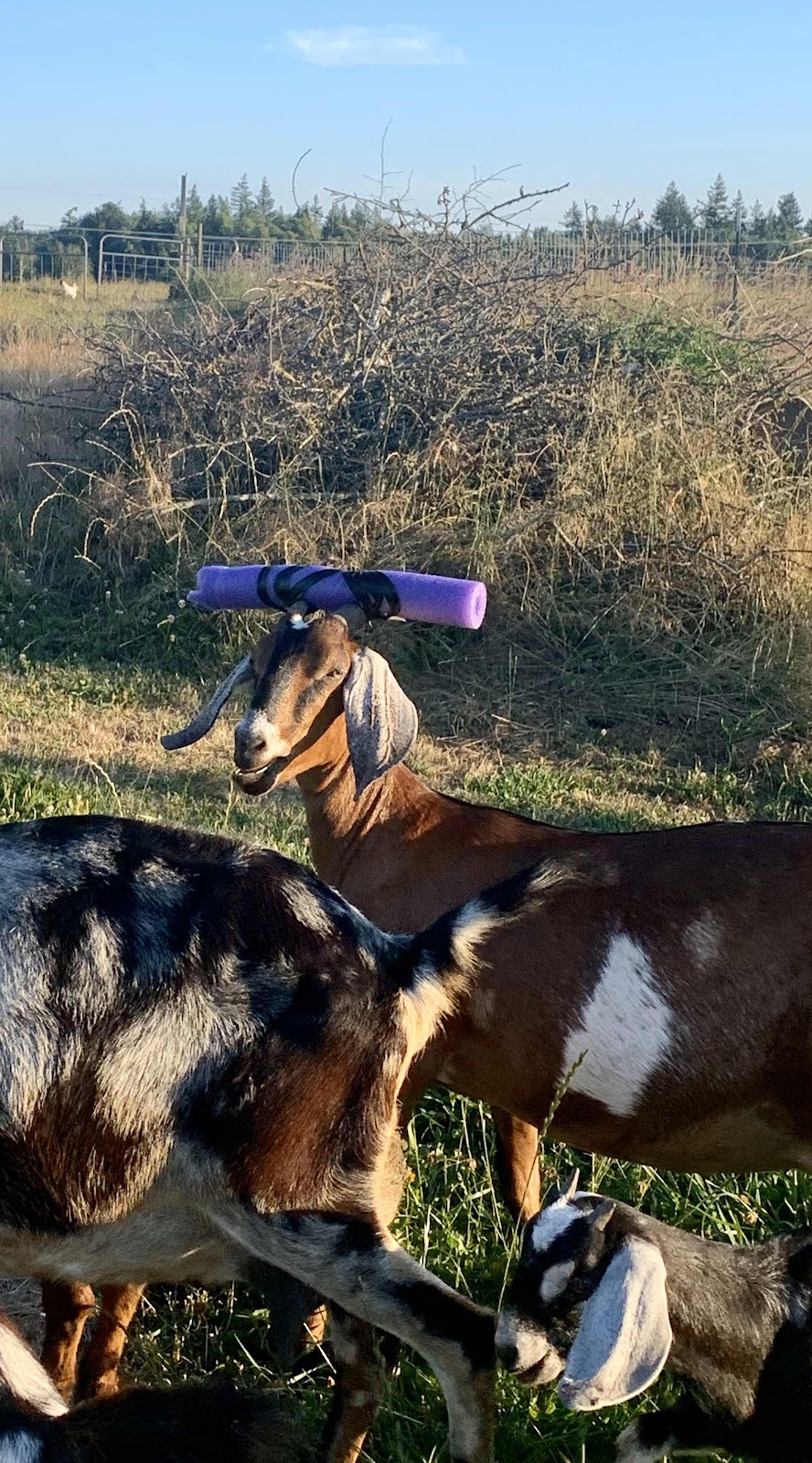
This also lasted less than 60 minutes. Our next attempt was to put the entire pool noodle crosswise:


Also attached with zip ties, this arrangement lasted all of 30 minutes. The problem is that her horns, like most, are basically cylindrical. The headdress tends to slip up to the tips. 

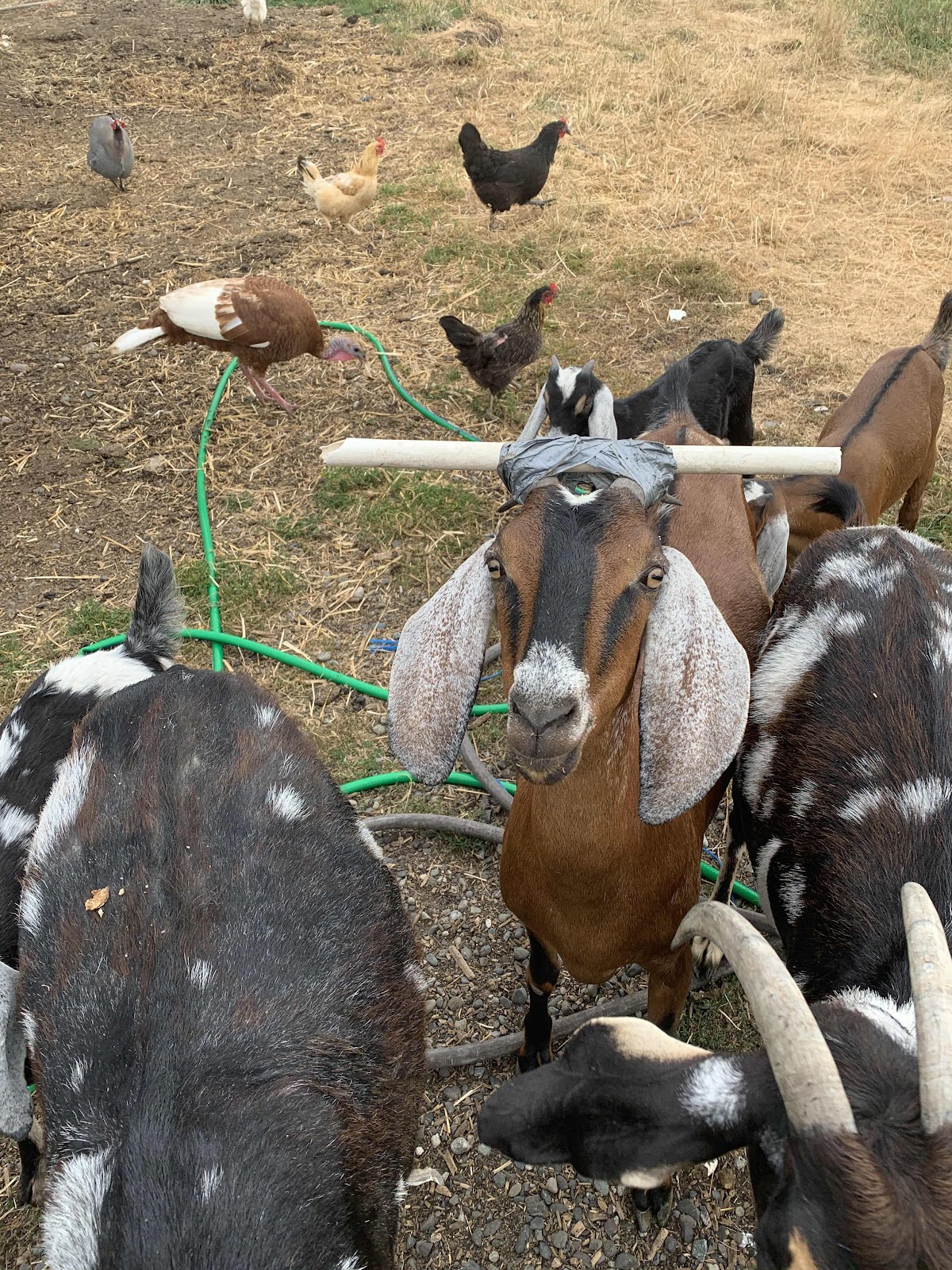
Finally, tired of fucking around and very extremely tired of being awakened at the crack of dawn by understandably irate neighbors, we bought a roll of wide, industrial strength duck tape and a short length of PVC piping. None too gently, I restrained the recalcitrant goat while Homero wound foot after foot of duck tape around her horns.


This iteration has lasted five days now. I hope
It will last until her horns grow wide enough to prevent the passage of her head through the holes in the fence. Wish us luck. We want to sleep. 

Sunday, July 19, 2020

High Cheese Season 2020 (Making Do)


            A middle stage in the making of cheddar 


In last week’s post on preserving, I forgot to include cheese. Cheese is kind of the whole point of this farm - a desire to milk goats and learn how to make cheese was one of the driving forces in moving up here in the first place. After ten or so years, I have developed three or four cheese recipes that serve me well. As in many endeavors, it is pretty easy to achieve a basic level of competence, and then quite difficult to move on to a level of expertise that allows for consistent, high quality results every time. 

Being who I am, I have more or less decided that I’m happy with my level. I very seldom have an abject failure - all the cheese I make tastes good and is usable for one application or another. But I often have to decide what that application is AFTER I see how the cheese turns out. 

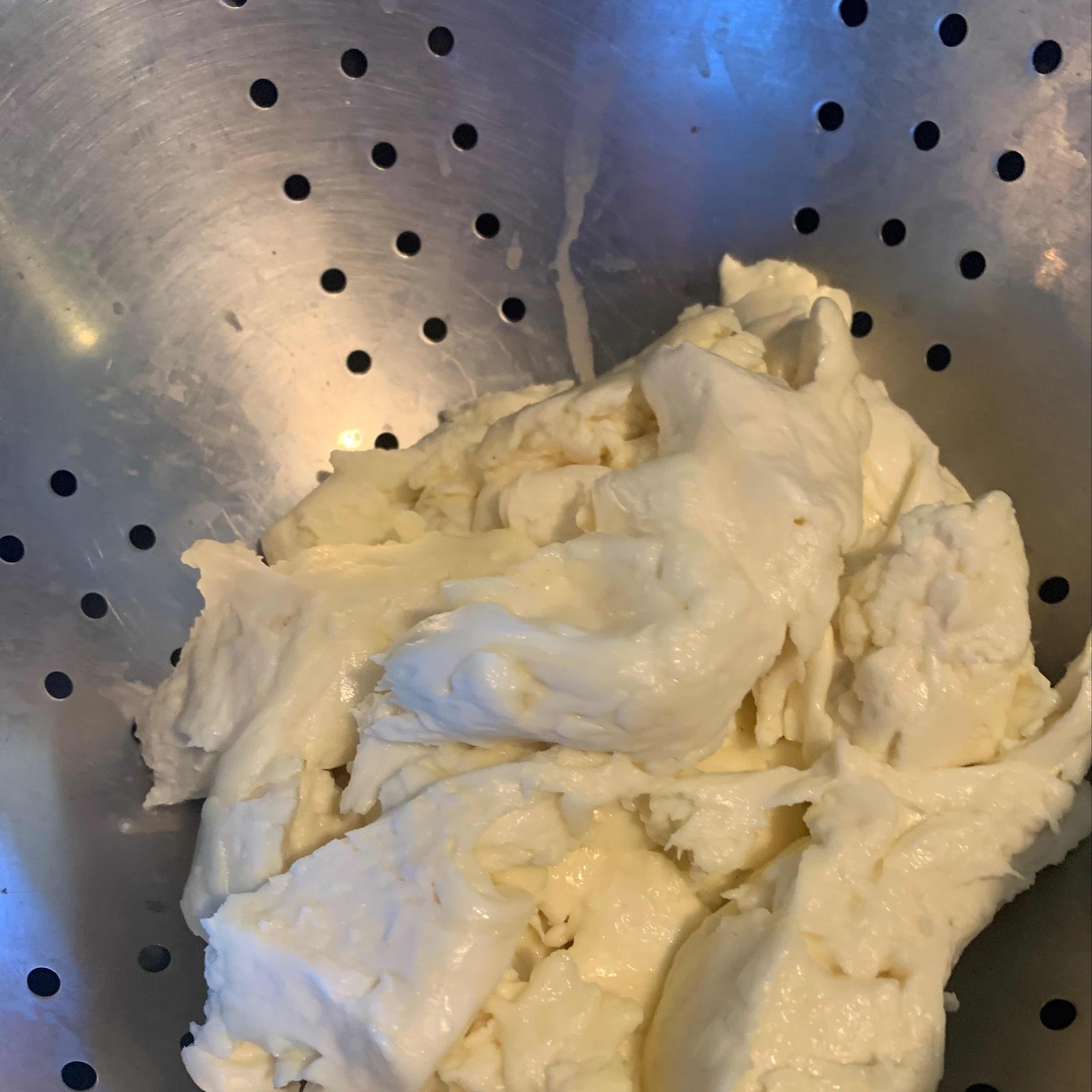
Today I am making chevre and cheddar. Chevre is easy - you just culture the fresh milk and wait 24 hours, then drain it through a clean pillowcase and salt it to taste. Once in a while, especially in very warm weather, the chevre will develop some off, goaty flavors that nobody is fond of. When that happens, I incorporate the cheese into a highly flavored recipe where the goaty flavors will be outcompeted,  like spicy eggplant Parmesan. 

Cheddar is more difficult. It requires several steps, and my recipes include instructions that are patently impossible to follow in a home kitchen, such as “hold the milk at exactly 99 degrees for four hours.” Much of the “cheddar” I’ve made is actually just “plain semi-hard cheese.” The most common defect is that it stays crumbly instead of melding into a single, smooth textured mass. But hey, goat cheese crumbles are a delicious addition to many dishes. Luckily, my Mexican husband is totally used to a dish of cheese crumbles on the table as a condiment, with a spoon, for sprinkling onto everything from refried beans to scrambled eggs to green salad. 

Making do with what you have is a philosophy, one that I’m fond of. I’m not going to waste any time lamenting over a “failure” to produce perfect cheddar when what I’ve actually produced is a pretty delicious piece of cheese. Instead, I’m going to incorporate that cheese into the larger, creative task of taking stock of what I have on hand and weaving disparate ingredients into something new and satisfying. 

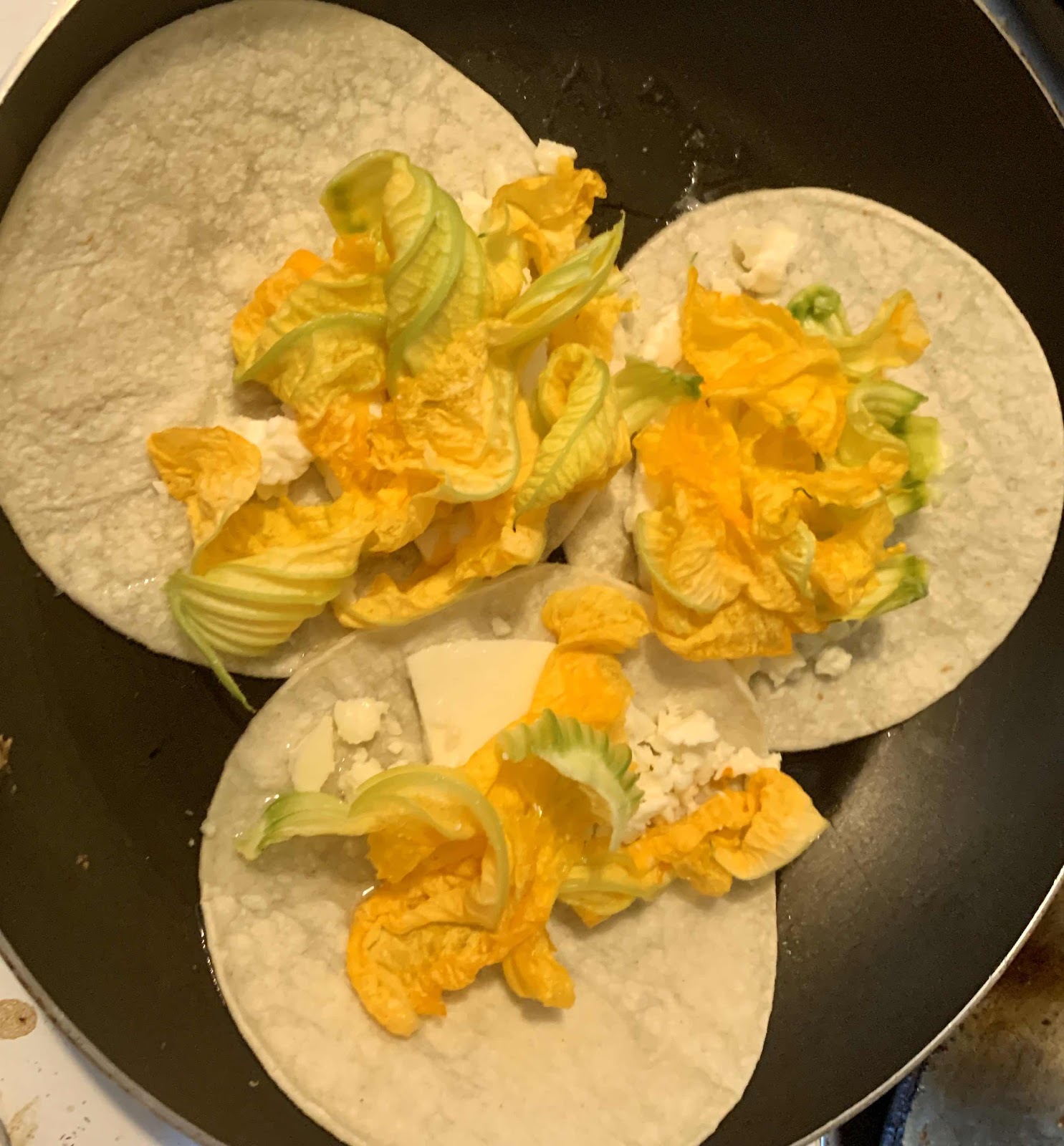
This morning, I opened a vacuum sealed package of cheese from early this spring, expecting to find a nice, mild, melting cheddar. Instead it was a sharp flavored crumbly cheese. But it still worked well to make squash blossom goat cheese quesadillas for breakfast. I got no complaints. 


Friday, June 5, 2020

Just Cute Goat Pictures


Paloma and Flopsy’s baby boy. I can’t decide who is cuter. 


My goat-totin’ man, totin’ Bitsy and Bootsy, Christmas’ two doelings. 


Hope being tickled by goat kisses from Sweet Pea, Polly’s doeling. 


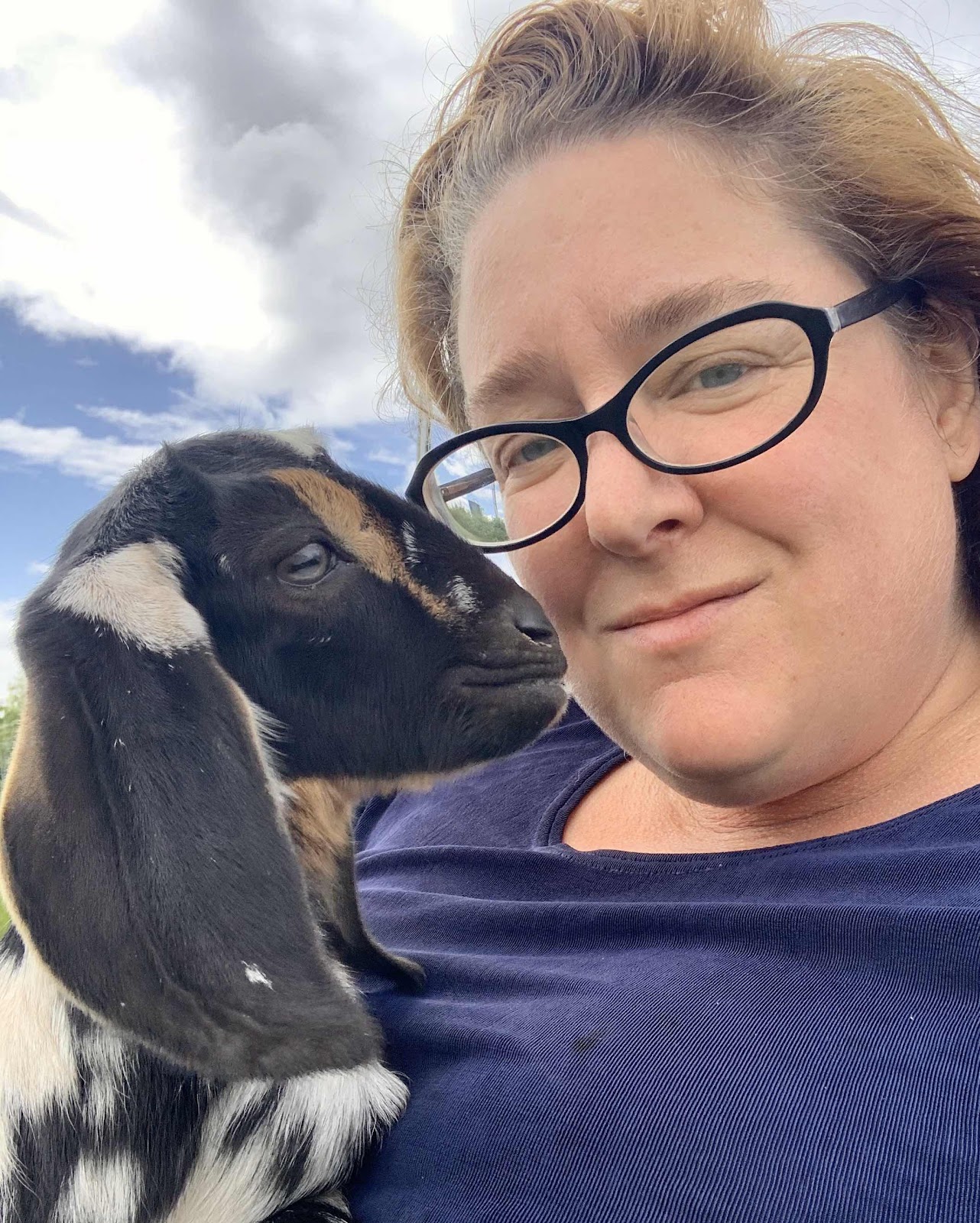
Me and Bitsy. I think I’m gonna keep this one. 

Tuesday, June 2, 2020

DQ- OH WAIT ITS OVER!!


On Friday, the governor announced that Washington state was ending the stay-home order as of Monday morning. All that really means is that we are now officially allowed to leave home for “non-essential” reasons. There are still no gatherings allowed and stores and restaurants have not reopened. Those activities can begin whenever we make it to “phase two,” which depends on a number of variables including number of new cases weekly, hospital capacity, and I did remember what else. Daily life has not really changed, but it’s still a big psychic relief not to be in actual quarantine anymore. 

Today our last baby goat was born. Lilac was the last to pop. She’s our first freshener, the one baby I chose to keep from last year because she was the biggest, healthiest, and cutest. 


Unfortunately, it wasn’t a super easy birth. She had a single big buckling, and one of his legs was back. The kids and I had put her in the mama barn when we went out for afternoon chores and saw she was straining, and then we went inside to eat dinner and watch an episode of cutthroat kitchen, our new favorite show. 

When I went back outside to check on her an hour later, she had a head protruding from her rear, and, after a closer examination, a single foot. Luckily she was quite calm and in no distress, and the baby was alive. I called the vet and asked what to do, since I have never corrected this presentation before. 

“Can you push the baby back in?” he asked. 

“No way.” There was no way in hell I was going to try to push the entire head back into poor Lilac. It was completely out, up to the base of the neck. 

“Ok,” he said, “sometimes you can pull them out with one leg back, if there’s enough room.” 

“How can I tell if there’s enough room?”

“Feel around the baby on all sides and see if you can slip your fingers in between the baby and the bone.” 

I could (Lilac was being extremely cooperative, just standing there eating grain while I felt around in her vagina), so the vet said I could wait for a contraction and just apply some gentle traction - “but stop if she starts to really cry out or struggle, and I’ll come out.” 

It worked. The baby came out a little more and more, until right at the widest part of the shoulders Lilac gave one big bleat - but the baby was on the straw five seconds later. 

What a good mama goat! After her rough delivery, she still took an interest in him right away, and vigorously cleaned him up, talking to him the whole time. The poor little guy took quite some time to stand up. Maybe he was just tired, but for a few minutes I was worried that the poor presentation had caused some nerve damage because he couldn’t seem to support his weight. Eventually I decided to hold him up by the teat and see if he would nurse. He did, and after he got a little milk into him, and rested for a while longer, he was able to stand up on his own. 

I think I made a good choice keeping Lilac. She was bred a little young, but she did great, and having been a bottle baby she’s very friendly and used to being petted and touched. Assuming she becomes a good milker - no reason she shouldn’t - I’ll be very happy with her. 

So that’s all the babies this year. Three does and three bucks. One of the does and one of the bucks are already spoken for; I may keep both of the other does and just sell the buckling. We’ll see. Now begins my favorite time of the year, early summer with baby goats gamboling about outside and lots of milk and cheese making in the kitchen. 

Hopefully it isn’t too late, if Whatcom country progresses through stage two and onto stage three fairly quickly, for a few summer activities that were previously cancelled to be revived. Paloma told me that her theater teacher said that if we reach phase three by the early part of July, they can go ahead with the summer play. Who knows, there might even be Fair in August. 


Saturday, May 30, 2020

DQ74 - Double Surprise


Yesterday Flopsy, our second oldest goat at thirteen, surprised the heck out of us by popping out a single baby buckling, quietly and with no fanfare. 


It’s been a couple of years since Flopsy had a baby. She’s elderly, arthritic, and not in the greatest of health, and I’ve tried to keep her separate from the buck so this wouldn’t happen. I don’t want to tax her system - she’s done yoeman service and doesn’t need to earn her keep any longer. 

Nonetheless, she got pregnant somehow and threw this adorable little buckling. Paloma discovered him yesterday morning when she was going out to bottle feed Polly’s babies. 

Oh yeah - Polly had a rough delivery and developed a fever and went downhill so quickly that I had to call the vet out. I was worried that I’d done her some harm by going in to help deliver the babies but the vet said no - more likely she’d been developing an infection since I noticed the premature string of goo four days before she delivered. Whenever membranes rupture prematurely you have a high risk of infection. Polly has been getting a twice daily regimen of antibiotics, vitamin B, and steroids for the past several days and is much better. However she lost most of her milk and her twins need supplemental feedings twice a day. The vet says she may never regain her milk this year. For a few days we were feeding the babies round the clock, but today whenever we tried to feed them they already had full tummies and were uninterested in the bottle, so it seems Polly has recuperes enough capacity to feed them herself. 

In other news, the governor has finally decided to lift the stay-at-home order as of this coming Monday morning. Yhe actual changes to daily life will be subtle - we are still prohibited to gather in groups larger than 5, and most businesses remain closed. Masks are also required in public indoor spaces, and outdoors where people cannot maintain 6 feet of distance. 

There has been a great deal of controversy on the subject of masks - violence has broken out in some places - but I haven’t seen open conflict here. In my small community, I’d say about half the people I see in public are wearing masks. I wear my mask assiduously, because I work in health care and am at high risk of contracting the virus. Wearing a mask protects me a little, but if I happen to be carrying the virus, it protects those around me a lot. Personally I have a hard time understanding the resistance to this innocuous act, but it seems to have become a political football. 

Now that there is a path forwards towards Opening back up, I have a little bit of hope that some events planned for later in the summer that were Called off - like the fair - might possibly be “called on” again. 

In the meantime, we just keep keeping on. 


Saturday, May 23, 2020

DQ67 am- More Baby Goats


Polly finally gave birth today. I’ve been expecting her to do so for about a week, ever since I saw her kneeling with a long string of amber colored goo depending from her vulva. That’s usually a sign babies will be born the same day. But for whatever reason, she didn’t give birth, and a full week went by. 

Last night I could tell it would be very soon, because her udder had gotten very tight and shiny. That’s really the best indicator. So we locked her up in the mama barn. I fully expected to find babies when we did morning chores, but still nothing. I kept checking every hour or so, and finally at around noon there was a bubble. 

I sat and waited, but nothing appeared; just the bubble of amniotic sack. After another hour or so, I could see two hooves, but no head. More worryingly, I could see flecks of blood and fecal matter in the amniotic fluid inside the sack. I don’t like to interfere if I don’t have to, but it was clearly time to see what the heck was going on.  

Homero helped me get Polly onto the milking stand, and I washed my hands, lubed up, and took a gentle feel inside.  I was worried I would find the head curled back; that’s a common malpresentation and is often hard to correct. But no - I could feel the head easily correctly positioned above the front legs. But it was very high - too high to slip under the  dorsal pelvic bone. I stuck a finger into the baby’s mouth (and promptly got bitten, proving baby was alive), and exerted downward pressure to lower the head enough to let it slip under the dorsal pelvis. After that it was easy. 

The baby was huge. A big, pretty spotted buckling. Another baby appeared quite quickly - another enormous baby, this time a doe. I decided to quickly go in again and check to make sure there wasn’t a third baby - nope, all empty. 

The babies had had a rough time, as had mama. They were stained with meconium (meaning they had pooped inside - not a normal thing to do and indicative of prolonged labor) and took their time standing up. I scrubbed them with a towel, and waited to see they both stood up, but resisted the urge to further interfere. I went inside and left mama and the babies alone. 

Checking back after a couple hours, both babies are dry and fluffy, and I could feel they had a little bit of milk in their tummies. They look like they are all going to be just fine. 

Now we only have Lilac still to go. She’s a first freshener, and so we don’t know yet how it will go with her or what kind of mama she will be. There’s always a risk with first time mamas that they might reject thier babies. But luckily, she’s the last to give birth this year and so has had the benefit of seeing her mother and auntie birth and nurse their babies. My guess is she will do just fine. 

Friday, May 22, 2020

State of the Farm - DQ66

Friday, May 15, 2020

DQ59 - Baby Goats!


Paloma holding Bootsy, one of Christmas’s twin doelings 


Christmas cleans up Bitsy, her other twin doeling.

Christmas was the first to pop, day before yesterday. She did super well, only needed the tiniest bit of help in the form of a little bit of traction on the first baby. She gave birth to two big healthy beautiful spotted doelings, and then, hours later, to a tiny dead one. 

I don’t know what happened to number three, but it had clearly been dead for a long time, and was only about half the size of the others. My best guess is she was killed when our big mean buck butted Christmas in the side. He butts all the ladies, and it’s a problem. A problem for another day, though. 

It looks like Polly is going to give birth today. When I did morning chores I saw the telltale string of goo. So I put her in the mama barn - which meant evicting Christmas and her babies - and I will check on her in an hour or so. Polly is a wonderful mama, and I’m not worried about her. Well - I’m a little worried she might give birth to quads again like she did last year. But if she does, Paloma is ready and waiting with bottles. 

Monday, April 8, 2019

......Or Does He? (Warning: Graphic Photo)


First, please enjoy this photo of adorable, healthy baby goats frolicking in the springtime, all right with the world. This is the reality for 8/9 babies born this year, and that’s not such a bad outcome. 

But now - 


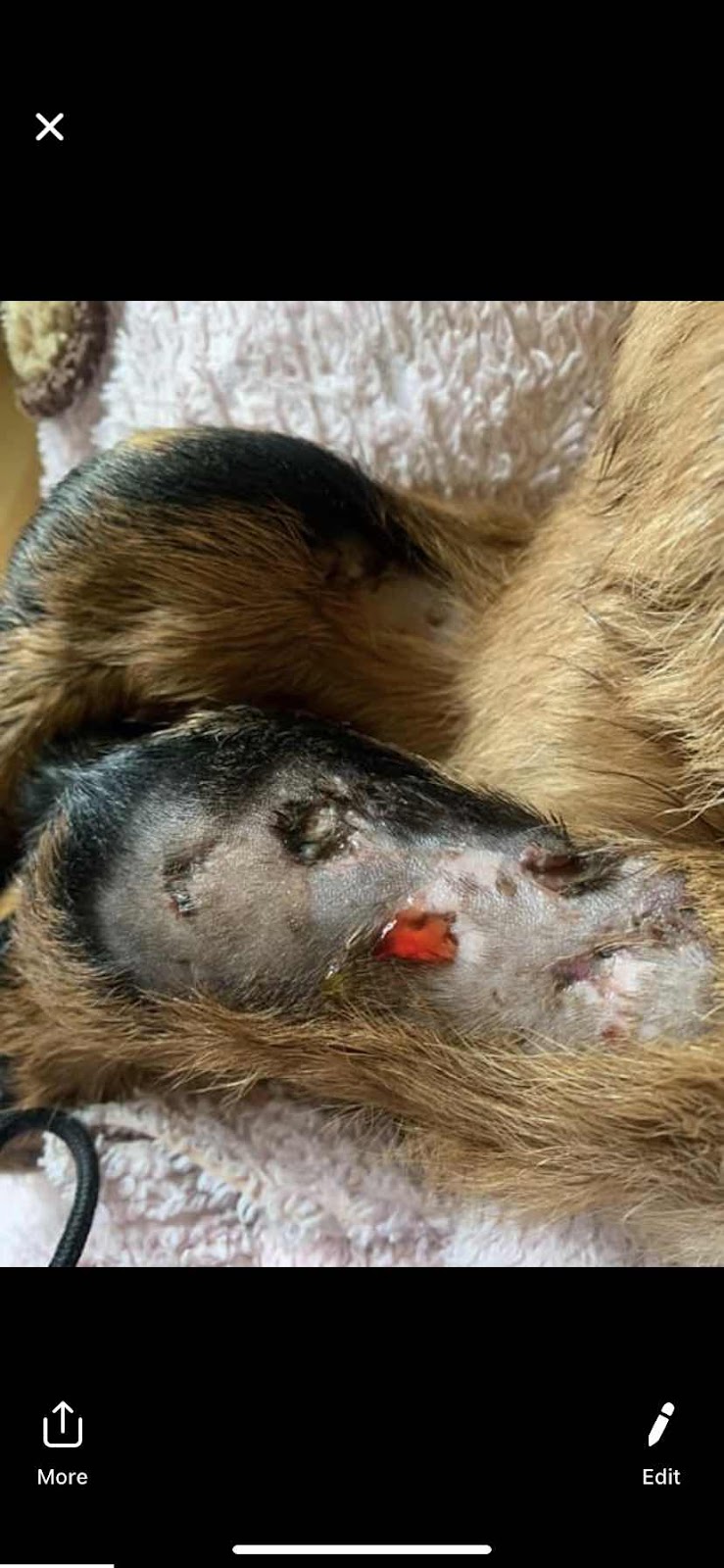
This photo of the bite inflicted on baby number nine by my very own dog. There’s a story here - hold on before you condemn the canine. 

The last mama goat to give birth was Polly, last Thursday evening around 5 o’clock. She had a lovely set of twins, who both stood up and nurses with no problems, a boy and a girl. I was thrilled. However, when Homero went out the next morning to do chores, he found another baby in the ground, still wet and gooey, who had apparently been born quite recently. 

For those of you who aren’t goat breeders, it’s not normal at ALL for there be such a long delay between kids. No matter how many kids are in there, a normal birth usually takes an hour, maybe an hour and a half, tops. So this little guy was off to a rough start. It seemed he had aspirated some amniotic fluid. His lungs rattled and he was very weak. He couldn’t stand up by himself, and his mama ignored him. 

That’s a bad sign. I always pay attention to the mamas, they seem to be able to tell better than I can when a baby is not very viable. However, he was alive, so we went to work to get some colostrum into him. Throughout that day we bottle fed him every hour or so, and although very weak and coughing, he was getting some down. 

But there was clearly something wrong with him. His head was swollen, whether from the hard birth or whether malformed in some way was hard to tell. He stayed standing if we stood him up, but he couldn’t get up on his own and he didn’t try to walk. 

We had plans to go away for the weekend. I asked my good friend K., goat rescuer extraordinaire, if she wanted to try to care for him over the weekend. I let her know he was poorly and might not make it. She did want to, and in her usual way she went to work on him. 

She noticed, however, that he seemed to have a small wound on his leg. When she washed it and shaved him, it turned out not to be a small wound after all but a pretty serious dog bite. Overall the weekend, it got infected despite her care. When we got home, she let me know she thought the baby was suffering. 

I picked him up and took him to the vet. My gut instinct told me that the little guy was in his way out and I thought he should be put down, but I wanted to give the vet a chance to weigh in. There’s always a possibility he or she might say “no, no, all he needs is a course of strong antibiotics.” 

But my instinct was right. The vet told me his leg was actually broken, and that he seemed to have some neurological damage as well, whether from the hard birth or for whatever reason. His lungs were crackly with pneumonia. He had several complex problems. It went far beyond a course of antibiotics. 

And truthfully, that’s about all I was willing to invest in this kid. Even if he lived, he was still marked as a meat animal. If he wasn’t going to enjoy his year or year and a half on earth as a happy, healthy member of the herd, then it’s better to put him out of his misery right away. Which is what we did. 

As for Haku.... well, I’m fairly sure he wasn’t trying to kill the baby. After all, if a 95 pound German Shepherd wants to kill a newborn baby goat, he generally can do it without much effort. And Haku is so very, very gentle with the babies. He only wants to lick them all over. My guess is that he was attempting to help. 

Baby goats hide. In the barn, they hide behind hay bales. That’s their instinct. When Homero found this little guy he was hidden behind hay bales. I think Haku was trying to drag him out of his hiding place. My sister has a livestock guardian dog and she told me that he once injured a baby goat doing exactly that. 

In any case, there is one less baby goat in the world now. Poor little guy. But it’s good news for his mama, who now only has to raise twins. 


Sunday, March 24, 2019

Four is Too Many


Christmas gave birth this morning, unaided, to quadruplets. They are all up and nursing, appear to be full term and healthy, and of course as cute as all get out. Three bucklings and one doeling. 

I’m not thrilled. Four is too many for a mama to raise alone. Having only two teats, even if she produces enough milk for all four (doubtful), the stronger kids will hog the teats and the weaker kids will starve. I’m going to have to pull a couple and bottle feed them, and I HATE bottle feeding. 

If there is anything in this world more frustrating than watching newborn kids try to stand up and nurse, it’s trying to get newborn kids to take a bottle. I’ve managed to avoid it most years, but I don’t think I’ll be able to this year. 

Christmas did NOT look big enough to have quads inside of her. I was expecting twins. She’s never had more than two before. 
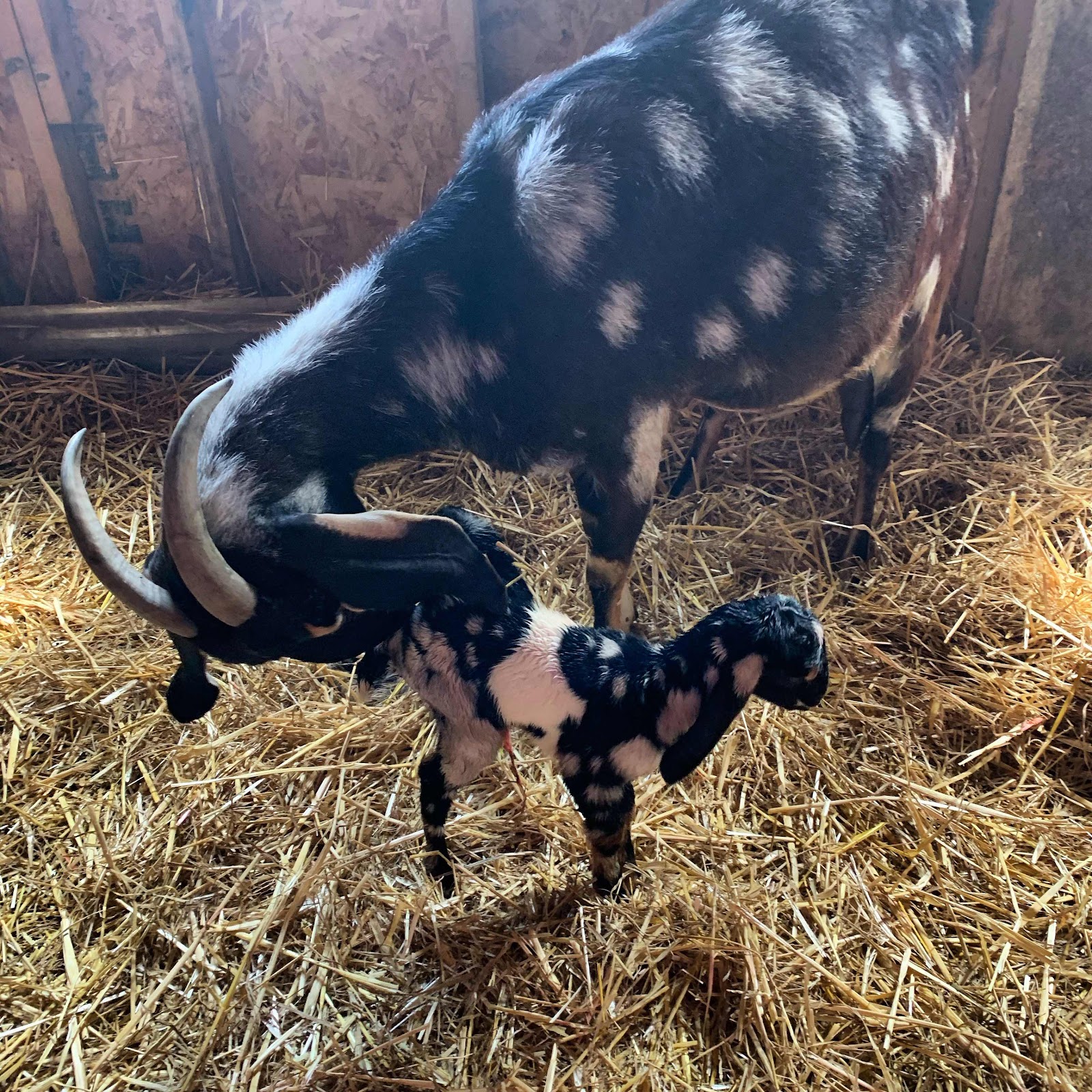
Now I’m terrified for poor Flopsy! She’s twice the size of Christmas. She must have, like, nine in there. 

Friday, June 8, 2018

Bloodsuckers (Parasite Problems)


Dairy goats are plagued by parasites. It's just a fact. Some areas of the country are worse than others, and in some areas resistance has become a problem; in other areas its less serious. But anyone who raises dairy goats will have to develop a parasite protocol and be on the lookout for signs of infestation.

I've had my troubles with parasites before - our wet weather and lack of hard freezes some winters contributes to the issue. We've had lungworms and stomach worms and coccidia. For the most part, these have been passing problems, and with vigilant treatment otherwise healthy goats shake off the effects and continue to thrive. I do know by now, however, what a wormy goat looks like.

-Diarrhea. Primary symptom. May be intermittent or constant.

- Skinny. Weight loss is the main symptom (after diarrhea) and it happens not just because the parasites leech energy from the host, but because if the host is losing enough blood they will become anemic and then the rumen doesn't get properly perfused, doesn't work correctly, and you get malabsorption syndrome. Then it doesn't matter how much quality food you are feeding, the goats can't benefit from it.

- anemia symptoms: lethargy, pale gums and conjunctiva

- lowered milk production, if they are in milk

- rough, coarse coat. I don't know why this happens.

In the middle of winter, when it's cold, and all the forage is gone and the goats are subsisting on just hay, and they are pregnant, it's fairly normal for them to lose a little weight. But they shouldn't get really thin. This past winter my goats kept losing weight no matter what I fed them. In fact, they were skinny as rail fences, and generally looked run down and wormy. They started pooping green glop, instead of nice clean pellets. I figured I had worms and dosed everyone with the standard medicine, Ivermectin.

When they didn't improve after some time, I repeated the ivermectin, and when they still didn't improve I thought I might have some resistant worms on my hands and switched to a different wormer that works by a totally different action.

Well they just kept losing weight. Spring came, they gave birth (Flopsy to quadruplets again) and the babies were all healthy, but the moms went downhill, trying to feed all those insatiable little monsters. I brought fecal samples to the vet and, maddeningly, they came out clean. Negative for everything. Repeat fecals came out clean as well.

I discussed the issue with my vet, on the phone, but all he suggested was increasing their ration of grain and buying some alfalfa hay. He seemed to think it was a feed issue, and indeed it certainly looked as though my poor goats were starving to death. He said "Parasites are not your problem," but I knew he was wrong. I know an anemic goat when I see one.

I don't know when the light dawned. Maybe it was when spring was far enough advanced that I started letting the goats out to graze in the front, and began spending a lot more time in close proximity with them than I did in the winter, when I would just go out for a few minutes twice a day for chores. I noticed that their coats weren't just rough, but that they actually had bald patches and that they were rubbing themselves along the fences. BINGO! A lightbulb went off in my head.

Not all parasites are internal. There are external parasites as well. Lice. Probably brought here by the buck I used to serve them last fall.

As the parent of three children who went to public school, I have had my fair share of experience with human head lice. As obnoxious and disgusting as they are, in people, lice are not dangerous. They do not carry and dangerous diseases, and being confined to a small percentage of our total surface area, they can't really suck enough blood to do us great harm. In goats, however, the case is different.

A serious lice infestation can act exactly as a serious internal parasite infestation - the insects can suck enough blood to cause serious anemia, and then all the sequelae are the same as that of a worm-induced anemia - malabsorption syndrome, weight loss, even death by starvation. My poor goats were being sucked dry by thousands of tiny vampires.

Luckily, the treatment is easy and cheap. It's actually the exact same medicine used in people - Permethrin - but at a higher concentration. You can buy it at the feed store under the name "Ultraboss," You dose the animals at 3mL/100lbs at a 5% concentration, laying down a line along their spines, just like applying flea medicine to dogs. As in people, it requires a minimum of two doses given two weeks apart, because Permethrin kills live lice but not eggs. Now my goats have received three treatments, and I may still have to give them a fourth. This was a very heavy infestation.

Almost immediately they began to improve. Their energy level went up quickly, and they began to gambol about and bounce like healthy goats do, instead of hobbling around arthritically. Milk production skyrocketed (another post will follow - I am drowning in milk). Their coats began to fill out and regain their gloss. Only the diarrhea is still hanging around. I think that probably the severe anemia actually did some damage to their rumens and it will simply take some time for them to heal and perform optimally again. That's just a supposition. If the diarrhea persists for another couple of weeks, I will have to bite the bullet and actually have the vet out to look at them.

But for now, I feel pretty proud of myself. Yes, it took me a while, but I diagnosed the problem despite poor veterinary advice, and was able to treat my ladies and help them get better. It makes me trust my eye and my instinct better than before. Little belittle, I am becoming a real farmer.

for more information about lice in goats:

http://www.ansc.purdue.edu/SP/MG/Documents/SLIDES/External%20Parasites.pdf


Tuesday, May 15, 2018

Summer in Oaxaca (Abbreviated Cheese)


This cheese season will be a short one: we are going to Mexico for most of the summer. Over the past three years we have been slowly, by fits and starts, building a house in Oaxaca. The house is finally getting close to “done,” by which I mean the part for which we are paying professionals is nearly done, and we are approaching the parts that we plan to do ourselves. 

The professionals (and it should be mentioned here that it pained my husband in the extreme to cede any part of the construction to professionals at all) have completed what in Mexico is called the “obra negra.” That means, more or less, that the floors, walls, ceilings, and roof are in, and the plumbing and wiring is basically finished. But there are no fixtures, no appliances, no lights or sinks or paint or flooring. Choosing and installing all of that, and choosing the furniture, is the “fun part.” We will be doing much of that work this July and August. 

It’s been two years since we were in Oaxaca, and I can’t wait to get back. The children are excited too. However, it is beginning to become clear to me that when we elected to raise our children bilingual, binational, and bicultural, it was not an unmixed blessing we were bestowing upon them. I only thought of the benefits of having two homelands; it never occurred to me that being at home and comfortable in two worlds came with the drawback of always being homesick for somewhere. 

When we are here, they miss Oaxaca, and their cousins, and the peculiar camaraderie and joie de vivre that life in Mexico affords. When they are in Oaxaca they miss their home, their rooms, their friends, and the American brand of privacy that does not exist in Mexico. I never thought about the fact that being a citizen of two countries means you are always pining for one or the other. 

Meanwhile, here on the farm, cheese season has begun. I was lucky to sell all the goats I intended to sell this year - not just this year’s babies but also those from last year that I deemed unsuitable as breeding stock - which was all of them. I think this is the best year I have ever had for selling goats. I sold ten, altogether - seven babies and three adults - for a combined total of fifteen hundred dollars. That is, coincidentally, the exact amount I need as farm income, once every third year at least, to keep my favorable tax status as a working farm. 

All of this year’s babies have now been collected, which means that I have three mammas to milk every day. And that means about three gallons of milk a day - a little less. And THAT means I need to be making cheese at least three times a weeks so far, I have made three batches of delicious chĆØvre, two cheddars, and a couple of queso frescos. My brother in law hooked me up with a woman who owns a fishing boat and sells Alaskan salmon - I am planning to meet with her and trade cheese for salmon sometime this week. 

And now I have to go, because it is time to milk, yet again.