"United we bargain, divided we beg."
Showing posts with label trade. Show all posts

Thursday, October 7, 2021

Farmer’s Swap Meet (Fall Harvest)


A neighbor of ours, a friend who started out as one of Homero’s clients, started a farm a few years ago. She raises medicinal plants of all sorts and makes them into tinctures, salves, ointments, and decoctions. She started just two or three years ago with a weedy patch of ground and now has a lovely three acre medicinal plant garden. 


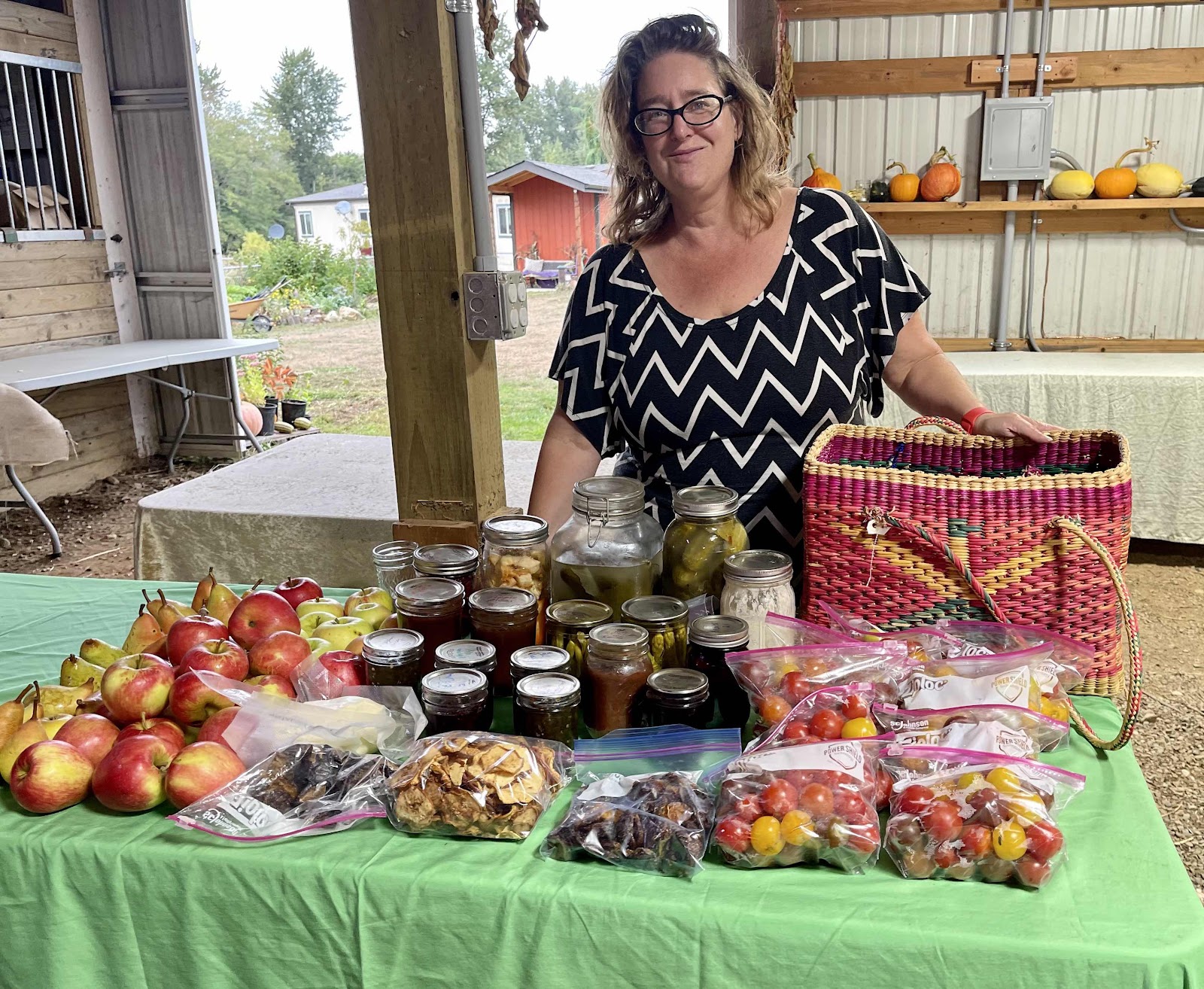
Last month, she decided to throw a swap meet for all her local friends - mostly farmers but also bakers, artists, musicians, and people with skills of various sorts. I was super excited to be invited - a decade ago I did the same thing, hoping to make it an annual event, but alas there was only one September Swap Meet and Jamboree on our farm. 


Deciding what to bring was half the fun. I didn’t know what might be available to trade for, so I didn’t worry about that and just brought a little of everything, hoping to hold my own and put on a pretty spread on front of my farming peers. 

We had lots of fruit from our trees - Italian plums, pears, and apples - both fresh and dehydrated. And just the day before Gleaner’s pantry hosted a farm glean for organic cherry tomatoes, so I had a ridiculous number of gorgeous cherry tomatoes in various colors. I also brought a selection of ferments - some caraway kraut, some kohlrabi kimchi, and some sourdough starter. 

I rounded out my section with a bunch of canned goods from the pantry. Admittedly, some of it was weird stuff from years last that didn’t get eaten, like my “spicy mixed stone fruit chutney” and some apple-plum butter. But I also brought a whole bunch of freshly made blackberry jam and pickled asparagus and dilly beans. Oh, and a two pound wheel of cheese. 

There was also a potluck, which was delicious. I brought lentil soup with bacon from our pig, and a big sourdough bread made with the same starter I had brought to swap with. 

We came home with a lot of stuff. Two or three different salves and some lip balms; tomatillos; raspberries; eggs; a carved wooden kitchen spoon, a fancy bottle shaped like a skull (which I think started out filled with tequila); a load of firewood; and a dehydrator. 

It was a great day. I got to meet lots of my neighbors and fellow farmers. Most of them were considerably younger than me, but it’s nice to be slowly morphing into a kind of elder in the community. I got to show off a little bit - my table was definitely one of the more diverse and well-frequented. And Homero and I got to wander through the beautiful garden eating raspberries and holding hands. 


Friday, August 7, 2020

Miracle Milk (Goats are Great)


A neighbor of mine, S., recently had her first grandchild. Her daughter gave birth to a beautiful little boy. Although everything seemed fine at first, the baby wasn’t growing well. He had nearly constant colic, and wasn’t gaining weight the way the doctor wanted to see, even though he was nursing well. After trying several other things, the doctor suggested it might be something in mom’s diet, and suggested going off dairy entirely. 

Well, my neighbor owns a dairy. They are an old fashioned family-owned dairy, the likes of which have nearly disappeared. They own a hundred or so Holsteins, which are milked twice a day, and the dairy truck comes by daily to take away the milk. The family simply siphons off fresh unpasteurized milk from their refrigerated tank for their own use. “Going off dairy” was a serious proposition for someone raised on a dairy farm and used to fresh raw milk with every meal. Mom tried, but couldn’t give up milk for her coffee. The baby didn’t materially improve, and mom decided as a last ditch effort, she would seek out goat’s milk for her coffee and see if that made a difference. 

An aside - people who have trouble with milk and milk products might have any one of a number of different things going on. The most common is lactose intolerance. That is an inability to digest lactose (milk sugar) because of deficiency of the enzyme needed to break it apart. That enzyme is called lactase. All infant mammals produce it, but all non-human mammals, and many human mammals, cease to produce it after the age of weaning. If you don’t produce lactase, you will not be able to digest any milk, from whatever source. 

However, other people produce plenty of lactase but are intolerant to the protein in cow’s milk. They might be truly allergic to that protein, or they might just have an “intolerance,” meaning it causes them indigestion. If the milk PROTEIN is the problem, as opposed to the milk SUGAR, then one might very well be able to tolerate goat’s milk but not cow’s milk. The protein molecule of cow’s milk is about 100 times larger than that of human milk; the goat’s milk protein molecule much more closely resembles that of human milk. 

Back to the main story - my neighbor approached me and asked if I would be interested in trading goats milk for cows milk, just to see if it made a difference to her grandbaby. Of course I said yes. Two weeks later, my neighbor called me and said that the goat’s milk was a miracle, that she had been skeptical that anything in mom’s diet was the issue but she couldn’t argue with the results. Baby’s colic had nearly disappeared and he had gained significant weight. When I went to her house to trade more milk, she gave me a huge hug. 

In the course of my job (medical interpreter) I spend a lot of time just chatting with people while we sit in tiny exam rooms waiting for the doctor to arrive. One of the ways I pass the time is talking about my farm. Many of my clients grew up in very rural situations and this gives them a chance to reminisce and often we connect talking about caring for animals, kitchen wisdom and lore. 

No fewer than three people - all of them very elderly now - have told me that they were raised on goat’s milk from early infancy. One old gentleman told me how he was adopted when his mother died in childbirth and that he was fed goat milk from the first day of his life. When he told me the story he said “a nanny goat was my mother.” The other two were not quite so effusive, but they both told me that formula just wasn’t a thing that was available in the tiny ranchitos where they lived, and if there wasn’t a wet nurse available, then goat’s milk was considered the next best thing for newborns. 

In our area, there are a lot of immigrants from Russia and Ukraine. Some of them that are friends of ours have also expressed an almost magical belief in the power of raw goat’s milk to promote health and vigor. One Ukrainian friend of my mom’s drove up from Seattle - 100 miles - every week to get goat’s milk for his small daughter. 

Personally I have no strong feelings one way or the other about goat’s vs cow’s milk, not even about pasteurized vs raw milk (though I do think people ought to be allowed to buy and sell raw milk). I like goat’s milk. I LOVE goat cheese. If there is any magic in it, I tend to think it derives not from an inherent quality of the milk, but from the fact that it is a product of our own homestead. 

This place, this earth, grew the grass that nourished the goats. My hands cared for them and doctored them, birthed them and milked them. My eyes delighted in their grace and cavorting. My mind learned to use the milk to make cheese. My spirit birthed the longing to create this place and called all of it into being. Together my family made a home here that supports the goats, and they in turn support us. We have a beautiful circle going on here. 

The circle is the magic.


Sunday, June 10, 2018

Long Live Hippies (Trade Network ‘18) S


We are currently getting about three gallons of milk a day from my two best dairy goats, Polly and Christmas. I have been making cheese two or three times a week, but the milk piles up even so. This morning, there were seven half-gallon jars full of milk in the fridge, as well as a few pounds of chèvre and several vacuum sealed packages of hard cheese. There are also eight or so pints of canned cajeta in the pantry. 

As I have written before, we will be spending most of this summer in Oaxaca, so any and all cheesemaking activity needs to take place before we leave. Obviously, we want to maximize the benefit of this shortened milk season. To that end, Homero and I have both been seeking out possible trade partners. 

A few miles from here, between our farm and the shore of the Salish sea, there is a bona-fide commune. It’s a beautiful piece of property inhabited by five or six families of hippies who live in school-buses, RVs, and trailers of various sorts. Somehow, several years ago, Homero became the de-facto hippie commune schoolbus mechanic for the entire colony. He has been quietly and cheaply keeping their vehicles running for years now. This year, the relationship has paid off in a new trade partner. 

Today, a couple of nice young white people with dreadlocks appeared on our porch with a big bowl of strawberries, a bag of lovely lettuces, and a bunch of radishes. In exchange we handed over a gallon and a half of fresh milk and a pound or so of chèvre. After chatting for a few minutes about cheesemaking, I also loaned them a book of cheese recipes and a teaspoon of mesophilic starter. They were delighted, and promised future zucchini, basil, and raspberries in exchange for more cheese. We even talked about them possibly coming to milk while we are gone and thereby keep at least one of our does lactating. 

Forging relationships with my neighbors always makes me happy. I do love striving for self-sufficiency, which is one of my long-term goals,  but to me, that term does not and never has meant providing all our family’s needs alone. No man, and no homestead, is an island. True self-sufficiency has always meant cultivating mutually beneficial relationships and creating networks of mutual support with neighbors. Sharing resources, whether those resources be material goods like tools, canning jars, and pasture, or whether they be knowledge and experience, books and knowhow. True wealth lies not in hoarding stuff but in creating and maintaining friendships. 

Friends are the real wealth. 


Wednesday, August 17, 2016

Plum Conundrum and Pear Perplexity


In recent days, as I took Haku outside in the evenings to run around in the orchard,  I've noticed that a couple of trees in the orchard are so heavily laden with fruit that the branches are actually sitting on the ground.  Specifically, the Italian plum and one of the pear trees - the Comice - were so bowed down that I made a mental note to get out and pick some fruit as soon as possible.

Then a couple of days went by. This morning Homero told me that the plum tree had broken nearly in half.

I said "No, the big branch is just sitting on the ground, that's all."

He said "Go take a look."

The biggest branch was indeed broken. It must have happened just that day, because the leaves were still bright green and crisp. I ran for a bucket and with Homero's help, stripped off five gallons of plums from just that one broken branch in five minutes flat. We didn't even get all the plums from that branch - many of them fell on the ground and we didn't even bother to pick them up.

The plums are not quite ripe, but it doesn't matter, because I looked it up and plums ripen beautifully off the tree. In two or three days I will have a bushel (more or less) of ripe plums, not even counting those still on the tree. The still-on-the-tree plums account for at least four fifths of the total. I tried to think of something to do with five gallons of plums. Drying comes to mind, of course, but really - who likes prunes that much? And I am not much of a jam-master. If I'm going to attempt to make jam I will make blackberry jam, which we all like, rather than risking going to all the work of canning jam only to find out that nobody enjoys the end product.

That left wine.

I don't have much experience with making alcohol. Sure; a side effect of fresh cider is tepache (naturally fermented fresh juice) - and I have occasionally expanded upon wild fermentation and ventured into the alchemy of hard cider - with mixed results. But I have never set out deliberately to create "wine" which seems for some reason very serious and highbrow, even when made from an accidental glut of plums instead of fancy pedigreed grapes.

Today I went to our local home-brew store and told them what I was up to and ended up spending something over $50 in tubing, plastic airlocks, yeast, and specialized equipment. Chances are better than even that I will not produce anything drinkable by any but a late-stage alcoholic, but I'm going to try.


The pears are a whole 'nother story.

For one thing, they mostly will not ripen on the tree and demand careful and specific post-harvest handling in order to reach peak perfection. For another thing, the time period between "peak perfection" and "post-perfection" is about fifteen minutes.

Also - The pears arrive in tsunami-sized waves. So when I try to think of something to do with the pears, I am thinking about seventy-five or eighty pears at a time, not six or eight, which would be the perfect number to make into a pie.

With that in mind, I went and bought a dozen wide-mouth quart sized canning jars. I figure I can make a few gallons of pear-sauce; hopefully mixed with blackberry if I can coerce my children into picking a few pints.

I may also try Car-dehydrating. The weather has been unrelentingly hot. It's supposed to hit 90 degrees tomorrow and stay there through the weekend. I have read that in this kind of heat, you can lay our thin slices of fruit on foil-covered trays and put them in your car. The temperature inside will reach 150-175 quite quickly. Basically, if it would kill your dog, it will dehydrate your pears.

But by far the best option is to trade some of my fruit for something else that I want more. I put out the word today over social media and within minutes had received offers to trade plums for locally caught trout; for freshly harvested green beans;  and for assorted canning jars. That's neighborliness at its best.

Sunday, March 6, 2016

What's Growing in my Kitchen (the Fermentation Files)?

There's a new bookstore in town, and when I went in to check it out, I found this irresistible book:


Much more than a recipe book - in fact, I don't think there any actual "recipes" in it at all - this book is a wonderful compendium of stories, anecdotes, instructions, and musings on all types of fermentation. Parts of it are scholarly and full of references to the newest scientific research on gut biota, and parts of it are full of poetic or mystical ramblings. I am thoroughly enjoying it, and it has inspired me to start a whole bunch of new projects. 

I have been dabbling in fermentation for ages, of course. Longtime readers of this blog will remember some of my experiments with pickles, kim chee, hard cider, and sourdough. Even cheesemaking is one of the fermentation arts, although I had never thought of it that way before. 


I miss baking. We get so much free bread from the Gleaner's Pantry that there has been no actual need for me to bake. My wonderful sourdough starter died over the year we lived in Oaxaca. I parted it out to friends, but none of them kept it going. I have been without sourdough since. 

Inspired by the book, I put out a call over Facebook for sourdough and Kefir grains. Within hours, a couple of local farmer ladies had answered me. This sourdough was brought to my friend G. by her aunt in Alaska. The aunt claims that it is from a strain that has been kept alive since the 1890's. It seems that most people who have family starters all claim that they have been nurtured since pioneer days; who knows? It's possible. 

This particular sourdough did not seem very lively. It took me a week to nudge it back to life. For a little while I thought it was completely dead. I had fed it with wheat flour, warm water, and dribbles of honey without much result. A slow bubble here and there. Then I remembered that when you first start a sourdough you are supposed to use rye flour - so I ransacked the cupboard to see if I had any. I did! Three years old, but apparently still potent because after I added a half cup of it to the mason jar, it perked right up and started bubbling vigorously. Today I baked my first loaf of bread, and it is delicious! 


Kefir is a weird thing. Most people who buy it in liquid form at the store probably think it is some sort of yogurt, but it is not. You cannot use kefir to make more kefir, as you can with yogurt; you need
a Kefir SCOBY (symbiotic community of bacteria and yeast), and you need to keep the SCOBY alive by providing it with fresh milk every day or two. That milk will become kefir as the SCOBY digests it.

There are lots of SCOBYs, by the way - a vinegar "mother" is a SCOBY, as is kombucha. the Kefir SCOBY looks sort of like cauliflower. The photo above shows the one given to me by M., another nearby farmer lady. She tells me it came from a woman on Lummi Island, who says she brought it with her 30 years ago when she moved here from the east coast. And one of the really cool things about this Kefir SCOBY is that is adapted to goat's milk, having been grown only in goats milk for at least the last several years.

Although I like knowing the age and history of my ferments, it feels like a bit of added pressure to keep them alive. What if I kill the 1890 Skilly Dough? What if this ancient and unique kefir SCOBY dies an ignominious death in the back of my crowded refrigerator? Well, presumably there are lots of other kitchen witches like me keeping their own little SCOBYs alive. Long may they prosper!


Tuesday, May 5, 2015

Spring Swaps

Spring is a good season for trading. I have eggs, milk, and cheese, and am on the prowl for anything to make gardening easier, as I get stiffer and lazier every year. Here are a few recent trades that made me happy:


- A pound and a half of assorted cheese for a dozen big, vigorous raspberry canes. I am slowly turning my garden patch into a raspberry patch. 

- A couple pounds of assorted cheese for credit towards future pruning for my fruit trees. The orchard is growing - that part of it not mutilated by tent caterpillars, anyway - and will need to be pruned this coming fall/winter. This fellow is happy rot accept cheese all season long and keep track of what he owes. It's a bit of a gamble, since I haven't ever traded with him before and don't know for certain he won't just stop returning my calls as soon as I run out of cheese. However, I have so much cheese I can't possibly eat it all and so what am I really losing, here? I know I'm making somebody really happy, so that's a gamble I'm willing to take. 

- Disbudding baby goats for various sundries. Since I acquired my own iron and started disbudding my own baby goats, other nearby goat-folks have been asking me to help them. I can't charge for the service - that would be "impersonating a veterinarian" - but I am not averse to accepting a small gift in exchange for my time. First, of course, I give a long spiel about how I am NOT a vet; that disbudding is an inherently dangerous job; that there is always some risk, of infection or brain damage; and by the way, did I say I am NOT a vet?

After I am convinced that the owner is aware of and willing to assume the risks, I am happy to help. It only takes a minute and so far, I haven't injured or killed any goats. And as far as I know, none of them have grown scurs, either; I tell everybody that if they do, I will repeat the procedure, but nobody has complained yet of an incomplete disbudding. 

One lady traded me a few cuts of grass fed beef and two jars of home-canned venison for the job. Another, my friend M., traded me several pounds of shelled, organic pecans from her uncle's farm in Texas. I made curry with the venison and pecan pie with some of the pecans.

I have a long list of people waiting for cheese. I have suggested, in trade, such things as canning jars, vegetable starts, jams and jellies, or meat. People have offered me other things - some interesting, some not so much. I have no use, for example, for evergreen tree starts. But sewing lessons? Yes, I think I might just enjoy that. 

I love trading with my neighbors. 

Monday, April 27, 2015

Homero's New Toy (the Craigslist Chronicles)


A few weeks ago, Homero made a spectacular find on Craigslist - a Case loader for under a thousand dollars, more or less in running condition. He has wanted a tractor for ages - he has major tractor envy of our neighbor, who has a small, spanking new Kubota with a loader and a backhoe. But the truth is that five acres does not a tractor justify, not unless you have some sort of intensive revenue-positive business on your five acres that requires a tractor. An occasional need to move barn-litter or patch potholes in the gravel driveway does not count.

Our neighbor, by the way, also has five acres. When he bought his Kubota, complete with field mower and rototiller attachments, he spent week after week going over his land, converting it fairly quickly into dust, which blew away in the wind or ran down into the ditches with the rain. We shook our heads, but what can a neighbor do? What is a friendly warning about erosion, compared to the seductive smell of diesel exhaust? 

Homero sensibly sold me on the idea of buying the Case by explaining how he would make a few minor repairs and then sell it for triple the purchase price. Maybe that will happen. Who am I to say? What do I know about the value of small farm machinery? Not a whole lot.  Meanwhile, Homero has been enjoying playing with the loader.

My brother in law brought a load of chips recently, which had stayed in a pile in front of the barn for lack of a way to spread them. Done - a neat, four inch thick carpet is laid over the muddy area. The barn litter, which I had simply forked out through the window into the old pig yard has now been moved over to the compost area. And best of all - the old compost pile has been turned and turned and turned again. 


Some of the compost goes back five years. I guess it can fairly be called topsoil now. Grass had grown thick over the top of the oldest mound. I certainly wasn't going to try to turn it by hand, with my creaky shoulders and my obstreperous lumbar region. There it sat, a four foot high mound, fifteen feet across, inviolate, until today. 

Homero spent the last hour of daylight this afternoon practicing with the loader, going over and over the compost, turning it and turning it again. When he was done there was a pile of beautiful loose dirt - black as a devil's food cake; moist, crumbly, squeezable, and absolutely heady with the smell of freshly turned earth. I cannot doubt that it will work magic in the garden. Somebody's garden, anyway - I plan to offer it for sale on Craigslist. Turnabout's fair play. 


Wednesday, July 2, 2014

Let the Harvest Start (Ingenuity)

Today has been a food preservation frenzy, and it isn't over yet. In the morning, I took five pounds of assorted cheese, a small jar of cajeta,  and three dozen eggs out of the refrigerator and set out on my trading route.

I returned home two hours later with:

- a large bunch of Toscano kale


- a bunch of garlic scapes
- a baggie full of feathery dill
- a fistful of rainbow colored carrots
- a small head of cauliflower
- a bowl of ripe red raspberries
- a few pounds of beautiful yellow Rainier cherries
- three small fillets of freshly caught wild Sockeye salmon

and nine dollars in cash (for the eggs).


I am delighted with the results of this day's trade. To be perfectly frank, we are all getting a little sick of cheese over here. I mean, you can only eat so much cheese before it starts to have consequences. I keep making cheese because, well, the milk keeps flowing, and it's good practice. Tinkering around with my methodology has produced a much superior chèvre this year, for example.

But just as eggs pile up in April, so does cheese accumulate in June. And yogurt, and kefir, and cajeta. Last week I canned twelve cups of cajeta and yesterday I made another quart to take to a party.  My refrigerator has become more or less a solid wall of weird milk products. I am so glad to be able to turn some of them into produce, because as usual my garden is not thriving.

The afternoon has been taken up with processing the bounty. Half the kale was sautéed and stuffed into quesadillas for lunch. The garlic scapes went into the blender along with olive oil, parmesan, and lemon juice to make a pesto which I will freeze in ice cube trays. The cubes can be stored in a ziploc bag in the freezer and used whenever I want a quick and easy sauce for pasta or chicken.

I used the last of my chèvre, the dill, and some parsley and green onions from the Gleaner's Pantry  to make a delicious dip, with which we ate the cauliflower and carrots just now as an afternoon snack.
The cherries will be eaten out of hand. The raspberries went into a ziploc in the freezer, and will be used for smoothies, which is how I use up all the kefir I've been making.

The fish, which was caught in Alaska day before yesterday by a new trade partner who I'll call jelly-man (for his amazingly delicious pepper jelly), is now smoking gently over soaked hickory chips inside of my little Totem brand smoker. I marinated the fillets in a mixture of salt, sugar, paprika, cayenne, and rice vinegar, with a dash of soy and orange juice. They are small and thin, so I think they will smoke in just a few hours.

The smoker has been in the shed since last year, and being a lazy git, I had put it away without scrubbing it. When I took it apart to clean it, there were no wire racks inside. The drip tray and the chip basket were there, but no racks for placing the fish. I searched the shed, but couldn't find them anywhere. I thought I would have to put off smoking the fish until I acquired new racks, and I was annoyed because the fish were already marinated and I didn't know what to do with them instead.

Luckily, my husband is a pack rat who seldom throws anything away. In the shed there is a small, less than half-sized refrigerator which doesn't work. I don't know why he has kept it lo these last five years, but when I opened it up it had a steel rack inside it that looked just about the right size. Almost; I had to trot out to the shop and ask Homero to cut off an inch or so from one side, but when he had done that, the rack slipped neatly into the smoker.

As I sit here, the heavenly smell of smoking salmon is wafting in from the back porch. I can't wait.


Saturday, June 7, 2014

New Trade Route


The trade network has been pretty much dormant since I got back from Mexico. We made that one great trade last summer - a baby goat for four turkeys ( Turkey Trade )- but nothing the robust networks I had going on a few years ago ( On Trading and Canning, Making Trade Goods (Gratuitous Canning Advice), Recent Trades and a Good Idea).

Then a new trading avenue opened up; I was invited to join a Facebook group of local farmers looking to trade goods and services. So far, it has only resulted in two actual trades - my pork chops for fresh cow's milk, and then my empty canning jars and some fresh cheese for these lovely canned plums, above. Since I have more cheese than I know what to do with, I asked people on the list who might be interested in some of it - as a free gift, from one neighbor to another, NOT for sale, which would be illegal. It's not illegal, however, for you to give me some of your extra snap peas. Not in exchange, you see, but just because you have too many of them. Just as I have too much cheese. Ahem.

Seriously, the legality of trading is so nebulous and cobwebby I don't even want to look into it. I'm sure it's illegal, just like EVERYTHING ELSE I want to do. Especially trading milk products. That probably would get me five to ten in the state pen. Please don't tell.

Please. I'll give you cheese.

I've already written a post about the legality of trading and admitting myself to be a scofflaw and an unrepentant participant in the informal economy (State of the Trade Network 2010 (What's Your Perspective?), so I won't go into it again here. But I am still interested - what do you all think about trading? Do you do it? Do you report it to the IRS? Do you think it ought to be regulated?

Monday, September 30, 2013

Double Buck (the Craigslist Chronicles)


Sometimes it seems like I spend way too much time on Craigslist. I've toned it down since the early days, when I would spend hours scanning the farm and garden section looking for free chickens (you'd be surprised) or people who wanted to trade vegetable starts or raw alpaca fleece or something like that. I used craigslist to meet other local farmers, to set up useful bartering networks (New To Farm Life: Trade Network 2012 (Craigslist Chronicles)), and occasionally, to get rid of commodities I no longer wanted - this posting, in which I offer 25 pounds of free chicken livers, is a particular favorite of mine:

New To Farm Life: My Latest Craigslist Posting

One of my bad Craigslist habits is that I seldom remember to go back and delete a post after it has outlived it's usefulness. Usually this means nothing much beyond an annoyed e-mail once in a while, but this week, my laziness paid off. I forgot to delete the post looking for a buck to service my herd. We bought a buckling, (A Buckling Named Boob) so I wasn't in the market for a buck anymore. However, when a lady called me offering me a practically free purebred, papered, tested, and proven buck, well, I could hardly say no. Haboob, cute as he is, is still a tiny little baby and may not even be capable of mating this year. If he is, it won't be until January. I had resigned myself to not having any babies until early summer next year, and no cheese until sometime in July. When this handsome fellow popped up out of the blue, I jumped on him.

The lady, A., is simply getting out of Nubians. She is going to pure Nigerians (minis) and had no more use for Paxton. I guess she hadn't had much luck selling him at a decent price (the goat market fluctuates wildly; this is probably an off year) and decided finally she just wanted his stinky ass off the property before he went and impregnated the wrong does. She even offered to transport him, which is wonderful, because our van is broken down.

Paxton arrived on the farm at about six in the evening last friday, and fifteen seconds later, everybody was pregnant. The does must have been in heat - I can never tell - because Paxton took one look at them and did his Buckly duty before he even got all the way through the gate. So, doing the math, I ought to have a very busy week sometime in early March. Hooray!

We are keeping Haboob, of course. We will just wait and use him next year. For the rest of this breeding season, we can rent out Paxton, for cash or for trade in hay. Back to the barter section of Craigslist I go!

Tuesday, September 24, 2013

Butchering Season (the Breakdown)


Fall is butchering season. The grass is dying back and losing nutrition, and the meat animals are as fat as they are going to get. We've been keeping two goats alive, Polly's last kids, for quite a bit longer than we ever intended to. They are a year and a few months old, older than meat kids usually ever get.

The last time we bred the goats, I had such a hard time finding a buck that we eventually had to borrow my sister's buck. Blueberry is a beautiful animal, a terrific buck... but he's an Angora. That's a fiber goat. I have Nubians, dairy goats. So Polly's kids, all three of them, were half Angora, half Nubian. That's not a useful cross. They end up being no good for either fiber or milk, and not even really good meat goats, because they grow slowly and are small, like an Angora. They do have excellent flavor, but they take twice as long to grow a carcass only about two thirds as meaty. I only resorted to using Blueberry because I really needed the mama goat bred, so she would produce milk. I simply decided ahead of time that her offspring from that year would be meat animals.

Polly threw triplets, as a first freshener. That's good, she's a good goat. She's going to be an excellent milker, as well. She raised those triplet without losing any noticeable condition. Before we left for Oaxaca, we gave away the single buckling to a friend of ours who was similarly in need of a buck. We explained that any resulting kids would not be prime quality, but he simply wanted his does freshened, so it didn't matter to him. That buck is now living the life of Riley down in the skagit valley, lucky fellow. The two doelings stayed on the farm while we were gone. One of them was given to our neighbor, I forget exactly why. The other was traded to another neighbor for four turkeys, after we got back.

Then, neither neighbor wanted to come get their goats. Time passed, summer passed. It started to rain. We called the turkey trade neighbor several times, and he always said the same thing: "Yeah, I'll be up there this week." Our other neighbor said he'd take the goat as soon as he got a pen built. Meanwhile, they are eating the grass and mashing down fences. The rest of our goats are older nannies; they don't jump anymore. But these little doelings were jumpers. One morning they jumped the fence and ate up half of the neighbor's fruit tree. I began badgering my husband to do something, either to the fences or to the goats.

One day my neighbor's wife was out working in the garden and we had a conversation across the fence. I told her that we'd bring over the goat anytime, or we'd be happy to do the butchering ourselves and give her the meat, but that we needed the goat gone. She told me to nevermind about the meat, her husband shouldn't have fatty goat meat anyway, he had a triple bypass just a few months ago, and that she would take the blame. So we went ahead and butchered the goats.

Or, I should say, Homero did. He is still a pretty fledgling butcher, having only once done the job entirely by himself before. It took him far too long to skin the first animal - nearly an hour. By the time he was ready to start on the second goat, the other neighbor had answered our phone calls and shown up to help. He knew what he was doing, and so the second goat went much quicker than the first. We have learned the fastest way to dispatch the goats is with a .22 bullet to the back of the head (never the front - a goat has a thick shelf of bone over the forehead and a bullet between the eyes would ricochet and be dangerous) and then immediately cut the throat. The little guys hit the ground and are dead before they know it. Then we hang them by the tendons in their hocks from the swingset and gut them into a kiddie pool that we keep around for that purpose. The kids are far too big for kiddie pools anymore.

When the goats were broken down into about eight pieces - shoulder and foreleg, haunch and back leg, ribs and belly, neck and back - the men brought them inside and I did the rest of the butchering on the kitchen table. I'm getting better. It's easy to separate the shanks from the haunch, but much harder on the front end. I need to read up on that. I had to use a heavy cleaver to cut through the bone, and it made sharp splinters that had to be carefully washed out of the meat. I cut away the loin from the spine and cut it up for stew meat. I cut the belly meat (the flank) from the ribs and packaged it separately. That will probably be marinated, pounded, and grilled as steaks. The ribs are not very meaty on these goats and probably it would take all of them to make a meal for the family, big as our family is these days. The biggest, meatiest part is of course the haunch, or the upper part of the hind leg. Each of those will make a big, fat roast.

The chart at the top of this page shows the cuts as they would be made by a professional butcher. Bully for the professional butcher - I really ought to study and practice a lot more. I wish I could make neat sections like that. But it's virtually impossible to learn how to do that from a book. You need - or at least, I need - someone to actually show me, someone to put my hand in the right place at the right angle and say "feel that?" In the absence of such hands-on mentoring, I do the best I can. I did okay, probably about as well as I did on the King salmons a few weeks ago (Fish Tale (Canning Salmon)).
Could somebody else do better? Sure. Did I do okay? Yup. I have a freezer full of neat packages wrapped in white paper and tucked into ziploc bags. As my mom always says, "good enough for government work."

I used all four shanks of our goat for the butchering day dinner. I seared them in a hot skillet and then braised them in a mixture of orange juice, chilpotle peppers, tomato, garlic, and cumin. They were very good, but they need to braise all day to reach that falling-off-the-bone consistency. I find that is the best way to cook goat. Again, according to the chart, there are fine chops and filets on a goat, but personally I haven't had much luck with cooking goat as though it were beef, fast and rare. Lamb works well that way, but not goat. Luckily, the falling-apart melt in your mouth meat was delicious, wrapped in fresh hot tortillas and dipped in the spicy sauce.

I am going to bring a package of the meat over to my neighbor, the one whose wife told me not to. Again, according to the chart, goat is actually very lean and has an excellent lipid profile.


Thursday, August 15, 2013

Turkey Trade


Over the years, we've benefitted greatly from trading goods and services with our neighbors (and also with the random people who read the barter section of Craigslist). The trade network has had its up times and down times, but in general, I feel confident in asserting that trade is a big boon to us. Probably as much food has come our way via the trade network as we actually produce ourselves here on the farm.

For the most part, I trade my animal products (cheese, eggs, meat) for other people's vegetable products, since I am a pretty poor gardener. I also offer up my husband's services as a mechanic (sometimes without his prior knowledge; I gotta quit doing that) in exchange for other professional services. That's how we got our roof fixed last year. I've been lucky enough to find and maintain a few long term trading partners - Veggie/Oil man and the Kale Fairy come to mind - but I lost those contacts over the year we were in Mexico.

Luckily, the trade network shows signs of revival. We're off to a good start I think. Talking to a friend at church, I mentioned that I needed to find some chickens, as I had given all mine away when we left last year. This led to a conversation and ultimately to a trade with her son-in-law. He got a bunch of old beekeeping equipment that we were certainly not going to use again, and we got nine healthy laying hens.

Some neighbors of ours wanted a goat for butchering. We have two young, plump goats that are just about ready to eat, and I offered to sell them one for $75 and let them do the work here at our place, since they don't have a suitable space for butchering. They countered with an offer of four turkeys for one goat. I've never raised turkeys before, but that seemed like a heck of a deal, so now we have turkeys. And nasty, obnoxious creatures they are, too. They look like dinosaurs, and charge at me whenever I go out to feed them. It's a bit frightening, having a twelve pound bird hurtle toward you at the speed of a velociraptor. Thanksgiving will be at our house this year.

Just today I set up a new trade, albeit a short-term one. I was buying pickling cucumbers at a vegetable stand downtown. I bought a lot of them because I'm selling them at $5 a quart and there seem to be a fair number of people who want to buy them. The proprietor and I got to talking, and he said if I brought down a few jars of pickles, he'd trade me fresh produce for them. I see tomatoes in my future.

Do you trade ? What do you like to trade? Does trade have a significant impact on your household budget? Below, find several links to stories about some of the more interesting trades I've made over the past few years.

Trade Network 2012 (Craigslist Chronicles)

On Trading and Canning

Mushroom Mistake (Win Some, Lose Some)

State of the Trade Network 2010 (What's Your Perspective?)

Friday, April 6, 2012

It Figures

Why is it that every time I get some good egg trades going, the hens mysteriously quit laying? Since my last post on Monday (Trade Network 2012 (Craigslist Chronicles)) I have collected a grand total of thirteen eggs. In the two days before that, I collected twenty-eight.


Maybe the hens put their pointy little heads together and decided to hold out on me for a bigger piece of the action. They all want massages, too. Maybe my chickens are organizing (did you ever see Chicken Run? I love that movie).

Maybe they are just laying their eggs in the blackberry bushes now that it's warmer out. Time to lock them up in the coop for a few days until they get the hang of things again.

Monday, April 2, 2012

Trade Network 2012 (Craigslist Chronicles)

Every year I have to start from scratch on the trade network, it seems. People move away, Like Veggie/Oil Man and the Kale Fairy did, or people stop producing anything I want, or people drop off the face of the earth, like the Baker Biker did - alas; I remember his marshmallows well!

So every year about this time, as the hens really start to crank out eggs, I have to place new Craigslist ads. I explain that we are all so stuffed full of eggs we can't walk, that I fear for my husband's cholesterol level, and we desperately need to offload some eggs. I talk about my happy hens, who are totally free-range on my five acres of pasture and I post pictures illustrating the difference between store-bought eggs and fresh farm eggs.

Farm egg on the left: bright orange, upright yolk and firm yellowish white. Store egg on the left: Pale, flabby yolk and thin, liquidy whites.

Not only do farm eggs taste better, I inform, but they have a healthier lipid profile and are crammed full of healthy Omega-6 fatty acids. I have not yet resorted to posting photos of industrial egg-producers with their battery cages and abused chickens. As my mom used to say, you catch more flies with honey.

In years past, I appealed specifically to gardeners by posting in the farm and garden section and using titles like "Eggs for Veggies!" This eventually works, but not usually until mid-May, when people have at least a little spinach to offer. This year I decided to post in the barter section and to leave it open as to what I was looking for. The title was simply "Eggs for....?"

In the body of the ad, I did list some things I wanted, like vegetable seeds or starts, baked goods, canning jars, etc. but also that I was open to hearing about anything people were interested in trading. After a couple of days, I got some intriguing replies. The first person to reply asked if I was interested in copies of The Rosetta Stone software (not really). Another fellow wrote saying he was a licensed massage therapist and could offer me a massage in the privacy of my own home on his folding table. Of course, this being Craigslist, alarm bells went off, but I decided to reply anyway. I said I'm not sure my husband would let me get a massage, but perhaps if he gave me the name and number of his office so I could verify...?

After verification, and asking permission from Homero (who said "as long as I can get a massage from a female therapist without you getting all weird"), I decided to go for it. When I spoke to the gentleman on the phone and gave him my name and address, he said "wait a minute! Are you the same Aimee I worked for a few years ago doing yard work in exchange for ham?"

Yes, indeed. Two years ago I was so broke and yet desperate for help that I posted an ad asking if anyone was willing to do some yard work in exchange for something I did have a lot of, which was grass-fed beef and homegrown pork products. "I realize this is unorthodox," I said, "but rest assured, although I don't have cash, I will HOOK YOU UP with the best quality local meat you have ever tasted. Also, I'll provide tools, transportation, and a nice lunch."

I actually got quite a few replies. This guy, who I'll call R., worked a couple of days for me cleaning out a whole buttload of blackberries and other assorted weeds in exchange for probably $150 dollars worth of beef and pork, plus a little money to cover his gas. He was a great worker, told me he lived pretty far out in the county, and was going back to school to get a medical assistant's certification, and doing whatever he could to support his large family in the meantime. I lost his number, or I most likely would have called him again a few times.

Having previous experience with R. and being fairly sure he wasn't a skeezy pervert made me much more relaxed. He came over yesterday and I enjoyed my massage very much. I told him I'd keep his entire family of nine in eggs for two weeks, which will probably end up being six dozen eggs. A steal.

Other trades in the works, though not yet finalized are a man who has a whole bunch of veggie starts and wants two dozen eggs a week; and a lady who is charging me two dozen eggs for four dozen bearded Iris bulbs, dug and ready to plant. I absolutely adore Irises.

Now I just need to keep my hens happy and well fed so they keep pumping out enough eggs to fuel my bartering schemes.


Saturday, October 15, 2011

The Great Hen Giveaway (It's Not His Fault)

It's not hard to tell roosters from hens, not when they are full grown. Here; I'll show you.
This is a hen. Hens are female. They lay eggs.

This, on the other hand, is a rooster. The rooster is easily recognized by his many colors, his long feathers and his large red crest.

We had too many roosters - eight, which is six more than we needed. I advertised six free roosters on Craigslist. A man called, and I told him to come pick them up after dark, when they would be easy to catch. As it turned out, I was at the grocery store when he showed up, so my husband caught the roosters and gave them to the man.

Can you guess where this is going?

This morning, I counted the roosters we had left. Four. That means that my husband gave away three roosters and three hens. We still have too many roosters, and now we have three fewer healthy young hens.

True - it was dark. That's true. I'm just going to keep repeating that to myself. And ask the next Craigslist guy to call me personally before he shows up.

Monday, October 3, 2011

Cider, Revisited


As I wrote in my last post, our neighbors J. and L., our pastors and friends, are leaving town. In exchange for Homero fixing up their car, they are giving us all of J.'s homebrewing equipment - and a couple of lessons. On saturday, I went over to their house with a few gallons of freshly pressed apple cider to get my first lesson.

Wow, J. has a lot of stuff! He's a fairly serious homebrewer - meaning, I guess, that he brews several times a year and consistently turns out a yummy product. The pile of equipment he is giving us was enough to almost cover their kitchen floor. Three carboys of varying sizes; yards and yards of various types of tubing; airlocks, small buckets, mesh bags, filters and funnels of all descriptions. Large stainless steel kettles. A stainless steel chiller - which is a really cool item that enables to cool down five gallons of boiling mash to room temperature in short order. A stand-up bottlecapper. Bags of bottlecaps. And several boxes of bottles.

the bottle-capper

the chiller


When I arrived, J. had a batch of dandelion wine in the smallest carboy that was ready to bottle. So we did that first, and I learned how to sterilize bottles and tubes, siphon the liquid off the top of the carboy into the bottles and how to use the bottlecapper. We sampled the wine, of course, and it gave the rest of the proceedings a certain golden, summery glow - which I believe is the whole point of dandelion wine.

Some of the equipment...

J. has not actually tried making cider before, probably because he doesn't have a cider press. Believe me, when you have ten or fifteen gallons of fresh cider on hand, turning it into a storable product - a storable alcoholic product - floats to the top of one's mind. Winemaking, let us not forget, is one of the preservation arts, no less than smoking or drying. Originally, in fact, winemaking was most likely a semi-accidental by-product of preserving fruit. The pleasant effects of alcohol were probably a felicitous side-effect, one that was only afterwards studied, harnessed, and turned into an art in its own right.

God bless the internet - in under five minutes, we had located a simple recipe for hard apple cider. We added two cups of sugar per gallon of fresh cider and brought it to a temperature just short of boiling. Then we let it cool to blood temperature, more or less (we didn't use the chiller, because it needs to be well-washed and sterilized), and poured it into the carboy. At this point, before you add the yeast, you want to aerate the product, so we shook it up real good.

Then J. put in the yeast - a champagne yeast which I bought at the Four Corners brewing supply in bellingham, and capped the carboy with an airlock. Today, not quite 48 hours later, he called me to let me know that the cider is bubbling away. In a week or so, we will decant it into another carboy for the secondary fermentation, and a week after that I will bottle it. Probably by myself, since I think J. and L. will be gone by then.

I hope this batch comes out better than my single past batch, which was wholly undrinkable. I'm very much looking forward to adding brewing to my small but growing repertoire of traditional skills. I can think of no other ability that has the ability to add so much cheer to a long dark winter.

I read in the paper today that there is a new La Nina system forming in the pacific, meaning another wetter and colder than usual winter around here. Here's hoping that we will have plenty of hard cider to keep our spirits up!

Wednesday, September 28, 2011

Good News, Bad News

I'm sad, because my pastor is moving across the country to be some other church's pastor. Pastor L. and her husband J. are friends as well as spiritual leaders, and we will miss them greatly. I can't even say much more about it, because I don't feel like crying at 11:00 in the morning.


They will be driving across the country, and came to Homero to check out their car and make sure it is fit for a long journey. Homero looked, and found several important things that needed to be fixed. He told them to get the parts and there would be no charge for the labor. Of course they protested, and we protested, and they said "we can't possibly..." and we said "we can't possibly..." and we were at an impasse.

Then J. called the next day and said, "you know, we are selling off most of our stuff, anything that won't fit in the car. Would you be interested in accepting our brewing equipment as payment for the mechanic work?" J., you see, is an enthusiastic and talented homebrewer. We have sampled his product a few times and can attest to it's deliciousness. He and Homero have talked several times about getting together to do a few batches, but it just hadn't happened.

I have had a little run-in with homebrewing of my own (Cider Season) and it was a miserable failure. I've always wanted to give it another go, but making cider is such hard work - picking the apples, hauling the press out of the garage, washing the apples, getting stung by bees, cleaning everything up afterwards - that I just haven't wanted to risk turning the hard-earned delicious fresh cider into disgusting undrinkable sludge. Again.

HOWEVER! If we are to have our very own brewing equipment, and a few lessons from a master before they (sniff) go away, then I am willing to take the plunge. Delighted, in fact.
Only problem - I still don't have any APPLES.

Gotta work on that.

Tuesday, September 20, 2011

Second Annual September Swap Meet and Cider Press

Last year's September Swap Meet was a flop - but partly that was because I broke three vertebrae three days before the event and couldn't do much of anything. Also, I couldn't quite decide if I wanted a family and friends event or a public event, and so it ended up being not quite either.


I was envisioning a campout and full-moon fest, with music and a bonfire, and so I did an awful lot of cleanup around the property, which was a lot of work (Swap Meet Preparations (Where Does It All Come From?)). Then the event itself was pretty anti-climactic.

One of the people who did come, however, was N., proprietor of the wonderful Custer Country Store (Custer General Store (You Might be a Redneck if....)). As September rolled around this year, she asked me if I would be throwing another swap meet. I hemmed and hawed. As much as I love the idea of getting an annual event rolling, I just couldn't face the amount of cleanup that would be needed.

Yes, things have gotten worse over the past year. It's pretty bad around here. Bad enough that we'll need to hire a few strong young men to help us with dump runs before we can have the public over. "Sorry," I said, "I'd love to, but..."

"You can have it here!" she said.

"REALLY?"

"Sure!"

N. is a wonderfully community minded lady - she has all kinds of cool events at her store, from sidewalk movies on summer weekend nights to organizing the August Custer Daze. She is very into trade and promoting community networking, so I guess this was a natural fit for her. Of course I took her up on it immediately.

So - this saturday, the 24th, there will be the Second Annual September Swap Meet and Cider Press at Custer Store. We still have room on the sidewalk for a few more tables; if any of you locals would like to have some space, just leave me a message here with your e-mail and I'll be in touch ASAP.

You don't need a table's worth of stuff. If you have a basket of plums off your plum tree, or some home canned ketchup, or a backpack full of extra tools from your garage, or a box full of children's books.... come on by! Most especially if you have apples, please bring them! I will be running the press all day long, and taking a share of cider for myself as press-rental. Oh and there will be a service board for swapping skills and services (i.e., "massage therapist needs oil changes.... plumber looking to swap services with electrician.... housecleaning for babysitting...." etc)

ONE RULE: if you bring it, you are responsible for it!!!! NO LEAVING STUFF at the end of the day! Or N. will never let me have the swap meet at her store again, and that would suck.

Let's hope the weather holds!

Thursday, September 15, 2011

Double Piglet!


We acquired two new piglets yesterday. Here they are: two handsome girls, a cross between a Large Black Hog boar and a Tamworth Sow. These girls are quite a bit bigger than the last piglet we raised was when we got him - they are eleven weeks old and have been weaned for several weeks now. The farmer said he likes to leave them get a bit bigger before they head off into the cruel world. It's nice for us, as well- a few weeks less feeding.


It's been quite a while since we had a pig. The last one one has been all eaten up for months, except for a couple of smoked hocks. We thought about getting one in the spring, but when I searched for some, they were all so expensive! The price of weaner pigs has gone up about 60% since our first pig, in 2008. We paid $75 for him (well, actually the first one was a trade - Holy Pork Chops, Batman! (the Backstory on Pigs)), and then the next year they were all $85 or $90. This year, I couldn't find any weaners for under $125.

We might still have sprung for one, except that I learned recently that one pig alone really suffers for companionship, even if housed with other hoofed animals. Pigs are extremely social animals, and a pig farmer my sister knows suggested that my pigs have been so obnoxious, loud, and bitey because they were lonely. Therefore I decided I wouldn't raise just one pig again - and we couldn't afford two. The economics of raising pigs is pretty marginal - you can't raise pork cheaper than you can buy it at the store, but the homegrown variety is so much better, on so many levels. Since we finished off our last pig, we just haven't been eating pork, since I can't bring myself to buy commercial pork and thereby contribute to a number of heinous evils (sorry! No lecture, I promise! Just - Hog CAFOS = environmental disaster + animal abuse + worker abuse and injustice).

Then, day before yesterday, I saw that a neighbor of mine, a guy I know and have traded with before, was selling off a litter of piglets at a discount, to pay off some bills and make room for new litters coming up soon. Instead of $125, he was letting them go at $80 apiece. I took the idea to Homero and he said to go for it. So, a quick repair of the pigpen and off we went! Our neighbor has a great set up, large roomy stalls and big outdoor exercise areas. The piglets were in one stall, and the grown breeding pigs in the next one - enormous animals, somewhere between six and seven hundred pounds. They looked pretty scary to me, but the farmer walked right in and scratched them and petted them.

I hope these little girls inherited the gentle temperament.


Sunday, September 11, 2011

The Fermentation Files (Daikon Kim chee and Grape Leaves)


There is a reason I haven't been posting much lately, but I don't care to go into it. Suffice it to say that I have a frustrating, time consuming, but in no way life-and-death situation which is sucking up a lot of my brainpower. Hopefully, this situation will resolve itself one way or the other soon, and life can get back to normal.

In the meantime, Preserving Season waits for no woman. The Great Trade I was going on about last week (Mother of All Trades (?) and Trade Network Update) has morphed into the Pretty Good Trade, but I'm happy about it. Basically, it's a crate of produce, and I get to fill it however I want. That crate isn't here yet, but there is still lots of vegetables coming in the door.

My sister passed me a bag full of daikon radishes and turnips. I like both of those sliced thinly and drizzled with lemon juice and salt, but not in those quantities. So I made kimchee. I have made kimchee a couple of times before, but only cabbage kimchee (detailed instruction can be found here:Kim Chee Situation (Food Storage Update)). Luckily, I save all my old Saveur magazines and I found the one with an enormous section all about kim chee. Basically, daikon kim chee is made the same way as cabbage kim chee, but with sugar added.

My other bonanza of the week was grape leaves. I love grape leaves, both for making dolmas and other wrapped foods (try wrapping fish in them), and also for their high tannin content. Adding grape leaves to kosher pickles will keep them crisp.

My daughter Rowan is babysitting this week for a friend who just so happens to have one of the most amazing small-homesteader type properties in the city of Bellingham, which is saying a lot. She is only renting the property, but whoever originally laid out the half acre did a fantastic job. There are some seven fruit trees - apples, plums, and cherries - sixteen blueberry bushes, a long row of raspberry canes, a truly impressive enormous asparagus bed, four 4x16 foot raised beds for annuals, and two gigantic grapevines.

These are the best grapevines I've seen in a home garden in this area, ever. Not sure of the varieties (alas) but both of them are covered in bunches of large grapes, which are just beginning to turn color and to soften. And did I mention they are huge? Each of them covers an arbor about twenty feet long by twelve or sixteen feet wide. And one of them has grown up into a large maple tree to a quite surprising height. Right away I asked if I could pick some leaves.

"My grapevines are your grapevines," said the gracious friend. So I filled a shopping bag. I decided to pickle them for use further on in the year. You CAN lacto-ferment grape leaves, but I decided to play it safe and vinegar pickle them. Here's how I did it:

Use a sharp knife or scissors to trim the grape leaves of their stems. Set aside leaves that are too small or ripped. You can use these in making fermented pickles, or feed them to your rabbits, if you have any. We do, and they loved them. This is a rather tedious task when you have a shopping bag full of leaves. The glass of wine you see in the middle helped out with that. Stack the leaves to be pickled with their stem-ends together.


Boil up your jars in a big kettle. When jars are sterilized, remove them to a clean towel. Take small stacks of grape leaves - about six or seven - and use tongs to dip them in the boiling water. Hold for about twenty seconds. They will wilt and turn brighter green.


Drain the leaves by holding them up and shaking them slightly. Roll the stack into a cigar shaped bundle and tuck into your sterilized quart jar (you may have to tuck one end under to make them fit). Each jar will fit about five of these bundles. Fill the jars with a basic brine (1/4 cup salt and 1 cup white vinegar to a half gallon of water), leaving 1/4 inch headroom. Add several twists of lemon peel, if desired. Place on sterilized lids and process in a water bath for fifteen minutes.

These make one of the prettier preserves. If I were making them for gifts I would use the quilted pint-sized jelly jars, the ones that always end up as water glasses in our house.