"United we bargain, divided we beg."
Showing posts with label finance. Show all posts

Wednesday, April 29, 2020

DQ43 (???) Meat Math 2020


One day blends into another. I can’t believe it’s been over 40 days of quarantine. Insanity. Anyhoo. 

Tomorrow is Paloma’s birthday. She’s turning 15 and it was supposed to be her big fancy quinceañera party but of course that isn’t happening. She is having ONE friend over and we are eating cheeseburgers and carrot cake (her request) out on the lawn where we can socially distance. 

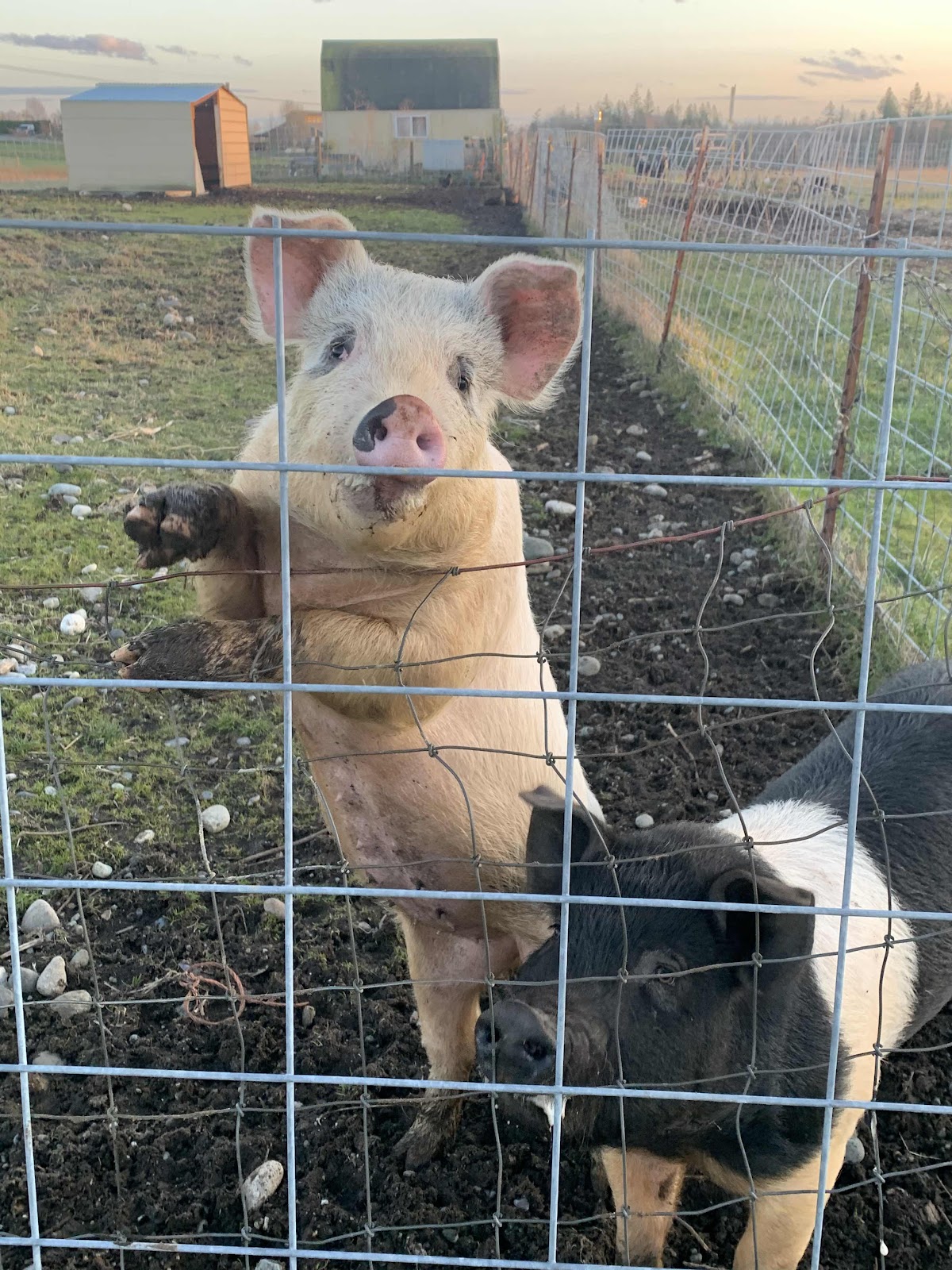
The pigs are meeting their maker tomorrow at 9 am. Since these pigs started out as Paloma’s FFA project, she gets a share of the profit. The catch is, she has to actually figure out the profit (if any) from the following facts:

- two piglets cost $100 each
- we bought 10 bags of pig food at $15 each (give or take)
- we are selling the bigger pig, in halves, and keeping the smaller pig for ourselves. The sale price is $3.50/lb hanging weight. We won’t actually know the exact hanging weight for a few days, but I guess the big pig will weigh in at about 200 lbs. 
- for one of the halves of the big pig, we are accepting in trade a butchered lamb worth $200. The value of the side over and above $200 will be paid in cash. 
- the other half of the big pig will be paid in cash. 
- we are not attempting to place a value on our labor (that’s a fool’s game). 

A little quick estimating tells me two things: a) this particular pork venture was more financially successful than past ventures have been. I feel that we came out ahead this time, very handsomely ahead. And b) Paloma is going to be disappointed in her share. 

I haven’t decided what value to let her put on the pig we are keeping - should it be the same $3.50/lb, even though we are not actually getting any money for it? Or should it be the cost of the same amount of pork if we bought it at the grocery store, even though we never actually would buy that much pork? Or should it be zero, because it just counts as free meat for us? What would an actual bookkeeper say? Any actual bookkeepers out there? 

Paloma wants to know. 

Sunday, November 17, 2019

Paloma’s Pigs


Some years we raise a couple of pigs, and some years we don’t. The decision whether or not to get a pig in any given year is based on a number of factors - how much meat we have in the freezer, the price of local weaner piglets, whether or not our neighbors are raising pigs this year, etc. 

In general, I have more or less decided that it is as cheap to buy pork from our neighbors as it is to raise a pig of our own, and much less work. However I can be swayed. This year we were swayed by our youngest daughter’s need for an FFA project coinciding with the availability of some handsome well-grown weaners raised by a close neighbor and offered at an excellent price. 

Paloma, our youngest, swore up and down to us that she would be in charge of feeding the pigs. Of course, she doesn’t know what that actually entails. We get much of our pig food from the Gleaner’s Pantry, and she can’t participate in that. The truth is that I will be doing most of the sourcing of food for the piggies, and Paloma will only be in charge of doing her pig-related homework. 

The question she posed and will be trying to answer is “is it financially advantageous to raise your own pigs?” For those who are interested enough to follow the links, I’ve already done the math and answered this question to my own satisfaction:
 
For those who aren’t that interested, the answer is - you can get nearly free meat if you don’t put any value on your own labor. 

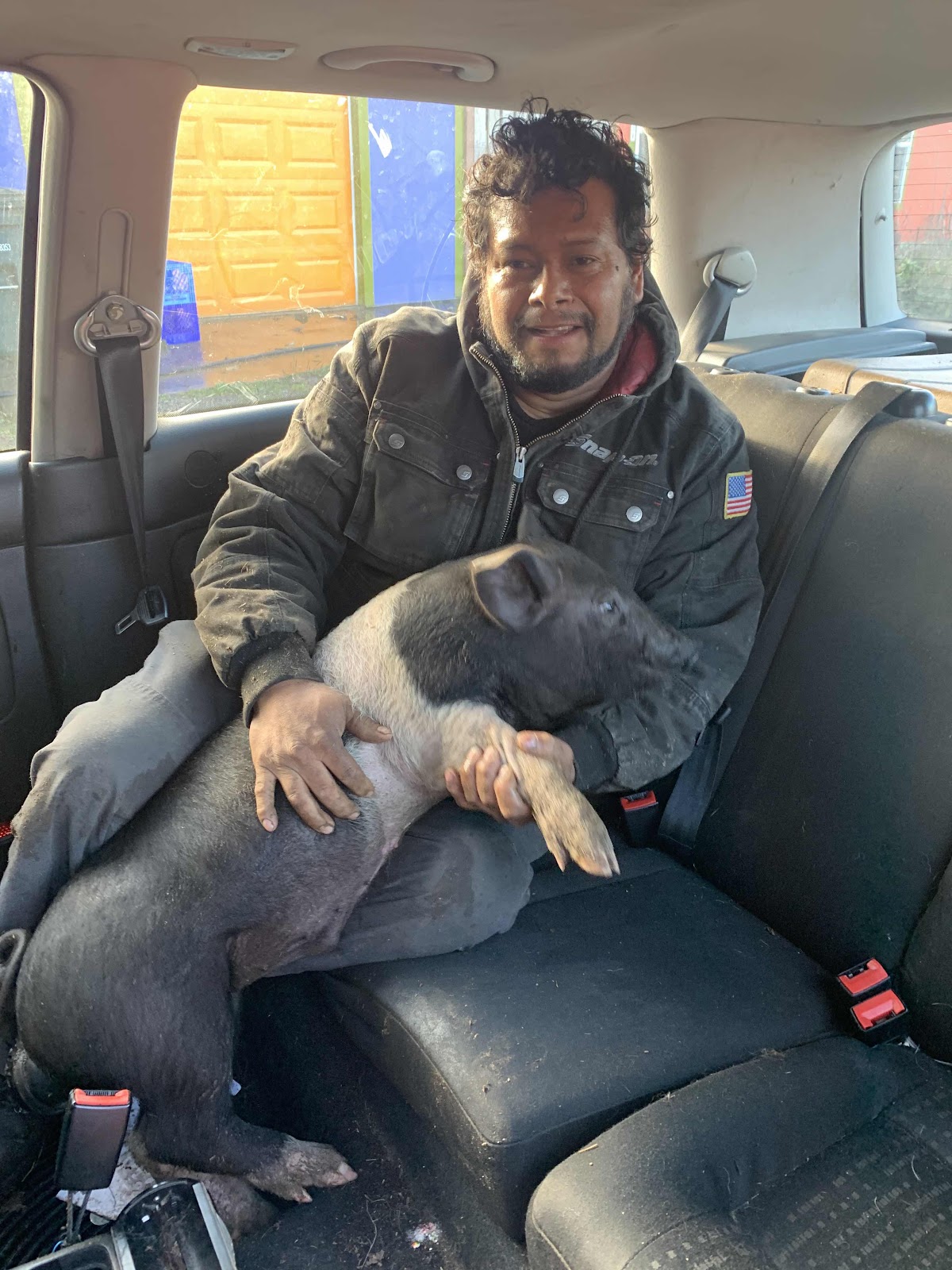
But of course labor counts. Here is Homero, after spending some twenty minutes chasing down a couple of well-grown piglets today. His face clearly shows that labor counts.  My neighbor told me we could choose our own pigs from her litter of fourteen, and there were a couple of standouts. In the end, however, we took whichever pigs Homero was able to catch. 


This handsome boy was the largest of the entire litter, and probably tipped the scales at sixty pounds. Homero was hard pressed to keep ahold of him all the way home. 


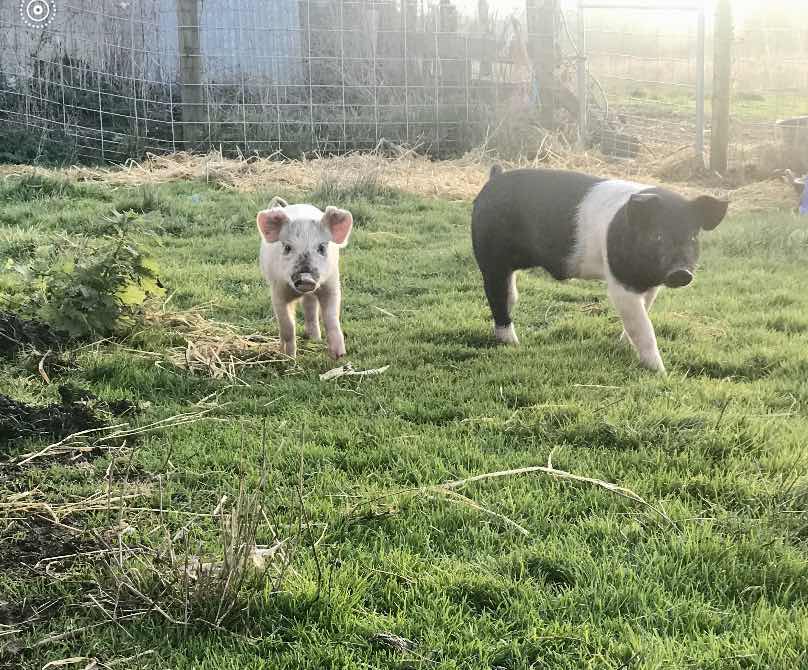
The second piglet he managed to catch was the smallest one of the litter, a little pink girl with curled back ears. They seem to be happy with their new digs - we have them in the sacrifice area which is about 100 x 100 feet. Their house is a round calf hutch stuffed with hay. 

Raising pigs over the winter has its challenges, and it obviously costs more than raising the same animals over the summer months, because mammals require many more calories to keep their body temperature up during the cold season. Also their natural rooting behavior causes more damage during the wet season. That’s why we have them confined to the sacrifice area, which is compacted and has a bad weed situation. Any rooting they do may actually be beneficial, and their manure will help fertilize the sandy poor soil. 

As in past years, the idea is to sell one pig (post-slaughter, in cuts) and use that money to offset the costs of raising the other pig, which we will keep for ourselves. Paloma will be keeping the books this year, and I’ll keep you all updated on her conclusions. 


Tuesday, May 15, 2018

Summer in Oaxaca (Abbreviated Cheese)


This cheese season will be a short one: we are going to Mexico for most of the summer. Over the past three years we have been slowly, by fits and starts, building a house in Oaxaca. The house is finally getting close to “done,” by which I mean the part for which we are paying professionals is nearly done, and we are approaching the parts that we plan to do ourselves. 

The professionals (and it should be mentioned here that it pained my husband in the extreme to cede any part of the construction to professionals at all) have completed what in Mexico is called the “obra negra.” That means, more or less, that the floors, walls, ceilings, and roof are in, and the plumbing and wiring is basically finished. But there are no fixtures, no appliances, no lights or sinks or paint or flooring. Choosing and installing all of that, and choosing the furniture, is the “fun part.” We will be doing much of that work this July and August. 

It’s been two years since we were in Oaxaca, and I can’t wait to get back. The children are excited too. However, it is beginning to become clear to me that when we elected to raise our children bilingual, binational, and bicultural, it was not an unmixed blessing we were bestowing upon them. I only thought of the benefits of having two homelands; it never occurred to me that being at home and comfortable in two worlds came with the drawback of always being homesick for somewhere. 

When we are here, they miss Oaxaca, and their cousins, and the peculiar camaraderie and joie de vivre that life in Mexico affords. When they are in Oaxaca they miss their home, their rooms, their friends, and the American brand of privacy that does not exist in Mexico. I never thought about the fact that being a citizen of two countries means you are always pining for one or the other. 

Meanwhile, here on the farm, cheese season has begun. I was lucky to sell all the goats I intended to sell this year - not just this year’s babies but also those from last year that I deemed unsuitable as breeding stock - which was all of them. I think this is the best year I have ever had for selling goats. I sold ten, altogether - seven babies and three adults - for a combined total of fifteen hundred dollars. That is, coincidentally, the exact amount I need as farm income, once every third year at least, to keep my favorable tax status as a working farm. 

All of this year’s babies have now been collected, which means that I have three mammas to milk every day. And that means about three gallons of milk a day - a little less. And THAT means I need to be making cheese at least three times a weeks so far, I have made three batches of delicious chèvre, two cheddars, and a couple of queso frescos. My brother in law hooked me up with a woman who owns a fishing boat and sells Alaskan salmon - I am planning to meet with her and trade cheese for salmon sometime this week. 

And now I have to go, because it is time to milk, yet again. 


Sunday, April 22, 2018

Farm Finances, Goat Edition 2018

For my records: all four baby bucklings have been sold, surprisingly. Usually, bucklings are hard to sell. The four were sold for an aggregate of $375. Also, Bunny and Ombré, last year’s doelings that didn’t catch pregnant this year, have been sold for $75 each. That’s awfully cheap for does, but these are an unuseful cross breed between Nubian and Nigierian. They are short and will not be good milkers. Basically good for only meat or weed-control. The gentleman who bought them said he wanted them to eat blackberries, but I suspect they will probably end up as food. That’s okay, as long as they are well treated in the meantime. 

Still for sale are this year’s three doelings. I’m asking $150, willing to bargain. I have no idea what to do with them if nobody wants them. I’m trying to get rid of many goats as possible because we will be in Oaxaca most of the summer and I don’t want to overburden the pasture. 

In any case: proceeds so far this year from animal sale:

Sale of live goats: $525
Sale of processed pork: $400

Total: $925

Not too shabby. 

Wednesday, November 8, 2017

Predator Problems Redux (Coyote Edition)


We always lose chickens over the winter. Always. Some years are worse than others, but on average I'd say we have about a 30% chicken attrition situation over any given winter. And some years are just terrible. This year has been a bad one so far. 

We started the fall with eleven hens. Now we have five. It's especially annoying because these hens were youthful and excellent layers. Golden sex-links that I bought in spring as pullets. This was their first laying year, and they provided us with a surfeit of delicious eggs. The second year of a hen's life is generally her most prolific, and the third and fourth years are also excellent. I was looking forward to several seasons of eggy abundance. 

We've known for some time that we have a coyote problem here.  I have seen them, in broad daylight, in the neighbor's field, and we hear them  singing on moonlight summer nights. In general, I appreciate coyotes as a savvy, adaptable animal. They are handsome too, no matter what their detractors say, with their sandy brown coats and their sly, intelligent faces. Losing a chicken here and there is the price we pay for living in this lovely rural area. I'd be sad indeed to never hear coyote song again. 

But I do draw the line at the loss of more than half our flock, and it's barely November yet. And yesterday they took a turkey - a well grown hen, who was already sold at $4/lb. Now I have to call a customer and tell  them their family will be eating store-bought turkey this thanksgiving, and that makes me mad. 

So it was with mixed emotions at best that I regarded the dead coyote that my husband brought me last week. As he was driving home in the dusky evening, he saw a coyote lying on the side of the highway just off our property; the same place that our dog Haku was hit last summer. The coyote was perfect, intact. So much so that Homero approached it cautiously in case it might actually be still alive. It wasn't, but it wasn't long dead either. Still warm. 

Homero dragged it off the verge of the highway and well into our property, for no particularly good reason. "I didn't want it to get run over into mush," he said. "Come look." 

Not having ever been close enough to a coyote to touch one before, I didn't have much of a frame of reference. Local farmers tend to greatly exaggerate the size and menace of coyotes, claiming they are larger than dogs and can drag off full grown sheep. I know that is bull-puckey. Coyotes seldom weigh more than forty pounds, and are quite a bit smaller than your average German Shepherd. This one seemed to weigh about thirty-five pounds, and was female. 

There wasn't a mark on her, apart from a little blood around her muzzle. It's been a cold fall, and her coat was thick and soft. I felt quite sorry for her. I imagined her as one of the pups I'd heard singing earlier, in summer, and that her dan had taught her where to go hunting. She probably knew us as "easy pickings farm." Nice fat chickens, if you can get across the road, look out, it's a bitch. 

Another nice thing about living in a rural area in the age of the internet: it was quite easy to find somebody who wanted to pick her up for her hide. I mean, why not, might as well salvage something beautiful from this disaster. We've lost good poultry and an intelligent animal list her life in her prime, but why shouldn't somebody salvage a nice fur? 

Homero tells me he's absolutely positively guaranteed going to patch up the chicken coop before it gets much colder. I say - as I say every year - that we won't get any more birds of any sort until he does. I know what will happen- the earth will turn and spring will come. Chicks will show up for sale under heat lamps in the farm store. We will look at our sad skinny chickens who survived winter and decide they need an infusion of new blood. We will think we have all summer long to fix the chicken coop. 


Thursday, September 29, 2016

Swine Squared (Women's Work?)

KWe have acquired two new pigs. To get a pig or not to get a pig, in any given year, is one of the larger farm-related decisions we make. Pigs can be profitable, and of course they are delicious, but pigs are also expensive and destructive. 


The price of weaned pigs has risen precipitously in the last several years - from about $75 to about $140. And with pig food running at $15 per 50# sack, that means that pigs are only profitable if we can generously supplement thier diet with free food - AKA the Gleaner's Pantry. (http://newtofarmlife.blogspot.com/2013/10/scavenge-city-gleaners-pantry.html?m=1)

The problem is, that in order to seriously supplement the diet of not one, but two pigs, we would have to go to the gleaner's twice a week. And that's a hell of a lot of work. Frankly, more work than I am prepared to do. Accordingly, I told my husband that we could get pigs if and only if he would sometimes take my place at gleaner's.

He reacted with poorly concealed horror. He squirmed and he hemmed and hawed. He looked at the floor. 

"What's the problem?" I asked. "I've been doing it alone for three or four years now, and you know how much work it is. I'm tired." 

"Well," he said, practically digging a hole In the floor with his toe, "there's only women there." 

"What?" I was a little taken aback. "That's not true! There's always a guy
or two.... Usually..."

I'm surprised at myself that my first impulse was to deny the truth - yes, gleaner's is a women's organization and
fully 90% of the people there are of the female persuasion. Why was my instinctual response an attempt to soothe my husband's discomfort, rather than a challenge to the implicit assumption that he couldn't possibly be expected to be the only man in a room full of women, even for one hour? 

Could it possibly be because I've been conditioned to believe that a man's psychological comfort is more important than my time, my effort, or my feelings? That part of my job as a woman and especially as a wife is to protect him from the need to ever confront his unconscious sexism? 

Nah. Couldn't be.

So, without insisting on a discussion of the underlying gender dynamics, I simply said "well, I don't think I can commit to going to gleaner's that often. I guess we won't get any pigs. Even though - look!- these beautiful well-grown piglets are available at an extremely good price." 

As I suspected, Homero's anticipatory hunger won out over his conditioned reluctance to do what had been branded in his mind as "women's work." He said he'd help me get food from gleaner's to feed the pigs. And so we went and bought these incredibly adorable and healthy, larger-than-usual pigs. 


We've had the pigs for two weeks, however, which means six opportunities to go to gleaner's, and Homero has yet to go in my stead. So maybe the joke's on me. 

It was hilarious to watch Haku interacting with the pigs. He clearly had no idea what they were - maybe puppies? He tried to play with them like puppies. He made a play bow, and the pigs looked at him and snuffled. Next he tried pawing them, which they didn't like. 

Even a baby pig is fully capable of defending itself against your average dog. When Haku got too rough, the pigs charged him and bit. Haku snarled in retaliation, and then I stepped in to scold him.

"Gentle!" I said.

"Gentle" is probably the word Haku knows best, after "no." As soon as he heard me say "gentle," he stopped roughhousing and started quietly licking the pigs along the ribs.

The pigs, under this treatment, went into a trance and slowly toppled over on thier sides.  I love this about pigs. Scratch them gently, and they just roll over and lay there with silly smiles on their snouts, legs stiffly akimbo. 


Wednesday, August 12, 2015

How Much is a Good Goat Worth?


Iris was the first goat on the farm. I bought her in 2007, as soon as I had a fence up and a place to keep livestock out of the rain. We moved in in August or September, and I was determined to have baby goats our first spring; so I advertised for a pregnant doe. I didn't care much about breed, I just cared that she was healthy, and pregnant.

I lucked out. A lady goat farmer nearby answered my ad - she had a young doe pregnant for the first time - a first freshener, as they are called - a Nubian, with a fine pedigree. Registered, tested for all of the local diseases, and guaranteed. Later I found out that this lady farmer actually raised locally famous goats, winners of many prizes at regional and state fairs, and that her animals were extremely well regarded among local goat folks in the know. If I had known that at the time, I suppose I might have sprung for the extra $50 she wanted to give me Iris' papers. But I didn't know that, and I didn't care, because I wasn't thinking in terms of the future monetary value of kids born on the farm. I thought - I'm a homesteader, not a breeder, so what do I care?

However, I didn't know the future, and Iris was quite expensive enough as it was. I paid $350 for her. That struck my husband as a rediculously exorbitant price. And even today, I can say that yes, that's pretty expensive. I routinely sell goats for less than $100. Male goats. Females are usually sold for between $150 and $200. The best price I ever got for a single goat (not pregnant) was $250, for an adorable spotty female kid, who had been disbudded and vaccinated.

That was one of Iris' kids.

Iris, over the years, has produced some 15 kids. I'd have to look at the blog to be certain exactly how many. Some of them were sold for a good price; some of them were eaten as meat; and a couple of them died without producing any value whatsoever. At least one cost us a lot in veterinary bills before he expired. If I average out the value of her kids - not an easy task, considering the calculations involved - I'd guess that each one was worth about $30. All told, her kids were worth about $450.

Now let's talk about milk. It's impossible to set a firm value on a gallon of goat milk. For one thing, I can't sell it. That is highly illegal, and I've never waded into those waters. However, I can say that a gallon of goat milk, if purchased in my local market, is worth approximately $12. I would never BUY a gallon of goat milk on the local market, so I can't really say that it's worth that much to me. I suppose I can call it "fair market value." However, to make calculation easier and to reflect more accurately the realities of my farm, I'll give each gallon of milk a value of $10.

I will not, because the math gets ridiculous, attempt to set any higher value on the cheese I produce. I could easily get lost in the intricacies of attempting to put a reasonable value on my cheese. I have, over the years, traded a pound of cheese for products ranging from a loaf of bread (value: $2?) to three fat dungeoness crabs (value: $50). I've traded cheese for smoked salmon; for cedar chips; for kale; for blueberries; for babysitting; for hay. The best I can say is that goat cheese is a commodity of highly variable worth. Therefore I will just calculate the worth of milk.

Iris is a good milk producer. She is probably above average for a Nubian goat, which is defined here  as 1,820 pounds per lactation cycle. 1,820 pounds divided by 8 lbs/gallon = 227.5 gallons a year. Times $10/gallon we arrive at a figure of well over $2,000 per year.

Well, that's a silly number. I can say with absolute certainty that I don't receive anything like that much in concrete benefits per year. Especially when multiplied by the three does I milk most years. However, we do save a great deal of money by not buying any milk, yogurt, or cheese for most of the year. Also, excess milk goes to feed the pigs and the chickens, which in turn saves us money on meat and eggs.

You can see that the worth of a good dairy goat is a hard thing to calculate. Iris has been providing my family with meat in the form of her kids and with milk and cheese for some 8 years now. She has been fertilizing our land with her manure, and providing weed control. She has also provided us with many hours of entertainment, and with affection and joy. Her kids are not simply walking bags of protein, but creatures that jump and play and are absolutely adorable and beautiful. There is simply no way at all to calculate the happiness evident in the face of my youngest child, below, cuddling one of Iris' newborn kids.

I give up. I cannot put a price on a good dairy goat. Here's what I can say for sure: Iris has earned her retirement, and should she never produce another kid or another gallon of milk,  we will care for her until she dies of old age.


Monday, May 18, 2015

Baby Birds (Wild and Tame)


My property is apparently the perfect habitat for killdeer.  I love these handsome, graceful birds, with their piercing calls and their swift, low flights across the fields in the twilight. They show up every year in February, and begin a months-long process of finding a mate and rearing young. They like to nest in flat, open, gravelly areas. For two years running, a pair of killdeer has chosen to nest in my sacrifice area, where I keep the horses. It has been delightful to watch the devoted pair incubating eggs - both male and female sit on eggs, and take turns guarding the nest - and especially delightful to see the tiny babies hatch. 

Killdeer babies are identical to the adults, but smaller, about the size of a golf ball. As soon as they hatch, they begin to run about, with that peculiar killdeer habit of running in short, straight lines and stopping abruptly, as though by a traffic light. The parents stand nearby, watching and, if anyone comes too close, pretending to be injured, dragging themselves athletically about and screaming, to distract a potential predator from their young. 

The nest in the horse pasture hatched out about three weeks ago, and the babies are already half the size of the parents. There were four eggs, but only three juveniles. However, there is another nest now. A pair got started late, I guess. This new mama found herself a supremely unsuitable nest site - right smack dab in the middle of my driveway (see above). When one of my broody hens nests in a poorly chosen site, I wait for dark and then move her, eggs and all, to a site of my choosing. Obviously I can't do that with a wild bird. The girls set up barricades made of pallets, instead. Luckily, killdeer are not much frightened by bustle and hubbub. Even when we (carefully and slowly) drive right by the nest, the parent bird only moves away a few feet, and then returns immediately.  I am looking forward to observing this new family. 


This year, we ordered 8 turkey poults. Turkeys are one of the more profitable animals on the farm - if I can keep them alive until Thanksgiving, and grow them out to a respectable weight, I can sell them for $4/lb, which means each bird is worth somewhere between $50 and $75. These poults, broad breasted bronzes, cost $6.50 apiece. 

Because I belong to the Gleaner's Pantry , I can feed them very cheaply indeed. I always start them off on expensive Game Bird food, but soon enough they can eat scraps, bread, and get out on pasture to forage. Last year, we lost two full grown birds to coyotes, which was a blow, but even so, the entire turkey operation turned a profit, and provided us with our own bird for the holiday. This year, we will have to repair the fences and make an effort to keep the predators away. On each bird that I raise to full weight, I can expect to make a minimum $40 profit. 

That's better than I can expect on a goat kid! 


Friday, August 29, 2014

Beef Roadtrip (the Computer Age)


You may have noticed that the price of meat has risen fairly dramatically over the past couple of years. The forecast is that it will continue to do so for the foreseeable future, due to a number of factors including prolonged drought in many parts of the country, a new and nasty pig virus, and increasing demand for meat in China and much of the rest of Asia. Here are a few links for the skeptical, from NR and the New York Times:

http://www.npr.org/blogs/thesalt/2014/08/26/343403757/high-prices-arent-scaring-consumers-away-from-the-meat-counter

http://www.nytimes.com/2014/08/26/business/meat-prices-continue-to-rise-but-corn-and-soybeans-slip.html?_r=0

Even those of you who buy meat by the half animal, as I do, have probably seen major increases. When we bought our first local half-beef, some six years ago, I think we paid $1.75/lb hanging weight. Even two and a half years ago, when we last bought beef, we paid only $2.00/lb. Granted, that was from a neighbor and a friend, who was charging us quite a bit less than the going rate, which if I remember right was about $2.50.

This year, I spent quite a bit of time searching Craigslist for decently priced grass fed beef (our neighbor and friend only raised enough for his extended family) without luck. The best price I could find was $3/lb, and that only applied if you ordered six months ahead of time and didn't include cut and wrap. Figure that in, and by the time you are done you'll be paying about $5/lb for what you actually put in the freezer. It's not that $5/lb is such an outrageous price (though it is pretty high), but that to buy a half you need to get together some $2,000 all at once.

I really hate buying supermarket meat. I hate participating in the CAFO feedlot system (Concentrated Animal Feeding Operation - Wikipedia, the free ...); I hate eating animals that lived in misery eating GMO soy and corn; I hate contributing to the destruction of tropical forests and the displacement of indigenous peoples. But I love eating beef. If it came down to a choice between eating CAFO meat or no meat at all, I know what I'd choose. So, to avoid slathering my burgers with guilt sauce, I decided to look further afield for my grass fed beef.

Washington State is divided between the wet west and, on the other side of the Cascade mountains, the wide open rangeland of the drier east. On the eastside, land is cheaper, hay is cheaper, and as a result, beef is cheaper. Marginally. After searching through all the Craigslist listings for beef in all the little towns of Eastern Washington, I struck gold: USDA prime grass fed black angus beef for $2.85/lb, cut and wrap included. A half weighing a little over 500 lbs was available. Problem is, it was a five hour drive, and comparatively cheap as it was, that half would still cost more than $1,500.

Social media to the rescue: on Facebook, I invited all my friends to go in on it with me. In the end, we bought a quarter for ourselves, and the other quarter was split into two eighths for two other families. I didn't charge the other families anything extra per pound, but I did ask them to contribute something toward the price of gas and dry ice. Dry ice, although pricey, is a necessity when transporting a quarter-ton of raw meat in a hot trunk for five hours. I used google maps to find the closest supplier to our destination, and lucked out: there was one in the same town. I collected cash and coolers from my co-purchasers, and Homero and I set off on a road trip.

The ranch was a lovely place, and the beeves on view were beautiful - vast, sleek, shiny black animals, moving slowly through flank-high grass or cooling themselves in a green pond, on which I saw a blue heron standing quietly among the reeds. The ranch owner, a friendly, tall, middle aged woman, was kind: There was a misunderstanding about the weight and we hadn't brought quite enough money. With no bank within a two hour drive, she simply decided to trust me to send a check when I got home.

It may seem like an awfully long way to go, but the math is convincing. On our quarter, we saved about $300 over local prices. Our diesel Jetta gets 45 miles to the gallon, so the gas cost us only about $30. The dry ice was the biggest expense, at $40, but friends kicked in on those costs. Our share of the travel expenses was about $25, which adds only a negligible amount to the price per pound.

If there's a downside, it's that the meat included an unreasonably high percentage of hamburger. At least 2/3 of the total weight was in burger, which is higher than I am used to. It seems like a shame to grind up that much of an animal that graded out to USDA prime, the very highest category. B ut I'm not complaining. The freezer is full of guilt-free meat and I am happy.


Saturday, April 5, 2014

The Goat Who Wouldn't Kid (When to Butt Out)


Iris, above, is the first goat I bought when I moved here. I was hurting for goats; I couldn't wait. Goats, as far as I was concerned, were the whole point of pulling up stakes and moving from the city to the countryside. It was late summer when we moved in, and late fall by the time I had bought a barn (Home Depot's largest model), put in fencing, and was ready to buy an animal. Not wanting to deal with breeding the first year, I looked for a pregnant goat.

Craigslist, as usual, was my vehicle. I put up an ad saying I wanted to buy a pregnant dairy goat - breed unimportant - and was soon answered by a local woman with a bred Nubian doe. She wanted an inordinate amount of money - $300! - but I was taken with goat fever and I simply decided to lie to my husband about how much I was spending. He has no idea what a good goat is worth, I rationalized. As it turns out, that woman actually runs a well-respected farm and her goats win prizes all over the tri-state area, but I had no way of knowing that at the time. Nor did the pedigree matter to me - she offered me Iris' papers for an extra $50 but I said no thanks, not thinking it would ever be important to prove her ancestry. I'm a homesteader, I said, not a goat breeder.

That was rather a dumb decision, I have since come to understand. For $50, I could have a herd of registered animals now, and each and every one of them would be regarded as quality breeding stock, allowed to be shown at agricultural fairs, and valued at some 25-50% higher than unregistered animals. Instead, I have a herd of beautiful, healthy animals, from good milking stock, and bred for hardiness, but only suitable for the smaller market of people who don't care about registries. It means I sell a lot of quality animals for meat instead of for show.

Nonetheless, Iris has earned her price many times over. That first year, she threw us twins, and one of them, Flopsy, I have to this day. Flopsy, in turn, has given us many kids over the years, including our prize buck. If I were to add up the value of all that Iris has provided in livestock, meat, and milk over the years - something I could theoretically do but not at this time of night - it would be a lot of money. Totally aside from her monetary worth, Iris is a great goat - smart, personable, and attractive.

She is getting on in years, however. A year and a half old when we bought her, she is now about eight. Goats live to something like thirteen, and they can theoretically keep producing until they keel over of old age. Iris is healthy, and she had a year off from kidding last year when we were in Mexico. When we brought in the buck, Paxton, last fall, he went for Iris first of all the does. He bred her within thirty seconds of entering the pasture, so it's clear she is still a fertile animal.

This spring, however, the other two does kidded first. Oh well, I thought, Iris must not have caught pregnant on the first go-round - I'll expect babies in a few weeks. I started to watch her. For a while, I was confused. I had been certain she was pregnant - like the other does, she got thick in the middle and developed a biscuity tail (that means that the skin of her tail got puffy and soft - a sign of early pregnancy). But after the other does kidded, Iris didn't seem to be developing at all - in fact, she was getting thinner. Her udder stayed stubbornly small and floppy. I couldn't figure it out at all and began to doubt she was even pregnant.

Finally, about a week ago, her udder began to fill out, which is unmistakable proof of advanced pregnancy. Usually, when the udder fills, you have only a few days until birth. But Iris' udder got bigger and bigger. Her belly got bigger and bigger. She was so poofy and huge she could barely walk. Her tail ligaments disappeared and her distal spine lifted up. Deep hollows appeared below her hipbones as the babies dropped lower and lower. I started to lock her in the mama barn at night, but every morning when I went out early to check, there was Iris, staring at me - no kids.

I had advertised her kids for sale on Craigslist, and a woman had already answered me with an offer to buy any doelings. She wrote me every day - are they here yet? No, I said, but I'm pretty sure today's the day. Night before last, I locked her in the barn as usual at evening feed, but I forgot to tip the milking stand on its side. I do that so that she won't be able to get up on the stand, stand on her hind legs, and reach the sack of grain stored on the tippy-top shelf, nine feet above the floor. So of course, that's what she did. When I went out first thing in the morning, expecting to see baby goats, instead I saw a lot of liquid excrement all over the place.

In case you don't know, when a goat overeats grain, she gets what's known as overeating disease (Enterotoxemia (Overeating Disease) of Sheep and Goats), or toxic rumen. To you and me, what that means is explosive diarrhea and massive amounts of gas. It's not a joke- goats can easily die of overeating disease - but Iris didn't get enough grain to be in serious trouble. Just enough to cause a lot of disgusting green liquid poo. Just what one wants when birth is imminent. I kept Iris locked inside the barn and bought a new bale of clean straw. I mucked out the poo-covered straw. I moaned and bitched and wailed and cursed the stupid goat. I wanted to beat her, but instead I brought out a pan of warm soapy water and a dozen rags and cleaned her rear end. Let nobody say I don't care about my goats.

All day I hung about, waiting. I brought a book out to the barn and sat down in the clean straw and read and waited. Iris was in serious distress, but I couldn't tell if it was labor or just intestinal distress from the diarrhea. Her udder continued to fill, and by four or five in the afternoon it was tight as a drum. That is an indication that the goat ought to kid within a few hours. I was waiting for the string of goo - which is, just as you probably guessed, a long string of mucus depending from the vagina. Once the string of goo appears, you want to see kids on the ground within an hour. No goo was forthcoming, but Iris was acting like a goat in active labor.

A goat in active labor will scratch at the ground, making a nest. She will often lay down and get up again, stretch, and yawn. Usually, she will stay standing until the final stages of labor, when she may lay down to push. She grunts and curls her lips in a very distinctive way. Normally, goats kid quickly, and the entire process ought not to take more than an hour or two from start to finish. I called the vet at 6 pm, because Iris had been getting up and laying down, stretching and rolling for about four hours. I was pretty certain that the kids were malpositioned.

The vet said it was time for me to go in and see what I could feel. Was the cervix open or shut? What was the presenting part? I put on some of my husband's thin black nitrile gloves, soaped up, and lay down on the wet straw behind Iris and inserted my hand.

I'm no expert. Over the years, I've had to pull kids several times, but until yesterday I'd never gone in before the water has broken. I would not have, but the vet said it was time. When it comes to birth - caprine or human - I am a big believer in standing back and letting nature take its course. I think we most often cause nothing but trouble when we interfere with a process honed by millions of years of evolution. In this case, I felt that her cervix was wide open and that I could feel the bag of waters easily, but that there was nothing firm inside it. I could feel no fetal part at all - not hooves, which would have been normal, nor a muzzle, nor even some blank wall of side or hip. Just an empty, squishy bag. Clearly, there was no kid in any position to be born.

I called the vet back and said "I think I better just leave her alone for a while. There's nothing I can do, those kids have to come around on their own."

Now, if any mothers are reading this, they may remember - as I do - that when somebody puts their hand inside you when you are already in labor, it provokes some serious contractions. My pelvic exam made poor Iris go into some hard core labor. Maybe that's what did it - I don't know. But in any case, Iris must have been busy while I was inside the house for a couple of hours. When I went back out at about 8 pm with a flashlight, there were two newborn babies on the ground. They had obviously been born mere minutes before. They hadn't yet stood up. I ran back to the house, yelling for Homero and the girls, and brought back clean towels and iodine.

The kids were both a little bit worse for wear, due to the long hard labor. The little girl, brown and white spotted just like her mama, had inhaled amniotic fluid and was snuffling and snorting. I didn't have a syringe to aspirate the fluid - not that I really knew how in any case. I briefly considered placing my mouth over her nose and aspirating old-school, but decided she'd probably live without any heroic measures. It seemed so, because she was the first one up, and managed to nurse without any help from me. Her brother, black with brown points and a white cap and ears, was the worse off between the two of them. He was shaky and weak and it took him a good half hour to stand up. A healthy baby ought to stand up within five minutes. I held him up and let him have at the teat; I knew that with a belly full of milk he'd be just fine for the night.

I don't like to see babies born late at night - the normal time seems to be early in the morning. I always wonder how they will figure out nursing without being able to see, but I realize that is a primate's prejudice. The little kids can smell and feel their way to the teat even in perfect darkness.

This morning, the babies were doing just fine. They had become all fluffy, as kids do when they are healthy, and both were standing and nursing without assistance. I think we are going to keep the little girl. I need a new doe - in another post I will detail my thinking on the health of the whole herd, but for the moment I'll just say I'm delighted to have a good looking spotted doling. The lady who wanted to buy a doling will just have to wait until next year.
Wednesday, February 12, 2014

Function Over Form

the calf keeping me company

Recently, I made a fairly large purchase: a dozen cattle panels. I have a long term goal of eventually having all my pastures fenced and cross-fenced with cattle panels, instead of with the droopy, non-functional field fencing we put up when we first moved here. 

After MUCH research, some of it by trial and error (The Forever Fence (Is It a Myth?)) I have made the discovery that cattle panels are the most economical and effective form of fencing for goats. Goats like to stand up on field fencing, which is why most of ours is now mashed down to a height of about twenty-five inches. That is a height which obviously provides no impediment to a goat who wants to be on the other side. It would be marginally cheaper to replace the old mashed down field fencing with new field fencing, as opposed to using cattle panels, but it would be a LOT more work, and no guarantees that the new fencing would last very long, either.

Cattle panels cost about $37 apiece, here, with tax figured in, and are 16 feet long. The dozen I just bought cost  $440 and are just sufficient to re-fence one side of the smallest pasture. At this rate, I will achieve my goal approximately six months before I die of old age. Once, I did find a whole bunch of cattle panels for sale at $20 a pop on Craigslist, but that situation turned out to have a few drawbacks, as well (Cattle (Panel) Rustling).

Today is a beautiful day, sunny and somewhere above fifty degrees. This fact, combined with a general lack of aches and pains when I woke up this morning, convinced me to get out and put up the panels. Dragging a sixteen foot long, wobbly panel through a gate and across a muddy field is not an easy task, and after I had done it six times I went to go find Homero and ask him to help me with the other six. We laid them out along the old fence, and then I went back and tied them to the fence posts using - what else - baling twine.

Every winter, we go through forty-five or fifty bales of hay, and each one has two lines of twine holding it together. When I was a child, these were made of natural jute, but now, of course, like everything else in the world, they are plastic. And very durable. I have pulled these bright orange strings out of the compost pile after years, and they are still just about as strong as ever. They do pile up, too; my work today demanded some thirty-six of them, and I had no trouble at all finding that many here and there about the place.

It would make sense to go back with some wire cutter and actually remove the mashed down field fencing. I'm not sure what it's good for at this point, since it is almost impossible to restore it to it's original shape, but aesthetics alone dictates I eventually get rid of it. The fences are quite a sight as they are now - tangled up, bent, tied together with string, festooned with horse-hair and the occasional plastic bag.... pretty, no they are not. But after today's work, they are a little bit more functional.

Ivory enjoys the sun


Saturday, February 18, 2012

Meat Math

Now that Keizer meats has called me with the hanging weight on our tiny, skinny, little pigs (109 lbs and 137 lbs, less than I expected) I can do the math to figure out how much our own pork is costing us and whether or not it is worth it to raise two pigs.


Since we are leaving for Mexico in six months and already have a freezer full of beef, we decided to keep the smaller pig and sell the larger one. The Costs to us of raising two pigs are as follows:

Piglets (2) $80 = $160
Feed (15) $12 = $180
Kill fee on our pig: $62
Cut and wrap on our pig : (109) $.60 = $65.40

Cost of both pigs to us: $467.40

I am not making any attempt to factor in labor because caring for two pigs is pretty much exactly the same as caring for one pig. Feed is necessarily something of an estimate, but I know we bought at least 12 bags of feed, because I counted that many empty bags, and I'm chucking in three more because it seems likely I'm missing a couple of empty bags. That wasn't all they ate, of course: they also ate all the household scraps and pretty much anything else I could scrounge up. But those things didn't cost us any outlay of cash, so they aren't counted. We didn't vaccinate or otherwise doctor the pigs, so no veterinary costs.

The fellow who is buying the larger pig will pay all of Keizer's fees, both cut and wrap and the kill fee. Then he pays me $2.5o a pound of hanging weight, which works out to $342.50

$467.40 - $342.50 = $124.90

Our 109 pounds of meat cost us $125, which is $1.15 per pound. Hanging weight, of course. We won't get back 109 pounds of wrapped meat, more like 75 or 80.

Wow. Assuming that this pork is as good as our previous pork (and why wouldn't it be?) then that is a hell of a deal. Let me do a quick google search on prices for pastured pork.....

The chart below is taken from Coulee View Family Farm in Wisconsin. Their prices are very much in line with the prices I saw on three other pages for pastured, naturally raised, but not organic pork. Looks like it probably is worth it to raise two pigs at a time.

Price Per PoundEstimated Weight
(lbs)
Smoked ProductsSmoked Bacon$5.501
Smoked Bacon - MSG & Nitrate Free$5.801
Smoked Boston Butt Bacon - MSG & Nitrate Free$5.951
Smoked Canadian Bacon$5.750.75
Smoked Boneless Chops$5.351
Smoked Ham$5.252 to 5
Smoked Ham - MSG & Nitrate Free$5.602 to 5
Smoked Hocks$3.301 to 3
Smoked Hocks - MSG & Nitrate Free$3.601 to 3
Sliced Honey Glazed Smoked Ham$5.251
Ground & More
Ground Pork$3.951
Seasoned Ground Pork$3.951
Roast BBQ Pork$5.751
SausageBratwurst$5.500.75
Itallian Sausage$5.501.25
B-fast Saus. Links MSG & Nitrate Free$5.501.25
Andoulle Sausage$5.501.25
Bratwurst - MSG & Nitrate Free$5.801.25
Chorizo - MSG & Nitrate Free$5.801.25
Andoulle Sausage - MSG & Nitrate Free$5.801.25
CutsBoneless Pork Chops$5.001.5 to 3
Tenderloins$8.00,75 to 1.25
Fresh Hocks$2.252 to 3
Shoulder Steak$4.752 to 3
Shoulder Roast$4.752 to 4
Loin Roast$5.002 to 4
Side Pork$4.751
Baby Back Ribs$4.00
Spare Ribs$3.50
Extras
Liver$1.751
Tounge$1.75,75
Heart$1.75,75
Rendered Lard$2.10
Pork Soup Bones$1.501