Wednesday, March 23, 2022
Forest Foraging (Spring Greens)
Posted by Aimee at 11:08 PM 0 comments
Labels: cooking, food, harvest, self sufficiency, spring
Saturday, March 19, 2022
Food Finances (Project Pantry)
Posted by Aimee at 6:14 PM 0 comments
Labels: cooking, food, frugality, self-sufficiency
Wednesday, March 18, 2020
State of the Farm: Pandemic Edition
Posted by Aimee at 8:24 PM 1 comments
Labels: canning, cooking, disaster, family, farm, fermentation, food, frugality, gardening, self sufficiency, spring, vacation
Wednesday, November 27, 2019
Thankful for the Truth (Warning graphic photos)
Posted by Aimee at 1:27 PM 1 comments
Labels: celebrations, cooking, death, fall, festival, food, harvest, holiday, husband, politics, self sufficiency
Friday, August 23, 2019
The Gift of the Crab
Saturday, May 18, 2019
The Fermentation Files, Spring 2019
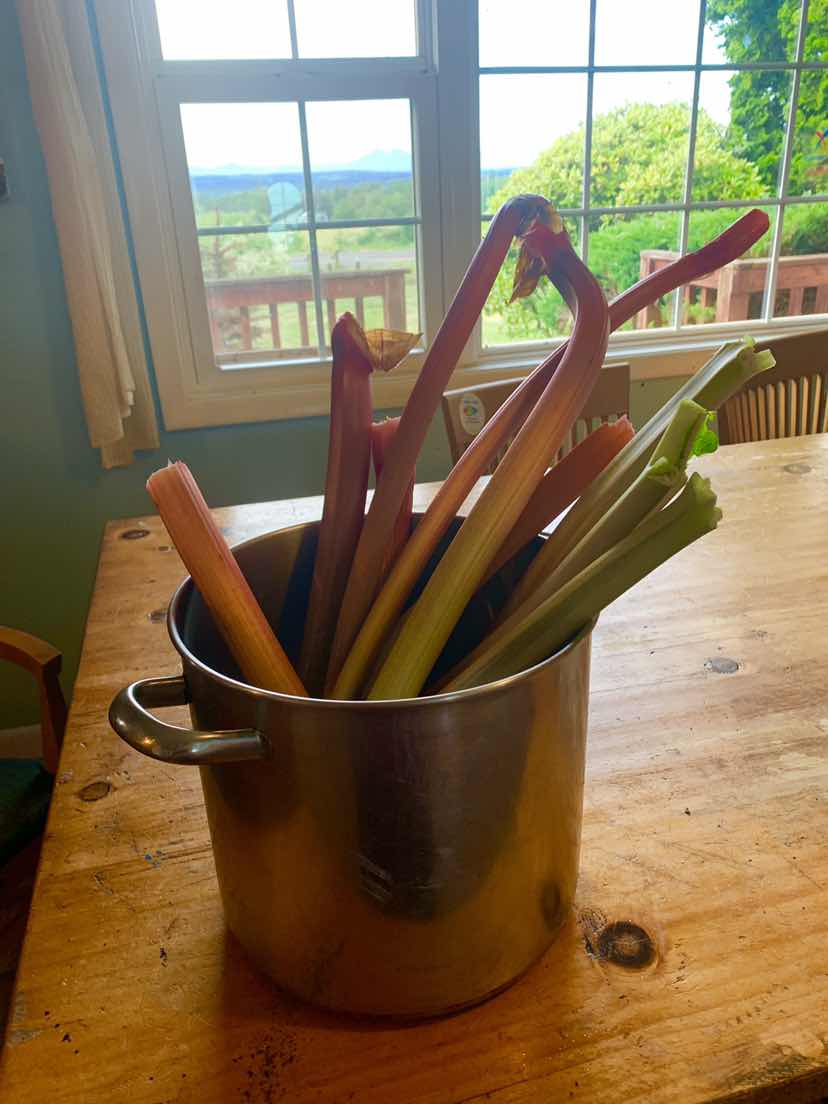
Spring finally sprang, and we’ve had a few weeks of beautiful weather. The grass grew all at once, the trees blossomed, and the rhubarb plant went wild.
Posted by Aimee at 8:00 PM 0 comments
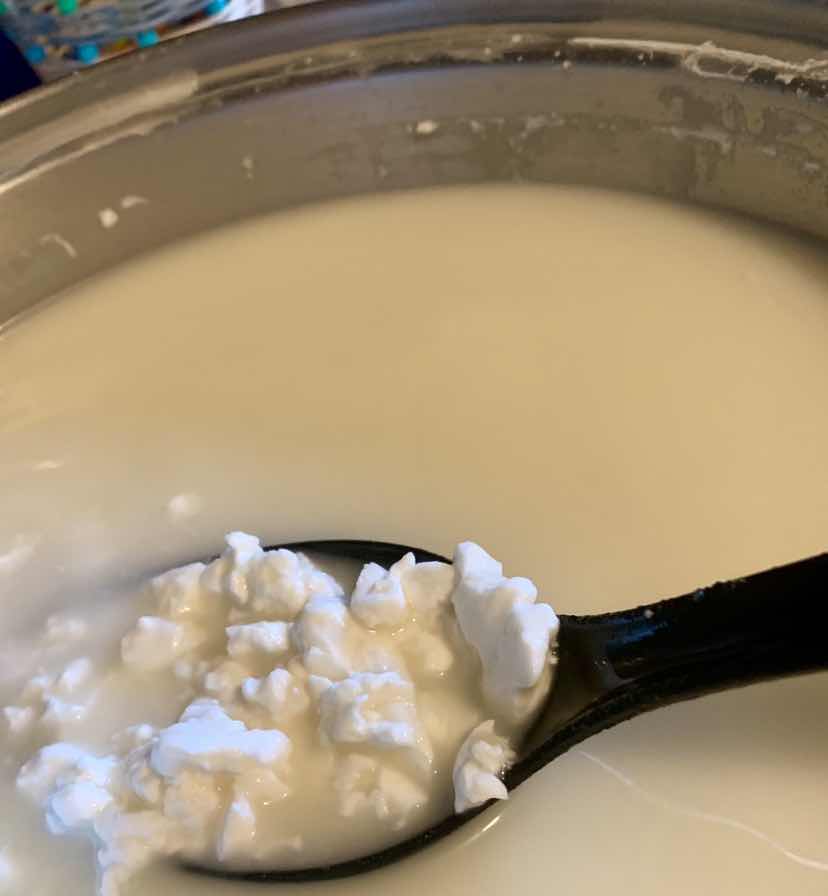
Labels: brewing, cheesemaking, cooking, fermentation, food, milk, preserving, self sufficiency, self-sufficiency, spring
Monday, November 19, 2018
Practicing Thankfulness (a look back)
2) the quart of dried morels I accepted as partial payment. I love wild mushroom gravy. The last turkey I decided to donate rather than stash it in the freezer for Christmas or something. Calling around, I found out that
3) the Lighthouse Mission in Bellingham will be serving a Thanksgiving meal on friday for those who missed out on the big day. I'm thankful they are doing this, and also that they can legally accept my turkey. Anybody looking for an easy way to help out the homeless and hungry this year could do worse than to donate to this hardworking organization.
4) I'm thankful that my mom is coming up from Seattle and we will have a crowd of family around the table. I'm sorry my sister won't be here, but I am thankful that
5) I don't have to make a gluten free, dairy free Thanksgiving meal.
6) I'm thankful that the buck is sold and the boarded does are gone home and that all my goats are probably pregnant and that goat breeding season is over for another year!
7) I'm grateful that the cold snap is over and I no longer have to water the animals with a five gallon bucket but can go back to using the hose like a normal person.
8) I'm grateful for my nieces, who are sweet, cheerful, hardworking, and funny. They are doing so well in school and making friends. I am grateful they are enjoying their time here and I'm so grateful for the trust that their parents put in me and Homero. It's a blessing.
9) I'm thankful for the beauty of my part of the world. I'm so grateful to be able to look out my window and see the mountains and the trees and the sky. I'm constantly amazed at the natural beauty with which I am surrounded.
10) I'm thankful for this house, drafty and creaky as it is, it's still shelter, and it's home.
Saturday, July 21, 2018
Cooking in Oaxaca (Improv Style)
Saturday, March 10, 2018
The Fermentation Files (Spring 2018)
As usual, I have a couple of different fermentations going on in the kitchen. At this point in time, after years of tinkering and experimenting, home-fermented foods are simply an everyday part of our diet - which is as it should be. Fermented foods have been an integral part of the diets of people in all parts of the world for centuries, if not millennia.
http://fermentalitylab.com/116655-2/
Fermentation is the answer to many problems - how to preserve fresh vegetables through the winter; how to turn easily spoiled milk into delicious, storable cheese and yogurt; how to increase the digestibility and the vitamin content of tough root vegetables; how to get drunk and party through a long, drab, grey season.
Fermenting is a traditional and easy way of preserving fresh vegetables through the cold season in four-season climates, like northern and Eastern Europe where most of my ancestors came from. It is the only method of preservation that actually increases the nutrient content of the food being preserved. Bacterial action produces high levels of B vitamins, including the hard-to-find B12.
Discover-the-Digestive-Benefits-of-Fermented-Foods_1383-1.html
My Kefir. A few years ago I bartered for some kefir grains and was sadly disappointed to learn that I couldn't put them in fresh, raw goat's milk. When I tried that, they died overnight. Turns out - as I could have learned from a very short investigation online - if you want to propagate a particular SCOBY (Symbiotic Community Of Bacteria and Yeast), you need to cultivate it in a relatively sterile medium. Raw milk is chock full of it's own community of bacteria and yeasts, and they are stronger and more vigorous than whatever you are trying to grow. I was basically starting WW3 every time I put a few kefir grains into raw milk. And my soft, domesticated culture lost every time. The kefir grains I bought turned into sludge and disappeared.
The last time we went to Oaxaca, two and a half years ago, I got new kefir grains from my mother-in-law. She calls them "bulgaros" and she calls the product they create "yogurt." In fact (or at least in English) yogurt is something different - simply milk cultured with certain bacterial strains, and it can be propagated indefinitely just by adding old yogurt to new, scalded milk. Kefir is a different animal - a SCOBY. You can make new yogurt from old yogurt, but you can't make new kefir from old kefir. You need the SCOBY - the grains.
These look like little niblets of cauliflower. Keeping them alive and growing is fairly simple. Put a tablespoon of kefir grains into a pint of pasteurized milk. Let sit for 24-48 hours. Strain. The thickened, digested milk that you strain off is kefir. Wash the grains in water several times, swishing and draining. Then place in new milk. Some books will tell you to wash the grains in milk, and not water. Don't believe them. When I did that, the grains melted over time into sludge. As soon as I started washing them in water every two days, they grew amazingly. Which is what my mother-in-law had been trying to tell me, but for reasons of cultural imperialism and white privilege I had been ignoring her wisdom in favor of some white dude who got published. If you are lucky enough to have access to an intact system of food production, utilize it! Go figure.
Sauerkraut. I probably wouldn't make sauerkraut very often except that my daughter Hope loves it. I like sauerkraut just fine, but its not what I would call a staple food. It is, however, one of the easiest and cheapest ferments One head of green cabbage, and one or two tablespoons of salt, depending on the weight of the cabbage. Shred cabbage finely , massage with salt, pack into a glass jar and pound down tightly with a wooden pestle. Let sit on the counter at least one week, then test for sourness. If you like the taste, rinse quickly under running water, squeeze, and pack into smaller ja and put int he fridge.
Making bread. I lost my sourdough starter several months ago. This is a quick focaccia bread, made with store-bought yeast. Still yummy, however. I love baking, it makes me happy and nothing makes the house smell so good.
Posted by Aimee at 5:46 PM 0 comments
Labels: bread, cooking, fermentation, food, frugality
Friday, June 30, 2017
Coming of Age Custard Pie
I am forty-five years old. Incredibly, there has not been a death in my immediate family since my last living grandparent - Grandma Eva - died when I was about twenty, some twenty-five years ago. My other grandparents were either dead before I was born, or died when I was still very much a child.
As an adult, only a very few people I know have died, principally the mother of my stepfather. Grandma Joann was a lovely woman, who we saw on every holiday and who always remembered my children with presents or cards. The mother of my best friend died of ovarian cancer years ago, and I went to her memorial service. That represents the sum total of my experience with human death, pretty much.
Never have I, until now, been an adult member of a community celebrating the death of one of its own. The church I belong to, Zion Lutheran, is a small rural church with a long history. I've written about Zion before. I joined in order to meet a deep, incohate need to be part of a congregation - to experience worship as more than a solitary activity - and in order to become more fully a part of the community I had moved into. That relationship has been everything I could have hoped, and more than I could have imagined when I first joined. It has been a deep pleasure, and a rather strange experience for a lifelong loner like me, to slowly become a fully instated, respectable member of a circle of peers. I am, believe it or not (few who knew me as a teenager would) a member of the church council. I sing in the (occasional) choir.
Zion's congregation is old, and small. There are perhaps thirty families who belong, and maybe thirty or forty individuals who show up for services every Sunday. Most of these folk are elderly. If I had to guess at a median age for people seated in the pews on an average Sunday, I'd say about seventy. Many of them were married at Zion a half-century hence, and christened there even longer ago. The grassy, sloping churchyard hosts a couple score of gravestones, many of which bear the names of the parents and grandparents of current members. In the basement, where we gather for coffee hour after service, there is a wall filled with photos going back to the year Zion was built, 1903. In those days, mass was spoken in Norwegian. There is a very real continuity, a living history, embodied in this tiny, local institution.
Last week, the oldest living member of Zion's congregation, H. R., died. She was in her nineties, and had been a member of Zion all her life. Her photo is one of the older ones on there basement wall. My children and I knew her as a neat, friendly, well-dressed, and tiny lady who still drove herself to church. We pressed her small hands when we passed the peace. She had beautiful snow-white hair and a sweet smile. She had deep, deep ties in our area. She will be missed. Her memorial is Saturday.
Yesterday, I got a phone call from another of the OG's of Zion, M. She is above - or behind - or superior to me on Zion's official phone tree, and she was calling me to ask me to bring a dessert to H.'s memorial service.
Of course I was planning to attend the service. But it would not have occurred to me to bring anything if I had not been called. I suppose I would have thought, if I thought anything at all, that H's family would be bringing "refreshments." At the very few memorial services I have attended, the food was just there, as if my magic, and I was a consumer; not a provider. Even when my step-grandma died just a few years ago, I had nothing to do with putting on the service - I just showed up, signed the book, and ate the cheese and crackers. It was only when I answered the phone that I realized I had become, willy-nilly, a person to be called upon. To be counted on. A sister. A matron of the church.
"Yes, of course I'll bring a dessert," I said. "What time is the service?"
"Noon," M. answered me. "Just bring it by anytime before." And then she surprised me by asking what I was going to make.
"I'm not sure," I said, "probably something with rhubarb because I have an awful lot of it."
"Oh good," said M., "rhubarb is my favorite."
Coming of Age Rhubarb Custard Pie
eight cups (or so) chopped fresh rhubarb, from 10 to 12 stems
four store-bought rolled pie crusts, or a double recipe home made
3 cups sugar
1 1/2 cups flour
8 eggs
1/2 cup milk (or more)
tsp salt
Grease a 9 x 13" baking pan. Preheat oven to 375.
Unroll pastry, or prepare homemade crust and roll out thin. Lay pastry in baking dish, leaving plenty of overlap on the edges. If using store-bought pastry, cut to fit.
In a large mixing bowl measure out sugar, four, salt. In a second bowl, beat all 8 eggs together with milk.add wet ingredients to dry, and mix with a fork. If very thick, add a bit more milk until you have a very thick but pourable mixture. Pour over chopped rhubarb and turn to mix, gently. Scrape into the baking dish, spreading to edges. Crimp dough around filling.
Bake at 375 for approximately 45 minutes until crust is golden and filling is well set. Let cool and top with whipped cream or drizzle with sweetened sour cream. Cut into squares to serve.
Sunday, December 13, 2015
One Husband, Many Heads (Graphic Pictures)
| the giant fish |
I am not a squeamish eater. I like liver, and I put the giblets in my gravy. Tacos de lengua are alright with me. As compared to your average American, I think I have a high tolerance for and even appreciation of variety meats. Or "offal" or whatever name you favor for all the bits that aren't straight up muscle meat.
It's true, though, that I like my offal disguised in a creamy pate (I make the best chicken liver pate you ever tasted) or minced into invisibility in a gravy. Like most Americans I know, I don't want to see an identifiable organ on my plate. Ew.
Homero is not American. He's Mexican, and in Mexico, they really do use "everything but the squeal." As they do in most other places around the world. It's pretty much just us rich white folks who can afford to ignore a third of the edible parts on an animal. In fact, most of the world will insist that the parts we refer to as "offal" include the best meat. I'm sure every organ has it's partisans; Homero is partial to the head.
Eyeballs. Cheek meat. Tongue. Brains. Even ears and snouts. It's all yummy to him, and it pretty much doesn't matter what animal you're talking about. Before we were married, the first time we were in Oaxaca together, Homero's sister made sheep's head soup (which was delicious) and Homero made a big show of scooping out the eyeball and eating it.
Right now, there is an entire cow's head in our freezer. It takes up a fair amount of the freezer all by itself. It's from our Jersey cow, who was butchered this past autumn. Homero insists that he is going to cook it - how, I haven't the faintest clue. We don't have a fire-proof receptacle capable of holding it - you'd need a medieval cauldron, even though she was a pretty small cow. Maybe he could barbecue it over an open fire outside.
Posted by Aimee at 1:31 PM 0 comments
Labels: cooking, farm, husband, meat-eating
Wednesday, April 22, 2009
Second Attempt Pronounced a Failure
It didn't work. Although definitely easier to chew than the last time, the meat was bland and tasteless, with a faint but noticeable flavor of barnyard. Even the dogs are unenthusiastic.
Posted by Aimee at 8:17 PM 4 comments
Labels: chickens, cooking, meat eating, self-sufficiency