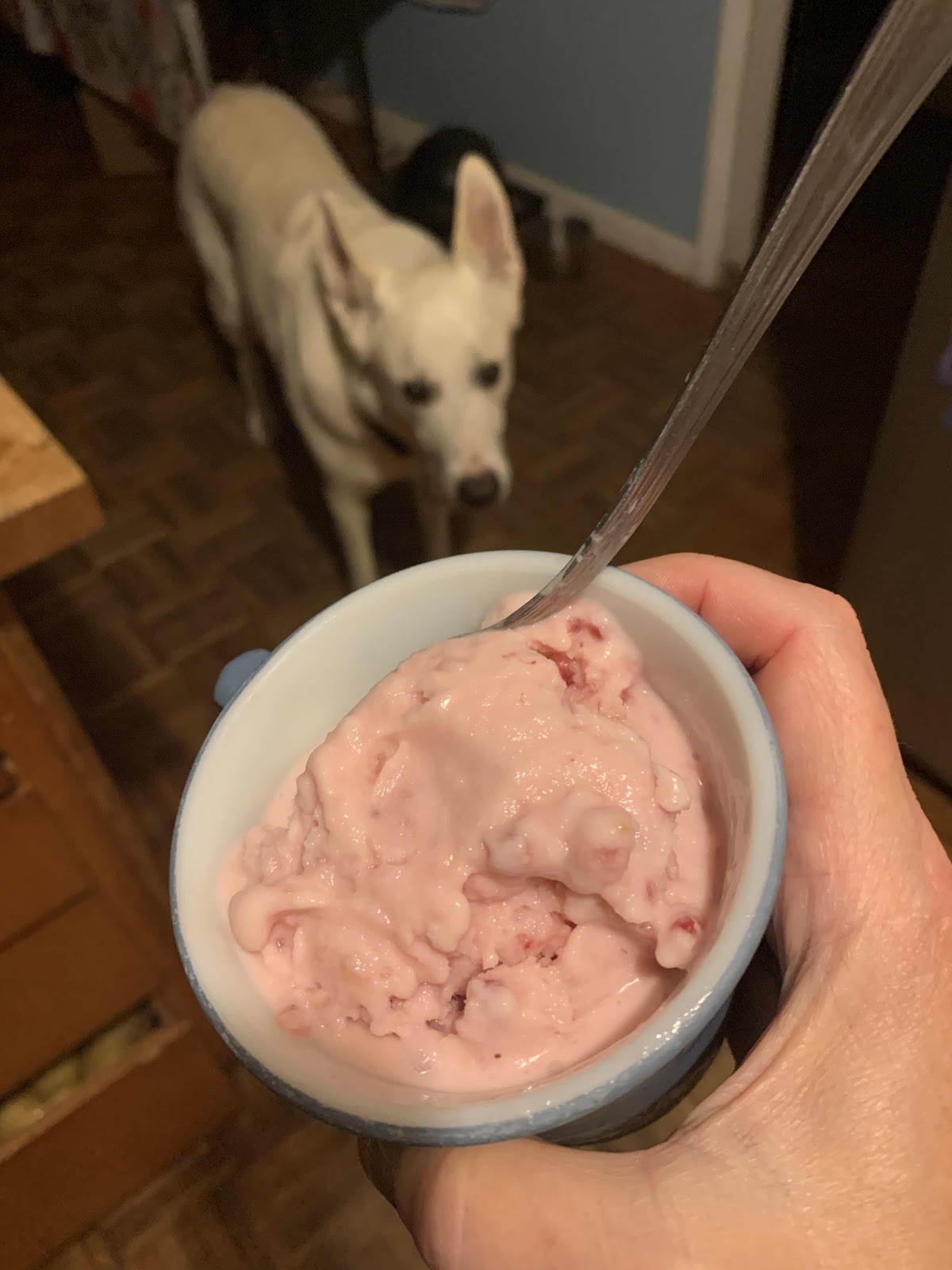
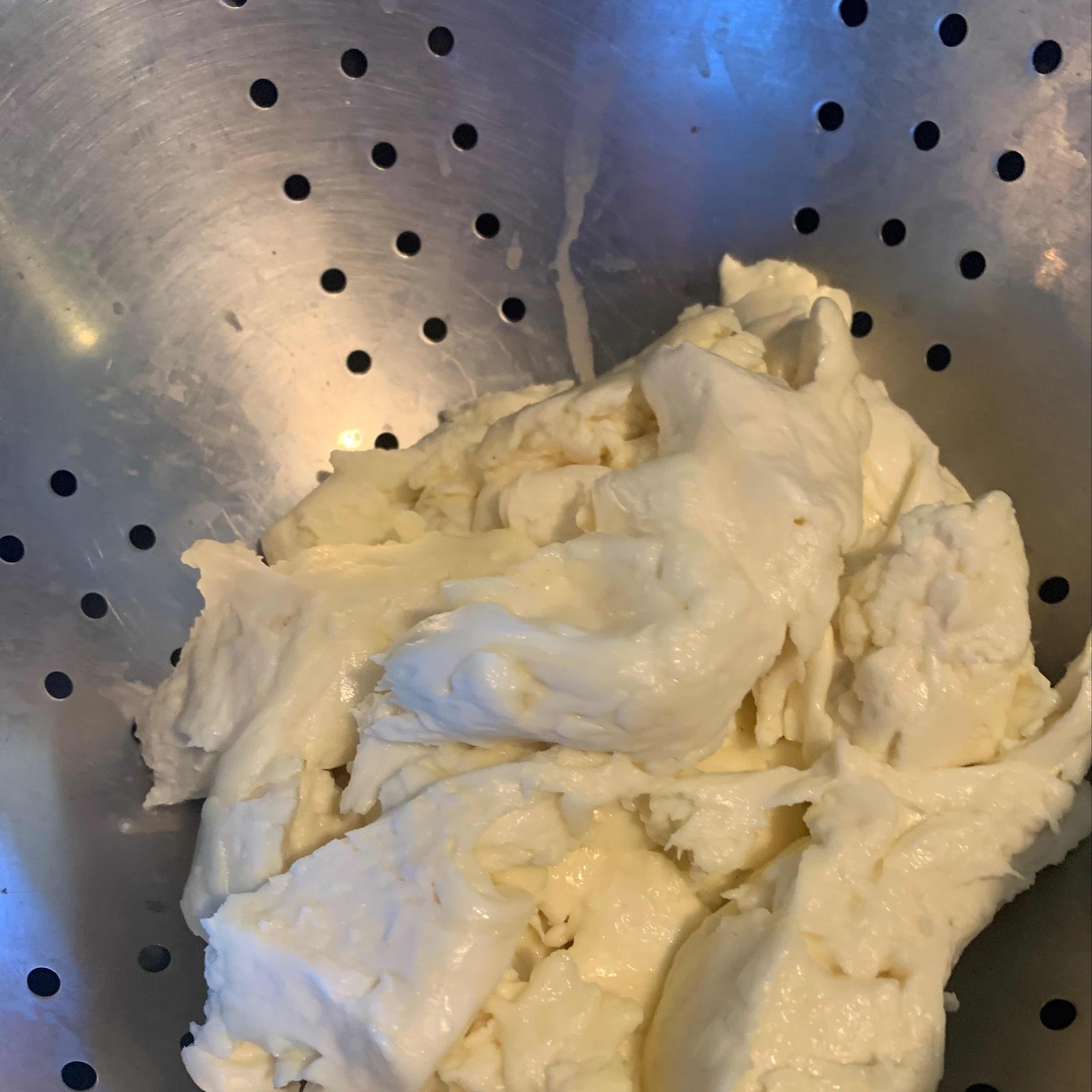
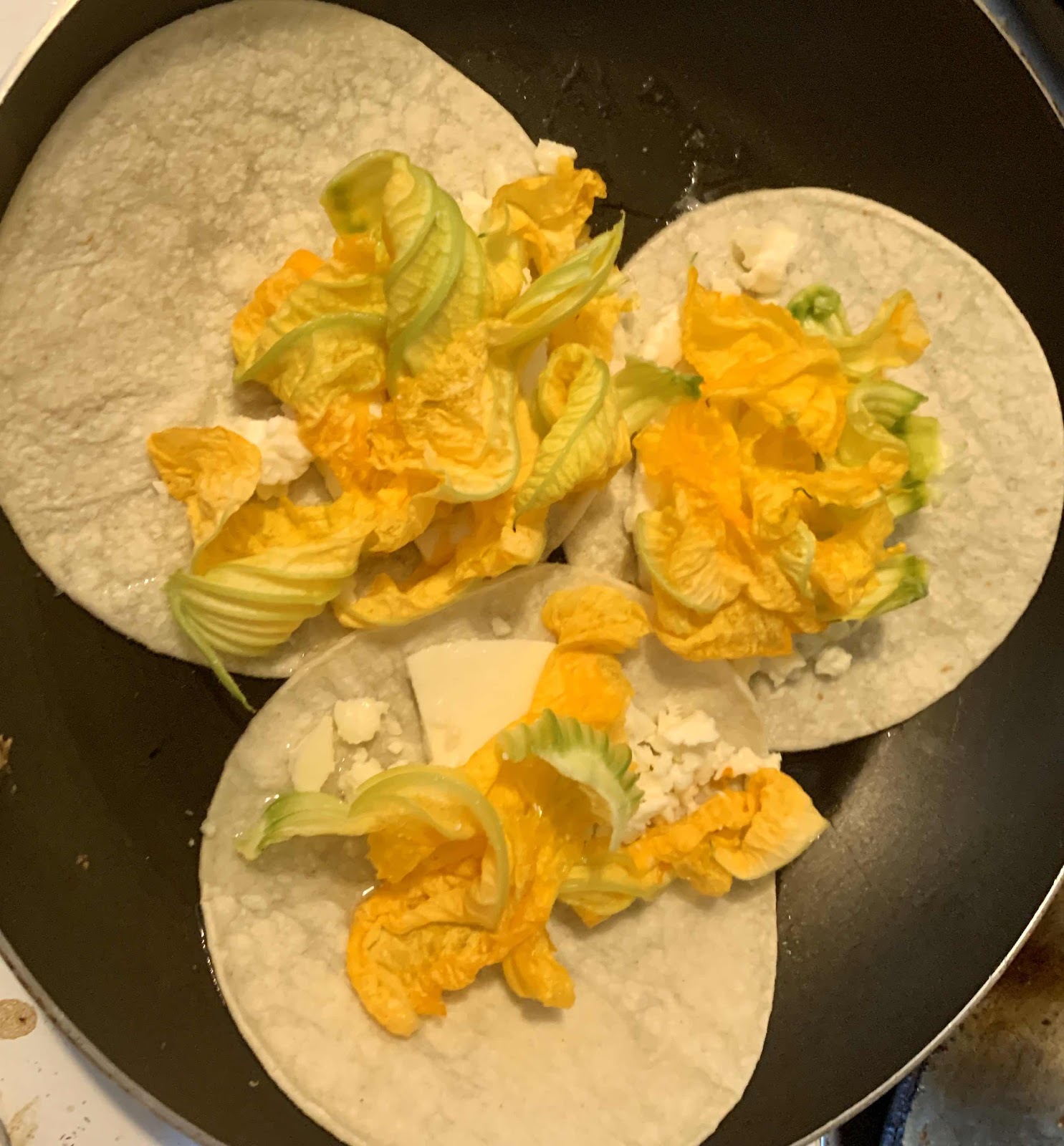
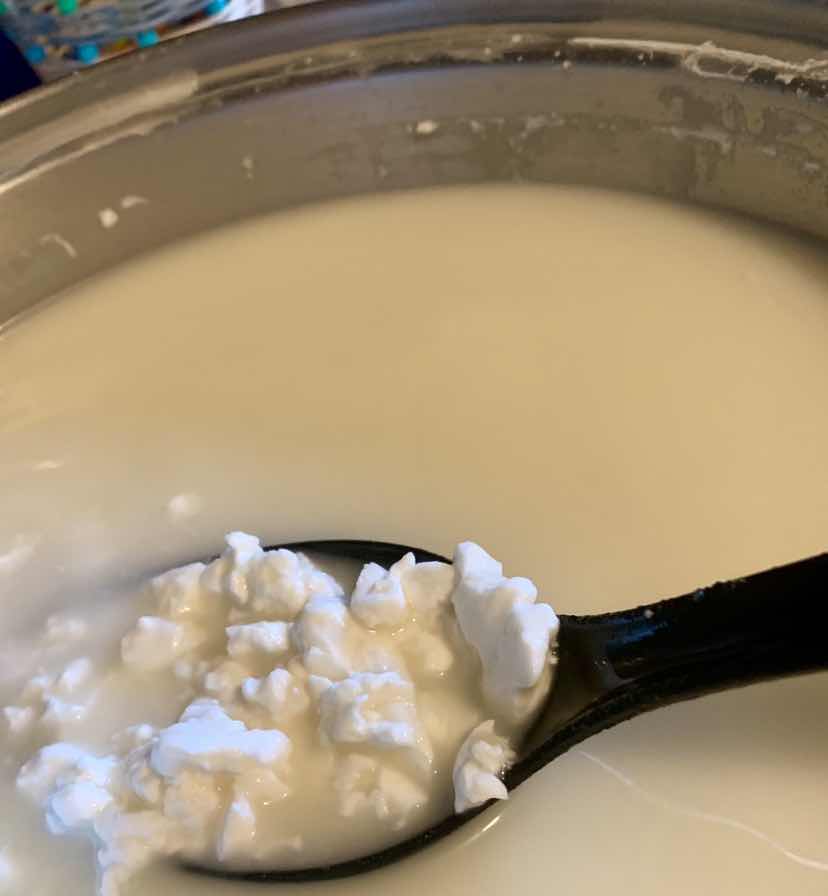
Ran across an ice cream maker at Goodwill the other day, and it reminded me that ice cream is a wonderful way of preserving the products of the season - goat milk, eggs, and fresh fruit. Also it’s been pretty hot lately and that’s just the excuse I needed. I bought the ice cream maker.
Tuesday, July 19, 2022
The Pantry Project (Ice Cream Edition)
Posted by Aimee at 10:39 PM 0 comments
Labels: cheesemaking, food, frugal, frugality, fruit
Sunday, July 19, 2020
High Cheese Season 2020 (Making Do)
A middle stage in the making of cheddar
Posted by Aimee at 5:09 PM 0 comments
Labels: cheese, cheesemaking, fermentation, goats, grass, homesteading, pasture, preserving
Saturday, May 18, 2019
The Fermentation Files, Spring 2019
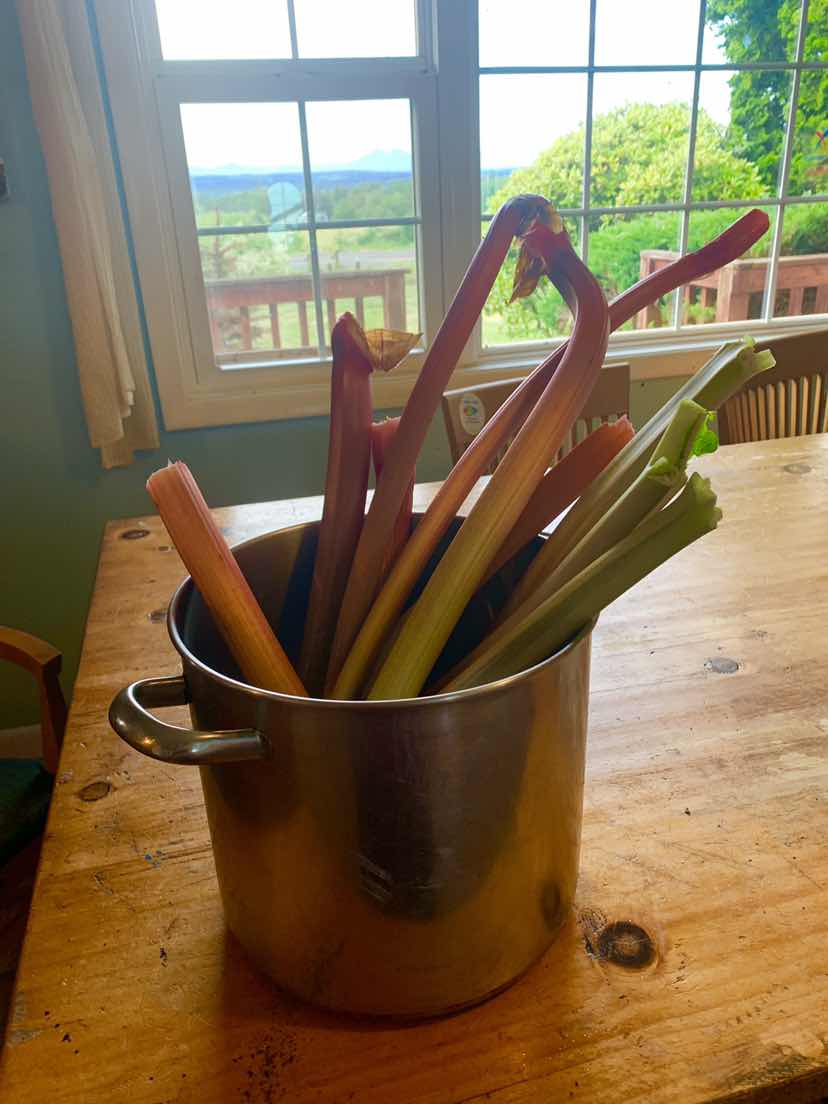
Spring finally sprang, and we’ve had a few weeks of beautiful weather. The grass grew all at once, the trees blossomed, and the rhubarb plant went wild.
Posted by Aimee at 8:00 PM 0 comments
Labels: brewing, cheesemaking, cooking, fermentation, food, milk, preserving, self sufficiency, self-sufficiency, spring
Saturday, August 26, 2017
Vampire Goats
Posted by Aimee at 9:18 PM 0 comments
Labels: cheesemaking, goats, milk
Friday, April 15, 2016
Cheese Season Solutions (Practicality vs. Purism)
Cheese season will be short this year. We are leaving for Oaxaca June 24th, and at that point we will let the does dry off, since Rowan cannot milk and take care of the farm and go to school full time. Right now, Iris is at peak milk production, providing me with just about a gallon of milk a day. The other two does still have kids on them, and I am not usually bothering to separate the kids because Iris is providing me all the milk I can reasonably use.
Unless, that is, I find a solution for the difficult problem of aging hard cheese. I have tried for several years, with little success (okay, no success) to age my hard cheeses. I purchased a wine fridge. I bought cheese wax and waxed the cheeses and stored them in the wine fridge. I read about optimal humidity levels. I turned them over daily. No matter what I did, the wax cracked and the cheese molded within about a month to six weeks.
With larger wheels of cheese (large for me is about a four to five pound wheel) I was able to whittle off the mold and eat the interior of the cheese, but more than half of it was lost, and I could always detect a little moldiness even after trimming. Just seemed like a giant waste and a big disappointment.
So this year I have been making more chèvre, which I can use up in lots of ways (although I feel like an Iron Chef with chèvre as a secret ingredient - "you must use chèvre in EVERY dish") There's about three pounds of it in the fridge at the moment. I still make the hard cheese, my farmhouse cheddar, but we just have to eat it young. It's extremely frustrating, because the cheese continues to improve every day, right up until the day it starts to mold, which is at about one month. Very green hard cheese is not delicious - it's naturally quite sour and one-dimensional. Complex flavors don't begin to develop and the sourness doesn't subside until the cheese is about two weeks old, and then it becomes a challenge to try and eat it before it goes bad two weeks later. I have found that I can speed up the maturation process some by cutting the fresh cheese into 2" cubes and giving them a final salting. But what I really want is to be able to make hard cheese that I can eat six months later.
Recently, an exciting new cheese shop opened up in my town, Twin Sisters Creamery (http://www.twinsisterscreamery.com/#!cheese-shop/cjdh). Not only do they sell a wonderful assortment of cheeses both local and international, but they are cheesemakers as well, producing a terrific blue cheese called "Whatcom Blue," among others. When they first opened, I went in and had a long chat with one of the owners and she was delightful. We talked about cheese for a half hour or so, and she was interested in the fact that there are many home cheesemakers around. I told her I'd be back as soon as cheese season started, and if she wanted to sample some of my goat cheese, she'd be more than welcome. She said she'd love to.
It occurred to me today to go and ask her about solutions for my storage issues. I brought along a wheel of two-day old cheese, and two baggies of cheese cubes, one about two weeks old and one about four weeks old. I was hoping that she would want to taste my cheese and would be impressed with it (I'm a sucker for praise), but mostly I was just hoping she would have some suggestions for aging it successfully.
Turns out, she wasn't there. I spoke to her husband, instead, who was a very kind and friendly guy, but not the head honcho cheesemaker. He didn't want to taste the cheese ("I'm not really a goat cheese kind of guy") and I don't blame him - if I were a professional cheesemaker I certainly wouldn't want to taste random cheese from a local person I'd never met before. He did, however, have a very useful suggestion for me.
A Foodsaver. A vacuum-sealer.
It was kind of a "du-uh" moment.
Vacuum sealers are the kind of medium-large, medium-expensive appliance that I always categorized in my head as "unnecessary gadget." Along with microwave ovens and dehydrators. Less frivolous than ice cream makers or popcorn poppers, but to a culinary purist like myself kind of a cheat.
I always imagined myself - in my daydreams - as learning the real, old world, traditional crafts of aging and curing; hanging salami in natural casings, brining kosher dills in stoneware crocks, brewing and bottling hard cider, and carefully turning and aging my own cheese. It matters not that each of these processes is actually an entire professional category on its own, I cheerfully imagined that I would become an expert in them all. And look good doing it, too.
Time passes and illusions fade. Cheese molds, cider turns to vinegar, and salamis never even get made. Time to get real. Do I want to eat my homemade cheese in November, or not? Am I simply a dilettante, feeding goats year round for the sake eating fresh cheese three months of the year, or am I serious about this thing?
So I bought a Foodsaver. It won't be just for cheese - I can also use it in the fall, for storing home-smoked salmon. I still have some questions, and I still plan on going and asking the head honcho cheesemaking lady about them. First among them, won't the cheese stop maturing once it is sealed? Doesn't it need air to keep developing? Maybe not - after all traditional cheeses are either waxed or develop a rind that severely limits gas exchange. At what stage ought I to seal the cheese? As soon as it's pressed? After air drying for a few days? Just before it would begin to mold?
Assuming I can get some answers to those questions, and assuming I can figure out how to work the darn thing. I will start separating the babies from all three does and try to make cheese two or three times a week until we leave. Hopefully, with a little experimentation, I can start to make maximum use of the oceans of milk that flow in the springtime, and save it for the droughts of winter.
Posted by Aimee at 2:26 PM 0 comments
Labels: cheese, cheesemaking, homesteading, milk, neighbors, preserving
Saturday, April 18, 2015
Three Easy Cheeses (From One and a Half Goats)
![]() |
| Polly and Iris |
This year I have one-and-a-half does in milk. Sounds weird, but it's about right. Polly (black and white, above) had twin babies born early during a snowstorm that didn't make it. She is a good milker and is now giving me about 3/4 gallon of milk a day. This isn't as much as last year - she ought to be at peak production about now and I expected closer to a gallon a day based on last year. However, with the addition of the cow, the pasture is not as abundant as it once was; maybe I am not making up the difference with quality supplemental hay. It doesn't matter much to me - she has good body condition and I don't need to squeeze every last drop of milk from her.
Flopsy had a single buckling a month later, a spectacular spotted boy. It's nice that Flopsy had a single this year, because she is more usually given to throwing triplets, and as a "half a doe" she can't raise triplets. Years and years ago, Flopsy had a serious case of mastitis and lost most of the production on one side of her udder. If this were a commercial operation, we would have had to cull her. Luckily, this is a homestead and I can make decisions that aren't ruthlessly practical. I decided that since Flopsy is fertile, healthy, a good mother and a good kidder, and still capable of raising twins on one teat, she's worth keeping. Indeed, Flopsy brought in the only cash income of the year, with the sale of her flashy buckling. Flopsy adds about three pints a day to the milk total.
Iris didn't get pregnant at all last year - a first. She is the best milker I have and also usually throws triplets. I don't know if it's her age - nine - or the fact that she clearly didn't like last year's buck. She ran away from him and wouldn't let him mount, even though she was in full, raging heat. It's okay though -together, the in-milk does are providing me a little over a gallon of milk a day, which is a lot.
I have to make cheese about three times a week to keep up. This year I have been pretty busy with a new job and so I have settled into a routine of making easy cheese that I am already very familiar with rather than trying to experiment with tricky recipes. Here are my three go-to cheeses, in ascending order of difficulty:
1) queso fresco. Just heat a gallon of milk to 180 degrees fahrenheit, add 1/4 cup of distilled white vinegar, and when the curds separate, strain through a clean cotton cloth. When drained, you can place cheese in a bowl, cut or crumble into small pieces, salt, and then wrap and press (in a press or under a stack of books) for several hours until firm. If you like, add chopped herbs or red pepper flakes when you add the salt. Good for quesadillas.
2) chèvre. Heat a gallon of milk just to blood temperature, no higher. Add mesophilic starter, 1/8 teaspoon and gently stir. Cover and let sit several hours. I like to add two to three drops rennet for a slightly firmer cheese, but if you like it very soft and spreadable, omit this step. Continue to let sit undisturbed for a full 24 hours at room temperature. Then drain through a clean cotton pillowcase. I like to hang my pillowcase up on the clothesline to drip. It will take several hours or overnight to drain sufficiently. Remove cheese and salt, mixing well. Takes about 1 level tablespoon salt per gallon of milk, less if you have drained the cheese until it is very thick and dry.
3) "cheddar." This is probably not really cheddar; it's my simplified recipe that I have developed over the years. For a gallon or up to two gallons of milk. Heat to blood temperature and add 1/8 tsp mesophilic starter. Cover and let sit undisturbed about 2 hours. Add five drops rennet and gently stir. Wait until curds separate into a cake with whey floating on top - about two more hours. Check for a clean cut with a thin-bladed knife. Make three or four cuts and then wiggle the pan - the cheese should separate cleanly with sharp lines. If not, wait longer, up to 8 hours if room is cool.
When you have a clean cut, use your knife to cut curd into small cubes - about 1/2". Heat gently to about 105 - warm bath temperature but not hot. Stir. Curds will firm up and whey will get clearer. Stir continually for as long as you have available - up to 45 minutes. Curds will become rounded, shiny, and firmer. Drain through a clean cotton cloth. Salt well, using hands to turn and knead for a few minutes. Then wrap in the cloth and press under firm pressure - about 50 pounds. You will need a press for this - a 50 pound stack of books is very wobbly.
Press overnight. Turn cheese and press under even firmer pressure - 75?- for another 10 to 12 hours. Remove cheese from press and let air dry (under cheesecloth to protect from flies) for about 2 days, turning once. Then cheese may be waxed and stored at cellar temperature. My oldest "cheddar" is now about 10 weeks old, but I haven't broached it yet so I can't tell you how it turned out.
It goes without saying that all of your equipment ought to be not just clean but sterile - use only stainless steel or tempered glass, something that can withstand being washed with boiling water. I keep a small pot of water simmering on the stove for my spoons, thermometers, etc. Only the cotton cloth cannot actually be sterile - but after each time I unwrap cheese, I wash it and wring it out in very hot water and then hang it up to dry outside in the breeze. I wash it again in hot water just before use.
Two of the above recipes use unpasteurized milk - that is up to your discretion. The recipes will work equally well with pasteurized milk. Just heat milk to 160 degrees. Boom, it's pasteurized. If anyone who might eat the cheese is pregnant or has an immune deficiency disease the milk MUST be pasteurized. Not to do so is to court Listeria, Salmonella, E. Coli, and other dangerous diseases. Even healthy, well-cared-for animals harbor these bacteria in their gut. I wash my hands!
Posted by Aimee at 4:30 PM 0 comments
Labels: cheese, cheesemaking, goats, recipe
Sunday, March 8, 2015
Nettle Season (Copycat Cheese)
Today was a beautiful unseasonably warm day for March. I think it was 60 degrees. We took the kids down to the beach, where it was warm enough for them to roil up their pant-sleeves and squish around in the cool mud, turning over rocks and looking for crabs and limpets.
It was more than warm enough for me to move some dirt around and plant some things in the garden - radishes, arugula, peas, even potatoes - but I have been sinfully lazy. In fact a large part of the reason we went to the beach is so I wouldn't have to feel guilty for not working in the garden.
Much easier than shovel-work is scissors-work: in the afternoon, after we got home from the bay, I took a pair of kitchen gloves, a pair of scissors, and a big brown paper bag and went out to the field to harvest nettles. In the past, I have usually used the nettles to make Avgolemono Soup, but this year I decided to make nettle cheese.
On the way to the bay, there is a wonderful local cheese maker, Samish Bay cheese. They sell their beautiful cow's milk cheese at local farmer's markets,. and they are justly locally famous for their Ladysmith Cheese, Gouda flavored with Caraway, and Jalapeño Queso Fresco. They also have a seasonable fresh cheese, available for just a few months each year, flavored with nettles.
I adore stinging nettles. Well, let me amend that statement just a little - I love eating stinging nettles; I do not love accidentally wading into a patch of them in capri-pants. Stinging nettles are a wild child's nemesis - lying in wait along roadside ditches and fence-lines to attack the unwary. The merest brush of the dusty green leaves against bare skin causes a sting that lasts hours - not for nothing is this plant's name is Spanish "Mala Mujer."
However, the sting is easily removed by drying or by blanching for even a few seconds in boiling water. I put a full kettle on to boil, place the nettles in a colander in the sink, and trickle the boiling water over the nettles. Let sit for five minutes, then rinse with cold water and squeeze to remove excess water. Then they are ready to be used as food or medicine. Many herbalists consider the nettle to be a near- panacea (see, for example http://www.herballegacy.com/Vance_Medicinal.html) and I certainly can't quibble. But there is no doubt as to nettle's nutritional qualities.
Plus, they are just plain delicious. They taste like a blend of spinach and asparagus. They have a full, soft texture and a wonderful mouth-feel. They are one of those foods that you can feel make you stronger and healthier as you eat them.
Tonight, I am going to try making my own version of Samish Bay's nettle cheese. I am making my basic cheddar recipe, but in the second pressing I will add the finely chopped nettles along with the salt. Of course, I am working with goat milk instead of cow's milk, and also my cheese is made from raw milk whereas their's is pasteurized. I expect it to be delicious. I'll let you know.
Posted by Aimee at 8:13 PM 3 comments
Labels: cheesemaking, seasons, spring, weeds
Tuesday, April 8, 2014
A Day in Cheese Season (Okay, Half a Day)
A day during cheese season actually begins in the evening, when I make the decision whether or not to separate the baby goats from their mothers for the night so I can have milk in the morning. Checking the fridge last night, I saw that I had three quarters of a gallon of milk in the fridge, which would be enough to try making yogurt, but not really enough for cheese. Since I have some store-bought yogurt in the fridge, but no cheese, I decided to milk in the morning.
Right now I have two milkers, Flopsy and Polly. Each of them have a single buckling on them. They each threw twins, but Polly's doeling died, and I sold one of Flopsy's bucklings. Every evening, I have to go outside and catch the little buggers. Until recently, I was closing them in the mama barn during the night, but this had a few drawbacks. When Iris kidded, she needed the mama barn for a few days. I probably could have left the bucklings in there with her and the newborns - what harm could they do? However, there is another reason I wanted to find a different place to put them.
When I go out in the morning, I have a logistics problem to deal with. I have to get two babies OUT of the mama barn, and two mamas IN (one at a time, of course), because that is where the milking stanchion is. Once the babies are released, they will instantly run over and latch onto their mama's teat, and I will lose the milk. So I need to get them from the barn into some other secure location. This other location used to be the adjoining small pasture, and the routine went like this:
- Open the mama barn door, keeping my body between the opening and the does, who instantly try to crowd inside, because they know that's where the food is.
- As the babies come hurtling by me, trying to get outside to their mamas, grab one.
- Shut the mama barn door before the other baby gets out.
- Carry a struggling, yelling baby goat fifty feet across the barnyard to the fence, and throw him over the top into the adjoining pasture.
- Repeat.
But bucklings grow quickly, especially when they are singles and are guzzling down a gallon or so of milk a day. Blizzard, the oldest, weighs about thirty pounds already, and chucking him over a four foot fence isn't easy. Also it is not uncommon that I get mildly injured somehow during the crush at the mama barn door - I've slammed my hand in the door; the mama goats stand up on me and knock me down; the baby goats struggle in my grasp and scratch me with their surprisingly sharp hooves.
| the bucklings, Blizzard and Comet |
Milking the mamas is another job. Polly, though a good milker with delicious sweet milk, has never learned to jump up on the stanchion. She will poke her head through the bars for food, and I can close the stanchion and trap her, but then I have to lift her hind end bodily onto the stanchion, which is annoying and difficult. Why she won't jump up I don't know; all the other goats do. Then she tries to squeeze her hind legs together and deny me access to her udder. Polly is giving about a quart and a half every morning.
Flopsy has a diminished milk supply on one side due to mastitis a few years ago, but even so she gives almost as much milk as Polly. She is much easier to milk, but all goats that I have ever known will start kicking as soon as they run out of food in the stanchion tray. I must always have a container of grain by my side, and as I milk, I toss scant handfuls into the tray. The idea is to extract maximum milk for minimum grain. Because there have been does in the mama barn recently for kidding, we have had to put the grain up on the highest shelf, and getting a container of it down isn't easy for me. I have to climb up on the stanchion myself, reach up over my head and pull a tote with fifty pounds of grain inside towards me, and try to scoop out a couple pounds without toppling it over on myself or falling off the stanchion. Maybe (and here's an idea that just occurred to me) a stepladder wouldn't be a bad idea.
| Bibi with Iris' doling |
8:15 Come back inside, curse at realizing I forgot to put on water for coffee. Put on water for coffee.
Realize it's okay there's no water hot because I have to use the Melitta filter to filter the milk anyway. Make a mental note to buy a second Melitta filter so I can make coffee and strain milk at the same time.
8:30. Yell at kids, try to think of something to feed them that I can make and they can eat in less than twelve minutes. Usually this means a banana smoothie and some bread. This morning, I have leftover beef vegetable soup from last night.
8:45. Kids out the door to the school bus. Milk filtered and put away in the fridge, coffee made. Homero and I have a few minutes to drink it and read the morning news.
9:00. Look around the kitchen and realize I have a solid hour of cleaning to do before I can begin the cheese making process, which requires a fairly spotless kitchen environment. Sigh heavily.
9:20. Make a deal with Homero that if he will clean our room, I will make him anything he wants for dinner. He chooses chiles rellenos, which means in exchange for his half an hour cleaning, I have to go shopping, and then spend about three hours cooking, and the children will all complain because they hate chiles rellenos. Oh well; I made this deal.
10:00 Dishes washed and sink scrubbed; put milk to heat on stove. Remember to check recipe for cheddar in cheese making book. Search for cheese making book. Find book under a pile of homework that probably should have been brought to school to turn in. Also find an overdue library book. Check recipe; proceed.
10:30 Check laundry on the line in the playroom to see if it is dry; it is raining hard outside and there's no drying laundry on the outside line. Also no drying laundry in the dryer, which continues, annoyingly, to be broken. It's not dry.
11:00 Add rennet to warm milk. Tell husband proto-cheese needs to sit for an hour and I will go to the store to shop for ingredients for chiles rellenos. He says he's going out to the shop to work. Not cleaning our room? No, he says, he'll do that later. If you think you are getting any chiles rellenos before that room is clean, you've got another think coming, say. Have small spat. Get in the van, notice there's no gas. Go back inside to get money for gas. Kiss and make up.
12:00 Come home with ingredients. Realize I forgot to buy Melitta coffee filter. Roast chiles under the broiler and cut the curds in the cheese. Next twenty minutes: go back and forth between stove top and oven, turning chiles, and stirring curds. Burn fingers. Drain curds.
12:20 Remove chiles to cool. Peel chiles. Salt the drained curds and mix well, then wrap and put into cheese press. Stare lovingly at beautiful cheese press made for me by my husband for mother's day a few years ago. Feel bad that I snapped at sweet husband who made me excellent cheese press. Wallow in guilt for two minutes.
![]() |
| the beautiful cheese press |
1:00 Check recipe again. Per instructions, unwrap cheese, salt, turn upside down, wrap again and put back in the press.
1:10 Facebook.
1:30 Turn cheese one more time; crank up pressure on cheese press. Think about writing this blog post. Think about taking a hot bath. Vacillate. Feel vaguely guilty about not writing much lately; wonder who the hell cares if I write or not? Feel vaguely sorry for myself. Decide to write.
1:50 Finish blog post. Take a hot bath.
![]() |
| queso fresco with chives |
Posted by Aimee at 1:36 PM 4 comments
Labels: cheesemaking, husband, work
Saturday, June 11, 2011
Massive Milk Overload (How to Make Paneer)!
I sent all my non-lactating goats to a friend's house to clean up her yard, and so for the next week or so I will be collecting nearly three gallons of milk a day. Probably that means it's time to can the year's supply of cajeta (goat's milk caramel sauce). I am actually all out of cheese making supplies - culture and rennet - so I'm going to order some more. It will take three days for the supplies to arrive in the mail, but in the meanwhile I can always make paneer - vinegar soured cheese.
Most of you are probably familiar with paneer from your local Indian restaurant - Saag Paneer is the famous pureed spiced spinach with cubed cheese dish. However, Paneer is used in any number of ways in Indian cooking, both sweet and savory. I tend to be lazy, which means I simply toss cubed panner into whatever type of curry I am currently simmering on the stovetop - peas and potatoes are popular, as are tomato based curries or chickpea or lentil stews. In my wonderful cookbook "660 Curries" by Raghavan Iyer, there are some thirty recipes for Paneer utilizing everything from cashews to cabbage. Most of them call for the paneer to be fried in shallow oil until golden beore being added to the curries, but you can skip this step if you want. Paneer is also great tucked into a hot folded tortilla or crumbled into a pan full of scrambled eggs. In fact, Paneer can be used pretty much any way you would use a fresh farmer's cheese or queso fresco. It works in quesadillas, for example. Indians use it in desserts, but I can't offer any recipes because I've never tried that.
What I love about it is that Paneer is "easy cheese." It requires almost nothing in the way of equipment or supplies. If you have a colander and some clean cloth, you can make paneer.
Paneer:
1 gallon milk (fresh raw milk will have the most flavor, but plain store bought cow's milk will work as well)
2-4 tablespoons distilled white vinegar
salt
Heat milk in a large pot to near boiling - about 180 degrees if you have a thermometer, or until it begins to rise up if you don't. Remove from heat. Drizzle in vinegar, stirring, until you see curds separate from whey - this will take about 1 minute.
Line a colander with a triple thickness of cheesecloth or with a section of plain cotton cloth cut from a pillowcase or sheet. Pour the contents of the pot into colander, slowly enough to let whey drain and curds be caught. Fold clean cloth over the top and let sit overnight.
In the morning, cut cheese into 1/2" cubes and salt heavily. Use in Indian or Mexican recipes or in grilled cheese sandwiches, or as you like.
Posted by Aimee at 10:55 AM 1 comments
Labels: cheesemaking, goats, milk
Sunday, May 8, 2011
Best Mother's Day Present EVER (Thanks, Baby, You're the BEST)
Today was great. The best mother's day I can remember, in fact. Many things about today were nice - lunch at my sister's with Mom and family; a late afternoon sunbreak; barbecue ribs and potato salad - but the best thing about today, as it is most days, was my husband.
Homero spent yesterday out in his shop, working on a mysterious present for me. All I knew about it was that he came in with greasy hands and that welding was involved, but that pretty much mirrors his daily routine, so I couldn't guess. He was fairly smug about it, however, supremely assured that I was going to love it. The little girls, who knew, did an admirable job of keeping the secret, only giggling uncontrollably as I interrogated them: "Is it bigger than a breadbox? Does it walk and talk? Does it wriggle on it's belly like a reptile?"
He wouldn't even give it to me this morning, but insisted on taking it with us to my sister's house so I could open in front of everybody. Which I did. And here it is:
It's okay; it took me a minute, too. It's a CHEESE PRESS! A beautiful, beautiful CHEESE PRESS, about two feet tall. The cheese basket (?) is a stainless steel pot from Goodwill, in which Homero drilled several drainage holes. He then cut the lid so that instead of sitting on top of the pot it slid neatly inside of it. Then he made the frame. The handle on top spins, lowering or raising the pressing-arm (I really know my technical language, don't I?). The entire machine is stainless steel for easy cleaning, and I LOVE LOVE LOVE it!
No more wobbly stacks of books! No more kettles of water precariously balanced on top of a colander! No more sudden crashes in the night, waking us all out of a sound sleep! Now I have even, controlled pressure. Now I can make beautiful round wheels instead of irregularly shaped lumps. Now I feel like a real cheesemaker!
The best part of all is the beautiful knowledge that my husband knows what is important to me. He really thinks about my desires, he respects my work and he wants to help me. He has done this before - once he spent weeks making me a whole series of gigantic stretched canvasses for me to paint on. I still haven't used them all. I am so very lucky to have a man like Homero. Not only does he know me and love me enough to think of these terrific gifts, but he is capable of making them a reality. And willing to spend time and sweat on them, too. I am so grateful and so moved and so happy.
And I haven't the FAINTEST IDEA how I am going to top this for father's day next month.
Posted by Aimee at 7:45 PM 3 comments
Labels: cheesemaking, husband
Wednesday, April 27, 2011
Cheesy Success!
It;s just about suppertime, so I have no time at the moment for a detailed explanation, but I have FINALLY created a reasonable facsimile of Quesillo, also known as Queso Oaxaqueno, a fresh mild string cheese which is wound into balls and used in quesadillas and as a topping for just about anything. Also it is my husband's favorite unavailable food from home, and I have been trying to make it for years now without notable success.
Consistency is the demon that torments all cheesemakers, of course, and one batch of decent quesillo does not guarantee success in future attempts. But nonetheless, I'm thrilled that I've done it once.
Posted by Aimee at 6:42 PM 0 comments
Labels: cheesemaking, goat cheese, mexican food
Sunday, October 31, 2010
Gimpy Goat and No More Milk
This is Django. She is one of the original three goats we bought when we moved here, and now she is the only La Mancha I have (La Manchas are the earless goats. Nobody cut off her ears: it's just her breed.). Django has always been a good goat - good mother, good milker, about as easy-going as a goat gets. She did get terribly ill a couple of years ago after getting into the grain, but she recovered and has been pretty healthy ever since. She had triplets this past year.
Posted by Aimee at 12:53 PM 5 comments
Labels: accident, cheesemaking, farm, goat, injury, milk, veterinarian
Friday, October 1, 2010
Serious Disappointment
Subject: Good Food Awards Entry Notification
Dear Aimee,
Posted by Aimee at 5:37 PM 7 comments
Labels: cheesemaking, goat cheese
Wednesday, September 29, 2010
Great, Now I'm Terrified
On a total whim, I entered one of my cheeses (the seedy dill and caraway) into the national Good Food Awards contest (Good Food Awards). This is a "first annual" event - just like my swap meet, ha ha ha - meant to honor producers of local, artisanal food in several categories, which include cheese, beer, pickles, preserves, and charcuterie.
Posted by Aimee at 6:06 PM 8 comments
Labels: cheese, cheesemaking, goat cheese
Thursday, June 17, 2010
The Quesillo Chronicles
Posted by Aimee at 8:16 PM 9 comments
Labels: cheese, cheesemaking, goat cheese, mexican food, milk, recipe
Wednesday, May 26, 2010
One Giant Leap for Cheese
Posted by Aimee at 9:24 PM 10 comments
Labels: cheesemaking, milk, preserving, self-sufficiency
Sunday, April 18, 2010
Aimee's Excellent Snacks
Posted by Aimee at 5:59 PM 4 comments
Labels: cheesemaking, farm, gardening, goat cheese, homesteading, locavore
Thursday, April 15, 2010
Easy-Cheesy (No Room at the Inn)
Last week, I started separating the baby goats at night. Now I am getting a crazy-large volume of milk, a volume that must be dealt with daily. If I don't do something with milk at least every other day, there will soon be no room at all in my fridge. The eggs are space-hogs. I have seven dozen eggs in there now, and the hens are outside popping out more even as we speak. I need to step up the trade network; but that's a topic for another day.
Posted by Aimee at 10:20 AM 7 comments
Labels: cheesemaking, eggs, mexican food, milk, recipe, self-sufficiency
Friday, January 1, 2010
2010 To-Do List
Posted by Aimee at 12:25 AM 7 comments
Labels: cheesemaking, farm, farrier, fence, homesteading, husband
Wednesday, September 9, 2009
Cheesy Goodness
I made a new type of cheese today. Black Pepper-Rosemary Queso Fresco. It's good. It's really, really good. That brings to four the kinds of cheese I can make (well okay, really it's flavors, not kinds so much:
Posted by Aimee at 1:10 PM 5 comments
Labels: cheesemaking