"United we bargain, divided we beg."
Showing posts with label bread. Show all posts

Friday, January 6, 2023

Rosca de Reyes (King Cake)


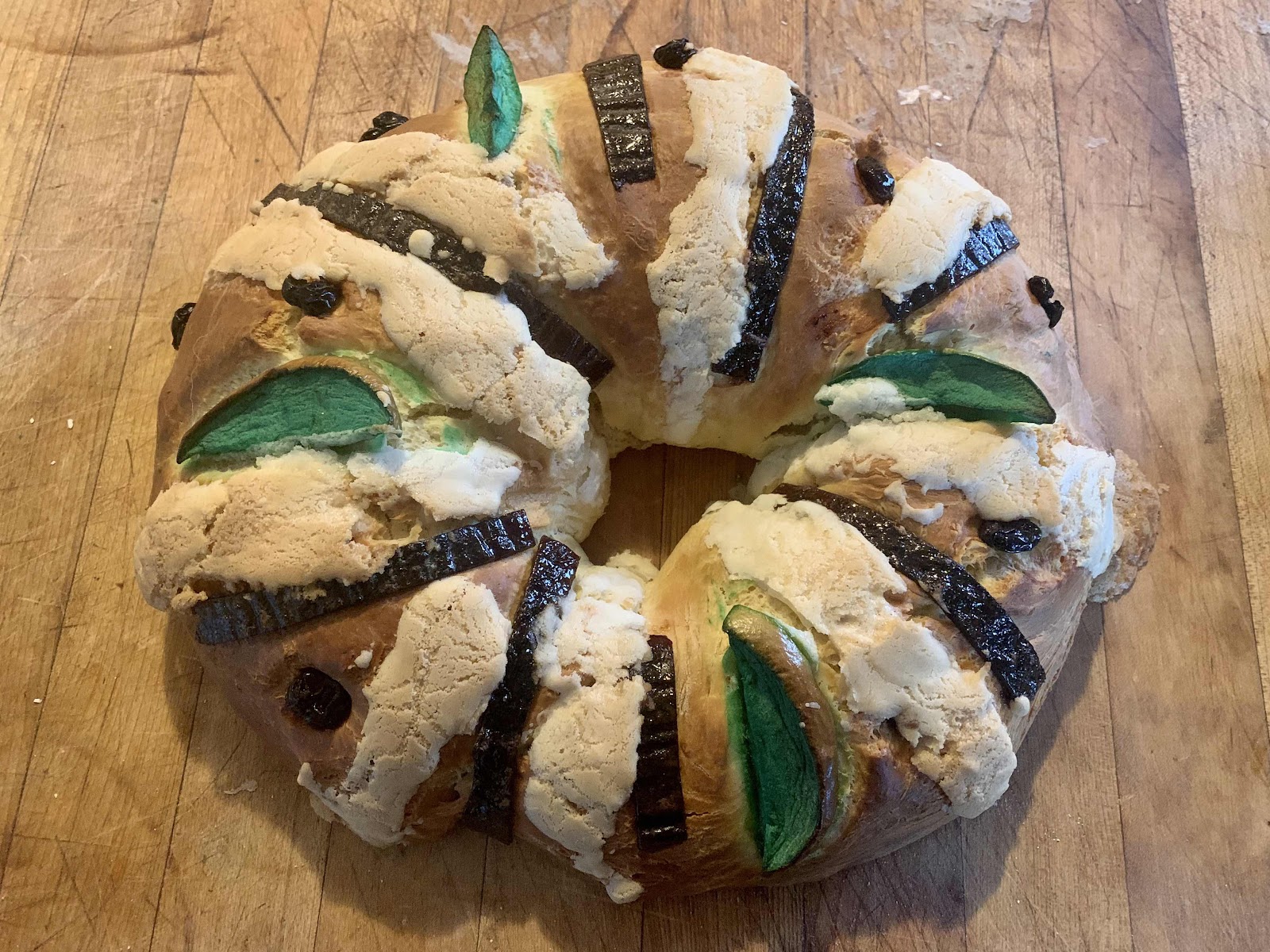
I made this lovely Rosca de Reyes cake today, which is January 6th - also known as Epiphany and the Three Kings day. 

Mexicans celebrate three kings day with a Rosca de Reyes, or a King Cake. It’s a sweet egg-and-butter enriched bread studded with dried fruit, nuts, and sugar paste. Sometimes it’s stuffed with marzipan. And somewhere inside it, there’s a little statue of the baby Jesus. Or a baby anyway. The tradition goes that whoever gets the baby Jesus in his or her slice of King Cake has to make tamales for the next feast on the calendar, which is Candelmas - February second. 

(For a post about Candelmas/Imbolc, click here http://newtofarmlife.blogspot.com/2014/02/imbolc-repost.html?m=1) 

Like many other catholic feast days, Epiphany has some Pagan antecedents. The tradition of a King Cake goes way back in pre-Christian Europe. Instead of a baby Jesus, a dried broad bean would be baked into the cake and the person who found it was crowned King for a day. 

This is an example of a topsy-turvy festival, when a peasant can be a king and vice versa. The Bean King would be the focus of the celebration and the center of attention. He could behave however he wanted for the night - get super drunk, grope the girls - without repercussions. Such festivals upset the social order and let people blow off steam, flouting the norms which they have to live by the rest of the year. 

But in the REALLY way back days, in some bronze-age planting societies across Eurasia, the bean-king was no laughing matter. Instead of being king for a night, he was made the sacred king for a year, during which he was given the best of everything and revered by everyone. But when the next year’s planting time came around, he would be killed and his blood poured on the fields to ritually fertilize them. 

There is no bean in my cake, nor is there a tiny baby Jesus statue. Oddly enough, I don’t actually own such a thing. For the decorations, I used strips of my homemade fruit leather, and thin slices of dehydrated pears colored with green food coloring. Tonight we will enjoy it with hot chocolate and nobody will be King. 


Saturday, March 10, 2018

The Fermentation Files (Spring 2018)


As usual, I have a couple of different fermentations going on in the kitchen. At this point in time, after years of tinkering and experimenting, home-fermented foods are simply an everyday part of our diet - which is as it should be. Fermented foods have been an integral part of the diets of people in all parts of the world for centuries, if not millennia.

http://fermentalitylab.com/116655-2/

Fermentation is the answer to many problems - how to preserve fresh vegetables through the winter; how to turn easily spoiled milk into delicious, storable cheese and yogurt; how to increase the digestibility and the vitamin content of tough root vegetables; how to get drunk and party through a long, drab, grey season.

Fermenting  is a traditional and easy way of preserving fresh vegetables through the cold season in four-season climates, like northern and Eastern Europe where most of my ancestors came from. It is the only method of preservation that actually increases the nutrient content of the food being  preserved. Bacterial action produces high levels of B vitamins, including the hard-to-find B12.

Discover-the-Digestive-Benefits-of-Fermented-Foods_1383-1.html


My Kefir. A few years ago I bartered for some kefir grains and was sadly disappointed to learn that I couldn't put them in fresh, raw goat's milk. When I tried that, they died overnight. Turns out - as I could have learned from a very short investigation online - if you want to propagate a particular SCOBY (Symbiotic Community Of Bacteria and Yeast), you need to cultivate it in a relatively sterile medium. Raw milk is chock full of it's own community of bacteria and yeasts, and they are stronger and more vigorous  than whatever you are trying to grow. I was basically starting WW3 every time I put a few kefir grains into raw milk. And my soft, domesticated culture lost every time. The kefir grains I bought turned into sludge and disappeared.

The last time we went to Oaxaca, two and a half years ago, I got new kefir grains from my mother-in-law. She calls them "bulgaros" and she calls the product they create "yogurt." In fact (or at least in English) yogurt is something different - simply milk cultured with certain bacterial strains, and it can be propagated indefinitely just by adding old yogurt to new, scalded milk. Kefir is a different animal - a SCOBY. You can make new yogurt from old yogurt, but you can't make new kefir from old kefir. You need the SCOBY - the grains.

These look like little niblets of cauliflower. Keeping them alive and growing is fairly simple. Put a tablespoon of kefir grains into a pint of pasteurized milk. Let sit for 24-48 hours. Strain. The thickened, digested milk that you strain off is kefir. Wash the grains in water several times, swishing and draining. Then place in new milk. Some books will tell you to wash the grains in milk, and not water. Don't believe them. When I did that, the grains melted over time into sludge. As soon as I started washing them in water every two days, they grew amazingly. Which is what my mother-in-law had been trying to tell me, but for reasons of cultural imperialism and white privilege I had been ignoring her wisdom in favor of some white dude who got published. If you are lucky enough to have access to an intact system of food production, utilize it! Go figure.


Sauerkraut. I probably wouldn't make sauerkraut very often except that my daughter Hope loves it. I like sauerkraut just fine, but its not what I would call a staple food. It is, however,  one of the easiest and cheapest ferments One head of green cabbage, and one or two tablespoons of salt, depending on the weight of the cabbage. Shred cabbage finely , massage with salt, pack into a glass jar and pound down tightly with a wooden pestle. Let sit on the counter at least one week, then test for sourness. If you like the taste, rinse quickly under running water, squeeze, and pack into smaller ja and put int he fridge.


Making bread. I lost my sourdough starter several months ago. This is a quick focaccia bread, made with store-bought yeast. Still yummy, however. I love baking, it makes me happy and nothing makes the house smell so good.

Tuesday, May 10, 2016

Fermentation Files (Sourdough)


A couple of months ago, a neighbor gave me some sourdough starter that had been in her family for a very long time. The label on the container said "Skilly Dough, Alaska, 1890." While I can't vouch for the history, I can vouch for the deliciousness. 

For the first few weeks I used it only to make pancakes. I had never made sourdough pancakes before, but that was how my friend used the leaven, so I decided to try it. The pancakes were incredible, with a complex tang I had never tasted before. 

Next I tried making naan - Indian flatbread. That was a revelation, too. The flatbread went from being merely a way to convey curry into my mouth to being the star of the meal. The curry became merely a seasoning for the chewy, delicious bread. 

I made challah - sweet egg bread - for Easter, but I wasn't very happy with it. It was too dense, almost a kind of bread pudding, moist and rich with egg yolks and sugar. It tasted good, but it was not what I was trying to make, and nobody could eat more than a tiny bit of it. 

The same thing happened when I tried to make seeded rye rolls. I didn't get the lift I needed, and the bread, though flavorful, remained dense and wet, without the airiness I wanted. 

I let the sourdough languish in the fridge. A thick crust formed on top, and I thought that I might have let it die entirely. As a test, I took about a tablespoon out of the jar and mixed it with a cup of flour and a cup of warm water. The next day the mixture was bubbling vigorously, so it obviously hasn't died. 

Today, I took that mixture and mixed it with a cup of fresh warm goat's milk, a half cup of sugar, half a stick of melted butter, and more flour. I kneaded it for five or ten minutes and let it rest for a few hours. It didn't double in bulk, but it definitely grew. 

I kneaded it again, formed it into an oblong oval, places it on a greased cookie sheet, and let it rest another hour. Then I slashed the top, preheated the oven to 375, and baked it for 45 minutes. 

As you can see, it's freaking gorgeous. A little bit of the bottom crust stick to the cookie sheet and so I had to pry it off and eat it (I HAD to) with butter. It was perfect - shatteringly crunchy, slightly sweet, and toothsome. I am currently waiting impatiently for the loaf to cool and finish cooking on the counter, before j can slice it and slather it with butter and devour it. 

It smells so good in my kitchen I had to go disturb my husband, who was watching a movie, and make him come into the kitchen and smell the bread. He agreed with me that it smells heavenly and that furthermore I am a genius and he is a lucky man to have married a woman who can bake such a miracle.