"United we bargain, divided we beg."
Showing posts with label food. Show all posts

Wednesday, September 20, 2023

Merry Mabon (preserving log)


Dressed the altar for Mabon today, a day or two early. I’ll continue to add to it as the season progresses. I bought these Japanese lanterns from a nearby farm stand, but they also had the live plants, and I bought a few and planted them in my garden. Hopefully next year I can harvest some of my own. I also want to add more seasonal plants - I like the red amaranth and yellow tansy at this time of year. 


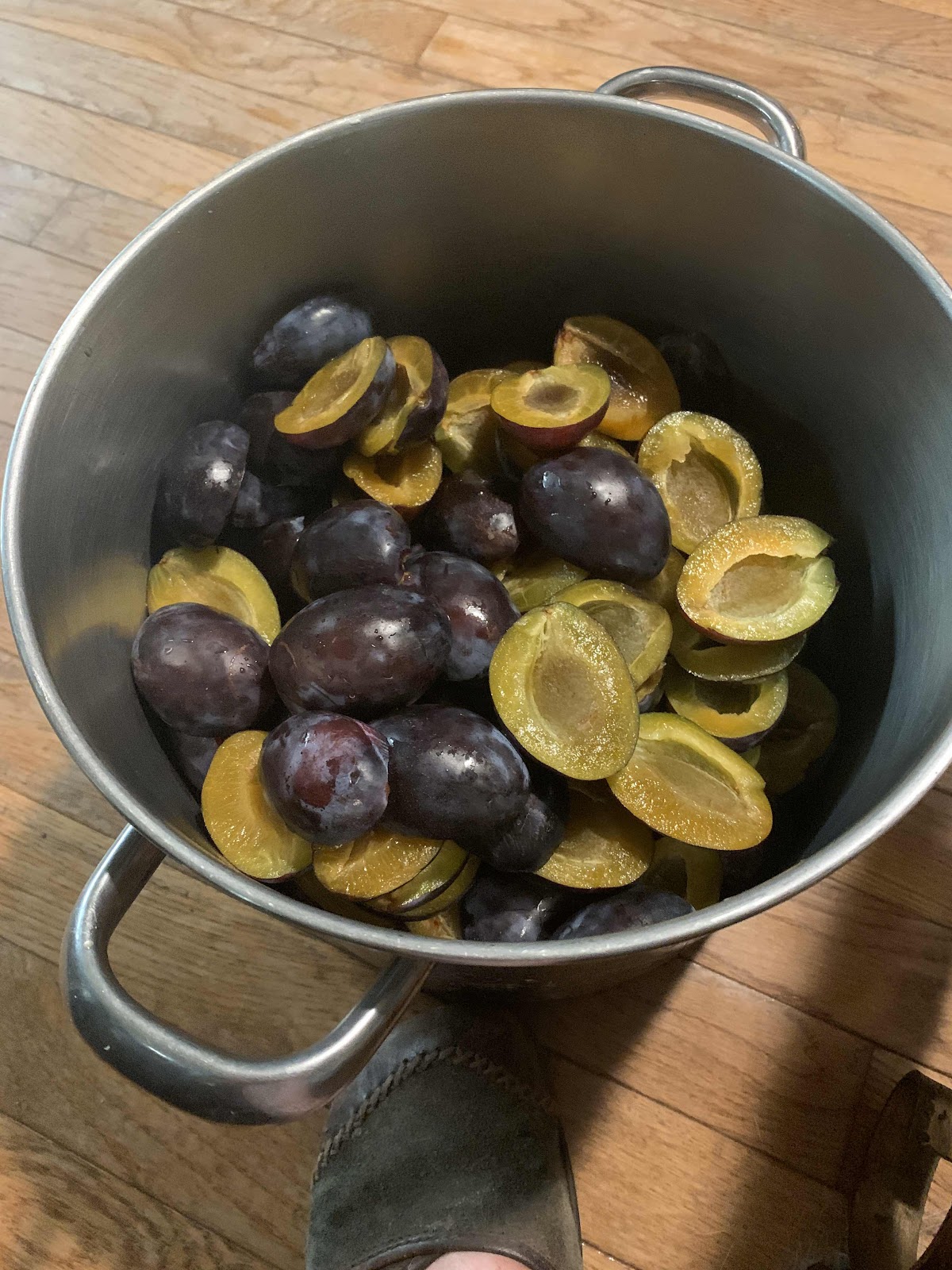
It was an “on” year for the Italian plum tree. There are still hundreds of plums on it - falling fast - but I think I am done with plums for the year. In addition to eating them fresh until I was sick them, I dehydrated a gallon sized ziploc bag full and made twelve half-pints of plum jam. 

Actually, my mom and I made the jam together and it was really nice. She’s amazing, she doesn’t use pectin and her jam always turns out perfectly. She uses her own system for eyeballing when the sugar syrup is ready - she says it will jell when it looks like “King Farouk on a barstool,” which is to say when there are two side by side drips coming off the spoon instead of only one. 

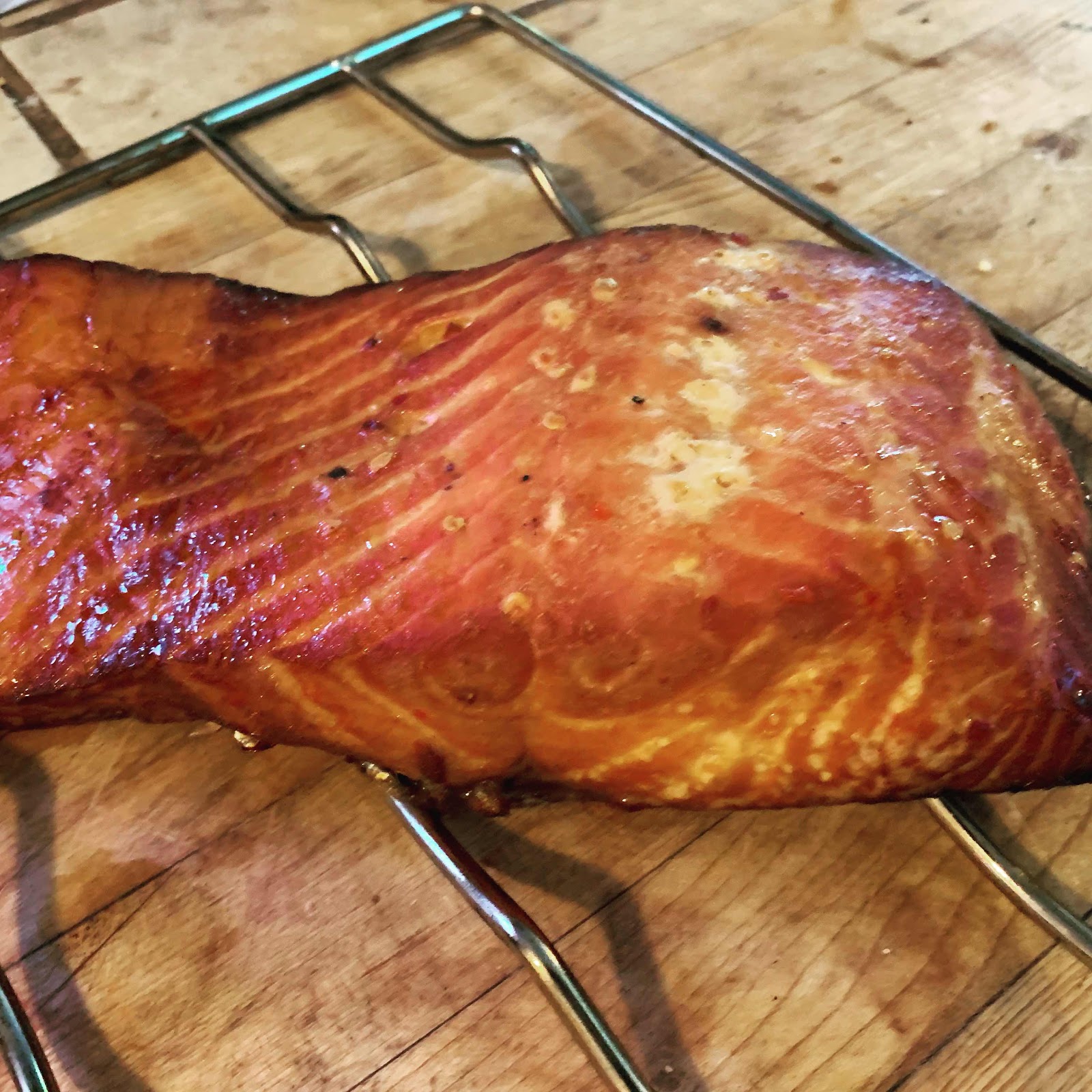
I also canned six pints of salsa ranchera and six pints of regular tomato sauce, and smoked two sockeye salmon. The main harvest left is the pears, but it wasn’t a very good year for pears and there arent a ton of them, for once. 


Friday, April 14, 2023

King Kong Squash


This gorgeous, enormous Blue Hubbard squash was given to me by a neighbor. I don’t know for sure if she grew it herself but she’s quite a gardener so it’s entirely possible. Blue Hubbards are an heirloom variety winter squash with excellent keeping qualities, fine dry orange flesh, and which grow to impressive size. This one weighs 43 pounds. 


I’m staying home sick from work today, so I decided it was as good a day as any to deal with the giant squash. Their shells are so hard I had to have Homero cut it up with an axe. It occurs to me that this blog is full of pictures of Homero dealing with various large and unusual comestible items. Like the 25 pound Ling Cod. Cow heads. I should make a post of all those photos. 

My plan is to bake it, purée it, and make a bunch of pies, some soup, and….. I guess freeze the rest of the purée for later. It’s not recommended to home-can winter squash, even in a pressure canner. Something about the purée being too thick to heat evenly. But it freezes very well, and quart sized blocks of frozen purée can be used to make soup, pie and quick breads into the future. 

I’m also saving some seeds to plant later this spring. Blue Hubbards are an open pollinated heirloom variety, which means they will produce fruit similar to the parent plant, not like the more common hybrids that will produce fruit unlike, and usually inferior to, the parent plant. 

I love this photo of me and the squash. Look how happy I am! I can lift 43 pounds of food over my head!! 


Friday, January 6, 2023

Rosca de Reyes (King Cake)


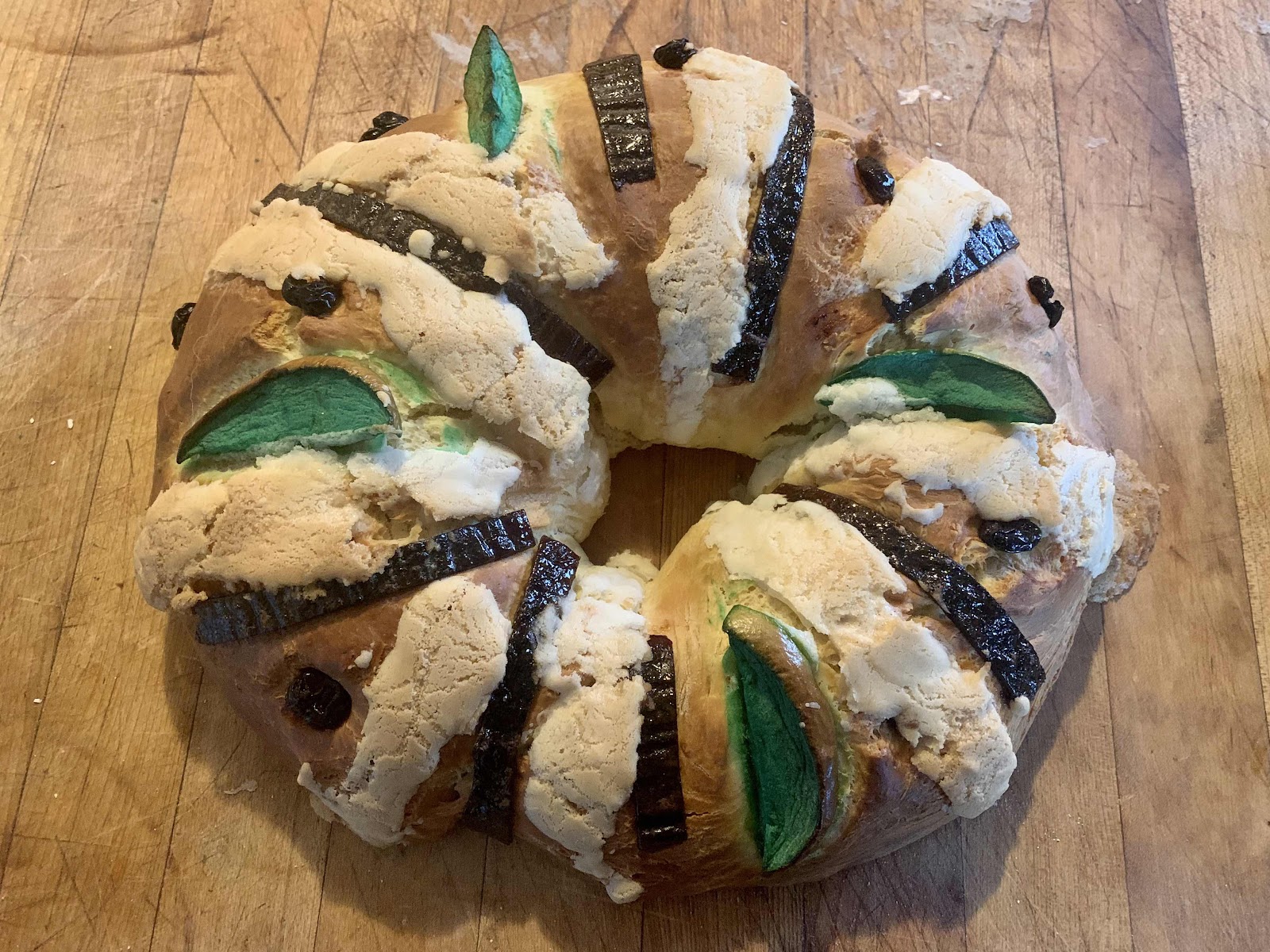
I made this lovely Rosca de Reyes cake today, which is January 6th - also known as Epiphany and the Three Kings day. 

Mexicans celebrate three kings day with a Rosca de Reyes, or a King Cake. It’s a sweet egg-and-butter enriched bread studded with dried fruit, nuts, and sugar paste. Sometimes it’s stuffed with marzipan. And somewhere inside it, there’s a little statue of the baby Jesus. Or a baby anyway. The tradition goes that whoever gets the baby Jesus in his or her slice of King Cake has to make tamales for the next feast on the calendar, which is Candelmas - February second. 

(For a post about Candelmas/Imbolc, click here http://newtofarmlife.blogspot.com/2014/02/imbolc-repost.html?m=1) 

Like many other catholic feast days, Epiphany has some Pagan antecedents. The tradition of a King Cake goes way back in pre-Christian Europe. Instead of a baby Jesus, a dried broad bean would be baked into the cake and the person who found it was crowned King for a day. 

This is an example of a topsy-turvy festival, when a peasant can be a king and vice versa. The Bean King would be the focus of the celebration and the center of attention. He could behave however he wanted for the night - get super drunk, grope the girls - without repercussions. Such festivals upset the social order and let people blow off steam, flouting the norms which they have to live by the rest of the year. 

But in the REALLY way back days, in some bronze-age planting societies across Eurasia, the bean-king was no laughing matter. Instead of being king for a night, he was made the sacred king for a year, during which he was given the best of everything and revered by everyone. But when the next year’s planting time came around, he would be killed and his blood poured on the fields to ritually fertilize them. 

There is no bean in my cake, nor is there a tiny baby Jesus statue. Oddly enough, I don’t actually own such a thing. For the decorations, I used strips of my homemade fruit leather, and thin slices of dehydrated pears colored with green food coloring. Tonight we will enjoy it with hot chocolate and nobody will be King. 


Monday, September 19, 2022

Meat Math, Bovine Edition (GRAPHIC)


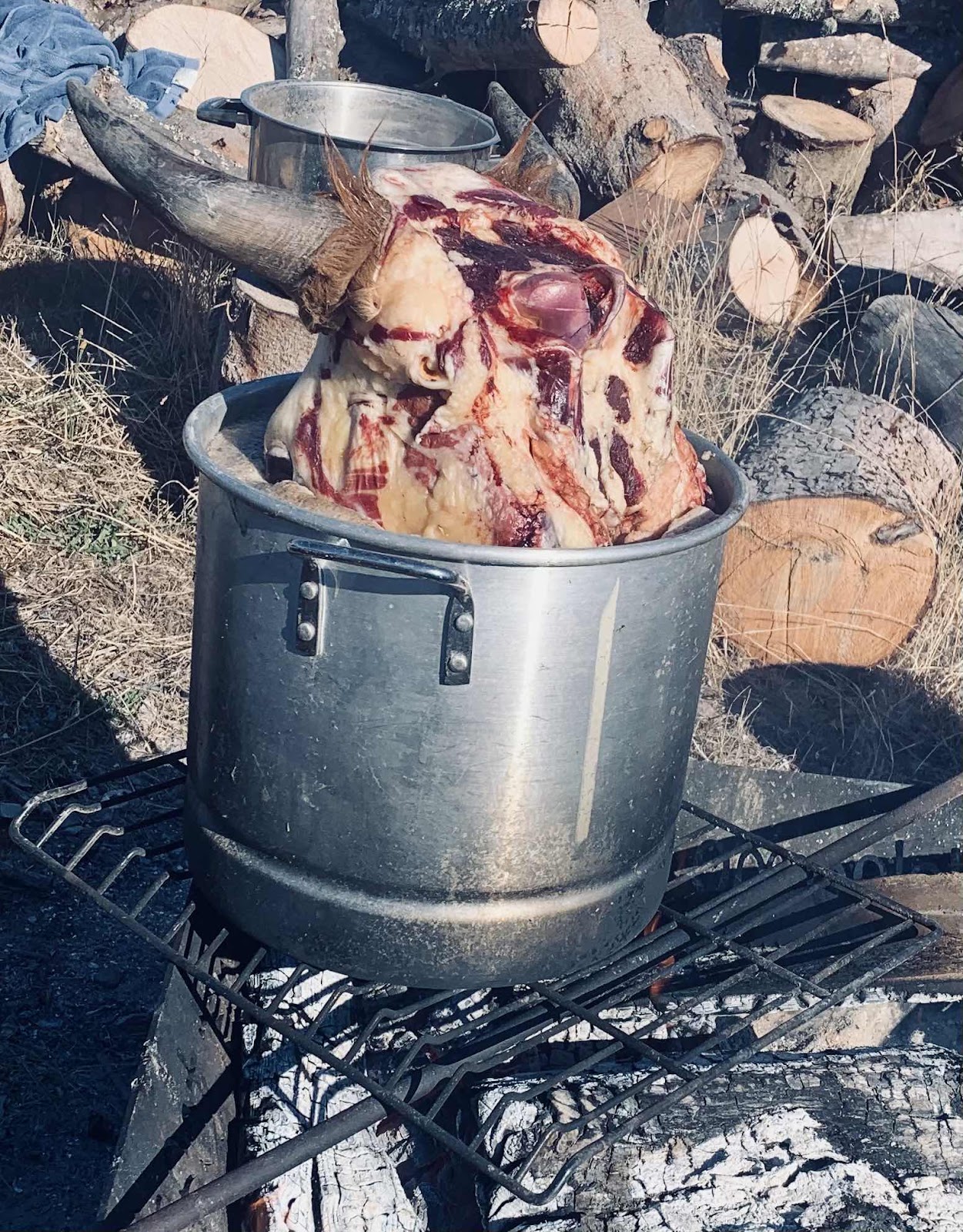
Not a very good picture, but that is a 40 quart stockpot, with  substantially less than half of a freshly butchered steer’s head submerged in it. 

This is what I came home to today. I knew, of course, that today was the day appointed for Pepe Toro, our Jersey steer, to meet his end. The men from Lynden meats were scheduled to arrive in their business-like panel van loaded with motorized equipment and on-board hot water, and do what butchers do. Half of Pepe Toro is already sold, and I have been making room in the freezer for the other half. The death of the cow, per se, was not a surprise. 

I did not know - though I should have suspected - that my husband was going to ask the men from Lynden meats to give him every scrap of the cow, from the horns to the hooves, that they would normally throw away or sell to a glue factory or something, and try to turn it into food. We’ve been through this before, and he ALWAYS does the same thing. 

We are just not prepared for cooking an entire cow’s head. In the past, even pig’s heads have proved to be difficult to manage. The head of a well-grown cow is a majorly large hunk of gristle and bone, and once the tongue has been removed, in my opinion it ought to be ignored. But Homero comes from a background that despises waste and finds a way to use EVERYTHING. This is, of course, admirable, but more so in the abstract than in real life. 


After I found the cow’s head sticking three-quarters of the way out of the pot, I convinced Homero to remove it, and to cut it into pieces with his sawzall, removing the horns and the disgusting patches of hair that clung to the skull around them. He has a plan for the horns - they are a gift to his friend Clacoyo, who wants to mount them on his motorcycle helmet. 

It took two sawzall blades, a cleaver, and a mallet to split the skull I to four pieces, but we got it done. Now the head is simmering over a wood fire - after two changes of water - along with a handful of allspice, cloves, star anise, fennel, and black pepper; three heads of garlic; several onions, and a bunch of guajillo chiles. It ought to be done sometime after moonrise. 

Now for the math. 

This animal was free. Homero has several clients who work on large dairy farms, and they are constantly giving away newborn males. I don’t know why they don’t just centrifuge the sperm they use - almost all cows are bred by AI - but either they don’t, or it has a high failure rate. This was the third free calf we’ve raised. 

The feed for a cow is almost all free too. We did have to bottle feed him for a short while but that was just one bag of milk replacer: about $30. Then of course there’s his winter hay, and a cow eats a lot of hay. I didn’t keep track of how much he ate versus the goats - that would be impossible - but we bought an extra 25 bales last winter and I’ll say that was all cow food. So that’s $100. Other than that, all he’s eaten is pasture grass and free veggies and bread from gleaners. Oh - and the same friend who provided him to us also have us the occasional pickup-load of free silage. 

We did take him to the vet to be castrated because we waited too long to band him. Won’t make that mistake again. I think that was about $100 as well. No medicine or other vet visits were needed over the course of his short lifetime. 

Total cost: approximately $230

Expected revenue: 

Last week I taped Pepe Toro to get an estimated live weight. He measured 78 inches around his heart-girth, which is very well grown. According to the internet charts, that means he has a live weight of approximately 1,112 pounds. The hanging weight of a cow is usually about 60% of live weight, so in our case approximately 668 lbs. 

I sold half of him for $3/lb, which would be $1,002. If I can find a buyer for another quarter I will sell that too, so that would be an extra $501 for a total of $1,503. Plus of course our own meat. 

That sounds like a hefty profit, but it isn’t as much as it sounds because Pepe Toro was wantonly destructive. He destroyed the calf hutch, which will cost $200 to replace, and he got I got he mama barn and put his feet right through the floor in a half dozen places. That will take a sheet of three quarter in inch plywood to fix, and now I have to go look up what that costs ($75) 

Total cost $505
Total expected revenue $1503
Total expected profit $998 

Not bad 


Wednesday, September 14, 2022

Farm Stand Photos


I thought it would be nice to post some photos of local farm stands and what I appreciate about each of them. They are so varied. 


Small, new farm stand on Blaine road north of Grandview (I think?). A small tow-headed boy came out to greet us, very excited to tell us about his lemon cucumbers. 


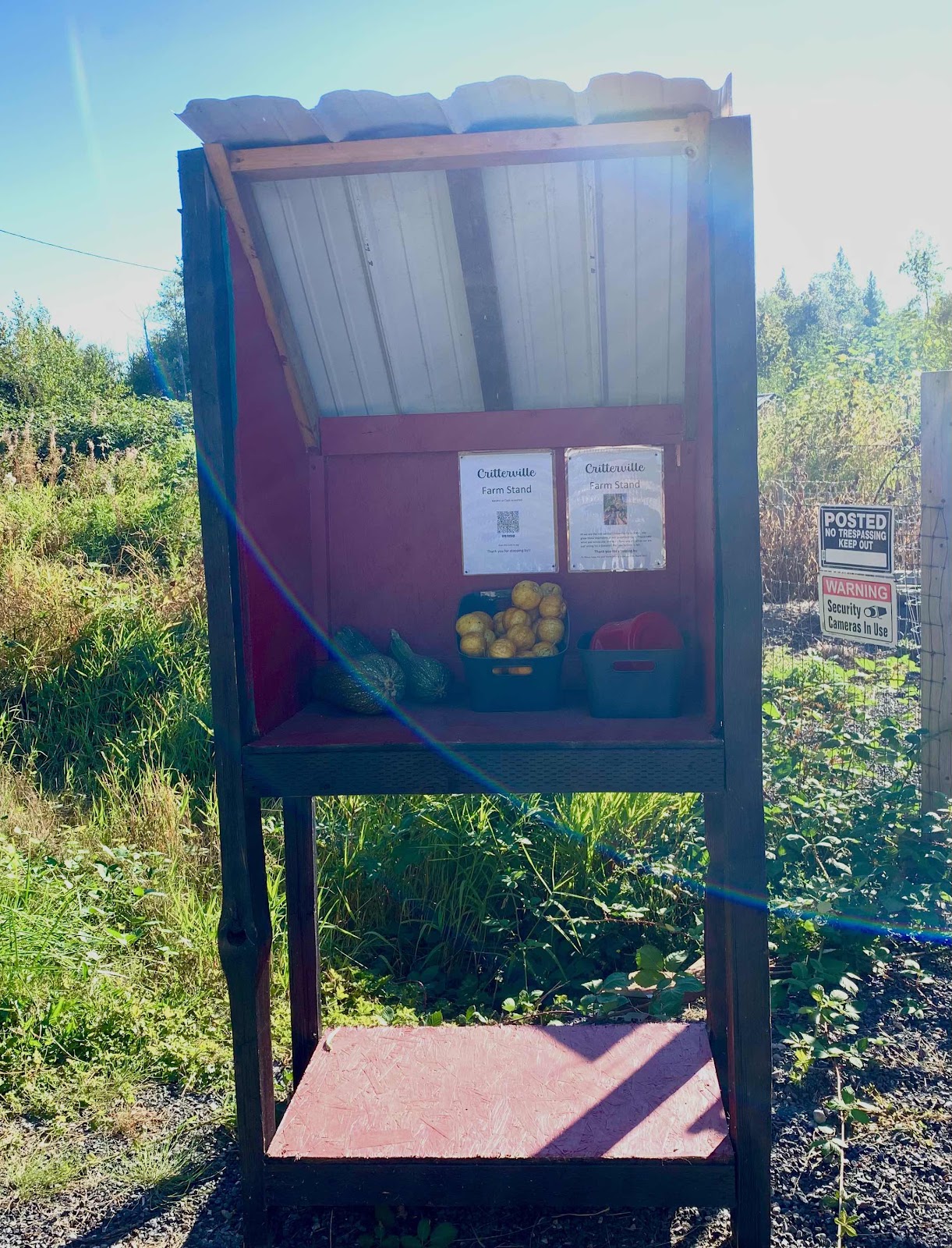
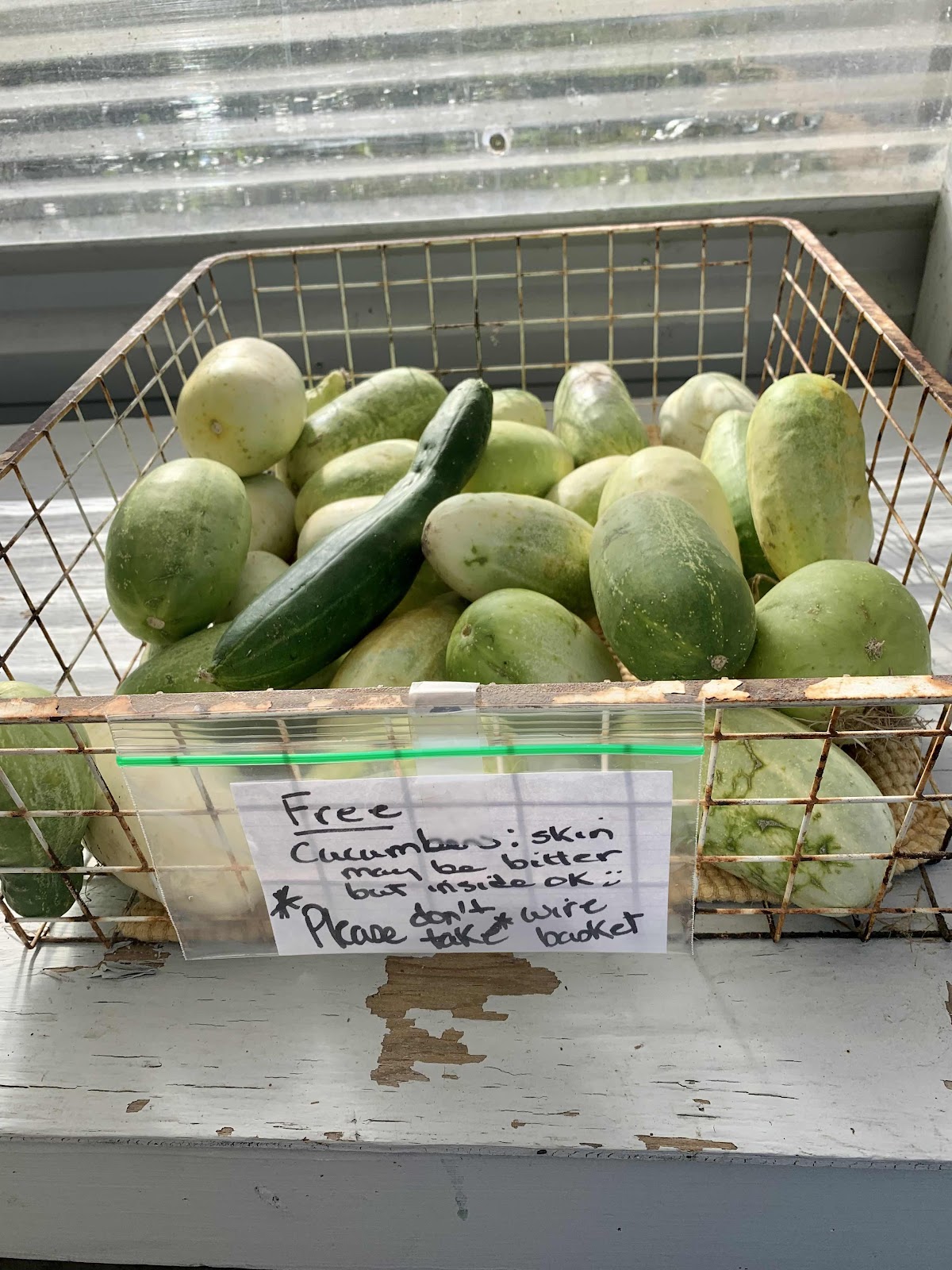
My favorite local stand. Kickerville road between Bay and Birch Bay-Lynden road. They run all season, with veggie starts and live plants in early spring, through to gourds in late fall. They sell seeds as well. There’s a small fridge where the greens stay nice and fresh. Prices are amazing - and in fact they often have free veggies as well. Also sell an assortment of books, baskets, and what-not. I’ve even bought chickens from them in the past. 


Free cucumbers in the Kickerville stand. 


The Kickerville stand from the outside. Looking fairly empty on this particular day. 


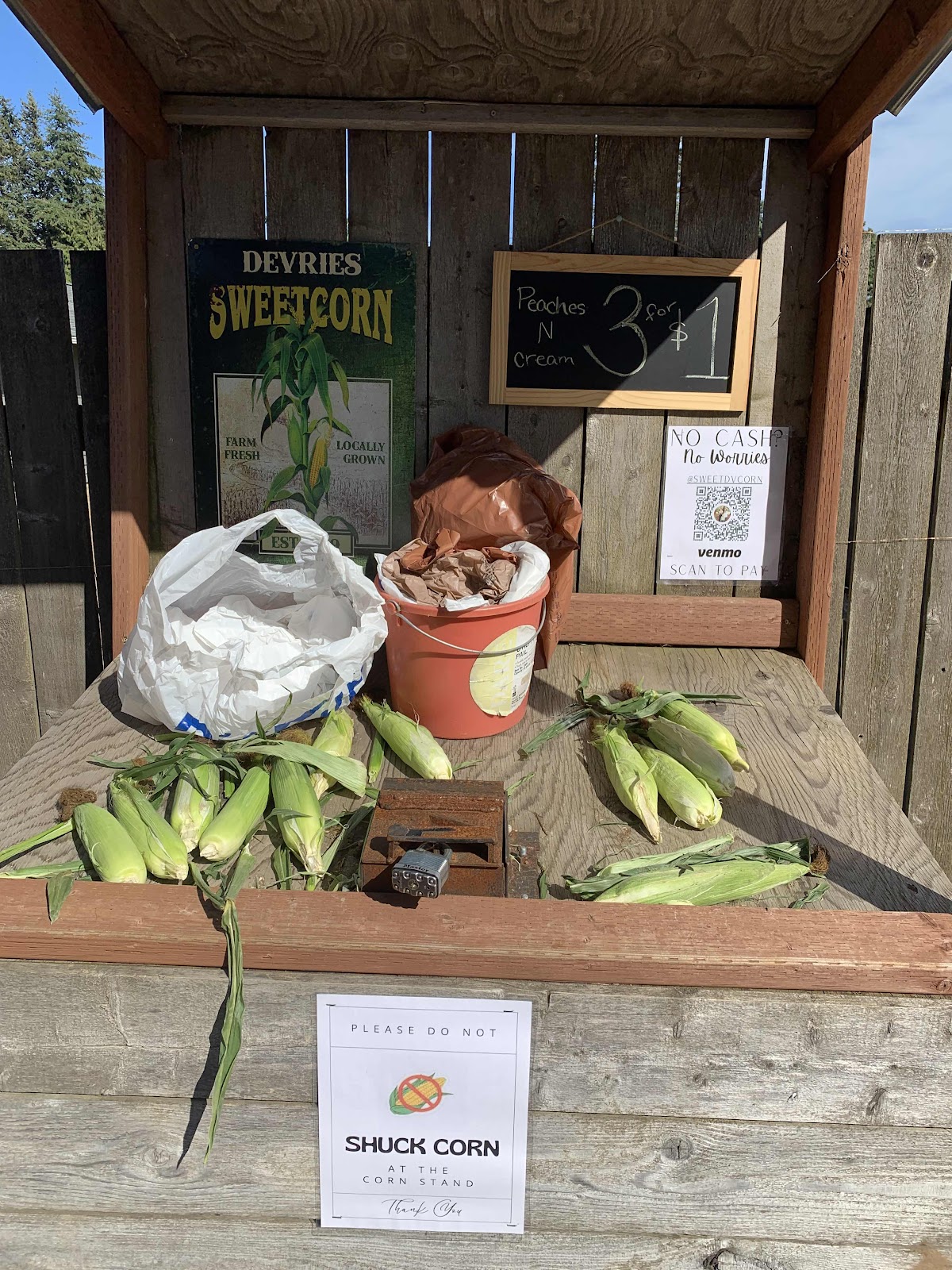
Sweet corn somewhere in the vast, confusing Bermuda Triangle between Enterprise road and the Guide, south of Birch Bay-Lynden road. Forgot to note the address. There are lots of sweet corn stands at the moment, of course, and they tend to be single-produce operations, appearing in mid-august and shuttered by early September. 


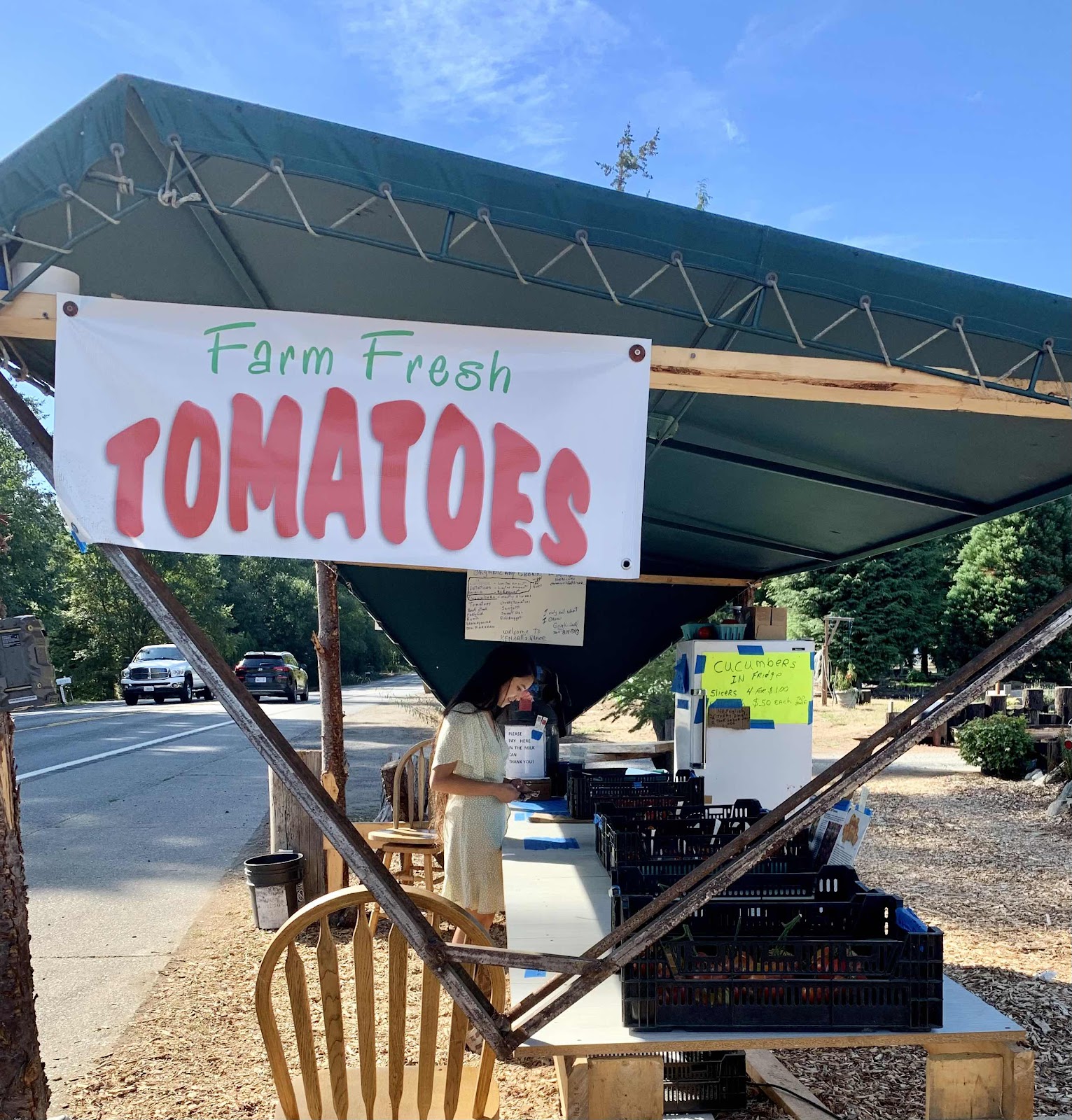
New stand (as of last year) on the Birch Bay -Lynden road just east of the freeway. This young lady grows TONS of tomatoes, many different varieties. Good prices and great tomatoes. 


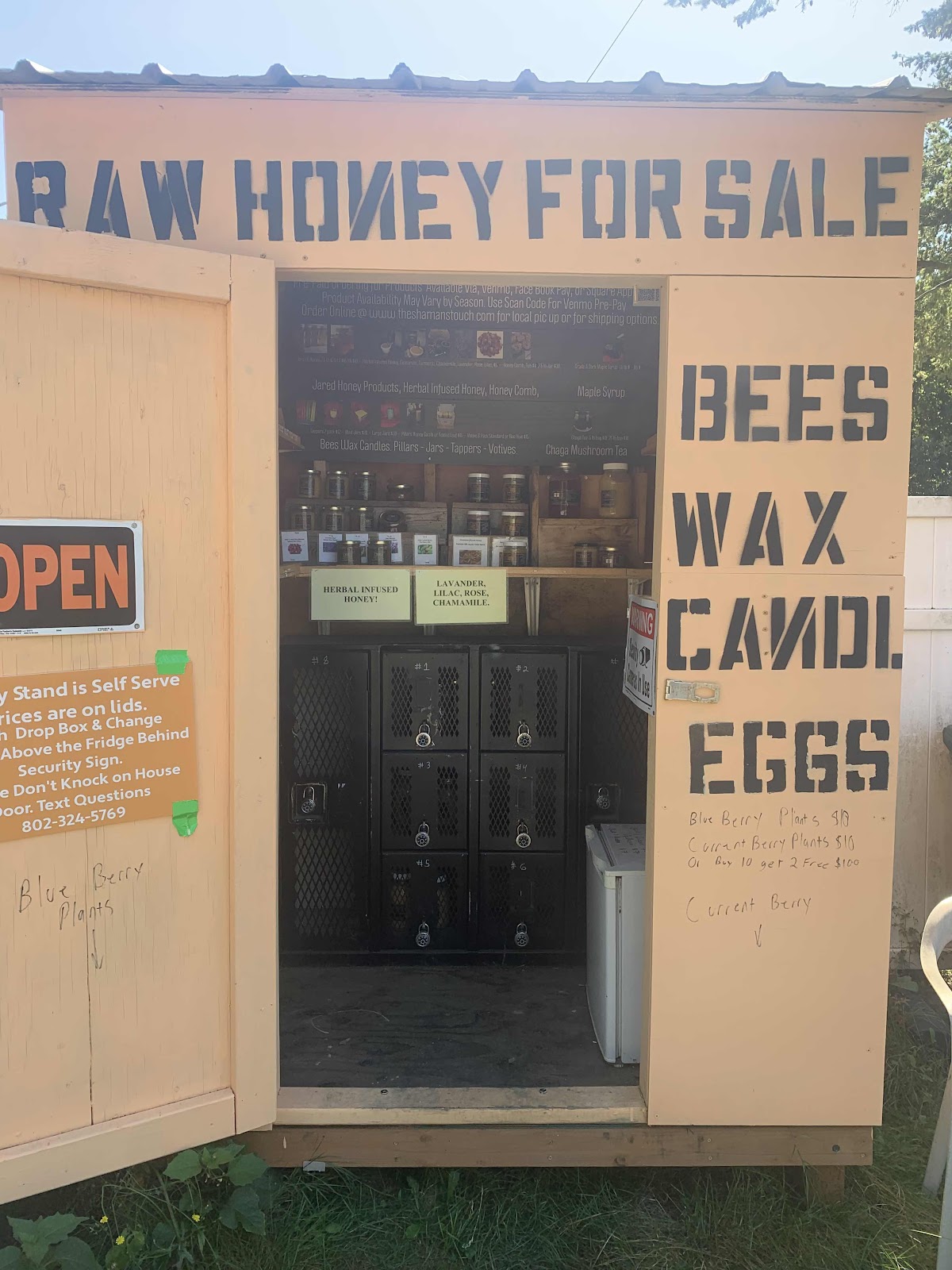
This stand is a real unique one. The owner is a beekeeper and he sells his honey, plain or compounded with herbs and spices and medicines. The lavender honey is especially nice. Overall the best, thickest honey I’ve found. He also sells gorgeous beeswax candles and copies of his self-published novels. 

There are many more farm stands that are worth a mention, but which I haven’t got any pictures of. Just across Kickerville from my favorite farm stand is Tiff’s Dahlias. 
A huge garden with all varieties of dahlias, sold for either $0.50 or $1 a stem, slightly older ones for $0.25. 

Smits family farm in Northwest has a huge and beautiful farm stand worthy of its own post. Mr. Smit has ten acres and grows hundreds of varieties of vegetables, including many not so common ones around here like asparagus. In fact if you are a regular, you can tell Mr. Smit what you would like and he will grow it for you. 

There’s a large stand with two big glass front refrigerators on E. Wiser lake road that sells Guernsey Milk, yogurt, and cream as well as fresh produce. There are also often homemade chocolate chips cookies. 

I never get tired of perusing farm stands, and it always makes me happy when I discover a new one, even if all they sell is zucchini.  

Tuesday, July 19, 2022

The Pantry Project (Ice Cream Edition)


Ran across an ice cream maker at Goodwill the other day, and it reminded me that ice cream is a wonderful way of preserving the products of the season - goat milk, eggs, and fresh fruit. Also it’s been pretty hot lately and that’s just the excuse I needed. I bought the ice cream maker. 


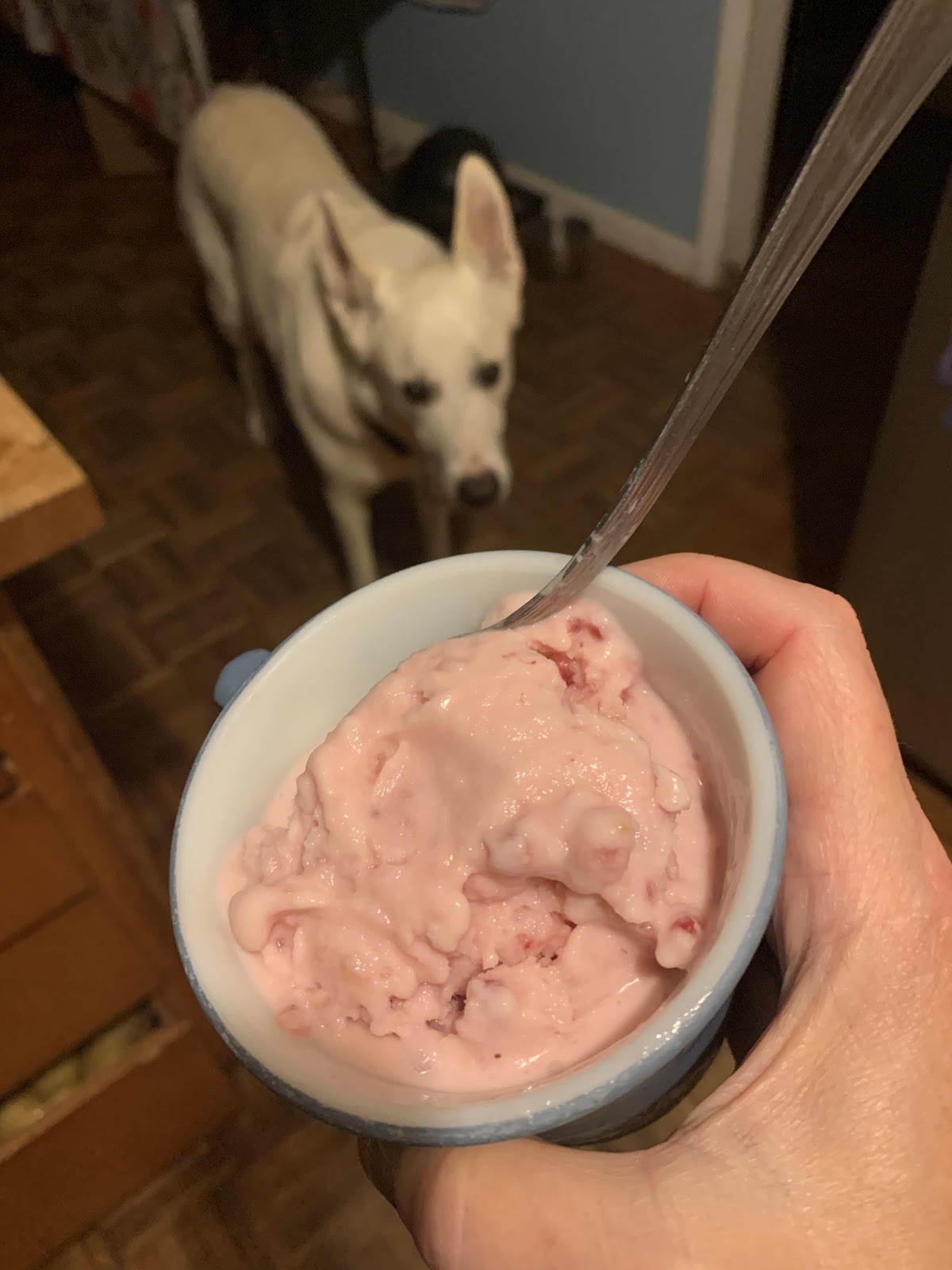
This delicious pink concoction, my first foray, is not technically ice cream, because it doesn’t have any eggs in it (or cream for that matter) but rather frozen yogurt. Sorta. I’m calling it “raspberry cheesecake” and it’s based on a batch of chévre that didn’t quite firm up enough to be called cheese. I could have used it like sour cream, but I already had sour cream in the fridge. It occurred to me to sweeten it instead, mix it with a bunch of raspberries, some yogurt, and run it through the machine. It’s delicious and right now I’m enjoying it as a bedtime snack. 

From the farm: 

Goat milk
Chèvre 
Raspberries 

From the grocery store:

Sugar
Yogurt 

Nothing from the gleaners pantry in this batch of ice cream, but maybe next I’ll try peach - there are always peaches at gleaner’s right now. 

Monday, June 20, 2022

Project Pantry (Meatballs and Morels)


Today’s dinner - kinda sorta Swedish meatballs but not really. I had a pound of ground venison from the gleaner’s  pantry that I wanted to use, but I’ve never cooked with it before. As I was perusing google on the subject of ground venison, Swedish meatball recipes kept popping up and they looked great. I’ve never made Swedish meatballs before either, but I have eaten them. I belong to a Lutheran church full of elderly people of Scandinavian heritage. 

After I decided to make Swedish meatballs, I realized that I was short several ingredients, but the benefit of having a deep pantry is that one can always adapt. I don’t have any beef broth, but I have dried morels, so I made more mushroom stock. I consider that an upgrade. I do wish I had fresh dill or parsley, all I have is chives and celery leaves. But who cares, I tasted the sauce and it’s fabulously delicious. 

I can’t remember what Swedish meatballs are traditionally serviced with (which starch, I mean. I know they are served with lingonberry jam but we will make do with blackberry). I’m thinking wild rice would be a good choice to go with the mushroom sauce. 

“Swedish” venison meatballs 

This is how I made them today, substitutions and all. Not how they are “supposed” to be. 

1 pound ground venison 
1/2 pound ground pork 
1 egg
1/2 cup breadcrumbs 
1 teaspoon sugar 
Garlic powder to taste 
Dash cinnamon (go very easy on this, a pinch is plenty) 
Fresh ground black pepper 

Mix all ingredients with hands and shape into meatballs. Place on a sheet pan lined with parchment paper or tinfoil and bake at 375 for 20 minutes. 

While meatballs are baking, get out a cast iron skillet and make sauce 

2 tablespoons butter 
Two yellow onions, sliced fairly thin ribbons 
Two tablespoons flour
1 teaspoon maggi chicken bouillon 
1 cup give or take dried morels, some broken into small pieces 
1 teaspoon Dijon mustard
2 cups goats milk
Black pepper 
Minced fresh herbs 

Melt butter and sauté onions over medium-low  heat until softened, about ten minutes. Increase heat to medium. Sprinkle over flour and mix with a wooden spoon until well incorporated and onions are coated. Sprinkle maggi and keep stirring. Add mustard and about 1/2 to 3/5 cup water. Add the morels. Stir until sauce smooths out and begins to thicken. Add more water if needed. Then add goat’s milk and stir until smooth. Bring to a simmer but not a boil. Add meatballs. Turn meatballs in sauce and let simmer until sauce is slightly reduced. Just before serving shower with herbs and fresh ground pepper. 

Breakdown: 

From the gleaners pantry: 

Venison 
Pork
Bread (for crumbs)
Maggi chicken bouillon 
Flour 

From the farm or trade network:

Egg 
Herbs 
Goat’s milk 
Morels 

From the grocery store:

Butter
Onions 
Mustard
Pepper 


Sunday, April 3, 2022

Spring Chickens


We got some baby chicks. Now that we have a coop for chickens so close to the house - right inside the fenced backyard - and can be reasonably sure that coyotes aren’t going to get them, we thought we’d take the risk on a few more. 


There wasn’t a lot of variety available at the farm stores in town. Mostly red or black sex links, broilers, and a few heritage breeds. I was specifically looking for broody breeds,  and I was frustrated because not only are there just not that many broody breeds being produced these days, but the stores uniformly had no information about the broodiness or lack thereof in the breeds they were selling. In one store, I asked the person working “do you carry any broody breeds of chicks?” And she answered me “what does broody mean?” 

I must be getting old. 

Well for those who don’t know, like the girl working in my local farm store, a broody breed of chicken is a breed in which the hens will sit on eggs, hatch out chicks, and raise them herself. What? Don’t all chickens sit on eggs? NO. Most modern breeds of chickens have had the broodiness bred out of them. When a hen is broody, she isn’t laying. When she’s raising chicks, she isn’t laying. It’s not cost effective to raise broody chickens for egg production. All your best egg laying breeds - leghorns, Rhode Island reds, etc, will not go broody. 

We eventually found two Cochin chicks. Cochins do go broody, and they also have cute feathered cheeks and feathered feet. We also bought two Golden Comets (not broody) and two Easter Eggers (seldom broody - they are  not Americaunas, which also lay blue eggs and DO go broody). Now all six chicks are out in the converted rabbit hutch under a heat lamp, which I hope will be sufficient in this nasty, cold, wet weather. 

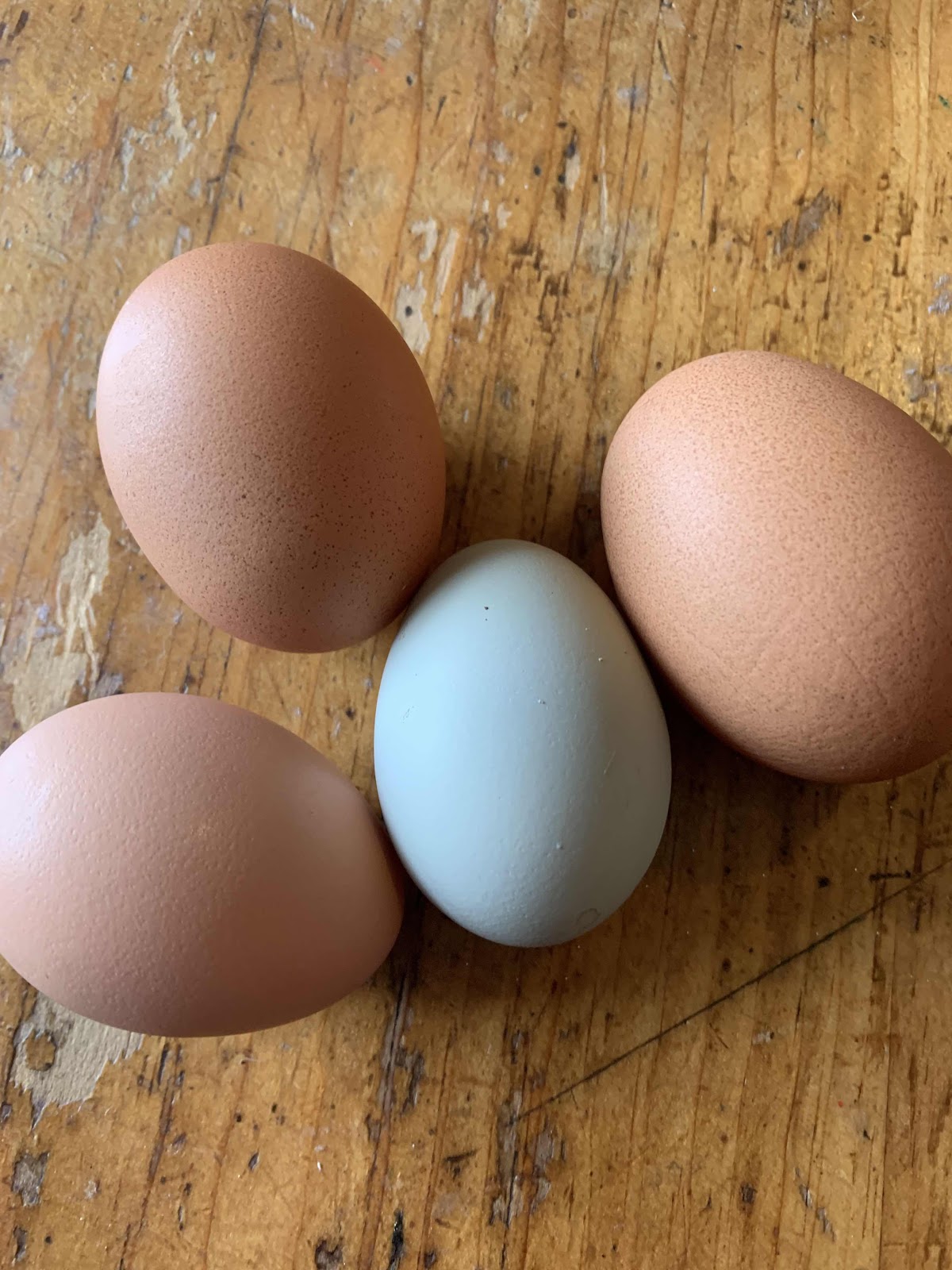
Speaking of colorful eggs, something very weird happened yesterday. We have five Rhode Island Red hens who have been laying all spring. They have all been laying many many eggs, and all of those eggs are, as you would expect, large and brown. Until yesterday:


There was a mystery egg in the nest box - a small blue egg. I have never, never, in all my years heard of a hen who could lay eggs of different colors. Hens who lay white eggs ALWAYS lay white eggs, and ditto brown, blue, green, and pink. Sometimes you get some weird eggs alright - teeny little ones the size of marbles, wrinkled ones. Once I even found an egg without an outer shell, just the inner membrane. That was an odd egg. But I have no explanation for this blue egg. 

Maybe we had a chicken visitor. My daughter and I had a good laugh imagining a lady chicken visitor who suddenly realized she was about to lay an egg. 

“Oh Penny, do you mind if I use your nest box?” 

“Oh of course Georgina, it’s right there on the wall. Yes, that plastic milk crate attached with zip ties. Make yourself at home.” 

“Oh thank you Penny I can’t imagine how I forgot to do this before going out….. BUCK BUCK BAGAWK!” 

Sunday, March 27, 2022

Project Pantry Week One


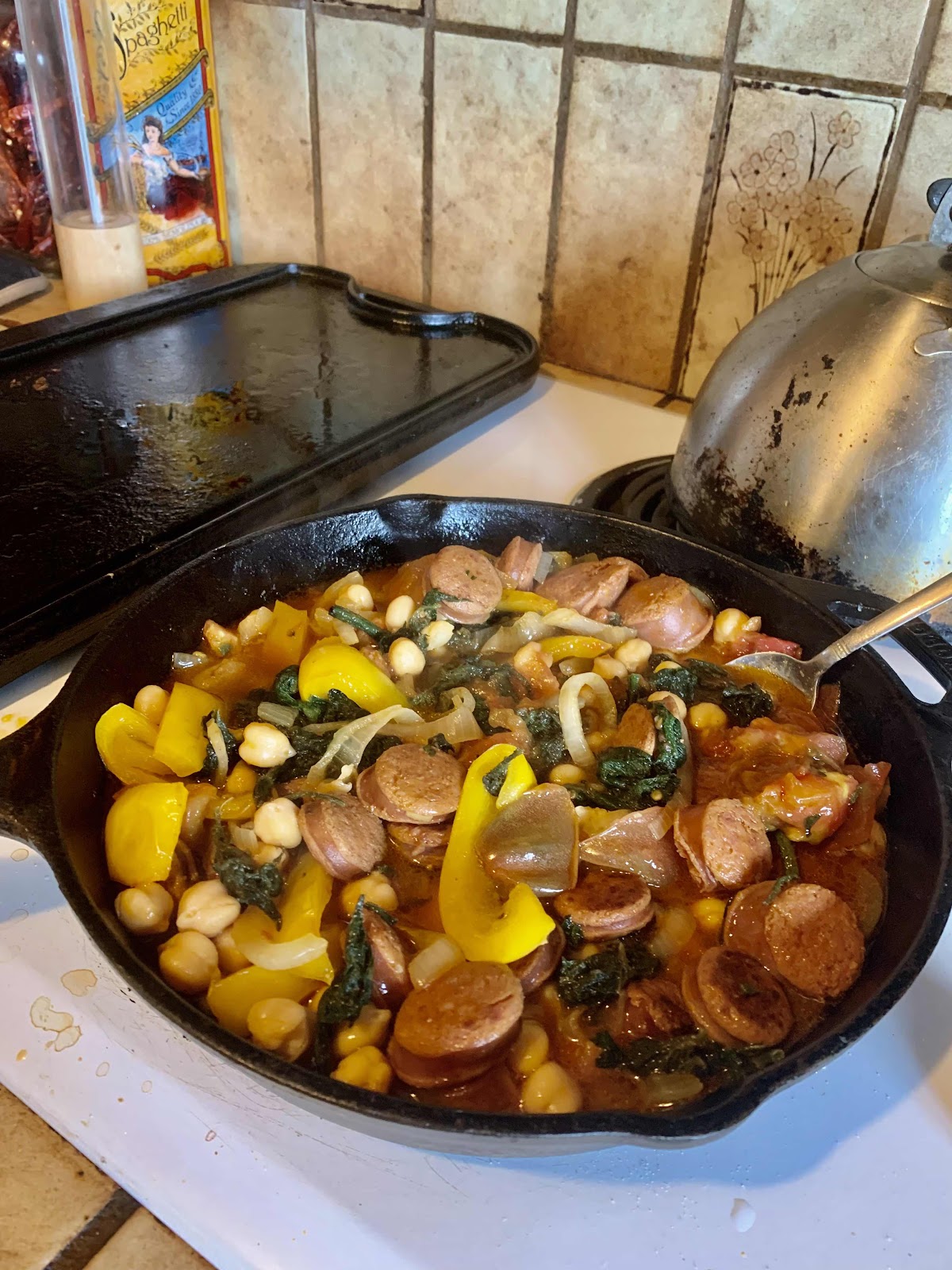
Every single ingredient in today’s dinner - chickpea and sausage stew -  is from the gleaner’s pantry, except for the nettles, which were foraged. But even if you were to buy all the ingredients, this would still be a cheap meal. And it’s healthy, too! 

Chickpea and Sausage stew 

- One sausage per person. I used Louisiana hotlinks because that’s what the gleaner’s pantry gave me, but Italian sausage, Polish, kielbasa, or chorizo works great too. Slice into coins. 

- one yellow onion, sliced 

- one bell pepper, sliced, red preferred. 

- 1-2 cups nettles, or whatever tender greens you have on hand. Spinach is good. So is Swiss chard. Chop roughly. 

- 1 large tomato, chopped

- one can chickpeas 

In a little bit of oil, sauté sausage over medium-high heat until browned. Add peppers and onions.  Continue to sauté until vegetables wilt and are slightly browned. Add chopped tomato. Add rinsed, drained beans. Add greens. If needed, add a tablespoon or two of water. I find the vegetables usually give off enough moisture, but sometimes a little water is good. Or lemon juice. 

Cover and simmer 15-20 minutes, until flavors meld. 

Nice additions if you have them - chopped Kalamata olives, capers, zucchini. 

Score:

Gleaner’s - 5

Foraged - 1

Grocery store - (the oil) 


Wednesday, March 23, 2022

Forest Foraging (Spring Greens)


This afternoon the sun made an appearance, interrupting several days of chilly rain. I was so happy to see it that I was moved to actually get off the couch and take a walk outside with my husband. 

My favorite nearby walk is a trail through the forest that leads to a steep, rather slippery and rickety staircase down to the beach. It’s a quiet beach with no access other than this trail, so it’s often empty except for seagulls and crabs. The trip out and back is about a mile and three quarters, which is long enough to feel like exercise, especially when you consider the staircase. 

The forest is nothing special - it’s certainly not old growth - but it is interesting and varied. On some parts of the trail you are surrounded by cedars and enveloped in a ferny gloom; and in other areas alders and cottonwoods prevail. Right now the Indian plums are blooming and there are yellow skunk cabbage in the shady bogs. 

I’m sure a more expert forager than I am could tell you dozens of edibles and medicinals that can be gathered from an environment like this one, year round. I have personally harvested 

- red huckleberry 
- trailing native blackberry
- shaggy parasol mushrooms 
- nettles

I have seen, but not harvested, cottonwood buds (for making Balm of Gilead - https://learningherbs.com/remedies-recipes/balm-of-gilead/) and devil’s club. And I’m certain there are edible fiddlehead ferns and many other types of edible mushrooms and fungi in there as well. And this is just one small forest reserve that a biologist would doubtless describe as degraded. 

I do most of my yearly foraging in fields and hedgerows, not forests. I pick dandelion greens, lamb’s quarter, amaranth, field mushrooms like puffballs and agaricus campestri. Blackberries and sour cherries and plums from abandoned trees. Most of what I forage is not truly wild but rather escaped nonnative weeds. That’s okay. It’s all good food. 

A few days ago I went out and walked my fence lines looking for nettles. There were a few here and there, but they were all still very small. It will be another two weeks before I can get enough for a pot of soup. Today on the forest rail though, I saw hundreds of nettles, all at just about the perfect stage for picking. I guess I have my exercise for tomorrow planned out. 

Saturday, March 19, 2022

Food Finances (Project Pantry)


For a while now, I’ve been thinking about starting a new recurring feature on the blog about cooking and eating from “the pantry,” meaning in this case both my personal pantry and the Gleaner’s Pantry, which is a small food rescue organization from which I get a large percentage of our family’s food. We pick up produce, meat, dairy and bakery items going out the back door of supermarkets and sort the usable food from the unusable. On average, around three quarters of the food being tossed is perfectly fresh and good. The rest goes to animals. 

Years ago, when we first moved here, before I learned about the Gleaner’s Pantry, I was all about sourcing as much food as possible from our own land. We planted fruit trees, we put in a garden every year, we raised chickens and goats and pigs. I learned to can and put up quarts and quarts of applesauce, jam, salsa, and pickles every year. I dehydrated pears and plums for the kid’s school lunches. I made cheese and yogurt, and traded the excess to friends for vegetables from their gardens. I foraged for greens, mushrooms, and berries. 

A mixture of concern about climate change, food prices, and the zombiepocalypse combined with the inherent “wow” factor of being a real, live homesteader drove me to spend lots of time and energy producing and preserving as much of our own food as possible. Turns out, however, that with a few exceptions here and there, producing and preserving your own food is not cheaper than buying it already preserved for you. Mostly the opposite, in fact. You wouldn’t believe how expensive a dozen eggs are when you factor in the cost of building a coop and raising the chicks. 

Our global food system is based around efficiencies of scale, and it is very good at producing vast quantities of food extremely cheaply. Again, with a few exceptions, it is much cheaper to buy your food than it is to grow it yourself. Of course, much of that cheapness is predicated on government subsides and the exploitation of labor, not to mention the externalization of costs such as pollution of waterways from agricultural runoff. Money out of pocket is not my only concern, nor can it be the only concern of anyone who cares about the ethics of their consumption. 

Eating for the Gleaner’s Pantry allows me to address many concerns at once - cost of food, of course, but also the desire to minimize food waste and to avoid participating in the evils of Big Ag. None of us can avoid that entirely, of course - Big Ag is just one of the gigantic systems in which we are all enmeshed and which we literally depend on for our survival. I am under no illusion that my feeding my family from Big Ag’s waste-stream makes any appreciable (or even detectable) difference to any of the aforementioned problems. But it makes me feel good, it provides an example to my kids, and it saves us a lot of money. My daughters have taken many lessons - music, gymnastics, sports - that we were able to pay for because we were saving hundreds of  dollars a month in food costs. 

You might have noticed food costs have risen quite a bit lately. This phenomenon comes at a time that we are a bit tight on cash. Our family budget has taken a hit recently, and it made me think that I could probably make even more use of the Gleaner’s Pantry and save even more money. I’ve never tried to actually keep track of exactly how much we eat from the Gleaner’s versus how much from the grocery store. It seems like it might be a fun project for the blog. So I think I’ll try to make a weekly post breaking down at least one day’s cooking in terms of where the ingredients came from. Three categories - Gleaner’s, grocery store, or personal pantry, which includes farm-produced and foraged or bartered from neighbors. 

I’ll start with just one project: the lemon curd Swiss rolls I made today. They are super pretty! 

From Gleaner’s:                              From grocery store:

Flour                                                Sugar
Lemons                                            Butter

From Personal Pantry:

Raspberries
Eggs 

This is a win - four non-store items versus only two store items. Maybe I’ll keep a running tally! 


Thursday, October 28, 2021

Monster Squash 2021 (Count on Cucurbits)

My mother used to say there were only two things for certain in this world - death and taxes. But I know there is another - that every year volunteer squash will grow out of the compost pile. 

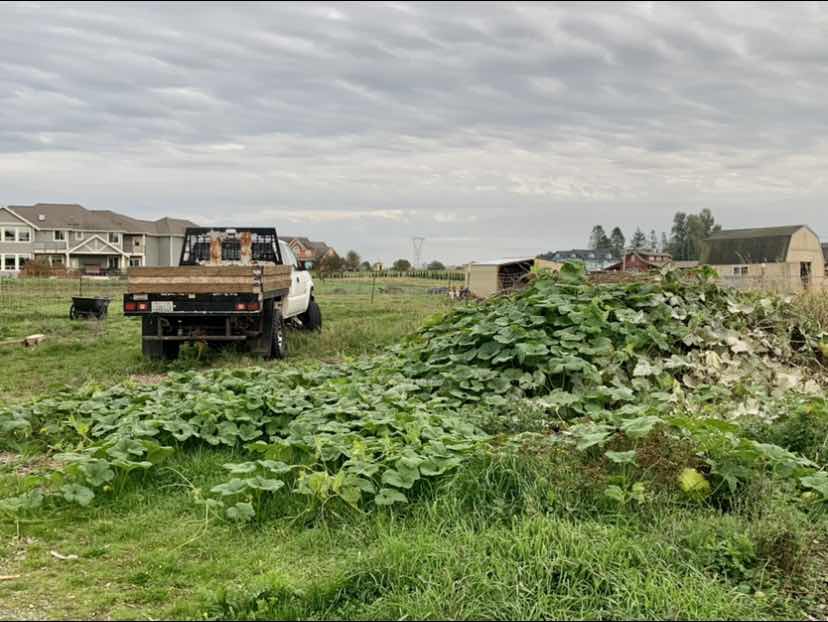
It’s so funny, I don’t usually have much luck trying to grow winter squash on purpose. The plants get powdery mildew, or they are poorly pollinated, or they get blossom end rot. But lo and behold the vigorous vines that sprouted this year from our discarded supermarket squash seeds:


There are actually three separate volunteer plants in that picture, and together they cover a good 500 square feet. All of them bore copious fruit, but unfortunately since supermarket squash are mostly hybrids, none of the three distinct varieties of fruit they bore was good to eat. 

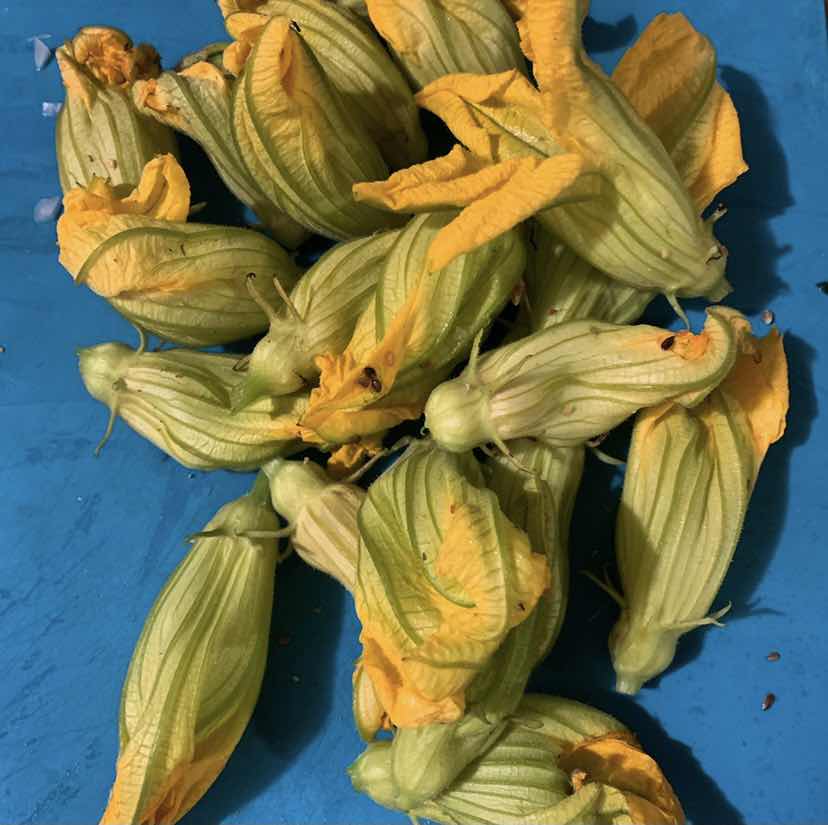
As varied as squash fruits are - that is to say, infinitely - squash blossoms are uniform. All squash plants, be they winter or summer or of unknown provenance, produce lovely yellow trumpet shaped flowers that are delicious. 

We like to tuck the fresh raw flowers into quesadillas, but they can be prepared in any number of different ways - one Italian preparation is stuffed with goat cheese, battered and fried. They can be added to soups or just sautéed in butter. 

Since we didn’t care about the inedible fruit of these particular plants, we picked both the male and female flowers, but if you are growing squash to eat just pick the male flowers. They are easy to tell apart because the male flowers grow in tall stems and the female flowers stay stuck close to the vine. Remove the pistils; they can be bitter. And always check for bugs! Our vines were still producing flowers last week, in chilly late October. 


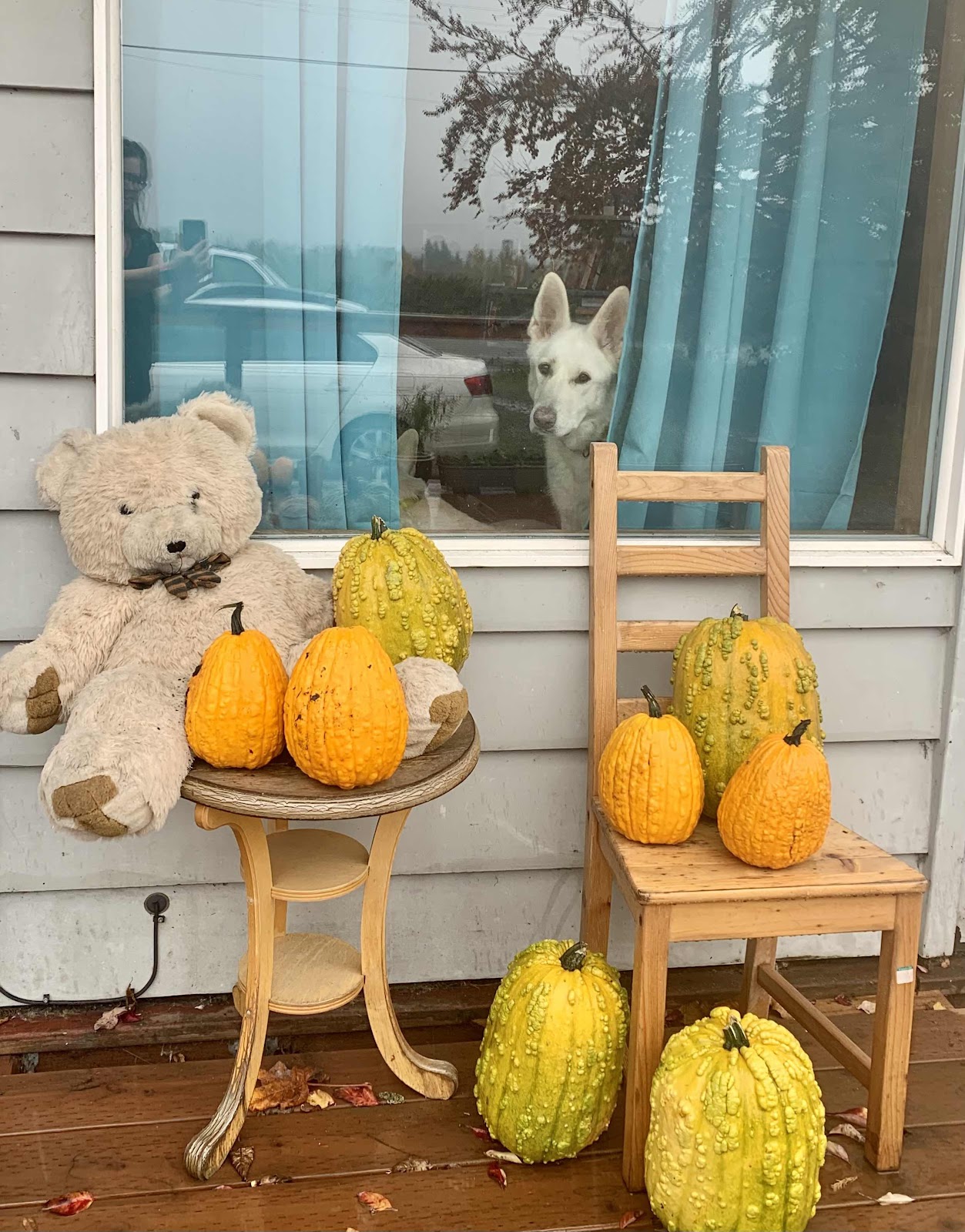
Although inedible, this year’s gourds do make a fine halloween porch display. There are many more that are not pictured here. One gargantuan vine produced more than a dozen of the huge warty gourds - probably well over 100 pounds of squash. 

I am not certain if the seeds of all these squashes are edible or not. I believe they are - I never heard of a poison pumpkin seed - but I should probably look it up to be safe before I decide to roast all the seeds after Halloween. 

Mercy is in the window. 


Monday, August 16, 2021

Meet the Greengage (Bears and Plums)


When we first moved here, in 2007, I knew the first thing I wanted to do was plant some fruit trees. The property had been a dairy farm before it was chopped into five acre parcels and sold off, and our parcel was the one with the original farmhouse on it, and where the dairy barn had stood before it was razed. There were few trees and a lot of bare earth. In my mind, an orchard is an indispensable part of any homestead, so I started doing some research.

Fruit trees are not as easy as people think - they are really rather finicky and delicate, for the most part, and need to be carefully chosen for the site. One needs to take into account not just the zone you are in 
(We are 8a - you can look up yours here) but also your microclimate and factors like drainage and soil composition. I have a very cold, windy microclimate and sandy, gravelly soil. Not really ideal. However I also have full sun all day long and  more than adequate rainfall.  While I was looking for information about varieties that might do well on my farm I found this amazing web site: Trees of Antiquity

Trees of Antiquity is devoted to propagating and preserving heirloom varieties of fruit and nut trees, and their experts will happily chat with you on the phone about your specific needs. They also have a terrific catalogue which arrives in the dead of winter and provides hours of entertainment in January, when I am likely to have exhausted all the interesting options on Netflix. 

After extensive consultation, I chose several trees - three varieties of apple including one cider apple (a golden russet); three cherries (Bing, Rainier, and one named Sam), three pears (really too many pears, nobody needs three pear trees but I'm glad I got the Comice, they are the best pears EVER. I forget what the other two varieties are) and two plums. One is an Italian plum, which are purple on the outside and golden on the inside and delicious. That tree bears an alternating light/heavy harvest, but always as many plums as we can eat or possibly use. 

The second plum tree I chose is a greengage plum. Greengage plums are a very old variety, believed to have originated in Iran, and first introduced to Europe by the royal gardeners of 16th century France, who named it the Reine Claude. You MAY have seen greengage plums once or twice in a particularly well-sticked grocery store, but they are not generally available because the trees are not well suited to profit driven agriculture. They take a decade or so to begin bearing, and then they only bear good crops every two or three years, with very scant or absent crops on the off years. 

My tree has a perverse tendency to bear only in years when we are spending the summer in Mexico. I have only had three good harvests off this tree (which I planted in 2008. The first was in 2016, when we first discovered the unearthly deliciousness of these plums. Their reputation as the queen of plums is well deserved. We gorged ourselves and eagerly anticipated the next harvest. In 2017 there were no plums. In 2018 we could se it would be a goof year, but alas, we were spending the entire summer in Oaxaca. 

I told a friend of mine to please harvest the plums, and she did. She texted me to thank me and said "oh by the way, there has been a bear in your orchard. I saw bear scat." Normally, I would probably pooh-pooh a pronouncement by a friend of mine that they saw bear scat, but this particular friend grew up in the Yukon, and I trust she k owe bear scat when she sees it. "don't worry about it," she said, "your goats are safe. He was here for the plums." A year or so later, while we were beating about the bushes looking for a lost turkey, we found the place where the bear must have come in. A heavy-duty galvanized cattle panel was crumpled up from the ground, bent and twisted and lifted a good three and a half feet from the ground. We hadn't noticed because it was in an area of very thick brush. As far as we know, the bear hasn't been back. 

Maybe the bear hasn't been back because the tree hasn't fruited again until this year. In late spring, I could see the tree was absolutely loaded with small fruit, and that this would be the best year yet. And once again, we were planning to be in Mexico from mid July through mid August. I lamented the fact that we would probably one again miss out, and told my friend to come on back, and watch for bears. But luckily, when we returned a few days ago, the plums were just beginning to ripen and fall. 

They are just as good as I remember. So sweet - the sweetest fruit I can think of, sweeter than peaches. They are beautiful, too, green with glowing yellow and pink blushes. There is probably no better way to use them than to just eat them out of hand until you can eat no more. But because there are so many, I need to find some other things to so with them. 

Things to do with greengage plums, after eating yourself sick:

- dehydrate them (greengages are a freestone plum, so very easy to prep and dehydrate)

- make a shrub (cover a quart or so of chopped fruit with sugar and let macerate two days in the fridge. Add apple cider vinegar to make a concentrated, sweet-and-sour fruit flavored syrup. Pour over some ice cubes and add sparkling water, with or without a jigger of spirits)


- jam, as a last resort. Perusing some recipes suggests vanilla as a flavoring. However, we also got home in time for peak blackberry season, so my jam needs will be well-met. 

Small rant to end this post: The world has lost some vast and depressing percentage (I've heard everything from 30-75%) of its heirloom varieties of food plants. The wonderful diversity of food plants not only provides us with a spectrum of tastes and nutrition, but is also essential for food security. Different varieties of the same species have differing resistance to pests and diseases and different abilities to thrive in varied climates. This isn't academic - with climate change we need ALL the varieties of ALL the food plants in order to feed our hot, crowded planet. 

There are many seed houses and orchardists devoted to preserving these wonderful old heirloom varieties. 
It's worth seeking some of them out and supporting their mission. You'll eat better and sleep better :)


Sunday, September 13, 2020

Preserving Log (Late Summer 2020)


I’ve been on an absolute tear in the kitchen the last two weeks. Late August/early September is the middle harvest season (Mabon is coming right up), the prime harvest season around here. Here’s a list of what I’ve done lately - as far as I can remember. 


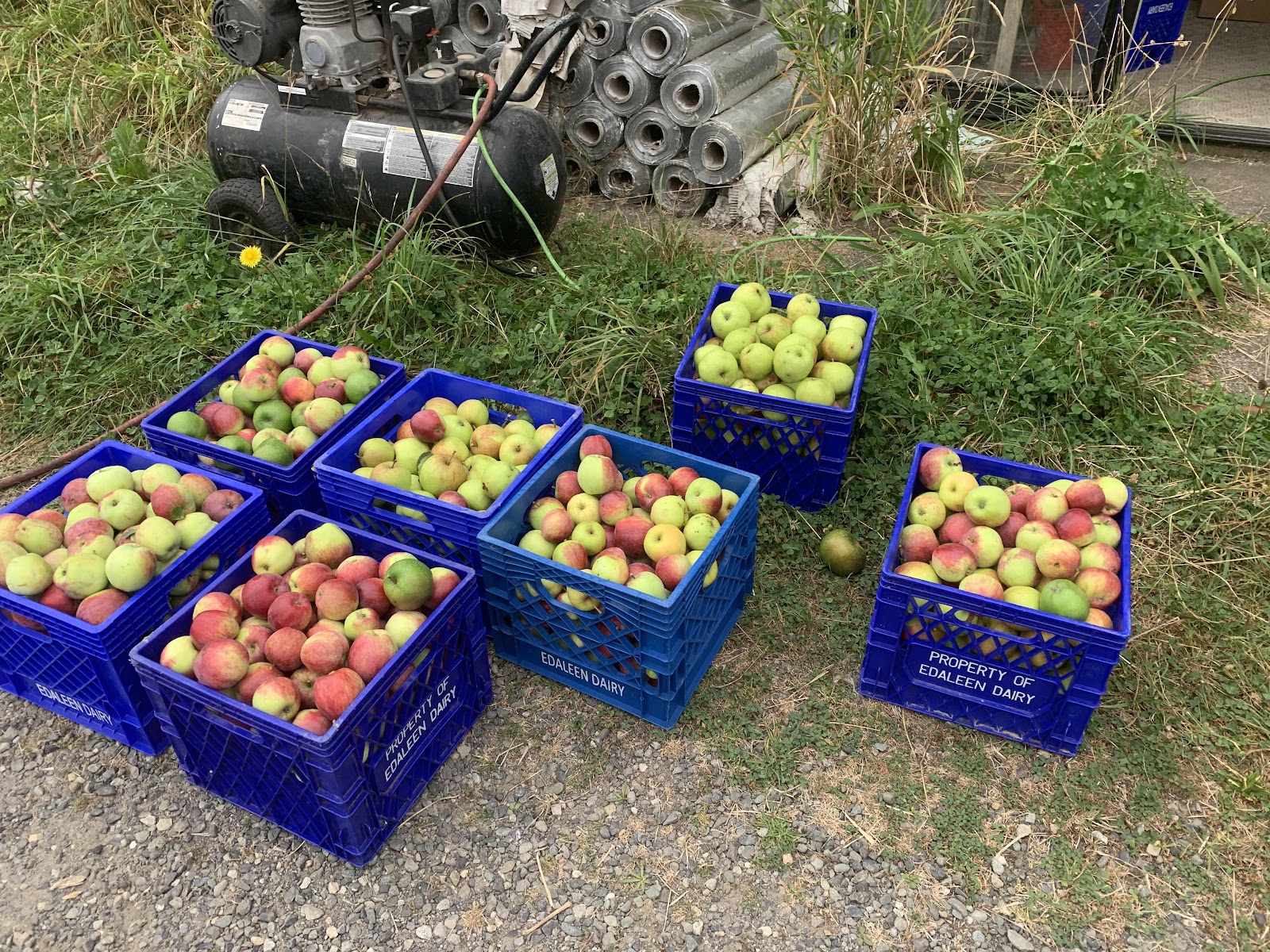
Today the girls and I pressed about ten gallons of cider, from the apples you see above. My friend H. down the way has a dozen apple trees and was only too happy to let us pick some. Tomorrow I will bring her some cider. 

Cidering is hard work. Picking the apples, carrying the crates, washing the apples, hauling the press out and cleaning it, bending down and standing up approximately 7000 times, pressing the buckets, pulling the tight-packed plate back out of the buckets, carrying the apple mast to the compost. It’s messy too, with little bits of apples flying everywhere and juice on everything. By the end I was so sweaty and sticky and tired! Working outdoors in this horrible smoke isn’t a lot of fun, either. But this was the first time we’ve pressed cider in a couple years and overall it’s a great experience. 

The smaller of my two carboys, three gallons, will be made into hard cider, and we’re keeping the rest sweet. I threw two gallons into the freezer, which leaves us about six gallons to get through before it turns into tepache. Not that there’s anything wrong with tepache. 


Plums. This in an on-year for the Italian plum tree, and there are hundreds and hundreds of plums. I’ve dehydrated enough to fill a gallon ziploc bag - more plums than you probably think - and the dehydrator is full of plums right now too. 

I’m taking another swing at plum wine. My past efforts have been drinkable, not fantastic.  Probably I won’t get any better unless I buy a little more equipment - like a hydrometer - and start taking recipes more seriously. But hey - there are so many plums. How far wrong can you go? Right now there’s about two gallons in a primary fermenting chamber and I’ll pitch the yeast tomorrow. I have to go buy another carboy because all of mine are currently full of apple cider. 


One of Homero’s clients brought him an enormous side of  salmon as a tip. I cut it into five approximately 1 1/2 lb pieces, and we ate one fresh and then I smoked the others. One of the smoked pieces is in the fridge to snack on and the others are vacuum sealed and will keep in the fridge for a few months. Probably not until Christmas though, sadly. Smoked salmon is my favorite thing to send friends and family as a Christmas gift. I could throw them in the freezer but I’m not sure how well the texture would hold up. 

Let’s see, what else? Oh, I canned six quarts of salsa ranchera  this week with tomatoes from gleaners. But I’m not doing a lot of canning for the simple reason that I can’t find canning lids anywhere! Apparently canning lids are the toilet paper of this phase of the pandemic. I have one package of small mouth lids left. 

A couple days ago I hit my favorite local farm stands just to see what was available. I brought home some sweet corn (which we ate), some cherry tomatoes (ditto), five pounds of green beans, and three smallish kohlrabi. I started kimchee with the kohlrabi. Earlier this summer I made a batch of kohlrabi kimchee and it was the BOMB. It’s only about a quart, but we will enjoy it. 

I’ll have to decide if I want to use the last of my canning lids to make canned dilly beans with the green beans, or if I will lacto-ferment them like kosher dill pickles. Both ways are good. 

I haven’t even started in the pears. Good lord, the pears! WHY did I plant FOUR pear trees? 


. 

Wednesday, July 8, 2020

Preserving Log (Early Summer Edition)


I’ve fallen behind on my blogging, I’m afraid. Since the stay-at-home order was lifted early last month, I’ve been busier than a one-armed paper-hanger (as my mother used to say). 

Mostly, I’ve been working a lot. All the procedures and routine checkup and vaccination appointments and dentist appointments that were canceled during the lockdown have been rescheduled, and all the doctor’s and dentist’s offices are full. My agency is down by at least three interpreters. Two of them are elderly and not in great health and so are not taking appointments at the moment, and o e of them got stuck in Spain way back in March and hasn’t been able to come home yet. This means there is a ton of work for me, more than I want, really, but if I turn appointments down they often go unfilled.

In my free times, this is what I’ve been doing as far as preserving goes: 

 - several small batches (3-4 quarts at a time) salsa ranchera, as the gleaners pantry gives me the ingredients

- a gallon of kosher fills that is almost gone now. Yesterday I bought more pickling cucumbers and later on today I will gather grape leaves start a new batch

- a gallon ziploc of dried cherry tomatoes. Haven’t done this before and it’s really good. I season them with a little salt and garlic powder and then dry them till they are very leathery or even crisp. Nice for snacking and they add great flavor to a stew or soup.

- froze about a dozen quarts of strawberries. Went to the u-pick with friends when they were up visiting. 

And today I am breaking out the big stockpot to deal with this:


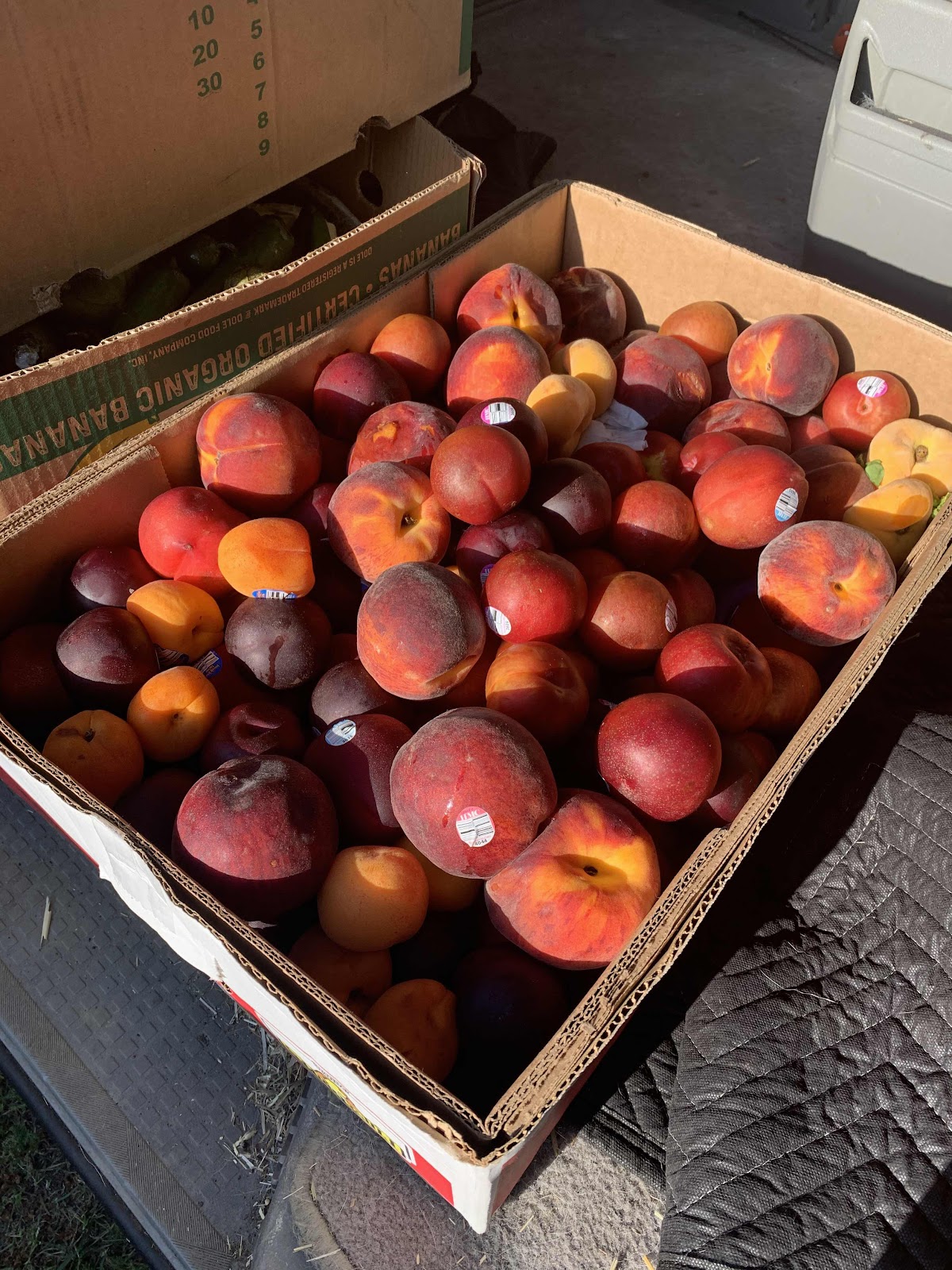
That’s about 25 pounds of mixed stone fruit from gleaner’s. After I separated the fruit that was too far gone and picked out the fruit that was still perfect for eating fresh, I was left with about ten to twelve pounds of slightly overripe fruit. The last hour or so has been devoted to bleaching, peeling, and chopping and my kitchen looked like a couple of murders had taken place (red plums!) but now I have this simmering on the stove:


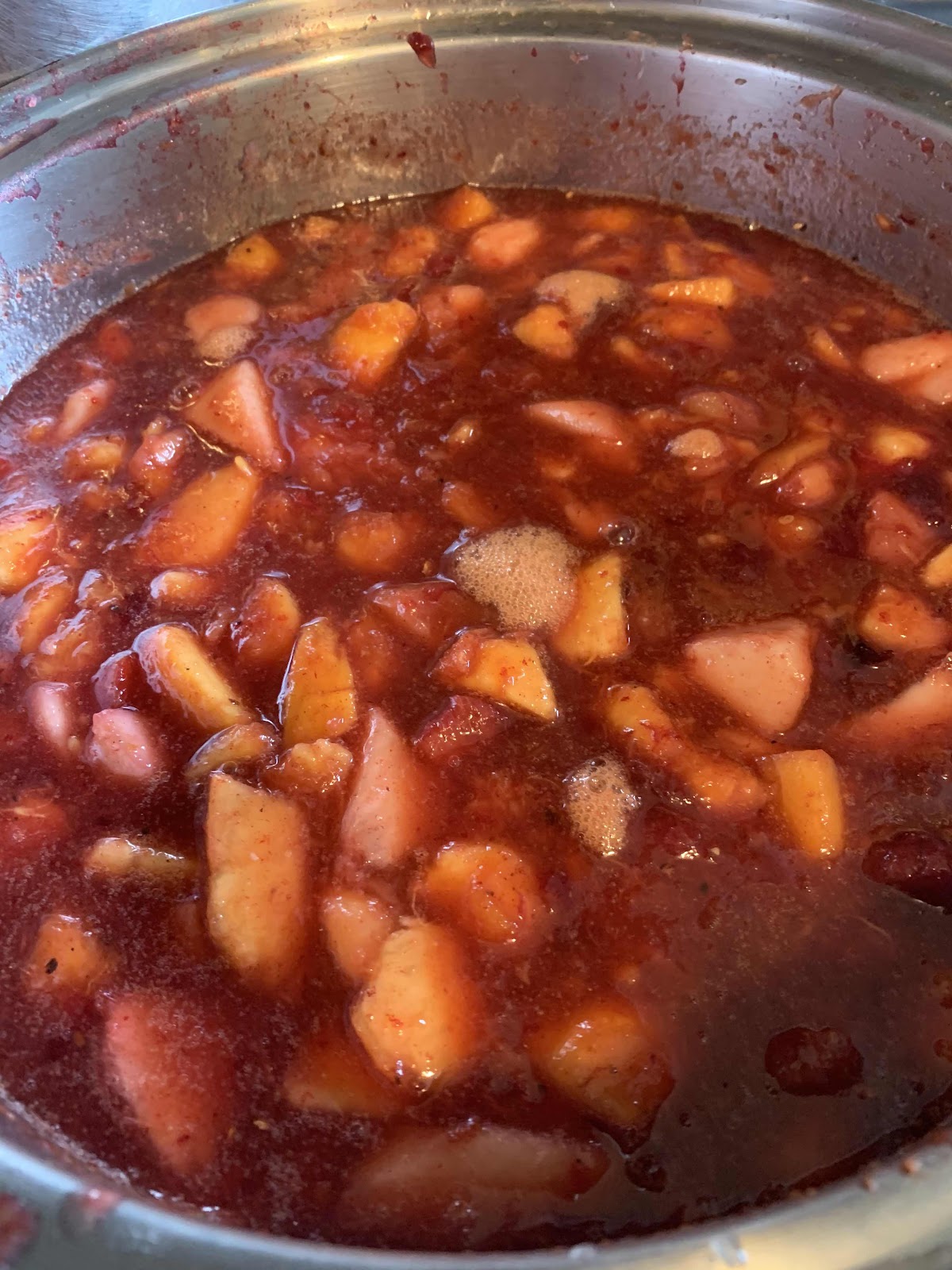
Spicy stone fruit chutney. It has cinnamon, cloves, black pepper, red pepper flakes, a TINY hint of garlic, brown sugar and apple cider vinegar. It smells like heaven and it ought to be delicious with pork chops, chicken breasts, or maybe a hearty fish like halibut. It’s super pretty, too. 

But man there’s gonna be a lot of it. I think this may be my Christmas present to a few people this year. 

Still sitting out on the front porch: a crate of corn on the cob to be shucked, shaved, and frozen; and about ten pounds of jalapeños to be turned into rajas en escabeche. I might get the peppers done today, but he corn is gonna have to wait. 


Wednesday, March 18, 2020

State of the Farm: Pandemic Edition


The girls amuse themselves at home with Henna freckles 


DQ2 - day two of “quarantine.” We aren’t officially quarantined, of course, and not even prohibited from going out and visiting. The official prohibitions in Washington are (as of right now) no gatherings of over 50 people (or has it been changed to 10?) and smaller gatherings must abide by strict “social distancing” rules that keep people 6 feet apart. 

Schools are closed at least through 4/27. I started the DQ count from the first day that schools were closed, which was yesterday, hence today is DQ2. Restaurants are closed, though takeout and delivery is allowed. Bars are closed, as are any place where people habitually gather, such as bowling alleys, churches, movie theaters, museums, libraries, barber shops, etc. Grocery stores and pharmacies are open. 

Everyone who can work from home is being told to work from home. I am still working, working more than usual in fact. As a medical interpreter, I spend my days going from one doctor’s office to another, which I suppose makes me high risk for infection. Today, for the first time, there were nurses with thermometers stationed at the entrances of the clinics, taking everyone’s temperature before they were allowed in. I don’t have a fever. 

Homero is still working as well, but he works from home all the time anyway. People still need their cars fixed, even if they are being told to stay home, I guess. I worry a bit about him because he has a few different underlying health conditions (as do I) that could make him a higher risk for complications. At least he wears gloves all the time. 

The girls were initially thrilled about the prospect of a six week spring break, until it was made clear to them that they would not being spending much time hanging out with friends, or indeed outside the house at all. I have let them see a couple friends, one or two at a time, and I’m thinking of getting in touch with the parents of a few of their “best friends” and asking about creating a closed circle of friends so they can all hang out with each other without becoming vectors of disease. 

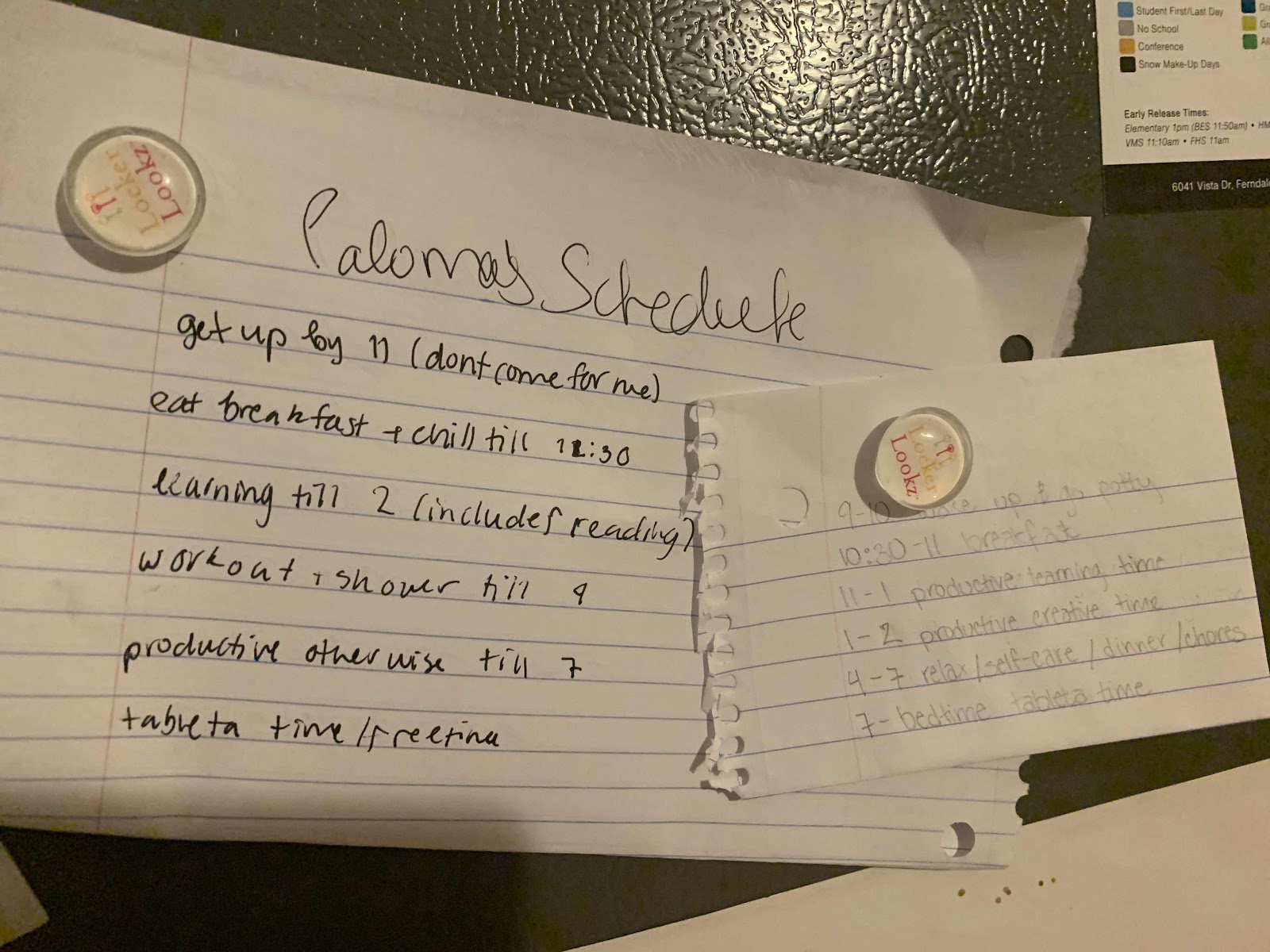
Nobody knows yet when school will resume. Teachers have been told not to send homework for the time being, since not every child has internet access at home and it wouldn’t be equitable. The district is working on a solution, at least for high schoolers, and I expect sometime in the next week or two that they will probably send home some fat packets. In the meantime, I told the girls this isn’t a vacation, and that they needed to write up a schedule for themselves. It doesn’t have to be a strict schedule, or overly specific, but it has to exist. Here’s what they came up with:


I especially like Paloma’s first line item: “get up by eleven (don’t come for me).” 

Each schedule has to include a two hour block of time for school related work (their teachers can’t assign work that will be collected and graded, but they can post “suggestions” online) and a two hour block of “productive other” time. This second category can be anything from playing piano to drawing to exercising to working in the garden to reading a book. Other than those two categories, and one chore assigned by me or their papa each day, their time is their own. 

Some examples of the chores I intend to make them do, in no particular order:

- walk the pastures and pick up all the pieces of broken plastic, plastic baling twine, or plastic bags and assorted trash they can find. No matter how careful one is, small plastic detritus accumulates over the winter. 

- turn over some of the compost pile

- clean out a drawer or a cabinet 

- harvest nettles

- organize the canning jars (full ones by contents; empty ones by size)

- use the sewing machine to make patches for mending the quilts with holes in them (our dogs have a tendency to get overexcited and tug on the bedclothes)

- clean up the greenhouse 

Like everyone else, I am imagining all the great stuff we will all get done during this enforced down-time, and like everyone else I am probably fooling myself. It’s unlikely I will take up a musical instrument or learn a third language. A more realistic hope is that I will have time and energy to put in a small garden - something I haven’t done for a few years - and read a few extra books. Perhaps do some drawing. Within a month the goats will kid, and soon thereafter it will be cheese season again. 

A good chore for me would be to find, clean, and organize 
my cheese making equipment, and order new cultures and supplies. 

Another good chore for me would be to commit to keeping a blog diary of our lives during this time.  Nobody knows how this is going to play out. Things could stay bad for a long time. Many of my neighbors are elderly and frail and are really not supposed to go out at all. Tomorrow I will talk about local efforts to pull together and provide help and services for folks who are ACTUALLY quarantined, and for folks who have lost their jobs, and those negatively affected in all sorts of ways by this unprecedented situation. 

Stay healthy! 

Wednesday, February 12, 2020

Dedicated Cheese


Today I opened up a cheese from last spring, that had been resting, vacuum sealed, in the dedicated fridge in the store room. The “dedicated fridge” is a half-sized refrigerator that I bought last year to store cheese, smoked salmon, and various fermented products such as sauerkraut, kim chee, and so forth.

As of today, there were only three packages of cheese in the dedicated fridge, totaling  perhaps  four pounds. Most of the cheese had been either eaten or traded away months ago. It’s always a gamble opening up a sealed cheese. 

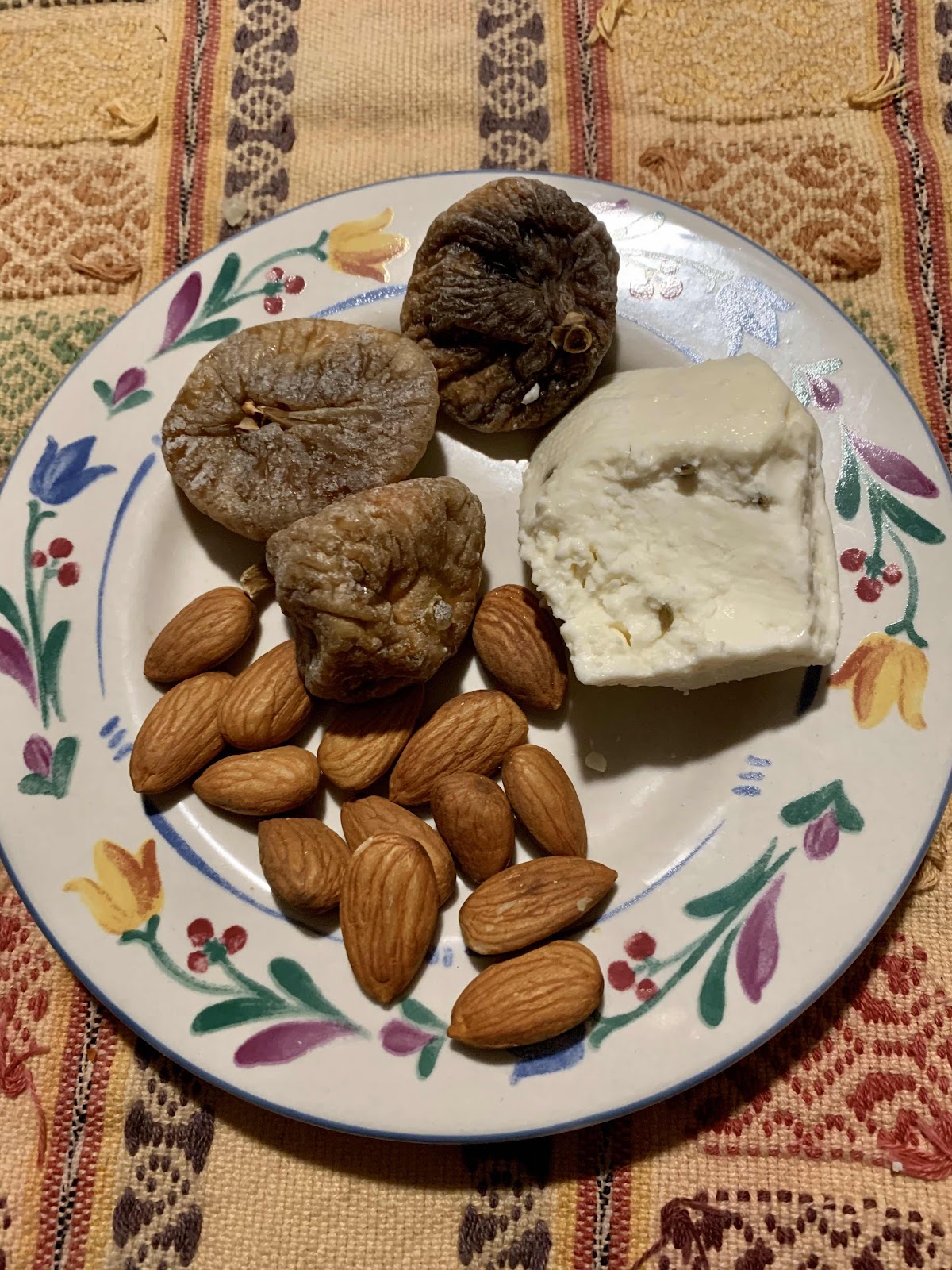
This gamble paid off. The cheese is strong but delightfully rather than offensively so; goaty but pleasantly so; herbal with the scent of caraway seed, but not overpoweringly. A handful of almonds and a few dried figs made a beautiful accompaniment.

Other likely partners include fresh apple slices, sourdough bread, olives, maybe roasted red peppers and artichoke hearts... basically it would be an enhancement to any mezze plate or antipasto plate. 

I’m inordinately proud. I mean seriously. How many people are there, in this day and age, who make their own cheese? And cheese made from the milk of goats who they raised and milked themselves, at that? the cheese I enjoyed tonight is a true artisan farmstead product that few people have the chance to taste.

More’s the pity. if you ever make it out here, there’s cheese in the dedicated fridge. Dedicated for you. 

Wednesday, November 27, 2019

Thankful for the Truth (Warning graphic photos)


I love Thanksgiving, especially in the years, like this one, that I get to host. I enjoy the process of writing a menu, shopping for ingredients, and setting a beautiful table. There are few things that make me happier than seeing people I love really digging in to food I’ve prepared for them. I’m happy when my adult daughter comes over, and I’m happy to see my mom. But there is something about Thanksgiving that make me feel uneasy. There is a whiff of - if not hypocrisy, then maybe willful blindness - that hangs around the Thanksgiving table. 

Thanksgiving is a day of delicious excess, a national fantasy of happy peaceful families and endless sweetness, but the truth is often unpalatable. Enjoying an abundance of good things and being thankful for what we have is, of course, wonderful, and in no way a bad thing. Indeed, we’d all be happier and the world would probably be a better place if we came together more often to share our abundance and to give thanks out loud and in the presence others. 

But it’s also important to acknowledge the realities that underlie the feast. These are manifold. Firstly, I acknowledge that to make this feast, a beautiful turkey had to die. 


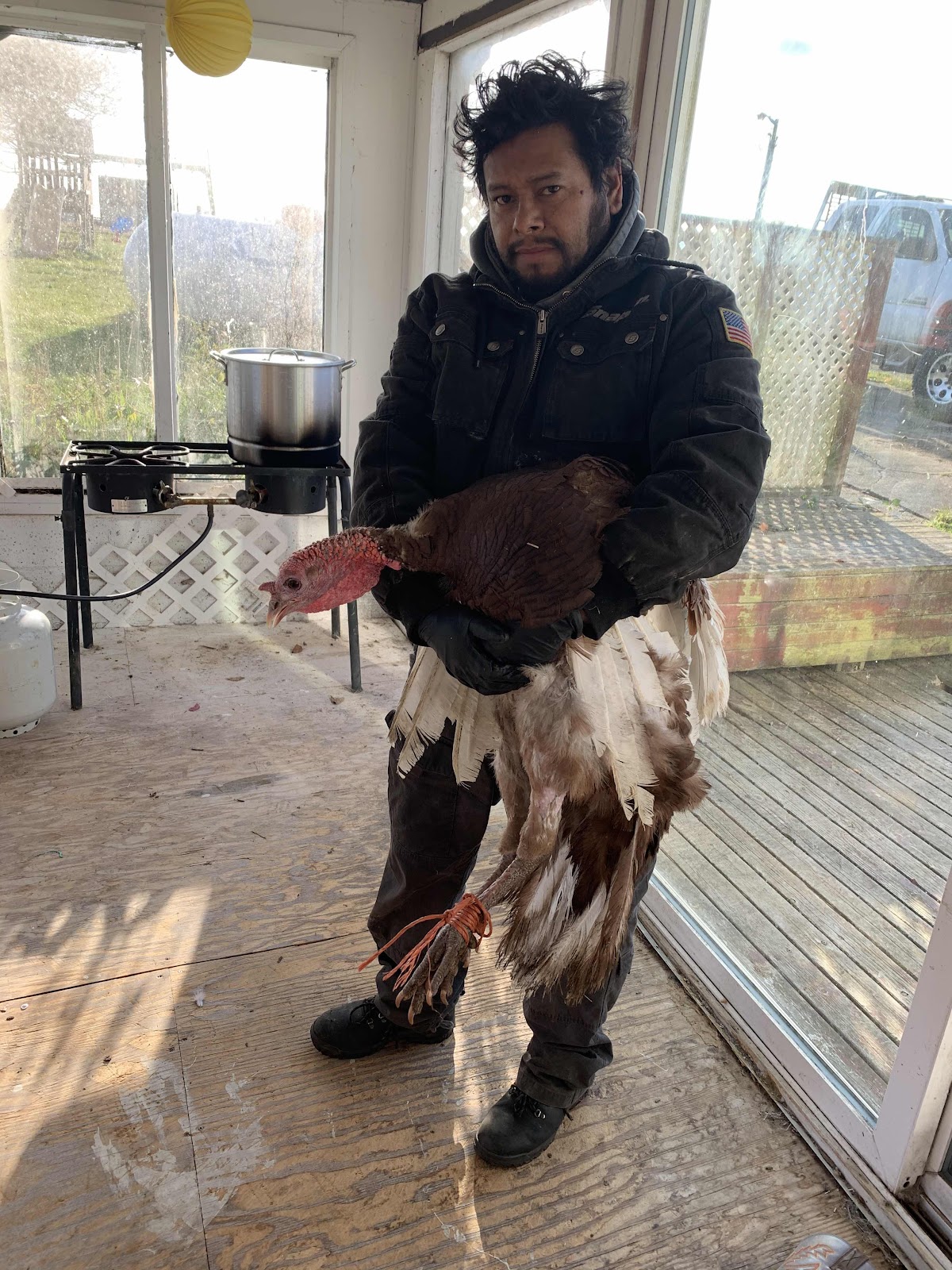
I acknowledge the work that went into raising him - this bird was raised on pasture by a local farmer, so I thank my neighbor for her work and expense. But I also recognize the labor of the people - mostly immigrants - who toil in the vast and dangerous poultry processing industry; I acknowledge their worth and affirm their right to safe working conditions and just recompense. 

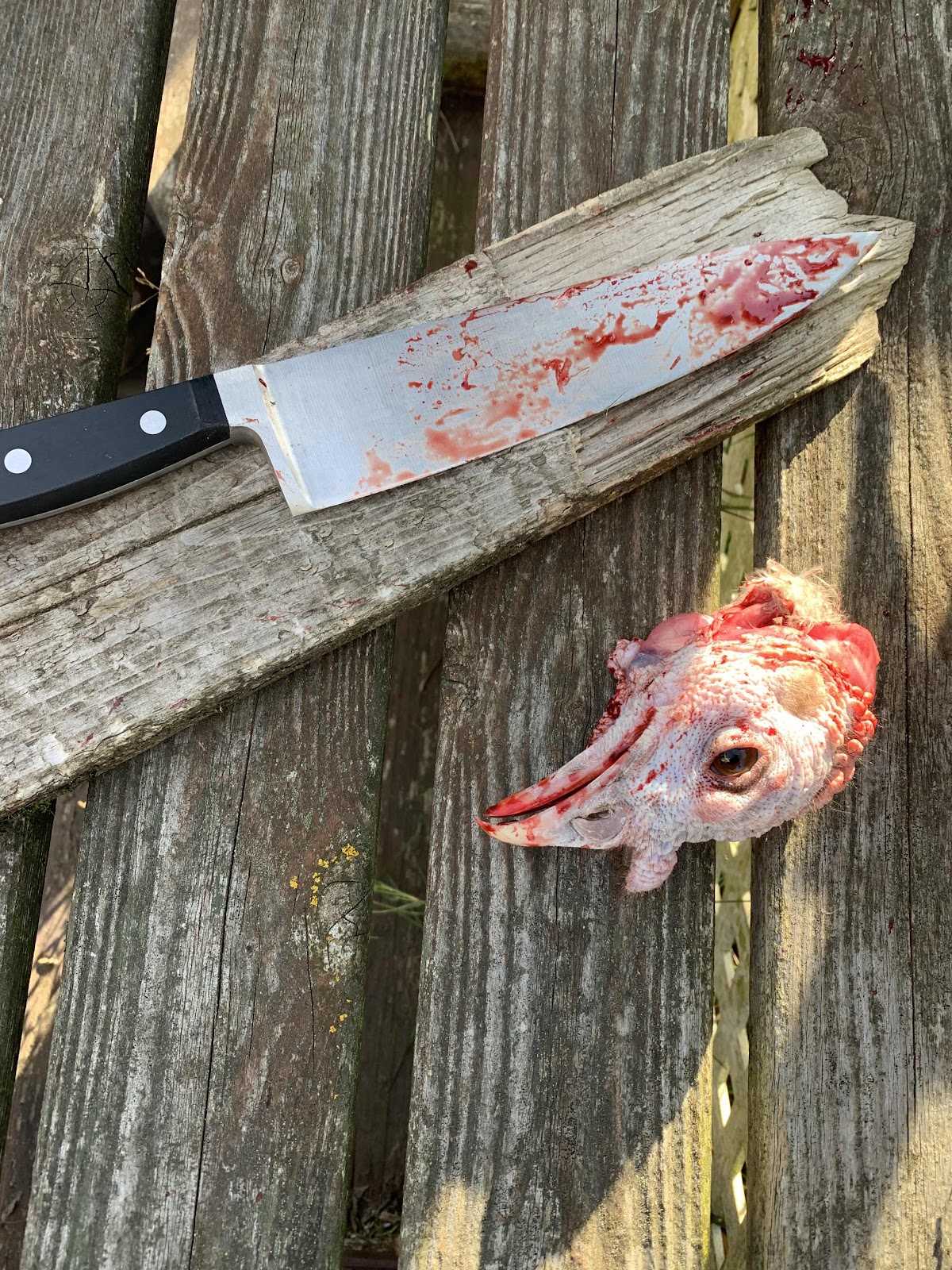
I thank my husband for the work he is doing right this minute - butchering the turkey out in the cold November wind. I acknowledge this is a disagreeable task and I thank him for being willing to develop the skill to do it well. 

The vegetables on the table - the potatoes, the Brussels sprouts, the salad greens - are produced by an unsustainable system that abuses workers and the earth in equal measure.  I am a witness, and I pledge to do what I can to avoid participating in those injustices and to mitigate the tremendous waste generated. 

And finally, I acknowledge that I live on unceded land of the Lummi and Nooksack tribes. All of us settlers live on land that either was never ceded by the tribes, or which was ceded under deeply unequal conditions, in which one side held all the power. I acknowledge that uncomfortable truth. If you want to know on whose land you reside, visit this link: 
https://native-land.ca/. I pledge to work toward correcting the grave inequalities that resulted by upholding the efforts of local tribes to sustain their culture and supporting their businesses and candidates for office. 

None of this is meant to be a huge bummer.

It is possible to be grateful for our wealth while recognizing the problem of poverty. We can celebrate being together with family while knowing that some are lonely. We can give thanks for warm homes, abundant food, and all the good things in our lives without trying to shut out the knowledge of the many who lack those things. It’s not a sin to be warm, to be fed, to be loved. These are wonderful gifts.

My hope and my prayer is that naming our gifts and sharing them with our loved ones will inspire us to share them more widely, as well. I remind myself, as I bask in warmth and light, of the existence of cold and darkness not out of guilt, but so that I may be moved by gratitude and grace to expand the circle of warmth and light to include others. I remind myself, as I nourish my body with roast turkey, of the death of the animal I am eating not as some sort of penance, but to honor the truth that this act embodies the cycles of life and death on this beautiful planet, cycles we are all of us bound by. 

May you be abundantly blessed this Thanksgiving. May you have much to give thanks for, as much as I. 


Sunday, November 17, 2019

Paloma’s Pigs


Some years we raise a couple of pigs, and some years we don’t. The decision whether or not to get a pig in any given year is based on a number of factors - how much meat we have in the freezer, the price of local weaner piglets, whether or not our neighbors are raising pigs this year, etc. 

In general, I have more or less decided that it is as cheap to buy pork from our neighbors as it is to raise a pig of our own, and much less work. However I can be swayed. This year we were swayed by our youngest daughter’s need for an FFA project coinciding with the availability of some handsome well-grown weaners raised by a close neighbor and offered at an excellent price. 

Paloma, our youngest, swore up and down to us that she would be in charge of feeding the pigs. Of course, she doesn’t know what that actually entails. We get much of our pig food from the Gleaner’s Pantry, and she can’t participate in that. The truth is that I will be doing most of the sourcing of food for the piggies, and Paloma will only be in charge of doing her pig-related homework. 

The question she posed and will be trying to answer is “is it financially advantageous to raise your own pigs?” For those who are interested enough to follow the links, I’ve already done the math and answered this question to my own satisfaction:
 
For those who aren’t that interested, the answer is - you can get nearly free meat if you don’t put any value on your own labor. 

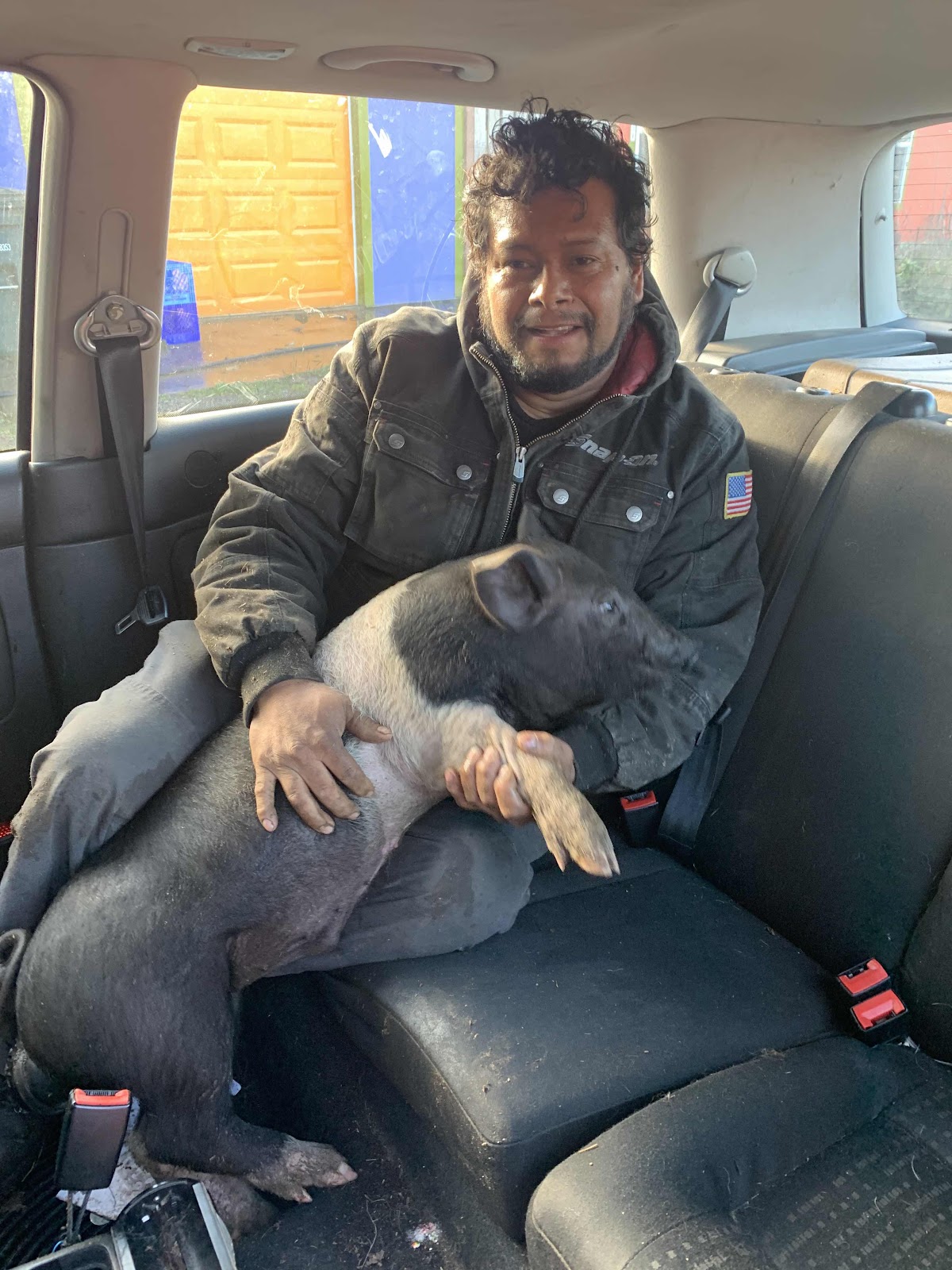
But of course labor counts. Here is Homero, after spending some twenty minutes chasing down a couple of well-grown piglets today. His face clearly shows that labor counts.  My neighbor told me we could choose our own pigs from her litter of fourteen, and there were a couple of standouts. In the end, however, we took whichever pigs Homero was able to catch. 


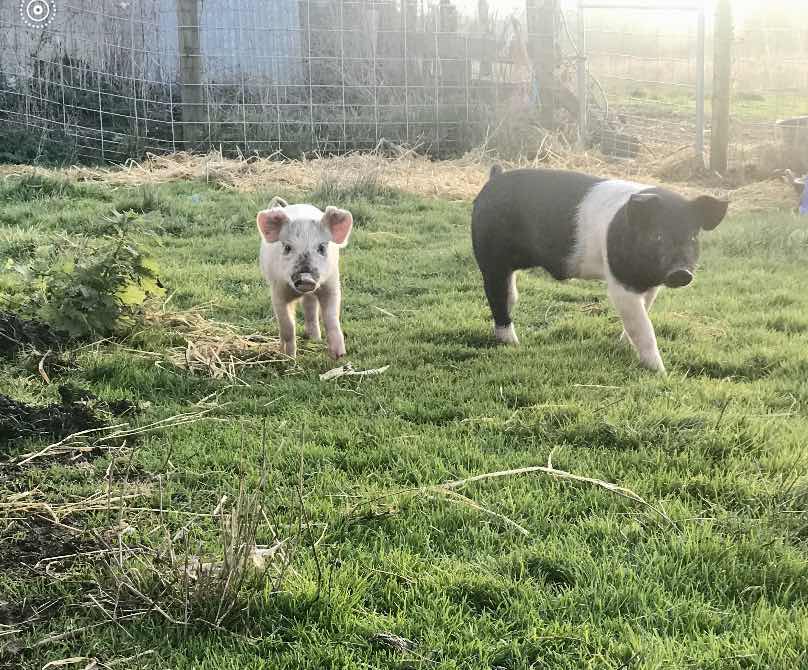
This handsome boy was the largest of the entire litter, and probably tipped the scales at sixty pounds. Homero was hard pressed to keep ahold of him all the way home. 


The second piglet he managed to catch was the smallest one of the litter, a little pink girl with curled back ears. They seem to be happy with their new digs - we have them in the sacrifice area which is about 100 x 100 feet. Their house is a round calf hutch stuffed with hay. 

Raising pigs over the winter has its challenges, and it obviously costs more than raising the same animals over the summer months, because mammals require many more calories to keep their body temperature up during the cold season. Also their natural rooting behavior causes more damage during the wet season. That’s why we have them confined to the sacrifice area, which is compacted and has a bad weed situation. Any rooting they do may actually be beneficial, and their manure will help fertilize the sandy poor soil. 

As in past years, the idea is to sell one pig (post-slaughter, in cuts) and use that money to offset the costs of raising the other pig, which we will keep for ourselves. Paloma will be keeping the books this year, and I’ll keep you all updated on her conclusions. 


Thursday, October 10, 2019

Lobsters of the Forest (Mushroom Madness)


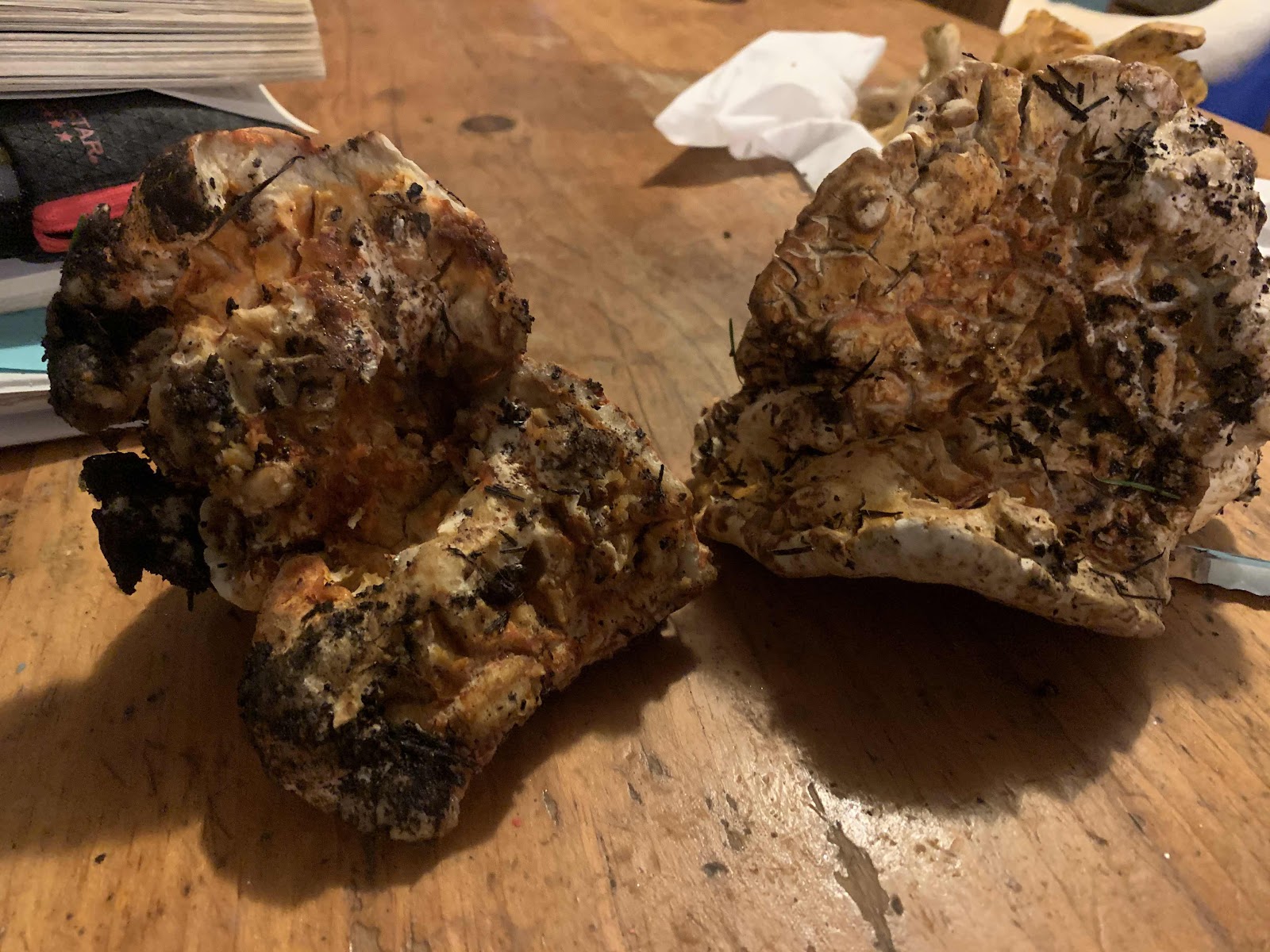
These ugly lumps are actually highly prized lobster mushrooms. 

It’s prime time for mushroom hunting in the Pacific Northwest. The rains came in mid September, right on schedule, and since then we’ve had alternating rain and sunshine, which is just perfect for making the mushrooms pop up. By all accounts it’s been a bumper year for chanterelles. 

I have long been fascinated by fungi, but I’ve not done the work of educating myself to pick them, beyond a very few varieties that are easy to identify. There’s a patch of shaggy manes out in the back pasture. I’m relatively sure I can recognize agaricus campestres (though there are toxic lookalikes). If I happened to trip over a chanterelle or a morel I would know what it was. 

Nobody just trips over forest mushrooms though. You have to go out and search for them, and you have to get off the trails and go bushwhacking through the deep woods. It’s hard physical exercise and it gets you wet, dirty, and scratched up. Also exhilarated and energized. 

A relatively new friend of mine is a confident forager. In the past I’ve traded her goat cheese for mushrooms, but this year I asked if I could pay her to just take me out with her foraging. Not to any of her secret spots! That would be a very rude thing to ask. Just out into the woods and help me improve my eye for good habitat and gain some confidence identifying a few more varieties. She was happy to do so. 

We found several edible mushrooms - coral mushrooms and oyster mushrooms, a couple of decent boletes, and a small patch of chanterelles- but the coolest find was a large number of lobster mushrooms. 


The ugly lumps after careful cleaning.

Lobster mushrooms are cool. They are actually a boring, bland mushroom that has been attacked by another fungus and improbably turned into something delicious. Lobsters start out as Russula Brevipes, which is a large white mushroom that pushes up through the forest duff in evergreen forests. They are edible but exceedingly bland. Wherever you find lots of Russulas, though, you will find a few that have been turned into lobsters. The fungus makes them bright orange and hard, and curls them into fantastic, tortuous shapes. Keep an eye out for glimpses of orange poking through the forest floor. 

Cleaning them is a chore. You don’t want to wash them with water if you can help it because they will soak it up like a sponge and ruin their texture and dilute their subtle flavor. Use a stiff brush instead. Most lobsters will have at least a few wormholes in them (these ones are exceptionally free from worms) but don’t worry about that. Just trim off any bits  that seem too wormy to eat. Ditto any parts that are stubbornly grubby - though as my mom says, you gotta eat a peck of dirt before you die and eating it along with wild mushrooms seems like as good a way as any. 


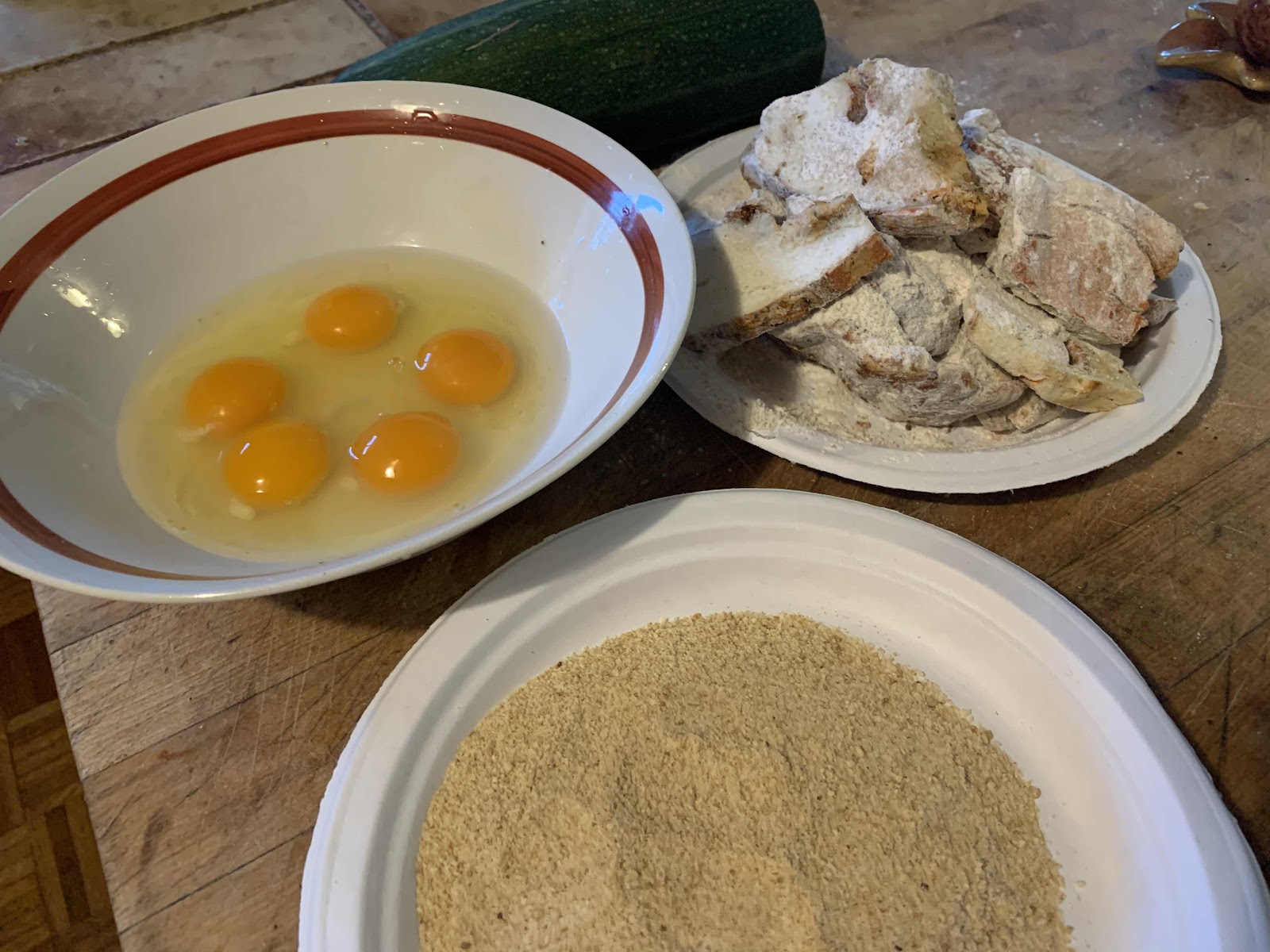
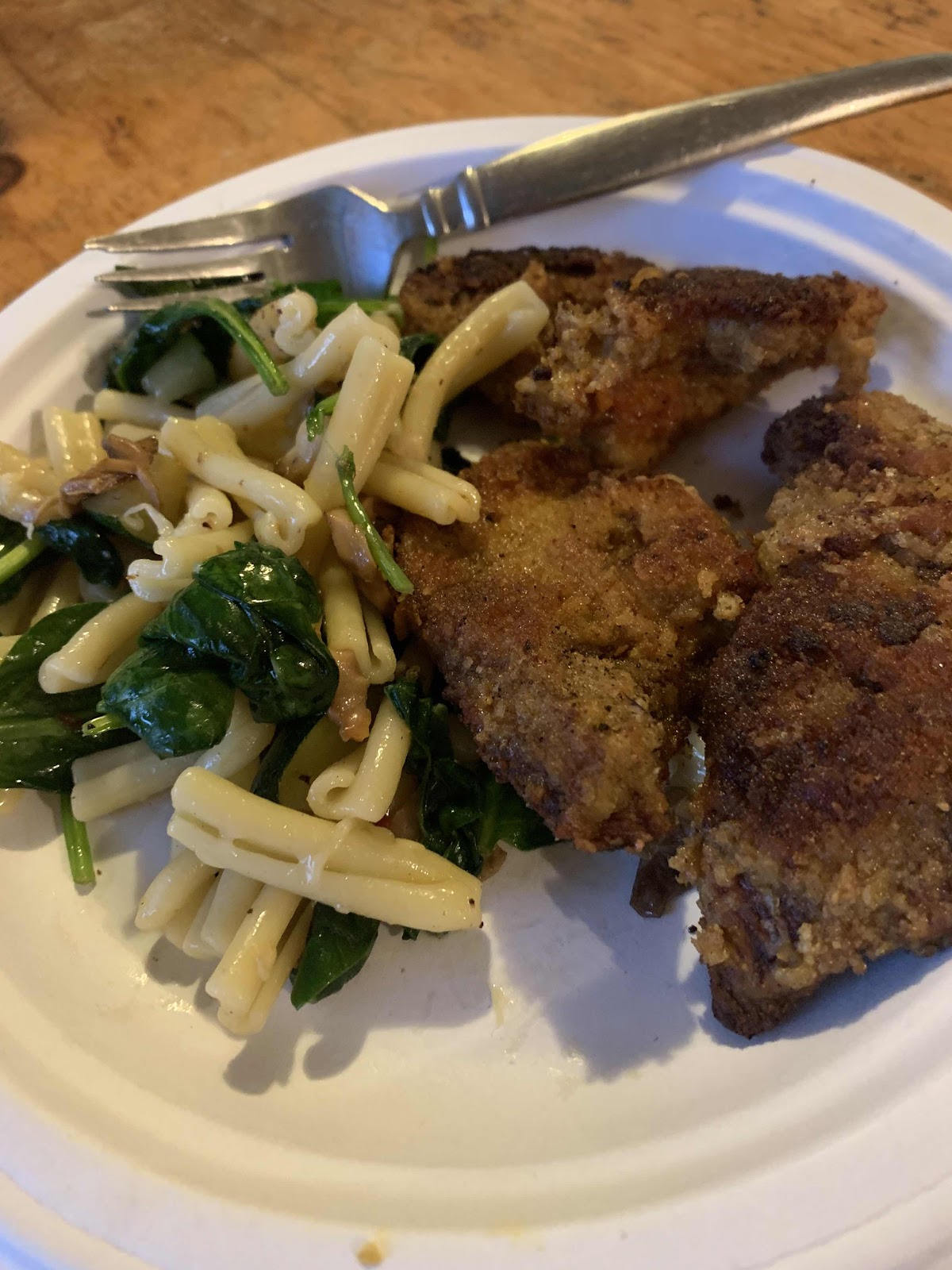
There are lots of ways to prepare lobsters, but they are one of the few wild mushrooms tough enough to stand up to being sliced and fried in egg wash and crumbs like chicken-fried-steak. I added Parmesan to my bread crumbs and pan fried the mushroom steaks y til deep golden brown on both sides. I found I liked them better the more cooked they were, so next time I might use a little lower heat and give them more time. 


The other mushrooms we found went into a pasta side dish with spinach. My husband and kids were a little leery of eating the lobsters at first, but they both enjoyed them after trying them. Homero, in fact, ate an entire lobster mushroom
all by himself. 

After three hours of hiking in the intermittent rain and then cleaning the haul and cooking dinner, Ipushed back from the table, told everyone to clean up please,  I was going to take  a long hot bath. I earned it.