"United we bargain, divided we beg."
Showing posts with label chickens. Show all posts

Sunday, April 3, 2022

Spring Chickens


We got some baby chicks. Now that we have a coop for chickens so close to the house - right inside the fenced backyard - and can be reasonably sure that coyotes aren’t going to get them, we thought we’d take the risk on a few more. 


There wasn’t a lot of variety available at the farm stores in town. Mostly red or black sex links, broilers, and a few heritage breeds. I was specifically looking for broody breeds,  and I was frustrated because not only are there just not that many broody breeds being produced these days, but the stores uniformly had no information about the broodiness or lack thereof in the breeds they were selling. In one store, I asked the person working “do you carry any broody breeds of chicks?” And she answered me “what does broody mean?” 

I must be getting old. 

Well for those who don’t know, like the girl working in my local farm store, a broody breed of chicken is a breed in which the hens will sit on eggs, hatch out chicks, and raise them herself. What? Don’t all chickens sit on eggs? NO. Most modern breeds of chickens have had the broodiness bred out of them. When a hen is broody, she isn’t laying. When she’s raising chicks, she isn’t laying. It’s not cost effective to raise broody chickens for egg production. All your best egg laying breeds - leghorns, Rhode Island reds, etc, will not go broody. 

We eventually found two Cochin chicks. Cochins do go broody, and they also have cute feathered cheeks and feathered feet. We also bought two Golden Comets (not broody) and two Easter Eggers (seldom broody - they are  not Americaunas, which also lay blue eggs and DO go broody). Now all six chicks are out in the converted rabbit hutch under a heat lamp, which I hope will be sufficient in this nasty, cold, wet weather. 

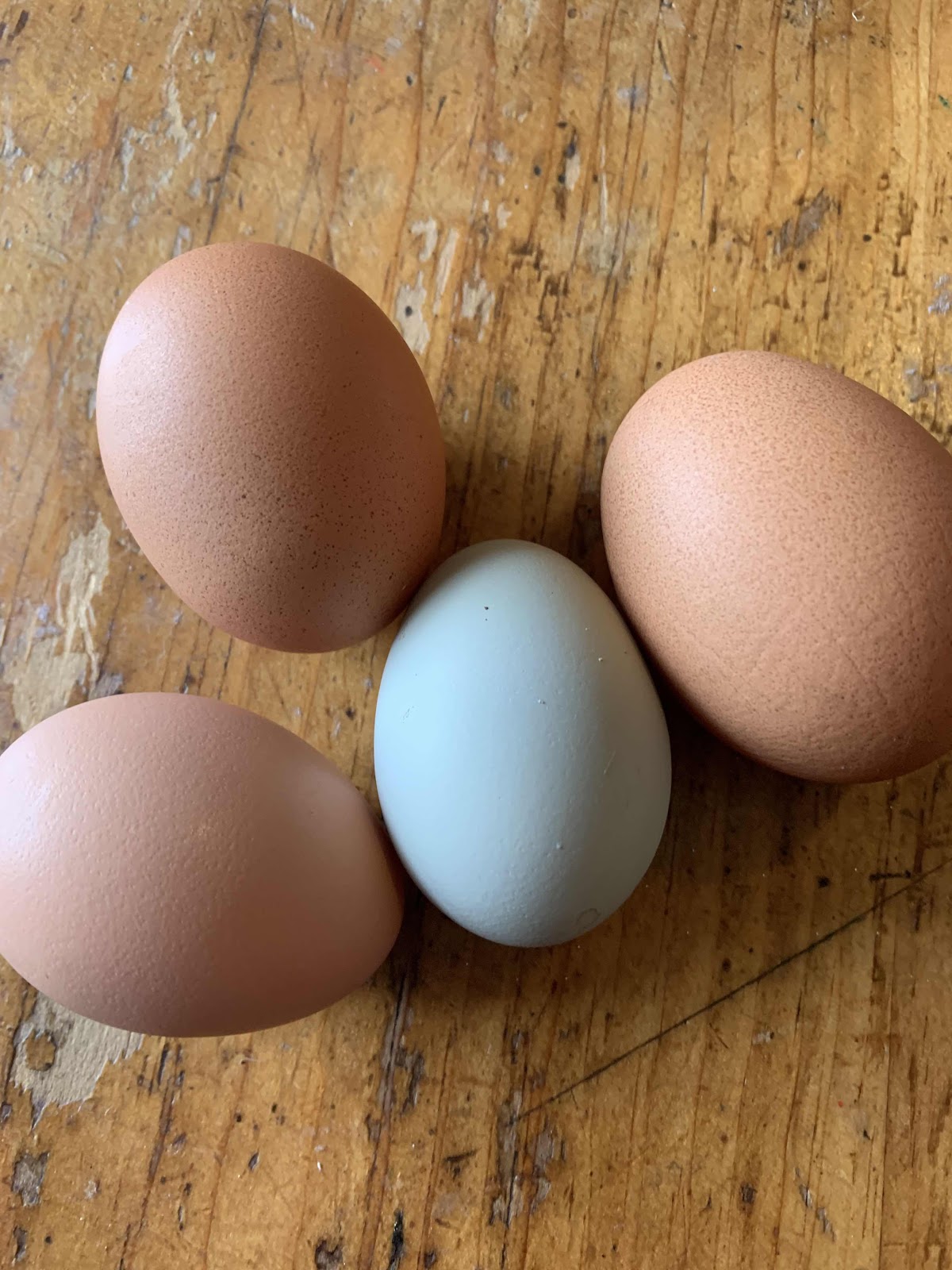
Speaking of colorful eggs, something very weird happened yesterday. We have five Rhode Island Red hens who have been laying all spring. They have all been laying many many eggs, and all of those eggs are, as you would expect, large and brown. Until yesterday:


There was a mystery egg in the nest box - a small blue egg. I have never, never, in all my years heard of a hen who could lay eggs of different colors. Hens who lay white eggs ALWAYS lay white eggs, and ditto brown, blue, green, and pink. Sometimes you get some weird eggs alright - teeny little ones the size of marbles, wrinkled ones. Once I even found an egg without an outer shell, just the inner membrane. That was an odd egg. But I have no explanation for this blue egg. 

Maybe we had a chicken visitor. My daughter and I had a good laugh imagining a lady chicken visitor who suddenly realized she was about to lay an egg. 

“Oh Penny, do you mind if I use your nest box?” 

“Oh of course Georgina, it’s right there on the wall. Yes, that plastic milk crate attached with zip ties. Make yourself at home.” 

“Oh thank you Penny I can’t imagine how I forgot to do this before going out….. BUCK BUCK BAGAWK!” 

Tuesday, March 8, 2022

Attempting Chickens Again (Hammer and Crime)


Every winter, we lose most of our poultry to coyotes. This is, of course, mostly our own fault. Our chicken coop is hardly worthy of the name - it’s just a rickety collection of random boards nailed up between our two small barns, with chicken wire tacked on and roofed with corrugated plastic, which is cracked and broken. I haven’t the heart to keep the chickens penned up in there. The barns have no gutters, so the rain sheets off the roofs and pools in the coop. Eight months of the year it’s just a mud puddle. They do have nest boxes and a couple of dowels to roost on up off the floor, but they don’t really like it in there and I don’t blame them. 

So the chickens and turkeys are fully free-range. They mostly roost in the hayloft of the main barn, which would be fine except for the fact that it ruins the hay. And except for the fact that the main barn apparently does not protect them from predators one little bit. Over the years, we have clearly become known far and wide as “easy pickin’s farm” with the local coyote population. Our property is only five acres, but it abuts some two hundred acres of woods and fields, and there is a whole mess of coyotes in there. 

I’ve pretty much given up on raising turkeys, because they are expensive and ticklish to raise, and it’s just too disheartening to spend a few hundred dollars and several months nurturing poults into big, fat, profitable birds, only to have them disappear just as they hit market weight, leaving behind only a patch of scattered feathers somewhere out in the field. I was close to ready to give up on chickens too, when we were down to a last solitary bird. I wanted to give the poor bedraggled thing away to somebody with a real chicken coop, but Paloma cajoled me into getting four new chickens instead. 

It was obvious we needed a better chicken situation. Either we had to repair the coop in a serious way, or make something new closer to the house where the coyotes wouldn’t come. For a while we toyed with the former, but settled on the latter solution as being both cheaper and less work. These are our prime considerations in most cases. We have a very well-fenced back yard, and it has a chain link dog run in it. We haven’t used this dog run for anything in particular in many years. I don’t even remember where it came from. But it makes a serviceable chicken coop when roofed with cattle panels bent into hoops and then covered with a tarp. 

I found four young rhode island red hens for sale and put them in the new coop along with the one surviving yellow hen. It took them a week or so so settle in and start laying, but now they are happy and healthy and popping out eggs just like they ought to. The downside is the back yard looks like hell - grass all scratched up and porch covered in bird poop - but oh well. What’s that saying? You can’t make an omelette without breaking a few eggs? 

Paloma named the chickens according to some secret logic of her own. She claims to be able to tell them all apart except two. The two she can’t tell apart she named Thunder and Lightening. The other three are Banka, Hammer, and Crime. I think Hammer and Crime sounds like the name of a rap duo from the late eighties. 

We had planned to get some fancy, colorful bantams as well, but I don’t know. Maybe five is enough chickens. It’s certainly better than just one. 

Tuesday, October 28, 2014

Predator Problems (Facebook Farmers)


Last year, we had good luck with turkeys. We never intended to raise turkeys, but a trade came our way (Turkey Trade) and we acquired four half-grown turkeys in exchange for one goat. We ate one, sold two, and donated one to the food bank. I decided pastured turkeys were a great return on investment - and also extremely delicious - so this past spring we upped our investment by 50% and bought six Standard Bronze poults.

All went well until just a few weeks ago - the turkeys all grew quickly and turned into handsome animals of about fifteen or eighteen pounds. I think they were all hens, although I wouldn't swear to that on a stack of bibles. Through Craigslist and Facebook, I had already sold four of them. But then one of them disappeared. There was no sign of "fowl play" (ha ha) - no feathers or blood. There was simply one less turkey.

My Facebook Farmer's group informed me that turkeys are known to wander. In fact, our turkeys had wandered over to the neighbor's a couple of times and had to be retrieved. But they had wandered as a group. Turkeys, at least mine, tend to stay in a pretty tight formation, and I thought it was unlikely that a single turkey had decided to strike out on his/her own.

Then, two weeks later, boom - another disappearance. Same modus operendi - simple vanishing, without a trace of violence. Once again, I went back to my Facebook Farmers. I suggested a coyote, as being the only local predator I knew of capable of carrying off a twenty-pound animal. Plenty of people responded, but with varying opinions - some people agreed that coyotes were a likely culprit, but others said that they would leave a big mess of feathers and blood. Somebody suggested bald eagles, which I discounted not because I think an eagle incapable, but because the turkeys disappeared at night. Again I heard that turkeys wander and I ought to check with the neighbors. And, as always, several people voiced the opinion that humans were stealing my turkeys.

Every time that someone in the group posts that anything has gone missing - apples off a tree, baby chicks, tame rabbits, pumpkins off a porch - the assertion surfaces that it was stolen by people. Personally, I find the idea that hordes of my neighbors are prowling through the dark looking for vulnerable apple trees or sneaking into unsecured barns to steal chickens patently absurd. It's been my experience that my neighbors are far more likely to bring me produce or game meat than they are to take it away. As a matter of fact, in my entire lifetime, I think I have been the victim of burglary twice or  maybe three times, whereas I have been the recipient of totally unsolicited generosity hundreds of times.

So, I've learned a couple of things about my Facebook Farmer's group. Although a valuable resource for those who are willing to sift and verify, there is a lot of suspicion and ignorance. I could learn a lot more about the telltale signs of various predators from five minutes on the internet ( http://www.backyardchickens.com/t/18670/poultry-predator-identification, http://www.avianaquamiser.com/posts/What_killed_my_chicken__63__/) than by asking for advice form a random collection of farmers. Some of them are probably well-informed and right, but how could I tell which ones?

As it turns out, my initial suspicion about coyotes was almost certainly correct. Not only does my google search confirm that coyotes and foxes often carry off birds and leave little trace behind, returning again and again to the same place as long as birds remain vulnerable, but my neighbor (he of the hotel-sized-house, or the HSH) called me night before last to tell me that he had seen two big coyotes in my field, and has shot at them, but missed.  Furthermore, when I decided, yesterday, to walk the pasture in a grid pattern looking for evidence, I found one fresh, well shredded leg bone and a small neat pile of guts.

Clearly, my flock is not well protected. I never know exactly how many chickens I have at any given time, but today I made a point of counting, and there are fewer than there ought to be. And the ones that remain are looking thin and harassed. I think I have a pack of coyotes who have decided that my farm is their snack bar.

Normally, the poultry is locked in a coop at night, but lately I have been leaving them to roost in the open main barn instead. This is because the weather has been unrelentingly awful, raining like mad for a couple of weeks on end. The chicken coop, which is just the space between my two barns fenced off and roofed, has terrible drainage and right now it is just a sea of liquid mud. The chickens would be utterly miserable in there. There is not even any land dry enough to feed them on. They have roosts, of course, but they can't stay on them all day. In this weather it would be inhumane to keep them in the coop. Ducks, maybe.

But something needs to be done, clearly. If I do nothing, the coyotes will likely eat my entire flock this winter. As far as the turkeys go, I think I will probably just butcher them immediately - they are full sized - and keep them in the freezer instead of the barnyard. But I need to finger out how to secure the coop and make it habitable before I lose the rest of my chickens.

Friday, April 6, 2012

It Figures

Why is it that every time I get some good egg trades going, the hens mysteriously quit laying? Since my last post on Monday (Trade Network 2012 (Craigslist Chronicles)) I have collected a grand total of thirteen eggs. In the two days before that, I collected twenty-eight.


Maybe the hens put their pointy little heads together and decided to hold out on me for a bigger piece of the action. They all want massages, too. Maybe my chickens are organizing (did you ever see Chicken Run? I love that movie).

Maybe they are just laying their eggs in the blackberry bushes now that it's warmer out. Time to lock them up in the coop for a few days until they get the hang of things again.

Friday, February 10, 2012

Putting the Pork in my Pocket (Farm Finances)


The time finally came to call our local meat processors and schedule the pigs for execution. These two have been slow growers - probably due to the time of year more than anything else - and just as loud and obnoxious as every other pig we've ever owned, and we are heartily sick of them. Sometimes, pigs actually bowl me over when I head out to feed them. These two haven't actually knocked me down into the mud, but they do chase me, push me with their horrible snouts, and scream. I am not actively frightened of these pigs, but I can't say I enjoy their company either.


There were two reasons for getting two pigs this time around. The first was that pigs are very social, and a pig alone gets lonely - so I've been told - and we thought they would be happier if they had the company of their own kind. The other reason was to bring down the price of our own pork. As I think I have mentioned before (Big Pig, and Big Decision), raising your own pork isn't actually any cheaper than buying it at the store. In fact, it probably costs somewhat more. It's the vastly superior quality of homegrown pork that makes it worth it - plus, of course, the able-to-sleep-at-night factor of not participating in the evil, earth-destroying factory farming industry.

If we raised two pigs, the thought went, we could sell one and recoup some of the costs of feeding both of them, thereby rendering (haha) our own pork somewhat cheaper. I am not at all sure that actually works... that would require about fifteen minutes of math and I don't feel up to it at the moment. However, without doing more than fifteen seconds of math, I can guesstimate that one of the pigs will bring us about $350, which, when you discount the $80 he cost in the first place, is $270... which is probably somewhere close to as much money as we spent on feeding both pigs. So, very broadly speaking, I feel more or less somewhat confident that this scheme actually reduced the price of our own pork by something between five and fifty percent.

There is a totally unrelated reason to sell pork. Our land is classified by the tax man as farmland. We enjoy low property taxes (relatively speaking, of course), but in order to maintain that status we have to be able to show we are reaping actual financial gain from agricultural endeavors on this property, to the tune of $1,500 three years out of every five. So far, we have met that goal... by the skin of our teeth, and by doing some creative accounting as regards barter arrangements. But it is a constant struggle to make good, and $350 bucks or so from a pig goes a fair way towards meeting this year's goal.

I made another $65 today by selling a half a dozen young laying chickens. My chickens have been hiding their eggs quite craftily for the past few weeks and I am getting sick of feeding two dozen chickens and getting bupkes in the way of eggs. Yesterday I put up a Craigslist add offering my 6 month old layers at $10/apiece, with a five dollar discount given for every rooster taken as well. So today, a lady bought seven hens and one rooster: $65. That leaves me with about fifteen hens and three roosters, which seems about right.

Saturday, October 15, 2011

The Great Hen Giveaway (It's Not His Fault)

It's not hard to tell roosters from hens, not when they are full grown. Here; I'll show you.
This is a hen. Hens are female. They lay eggs.

This, on the other hand, is a rooster. The rooster is easily recognized by his many colors, his long feathers and his large red crest.

We had too many roosters - eight, which is six more than we needed. I advertised six free roosters on Craigslist. A man called, and I told him to come pick them up after dark, when they would be easy to catch. As it turned out, I was at the grocery store when he showed up, so my husband caught the roosters and gave them to the man.

Can you guess where this is going?

This morning, I counted the roosters we had left. Four. That means that my husband gave away three roosters and three hens. We still have too many roosters, and now we have three fewer healthy young hens.

True - it was dark. That's true. I'm just going to keep repeating that to myself. And ask the next Craigslist guy to call me personally before he shows up.

Sunday, July 10, 2011

It's a Fricken' Chicken' Miracle!


The hens have not had good luck this year raising chicks. Twice that I know of, a hen sat on a clutch of eggs for the full 21 days (or longer) and then abandoned them when nothing hatched. I don't know why nothing hatched - the roosters have surely been doing their job. A little too vigorously, I might add, with much squawking and flying of feathers. One or two of the hens are looking quite bare about the withers, a sure sign that we have too many roosters for too few hens.


After the two nest failures, I began shooing away any hens I saw sitting on eggs, and trying to collect all the eggs every day. A large percentage of my hens are broody breeds, and unless I break them up, I just don't have very many eggs during the summer months. I hate feeding twenty-some odd hens and collecting only three or four eggs a day. That's just silly.

There was one hen I didn't shoo, because I didn't know how long she had been sitting when I found her. She was up on a high shelf in the mama barn. On the day that we stuffed the mama barn with hay, I thought to myself, I'd better send the kids up there with a pillowcase and get her and those eggs into a better place - but we never did it. All I did was leave a window open so the hen could get in and out to eat and drink.

This morning, when I went out to feed the animals, I saw the mother hen outside with a bunch of babies - tiny little fluffy just hatched babies. A couple of quick counts left me fairly sure there were seven of them. I was extremely impressed - the journey from high shelf to outside cannot have been easy. Alas, I can't find the cord to my camera, so I can't show you exactly how difficult the journey was, but let me try to explain.

After the babies hatched, they had to follow their mama down off the high shelf and onto the tops of the stacked hay. Then they had to traverse the hay bales - a journey across several frightening crevasses that a chick, if it fell into, would be entirely incapable of climbing out of. Upon reaching the open window, the mama hen would have flown out and onto the ground; a paltry drop, for her, of about four and a half feet. But the chicks would have to have hurled themselves willy-nilly out into the unknown and tumbled unwittingly onto the hard-packed earth.

What courage! What valiance! I'm not being sarcastic here, I'm honestly moved by the determination it took for this mother hen to get her babies out into the world. By her endurance, sitting for weeks in that hot, dark barn. And by the beauty and strength of the directive implanted in those babies to follow their mother, come hell or high water. I know it's all instinct, but in my mind that makes it no less awe-inspiring.

The next thing I did, after counting babies, was to open up the mama barn and see if there were any babies left behind. Indeed, I heard a loud peeping emanating from floor level by the window. One chick must have fallen down between the hay bales. Oh no! What to do? On my own, I was totally incapable of moving the twenty or so bales that would have to be moved to rescue the chick. It wasn't even close - there's just no way. I would have to wait for Homero to get home and see what he said. In my mind, I decided to abide by whatever his decision was without complaint - he has been suffering a great deal with his back lately and I certainly wasn't going to insist he hurt himself to rescue one baby chick that would have a very high likelihood of being eaten by a hawk within a day or two in any case.

However, my husband being the man he is, he set about moving hay bales right away. "She worked so hard," he said, referring to the mama hen, "we can't just let her baby die down there." It took him about fifteen minutes to tear down the bales, rescue the baby, and replace the bales. I hope he doesn't suffer for it later tonight, but if he does, I will be there with ice-packs and massages. What a man I married.

Right now, the mama and all eight of her chicks are under the mama barn, where they will be safe from hawks and - I hope - other predators. In past years, we have lost a very high percentage of chicks, mostly, I think, to hawks. I would try to round them up and keep them in a safer place, but I don't really have one available, and that hasn't worked well in the past in any case. I have come to the conclusion that a good mother hen can raise babies at least as well as I can and most likely better.

I wish her luck.

That's not her in the above picture, by the way. As I said, I lost my camera cord, and so I pulled a generic picture off the web. My mama hen is black, and her babies are a delightful melange of colors from jet black to palest daffodil yellow.


Friday, June 17, 2011

Broiler Report (Caldo de Pollo and Liver Pate)

Back in late March, my sister and I decided to go in on a dozen broiler chicks. Homero and I had been trying - unsuccessfully - to eat one of our layers once in a while, and had found them to be inedibly tough, no matter how they were cooked. Long boiling? nope. Marinated in wine, like coq au vin? Huh-uh. Pressure cooker? Not even that. Layer hens are simply not food for humans - the best I could do was freeze the broth and throw the carcasses to the dogs. And even the dogs tended to ignore the rubbery lumps.

We love chicken around here - who doesn't? Chicken is the backbone of the American diet! Mexicans eat chicken like it's going out of style. I am accustomed to roasting a chicken about once a week for dinner, and then using the leftover scraps for either soup or - if there's enough meat leftover - enchiladas, chicken salad, or a casserole of some kind. Chicken is not something we can eliminate from our diet. Yet, I really don't want to eat commercially raised poultry. I won't go into a rant here - I'm sure everyone here already knows about the conditions in factory farming. Just one image ought to suffice:


People who want to know more about the consequences of factory farming on the animal, human, and planetary health are advised to watch Food, inc., or to read The Future of Food, The Omnivore's Dilemma, or any of a number of excellent books on the subject. While I make no pretense that I will entirely avoid commercial chicken (I may order it in a restaurant, for example) I decided that at least I should make provisions for my home cooked birds. With that in mind, my sis and I decided to raise some of our own. The meat chicks available at the local feed store were Cornish Crosses.


This is the same breed as commercially raised meat birds. That is rather troublesome in itself - these birds are bred to grow so quickly that their body weight often outstrips their legs ability to support it, and they break their legs. They are also prone to heart attacks. They must be slaughtered by ten weeks of age to avoid these and other issues. I had my doubts about supporting the breeding of animal so unnatural that it can't survive for anything like a natural lifespan, but I decided that raising my own Cornish Crosses was the lesser evil. My sister and I bought a dozen, with the understanding that I would care for them and she would provide a greater share of the feed (organic.). Then at slaughter time, we'd split them, six for her, six for us.

Slaughter time has come and gone. Sister's six were sent to a slaughterhouse, because she wanted them to be professionally processed. Homero killed and cleaned our six. I can't see any difference, myself. The first application of the chickens was Chicken Liver Pate - as Homero handed the freshly cleaned and plucked chickens in through the kitchen window, I washed them, wrapped them in plastic bags, and threw the livers into a pan of foaming butter. The second application was Mexican Caldo de Pollo. Recipes for both follow.

The report on the quality of the chicken is mixed: Homero is delighted with them. They do indeed yield a rich, golden, chickeny broth with tons of flavor. However, they are still tough compared to supermarket birds. This may be because we slaughtered them a little late - about 11 weeks instead of 8 to 10 - but I think the sad fact is that supermarket chicken is so tender because it spends it's life in a 12 by 12 inch box. Like the tender, succulent, pale meat of veal calves - cruel, unjustifiable, and oh so delicious. However, compared to layer hens, these chickens (which dressed out at about five and a half pounds each) are perfect. They are an excellent compromise between quality and conscience.

Aimee's Liver Pate

6 large chicken livers
1/2 stick butter
1 large sweet yellow onion, such as Walla Walla
one sage leaf
1 pinch rosemary leaves
1 jigger bourbon, or if unavailable sherry, or even white wine.
1/2 bunch parsley
salt and pepper

Melt butter in a skillet. Add chopped onion, raise heat to medium, and stir until onion is wilted, translucent. Add livers and herbs. When livers are firm but still pink inside, add bourbon and raise heat to simmer. When liquid is reduced (5 minutes) pour all contents into a blender canister, add parsley and salt and pepper, and blend until quite smooth. Scrape into a bowl, top off with melted butter and refrigerate. Serve with water crackers and crudites. Unbelievably delicious!

Mexican Caldo de Pollo:

Soup ingredients:
One chicken, cut into serving pieces
1 small onion, chopped
2 jalapenos, chopped
4-6 allspice berries
2-4 cloves
2 carrots, chopped
pinch cumin seed
1 chayote squash, peeled and chopped (optional)

garnishes:
cilantro, minced
jalapeno, minced
avocado, cubed
limes, quartered

hot tortillas

Combine soup ingredients in a kettle and bring to a fast simmer. Cover. Cook one hour or more, until chicken very tender. Salt to taste. Ladle into serving bowls, adding one good piece of chicken to each bowl. Set out garnishes on table in attractive bowls. Serve with plenty of hot corn tortillas. And plain boiled rice.

Saturday, May 14, 2011

Greenhouse Pictures


My new sitting area on the porch. I traded a dozen eggs for each of the wooden spools, and I think they make nice tables. My herbs are acclimating to life outside the greenhouse.


The broilers are getting big. We made them a small run by leaning cattle panels up against the side of the greenhouse, and they sleep in the old truck canopy. Isn't it great how you can make almost everything you need out of trash and rubble, if you aren't too picky about aesthetics?


The tomatoes are beginning to bloom - bad news because it is still too cold to move them outside. Will this cold spring ever end? Probably not for a while yet. The paper had an extended weather report that said they expect all of May and June to be significantly colder than usual. Then they thoughtfully provided the newest round trip airfares to Honolulu, Phoenix, and Palm Springs, along with the current temperatures. Oh well, I guess I should be happy I have a greenhouse now. I AM happy - even on a cold day, I can go inside and close the doors and enjoy the warmth.

Monday, March 21, 2011

Bad Bee News; Baby Broilers


About a month ago, we had a windstorm. That's not news; we have windstorms every couple of weeks from October on every winter. We live on a high, exposed ridge and seventy mile an hour winds are nothing exceptional in the fall, winter and early spring - usually accompanied by stinging rain or hail. Sometimes I wish I had paid more attention to the man who inspected our house before purchase. He grew up just down the road and told us "you get a lot of weather up on this ridge." I guess he thought he was warning us, but the man had a gift for understatement.

Apparently it's the kind of thing you just can't understand without experiencing it. I remember thinking "Sure, sure, a lot of weather. Whatever THAT means." I didn't really try to puzzle it out. After all, I grew up around here myself, and I'm no stranger to rain. Turns out, I was blissfully ignorant of what a local boy means by "a lot of weather." It means having to literally propel yourself against the wind by main force, unable to hear a thing except for the shrieking and howling of the moving air. It means cold rain driving itself into your actual eardrums at fifty miles an hour, giving you earaches. It means that you can't carry a bucket of water ten feet without getting soaked. By the time you reach your destination, the wind will have removed the top half of the water from the bucket, and it will have landed on you, anywhere from the chest down. If this happens in the dead of winter, your pants will be frozen solid against your legs by the time you reach the house. It means laying awake at night listening to the banshee wail of the wind around the corners of the house and wondering when the power will go out; or if you are losing roof shingles; or how the animals are coping.

This year, it meant losing a baby goat to hypothermia. Not this year but two years ago, we had such a prolonged stretch of extreme weather that I had to sit the children down and talk to them about what to do if they had to come outside and find us while we were attending to the animals. Do NOT leave the house, I said, without putting on your coat, your boots, your hat, and your mittens. Come STRAIGHT out to the barn and go inside right away. If you ever get stuck outside and you can't get in the house, go STRAIGHT to the barn and close the door. Once, coming back from chores, I found Paloma, then three years old, stumbling around outside in the driving snow trying to come find me. She was crying and very cold. That episode terrified me. I realized that you don't need to live above the arctic circle for your children to die of exposure. Really, any old freezing weather will do, especially when combined with precipitation. A three year old might suffer severe hypothermia in as little as half an hour.

All of this is by way of preamble: our bees dies over the winter. Both hives. In the windstorm that I mentioned, one of the many, the tops blew off of both hives. In spite of the "bee glue" - propolis - that the bees use to seal the hive. In spite of the cement blocks that we placed on top of the hive lids. The storm blew the lids off, and I went out to find that the interior of the hive was exposed to the cold rain. At the time, I knew the bees were still alive because I could hear them humming, trying desperately to dry out the interior of their home by fanning their wings. I replaced the lids, not knowing what else to do. The bees died. I didn't know for sure they were dead until this past week, when I cooked up a strong sugar syrup for the feeders. After three days, the syrup was untouched. There is only one explanation for that, and it's a hive full of dead bees.

Of course I haven't opened the hives; I won't do that until we get a really warm day. That looks like it might be mid-June, at this rate. But I fully expect, when I do open them, to find a lot of dead, decomposed, wet bee-bodies. I am not going to try again with bees. My husband and my teenage daughter both expressed enthusiasm for beekeeping, and then they both did exactly nothing to help. Personally, I am not excited by beekeeping and never was - I like honey, but I'm scared of bees. I got the equipment because I felt like bees are part of a self-sufficient homestead and I thought I had family members willing to take on the duties. Oh well. Maybe we can salvage some honey and then sell the equipment.

Meanwhile, we have decided to try meat chickens. Homero has always felt that chickens are meant to be eaten, and we have been sadly disappointed by our attempts to turn our birds into something worth eating. Look at the sidebar for links to chickens, meat eating for a log of our past attempts. I told him, finally, that we just didn't have the right kind of birds - our skinny little chickens were great at pumping out eggs but really not worth the twenty minutes it takes to dress them out when it comes to meat. So, this year, we decided to give meat birds a try.

IN GENERAL, I am philosophically opposed to the whole idea of breeding an animal that can't even live to maturity because it gets so heavy that it's legs will break trying to hold it up. However, I have to face the fact that if I am to eat chicken at all, I will either have to eat our skinny, hard-as-nails birds (something we have already decided is damn-near impossible); eat supermarket chickens, which are the same meat birds raised in factory-farm conditions, or eat meat birds that we raise ourselves in humane conditions. From a purely philosophical point of view, raising our own meat birds looks like the lesser evil. It may or may not turn pout to be practical - we'll see.

Tuesday, January 18, 2011

Chicken Surprise!

Yesterday, I found the first egg of the year... or what I THOUGHT was the first egg of the year. Most chicken folk I know have been getting eggs for some time now, and so I wondered what was wrong with my hens. I checked them over for signs of egg-readiness (such as a bigger, brighter red comb and a big fluffy bottom) and it seemed to me that were three or four who ought to be laying, by the looks of them. But I found no eggs until yesterday, when I found one in the hayloft.


So today, of course, I decided to go up to the loft and make a search to see if there were any eggs today. As I was poking around, a hen came fluttering out from between bales of hay and flew off with a squawk. Well, I know what that means. Sure enough, when I pulled one bale away from the other, I found a clutch of some twenty eggs. All were nice and toasty warm, which means she's been sitting on them. She's broody.

What now, dang it? Don't these stupid chickens have any idea of the season? Well, to give them credit where credit is due, it is true that we recently had a very hard freeze followed by a dramatic warm-up. In the chicken brain, I guess that equals spring. If I had any way of determining how far along the eggs are, such as a candling setup, I would scare the hen away and then check out the eggs one by one to see if they are still edible or irredeemably fertilized. But then, I'd have to throw away the developing ones, and I just hate to do that.

Oh heck. I'll go out there tomorrow morning and see what's up. Most likely, my disturbance of the nest site has scared away the hen for good and If the eggs are cold in the A.M. then I'll gather them and take my chances.

But if there's a hen sitting on them, or if they are toasty warm, then I'll let them be.

Wednesday, August 4, 2010

Surprise!!

Monday, April 19, 2010

Things I Saw Today, and Stuff I Thought About Those Things.


1) A bunch of goats in the house. I let the goats out to browse, and contrary to all my previous experience, I tried to do something else while they were out. You'd think that it would be possible to plant a few beans while simultaneously supervising a small herd of goats, but you would be wrong. It is impossible to watch goats and do anything else at the same time (except drink a glass of wine. You can do that, as long as you can hold a glass of wine and a long stick at the same time. And run, while holding both of those things. Plus maybe a book tucked under the arm. Not quite as easy as walking and chewing gum, but possible. If you don't mind the occasional twisted ankle or skinned knee.) So I planted three boxes (The Tippler's Garden) of scarlet runner beans, and meanwhile, Iris and four baby goats made it into the house.

They did not want to leave the house. It took me about fifteen minutes to get them all out. First I had to straddle Iris, clamp her neck between my knees, grab both of her ears, and frog-march her out. Iris weighs about 150 pounds and is quite strong, for such a skinny goat. Then I had to chase four fully panicking baby goats up and down the hall, vainly attempting to snag one of them by the leg as it hurtled past me at a speed approaching that of sound. I think I heard a tiny sonic boom, in fact, although it may just have been my aging, flabby heart bursting in my chest. It was a very warm and muggy day, which is why the doors were open in the first place. Not the kind of day that makes you think "I think I'll wrestle a few goats today, just for fun."

2) My family using less energy. On the left you see my new clothes-tree, with a bunch of clean clothes on it, for the first time. Yay, air-drying! On the right, Rosie pony, acting as the lawnmower. Actually, we have no way of power-mowing the back yard, since it is fully fenced in for the dogs and we can't drive the riding lawnmower through the playroom. The pony, however, can be coaxed through the playroom and out into the back yard. So I have to shovel a few piles of pony-poop over the fence. BFD.

Oh - and in the background at the far right, you can see the neighbor's new mega-house going up. The farrier came last week, and he asked me, "what are they building over there, a Holiday Inn?" No, no.... just a 7,000 square foot private house. For two retired people whose children are all grown and gone. People who are apparently determined not to leave a red cent to their children if they can instead spend it on propane and landscaping.

3) Baby spiders. I know this picture is a bit hard to interpret: let me guide you through it. The wood is one of the posts on our front porch. The grayish-blue part surrounding the post is an area rug that I threw over the front porch railing sometime last summer. I thought I would clean the rug with the hose and some dishsoap, let it dry, and put it back on the floor. Now, nine months later, I think I may still be able to use the rug. To keep weeds down in the garden. The tiny golden specks in the middle are dozens of baby wolf spiders. Hooray! I love wolf spiders. (No Arachnaphobes....) They keep the local noxious bug population down a little bit, and they are also very handsome and fun to watch. Paloma in particular adores spiders and will watch them for hours.

4) A zombie rooster. Not sure if the picture shows it very well, but this rooster looks like hell. He looks like he rose from the grave, at least a week ago. He looks like he went sixteen rounds with Oscar De La Hoya. In actual fact, he probably went sixteen rounds with the other rooster. One of his eyes is nearly sealed shut with scar tissue; his comb is covered in scabs; and he limps.

What should I do with this rooster? He is still relatively young - about three. He has a small harem of hens who follow him everywhere. He is doing his roosterly duty - inseminating hens and protecting them from predators, and marshalling them around the yard. I sure as heck don't want to eat him. I don't doubt he tastes like an old shoe.

I'm sure this rooster could benefit - theoretically - from a visit to a vet. He looks like a course of antibiotics would do him good. Will I take him to the vet? Hell no! Should I? Maybe, I don't know. I am enough of a city girl still that it bothers my conscious to own animals that I deem unworthy of veterinary care. Good people take financial responsibility for the well being of their animals, right? No matter how lowly? Lots of folks have rats as pets, right? Or even things like stick-bugs and tarantulas. Is there such a thing as a spider-vet? Most likely there is - because good people take their animals to the vet.

I guess that means I am not a good person, because I am not taking a rooster - that I got for free in the first case - to the vet. If it appears to be suffering, I'll put it out of it's misery.

And feed it to my dogs.

Sunday, February 28, 2010

Just Who Do I think I Am, and What the Hell Do I Think I'm Doing?

Although it was a beautiful day here, weatherwise, it was a rather discouraging day for me personally. I'm not sure why - it was a fairly ordinary day. Some friends came by in the morning unexpectedly, and I had to scramble to find a meal to cook for them (Mexicans - if a family of Mexicans ever comes to visit you, know that you should provide a fairly substantial meal no matter what the time of day, and also that you will have to coax them to eat it. They will refuse, but just load up the plates and push. That's what's expected.).


I had about twenty minutes notice, so after I checked the fridge and ascertained there was basically nothing in it, I ran out to the chest freezer. There was also basically nothing in it. I'm down to three gallons of blueberries, three or four large beef roasts, one half-ham, and some dog bones. I picked the last package of small steaks - tenderloins, and cut them up frozen and fried them with jalapenos and garlic (I didn't have an onion in the house, can you imagine?) and served them with last night's reheated white rice and some canned refried beans. Pretty embarrassing.

I've been following a lot of "sustainability" blogs, and there are apparently a lot of people out there who take producing their own food a lot more seriously than I do. I have nothing but admiration for these people - I desire to emulate them. But surely I am not there yet. If my family had to depend on what I have been able to produce and preserve over the last year, we'd be in serious starvation mode right about now. Much less would I be able to entertain - as evidenced by today's adventure.

Of course, when I moved out of the city three years ago, starvation was the very last thing on my mind. I simply wanted to provide my young children with the opportunity to grow up with space to run and experience nature, the way I did. I wanted them to have the chance to interact with the plant and the animal kingdom in an immediate and emotional way, to ENJOY nature in the simplest, most visceral way - by playing in it. I wanted to recreate the best aspects of my own childhood while (hopefully) avoiding the worst. And in terms of that goal, I have been extremely successful. My kids have a grand old time digging for worms, catching frogs and snakes, gathering eggs, milking goats, picking flowers, and generally running wild.

But over a relatively short period of time, my goals changed. I became aware of crucial and short-term problems such as peak oil, climate change, and the disappearance of the honeybee. I started to worry, in a serious and sustained way, about how I was going to provide for the well-being of my progeny, to the second and third generation. The most common way parents try to do this is by paying for their children's college education, or maybe even giving them the funds for a down payment on a house. Thanks to my generous ancestors, my kid's college education is assured. I hope they will each take full advantage of that benefit. However, in the past few generations, Americans seem to have collectively decided that preparing our children for the future means preparing them to make money. I no longer believe that is a very practical goal. I have begun to wonder if money in the bank is going to be worth anything at all by the time my children are adults starting their own families.

I don't pretend to know what the world will be like in twenty or thirty years. But I will say I am not very optimistic. I believe there is a better than even chance that life is going to be very much more difficult - Americans will be poorer, with less access to healthcare and credit, and in general people will have to depend much more on localized economies - barter with their neighbors -and the sweat of their own brows. If that is the case, then the most important thing I can leave my children is fertile land and the knowhow to make it productive. When I think about what I can do to help my children be successful, I think about preparing them to be able to grow, store, and prepare their own food; to build and maintain their own systems of energy generation; to care for livestock and the fertility of the soil, and to doctor themselves and their children.

Well.... for the last three years, I've been working pretty hard to try and educate myself about all those subjects. I've made it my business to learn about small scale subsistence farming. I've laid out a plan for a self-sustaining homestead that includes food production, energy production, water security, and a full-scale library on a wide variety of topics, from beekeeping to home midwifery. I've laid in a supply of hand tools and a multi-year supply of seeds.

But while I have thoroughly enjoyed the planning and the reading, I would be a liar if I said that the practical results have been wholly satisfactory. Here is a small list of the things that are currently plaguing my homestead:

1) the chickens are not laying. They apparently don't like their home. Some of them seem to have diarrhea - most likely coccidia from living in a damp environment. They were happier and healthier when let to range freely, but we could never find the eggs and they would destroy our seedlings in the spring garden. Which is the better path? Don't know..... don't know. Everything I read says chickens are the easiest livestock on earth, which only makes me me feel like the biggest idiot on earth.

2) Pasture rotation - it turns out that a couple of ponies and four to six goats can strip five acres of land right down to the bone in three years. When we first came here, there were blackberry bushes galore - so many that I thought our goats would never be able to control them. Boy was I wrong. Now I wish the whole damn property was covered in blackberry bushes.

3) Noxious Weeds - there are some things the goats won't eat. Turns out these things are: various species of thistles, poison hemlock, creeping buttercup, milkweed, shotweed, and pretty much every noxious or invasive weed you've ever heard of. What this means is that year after year, my pastures have a tendency to become more and more thickly covered with poisonous and/or invasive/illegal weeds. Good plants die off as the goats eat them, and whatever is too evil to be eaten wins the evolutionary rat race and becomes dominant. I have spent a ridiculous amount of time pulling the deep taproot of poison hemlock out of the ground, and yet it is kicking my ass. Sooner or later I assume my entire property will be covered with venomous strangling vines and stinging nettle.

4) Mud. Hooves are the enemy of grass. I have seven or eight hoofed animals, and every one of them is doing it's level best to trample every bit of fertile soil I own into a quagmire. I have spent hundreds of dollars on hog fuel and injured my back trying to spread it over the most vulnerable areas, but nonetheless, greater and greater areas of my property are inexorably being converted into deep, sucking mud. The pig is especially destructive, rooting up turf and creating muddy wallows all over the main pasture. We have tried to confine him to his 12 x 20 foot pen, but he is an escape artist worthy of Houdini.

5) Parasites. Goats are particularly prone to worms, and without careful and aggressive management will become progressively overloaded with intestinal parasites. Resistance to common medications is a major problem. So far, my goats have not had serious parasite problems, but it's entirely likely that they will, and without access to high powered drugs, I don't know how I can continue to protect them.

6) Ignorance. I'm sure if I kept thinking about it, there are several things I could remunerate.
But I am a late-twentieth-century American and that means I am lazy, tired, overweight, and apathetic. God damn. I can't help but feel but that my best efforts are rather pathetic, judged by historical standards.

I know my brother will understand this - I swing between wildly opposed poles of feeling kind of absurdly proud of my accomlishments and feeling abjectly ashamed of how little I have managed to get done. It is actually very difficult to arrive at an objective judgement, and also probably irrelevant. How'd I do? I dunno, how many live grandchildren do you have?

Well, time marches on and I have to put my progeny to bed, because one thing I know for sure is that the little buggers need sleep if they are going to grow satisfactorily.

Some sage said that when in doubt, we should "do that duty that lies nearest." Right now I have to go feed my kids and put them to bed.



Sunday, February 21, 2010

Things I Don't Understand

1) Why the chickens are not laying eggs. A few weeks ago, we decided to put the chickens into a coop because we weren't getting very many eggs. Since then, we've been getting no eggs at all. Before you suggest it, yes, I let the chickens back out and still got almost no eggs at all. Put them back in so at least we would know whether they were not laying or laying but hiding eggs in the blackberries. They aren't laying. I'm feeding twenty chickens and getting two eggs a day. Why?


2) Why I can't figure out how to cook a farm chicken and make it edible. In light of the rediculous feed:egg ratio, we decided to kill a few roosters today (note to self: later, post pics and praise Rowan highly for doing her part). This time, we picked the very youngest roosters, neither more than four months old. Same result: tough, inedible, rubbery flesh in a grimy broth. Happy dogs, unhappy people.

3) Why I even have chickens at all.

4) How to clean up beehive frames and put together a beehive. It seems simple when you read about it in a book. There are only four or five parts to a beehive, none of them moving parts (until you put the bees in, anyway.) Why can't I figure it out? Today I scraped down about thirty frames and tried to sort my big jumble of equipment into recognizable bits: bases, boxes, lids, queen excluders, feeders..... I just got hot and confused.

5) Why the beeswax won't melt. When I scraped the frames, I scraped them into a big cardboard box. Beeswax is really nice stuff, and expensive, too. Of course, the crap I was scraping off the frames wasn't nice clean wax, but rather blackened, hardened lumps full of dead bees. However, I figured it was at least worth a shot to try to save it, beeswax being so valuable and all. I dumped it all into the top of a double boiler and it's been simmering away on the stove (along with the hideous chicken soup) for hours. No melting yet. I planned to sieve the melted wax through a triple layer of cheesecloth, but I can't do that if it WON'T MELT.

6) Why in God's name there's no beer in the house.

Monday, February 8, 2010

New Coop

Every spring, the chickens destroy the seedlings in the garden. Every spring, the chickens start running around and laying their eggs all over hell and gone where we can't find them. Every spring, I say we need a coop - not forever, just for springtime, until the garden is well established and the chickens are trained to lay their eggs in one place. Then they can come out and be free-range again.

Today, Homero built the coop. We used the spot between the two barns that used to be the alpaca catch-pen, back when we still had alpacas. This space has the advantage of already being fenced and roofed - all he had to do was cut a man-sized door in the fence and wrap the whole enclosure in chicken wire.
Here he has built a small shelf out of scrap wood and placed all the nest boxes on it. The chickens are used to roosting in the nest boxes because we don't have any good roosts for them in the barn - which means that the eggs are often poopy and gross. We hope we have solved this problem by building some roosts. The coolest roost is visible behind Homero: a length of broken ladder, set up to lie flat and the rungs provide the roosts. Also, a twelve foot dowel, also scavenged from something else.

I have often castigated Homero for the gigantic pile of scrapwood he has behind his shop. And I do mean gigantic: it is perhaps four feet high by four feet wide by thirty feet long. It's dangerous - nails stick out willy-nilly - and ugly and provides an ideal home for rats and snakes and God knows what else. Plus, when combined with the twelve or fourteen cars on the place in various states of disrepair, it makes us look like .... well, like Mexicans.

I know - I know. But sometimes the truth hurts, y'all.

However, today the scrap pile came in very handy. We have a new chicken coop and we didn't buy anything but a roll of chicken wire.

Monday, January 11, 2010

Enough Eggs


The chickens must be extremely sensitive to light. Even though the days have been dark and dreary since the New Year, several hens have started to lay. If I didn't have a calendar, I could use chickens to tell me when the solstice was past and the spring around the corner!


For the last week, I've been getting three or four eggs a day. I now have enough so that I don't need to calculate my menus based on how many eggs needed; I can assume there will be enough eggs in the fridge for whatever I choose. I will very soon have enough to begin trading again!

Actually, I have an egg debt left over from last year. My trade partner the Kale Fairy decided, late in the season, after she'd already given me a full CSA share of organic veggies, that she didn't want a butchered baby goat after all (which was what we had bargained). So I gave her eggs and goat cheese as long as they lasted, but by late October those things pretty much dry up and I hadn't nearly worked off my egg-debt. So I think for several weeks my egg surplus is spoken for.

However, by the time the farmer's market opens in May, I ought to have eggs galore!

Monday, January 4, 2010

Too Many Roos, and Musings on Meat (WARNING - GRAPHIC PICS)


Although last year's chicks had a very poor survival rate (like maybe 25%) we still ended up with too many roosters. Now we have five, which is far too many for a flock of sixteen or eighteen hens. There are the original two, now about two and a half years old. I hear that older roosters are better at protecting the hens, so maybe we should keep these and get rid of the others. Plus, of course, these old roos wouldn't be very good to eat.

But there is one who hatched out quite early last spring and has become a real handsome guy; he's large, glossy, and gorgeous. Homero likes him and wants to keep him. The other two are just old enough to be recognizable as bona-fide roosters, and they are both scruffy and ugly, scrawny little crossbreeds - nothing much to look at. They are definitely going in the fry-pan, even though they are barely bigger than pigeons. That's the problem with raising one's own chickens. When it comes time to eat them, there's a lot of (very icky) work for very little return.

I have to admit, I have not yet been able to completely overcome the yuck factor when it comes to eating animals that I process myself. I have no idea why this should be: after all, meat from the grocery store is just as dead. A whole chicken from the store doesn't gross me out, but if I pluck it and gut it myself first, then it does. I don't like duck anyway, but I couldn't get over the yuck factor of the wild duck breasts that I carved out myself from the still-warm duck. The rabbit that Homero skinned and processed. Even the goats - although I wasn't around for the actual slaughter, I did see the big kettle full of body parts and watch the men doing the last bit of disjointing and skinning.


That part of it doesn't bother me - I didn't feel nauseated while the butchering was going on - in fact I found it interesting and wanted to see all the different organs. Only the next day, when I tried to eat some of the meat - which at that point looked, smelled and tasted great! - did I feel faintly sick.

This bothers me, and I really hope I get over it. I know intellectually that the meat I buy from the store is actually much more disgusting. If I saw the processes that led to it being there - not just the dangerous slaughterhouse, but the factory farm, the CAFO and the battery cages, I would be horrified. Presumably I wouldn't want to eat it.

The meat I raise here on the farm is, objectively speaking, much better. I know my animals are healthy. I know exactly what kind of lives they have led and what they have eaten, and my conscience is clear on all accounts. I treat my animals well and this place is adequate to their needs. So why do I still have this visceral reaction?

Is it just a natural reaction to death, blood and guts? Maybe I shouldn't be eating meat at all. I remember way back when I first was contemplating eating my own animals I said (very bravely, and very prematurely) that if couldn't enjoy meat from my own animals, meat that I was wholly responsible for, well then, I just shouldn't eat meat at all. I still feel that way - no, more accurate to say, I still THINK that way.

But I FEEL a little sick when I kill a chicken, and I only feel hungry when I order chicken at a restaurant. I'm going to have to try harder. I'm going to have to just try and get through it and get over it. I'm going to have to kill a bunch of roosters.

Sigh.

Sunday, January 3, 2010

Eureka! Eggs!

Found eight eggs up in the hayloft. I always check up there, but it's kind of dark. The hens snuggle down between bales of hay and make nests. They are impossible to find until I move a bale.

Tuesday, December 29, 2009

Chicken Conundrum


Time for another installment of the regularly recurring game - "Where the %$@? are the chickens laying their eggs?"

I don't expect many eggs this time of year, of course. But I can tell by looking at them that some of the hens are laying. There are several signs to look for, but the easiest way to tell if a hen is laying or not is to look at her comb.


This hen is not laying. She is molting. See how she looks skinny and untidy, and her comb (though I barely got it in the picture) is small and pale? She won't start to lay for probably several weeks. First she has to grow all her feathers back and gain some weight. Hens go into molt after their first year of laying, at about 18 months of age. The first year is the most productive, but the second year is still pretty good. After year number two, it's charity to keep a laying hen alive.


These two hens are intermediate: their feathers are full and sleek, but their combs aren't there yet. The black hen is a little closer to starting production, I think, but the speckled hen is not close yet.

This hen is a layer. She is fat and fluffy, her comb and wattles are well developed and bright red. She is laying her eggs somewhere all right... I just don't know where!!! For comparison, here is the comb on one of our roosters. A hen in good laying form has a nice big crest and wattles, at least two thirds the size of a rooster's. Combs vary a lot by breed, so some will be bigger than others, but all laying hens will have combs and wattles that are thicker, brighter, and redder than hens who are not laying.

Now I have to go back out to the barnyard because as I was posting these pictures, I saw that I had taken a picture of an egg which I didn't find when I was out there. Can you find it?