"United we bargain, divided we beg."
Showing posts with label farm. Show all posts

Tuesday, September 12, 2023

Change of (Beverage) Seasons


It’s been a few years since we last broke out the old cider press. This is the same machine my family used to press apples when I was a little kid growing up on a three acre hobby farm in Woodinville (years before the Microsoft campus transformed it from a sleepy, far-out Seattle suburb into software-mogul wonderland). My mom gave it to me when we first moved up here and started planting apple trees. 

Our apple trees have met various terrible fates. Some were eaten by goats, other run over with riding mowers when they were but tiny saplings. We do have one beautiful, well grown apple tree that I planted specifically for the purpose of making hard cider. It’s an antique variety called a golden russet. But it’s a late apple, best after the first frost, and also I don’t drink alcohol anymore, so it’s of minimal use on a warm September day when we feel like making cider. 

Therefore I invited my good neighbor Hilde and her family to make cider with us. They have a large old orchard with several different kinds of apples. We all traipsed out to pick apples, and her sharp-eyed daughter saved us from a fate worse than death by spotting this horrendously huge hornet’s nest hidden in one of the trees.


Carefully avoiding the tree of mayhem, we gathered several large totes full of apples. Hope kept asking “do you think we have enough apples?” and didn’t believe me when I told her we manifestly had more than enough apples. Like I said, it’s been a few years, but I can still do 5 gallon bucket-to-gallon jug conversions in my head. 

It was a lot of work, as cidering always is,,but we all had a great time. Hilde’s kids had never made cider before and they were excited to turn the crank and pass the apples hand to hand and pour the juice through sieves and funnels. 

And we made SO. MUCH. CIDER. As usual, the weak link in the cider-making chain is finding enough jars. We filled up all my half-gallon mason jars, which means it is truly the end of milk season (the goat is almost dry anyway). Luckily Homero rooted around in the recesses of his shop and came up with this 3 gallon skull-shaped beverage dispenser. It doesn’t have a lid, but we just put a plate on top of it and will dispense cider at will for the next few days. 


Friday, April 14, 2023

King Kong Squash


This gorgeous, enormous Blue Hubbard squash was given to me by a neighbor. I don’t know for sure if she grew it herself but she’s quite a gardener so it’s entirely possible. Blue Hubbards are an heirloom variety winter squash with excellent keeping qualities, fine dry orange flesh, and which grow to impressive size. This one weighs 43 pounds. 


I’m staying home sick from work today, so I decided it was as good a day as any to deal with the giant squash. Their shells are so hard I had to have Homero cut it up with an axe. It occurs to me that this blog is full of pictures of Homero dealing with various large and unusual comestible items. Like the 25 pound Ling Cod. Cow heads. I should make a post of all those photos. 

My plan is to bake it, purée it, and make a bunch of pies, some soup, and….. I guess freeze the rest of the purée for later. It’s not recommended to home-can winter squash, even in a pressure canner. Something about the purée being too thick to heat evenly. But it freezes very well, and quart sized blocks of frozen purée can be used to make soup, pie and quick breads into the future. 

I’m also saving some seeds to plant later this spring. Blue Hubbards are an open pollinated heirloom variety, which means they will produce fruit similar to the parent plant, not like the more common hybrids that will produce fruit unlike, and usually inferior to, the parent plant. 

I love this photo of me and the squash. Look how happy I am! I can lift 43 pounds of food over my head!! 


Friday, August 19, 2022

Farm Stand Fun


One of the things I love about where I live is that, recent development notwithstanding, it is still rural enough that there are dozens of small, seasonal farm stands close to me. 

Many of my neighbors put out farm produce of one sort or another, or of various kinds, throughout the agricultural year.  It begins with eggs in the earliest spring (we have sold eggs ourselves) and progresses through vegetable starts, spring flower bouquets, early greens, right up to August, where we are now, with an absolute abundance of garden produce of all sorts. This particular moment is sweet corn, tomatoes, peppers, cucumbers, and of course, zucchini. Further along there will be apples and pears, pumpkins and gourds and dahlias. 

Some stands are no more than a hand lettered sign and a cooler. Most are some sort of cabinet or old wardrobe, with the goods portioned out into Tupperware or ziplocs, and a cash box of varying degrees of impregnability ranging from a child’s piggy bank to miniature bank vaults. These days, many farm stands accept Venmo or PayPal. The more professional stands will have a refrigerator and possibly an entire greenhouse. In addition to edible goods, some stands sell locally made soaps and lotions, or bric-a-brac, or second hand books. I have a bias towards the small, the ramshackle, the eccentric, and the obviously run by children. 

There’s a circuit I do when I want to see what’s up in my local farm stands. A couple of circuits, really - a small one that is a square about two miles on a side and includes five farm stands, and a longer route I do if I have more time or want to hit up some of the bigger stands. A little bit further will take me to a special stand I like that has dairy products - Jersey milk, yogurt, and cheese. It’s a really relaxing and enjoyable way to spend an hour or two - driving down my well-known country roads with the windows open and the smell of curing hay blowing in the window, discovering what my neighbors have been planting, what did well this year and what failed, maybe having a chat with a farmer if you happen to catch one replenishing the ziplocs. 

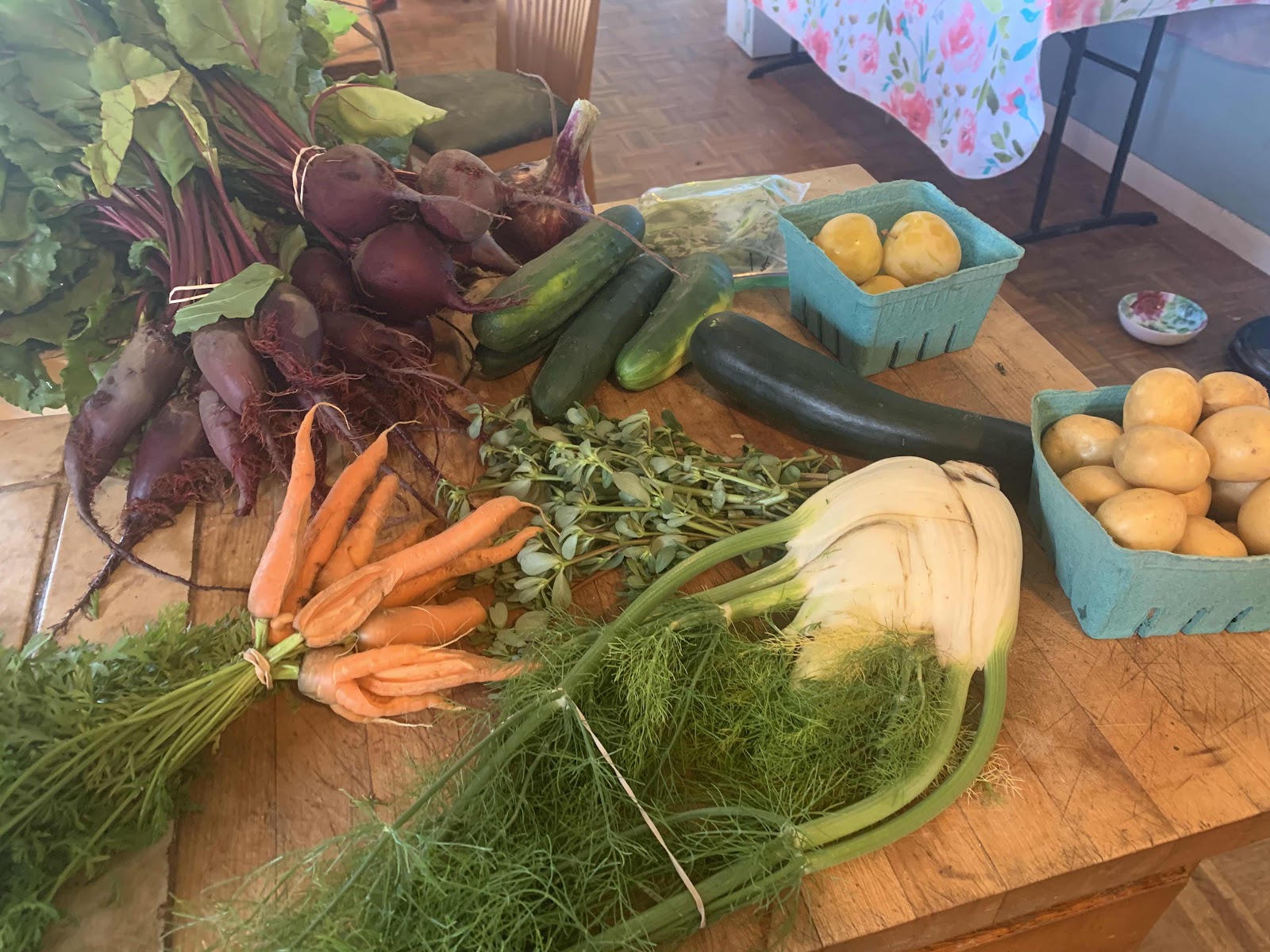
Yesterday’s haul was all from my small local circuit. Twenty dollars total got me everything you see above - new potatoes, Italian frying peppers, carrots, beets, fennel, cucumbers, plums, onions and purslane. Those three bunches of beets made six pints of pickled beets with enough left over for a beautiful roasted beet and goat cheese salad for dinner. 

There are only three of us at home these days, and it often happens that my eyes are bigger than all of our stomachs. 


Thursday, July 14, 2022

They’re BAAAAAAACK (Prey Animal Strategy)


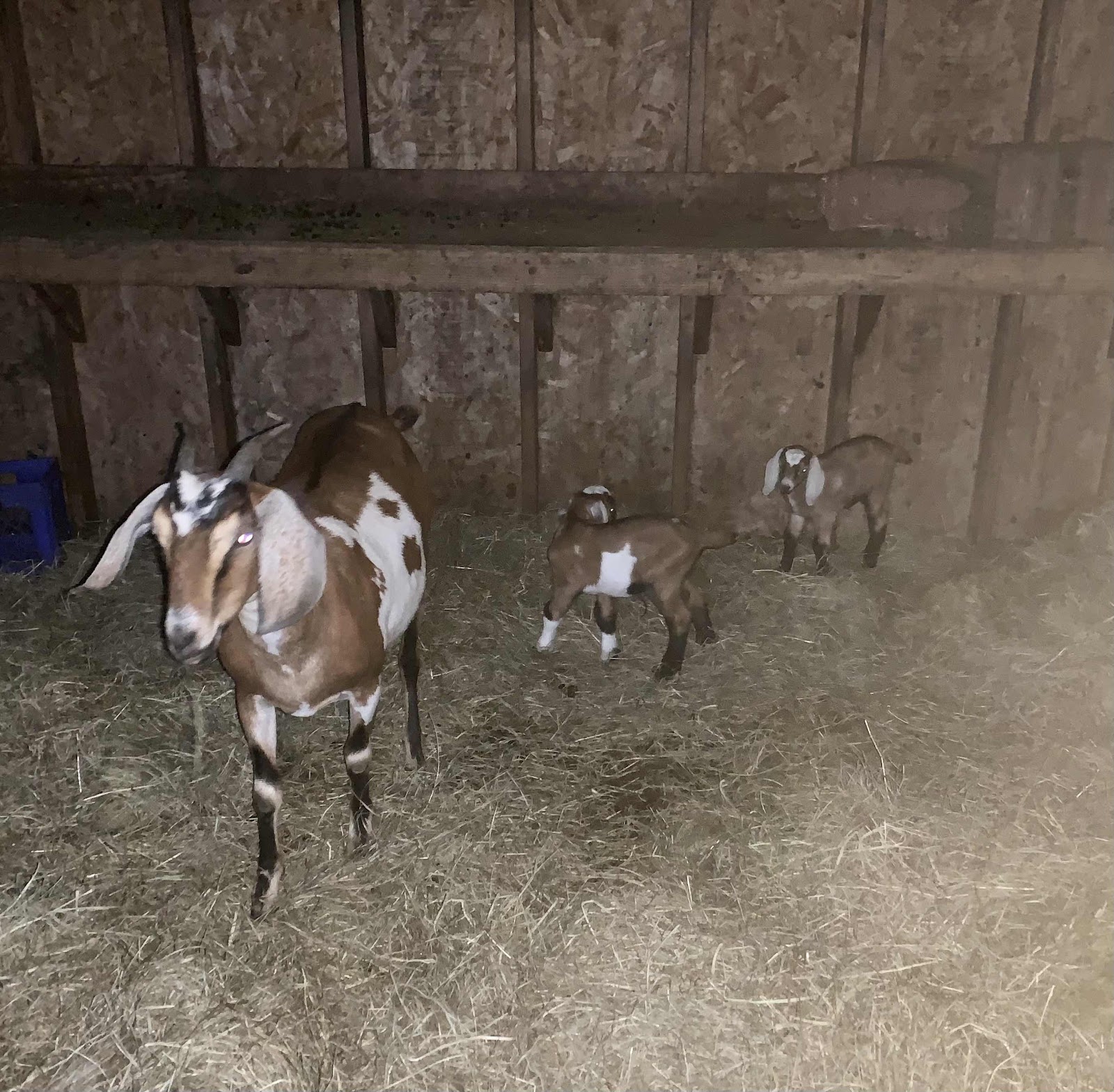
Right before bed, I decided to go out and check on the goats one more time, on the off-chance that mama Clio had found her babies. I was fairly certain coyotes had dragged them off, since two hours of me and Clio both searching for them this afternoon, Clio yelling her head off the whole time,  had yielded nothing. But there they were, like nothing ever happened. Just two sassy little baby goats without a care in the world. 


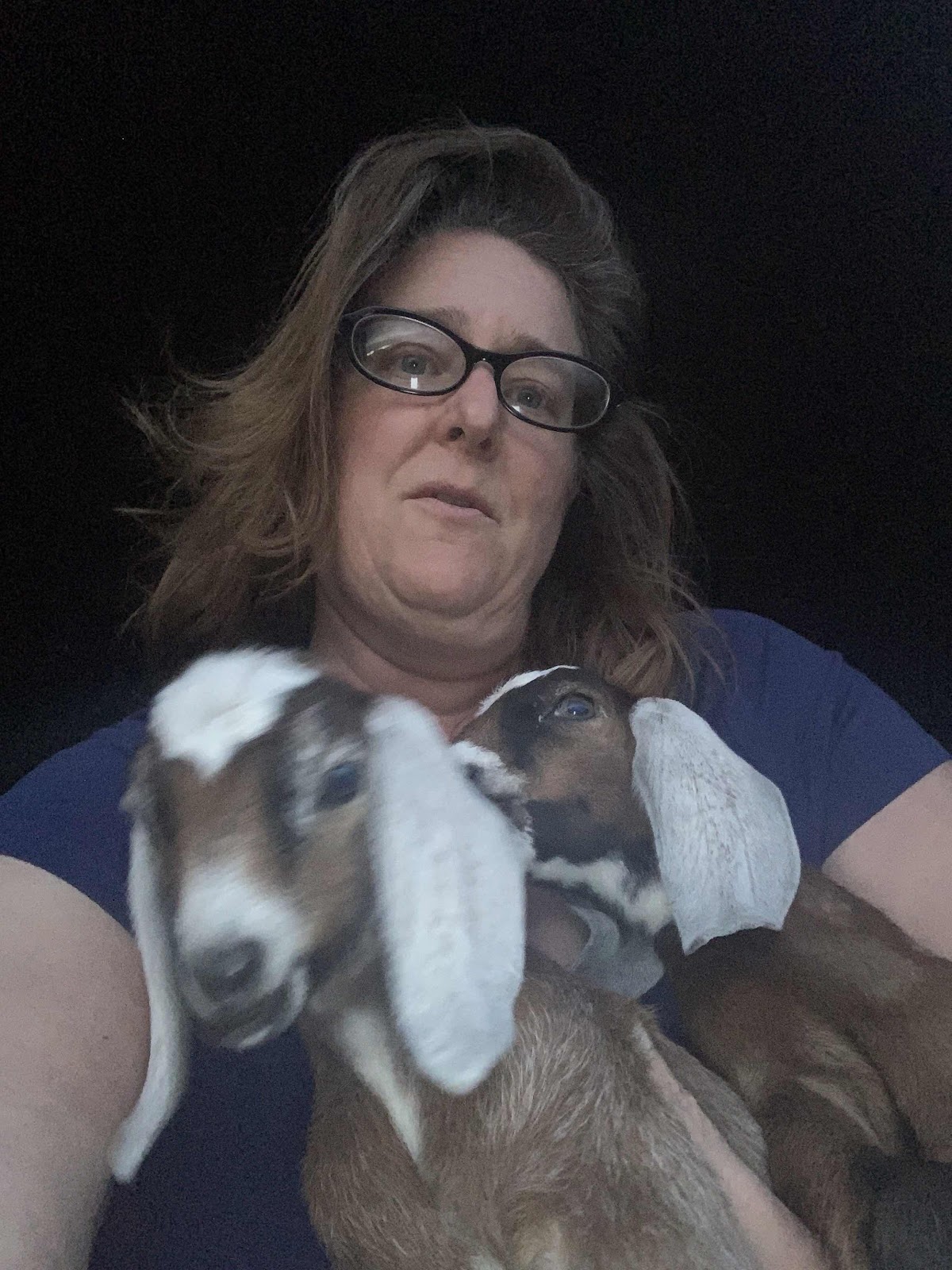
Im so relieved. I had been so sad, so angry at myself for putting them back in the big pasture, and so disappointed. I scooped them both up and took a selfie to send to Paloma, who was just as sad as I was about it. Then I dragged them all back into the backyard, where they will stay with the chickens until the babies are big enough to run fast. 

Baby goats hide while their mothers go off and eat. Just like baby deer do, and probably lots of other baby prey animals. And they are really, really good at hiding. It’s their only chance at survival - they have no other defense. Of course know that baby goats are good hiders, and for two hours today I assumed that’s what they were doing. But when their own mother was running around panicked, yelling and searching, I got worried. I thought they would answer her if they were there. But I guess as long as they don’t feel safe, they will stay quiet and immobile. And in four acres of chest high grass, there was no way we were going to find them if they didn’t make a noise. 

Phew. I’m wrung out. I’m gonna take a bath. 


Sunday, June 19, 2022

Meet the Herd


Clio (pregnant first freshener) with her mom Bitsy. 


Buck of many names. In keeping with our tradition of using weather or atmospheric or space related names for our bucks, we named him Jupiter. But the the girls started calling him Juniper instead. And then, just recently, I talked to one of his former owners and they said his name was Hunter. Homero likes that name and so now we all call him something different. He cares not a whit. 


Christmas (pregnant) is my oldest goat at about 7 or 8. She’s also my biggest goat except for the buck and a great milker. 
Behind her is this years only surviving baby (coyotes got the others), Luna. 


Sweetpea, Luna’s mom. Great little goat and very friendly because she was a bottle baby. 


Closeup of Luna. I love her unusual coloring, but experienced goat people tell me the brown will fade to white or cream. 


Monday, June 6, 2022

Project Pantry (Poor Man’s Soufflé)


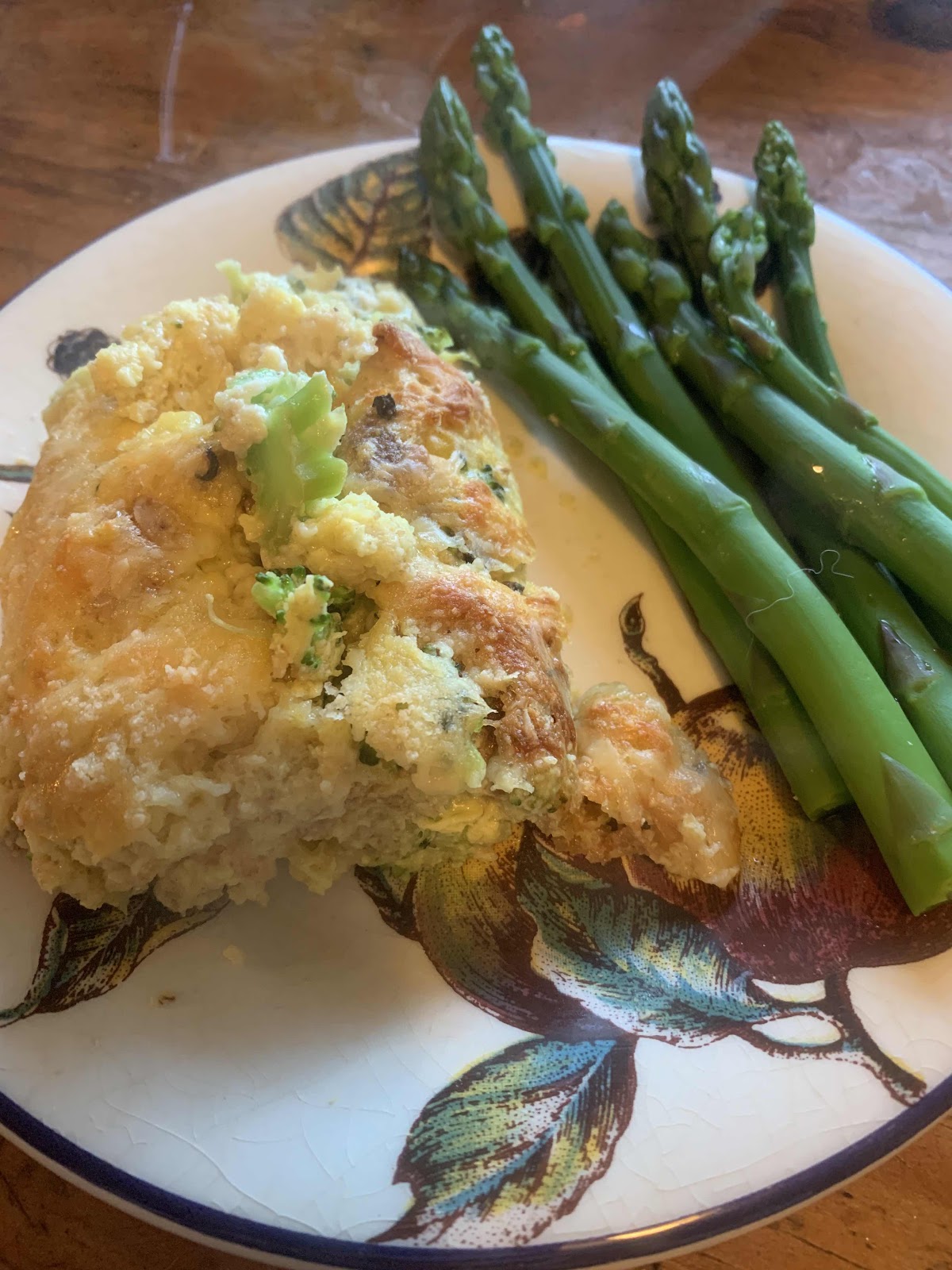
Episode two of Project Pantry, my occasional feature where I describe a recent home cooked meal and detail which ingredients came from where. Tonight’s dinner was a broccoli strata, and it was delicious. 

Strata, as far as I can tell, is a relatively new term made up to seem fancier than “savory bread pudding.” It sounds vaguely Italian, which this dish probably isn’t. This dish, in fact, screams “Ladies Home Journal Brunch Contest 1996.” 
That’s not an insult - as a veteran of a few recipe contests myself, I appreciate the ingenuity, ease, and frugality evident in a dish like this. But I like to call it a Poor Man’s Soufflé, because it really is almost as puffy and delicate. 

Ingredients: 

2-3 cups cooked broccoli, chopped into small pieces 

4 large eggs 

1 1/2 cups milk (I used goat milk since that’s what I got) 

5 pieces sandwich bread. You can use whole wheat but it has to be soft, squishy bread. Nothing too crusty. 

3 oz chevre or other semi-soft, crumbly cheese 

1 cup extra sharp grated cheddar 

Fresh ground pepper

Preheat oven to 350
Tear up the bread and scatter in a casserole dish. Beat eggs with milk and pour over bread. Add chopped broccoli and chevre. Several grinds of pepper. Turn with a large spoon several times to coat. Leave bread to soak for at least fifteen minutes. Then add cheddar on top, and bake for 30 minutes, until puffed up and barely jiggly in the middle. Broil for one minute to brown cheese topping. 

Serve with a green salad, or as I did, with fresh asparagus from a local farm stand. 

Ingredient breakdown: 

From the store: cheddar cheese, broccoli, pepper

From the gleaner’s pantry: bread 

From our farm: eggs, milk, and chevre

From a local neighbor’s farm: asparagus 


Monday, May 30, 2022

Herb Harvest 2022


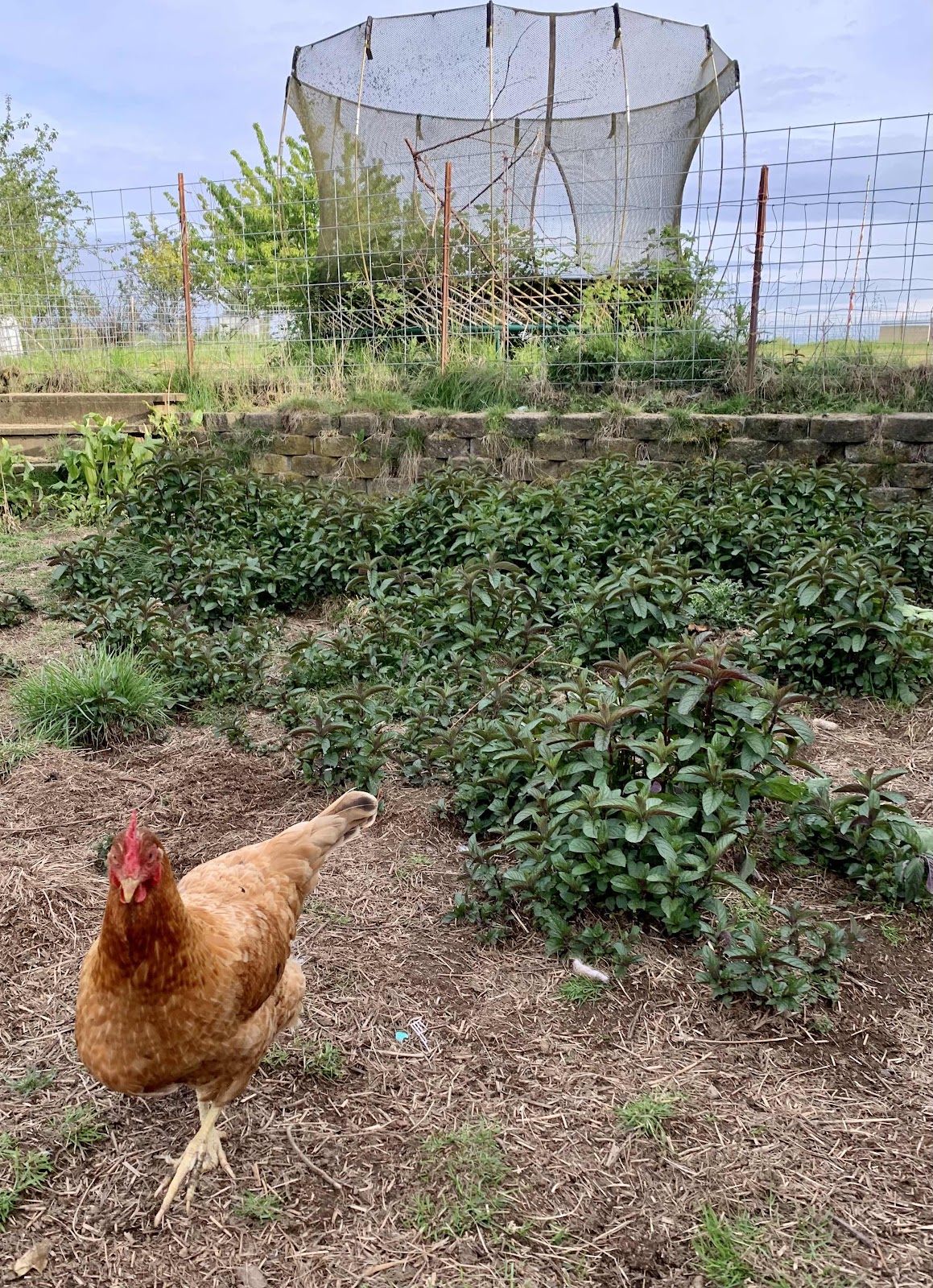
Mint is one of my favorite herbs, not only for its zingy flavor and medicinal qualities, but because it’s a hardy perennial that’s damn near impossible to kill, even for a notorious plant murderer like me. 

I have spearmint in the front yard and peppermint in the back yard. The spearmint is buried in amongst a hedge of tall weeds and I have to forage for it. This used to be the case for the backyard peppermint as well, but ever since we moved the chickens, the mint is the only green thing left. The rest of the yard has been scratched bare. 


Spearmint is a lovely herbal addition to lots of dishes and we eat a fair amount of it fresh. I add it by the handful to tabouli, for example, and to fresh fruit salads, especially melons. I added some to the melange of herbs I chopped finely and added to my chevre. It even goes well into a pot of Mexican chicken soup, if you can believe that.

Peppermint is a different proposition altogether. It’s much too strong for use as a vegetable or salad green. Mine is so strong that if you chew on a fresh leaf it actually burns your mouth. It’s pretty strictly for tea. A few years ago I made some peppermint vodka, but that’s out of my realm these days. 

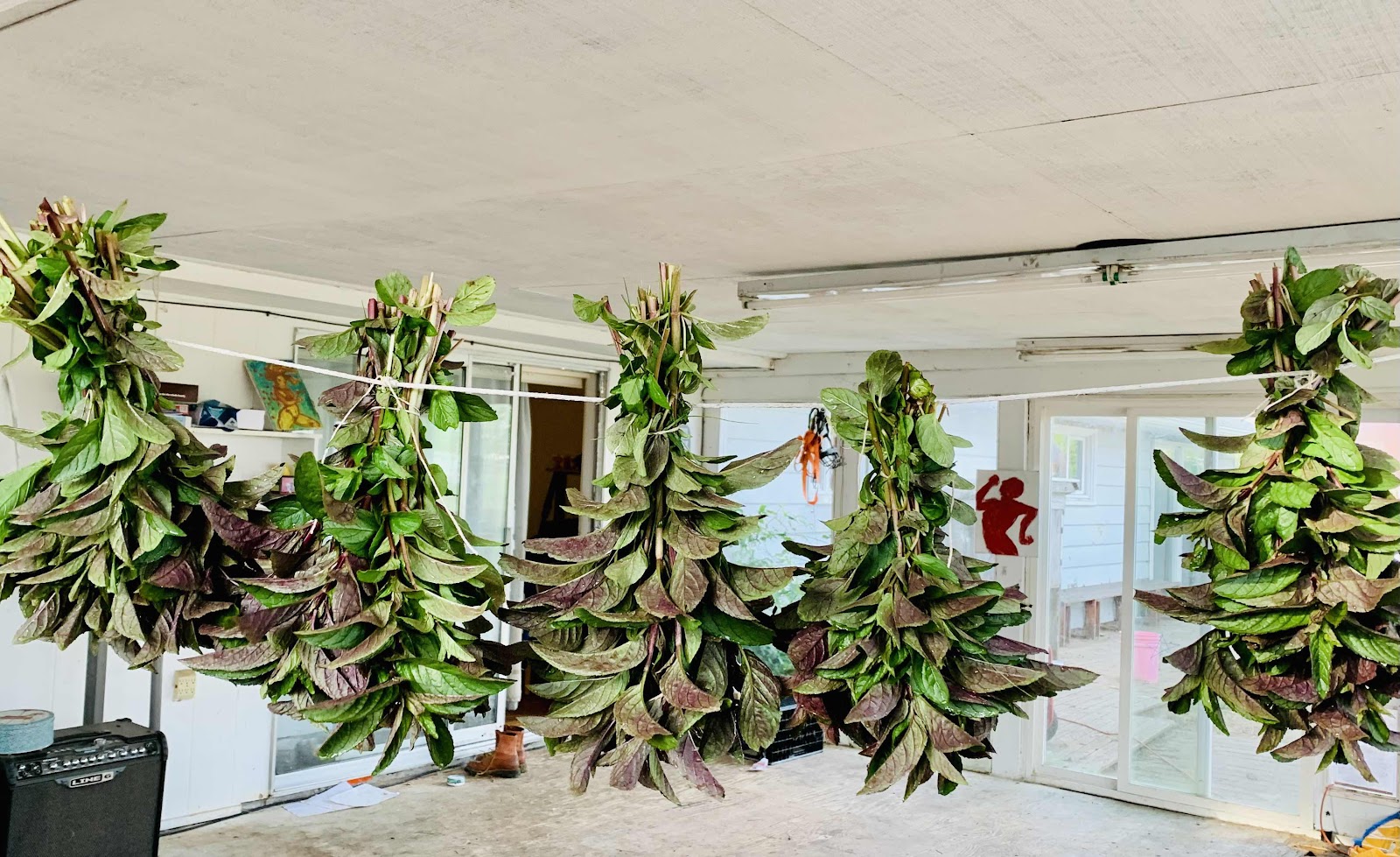
Last year I cut a couple bunches and hung them up to dry in the playroom. Then I forgot about them for an entire year. You don’t generally want to leave your herbs to dry for a whole year - most books will tell you dried herbs last a few months, maximum. However, today when I took the bunches down and rubbed the leaves off them, the scent of peppermint that wafted up was still vibrant. So I crushed them in my hands - they were crispy dry and crumbled nicely into bits - and put them into an airtight storage jar. Later on tonight I’ll make some tea and see how it tastes. 


Then I went and cut five more big bunches of peppermint and hung them up to dry. Since they are in the chicken yard, 
I gave them a good rinse first. This time I will try to remember to strip the leaves and jar them up before another year goes by. I should probably order some desiccant packs from the restaurant supply store, too. That will eliminate any chance of mold. And I’ll want them in a few months when it’s mushroom drying season. 


Now, I should probably get to work and harvest the lemon balm! Lemon balm makes delicious lemony tea and it’s very calming and good for nerves and insomnia. And I have an absolutely ridiculous amount of it. It’s in the mint family as well, and it gets out of control fairly quickly. 

Wednesday, May 4, 2022

Coyote Blues (Adios Cosmos)


I thought we were going to have a great year for baby goats. Last year was just terrible, we lost three out of four babies. But this year, so far, was shaping up to be great. Two out of three mamas have given birth, without issues, to a healthy single doeling and to a pair of healthy twins, a buck and a doe. 

The buckling is -was - this beautiful fellow here. As adorable as he was, for some reason his mama took a dislike to him and rejected him. But he took to a bottle with no trouble at all and was thriving. Like all bottle babies, he became very friendly and would run up to us as soon as we appeared. After a week or so, his mama (Bitsy) decided he wasn’t so bad after all and let him nurse again. He was just entering maximum cuteness phase, that’s probably why :) 

Because of his flashy coloring, there was a lot of interest in him and I actually managed to sell him for the very decent price of $200. A neighbor wanted him for her new herd sire. He would have made a very handsome buck, for sure. He was going to look just like his papa, Jupiter. We named him Cosmos. All our bucks have weather or atmospheric or space related names. 


But alas, it was not to be. Day before yesterday when we went out to do morning chores he was just missing. The other babies were there but Cosmos wasn’t. We searched the whole pasture but he was totally gone. We didn’t find any signs of him - not hide nor hair nor bloody patch of grass. What we did find were fresh tracks in the muddy area under the fence on the western side of the pasture where the coyotes come in. 

Damn coyotes. They have eaten well from our farm over the years. Never before have we lost a goat, though, only poultry. But we lose at least half our flock every damn winter. This winter we were down to a single chicken when we decided to just move the poor thing into a shelter inside  the fenced backyard; the coyotes wouldn’t dare come right up to the house like that. So we built a new coop and got a few more hens to be her companions and we haven’t lost a chicken since. 

If I had put any thought into it, it might have occurred to me that without any chickens to eat, the coyotes might not just shrug their metaphorical shoulders and move on. That they might, in fact, decide hey, we’re here anyway, might as well try out baby goat. 

For now, we are just locking up the babies at night. Hopefully before long they will be too big for the coyotes. I’m not sure what to do about it long term. We can patch one spot in the fence - though it would not be easy to get enough gravel or cement through the pasture to the site - but the coyotes could and would just dig a new hole. Considering that there’s 1000 linear feet of fence line it doesn’t seem likely that we are going to successfully fence them out. 

Opinions are mixed on the effectiveness of shooting them (we don’t have a rifle anyways). Most sources suggest that’s it’s a very temporary solution at best. There just doesn’t seem to be a great solution. Keeping the goats locked up at night is probably as good as we are going to get. And that’s problematic as well because it increases the chores exponentially. It decreases the time they can spend on pasture, thereby necessitating more hay,  and it drastically increases the amount of poop in the barn. 

Losing this baby hurt. He was gorgeous and sweet. I thought they were all going to live this year. It’s a gut punch. And, I’m not going to lie, it wasn’t any fun to give back that $200, either. 

Sunday, April 3, 2022

Spring Chickens


We got some baby chicks. Now that we have a coop for chickens so close to the house - right inside the fenced backyard - and can be reasonably sure that coyotes aren’t going to get them, we thought we’d take the risk on a few more. 


There wasn’t a lot of variety available at the farm stores in town. Mostly red or black sex links, broilers, and a few heritage breeds. I was specifically looking for broody breeds,  and I was frustrated because not only are there just not that many broody breeds being produced these days, but the stores uniformly had no information about the broodiness or lack thereof in the breeds they were selling. In one store, I asked the person working “do you carry any broody breeds of chicks?” And she answered me “what does broody mean?” 

I must be getting old. 

Well for those who don’t know, like the girl working in my local farm store, a broody breed of chicken is a breed in which the hens will sit on eggs, hatch out chicks, and raise them herself. What? Don’t all chickens sit on eggs? NO. Most modern breeds of chickens have had the broodiness bred out of them. When a hen is broody, she isn’t laying. When she’s raising chicks, she isn’t laying. It’s not cost effective to raise broody chickens for egg production. All your best egg laying breeds - leghorns, Rhode Island reds, etc, will not go broody. 

We eventually found two Cochin chicks. Cochins do go broody, and they also have cute feathered cheeks and feathered feet. We also bought two Golden Comets (not broody) and two Easter Eggers (seldom broody - they are  not Americaunas, which also lay blue eggs and DO go broody). Now all six chicks are out in the converted rabbit hutch under a heat lamp, which I hope will be sufficient in this nasty, cold, wet weather. 

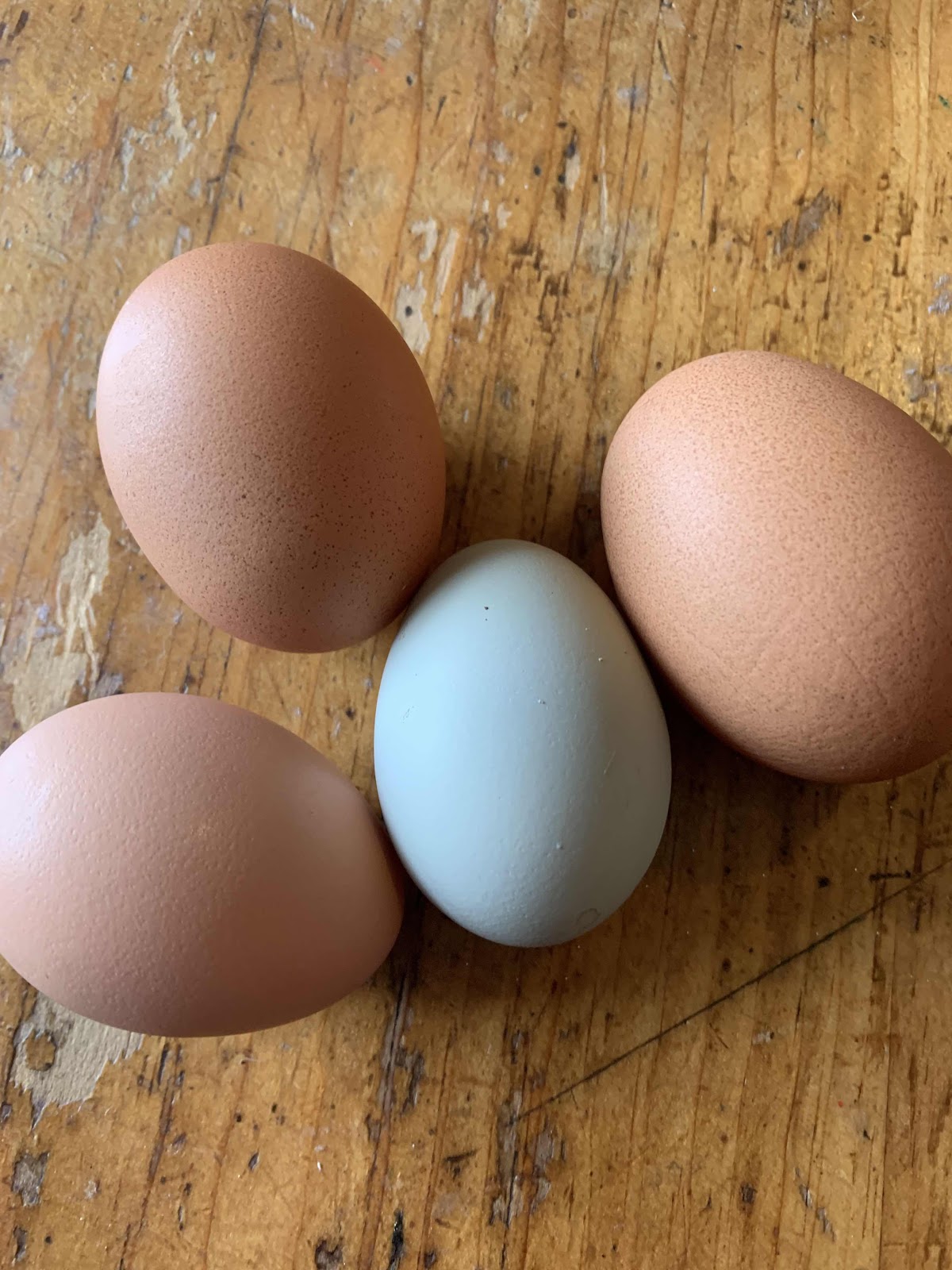
Speaking of colorful eggs, something very weird happened yesterday. We have five Rhode Island Red hens who have been laying all spring. They have all been laying many many eggs, and all of those eggs are, as you would expect, large and brown. Until yesterday:


There was a mystery egg in the nest box - a small blue egg. I have never, never, in all my years heard of a hen who could lay eggs of different colors. Hens who lay white eggs ALWAYS lay white eggs, and ditto brown, blue, green, and pink. Sometimes you get some weird eggs alright - teeny little ones the size of marbles, wrinkled ones. Once I even found an egg without an outer shell, just the inner membrane. That was an odd egg. But I have no explanation for this blue egg. 

Maybe we had a chicken visitor. My daughter and I had a good laugh imagining a lady chicken visitor who suddenly realized she was about to lay an egg. 

“Oh Penny, do you mind if I use your nest box?” 

“Oh of course Georgina, it’s right there on the wall. Yes, that plastic milk crate attached with zip ties. Make yourself at home.” 

“Oh thank you Penny I can’t imagine how I forgot to do this before going out….. BUCK BUCK BAGAWK!” 

Thursday, October 28, 2021

Monster Squash 2021 (Count on Cucurbits)

My mother used to say there were only two things for certain in this world - death and taxes. But I know there is another - that every year volunteer squash will grow out of the compost pile. 

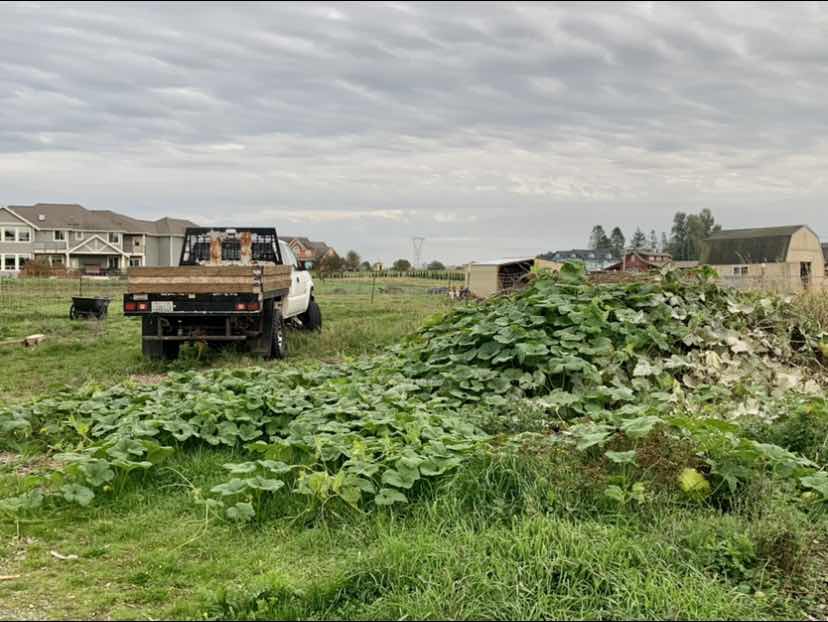
It’s so funny, I don’t usually have much luck trying to grow winter squash on purpose. The plants get powdery mildew, or they are poorly pollinated, or they get blossom end rot. But lo and behold the vigorous vines that sprouted this year from our discarded supermarket squash seeds:


There are actually three separate volunteer plants in that picture, and together they cover a good 500 square feet. All of them bore copious fruit, but unfortunately since supermarket squash are mostly hybrids, none of the three distinct varieties of fruit they bore was good to eat. 

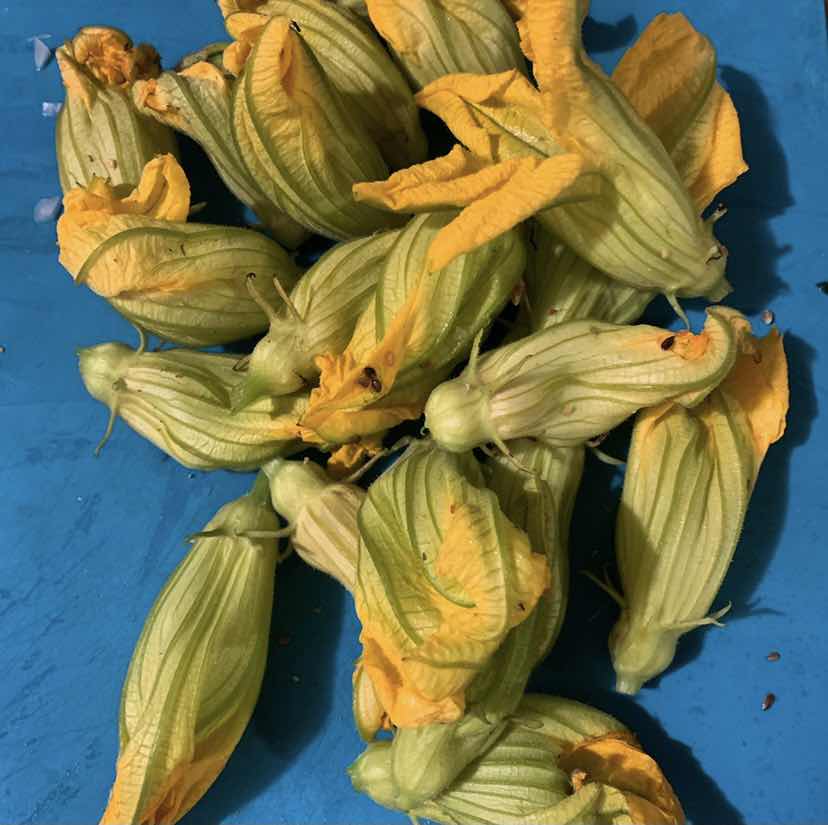
As varied as squash fruits are - that is to say, infinitely - squash blossoms are uniform. All squash plants, be they winter or summer or of unknown provenance, produce lovely yellow trumpet shaped flowers that are delicious. 

We like to tuck the fresh raw flowers into quesadillas, but they can be prepared in any number of different ways - one Italian preparation is stuffed with goat cheese, battered and fried. They can be added to soups or just sautéed in butter. 

Since we didn’t care about the inedible fruit of these particular plants, we picked both the male and female flowers, but if you are growing squash to eat just pick the male flowers. They are easy to tell apart because the male flowers grow in tall stems and the female flowers stay stuck close to the vine. Remove the pistils; they can be bitter. And always check for bugs! Our vines were still producing flowers last week, in chilly late October. 


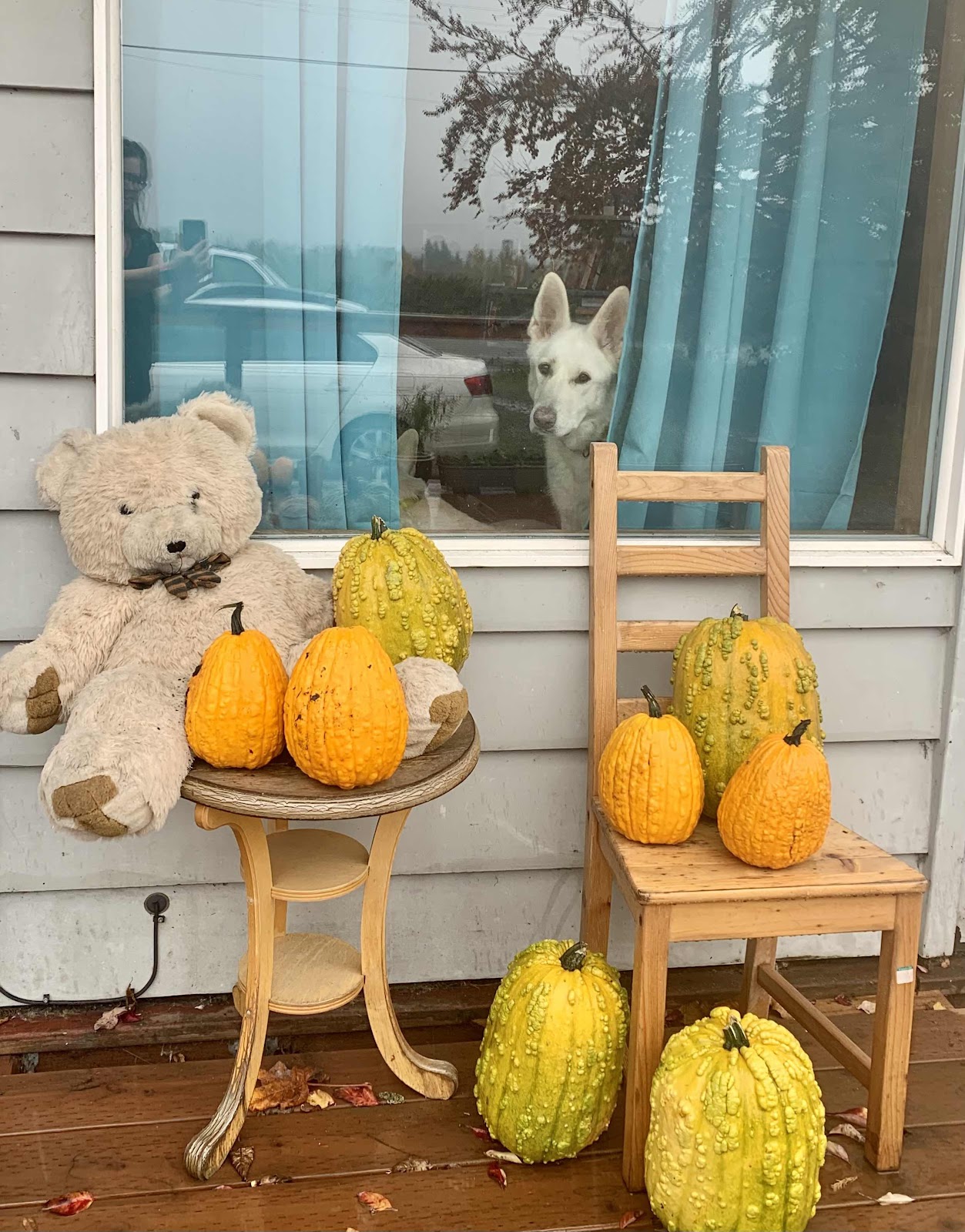
Although inedible, this year’s gourds do make a fine halloween porch display. There are many more that are not pictured here. One gargantuan vine produced more than a dozen of the huge warty gourds - probably well over 100 pounds of squash. 

I am not certain if the seeds of all these squashes are edible or not. I believe they are - I never heard of a poison pumpkin seed - but I should probably look it up to be safe before I decide to roast all the seeds after Halloween. 

Mercy is in the window. 


Monday, August 16, 2021

Meet the Greengage (Bears and Plums)


When we first moved here, in 2007, I knew the first thing I wanted to do was plant some fruit trees. The property had been a dairy farm before it was chopped into five acre parcels and sold off, and our parcel was the one with the original farmhouse on it, and where the dairy barn had stood before it was razed. There were few trees and a lot of bare earth. In my mind, an orchard is an indispensable part of any homestead, so I started doing some research.

Fruit trees are not as easy as people think - they are really rather finicky and delicate, for the most part, and need to be carefully chosen for the site. One needs to take into account not just the zone you are in 
(We are 8a - you can look up yours here) but also your microclimate and factors like drainage and soil composition. I have a very cold, windy microclimate and sandy, gravelly soil. Not really ideal. However I also have full sun all day long and  more than adequate rainfall.  While I was looking for information about varieties that might do well on my farm I found this amazing web site: Trees of Antiquity

Trees of Antiquity is devoted to propagating and preserving heirloom varieties of fruit and nut trees, and their experts will happily chat with you on the phone about your specific needs. They also have a terrific catalogue which arrives in the dead of winter and provides hours of entertainment in January, when I am likely to have exhausted all the interesting options on Netflix. 

After extensive consultation, I chose several trees - three varieties of apple including one cider apple (a golden russet); three cherries (Bing, Rainier, and one named Sam), three pears (really too many pears, nobody needs three pear trees but I'm glad I got the Comice, they are the best pears EVER. I forget what the other two varieties are) and two plums. One is an Italian plum, which are purple on the outside and golden on the inside and delicious. That tree bears an alternating light/heavy harvest, but always as many plums as we can eat or possibly use. 

The second plum tree I chose is a greengage plum. Greengage plums are a very old variety, believed to have originated in Iran, and first introduced to Europe by the royal gardeners of 16th century France, who named it the Reine Claude. You MAY have seen greengage plums once or twice in a particularly well-sticked grocery store, but they are not generally available because the trees are not well suited to profit driven agriculture. They take a decade or so to begin bearing, and then they only bear good crops every two or three years, with very scant or absent crops on the off years. 

My tree has a perverse tendency to bear only in years when we are spending the summer in Mexico. I have only had three good harvests off this tree (which I planted in 2008. The first was in 2016, when we first discovered the unearthly deliciousness of these plums. Their reputation as the queen of plums is well deserved. We gorged ourselves and eagerly anticipated the next harvest. In 2017 there were no plums. In 2018 we could se it would be a goof year, but alas, we were spending the entire summer in Oaxaca. 

I told a friend of mine to please harvest the plums, and she did. She texted me to thank me and said "oh by the way, there has been a bear in your orchard. I saw bear scat." Normally, I would probably pooh-pooh a pronouncement by a friend of mine that they saw bear scat, but this particular friend grew up in the Yukon, and I trust she k owe bear scat when she sees it. "don't worry about it," she said, "your goats are safe. He was here for the plums." A year or so later, while we were beating about the bushes looking for a lost turkey, we found the place where the bear must have come in. A heavy-duty galvanized cattle panel was crumpled up from the ground, bent and twisted and lifted a good three and a half feet from the ground. We hadn't noticed because it was in an area of very thick brush. As far as we know, the bear hasn't been back. 

Maybe the bear hasn't been back because the tree hasn't fruited again until this year. In late spring, I could see the tree was absolutely loaded with small fruit, and that this would be the best year yet. And once again, we were planning to be in Mexico from mid July through mid August. I lamented the fact that we would probably one again miss out, and told my friend to come on back, and watch for bears. But luckily, when we returned a few days ago, the plums were just beginning to ripen and fall. 

They are just as good as I remember. So sweet - the sweetest fruit I can think of, sweeter than peaches. They are beautiful, too, green with glowing yellow and pink blushes. There is probably no better way to use them than to just eat them out of hand until you can eat no more. But because there are so many, I need to find some other things to so with them. 

Things to do with greengage plums, after eating yourself sick:

- dehydrate them (greengages are a freestone plum, so very easy to prep and dehydrate)

- make a shrub (cover a quart or so of chopped fruit with sugar and let macerate two days in the fridge. Add apple cider vinegar to make a concentrated, sweet-and-sour fruit flavored syrup. Pour over some ice cubes and add sparkling water, with or without a jigger of spirits)


- jam, as a last resort. Perusing some recipes suggests vanilla as a flavoring. However, we also got home in time for peak blackberry season, so my jam needs will be well-met. 

Small rant to end this post: The world has lost some vast and depressing percentage (I've heard everything from 30-75%) of its heirloom varieties of food plants. The wonderful diversity of food plants not only provides us with a spectrum of tastes and nutrition, but is also essential for food security. Different varieties of the same species have differing resistance to pests and diseases and different abilities to thrive in varied climates. This isn't academic - with climate change we need ALL the varieties of ALL the food plants in order to feed our hot, crowded planet. 

There are many seed houses and orchardists devoted to preserving these wonderful old heirloom varieties. 
It's worth seeking some of them out and supporting their mission. You'll eat better and sleep better :)


Friday, May 7, 2021

Animals Behaving Badly (Escapes and Attacks)


We had an exciting morning around here. It started off nicely enough; I was sitting at the kitchen table around nine am having coffee with my husband, and we were enjoying the fact that our children are now in high school and get themselves off to school without even waking us up. The sun was out and it looked like it was going to be a nice day. 

Then our neighbor called. 

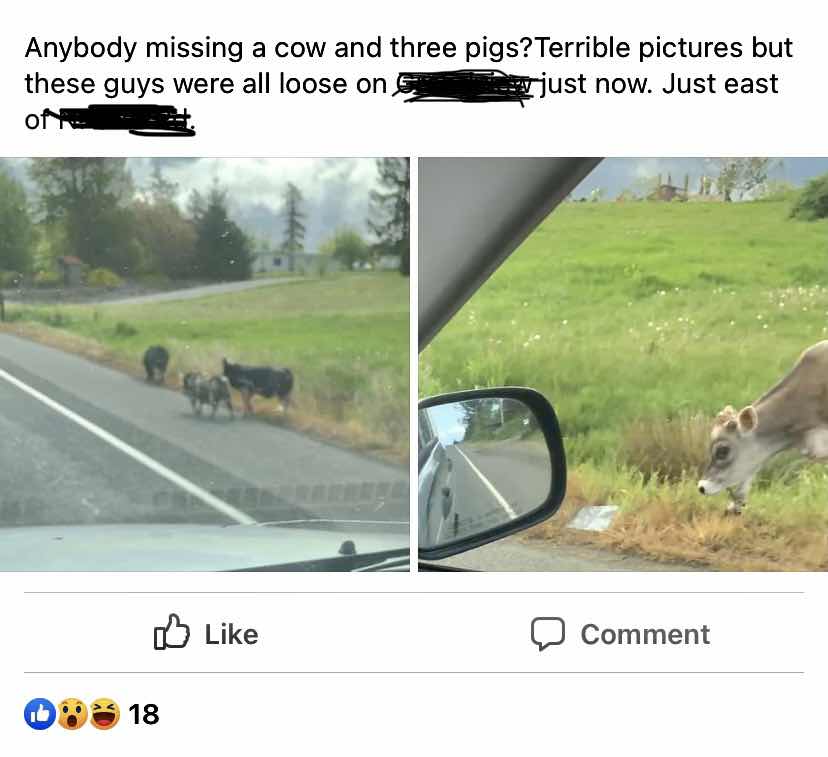
"Your cow and the pigs, they are over here on my side of the fence," he said. So we jumped up from the table, ran around looking for ropes (to lead the cow) and stale bread (to entice the pigs) and headed outside. The animals were indeed just on the other side of the fence, on the east side, near the orchard. Luckily, there is a cattle panel on that side that is just attached with carabiners, which we had done in order to let our neighbor come through on his tractor and pick up compost for his garden. So it was fairly easy to open the fence and chase the animals back in through the gap. Except for the Kune Kune pig, who had apparently decided he wanted to run away and join the circus. 

I assumed we had a breach in the fenceline somewhere along the eastern side of the property. Pigs will test fences and push cattle panels up off the ground and go under,  or detach them from the t-posts if, as is there case at our house, they are but loosely affixed with baling twine. So once the animals were all back in the main pasture, Homero grabbed some zip ties and got on the ATV to inspect the fences, and I went back inside to finish my coffee and peruse Facebook. 

Where I saw this:


Shame!! Shame and embarrassment! Animal escapes are always entertaining unless they are your animals. It's bad enough that people know my animals were out, but the fact that they were actually wandering along the state highway was worse. Tanker trucks blast by at 60 MPH and we live on top of a hill with a very short sight distance. Only blind luck prevented a terrifying accident. Oh well - all's well that ends well, and at least somebody driving along got a giggle out of it. As it turns out, there was no breach in the fenceline (although we do need to do some maintenance). The chain holding the main gate shut had broken. Probably secondary to a couple of big pigs pushing on it. 

Then, when I went back out to feed everyone, the black rooster attacked me noiselessly from behind and gouged two good sized holes into my thigh, right through my skirt. I never saw him coming. It was like being hit by a very small meteor. He's always been a vicious bird. I think I'll have Homero wring his neck and make a fan out of his very beautiful, glossy black evil feathers. 


Saturday, March 20, 2021

Notes from the Year of the Pandemic (Spring Equinox, 2021)


So far, spring this year is cold. There was a week of warm sun sometime in early March - there usually is - that tempted me to start shoveling some dirt into a wheelbarrow and laying down cardboard in the garden, but it was only a tease, and the frost returned as expected. I knew it would, of course, even as I stood on top of the compost pile in my shirtsleeves, shovel in hand. I'm slow but I do learn. 
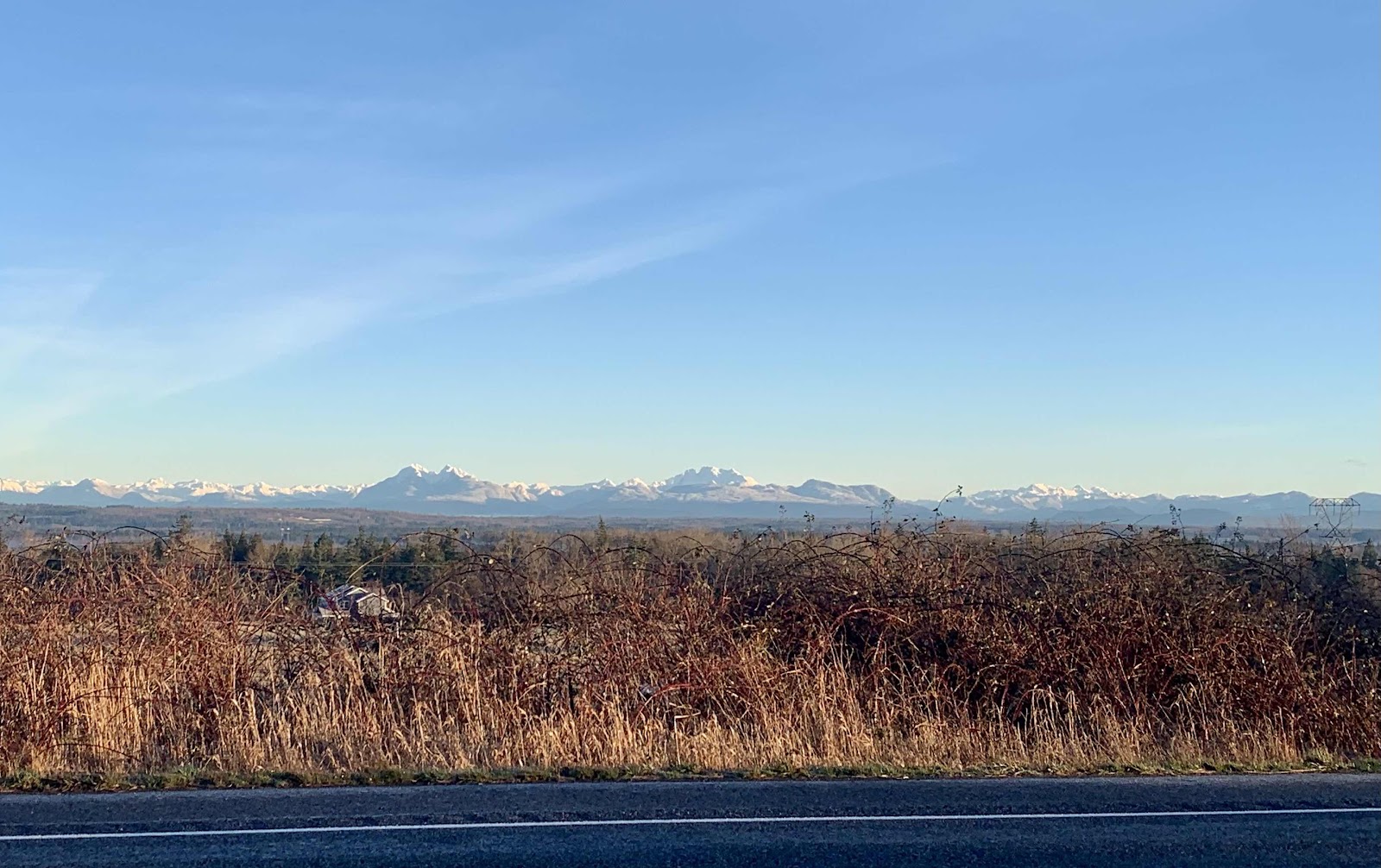


The awareness that the warmth on my shoulders was the product of a small, false spring didn't matter. When the sun shines in March in the far Pacific Northwest, and you live on a farm, you get outside and you pick up a shovel with as much thought as worms have as they come to the surface when the ground thaws, as much as chickens who start to lay when the days lengthen, even though the eggs may freeze in the nest boxes overnight. After a Northwest winter, especially this last one which threatened to draw a final dark curtain across so many lives, you take your lumens while you may. Get out in that thin wind and squint, and take off your coat, and shiver, and give thanks.

It was a bad winter. In so many ways. Last spring, when the pandemic was just ramping up and we didn't know how long it would last, we made jokes about lockdown lasting a whole month, and we distracted ourselves with the rites and tasks of spring on the farm. I took up an old habit and carried a sketchbook around the property, drawing leaves and bugs and chickens. Like everyone else, I put in a big garden. I bought mountains of craft supplies for the girls and we all planned the ways we would enjoy ourselves and better ourselves and learn things and have fun together during this time of enforced togetherness. We were optimistic, if not about the course of the pandemic then about the possibility of our own growth and development during it. Like healthy people everywhere, undamaged people, people who know not what lies ahead, we embraced the imagined challenge of joy in adversity.

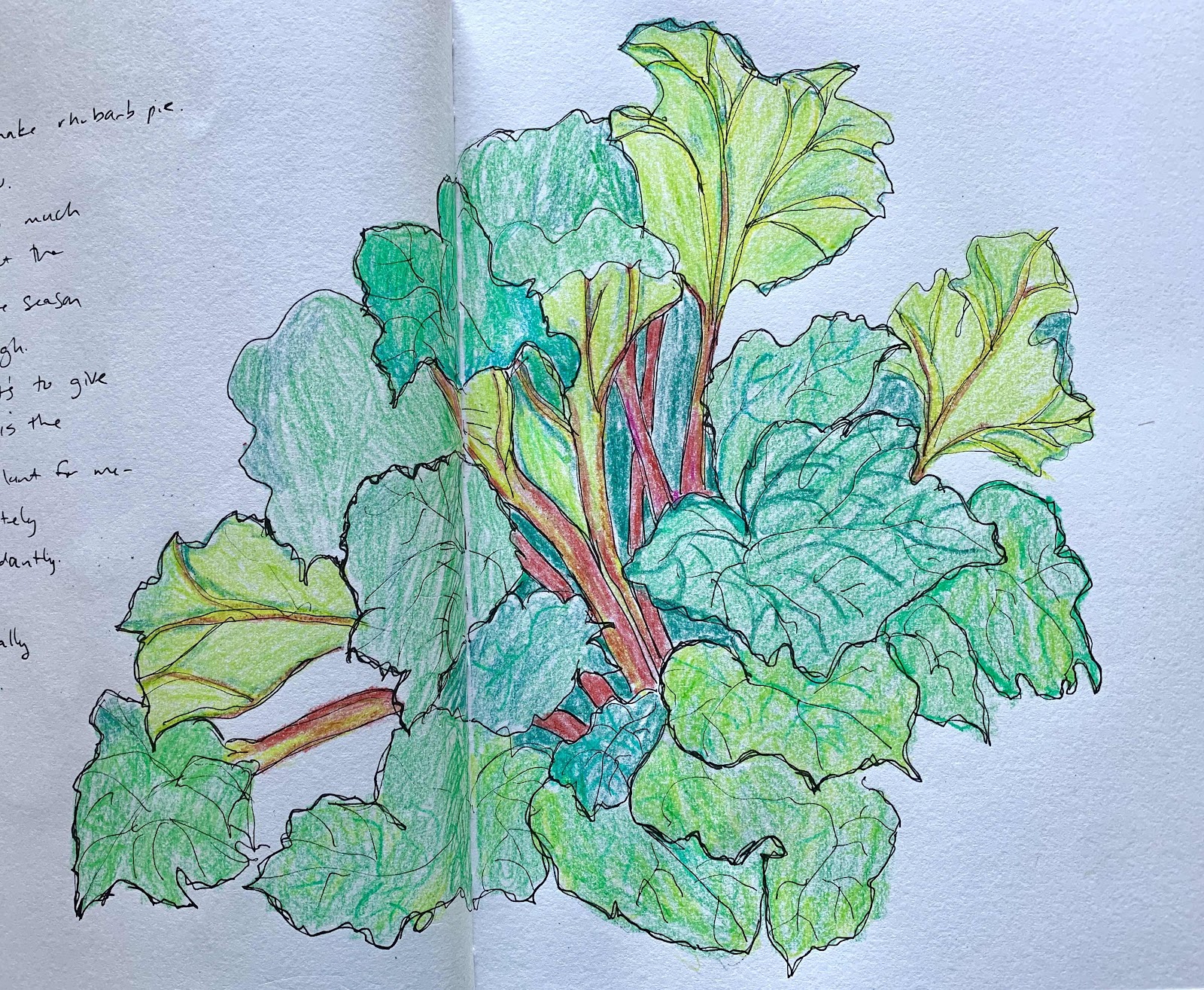


And I'm not saying none of it happened. We did stuff. The craft supplies were used to make crafts. I taught the kids to play cribbage and rummy. We took to going hiking on Sundays as a family and discovered beautiful places we'd never gone before. The garden did pretty well and many vegetables were fermented, and many loaves of sourdough were baked (yeast being in short supply). The farm produced, as it does every summer, a crop of beauty and fun in the form of baby goats and baby chicks and, this year, baby guinea hens. For months, the work of the day was sufficient thereunto, and we were more or less content. 


Then fall came, and school did not start. Life refused to return to anything approaching normal. Milestones passed uncelebrated. The new systems that were hastily constructed to replace the old, now-impossible ways of doing things were confusing and inadequate. We were all sick of the sight of each other. The stress of waiting to get sick was making us sick. The uncertainty -the total, global uncertainty - was wearing us all down. Would Hope be able to apply to colleges? Would school sports ever happen? Would we ever be able to have a birthday party? Would ANYTHING ever be NORMAL again? Time seemed more meaningless by the week, and I stopped updating the altar or looking forward to seasonal celebrations. 

It was especially hard to keep our spirits up after the string of disasters among the animals. The problem of multiple drug-resistant parasites with my goats has gotten worse and worse, and my veterinarian has basically thrown up his hands. First baby Stormy died, then Flopsy. Trying to medicate Lilac - out of desperation, as all the medications we have tried have utterly failed - the plunger slipped in my hand and I accidentally gave her a fatal overdose. This was especially awful, as Lilac was young and healthy and I expected her to be the star of the next generation of milkers. Polly and Christmas are looking thin and unthrifty and there's not a damn thing I can do about it. All I can do is keep them all contained in the sacrifice area, where there is nothing to eat, and feed them (presumably parasite free) hay. I am terrified I will simply have to watch them all die slowly, one after another. I can't sell any babies, should there be any, because I can't ethically export these awful worms to other farms. Paloma is not even looking forward to baby goats this year, after she fell in love with Stormy last year and lost him so soon.


An entire clutch of newly hatched chicks drowned in a waterer. 

Thirteen out of fourteen baby guinea hens failed to survive. They just disappeared one by one over a few days, and by the time we could catch the mother and remaining babies there was only one left. 

Gucci, Hope's beloved ferret, got tumors in the belly and had to be put down.

Turning our attention away from the farm to the outside world was little solace; the news was full of death, disaster, riot, war, idiocy, and fear. Fall was scary and long and dark and cold, and it often felt like the whole damn world was going straight down the shitter. The election was a bright spot of blessed relief, but the period between November 3 and January 20 was nerve-wracking.  Every day threatened rampage and disruption on a scale unimagined in my lifetime.

Now I've just been sitting here staring at the screen for five minutes. Then what? Then it was winter. We lived through it. It was not so awful for us, really, not compared to so many others. We had work. We didn't get Covid until January, and when we did it wasn't so bad, thank God. Homero's oxygen dipped down to 89 a few times and that was scary, but they put him on prednisone and gave him an inhaler and he was fine. I had awful chills and couldn't stay warm. I would shiver and my teeth would chatter while submerged in a hot bath. But it only lasted about ten days and we have almost totally recovered. I get winded quickly, that's all. Everyone should be so lucky.

There was a pretty good snowfall in February - 18 inches or so, enough to entirely transform the landscape and bring a welcome intermission from the tedium of rain and mud. My kids no longer play in the snow much, being in their high teenage years, but the dogs do. 


I don't know what I'm going to do next. Im staring down the barrel of empty-nest-hood. Hope did apply to colleges, and she will go away next fall, to one or another of them. Paloma is only two years behind her. Sports did start, and both girls have evening practice most nights. They have jobs on the weekends. They  drive. They kiss me and say "goodbye, mom!" and go see their friends.  I cook too much food, and nobody eats it. Well, the pigs do. 

Will nothing be normal ever again? No, it will not. Not for me. Normal is little girls blowing dandelion clocks on the lawn; normal is shiny baby goats bouncing across the field. Normal is reading bedtime stories. Normal is being able to make it all better with a kiss, and having answers to all their questions, or at least them believing I do. Normal is a memory now.




It is the equinox today. Winter is passing away and Spring is on the verge of emerging. The year of the pandemic - godwilling - is over, but I cannot see what is coming next. Like the planet, I am balanced on the knife edge of a new season. Be gentle with me, spring. I'm getting old and I'm slow, but I learn if you give me enough time. 


Friday, June 5, 2020

Just Cute Goat Pictures


Paloma and Flopsy’s baby boy. I can’t decide who is cuter. 


My goat-totin’ man, totin’ Bitsy and Bootsy, Christmas’ two doelings. 


Hope being tickled by goat kisses from Sweet Pea, Polly’s doeling. 


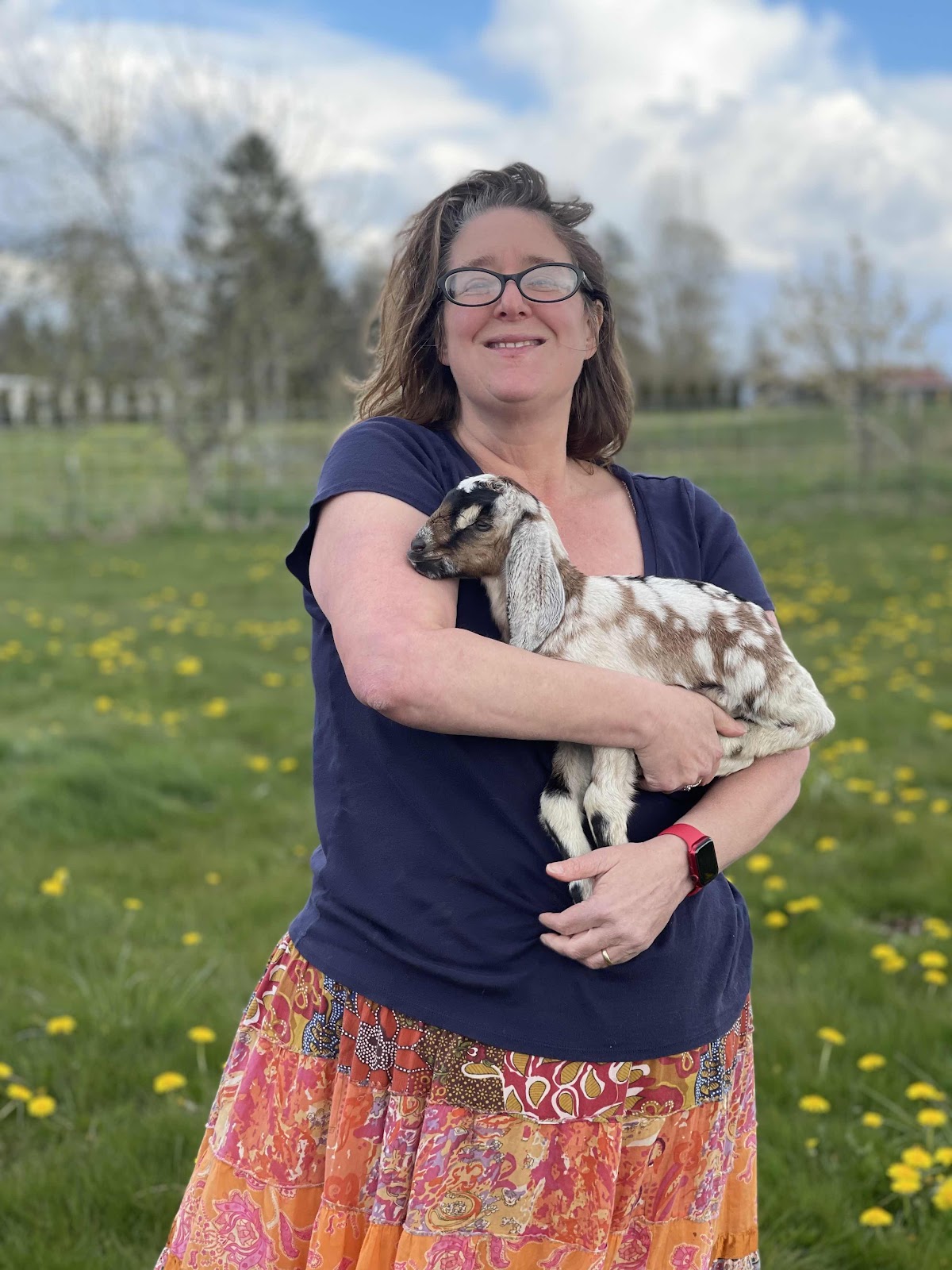
Me and Bitsy. I think I’m gonna keep this one. 

Friday, May 15, 2020

DQ59 - Baby Goats!


Paloma holding Bootsy, one of Christmas’s twin doelings 


Christmas cleans up Bitsy, her other twin doeling.

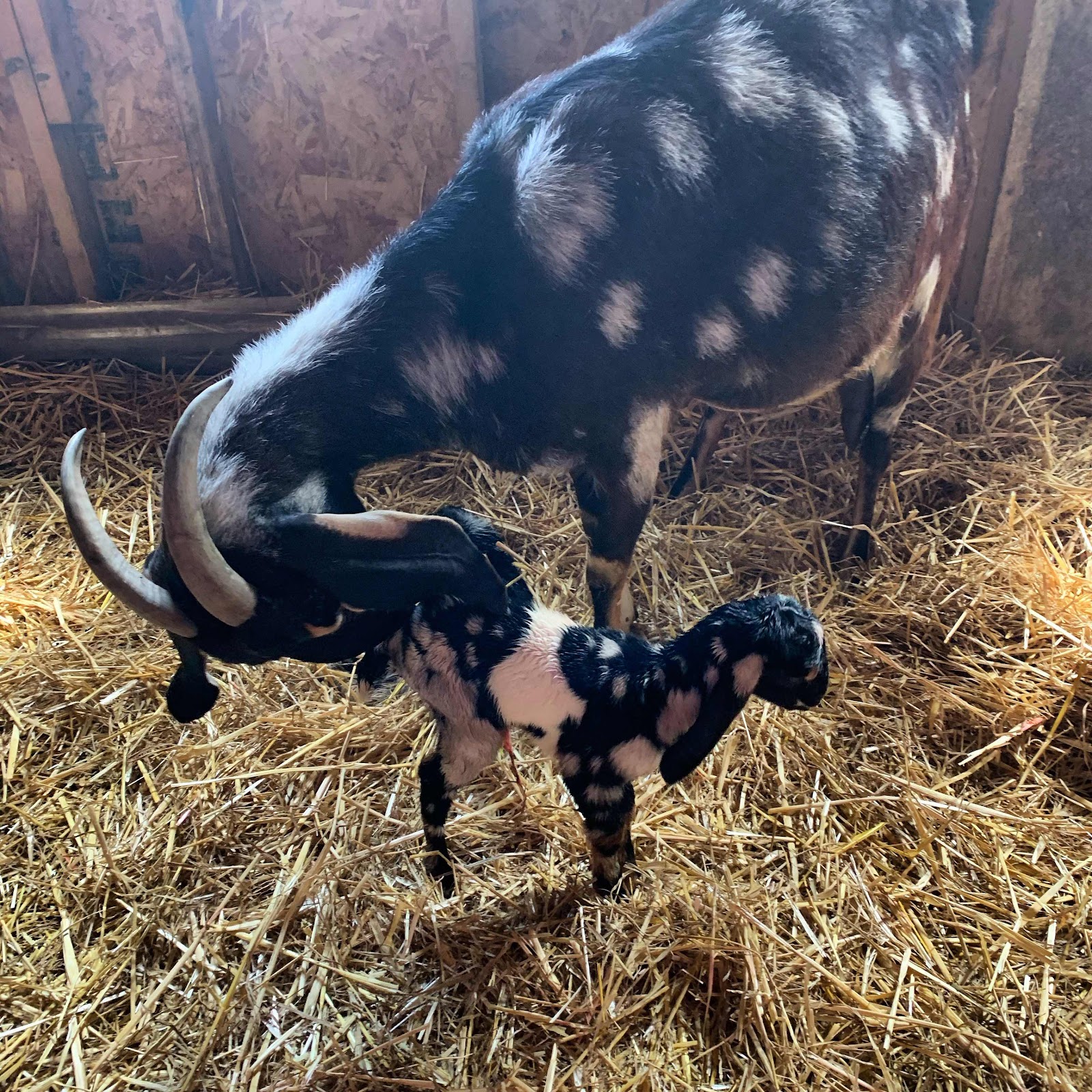
Christmas was the first to pop, day before yesterday. She did super well, only needed the tiniest bit of help in the form of a little bit of traction on the first baby. She gave birth to two big healthy beautiful spotted doelings, and then, hours later, to a tiny dead one. 

I don’t know what happened to number three, but it had clearly been dead for a long time, and was only about half the size of the others. My best guess is she was killed when our big mean buck butted Christmas in the side. He butts all the ladies, and it’s a problem. A problem for another day, though. 

It looks like Polly is going to give birth today. When I did morning chores I saw the telltale string of goo. So I put her in the mama barn - which meant evicting Christmas and her babies - and I will check on her in an hour or so. Polly is a wonderful mama, and I’m not worried about her. Well - I’m a little worried she might give birth to quads again like she did last year. But if she does, Paloma is ready and waiting with bottles. 

Friday, March 20, 2020

DQ4 - Garden Notes


I haven’t bothered with a garden in years - beyond my perennials; rhubarb, raspberries, fruit trees - because I can get unlimited free produce from the gleaner’s pantry. This year, however, things are so very uncertain that it seems like it can’t be a bad idea to try to plant a few things. So far, gleaner’s is carrying on, but if the governor issues a shelter in place order, as so many others have, then I assume it will have to come to a halt. 

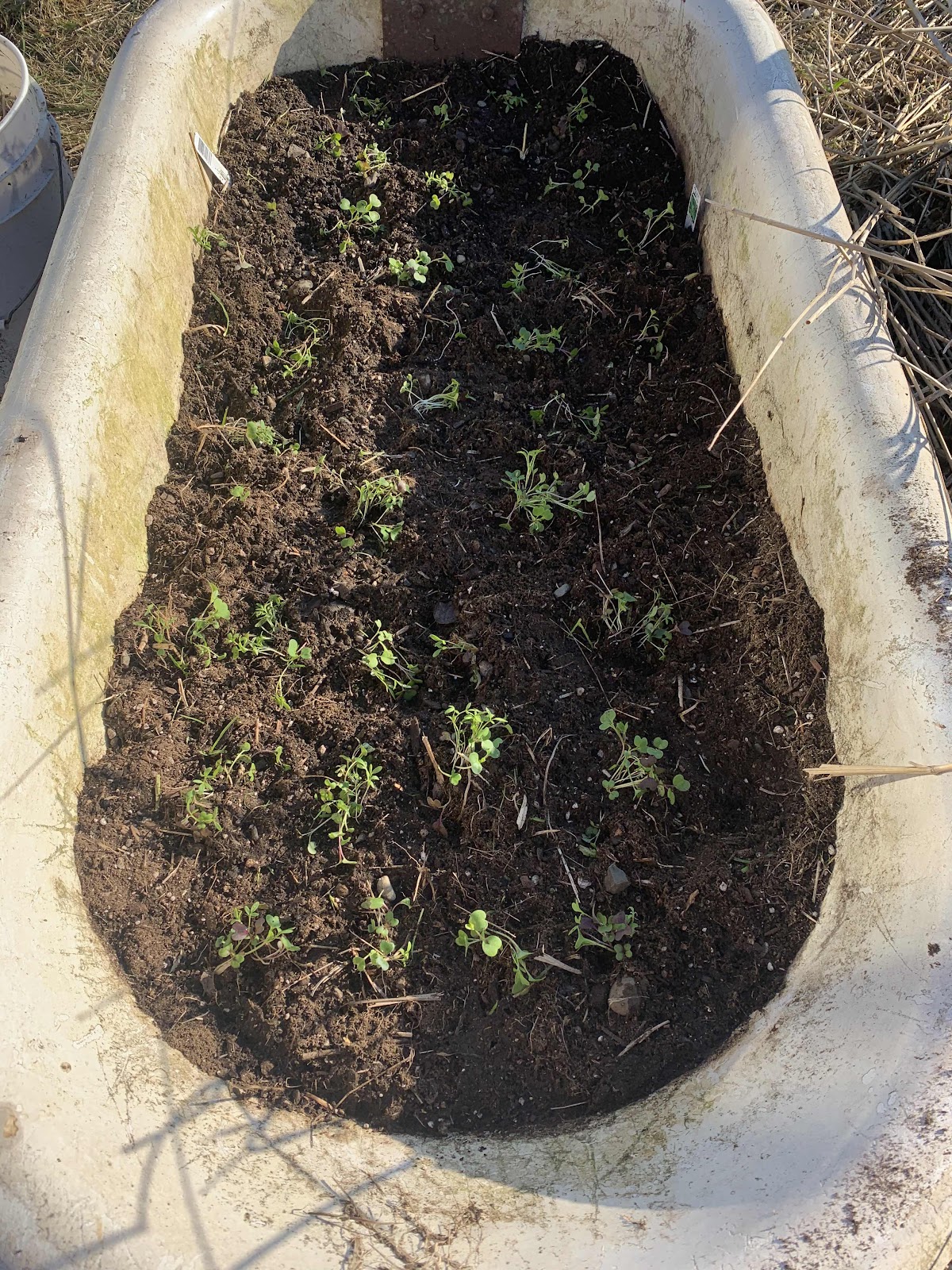
Our old garden space is a mess. The beds are entirely gone - just grass. Homero took a weed eater to the canary grass and Paloma clipped the blackberries. I hauled a few buckets full of compost and topped up one of the bathtubs. Then we planted a couple packs of spicy salad mix. 

A few days ago Paloma and I planted five egg cartons worth of snap peas, and they are germinating in the kitchen table. I’ll have to prepare a bed for them soon. Also sorted through some drawers and found seed packets of years past - most of the seeds will still sprout. I have cylindrical beets, radishes, and green beans. Also nasturtiums. No place to plant those though, until we do a lot more work. 

We have the time. Nothing but time. 
Wednesday, March 18, 2020

State of the Farm: Pandemic Edition


The girls amuse themselves at home with Henna freckles 


DQ2 - day two of “quarantine.” We aren’t officially quarantined, of course, and not even prohibited from going out and visiting. The official prohibitions in Washington are (as of right now) no gatherings of over 50 people (or has it been changed to 10?) and smaller gatherings must abide by strict “social distancing” rules that keep people 6 feet apart. 

Schools are closed at least through 4/27. I started the DQ count from the first day that schools were closed, which was yesterday, hence today is DQ2. Restaurants are closed, though takeout and delivery is allowed. Bars are closed, as are any place where people habitually gather, such as bowling alleys, churches, movie theaters, museums, libraries, barber shops, etc. Grocery stores and pharmacies are open. 

Everyone who can work from home is being told to work from home. I am still working, working more than usual in fact. As a medical interpreter, I spend my days going from one doctor’s office to another, which I suppose makes me high risk for infection. Today, for the first time, there were nurses with thermometers stationed at the entrances of the clinics, taking everyone’s temperature before they were allowed in. I don’t have a fever. 

Homero is still working as well, but he works from home all the time anyway. People still need their cars fixed, even if they are being told to stay home, I guess. I worry a bit about him because he has a few different underlying health conditions (as do I) that could make him a higher risk for complications. At least he wears gloves all the time. 

The girls were initially thrilled about the prospect of a six week spring break, until it was made clear to them that they would not being spending much time hanging out with friends, or indeed outside the house at all. I have let them see a couple friends, one or two at a time, and I’m thinking of getting in touch with the parents of a few of their “best friends” and asking about creating a closed circle of friends so they can all hang out with each other without becoming vectors of disease. 

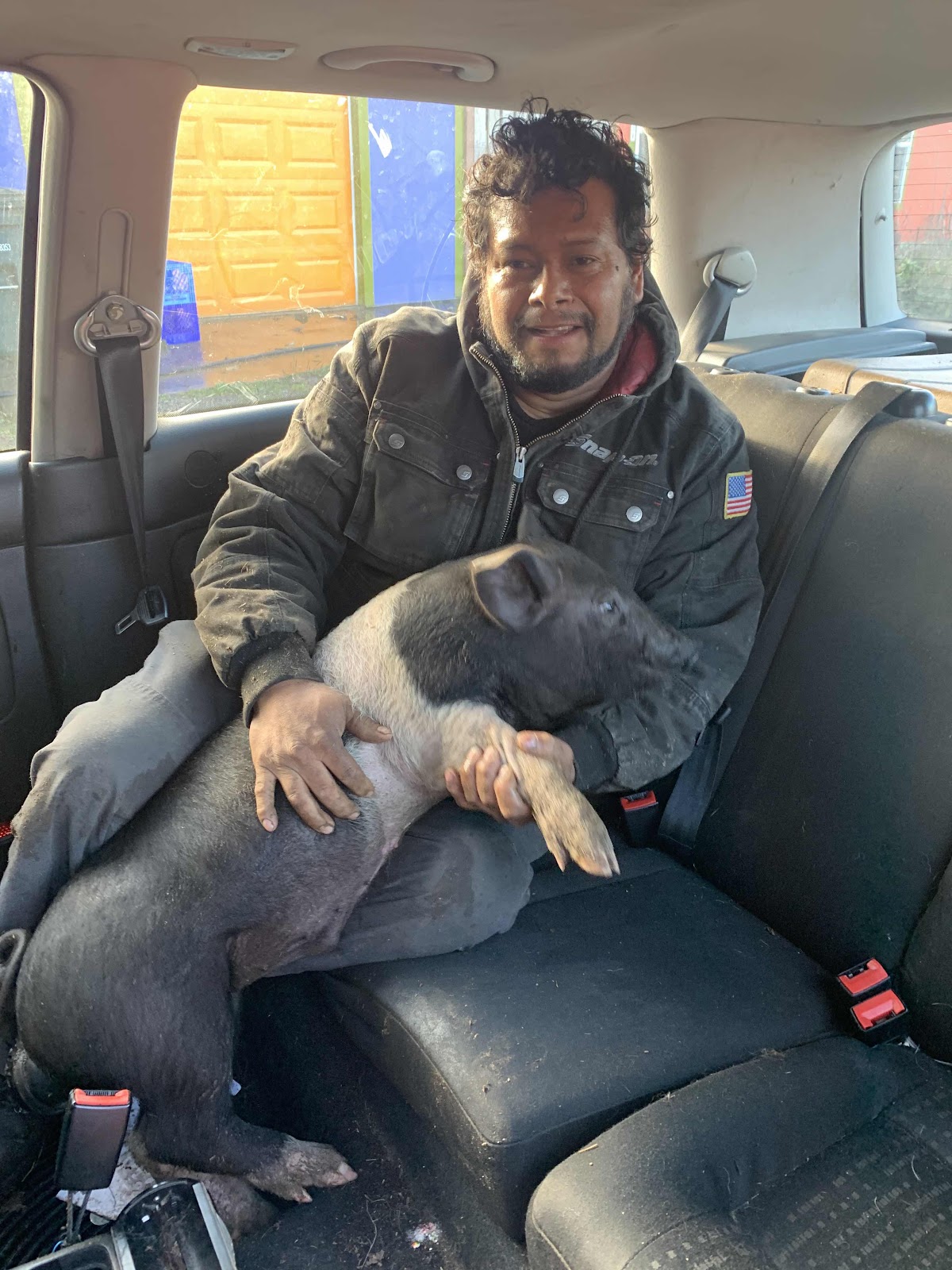
Nobody knows yet when school will resume. Teachers have been told not to send homework for the time being, since not every child has internet access at home and it wouldn’t be equitable. The district is working on a solution, at least for high schoolers, and I expect sometime in the next week or two that they will probably send home some fat packets. In the meantime, I told the girls this isn’t a vacation, and that they needed to write up a schedule for themselves. It doesn’t have to be a strict schedule, or overly specific, but it has to exist. Here’s what they came up with:
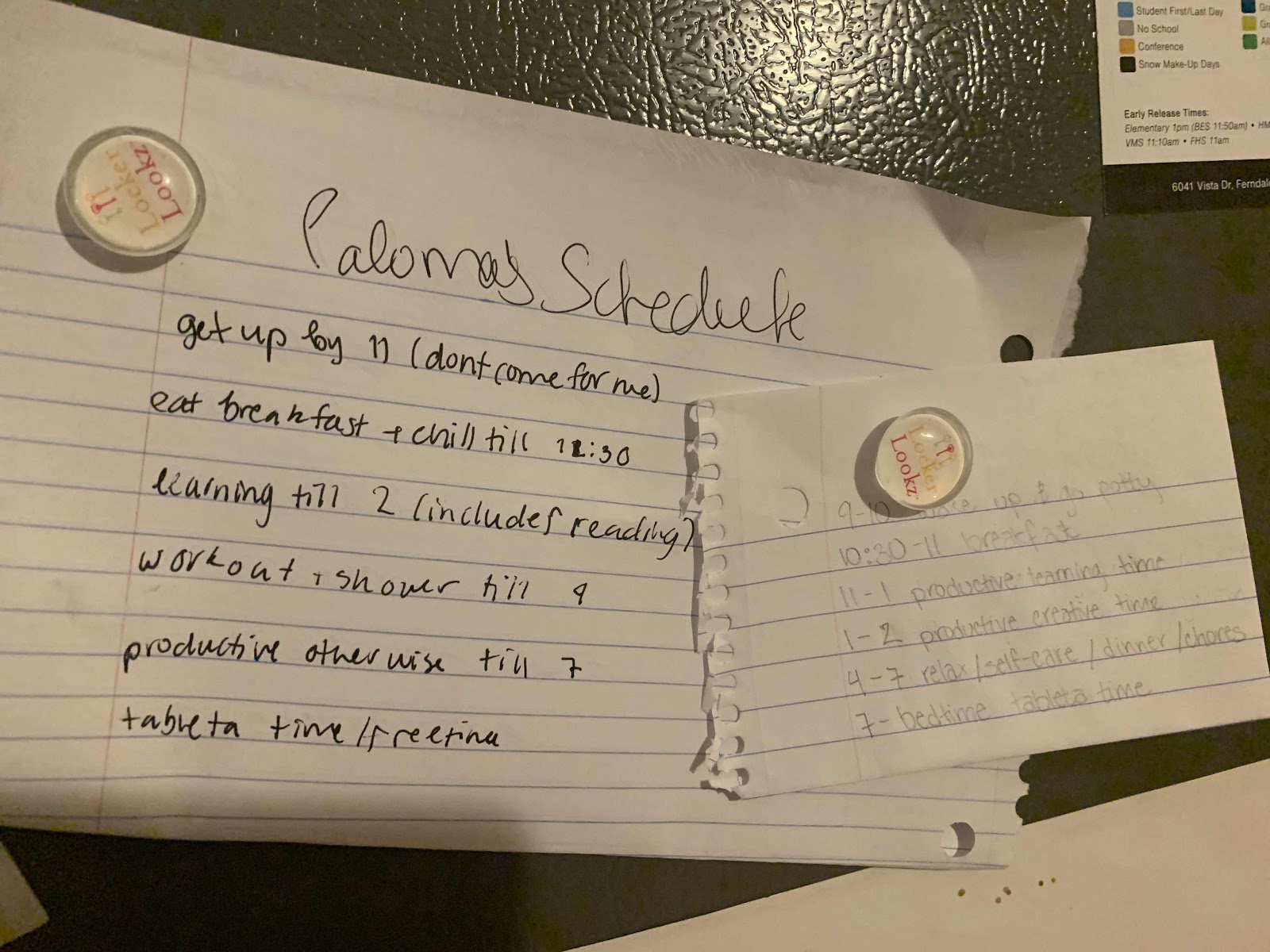


I especially like Paloma’s first line item: “get up by eleven (don’t come for me).” 

Each schedule has to include a two hour block of time for school related work (their teachers can’t assign work that will be collected and graded, but they can post “suggestions” online) and a two hour block of “productive other” time. This second category can be anything from playing piano to drawing to exercising to working in the garden to reading a book. Other than those two categories, and one chore assigned by me or their papa each day, their time is their own. 

Some examples of the chores I intend to make them do, in no particular order:

- walk the pastures and pick up all the pieces of broken plastic, plastic baling twine, or plastic bags and assorted trash they can find. No matter how careful one is, small plastic detritus accumulates over the winter. 

- turn over some of the compost pile

- clean out a drawer or a cabinet 

- harvest nettles

- organize the canning jars (full ones by contents; empty ones by size)

- use the sewing machine to make patches for mending the quilts with holes in them (our dogs have a tendency to get overexcited and tug on the bedclothes)

- clean up the greenhouse 

Like everyone else, I am imagining all the great stuff we will all get done during this enforced down-time, and like everyone else I am probably fooling myself. It’s unlikely I will take up a musical instrument or learn a third language. A more realistic hope is that I will have time and energy to put in a small garden - something I haven’t done for a few years - and read a few extra books. Perhaps do some drawing. Within a month the goats will kid, and soon thereafter it will be cheese season again. 

A good chore for me would be to find, clean, and organize 
my cheese making equipment, and order new cultures and supplies. 

Another good chore for me would be to commit to keeping a blog diary of our lives during this time.  Nobody knows how this is going to play out. Things could stay bad for a long time. Many of my neighbors are elderly and frail and are really not supposed to go out at all. Tomorrow I will talk about local efforts to pull together and provide help and services for folks who are ACTUALLY quarantined, and for folks who have lost their jobs, and those negatively affected in all sorts of ways by this unprecedented situation. 

Stay healthy! 

Sunday, November 17, 2019

Paloma’s Pigs


Some years we raise a couple of pigs, and some years we don’t. The decision whether or not to get a pig in any given year is based on a number of factors - how much meat we have in the freezer, the price of local weaner piglets, whether or not our neighbors are raising pigs this year, etc. 

In general, I have more or less decided that it is as cheap to buy pork from our neighbors as it is to raise a pig of our own, and much less work. However I can be swayed. This year we were swayed by our youngest daughter’s need for an FFA project coinciding with the availability of some handsome well-grown weaners raised by a close neighbor and offered at an excellent price. 

Paloma, our youngest, swore up and down to us that she would be in charge of feeding the pigs. Of course, she doesn’t know what that actually entails. We get much of our pig food from the Gleaner’s Pantry, and she can’t participate in that. The truth is that I will be doing most of the sourcing of food for the piggies, and Paloma will only be in charge of doing her pig-related homework. 

The question she posed and will be trying to answer is “is it financially advantageous to raise your own pigs?” For those who are interested enough to follow the links, I’ve already done the math and answered this question to my own satisfaction:
 
For those who aren’t that interested, the answer is - you can get nearly free meat if you don’t put any value on your own labor. 

But of course labor counts. Here is Homero, after spending some twenty minutes chasing down a couple of well-grown piglets today. His face clearly shows that labor counts.  My neighbor told me we could choose our own pigs from her litter of fourteen, and there were a couple of standouts. In the end, however, we took whichever pigs Homero was able to catch. 


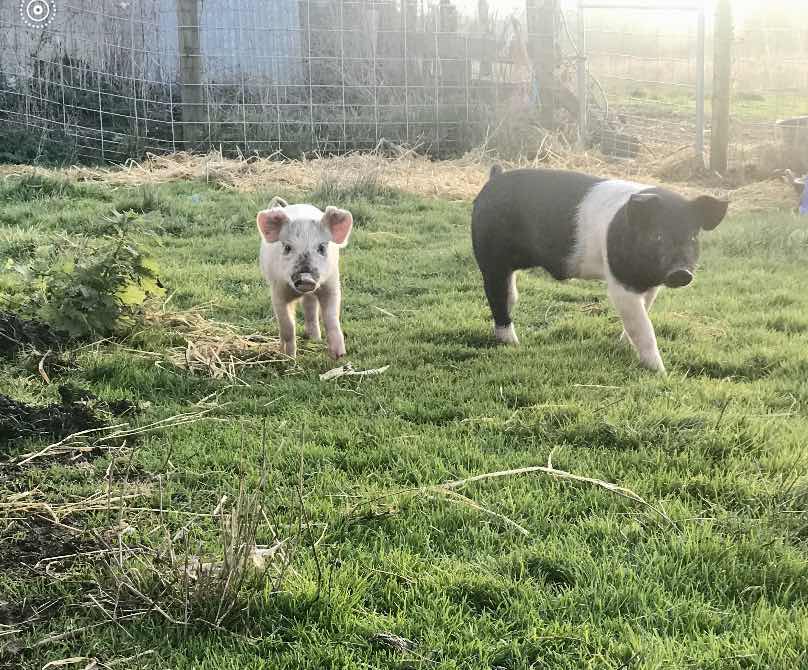
This handsome boy was the largest of the entire litter, and probably tipped the scales at sixty pounds. Homero was hard pressed to keep ahold of him all the way home. 


The second piglet he managed to catch was the smallest one of the litter, a little pink girl with curled back ears. They seem to be happy with their new digs - we have them in the sacrifice area which is about 100 x 100 feet. Their house is a round calf hutch stuffed with hay. 

Raising pigs over the winter has its challenges, and it obviously costs more than raising the same animals over the summer months, because mammals require many more calories to keep their body temperature up during the cold season. Also their natural rooting behavior causes more damage during the wet season. That’s why we have them confined to the sacrifice area, which is compacted and has a bad weed situation. Any rooting they do may actually be beneficial, and their manure will help fertilize the sandy poor soil. 

As in past years, the idea is to sell one pig (post-slaughter, in cuts) and use that money to offset the costs of raising the other pig, which we will keep for ourselves. Paloma will be keeping the books this year, and I’ll keep you all updated on her conclusions.