"United we bargain, divided we beg."
Showing posts with label canning. Show all posts

Wednesday, September 20, 2023

Merry Mabon (preserving log)


Dressed the altar for Mabon today, a day or two early. I’ll continue to add to it as the season progresses. I bought these Japanese lanterns from a nearby farm stand, but they also had the live plants, and I bought a few and planted them in my garden. Hopefully next year I can harvest some of my own. I also want to add more seasonal plants - I like the red amaranth and yellow tansy at this time of year. 


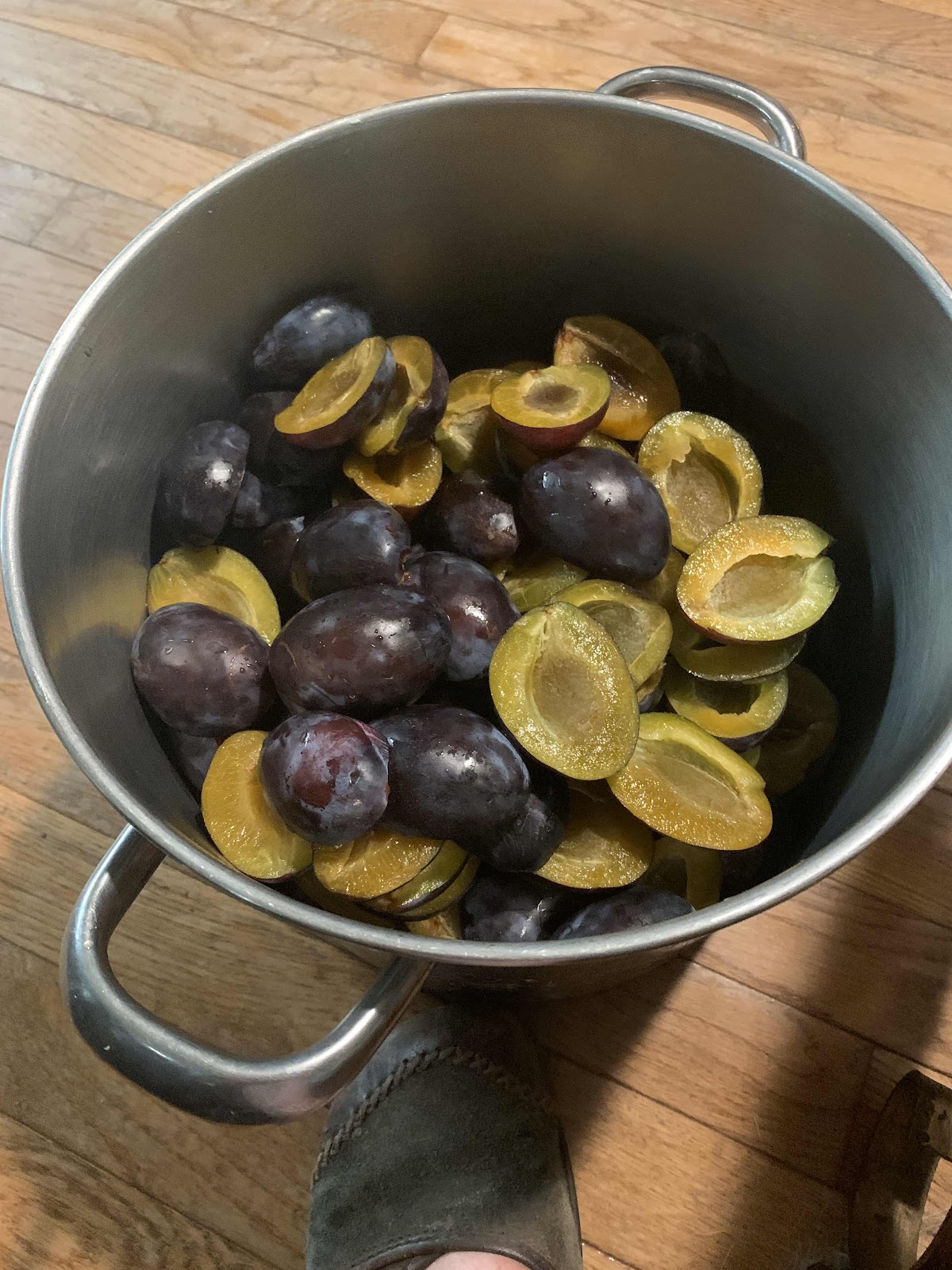
It was an “on” year for the Italian plum tree. There are still hundreds of plums on it - falling fast - but I think I am done with plums for the year. In addition to eating them fresh until I was sick them, I dehydrated a gallon sized ziploc bag full and made twelve half-pints of plum jam. 

Actually, my mom and I made the jam together and it was really nice. She’s amazing, she doesn’t use pectin and her jam always turns out perfectly. She uses her own system for eyeballing when the sugar syrup is ready - she says it will jell when it looks like “King Farouk on a barstool,” which is to say when there are two side by side drips coming off the spoon instead of only one. 

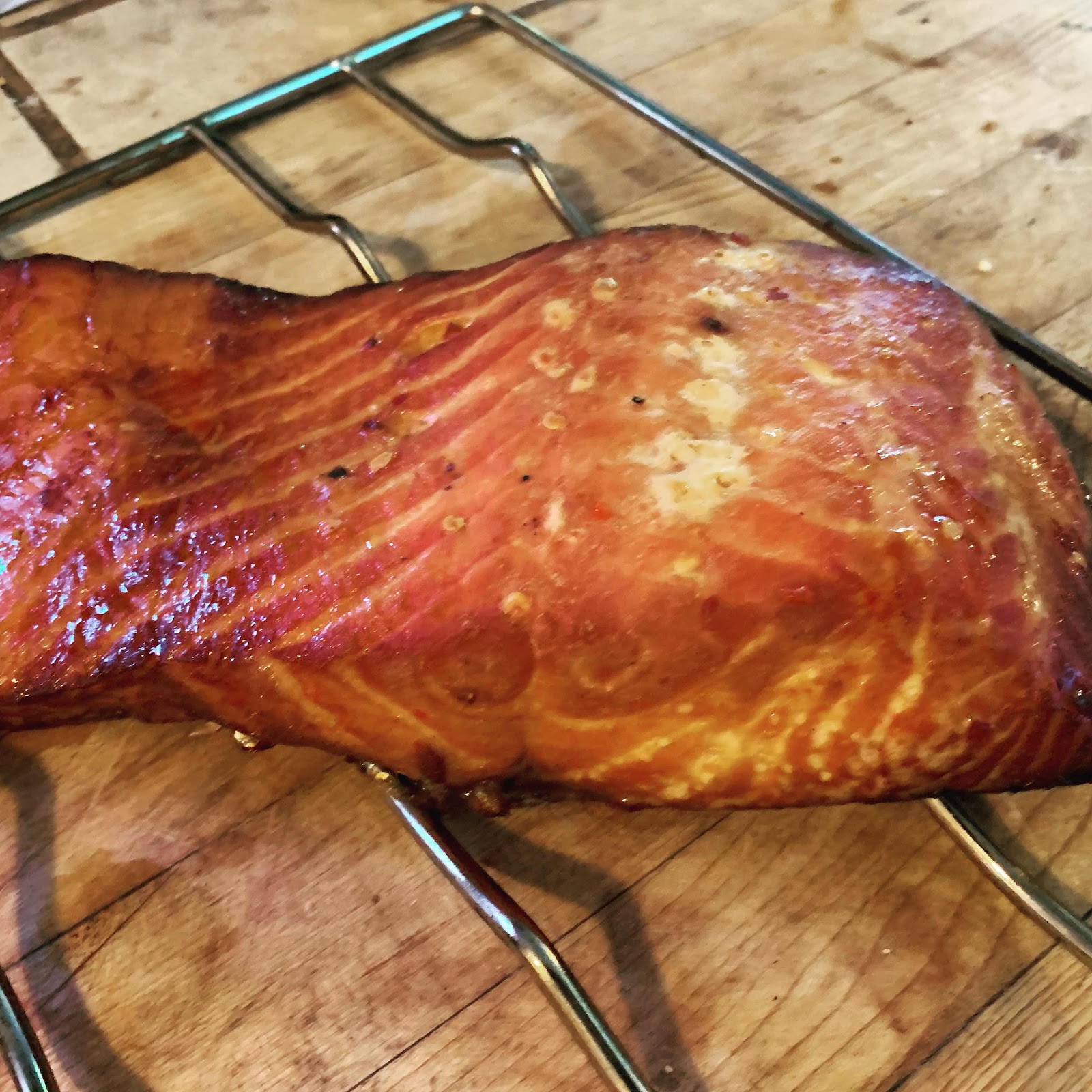
I also canned six pints of salsa ranchera and six pints of regular tomato sauce, and smoked two sockeye salmon. The main harvest left is the pears, but it wasn’t a very good year for pears and there arent a ton of them, for once. 


Sunday, September 13, 2020

Preserving Log (Late Summer 2020)


I’ve been on an absolute tear in the kitchen the last two weeks. Late August/early September is the middle harvest season (Mabon is coming right up), the prime harvest season around here. Here’s a list of what I’ve done lately - as far as I can remember. 


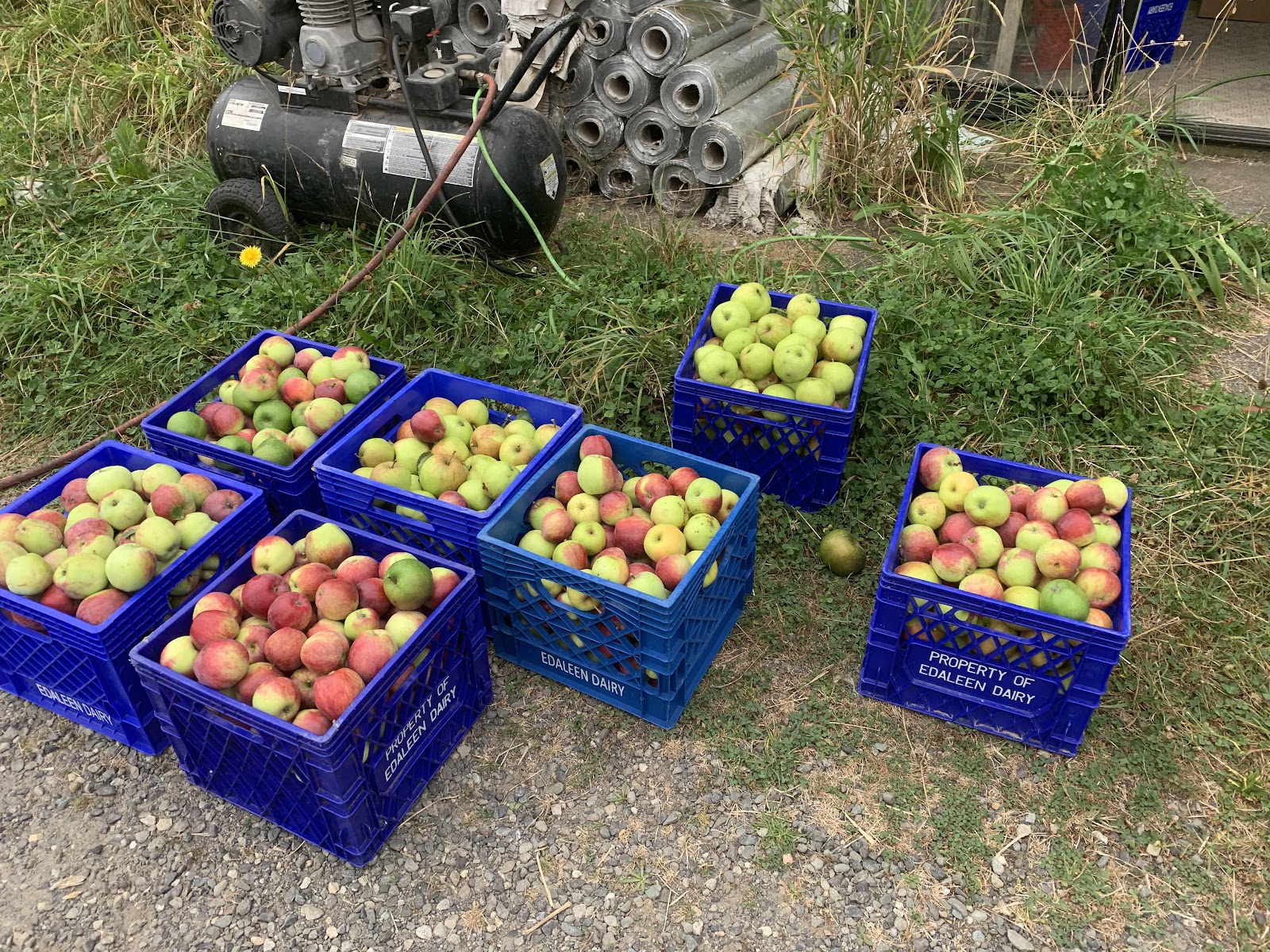
Today the girls and I pressed about ten gallons of cider, from the apples you see above. My friend H. down the way has a dozen apple trees and was only too happy to let us pick some. Tomorrow I will bring her some cider. 

Cidering is hard work. Picking the apples, carrying the crates, washing the apples, hauling the press out and cleaning it, bending down and standing up approximately 7000 times, pressing the buckets, pulling the tight-packed plate back out of the buckets, carrying the apple mast to the compost. It’s messy too, with little bits of apples flying everywhere and juice on everything. By the end I was so sweaty and sticky and tired! Working outdoors in this horrible smoke isn’t a lot of fun, either. But this was the first time we’ve pressed cider in a couple years and overall it’s a great experience. 

The smaller of my two carboys, three gallons, will be made into hard cider, and we’re keeping the rest sweet. I threw two gallons into the freezer, which leaves us about six gallons to get through before it turns into tepache. Not that there’s anything wrong with tepache. 


Plums. This in an on-year for the Italian plum tree, and there are hundreds and hundreds of plums. I’ve dehydrated enough to fill a gallon ziploc bag - more plums than you probably think - and the dehydrator is full of plums right now too. 

I’m taking another swing at plum wine. My past efforts have been drinkable, not fantastic.  Probably I won’t get any better unless I buy a little more equipment - like a hydrometer - and start taking recipes more seriously. But hey - there are so many plums. How far wrong can you go? Right now there’s about two gallons in a primary fermenting chamber and I’ll pitch the yeast tomorrow. I have to go buy another carboy because all of mine are currently full of apple cider. 


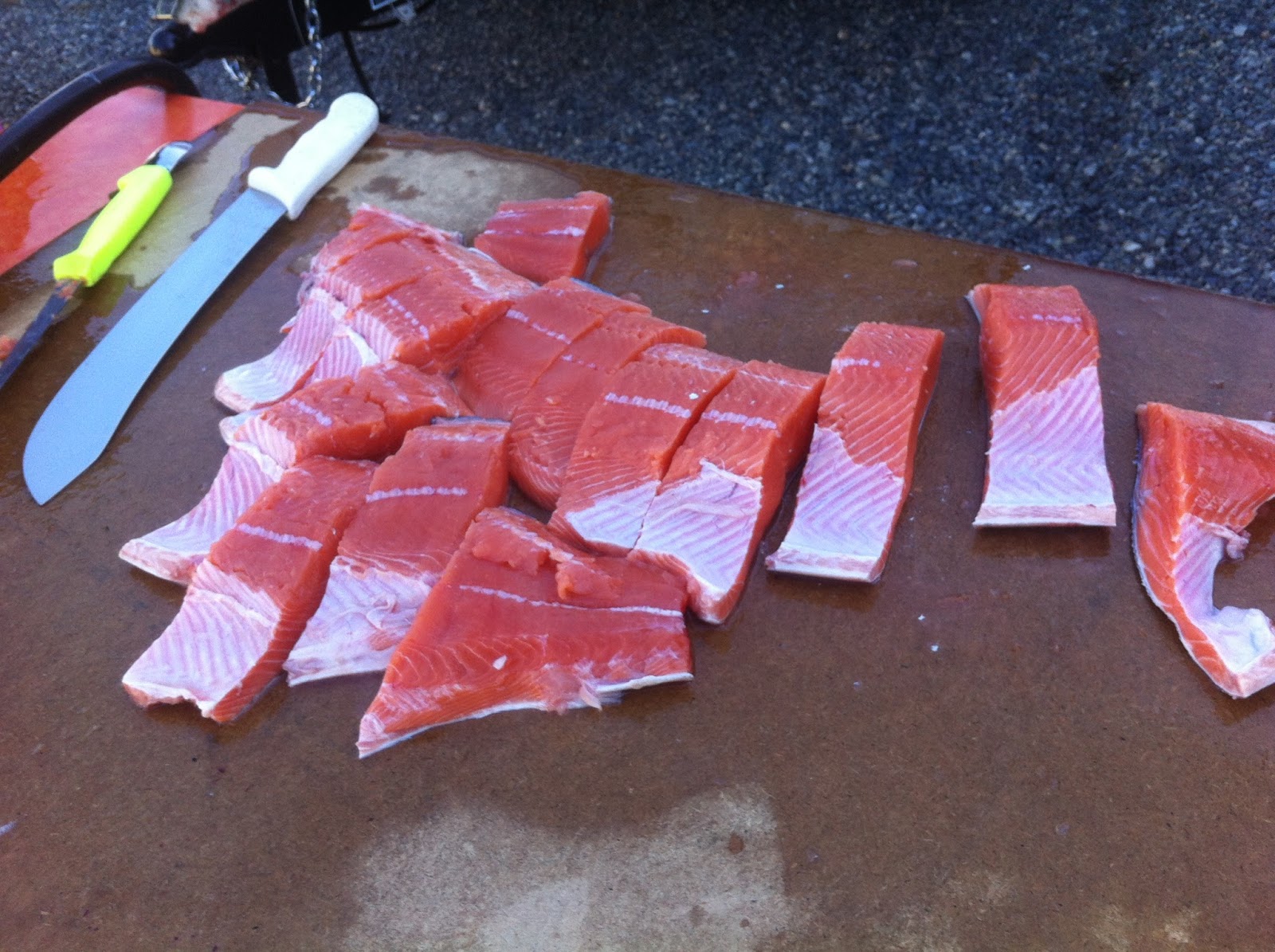
One of Homero’s clients brought him an enormous side of  salmon as a tip. I cut it into five approximately 1 1/2 lb pieces, and we ate one fresh and then I smoked the others. One of the smoked pieces is in the fridge to snack on and the others are vacuum sealed and will keep in the fridge for a few months. Probably not until Christmas though, sadly. Smoked salmon is my favorite thing to send friends and family as a Christmas gift. I could throw them in the freezer but I’m not sure how well the texture would hold up. 

Let’s see, what else? Oh, I canned six quarts of salsa ranchera  this week with tomatoes from gleaners. But I’m not doing a lot of canning for the simple reason that I can’t find canning lids anywhere! Apparently canning lids are the toilet paper of this phase of the pandemic. I have one package of small mouth lids left. 

A couple days ago I hit my favorite local farm stands just to see what was available. I brought home some sweet corn (which we ate), some cherry tomatoes (ditto), five pounds of green beans, and three smallish kohlrabi. I started kimchee with the kohlrabi. Earlier this summer I made a batch of kohlrabi kimchee and it was the BOMB. It’s only about a quart, but we will enjoy it. 

I’ll have to decide if I want to use the last of my canning lids to make canned dilly beans with the green beans, or if I will lacto-ferment them like kosher dill pickles. Both ways are good. 

I haven’t even started in the pears. Good lord, the pears! WHY did I plant FOUR pear trees? 


. 

Wednesday, March 18, 2020

State of the Farm: Pandemic Edition


The girls amuse themselves at home with Henna freckles 


DQ2 - day two of “quarantine.” We aren’t officially quarantined, of course, and not even prohibited from going out and visiting. The official prohibitions in Washington are (as of right now) no gatherings of over 50 people (or has it been changed to 10?) and smaller gatherings must abide by strict “social distancing” rules that keep people 6 feet apart. 

Schools are closed at least through 4/27. I started the DQ count from the first day that schools were closed, which was yesterday, hence today is DQ2. Restaurants are closed, though takeout and delivery is allowed. Bars are closed, as are any place where people habitually gather, such as bowling alleys, churches, movie theaters, museums, libraries, barber shops, etc. Grocery stores and pharmacies are open. 

Everyone who can work from home is being told to work from home. I am still working, working more than usual in fact. As a medical interpreter, I spend my days going from one doctor’s office to another, which I suppose makes me high risk for infection. Today, for the first time, there were nurses with thermometers stationed at the entrances of the clinics, taking everyone’s temperature before they were allowed in. I don’t have a fever. 

Homero is still working as well, but he works from home all the time anyway. People still need their cars fixed, even if they are being told to stay home, I guess. I worry a bit about him because he has a few different underlying health conditions (as do I) that could make him a higher risk for complications. At least he wears gloves all the time. 

The girls were initially thrilled about the prospect of a six week spring break, until it was made clear to them that they would not being spending much time hanging out with friends, or indeed outside the house at all. I have let them see a couple friends, one or two at a time, and I’m thinking of getting in touch with the parents of a few of their “best friends” and asking about creating a closed circle of friends so they can all hang out with each other without becoming vectors of disease. 

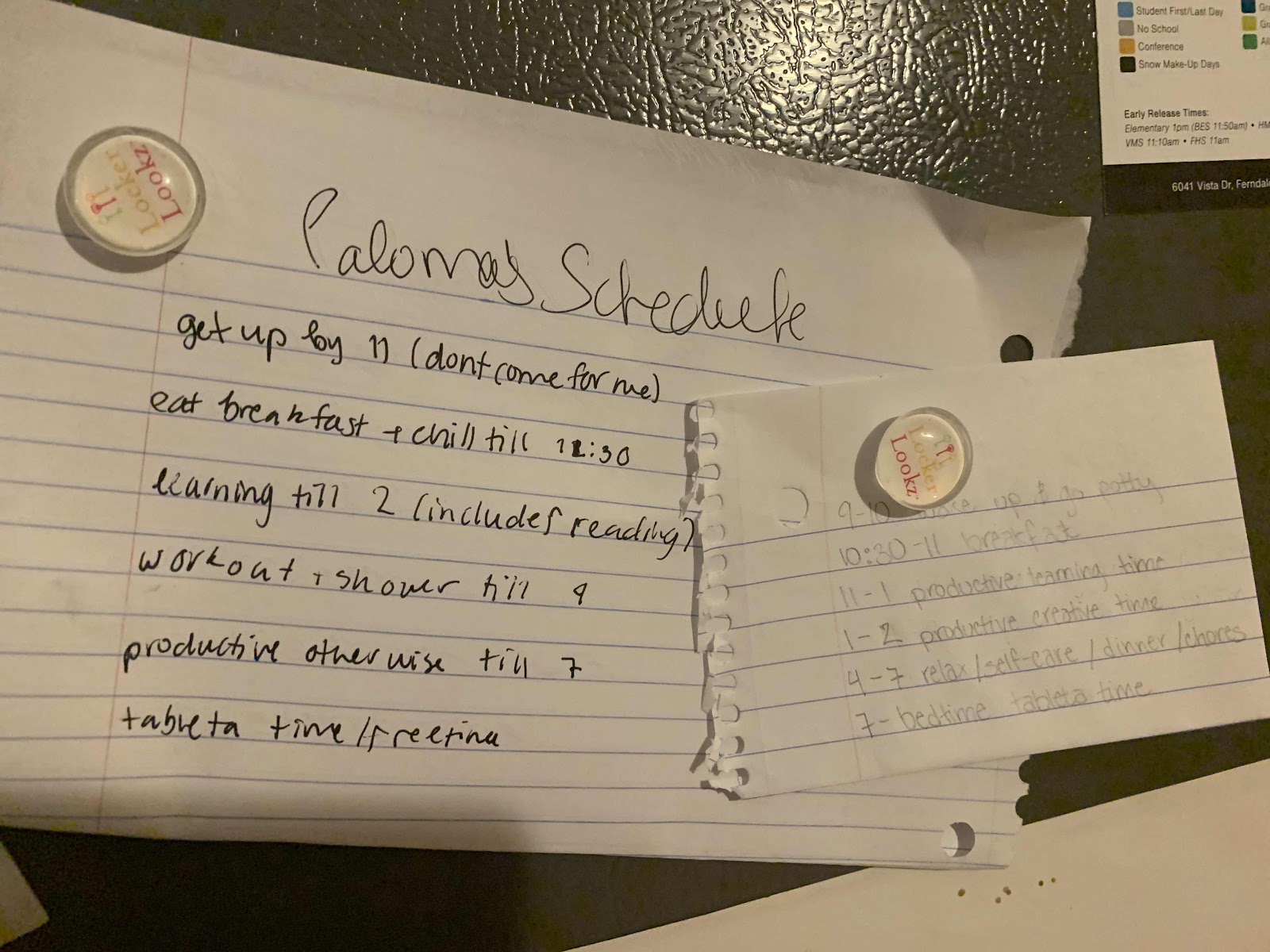
Nobody knows yet when school will resume. Teachers have been told not to send homework for the time being, since not every child has internet access at home and it wouldn’t be equitable. The district is working on a solution, at least for high schoolers, and I expect sometime in the next week or two that they will probably send home some fat packets. In the meantime, I told the girls this isn’t a vacation, and that they needed to write up a schedule for themselves. It doesn’t have to be a strict schedule, or overly specific, but it has to exist. Here’s what they came up with:


I especially like Paloma’s first line item: “get up by eleven (don’t come for me).” 

Each schedule has to include a two hour block of time for school related work (their teachers can’t assign work that will be collected and graded, but they can post “suggestions” online) and a two hour block of “productive other” time. This second category can be anything from playing piano to drawing to exercising to working in the garden to reading a book. Other than those two categories, and one chore assigned by me or their papa each day, their time is their own. 

Some examples of the chores I intend to make them do, in no particular order:

- walk the pastures and pick up all the pieces of broken plastic, plastic baling twine, or plastic bags and assorted trash they can find. No matter how careful one is, small plastic detritus accumulates over the winter. 

- turn over some of the compost pile

- clean out a drawer or a cabinet 

- harvest nettles

- organize the canning jars (full ones by contents; empty ones by size)

- use the sewing machine to make patches for mending the quilts with holes in them (our dogs have a tendency to get overexcited and tug on the bedclothes)

- clean up the greenhouse 

Like everyone else, I am imagining all the great stuff we will all get done during this enforced down-time, and like everyone else I am probably fooling myself. It’s unlikely I will take up a musical instrument or learn a third language. A more realistic hope is that I will have time and energy to put in a small garden - something I haven’t done for a few years - and read a few extra books. Perhaps do some drawing. Within a month the goats will kid, and soon thereafter it will be cheese season again. 

A good chore for me would be to find, clean, and organize 
my cheese making equipment, and order new cultures and supplies. 

Another good chore for me would be to commit to keeping a blog diary of our lives during this time.  Nobody knows how this is going to play out. Things could stay bad for a long time. Many of my neighbors are elderly and frail and are really not supposed to go out at all. Tomorrow I will talk about local efforts to pull together and provide help and services for folks who are ACTUALLY quarantined, and for folks who have lost their jobs, and those negatively affected in all sorts of ways by this unprecedented situation. 

Stay healthy! 

Thursday, December 27, 2018

A Peck of Disappointing Peppers


The Gleaner’s Pantry usually has an abundance of food after any major holiday - and this year was no exception. The day after Christmas there was a special glean, and along with a plethora of cookies, cakes, pannetone, and various and sundry candies, there was also a vast amount of fresh vegetables and fruits. 


I took home three or four sacks of oranges, a half a dozen pomegranates, and a goodly number of specialty pears wrapped in crinkly foil paper, lovingly packed into wooden crates, and labeled with a well-known national
brand. But the real haul was a near-bushel of shiny, green, taut-skinned jalapeños. I couldn’t see a damn thing wrong with these peppers, nor imagine why they had been thrown away. I took all of them that nobody else wanted - at least two full shopping bags full. 

This morning I spent three hours with a pair of latex gloves on, prepping the peppers for canning. I searched the cabinets and discovered a dozen wide mouth pint jars; I unearthed the lids and rings and set them to boil. I sat down with a paring knife and put on a CD and filleted some fifty or sixty peppers and cut them into rajas. I made a brine of one third white vinegar and two thirds water, a half cup of sugar and a quarter cup of salt, pickling spices and several cloves peeled garlic. 


Ten pints of sealed pickled peppers later it occurs to me to actually taste the peppers - there were a lot left over. And damn! I finally figured out why such a huge quantity of perfect peppers was at Gleaner’s in the first place. These supposed jalapeños had ZERO heat. They were basically small, pointy green bell peppers. 

You have probably noticed - if you are over thirty years old and like to cook -  that jalapeño peppers have changed in the past decade or so. A new hybrid came out ten or fifteen years ago: a bigger, blunter, WAY less spicy jalapeño. I think it’s a cross between a jalapeño and a green bell pepper. Recently, it seems that this is the only “jalapeño” you can find. The older, smaller, hotter jalapeños have pretty much disappeared from the markets. These days if I want a hot pepper, I have to buy serranos. But I have never yet run into a hybrid jalapeño that had NO heat whatsoever.

My guess is that somebody bought a bunch of this batch and then complained to the grocery manager - I know I would. And then the manager taste-tested them and came to the same conclusion I did - these jalapeños are shit. 

Oh well - now I have twelve pints of pickled anemic peppers. We usually go through a pint of pickled jalapeños every two weeks or so. They are standard garnish for three out of every four meals we eat here - scrambled eggs, taco toppings, sandwich fillings, components in tuna or chicken salad. But peppers without any bite at all? I just don’t know how we will use them up. 


Wednesday, September 12, 2018

Preserving Log 9/18


Arrived home from Oaxaca ten days ago. In that time we had a lot to do to get the kids ready for school- go shopping for supplies and clothes, adjust their schedules, etc. Paloma made a schedule and posted it on the fridge:


We did all that. Also I started a serious job - ten days of full time, 8 hour days interpreting for a student enrolled in he Washington state Caregiver’s training program. I have done this same course several times before. It’s very demanding; after eight hours of simultaneous interpretation my brain feels like a bowl of cold oatmeal. But it pays well and after our expensive summer abroad I couldn’t turn it down. 

Meanwhile, the pears and the plums and the early apples just kept on coming. Here’s what I’ve done in the way of preserving in the last ten days, more or less in order:

1) dehydrated two gallons of pears and two gallons of plums

2) canned six quarts salsa ranchera

3) canned four quarts pear/apple sauce

4) three gallons lacto-fermented pickles

5) made three gallons of plum wine - currently undergoing secondary fermentation in a carboy on the mantle. 

6) made three pounds chevre

7) canned eight pints blackberry jam

8) froze a gallon blueberries

Planning on picking up several pounds of peppers for canning later this week. That’s about it for now. I want to hit the farmers market and look for wild mushrooms - chanterelle season is in full swing, and I’d like to dry a few pounds. 

Happy Mabon to you all. 


Saturday, September 1, 2018

Making Up for Lost Time (Mabon Again)


We arrived home late the night before last. Or perhaps more accurate to say, early yesterday morning. We finally opened the door to our home at about 1:30 am Friday morning, to a couple of very happy dogs. 

After sleeping in quite late, we set about cleaning the house (my daughter Rowan did a wonderful job taking care of the farm and keeping the place operational, but she apparently didn’t sweep the floor or scrub the toilet once in seven weeks). I had cleaned out the fridge before we left, so there wasn’t much food in the house. 

A quick reconnaissance of the orchard revealed that there is still a heck of a lot of fruit to cope with. The greengage plums are done for this year - though a neighbor friend picked a bunch and dehydrated some for us - but the Italian plums are still a week or so away from ripe, and the tree is loaded. 

Pears are falling all over the property. I think I may have mentioned that I have FOUR pear trees, which is a ridiculous number. The Bartletts are ripe, and the Comice pears are not far behind. The Seckels and whatever the fourth one is (I forget) have a ways to go. Today I picked up a few dozen fallen Bartlett pears that were still firm and  fragnrant and tomorrow I will haul the dehydrator out of storage and scrub it. The girls love dehydrated pears in their school lunches. School starts Tuesday. 

The cider apple tree is covered with apples. Cider season will be soon.  The other Apple trees, still quite young, have a few dozen apples apiece. And the Asian pears trees, planted two years ago, and a half have a few pears on them. 


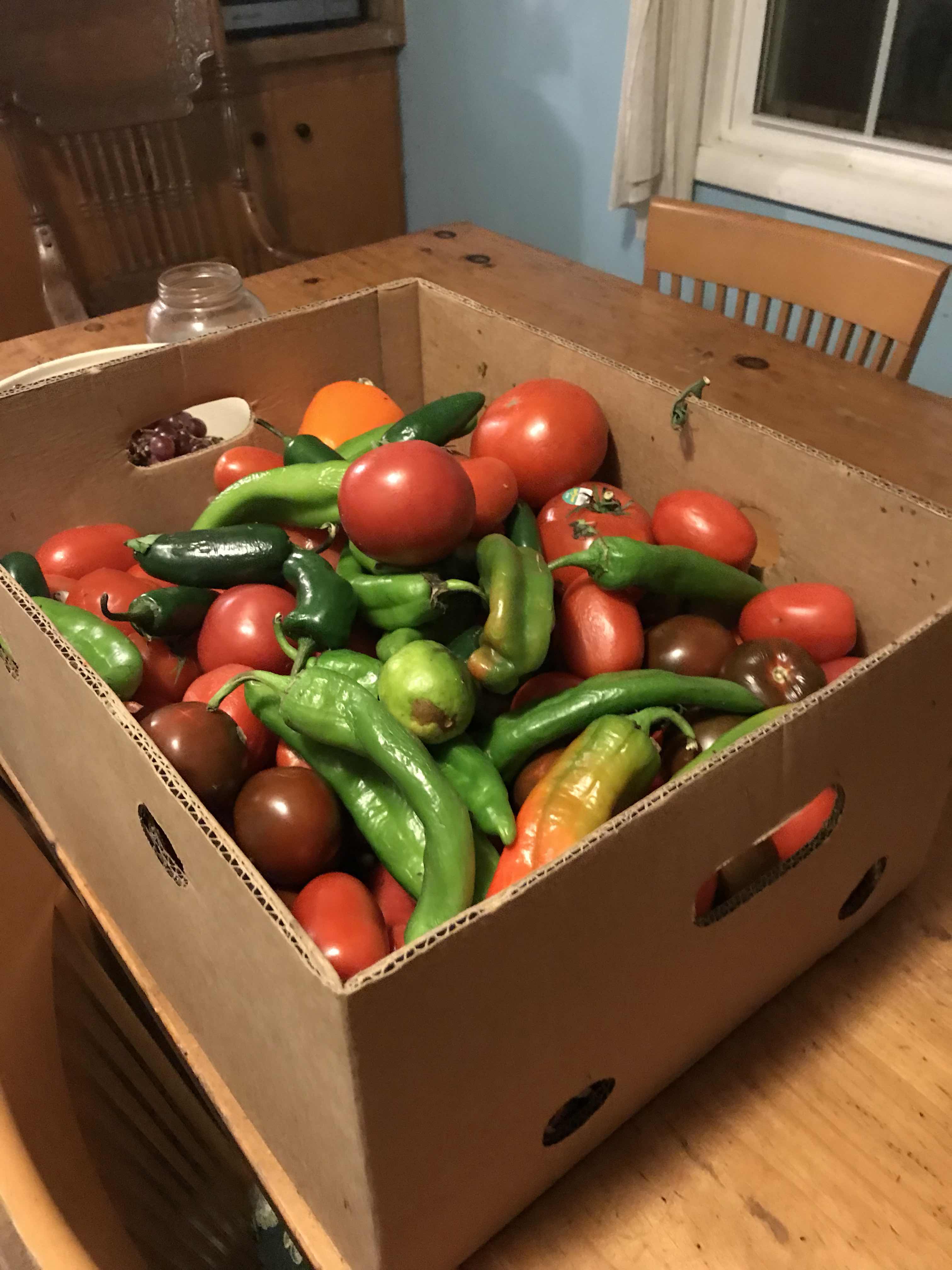
Today I went to Gleaners’s Pantry. Came home with the crate you see above - about twenty five pounds of tomatoes and peppers. Tomorrow I will can. I’m guessing there’s a good dozen quarts of salsa in that box. 

Tonight I spent a few hours making good use of other produce fromGleaner’s. Roasted hatch chiles, red onions, corn on the cob, and fresh tomatoes became this beautiful salsa: 


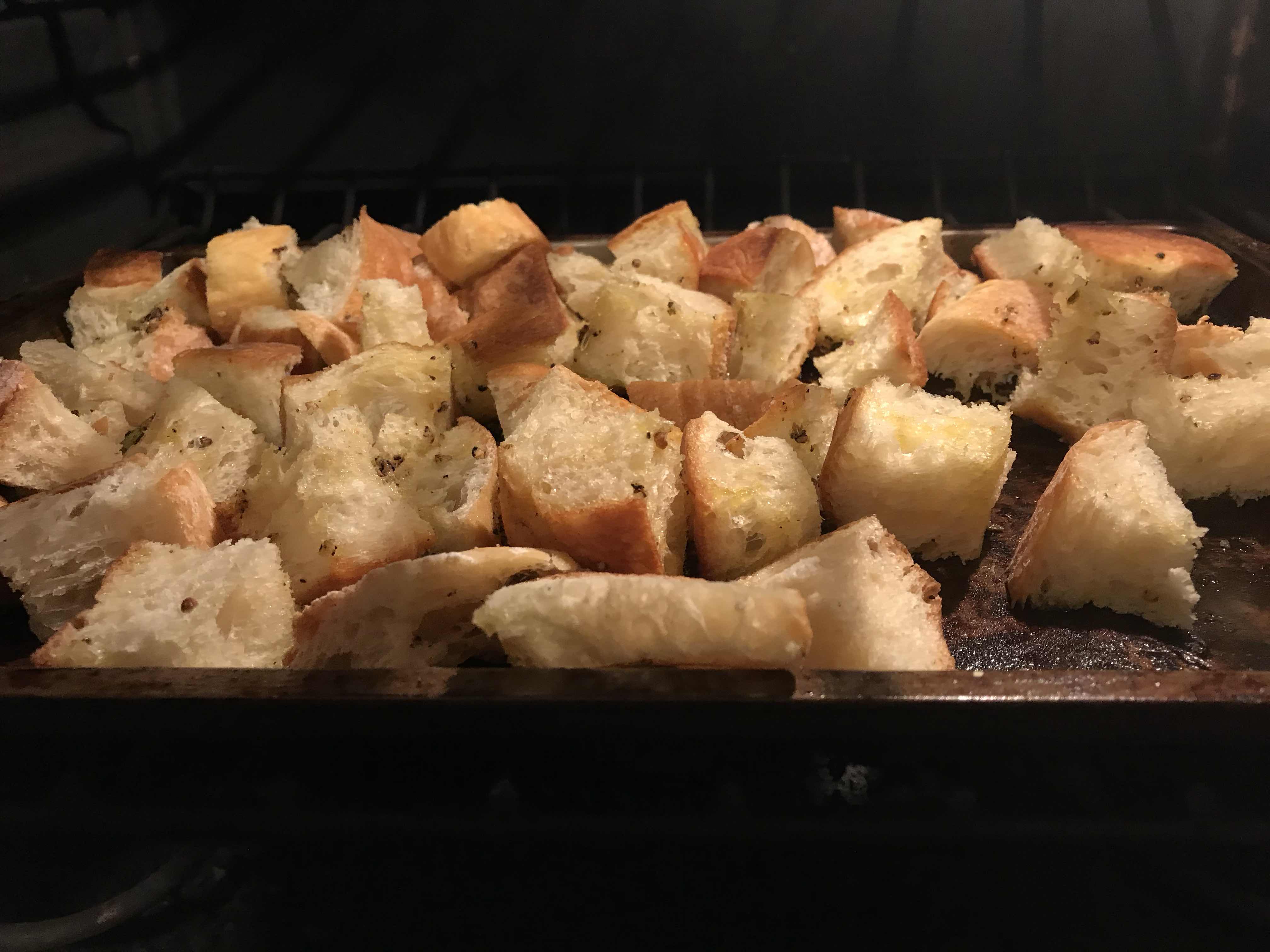
I also brought home a half dozen loaves of ciabatta bread. I like to cube it up and toss the cubes with a mix of olive oil, herbs, garlic, salt and pepper, and bake until they are crunchy croutons. Store in a ziplock bag in the fridge. 


 Not pictured here is a new experiment - plum shrub. A shrub is a fruit based concentrate, made of any fresh fruit macerated with sugar for a few days and then mixed with apple cider vinegar. That makes a storable concentrate that can be mixed with fresh water - still or sparkling - for a delightful refreshing non-alcoholic beverage. If you like, of course, you can also add a jigger of vodka or gin. My first attempt at a shrub is a half gallon of chopped Italian plums and a few springs of rosemary. I expect it will be delicious. 

I missed a lot of preserving season this year - for the very worthwhile reason that we were in Mexico with my husband’s family - but I am making up for list time. Mabon is upon us, almost, and I intend to embrace the motto of the season and be prepared. 

Besides, I love it. Putting up food is just about my favorite thing ever. 

Wednesday, June 7, 2017

Canning Log and Canning Jars


Finally, we seem to have caught up to the calendar. We've had weather hot enough to go to the lake and go swimming, and the first crops are just beginning to show up in local markets - snap peas, asparagus, rhubarb, spinach, radishes. On the farm we've been enjoying our very limited produce: rhubarb, nasturtiums, and tender herbs like chives and lemon balm. I did plant peas, but the vines are only about five inches tall and have not yet begun to flower. Raspberry canes are in flower, though, and there are lots of little green strawberries in the strawberry bed. Today I saw the first blossoms on the blackberry bushes.

I decided I will try to keep a preservation log on the blog this year. Every year, I post what I'm doing in the kitchen when I think about it, but this year I'd like to be a little more methodical about it. I'm going to concentrate on canning, even though that only accounts for about a third of the preservation I do (the other thirds being freezing and smoking or dehydrating). Canning is an event - I usually devote an entire day at a time to it, which makes it easy to document. Of coursed, I've canned a little bit of salsa here and there already this year, but I'm going to start the log with last Sunday.

I'd been to the Gleaner's pantry on Saturday, and I brought back enough produce to mandate a canning session. I made three separate products in one day, which makes me feel especially productive.

- Four quarts of salsa ranchera
- four tall quilted jelly jars of pickled jalapeño peppers
- three pints of pickled beets, all from one enormous beet the size of a baby's head.

I'm not sure if I mentioned that a friend brought me several boxes full of canning jars as a gift. They were helping a friend clean out their mother's house after she moved to assisted living, and the lady had quite a collection. Many of the jars are beautiful, unusual varieties. There are some blue-tinted jars, and some lovely bell-shaped quilted quart sized jars, and some of those neat old square sided jars.

Unfortunately, some of them are old enough to be non-standard, which renders them totally useless for canning. There's very little more annoying than going to all the work of canning a batch of, say, pepper jelly, and sterilizing a bunch of jars only to find at the critical moment that the jar openings are just a little bit off standard.  Sooner or later, I'm going to have to sit down with a standard size lid, a wide-mouth lid, and a big glass of wine and separate the sheep from the goats (so to speak).

Then I'll have to decide what to do with all the pretty but non-functional antiques. I'm a sentimental type, so I can't just recycle them. Maybe I can trade them for something - like more stuff to can!

Friday, August 5, 2016

Homecoming Harvest


We had a bit of difficulty getting home
from Oaxaca. Without going into details, we got home 48 hours later than we thought we would; paid more than a thousand dollars more than we thought we would have to; and had to take a seven hour bus ride to Mexico City instead of flying from Oaxaca, as we had planned. 

None of that matters, in the grand scheme of things. We are home - whole, hale, and hearty. We had a wonderful trip (recap to follow, with pictures). The farm, under Rowan's care, has flourished in our absence. 

I was sorry to have missed so much of harvest season. All the berries were early this year and the strawberries and raspberries came and went while we were gone. I got anxious as I saw my friends' Facebook posts of blueberries and even blackberries while I was still
thousands of miles away. 

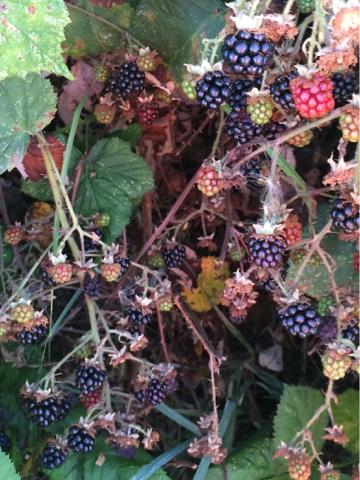
Today I found out that there is plenty of harvest season left. As you can see above, the blackberries are in full swing but there are plenty of green ones left and there will be blackberries for weeks yet. 

The blueberry harvest is not over yet, either. My favorite local no-spray blueberry farm had many plants loaded with berries still, although some had begun to dry on the bush. It only took me twenty minutes to pick about 4 pounds. Sometime this weekend I'll be bringing the kids out to pick more.


Walking the orchard brought some delightful surprises. Some trees that had never yet borne fruit are bearing. Chiefly - the hazelnut. I don't know if this is due to the two new tiny hazels I planted this spring for improved fertilization or if the bush simply needed more time. In years past, it flowered but never developed nuts. This year there are hundreds of nuts all of a sudden. I need to read up on when to harvest them and how to cure them. 

Another tree, which I had pretty much given up on, surprised me: the greengage plum. We have two plum trees - an Italian plum and a greengage plum. The Italian plum has been providing us with a good harvest for several years, but the greengage plum had not set a single fruit, despite growing tall and flowering. For whatever unknown reason, it decided that this was the year it was going to fruit. The plums are just ripe - and delicious. The greengage plum is a heritage fruit that many of us remember, but which you almost never find in the grocery store. I'm so happy ours has decided to bloom.

All the pear trees look pretty loaded (we have four - too many), but one in particular is so weighed down with hundreds of enormous pears that the tips of the branches are actually resting on the ground. I think it is the Comice pear - my favorite. They haven't started to fall yet, so I'll leave them be until they do. 


Our first day back happened to be a Friday, which is farmer's market day in Ferndale. Overly ambitious, perhaps, I bought enough green beans for canning and several pounds of pickling cucumbers and dill to start a crock of lacto-fermented pickles. 

I've already got the pickles going in a big glass container on the kitchen counter but the green beans will have to wait until I buy some new canning jars - tomorrow. I swear. 

Saturday, September 12, 2015

Abundance (The Pressure is On)


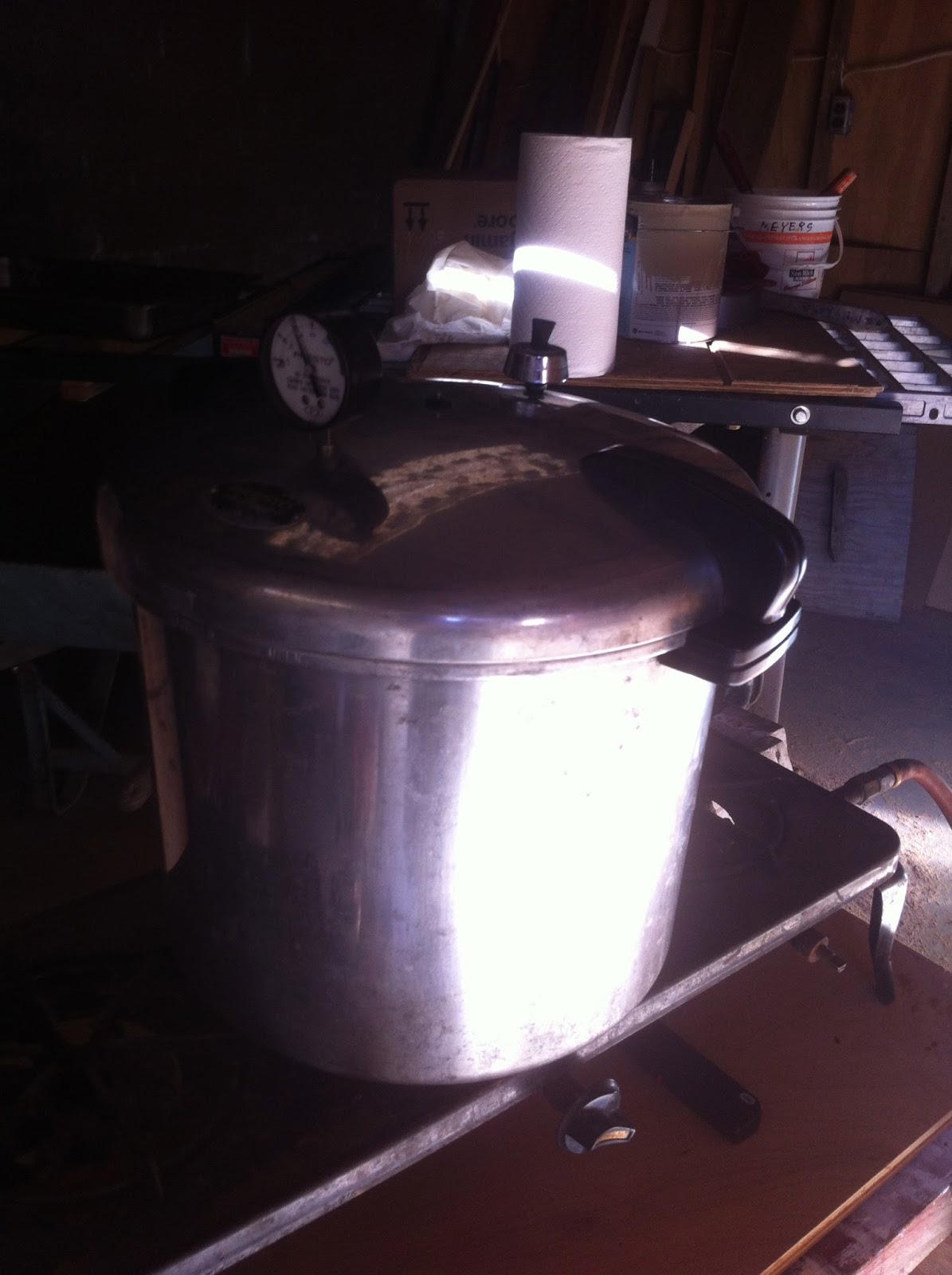
Although I do a lot of canning, it is almost all water-bath canning. I am afraid of pressure-canning. Basically, water-bath canning is packing food into sterilized jars and immersing them in boiling water to seal the lids. Pressure canning is doing much the same thing, but processing them in a pressure canner, which uses steam raised to temperatures higher than 212 degrees Fahrenheit - the temperature of boiling water. Water bath canning is safe for high acid foods like pickles and salsa or high sugar foods like jam. Anyone desirous of more precise information can find it here.

I've already written a long and informative post on why I seldom use a pressure canner, and it is reproduced at the end of this post, so I won't go into it again here. Here I simply mean to document what I did with these beauties:


The Gleaner's Pantry offered up an abundance of eggplant again. I think these came from Trader Joe's, which usually carries the most perfectly shaped and glossiest eggplant. These ones were oddly shaped, and some had bronzy-patches which were a skin-only phenomenon. I don't know what causes that, but the eggplant underneath is perfectly sound. 

Eggplant is one of those love 'em or hate 'em vegetables. Most people dislike them, but I enjoy them. I think part of the problem with eggplant is that is hard to cook correctly. It's easy enough to bake until soft and mash, as for baba ganoush , but it's more challenging when the eggplant retains it's shape and texture. It's not easy to avoid the eggplant turning to mush when you don't want it to. 
Then there's all that stuff about salting and extracting the "bitter juices," which I totally ignore and have never felt that the eggplant was especially bitter as a result. I can't claim to be any sort of eggplant-cooking expert, but I have several decent recipes that I like.

Not enough, however, to use up SEVEN big eggplants. I don't know what I was thinking. After making an extra-large eggplant parm, I still had three eggplants to use. I decided to make caponata and can it. Recipes found on the internet disagreed about whether or not caponata needs to be pressure canned. Last time I made it, a few years ago, I water-bath canned it, adding extra sugar and vinegar to make it into a kind of chutney that I felt would be safer. This time around, I wanted to err on the side of caution so that I could give some of it away if - as seems likely - we didn't actually want to eat 8 pints of caponata. 

So I borrowed a pressure canner from my friend M. It was actually very easy to use. I set it up on the propane cooker outside and never felt nervous at all. My only issue with it now is that I feel like the caponata came out overcooked (one of the jars didn't seal and so we ate it right away). The caponata is cooked first, of course, and packed hot into sterilized jars. Then the pressure canner has to heat up and vent steam for 10 minutes before you let it come up to pressure. AFTER THAT, the caponata is processed at 10 pounds pressure for 20 minutes. It all seems like just too much for delicate eggplant flesh. 

The caponata is delicious fresh, however, and so I'm giving my recipe here for those of you who find yourselves with too much eggplant at the end of summer. 

Caponata

1 large eggplant, cut into 1" dice
1 red onion, chopped
2 long green Italian frying peppers, diced
3 cloves garlic, minced
1/4 c. olive oil
1/4 cup raisins
1/4 cup kalamata olives, chopped
heaping tablespoon capers, rinsed
4 medium ripe red tomatoes
1/4 c. red wine or apple cider vinegar
1/2 c. sugar
salt and pepper

Heat olive oil, and saute peppers, eggplant, onion, garlic, and raisins.  Put tomatoes, vinegar, and sugar in blender and puree. Add to eggplant mixture and simmer until somewhat reduced and vegetables are tender. Salt and pepper to taste. Shower with minced parsley and serve with good quality crackers. 


The following is a repeat of my "controversial canning" post from 2011. 


HURSDAY, AUGUST 4, 2011


Controversial Canning (A Confession)


These last four years, I've done a lot of canning. In past years, before I moved up here, I know I must have canned at least a few times, but I can't for the life of me remember doing it. I just know that when I made my first batch of jam up here, I wasn't doing it for the first time.

So I guess I can't really remember how I learned to can. I do remember watching my mother can when I was quite small, when we lived in Woodinville before the divorce. My dad put in a good sized garden every year and mom would usually preserve something at least once or twice a summer. My memories are vague rather than specific: standing near - but behind - my mother as she peered into a large steaming kettle; the wooden spoon, stained red with strawberry juice; touching the tops of the hot jars to see if they had sealed properly. I certainly don't remember any lessons happening. 

Canning is intimidating; there's so much work involved, for one thing. Another thing I remember is my mom all sweaty and angry with her hair hanging down and tomatoes everywhere. Now I know why - dealing with twenty or thirty pounds of ripe fruit is a lot of work. Washing jars and finding lids and carrying kettles of boiling water around is hard work. Forcing gallons of applesauce or tomato paste through a foodmill is excruciatingly hard work. Hot work, too. And it always happens in August. 

Then there's the fact that home canning can kill you. If you read a book on the subject (the Ball Blue Book is the best known and the most venerable: Amazon.com: Ball Blue Book Guide to Preserving (0797190001428 ...) you will come away convinced that legions of Americans die every year from improperly home canned food. My general impression, when I first looked into home canning, was that the annual death toll from botulism in this country was on a par with, oh, say, traffic accidents. In actual fact, the incidence of botulism from home canned foods between 1990 and 2000 in the united states was approximately one in ten million (Botulism - Wikipedia, the free encyclopedia). 

Now here's where things get controversial. As anyone who cans, or who has read a book on canning knows, there are two methods for home canning: the water-bath and pressure canning. Water bath canning involves filling sterilized jars with food and then immersing them in boiling water for a length of time. Water bath canning is safe for all high acid foods like tomatoes, chutneys, pickles, and also for high sugar foods such as jams and jellies. Pressure canning involves a pressure canner, which allows the cook to achieve temperatures higher that that of boiling water, temperatures high enough to kill the pathogen that causes botulism. 

I have always avoided pressure canning. It just intimidates me. I do OWN a pressure cooker, but I'm not totally sure how to use it, and I think I lost the regulator. Once when I was a child, my mom was cooking beans in a pressure cooker and there was an explosion and boiling beans hit the ceiling with such force that that it rained beans. The stain never left the ceiling. Nor is that the only pressure cooker explosion I know about. In fact, my sister's sister-in-law (got that?) suffered third degree burns over 16% of her body in a pressure cooker explosion. She was in the hospital for a week. I think my brother may also have experienced some kind of pressure-cooker blowout but I'm not sure. 

So on the one hand, we have a one in ten million incidence of botulism (which, by the way, has a 4% fatality rate in adults), and on the other hand we have two or possibly three incidents in my immediate experience of catastrophic pressure-cooker accidents, with serious injury. I think I am justified in being more frightened of pressure cookers than I am of home-canned food.

Now to be clear - I am NOT advocating that anyone disregard the United States Government's recommendations on home canning procedures. They are very sensible, free, and you can read them here: National Center for Home Food Preservation | USDA Publications. But I AM saying that I personally am not going to break out the pressure cooker. 

That does limit me as far as what I can can. I can can (la da da-da-da-da, la da da DAH- da-da-da, la da DAH-da-da-da dum dum dum dum dum dum dum dum...) tomatoes, all types of pickles, salsas, chutneys, and jams and jellies. I can not can vegetables, fish or meats. 

But it seems to me there's a little wiggle room there. I know that what matters is the acid level. I should do a little research into what the actual acceptable levels of acid are that permit water bath canning. If you add a tablespoon of lemon juice to your green beans, is that enough? Are you really flirting with a gruesome death if you water-bath can eggplant caponata?

Well I hope not, because that's what I did yesterday. That's a jar of eggplant caponata at the top of this column, and a thing of beauty, too. There was a sale on eggplants at Trader Joe's. They always have the MOST beautiful eggplants there - I don't know why, but their eggplants are larger, firmer, glossier, and purpler than any other eggplants. And cheap, too. I got three for under $5. In the house I had the other ingredients: tomatoes, herbs, and celery from the garden, onions and garlic from my neighbor's garden, raisins in the pantry. Caponata is meant to be rather acid, but to be on the safe side, I added more than the usual amount of vinegar, and therefore more than the usual amount of sugar, too. In fact, I added so much extra sugar and vinegar that I think I can call the result a chutney.... which is perfectly safe to water-bath can....

The fact is, I fudge. I don't follow recipes. I use my common sense, born of experience. Am I an expert? Heck no! But I am a very experienced cook, and I am growing more experienced with canning every year. Also I am a trained nurse, and I know the difference between clean technique, sterile technique, and how to maintain a sterile field. It may be that when I do more research I find I am wrong - hunches are often wrong - but my hunch is that the danger involved in canning comes from inadequately sterilized equipment BEFORE it is processed, and that if great care is taken to sterilize jars, tongs, spoons, etc, then the method pf processing is less important.

In any case, if you are on my Christmas list don't worry - I will only send you absolutely 100% safe stuff like pickles and jam. But here at home I will be eating my caponata. And I may even can chile! Or soup! Hell, I'm a renegade! I already feed my children raw MILK!

But that's a post for another day...


Wednesday, July 15, 2015

Tomato Slavery (Canning for my Soul)

Ever since I first moved to this farm, one of my main motivations for raising animals and putting in a garden has been to try and eat more ethically. I think this is a common concern - most of us care about the ethics of what we put in our mouths and most of us make some sort of effort to source our food with ethical concerns in mind.

For some of us, our paramount concern might be animal welfare, and our concern might lead us to vegetarianism, or to sourcing ethically raised meat. Some of us eat all organic, not just for our own health, but for the planet's health. Most of us try to avoid eating endangered species, and look for sustainably harvested seafood. Recently, many people have become concerned with the carbon footprint of their diet and look for locally produced food that isn't trucked or flown thousands of miles from the point of production.

These are ALL laudable goals, and what I am about to post is in no way meant to suggest that anybody ought to abandon their priorities for mine. We all do what we can to behave ethically - I hope - and I firmly believe it is impossible to refrain from all evil in all our actions.

That said - consider this quote:

"Since 1997, the Justice Department has prosecuted seven cases of slavery in the Florida agricultural industry — four involving tomato harvesters — freeing more than 1,000 men and women. The stories are a catalogue of horrors: abductions, pistol whippings, confinement at gunpoint, debt bondage and starvation wages." 
(for the rest of the article, see here)

Did you catch that? Here in these United States, in the past couple of decades, there have been cases of SLAVERY so egregious that they have been prosecuted as such by the Justice Department. Not "Wage Theft;" not "exploitation," but SLAVERY. For those of you who won't follow the link, the article details the commonplace practices of imprisonment, of people being forced to work at gunpoint, of hostage taking and threatening the families of those who try to escape. For the each of the seven cases that were prosecuted, there were (and are) literally thousands of cases that are never documented.

Following are two more links. I especially recommend the first. It was originally published in Gourmet Magazine in 2009, and it was the first time that the problem of widespread slavery in our agricultural system got serious mainstream press. It is the article that opened my eyes to the scale of the problem.

http://www.gourmet.com/magazine/2000s/2009/03/politics-of-the-plate-the-price-of-tomatoes.html

http://www.thenation.com/article/trouble-tomato-slave-labor/

More recently, there has been news coming out about conditions on tomato farms in Baja California in Mexico. Nearly all of our winter tomatoes in the US come from either Florida or Baja. The large plantations in Baja are not owned by US companies, but they are contracted to large US companies and those companies have moral responsibility for the conditions, which are, again, tantamount to slavery.

This past winter and spring, farmworkers on these plantations have begun to protest the practices and conditions - enforced confinement behind barbed wire and electric fencing; forcing workers to purchase all of their food and water from the company store, which charges exorbitant prices and puts the workers into debt-slavery; lack of running water or plumbing; and as retaliation for protesting, beatings and starvation.

The LA Times ran an expose on the situation, which you can read here:

http://www.latimes.com/world/mexico-americas/la-fg-baja-farmworkers-20150509-story.html

Aside from labor practices (what a tame and euphemistic phrase), our current system abuses farmworkers by poisoning their bodies with pesticides which they must apply to the fields, often with inadequate or nonexistent protection. The wells from which they must drink are tainted. Their children are subject to birth defects and chronic illnesses as a result of exposure to dangerous agricultural chemicals (see: http://afop.org/wp-content/uploads/2010/07/Annual_Publication_FINAL_English1.pdf)


In short, I have come to a decision. This decision is going to cost me a lot of time and effort. I have decided that I can no longer purchase tomatoes from Mexico or Florida. I realize that it is impossible for me to entirely wash my hands of my participation in our evil (yes, I said evil) agricultural system. Just as I cannot utterly refrain from the evils of the systems which produce my clothing, electronics, or transportation needs, I cannot keep 100% "clean" in my food choices either. It's simply not possible. But I can make a few choices that make me feel better, even if they do not do much to dismantle the systems themselves. This is one of those cases where the only effective action is collective action, yet I can only take individual action.

We eat a lot of tomatoes. After onions, I think tomatoes are probably the single most important vegetable ingredient in my pantry. They go into at least a third of the meals I cook at home. I will continue to buy tomatoes when I can verify that they were produced locally. And I will continue to accept tomatoes from the Gleaner's pantry, no matter where they come from. That is because - similarly to buying secondhand goods - my using those tomatoes does not materially benefit the producers. Exactly zero of my dollars are going to the growers if I collect the tomatoes after they have already been thrown away.

But if I want tomatoes in the months of November through March, I am going to have to preserve them myself. That means I am going to spend a large number of hot August afternoons washing, blanching, peeling, dicing, and canning tomatoes. If I can get my hands on small Roma tomatoes, I can freeze them whole, which is the easiest way of preserving tomatoes. But no matter what, my tomatoes are going to be more expensive from here on out - expensive in terms of time, certainly, and maybe money too, if if we factor in electricity and canning jars.

But what price, after all, a clean conscience? Moderately clean. at least. Moderately.


Sunday, September 21, 2014

Canning Party (Recipes)

lemon curd


mixing up Ukrainian refrigerator pickles

making dilly beans


Yesterday I invited a couple of girlfriends over to do some communal canning. It was a beautiful fall day and I enjoyed showing my friends around the homestead. After a few drinks and some snacks, we got down to business.

One of my friends was a total canning novice, and she chose dilly beans as a good place to start. I think that's a good choice - easy vinegar based pickle, delicious, pretty. I made lemon curd because I had a serious surplus of organic lemons from the Gleaner's Pantry. Lemon curd is not just yummy, but also very attractive and I'm thinking it will make a good addition to any Christmas packages I send out this year, should I get my shit together and send any.

My other friend is Ukrainian, and was making two of her mother's recipes. I was very excited about this; my mother's family also comes from Ukraine, but a few generations back, and as far as I know no family recipes have survived from that time. The three of us had a great time in the kitchen, and we decided to make it an annual event - the September canning get-together.


Nastia's Refrigerator Pickles

4 kg pickling cucumbers sliced in fourths lengthwise, and halved if long
4 Tbsn minced garlic
1 C. salad oil
1 C. sugar
2 Tbsn mustard powder
2 Tbsn yellow mustard seeds
2 tspn ground black pepper
1 C. 9% white vinegar (available in Russian grocery stores; or 2 C. regular white vinegar

Mix all ingredients in a large non-reactive kettle; let stand 3 hours at room temp. Then pack into large glass jars and refrigerate up to 2 months. 

These pickles are so delicious we couldn't stop eating them immediately, but now, a day later, I can say they are much better than they were even 24 hours ago. Unbelievable. I will be making these every year. 


Nastsia's Eggplant Preserve

3 Kg ripe eggplants (about 8), chopped in large (2") dice
1 Liter tomato juice
1 Tbsn salt
1 C. sugar
1 C. salad oil
1/2 C. 9% vinegar (available in Russian groceries; or 1 C. regular white vinegar)

Salt the eggplant well and leave to sit 1/2 hour in a colander; then rinse well and combine with all the other ingredients. Boil 20 minutes, then ladle into sterilized wide-mouth pint jars and process in a water bath 30 minutes. Cool and make sure jars have sealed. 
NOTE: this is Nastia's mother's recipe. The Blue Book Canning Guide states that eggplant, as a low acid vegetable, MUST be pressure canned. Some sources say that acidizing the eggplant with vinegar makes it safe; other sources DISAGREE. To be totally safe, process in a pressure canner.


Lemon Curd

Juice of 8 large or 12 small lemons; about 1 full cup
6 eggs plus 2 egg yolks
2 C. sugar or more to taste
3 sticks (3/4 lb) butter

in a large sauce pan, mix first three ingredients. Whisk until well blended. Over medium heat, whisk in butter in small pieces until incorporated; keep whisking occasionally until thickened; about 6 or 7 minutes. Ladle into sterilized 1 C. quilted jelly jars and place on sterilized lids. Process in a water bath just to seal; about 5 minutes. The high acid of this conserve makes it safe as long as the jar seals well. Will keep for many months. 


Wednesday, August 21, 2013

Fish Tale (Canning Salmon)


One of the many blessings of living where I live is the seasonal availability of the world's greatest fish, the noble King Salmon. Salmon of one kind or another, often farmed, are available year round, but I wait for the local wild runs. To my mind, no other fish can come close to the deliciousness of a fresh caught wild salmon. 

Salmon has become very expensive in recent years, as has most quality seafood. The damage we have done and continue to do to our oceans through overfishing, pollution and acidification is catching up with us fast. The price of good clean fish is really the least of it, but I don't want to get sidetracked into a rant. Point being, I can only afford a few fish a year, and I want them to be salmon. 

A small scale local fisherman shoots me an e-mail when the fish come in, so I was ready. These fish came off the boat yesterday morning about 6 a.m., and I was there with a hundred dollar bill at nine. That bought me these two lovely twelve pound fish. I know that sounds like an awful lot of money, but I did some math, and by using up every last gram of meat on these fish, I can make each fish feed my family four times, maybe even five. That is, I can get somewhere between fifteen and twenty servings from each fish, and that brings the price right down in a very reasonable range. 

fresh kings

One of the fish was for eating fresh, and the other was for canning. I know that sounds like sacrilege, but ever since a friend of mine who lives in Alaska sent me some canned King salmon several years ago, I've wanted to try it. A King salmon is a big fish, it's hard to eat a whole one, and I like canned salmon better than frozen salmon. In fact, canned salmon is delicious.

I've never canned fish before - in fact I've never used a pressure canner and don't own one.  Luckily, a wonderful couple I know from church offered to help me. The gentlemen half of this couple is none other than Duckman , an avid hunter and fisherman who has been very generous with us. The lady half is R., one of the most welcoming women at Zion and an old hand at canning the fish her husband brings home. I was very grateful to have their help. First, however, I had to deal with the fish I planned to cook for dinner last night.

Never having filleted a whole fish before (I know, I know, how does a woman who considers herself a serious cook and who loves salmon as much as I just said I do get to the age of 40 without ever filleting a fish? Buy small ones and bake them whole, or pay the fisherman) I was terrified I was going to massacre it. Because it was so fresh, only hours out of the water, the fish was covered with a thick layer of slime, and it was so slippery I could barely hold on to it.

Thank God for Youtube. It took ten seconds to find a short, no nonsense video of a chef with a thick European accent cutting up a whole salmon. Of course, he made it look easy, which it wasn't. Maybe his fish wasn't as slimy as mine. Certainly, his knives were sharper. Mine need professional help. However, I don't think I did too badly for my first ever attempt.


Here is the fish after I removed the filets, with the bellies alongside. I know I left a lot of usable meat on the bones, but don't worry. I chopped the fish into pieces, removed the gills, and put the whole carcass into gently simmering salted water with a little lemon juice. It only needs about five minutes poaching, then all the meat easily slips right off the bones (ok, you have to dig around a little in the head). I salvaged close to a pound of meat from that carcass, and froze it in a ziploc bag. Sometime in the future, it is plenty to make a salmon cake dinner.  Also, I took the collars and bellies and marinated them for a few minutes in a mixture of sugar, soy cause, rice vinegar, and sriracha, and then broiled them skin side up under the broiler for 10 minutes or so. These bits we just gobbled up like candy, but it was plenty of meat that I could have made a separate meal out of it if I wanted to.


Here are the filets. They aren't super pretty, but I think I did okay. One of them was dinner last night (with enough leftovers to make some salmon salad sandwich spread) and the other is in the fridge, marinating in a dry rub. I'm going to break out my "Little Chief" smoker - which I've never used - and attempt to make some real smoked salmon. 

The second fish went out to Duckman's house with me in the afternoon. Let me tell you, watching him with a knife and a fish was a thing of beauty. In about a minute flat he had that big old King filleted, and the filets cut into pieces. He did a neat little trick where he sliced the skin off (not good for canning) without losing a millimeter of meat. Once again, I took the trim (a lot less of it, this time) for poaching and picking. 


We packed the raw salmon into wide mouth pint jars, and added nothing at all except a quarter teaspoon of salt to each jar. You leave plenty of headroom. No water, oil, or anything else. 


 Top the jars with sterilized lids and rings, and into the canner they went. R. and Duckman have a propane cooker set up in their shed; they don't like to can fish in the house because of the smell. I personally find the smell divine, but maybe it lingers.

I'm still a little sacred of the canner, to tell the truth. I just don't quite get exactly how it works. I mean, I can follow instructions, and I can tell when it's working correctly and when something is wrong, but I can't exactly visualize what the parts are all for, and what is happening inside. Anyway. We put the eight pints in the canner and added 2 quarts of water. We ran hot water over the inside of the lid and checked that the gasket fitted into the groove tightly all the way around. We closed it up and put the cooker on low. If you heat it up too fast, you run the risk of breaking all your jars.

When you can see steam venting continuously from the vent, you carefully place the regulator on. The little vent in the middle ought to pop up. If it doesn't, you just wait until it does. Then the pressure will start to rise, and you watch the gauge carefully. Salmon is canned at 10 pounds pressure for 100 minutes. Don't start the timer until the pressure rises to 10.

Then, settle down in your chair and read a book. We had to adjust the flame several times to keep the pressure right; it wanted to creep up. It's fine to let it go a little higher than ten, but you don't want it to go above 15. Once it's at pressure, it only takes the barest whisper of flame to keep it up.


While we were waiting, R. made hamburgers and corn on the cob from her garden. I had brought over a blackberry cobbler as a thank you, and so we had a fine meal. The girls ran and played on the lawn in the late afternoon sunshine and we grownups sat back and chatted about local goings-on. There's a new pastor at Zion. The grandchildren are coming to stay. A fishing trip planned for October. 

When the timer went off, we just turned off the propane. You have to let the pressure dissipate completely before you open the lid - in fact, you have to let it cool down. That takes quite a while, and it was getting late. The sun was setting and a big full moon was rising over the mountain. We decided to just let the canner cool down overnight and I'd come back for my fish in the morning. 

Which I just did. It's beautiful. I brought over a quart of my dill pickles as a thank you for Duckman, but he wasn't home. He's out on the Skagit river, fishing for humpies. 


Monday, May 9, 2011

On Trading and Canning


Yesterday I made the first major trade of the year - four dozen eggs and a pound of goat cheese for ten pounds of asparagus. That makes a pretty big box of asparagus, even after deducting my sister's mother's day present (she adores asparagus). I traded with Veggie/Oil Man, now officially my longest-term trade partner. We have three solid years of trading everything we have to trade - eggs, cheese, and mechanic services on our side for organic vegetables, use of equipment, and waste veggie oil on his side. Veggie/Oil Man supplies a great percentage of our fresh food in the summertime, and allows us to glean his fields as the season ends. He is also a very interesting and colorful character and something of a local legend.

The trade network is real fun, something I very much enjoy. I like meeting new people; I like finding out what our local foodshed has to offer; and I like offering up the fruits of our own labor. But it does have a few disadvantages. Imagine for a minute that the only place you could ever shop was Costco. Imagine that most of your fresh produce comes in ten pound lots. Most of us are probably familiar with a ten pound sack of potatoes, and if we have a medium-to-large family, that's not really a lot of potatoes. But ten pounds of asparagus is a lot. Ten pounds of tomatoes is a lot. Ten pounds of snap peas or green beans is a MAJOR lot. And ten pounds of kale or chard is an insane amount.

There are a few ways to deal with massive amounts of one kind of food at a time - recipes heavy on one or two ingredients ( for example - http://newtofarmlife.blogspot.com/2010/06/seasonal-abundance-greens-n-cheese.html), or throwing a party with enough people to absorb whatever you have too much of (any excuse for a party.). But eventually, we have to fall back on preserving. Not that it's a hardship or a last resort - quite the opposite. It's the only way to eat locally throughout the year; a good way to save money; a wonderful source of satisfaction and pride, not to mention cheap christmas presents.

Again, there are many methods of preserving, and each of them has advantages and disadvantages, depending on the produce involved, your preferences, and energy/infrastructure situation. We tend to favor freezing and canning around here. To get back to the subject of this week's trade, asparagus, I am planning to pickle it. I know my siblings both consider pickles to be the scourge of the earth and a shameful waste of good fresh food. I couldn't disagree more. Maybe I was born with a salty/sour gene that they missed out on, but there's nothing I like more than a good half-sour kosher dill. Or some tangy, sweet pickled beets. Or hot n' spicy dilly beans. Or, more to the point, pickled asparagus.

Maybe it has something to do with my love of a good Bloody Mary, I don't know. Is there a better addition to a Bloody Mary than a hot, garlicky spear of pickled asparagus? I think not; unless it might be the pickled yard-long bean served in the Wasabi Mary at the Dragonfish Cafe in Seattle. Last year, alas, only a very few of my pickled asparagus spears ever made it into a Bloody Mary. Most of them were snarfed up by my children, who have apparently all inherited the salty/sour gene. I can't remember for sure, but I think I made six quarts of pickled asparagus last year. There is enough asparagus in the fridge right now for about the same amount - but I'm going back next week for more. There is no such thing as too much pickled asparagus.

Six quarts pickled asparagus:

2 or 3 pounds fresh asparagus
1 quart distilled white vinegar
3 quarts water
1/2 cup sea salt
1/4 cup white sugar
1 head garlic, separated and peeled
1 tablespoon hot red pepper flakes
small handful whole black peppercorns
several whole allspice berries
several cloves


Sterilize 6 wide mouth quart jars in boiling water; keep water simmering. Set our sterilized jars on a clean towel on counter. Add lids and rings to simmering water.
Make brine - boil all remaining ingredients and keep at a bare simmer.
Pack jars with cleaned, trimmed spears of asparagus.
Add simmering brine to within 1/4 inch of jar lips. Make sure each jar has a couple of cloves of garlic.
Using tongs, remove lids and rings from simmering water and close jars. Replace jars in simmering water and process for 30 minutes. Remove jars with tongs and set out to cool. Testy to make sure all jars have sealed. If any have not, keep in fridge and use within 2 weeks.


Bloody Mary:

For Four:

In a pitcher, combine 6 - 8 ounces of vodka, one jar of V-8 or Very Veggie juice, juice of 2 lemons, and several shakes of tabasco. Pour over ice-filled tumblers. Garnish with celery sticks, parsley springs, pickled asparagus, and whatever else helps you maintain the illusion that you are consuming a healthy dose of vitamins along with your alcohol. Best served around the breakfast table about 11 a.m. with 3 of your best friends over a platter of greasy hashbrowns, scrambled eggs, bacon, and biscuits. Hair of the dog and all that.

Saturday, October 2, 2010

Canning Wrap Up (Green Tomato Chutney)

Now it's October. We are still enjoying lovely, sunny weather, which is very nice, but it's definitely fall now. The leaves are changing, the garden spiders have set up their webs all over everything and are beginning to lay their egg sacs, and the harvest is basically over. There will be apples, of course, but the garden is done for.


At the swap meet last weekend, I acquired a grocery sack full of green tomatoes. Having never had so many green tomatoes before, I looked for ways to use them aside from frying them in cornmeal batter (yummy, but not really so very healthy). Everywhere I looked, I really found only one solution: Green tomato chutney.

Chutney is kind of a weird food. Who really eats a lot of chutney? I mean, growing up, there was always a bottle of Major Grey's Mango Chutney in the fridge, and I did like that stuff. I still do. But a tablespoon or so was about my annual consumption. I don't think I've bought a bottle in at least five years. I do enjoy Indian food and actually cook it fairly often, but I just don't put chutney on anything. I make raita, usually (yogurt sauce).

Plus it's a weird word, isn't it? chutney chutney chutney chutney.... Anyway.

I found a recipe and cooked up some green tomato chutney. It's pretty simple, just chopped green tomatoes, chopped onion, raisins, sugar and vinegar and a little salt. I added garlic and hot red pepper flakes, just because those two items improve everything, right? Then you simmer it for a few hours until it is almost jam-like. And you know what? I like it! It's good! It's tangy, sweet-and-sour, jammy and delicious.

But what do you DO with it? You can't just eat it with a spoon! Although to be honest I remember doing that very thing as a child with the Major Grey's. I could give it away as Christmas presents but I canned it in quart jars. I'm all out of smaller jars. Merry Christmas! Here's a lifetime supply of chutney for you! Does this mean I'm off the Christmas card list?

So if anyone out there has some ideas about how to use green tomato chutney, let me know, wouldja? I think it would taste good on a toasted cheese sandwich, and I'm thinking it might go well on a baked potato. Maybe as a small side for pork chops. Anything else?

Monday, September 20, 2010

Making Trade Goods (Gratuitous Canning Advice)

Please note: the above picture is not a picture of my kitchen. I'm not saying my kitchen has never looked like that: I'm just saying it doesn't look like that right now. The above picture is one I pulled off the internet to illustrate the process of making ketchup, which is what I am doing right now. MY kitchen is spotless and I am wearing pearls, heels, and a clean apron and singing a little ditty as I waltz about with a wooden spoon. There's a bluebird over my head right now, in fact, and a fuzzy-wuzzy little rabbit gallivanting around my feet. I'd post a picture, but the dwarves took the camera with them to diamond mine.


I got a good deal on a twenty pound box of roma tomatoes. I've made homemade ketchup before and in my opinion it kicks Heinz all to heck. My children are not so sure, but that's only because they are dinky little twits with immature little tastebuds. They also think boxed cake mix is superior to my homemade pear pie and that cafeteria lunches are better than homemade. You try and you try as a parent, but you can't compete with Madison avenue. Or even with the other six-year old idiots at elementary school.

Anyhoo. My twenty pounds of tomatoes looks like it's going to make about ten cups of ketchup. I'm canning it in jelly jars. I was all out of empty jelly jars, so I raided the pantry. There were a dozen full jelly jars in there - full of three year old ginger-rhubarb sauce. Here's a little piece of advice for you, absolutely free of charge: Never can rhubarb. It's a total waste of time and effort. Nobody will ever ever eat it. You will find yourself three years later, agonizing over opening the jars and pouring the sauce down the sink. On the one hand - it was the first stuff you ever canned as an adult, ever! On the other hand, what the bloody blue hell are you gonna do with it?

I tipped it down the sink. I KNOW what to do with ketchup.

Actually, this ketchup is earmarked for the swap meet (Swap Meet Preparations (Where Does It All Come From?)). I've been trying to produce and gather together enough stuff to trade at the swap meet. So far I have -

- about twelve pounds of assorted cheese. I am still making cheese as fast as I can. Today, I am making a batch of Smokin' Goat Chilpotle Cheddar.

- ten quarts pear sauce, some with blackberry and some without

- nine garbage bags full of raw alpaca fleece (that's another story)

- and soon, ten cups of lovely, delicious ketchup. Speaking of which, I have to go stir.

Tuesday, September 7, 2010

Turn the Page


I was out of town for three days, and when I got back, it was autumn. The temperature dropped twenty degrees and a chilly, saturating rain fell for 48 hours straight. Mud, which we haven't seen in months, manifested itself and the dogs tracked it all over the house. The pears on the pear tree swelled in the sudden moisture and began to fall. When the clouds blew away and the sky reappeared, it was a cold blue that did not seem at all the same as the soft summer sky of just a week ago.

The earliest leaves (the vine maples) had just begun to turn when I left on thursday last. Now, the big leaf maples have started to look yellow and ragged. Driving to my sister's house today, I noticed that the hills south of town have - as a whole - changed color. They now have a rusty tinge and have entirely lost the fresh green of young leaves. School starts tomorrow - or it was supposed to; the teachers went out on strike.

Summer blew by so fast this year. Summer was cram-packed. We went to Mexico for 3 weeks (Remote Post, 7/4/10 (Mexican Fireworks));then Dad came to stay for 3 weeks. I took the kids to Mom's place for a long weekend (Where I've Been....) and then I went to my brother's for another long weekend. And all of a sudden, that was it. It was over. Everything is suddenly all mushrooms and slugs.
Well, I should try to remember, it's only September 6th. Around here, September is usually a very nice month. It could easily get hot again before the autumn rot sets in for good. I hope so. I am just not ready for the endless damp; for the mold and the mildew; for the dark grey days that last a mere seven hours; for the rain that never stops and the mud that could swallow a cow without leaving a trace.

I am not ready for Hecate to take over the world. I am not ready for Persephone to sink into the earth and become Queen of the Underworld. I am not ready for the Dark Mother to make the Earth deliquesce like a pumpkin rotting on the porch three weeks after Halloween. I never even made up the household altar for late summer harvest.

That's probably why I feel unready. I have neglected the sacred calendar this summer. Suddenly I feel a very strong urge to go clean the living room and decorate the altar with the last of the the zucchini (which I picked an hour ago) and the first of the pears (likewise). It is still only the middle of blackberry season - I should get out and pick enough for a couple of pies. Likewise blueberries. There is still plenty of time to go get a bunch more blueberries.

Also I haven't done hardly any canning this year - asparagus in April and pickles in July was about the extent of it. I need to find a cheap source of many many tomatoes and can up a shitload of sauce. No wonder I feel out of sorts and off kilter. I really AM unready, in the literal sense. My pantry is virtually bare, at the very season when it should be bursting with abundance. I haven't done the labor appropriate to the season. I am nervous and unhappy because some part of my brain is shouting at me "you are all going to starve!"

Okay, so I have my work cut out for me. Re-establish the sacred calendar. Clean and sanctify my altar. Get some fucking food in the pantry. Celebrate Demeter amply, lest she transform into the hag of famine. Placate. Placate.