"United we bargain, divided we beg."
Showing posts with label meat eating. Show all posts

Monday, September 19, 2022

Meat Math, Bovine Edition (GRAPHIC)


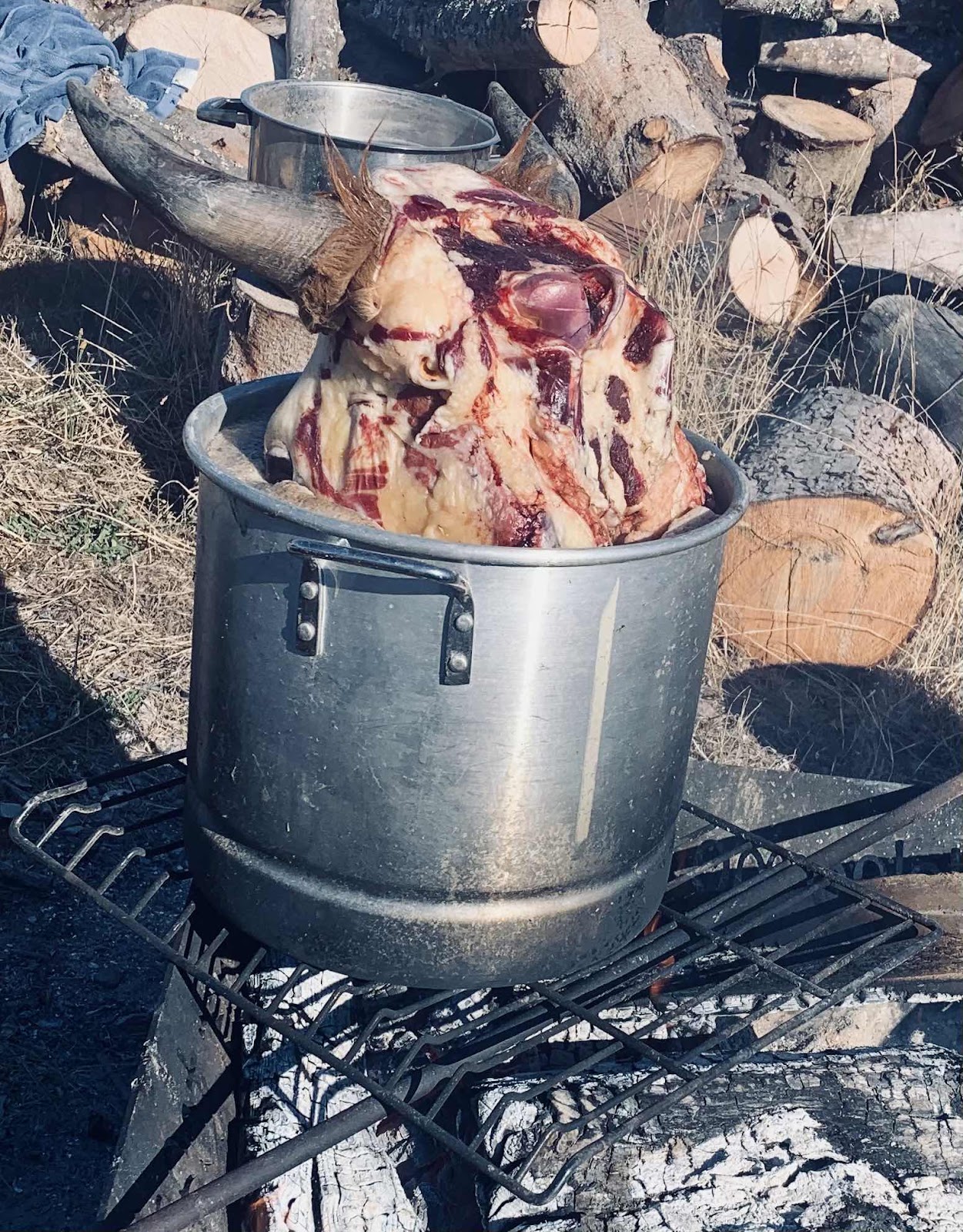
Not a very good picture, but that is a 40 quart stockpot, with  substantially less than half of a freshly butchered steer’s head submerged in it. 

This is what I came home to today. I knew, of course, that today was the day appointed for Pepe Toro, our Jersey steer, to meet his end. The men from Lynden meats were scheduled to arrive in their business-like panel van loaded with motorized equipment and on-board hot water, and do what butchers do. Half of Pepe Toro is already sold, and I have been making room in the freezer for the other half. The death of the cow, per se, was not a surprise. 

I did not know - though I should have suspected - that my husband was going to ask the men from Lynden meats to give him every scrap of the cow, from the horns to the hooves, that they would normally throw away or sell to a glue factory or something, and try to turn it into food. We’ve been through this before, and he ALWAYS does the same thing. 

We are just not prepared for cooking an entire cow’s head. In the past, even pig’s heads have proved to be difficult to manage. The head of a well-grown cow is a majorly large hunk of gristle and bone, and once the tongue has been removed, in my opinion it ought to be ignored. But Homero comes from a background that despises waste and finds a way to use EVERYTHING. This is, of course, admirable, but more so in the abstract than in real life. 


After I found the cow’s head sticking three-quarters of the way out of the pot, I convinced Homero to remove it, and to cut it into pieces with his sawzall, removing the horns and the disgusting patches of hair that clung to the skull around them. He has a plan for the horns - they are a gift to his friend Clacoyo, who wants to mount them on his motorcycle helmet. 

It took two sawzall blades, a cleaver, and a mallet to split the skull I to four pieces, but we got it done. Now the head is simmering over a wood fire - after two changes of water - along with a handful of allspice, cloves, star anise, fennel, and black pepper; three heads of garlic; several onions, and a bunch of guajillo chiles. It ought to be done sometime after moonrise. 

Now for the math. 

This animal was free. Homero has several clients who work on large dairy farms, and they are constantly giving away newborn males. I don’t know why they don’t just centrifuge the sperm they use - almost all cows are bred by AI - but either they don’t, or it has a high failure rate. This was the third free calf we’ve raised. 

The feed for a cow is almost all free too. We did have to bottle feed him for a short while but that was just one bag of milk replacer: about $30. Then of course there’s his winter hay, and a cow eats a lot of hay. I didn’t keep track of how much he ate versus the goats - that would be impossible - but we bought an extra 25 bales last winter and I’ll say that was all cow food. So that’s $100. Other than that, all he’s eaten is pasture grass and free veggies and bread from gleaners. Oh - and the same friend who provided him to us also have us the occasional pickup-load of free silage. 

We did take him to the vet to be castrated because we waited too long to band him. Won’t make that mistake again. I think that was about $100 as well. No medicine or other vet visits were needed over the course of his short lifetime. 

Total cost: approximately $230

Expected revenue: 

Last week I taped Pepe Toro to get an estimated live weight. He measured 78 inches around his heart-girth, which is very well grown. According to the internet charts, that means he has a live weight of approximately 1,112 pounds. The hanging weight of a cow is usually about 60% of live weight, so in our case approximately 668 lbs. 

I sold half of him for $3/lb, which would be $1,002. If I can find a buyer for another quarter I will sell that too, so that would be an extra $501 for a total of $1,503. Plus of course our own meat. 

That sounds like a hefty profit, but it isn’t as much as it sounds because Pepe Toro was wantonly destructive. He destroyed the calf hutch, which will cost $200 to replace, and he got I got he mama barn and put his feet right through the floor in a half dozen places. That will take a sheet of three quarter in inch plywood to fix, and now I have to go look up what that costs ($75) 

Total cost $505
Total expected revenue $1503
Total expected profit $998 

Not bad 


Friday, April 22, 2022

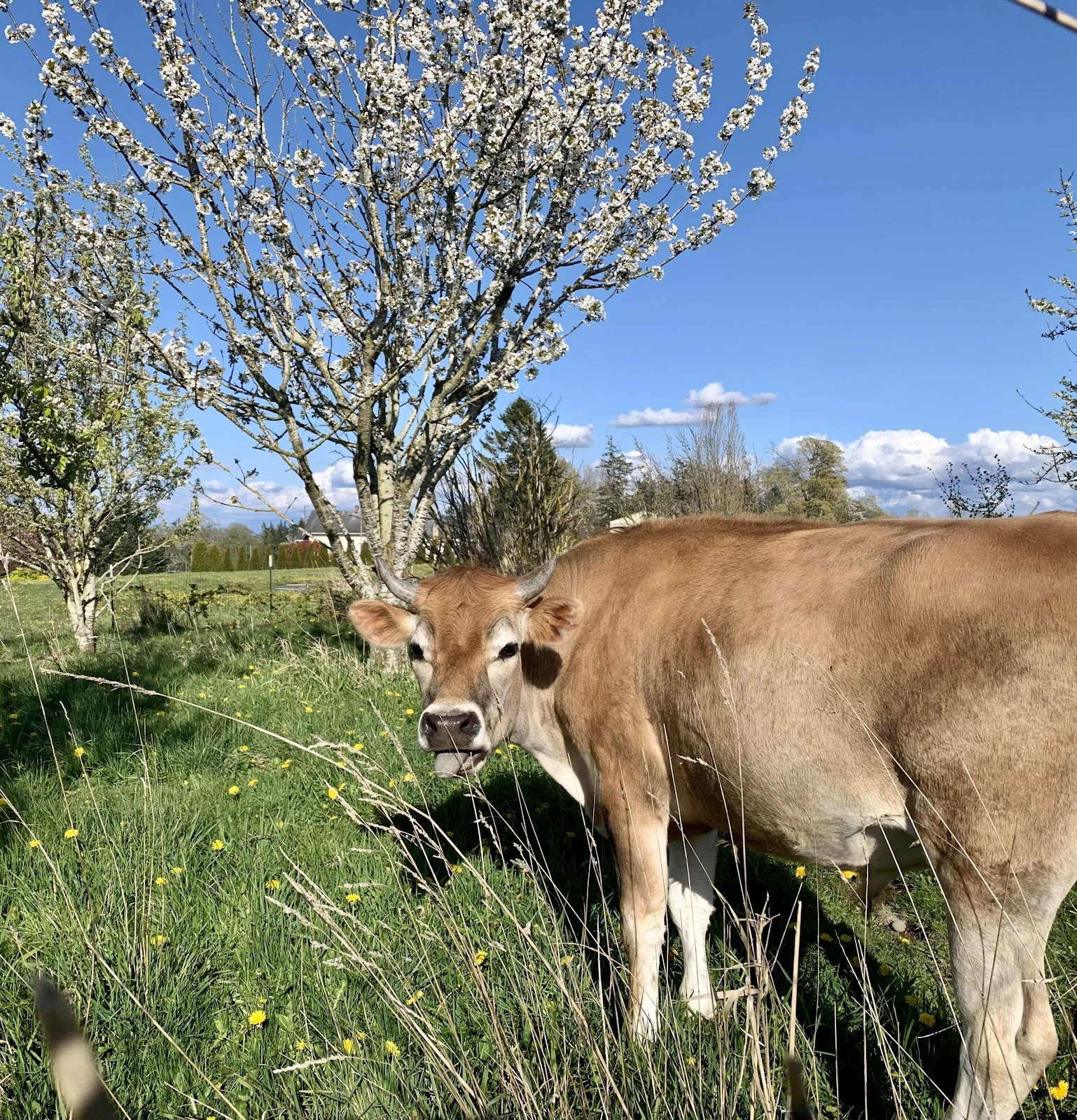
Pasture Puzzle (All Flesh is Grass)


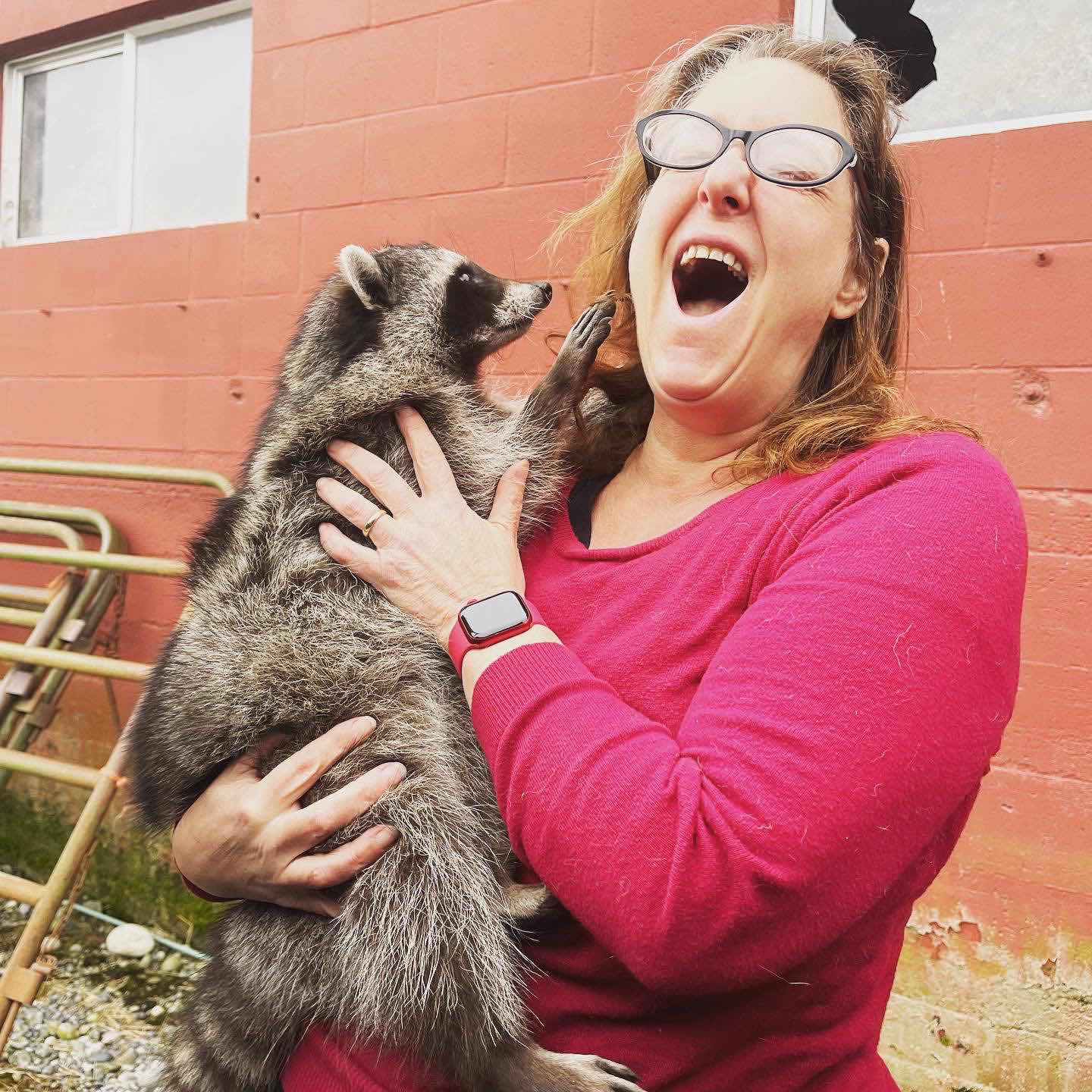
This year the grass has been slow to start growing. It’s been a very cold, wet spring. But finally, nearing the end of April, after months of mud, there is finally a decent amount of grass. Good thing too, because we’ve flat run out of hay. Actually we’ve run out of hay twice and gone for more, but as of yesterday we are out again. At one of the places we bought hay there was a tame raccoon and I got to hold her. Just putting that in there so I don’t forget THE BEST DAY OF MY LIFE. 


The goats are in the main pasture now, but the cow has been in the sacrifice area, because he is rambunctious and I worry he will injure the pregnant goats or the newborn babies. That’s why we had to get rid of Rowan’s cow, Nettles. Also I want to preserve grass for the goats. One dairy cow eats as much grass as six or seven goats, easily. 

We have three fenced pasture areas, but only the largest - which is about 60% of the total area -  has any real grass in it. The second largest one is about 100x100 and is our sacrifice area. The smallest simply isn’t large enough to have much grass, and moreover the grass doesn’t grow great in there because it is very wet. It’s more of a holding pen for keeping animals separate from each other when necessary. 

There is one other fenced area, and it has a ton of grass. That’s the orchard. Unfortunately we can’t put the goats in the orchard, because they are fully capable of killing the smaller trees in a day or two. I long for the day that the trees are big enough to withstand the caprice onslaught, but that day is still several years away. The cow may nibble on the trees, but cows aren’t browsers like goats are, so I’m hoping he will munch on the grass instead. 

Getting the cow INTO the orchard, however, was a problem. The cow has not been trained in any way, shape, or form, and when he gets out of the corral he goes mad with freedom and starts running about wildly and kicking up his heels. He’s very dangerous. Instead of attempting to lead the cow across the yard with a grain bucket, which might end up with a cow running around on the state highway, I decided to get some wire cutters and open up a gap between the sacrifice area and the orchard. 

Currently I am sitting on the lawn with a book, watching to make sure the cow doesn’t start trying to push over the trees or anything like that. The gap in the fence is closed with a bungi cord. I have a loaf of sliced bread next to me. If the trees are endangered, I can just undo the bingo cord and throw bread through the gap. The cow will chase the bread into the sacrifice area, and I can bingo the fence shut behind him. 

I hope this works, because we really have needed an extra area of grass for a long time now. A five acre farm is really quite small - all those silly books about homesteading on an acre? Yeah, chuck those books out the window. We have about three and a half acres of pasture and that is a bare minimum, even for dairy goats and it really isn’t sufficient for a cow PLUS dairy goats. 

It’s been frustrating to have a big fenced area of green grass we couldn’t use, and it’s very gratifying today to sit here listening to the cow tear up and chew all that green embodied sunlight. Come fall, it will all be meat. For, as the Bible tells us, “all flesh is grass.” 

I may have a slightly different understanding of those words than Isaiah intended. 

Sunday, November 17, 2019

Paloma’s Pigs


Some years we raise a couple of pigs, and some years we don’t. The decision whether or not to get a pig in any given year is based on a number of factors - how much meat we have in the freezer, the price of local weaner piglets, whether or not our neighbors are raising pigs this year, etc. 

In general, I have more or less decided that it is as cheap to buy pork from our neighbors as it is to raise a pig of our own, and much less work. However I can be swayed. This year we were swayed by our youngest daughter’s need for an FFA project coinciding with the availability of some handsome well-grown weaners raised by a close neighbor and offered at an excellent price. 

Paloma, our youngest, swore up and down to us that she would be in charge of feeding the pigs. Of course, she doesn’t know what that actually entails. We get much of our pig food from the Gleaner’s Pantry, and she can’t participate in that. The truth is that I will be doing most of the sourcing of food for the piggies, and Paloma will only be in charge of doing her pig-related homework. 

The question she posed and will be trying to answer is “is it financially advantageous to raise your own pigs?” For those who are interested enough to follow the links, I’ve already done the math and answered this question to my own satisfaction:
 
For those who aren’t that interested, the answer is - you can get nearly free meat if you don’t put any value on your own labor. 

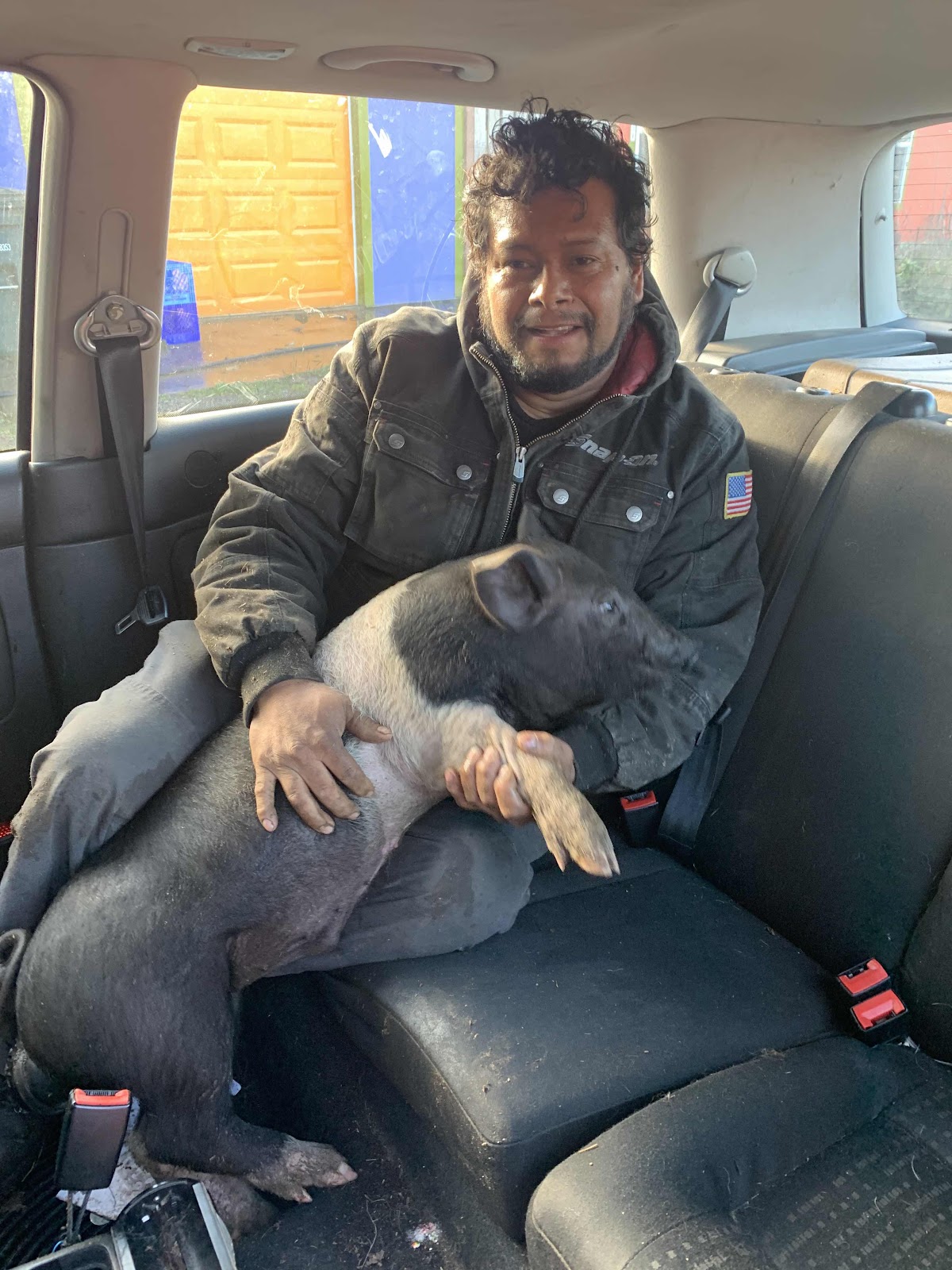
But of course labor counts. Here is Homero, after spending some twenty minutes chasing down a couple of well-grown piglets today. His face clearly shows that labor counts.  My neighbor told me we could choose our own pigs from her litter of fourteen, and there were a couple of standouts. In the end, however, we took whichever pigs Homero was able to catch. 


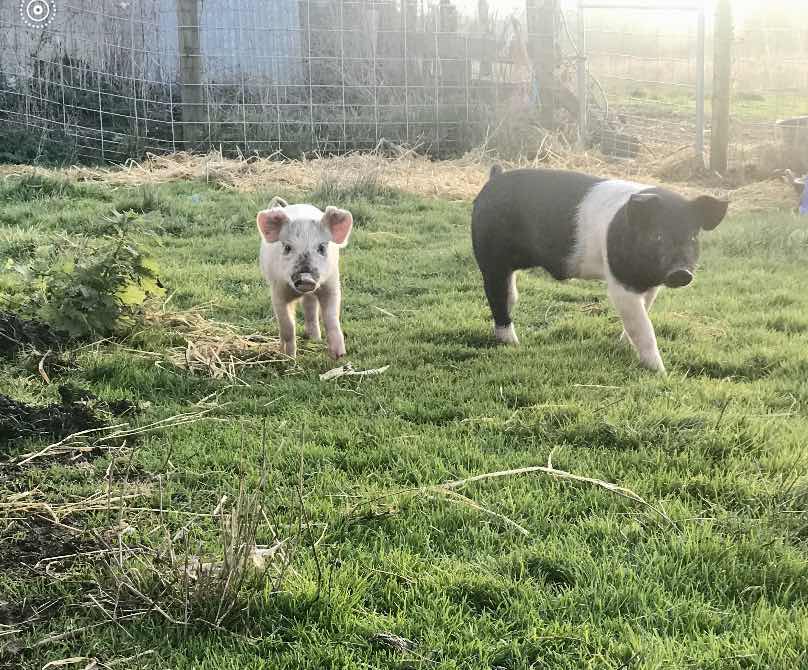
This handsome boy was the largest of the entire litter, and probably tipped the scales at sixty pounds. Homero was hard pressed to keep ahold of him all the way home. 


The second piglet he managed to catch was the smallest one of the litter, a little pink girl with curled back ears. They seem to be happy with their new digs - we have them in the sacrifice area which is about 100 x 100 feet. Their house is a round calf hutch stuffed with hay. 

Raising pigs over the winter has its challenges, and it obviously costs more than raising the same animals over the summer months, because mammals require many more calories to keep their body temperature up during the cold season. Also their natural rooting behavior causes more damage during the wet season. That’s why we have them confined to the sacrifice area, which is compacted and has a bad weed situation. Any rooting they do may actually be beneficial, and their manure will help fertilize the sandy poor soil. 

As in past years, the idea is to sell one pig (post-slaughter, in cuts) and use that money to offset the costs of raising the other pig, which we will keep for ourselves. Paloma will be keeping the books this year, and I’ll keep you all updated on her conclusions. 


Friday, March 10, 2017

Meat Math 2017


This year's horrible pigs (all pigs are horrible but this year's were worse than most) have been converted into meat, and the meat sold, except for what we wanted to keep for ourselves. It's time for this year's edition of MEAT MATH (Meat Math).

The pigs were pretty small. We killed them earlier than we maybe should have because they were so evil, and also because in the cold and wet, they weren't gaining weight very quickly. It's better to get piglets in the spring than in the fall, but of course everybody knows that, and so spring piglets are more expensive than fall piglets. The boy had a hanging weight of 132lbs, and the gilt 110lbs.

The larger pig we sold off in halves. One half went to our neighbor, the D. family, from whom we have actually bought pork in years past. But they decided (being quicker learners than we are, apparently) that they don't want to raise pigs anymore, so now they are buying from us. That half weighed 67lbs. The other half went to a Facebook friend, and weighed 65lbs.

We asked $3/lb, which is on the cheap side. I started out at $3.50/lb, which seems to be the going rate for pork without fancy qualifiers like Organic or Pastured, but it so happened that there was a lot of pork for sale at the same time I was trying to sell, at least according to Craigslist. I didn't get any response at $3.50/lb.

If I'd had an empty freezer, I might have held out. But I'd already made the date with the butcher, and our freezer was stuffed nigh to bursting with beef, salmon, and lamb. We have two eminently butcher-able animals (a sheep and a goat) that we have let live for the sole reason that we were saving room in the freezer for the pork. Faced with that severe space shortage, I lowered the price, and quickly sold off the bigger pig.

Okay, so 132 x $3 = $396. Rounding to $400.

The piglets themselves cost us $100 each. That leaves $200.

Feed was negligible, thanks to unlimited bread and produce from the Gleaner's Pantry ( What Wrong With this Avocado?). We did buy three or four bags of conventional pig feed - let's say that was $60. Now we have $140 left.

Unfortunately, I lost my receipt from the butcher, so I can't break it down into categories, but we paid them $178 for our 110lbs, which includes the kill fee, the cut and wrap, and the fee for smoking the hams, bacon, and hocks. Take 178 from 140 and we are 38 dollars in the hole. Divide 38 by 110 and you get homestead pork for $0.35/lb. Not, obviously, counting labor.

Even if I am forgetting a couple bags of feed, that's some pretty cheap, quality protein. The first meal I made was BBQ spareribs. Delicious.


Monday, September 21, 2015

Welcome Sheep


The little brown blob in the lower left foreground of this picture is a young Jacob's sheep. She is about four or five months old, and wads given to me by my sister in exchange for babysitting her children for a weekend so she could go away with her husband. For the record: I would have babysat in any case, but once offered, I wasn't going to turn down a free sheep.

Jacob's sheep are those funny four (or even six) horned breed. They are an ancient "unimproved" breed, meaning they have not been highly selected for any given trait or developed for commercial purposes. Until recently, they were usually only found in the U.S. among Native American herds in the southwest. Sometimes they are called "churro" sheep.


As such, they vary widely from herd to herd, but in general they are small (a ewe reaches approximately 80-100 pounds) and have good quality wool and lean meat. You can see how small the little ewe looks next to my Nubian goats.

I was afraid my goats would bully her terribly, but it seems not. I brought the lamb home last night and shut her up in the Mama Barn for the night. This morning I went to the Gleaner's Pantry and so I wasn't around when Homero let her out to mingle with the goats. It seems to have gone well, though. This afternoon - a beautiful sunny warm September afternoon - when I let the goats out, I tried to keep the sheep in the pasture because I didn't know how herd able she was. At my sister's house she lived in a small enclosure and nobody ever tried to herd her in an open space.

After twenty minutes or so of enjoyably perusing my magazine while the goats grazed, I heard the sheep bleating plaintively from a direction incompatible with her being inside the pasture fence. The little thing was apparently able to squeezed through the gap between the gate panels and get out onto the front lawn. She simply followed the goats around, any stayed close to them even though the does occasionally butted her in the side.

Our plan is to keep her over the winter - hopefully she will grow well - and then shear her in the spring. Rowan is interested in her wool. Then we will let her fatten a bit on the spring grass before we turn her into lamburgers. Lamb is actually my favorite meat. I never buy it at the store; it has become so terribly expensive lately. I'm looking forward to having some put away for our personal use.


Tuesday, June 23, 2015

Pig and Cow (Major Meat)


Long summer evenings and good weather have us out in the yard until late in the day. I haven't mowed the back yard in a few weeks; partly for the benefit of the bees and partly to have a nice carpet of clover available for fattening up the cow, who will be meeting her destiny as a meat animal as soon as this summer is over. Today when I let the goats out to graze, the cow came barreling out as well - nearly knocking me over - and so I grabbed a rope and tied her up smack in the middle of the clover-carpet. 

The rope was maybe too long, and the cow was overexcited at being out of the back pasture for the first time in her woefully short and dim memory. She capered about, knocking over the burn barrel to eat the salty ashes, upending the ferret's play-cage, and generally wreaking havoc. She trampled the new lawn game I bought last week (ladder ball) and now we will have to repair it with many yards of duct-tape. As annoying as all that was, it was also hilarious and delightful to watch her happily kicking up her heels. Homero was moved to try and ride her, with the results you see above. 


We have a new pig. It's been years since we had a pig - I'd have to look back over the blog to see exactly how long it's been and exactly why I swore off pigs forever. I remember doing that, but not precisely why. Since I have belonged to the Gleaner's Pantry, it almost seems a sin not to have a pig, when I have access to a literally unlimited amount of fresh clean bread and produce. Also, it being high milk season, a nearly unlimited amount of whey from cheese making. The waste-stream to which I have access is abundant enough to support a half-dozen pigs - I have been partaking only minimally, but now I will have to up my participation.

There is a local farmer, a neighbor of mine, an older gentleman who has lived around here since Hector was a pup and who in his retirement still raises pigs and chickens and who imparts wisdom to all and sundry via the medium of the local Facebook Farmer's group. I'll call him the Livestock Guru, or the L.G. for short.  This week, he was advertising barbecue pigs (100-150 lbs) for the fourth of July, dressed out and ready for the spit for $350. At the end of the ad he added "or you could raise them out for meat." I asked, "same price live or dressed?" and he answered that I could have a live one for only $200.

Considering that a 40-50 lb piglet goes for $125 to $140, and they usually sell out in minutes, that seemed like an extraordinarily good deal. I consulted with Homero and he agreed. He spent today fixing up the old pigpen - putting new hinges on the old broken gate and hauling the calf-hutch over from the pony's pasture.  Around 6 pm, L.G. brought over a beautiful, healthy pink pig who immediately went to town on the pile of compost in his pen.

If all goes well, he ought to be ready for slaughter at about the same time as the cow - late September, when the grass is dried up. I have heard that I ought to get on the waiting list at local slaughterhouses, as it isn't always easy to get a slaughter date in those prime weeks at the end of summer.


Friday, August 29, 2014

Beef Roadtrip (the Computer Age)


You may have noticed that the price of meat has risen fairly dramatically over the past couple of years. The forecast is that it will continue to do so for the foreseeable future, due to a number of factors including prolonged drought in many parts of the country, a new and nasty pig virus, and increasing demand for meat in China and much of the rest of Asia. Here are a few links for the skeptical, from NR and the New York Times:

http://www.npr.org/blogs/thesalt/2014/08/26/343403757/high-prices-arent-scaring-consumers-away-from-the-meat-counter

http://www.nytimes.com/2014/08/26/business/meat-prices-continue-to-rise-but-corn-and-soybeans-slip.html?_r=0

Even those of you who buy meat by the half animal, as I do, have probably seen major increases. When we bought our first local half-beef, some six years ago, I think we paid $1.75/lb hanging weight. Even two and a half years ago, when we last bought beef, we paid only $2.00/lb. Granted, that was from a neighbor and a friend, who was charging us quite a bit less than the going rate, which if I remember right was about $2.50.

This year, I spent quite a bit of time searching Craigslist for decently priced grass fed beef (our neighbor and friend only raised enough for his extended family) without luck. The best price I could find was $3/lb, and that only applied if you ordered six months ahead of time and didn't include cut and wrap. Figure that in, and by the time you are done you'll be paying about $5/lb for what you actually put in the freezer. It's not that $5/lb is such an outrageous price (though it is pretty high), but that to buy a half you need to get together some $2,000 all at once.

I really hate buying supermarket meat. I hate participating in the CAFO feedlot system (Concentrated Animal Feeding Operation - Wikipedia, the free ...); I hate eating animals that lived in misery eating GMO soy and corn; I hate contributing to the destruction of tropical forests and the displacement of indigenous peoples. But I love eating beef. If it came down to a choice between eating CAFO meat or no meat at all, I know what I'd choose. So, to avoid slathering my burgers with guilt sauce, I decided to look further afield for my grass fed beef.

Washington State is divided between the wet west and, on the other side of the Cascade mountains, the wide open rangeland of the drier east. On the eastside, land is cheaper, hay is cheaper, and as a result, beef is cheaper. Marginally. After searching through all the Craigslist listings for beef in all the little towns of Eastern Washington, I struck gold: USDA prime grass fed black angus beef for $2.85/lb, cut and wrap included. A half weighing a little over 500 lbs was available. Problem is, it was a five hour drive, and comparatively cheap as it was, that half would still cost more than $1,500.

Social media to the rescue: on Facebook, I invited all my friends to go in on it with me. In the end, we bought a quarter for ourselves, and the other quarter was split into two eighths for two other families. I didn't charge the other families anything extra per pound, but I did ask them to contribute something toward the price of gas and dry ice. Dry ice, although pricey, is a necessity when transporting a quarter-ton of raw meat in a hot trunk for five hours. I used google maps to find the closest supplier to our destination, and lucked out: there was one in the same town. I collected cash and coolers from my co-purchasers, and Homero and I set off on a road trip.

The ranch was a lovely place, and the beeves on view were beautiful - vast, sleek, shiny black animals, moving slowly through flank-high grass or cooling themselves in a green pond, on which I saw a blue heron standing quietly among the reeds. The ranch owner, a friendly, tall, middle aged woman, was kind: There was a misunderstanding about the weight and we hadn't brought quite enough money. With no bank within a two hour drive, she simply decided to trust me to send a check when I got home.

It may seem like an awfully long way to go, but the math is convincing. On our quarter, we saved about $300 over local prices. Our diesel Jetta gets 45 miles to the gallon, so the gas cost us only about $30. The dry ice was the biggest expense, at $40, but friends kicked in on those costs. Our share of the travel expenses was about $25, which adds only a negligible amount to the price per pound.

If there's a downside, it's that the meat included an unreasonably high percentage of hamburger. At least 2/3 of the total weight was in burger, which is higher than I am used to. It seems like a shame to grind up that much of an animal that graded out to USDA prime, the very highest category. B ut I'm not complaining. The freezer is full of guilt-free meat and I am happy.


Tuesday, May 27, 2014

The Littlest Huntress


Hope is ten, nearly eleven. She is a tall, graceful, athletic girl; just entering the stormy adolescent years. She is strong from gymnastics, an active and nimble thinker, and like many young girls her age, hotheaded and strong willed. For months she has been lobbying us to get her a BB gun. It seems her best friend has one, and she just has to have one too. She wants to hunt.

Sometime earlier this spring, we decided the time was right, and I bought her a mid-range air rifle - neither a toy nor a high powered weapon. It takes some real muscle to pump up the air pressure, and it is capable of firing BBs at 800 feet/second. We set up a target down in the bottom of the back pasture, and laid down the law about safety and seriousness. She would get exactly no second chances, we said - break the rules, and the gun goes bye bye for a long long time.

For about six weeks, we made her shoot only at that one target, and only when an adult was nearby. Hope grumbled and repeatedly asked when she would be allowed to actually hunt, but she followed the rules. She got pretty good, too: she could sometimes shoot a bottle cap from twenty feet away, and a tin can from twice as far. Yesterday, after chasing several rabbits out of the garden, Homero told her to go ahead and try to shoot one.

Rabbits are a plague around here. When Ivory was younger, they had a healthy respect for her and stayed away. Once in a while, she would catch one, but it takes a young, quick dog to catch a rabbit very often. As she got older, they got bolder, and now that she is twelve, she simply lays in the sun and pricks up her ears as they run past.

No rabbit, however, can run 800 feet per second, and it seems they are no match for Hope's eye, either. Within a half hour of being given permission, Hope came running back to the house yelling that she had killed a rabbit.

"Where is it?" we asked.

"Out here!" she answered, and she went galloping over the grass with Paloma bouncing behind her. I followed slowly, and saw the girls come to a stop, circling and looking down. They bent over, then sprang back up with sharp little cries of alarm, arms flying.

"Is it dead?" I yelled.

"Yes!"

"Then pick it up!"

After a few false starts, Hope picked the rabbit up by the back legs and trotted back towards the house. Homero and I bickered briefly over who was going to skin and dress it (I won; he did it) and we praised Hope lavishly.

I didn't really want to eat it (I've had wild rabbit before  - The Land Provides, part 1 - and I'm not too crazy about it) but we had talked to Hope before about eating what we kill and killing what we eat, and she would have been rightly appalled at our hypocrisy if we hadn't cooked her first kill. Moreover, she deserved us to make a big deal out of it. It IS a big deal.

I marinated the jointed rabbit (it probably weighed all of a pound, skinned and gutted) and braised it in beer with collards, onions, peppers, and corn kernels. The vegetables were delicious, but the rabbit itself was, as I expected, tough and bland. Maybe next time I will try a pressure cooker.

Oh yes, there will be a next time. Hope went back out and shot another rabbit ten  minutes after the first one. I convinced her the second rabbit was too small to eat (it was tiny) and that she shouldn't feel bad tossing it into the tall bushes; if it didn't become food for us, it would surely be food for something. The law of nature, I explained, is that "wherever there is something to eat, there will be something to eat it." If I remember, I got that out of Dune, from the planetary ecologist Kynes.

I really am proud of my middle child. She is beautiful, and growing up, and dangerous. She is at that frightening and lovely age when she is coming into her power, all unaware. She is stunning in her pride, and in her unconscious grace. She has already left her infancy behind, and in another year, or two or three, she will suddenly be a young woman. And in a few years after that, the cares and preoccupations of womanhood will take over, and the last traces of her childhood will be gone.

Artemis, most chaste and perilous Goddess, be with my young huntress. Help her learn to guide her arrows wisely, and lend her your fierceness and your unapologetic pride. Run with her through the trackless woods of adolescence. Protect her, and set your hounds on anyone who would try to cage her or make her doubt herself. Be her wild friend. Light her way with moonbeams, and let your silver laughter ring through her dreams.


Sunday, November 17, 2013

Mexican Turkey Broth (What is a Gizzard Anyway?)


At 6:30 this morning Homero and I squelched out through the cold mud and light rain to the chicken coop, to catch sleeping turkeys before they woke up. The processor had asked me to be at his place by 7 am. Homero would grab a turkey right off its perch and take it into the mama barn, tie its feet together with hay twine, and hand it to me. I'd wrap my arms around it to keep the wings from flapping and lay it down on its side on a tarp in the back of the van. Then I'd throw a blanket over the turkey and it would lie there quietly, seemingly resigned to its fate.

As soon as I had four strangely quiscent lumps under the blanket, I drove as quickly as I could out to the processor's facility. We unloaded the turkeys and the man asked me "do you mind if I kill them in front of you? I'm in a hurry."

"Not at all," I said, "do what you gotta do."

He had a neat contraption; a round stand with three metal, upside-down cones attached. The bottom of the cone is open. You dump a turkey in headfirst, so its head sticks out the bottom, and then when you cut its throat, it can't flap around. A twenty five or thirty pound bird can really beat you up with its wings. Even a healthy chicken can be difficult to manage. When I got home, I told Homero to look out for a discarded orange traffic cone; I bet we can use it for chickens here on the farm.

I asked the man to save me the livers and the necks. He said "don't you want the hearts and gizzards?" Actually I did not, but I knew Homero would, so I said, "yeah, save me all of it."

"Come back in an hour."

I spent a very pleasant hour at a local coffee shop with the sunday paper. It might not have been so pleasant for the people around me, however. I didn't have time to change my shoes before I left the house. I was in my barnyard gumboots. I did look for a good deep puddle and waded through it before I went into the coffee shop. Heck, its a rural area. I'm sure I'm not the only fragrant farmer who passes through.

The turkeys were just about exactly the sizes I had estimated - the smallest was fourteen pounds and the largest was twenty. They were beautiful, wrapped up in big clear plastic bags looking just like supermarket turkeys. Then the man's son, a husky twelve or thirteen year old boy who was helping, handed me a gallon sized ziploc bag full of innards. The gizzards were the most disgusting things I've ever seen; big, round, veiny softball-sized lumps of gore. I figured Homero would take one look at them and decide to throw them away.

I was wrong. He took one look and started rooting through the kitchen drawer for our sharpest knife. While I put a big pot of water on for the necks and started chopping vegetables, he carefully cleaned the gizzards, while we had this discussion:

"So what is a gizzard, anyway?" I asked.

"I hate to tell you this, amor, but it's the butt."

"The WHAT?"

"The butt."

"That's not a chicken butt," I said. "I think it's the crop."

"The what?" he asked.

"The crop. Or is it the craw?"

"What's that?"

"You know, the neck pouch where they eat little rocks to chew up their food."

"No," he said, "I've cut it out of too many chickens. It doesn't come from the neck. That's the buche, this is the butt."

In the olden days, we might have had to agree to disagree, but today there's google. According to Wikipedia, arbiter of 9/10th of all marital disagreements, the gizzard is neither the butt nor the crop. It's a secondary stomach, a grinding chamber additional to the crop (or, colloquially, craw). Although it is located in the last third or so of the digestive tract, it is definitively not the butt.

Gizzards are apparently pretty hard to deal with, though. It took Homero a good twenty minutes to split open, wash, and peel the four gizzards. There's a tough membrane that has to be removed. After serious washing, he tossed them into the pot with the necks and vegetables. That broth turned out to be the best broth I've tasted in AGES. We were all swooning over the soup, although only Homero elected to actually eat the gizzards. I don't know if the gizzards added materially to the flavor, or if it would have been just as good with only the necks, but it seems likely they added something.

Here's my recipe for Mexican turkey broth. This stuff will cure you of colds you haven't even caught yet, it's that good. Probably, however, it only has that magic if you have access to pastured turkey.

MEXICAN TURKEY BROTH
and Mexican Rice - makes a whole meal

for a big pot:

4 turkey necks
4 well-cleaned gizzards (optional but recommended)
1 yellow onion, rough chopped
3 cloves garlic
2 carrots, chopped
1 fresh jalapeño chile, chopped
teaspoon whole allspice
10 or so whole cloves
teaspoon whole black peppercorns
tablespoon salt

Put all ingredients into a large stockpot with a gallon of water. Bring to a boil and then turn down to a fast simmer. Skim any scum. Let simmer two hours.

Meanwhile, make Mexican rice - heat a tablespoon canola oil in a large non stick skillet, and put in a cup and a half of long grain wite rice, a diced onion, diced red pepper, two cloves of minced garlic, and a large pinch of cumin. Stir with a wooden spoon until rice is lightly toasted and just beginning to  color. Add 1 can of diced tomatoes and several ladles of the simmering turkey stock. Turn heat down to low and cover tightly. Let steam twenty minutes or so until rice is tender and fluffy.

Set out a plate with the following condiments: quartered limes, diced avocado, minced green onion, cilantro, and more jalapeños. Also set out a bowl of good quality corn chips.

In every bowl, put a scoop of rice, then ladle over the broth. Everybody seasons their soup as they like best. I like mine with everything, including crumbled corn chips. Delicious and warming.


Tuesday, September 24, 2013

Butchering Season (the Breakdown)


Fall is butchering season. The grass is dying back and losing nutrition, and the meat animals are as fat as they are going to get. We've been keeping two goats alive, Polly's last kids, for quite a bit longer than we ever intended to. They are a year and a few months old, older than meat kids usually ever get.

The last time we bred the goats, I had such a hard time finding a buck that we eventually had to borrow my sister's buck. Blueberry is a beautiful animal, a terrific buck... but he's an Angora. That's a fiber goat. I have Nubians, dairy goats. So Polly's kids, all three of them, were half Angora, half Nubian. That's not a useful cross. They end up being no good for either fiber or milk, and not even really good meat goats, because they grow slowly and are small, like an Angora. They do have excellent flavor, but they take twice as long to grow a carcass only about two thirds as meaty. I only resorted to using Blueberry because I really needed the mama goat bred, so she would produce milk. I simply decided ahead of time that her offspring from that year would be meat animals.

Polly threw triplets, as a first freshener. That's good, she's a good goat. She's going to be an excellent milker, as well. She raised those triplet without losing any noticeable condition. Before we left for Oaxaca, we gave away the single buckling to a friend of ours who was similarly in need of a buck. We explained that any resulting kids would not be prime quality, but he simply wanted his does freshened, so it didn't matter to him. That buck is now living the life of Riley down in the skagit valley, lucky fellow. The two doelings stayed on the farm while we were gone. One of them was given to our neighbor, I forget exactly why. The other was traded to another neighbor for four turkeys, after we got back.

Then, neither neighbor wanted to come get their goats. Time passed, summer passed. It started to rain. We called the turkey trade neighbor several times, and he always said the same thing: "Yeah, I'll be up there this week." Our other neighbor said he'd take the goat as soon as he got a pen built. Meanwhile, they are eating the grass and mashing down fences. The rest of our goats are older nannies; they don't jump anymore. But these little doelings were jumpers. One morning they jumped the fence and ate up half of the neighbor's fruit tree. I began badgering my husband to do something, either to the fences or to the goats.

One day my neighbor's wife was out working in the garden and we had a conversation across the fence. I told her that we'd bring over the goat anytime, or we'd be happy to do the butchering ourselves and give her the meat, but that we needed the goat gone. She told me to nevermind about the meat, her husband shouldn't have fatty goat meat anyway, he had a triple bypass just a few months ago, and that she would take the blame. So we went ahead and butchered the goats.

Or, I should say, Homero did. He is still a pretty fledgling butcher, having only once done the job entirely by himself before. It took him far too long to skin the first animal - nearly an hour. By the time he was ready to start on the second goat, the other neighbor had answered our phone calls and shown up to help. He knew what he was doing, and so the second goat went much quicker than the first. We have learned the fastest way to dispatch the goats is with a .22 bullet to the back of the head (never the front - a goat has a thick shelf of bone over the forehead and a bullet between the eyes would ricochet and be dangerous) and then immediately cut the throat. The little guys hit the ground and are dead before they know it. Then we hang them by the tendons in their hocks from the swingset and gut them into a kiddie pool that we keep around for that purpose. The kids are far too big for kiddie pools anymore.

When the goats were broken down into about eight pieces - shoulder and foreleg, haunch and back leg, ribs and belly, neck and back - the men brought them inside and I did the rest of the butchering on the kitchen table. I'm getting better. It's easy to separate the shanks from the haunch, but much harder on the front end. I need to read up on that. I had to use a heavy cleaver to cut through the bone, and it made sharp splinters that had to be carefully washed out of the meat. I cut away the loin from the spine and cut it up for stew meat. I cut the belly meat (the flank) from the ribs and packaged it separately. That will probably be marinated, pounded, and grilled as steaks. The ribs are not very meaty on these goats and probably it would take all of them to make a meal for the family, big as our family is these days. The biggest, meatiest part is of course the haunch, or the upper part of the hind leg. Each of those will make a big, fat roast.

The chart at the top of this page shows the cuts as they would be made by a professional butcher. Bully for the professional butcher - I really ought to study and practice a lot more. I wish I could make neat sections like that. But it's virtually impossible to learn how to do that from a book. You need - or at least, I need - someone to actually show me, someone to put my hand in the right place at the right angle and say "feel that?" In the absence of such hands-on mentoring, I do the best I can. I did okay, probably about as well as I did on the King salmons a few weeks ago (Fish Tale (Canning Salmon)).
Could somebody else do better? Sure. Did I do okay? Yup. I have a freezer full of neat packages wrapped in white paper and tucked into ziploc bags. As my mom always says, "good enough for government work."

I used all four shanks of our goat for the butchering day dinner. I seared them in a hot skillet and then braised them in a mixture of orange juice, chilpotle peppers, tomato, garlic, and cumin. They were very good, but they need to braise all day to reach that falling-off-the-bone consistency. I find that is the best way to cook goat. Again, according to the chart, there are fine chops and filets on a goat, but personally I haven't had much luck with cooking goat as though it were beef, fast and rare. Lamb works well that way, but not goat. Luckily, the falling-apart melt in your mouth meat was delicious, wrapped in fresh hot tortillas and dipped in the spicy sauce.

I am going to bring a package of the meat over to my neighbor, the one whose wife told me not to. Again, according to the chart, goat is actually very lean and has an excellent lipid profile.


Wednesday, March 14, 2012

Psst... Wanna Buy a Pig's Head?

Today I went and picked up our pig from Keizer Meats. One hundred and nine pounds of pork (hanging weight) transformed into ham, bacon, chops, spareribs, smoked hocks, and sausage. I'm delighted, and the first thing I did is put some dried corn to soak so I can make a big pot of posole tomorrow (for a recipe, see: New To Farm Life: Posole (Mexican dried corn stew)).


For the most part, we try to eat only sustainably raised meat, meaning in our case, our own pork, beef from our neighbors, and our own young goat. I have not yet found an acceptable substitute for factory-chicken. We tried raising our own, with mixed results (Broiler Report (Caldo de Pollo and Liver Pate)), and we may yet try again, but for the time being, we still buy chicken at the supermarket.

Part of being responsible meat eaters is using as much of the animal as we can. Now - let's be clear. I am not trying to assert that we eat ALL POSSIBLE parts of the pig. Far from it. Sorry, but I am not interested in chitlins. Been there, ate that, won't do it again. Also, I am not going to deal with feet. Once upon a time I tried to cook pigs feet for my then-boyfriend/now-husband, and only succeeded in stinking up my kitchen so badly that I told him to pick one: me or pig's foot tacos. Luckily, he's not a complete fool. Last time we slaughtered a pig I asked for the liver, which then remained in our freezer for nine months until I threw it to the chickens.

Okay - so I'm not a fan of organ meats. At least, not pig organ meats. I do like calf's liver and I have heard that heart is delicious. We also make use of the lard. People who let the lard go to waste are just sadly ignorant. This time around, I told the men from Keizer meats to forget the liver, but to save me the head. Mostly, this was to mollify my husband, who feels that any scrap of meat not saved is a waste of his hard-earned cash. Now, I have a whole pig's head (frozen) in the trunk of my car and I need to figure our what to do with it.

So far, the only websites I have found are recipes for headcheese, which just sounds so disgusting (think: smegma) that I'm not sure I can cope with it. I don't like pate at the best of times. I may just toss the entire thing into my husband's lap (how often does a wife get to do that??) and leave it at that. Just in case you have a pig's head of your own to deal with, here are a few of the recipes I've found.


Thursday, August 18, 2011

Pajaretas (Goat Milk Cocktail)

Yesterday's goat slaughtering turned into quite a party. It was a gorgeous day but hot, and the men doing the butchering worked up a thirst early on. By the time the two goats were finished (we had originally thought we would process all four but that was just too much work) and one was tucked neatly into a giant kettle steaming away on top of a propane ring, the guys had worked their way through most of a case of Corona.


For myself, I made a pitcher of mojitos - I have a truly splendid patch of mint - and sipped on that while I made red salsa and green salsa, a pasta salad, and the various other accoutrements. My sister and her family showed up for the meal and she helped me out a little with the mojitos. Then our next door neighbors showed up and brought a bottle of whiskey with them.

It sounds like quite the bacchanal, but nobody got too lubricated. There was so much food. We decided to eat outside, and Homero dragged the milking stand over to the fire pit to serve as the sideboard. We simply laid out all the dishes, along with a tall stack of tortillas and some paper plates, lifted the lid off of the kettle, and let everyone make up their own tacos to their specifications. The meat was delicious and tender, falling off the bone. I think I ate six tacos.

Then we laid back in our canvas camping chairs and talked and laughed and drank while the children ran around playing. The hours drifted by. My sister and her family waved goodbye, and sometime later our neighbors walked across the field home. We picked at the food and told stories and threw bones to the dogs. The sun lowered in the west and the mosquitos came out, but nobody cared by that point.

Our friend C. suggested, after we ran out of beer, that rather than drink straight whiskey we try a rustic Mexican cocktail that a friend of his had introduced him to back home in Oaxaca. I have no idea who invented the "pajareta" nor where nor when, but that anonymous Mexican goatherd was a genius. Now I'm warning you, this is going to sound hideous. But trust me, it's actually delicious.

Well, you will just have to trust me, because unless you have an in-milk nanny-goat, you aren't going to be able to try it yourself anyway. C. told me to go get a jar and put a few spoonfuls of chocolate milk mix in it (in Mexico they use "chocomil" or Nestle's quick). I, of course, don't have any chocolate milk mix, but I did have some plain unsweetened powdered cocoa. I used a heaping teaspoon of cocoa and three heaping teaspoons of sugar and brought the jar back. C. added a healthy three shots of whiskey to the jar and swirled it around. Then we brought out the goat and - after clearing the milking stand of the detritus of the meal - milked her straight into the jar. I'd say we aded about a pint of fresh hot goat's milk to the chocolate and whiskey.

Then we divided it up and drank it. It was utterly fantastic ("udderly," ha ha), and no I'm not kidding. Sweet, creamy, frothy, chocolatey, and smooth, with a kick. I know this sounds bizarre, and maybe it is. But it was also the perfect capper for our goat party.

Trust me.

Pajaretas

for three people:

1 heaping teaspoon hershey's unsweetened cocoa powder
3 heaping teaspoons sugar
3 healthy jiggers whiskey
mix in the bottom of a quart jar.
add:
1 pint goat's milk straight from the teat.

pour into three cups and share, preferably around a fire outdoors.

Wednesday, August 17, 2011

Redneck Shopping List

This is how much of a redneck I've become: my shopping list for today? A case of beer, propane, and bullets.


It's goat slaughtering day. Our friend C. is here with his family, and all four baby goats are meeting their end today. One will be cooked up for the taco feast later on, one will go home with C. as his pay, and the other two will go in the freezer.

At this point, we've done this enough times that I no longer feel the need to take a bunch of pictures and post about the process. I've listed some related posts which do have photos and musings if anyone cares to get the details.


Monday, March 21, 2011

Bad Bee News; Baby Broilers


About a month ago, we had a windstorm. That's not news; we have windstorms every couple of weeks from October on every winter. We live on a high, exposed ridge and seventy mile an hour winds are nothing exceptional in the fall, winter and early spring - usually accompanied by stinging rain or hail. Sometimes I wish I had paid more attention to the man who inspected our house before purchase. He grew up just down the road and told us "you get a lot of weather up on this ridge." I guess he thought he was warning us, but the man had a gift for understatement.

Apparently it's the kind of thing you just can't understand without experiencing it. I remember thinking "Sure, sure, a lot of weather. Whatever THAT means." I didn't really try to puzzle it out. After all, I grew up around here myself, and I'm no stranger to rain. Turns out, I was blissfully ignorant of what a local boy means by "a lot of weather." It means having to literally propel yourself against the wind by main force, unable to hear a thing except for the shrieking and howling of the moving air. It means cold rain driving itself into your actual eardrums at fifty miles an hour, giving you earaches. It means that you can't carry a bucket of water ten feet without getting soaked. By the time you reach your destination, the wind will have removed the top half of the water from the bucket, and it will have landed on you, anywhere from the chest down. If this happens in the dead of winter, your pants will be frozen solid against your legs by the time you reach the house. It means laying awake at night listening to the banshee wail of the wind around the corners of the house and wondering when the power will go out; or if you are losing roof shingles; or how the animals are coping.

This year, it meant losing a baby goat to hypothermia. Not this year but two years ago, we had such a prolonged stretch of extreme weather that I had to sit the children down and talk to them about what to do if they had to come outside and find us while we were attending to the animals. Do NOT leave the house, I said, without putting on your coat, your boots, your hat, and your mittens. Come STRAIGHT out to the barn and go inside right away. If you ever get stuck outside and you can't get in the house, go STRAIGHT to the barn and close the door. Once, coming back from chores, I found Paloma, then three years old, stumbling around outside in the driving snow trying to come find me. She was crying and very cold. That episode terrified me. I realized that you don't need to live above the arctic circle for your children to die of exposure. Really, any old freezing weather will do, especially when combined with precipitation. A three year old might suffer severe hypothermia in as little as half an hour.

All of this is by way of preamble: our bees dies over the winter. Both hives. In the windstorm that I mentioned, one of the many, the tops blew off of both hives. In spite of the "bee glue" - propolis - that the bees use to seal the hive. In spite of the cement blocks that we placed on top of the hive lids. The storm blew the lids off, and I went out to find that the interior of the hive was exposed to the cold rain. At the time, I knew the bees were still alive because I could hear them humming, trying desperately to dry out the interior of their home by fanning their wings. I replaced the lids, not knowing what else to do. The bees died. I didn't know for sure they were dead until this past week, when I cooked up a strong sugar syrup for the feeders. After three days, the syrup was untouched. There is only one explanation for that, and it's a hive full of dead bees.

Of course I haven't opened the hives; I won't do that until we get a really warm day. That looks like it might be mid-June, at this rate. But I fully expect, when I do open them, to find a lot of dead, decomposed, wet bee-bodies. I am not going to try again with bees. My husband and my teenage daughter both expressed enthusiasm for beekeeping, and then they both did exactly nothing to help. Personally, I am not excited by beekeeping and never was - I like honey, but I'm scared of bees. I got the equipment because I felt like bees are part of a self-sufficient homestead and I thought I had family members willing to take on the duties. Oh well. Maybe we can salvage some honey and then sell the equipment.

Meanwhile, we have decided to try meat chickens. Homero has always felt that chickens are meant to be eaten, and we have been sadly disappointed by our attempts to turn our birds into something worth eating. Look at the sidebar for links to chickens, meat eating for a log of our past attempts. I told him, finally, that we just didn't have the right kind of birds - our skinny little chickens were great at pumping out eggs but really not worth the twenty minutes it takes to dress them out when it comes to meat. So, this year, we decided to give meat birds a try.

IN GENERAL, I am philosophically opposed to the whole idea of breeding an animal that can't even live to maturity because it gets so heavy that it's legs will break trying to hold it up. However, I have to face the fact that if I am to eat chicken at all, I will either have to eat our skinny, hard-as-nails birds (something we have already decided is damn-near impossible); eat supermarket chickens, which are the same meat birds raised in factory-farm conditions, or eat meat birds that we raise ourselves in humane conditions. From a purely philosophical point of view, raising our own meat birds looks like the lesser evil. It may or may not turn pout to be practical - we'll see.

Wednesday, January 5, 2011

Farm Folks Are Friendly (Home-style Goat Tacos)

Like most other bloggers, I suspect, I have an online community made up of people who read my blog and leave comments and of those whose blogs I read and comment on. As you can see by the blogroll on my sidebar (oh wow, I'm afraid the internet has not, generally speaking, given rise to poetic turns of phrase), my community is mostly made up of other farmer/homesteader types, both nearby and far away. One of the cooler blogs run by a neighbor of mine is the Schoonover Farm blog. D. and her husband run a great little operation in the Skagit valley focused mostly on fiber. Here is a photo of a few of her animals, healthy and sassy in the dead of winter. I especially like the white guy in the right background caught in the middle of a caprine leap.

D. Schoonover contacted me not so long ago, via the blog, and asked me if I'd be interested in a goat of hers as food. She had a particular wether (castrated male) who was very aggressive and they had decided to put him down. They themselves are not fans of goat meat, but she knew that my family is, and did we want to pick him up and make use of him?

Well, hell, we sure did! She may have been inspired to make this generous offer by my incessant whining about how much food it takes to feed eleven people a day when you are accustomed to feeding only five (my in-laws were in town for an extended visit). I think that my duck-hunting neighbor may also have been moved to donate his kill to us after reading my post on how much money I was spending at Costco (Quack Quack Christmas (Shout Out to Zion)). This same neighbor came by New Year's Eve morning with a gigantic turkey - storebought, not hunted - and said that as he and his wife were going out of town on an extended trip, we'd be doing them a favor by accepting the bird. Doubtful though I was about this claim, I nonetheless took the turkey with alacrity and gratitude. It was delicious.

As was D.'s wether. Early New Year's Day, I sent my husband and his brother and sister down to pick up the goat (who had been swiftly and mercifully dispatched by D.). We called on our trusty goat-butchering-buddy, Crecencio, to come and help us and of course to bring his family and feast with us. Homero did not wait for Crecencio to arrive, but began right away to skin and gut the goat. He said he's witnessed at least four slaughters and ought to be able to do it himself by now.
Once again, as with the roadkill deer (New To Farm Life: The Redneck Rubicon (WARNING - GRAPHIC)), we found that a sturdy swingset makes a mighty fine gallows, and a plastic kiddie pool a very serviceable receptacle for guts and such. I made myself scarce, so I can't say much about how the actual butchering went. By eleven o'clock in the morning, the goat was dismembered and firmly ensconced in a truly enormous kettle, along with various Mexican seasonings, and spent the next four hours steaming gently over a wood fire.

Meanwhile, in the kitchen, I, Mama, Temy, and Crecencio's wife Maricela went to work cooking the accompaniments. Basically we were making tacos, which means that the only truly necessary sides are a couple of different salsas, finely chopped onion and cilantro, and quartered limes. I have been a guest in Maricela's kitchen a few times now, and her salsas are absolutely divine, so I stood aside and let her go to town in my kitchen. However, I watched extremely closely and can now offer a couple of recipes:

Salsa Verde Cruda - Raw Green Sauce

several tomatillos - about eight - husked and rinsed
1 bunch cilantro, stemmed and rinsed
3-5 serranos (if you like it hot) or jalapenos (if you like it hot but a little less so)
1/2 medium yellow onion, skinned and chopped
juice of one fat lime
salt

combine all ingredients in blender and blend until nearly but not quite smooth.

Salsa Roja Cocida - Cooked Red Sauce

1 oz chile de arbol - small dried red chiles (1 package) or more to taste.
1 lb tomatillos, husked and rinsed
2 cloves garlic
pinch cumin seed
salt

In a shallow pot, simmer whole chiles for 15-20 minutes. Then add tomatillos and continue to simmer another 20-30 minutes. Transfer to blender along with other ingredients. Blend until as smooth as it's going to get. Salt to taste. This salsa is extremely hot - watch out!

I also cooked a pot of black beans as a side dish. Add a tall stack of fresh hot corn tortillas and you are good to go! Some people might like sour cream or avocado slices, or some finely grated cotija cheese, but we are purists. Do not, however, neglect a case of icy cold Corona or Pacifico beer.

Happy New Year to all, and a great shout of thanks to the Schoonover Farm Family, who, I can testify, really know how to raise a goat!


Monday, December 27, 2010

Accepting Responsibility (Farm Economics)

Last week, when I went out to feed the animals, I came upon a hen dangling from the cast-iron hay feeder by one leg. She had roosted on the rim for the night and had somehow slipped and wedged her leg into the V formed by two iron bars. I have no idea how long she had been hanging, but when I freed her and set her down, she could not support her weight and flopped around most miserably.


Perhaps I should have dispatched her on the spot. She is one of the older hens - at least three years old - and there is no way she is an economically viable animal. Most probably, she didn't earn her keep even before she was hurt, but I don't really keep track of who is laying well and who isn't, and as long as all chickens can fend for themselves and the flock as a whole is maintaining an average age of under 36 months, I'm happy. However, as anyone familiar with chickens knows, they are ruthless animals and will heartlessly attack any individual among them incapable of defending herself. When I set this hen down on the ground, she was instantly attacked by three or four others.

Being unwilling - or, ok, unable - to wring her neck immediately, I closed her in the Mama Barn and gave her food and water apart. She hid herself down among the bales of hay and disappeared for a week or so. Day before yesterday, she reappeared and started asserting herself, apparently wanting to get outside. So I grabbed her and put her outside, but the same thing happened. She still can't walk and the other hens attacked her mercilessly. At this point, I was ready to turn her over to Homero to be killed. She was no good as food - her injury and confinement had left her skinny as a rail fence, and she is old and tough as a boot. She'd be a total waste; the only reason to kill her would be to put her out of her pain.

But then my sister-in-law, Temy, asked to see her. Temy is a doctor. She isn't a vet. But nonetheless, she is perfectly competent to examine the animal and say - as she did - that the leg isn't broken and that she should heal, given time.

Dammit. What to do now? I really wanted to say "Oh what the hell. She'll never be the same; she'll always be lame and weak, probably the other chickens will always pester and torment her, and she's old and hasn't got many eggs left in her. Just kill her already, and throw her to the dogs." But of course I didn't. I took her and put her in the rabbit hutch near the house. I am feeding her specially and separately every day. I am bringing her clean straw and changing her water. I am doing this, I fully admit, only in order not to seem like a monster to my Mexican relatives. That's really weird, because in most respects, they are far less sentimental and far more practical than we Americans when it comes to animals.

Here's what I wrote about that a while ago: Mexicans don't have farm animals as pets. In fact, they barely have pets at all. Seriously. I know there are a few here and there, but I feel totally confident in saying that in general, dogs are guard animals; cats are rat-catchers; burros are pack animals; and everything else is food. ( Question for People Who Kill Their Own Meat)

Now all of a sudden I find myself on the other side of that equation: I'm the soulless bad guy who has dollar signs in her eyes, and they are the ones arguing for compassion and mercy. Okay, that's projection. I know if I had actually said "I just don't think there's any point in keeping this hen alive" they would have said "Sure, you're right" and no-one would have given it a second thought. It's all me. It's I who have to get used to the idea that I have taken on responsibility for the life and death of some thirty other beings - chickens, goats, horses, dogs and cats. I'm still wrestling with this, apparently, after four years.

It's not about money. It's not about food. It's not about necessity - not yet, anyway. It's about this - me being the deciding force for the lives of my animals. If I'm hungry, they die. If I decide they aren't "worth it" they die. If I want what they have - meat, skin, feathers, milk, eggs, offspring - I take it and they lose. I am the power. I am the MAN. I take and they give.

Yeah yeah yeah, I also give and they also take. I give shelter, food, medicine, protection from predators, et cetera. In fact they wouldn't even exist if I hadn't decided they be born. Blah blah blah. That all smacks of rationalization. Here's the fact: I am a peak predator and I reap where I choose. I like meat, and I like milk and I like eggs.

Given that fact (given: wow, that's a big given, isn't it? Let's just sweep right over that) where is my responsibility? What do I actually owe this hen? Life or death? What is the more moral course; to kill her when she begins to suffer and salvage what I can from her existence (she would feed the dogs, after all), or to expend a modicum of extra energy keeping her alive, albeit in a cage, at a reduced level of existence? What for, if she can't integrate back into the flock? I'm making an assumption here that a chicken can even tell the difference between a "natural" life as a member of a flock and as a solitary being in a cage. I do assume that a chicken CAN tell the difference and that she "prefers" a more natural, free range life. Maybe I'm wrong. Maybe I just want an excuse to kill a chicken that causes me trouble and time.

I don't think so though. I'm pretty sure a chicken does experience some sort of reduced existence separated from the flock and confined to a cage. I see chickens interacting with each other every day. Okay, it's getting late and I'm getting tired and I haven't come to any conclusions. Part of me says why are you even wasting so much time trying to be fair to a chicken? Do what makes your life easier, as long as it doesn't involve increased cruelty. Damn, what is the BFD here?

Part of me says puzzle it out, make sure that whatever you decide to do you are doing because you feel it is right, not because it is easy. At the end of the day, that's what matters, right? What matters is not the life of an individual chicken, but that I have lived according to my principles. Goddamn it, that strikes me as a problematic statement. I don't like the way that statement feels. But I think I'm going to have to leave it for another day.

Right now, friends and neighbors, I am leaving questions of morality and ethics behind, in favor of another beer and a little time with my husband before I fall asleep. Let that stand as my final expression of my personal ethics.


Thursday, October 28, 2010

Great Goat (Manly Food)!

Yesterday, I made goat for dinner.


Obviously, we have eaten some of our goats before. We have butchered kids two years in a row now, and every time we have eaten some of the meat. But this past butchering was the first time we actually put a whole goat in the freezer. Before that, we sold the kids to people who butchered them on site and then took the meat away for a big party (to which we were invited). See Goat Butchering Party.

Although I cooked a leg of goat on the day of slaughter for the men who were butchering, I had not removed any of the meat from the freezer to cook until last night. I was a little reluctant. It's funny - every time I have eaten goat, I liked it. "Hey, that's not too bad," was my reaction, and sometimes "man, that's really good!" Yet, I never got over the faint distaste I felt when I raised it to my lips and opened my mouth. The thought of eating goat was what I disliked - I'm not sure if it had more to do with the fact of being present for the butchering or with having known the individual animals, or with goat being a "non-food animal" for Americans.

Whatever the problem was, it's all over now. The leg of goat I made last night was probably the single best-tasting piece of meat I've ever eaten in my life. There is one steak from a steakhouse in St. Louis that I remember as being a serious contender, but actually, I think this goat was better.

Goat needs long, slow cooking, I've decided, at least, our goat does. Here's what I did last night:

Braised Goat, Yucateco Style

1 3-4 pound piece of goat (the piece I used was labeled "loin" but I think that was wrong. I think it was actually a substantial section of hind leg.)

Thaw meat if frozen and place in a big ziploc.

In a big mortar and pestle or in the blender, blend together 4 cloves garlic, several allspice berries, several whole cloves, 3/4 tsp cumin seed, ditto peppercorns, 1 tsp salt, pinch red pepper flakes, big pinch thyme, tablespoon olive oil, tablespoon achiote paste, 1.5 cups orange juice, juice of one lime, a half can or so beer (lager) and a tablespoon of cider vinegar. Add a branch of rosemary to the bag (do not blend rosemary in blender). Put marinade in the bag with the meat and let rest 3-4 hours, turning as needed.

No later than 3 in the afternoon, put goat with all the marinade into a large baking dish. Quarter three yellow onions and add to dish. Bake, uncovered, at 325 for 2 hours. Baste occasionally, and turn the meat over once (if the shape of the roast allows this). If marinade thickens too much, loosen with orange juice.

At about 2 hours, test the meat with two forks to see if it pulls away from bone easily. It should be starting to shred. At this point, add to dish (all veggies diced into 1/2" dice) 1 large carrot, one large stick celery, and 1 large potato. Make sure veggies are all coated with juices and leave to bake approximately 1 hour more.

By 6 pm, the meat should be falling apart, the veggies tender, and everyone salivating from the incredible aroma. Serve meat with white rice and lots of fresh hot corn tortillas. This was just out-of-this-world mind blowingly good.

I think I'll try goat ribs next.

Friday, August 13, 2010

Question for People Who Kill Their Own Meat

I've posted before about butchering our animals. We butchered quite recently. I've posted about my feelings on meat eating in general, and also about eating our own animals (Too Many Roos, and Musings on Meat (WARNING - GRAPHIC PICS)). The question has come up (to put it mildly) as to how we should treat this issue as regards the kids?


My husband is from Mexico, and his family raised chickens, ducks, and pigs for meat. Homero cannot remember a time when he wasn't aware that the family animals were killed and eaten. But he does remember a specific occasion, when he was about eight years old, that his mother was preparing for a fairly large party, a party that required the demise of more than a few chickens. Up until that point, his job had been to catch chickens and bring them to his mother, who would stretch their necks. This time, when he brought her a chicken, she already had one in her own hands and said "Andale, hijo! Matalo!" Which means, "buck up, kiddo, and kill it already!" That was his introduction to killing chickens with his own hands. He doesn't remember this incident as traumatic, but the fact that he does remember it clearly shows it made a serious impression.

Homero also told me the story of his younger brother's "pet" duck. Now, Mexicans don't have farm animals as pets. In fact, they barely have pets at all. Seriously. I know there are a few here and there, but I feel totally confident in saying that in general, dogs are guard animals; cats are rat-catchers; burros are pack animals; and everything else is food. Little brother's duck was never ever going to live out it's life as a pet. Little brother was aware of that. But on the awful day that the duck appeared on the table, little brother said he wasn't going to eat any and went and sat in his room. Now understand, in my husband's family when they were children, meat was a treat eaten once a week or less. Little brother sat up in his room fuming for several minutes before his stomach won over his conscience, and then came down and ate the duck with tears streaming down his face.

When this story was told to me, everyone laughed uproariously, including little brother (now thirty-some years old.). I don't doubt for a second that little brother had strong negative emotions at the time. But in that world, the death of animals for food, including those who had been known by name, was simply a given fact of life, not something in the least open to debate. All children had to confront the facts of life; it was understood to be unpleasant, but not traumatic in any lasting way. Children, like little brother, who had trouble were teased and cajoled until they got used to it.

In my own family, there is a famous incident that all three of us kids remember vividly - the day Dad killed the rooster. We normally didn't eat any of our animals for food. I think mom put the kibosh on that idea. But we had a rooster who was vicious and attacked us kids, so Dad decided to kill it. He further decided that all three of us children had to line up and watch as he laid it on the chopping block and chopped off its head.

I remember the bright blood fountaining out of the stump. I remember the headless body flopping about. I remember being terribly excited and also kind of scared. I don't remember much after the body stopped flopping. Did he cook it? Did we eat it? Can't remember. As an adult, I don't think Dad made the right decision, but I understand why he did what he did. I do not feel traumatized, though I was the oldest child (maybe seven?) and it's possible my younger siblings received a more severe and lasting shock than I did.

Among the people I know who raise their own animals for food, there is a wide range of opinion on when and how to introduce children to the reality. Should they be totally shielded even from the knowledge that meat comes from dead animals? Should they know the generalities but be shielded from the process of killing and butchering? Should they be fully included in the whole process, from raising the animal to eating it? And what ages are appropriate for different levels of involvement?

I think our position is probably clear to anyone who reads this blog - we hide nothing from our children, but neither do we force their participation. Our children are currently five and a half, almost seven, and sixteen. The sixteen year old is a vegetarian. She has tried many different ways of eating ethically, including killing a chicken herself with her own hands. After much thought and serious consideration, she has decided not to eat meat. That's absolutely fine with me and I respect her immensely for doing the necessary work to arrive at her decision. Our smaller children know that we eat our own animals, and they were peripherally present when we butchered - that is, they were running around doing their own thing and not paying a whole lot of attention but if they had wanted to stop and watch they would have been allowed to. C., our friend who did most of the work, has a seven year old son who physically assisted him with the actual killing of the animal. Homero was impressed and proud of the boy, and said something to the effect that someday his children would be helping him.

So far, our smaller children don't have the mental or moral maturity to evaluate killing and eating the way they will one day have to. When that day comes, we will try to help them through it compassionately and factually, and explain why we eat the way we do, according to their ability to understand. Until that day, we want their default position to be that raising, killing, and eating animals in a natural, healthy way is absolutely normal, and that there is nothing frightening or repugnant about it.

Obviously, there are many ways to approach these issues. I'm curious as to how your family does it. If you raise and butcher your own meat, would you please take a moment and let me know how you do/did handle introducing your children to it?

Monday, April 26, 2010

You Can Please Some of the People Some of the Time (Post-Apocalyptic Dinner Party)

Yesterday was Sunday, and a very nice Sunday indeed. High haze did not materially interfere with bright sunlight and non-chilly temperatures. If the sky was not completely blue, neither was it spitting precipitation. It was shirtsleeves weather, and not a bad day to have a few friends over for an outdoor meal.


The friends I invited are FOAFs (friends of a friend), who have recently moved to town and been put in touch with me through a very old mutual friend. They are a perfectly lovely couple, unconventional in many of the same ways as we are ourselves, and they have two handsome boys, both on the autism spectrum, one more so than the other.

Their boys have specific dietary needs, which include no gluten and no cow dairy products (goat dairy is okay, hallelujah!). When I was planning dinner, I thought my sister's family was coming, and they have even more severe dietary restrictions. Besides being laxly kosher (no pork or shellfish), my sister is vegetarian entirely, and her son (my nephew) has a severe peanut and cashew allergy.

So, to be on the safe side I had to plan a gluten free, cow-dairy free, peanut and cashew free vegetarian dinner party. Actually, it's a little more nuanced than that. My sister doesn't care if there's meat on the table as long as it is wholly separate from other dishes. Ditto shellfish - but pork is right out. If pork is being served in any way, shape or form, they won't come. I think. I could be wrong about all this - it's just what I've informally gathered over the last several years. Also, please be advised that a gluten free meal is not as simple as avoiding wheat. Many other grains, like oats, for example, are LOW gluten but not NO GLUTEN.

I would be remiss not to mention my own prejudices, which are towards local, seasonal foods, and especially towards anything produced on the farm.

Early Sunday morning found me meditatively doing dishes and trying to imagine what I might serve. Every time I thought I had come up with something interesting, one or another of the proscribed items would rear its ugly head and laugh at me "Hahahahaha, you can't serve pasta primavera that has GLUTEN," or "Wrong, asshole, quinoa with caramelized onions is okay, but forget about the ceviche, that's totally NON-KOSHER!!!" What about pad thai (rice noodles) and chicken in peanut sauce.... oh never mind.

Finally I had a brain-wave. Indian food! I could serve basmati rice (non-gluten) and lentil dal (ditto), plus lamb and spinach curry, utilizing spinach from the garden. I'd make whole wheat tortillas (gluten) as well as corn tortillas (non-gluten). For dessert I'd break out the ice cream maker and whip up a batch of goat-yogurt coconut sorbet. Non-meat eaters could still get a complete meal with rice, lentils, and corn tortillas. No gluten is in evidence anywhere as long as whole wheat tortillas are avoided. No pork (Indians are non-pig-eaters) or shellfish.

I fulfilled my need to show off farm products by making paneer, a fresh Indian cheese, and serving it with my home grown radishes and salad greens as an appetizer. I did remember, mid-preparation, to call my friend and ask if her children could tolerate mild spices (My mother never had to deal with all this: a generation ago, people with dietary restrictions kept them to themselves out of politeness, or made excuses as to why they couldn't make it to the party. Ahh, the olden days!).

The meal was pretty much a hit, although as it turned out, the curry was a little too spicy for a few of the invited guests. I am so inured to chile that I have a hard time toning it down enough for non-chile eaters. As we were sitting around the table scarfing up Indian food, the conversation turned to books we were currently reading, and thence to the inherent instability of industrial food production (I told you; this couple is similarly unconventional - in fact, they were survivalist types long before it ever occurred to me to wonder about a future seriously divergent from the past). Not to bore you with the particulars, but we discussed greenhouse design and fruit tree cultivation; peak oil and home electricity production. As the discussion progressed to the modern homesteading movement and the lost art of food preservation, I looked at the food on the table and realized how much of it either was or could be produced on the farm.

The lamb could be goat instead. All the vegetables could be home-grown (or were). The dairy products and the eggs in the ice cream were home-grown. The sugar in the dessert could be replaces with honey from the hives. Even the beverage was iced mint tea made with mint from the garden. Really, the only part of the meal that couldn't feasibly be produced on the homestead were the starches: it's too wet for wheat here, and we don't have the acreage. Rice, of course, can't be grown anywhere within 300 miles of here (though with global warming, all bets are off). In the theoretical future, I would have to replace bread and rice with potatoes. And coconut and exotic spices of course would still have to be bought from afar.

But even with those caveats, I was struck by what a decent meal we could provide with 100% home grown stuff. Green salad, radishes, fresh cheese, meat and garden vegetables, sweets. All of this was produced with minimal inputs; mainly hay and grain for the goats.

"Well," I said, "if this is a sample of post-apocalyptic cuisine, bring it on!"

The curry I made was based on a recipe my Dad taught me, which he learned from a Pakistani roommate of his at the University of Washington, circa 1966. Here is my Dad's recipe as he taught it to me, with my modifications in parenthesis:

For six to eight people:

2 pounds stew meat (beef, lamb, or goat!)
2 medium yellow onions, chopped
2-4 cloves garlic, minced
1 green bell pepper or 2-3 jalapenos, depending on taste
1 tablespoon curry powder (these days there are so many choices: I use madras or kashmiri)
1/2 teaspoon allspice, ground
1/2 teaspoon cinnamon, ground
1/4 teaspoon cayenne, or to taste
2 oz tomato paste
2 large cans spinach (that's Dad talking: I say 1 pound fresh spinach, with any mixture you like of greens such as mustard, collard, kale, turnip, etc)

Method:
In a very large saucepan, heat 2 tablespoons canola oil. Add meat, onions, garlic, and peppers, and brown, stirring with a wooden spoon. When meat begins to brown nicely, add spices. Cook 30 seconds, turning, then add tomato paste. Cook, stirring, a minute or two. Add two cups water. Bring to a boil. Add canned spinach (If using fresh greens, use this method: Wash, chop, and steam greens until tender, adding tough greens such as kale or collards first and tender greens such as spinach last. When all greens are cooked, rinse in cold water in a colander and then squeeze out excess water before adding to curry pot.). Salt and pepper to taste. Let simmer slowly at least 45 minutes while you cook rice or potatoes and heat wheat tortillas. Ladle curry into shallow bowls over rice and top with fresh homemade paneer.

In actual practice, I have used many different vegetables, from cauliflower to peas. But Greens are the best. Enjoy!


Sunday, April 4, 2010

On Beyond Goats (WARNING: GRAPHIC PIC)


This post is actually a bit delayed: life has been rather hectic around here lately, what with all the baby goat activity. In the the last three weeks, we've had three births, two of which required intervention (including a screaming bombing run to the vet at high speed with a bleeding, bleating mama goat in the back). We've had disbuddings and complications of same, and we've had illnesses of varying severity among the adults. We've wormed and trimmed hooves. We've had a steady stream of visitors to the farm looking at the babies, and I've sold every last one of them, including the ones I thought I might keep. We have harvested our first quart of milk.


Of course, other activities HAVE been going on, activities which have absolutely nothing to do with goats. It's just that nobody would guess that by reading this blog. I actually felt compelled to put a post on my facebook page that said "Aimee insists that, all evidence to the contrary, her life does not revolve entirely around goats." Really.

I have attended church and dyed eggs for easter with my kids. I have been cleaning and cooking and supervising as usual; generally fulfilling my function as the superego of the family - a thankless task if ever there was one. Tonight I finally (with the help of a bottle of wine) finished the taxes.

And, somewhere in there, I scheduled the pig for slaughter. I think it was wednesday. The men from Keizer meats came out and did their thing. I wasn't home but Homero was. Unfortunately, Homero told me that this time the pig was not cleanly dispatched: he moved his head at the last second and was shot through the jaw. He ran away and the men had to chase him down and hold him and shoot him again in the head.

I am really really glad I wasn't there for that. I arrived just about ten minutes later, after the pig was good and dead and laid out upside down on the sawhorse. The men were just getting started with the skinning and gutting. Homero had already told them he wanted all the bits that they usually throw away, so I went and got a couple of large clean bowls. We were given the liver, the heart, the feet, and the head.

That's the head, there, in the picture at the top, just as they tossed it in the bowl. I washed and trimmed the liver and stored it in a gallon sized ziploc bag in the fridge, but I refused to have anything to do with the head or the feet.

Once, many years ago when Homero and I were still dating, he brought me some fresh pig's feet and asked me to find a recipe and make him some tacos de patita. It's amazing what young love will drive you to. I did my best, but the smell of boiling pig's feet utterly defeated me. I ended up saying something like "I love you, but I will NEVER allow pig's feet to be boiled in my kitchen again."

Not to repeat myself, but it's amazing what ten years of marriage will drive you to. As long as he was willing to do it all himself, who am I to say no? It's his kitchen too. And I have to give the Devil his due: the soup he made - which involved not only feet but tongue - was seriously not bad. I mean it! I must have done something wrong all those years ago.

It's been a while since I posted a recipe here. I'll ask Homero for his foot-and-mouth soup recipe. I know you don't think you are interested, but there is a surprising amount of meat on a pig's head. It seems a shame to let it all go to waste. I mean, if you ever find yourself with an extra one.