"United we bargain, divided we beg."

Wednesday, February 15, 2012

Getting Off My Ass (Or Not)


Except for a freak snowstorm that dropped twenty-some inches of snow and brought sub-freezing temperatures in January, this has been a very mild winter. Lots of rain, but generally above average mercury. Since the snow melted three weeks ago, it's been quite warm, and the earliest signs of spring are at hand.


Ornamental fruit trees (like the one above, in Ferndale) are in bloom. Witch hazel is in bloom. Pussy willows are out, except in the very coldest and most exposed of locations. In fact, I bought a red-twig pussy willow from a nursery to plant this year. I've always wanted a pussy willow - it is, so far, the single exception to my "plant only edibles" rule. I'm dreadfully practical, you see. Back when I lived on a standard city lot in Seattle, it made sense to insist that every single thing I put in the ground serve the dual purposes of attractiveness and edibility, but out here, with five acres to work with, you think I might relax a little bit. No; not really. We do plant our live Christmas trees, but other than that, every single plant I plant must be edible or medicinal.

Well, willow is medicinal, I guess. For two years running, I've cut branches from my neighbors and tried to root them, but without success. They would flourish for a while, then die. I asked at the nursery, and found out that I was making the mistake of putting the branches in pure water before planting them. Don't do that - it encourages what the lady called water roots" which apparently don't translate to real roots in the soil later. They die off, and then the plant dies. Better to put the cut branch directly into a pot of moist soil. In any case, I bought a well-gorwn bush about ten feet high. I'd like to save a few years, this time.

The warm weather means it is time for several tasks which I thought I would not have to face for at least another few weeks. The young orchard needs pruning. Usually, I would have at least until the end of the first week in March, but the buds are beginning to swell. Probably I should be digging in the garden, or at the very least preparing the seed trays in the greenhouse. I did get seed catalogues in the mail last week, but it hadn't occurred to me to buy any seed yet.

This is an odd year - as we will be leaving for Mexico in September (The Big Reveal (What We Want)) there will be no late harvest. My entire garden will be planned for spring and early summer harvest - nothing that ripens later than summer squash. I could probably force tomatoes to harvestability in the greenhouse by the end of July. Green beans seem do-able. Last year was so slow and cold that none of the second harvest veggies matured before mid-September, and some not until the end of September.

Well, it's all academic because actually I haven't done a damn thing yet. I am sitting in here typing away on a lovely early spring afternoon when I ought to be shoveling compost and preparing the cold frames. Hmm. I wonder what I can find on YouTube?

Sunday, February 12, 2012

Zion's Traditional Arts Project (Keeping the Flame Alive)

A friend of mine at my church, who I'll call J., has had a pet project for awhile now. One of many projects, actually - she is the kind of woman who, in addition to raising her children, running the family farm, and helping run the family business also volunteers for the PTA, and generally manages to be a pillar of her community. The kind of woman I admire but will never, ever be.


The project - this one-of-many projects - is a series of community classes to teach traditional arts to local children. J. has the idea that it would be a good thing to offer a series of ongoing saturday morning classes in the church basement to teach any local kids who are interested some basic life skills. For a very nominal fee (which is waived if it is a burden in any particular case) children can come and learn beginning skills in sewing, cooking, knitting or crocheting, canning and other methods of food preservation, et cetera.
This list is heavy on the feminine arts, I realize. It looks a little like an old fashioned home-ec class, though not as comprehensive. I would love to see the list of skills offered expanded to include things like basic first aid, basic gardening skills, how to change a tire and do an oil change on a car, familiarity with tools and basic home repair, etc. I may take the opportunity to talk with J. and ask her if any of the gentlemen of Zion have expressed an interest in offering a course.

J., like many women of her general type, is long on enthusiasm and short on time. She is a boundless fount of ideas, but sometimes realizes she may have bitten off a mite more than she can chew and has to ask for help. Last week, she was asking for people to help her teach a class or two this series. Well, I have fairly limited skills, but I am devoted to the idea of passing along what meagre skills I have to the next generation.

It is my firm belief that the children of today will have greater need of self-sufficiency than many of their parents did or do. I believe that many of the goods and services we take for granted may become very much more expensive in the coming decades, if they do not completely cease to exist. Running down to the corner store for a frozen pizza may become an unaffordable luxury. Ditto taking the car in for a quick oil change and check of the belts and hoses. Throwing away clothing because the hem is frayed or the buttons lost may become a completely ridiculous idea in the not-too-distant-future. It is my belief that the simple, homely skills of mending, fixing, patching, and preserving will become much more important, and soon.

Many venues have sprung up of late to teach some of the trendier skills (homebrewing, cheesemaking) to adults. This is all to the good. Hooray for non-traditional "universities" and learning co-operatives. I hope to participate in many such forums and wish them all the luck in the world. But what my friend J. is trying to do is something simpler, and more basic. She - and I - hope to in still in our local children something more important than any given skill. We want them to gain what I would call the habit of competence. I want my kids to believe that they can do a great number of various things, and what they can't do now, they can learn to do. I want them to not feel helpless.

For the class I am teaching, I decided on making vinegar cheese (the simplest kind of cheesemaking - it's done in an hour and is sort of like magic) and then using it to make quesadillas with homemade salsa. It's a meal that a six year old can safely make (using storebought cheese) and which is actually pretty healthy. I've seen that my own children get a sense of pride and accomplishment from making their own peanut butter sandwiches for their school lunches. How much more from learning how to sew a patch on their favorite jeans? Or knit themselves a scarf? Or plant a kitchen garden?

It has been my observation that, compared to some other cultures (ahem), many Americans have lost a great number of self sufficiency skills. Since I've moved out to the country, I have changed my opinion somewhat, but I am still fundamentally convinced that American kids are lacking in survival skills. We can't teach our children things we have never learned how to do ourselves, and our school system has long ago given up on teaching traditional arts. I think we had better get to work passing on the skills we have managed to preserve to to relearn.


Friday, February 10, 2012

Putting the Pork in my Pocket (Farm Finances)


The time finally came to call our local meat processors and schedule the pigs for execution. These two have been slow growers - probably due to the time of year more than anything else - and just as loud and obnoxious as every other pig we've ever owned, and we are heartily sick of them. Sometimes, pigs actually bowl me over when I head out to feed them. These two haven't actually knocked me down into the mud, but they do chase me, push me with their horrible snouts, and scream. I am not actively frightened of these pigs, but I can't say I enjoy their company either.


There were two reasons for getting two pigs this time around. The first was that pigs are very social, and a pig alone gets lonely - so I've been told - and we thought they would be happier if they had the company of their own kind. The other reason was to bring down the price of our own pork. As I think I have mentioned before (Big Pig, and Big Decision), raising your own pork isn't actually any cheaper than buying it at the store. In fact, it probably costs somewhat more. It's the vastly superior quality of homegrown pork that makes it worth it - plus, of course, the able-to-sleep-at-night factor of not participating in the evil, earth-destroying factory farming industry.

If we raised two pigs, the thought went, we could sell one and recoup some of the costs of feeding both of them, thereby rendering (haha) our own pork somewhat cheaper. I am not at all sure that actually works... that would require about fifteen minutes of math and I don't feel up to it at the moment. However, without doing more than fifteen seconds of math, I can guesstimate that one of the pigs will bring us about $350, which, when you discount the $80 he cost in the first place, is $270... which is probably somewhere close to as much money as we spent on feeding both pigs. So, very broadly speaking, I feel more or less somewhat confident that this scheme actually reduced the price of our own pork by something between five and fifty percent.

There is a totally unrelated reason to sell pork. Our land is classified by the tax man as farmland. We enjoy low property taxes (relatively speaking, of course), but in order to maintain that status we have to be able to show we are reaping actual financial gain from agricultural endeavors on this property, to the tune of $1,500 three years out of every five. So far, we have met that goal... by the skin of our teeth, and by doing some creative accounting as regards barter arrangements. But it is a constant struggle to make good, and $350 bucks or so from a pig goes a fair way towards meeting this year's goal.

I made another $65 today by selling a half a dozen young laying chickens. My chickens have been hiding their eggs quite craftily for the past few weeks and I am getting sick of feeding two dozen chickens and getting bupkes in the way of eggs. Yesterday I put up a Craigslist add offering my 6 month old layers at $10/apiece, with a five dollar discount given for every rooster taken as well. So today, a lady bought seven hens and one rooster: $65. That leaves me with about fifteen hens and three roosters, which seems about right.

Monday, February 6, 2012

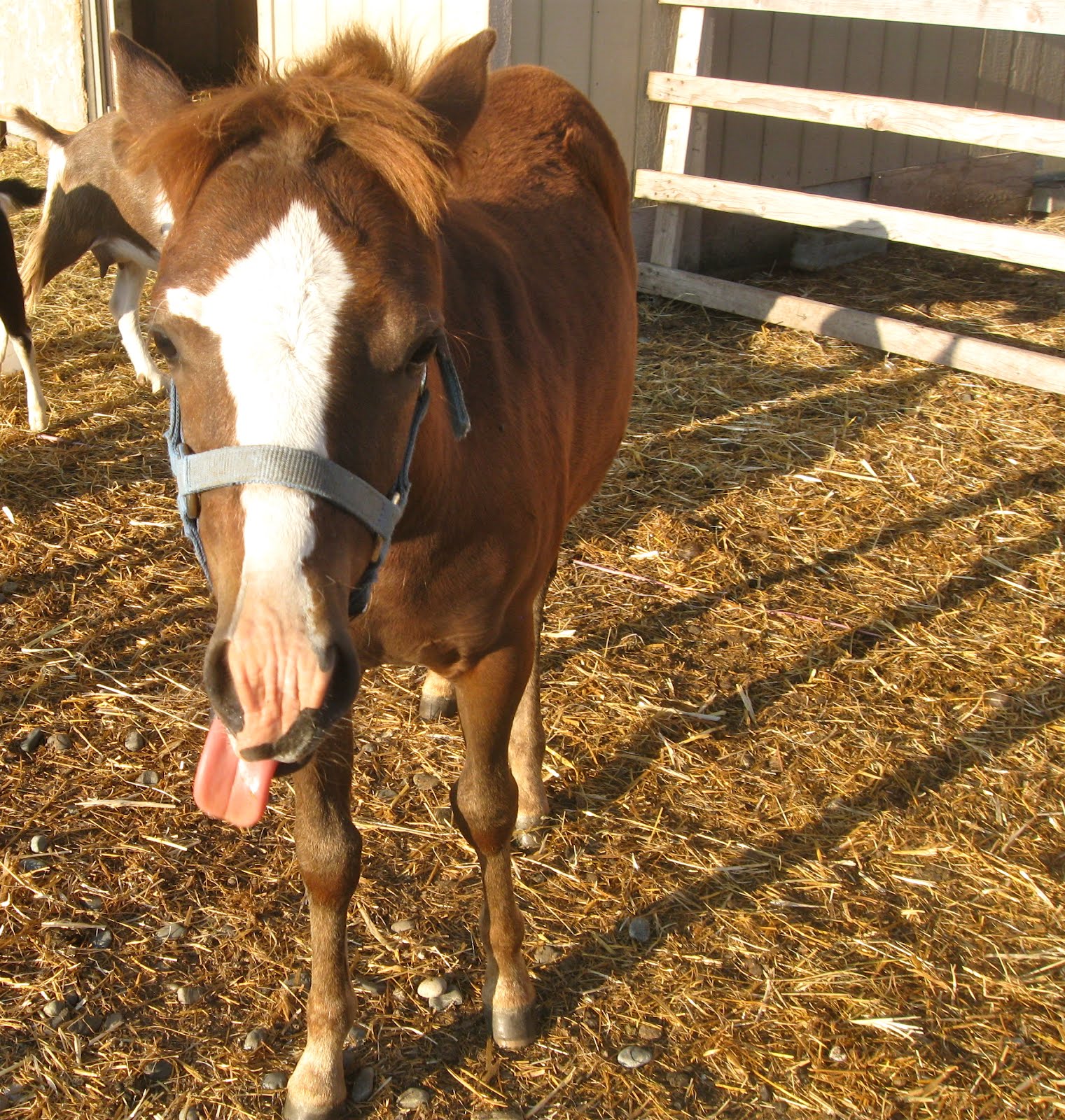
What Do You Do With a Drunken Pony?


The last time the farrier came out, he was unable to trim Rosie's back hooves. Rosie, remember, is my rescue shetland, who has some sort of abuse in her background and is absolutely terrified of having her feet touched.


With much patience and gentleness, my wonderful farrier (Glenn Hallberg of Broken Bit Farms) was able to get to a point where he could trim Rosie's feet with a minimum of trauma. He patiently forbore being kicked in the shins and knocked down into the mud. The last several times, in fact, Rosie was acting almost normally, just needing to be cross-tied.

Then for some unknown reason she went bat-shit crazy. It might have been that she had had a touch of laminitis and her feet may have been a little bit sore. Then again, we had had to cancel a couple of appointments and were running about two weeks behind schedule, and her feet were quite long. Maybe that was it. Also, it being the dead of winter, Rosie just hasn't been handled a whole lot lately and she gets skittish when I don't groom her regularly.

Whatever the cause, Glenn and I tried for over an hour, but those back feet were not getting done. I eventually made Glenn stop for fear he might get injured. She's a small pony, but she can kick like a mule. We decided we would have to have the vet come sedate her.

Both ponies have been in high fettle lately - might be the turning weather, I don't know, but they have been kicking up their heels a lot lately. On the morning the vet came, it took her ten minutes just to get the shot into her, and it was purely a "grab-and-stab" intramuscular injection. No way to fiddle about with an IV.

After fifteen minutes of Rosie prancing about not noticeably affected by the drugs, with the whites of her eyes still showing all around, the vet said "looks like I'm going to have to bring out the big guns." Fifteen minutes after that, we had a pony who was stoned out of her gourd. She stood quietly with her head hanging down and a fine string of drool hanging from her lip. When Glenn lifted her back foot, she didn't seem to notice, but she did list dangerously to the left.

Except for having some trouble staying upright, Rosie offered no resistance at all, and the vet and I decided it might be a good time to make an examination of her teeth (need work ) and also to irrigate her tear ducts, because she has chronically goopy eyes and the vet says they are caused by blocked tear ducts. Did you know that a horses tear ducts open into her nostrils? If you look inside her nose, there is a small opening on the ventral surface of the nostril which is the terminus of the tear duct. The vet used a small syringe to shoot saline up through that duct until it squirted out of Rosie's eyes.

Rosie didn't give a crap.

The most difficult part of the whole event was trying to get Rosie to walk back into her corrall. Her front legs kept crossing and I was pretty sure she was going to go over like an overloaded ferry boat. But no: weebles wobble but they don't fall down. She made it back. The funniest part of the afternoon was watching Poppy check out her mom. She walked up and sniffed her, she whinnied, she nudged her with her nose. Then, a calculating look came into her eye, and she lowered her head and began to nurse.

"Poppy!" I yelled, and threw a clod of dirt at her. "Cut that out!" Poppy is almost three and hasn't nursed in a year. But obviously, she hasn't forgotten, and she must have realized her mama was in no shape to stop her.

Rosie is fine now - trimmed feet, de-gunked eyes, and up to date on vaccines and boosters. But this is not a sustainable solution. The vet's bill was $415. That's an entire year's worth of the farrier's bill. That's an entire year of hay, for all the animals. I can't afford to do that again. In fact, if my husband reads this post and finds out what it cost, I am going to be a load of trouble.

I did ask the vet if she could prescribe me something to put in Rosie's feed before the farrier shows up. "My sister's dog takes valium before he goes to the vet," I said, "And so do I before I go to the dentist. Don't they have valium for ponies?" She hesitated, and then said "there aren't any really good options."

Okay, but are there any options that are better than giving her up as a bad job and sending her to the dog-food auction???

Friday, February 3, 2012

Sharpie Desecration (Or; a Chance For You Non-Parents to Feel Smug and Superior)


Monday, January 30, 2012

Things That Need to Happen (Before We Can Go)


As I wrote a few days ago, we are moving to Mexico this coming year (The Big Reveal (What We Want)). We are hoping to be there by September, when the new school year starts. That would be great, but when I start to think seriously about all the things that need to happen before we go, I just can't see it.

1) Rowan needs to be enrolled in University. My oldest daughter, Rowan, will not be coming with us. Unless, that is, she doesn't get her ass in gear and get herself accepted to a decent program. If she doesn't get in anywhere (which will only happen if she doesn't apply, because she is a freakishly talented artist and a grade A student), then she will have to come with us because there is no way I'm leaving her here with nothing to do all day.

2) Assuming she does get in to her first choice, which is WWU's graphic design program right here in Bellingham, then we need to convert the computer room into an apartment for her. It's mostly ready already: the previous owners converted a two car garage into a master bedroom suite with it's own entrance and bathroom. All we will need to do now is create some sort of cooking area and then Rowan will be set. That, of course, makes it sound easier than it actually is. For one thing, we need to clean out approximately two tons of crap from the walk-in closet/cum food storage area in the way-back. Alas, this isn't something I can do on my own. One example of the crap is a full set of racing tires for a Lamborghini Diablo, which my husband bought for the kit car which he is never going to build.

3) Somehow make the house presentable to potential renters. This is such a sweeping generality that I haven't even the faintest idea how to go about describing the particulars. The list of jobs that absolutely must be completed before we can even hold our heads up if potential renters come to visit includes:
a) Remove and replace all the carpets in all three bedrooms. The off-white carpet that was here when we moved in has, let's say gently, outlived it's usefulness (When the Cat's Away (the Mice Will Get Some Work Done)). Not so gently, I can say it is thoroughly disgusting, no longer remotely off-white, and smells strongly of cat pee.

b) Repaint two of the three bedrooms. The master bedroom, where Homero and I reside, may not be exactly house beautiful material, but at least it isn't embarrassing. The little girl's bedroom, on the other hand, has been lavishly decorated with sharpie (Oh I wish I had photos to show you right now. None of you can possibly believe the level of sharpie desecration unless you have seen it.). Homero and I had a very intense discussion about whether or not the girls should be allowed to sharpie their walls (can you guess whether I took the "yea" or the "nay" position?) and the end result is sharpie from here to hell and gone. The other bedroom in question is Rowan's, which most closely resembles a landfill.

When the painter-guy showed up today to give me an estimate, he looked into Rowan's room and said, "so, you'll be ready in like, two weeks?" Yeah - if I go in there with a bulldozer. Otherwise, never.

c) So many outdoor repairs. Probably the main one is the porch. This house enjoys a commanding view of the Canadian Cascades and takes advantage of it with a wrap-around deck that is something like 1,000 square feet. We have totally ignored any maintenance on this deck since we moved in five years ago. Given that we live in the wettest, moldiest, windiest, nastiest part of the state, the deck needs serious attention. There is also the playroom (new carpet) and the main bathroom (new vinyl flooring). There is the situation under the kitchen sink. Oh my God. Hyperventilating right now.

d) forgot the "landscaping" situation. Once upon a time there was actual landscaping: now I just have to hire a strong man, equip him with some serious weed-eating technology and ask him to chop everything down to an even four inches. It'll be green, right?

4) figuring out what to do with the animals. I told Homero that I was willing to sell all of the animals except the dogs and the horses. Rosie was a rescue and she can't be re-homed due to behavioral problems. The only way to get rid of her is to send her to the auction, and I won't. And Poppy, of course, is our pride and joy, our delight and the equine apple of our eye. She's not going anywhere.

However, boarding horses is crazy expensive. Going rate around here is approximately $200/month/horse for full care board. That is just not do-able. I've been looking around and I may have struck a deal with a guy - a rich, retired, Redmond fellow - who has five acres and wants to set up a petting zoo in his old age. We talked about my giving him my small herd of (gorgeous) dairy goats and my large flock of chickens in exchange for care of the two ponies for a year.

By the way - if it works out, that is a smokin' deal. At $200/month/horse, a year's board would cost me nearly than $5,000, not even counting farrier service or any vet care they might need. On the other had, a very good price for an in-milk Nubian goat is about $300. A VERY good price. I have four of them, plus their offspring. If I count optimistically, I might be able to convince myself that the whole herd is worth something like $2,000. Therefore, it's totally obvious that the above deal is smokin', right?

My husband, when I told him about it, said "You aren't going to give him ALL the goats, are you?" Seeing as how he hadn't done any research and didn't know the relative prices of goats vs. horse care. I told him, "Yes, I am, plus all thirty laying hens. Look on Craigslist at least before you judge." He clearly thought I was making a terrible deal and he could have done much better.

5) Renting out this house. After some thought, I decided it might be worth the expense to hire a property management company. There's one in town, and I stopped by to ask about their general rates and if this kind of specialty arrangement (one year lease; teenager in residence) is even something they do. I expected that a management company would charge about 15% (Don't know how that figure got in my head) and was delighted to find that they actually charge 8%. Of course, they charge separately for advertising the property, for the background check on applicants, and for any repairs needed. The fellow I spoke to (extremely nice) answered all my questions and inspired confidence. He said "Have the place ready for us to check out by May; we will tell you what we think it will rent for."

May is only four months away. Holy Crap. There's not even enough time to do half of making it presentable. I did say to the man "There are a lot of nice things about this property, but it is an old farmhouse. There's no getting around that."

Maybe I should stop focusing on things like slow drains and slippery porches, Maybe I should focus on the best freaking view on the entire county. Ok - here's my mantra. Practice this, Aimee. When he says "Your Jacuzzi tub doesn't work" you say "have you SEEN Mt. Baker?"
When he says "there's a draft around the front door" you say "They don't call it Grandview for nothing, y'know!"


Friday, January 27, 2012

A Day in the Life (So Far)

Homero is out of town. He had to go to Atlanta to help his brother fix a number of cars that have been waiting for Homero's attention. It might seem odd to many Americans that a person would stockpile out-of-order cars until one's brother could come from 3,000 miles away to fix them, but if you do the math, it is actually much much cheaper to pay your brother's airfare than it is to pay for three or four major automotive repairs. Plus, Fransisco came out here last year to help Homero finish his shop ( Top O' the World, Ma!) and it is my husband's turn to return the favor.

So, I am alone for the next couple of weeks. Not entirely, of course: I now have a nearly adult daughter, Rowan, who is incredibly helpful. She is delightfully willing to help out with cooking, cleaning, and childcare. However, I am still responsible for more of the daily chores than I am when Homero is home.

7:00 a.m. Alarm. Crickets. Alarm is set 1/2 hour earlier than usual because I have to teach an art lesson to my first-grader's class today and I have not prepared. I have a stack of materials to g0 through. The artist is Van Gogh and I'm thinking I'm going to talk about color.

8:00 a.m. Get the kids up. Usual routine: help them find clothes, make breakfast, make lunches. Notice that there is not much for lunches. I am feeding the kids carrot and celery sticks, bag of corn chips, a handful of raisins, and a few cubic inches of cheese. Nutritionally, it isn't a bad lunch, but socially, it may get them ostracized.

9:00 a.m. Bundle everybody in the car. Run Rowan down to the bus station so she can get to class at the community college on time. Listen to her beg me to take her all the way down. Give in, because I have to go to the store to buy paper plates for the art lesson anyway.

10:00 a.m. Run as fast as possible through Fred Meyer, looking for the right kind of paper plate (uncoated) and also something to eat that I can hold in one hand while driving. Also, coffee, because I didn't have a chance to make coffee at home and if I don't get some I will be biting the heads off of first graders in half an hour instead of helping them make sunflowers out of paper plates.

10:45 a.m. Spend an absolutely delightful hour teaching six year olds about complementary versus contrasting colors. Most of them don't get it, but they still enjoy smearing fingerpaint around and when I leave, they regale me with an adorable chorus of thanks.

12:00 p.m. Realize I forgot to feed the animals this morning. Race home like a demon on speed and feed everyone. Climb into the hayloft to look for eggs. Curse like a sailor when I plant my palm into piles of chickenshit but find zero eggs. Wonder what is wrong with the chickens.

1:00 p.m. Suddenly remember that Hope is bringing a friend home on the bus today for a playdate. Scramble to make house semi-presentable (who knows, the little girl might report to mama). Try to think of a snack. While thinking of snacks, remember that there is nothing in the house to make for dinner. Check the fridge. No milk. No vegetables except a head of cabbage.

1:30 p.m. Run to the grocery store. Have the intention of stocking up on healthy foods but while there say "oh hell with it" and buy a frozen pizza and a gallon of milk. Think better of yourself and go back for a few pounds of broccoli.

2:30 p.m. Get home. As I alight from the car, notice a neighbor's car pulling in behind me. It's Mr. Duckhunter, with three freshly killed ducks for me. Accept ducks, with thanks. Talk about what, exactly, to do with ducks. Learn a little bit about duck breast jerky. Sharpen knives. Carve out breasts and submerge in marinade made of soy, honey, and chile flakes.

3:15 p.m. Head for the computer. Realize you forgot to eat anything this morning and heat one of the pizzas. Make this post, while snarfing down DiGiorno's.

3:40 p.m. Read over post and berate yourself for being so shallow. Realize you have only thirty minutes before house is overrun by little girls and decide to spend that half an hour in bed reading "The Praise Singer" by Mary Renault, the best writer of historical fiction of the twentieth century.

Goodbye.


Sunday, January 22, 2012

The Big Reveal (What We Want)


I've been sitting on a major news item. My husband and I made a decision a few months ago, which we only revealed to our families recently. Making this decision and dealing with the ramifications has been sucking up an awful lot of my brainspace, which helps explain why I haven't been writing very much.


We are moving to Mexico. Not permanently: for about a year. Ever since we had children, we knew we would do this at some point. We want our children to know their family and their heritage more fully than they possibly could if annual two-week vacations are all we can give them. We want them to be truly bilingual, not just fluent in a a second language as I am and as their father is. We also want them to be bicultural.

That's a weird word, bicultural. Just as neither Homero nor I is truly bilingual, neither are we truly bicultural. Being bilingual means more than simply being able to converse fluently. It means understanding slang, and jokes. It means being able to speak to a toddler as well as a grandmother. It means hearing accents, and being able to infer something from them. It means being able to read poetry. Few people can do those things in a language that they learned as an adult.

Similarly, being bicultural means more than just being able to get along in another country without committing a bunch of ignorant mistakes all the time. Understanding gestures - just gestures! - is complicated. After ten years married to a Mexican and many trips to Mexico I still misinterpreted a simple "reverencia" on our last trip. Manners. Manners are tricky even in one's own culture, of course, and are a subject wide ranging and variable enough to spawn several books on the topic in any given year. Learning the right things to say and do in various contexts in another culture is a process that takes decades.

And - here's where it gets complicated - learning the assumptions and the realities on which those manners are based.... ah! Now we're getting somewhere. As with language - a person might be fluent enough to read the Spanish translation of the Mayan book the Popol Vuh, but still totally unable to comprehend it, because one has no grasp of the symbols, the references, and the feelings that suffuse it.

I remember visiting the Mexican Museum of Anthropology in Mexico City for the first time. Surrounded by art and artifacts that were wholly unfamiliar to me, I felt dumbfounded. I realized I could not appreciate this art - not because it wasn't beautiful - but because I was totally illiterate in the language of symbols it used. I realized that in just about every other museum I had ever visited, the art was based on a symbology - and even deeper, a cosmology - that is part of my heritage as a European. Even when looking at Indian art, or Middle Eastern Art, I can find the marks of Greek, Jewish, and Christian thought. Our shared history makes a path that is easily to follow. I recognize the pantheon of Gods, even if I don't know their names in Sanskrit or Aramaic. I know what the moon means, more or less, all across Europe and Asia Minor.

In Mexico, I knew nothing. Where art and cosmology is concerned, I was as an infant. The symbols slid right off my brain. Americans think of Mexico as a neighbor, and have no idea whatsoever how very different it really is. Even five hundred years of European rule have only left a familiar suit of clothes on the great brown body of Indigenous Mexico.

Octavio Paz calls Mexico a "non-Cartesian culture" and that is true, and also a very hard thing for a westerner to accept. We tend to see all non-Cartesian thinking as simply uneducated, rather than as part of a different tradition of knowledge. Mexico is a communal culture rather than an individualistic one, and that is a very hard thing for an American to accept. Americans who have spent time in other communal cultures such as Japan or the Arab countries will know what I mean when I say we see them as smothering and constricting, and they see us as cold and uncaring.

Necessarily, I am taking a bit of a leap of faith here. I am not Mexican, I am not bicultural, and it is too late for me to become so. I have found a great deal to admire in Mexican culture as I know it, and I love the Mexican land and I adore my Mexican relatives. I want my children to have real, deep relationships with their family, and I want them to be real Mexicans as well as real Americans. I want them to develop the typical thick, tangled web of kinship relationships. I want them to grow up with many comadres and compadres. I want them to grow up knowing deep in their bones that their family will do anything for them, anything... and to feel the equally deep obligations to help out to the best of their ability. I want them to laugh at dirty jokes and speak street slang in Spanish. I want them to be have that beautiful sparkle, that lovely Mexican ability to laugh at fate even as you accept its yoke, to bend in the wind and pop up dancing.

On one of my trips to Mexico, years ago, I had a dream. I dreamed that I was on a boat in a river, and that the a gaudy, gorgeous, colorful Mexican countryside was rolling by on the shore. There were people on land calling to me, inviting me to join them, but I couldn't get off the boat. I could only slide by and enjoy the view.

I want my children to be on the shore.

Wednesday, January 18, 2012

Winter Haiku

Hot tea in my mug
winter outside the window
study in contrast

A beautiful sight

winter pulls her cold white cloak
over the mountain

Farm chores in the snow
horse's breath makes warm white clouds
pigs snug in straw beds

On the third day stuck at home, snowed in, tired of playing Scrabble with six year olds and having rifled through the stack of DVD's more than once without piquing my interest, I turn to an older pursuit: poetry. Haikus are lovely - so beautifully easy to write, and so soothing in their single-minded simplicity. I wish I had someone ere who liked them as much as I do so we could sit across from each other at the kitchen table, hot cocoa in hand, and play the game of speaking in haiku for as long as we can.

Three days is too long
to watch TV with the kids
I long for power outage

Monday, January 16, 2012

Snow at Last (On Being Unprepared)

The "puff-room."

There are about eight inches of snow on the ground right now, and it's still coming down. I don't mind snow - I actually like snow. We've all been waiting for snow this year, and we are pretty happy that it's finally here. The little girls spent most of the day outside yesterday, apparently oblivious to the cold. Whenever they would come inside, I'd ply them with hot chocolate, put their wet clothes in the dryer, and send them into the "puff-room." The puff-room is a tent made by throwing a down quilt over the heater grate. The girls crawl under there with their teddy bears and curl up together, getting warm. As my sister pointed out, it looks like Epcott center, but it really works!

View of the front pasture

For the past two days, it's looked pretty much the picture above: grey skies, with snow falling five minutes on, five minutes off. Homero has been working out in the shop, poor man. We don't have any paying work right now, so he's been making biodiesel and working on the diesel bug, which lately tops out at thirty miles an hour. After several hours out in the shop I'm sure he wishes he could visit the puff-room.

The Dogwood Tree.

I should really make more of an effort to read the weather reports. I can't say the snow caught me entirely off guard, but I had the idea it would be no more than a dusting, not a snowstorm that would have us stuck at home for at least two days. When I find myself stranded at home for even a day or two, I realize how woefully unprepared I am.

Firstly; we are stuck not because the roads are truly impassible, but simply because all the tires on all of our vehicles are smooth as cue balls. We are incredibly lazy (and Homero is incredibly cheap) about replacing tires on time. If the truck had decent tires we could get around. At least down to the feed store, which is pretty important because -

Secondly; there is no chicken food or pig food in the barn. Ran out yesterday. Those damn pigs! They eat like... well, like pigs, but they never seem to grow! We are so tired of having them around (Pig Farming is Not Sexy) and really really want them to be ready for slaughter. To that end, we have been feeding them even more than usual... but it just doesn't seem to make much difference. I don't know if the cold is making them use more energy than they would if it were summer, but it seems logical. Anyway, we go through a fifty pound bag in three days, and that's with all the kitchen scraps on top of it.

Since I seldom have a hundred bucks to drop at the feed store at any given time, I can't really stock up. We're out again. This morning I cleaned out the cupboards and the fridge and found enough stale bread, old cereal, wrinkly apples, limp carrots, and pieces of hard old cheese to tide them over for the morning feeding, but I'm going to have to try to get out to the feed store before nightfall.
Pigs in the Snow.

Thirdly, there's no milk in the house. Or cheese. Or fruit. Or cereal. Or beer, damn it. I really must learn to pay attention to details like groceries and the weather!

Tuesday, January 10, 2012

Sunshine (Makes Me Feel Like Working)

It's been an oddly warm winter so far. The forecast, back in the fall, was for colder and wetter conditions than usual due to La Nina conditions (the opposite, not surprisingly, of El Nino conditions, which are warmer and dryer than usual). As it turns out, we haven't had a single flake of snow yet, and not very many days of hard frost, either.


It HAS been extremely wet, however, Rain, rain, and more rain. I get tired of bitching about the mud (New To Farm Life: Mud Patrol (I Heart Hog Fuel)) so I won't go into a tirade. I'll just mention, briefly, that the other day when I had to go into the pigpen the mud came up over the top of my gumboot. It was an unpleasant experience.

Today was the first day since we returned from mexico that the sun was out for more than a few minutes at a time. For most of the day the sky was bright blue and the temperature was somewhere in the high forties. T-shirt weather. The kind of day that makes you want to get out and work.

Here's what I did today:

Let all the animals out. The goats and the horses got to go out on the front lawn and eat to their hearts content. I don't suppose that January grass has a whole lot of nutrition in it, but it's green, and they all seemed absolutely rapturous.

I also let the pigs out of their small enclosure. They were so happy to be out, they started charging around the back pasture like wild animals, snorting and kicking and acting up. After a few minutes, they settled down and began grazing. Really: grazing, just like horses. They were chomping down on the green grass as if it were candy. In addition to their bagged pig food, which is mainly corn and soy, we feed the pigs all the scraps from our kitchen. Those are mainly things like banana peels, eggshells, old greens and limp carrots, rinds of cheese, et cetera. I liked to think that those items added needed nutrients and variety to the pig's diet, but seeing them out on the pasture today, devouring grass like it was crack cocaine, I realized they are probably missing fresh food.

It was pleasing to see how happy the pigs were. Unlike goats and horses, it is totally obvious when a pig is happy. Like a dog. You just can't mistake it. The pigs ran around in circles and then would trot up to me, grunting and looking up at my face as if to say "hey! Thanks, friend!" I walked the perimeter of the property, just generally checking things out, and the pigs trotted along at my heels like puppies. It will be hard to lock them back in.

I tried to turn the compost pile, but it is too much for me. I did put on gloves and pull out about forty hay-bale strings. It's amazing how many hay bale strings pile up on a small property. When I start to count, I realize that we go through some hundred bales of hay a year, and each bale has two strings... it isn't amazing how many strings there ARE, but that every single one of them ends up in the compost pile. You'd think we would gather at least some of the up and throw them away. I consoled myself by imagining that pulling out the deeply buried strings must do SOMETHING towards aerating the compost and providing tunnels for worms.


Then Homero and I planted two Christmas trees. Neither one was from this year: this year we were in Mexico and we only had trees made out of paper ( Speed Christmas (I've Doubled my Trouble)). No; these two trees were from Christmases long past. We had simply been too lazy to plant them and so they had hung about in pots for two years while we scratched our butts. For some reason, I decided that today was the day they would get planted. Then I gave my husband a shovel and told him where to dig. No - I actually dug, too, but I have to admit he did the heavy work. I mostly shoveled the loose dirt in around the trunks after they were planted and stomped it down firm.

That's about as much work as these short January days can inspire me to do - on top, of course, of the regular rounds of shopping, cooking, and tidying up. I am so looking forward to March, when I can get started on seeds and gardening. The seed catalogues are due to arrive in the mail anytime now.


Saturday, January 7, 2012

Sign of the Season (Trumpeter Swans)

The day before yesterday, I saw the first trumpeter swans of the season. Twice a year - in the early fall and then again in the late winter - trumpeter swans pass by as they migrate. I assume, though I really am not sure, that this time of year they are migrating North to their spring breeding grounds.

We are in the middle of the Pacific flyway here and there are many other waterfowl who pass by twice annually - Canada geese, tundra swans, snow geese, and others. The trumpeters are the most spectacular, however. They are really huge, for one thing. When I saw them the other day, they were feeding among the rubble of a corn field along with some Canada geese. Most of you will be familiar with Canada geese - the large, brown and white geese ubiquitous in city parks all over the united states. Canada geese can be scary. They are large enough, and aggressive enough, to intimidate a six year old, for example. Well, trumpeter swans are nearly twice as big.

The field that I pass by is on a quiet country road, and so I stopped to observe the swans for a while. There were about fifty of them, perhaps as many as seventy. Most of them were adults, but there was a smattering of grayish juveniles as well. Many of them were doing a strange kind of dance, dipping their necks and stretching them out, over and over again. I don't know if this was a mating ritual or perhaps just part of their normal feeding behavior.

About thirty miles south of me lies the Skagit Valley, a beautiful, productive, wide flat river valley created by the Skagit river. The Skagit is threatened by runaway development, but still supports some of the greatest abundance and variety of bird life in the entire country. It is, for example, possibly the best area in the lower 48 for observing bald eagles. The estuary supports tens thousands of waterfowl of many different species. In the right season, a person simply cruising along the freeway can observe thousands of trumpeter swans on their annual migrations.

Below, please find a few links to societies which are actively working to protect the Skagit river and its wildlife. Few rivers in the country have as much potential to support wild birds as the Skagit does. Thanks for your support!

The Trumpeter Swan Society

Tuesday, January 3, 2012

State of the Farm: Midwinter

Here's a long overdue update on the state of farm, after a long and delightful diversion into the wonders of Mexico, which I hope y'all enjoyed as much as I did. Well, you know, without actually being there.


The house: Not too bad. Everything is about the same as we left it, which is to say, in medium-poor repair and not as clean as I would like, but habitable. I did notice, upon entering the house for the first time in 3 weeks, the smell of mildew. I'm pretty sure the house always smells slightly of mildew during the winter months - and I've already ceased to notice it - but it was unpleasant that the first thing I noticed about getting home was that it smelled funky.

As I believe I may have mentioned (The Demon of Bad Smell (the Plumber as Hero)) we live in a sixty year old, owner built farmhouse in the wettest, windiest part of a wet, windy state. The house has issues - and will, unless and until it is razed to the ground. Faint unpleasant smells are par for the course in an old farmhouse on a working farm. Some people wouldn't live in an old farmhouse, and some people don't mind. I am the latter kind of people.

The Livestock: Once again, not too bad. The ponies are fine, shaggy in their winter coats and muddy about the ankles, but well fed and healthy. They were clearly happy to see me, running up the fence and putting their heads over to be scratched. The field shelter is in serious need of mucking out, but that's to be expected. The hard part is that there is so much mud right now that I can't get a wheelbarrow out there. I'll have to pitch poop into a pile to be picked up later.

The goats are also well- presumably all pregnant. There was a bit of drama in getting them bred this year (New To Farm Life: Unwelcome Drama in the Goat Breeding Business), and one of the girls was at my sister's house while we were gone getting bred to her Angora buck. My girl - Polly - is a Nubian, but there wasn't a Nubian buck available when I needed one, and I wanted her bred before I left. The kids will be designated as meat - unless someone wants them as pets, they are sure to be adorable - and I will still get to see what kind of mother Polly will be. I brought Polly home last night.

Edith, my Nubian/Boer cross, is limping a bit and I think she has hoof rot. Just as with mildew in the house, the climate around here ensures that all the goats will suffer a spot of hoof rot here and there in the wet season, no matter how carefully one trims. But usually it doesn't proceed as far as limping. I need to get her on the stand in the next couple of days and take a look.

Pigs. Ah, pigs. How I loathe pigs. I think we will be done with pigs after this pair, at least until we totally revamp the pig-corral situation. The two pigs seem to be exactly the same size as when we left. These girls have been slow growing, and I don't know why. Maybe it's the breed, I haven't raised these pigs before. They are a cross between a Large Black Hog and a Tamworth Sow. My book says these breeds are known for hardiness and foraging ability, but it doesn't say anything about weight gain. We have fenced them into a fairly large corral for the winter to keep them off the pasture. They have a space in the barn as well as an area approximately 30 x 20 to exercise in. That outside area is a knee-deep stew of cold mud. It's horrible. I am having a terrible time figuring out a way to keep their food and water out of the mud. Any container I put in there they flip over and drag away from the fence, even when I have securely tied it in three places. Even if they can't flip it, they put their feet in and fill up any container with mud. It is so gross I am in a constant state of deep disgust whenever I am out there. Ugh.

Chickens. The chickens are laying well, as far as I can tell. There were two nests up in the hayloft when we got back, each with some twenty eggs in it. Let's see... I have a dozen laying hens and we were gone for 18 days... that's approximately two eggs a day from a dozen hens, or 14 eggs a week, or 2 eggs per week per hen. Not bad for the absolute shortest days of the year. I don't, obviously, have a lamp out there. There is one hen who seems to have hurt her leg, but she is still getting around well enough that I can't catch her, so...

The Orchard: Late in the fall, I planted two hazelnut bushes that a friend gave me. They are both dead, apparently eaten by deer. Everything else looks fine. I want to plant two more apple trees in the spring. We lost three out of the four apples I planted two years ago - two to goats and one to the mower. This time I will buy the largest, well-grown trees I can find instead of mail-order two-foot high sticks.

All in all, I am pleased with the state of the place. As always, there is a gigantic heap of work to do. I love my children, but sometimes I think I would love them more if they were all strapping teenage boys with an excess of muscles and energy.

Sunday, January 1, 2012

Mexico Photos (Part Three)

Agave hearts ready to be roasted (on the left) and after roasting in a pit oven on a small-scale mescal producer's farm (right). Agaves take seven to ten years to reach maturity; then it takes some thirty to forty of the hearts to create a single batch of mescal - we were told that a ton of fermented agave hearts results in twenty to thirty liters of mescal. We bought a liter for thirty pesos - or two and a half bucks. I am sipping some of that right now as I write this post.


Evening in Chiapa de Corzo. Homero bought us a carriage ride around the main square. In an old colonial town like Chiapa de Corzo, there are three or four churches within a two block radius of the main square, each decorated for Christmas. This photo was taken out the back of the carriage, which was driven by an old man in his seventies, who gleefully pointed out all the old points of interest. "That was the movie theatre," he said, and "right there was old mercado, before they moved it." His was the only horse drawn carriage in the area, and patronizing him felt like supporting a time gone by.

Nearly every business in Mexico has an altar. Perhaps in the Christmas season the altars are more prominent and elaborate than usual, but I have been visiting Mexico for some ten years now and I have always noticed the altars set up in every establishment, no matter how humble. The altar above was set up in a gas station: an ordinary Pemex station along the highway.

This picture is from our visit to the limestone caves above the city of San Cristobal de las Casas. As far as I can tell, the caves have no name besides "las grutas" which simply means "the caves." The entrance is located within a beautiful park about ten miles outside of town. It costs ten pesos to enter the park and another ten to visit the caves - about two dollars total for an incredible experience.

El Palacio Municipal (city center) lit up for Christmas with lovely magenta light. This building lines one side of the zocalo in San Cristobal de las Casas, providing one fourth of the gaudy, gorgeous pageantry surrounding the main square. Three bands were playing; couples were dancing; old movies were projected on rolled down screens; and of course dozens of artisans strolled hither and yon hawking their wares.

Tule: the largest tree of it's species in the world. The species is Taxodium mucronatum , a kind of cypress. It's trunk is the stoutest in the world. The tree towers over the church built in front of it. It is a lovely and impressive tree. The town is also lovely and impressive - about fifteen miles outside of Oaxaca, a goof place to visit, to eat at the mercado and but artesanias.

Hope and Paloma enjoying a few moments climbing all over the back side of Santo Domingo Church.


Beautiful and strange art installation in the corredor turistica in Oaxaca. Somone, or several someones, placed hundreds of hand built, unique clay people in the courtyard of Santo Domingo, the grandest and most ancient church in Oaxaca. It looked like a pilgrimage of Morlocks.
I absolutely cannot remember which of a hundred beautiful churches this is.

Chapulines. Grasshoppers, in other words. In pre-hispanic times, insects provided a significant portion of the people's protein. Even today, many species of insects are highly prized as food and command high prices. Chapulines are only one of many. Agave worms, Chinches, and Escamoles are only a few of the bugs one might find in a well-stocked mercado. Chapulines are the most available: the common wisdom holds that if one eats chapulines one will always return to Oaxaca.

It has always worked for me so far.

Saturday, December 31, 2011

How to Make the Most Beautiful Pinata (Mexican Photos Part Two)


The pinata is the universal celebratory item, is it not? I don't know if the pinata is a purely Mexican invention that has spread around the world, or if the idea of the pinata is a kind of cultural universal (I suspect the latter) but in either case, a pinata is a lot of fun and a must-have item for all festive occasions.

My children broke seven pinatas on this trip. That's by their own count. I kind of lost track. Pinata making is a cottage industry in Mexico, and many is the family that makes its living with newspaper and paste. The sad little cardboard factory made things that pass for pinatas here in the states are pathetic by comparison, and I hate buying them. Pinatas in Mexico are truly works of art, even if most of them are based on Disney characters and one might question the tastefulness of beating the little mermaid to death with a stick.

My sister-in-law Temy and her children made the most beautiful pinata I have ever seen - with small help from us. It is in the form of a branch of grapes, and is molded on a clay pot and covered with blown, confetti stuffed eggs. If you count the time it takes to save up so many eggshells, this pinata must have taken months to make. I hope to make one myself someday, so I documented the process. This pinata is truly for those with the Martha Stewart gene, so be warned. But if you want to make the mothers of the friends of your five year old swoon with envy, make this for her birthday party. Just start four months ahead of time.

The girls covering the clay pot with strips of newspaper glued on with a paste made from water and cornstarch. Since you are unlikely to come across an unfired round clay pot here in the states (and may also wish to avoid the risk of concussion), mold your pinata base on a balloon.

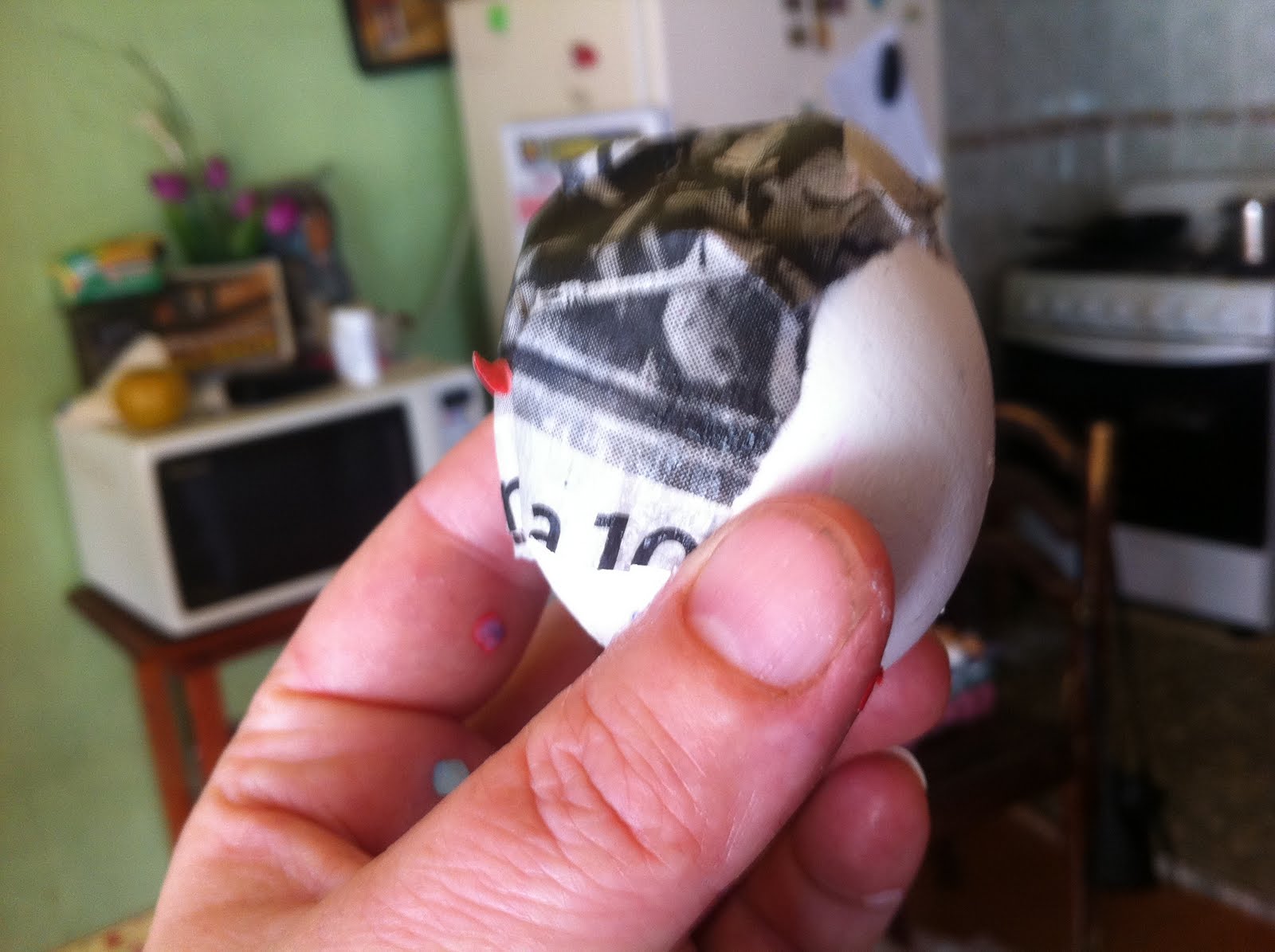
For several months ahead of time, anytime you use an egg, be careful to crack it only at the top, preserving as much as possible the shell. Set the shells aside to dry. When you have about 150 of them, buy a bag full of confetti and fill the eggshells with a spoon.

Use small strips of newspaper and paste to cover the openings of the filled eggs. Set the covered eggs out in the sun to dry - this will take a few hours to a day, depending on solar availability in your area.
Turn the pot upside down - or, if using a balloon, cut off a small opening on the top for filling with candy. Then turn upside down. Roll a piece of thin cardboard into a cone and attach to the bottom of the pinata (the top, turned upside down - get it?) with newspaper and paste. Let dry completely. Poke four holes in the rim of the opening and run twine through in a cross pattern. This is to hang the pinata later. When eggs and pinata are dry, use a hot glue gun to attach the eggs, covered side in, to the pinata. Start at the tip of the cone and work your way down on a spiral, trying to cover the pinata as closely as possible. When all are attached and dry, carefully turn pinata right side up and hang with the twine outside somewhere.

Use spray paint to paint the pinata grape-colored. This pinata has leaves made of cardboard covered with green crepe-paper, which is a nice touch. The hardest part is transporting the pinata after it is filled, so if possible make and fill the pinata on the same site where it is to be broken. Once it is turned right side up and filled, a strong person has to hold it at arm's length so the eggs don't break until it can be strung up.


It feels like a damn shame to destroy such a beautiful, painstakingly constructed object. You will not want to. I didn't. But the children have so much fun, they are so delighted with the crash and the shower of confetti and the candy. And there is something both terrible and elating about the violent destruction of beauty, especially of a beautiful object that embodies so much time and effort.

Breaking this pinata is like a tiny lesson in mortality. In all endeavors, natural and artificial, complexity occurs slowly and with effort, but can and will inevitably be reduced in a relative instant. Breaking the pinata is ritually laughing in the face of death, a beautiful celebration of ending. To break the pinata is to bow to the inevitable, but to do so with grace and spirit and joy.

How very Mexican.