"United we bargain, divided we beg."

Sunday, March 27, 2022

Project Pantry Week One


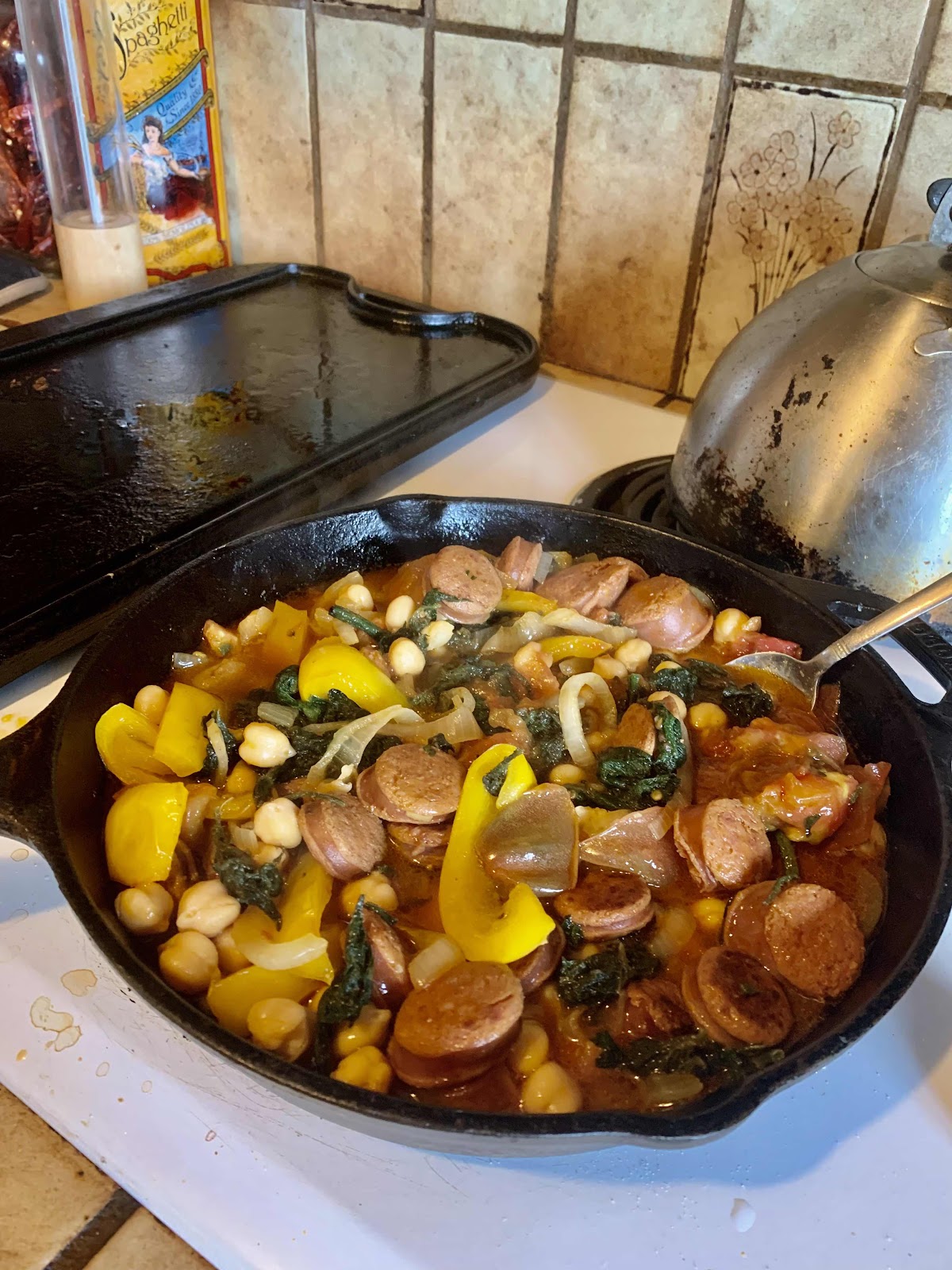
Every single ingredient in today’s dinner - chickpea and sausage stew -  is from the gleaner’s pantry, except for the nettles, which were foraged. But even if you were to buy all the ingredients, this would still be a cheap meal. And it’s healthy, too! 

Chickpea and Sausage stew 

- One sausage per person. I used Louisiana hotlinks because that’s what the gleaner’s pantry gave me, but Italian sausage, Polish, kielbasa, or chorizo works great too. Slice into coins. 

- one yellow onion, sliced 

- one bell pepper, sliced, red preferred. 

- 1-2 cups nettles, or whatever tender greens you have on hand. Spinach is good. So is Swiss chard. Chop roughly. 

- 1 large tomato, chopped

- one can chickpeas 

In a little bit of oil, sauté sausage over medium-high heat until browned. Add peppers and onions.  Continue to sauté until vegetables wilt and are slightly browned. Add chopped tomato. Add rinsed, drained beans. Add greens. If needed, add a tablespoon or two of water. I find the vegetables usually give off enough moisture, but sometimes a little water is good. Or lemon juice. 

Cover and simmer 15-20 minutes, until flavors meld. 

Nice additions if you have them - chopped Kalamata olives, capers, zucchini. 

Score:

Gleaner’s - 5

Foraged - 1

Grocery store - (the oil) 


Wednesday, March 23, 2022

Forest Foraging (Spring Greens)


This afternoon the sun made an appearance, interrupting several days of chilly rain. I was so happy to see it that I was moved to actually get off the couch and take a walk outside with my husband. 

My favorite nearby walk is a trail through the forest that leads to a steep, rather slippery and rickety staircase down to the beach. It’s a quiet beach with no access other than this trail, so it’s often empty except for seagulls and crabs. The trip out and back is about a mile and three quarters, which is long enough to feel like exercise, especially when you consider the staircase. 

The forest is nothing special - it’s certainly not old growth - but it is interesting and varied. On some parts of the trail you are surrounded by cedars and enveloped in a ferny gloom; and in other areas alders and cottonwoods prevail. Right now the Indian plums are blooming and there are yellow skunk cabbage in the shady bogs. 

I’m sure a more expert forager than I am could tell you dozens of edibles and medicinals that can be gathered from an environment like this one, year round. I have personally harvested 

- red huckleberry 
- trailing native blackberry
- shaggy parasol mushrooms 
- nettles

I have seen, but not harvested, cottonwood buds (for making Balm of Gilead - https://learningherbs.com/remedies-recipes/balm-of-gilead/) and devil’s club. And I’m certain there are edible fiddlehead ferns and many other types of edible mushrooms and fungi in there as well. And this is just one small forest reserve that a biologist would doubtless describe as degraded. 

I do most of my yearly foraging in fields and hedgerows, not forests. I pick dandelion greens, lamb’s quarter, amaranth, field mushrooms like puffballs and agaricus campestri. Blackberries and sour cherries and plums from abandoned trees. Most of what I forage is not truly wild but rather escaped nonnative weeds. That’s okay. It’s all good food. 

A few days ago I went out and walked my fence lines looking for nettles. There were a few here and there, but they were all still very small. It will be another two weeks before I can get enough for a pot of soup. Today on the forest rail though, I saw hundreds of nettles, all at just about the perfect stage for picking. I guess I have my exercise for tomorrow planned out. 

Saturday, March 19, 2022

Food Finances (Project Pantry)


For a while now, I’ve been thinking about starting a new recurring feature on the blog about cooking and eating from “the pantry,” meaning in this case both my personal pantry and the Gleaner’s Pantry, which is a small food rescue organization from which I get a large percentage of our family’s food. We pick up produce, meat, dairy and bakery items going out the back door of supermarkets and sort the usable food from the unusable. On average, around three quarters of the food being tossed is perfectly fresh and good. The rest goes to animals. 

Years ago, when we first moved here, before I learned about the Gleaner’s Pantry, I was all about sourcing as much food as possible from our own land. We planted fruit trees, we put in a garden every year, we raised chickens and goats and pigs. I learned to can and put up quarts and quarts of applesauce, jam, salsa, and pickles every year. I dehydrated pears and plums for the kid’s school lunches. I made cheese and yogurt, and traded the excess to friends for vegetables from their gardens. I foraged for greens, mushrooms, and berries. 

A mixture of concern about climate change, food prices, and the zombiepocalypse combined with the inherent “wow” factor of being a real, live homesteader drove me to spend lots of time and energy producing and preserving as much of our own food as possible. Turns out, however, that with a few exceptions here and there, producing and preserving your own food is not cheaper than buying it already preserved for you. Mostly the opposite, in fact. You wouldn’t believe how expensive a dozen eggs are when you factor in the cost of building a coop and raising the chicks. 

Our global food system is based around efficiencies of scale, and it is very good at producing vast quantities of food extremely cheaply. Again, with a few exceptions, it is much cheaper to buy your food than it is to grow it yourself. Of course, much of that cheapness is predicated on government subsides and the exploitation of labor, not to mention the externalization of costs such as pollution of waterways from agricultural runoff. Money out of pocket is not my only concern, nor can it be the only concern of anyone who cares about the ethics of their consumption. 

Eating for the Gleaner’s Pantry allows me to address many concerns at once - cost of food, of course, but also the desire to minimize food waste and to avoid participating in the evils of Big Ag. None of us can avoid that entirely, of course - Big Ag is just one of the gigantic systems in which we are all enmeshed and which we literally depend on for our survival. I am under no illusion that my feeding my family from Big Ag’s waste-stream makes any appreciable (or even detectable) difference to any of the aforementioned problems. But it makes me feel good, it provides an example to my kids, and it saves us a lot of money. My daughters have taken many lessons - music, gymnastics, sports - that we were able to pay for because we were saving hundreds of  dollars a month in food costs. 

You might have noticed food costs have risen quite a bit lately. This phenomenon comes at a time that we are a bit tight on cash. Our family budget has taken a hit recently, and it made me think that I could probably make even more use of the Gleaner’s Pantry and save even more money. I’ve never tried to actually keep track of exactly how much we eat from the Gleaner’s versus how much from the grocery store. It seems like it might be a fun project for the blog. So I think I’ll try to make a weekly post breaking down at least one day’s cooking in terms of where the ingredients came from. Three categories - Gleaner’s, grocery store, or personal pantry, which includes farm-produced and foraged or bartered from neighbors. 

I’ll start with just one project: the lemon curd Swiss rolls I made today. They are super pretty! 

From Gleaner’s:                              From grocery store:

Flour                                                Sugar
Lemons                                            Butter

From Personal Pantry:

Raspberries
Eggs 

This is a win - four non-store items versus only two store items. Maybe I’ll keep a running tally! 


Tuesday, March 8, 2022

Attempting Chickens Again (Hammer and Crime)


Every winter, we lose most of our poultry to coyotes. This is, of course, mostly our own fault. Our chicken coop is hardly worthy of the name - it’s just a rickety collection of random boards nailed up between our two small barns, with chicken wire tacked on and roofed with corrugated plastic, which is cracked and broken. I haven’t the heart to keep the chickens penned up in there. The barns have no gutters, so the rain sheets off the roofs and pools in the coop. Eight months of the year it’s just a mud puddle. They do have nest boxes and a couple of dowels to roost on up off the floor, but they don’t really like it in there and I don’t blame them. 

So the chickens and turkeys are fully free-range. They mostly roost in the hayloft of the main barn, which would be fine except for the fact that it ruins the hay. And except for the fact that the main barn apparently does not protect them from predators one little bit. Over the years, we have clearly become known far and wide as “easy pickin’s farm” with the local coyote population. Our property is only five acres, but it abuts some two hundred acres of woods and fields, and there is a whole mess of coyotes in there. 

I’ve pretty much given up on raising turkeys, because they are expensive and ticklish to raise, and it’s just too disheartening to spend a few hundred dollars and several months nurturing poults into big, fat, profitable birds, only to have them disappear just as they hit market weight, leaving behind only a patch of scattered feathers somewhere out in the field. I was close to ready to give up on chickens too, when we were down to a last solitary bird. I wanted to give the poor bedraggled thing away to somebody with a real chicken coop, but Paloma cajoled me into getting four new chickens instead. 

It was obvious we needed a better chicken situation. Either we had to repair the coop in a serious way, or make something new closer to the house where the coyotes wouldn’t come. For a while we toyed with the former, but settled on the latter solution as being both cheaper and less work. These are our prime considerations in most cases. We have a very well-fenced back yard, and it has a chain link dog run in it. We haven’t used this dog run for anything in particular in many years. I don’t even remember where it came from. But it makes a serviceable chicken coop when roofed with cattle panels bent into hoops and then covered with a tarp. 

I found four young rhode island red hens for sale and put them in the new coop along with the one surviving yellow hen. It took them a week or so so settle in and start laying, but now they are happy and healthy and popping out eggs just like they ought to. The downside is the back yard looks like hell - grass all scratched up and porch covered in bird poop - but oh well. What’s that saying? You can’t make an omelette without breaking a few eggs? 

Paloma named the chickens according to some secret logic of her own. She claims to be able to tell them all apart except two. The two she can’t tell apart she named Thunder and Lightening. The other three are Banka, Hammer, and Crime. I think Hammer and Crime sounds like the name of a rap duo from the late eighties. 

We had planned to get some fancy, colorful bantams as well, but I don’t know. Maybe five is enough chickens. It’s certainly better than just one. 

Monday, February 21, 2022

The Fermentation Files (Ginger Beer/Not Beer)

Small batch fermenting is one of my favorite things to do. I love to make sauerkraut, kim chee, and kosher dill pickles. During milk season I make kefir and, of course, cheese. People don’t think of it that way, but cheese is in fact a fermented food. Someday I would love to try my hand at another non-intuitive fermented food - dry cured salami. Fermented foods have a ton of health benefits and they are a cheap, low stakes hobby that doesn’t require much in the way of equipment. 


A notable exception to that cheap and easy thing, though, is one type of fermentation that I don’t do anymore. I used to be a home brewer. I’d make plum wine in the late summer and hard cider in the fall. I never got all that good at it, but I did enjoy myself and I did amass a collection of cool glass carboys and neato accoutrements like airlocks and bottlecappers. And I felt a great deal of satisfaction and pride whenever I got “high on my own supply” and enjoyed a few glasses of mediocre but effective home made hooch. 

Alas, I enjoyed it all a little too much and eventually I quit drinking alcohol altogether. I gave away all my cool carboys and tubing and whatnot. It was sad to part with it all, but I still had a whole world of fermenting projects and kitchen-witchery to console myself. I’ve stayed away from fermented beverages ever since. Until a few days ago. 

My daughter Hope has long wanted to make old fashioned root beer and/or ginger ale. It’s a fermented drink, but it isn’t alcoholic. Or, at least, it shouldn’t be more than about 0.5-1% alcoholic, which is the same amount that’s allowed to be in regular apple or orange juice that you buy at the grocery store. So when, last week, the Gleaner’s Pantry offered up a bounty of a whole pound of fresh ginger, we decided to give it a try. 


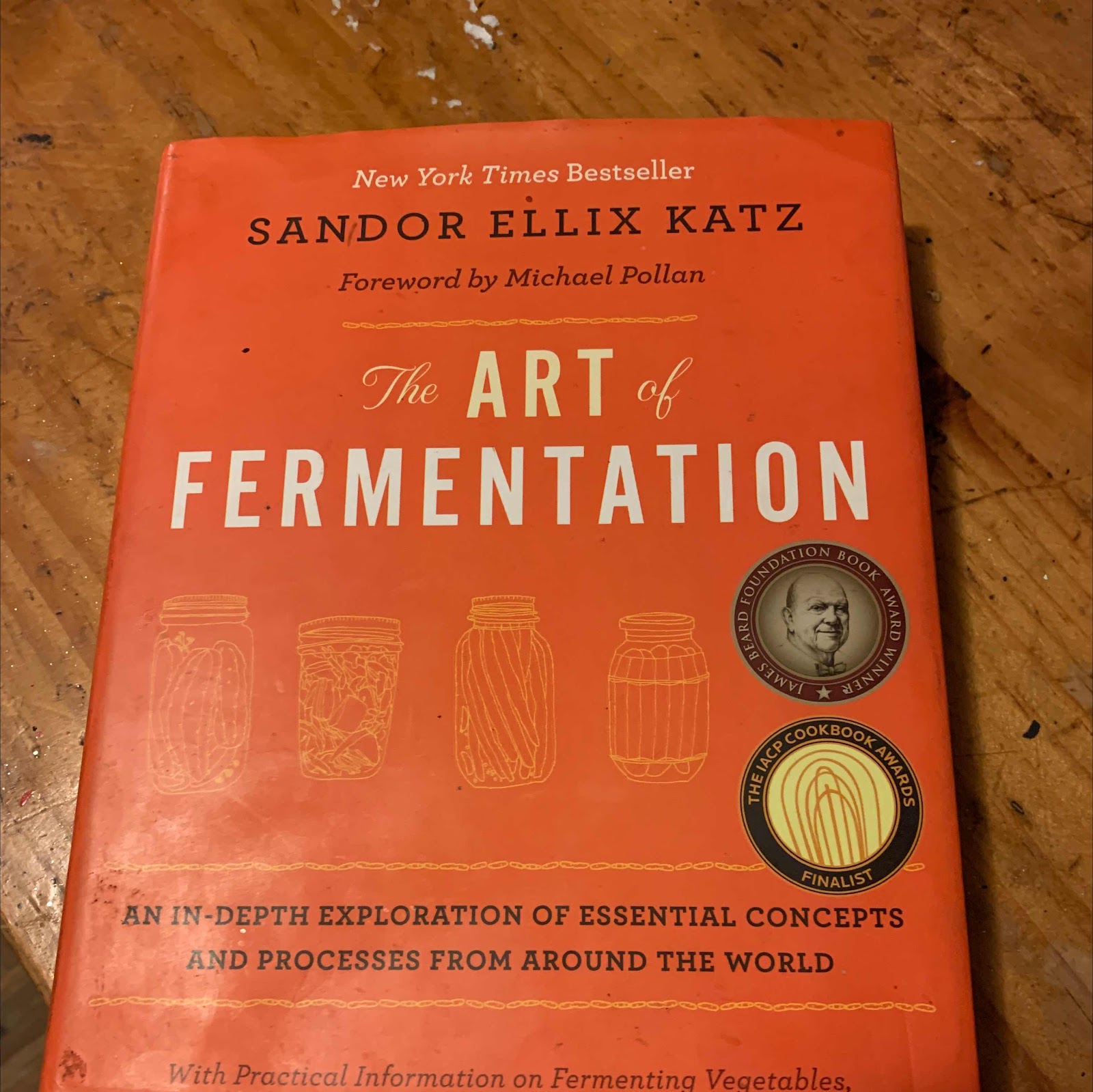
I wasn’t sure how to go about it, but that’s why I have books. The first step in making ginger beer is making a ginger bug. A ginger bug is very simple to make. You just grate a ton of ginger into a jar, add a big scoop of sugar, and fill the jar with water. Leave it on your fermenting shelf (what? You don’t have a dedicated fermenting shelf?), and within a day or two it will be bubbling away. 

When your ginger bug is nice and active, make a pot of very strong ginger tea - actually a decoction of ginger. Grate, chop, or thinly slice at least six inches of ginger root into a half gallon of water. Simmer for twenty minutes. It will reduce down to about a quart. Strain into a half gallon jar and add a full cup to two cups of sugar and another quart of cool water. Temperature should be lukewarm. Then add your ginger bug in a mesh bag. 

Cover, but do not seal. Put it on your fermenting shelf (you set one up in the last minute and a half, right?). Wait a day or two until it’s nice and fizzy and drink. You can bottle at this point, but be careful. We bottled some in stoppered bottles and when we opened one a day later it shot out like champagne. 

I ended up not drinking the ginger beer, after just a taste. On the first day, I couldn’t taste any alcohol, but on the second day I thought I could. I might have been imagining it. It tasted like apple cider when it’s left out overnight. I’m certain it would be impossible to get drunk on this ginger beer, but these days I take no chances. It is a sugar-based ferment, and that means it must have some alcohol in it. I don’t fuck with alcohol anymore. So Hope gets to enjoy it all herself. 

However the taste I did get was great! Very “hot” ginger taste, light carbonation, and that slightly sweet-sour taste fermented liquids have. I’m sure it would be tremendously refreshing over ice on a hot day, and probably very good for stomach ills and nausea. Next time, I may try just making the string, sweet tea and adding carbonated water instead of a ginger bug. It won’t be a real fermented product that way, but at least I could drink it. 

Wednesday, February 16, 2022

To Plant or Not to Plant


The other day I went for a walk in a nice neighborhood downtown. There were signs of spring everywhere - crimson buds on the rhubarb plants in the alleys; small green shoots in garden beds that will soon be blooming crocuses and narcissus; red alder catkins dangling from the branches like caterpillars. And, in many yards, evidence of industrious people preparing for early planting season. 

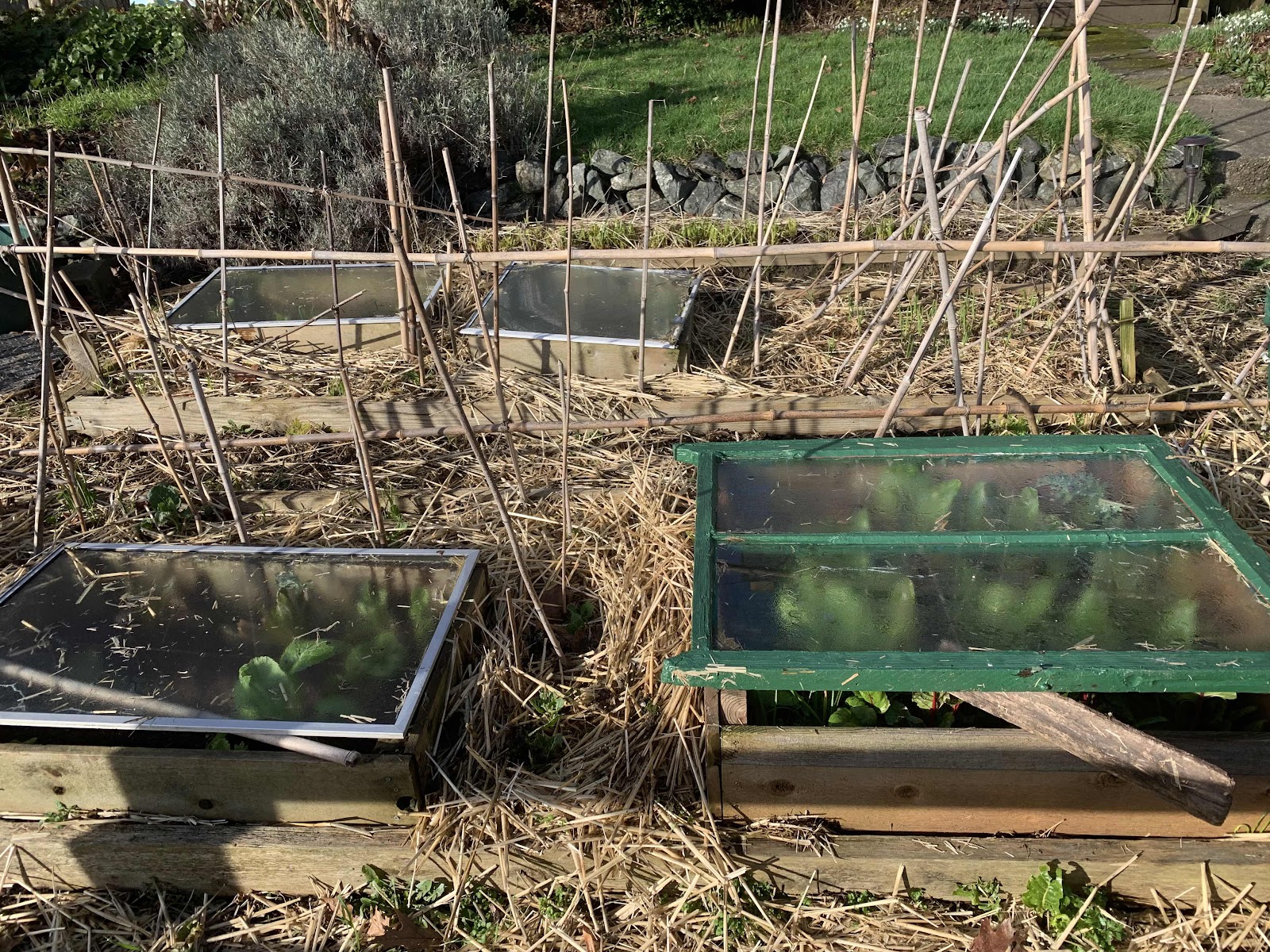
I took a picture of these beautiful cold frames. They are just old windows attached with hinges to raised wooden beds. They can be kept closed or propped open. Inside, I could see fresh greens. It’s too early for these to be new spring greens, they looked like overwintered chard and kale. But they were gorgeous, bright green, tender and delicious-looking. 

I got excited. I have long wanted cold frames just like this. If I had such nice cold frames, I could plant radishes and spinach ANY DAY NOW. I could start slow-to-mature vegetables in April instead of direct sowing in late May. I could grow CUCUMBERS. I could grow EGGPLANTS. 
I even remembered that we have four or five good-sized windows just sitting on a trailer in the yard near the shop, doing nothing. 

Then I remembered that I am one of the world’s worst gardeners and there are many reasons for my failure besides my lack of cold frames. Mostly a lack of will or energy to spend hours and hours a week pulling weeds and picking slugs and bugs off of my plants. My aching knees and creaky back. My inability to remember where I put the trowel and the gardening fork for the life of me. 

I remembered that “I fought the weeds and the weeds won” is pretty much our farm-anthem around here. I remembered that I have consciously cultivated tough perennials like raspberries and rhubarb just so I don’t have to prepare garden beds every year. I remembered that I belong to the gleaner’s pantry and have pretty much unlimited access to organic vegetables year-round, even if they aren’t quite as fresh as they would be if I were picking them from my own garden. 

I always plant a few things, and I’m sure I will this year as well. Maybe this will be the year I actually get some asparagus crowns into the dirt. Maybe I can convince Paloma to help me lay down all the cardboard I keep intending to bring home from Gleaner’s and so get a jump start on weed suppression. Maybe Homero will finally put the wheel back on the wheel barrow so I can move compost in quantities larger than a five gallon bucket. 

Maybe. 


Thursday, February 10, 2022

Goat Totin’ Man Totin’ Goats

It recently came to my attention that there are still people out there reading my blog. Apparently, there’s a high school boy out there, a friend of Paloma’s, who thinks my blog is pretty cool and asked Paloma why I don’t write anymore. 


Because, Kyler B., I’m just lazy. Terribly, terribly lazy. It’s easier to post a  picture on Instagram or Facebook than it is to write a real post. Also, the news has been so sad on the farm lately - we went through a terrible time of many deaths. I felt like a complete failure as a farmer. And, after twelve or so years, I sometimes feel I’ve written all I have to write about the passing seasons on our little farm. 


But of course, I haven’t. There have been all sorts of recent developments. And I have had a cool idea for a new ongoing  series of posts about eating from the gleaner’s pantry as close to exclusively as possible. So, for those few of you out there in the real world who are still interested in life up here at Windy Hill Homestead, I will start writing again. 

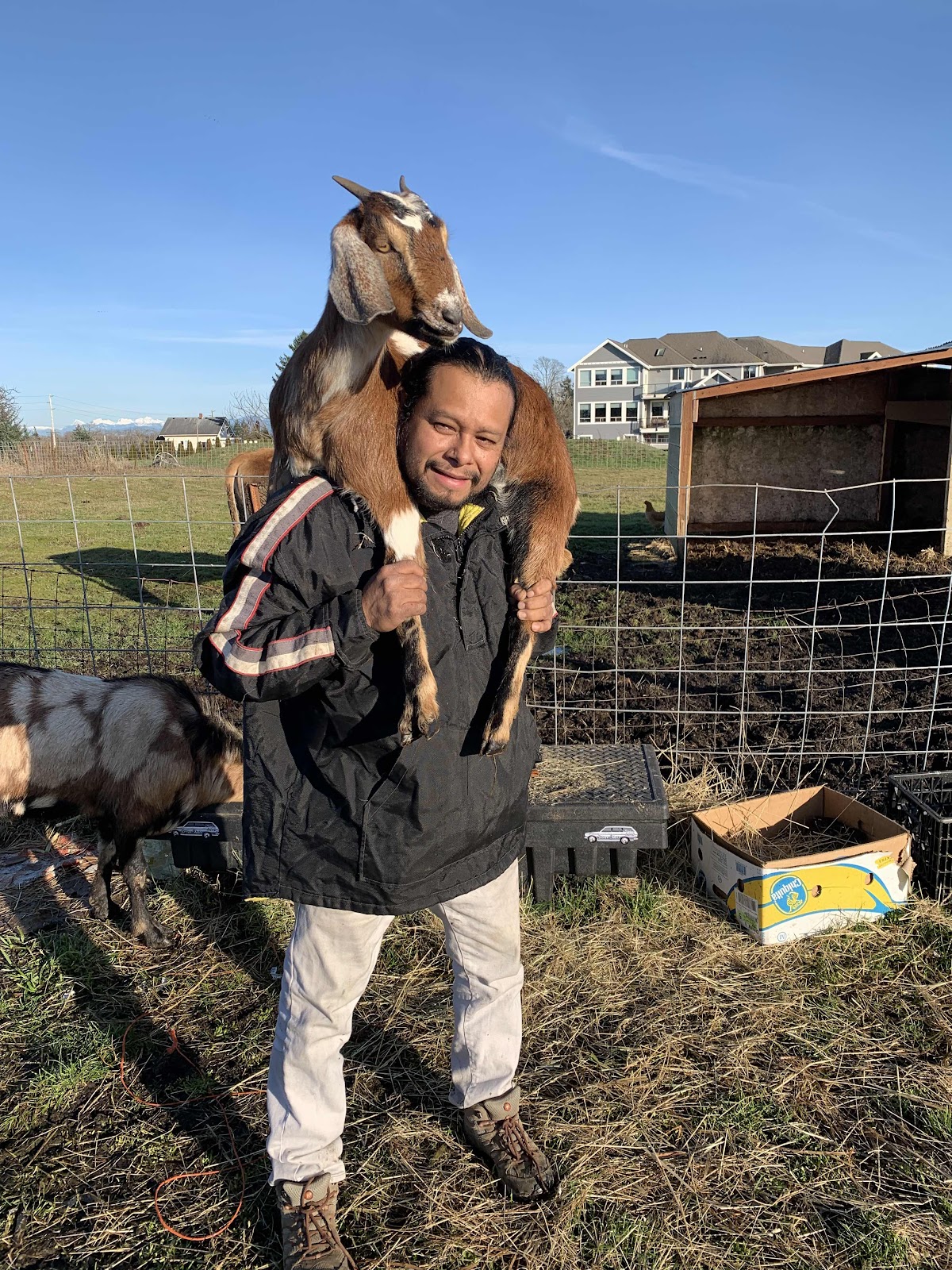
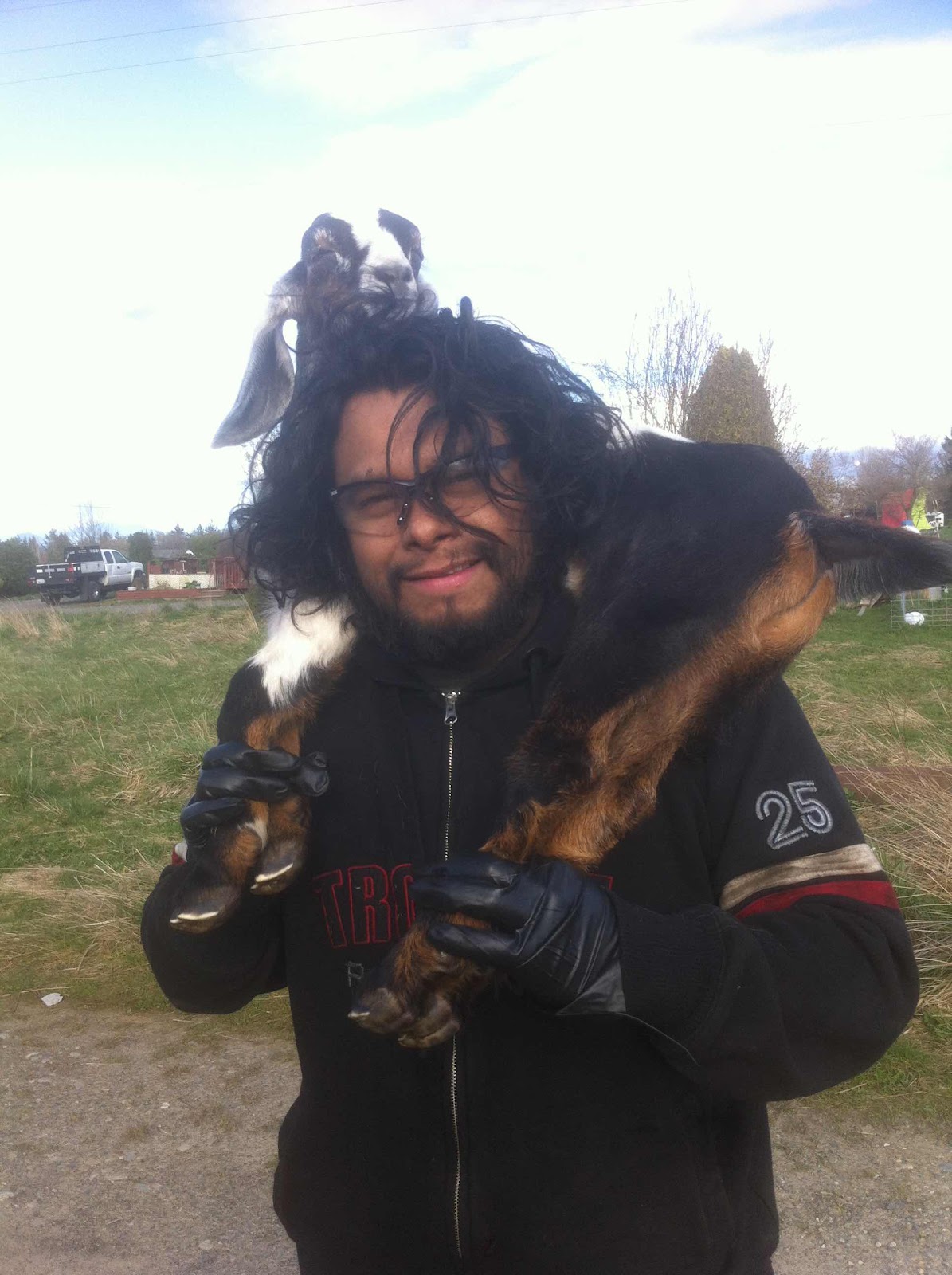
Meanwhile, here’s a few pictures of Homero toting goats. 


With Cleo, 2022


With Bitsy and Bootsy, 2020


 With a goat whose name I can’t remember, 2017 (?) 

Thursday, October 28, 2021

Monster Squash 2021 (Count on Cucurbits)

My mother used to say there were only two things for certain in this world - death and taxes. But I know there is another - that every year volunteer squash will grow out of the compost pile. 

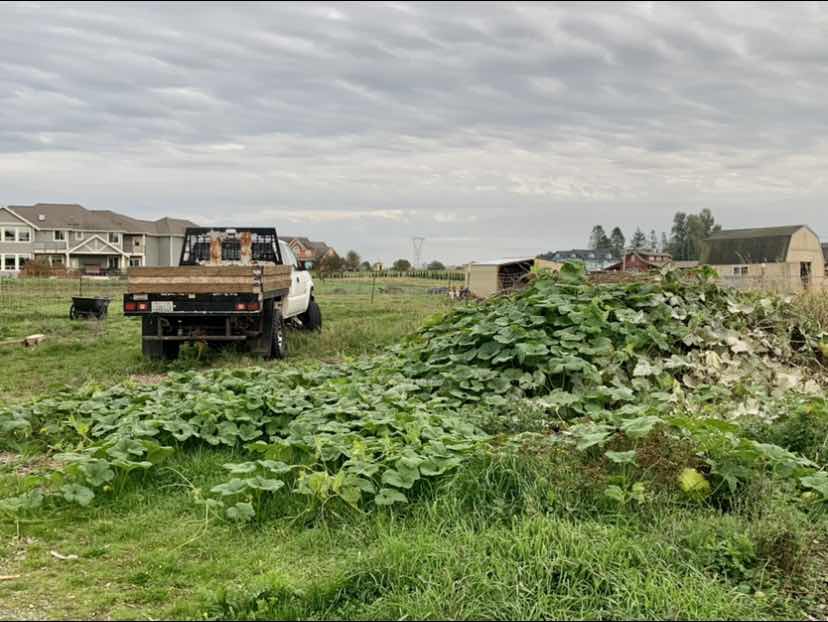
It’s so funny, I don’t usually have much luck trying to grow winter squash on purpose. The plants get powdery mildew, or they are poorly pollinated, or they get blossom end rot. But lo and behold the vigorous vines that sprouted this year from our discarded supermarket squash seeds:


There are actually three separate volunteer plants in that picture, and together they cover a good 500 square feet. All of them bore copious fruit, but unfortunately since supermarket squash are mostly hybrids, none of the three distinct varieties of fruit they bore was good to eat. 

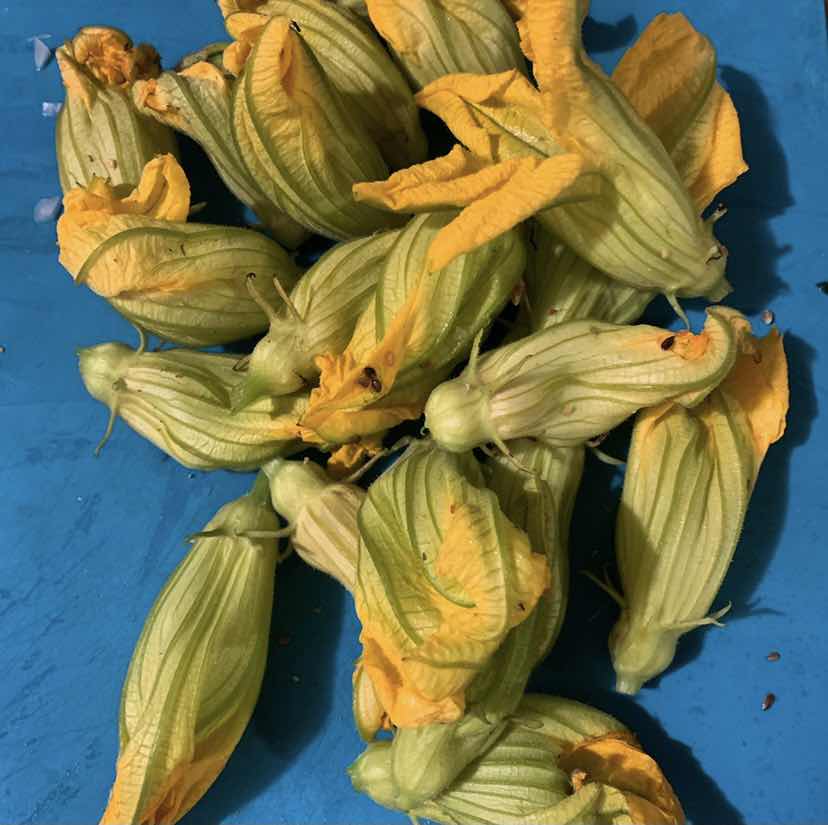
As varied as squash fruits are - that is to say, infinitely - squash blossoms are uniform. All squash plants, be they winter or summer or of unknown provenance, produce lovely yellow trumpet shaped flowers that are delicious. 

We like to tuck the fresh raw flowers into quesadillas, but they can be prepared in any number of different ways - one Italian preparation is stuffed with goat cheese, battered and fried. They can be added to soups or just sautéed in butter. 

Since we didn’t care about the inedible fruit of these particular plants, we picked both the male and female flowers, but if you are growing squash to eat just pick the male flowers. They are easy to tell apart because the male flowers grow in tall stems and the female flowers stay stuck close to the vine. Remove the pistils; they can be bitter. And always check for bugs! Our vines were still producing flowers last week, in chilly late October. 


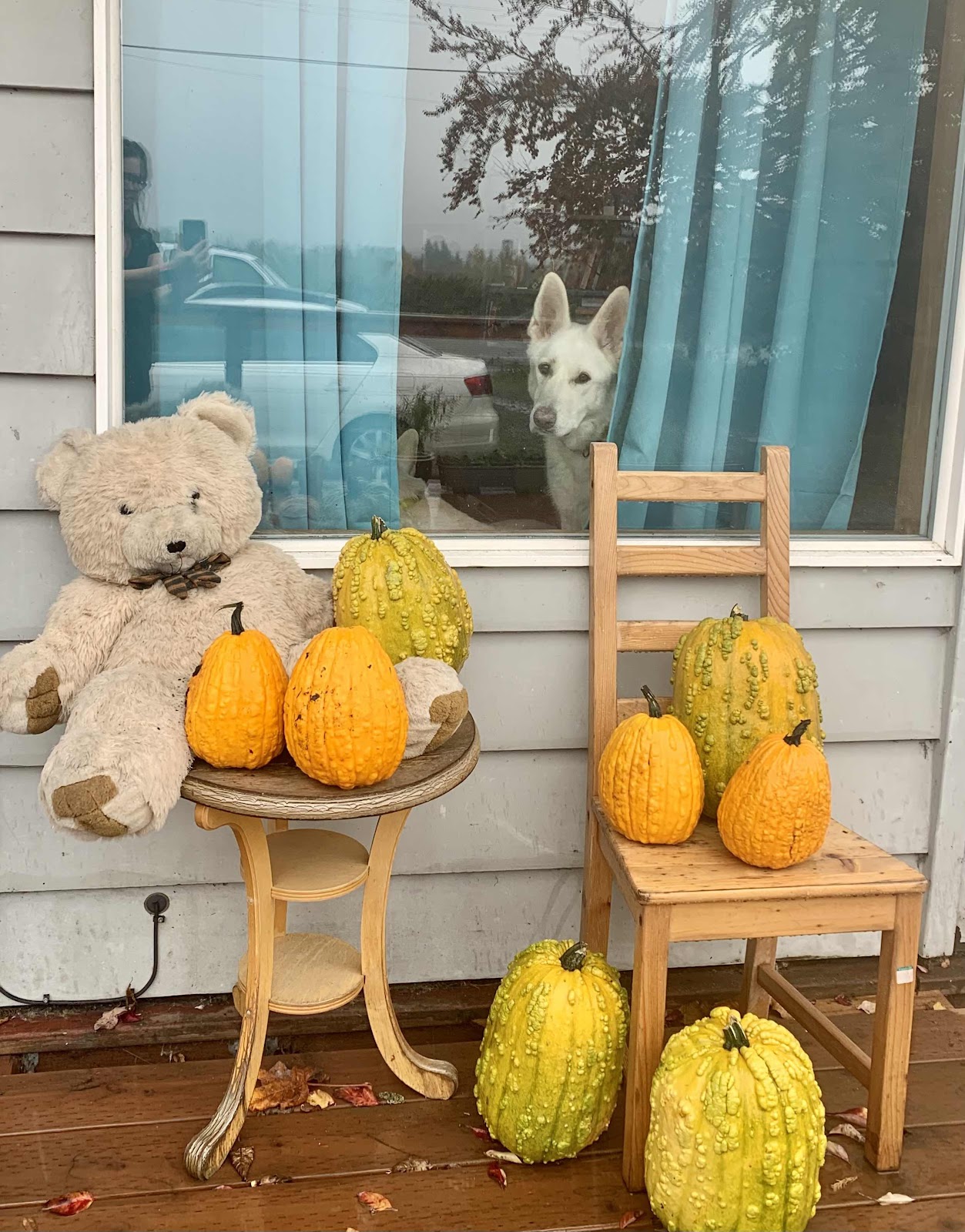
Although inedible, this year’s gourds do make a fine halloween porch display. There are many more that are not pictured here. One gargantuan vine produced more than a dozen of the huge warty gourds - probably well over 100 pounds of squash. 

I am not certain if the seeds of all these squashes are edible or not. I believe they are - I never heard of a poison pumpkin seed - but I should probably look it up to be safe before I decide to roast all the seeds after Halloween. 

Mercy is in the window. 


Thursday, October 7, 2021

Farmer’s Swap Meet (Fall Harvest)


A neighbor of ours, a friend who started out as one of Homero’s clients, started a farm a few years ago. She raises medicinal plants of all sorts and makes them into tinctures, salves, ointments, and decoctions. She started just two or three years ago with a weedy patch of ground and now has a lovely three acre medicinal plant garden. 


Last month, she decided to throw a swap meet for all her local friends - mostly farmers but also bakers, artists, musicians, and people with skills of various sorts. I was super excited to be invited - a decade ago I did the same thing, hoping to make it an annual event, but alas there was only one September Swap Meet and Jamboree on our farm. 


Deciding what to bring was half the fun. I didn’t know what might be available to trade for, so I didn’t worry about that and just brought a little of everything, hoping to hold my own and put on a pretty spread on front of my farming peers. 

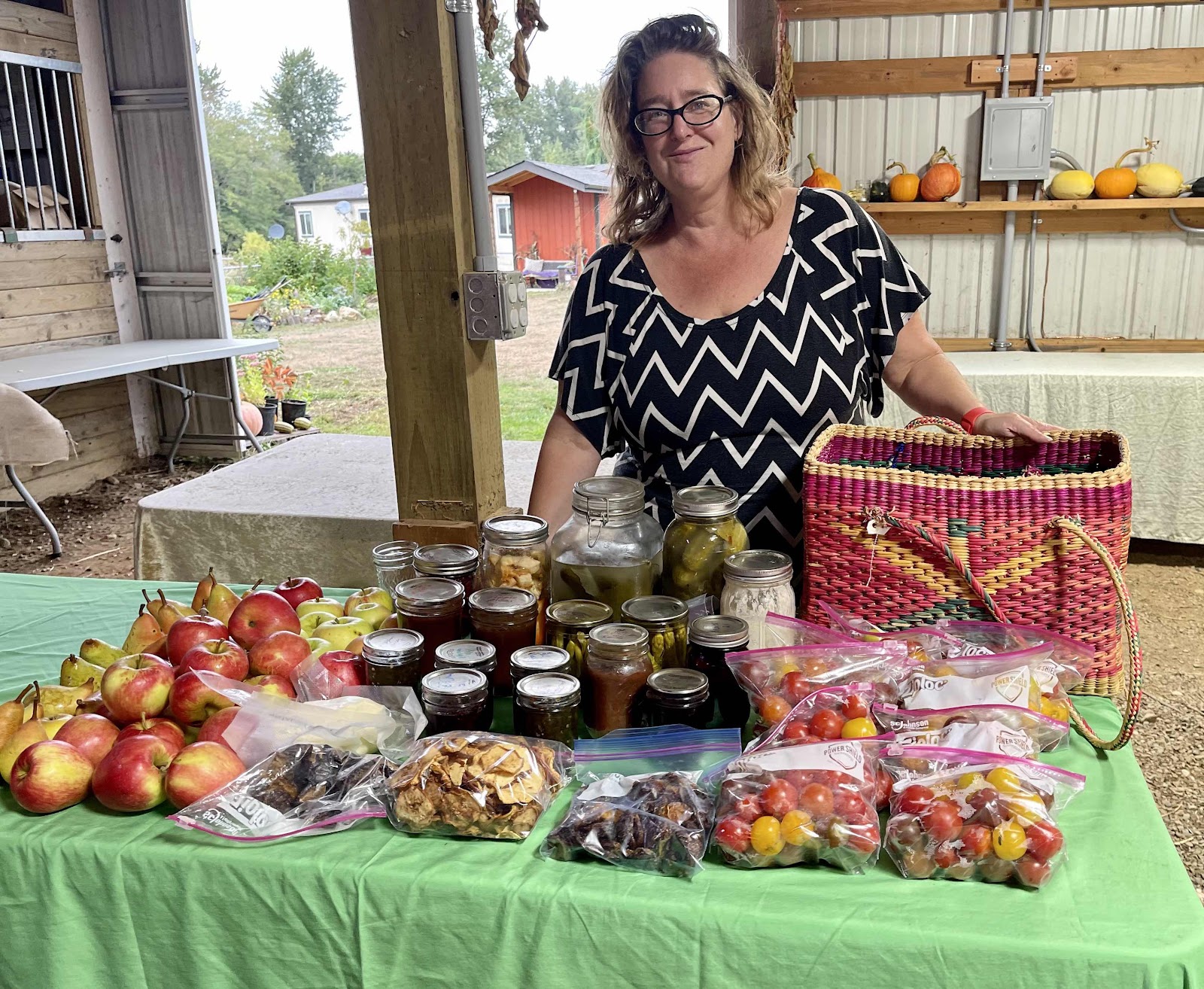
We had lots of fruit from our trees - Italian plums, pears, and apples - both fresh and dehydrated. And just the day before Gleaner’s pantry hosted a farm glean for organic cherry tomatoes, so I had a ridiculous number of gorgeous cherry tomatoes in various colors. I also brought a selection of ferments - some caraway kraut, some kohlrabi kimchi, and some sourdough starter. 

I rounded out my section with a bunch of canned goods from the pantry. Admittedly, some of it was weird stuff from years last that didn’t get eaten, like my “spicy mixed stone fruit chutney” and some apple-plum butter. But I also brought a whole bunch of freshly made blackberry jam and pickled asparagus and dilly beans. Oh, and a two pound wheel of cheese. 

There was also a potluck, which was delicious. I brought lentil soup with bacon from our pig, and a big sourdough bread made with the same starter I had brought to swap with. 

We came home with a lot of stuff. Two or three different salves and some lip balms; tomatillos; raspberries; eggs; a carved wooden kitchen spoon, a fancy bottle shaped like a skull (which I think started out filled with tequila); a load of firewood; and a dehydrator. 

It was a great day. I got to meet lots of my neighbors and fellow farmers. Most of them were considerably younger than me, but it’s nice to be slowly morphing into a kind of elder in the community. I got to show off a little bit - my table was definitely one of the more diverse and well-frequented. And Homero and I got to wander through the beautiful garden eating raspberries and holding hands. 


Monday, August 16, 2021

Meet the Greengage (Bears and Plums)


When we first moved here, in 2007, I knew the first thing I wanted to do was plant some fruit trees. The property had been a dairy farm before it was chopped into five acre parcels and sold off, and our parcel was the one with the original farmhouse on it, and where the dairy barn had stood before it was razed. There were few trees and a lot of bare earth. In my mind, an orchard is an indispensable part of any homestead, so I started doing some research.

Fruit trees are not as easy as people think - they are really rather finicky and delicate, for the most part, and need to be carefully chosen for the site. One needs to take into account not just the zone you are in 
(We are 8a - you can look up yours here) but also your microclimate and factors like drainage and soil composition. I have a very cold, windy microclimate and sandy, gravelly soil. Not really ideal. However I also have full sun all day long and  more than adequate rainfall.  While I was looking for information about varieties that might do well on my farm I found this amazing web site: Trees of Antiquity

Trees of Antiquity is devoted to propagating and preserving heirloom varieties of fruit and nut trees, and their experts will happily chat with you on the phone about your specific needs. They also have a terrific catalogue which arrives in the dead of winter and provides hours of entertainment in January, when I am likely to have exhausted all the interesting options on Netflix. 

After extensive consultation, I chose several trees - three varieties of apple including one cider apple (a golden russet); three cherries (Bing, Rainier, and one named Sam), three pears (really too many pears, nobody needs three pear trees but I'm glad I got the Comice, they are the best pears EVER. I forget what the other two varieties are) and two plums. One is an Italian plum, which are purple on the outside and golden on the inside and delicious. That tree bears an alternating light/heavy harvest, but always as many plums as we can eat or possibly use. 

The second plum tree I chose is a greengage plum. Greengage plums are a very old variety, believed to have originated in Iran, and first introduced to Europe by the royal gardeners of 16th century France, who named it the Reine Claude. You MAY have seen greengage plums once or twice in a particularly well-sticked grocery store, but they are not generally available because the trees are not well suited to profit driven agriculture. They take a decade or so to begin bearing, and then they only bear good crops every two or three years, with very scant or absent crops on the off years. 

My tree has a perverse tendency to bear only in years when we are spending the summer in Mexico. I have only had three good harvests off this tree (which I planted in 2008. The first was in 2016, when we first discovered the unearthly deliciousness of these plums. Their reputation as the queen of plums is well deserved. We gorged ourselves and eagerly anticipated the next harvest. In 2017 there were no plums. In 2018 we could se it would be a goof year, but alas, we were spending the entire summer in Oaxaca. 

I told a friend of mine to please harvest the plums, and she did. She texted me to thank me and said "oh by the way, there has been a bear in your orchard. I saw bear scat." Normally, I would probably pooh-pooh a pronouncement by a friend of mine that they saw bear scat, but this particular friend grew up in the Yukon, and I trust she k owe bear scat when she sees it. "don't worry about it," she said, "your goats are safe. He was here for the plums." A year or so later, while we were beating about the bushes looking for a lost turkey, we found the place where the bear must have come in. A heavy-duty galvanized cattle panel was crumpled up from the ground, bent and twisted and lifted a good three and a half feet from the ground. We hadn't noticed because it was in an area of very thick brush. As far as we know, the bear hasn't been back. 

Maybe the bear hasn't been back because the tree hasn't fruited again until this year. In late spring, I could see the tree was absolutely loaded with small fruit, and that this would be the best year yet. And once again, we were planning to be in Mexico from mid July through mid August. I lamented the fact that we would probably one again miss out, and told my friend to come on back, and watch for bears. But luckily, when we returned a few days ago, the plums were just beginning to ripen and fall. 

They are just as good as I remember. So sweet - the sweetest fruit I can think of, sweeter than peaches. They are beautiful, too, green with glowing yellow and pink blushes. There is probably no better way to use them than to just eat them out of hand until you can eat no more. But because there are so many, I need to find some other things to so with them. 

Things to do with greengage plums, after eating yourself sick:

- dehydrate them (greengages are a freestone plum, so very easy to prep and dehydrate)

- make a shrub (cover a quart or so of chopped fruit with sugar and let macerate two days in the fridge. Add apple cider vinegar to make a concentrated, sweet-and-sour fruit flavored syrup. Pour over some ice cubes and add sparkling water, with or without a jigger of spirits)


- jam, as a last resort. Perusing some recipes suggests vanilla as a flavoring. However, we also got home in time for peak blackberry season, so my jam needs will be well-met. 

Small rant to end this post: The world has lost some vast and depressing percentage (I've heard everything from 30-75%) of its heirloom varieties of food plants. The wonderful diversity of food plants not only provides us with a spectrum of tastes and nutrition, but is also essential for food security. Different varieties of the same species have differing resistance to pests and diseases and different abilities to thrive in varied climates. This isn't academic - with climate change we need ALL the varieties of ALL the food plants in order to feed our hot, crowded planet. 

There are many seed houses and orchardists devoted to preserving these wonderful old heirloom varieties. 
It's worth seeking some of them out and supporting their mission. You'll eat better and sleep better :)


Thursday, May 13, 2021

Scrumptious Scraps


I don't have any work appointments today, so it's "get stuff done" day. Although it's a gorgeous day outside, the inside of the house is what needs attention. I've already washed the dishes, done the laundry, cleaned the kitchen (okay, half-cleaned), and gone grocery shopping. Grocery shopping means I have to clean out the fridge and make use of the older produce to make room for the new. 

After throwing all the really old produce into the piggy bucket - we will have happy piggies later today - here's what I was left with:


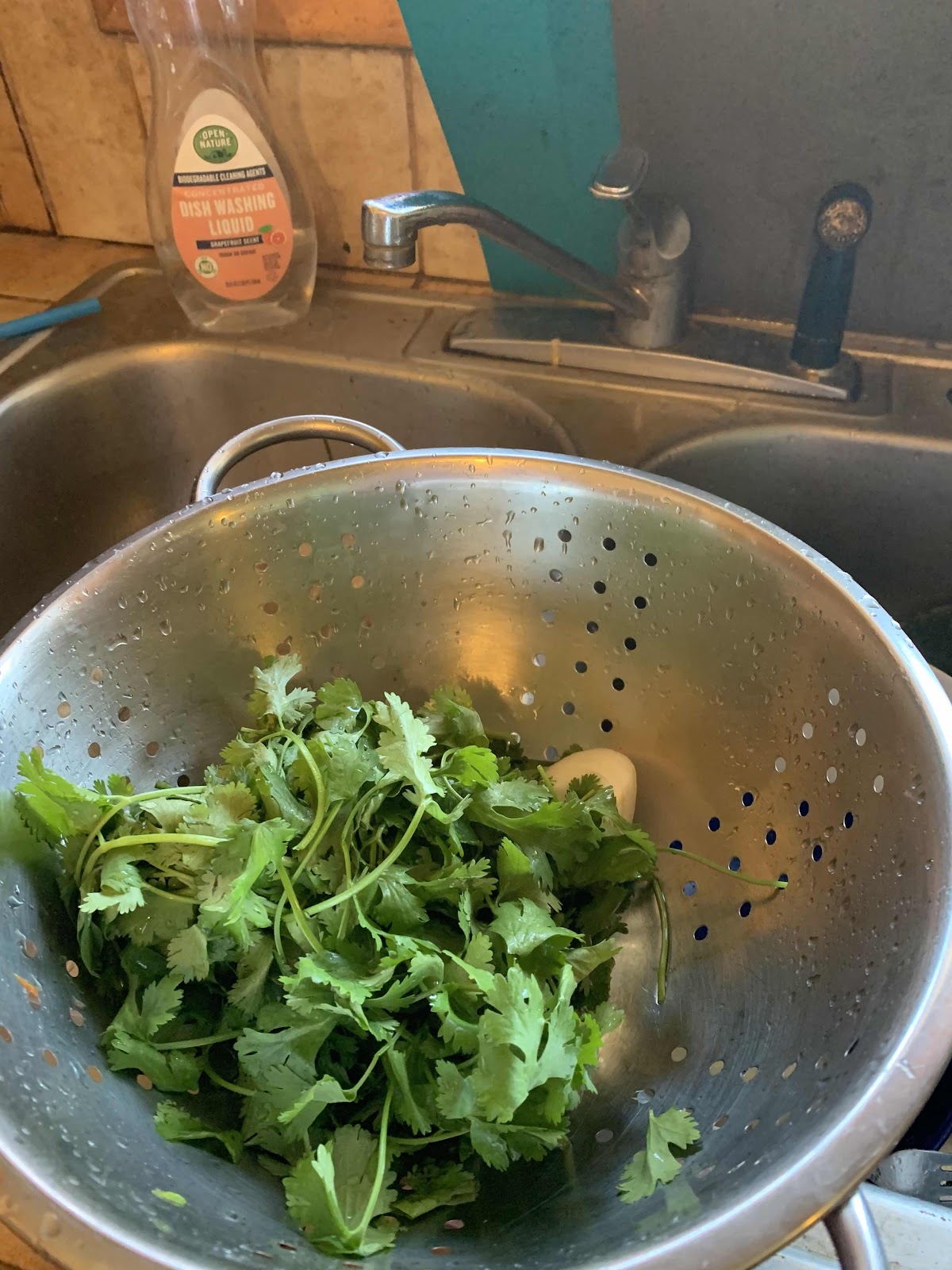
A whole lot of cilantro


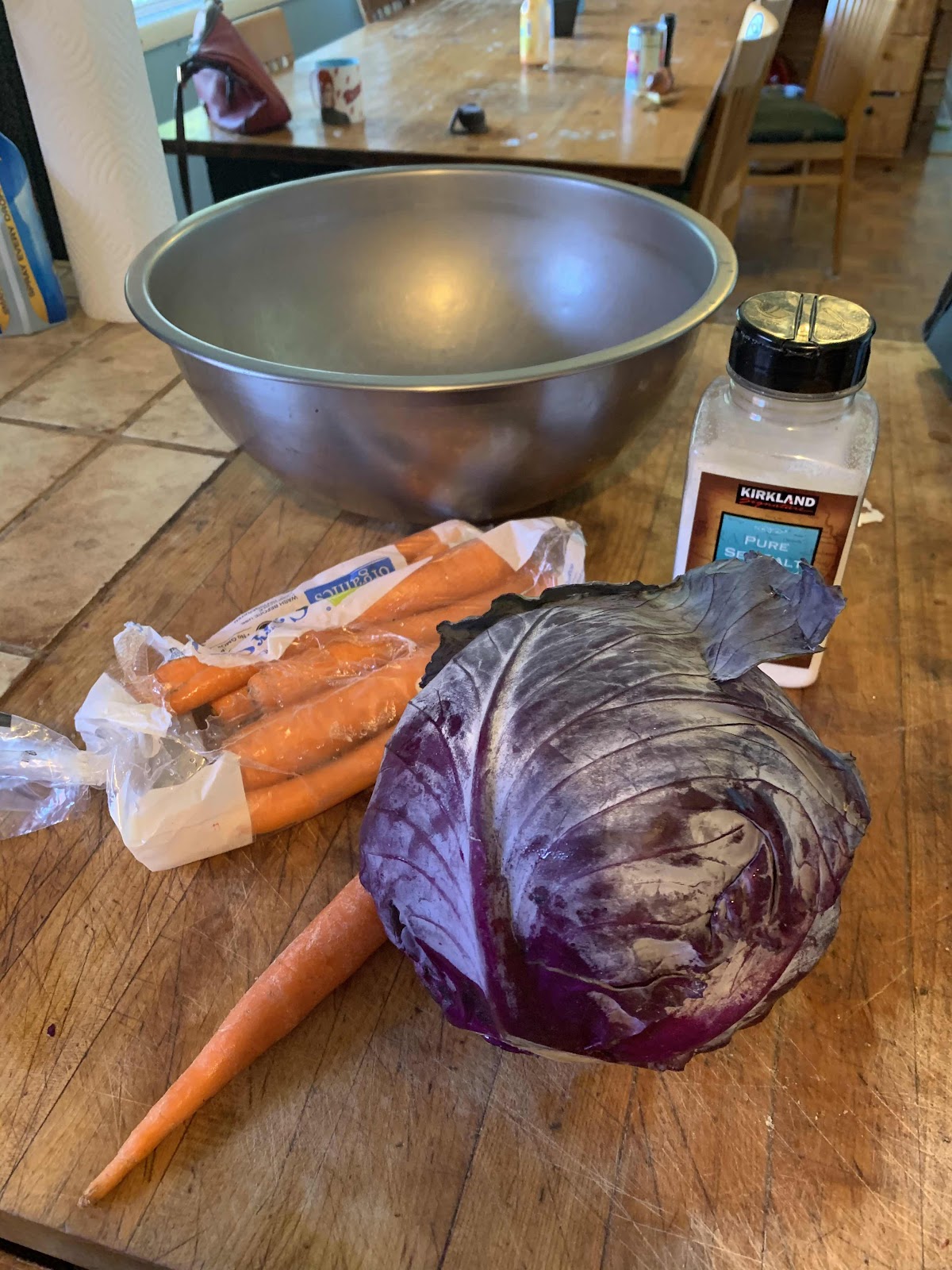
 a head of organic purple cabbage and a fair number of carrots. Not pictured, several Serrano chiles and a half a head of garlic. 

Looks like a good day to make a few ferments. I will make cilantro chutney by blending the cilantro with the chiles, a white onion, a knob of ginger, and a heaping teaspoon of salt. That will go in the fridge and be available as a fresh dressing for anything vaguely Indian. I have leftover mashed potatoes so maybe I'll make samosas tonight. 

The carrots and cabbage will, of course, become sauerkraut. It's a little unusual to have such a high ratio of carrot to cabbage, but I'm sure it will taste fine. I will just grate the carrots on the largest holes of a box grater, shred the cabbage as thinly as possible, and toss with 2% salt by weight (which I estimate). pack into large glass or ceramic jar, pound down firmly until the natural liquid covers the vegetables. Put something on top to keep all veggies submerged - I use a plastic bag and a glass weight. 

At room temperature - about 67 these days - the kraut will take several days to get nice and tangy on the countertop. After that it keeps indefinitely in the fridge. 


Friday, May 7, 2021

Animals Behaving Badly (Escapes and Attacks)


We had an exciting morning around here. It started off nicely enough; I was sitting at the kitchen table around nine am having coffee with my husband, and we were enjoying the fact that our children are now in high school and get themselves off to school without even waking us up. The sun was out and it looked like it was going to be a nice day. 

Then our neighbor called. 

"Your cow and the pigs, they are over here on my side of the fence," he said. So we jumped up from the table, ran around looking for ropes (to lead the cow) and stale bread (to entice the pigs) and headed outside. The animals were indeed just on the other side of the fence, on the east side, near the orchard. Luckily, there is a cattle panel on that side that is just attached with carabiners, which we had done in order to let our neighbor come through on his tractor and pick up compost for his garden. So it was fairly easy to open the fence and chase the animals back in through the gap. Except for the Kune Kune pig, who had apparently decided he wanted to run away and join the circus. 

I assumed we had a breach in the fenceline somewhere along the eastern side of the property. Pigs will test fences and push cattle panels up off the ground and go under,  or detach them from the t-posts if, as is there case at our house, they are but loosely affixed with baling twine. So once the animals were all back in the main pasture, Homero grabbed some zip ties and got on the ATV to inspect the fences, and I went back inside to finish my coffee and peruse Facebook. 

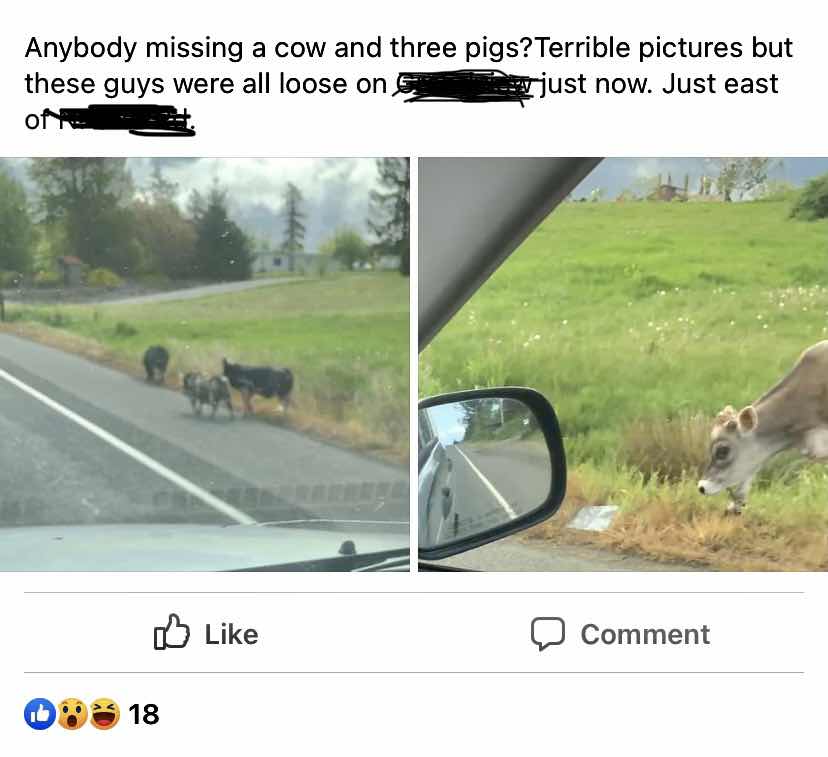
Where I saw this:


Shame!! Shame and embarrassment! Animal escapes are always entertaining unless they are your animals. It's bad enough that people know my animals were out, but the fact that they were actually wandering along the state highway was worse. Tanker trucks blast by at 60 MPH and we live on top of a hill with a very short sight distance. Only blind luck prevented a terrifying accident. Oh well - all's well that ends well, and at least somebody driving along got a giggle out of it. As it turns out, there was no breach in the fenceline (although we do need to do some maintenance). The chain holding the main gate shut had broken. Probably secondary to a couple of big pigs pushing on it. 

Then, when I went back out to feed everyone, the black rooster attacked me noiselessly from behind and gouged two good sized holes into my thigh, right through my skirt. I never saw him coming. It was like being hit by a very small meteor. He's always been a vicious bird. I think I'll have Homero wring his neck and make a fan out of his very beautiful, glossy black evil feathers. 


Sunday, April 11, 2021

First Fire (Carne Asada)


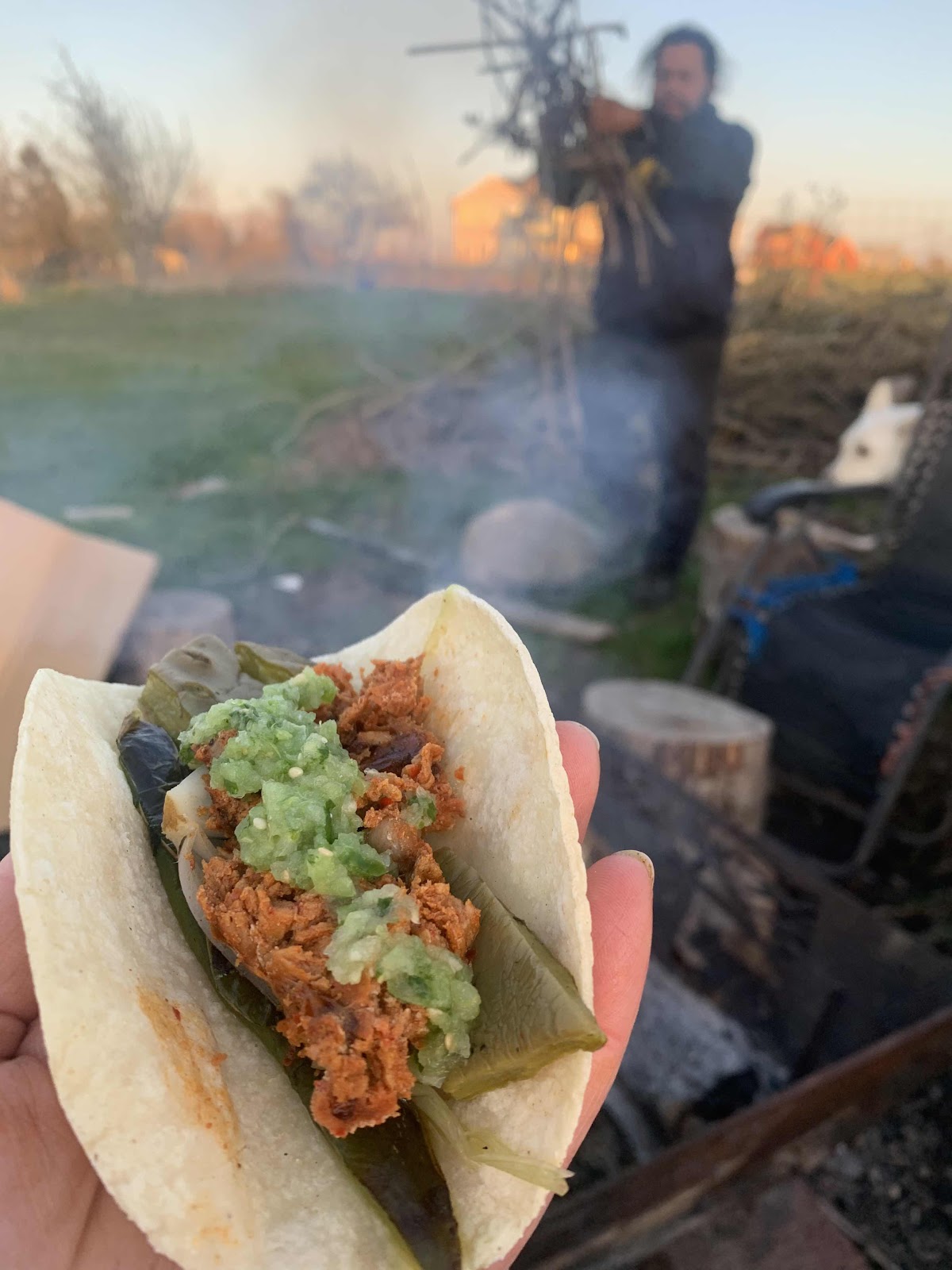
Built a fire this afternoon and had a carne asada, just for us. It’s still cold, but the sun was bright and tempting. I just took the oven rack out to the fire pit and laid it over the coals. Nopales and spring onions, tasajo, and a bit of fresh chorizo. I whizzed up a quick raw tomatillo salsa in the blender, heated up tortillas, and brought out the quesillo I made last week. 


Saturday, April 10, 2021

Yard work (Before and After)

This past week, the first week in April, has had typically schizophrenic weather. Bright sunny days alternate with gloomy, freezing days - and the occasional hailstorm thrown  in for fun. 

Last night there was a windstorm that blew frigid air into the house under the doors and -seemingly- right through the windows. But this morning dawned bright and clear, and warm enough that I felt like working outside.  It was cold, but not so cold that a few minutes with a hoe wouldn’t warm me up. 

The farm is a mess. I mean, it’s always a mess, kind of, but in early spring the accumulated detritus of winter really stands out. There’s work to do anywhere I rest my eyes. Today I decided to spend the day doing something about it. 
Turns out, “a day” for me means about four hours, and that right leisurely. Nonetheless, I did manage to make a noticeable difference. 

I cleaned up two small garden beds, each about two by ten feet. I dug out the buttercup and the grass roots, raked, and brought over fresh compost from the pile. I had a few plants in pots I wanted to get into the ground, so in one bed I planted a sage plant and some lemon thyme, and in the other I sowed scarlet runner beans. 


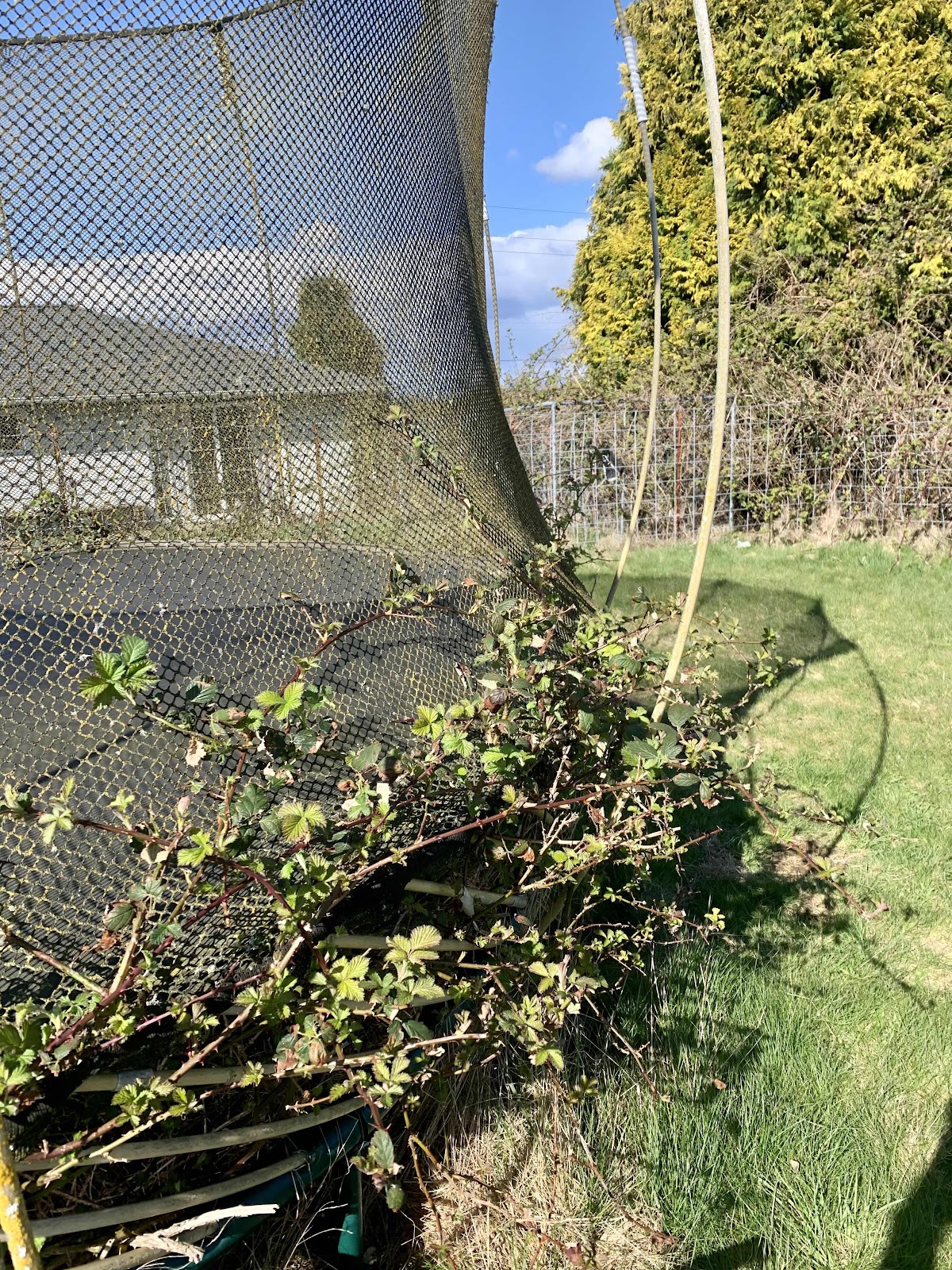
The trampoline has been overrun with blackberries over the last few years. It took me a solid hour with a pair of pruning shears and a pair of gardening gloves (not thick enough - need leather) to get it cleaned up. 


The cut blackberry vines went over the fence into the hot yard, where the goats were very happy to see them. There are still blackberries growing underneath, but I can’t get at those without loving the entire trampoline, which is staked down against the wind. That will have to wait. 

I did a good enough job for Paloma, anyway. 


Saturday, March 20, 2021

Notes from the Year of the Pandemic (Spring Equinox, 2021)


So far, spring this year is cold. There was a week of warm sun sometime in early March - there usually is - that tempted me to start shoveling some dirt into a wheelbarrow and laying down cardboard in the garden, but it was only a tease, and the frost returned as expected. I knew it would, of course, even as I stood on top of the compost pile in my shirtsleeves, shovel in hand. I'm slow but I do learn. 
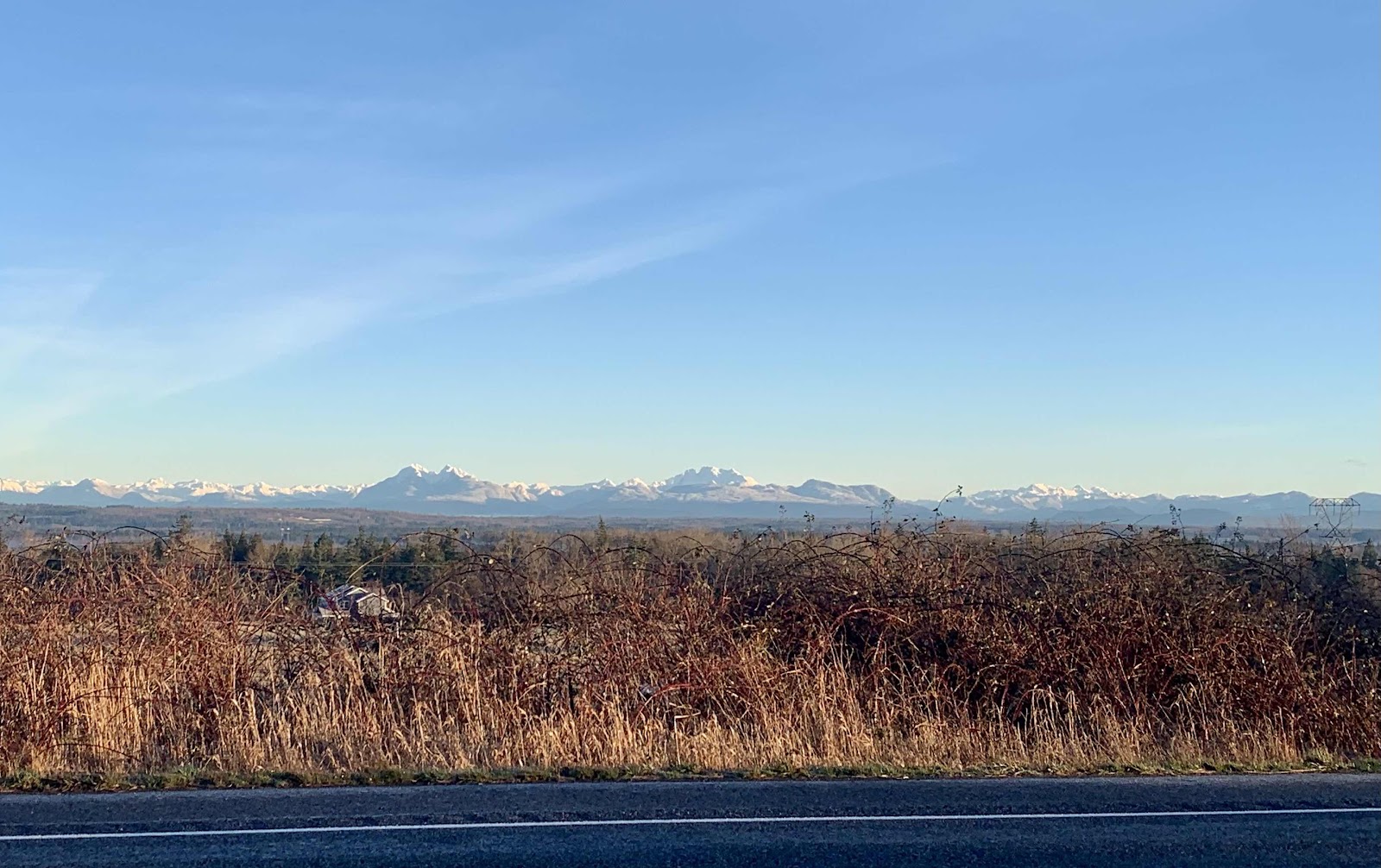


The awareness that the warmth on my shoulders was the product of a small, false spring didn't matter. When the sun shines in March in the far Pacific Northwest, and you live on a farm, you get outside and you pick up a shovel with as much thought as worms have as they come to the surface when the ground thaws, as much as chickens who start to lay when the days lengthen, even though the eggs may freeze in the nest boxes overnight. After a Northwest winter, especially this last one which threatened to draw a final dark curtain across so many lives, you take your lumens while you may. Get out in that thin wind and squint, and take off your coat, and shiver, and give thanks.

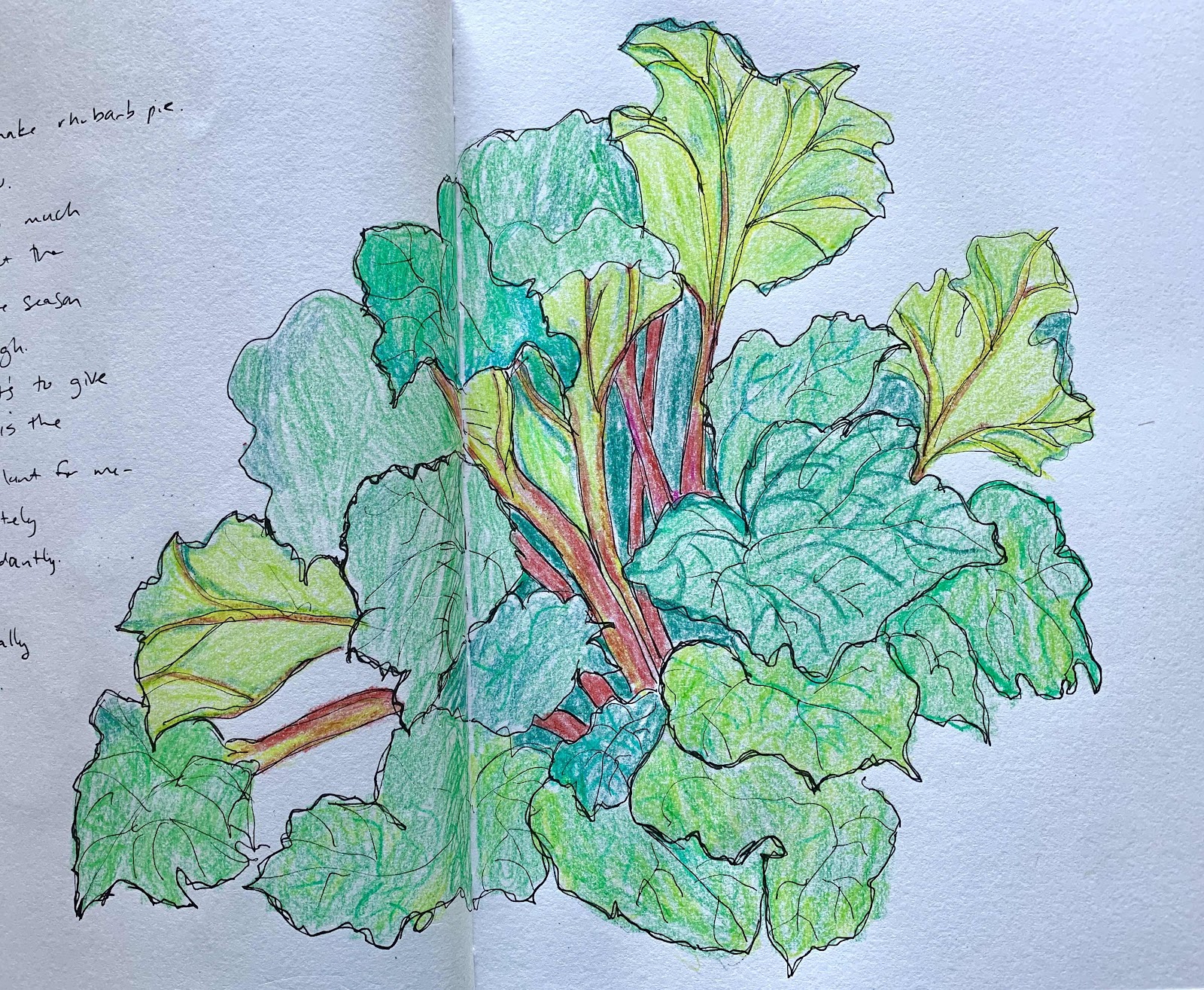
It was a bad winter. In so many ways. Last spring, when the pandemic was just ramping up and we didn't know how long it would last, we made jokes about lockdown lasting a whole month, and we distracted ourselves with the rites and tasks of spring on the farm. I took up an old habit and carried a sketchbook around the property, drawing leaves and bugs and chickens. Like everyone else, I put in a big garden. I bought mountains of craft supplies for the girls and we all planned the ways we would enjoy ourselves and better ourselves and learn things and have fun together during this time of enforced togetherness. We were optimistic, if not about the course of the pandemic then about the possibility of our own growth and development during it. Like healthy people everywhere, undamaged people, people who know not what lies ahead, we embraced the imagined challenge of joy in adversity.



And I'm not saying none of it happened. We did stuff. The craft supplies were used to make crafts. I taught the kids to play cribbage and rummy. We took to going hiking on Sundays as a family and discovered beautiful places we'd never gone before. The garden did pretty well and many vegetables were fermented, and many loaves of sourdough were baked (yeast being in short supply). The farm produced, as it does every summer, a crop of beauty and fun in the form of baby goats and baby chicks and, this year, baby guinea hens. For months, the work of the day was sufficient thereunto, and we were more or less content. 


Then fall came, and school did not start. Life refused to return to anything approaching normal. Milestones passed uncelebrated. The new systems that were hastily constructed to replace the old, now-impossible ways of doing things were confusing and inadequate. We were all sick of the sight of each other. The stress of waiting to get sick was making us sick. The uncertainty -the total, global uncertainty - was wearing us all down. Would Hope be able to apply to colleges? Would school sports ever happen? Would we ever be able to have a birthday party? Would ANYTHING ever be NORMAL again? Time seemed more meaningless by the week, and I stopped updating the altar or looking forward to seasonal celebrations. 

It was especially hard to keep our spirits up after the string of disasters among the animals. The problem of multiple drug-resistant parasites with my goats has gotten worse and worse, and my veterinarian has basically thrown up his hands. First baby Stormy died, then Flopsy. Trying to medicate Lilac - out of desperation, as all the medications we have tried have utterly failed - the plunger slipped in my hand and I accidentally gave her a fatal overdose. This was especially awful, as Lilac was young and healthy and I expected her to be the star of the next generation of milkers. Polly and Christmas are looking thin and unthrifty and there's not a damn thing I can do about it. All I can do is keep them all contained in the sacrifice area, where there is nothing to eat, and feed them (presumably parasite free) hay. I am terrified I will simply have to watch them all die slowly, one after another. I can't sell any babies, should there be any, because I can't ethically export these awful worms to other farms. Paloma is not even looking forward to baby goats this year, after she fell in love with Stormy last year and lost him so soon.


An entire clutch of newly hatched chicks drowned in a waterer. 

Thirteen out of fourteen baby guinea hens failed to survive. They just disappeared one by one over a few days, and by the time we could catch the mother and remaining babies there was only one left. 

Gucci, Hope's beloved ferret, got tumors in the belly and had to be put down.

Turning our attention away from the farm to the outside world was little solace; the news was full of death, disaster, riot, war, idiocy, and fear. Fall was scary and long and dark and cold, and it often felt like the whole damn world was going straight down the shitter. The election was a bright spot of blessed relief, but the period between November 3 and January 20 was nerve-wracking.  Every day threatened rampage and disruption on a scale unimagined in my lifetime.

Now I've just been sitting here staring at the screen for five minutes. Then what? Then it was winter. We lived through it. It was not so awful for us, really, not compared to so many others. We had work. We didn't get Covid until January, and when we did it wasn't so bad, thank God. Homero's oxygen dipped down to 89 a few times and that was scary, but they put him on prednisone and gave him an inhaler and he was fine. I had awful chills and couldn't stay warm. I would shiver and my teeth would chatter while submerged in a hot bath. But it only lasted about ten days and we have almost totally recovered. I get winded quickly, that's all. Everyone should be so lucky.

There was a pretty good snowfall in February - 18 inches or so, enough to entirely transform the landscape and bring a welcome intermission from the tedium of rain and mud. My kids no longer play in the snow much, being in their high teenage years, but the dogs do. 


I don't know what I'm going to do next. Im staring down the barrel of empty-nest-hood. Hope did apply to colleges, and she will go away next fall, to one or another of them. Paloma is only two years behind her. Sports did start, and both girls have evening practice most nights. They have jobs on the weekends. They  drive. They kiss me and say "goodbye, mom!" and go see their friends.  I cook too much food, and nobody eats it. Well, the pigs do. 

Will nothing be normal ever again? No, it will not. Not for me. Normal is little girls blowing dandelion clocks on the lawn; normal is shiny baby goats bouncing across the field. Normal is reading bedtime stories. Normal is being able to make it all better with a kiss, and having answers to all their questions, or at least them believing I do. Normal is a memory now.
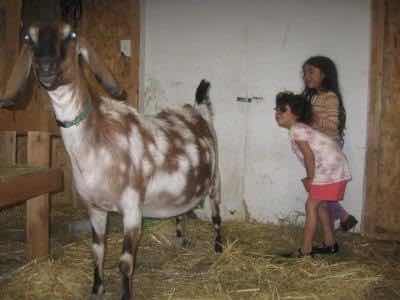


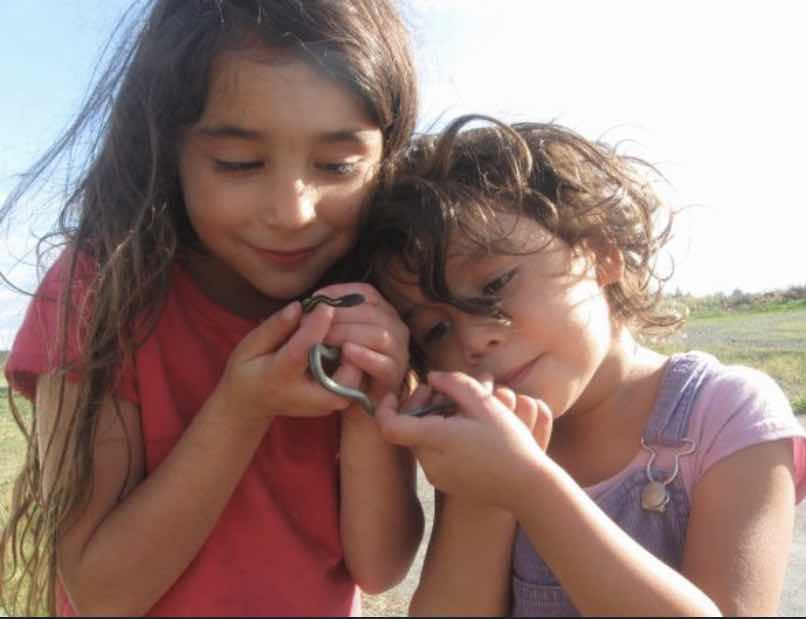


It is the equinox today. Winter is passing away and Spring is on the verge of emerging. The year of the pandemic - godwilling - is over, but I cannot see what is coming next. Like the planet, I am balanced on the knife edge of a new season. Be gentle with me, spring. I'm getting old and I'm slow, but I learn if you give me enough time.