"United we bargain, divided we beg."

Monday, May 30, 2022

Herb Harvest 2022


Mint is one of my favorite herbs, not only for its zingy flavor and medicinal qualities, but because it’s a hardy perennial that’s damn near impossible to kill, even for a notorious plant murderer like me. 

I have spearmint in the front yard and peppermint in the back yard. The spearmint is buried in amongst a hedge of tall weeds and I have to forage for it. This used to be the case for the backyard peppermint as well, but ever since we moved the chickens, the mint is the only green thing left. The rest of the yard has been scratched bare. 
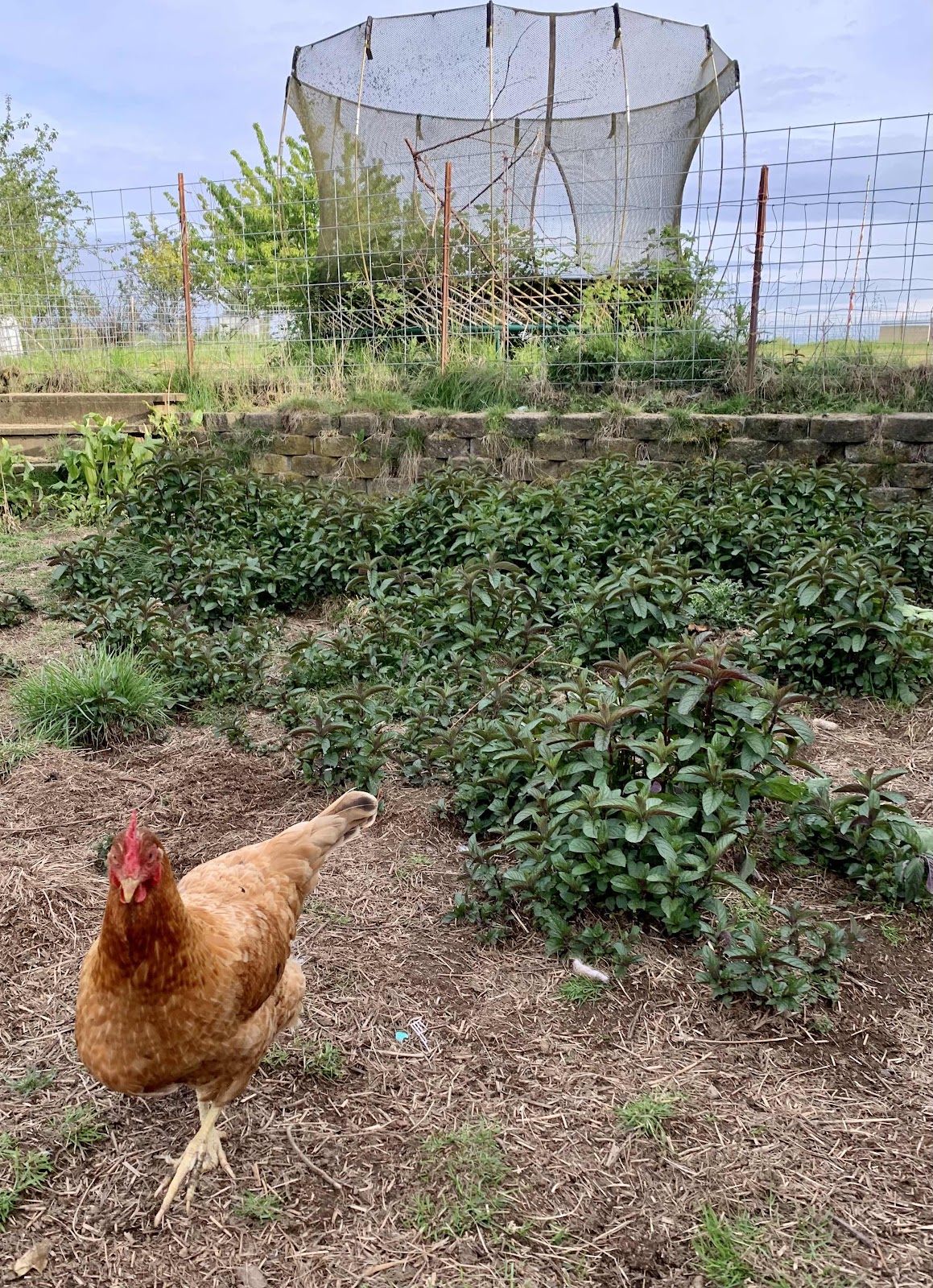


Spearmint is a lovely herbal addition to lots of dishes and we eat a fair amount of it fresh. I add it by the handful to tabouli, for example, and to fresh fruit salads, especially melons. I added some to the melange of herbs I chopped finely and added to my chevre. It even goes well into a pot of Mexican chicken soup, if you can believe that.

Peppermint is a different proposition altogether. It’s much too strong for use as a vegetable or salad green. Mine is so strong that if you chew on a fresh leaf it actually burns your mouth. It’s pretty strictly for tea. A few years ago I made some peppermint vodka, but that’s out of my realm these days. 

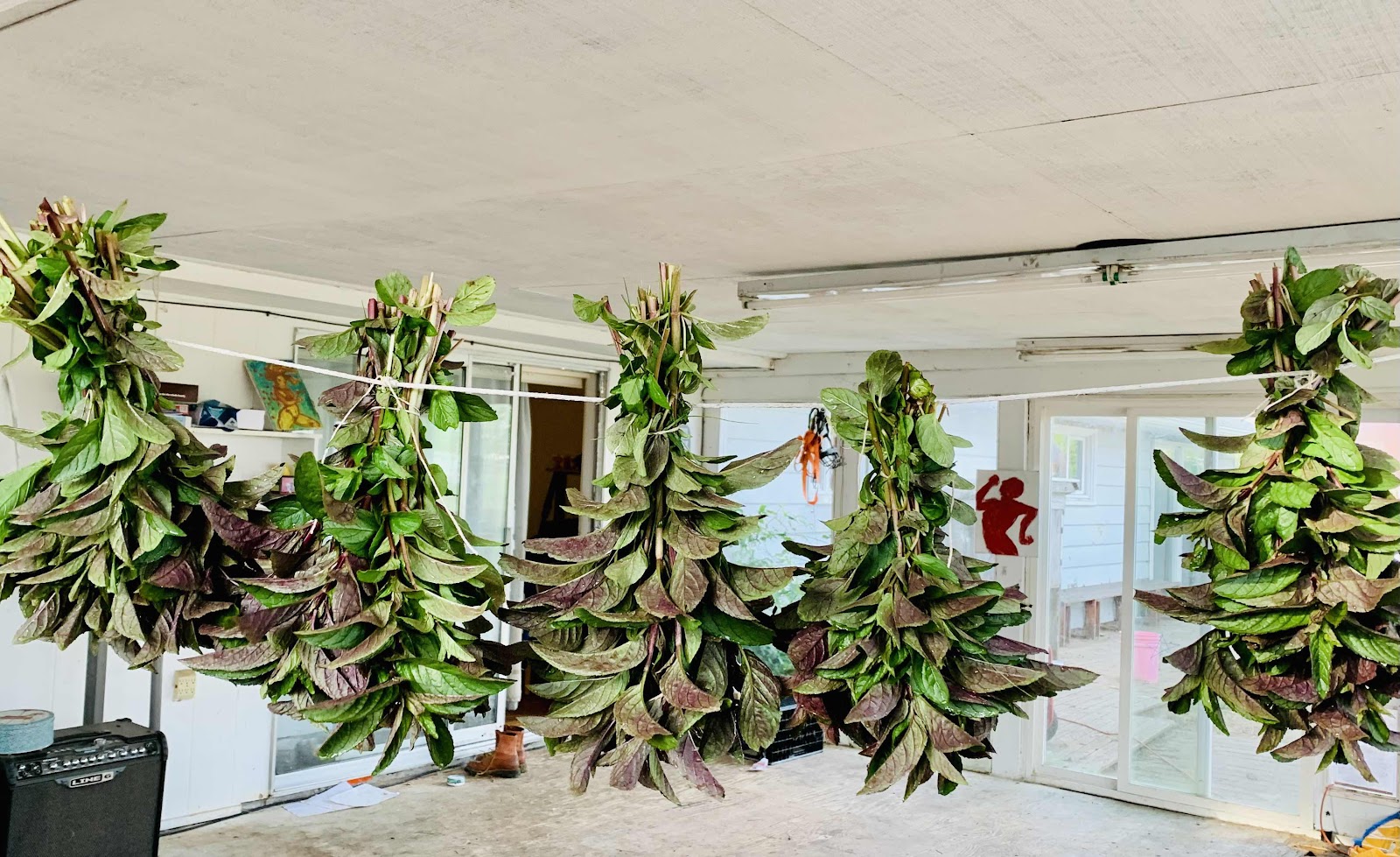
Last year I cut a couple bunches and hung them up to dry in the playroom. Then I forgot about them for an entire year. You don’t generally want to leave your herbs to dry for a whole year - most books will tell you dried herbs last a few months, maximum. However, today when I took the bunches down and rubbed the leaves off them, the scent of peppermint that wafted up was still vibrant. So I crushed them in my hands - they were crispy dry and crumbled nicely into bits - and put them into an airtight storage jar. Later on tonight I’ll make some tea and see how it tastes. 


Then I went and cut five more big bunches of peppermint and hung them up to dry. Since they are in the chicken yard, 
I gave them a good rinse first. This time I will try to remember to strip the leaves and jar them up before another year goes by. I should probably order some desiccant packs from the restaurant supply store, too. That will eliminate any chance of mold. And I’ll want them in a few months when it’s mushroom drying season. 


Now, I should probably get to work and harvest the lemon balm! Lemon balm makes delicious lemony tea and it’s very calming and good for nerves and insomnia. And I have an absolutely ridiculous amount of it. It’s in the mint family as well, and it gets out of control fairly quickly. 

Monday, May 16, 2022

Another One for the Coyotes (Attempts at Fence-Fixing)

Ever since the coyotes took Cosmos from the main barn during the night, we’ve been locking up the two remaining babies in the smaller, secure mama barn at night. We have to lock them up fairly late, unless we want to get up at the crack of dawn to milk the mamas. We go out after sundown but before full dark, which this time of year is about 8:30-8:45. 


Two nights ago When Paloma went out to get them, Gingersnap was missing. They coyotes got her while it was still light out. They are incredibly bold. I thought they babies would be safe during the daylight hours, but I guess I thought wrong. I really am just about out of ideas. Almost everybody I talk to agrees there is really no long term solution for coyotes - if you shoot them, they just have a bigger litter next year. Total eradication of a pack - if that’s even possible - will only create a temporary vacuum for a new pack to move  into. They are smart animals, tough and persistent. 

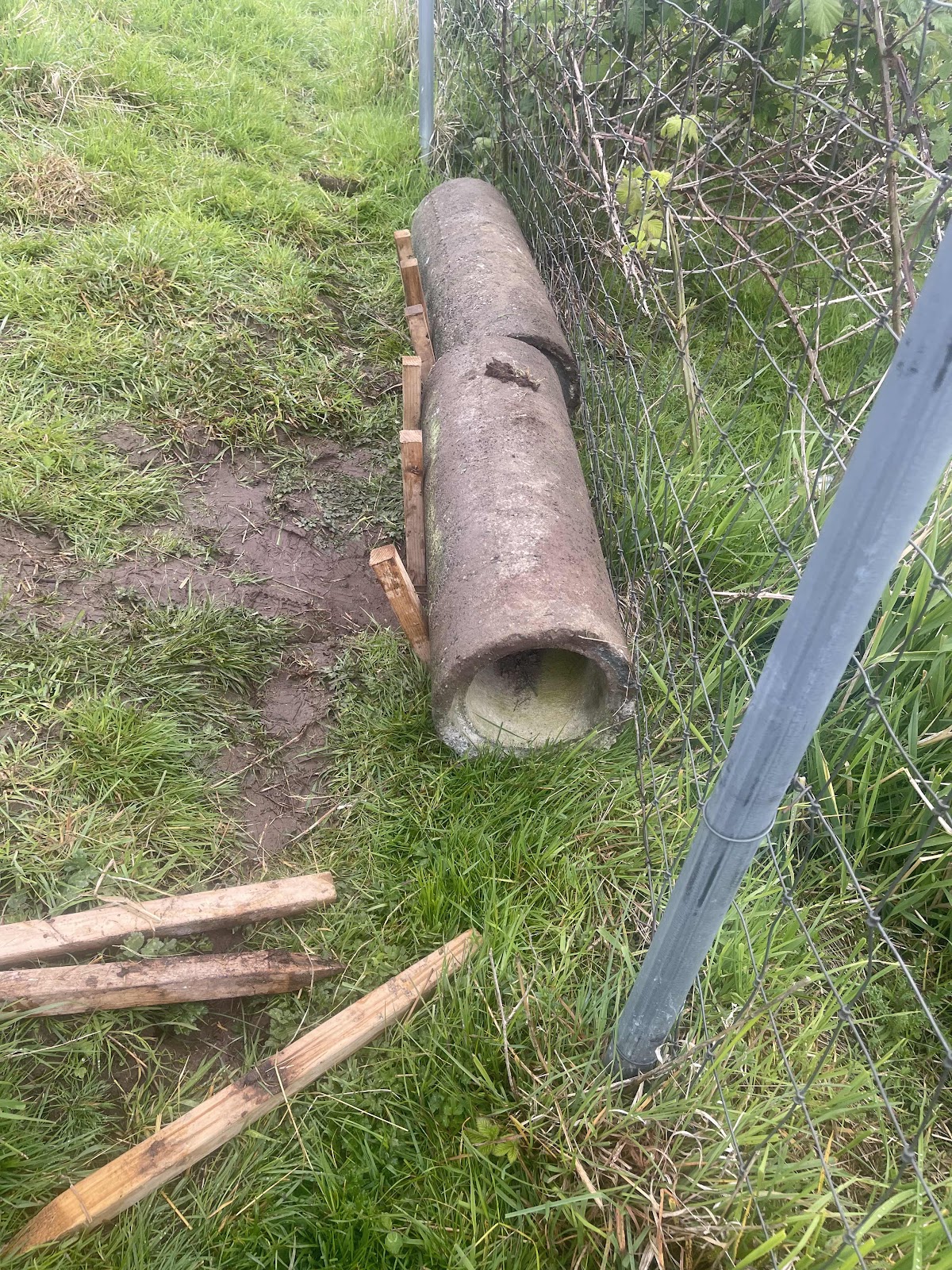
The hole under the fence has been patched, with an ad-hoc and frankly rather embarrassing mishmash of materials that Homero cobbled  together. We had a large number of wooden stakes, which he used to tack down the field fencing by stapling the lower wire to the stakes and then pounding them into the ground. The big hole was blocked with some concrete cylinders that have been lying along the back acre since we bought the place. It will do for now. 


In this picture you can see how much acreage our neighbors to the west have. It’s about 300, give or take, and it has fields and forest and streams. It’s absolutely teeming with coyotes. When I complained about the problem on Facebook a few hunters contacted me and offered to help me out, so I may ask the neighbor’s  permission to let a couple hunters try and pick off the boldest ones. It may discourage them for a while. Especially if, as has been suggested, we leave a carcass hanging to rot on the fence where they normally come in. 


As I was walking the pasture that evening looking for signs of Gingersnap, I could hear the coyotes howling and  yippi-ki-yaying back in the woods. It sounded like a pretty fair number. “They’re fucking celebrating over my poor Gingersnap,”  I thought, filled with thirst for revenge. 

But the next day at church, we read psalm 148, which reads in part “praise the Lord from the earth, you sea monsters and all you deeps; fire and hail, snow and fog, tempestuous winds, doing God’s will; mountains and all hills, fruit trees and all cedars; wild beasts and all cattle….sing praise.” And I remembered the coyote song and thought to myself  “I may be upset, I may be sad, but the coyotes are praising the Lord.” 


Wednesday, May 4, 2022

Coyote Blues (Adios Cosmos)


I thought we were going to have a great year for baby goats. Last year was just terrible, we lost three out of four babies. But this year, so far, was shaping up to be great. Two out of three mamas have given birth, without issues, to a healthy single doeling and to a pair of healthy twins, a buck and a doe. 

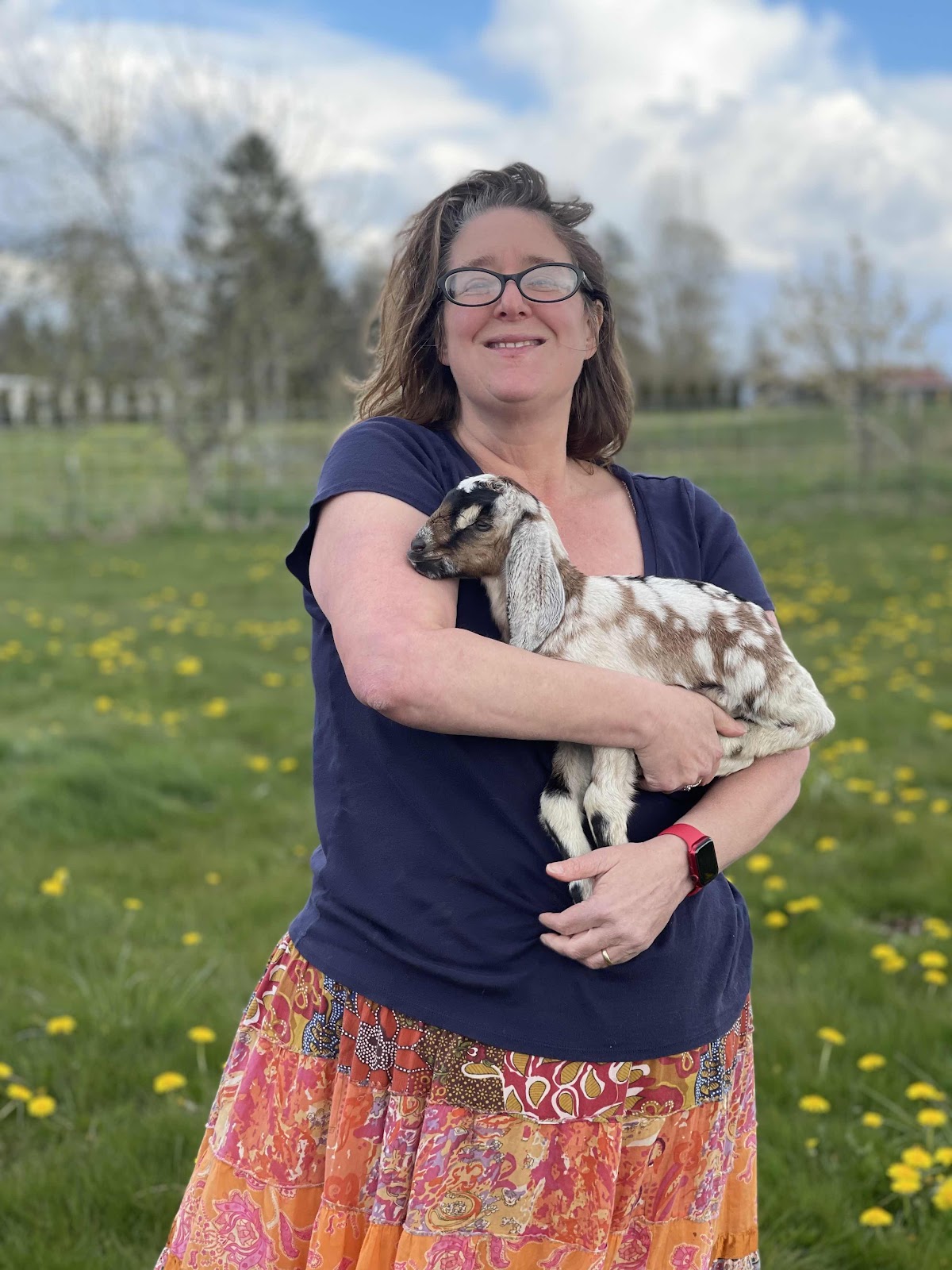
The buckling is -was - this beautiful fellow here. As adorable as he was, for some reason his mama took a dislike to him and rejected him. But he took to a bottle with no trouble at all and was thriving. Like all bottle babies, he became very friendly and would run up to us as soon as we appeared. After a week or so, his mama (Bitsy) decided he wasn’t so bad after all and let him nurse again. He was just entering maximum cuteness phase, that’s probably why :) 

Because of his flashy coloring, there was a lot of interest in him and I actually managed to sell him for the very decent price of $200. A neighbor wanted him for her new herd sire. He would have made a very handsome buck, for sure. He was going to look just like his papa, Jupiter. We named him Cosmos. All our bucks have weather or atmospheric or space related names. 


But alas, it was not to be. Day before yesterday when we went out to do morning chores he was just missing. The other babies were there but Cosmos wasn’t. We searched the whole pasture but he was totally gone. We didn’t find any signs of him - not hide nor hair nor bloody patch of grass. What we did find were fresh tracks in the muddy area under the fence on the western side of the pasture where the coyotes come in. 

Damn coyotes. They have eaten well from our farm over the years. Never before have we lost a goat, though, only poultry. But we lose at least half our flock every damn winter. This winter we were down to a single chicken when we decided to just move the poor thing into a shelter inside  the fenced backyard; the coyotes wouldn’t dare come right up to the house like that. So we built a new coop and got a few more hens to be her companions and we haven’t lost a chicken since. 

If I had put any thought into it, it might have occurred to me that without any chickens to eat, the coyotes might not just shrug their metaphorical shoulders and move on. That they might, in fact, decide hey, we’re here anyway, might as well try out baby goat. 

For now, we are just locking up the babies at night. Hopefully before long they will be too big for the coyotes. I’m not sure what to do about it long term. We can patch one spot in the fence - though it would not be easy to get enough gravel or cement through the pasture to the site - but the coyotes could and would just dig a new hole. Considering that there’s 1000 linear feet of fence line it doesn’t seem likely that we are going to successfully fence them out. 

Opinions are mixed on the effectiveness of shooting them (we don’t have a rifle anyways). Most sources suggest that’s it’s a very temporary solution at best. There just doesn’t seem to be a great solution. Keeping the goats locked up at night is probably as good as we are going to get. And that’s problematic as well because it increases the chores exponentially. It decreases the time they can spend on pasture, thereby necessitating more hay,  and it drastically increases the amount of poop in the barn. 

Losing this baby hurt. He was gorgeous and sweet. I thought they were all going to live this year. It’s a gut punch. And, I’m not going to lie, it wasn’t any fun to give back that $200, either. 

Friday, April 22, 2022

Pasture Puzzle (All Flesh is Grass)


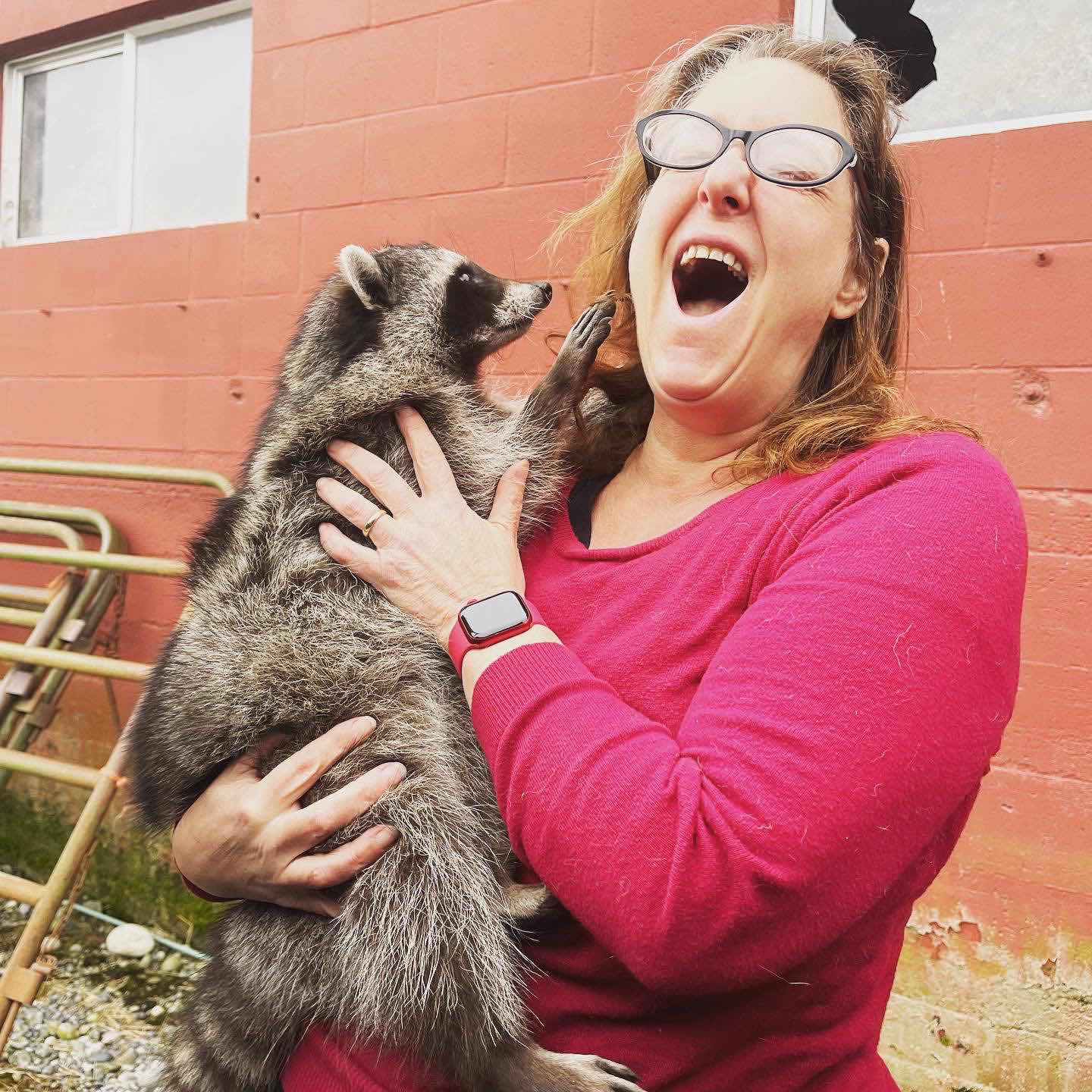
This year the grass has been slow to start growing. It’s been a very cold, wet spring. But finally, nearing the end of April, after months of mud, there is finally a decent amount of grass. Good thing too, because we’ve flat run out of hay. Actually we’ve run out of hay twice and gone for more, but as of yesterday we are out again. At one of the places we bought hay there was a tame raccoon and I got to hold her. Just putting that in there so I don’t forget THE BEST DAY OF MY LIFE. 


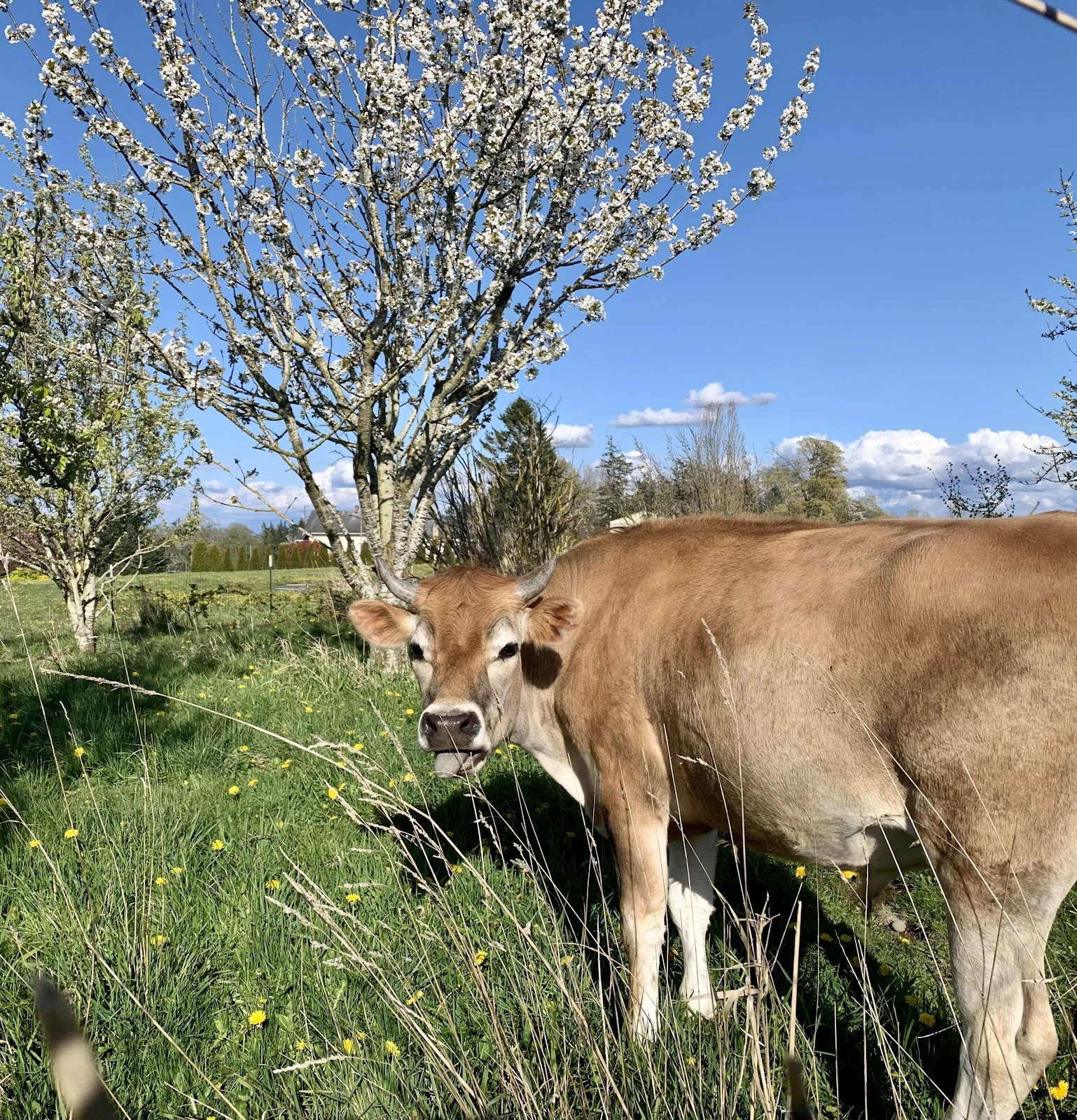
The goats are in the main pasture now, but the cow has been in the sacrifice area, because he is rambunctious and I worry he will injure the pregnant goats or the newborn babies. That’s why we had to get rid of Rowan’s cow, Nettles. Also I want to preserve grass for the goats. One dairy cow eats as much grass as six or seven goats, easily. 

We have three fenced pasture areas, but only the largest - which is about 60% of the total area -  has any real grass in it. The second largest one is about 100x100 and is our sacrifice area. The smallest simply isn’t large enough to have much grass, and moreover the grass doesn’t grow great in there because it is very wet. It’s more of a holding pen for keeping animals separate from each other when necessary. 

There is one other fenced area, and it has a ton of grass. That’s the orchard. Unfortunately we can’t put the goats in the orchard, because they are fully capable of killing the smaller trees in a day or two. I long for the day that the trees are big enough to withstand the caprice onslaught, but that day is still several years away. The cow may nibble on the trees, but cows aren’t browsers like goats are, so I’m hoping he will munch on the grass instead. 

Getting the cow INTO the orchard, however, was a problem. The cow has not been trained in any way, shape, or form, and when he gets out of the corral he goes mad with freedom and starts running about wildly and kicking up his heels. He’s very dangerous. Instead of attempting to lead the cow across the yard with a grain bucket, which might end up with a cow running around on the state highway, I decided to get some wire cutters and open up a gap between the sacrifice area and the orchard. 

Currently I am sitting on the lawn with a book, watching to make sure the cow doesn’t start trying to push over the trees or anything like that. The gap in the fence is closed with a bungi cord. I have a loaf of sliced bread next to me. If the trees are endangered, I can just undo the bingo cord and throw bread through the gap. The cow will chase the bread into the sacrifice area, and I can bingo the fence shut behind him. 

I hope this works, because we really have needed an extra area of grass for a long time now. A five acre farm is really quite small - all those silly books about homesteading on an acre? Yeah, chuck those books out the window. We have about three and a half acres of pasture and that is a bare minimum, even for dairy goats and it really isn’t sufficient for a cow PLUS dairy goats. 

It’s been frustrating to have a big fenced area of green grass we couldn’t use, and it’s very gratifying today to sit here listening to the cow tear up and chew all that green embodied sunlight. Come fall, it will all be meat. For, as the Bible tells us, “all flesh is grass.” 

I may have a slightly different understanding of those words than Isaiah intended. 

Wednesday, April 13, 2022

First Babies of 2022 (Bitsy Babies)


Bitsy surprised us today by quietly popping out twins with no fanfare this evening. We had just finished trimming all the hooves - a horrible, grubby job that we put off for too long, as always. Over the winter it is hard to force ourselves to trim as often as we should, what with the ankle deep mud and the shit and the freezing cold. The hooves were all fairly badly overgrown, with the soft rotten spots that they get from standing in the wet all the time. Those spots all need to be trimmed out or they will go lame. 

All the goats are rather flighty and shy after a long winter with little handling, especially the young does. They had to be caught and bodily lifted onto the stanchion, and then it took both of us to grip the legs and hold them still enough to trail with the extremely sharp hoof trimmers. The buck, Jupiter, is extremely strong and does NOT like having his hooves trimmed. Bitsy is small and easier to handle, but she didn’t like it either and struggled a lot. 

After we finished, I opened the gate and let them all out to graze on the front pasture for a while, but Bitsy didn’t follow the herd. She just hung back, bleating plaintively. I was worried the stress of being manhandled might have caused her a shock, or that we might have accidentally hurt one of her legs holding it in position for trimming. I didn’t think she was near kidding yet - she had an udder but it wasn’t tight and shiny the way it gets right before kidding. 

However when I went back out to check in her after dinner, she was in the back of the big barn and two babies were struggling to stand up next to her. I ran for the house yelling for help and towels. Homero and Paloma came out and we all trooped back and put her and the babies into the mama barn, where it is warm and dry. Over the next fifteen minutes we watched as they stood up and successfully nursed. Bitsy was wonderful - she chuckled at them and licked them clean and stood still to let them figure out where the milk is. She’s a great little mama. 

However, she is quite thin. We wormed her yesterday and repeated the worming today - I’m using ivermectin and fenbendazole together, two doses twelve hours apart, repeated in ten days. But as I’ve written ad nauseum, the worms on my farm are very resistant and the poor mamas always get thin and pale this time of year. All I can do is worm her, give her lots of good food, and hope for the best. 

Theres a buck and a doe. As seems to be usual, the buckling is the pretty flashy one, and the doe is just regular brown. But they are both healthy and vigorous, and that’s the most important thing. I’m tremendously relieved after last year’s awful losses that we are off to a good start to kidding season. 


Sunday, April 3, 2022

Spring Chickens


We got some baby chicks. Now that we have a coop for chickens so close to the house - right inside the fenced backyard - and can be reasonably sure that coyotes aren’t going to get them, we thought we’d take the risk on a few more. 


There wasn’t a lot of variety available at the farm stores in town. Mostly red or black sex links, broilers, and a few heritage breeds. I was specifically looking for broody breeds,  and I was frustrated because not only are there just not that many broody breeds being produced these days, but the stores uniformly had no information about the broodiness or lack thereof in the breeds they were selling. In one store, I asked the person working “do you carry any broody breeds of chicks?” And she answered me “what does broody mean?” 

I must be getting old. 

Well for those who don’t know, like the girl working in my local farm store, a broody breed of chicken is a breed in which the hens will sit on eggs, hatch out chicks, and raise them herself. What? Don’t all chickens sit on eggs? NO. Most modern breeds of chickens have had the broodiness bred out of them. When a hen is broody, she isn’t laying. When she’s raising chicks, she isn’t laying. It’s not cost effective to raise broody chickens for egg production. All your best egg laying breeds - leghorns, Rhode Island reds, etc, will not go broody. 

We eventually found two Cochin chicks. Cochins do go broody, and they also have cute feathered cheeks and feathered feet. We also bought two Golden Comets (not broody) and two Easter Eggers (seldom broody - they are  not Americaunas, which also lay blue eggs and DO go broody). Now all six chicks are out in the converted rabbit hutch under a heat lamp, which I hope will be sufficient in this nasty, cold, wet weather. 

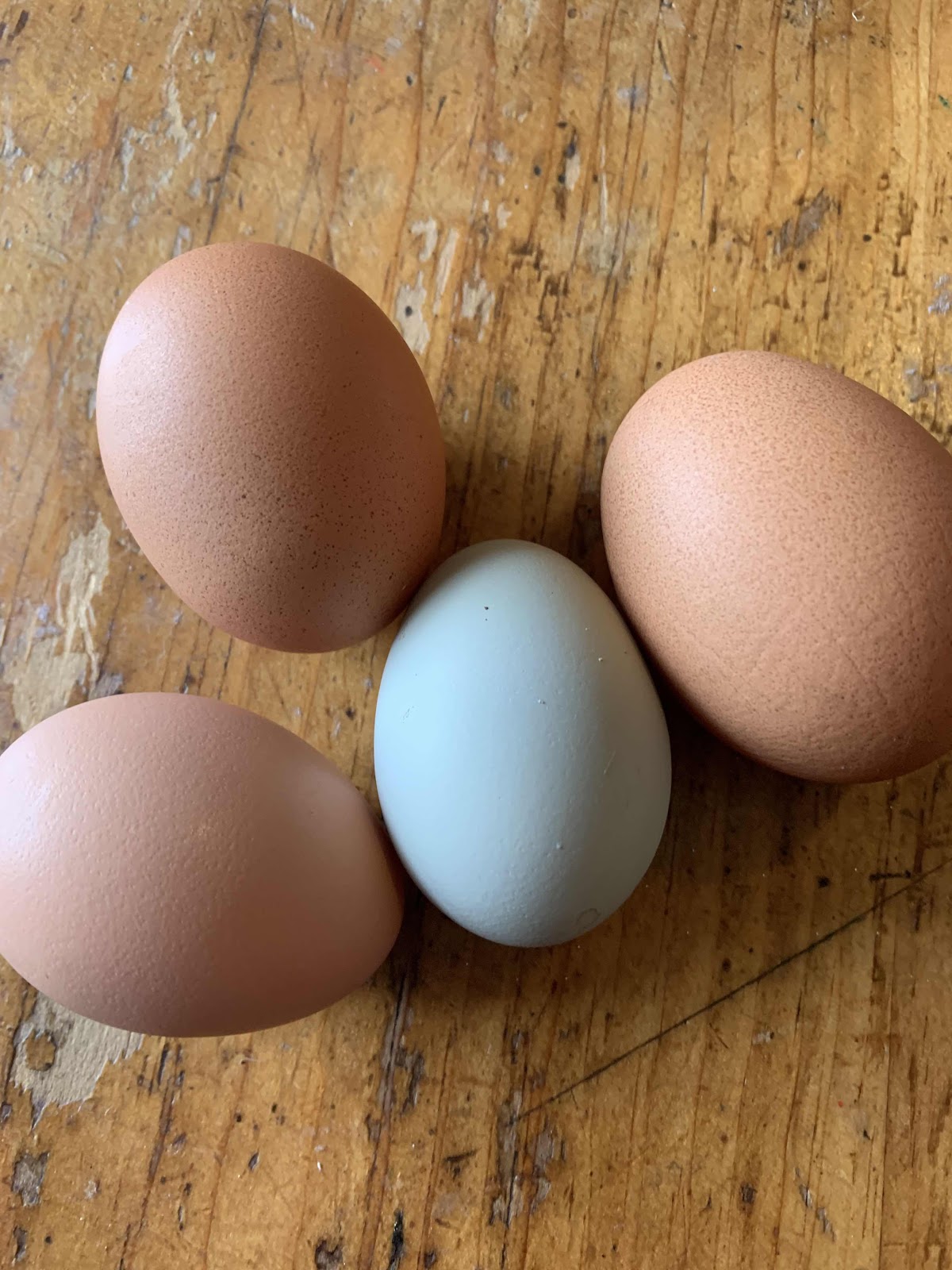
Speaking of colorful eggs, something very weird happened yesterday. We have five Rhode Island Red hens who have been laying all spring. They have all been laying many many eggs, and all of those eggs are, as you would expect, large and brown. Until yesterday:


There was a mystery egg in the nest box - a small blue egg. I have never, never, in all my years heard of a hen who could lay eggs of different colors. Hens who lay white eggs ALWAYS lay white eggs, and ditto brown, blue, green, and pink. Sometimes you get some weird eggs alright - teeny little ones the size of marbles, wrinkled ones. Once I even found an egg without an outer shell, just the inner membrane. That was an odd egg. But I have no explanation for this blue egg. 

Maybe we had a chicken visitor. My daughter and I had a good laugh imagining a lady chicken visitor who suddenly realized she was about to lay an egg. 

“Oh Penny, do you mind if I use your nest box?” 

“Oh of course Georgina, it’s right there on the wall. Yes, that plastic milk crate attached with zip ties. Make yourself at home.” 

“Oh thank you Penny I can’t imagine how I forgot to do this before going out….. BUCK BUCK BAGAWK!” 

Sunday, March 27, 2022

Project Pantry Week One


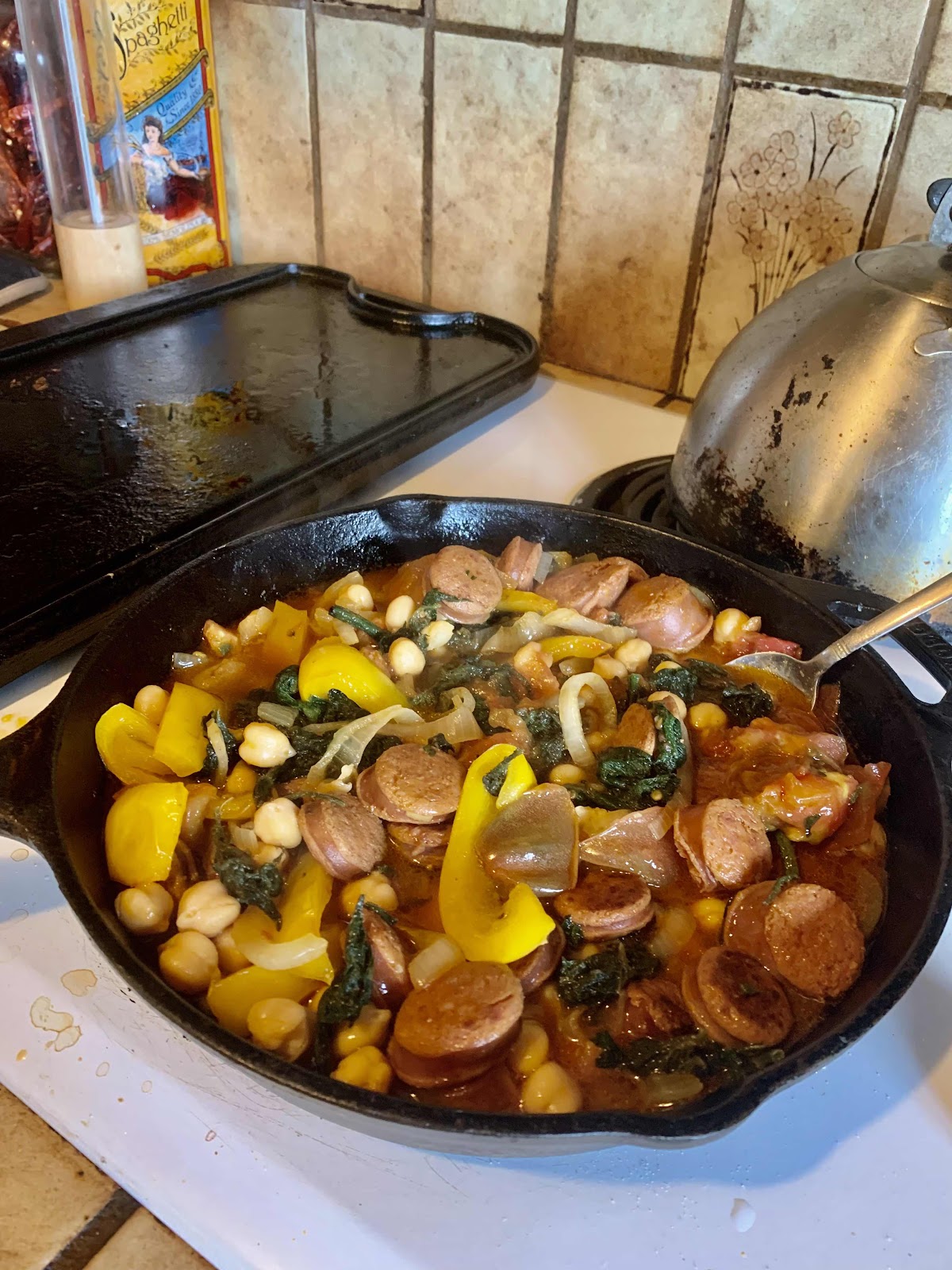
Every single ingredient in today’s dinner - chickpea and sausage stew -  is from the gleaner’s pantry, except for the nettles, which were foraged. But even if you were to buy all the ingredients, this would still be a cheap meal. And it’s healthy, too! 

Chickpea and Sausage stew 

- One sausage per person. I used Louisiana hotlinks because that’s what the gleaner’s pantry gave me, but Italian sausage, Polish, kielbasa, or chorizo works great too. Slice into coins. 

- one yellow onion, sliced 

- one bell pepper, sliced, red preferred. 

- 1-2 cups nettles, or whatever tender greens you have on hand. Spinach is good. So is Swiss chard. Chop roughly. 

- 1 large tomato, chopped

- one can chickpeas 

In a little bit of oil, sauté sausage over medium-high heat until browned. Add peppers and onions.  Continue to sauté until vegetables wilt and are slightly browned. Add chopped tomato. Add rinsed, drained beans. Add greens. If needed, add a tablespoon or two of water. I find the vegetables usually give off enough moisture, but sometimes a little water is good. Or lemon juice. 

Cover and simmer 15-20 minutes, until flavors meld. 

Nice additions if you have them - chopped Kalamata olives, capers, zucchini. 

Score:

Gleaner’s - 5

Foraged - 1

Grocery store - (the oil) 


Wednesday, March 23, 2022

Forest Foraging (Spring Greens)


This afternoon the sun made an appearance, interrupting several days of chilly rain. I was so happy to see it that I was moved to actually get off the couch and take a walk outside with my husband. 

My favorite nearby walk is a trail through the forest that leads to a steep, rather slippery and rickety staircase down to the beach. It’s a quiet beach with no access other than this trail, so it’s often empty except for seagulls and crabs. The trip out and back is about a mile and three quarters, which is long enough to feel like exercise, especially when you consider the staircase. 

The forest is nothing special - it’s certainly not old growth - but it is interesting and varied. On some parts of the trail you are surrounded by cedars and enveloped in a ferny gloom; and in other areas alders and cottonwoods prevail. Right now the Indian plums are blooming and there are yellow skunk cabbage in the shady bogs. 

I’m sure a more expert forager than I am could tell you dozens of edibles and medicinals that can be gathered from an environment like this one, year round. I have personally harvested 

- red huckleberry 
- trailing native blackberry
- shaggy parasol mushrooms 
- nettles

I have seen, but not harvested, cottonwood buds (for making Balm of Gilead - https://learningherbs.com/remedies-recipes/balm-of-gilead/) and devil’s club. And I’m certain there are edible fiddlehead ferns and many other types of edible mushrooms and fungi in there as well. And this is just one small forest reserve that a biologist would doubtless describe as degraded. 

I do most of my yearly foraging in fields and hedgerows, not forests. I pick dandelion greens, lamb’s quarter, amaranth, field mushrooms like puffballs and agaricus campestri. Blackberries and sour cherries and plums from abandoned trees. Most of what I forage is not truly wild but rather escaped nonnative weeds. That’s okay. It’s all good food. 

A few days ago I went out and walked my fence lines looking for nettles. There were a few here and there, but they were all still very small. It will be another two weeks before I can get enough for a pot of soup. Today on the forest rail though, I saw hundreds of nettles, all at just about the perfect stage for picking. I guess I have my exercise for tomorrow planned out. 

Saturday, March 19, 2022

Food Finances (Project Pantry)


For a while now, I’ve been thinking about starting a new recurring feature on the blog about cooking and eating from “the pantry,” meaning in this case both my personal pantry and the Gleaner’s Pantry, which is a small food rescue organization from which I get a large percentage of our family’s food. We pick up produce, meat, dairy and bakery items going out the back door of supermarkets and sort the usable food from the unusable. On average, around three quarters of the food being tossed is perfectly fresh and good. The rest goes to animals. 

Years ago, when we first moved here, before I learned about the Gleaner’s Pantry, I was all about sourcing as much food as possible from our own land. We planted fruit trees, we put in a garden every year, we raised chickens and goats and pigs. I learned to can and put up quarts and quarts of applesauce, jam, salsa, and pickles every year. I dehydrated pears and plums for the kid’s school lunches. I made cheese and yogurt, and traded the excess to friends for vegetables from their gardens. I foraged for greens, mushrooms, and berries. 

A mixture of concern about climate change, food prices, and the zombiepocalypse combined with the inherent “wow” factor of being a real, live homesteader drove me to spend lots of time and energy producing and preserving as much of our own food as possible. Turns out, however, that with a few exceptions here and there, producing and preserving your own food is not cheaper than buying it already preserved for you. Mostly the opposite, in fact. You wouldn’t believe how expensive a dozen eggs are when you factor in the cost of building a coop and raising the chicks. 

Our global food system is based around efficiencies of scale, and it is very good at producing vast quantities of food extremely cheaply. Again, with a few exceptions, it is much cheaper to buy your food than it is to grow it yourself. Of course, much of that cheapness is predicated on government subsides and the exploitation of labor, not to mention the externalization of costs such as pollution of waterways from agricultural runoff. Money out of pocket is not my only concern, nor can it be the only concern of anyone who cares about the ethics of their consumption. 

Eating for the Gleaner’s Pantry allows me to address many concerns at once - cost of food, of course, but also the desire to minimize food waste and to avoid participating in the evils of Big Ag. None of us can avoid that entirely, of course - Big Ag is just one of the gigantic systems in which we are all enmeshed and which we literally depend on for our survival. I am under no illusion that my feeding my family from Big Ag’s waste-stream makes any appreciable (or even detectable) difference to any of the aforementioned problems. But it makes me feel good, it provides an example to my kids, and it saves us a lot of money. My daughters have taken many lessons - music, gymnastics, sports - that we were able to pay for because we were saving hundreds of  dollars a month in food costs. 

You might have noticed food costs have risen quite a bit lately. This phenomenon comes at a time that we are a bit tight on cash. Our family budget has taken a hit recently, and it made me think that I could probably make even more use of the Gleaner’s Pantry and save even more money. I’ve never tried to actually keep track of exactly how much we eat from the Gleaner’s versus how much from the grocery store. It seems like it might be a fun project for the blog. So I think I’ll try to make a weekly post breaking down at least one day’s cooking in terms of where the ingredients came from. Three categories - Gleaner’s, grocery store, or personal pantry, which includes farm-produced and foraged or bartered from neighbors. 

I’ll start with just one project: the lemon curd Swiss rolls I made today. They are super pretty! 

From Gleaner’s:                              From grocery store:

Flour                                                Sugar
Lemons                                            Butter

From Personal Pantry:

Raspberries
Eggs 

This is a win - four non-store items versus only two store items. Maybe I’ll keep a running tally! 


Tuesday, March 8, 2022

Attempting Chickens Again (Hammer and Crime)


Every winter, we lose most of our poultry to coyotes. This is, of course, mostly our own fault. Our chicken coop is hardly worthy of the name - it’s just a rickety collection of random boards nailed up between our two small barns, with chicken wire tacked on and roofed with corrugated plastic, which is cracked and broken. I haven’t the heart to keep the chickens penned up in there. The barns have no gutters, so the rain sheets off the roofs and pools in the coop. Eight months of the year it’s just a mud puddle. They do have nest boxes and a couple of dowels to roost on up off the floor, but they don’t really like it in there and I don’t blame them. 

So the chickens and turkeys are fully free-range. They mostly roost in the hayloft of the main barn, which would be fine except for the fact that it ruins the hay. And except for the fact that the main barn apparently does not protect them from predators one little bit. Over the years, we have clearly become known far and wide as “easy pickin’s farm” with the local coyote population. Our property is only five acres, but it abuts some two hundred acres of woods and fields, and there is a whole mess of coyotes in there. 

I’ve pretty much given up on raising turkeys, because they are expensive and ticklish to raise, and it’s just too disheartening to spend a few hundred dollars and several months nurturing poults into big, fat, profitable birds, only to have them disappear just as they hit market weight, leaving behind only a patch of scattered feathers somewhere out in the field. I was close to ready to give up on chickens too, when we were down to a last solitary bird. I wanted to give the poor bedraggled thing away to somebody with a real chicken coop, but Paloma cajoled me into getting four new chickens instead. 

It was obvious we needed a better chicken situation. Either we had to repair the coop in a serious way, or make something new closer to the house where the coyotes wouldn’t come. For a while we toyed with the former, but settled on the latter solution as being both cheaper and less work. These are our prime considerations in most cases. We have a very well-fenced back yard, and it has a chain link dog run in it. We haven’t used this dog run for anything in particular in many years. I don’t even remember where it came from. But it makes a serviceable chicken coop when roofed with cattle panels bent into hoops and then covered with a tarp. 

I found four young rhode island red hens for sale and put them in the new coop along with the one surviving yellow hen. It took them a week or so so settle in and start laying, but now they are happy and healthy and popping out eggs just like they ought to. The downside is the back yard looks like hell - grass all scratched up and porch covered in bird poop - but oh well. What’s that saying? You can’t make an omelette without breaking a few eggs? 

Paloma named the chickens according to some secret logic of her own. She claims to be able to tell them all apart except two. The two she can’t tell apart she named Thunder and Lightening. The other three are Banka, Hammer, and Crime. I think Hammer and Crime sounds like the name of a rap duo from the late eighties. 

We had planned to get some fancy, colorful bantams as well, but I don’t know. Maybe five is enough chickens. It’s certainly better than just one. 

Monday, February 21, 2022

The Fermentation Files (Ginger Beer/Not Beer)

Small batch fermenting is one of my favorite things to do. I love to make sauerkraut, kim chee, and kosher dill pickles. During milk season I make kefir and, of course, cheese. People don’t think of it that way, but cheese is in fact a fermented food. Someday I would love to try my hand at another non-intuitive fermented food - dry cured salami. Fermented foods have a ton of health benefits and they are a cheap, low stakes hobby that doesn’t require much in the way of equipment. 


A notable exception to that cheap and easy thing, though, is one type of fermentation that I don’t do anymore. I used to be a home brewer. I’d make plum wine in the late summer and hard cider in the fall. I never got all that good at it, but I did enjoy myself and I did amass a collection of cool glass carboys and neato accoutrements like airlocks and bottlecappers. And I felt a great deal of satisfaction and pride whenever I got “high on my own supply” and enjoyed a few glasses of mediocre but effective home made hooch. 

Alas, I enjoyed it all a little too much and eventually I quit drinking alcohol altogether. I gave away all my cool carboys and tubing and whatnot. It was sad to part with it all, but I still had a whole world of fermenting projects and kitchen-witchery to console myself. I’ve stayed away from fermented beverages ever since. Until a few days ago. 

My daughter Hope has long wanted to make old fashioned root beer and/or ginger ale. It’s a fermented drink, but it isn’t alcoholic. Or, at least, it shouldn’t be more than about 0.5-1% alcoholic, which is the same amount that’s allowed to be in regular apple or orange juice that you buy at the grocery store. So when, last week, the Gleaner’s Pantry offered up a bounty of a whole pound of fresh ginger, we decided to give it a try. 


I wasn’t sure how to go about it, but that’s why I have books. The first step in making ginger beer is making a ginger bug. A ginger bug is very simple to make. You just grate a ton of ginger into a jar, add a big scoop of sugar, and fill the jar with water. Leave it on your fermenting shelf (what? You don’t have a dedicated fermenting shelf?), and within a day or two it will be bubbling away. 

When your ginger bug is nice and active, make a pot of very strong ginger tea - actually a decoction of ginger. Grate, chop, or thinly slice at least six inches of ginger root into a half gallon of water. Simmer for twenty minutes. It will reduce down to about a quart. Strain into a half gallon jar and add a full cup to two cups of sugar and another quart of cool water. Temperature should be lukewarm. Then add your ginger bug in a mesh bag. 

Cover, but do not seal. Put it on your fermenting shelf (you set one up in the last minute and a half, right?). Wait a day or two until it’s nice and fizzy and drink. You can bottle at this point, but be careful. We bottled some in stoppered bottles and when we opened one a day later it shot out like champagne. 

I ended up not drinking the ginger beer, after just a taste. On the first day, I couldn’t taste any alcohol, but on the second day I thought I could. I might have been imagining it. It tasted like apple cider when it’s left out overnight. I’m certain it would be impossible to get drunk on this ginger beer, but these days I take no chances. It is a sugar-based ferment, and that means it must have some alcohol in it. I don’t fuck with alcohol anymore. So Hope gets to enjoy it all herself. 

However the taste I did get was great! Very “hot” ginger taste, light carbonation, and that slightly sweet-sour taste fermented liquids have. I’m sure it would be tremendously refreshing over ice on a hot day, and probably very good for stomach ills and nausea. Next time, I may try just making the string, sweet tea and adding carbonated water instead of a ginger bug. It won’t be a real fermented product that way, but at least I could drink it. 

Wednesday, February 16, 2022

To Plant or Not to Plant


The other day I went for a walk in a nice neighborhood downtown. There were signs of spring everywhere - crimson buds on the rhubarb plants in the alleys; small green shoots in garden beds that will soon be blooming crocuses and narcissus; red alder catkins dangling from the branches like caterpillars. And, in many yards, evidence of industrious people preparing for early planting season. 

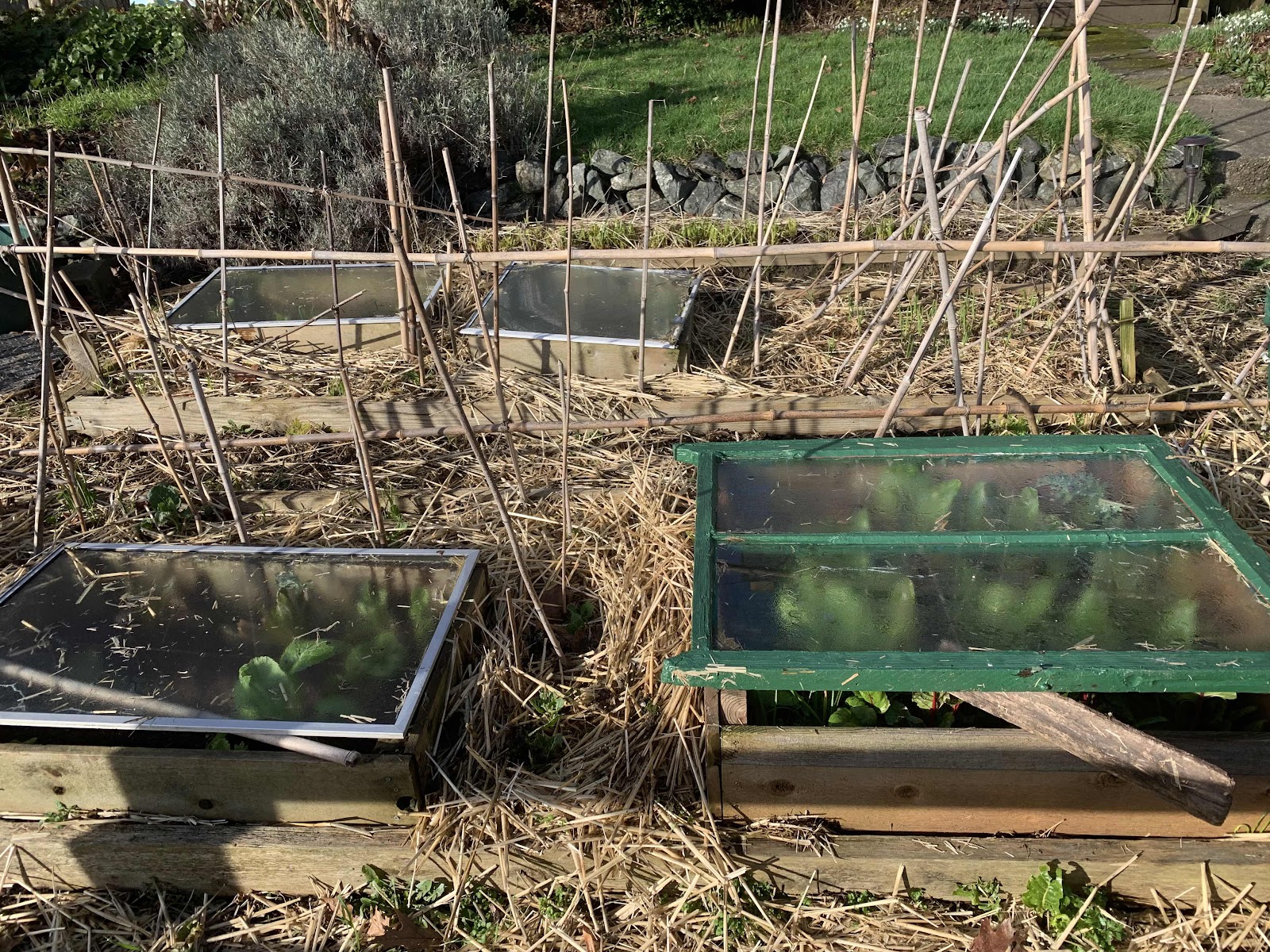
I took a picture of these beautiful cold frames. They are just old windows attached with hinges to raised wooden beds. They can be kept closed or propped open. Inside, I could see fresh greens. It’s too early for these to be new spring greens, they looked like overwintered chard and kale. But they were gorgeous, bright green, tender and delicious-looking. 

I got excited. I have long wanted cold frames just like this. If I had such nice cold frames, I could plant radishes and spinach ANY DAY NOW. I could start slow-to-mature vegetables in April instead of direct sowing in late May. I could grow CUCUMBERS. I could grow EGGPLANTS. 
I even remembered that we have four or five good-sized windows just sitting on a trailer in the yard near the shop, doing nothing. 

Then I remembered that I am one of the world’s worst gardeners and there are many reasons for my failure besides my lack of cold frames. Mostly a lack of will or energy to spend hours and hours a week pulling weeds and picking slugs and bugs off of my plants. My aching knees and creaky back. My inability to remember where I put the trowel and the gardening fork for the life of me. 

I remembered that “I fought the weeds and the weeds won” is pretty much our farm-anthem around here. I remembered that I have consciously cultivated tough perennials like raspberries and rhubarb just so I don’t have to prepare garden beds every year. I remembered that I belong to the gleaner’s pantry and have pretty much unlimited access to organic vegetables year-round, even if they aren’t quite as fresh as they would be if I were picking them from my own garden. 

I always plant a few things, and I’m sure I will this year as well. Maybe this will be the year I actually get some asparagus crowns into the dirt. Maybe I can convince Paloma to help me lay down all the cardboard I keep intending to bring home from Gleaner’s and so get a jump start on weed suppression. Maybe Homero will finally put the wheel back on the wheel barrow so I can move compost in quantities larger than a five gallon bucket. 

Maybe. 


Thursday, February 10, 2022

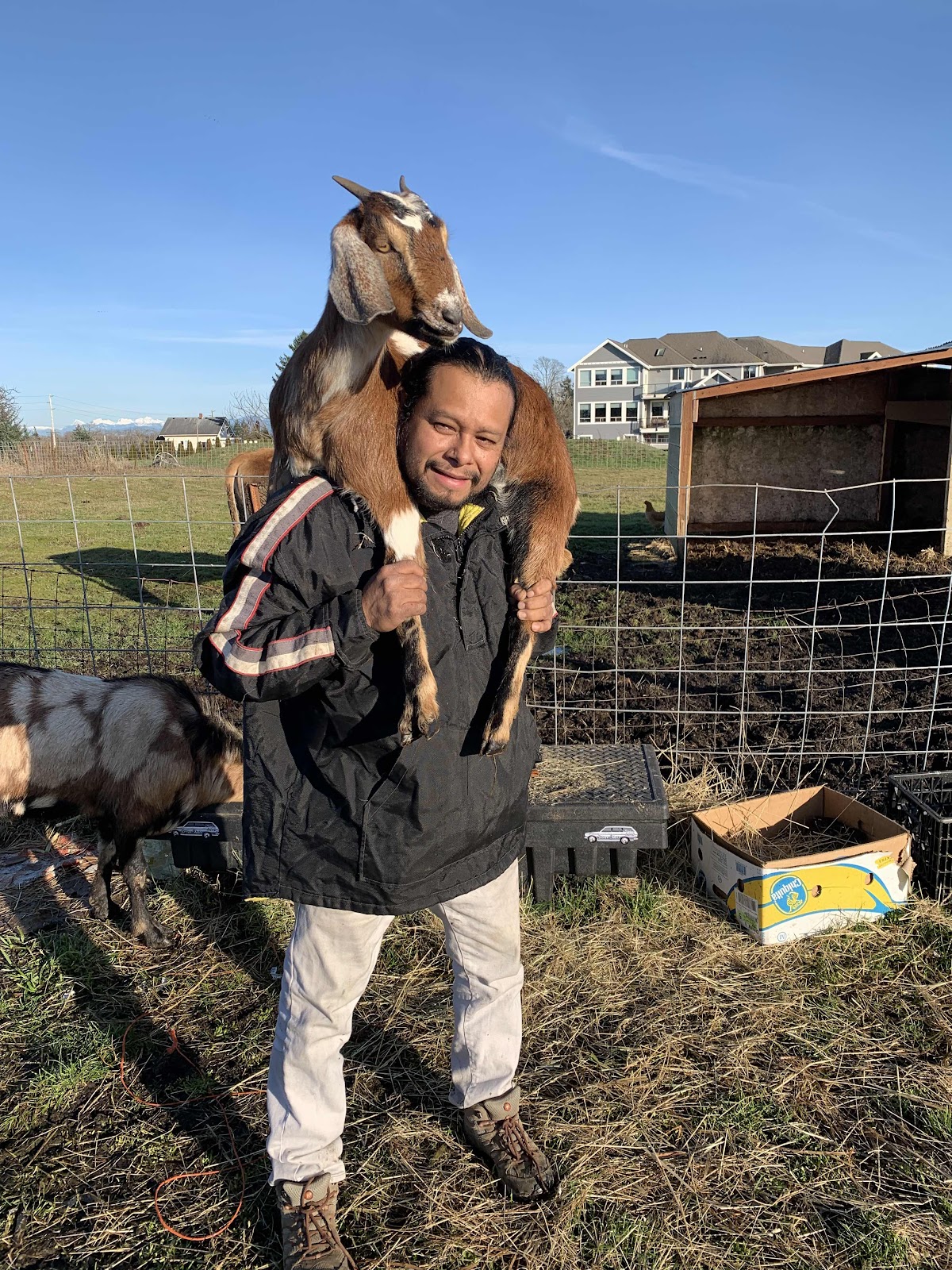
Goat Totin’ Man Totin’ Goats

It recently came to my attention that there are still people out there reading my blog. Apparently, there’s a high school boy out there, a friend of Paloma’s, who thinks my blog is pretty cool and asked Paloma why I don’t write anymore. 


Because, Kyler B., I’m just lazy. Terribly, terribly lazy. It’s easier to post a  picture on Instagram or Facebook than it is to write a real post. Also, the news has been so sad on the farm lately - we went through a terrible time of many deaths. I felt like a complete failure as a farmer. And, after twelve or so years, I sometimes feel I’ve written all I have to write about the passing seasons on our little farm. 


But of course, I haven’t. There have been all sorts of recent developments. And I have had a cool idea for a new ongoing  series of posts about eating from the gleaner’s pantry as close to exclusively as possible. So, for those few of you out there in the real world who are still interested in life up here at Windy Hill Homestead, I will start writing again. 

Meanwhile, here’s a few pictures of Homero toting goats. 


With Cleo, 2022


With Bitsy and Bootsy, 2020


 With a goat whose name I can’t remember, 2017 (?) 

Thursday, October 28, 2021

Monster Squash 2021 (Count on Cucurbits)

My mother used to say there were only two things for certain in this world - death and taxes. But I know there is another - that every year volunteer squash will grow out of the compost pile. 

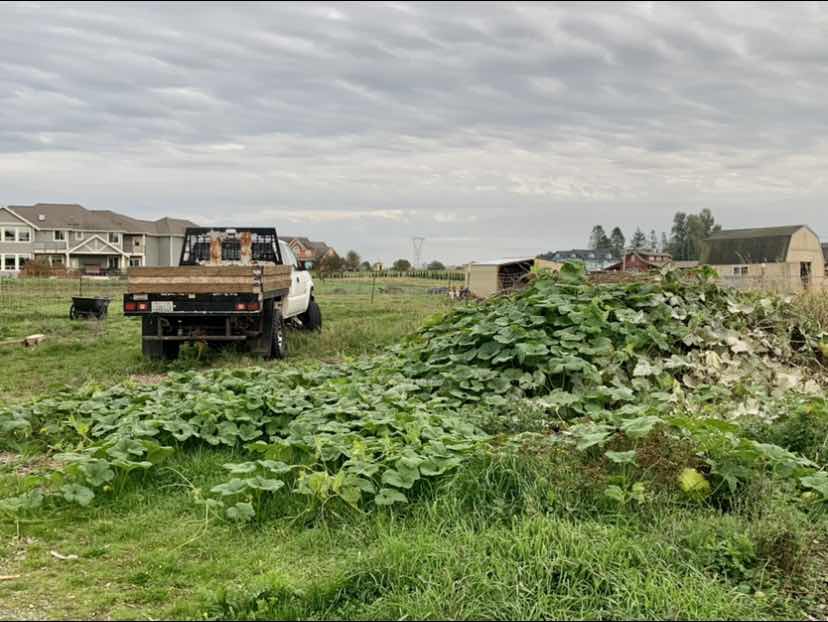
It’s so funny, I don’t usually have much luck trying to grow winter squash on purpose. The plants get powdery mildew, or they are poorly pollinated, or they get blossom end rot. But lo and behold the vigorous vines that sprouted this year from our discarded supermarket squash seeds:


There are actually three separate volunteer plants in that picture, and together they cover a good 500 square feet. All of them bore copious fruit, but unfortunately since supermarket squash are mostly hybrids, none of the three distinct varieties of fruit they bore was good to eat. 

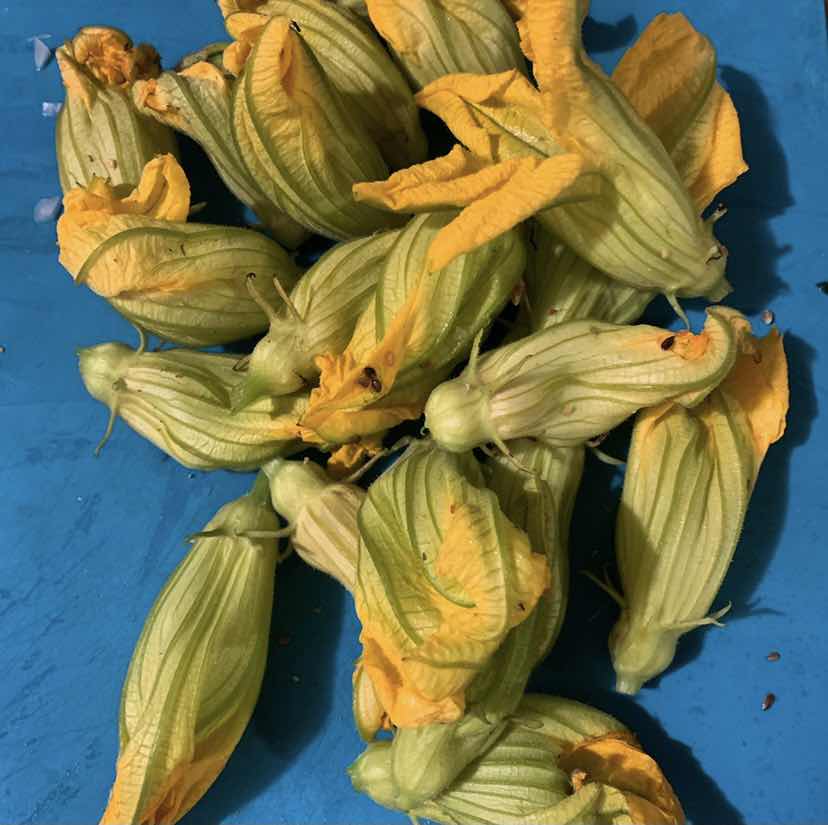
As varied as squash fruits are - that is to say, infinitely - squash blossoms are uniform. All squash plants, be they winter or summer or of unknown provenance, produce lovely yellow trumpet shaped flowers that are delicious. 

We like to tuck the fresh raw flowers into quesadillas, but they can be prepared in any number of different ways - one Italian preparation is stuffed with goat cheese, battered and fried. They can be added to soups or just sautéed in butter. 

Since we didn’t care about the inedible fruit of these particular plants, we picked both the male and female flowers, but if you are growing squash to eat just pick the male flowers. They are easy to tell apart because the male flowers grow in tall stems and the female flowers stay stuck close to the vine. Remove the pistils; they can be bitter. And always check for bugs! Our vines were still producing flowers last week, in chilly late October. 


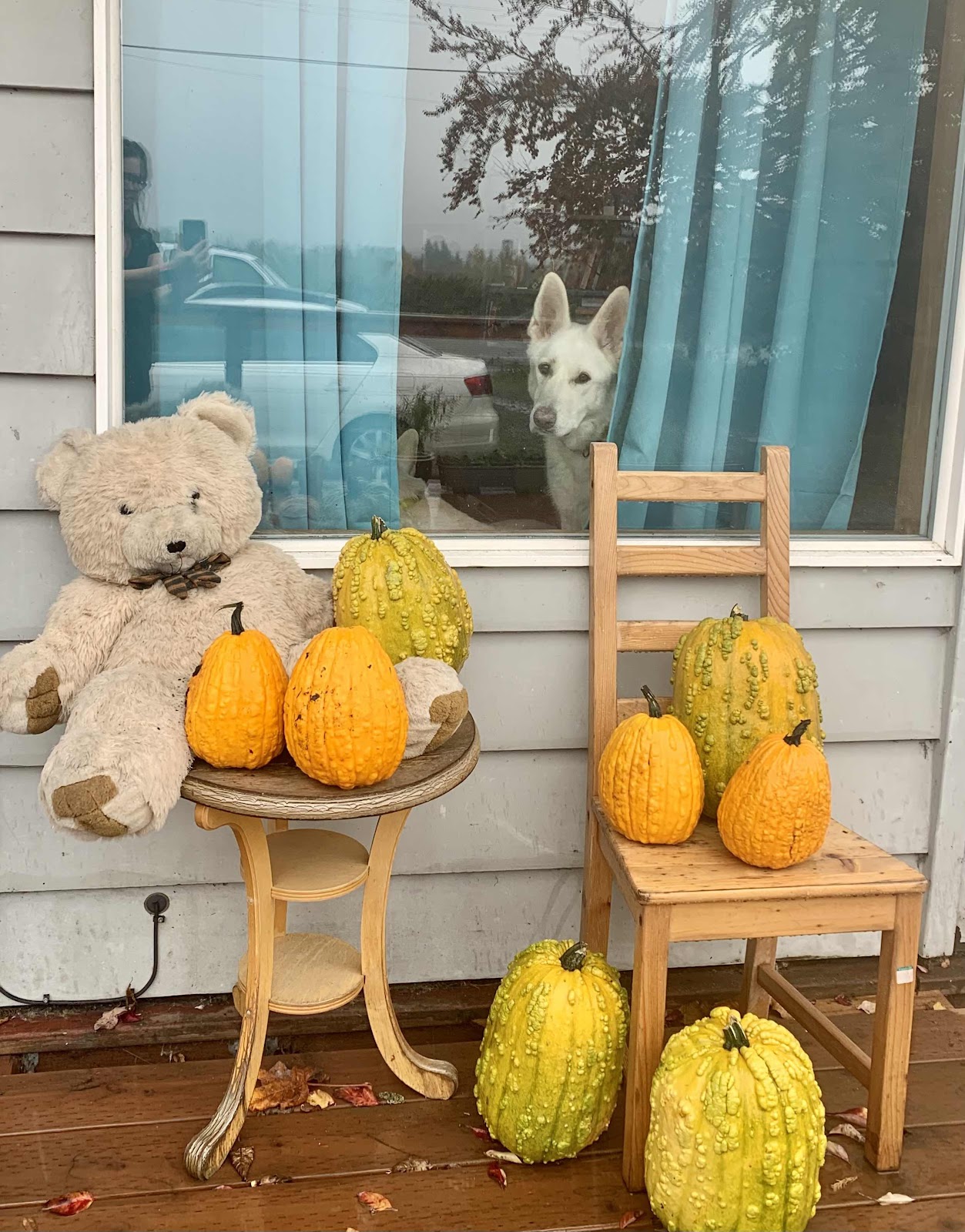
Although inedible, this year’s gourds do make a fine halloween porch display. There are many more that are not pictured here. One gargantuan vine produced more than a dozen of the huge warty gourds - probably well over 100 pounds of squash. 

I am not certain if the seeds of all these squashes are edible or not. I believe they are - I never heard of a poison pumpkin seed - but I should probably look it up to be safe before I decide to roast all the seeds after Halloween. 

Mercy is in the window. 


Thursday, October 7, 2021

Farmer’s Swap Meet (Fall Harvest)


A neighbor of ours, a friend who started out as one of Homero’s clients, started a farm a few years ago. She raises medicinal plants of all sorts and makes them into tinctures, salves, ointments, and decoctions. She started just two or three years ago with a weedy patch of ground and now has a lovely three acre medicinal plant garden. 


Last month, she decided to throw a swap meet for all her local friends - mostly farmers but also bakers, artists, musicians, and people with skills of various sorts. I was super excited to be invited - a decade ago I did the same thing, hoping to make it an annual event, but alas there was only one September Swap Meet and Jamboree on our farm. 


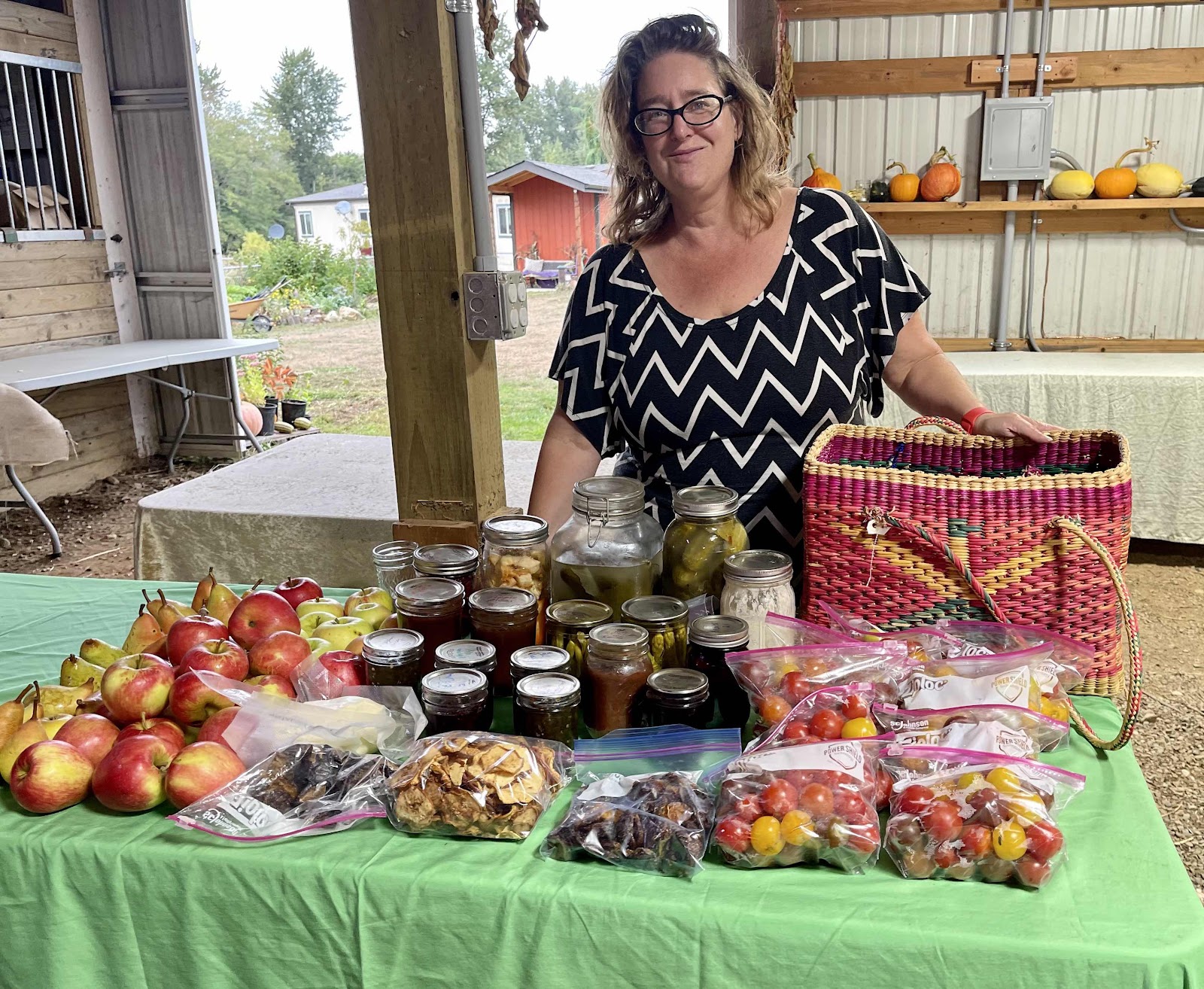
Deciding what to bring was half the fun. I didn’t know what might be available to trade for, so I didn’t worry about that and just brought a little of everything, hoping to hold my own and put on a pretty spread on front of my farming peers. 

We had lots of fruit from our trees - Italian plums, pears, and apples - both fresh and dehydrated. And just the day before Gleaner’s pantry hosted a farm glean for organic cherry tomatoes, so I had a ridiculous number of gorgeous cherry tomatoes in various colors. I also brought a selection of ferments - some caraway kraut, some kohlrabi kimchi, and some sourdough starter. 

I rounded out my section with a bunch of canned goods from the pantry. Admittedly, some of it was weird stuff from years last that didn’t get eaten, like my “spicy mixed stone fruit chutney” and some apple-plum butter. But I also brought a whole bunch of freshly made blackberry jam and pickled asparagus and dilly beans. Oh, and a two pound wheel of cheese. 

There was also a potluck, which was delicious. I brought lentil soup with bacon from our pig, and a big sourdough bread made with the same starter I had brought to swap with. 

We came home with a lot of stuff. Two or three different salves and some lip balms; tomatillos; raspberries; eggs; a carved wooden kitchen spoon, a fancy bottle shaped like a skull (which I think started out filled with tequila); a load of firewood; and a dehydrator. 

It was a great day. I got to meet lots of my neighbors and fellow farmers. Most of them were considerably younger than me, but it’s nice to be slowly morphing into a kind of elder in the community. I got to show off a little bit - my table was definitely one of the more diverse and well-frequented. And Homero and I got to wander through the beautiful garden eating raspberries and holding hands.