"United we bargain, divided we beg."

Sunday, May 29, 2011

Aimee Gotcha Gun (Finally!)


My first bullseye (probably a fluke)


Homero takes aim


My target.


About two years ago, I bought a handgun( http://newtofarmlife.blogspot.com/2009/10/armed-aimee.html). I was almost totally inexperienced with guns: my siblings and I were given daisy air rifles one christmas when I was about eight, and we merrily donned puffy jackets and shot each other until our outraged mother caught us and took our guns away. Only once had I ever shot a real gun. When I was fourteen, my Dad won a tiny little pearl handled .22 in a poker game. It was almost small enough for me to palm, small as my hands were at the time. He took me down into the sub-basement of our apartment building and showed me how to fire the gun into the damp, crumbly brick walls. That was that as far as my firearms experience.

I decided I needed a gun when it became clear we would be doing our own slaughtering and butchering. Homero's friends dispatch the goats by the old-time method of a sharp knife to the throat, but I prefer a bullet to the brain. The first time I saw one of our pigs killed, by the very professional Keizer Meats men, they used a .22 revolver at point blank range, and that pig was dead before it hit the ground. If I'm going to kill an animal myself, I want it to die just that fast. So I asked the husband of a friend, who is a very knowledgeable enthusiast, to help me pick a gun that would serve my needs. This is the gun I picked:


It's a Ruger single action .22 revolver. 19th century technology that still works with perfect efficacy. It may not be the most excellent choice if you are looking for personal protection, but for dispatching pigs and goats, or for target shooting, no problem whatsoever. Plus - and forgive me, anti-gun folks - it's a COOL gun. It's a cowboy gun. It LOOKS like a gun, unlike modern automatics, which to me look like they came out of a vending machine. If - God forbid - I ever did have to use it to protect myself, whoever was threatening me would feel for certain like he was looking down the barrel of a real gun.

It was recommended, it was reasonably priced, it was nearby. So I bought it. Then it spent the next year and a half in a box on a high shelf. I never touched it. I must have been scared, I guess. To myself, I just kept saying "I need to sign up for a safety course." My friend who recommended it to me asked me, every other month or so, "so have you taken that pistol to range yet?" No, not yet. My younger brother likes to shoot, and he offered to take me to the range several times. "Oh, sounds like fun," I always said. "Yeah, I should really do that."

Meanwhile, the gun stayed in it's box.

Yesterday, my brother came up to spend the night. He brought his pistol and just flat out told me we were going to the range. He provided the ammunition (I never bought any) and we paid the entry fee (a very reasonable eight bucks, paper targets and earplugs included). My brother taught us the four cardinal rules of shooting:

-treat every gun as though it is loaded
-don't point the muzzle at anything you don't want to shoot
-keep your finger away from the trigger until you are sighted and ready to fire
- and I think I forgot the last one but it'll come to me.

He helped us learn a basic stance and a basic grip, and taught us the basic etiquette of the public range. Then we spent a happy hour and a half shooting. It was really very fun, although much more difficult that I would have guessed. Even a .22, for example, gets quite heavy after a while, and my injured shoulder did not stand up well after the first half hour. I learned that there is a big difference between my accuracy at 21 feet (the minimum) and at forty feet. I learned that with a little time and practice I can get over that panicky OH MY GOD THERE'S A GUN IN MY HAND feeling. And I learned that Homero is a much better shot than I am.

I enjoyed target shooting. I will do it again, and again, until I feel comfortable and reasonably practiced. But somewhere in my future I know there looms a much more difficult test: the day I actually shoot an animal. I'm not looking forward to that day at all, but at least I will have the satisfaction of knowing that I have done what was needed to ensure that my animals suffer as little as possible in their final moments.

Tuesday, May 24, 2011

Banding Baby Bucklings (What's Outside Your Comfort Zone?)

There are many animal procedures that happen on a farm that fall along a spectrum of skill. From the things that almost all farmers so for themselves - such as hoof trimming - to the things that almost everyone has the vet do - like putting down a terminally ill beast - we all have our "no big deal" procedures and our "no way I'm not going there" procedures.

For me, banding bucklings is as easy as pie. You buy a twelve dollar tool at the farm store, and off you go. A bander is a small handheld tool with squeeze handles on one end and four prongs on the other. You slip a heavy duty rubber band over the prongs, and squeeze the handles to separate the prongs and force open the band. Then you slip the scrotum through and let go. That's not quite all there is to it - you do need to be careful and know a couple of things. Yesterday I banded my sister's bucklings (because for her, banding is one of those "uh-uh" jobs) and I took a picture to try to illustrate those couple of things. It's a terrible picture, but I'll try to use it:

alt=""id="BLOGGER_PHOTO_ID_5610355584572377394" />
Okay, the big round thing is the scrotum. At the top, you can see a bit of the dark green band. Above the band and to one side, you can see a dark pointy-down thing. That's one of his nipples. Yes, boy baby goats have nipples, too. And the nipples are right one front of the scrotum, quite close to where the band goes. Before you let go of the handles, you need to be quite sure that neither nipple is under the band. That would be bad.

My vet told me that the other main way to fail at castrating is to get only one ball under the band. See, the testicles are actually quite free-floating inside the scrotum. And they are slippery little buggers, too. After pushing the scrotum through the band, and before you let go, palpate to make sure there are TWO testicles inside. You will be surprised at how easy it is, while palpating, to accidentally send on or both of them squipping up through the loose skin of the scrotum and into the body cavity. I'm sure many a farmer has only half castrated a billy and been unpleasantly surprised come breeding season.

It's also surprising - men will be shocked - that the baby goats hardly seem to notice. Sometimes one will yelp a little bit just as I let go the band, but most of the time, if they are eating a little grain, they don't do anything at all. One or two will walk a little funny or shake their hind legs for an hour or so, and then they just utterly forget about it. Clearly, being castrated is not nearly as traumatic as having your horn buds burned off.


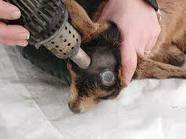
Now, that is a procedure that is seriously painful. This is something I have not been able to bring myself to do. My husband says I should, that it is part of farming, and taking them all to the vet just isn't practical. It isn't - he's right. It costs a minimum of $40 to have the vet do it, and this is for an animal that most years, sells for $75 if I'm very lucky. The vet gives them a nerve block and puts them to sleep with gas. One year I took them to a farmer who does it herself, and I must say, with no anesthesia at all, I was impressed with how quickly the little animals bounced back. They were imprisoned in a box with just their heads sticking out and they struggled and screamed most horribly as they were burned, but when they were let out, they ran back to their mothers, nursed, and then pretty much went back to jumping and playing as usual. But I just don't have the stomach for it. Plus I think it extremely likely I would burn myself.

And of course, disbudding can be dangerous. I lost a baby to brain injury from disbudding this year (See "this one really hurts"). And the vet did that disbudding! If I had done it myself I'd never have forgiven myself. I'd rather somebody else kill my goat than kill it myself.

What about you all? Do you castrate, disbud, slaughter? Do you hire it out, call in a neighbor, or what?

Friday, May 20, 2011

Busting Out All Over

Today was the fourth in a string of sunny days. The longest string of sunshine we have enjoyed around here since last September. The mercury has not yet broken 70 degrees - the longest such stretch in many years, I read in the paper, a full 300 days - but for the past four days, it has been somewhere near or slightly above 60, with clear blue skies. The mud has receded to a few stubborn puddles. The grass is growing almost visibly. And I have emerged from a serious funk.

Having been born and bred here, I like to think that I pay slight attention to the weather. It is sort of a mark of pride, for the native Seattleite, to never ever carry an umbrella; to walk head high through the drizzle; and to be just ever so gently condescending of those poor souls who haven't the gumption to abide the endless grey skies and who succumb to sissy weaknesses like seasonal affective disorder. They are not to be scorned, but pitied.

Of course, it's all a pathetic front. Born and bred is as may be, but we are just as susceptible as the rest of the rabble to SAD and cabin fever. We just work harder to hide it behind closed doors, and subsequently take it out even more on our spouses and children and pets. Behind the brave facade of the chipper outdoorsman/woman striding confidently down the street through the driving rain is a whining whimperer huddled next to a woodstove or a radiator, snapping pulishly at his or her family to bring them some hot chocolate, goddammit. Housewives like myself spend fully seven months of the year screeching at their family to take their ever-loving shoes off before they track mud all over the carpet. Those of us who live on farms endure seven months of damp, of never being clean, of stinky wrinkled white feet, of deep misanthropic resentment.

Then, just about now, the sun comes out. Suddenly, the trees are in full leaf, having seemingly skipped over all the stages from bare branches. There is endless birdsong, flowers of all descriptions, spring mushrooms, flowing milk, early crops bursting out the garden, an amazing over-abundance of eggs. The farmer's markets open, and there is fresh asparagus, bright red radishes, spinach galore. Last night at my sister's house we made pizza with fresh goat cheese and arugula from the farm. Our winter-starved bodies hunger for the fresh greens and the vivid, astringent tastes of spring. Our pallid skins begin to soak up the sun and manufacture some sorely needed vitamin D.

I have begun to slough off the torpid skin of winter. I feel like a turtle emerging from damp frigid sand, like a small animal shaking off the dull metabolism of hibernation. Soon enough, perhaps, I will be complaining about the heat of summer and about drought; but for now, I am content to revel in green spring. Today I was able to lay down in the tall fresh grass and look up at the blue sky through a frame of bright green leaves, and I was very very happy.

Wednesday, May 18, 2011

Urban Gardens, Bellingham Style

I love walking around residential neighborhoods this time of year. I am such an unrepentant voyeur; I just can't help looking into people's yards and checking out their gardens. Bellingham is a great city for urban gardens. At a rough guess, I'd say that easily a third of homes have a medium to serious garden - raised beds, a compost pile. And alm ost all the yards have something edible planted in them - a fruit tree, a blueberry bush, a line of raspberry canes, a window box full of herbs.

Chickens are legal in Bellingham, and it's quite common to see a coop in a backyard with three or four hens inside. I believe goats are legal too, but I didn't see any of those. This being a short-season climate (and a cold year) serious gardeners must do something to extend the season, and many homes have hoop houses set up over their raised beds, or cold frames, or greenhouses. In the picture below, you see an ingeniously cheap cold frame made by the simple expedient of leaning up a pane of glass against the side of the house, and planting beneath it.


Here, at the other end of the spectrum, is a gorgeous well constructed hoop house that was fully 12 x 30 feet, and a good eight or nine feet high. It was too early in the season for me to see what was planted inside, but there was enough space in there to plant anything. The photo below that shows a raised bed in the same yard, about six by twenty, full of raspberry canes. There are some folks who are NOT going to run short of raspberries.


On the smaller end of the scale, here is a cute little bamboo pyramid with a bunch of snap peas growing up it. There will be enough peas here to provide snacks for several weeks. Next to the pyramid is a seriously out of control rhubarb plant.


And finally, this photo has no edibles at all in it, but what a beautiful tulip garden! This view just made my day.

Sunday, May 15, 2011

Loaning Out the Goats (Never Loan More Goats Than You Can Afford to Give Away)

Ok, that subtitle was an inside joke for my siblings.

Half my herd is at a friend's house. A friend of my sister's, B., put up a notice on Facebook that she was looking for a few goats to help her take control of an out-of-control yard. Also, she thought her kids would get a big kick out of having some temporary goats. After ascertaining that the yard in question has good fences, I offered my goats.

I am only milking one goat at present, Iris. The others have enough to do feeding their own kids, or else haven't been bred. The pastures have been very slow to get growing this year, because of the unseasonable cold. It makes sense for me to pawn off a few goats, if I can, for a week or two and take a little stress off of the pasture. B. is very trustworthy, and I felt totally confident in her ability to take care of a few goats for a week.

Really, it isn't very hard. Friday, I loaded Edith and Flopsy in the van, along with Flopsy's kid (who isn't named but who the kids have taken to calling Spotsicle) and the largest of Django's triplets. I figured I might as well take the opportunity to forcibly wean that greedy little bugger and give Django a bit of a rest.

B. and her family were excited just about out of their pants to see the goats. Her children are very close in age to my own (7 and 5). Hope and Paloma instantly took a liking to B.'s little girl and the three of them ran off into the underbrush to giggle and play. The little boy, the youngest of the four, toddled after the goats and hugged them mercilessly.

Many of B.'s neighbors and friends were also interested in the goats, and quite soon the event had evolved into a pizza picnic, complete with a cooler full of beer and approximately seventeen small children rampaging all over the landscape, alternately chasing and chased by goats. B. and I unloaded a bale of hay into the carport and kicked it around to make a nest for the goats. By the time I left, all four goats looked quite happy with their new digs.

B. called me this morning to let me know that so far all the goats seemed to be doing fine. My reconnaissance of the property led me to believe that the goats will have about a week before they have eaten everything edible and it will be time for them to come home. Who knows... if B. and her family love the goats a whole lot, maybe I will be able to sell them one of the babies!

Saturday, May 14, 2011

Greenhouse Pictures


My new sitting area on the porch. I traded a dozen eggs for each of the wooden spools, and I think they make nice tables. My herbs are acclimating to life outside the greenhouse.


The broilers are getting big. We made them a small run by leaning cattle panels up against the side of the greenhouse, and they sleep in the old truck canopy. Isn't it great how you can make almost everything you need out of trash and rubble, if you aren't too picky about aesthetics?


The tomatoes are beginning to bloom - bad news because it is still too cold to move them outside. Will this cold spring ever end? Probably not for a while yet. The paper had an extended weather report that said they expect all of May and June to be significantly colder than usual. Then they thoughtfully provided the newest round trip airfares to Honolulu, Phoenix, and Palm Springs, along with the current temperatures. Oh well, I guess I should be happy I have a greenhouse now. I AM happy - even on a cold day, I can go inside and close the doors and enjoy the warmth.

Monday, May 9, 2011

On Trading and Canning


Yesterday I made the first major trade of the year - four dozen eggs and a pound of goat cheese for ten pounds of asparagus. That makes a pretty big box of asparagus, even after deducting my sister's mother's day present (she adores asparagus). I traded with Veggie/Oil Man, now officially my longest-term trade partner. We have three solid years of trading everything we have to trade - eggs, cheese, and mechanic services on our side for organic vegetables, use of equipment, and waste veggie oil on his side. Veggie/Oil Man supplies a great percentage of our fresh food in the summertime, and allows us to glean his fields as the season ends. He is also a very interesting and colorful character and something of a local legend.

The trade network is real fun, something I very much enjoy. I like meeting new people; I like finding out what our local foodshed has to offer; and I like offering up the fruits of our own labor. But it does have a few disadvantages. Imagine for a minute that the only place you could ever shop was Costco. Imagine that most of your fresh produce comes in ten pound lots. Most of us are probably familiar with a ten pound sack of potatoes, and if we have a medium-to-large family, that's not really a lot of potatoes. But ten pounds of asparagus is a lot. Ten pounds of tomatoes is a lot. Ten pounds of snap peas or green beans is a MAJOR lot. And ten pounds of kale or chard is an insane amount.

There are a few ways to deal with massive amounts of one kind of food at a time - recipes heavy on one or two ingredients ( for example - http://newtofarmlife.blogspot.com/2010/06/seasonal-abundance-greens-n-cheese.html), or throwing a party with enough people to absorb whatever you have too much of (any excuse for a party.). But eventually, we have to fall back on preserving. Not that it's a hardship or a last resort - quite the opposite. It's the only way to eat locally throughout the year; a good way to save money; a wonderful source of satisfaction and pride, not to mention cheap christmas presents.

Again, there are many methods of preserving, and each of them has advantages and disadvantages, depending on the produce involved, your preferences, and energy/infrastructure situation. We tend to favor freezing and canning around here. To get back to the subject of this week's trade, asparagus, I am planning to pickle it. I know my siblings both consider pickles to be the scourge of the earth and a shameful waste of good fresh food. I couldn't disagree more. Maybe I was born with a salty/sour gene that they missed out on, but there's nothing I like more than a good half-sour kosher dill. Or some tangy, sweet pickled beets. Or hot n' spicy dilly beans. Or, more to the point, pickled asparagus.

Maybe it has something to do with my love of a good Bloody Mary, I don't know. Is there a better addition to a Bloody Mary than a hot, garlicky spear of pickled asparagus? I think not; unless it might be the pickled yard-long bean served in the Wasabi Mary at the Dragonfish Cafe in Seattle. Last year, alas, only a very few of my pickled asparagus spears ever made it into a Bloody Mary. Most of them were snarfed up by my children, who have apparently all inherited the salty/sour gene. I can't remember for sure, but I think I made six quarts of pickled asparagus last year. There is enough asparagus in the fridge right now for about the same amount - but I'm going back next week for more. There is no such thing as too much pickled asparagus.

Six quarts pickled asparagus:

2 or 3 pounds fresh asparagus
1 quart distilled white vinegar
3 quarts water
1/2 cup sea salt
1/4 cup white sugar
1 head garlic, separated and peeled
1 tablespoon hot red pepper flakes
small handful whole black peppercorns
several whole allspice berries
several cloves


Sterilize 6 wide mouth quart jars in boiling water; keep water simmering. Set our sterilized jars on a clean towel on counter. Add lids and rings to simmering water.
Make brine - boil all remaining ingredients and keep at a bare simmer.
Pack jars with cleaned, trimmed spears of asparagus.
Add simmering brine to within 1/4 inch of jar lips. Make sure each jar has a couple of cloves of garlic.
Using tongs, remove lids and rings from simmering water and close jars. Replace jars in simmering water and process for 30 minutes. Remove jars with tongs and set out to cool. Testy to make sure all jars have sealed. If any have not, keep in fridge and use within 2 weeks.


Bloody Mary:

For Four:

In a pitcher, combine 6 - 8 ounces of vodka, one jar of V-8 or Very Veggie juice, juice of 2 lemons, and several shakes of tabasco. Pour over ice-filled tumblers. Garnish with celery sticks, parsley springs, pickled asparagus, and whatever else helps you maintain the illusion that you are consuming a healthy dose of vitamins along with your alcohol. Best served around the breakfast table about 11 a.m. with 3 of your best friends over a platter of greasy hashbrowns, scrambled eggs, bacon, and biscuits. Hair of the dog and all that.

Sunday, May 8, 2011

Best Mother's Day Present EVER (Thanks, Baby, You're the BEST)

Today was great. The best mother's day I can remember, in fact. Many things about today were nice - lunch at my sister's with Mom and family; a late afternoon sunbreak; barbecue ribs and potato salad - but the best thing about today, as it is most days, was my husband.

Homero spent yesterday out in his shop, working on a mysterious present for me. All I knew about it was that he came in with greasy hands and that welding was involved, but that pretty much mirrors his daily routine, so I couldn't guess. He was fairly smug about it, however, supremely assured that I was going to love it. The little girls, who knew, did an admirable job of keeping the secret, only giggling uncontrollably as I interrogated them: "Is it bigger than a breadbox? Does it walk and talk? Does it wriggle on it's belly like a reptile?"

He wouldn't even give it to me this morning, but insisted on taking it with us to my sister's house so I could open in front of everybody. Which I did. And here it is:


It's okay; it took me a minute, too. It's a CHEESE PRESS! A beautiful, beautiful CHEESE PRESS, about two feet tall. The cheese basket (?) is a stainless steel pot from Goodwill, in which Homero drilled several drainage holes. He then cut the lid so that instead of sitting on top of the pot it slid neatly inside of it. Then he made the frame. The handle on top spins, lowering or raising the pressing-arm (I really know my technical language, don't I?). The entire machine is stainless steel for easy cleaning, and I LOVE LOVE LOVE it!

No more wobbly stacks of books! No more kettles of water precariously balanced on top of a colander! No more sudden crashes in the night, waking us all out of a sound sleep! Now I have even, controlled pressure. Now I can make beautiful round wheels instead of irregularly shaped lumps. Now I feel like a real cheesemaker!

The best part of all is the beautiful knowledge that my husband knows what is important to me. He really thinks about my desires, he respects my work and he wants to help me. He has done this before - once he spent weeks making me a whole series of gigantic stretched canvasses for me to paint on. I still haven't used them all. I am so very lucky to have a man like Homero. Not only does he know me and love me enough to think of these terrific gifts, but he is capable of making them a reality. And willing to spend time and sweat on them, too. I am so grateful and so moved and so happy.

And I haven't the FAINTEST IDEA how I am going to top this for father's day next month.

Wednesday, May 4, 2011

Ivory (Dog O'My Heart)


My husband has been bugging me for some time to write a post exclusively about Ivory. Ivory is our dog, one of our two dogs, and as you can clearly see, the most beautiful dog on the planet. Oh I know, many of you are thinking that YOUR dog is the most beautiful dog on the planet, and I feel for you. I really do. You are laboring under a very common delusion, a delusion called "being flat-out wrong." I've run into this delusion before, on the very rare occasions when somebody thinks their children are cuter or more intelligent than mine.

We have had Ivory since the very first days of our marriage, which means she is just about ten years old now. Before Ivory, I had never had a dog of my own. My mother had a dog during my early childhood - a cocker spaniel named Pepper - but since I went out on my own I had not lived a lifestyle conducive to dog ownership (cough cough), and moreover had self-identified as a cat person. We all make embarrassing mistakes during adolescence, don't we? The story of how I acquired my first dog is kind of cute: one day my seven year old daughter came home from school and burst in the door yelling "Mom! Mom! Come quick! There's a hurt crow on the sidewalk!"

I followed her out the door and found a very large and healthy looking crow which did not, however, fly away when I approached. I couldn't see anything wrong with it, but clearly it couldn't fly or it would have as our sleek cat got closer and closer. I was about to give my daughter the "circle of life" speech when she looked up at me with gigantic china-blue eyes and asked "can't we try to save it, Mama, please?"

Lucky for her - and the crow - it only took one phone call to locate a wildlife rehabilitation shelter willing to take a crow. I found a small cardboard box and a towel, and gingerly approached the fierce looking bird. "I'm only to try this ONCE," I warned my daughter. "If it doesn't work on the first try I don't want to hear a word about it." I will never forget how the crow, as I crept up on it with a towel in my hand, looked at me out of one bright eye and then lay down on it's side and went still. Silly as the idea is, it seemed to me - and it still does - that somehow the bird knew I intended to help it. I threw the towel over it and then gathered it up and put it into the box. Not once did it struggle.

The PAWS wildlife shelter accepted the crow and told me that there was no immediate reason to think it wouldn't recover completely. I couldn't help but notice that the adoption shelter was right next door to the wildlife rehabilitation shelter. "Since we are right here," I said to Rowan, "Do you want to go take a look at the animals? But I'm warning you, we are NOT getting a kitten."

Well we didn't get a kitten. But there was a litter of six puppies, white puppies with spots, that were heartbreakingly adorable. I asked about them and was told that they had just been neutered that day and wouldn't be ready for adoption until the following day. "If you are seriously interested," said the lady at the desk, "get here early. There's been a lot of interest in those puppies."

There was a lot of beseeching around the dinner table that night. Homero had been talking about a dog for quite some time, and I asked him to come with us the next morning, but he couldn't get the time off work. I took my sister instead. At PAWS, when you are interested in adopting an animal, you can take it to a special "interaction room" (or whatever they call it) to play with it for a little while and make up your mind. We took Ivory - the smallest of the puppies and the only one that was pure white - to this room and played for a while. She was bold, friendly, roly-poly, and we all pretty much fell for her. "Wait here," I told my sister, "I'm going to go tell them I want this puppy."

When I came back, my sister grabbed my arm. "You should have seen it," she said. "As soon as you left the room, the puppy ran over to the door and started whining and scratching, even though there are still four people in here who want to play with her. That's your dog, Aimee! You can't leave without her!" I had to tell a fib in order to take her home: PAWS won't let you adopt a dog unless everyone in the household has met the animal. But I lied and said my husband had met her on the previous day. I wasn't going to let this dog slip through my fingers. When I stopped by Homero's work to show him the new puppy, he actually thought she was homely beyond belief and that I might have made a major mistake. That is funny now, because no-one loves Ivory as much as my husband does. He dotes on her so devotedly that it has occasionally made me jealous. C'mon, if your husband thought his dog was more attractive than you are, you'd be jealous too, right? Especially if it were true?


Ten years later, Ivory is still the best dog ever. No member of the family has enjoyed the move out of the city and into the country more than Ivory has; no member of the family tears through the blackberries to catch rabbits like she does; nobody else has learned to herd goats like Ivory has. I moved out here for my children, but I think Ivory has benefitted the most. Ivory is the all-around American dog: she is fierce enough to protect the house and family, yet gentle enough to sleep with a newborn baby. She kills rats mercilessly, but has never killed a chicken.


She is endlessly elegant and beautiful. As an artist, I appreciate her gorgeous lines. She literally can't strike an awkward pose. Yet she can be silly and clownish. She is playful, athletic, graceful, rambunctious, and energetic.


She effortlessly learned to help me with the goats, and even learned to protect the little girls from aggressive pigs.


Ivory was born to be a farm dog. She was born to be OUR dog. Nobody knows what kind of dog she is - although everybody asks. "What a pretty dog!" They always say. "What kind of dog is she?" Even the vet can't guess, but we know she is largely whippet and most likely part pit bull. That leads us to call her a "whippet-pit." But there could easily be a bit of shepherd or just about anything else in there as well. All we care about is that she is OUR dog; a fantastic family dog and a very, very good friend.


At the risk of sounding ridiculous, I will share with you a song we made up for Ivory, back when she was still a young dog. Please refer to the first picture at the top of this post; and then play this to the tune of that old schoolyard favorite "do your ears hang low?"

Do your ears stand high
do they almost touch the sky?
if you flapped them do you think you could fly?
are they tri-an-gu-lar
and covered with fur?
the ears of
the dog that
I love....

Thursday, April 28, 2011

A Mess for Every Season (Blessed Be the Mess!)


I am a lackadaisical housekeeper. Some people would call me slovenly, but I don't care for that kind of person and so they don't get invited to my house anyway. Nevertheless, it is true that for a woman who voluntarily became a housewife, I sure hate to clean.

Don't get me wrong: There are many housewifely duties that I enjoy very much - I love to cook, for example, and I am a damn good home cook, if I do say so myself. And when I say "cook," I don't mean that I can throw together a pretty good meal. That is sort of the least of it. I mean that I take very seriously my job of nourishing my family: I am knowledgeable about nutrition; I am thrifty and know how and where to shop to get maximum bang for the family buck; I have put together a serious pantry out of which we could eat, if we had to, for months; I have taken up the gauntlet of providing a large share of the family's food through gardening and animal husbandry; and I have - if you will forgive the hubris - a deeper and wider knowledge base about preparing all kinds of food from scratch than almost anyone I have met in my generation. With deep humility, I acknowledge my friend Sarah, who kicks the shit out me in the kitchen. I am about as good a cook as my mother, and that is saying something.

But man, I do hate to clean. Laundry is okay, I can handle laundry, pretty much, although now that spring is here I feel guilty for using the dryer instead of hanging out the clothes on the line. But I literally can't think of another cleaning task I don't absolutely loathe. I hate the dishes, the never-ending mountains of dishes, which make me feel like Sisyphus on a bad day. You finish one mountain and ten minutes later there is another mountain behind it. It makes me want to force us all to live like Bhuddist monks, with only one bowl apiece and not even a spoon to our name. I make my teenage daughter scrub the bathroom. As far as I can tell, having a live-in bathroom scrubber is just about the only reason to have a teenage daughter. Well, that and a live-in babysitter. The day she decides she doesn't want to clean the bathroom anymore is the day I suggest she get a job and an apartment.

Since I hate cleaning so much, I tend to do it rather the same way that most of us fill our gas tanks - the minimum required to get us through the day. The bare minimum I can get away with daily, I have found, is dishes twice a day, a thorough sweeping, and wiping of all major surfaces. That, of course, is in addition to all my non-cleaning tasks like childcare, shopping, cooking, chaffuering, animal care, bill paying, et cetera. The deep cleaning like mopping and crevice-scrubbing, tends to be an occasional affair. Like when I can occasionally afford to hire someone to help.

As I was cleaning the kitchen today, I started ruminating on the seasonal nature of messes on a farm. It being late April, we are still in the throes of mud season. The twice-daily chores require that we trudge through the mud, and inevitably, some gets tracked into the house. Personally, I take off my shoes in the playroom, but I haven't been able to train Homero to do the same. At least there is finally enough new grass for him to wipe his shoes on on the way back to the house after chores, but even so, I am constantly finding horrible clots of mud, poop, and grass on the floors. Mud season is the main reason I spent so much money to get rid of the carpets and install hardwood floors. Said horrible clots are much easier to sweep off a hard surface than they are to remove from a carpet.

Cheese season has begun. I love cheese season - I love milking, I love making cheese, I love making yogurt. However I can't say I love the cheesemaking mess. For the duration of cheese season (April to September) there tends to be a faint tang of sour milk hanging in the air of the kitchen. During cheese season, I have to break out all the big jars, the gallon and half-gallon sized jars, and there are always jars hanging out on the counter that maybe needed to be scrubbed a little better than I scrubbed them. There are always acres of cheesecloth, used once and rinsed well in boiling water and hung up to dry and use again. Every time I open the fridge, the smell of green cheese wafts out. There is usually a ziploc bag or two full of cheese-crumbles past their prime that needs to be disposed of. When I milk the goats, I usually get at least a little milk on my shirt or on my jeans, and if it's just a squirt or two it seems a pain in the ass to change clothes... until it gets hot later in the afternoon and somewhere around four o'clock in line at the grocery store I start thinking "what is that smell?" and it's me. Brings me back to my breastfeeding days, when I always smelled faintly of sour milk....

High summer will bring on the canning mess - perhaps the biggest mess of all. First you bring in a dozen or a score of pounds of produce fresh from the garden, which means dirt and bugs all over the kitchen table... then you wash it and stem it or de-leaf it or whatever is called for, thus creating a large quantity of compost... and if it is something juicy like strawberries or staining like beets that creates it's own situation. Then there is always the possibility for a disaster like a ketchup explosion (see photo) or a jam eruption. The smell of burnt sugar lingers for weeks, as does the smell of fermentation from your half-sour kosher dills or your kim chee. Hardened jam is like lacquer, and requires a serious expenditure of elbow grease and steel wool to remove from a ceramic stovetop. Basically, for the entire preserving season - say, June to October - you can expect your kitchen to be a disaster area.

As exhausting as the mess is, however, it has it's compensations. The mess is tangible proof that you are doing your job. The mess is an incontrovertible sign of progress. The ever-changing mess is a kind of sacred calendar, a way of marking the seasons, a book of days and works (http://www.sacred-texts.com/cla/hesiod/works.htm). The mess reminds me that I am also a part of the earth and it's yearly cycle. Like the birds and the beasts, I have my appointed rounds according to the season and the gifts thereof. In the spring I plant and milk; in the summer I reap and preserve, in the autumn I slaughter, hoard and burrow. In the winter we abide.

Blessed be the mess!

Wednesday, April 27, 2011

Cheesy Success!


It;s just about suppertime, so I have no time at the moment for a detailed explanation, but I have FINALLY created a reasonable facsimile of Quesillo, also known as Queso Oaxaqueno, a fresh mild string cheese which is wound into balls and used in quesadillas and as a topping for just about anything. Also it is my husband's favorite unavailable food from home, and I have been trying to make it for years now without notable success.

Consistency is the demon that torments all cheesemakers, of course, and one batch of decent quesillo does not guarantee success in future attempts. But nonetheless, I'm thrilled that I've done it once.

Monday, April 25, 2011

Meet Edith (New Blood in the Herd)


Following the death of my little black and white doeling (http://newtofarmlife.blogspot.com/2011/04/this-one-really-hurts-bad-year-for-baby.html), I spent some time reflecting on my breeding program - or rather, my lack of a breeding program. Here's my program, in a nutshell: I like spots. It was very easy, I found, to breed for spots. I just pick my spottiest goats, let them go at it, and now, a few generations later, I got spots all over.

But I really do believe that Flopsy's triplets were weaker and less vigorous as a result of their close inbreeding. They were sired by their brother - or in other words, Flopsy was served by her own son. I knew it wasn't the best idea (even though both goats were utterly without defects as far as I could tell) but I just marked them down as meat kids in my mind. It was only when all three came out spectacularly spotty that I went against my better judgement and started thinking about keeping the girl. Last year I was able to sell a spotted wether for $250 (unHEARD of price for an unregistered wether), so I started thinking about trying to sell this boy, too. After all, if he were wethered, I wouldn't have to worry about him passing on his bad genetics....

However, when all three of Flopsy's triplets had problems of one kind or another, I had to face the fact that most likely they were simply not "good" goats, no matter how adorable and seemingly perfect. I am wholly against single-trait breeding - I don't even like purebred dogs! I think it is the height of irresponsibility to breed animals for a single trait, at the expense of their overall health or temperament. Yet, I did it myself. It really is frighteningly easy to get carried away by a showy, attractive trait like spots or, I would guess, a lucrative one like milk production and end up with defective or somehow inferior animals. Aside from the ethics of deliberately creating unhealthy animals, what a homesteader like me needs to be breeding for is hardiness.

Storm Cloud, the sire, is already sold. I sold him for a very handsome price after last year's breeding season, knowing I wouldn't be able to use him again. I thought about buying a new buck, but actually I have a different plan, now. I want to give Iris and Django a year off. They have both produced four years in a row and that's a lot. They are good, strong healthy goats and for all I know it won't do them a lick of hurt to keep on year after year, but as a woman and a mother, it feels cruel. Give the ladies a break! Flopsy, I will sell if I can. So I needed a replacement doe.

Enter Edith.


I found Edith on Craigslist, advertised as a two-year old, never bred purebred Nubian doe. I believe the rest of it, but I don't think she is a purebred. She looks like part Boer to me. She is thick-boned, with legs almost twice as thick as my other goats, and she is thick and heavily muscled. The last owners called her "Edith Behemoth" and I've already nicknamed her "the Bunker." It's a little bit hard to tell, because she is also pretty severely overweight, but I think she may have the signature "double-muscling" of the meat goat. If so, I would consider that an asset. After all, at least half of the kids born here end up on somebody's table. We have found that the Nubians and the crossbreeds give a nice carcass, if slaughtered in the fall after a summer on grass and browse, but I am sure adding some Boer into the mix would improve things. I'm not sure what kind of a milker she will be, but I have seen 1/2 and 1/2 Nubian/Boer mixes advertised as "dual purpose" goats, so I'm willing to give it a try.

Especially considering her spots! Edith has great color. And she is totally unrelated to all my other goats. So here's my new breeding plan: rent a spotted Nubian Buck this year and breed him to only Edith, giving the others a year off. If Edith throws a buckling, I can breed him to all my other ladies the following year, and send Edith out for breeding to a different buck. B y the end of that year I will know if Edith is a good milker or not. If she is, I'll keep her and sell the buck. If not, I'll keep the buck and sell Edith. Either way, I will have new blood in my herd and hopefully still have preserved the spotty genetics.

Edith is also a sweetheart. She loves people and follows me and the kids everywhere we go. She has been well taken care of and has good hooves, a shiny coat, and is pooping pellets. I hope she works out and adds a nice meaty strain to my stock.

Monday, April 18, 2011

Plodding Along

There hasn't been a whole lot going on here, we're just plodding along through this cold spring. The weather has finally turned a corner and we have had several days of sunshine, but it is still very cold. We ran out of propane about three weeks ago and I didn't buy any more, thinking that any day now spring would kick in. Nearly a month later and we are still shivering in our sweaters. At least the sunshine means it warms up in the greenhouse. The kids like to play in there, and I took in a folding chair and a book just to enjoy the warmth through the glass.

The broiler chicks got too big for the rabbit hutch, and we were casting about for a place to put them, when I spied an old truck canopy upside down out in the blackberry bushes. Righted and dragged over to the side yard, it makes a fine chicken house, Except that Lancelot, the collie dog, tore out the mesh on one of the windows so he could crawl in with the chicks. He didn't kill any of them, he just wanted to be in there with them. Weird dog. So now we have to keep that window closed. They still need the light at night, but not during the day.

The annual struggle with the lawnmower has begun. This time, it only took Homero about a half an hour to get it running - a record - but it only ran for about two minutes before one of the tires peeled off. Another record. He doesn't want to look at the damn thing anymore (I don't blame him) but on the other hand the grass is really starting to get long and if we don't mow now we will need to rent a brushmower.

I did something to my left shoulder. It's been bothering me moderately for some time now, but yesterday I tripped on a brick, fell on the shoulder, and now I can't lift it more than 45 degrees in any direction. I'm wearing a sling and taking lots of ibuprofen, and we'll see how it in a week.

Wednesday, April 13, 2011

Letter to the Vetrinarian

I got the results of the necropsy on Sunshine. Here is the letter I wrote to my vet's office:


To whom it may concern:

On Monday April 11th, I brought in two goat kids to be disbudded. Dr. A* performed the operation. The kids did not respond well, and the following day - yesterday - I called and spoke to Dr. J* regarding my concerns. I followed her advice, but alas, this morning, I found the doeling dead and the buckling quite depressed. I called in, and when Dr. A* was informed she told me to bring in both kids at any time and the boy would be treated and the girl examined. Dr. J* saw my buckling, and treated him with banamine, antibiotics, and subcutaneous fluids. I am happy to report he is doing much better as of this evening.

Dr. A* called me with the results of the necropsy and told me quite frankly that the baby appeared to have died of a brain hemorrhage and it appeared that thermal damage was the cause. She apologized and let me know that my disbudding fee would be refunded and that there would be no fee for the buckling's treatment.

I am writing to let you know that my confidence in Dr. A* is totally unshaken, and that I in no way, shape, or form blame her for my doeling's death. I was present during the operation - as I have been at many others previously - and her technique was faultless. Both kids appeared to recover from anaesthesia quickly and unremarkably. I do not believe that anything Dr. A* did was responsible for my doeling's death - on the contrary, I am sure it was due to some small idiosyncrasy of her anatomy. These things happen occasionally and they are nobody's fault, but simply the result of chance.

I will continue to request Dr. A* as the primary doctor for my goats, and I will continue to recommend her to my friends and neighbors.

Thank you for your time.

Sincerely,

Aimee Day

This One Really Hurts (Bad Year for Baby Goats)

Sunshine is dead. She was the doeling from Flopsy's triplets. The prettiest goat, the one we had decided to keep, the spotty doeling I've been waiting for for years.

I took her and her brother in to be disbudded the day before yesterday. Sunshine's buds were still quite small, but her brother's were getting so big I was afraid to wait longer. The vet checked sunshine and decided she wasn't too small and we could disbud her too. All seemed to go well; they woke up from the anaesthesia in good time, were given banamine for the pain, and were walking around and nursed when I got them home.

But the next day, yesterday, they didn't look good at all, especially Sunshine. They were lethargic, trembling, and not nursing well. It looked they were suffering from brain swelling - this happened once before and I recognized the signs. That time, though, the baby had been disbudded by a farmer, not a vet. That is the main reason I brought them to the vet this time, despite the expense. I called the vet back and was given instructions to give her aspirin at 100 mg/kg, or about 500 mg. I crushed up two aspirin (650 mg), dissolved it in a few ounces of milk, and gave her three quarters of the milk, approximately. I very much doubt she received more than 400 mg. I closed her and her brother up with Flopsy in the mama barn, waited until I had seen her nursing, and went to bed.

This morning she was stiff and cold. She must have died in the middle of the night. Her brother doesn't look great, either. I called the vet back, of course, and we decided I will bring them both in and the boy can be examined and treated, and the girl autopsied so the vet can decide if she killed her accidentally or what.

I feel just terrible. The kids are going to be devastated. This one was going to be a pet.