"United we bargain, divided we beg."

Thursday, April 28, 2011

A Mess for Every Season (Blessed Be the Mess!)


I am a lackadaisical housekeeper. Some people would call me slovenly, but I don't care for that kind of person and so they don't get invited to my house anyway. Nevertheless, it is true that for a woman who voluntarily became a housewife, I sure hate to clean.

Don't get me wrong: There are many housewifely duties that I enjoy very much - I love to cook, for example, and I am a damn good home cook, if I do say so myself. And when I say "cook," I don't mean that I can throw together a pretty good meal. That is sort of the least of it. I mean that I take very seriously my job of nourishing my family: I am knowledgeable about nutrition; I am thrifty and know how and where to shop to get maximum bang for the family buck; I have put together a serious pantry out of which we could eat, if we had to, for months; I have taken up the gauntlet of providing a large share of the family's food through gardening and animal husbandry; and I have - if you will forgive the hubris - a deeper and wider knowledge base about preparing all kinds of food from scratch than almost anyone I have met in my generation. With deep humility, I acknowledge my friend Sarah, who kicks the shit out me in the kitchen. I am about as good a cook as my mother, and that is saying something.

But man, I do hate to clean. Laundry is okay, I can handle laundry, pretty much, although now that spring is here I feel guilty for using the dryer instead of hanging out the clothes on the line. But I literally can't think of another cleaning task I don't absolutely loathe. I hate the dishes, the never-ending mountains of dishes, which make me feel like Sisyphus on a bad day. You finish one mountain and ten minutes later there is another mountain behind it. It makes me want to force us all to live like Bhuddist monks, with only one bowl apiece and not even a spoon to our name. I make my teenage daughter scrub the bathroom. As far as I can tell, having a live-in bathroom scrubber is just about the only reason to have a teenage daughter. Well, that and a live-in babysitter. The day she decides she doesn't want to clean the bathroom anymore is the day I suggest she get a job and an apartment.

Since I hate cleaning so much, I tend to do it rather the same way that most of us fill our gas tanks - the minimum required to get us through the day. The bare minimum I can get away with daily, I have found, is dishes twice a day, a thorough sweeping, and wiping of all major surfaces. That, of course, is in addition to all my non-cleaning tasks like childcare, shopping, cooking, chaffuering, animal care, bill paying, et cetera. The deep cleaning like mopping and crevice-scrubbing, tends to be an occasional affair. Like when I can occasionally afford to hire someone to help.

As I was cleaning the kitchen today, I started ruminating on the seasonal nature of messes on a farm. It being late April, we are still in the throes of mud season. The twice-daily chores require that we trudge through the mud, and inevitably, some gets tracked into the house. Personally, I take off my shoes in the playroom, but I haven't been able to train Homero to do the same. At least there is finally enough new grass for him to wipe his shoes on on the way back to the house after chores, but even so, I am constantly finding horrible clots of mud, poop, and grass on the floors. Mud season is the main reason I spent so much money to get rid of the carpets and install hardwood floors. Said horrible clots are much easier to sweep off a hard surface than they are to remove from a carpet.

Cheese season has begun. I love cheese season - I love milking, I love making cheese, I love making yogurt. However I can't say I love the cheesemaking mess. For the duration of cheese season (April to September) there tends to be a faint tang of sour milk hanging in the air of the kitchen. During cheese season, I have to break out all the big jars, the gallon and half-gallon sized jars, and there are always jars hanging out on the counter that maybe needed to be scrubbed a little better than I scrubbed them. There are always acres of cheesecloth, used once and rinsed well in boiling water and hung up to dry and use again. Every time I open the fridge, the smell of green cheese wafts out. There is usually a ziploc bag or two full of cheese-crumbles past their prime that needs to be disposed of. When I milk the goats, I usually get at least a little milk on my shirt or on my jeans, and if it's just a squirt or two it seems a pain in the ass to change clothes... until it gets hot later in the afternoon and somewhere around four o'clock in line at the grocery store I start thinking "what is that smell?" and it's me. Brings me back to my breastfeeding days, when I always smelled faintly of sour milk....

High summer will bring on the canning mess - perhaps the biggest mess of all. First you bring in a dozen or a score of pounds of produce fresh from the garden, which means dirt and bugs all over the kitchen table... then you wash it and stem it or de-leaf it or whatever is called for, thus creating a large quantity of compost... and if it is something juicy like strawberries or staining like beets that creates it's own situation. Then there is always the possibility for a disaster like a ketchup explosion (see photo) or a jam eruption. The smell of burnt sugar lingers for weeks, as does the smell of fermentation from your half-sour kosher dills or your kim chee. Hardened jam is like lacquer, and requires a serious expenditure of elbow grease and steel wool to remove from a ceramic stovetop. Basically, for the entire preserving season - say, June to October - you can expect your kitchen to be a disaster area.

As exhausting as the mess is, however, it has it's compensations. The mess is tangible proof that you are doing your job. The mess is an incontrovertible sign of progress. The ever-changing mess is a kind of sacred calendar, a way of marking the seasons, a book of days and works (http://www.sacred-texts.com/cla/hesiod/works.htm). The mess reminds me that I am also a part of the earth and it's yearly cycle. Like the birds and the beasts, I have my appointed rounds according to the season and the gifts thereof. In the spring I plant and milk; in the summer I reap and preserve, in the autumn I slaughter, hoard and burrow. In the winter we abide.

Blessed be the mess!

Wednesday, April 27, 2011

Cheesy Success!


It;s just about suppertime, so I have no time at the moment for a detailed explanation, but I have FINALLY created a reasonable facsimile of Quesillo, also known as Queso Oaxaqueno, a fresh mild string cheese which is wound into balls and used in quesadillas and as a topping for just about anything. Also it is my husband's favorite unavailable food from home, and I have been trying to make it for years now without notable success.

Consistency is the demon that torments all cheesemakers, of course, and one batch of decent quesillo does not guarantee success in future attempts. But nonetheless, I'm thrilled that I've done it once.

Monday, April 25, 2011

Meet Edith (New Blood in the Herd)


Following the death of my little black and white doeling (http://newtofarmlife.blogspot.com/2011/04/this-one-really-hurts-bad-year-for-baby.html), I spent some time reflecting on my breeding program - or rather, my lack of a breeding program. Here's my program, in a nutshell: I like spots. It was very easy, I found, to breed for spots. I just pick my spottiest goats, let them go at it, and now, a few generations later, I got spots all over.

But I really do believe that Flopsy's triplets were weaker and less vigorous as a result of their close inbreeding. They were sired by their brother - or in other words, Flopsy was served by her own son. I knew it wasn't the best idea (even though both goats were utterly without defects as far as I could tell) but I just marked them down as meat kids in my mind. It was only when all three came out spectacularly spotty that I went against my better judgement and started thinking about keeping the girl. Last year I was able to sell a spotted wether for $250 (unHEARD of price for an unregistered wether), so I started thinking about trying to sell this boy, too. After all, if he were wethered, I wouldn't have to worry about him passing on his bad genetics....

However, when all three of Flopsy's triplets had problems of one kind or another, I had to face the fact that most likely they were simply not "good" goats, no matter how adorable and seemingly perfect. I am wholly against single-trait breeding - I don't even like purebred dogs! I think it is the height of irresponsibility to breed animals for a single trait, at the expense of their overall health or temperament. Yet, I did it myself. It really is frighteningly easy to get carried away by a showy, attractive trait like spots or, I would guess, a lucrative one like milk production and end up with defective or somehow inferior animals. Aside from the ethics of deliberately creating unhealthy animals, what a homesteader like me needs to be breeding for is hardiness.

Storm Cloud, the sire, is already sold. I sold him for a very handsome price after last year's breeding season, knowing I wouldn't be able to use him again. I thought about buying a new buck, but actually I have a different plan, now. I want to give Iris and Django a year off. They have both produced four years in a row and that's a lot. They are good, strong healthy goats and for all I know it won't do them a lick of hurt to keep on year after year, but as a woman and a mother, it feels cruel. Give the ladies a break! Flopsy, I will sell if I can. So I needed a replacement doe.

Enter Edith.


I found Edith on Craigslist, advertised as a two-year old, never bred purebred Nubian doe. I believe the rest of it, but I don't think she is a purebred. She looks like part Boer to me. She is thick-boned, with legs almost twice as thick as my other goats, and she is thick and heavily muscled. The last owners called her "Edith Behemoth" and I've already nicknamed her "the Bunker." It's a little bit hard to tell, because she is also pretty severely overweight, but I think she may have the signature "double-muscling" of the meat goat. If so, I would consider that an asset. After all, at least half of the kids born here end up on somebody's table. We have found that the Nubians and the crossbreeds give a nice carcass, if slaughtered in the fall after a summer on grass and browse, but I am sure adding some Boer into the mix would improve things. I'm not sure what kind of a milker she will be, but I have seen 1/2 and 1/2 Nubian/Boer mixes advertised as "dual purpose" goats, so I'm willing to give it a try.

Especially considering her spots! Edith has great color. And she is totally unrelated to all my other goats. So here's my new breeding plan: rent a spotted Nubian Buck this year and breed him to only Edith, giving the others a year off. If Edith throws a buckling, I can breed him to all my other ladies the following year, and send Edith out for breeding to a different buck. B y the end of that year I will know if Edith is a good milker or not. If she is, I'll keep her and sell the buck. If not, I'll keep the buck and sell Edith. Either way, I will have new blood in my herd and hopefully still have preserved the spotty genetics.

Edith is also a sweetheart. She loves people and follows me and the kids everywhere we go. She has been well taken care of and has good hooves, a shiny coat, and is pooping pellets. I hope she works out and adds a nice meaty strain to my stock.

Monday, April 18, 2011

Plodding Along

There hasn't been a whole lot going on here, we're just plodding along through this cold spring. The weather has finally turned a corner and we have had several days of sunshine, but it is still very cold. We ran out of propane about three weeks ago and I didn't buy any more, thinking that any day now spring would kick in. Nearly a month later and we are still shivering in our sweaters. At least the sunshine means it warms up in the greenhouse. The kids like to play in there, and I took in a folding chair and a book just to enjoy the warmth through the glass.

The broiler chicks got too big for the rabbit hutch, and we were casting about for a place to put them, when I spied an old truck canopy upside down out in the blackberry bushes. Righted and dragged over to the side yard, it makes a fine chicken house, Except that Lancelot, the collie dog, tore out the mesh on one of the windows so he could crawl in with the chicks. He didn't kill any of them, he just wanted to be in there with them. Weird dog. So now we have to keep that window closed. They still need the light at night, but not during the day.

The annual struggle with the lawnmower has begun. This time, it only took Homero about a half an hour to get it running - a record - but it only ran for about two minutes before one of the tires peeled off. Another record. He doesn't want to look at the damn thing anymore (I don't blame him) but on the other hand the grass is really starting to get long and if we don't mow now we will need to rent a brushmower.

I did something to my left shoulder. It's been bothering me moderately for some time now, but yesterday I tripped on a brick, fell on the shoulder, and now I can't lift it more than 45 degrees in any direction. I'm wearing a sling and taking lots of ibuprofen, and we'll see how it in a week.

Wednesday, April 13, 2011

Letter to the Vetrinarian

I got the results of the necropsy on Sunshine. Here is the letter I wrote to my vet's office:


To whom it may concern:

On Monday April 11th, I brought in two goat kids to be disbudded. Dr. A* performed the operation. The kids did not respond well, and the following day - yesterday - I called and spoke to Dr. J* regarding my concerns. I followed her advice, but alas, this morning, I found the doeling dead and the buckling quite depressed. I called in, and when Dr. A* was informed she told me to bring in both kids at any time and the boy would be treated and the girl examined. Dr. J* saw my buckling, and treated him with banamine, antibiotics, and subcutaneous fluids. I am happy to report he is doing much better as of this evening.

Dr. A* called me with the results of the necropsy and told me quite frankly that the baby appeared to have died of a brain hemorrhage and it appeared that thermal damage was the cause. She apologized and let me know that my disbudding fee would be refunded and that there would be no fee for the buckling's treatment.

I am writing to let you know that my confidence in Dr. A* is totally unshaken, and that I in no way, shape, or form blame her for my doeling's death. I was present during the operation - as I have been at many others previously - and her technique was faultless. Both kids appeared to recover from anaesthesia quickly and unremarkably. I do not believe that anything Dr. A* did was responsible for my doeling's death - on the contrary, I am sure it was due to some small idiosyncrasy of her anatomy. These things happen occasionally and they are nobody's fault, but simply the result of chance.

I will continue to request Dr. A* as the primary doctor for my goats, and I will continue to recommend her to my friends and neighbors.

Thank you for your time.

Sincerely,

Aimee Day

This One Really Hurts (Bad Year for Baby Goats)

Sunshine is dead. She was the doeling from Flopsy's triplets. The prettiest goat, the one we had decided to keep, the spotty doeling I've been waiting for for years.

I took her and her brother in to be disbudded the day before yesterday. Sunshine's buds were still quite small, but her brother's were getting so big I was afraid to wait longer. The vet checked sunshine and decided she wasn't too small and we could disbud her too. All seemed to go well; they woke up from the anaesthesia in good time, were given banamine for the pain, and were walking around and nursed when I got them home.

But the next day, yesterday, they didn't look good at all, especially Sunshine. They were lethargic, trembling, and not nursing well. It looked they were suffering from brain swelling - this happened once before and I recognized the signs. That time, though, the baby had been disbudded by a farmer, not a vet. That is the main reason I brought them to the vet this time, despite the expense. I called the vet back and was given instructions to give her aspirin at 100 mg/kg, or about 500 mg. I crushed up two aspirin (650 mg), dissolved it in a few ounces of milk, and gave her three quarters of the milk, approximately. I very much doubt she received more than 400 mg. I closed her and her brother up with Flopsy in the mama barn, waited until I had seen her nursing, and went to bed.

This morning she was stiff and cold. She must have died in the middle of the night. Her brother doesn't look great, either. I called the vet back, of course, and we decided I will bring them both in and the boy can be examined and treated, and the girl autopsied so the vet can decide if she killed her accidentally or what.

I feel just terrible. The kids are going to be devastated. This one was going to be a pet.

Saturday, April 9, 2011

Custer General Store (You Might be a Redneck if....)


Custer General Store - Open 125 Years

There's not much to Custer, the tiny town a few miles away from us. No gas station, no bank, no fast food joints. There's a post office, a tavern, an elementary school, and a general store. That's it. My kids go to the elementary school, and so we also often find ourselves in the Custer general store. I absolutely LOVE this place. Occupying an old two-story wooden building with living quarters on the second floor, the Custer store has been open continuously for 125 years.

I'm sure that the place has gone through many incarnations in that time - these days they don't sell a huge amount of actual staple goods. It's more like a very well stocked convenience store housed in a pioneer setting. You can get a loaf of bread, a bag of flour, a dozen eggs (local eggs, from nearby backyard chicken farmers, if you wish), and some canned goods and of course milk and butter. There's always a small selection of basic produce, usually bananas and potatoes and onions and tomatoes. You can get a bar of soap or a roll of thread. But you couldn't do your weekly grocery shopping there.

On the other hand, they have a fantastic collection of interesting stuff - there's a wall of used books, which aren't even for sale, as I found out when I tried to buy a couple. It's take-one-leave-one. Isn't that a great idea? There's a rack of weird old fashioned greeting cards and postcards - the kind with pictures of a ludicrously enlarged cabbage on a hay wagon, and a caption something like "greetings from Enumclaw!" or some such unheard-of place scores of miles away. They sell T-shirts that say "You might be from Custer if..." followed by a series of Jeff Foxworthy one liners. "...If you've ever driven your tractor down to Custer store for a sixpack!" As a matter of fact, I once saw a young man (Mexican, of course) ride his horse up to the store and actually tie it to the honest-to-God hitching post.


Coyote Hides Hanging Next to the ATM Machine

Being right next to the elementary school, there is a wide selection of schoolkid-related items: the cold case is full of items for throwing together a quick brown bag lunch, such as string cheese and juiceboxes. There is a whole lot of bubblegum, candy designed to appeal to the third-grade set, and cool, cheap toys like glow-bracelets and balsa wood gliders.

And then they have the "garage sale" room - filled with the odds and ends that tend to collect over a 125 year history: wooden spools, planters, tools that no-one knows the exact use of, old scales, glass weights and sinkers, antique tin signs, and unassorted junk of all descriptions. I bought a whole set of nine planter boxes made out of old wooden house siding for $3 apiece, and now they are in my greenhouse growing spinach and swiss chard.


One of Many Pieces of Antique Equipment

If you have to go to the bathroom, you will be directed through a back door and into the storeroom, which is full of even more fascinating old mathoms. The particular, idiosyncratic history of the place is demonstrated in such items as a cork-board with hundreds of old metal bottlecaps driven into it. I'm sure some elderly librarian could have a fine time examining that board for a study of the brands of beer available and popular through the decades in small town Western Washington.

As if all this weren't enough, the Custer store also serves a very respectable espresso, a damn good sandwich or bowl of soup, and has an ice cream counter with a selection of flavors from the local dairy. In fact, during the summer months, children can get a free ice cream cone by bringing in a dozen nightcrawlers.

Oh yeah, of course they also sell bait!

Tuesday, April 5, 2011

Mushroom Mistake (Win Some, Lose Some)


Verpa Bohemica, also known as the early morel, split to show how the cap is unattached to the stem except at the top: a true morel is attached all the way down. Also, true morels are hollow, and the verpa is full of cottony wisps. True morels are the most delicious of mushrooms; V. Bohemica is only "edible with caution.".


The whole potful of utterly useless verpas that I traded two dozen eggs, a pound of goatcheese, and some grass fed beef for.

As always at this time of year, I am trying desperately to get the trade network up and running. Just about now I am beginning to be overrun with eggs and experiencing a serious surplus of milk and milk products (Iris' twins were picked up today - starting tonight I will be milking twice a day). No-one, however, yet has any garden produce to trade, and won't for at least another month. Trolling Craigslist looking for things I might want to trade for, I found morels advertised!

I adore morels, as does anyone with half a brain, and was delighted to find them so early in the year. The man wanted $12 a pound for them - cheap for morels, but we are pretty broke and don't have money to be throwing around on mushrooms. So I asked him if he'd be into a trade and he said he would. Yippee!

When he arrived, however, he told me about how he'd been having trouble on Craigslist with people who kept flagging his post, saying that the mushrooms he was selling weren't safe.

"Why not," I asked him, "Morels are awesome!"

"Well," he said, "these aren't the same species as the morels you buy in the store. These are early morels, but they are great and just as yummy."

I was, of course, skeptical of this, but since I was born without a spine, I didn't send him packing but merely asked him if he knew the genus and species names. He did, and he told me, and he assured me that he's been eating these for years and feeds them to his kids and that the people flagging his account were simply mistaken. Dubiously, I went ahead with the trade, and when he was gone, started doing some research.

He was right about what the mushrooms were, anyway. They were indeed, as he had said, Verpa Bohemica. With good resources they are pretty easy to identify. However, not one resource I checked (and I checked about eight) said that V. Bohemica should be eaten without reservation. Most sites said something along the lines of "be careful with these, as reports of vomiting, GI distress, and loss of muscular co-ordination exist. However, personally I've never had an issue." Only one person I found reported actual effects, and he also said that the mushrooms just didn't taste very good. Many more people said they liked the mushrooms and that they suffered no ill effects, but that's not really good enough for me.

I decided to give them a try in a small quantity but not feed them to anyone else in the family. I have a fairly cast-iron stomach and I'm not afraid of a little muscular discoordination in a good cause. Heck, I've been known to bring muscular discoordination on myself, on purpose, of a saturday night. However, after soaking the shrooms in saltwater and then drying them in a low oven, I just didn't like the smell of them. They didn't smell woodsy and enticing, as wild mushrooms ought to smell, but rather gloomy and bloated and a little bit rotten, like the bottom of a compost pile.

I threw them out. You win some, you lose some.

Thursday, March 31, 2011

Rhubarb Ho! (Thanks, Sis!)


My sister gave me a bunch of plants the other day. Years ago, she moved into a house that previously belonged to VERY serious gardeners, and inherited beautiful perennial beds full of all sorts of useful and beautiful plants. One of them is rhubarb. At my request, she hacked me off a chunk (all you have to do to divide rhubarb is drive a shovel through the corm and replant - it's pretty hard to kill. So I hear. I might manage it - I can kill almost anything.).

People tend to either adore or despise rhubarb. I am firmly in the former camp. I love it's tart, citrusy taste. Rhubarb is one of the earliest spring crops, along with asparagus and young greens. Just when we are all dying for a taste of fresh food, rhubarb offers it's beautiful ruby stalks, bracingly astringent and delightfully healthy. Although a vegetable botanically, it is a fruit culinarily. Chopped, stewed, and heavily sweetened, it can be eaten as is or added to quickbreads, cake batters, pies (of course), or served over ice cream or stirred into yogurt.

There was a large rhubarb plant in the garden of the house I grew up in. It is a nostalgic plant for me. That garden is the setting for most of my memories of my father before the divorce, when I was seven. I remember harvesting rhubarb with him and taking it into the kitchen and giving it to Mom, who made it into strawberry-rhubarb pie.

I also love rhubarb for it's beauty, and for the fact that it is a hardy perennial. I am trying to grow as much food as possible from long-lived perennials (fruit trees, nut trees, berries, asparagus, artichokes, et cetera) because I am so very very lazy. Why break your back every year digging and hoeing and raking and mulching to raise short lived annuals when you could do the same work once and get increasing returns every year for decades? Rhubarb lives a long time.

My sister also gave me a whole bunch of raspberry canes, which I am thrilled about. Raspberries are probably my favorite fruit. But I'm not going into a lot of detail about them because everybody knows and loves raspberries. They don't need a cheerleader, whereas Rhubarb kind of does. Here is some information I dug up on the medicinal properties of rhubarb - seems like quite a handy plant, all told.

From The Rhubarb Compendium:

Rhubarb has a long history of herbal usage. The primary result of rhubarb root as an herbal medicine is a positive and balancing effect upon the digestive system. Rhubarb is one of the most widely used herbs in Chinese medicine. Rhubarb roots are harvested in the fall from plants that are at least six years old. The roots are then dried for later use. The root is used as an anticholesterolemic, antiseptic, antispasmodic, antitumor, aperient, astringent, cholagogue, demulcent, diuretic, laxative, purgative, stomachic and tonic. Rhubarb roots contain anthraquinones which have a purgative effect, and the tannins and bitters have an an effect that is opposite that of an astringent.

When taken internally in small doses, rhubarb acts as an astringent tonic to the digestive system, when taken larger doses rhubarb acts as a very mild laxative. The root can be taken internally for the treatment of chronic constipation, diarrhea, liver and gall bladder complaints, hemorrhoids, menstrual problems and skin eruptions due to an accumulation of toxins. Note that this remedy should not used by pregnant or lactating women, or patients with intestinal obstruction. Used externally, rhubarb root can be used in the treatment of burns.

People have further claimed that Rhubarb enhances the appetite when it is taken before meals in small amounts, that it also promotes blood circulation and relieves pain in cases of injury or inflammation, inhibits intestinal infections. and can also reduce autoimmune reactions. The impact of the rhubarb depends on how it is prepared. More recently there have been claims that rhubarb root (Rheum officinale) can be useful in treatment of Hepatitis B.

Laxative Tea

Psyllium Seed 3 parts
Licorice Root 3 parts
Rhubarb Root 2 parts
Senna Pods (crushed) 2 parts
Angelica Root 2 parts

Drink as a simple infusion in evening.

Colon Tonic

Cascara Sagrada 2 parts
Oregon Grape 2 parts
Cayenne 1 part
Ginger Root 1 part
Lobelia 1 part
Rhubarb Root 1 pt.

Stimulates peristalsis for chronic constipation of long duration. 2 "00" caps with water, morning and evening. When feces soften up go to 1 capsule twice a day.

Wednesday, March 30, 2011

Not Another One!

This morning, the last-born buckling of Flopsy's new triplets was laid out flat off in a corner by himself. I thought he was dead, but no, just cold.

I almost wish he were dead - Flopsy can't feed triplets and I don't want a bottle baby. I brought the poor little thing in the house and warmed him up by putting him inside a plastic garbage bag and dipping him in a sinkful of very warm water (vet trick). I wrapped him in a heated towel and put him in my bed, under the down comforter. Homero was able to get about two ounces of colostrum from Flopsy, which I fed to the baby with a syringe. Now we just wait and see if he revives.

I hate triplets. Two years in a row with all three mamas throwing triplets, and three dead/dying babies. I'd much rather have twins. Not as hard on the moms, either. Growing triplets and then feeding them is an amazing feat, and the goats always get skinny and ragged looking, no matter how much I feed them. Free choice grass hay, plus alfalfa, plus grain.

I think I may take a year off from babies next year.

Tuesday, March 29, 2011

Triplet Trifecta


Flopsy and the "twins"


Bad presentation: Head alone, feet back. I had to pull this kid, but she's fine now.


Mama goat love. Flopsy is a good mama.


Flopsy gave birth this afternoon- about an hour ago. This morning when Homero and I went out to milk and feed, I knew it would be today. It's funny - you just develop an eye after a while. Her belly had dropped about four inches toward the floor, and her udder was suddenly bigger and tighter. After dropping the girls off at school and running a few errands, I came back home and went straight out to the barn to take a look.

All the other goats were out grazing, but Flopsy was in the barn, standing still and looking preoccupied. That was enough for me - I hustled her into the mama barn and sat down to wait. Within a few minutes, the string of goo appeared. The string of goo is your A-1 indication that labor has not just started, but is progressing. You want to see kids on the ground within a half hour of the first appearance of the string of goo.

Unfortunately, what shortly appeared at Flopsy's backside was not the normal nose-on-two-hooves presentation, but a head alone. That means the legs were back - not a terrible presentation (like last year: http://newtofarmlife.blogspot.com/2010/03/scary-sad-and-happy.html), but not something you like to see, either. The kid was stuck with her head sticking out for a few minutes, and she looked dead - but when I touched her she rolled her eyes and flicked her tongue. Then I knew I'd have to pull her. Damn. The head was out to the shoulders - it wasn't going back in. I just had to grasp the poor little beastie gently behind the jaw - aiming downwards - and haul. I waited for a contraction (always work with the uterus, not against it) and applied a medium-serious amount of force. Maybe thirty or forty pounds? The kid slid smoothly out to the hips and dangled there for a moment, until I decided to finish the job and yank her.


As you might imagine, she was a little bit tuckered, and just lay there like a dead thing. I was nervous for a few minutes, but I didn't have much time, because Flopsy was straining again. A second bubble showed a hoof and a nose. Once again, a not-quite-normal presentation. One leg was back. Flopsy was straining hard, and I thought she might manage to push the baby out on her own, but after a minute or two she began to get much more agitated. She laid down and started to bawl, and I could see she was in distress, so I soaped up and went in. I only had to get a couple of fingers right inside the vulva to find the leg that was doubled back. As soon as I managed to unfold the leg and straighten it out, the baby slipped out in a matter of seconds. This one was a buckling. Big and strong.


All was well, I thought. Flopsy, a large, healthy doe, didn't seem to be traumatized by the births, and was happily licking her babies and encouraging them to stand up. I was delighted, seeing that they were healthy and spotted. I rubbed them down with hay and took a video.


When I noticed Flopsy was straining again, about ten minutes later, I assumed it was the placentas. But a bubble appeared; and I know there was another kid. At least this third kid was well-presented - the only one of the three that was. But the poor little thing had been inside a long time and was almost dead. It took him quite a while to start snuffling and sitting up, and Flopsy wanted to ignore him. I thought about letting him quietly slip away - Flopsy has a damaged udder from mastitis as a primipara and I doubt she can feed three kids - but I just couldn't bring myself to watch him die. I wiped him down with hay and shoved him under Flopsy's nose, and she began to take an interest and nicker and lick him.

Last thing I saw, the two early kids were up and nursing, but the last little guy was still struggling to stand. I held him up to the udder, but he didn't even really try to nurse. There was no butting reflex. I squirted some colostrum into his mouth, just so I'd know he got some, and I'll just let them all be for a while and see how they do. I won't cry if the last little buckling doesn't make it - in fact, as soon as I sign off here, I'm putting an ad on Craigslist for a free bottle baby. I'm fairly sure Flopsy won't be able to feed three, and I really don't want to watch one of the triplets slowly starve to death.

I LOVE the looks of the little doeling. She looks just like Storm Cloud, but female. I've been waiting forever for a little spotty doeling like this. I might have to keep her... risky genetics and all.

Friday, March 25, 2011

Stinging Nettle Soup (Wild Spring)


For a long time, I've been interested in foraging wild foods. I've collected a fair number of field guides and amassed a pretty good knowledge base, but I haven't done as much actual foraging as I would like. Berries; now, everyone picks berries. Besides blackberries, I can recognize salmonberries, thimbleberries, and huckleberries. Blackberries are by far the best, of course, and I try to put away at least a few gallons in the freezer every year, besides making as much of them as I can fresh during the season in the form of pies, smoothies, jams, and bowls and bowls of berries and cream.

A few years ago, I discovered that the large patch of mushrooms which springs up every fall out by the back fence are shaggy manes, a delicious variety. I always make a big pot of soup (these aren't very amenable to drying, alas). Other mushrooms I can recognize include field mushrooms (the grocery store variety) and puffballs. Not to mention the "special" kinds unique to our area - not that I've much use of them in the last two decades.

Growing up on the shores of Puget Sound, I've done my share of clamming and gathering of mussels. And that's about it. I tried young wild dandelion greens, but found them extremely bitter and just about inedible. Nettles have been on my list forever; they are easily recognizable, and anyone who has ever been stung by them relishes the idea of wreaking some vengeance.

Their sting, which is horrible, disappears after blanching, so I've always read, but the threat was enough to deter me until now. Today, walking the pasture to see if any of the grass seed I sowed had sprouted (apparently not) I saw that a good crop of nettles was up along the fenceline, and it seemed exactly the right stage to pick. About four inches high, tender and bright green. So the girls and I took a paper bag, a pair of gloves and some scissors and set out. It didn't take long to snip off enough tops to almost fill a grocery bag. It was a good opportunity to talk to the girls about nettles, how to recognize them and what to do if they got stung (make mud and slap it on the sting.). They thoroughly enjoyed the outing.

After looking up a few recipes on the internet, I decided to make avgolemeno soup. It was absolutely delicious and everyone had seconds - even Homero, who usually eschews all foods green. This is one of those foods that tastes so muscularly healthy that when you swallow it you can feel the strength running down your throat into your body. Nettles have always been considered a powerful spring tonic, being one of the first greens available in the early spring, and now I can see why they are held in such high esteem. Nettle soup will be on our spring menu from here on out.

Nettle and Spinach Avgolemeno Soup

1 grocery bag at least half full of young nettle tops (use gloves and scissors.)
Similar amount baby spinach or other tender greens (if you have enough nettles, omit other greens)
1/2 medium yellow onion, minced
2-3 cloves garlic, minced
1 tablespoon butter
1 tablespoon olive oil
1 quart good quality chicken stock (bullion cubes are okay if that's all you have)
3 eggs
juice of two or three lemons (1/2 cup minimum)
1 big spoonful sour cream
salt and pepper to taste
red pepper flakes (optional)

Bring a pot of water top a rolling boil. Dump in the bag of nettles and use a wooden spoon or tongs to submerge. If using spinach, add immediately and submerge as well. Let cook one minute. Drain in a colander in the sink and run cold water over to stop cooking. Drain well, pressing on greens with a spoon to remove water. Dump onto a cutting board and chop finely.

In the same soup pot (now drained, duh), heat butter and olive oil. saute onion and garlic until just soft. Add stock. Bring to a simmer. Add greens.

In a medium bowl, crack eggs and add lemon juice. Beat with a fork until smooth and bright yellow. While beating, add a few tablespoons of hot soup to temper. Then pour egg mixture into soup and stir rapidly. Add salt to taste and plenty of fresh ground black pepper. Ladle immediately into bowls and top with a small dollop of sour cream and sprinkle with red pepper flakes.

Not only delicious, but absolutely beautiful soup!


Thursday, March 24, 2011

Spring Chores


A small break in the weather these last few days has allowed me to get a few chores done.

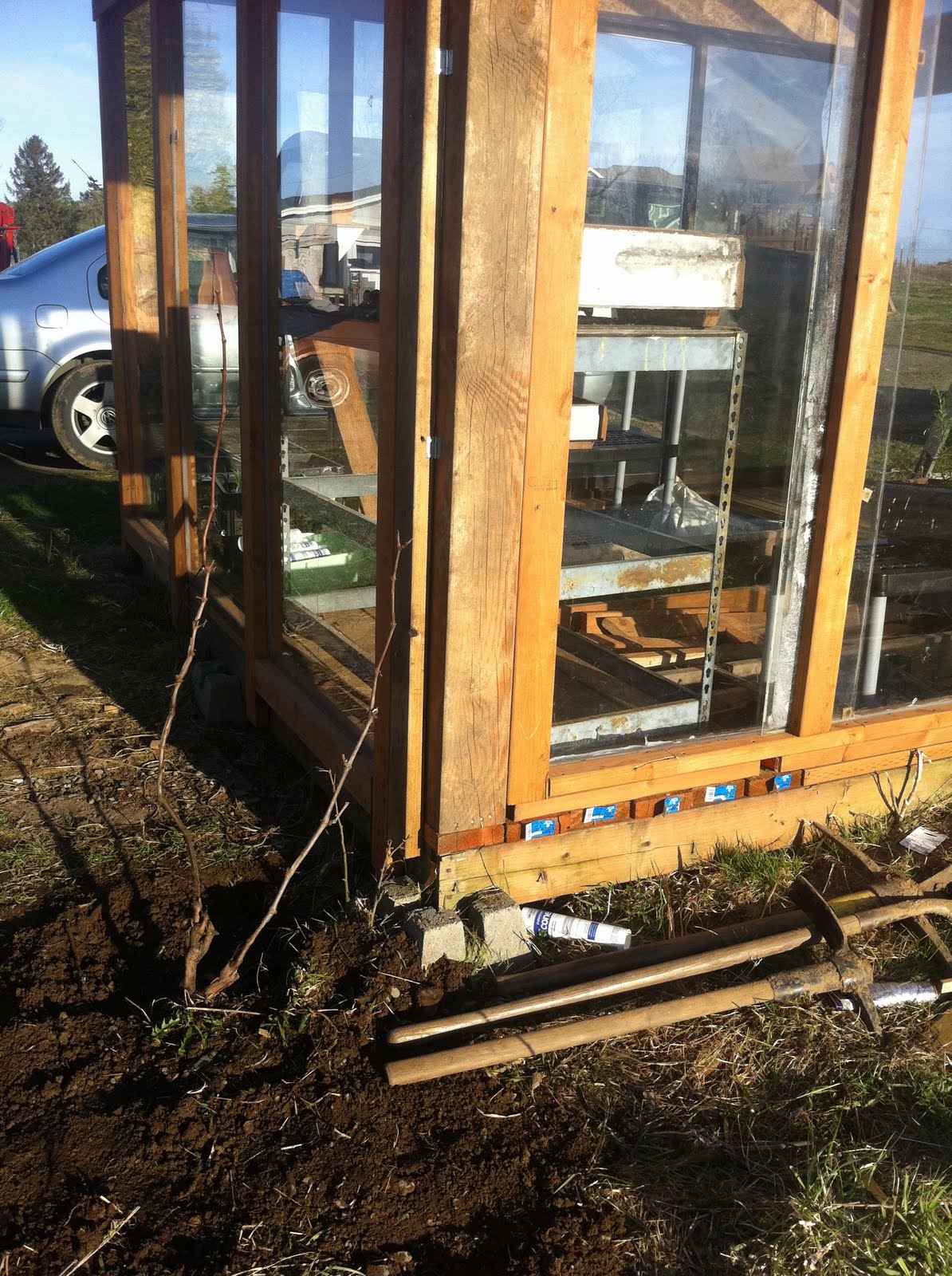
I bought a grapevine off Craigslist and planted it on the north side of the greenhouse. The sun come in from the south even in high summer, so the vine won't block much light, but it will eventually provide an area of filtered sun inside the greenhouse, which some plants will enjoy. Also the grape will benefit from the warmed air inside the greenhouse. Plenty of folks do grow grapes up here - just down the road, in fact, there is a small commercial grape nursery that develops and tests different varieties for this climate. But even so, I can't see my place as being particularly hospitable to grapevines. Our "microclimate" is colder and more exposed than most others around here (see last post). This particular grape is a local eating variety called "Lynden Blue." Even if I don't get many ripe grapes, I'd be happy with the leaves. I love grapeleaves and if I had better access to them I'd use them more.


I also did some turning of the ever-expanding compost pile and took four giant carts full over to one of the unused garden "beds" (really they are just frames set out on the ground). I'm going to try "mulch gardening," which means I lay a thick covering of half-composted hay and poop from the barn on the area, which will prevent weeds from growing. Leave it for another month or so until I have starts ready to set out. Then I just rake back a clear spot and dig a hole for the plant. I got this idea out of a book (vegetable gardening 101, I think) and like most ideas that I get out of books, I assume it won't work in practice as well as it does on the page. I'm willing to try it, though, because it uses a lot less muscle power to prepare beds and theoretically less time weeding, which is a job I hate more than I hate cleaning the bathroom. Well, as much as.

I also planted some cucumber and canteloupe seeds in the greenhouse, and have moved my pepper starts out there from the house, though I still bring them in at night. All in all, spring is proceeding apace.

Monday, March 21, 2011

Bad Bee News; Baby Broilers


About a month ago, we had a windstorm. That's not news; we have windstorms every couple of weeks from October on every winter. We live on a high, exposed ridge and seventy mile an hour winds are nothing exceptional in the fall, winter and early spring - usually accompanied by stinging rain or hail. Sometimes I wish I had paid more attention to the man who inspected our house before purchase. He grew up just down the road and told us "you get a lot of weather up on this ridge." I guess he thought he was warning us, but the man had a gift for understatement.

Apparently it's the kind of thing you just can't understand without experiencing it. I remember thinking "Sure, sure, a lot of weather. Whatever THAT means." I didn't really try to puzzle it out. After all, I grew up around here myself, and I'm no stranger to rain. Turns out, I was blissfully ignorant of what a local boy means by "a lot of weather." It means having to literally propel yourself against the wind by main force, unable to hear a thing except for the shrieking and howling of the moving air. It means cold rain driving itself into your actual eardrums at fifty miles an hour, giving you earaches. It means that you can't carry a bucket of water ten feet without getting soaked. By the time you reach your destination, the wind will have removed the top half of the water from the bucket, and it will have landed on you, anywhere from the chest down. If this happens in the dead of winter, your pants will be frozen solid against your legs by the time you reach the house. It means laying awake at night listening to the banshee wail of the wind around the corners of the house and wondering when the power will go out; or if you are losing roof shingles; or how the animals are coping.

This year, it meant losing a baby goat to hypothermia. Not this year but two years ago, we had such a prolonged stretch of extreme weather that I had to sit the children down and talk to them about what to do if they had to come outside and find us while we were attending to the animals. Do NOT leave the house, I said, without putting on your coat, your boots, your hat, and your mittens. Come STRAIGHT out to the barn and go inside right away. If you ever get stuck outside and you can't get in the house, go STRAIGHT to the barn and close the door. Once, coming back from chores, I found Paloma, then three years old, stumbling around outside in the driving snow trying to come find me. She was crying and very cold. That episode terrified me. I realized that you don't need to live above the arctic circle for your children to die of exposure. Really, any old freezing weather will do, especially when combined with precipitation. A three year old might suffer severe hypothermia in as little as half an hour.

All of this is by way of preamble: our bees dies over the winter. Both hives. In the windstorm that I mentioned, one of the many, the tops blew off of both hives. In spite of the "bee glue" - propolis - that the bees use to seal the hive. In spite of the cement blocks that we placed on top of the hive lids. The storm blew the lids off, and I went out to find that the interior of the hive was exposed to the cold rain. At the time, I knew the bees were still alive because I could hear them humming, trying desperately to dry out the interior of their home by fanning their wings. I replaced the lids, not knowing what else to do. The bees died. I didn't know for sure they were dead until this past week, when I cooked up a strong sugar syrup for the feeders. After three days, the syrup was untouched. There is only one explanation for that, and it's a hive full of dead bees.

Of course I haven't opened the hives; I won't do that until we get a really warm day. That looks like it might be mid-June, at this rate. But I fully expect, when I do open them, to find a lot of dead, decomposed, wet bee-bodies. I am not going to try again with bees. My husband and my teenage daughter both expressed enthusiasm for beekeeping, and then they both did exactly nothing to help. Personally, I am not excited by beekeeping and never was - I like honey, but I'm scared of bees. I got the equipment because I felt like bees are part of a self-sufficient homestead and I thought I had family members willing to take on the duties. Oh well. Maybe we can salvage some honey and then sell the equipment.

Meanwhile, we have decided to try meat chickens. Homero has always felt that chickens are meant to be eaten, and we have been sadly disappointed by our attempts to turn our birds into something worth eating. Look at the sidebar for links to chickens, meat eating for a log of our past attempts. I told him, finally, that we just didn't have the right kind of birds - our skinny little chickens were great at pumping out eggs but really not worth the twenty minutes it takes to dress them out when it comes to meat. So, this year, we decided to give meat birds a try.

IN GENERAL, I am philosophically opposed to the whole idea of breeding an animal that can't even live to maturity because it gets so heavy that it's legs will break trying to hold it up. However, I have to face the fact that if I am to eat chicken at all, I will either have to eat our skinny, hard-as-nails birds (something we have already decided is damn-near impossible); eat supermarket chickens, which are the same meat birds raised in factory-farm conditions, or eat meat birds that we raise ourselves in humane conditions. From a purely philosophical point of view, raising our own meat birds looks like the lesser evil. It may or may not turn pout to be practical - we'll see.

Wednesday, March 16, 2011

Greenhouse Update (High Hopes)


Greenhouse from the Outside


Greenhouse from the Inside


The Seed Drawer


Today was the first day I have seen the sun in more than a fortnight. We here in the extreme Pacific Northwest have been suffering through a long, chilly, windy, stormy, wet spring. The weather has not changed appreciably since mid-February. I read in yesterday's paper that we have already received more than the average precipitation for all of March. This news did not surprise me: I have been wading through the freezing mud for weeks now. I know how deep it is.

Today, however, the sun actually came out. And it is still out, at five in the evening. Thank you, daylight savings time! I don't care if you cause incrementally more heart attacks, I am all for you! Rock on, light after four P.M.! Inside the greenhouse, the temperature rose to somewhere around seventy degrees. I decided to plant some more seeds.

Weeks ago, I planted pepper seeds inside the house. I thought they were never going to sprout - we keep the thermostat at 63, and they need a soil temperature of 75, according to the package. But finally, most of them did sprout, and now I have a lovely little bed of seedlings all straining towards the sun on the kitchen table. About half the plants are jalapenos, and the other half are thai peppers. If even half the plants bear fruit, we will; have enough peppers to use fresh and dry for the winter.

In the greenhouse so far, I have planted radishes, spinach, snow peas, and swiss chard. All of the above are up, though I don't see any serious happy growth. All the plants are about where I would expect them to be if I had sown them outside in a regular year. It hasn't been warm enough to plant the warm-weather crops I have wanted to try - until today. It probably still isn't warm enough, actually, but I had to try. I cut an egg carton in half and planted cantaloupe in one half and tomatillo in the other. Then I decided it really wouldn't be warm enough in the greenhouse overnight and brought them all into the house.

My greenhouse, handsome though it is, and happy with it as I am, isn't really very effective. It isn't well sealed. I didn't know how much that mattered, until I was at a community pea-patch last week, on a raw thirty-six degree day, and stepped into a well-sealed greenhouse. It was lovely, balmy, delicious. A thermometer was hanging from the ceiling and it said 76 degrees. My drafty greenhouse keeps things about four degrees warmer than the ambient temperature. I spent some three hours last week squeezing silicone gel into the cracks, making a bloody balls-up of the job, using fourteen times as much silicon as should be needed, and gluing my hair to my pant legs. Even after all that, I hadn't managed to make a dent in the draft, so I said the Hell with it and decided it would be easier to nag my husband intro submission.

He's actually rather busy with things like making money, so I don't know how long it might be until I have a real greenhouse. In the meantime, the four degrees difference will be enough to give me about two weeks head start on cold weather crops, and eventually will allow me to grow things I wouldn't be able to otherwise; like peppers and cantaloupes.

Frankly, I don't know why I bother. I am SUCH a black thumb. I know that defeat and despair awaits me in the prettiest part of the year, but I persist anyway. Why? Because it is there?